
By: Marsan Melanie, Safadi
Gabrielle, Tilley Margarett, Schmidt
           Katielynn and
   According to behaviorism, knowing is giving the correct response when exposed
    to a particular stimulus. The behaviorist is not concerned with how or why
    knowledge is obtained, but rather if the correct response is given. Yu Ching
    Chen’s web site on behaviorism states that, “Learning is defined as nothing
    more than the acquisition of new behavior”.


    In terms of the concept of learning
   -the process tends to be passive with regard to the behaviorist theory.
   -The learner uses low level processing skills to understand material and
    the material is often isolated from real-world contexts or situations
   -Little responsibility is placed on the learner concerning his/her own
    education.
Typical classroom instruction consistent
-the behaviorist theory includes; classroom management, rote memorization, and drill and practice.


Example 1
      is using a token system to reinforce positive academic performance and student behavior. A classroom
      application of using drill and practice includes computer software, such as Math Blaster’s. These types
      of software provide positive and negative reinforcements for answering math problems correctly or
      incorrectly.


Example 2
      highlighting the behaviorist theory is rote memorization. Rote memorization may include memorizing
      addition or multiplication facts or memorizing state capitals.


Approach
      understanding basic skills and core subject knowledge. The approach of using
      positive and negative reinforcements to elicit desired behaviors of students is also
      useful in establishing and maintaining classroom management.
Albert Bandura suggested that environment causes behavior but behavior
   causes environment as well. This was called reciprocal determinism.

He saw personality as an interaction among 3 thing:
The environment
Behavior
Person’s psychological processes.

Bandura’s modeling steps
   Attention
   Retention- remember what you paid attention to
   Reproduction- reproduce the translated images and descriptions
   into actual behavior
   Motivation-
   Self- regulation- controlling our own behavior. Links to self-
   observation, judgement, and self-response.
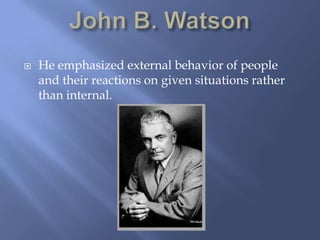
   He emphasized external behavior of people
    and their reactions on given situations rather
    than internal.
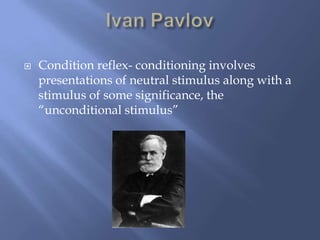
   Condition reflex- conditioning involves
    presentations of neutral stimulus along with a
    stimulus of some significance, the
    “unconditional stimulus”
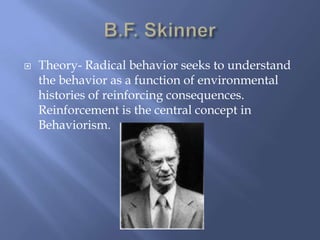
   Theory- Radical behavior seeks to understand
    the behavior as a function of environmental
    histories of reinforcing consequences.
    Reinforcement is the central concept in
    Behaviorism.
   Behaviorist approach is based on these
    assumptions:
    -Psychology should be seen as a science
    -Behaviorist’s primary concern is observable
    behavior therefore research and experiments
    can take place.
    -All behavior is the result of a stimulus-
    response.
    -All behavior is learned from the environment.
Behaviorism is a theory based upon the idea that
  all behaviors are acquired through
  conditioning.
  2 types of conditioning:

Classical conditioning

Operant conditioning
Classical conditioning- a naturally occurring stimulus is
   paired with a response. Next, a neutral stimulus is
   paired with the naturally occurring stimulus. In the
   end, the neutral stimulus comes to evoke the response
   without the naturally occurring stimulus. The results
   are then the conditioned stimulus and the conditioned
   results.
Operant conditioning- is a method that occurs
  through rewards and punishments for
  behavior. Through this conditioning, an
  association is made between a behavior and a
  consequence.
  Through operant conditioning Skinner found
  that positive reinforcement strengthens a
  behavior and punishment weakens the
  likelihood of a behavior occurring again.
https://www.msu.edu/~purcelll/behaviorism%
   20theory.htm?pagewanted=all

http://webspace.ship.edu/cgboer/bandura.html

Behaviorismgroup

  • 1.
    By: Marsan Melanie,Safadi Gabrielle, Tilley Margarett, Schmidt Katielynn and
  • 2.
    According to behaviorism, knowing is giving the correct response when exposed to a particular stimulus. The behaviorist is not concerned with how or why knowledge is obtained, but rather if the correct response is given. Yu Ching Chen’s web site on behaviorism states that, “Learning is defined as nothing more than the acquisition of new behavior”. In terms of the concept of learning  -the process tends to be passive with regard to the behaviorist theory.  -The learner uses low level processing skills to understand material and the material is often isolated from real-world contexts or situations  -Little responsibility is placed on the learner concerning his/her own education.
  • 3.
    Typical classroom instructionconsistent -the behaviorist theory includes; classroom management, rote memorization, and drill and practice. Example 1 is using a token system to reinforce positive academic performance and student behavior. A classroom application of using drill and practice includes computer software, such as Math Blaster’s. These types of software provide positive and negative reinforcements for answering math problems correctly or incorrectly. Example 2 highlighting the behaviorist theory is rote memorization. Rote memorization may include memorizing addition or multiplication facts or memorizing state capitals. Approach understanding basic skills and core subject knowledge. The approach of using positive and negative reinforcements to elicit desired behaviors of students is also useful in establishing and maintaining classroom management.
  • 4.
    Albert Bandura suggestedthat environment causes behavior but behavior causes environment as well. This was called reciprocal determinism. He saw personality as an interaction among 3 thing: The environment Behavior Person’s psychological processes. Bandura’s modeling steps Attention Retention- remember what you paid attention to Reproduction- reproduce the translated images and descriptions into actual behavior Motivation- Self- regulation- controlling our own behavior. Links to self- observation, judgement, and self-response.
  • 5.
    He emphasized external behavior of people and their reactions on given situations rather than internal.
  • 6.
    Condition reflex- conditioning involves presentations of neutral stimulus along with a stimulus of some significance, the “unconditional stimulus”
  • 7.
    Theory- Radical behavior seeks to understand the behavior as a function of environmental histories of reinforcing consequences. Reinforcement is the central concept in Behaviorism.
  • 8.
    Behaviorist approach is based on these assumptions: -Psychology should be seen as a science -Behaviorist’s primary concern is observable behavior therefore research and experiments can take place. -All behavior is the result of a stimulus- response. -All behavior is learned from the environment.
  • 9.
    Behaviorism is atheory based upon the idea that all behaviors are acquired through conditioning. 2 types of conditioning: Classical conditioning Operant conditioning
  • 10.
    Classical conditioning- anaturally occurring stimulus is paired with a response. Next, a neutral stimulus is paired with the naturally occurring stimulus. In the end, the neutral stimulus comes to evoke the response without the naturally occurring stimulus. The results are then the conditioned stimulus and the conditioned results.
  • 11.
    Operant conditioning- isa method that occurs through rewards and punishments for behavior. Through this conditioning, an association is made between a behavior and a consequence. Through operant conditioning Skinner found that positive reinforcement strengthens a behavior and punishment weakens the likelihood of a behavior occurring again.
  • 12.
    https://www.msu.edu/~purcelll/behaviorism% 20theory.htm?pagewanted=all http://webspace.ship.edu/cgboer/bandura.html