+

Behaviorism:
a learning theory


                    By:   Aubrey
                          Radford
+
    Behaviorism
    What?

    Who?

    How?

    In   my classroom?
    Credits
+
    What is Behaviorism?

     A theory
             of learning that measures
     observable behaviors produced by a learners
     response to stimuli.
     Based upon the idea that all behaviors are
     acquired through conditioning.
+
    More on Behaviorism

    Response    to stimuli can be reinforced
     with positive or negative feedback to
     condition desired behaviors.
    Punishment   is sometimes used to
     eliminate or reduce incorrect actions.
+
    Key theorists

    B.   F. Skinner
    Ivan   Pavlov
+
    B. F. Skinner
       An American behaviorist and social philosopher, among other
        things

       Operant conditioning
           An individual modifies the occurrence and form of its own behavior
            due to the consequences of the behavior.

       Invented operant conditioning chamber (Skinner box)
           Laboratory apparatus used to study animal behavior, classical
            conditioning, and operant conditioning
           Animal pushes lever or button and receives reward

       Innovated his own philosophy of science called radical
        behaviorism
+
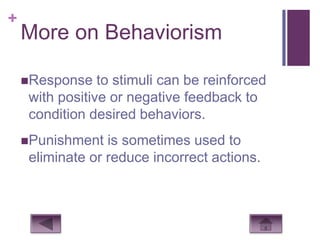
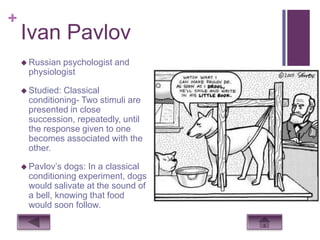
    Ivan Pavlov
     Russianpsychologist and
     physiologist

     Studied:Classical
     conditioning- Two stimuli are
     presented in close
     succession, repeatedly, until
     the response given to one
     becomes associated with the
     other.

     Pavlov’s dogs: In a classical
     conditioning experiment, dogs
     would salivate at the sound of
     a bell, knowing that food
     would soon follow.
+
    Behaviorism in the classroom:
    How Teachers Use It
       Teachers would use
           Classrooms management
           Drill
           Practice
           Rote memorization
           Reinforcement of positive behavior
           Punishment of negative behavior
           Examples: giving out prizes for good work and good behavior.
            Taking privileges away from students who behave badly. Eventually
            students will learn what is right and wrong. When projector turns
            on, students know to quiet down or will be punished (use of
            technology).
+
    Behaviorism in the classroom:
    How Students Respond
       In order to receive reward, students will behave the way the
        teacher deems appropriate.

       Drill and practice could include students using computer
        programs (use of technology) that provide positive and
        negative reinforcement.

       Rote memorization includes students memorizing things such
        as state capitals or multiplication tables.
+
    My Classroom
       My classroom will be managed
        in a way that students know
        right and wrong very quickly
        after entering my class.

       A reward system will be in
        place for when students act
        responsibly and
        respectfully, and when they are
        correct when answering a
        question in class.

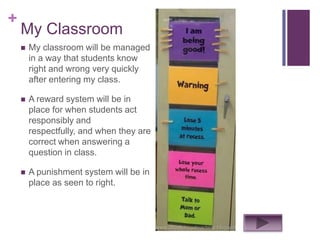
       A punishment system will be in
        place as seen to right.
+
    My Classroom

       This learning theory impacts my teaching style in a positive way
        and is consistent with my philosophy of education.
           Teaching style: Being either a formal authority or demonstrator
            requires the attention of the students and their understanding. By
            rewarding their good behavior (paying attention and not disrupting
            class), they will be more adept to paying attention to me because
            they will get more than knowledge out of it.
           Philosophy of Education: I feel my values are most consistent with
            Essentialism, which is an instructor based setting. As I stated
            above, students will learn what they need to learn by paying
            attention and being rewarded for it.
+
    Credits for Pictures

       http://pinterest.com/pin/52917364341316135/

       http://0.tqn.com/d/psychology/1/G/y/3/Ivan-Pavlov.gif

       http://3.bp.blogspot.com/-k_s5WKD-
        6XY/ToGfA0NGyNI/AAAAAAAAAj8/ngM5XAC6cpQ/s400/pavlo
        vs_dog.jpg

       http://blog.wsd.net/jreeve/files/2010/06/behaviorism1.jpg

Behaviorism

  • 1.
  • 2.
    + Behaviorism What? Who? How? In my classroom? Credits
  • 3.
    + What is Behaviorism?  A theory of learning that measures observable behaviors produced by a learners response to stimuli.  Based upon the idea that all behaviors are acquired through conditioning.
  • 4.
    + More on Behaviorism Response to stimuli can be reinforced with positive or negative feedback to condition desired behaviors. Punishment is sometimes used to eliminate or reduce incorrect actions.
  • 5.
    + Key theorists B. F. Skinner Ivan Pavlov
  • 6.
    + B. F. Skinner  An American behaviorist and social philosopher, among other things  Operant conditioning  An individual modifies the occurrence and form of its own behavior due to the consequences of the behavior.  Invented operant conditioning chamber (Skinner box)  Laboratory apparatus used to study animal behavior, classical conditioning, and operant conditioning  Animal pushes lever or button and receives reward  Innovated his own philosophy of science called radical behaviorism
  • 7.
    + Ivan Pavlov  Russianpsychologist and physiologist  Studied:Classical conditioning- Two stimuli are presented in close succession, repeatedly, until the response given to one becomes associated with the other.  Pavlov’s dogs: In a classical conditioning experiment, dogs would salivate at the sound of a bell, knowing that food would soon follow.
  • 8.
    + Behaviorism in the classroom: How Teachers Use It  Teachers would use  Classrooms management  Drill  Practice  Rote memorization  Reinforcement of positive behavior  Punishment of negative behavior  Examples: giving out prizes for good work and good behavior. Taking privileges away from students who behave badly. Eventually students will learn what is right and wrong. When projector turns on, students know to quiet down or will be punished (use of technology).
  • 9.
    + Behaviorism in the classroom: How Students Respond  In order to receive reward, students will behave the way the teacher deems appropriate.  Drill and practice could include students using computer programs (use of technology) that provide positive and negative reinforcement.  Rote memorization includes students memorizing things such as state capitals or multiplication tables.
  • 10.
    + My Classroom  My classroom will be managed in a way that students know right and wrong very quickly after entering my class.  A reward system will be in place for when students act responsibly and respectfully, and when they are correct when answering a question in class.  A punishment system will be in place as seen to right.
  • 11.
    + My Classroom  This learning theory impacts my teaching style in a positive way and is consistent with my philosophy of education.  Teaching style: Being either a formal authority or demonstrator requires the attention of the students and their understanding. By rewarding their good behavior (paying attention and not disrupting class), they will be more adept to paying attention to me because they will get more than knowledge out of it.  Philosophy of Education: I feel my values are most consistent with Essentialism, which is an instructor based setting. As I stated above, students will learn what they need to learn by paying attention and being rewarded for it.
  • 12.
    + Credits for Pictures  http://pinterest.com/pin/52917364341316135/  http://0.tqn.com/d/psychology/1/G/y/3/Ivan-Pavlov.gif  http://3.bp.blogspot.com/-k_s5WKD- 6XY/ToGfA0NGyNI/AAAAAAAAAj8/ngM5XAC6cpQ/s400/pavlo vs_dog.jpg  http://blog.wsd.net/jreeve/files/2010/06/behaviorism1.jpg