Behavior-Based SafetyBehavior-Based Safety
Behavior-Based Safety is aBehavior-Based Safety is a
process that helps employeesprocess that helps employees
identify and choose a safeidentify and choose a safe
behavior over an unsafe one.behavior over an unsafe one.
Basic BehaviorBasic Behavior
PrinciplesPrinciples
Safety in the workplace is aSafety in the workplace is a
combination of threecombination of three
measurable components: themeasurable components: the
person, their environment, andperson, their environment, and
their behavior.their behavior.
Only when these three elementsOnly when these three elements
are combined can workplaceare combined can workplace
accidents be eliminated.accidents be eliminated.
Basic BehaviorBasic Behavior
PrinciplesPrinciples
The person component consist ofThe person component consist of
the employees:the employees:
• Physical capabilitiesPhysical capabilities
• Experience, andExperience, and
• TrainingTraining
Basic BehaviorBasic Behavior
PrinciplesPrinciples
The work environment represents:The work environment represents:
• Engineering Controls,Engineering Controls,
• Equipment,Equipment,
• Job task, andJob task, and
• The work cultureThe work culture
Basic BehaviorBasic Behavior
PrinciplesPrinciples
• The final, most often overlookedThe final, most often overlooked
component iscomponent is behaviorbehavior—what—what
the person does on the job.the person does on the job.
The Behavior-BasedThe Behavior-Based
Safety ProcessSafety Process
Behavior-based safety is based on fourBehavior-based safety is based on four
key components:key components:
• A behavioral observation andA behavioral observation and
feedback process;feedback process;
• A formal review of observation data;A formal review of observation data;
• Improvement goals, andImprovement goals, and
• Reinforcement for improvement andReinforcement for improvement and
goal attainment.goal attainment.
Behavioral ObservationBehavioral Observation
and Feedbackand Feedback
This is one of the most importantThis is one of the most important
components of the process. Observationscomponents of the process. Observations
provide direct, measurable information onprovide direct, measurable information on
employees’ safe work practices.employees’ safe work practices.
• Employees are observed performing theirEmployees are observed performing their
routine task. The observer documents bothroutine task. The observer documents both
safe and unsafe behaviors.safe and unsafe behaviors.
• The employee is then provided positiveThe employee is then provided positive
feedback on the safe behaviors and non-feedback on the safe behaviors and non-
threatening feedback on the unsafethreatening feedback on the unsafe
behaviors. They are also provided withbehaviors. They are also provided with
suggestions on correcting the unsafesuggestions on correcting the unsafe
behaviors.behaviors.
Formal Review ofFormal Review of
Observation DataObservation Data
The data is then analyzed to determineThe data is then analyzed to determine
the employee’s (or department’s)the employee’s (or department’s)
improvement in safe behaviors. Itimprovement in safe behaviors. It
can be looked at as an overallcan be looked at as an overall
percentage.percentage.
Example: If there were 20 items on theExample: If there were 20 items on the
checklist and the worker performedchecklist and the worker performed
17 of them safely, then he would get17 of them safely, then he would get
a score of 85% safe.a score of 85% safe.
Formal Review ofFormal Review of
Observation DataObservation Data
The improvement betweenThe improvement between
observations could be graphedobservations could be graphed
and displayed for employees toand displayed for employees to
view. When the graphs showsview. When the graphs shows
improvement, it providesimprovement, it provides
positive reinforcing feedback topositive reinforcing feedback to
employees.employees.
Improvement GoalsImprovement Goals
Setting improvement goalsSetting improvement goals
increases the effectiveness ofincreases the effectiveness of
feedback and the success offeedback and the success of
the behavior-based safetythe behavior-based safety
process.process.
Improvement GoalsImprovement Goals
These goals can take differentThese goals can take different
forms, such as:forms, such as:
1.1. Percent safe goalsPercent safe goals
2.2. Process goalsProcess goals
3.3. Implementation goalsImplementation goals
Reinforcement for ImprovementReinforcement for Improvement
and Goal Attainmentand Goal Attainment
Management must provideManagement must provide
immediate, positive feedback toimmediate, positive feedback to
reinforce safe behavior.reinforce safe behavior.
Rewards can be an effectiveRewards can be an effective
means of reinforcing goalmeans of reinforcing goal
attainment.attainment.
ResultsResults
• Increased efficiencyIncreased efficiency
• Increased productivityIncreased productivity
• Increased moraleIncreased morale
• Increase profitabilityIncrease profitability
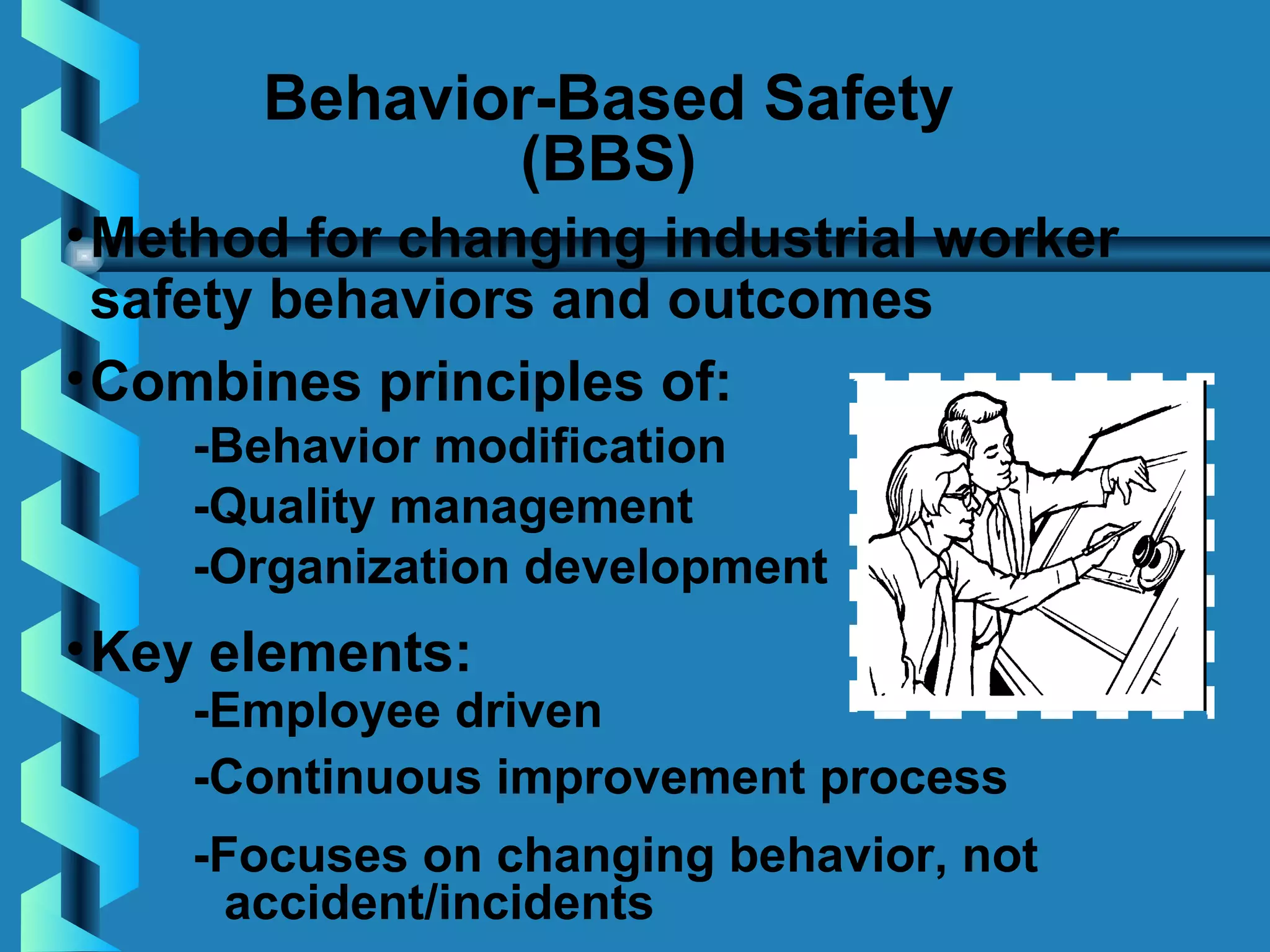
Behavior-Based Safety
(BBS)
•Method for changing industrial worker
safety behaviors and outcomes
•Combines principles of:
-Behavior modification
-Quality management
-Organization development
•Key elements:
-Employee driven
-Continuous improvement process
-Focuses on changing behavior, not
accident/incidents
BBS Track Record:
•Implemented at more than 1,000
sites worldwide
•90% of companies adopting
BBS continue
•Average 5-year
incident/accident reduction:
62%
Total SafetyTotal Safety
CultureCulture
ENVIRONMENTENVIRONMENT
Equipment, Tools, Machines,
Housekeeping, Climate,
Management Systems
BEHAVIOR
Putting on PPE, Lifting properly, Following procedures,
Locking out power, Cleaning up spills,
Sweeping floors, Coaching peers
PERSONPERSON
Knowledge, Skills, Abilities,
Intelligence, Motives,
Attitude, Personality SAFETYSAFETY
CULTURECULTURE
Focusing onFocusing on
Behaviors CanBehaviors Can
Reduce InjuriesReduce Injuries
At-Risk Behavior
Near Miss
Minor Injury
Serious Injury
Fatality
The ABC ModelThe ABC Model
Explains Why We DoExplains Why We Do
What We DoWhat We Do
Activators
Consequences
BBehaviorehavior
Direct
Motivate
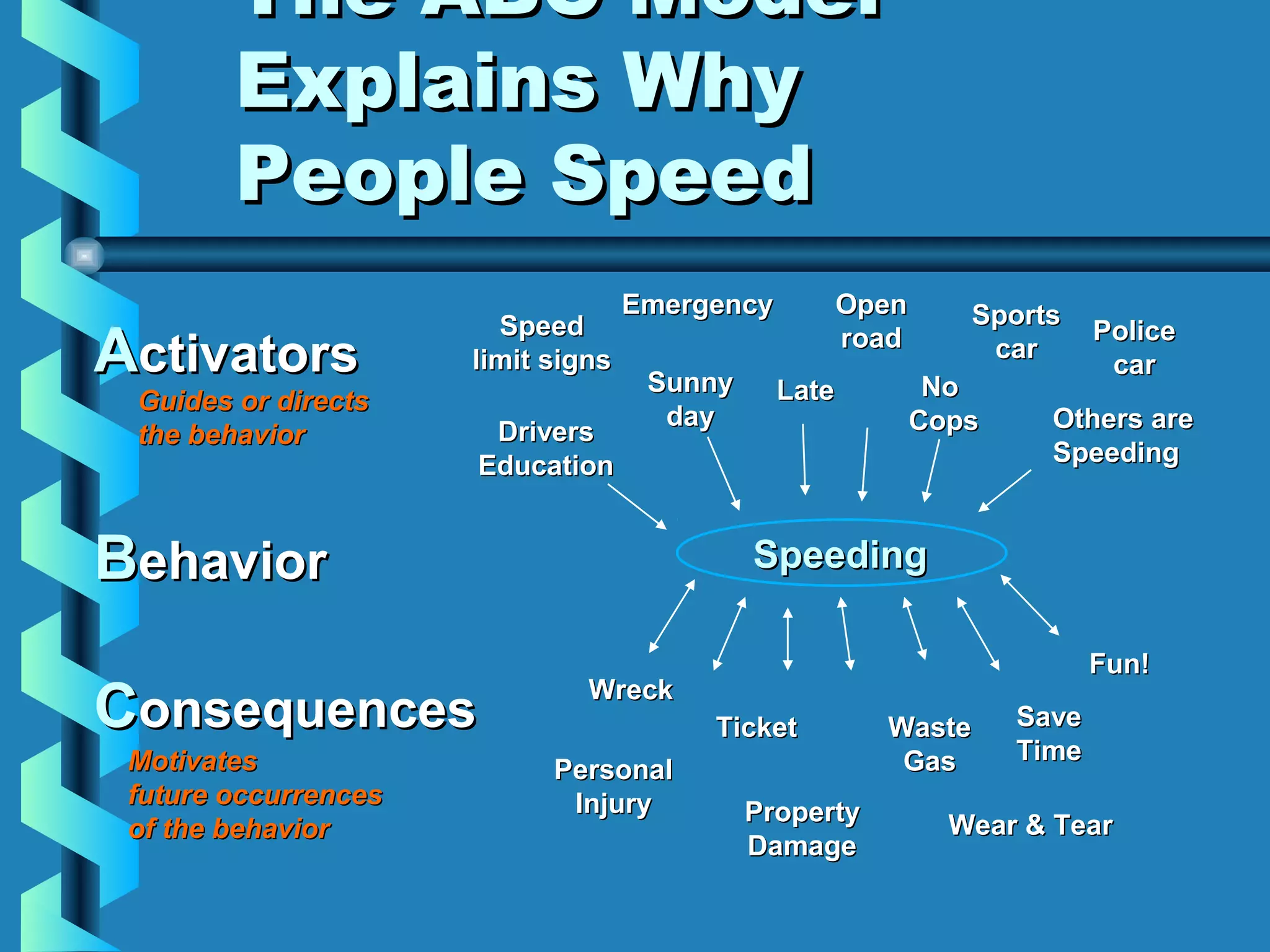
The ABC ModelThe ABC Model
Explains WhyExplains Why
People SpeedPeople Speed
SpeedingSpeedingBBehaviorehavior
AActivatorsctivators
Guides or directsGuides or directs
the behaviorthe behavior
CConsequencesonsequences
MotivatesMotivates
future occurrencesfuture occurrences
of the behaviorof the behavior
LateLate
OpenOpen
roadroad
SportsSports
carcar
SunnySunny
dayday
EmergencyEmergency
NoNo
CopsCops Others areOthers are
SpeedingSpeeding
PolicePolice
carcar
DriversDrivers
EducationEducation
SpeedSpeed
limit signslimit signs
Wear & TearWear & Tear
WreckWreck
TicketTicket
PersonalPersonal
InjuryInjury
WasteWaste
GasGas
SaveSave
TimeTime
Fun!Fun!
PropertyProperty
DamageDamage
Direction Alone MayDirection Alone May
Not be Sufficient ToNot be Sufficient To
Maintain BehaviorMaintain Behavior
Some Consequences AreSome Consequences Are
More Powerful Than OthersMore Powerful Than Others
TheThe MOSTMOST effectiveeffective
consequences are:consequences are:
• CertainCertain
There’s a high probability you’ll receiveThere’s a high probability you’ll receive
the consequencethe consequence
• SoonSoon
The consequence occurs immediatelyThe consequence occurs immediately
after your behaviorafter your behavior
• SignificantSignificant
Some ConsequencesSome Consequences
WeighWeigh More Than OthersMore Than Others
Risky Behavior: You're late and you speed 20 MPH over limit
Consequences: Save Time vs. Ticket
Save Time
Ticket
Uncertain
Soon
Significant
Soon
Certain
Significant
Identifying ProblemsIdentifying Problems
and Potential Solutionsand Potential Solutions
ABC Analysis helps us understandABC Analysis helps us understand
activators and consequences, andactivators and consequences, and
how they influence safety behavior.how they influence safety behavior.

Behavior basedsafety

  • 1.
    Behavior-Based SafetyBehavior-Based Safety Behavior-BasedSafety is aBehavior-Based Safety is a process that helps employeesprocess that helps employees identify and choose a safeidentify and choose a safe behavior over an unsafe one.behavior over an unsafe one.
  • 2.
    Basic BehaviorBasic Behavior PrinciplesPrinciples Safetyin the workplace is aSafety in the workplace is a combination of threecombination of three measurable components: themeasurable components: the person, their environment, andperson, their environment, and their behavior.their behavior. Only when these three elementsOnly when these three elements are combined can workplaceare combined can workplace accidents be eliminated.accidents be eliminated.
  • 3.
    Basic BehaviorBasic Behavior PrinciplesPrinciples Theperson component consist ofThe person component consist of the employees:the employees: • Physical capabilitiesPhysical capabilities • Experience, andExperience, and • TrainingTraining
  • 4.
    Basic BehaviorBasic Behavior PrinciplesPrinciples Thework environment represents:The work environment represents: • Engineering Controls,Engineering Controls, • Equipment,Equipment, • Job task, andJob task, and • The work cultureThe work culture
  • 5.
    Basic BehaviorBasic Behavior PrinciplesPrinciples •The final, most often overlookedThe final, most often overlooked component iscomponent is behaviorbehavior—what—what the person does on the job.the person does on the job.
  • 6.
    The Behavior-BasedThe Behavior-Based SafetyProcessSafety Process Behavior-based safety is based on fourBehavior-based safety is based on four key components:key components: • A behavioral observation andA behavioral observation and feedback process;feedback process; • A formal review of observation data;A formal review of observation data; • Improvement goals, andImprovement goals, and • Reinforcement for improvement andReinforcement for improvement and goal attainment.goal attainment.
  • 7.
    Behavioral ObservationBehavioral Observation andFeedbackand Feedback This is one of the most importantThis is one of the most important components of the process. Observationscomponents of the process. Observations provide direct, measurable information onprovide direct, measurable information on employees’ safe work practices.employees’ safe work practices. • Employees are observed performing theirEmployees are observed performing their routine task. The observer documents bothroutine task. The observer documents both safe and unsafe behaviors.safe and unsafe behaviors. • The employee is then provided positiveThe employee is then provided positive feedback on the safe behaviors and non-feedback on the safe behaviors and non- threatening feedback on the unsafethreatening feedback on the unsafe behaviors. They are also provided withbehaviors. They are also provided with suggestions on correcting the unsafesuggestions on correcting the unsafe behaviors.behaviors.
  • 8.
    Formal Review ofFormalReview of Observation DataObservation Data The data is then analyzed to determineThe data is then analyzed to determine the employee’s (or department’s)the employee’s (or department’s) improvement in safe behaviors. Itimprovement in safe behaviors. It can be looked at as an overallcan be looked at as an overall percentage.percentage. Example: If there were 20 items on theExample: If there were 20 items on the checklist and the worker performedchecklist and the worker performed 17 of them safely, then he would get17 of them safely, then he would get a score of 85% safe.a score of 85% safe.
  • 9.
    Formal Review ofFormalReview of Observation DataObservation Data The improvement betweenThe improvement between observations could be graphedobservations could be graphed and displayed for employees toand displayed for employees to view. When the graphs showsview. When the graphs shows improvement, it providesimprovement, it provides positive reinforcing feedback topositive reinforcing feedback to employees.employees.
  • 10.
    Improvement GoalsImprovement Goals Settingimprovement goalsSetting improvement goals increases the effectiveness ofincreases the effectiveness of feedback and the success offeedback and the success of the behavior-based safetythe behavior-based safety process.process.
  • 11.
    Improvement GoalsImprovement Goals Thesegoals can take differentThese goals can take different forms, such as:forms, such as: 1.1. Percent safe goalsPercent safe goals 2.2. Process goalsProcess goals 3.3. Implementation goalsImplementation goals
  • 12.
    Reinforcement for ImprovementReinforcementfor Improvement and Goal Attainmentand Goal Attainment Management must provideManagement must provide immediate, positive feedback toimmediate, positive feedback to reinforce safe behavior.reinforce safe behavior. Rewards can be an effectiveRewards can be an effective means of reinforcing goalmeans of reinforcing goal attainment.attainment.
  • 13.
    ResultsResults • Increased efficiencyIncreasedefficiency • Increased productivityIncreased productivity • Increased moraleIncreased morale • Increase profitabilityIncrease profitability
  • 14.
    Behavior-Based Safety (BBS) •Method forchanging industrial worker safety behaviors and outcomes •Combines principles of: -Behavior modification -Quality management -Organization development •Key elements: -Employee driven -Continuous improvement process -Focuses on changing behavior, not accident/incidents
  • 15.
    BBS Track Record: •Implementedat more than 1,000 sites worldwide •90% of companies adopting BBS continue •Average 5-year incident/accident reduction: 62%
  • 16.
    Total SafetyTotal Safety CultureCulture ENVIRONMENTENVIRONMENT Equipment,Tools, Machines, Housekeeping, Climate, Management Systems BEHAVIOR Putting on PPE, Lifting properly, Following procedures, Locking out power, Cleaning up spills, Sweeping floors, Coaching peers PERSONPERSON Knowledge, Skills, Abilities, Intelligence, Motives, Attitude, Personality SAFETYSAFETY CULTURECULTURE
  • 17.
    Focusing onFocusing on BehaviorsCanBehaviors Can Reduce InjuriesReduce Injuries At-Risk Behavior Near Miss Minor Injury Serious Injury Fatality
  • 18.
    The ABC ModelTheABC Model Explains Why We DoExplains Why We Do What We DoWhat We Do Activators Consequences BBehaviorehavior Direct Motivate
  • 19.
    The ABC ModelTheABC Model Explains WhyExplains Why People SpeedPeople Speed SpeedingSpeedingBBehaviorehavior AActivatorsctivators Guides or directsGuides or directs the behaviorthe behavior CConsequencesonsequences MotivatesMotivates future occurrencesfuture occurrences of the behaviorof the behavior LateLate OpenOpen roadroad SportsSports carcar SunnySunny dayday EmergencyEmergency NoNo CopsCops Others areOthers are SpeedingSpeeding PolicePolice carcar DriversDrivers EducationEducation SpeedSpeed limit signslimit signs Wear & TearWear & Tear WreckWreck TicketTicket PersonalPersonal InjuryInjury WasteWaste GasGas SaveSave TimeTime Fun!Fun! PropertyProperty DamageDamage
  • 20.
    Direction Alone MayDirectionAlone May Not be Sufficient ToNot be Sufficient To Maintain BehaviorMaintain Behavior
  • 21.
    Some Consequences AreSomeConsequences Are More Powerful Than OthersMore Powerful Than Others TheThe MOSTMOST effectiveeffective consequences are:consequences are: • CertainCertain There’s a high probability you’ll receiveThere’s a high probability you’ll receive the consequencethe consequence • SoonSoon The consequence occurs immediatelyThe consequence occurs immediately after your behaviorafter your behavior • SignificantSignificant
  • 22.
    Some ConsequencesSome Consequences WeighWeighMore Than OthersMore Than Others Risky Behavior: You're late and you speed 20 MPH over limit Consequences: Save Time vs. Ticket Save Time Ticket Uncertain Soon Significant Soon Certain Significant
  • 23.
    Identifying ProblemsIdentifying Problems andPotential Solutionsand Potential Solutions ABC Analysis helps us understandABC Analysis helps us understand activators and consequences, andactivators and consequences, and how they influence safety behavior.how they influence safety behavior.

Editor's Notes

  • #12 Percent safe goals Based on safe work practices observed. Must be based on realistic evaluation of the area’s level of safety Should be set for a short time-period: 1 to 3 months is common. Process Goals Focus on improving a specific work practice, such as using proper lifting techniques. Implementation Goals Focus on maintaining the process, such as setting a goal for how many observations are conducted a week.
  • #23 At-risk behaviors are often more comfortable, convenient, and faster than safe behaviors At-risk behaviors are often reinforced by the work culture At-risk behaviors rarely result in negative consequences (e.g., injury,reprimand) powerful enough to discourage their performance