Leadership &
Safety Culture
UNIVERSITY WITH A PURPOSE
•Explore and share ideas about some basic concepts of
Leadership and how they can be applied in WH&S
•Begin development of your own safety leadership
improvement strategy
Objectives:
UNIVERSITY WITH A PURPOSE
Leadership – What is it?
UNIVERSITY WITH A PURPOSE
Leadership is not:
Not Power -
•Power derives from status, money, ability to harm,
access to media or control materials
•A Thug who sticks a gun in you back has “power” but
not leadership
UNIVERSITY WITH A PURPOSE
Leadership is not:
Not Status -
•Status or position may enhance the opportunity for
leadership
•Some in a high status or position haven’t got a clue
how to lead
Not Authority –
• A person may have subordinates, but not followers
•People will only follow if a person acts as a leader
UNIVERSITY WITH A PURPOSE
Leadership is not:
Not Management -
•Management is an organizational skill
•Managers preside over procesesses, functions and
program
UNIVERSITY WITH A PURPOSE
The leadership role, more than any other function,
shapes and influences the culture that produces
performance outcomes
UNIVERSITY WITH A PURPOSE
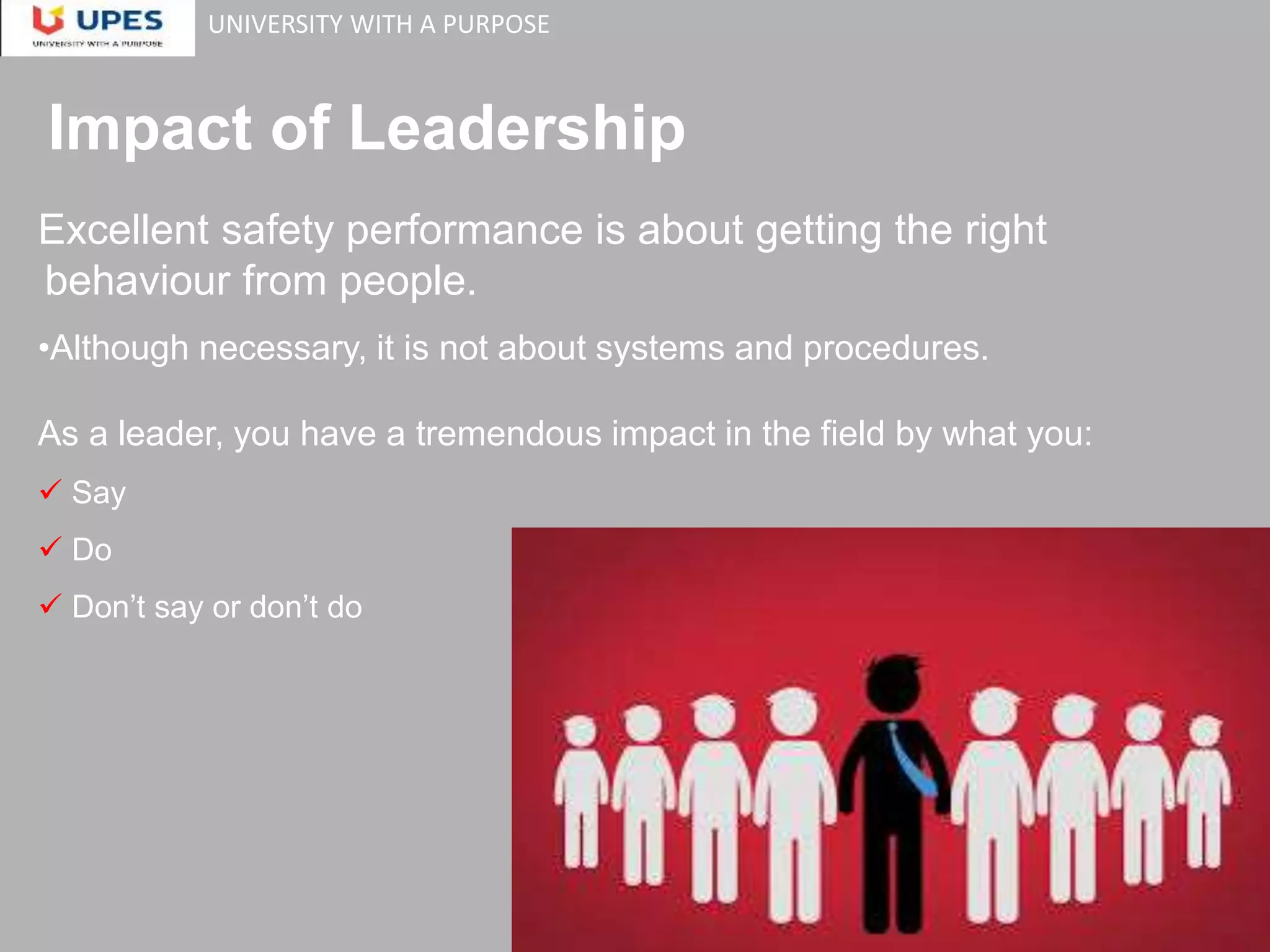
Impact of Leadership
Excellent safety performance is about getting the right
behaviour from people.
•Although necessary, it is not about systems and procedures.
As a leader, you have a tremendous impact in the field by what you:
 Say
 Do
 Don’t say or don’t do
UNIVERSITY WITH A PURPOSE
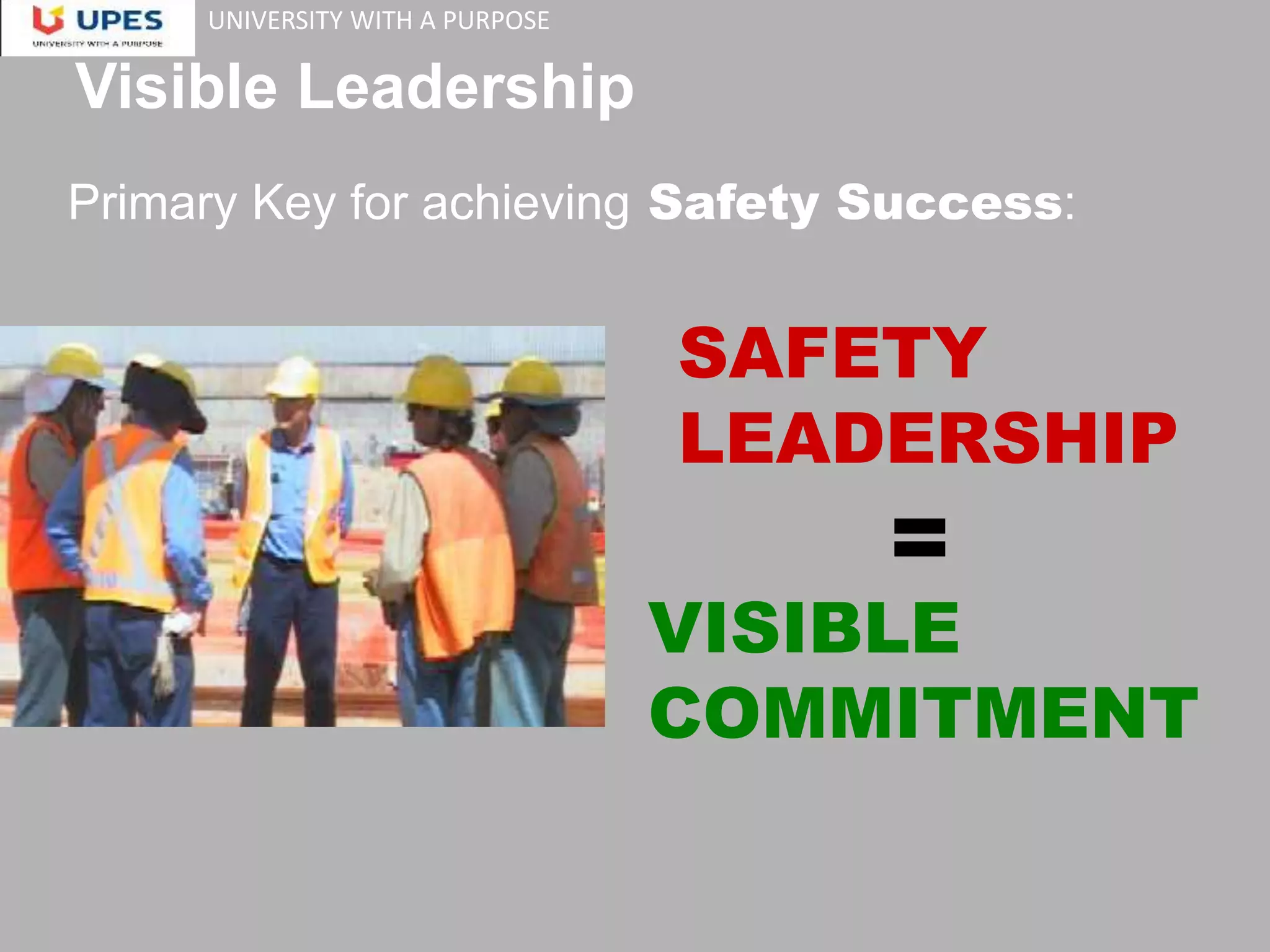
Visible Leadership
Primary Key for achieving Safety Success:
SAFETY
LEADERSHIP
=
VISIBLE
COMMITMENT
UNIVERSITY WITH A PURPOSE
Your Role as a Leader
• Excellent performance requires your leadership
• As a leader you should know:
 how our safety programs work and your role in them
 the importance of leadership in getting the right behaviours
UNIVERSITY WITH A PURPOSE
Leading in the Field
• ‘Walk the talk’
• Demonstrate your commitment with visible actions
• Follow-through with actions
• Never turn a blind eye
• Hold others accountable
Consistent
Fair
Firm
Be
UNIVERSITY WITH A PURPOSE
Your Job as a Safety Leader is to…
• Explain the HSE process to employees
• Provide effective feedback
• INTERVENE: NEVER walk past an unsafe act or
condition. To do so is to approve or condone the activity
or condition
• Seek to understand WHY the situation or behaviour was
that way
And so correct the problem, not treat the symptom
UNIVERSITY WITH A PURPOSE
At-Risk Behaviour
If you see someone taking a risk, you are authorised to:
Stop the job
Talk to them
Explain the risk
Explain the safe way
If you are ignored & they continue to take the risk,
Report it
UNIVERSITY WITH A PURPOSE
Personalise your leadership…
Use words like
I need you to…
My expectations are…
I want you to...
Not
The Client want you to…
WHS Advisor requires…
My boss wants…
UNIVERSITY WITH A PURPOSE
Actions Speak Louder Than Words
• Lead by example
• Employees will subconsciously follow your actions
They always pick up the bad habits first!
• Show them the way
• Nominate individuals and teams for awards and certificates
UNIVERSITY WITH A PURPOSE
Recognition
• Give plenty of verbal recognition to individuals and teams for
jobs well done
Let individuals and team known when you observe
their safe behaviour
Use pre-start safety talks to provide feedback
• Catch your team doing the right thing!!
UNIVERSITY WITH A PURPOSE
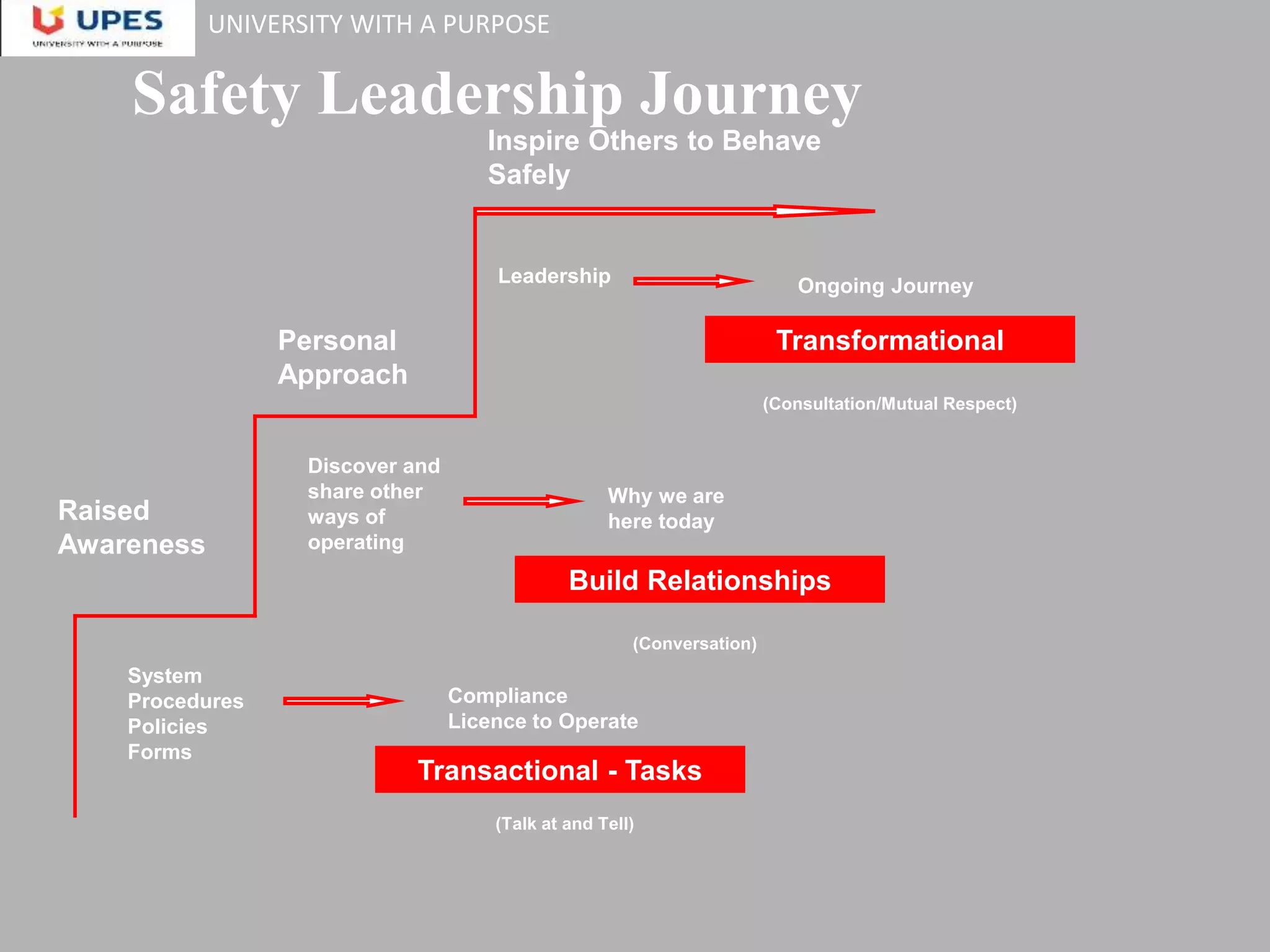
Safety Leadership Journey
Raised
Awareness
Personal
Approach
Inspire Others to Behave
Safely
System
Procedures
Policies
Forms
Compliance
Licence to Operate
Discover and
share other
ways of
operating
Why we are
here today
Leadership Ongoing Journey
Transactional - Tasks
(Talk at and Tell)
Build Relationships
Transformational
(Conversation)
(Consultation/Mutual Respect)
UNIVERSITY WITH A PURPOSE
Practical Tools To Apply Leadership
UNIVERSITY WITH A PURPOSE
Understanding Peoples Behaviour
ABC Model
Activator
Events that precede behaviour
and prompt it.
Have 20% impact impact on
behaviour
E.g. Training, personal beliefs,
behaviour of others, past
experience, requested to do
something
Behaviour
Things people say and their
actions
Behaviour determines
performance
Consequences
Events that follow behaviour
Have 80% influence on whether
behaviour occurs again
UNIVERSITY WITH A PURPOSE
Understanding Peoples Behaviour
Principles of ABC
• Majority of all incidents are caused by people behaving in
unsafe ways
• Understanding employee behaviour is fundamental to the
success of creating a safe workplace
• Premise of model is that all Behaviour (B) is a function of its
immediate environment.
• Factors such as Activators (A) and Consequences (C) of
each behaviour trigger and sustain it
UNIVERSITY WITH A PURPOSE
ABC Model
• Activator – Aspect of the environment, precedes and
influences behaviour
Eg – Others are doing it or The right tool/plant not available
• Behaviour – Something you can see, every day – every
task – Its either safe or unsafe
• Consequence – Every behaviour is followed by a series
of consequences
UNIVERSITY WITH A PURPOSE
ABC Model - Examples
• Someone is speeding in the workplace
• Why are they speeding? – Thrill, Late for work,
emergency, attitude, nice road to speed
• Ended up as – crash, caught by Police, someone else
ran off the road
• Activity - Work out the ABC!
• Activity – Think of Some others
• As a Leader – Ask the questions
UNIVERSITY WITH A PURPOSE
How we reward Unsafe Behaviours
How we punish safe behaviour indirectly
Key Message
ABC Model is a cultural change tool
Moves culture from one that inadvertently encourages
unsafe behaviour and punishes safe behaviour
To one that increases positive behaviour through
reinforcement
UNIVERSITY WITH A PURPOSE
Psychology of Influencing Others
Reticular
Activating System
(RAS)
• The part of the brain that
determines what we are
going to pay attention to
• You can program your
RAS
• You can program other
peoples RAS
• Influencing Positively
with RAS questions
UNIVERSITY WITH A PURPOSE
Influencing Positively
RAS Questions -
• What might happen if you fall?
• What impact does it have for others if they see you doing it
that way?
• Have you thought about the consequences?
• How can you improve on that?
• Activity - Can you think of Others?
UNIVERSITY WITH A PURPOSE
Consult and Communicate
• Intent
• Look & Observe
• Engage
• Ask Questions
• Discuss
Consequences
UNIVERSITY WITH A PURPOSE
Leading an Effective Toolbox
Talk/Pre-Start Meeting
• Target
• Engage
• Ask Questions
• Mutually Agree
UNIVERSITY WITH A PURPOSE
In Short…
• You are the key to high performance. Your job as a
Leader is as much about SAFETY as it as about
productivity
• Know and understand the expectations and systems
• Ask for support whenever needed… demand it!
• If in doubt, STOP THE WORK
• Document your efforts
UNIVERSITY WITH A PURPOSE
REMEMBER
YOU are responsible for safety
YOU are the KEY to safety
UNIVERSITY WITH A PURPOSE
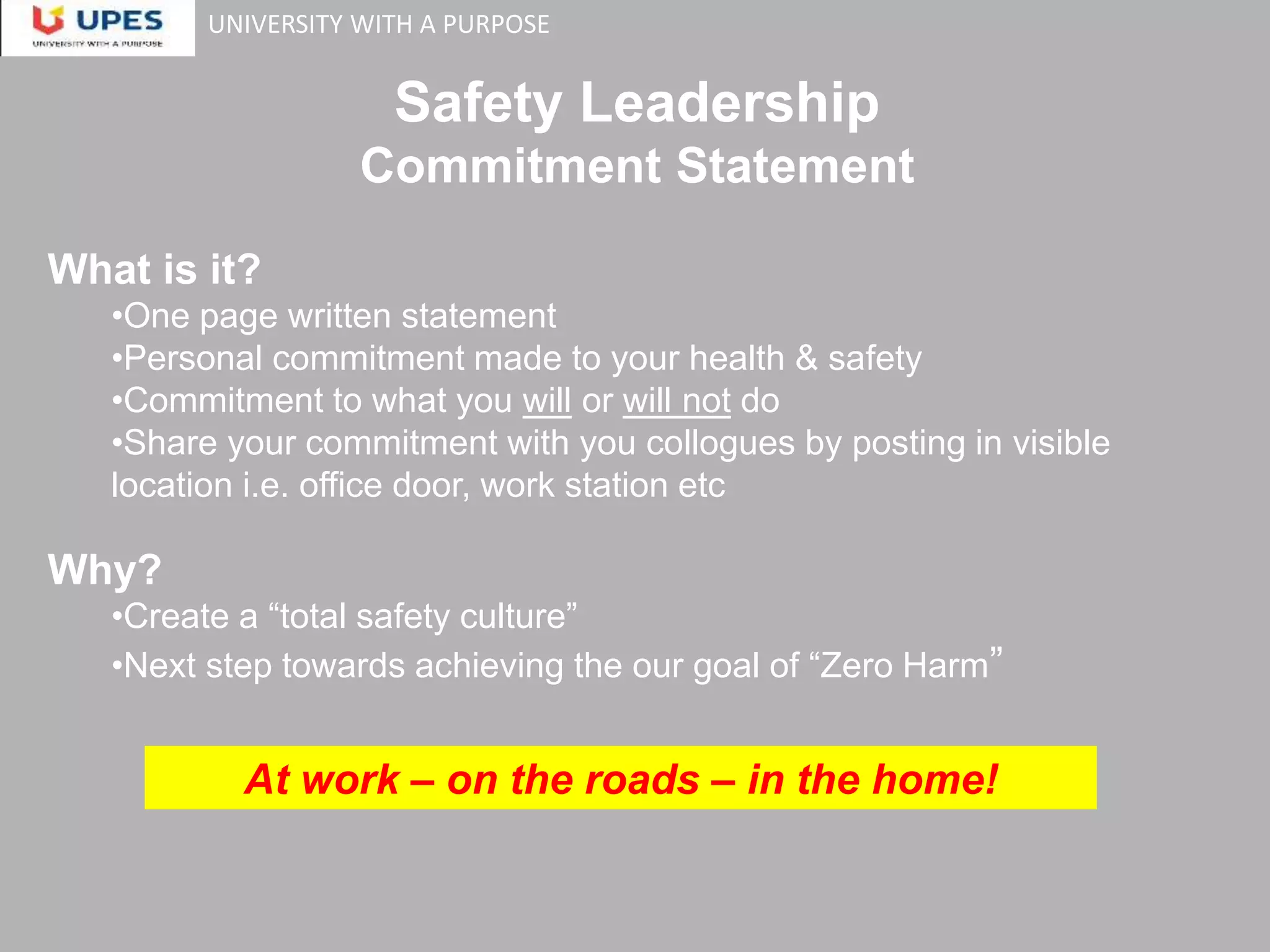
Safety Leadership
Commitment Statement
What is it?
•One page written statement
•Personal commitment made to your health & safety
•Commitment to what you will or will not do
•Share your commitment with you collogues by posting in visible
location i.e. office door, work station etc
Why?
•Create a “total safety culture”
•Next step towards achieving the our goal of “Zero Harm”
At work – on the roads – in the home!
UNIVERSITY WITH A PURPOSE
SAFETY PERFORMANCE
Safety performance of a company can be measured by
1. Lagging indicators
2. Leading indicators
Measurement of safety performance-
leading indicators
1. HSE Training Factor (Training Hours/ employee/ annum)
2. HSE Audit Rating
3. Number of inspections, safety survey, safety sampling and
safety tour
4. Man hours worked without accident
5. Safety Observations (No of observation/employees/year)
Measurement of safety performance-
lagging Indicators
1. First aid cases (First Aid Cases/1000 employee/month)
2. Lost Time Injury Frequency rate (No. of LTI cases* 1000000 /
man-hours worked)
3. No of Fatality/Accident
4. Number of medical illness cases
5. Complaints from the workforce regarding safety
Safety Audit:. “A safety audit subjects every area of organization’s
activity to a systematic Critical examination to reveal the strengths
and weaknesses and the areas of vulnerability”. One of the first
systematic methods of hazard identification used in the chemical
industry was the safety audit
Safety Survey: It is a detailed examination a narrow field such as
specific procedures or a particular plant.
Safety inspection: Which is a scheduled inspection of a unit carried
out by the units own personnel. Eg. Crane inspection
Safety Tour: It is unscheduled tour carried out by an outsider such
as works manager or a safety representative.
What is safety Culture
• Safety culture … forms the environment within which
individual safety attitudes develop and persist and
safety behaviours are promoted.
• It is important to have a consistent way of talking
about culture – the Bradley Curve (a Dupont
concept) so that there is a common way of describing
culture
Safety Maturity AND CULTURE –
BRADLEYY CURVE
• Reactive- There is no real order, structure or framework.
Employees use their wits to stay safe.
• Dependent- This is when there are published H&S
standards, SWPs, and permits which the managers value
and enforce the workers to use.
• Independent- This is when the workers value the standards
and safe working procedures, and whether managers are
there or not they follow the rules
• Interdependent- This is when employees actively look out
for each other – brothers keepers – and ensure that they all
follow the correct standard
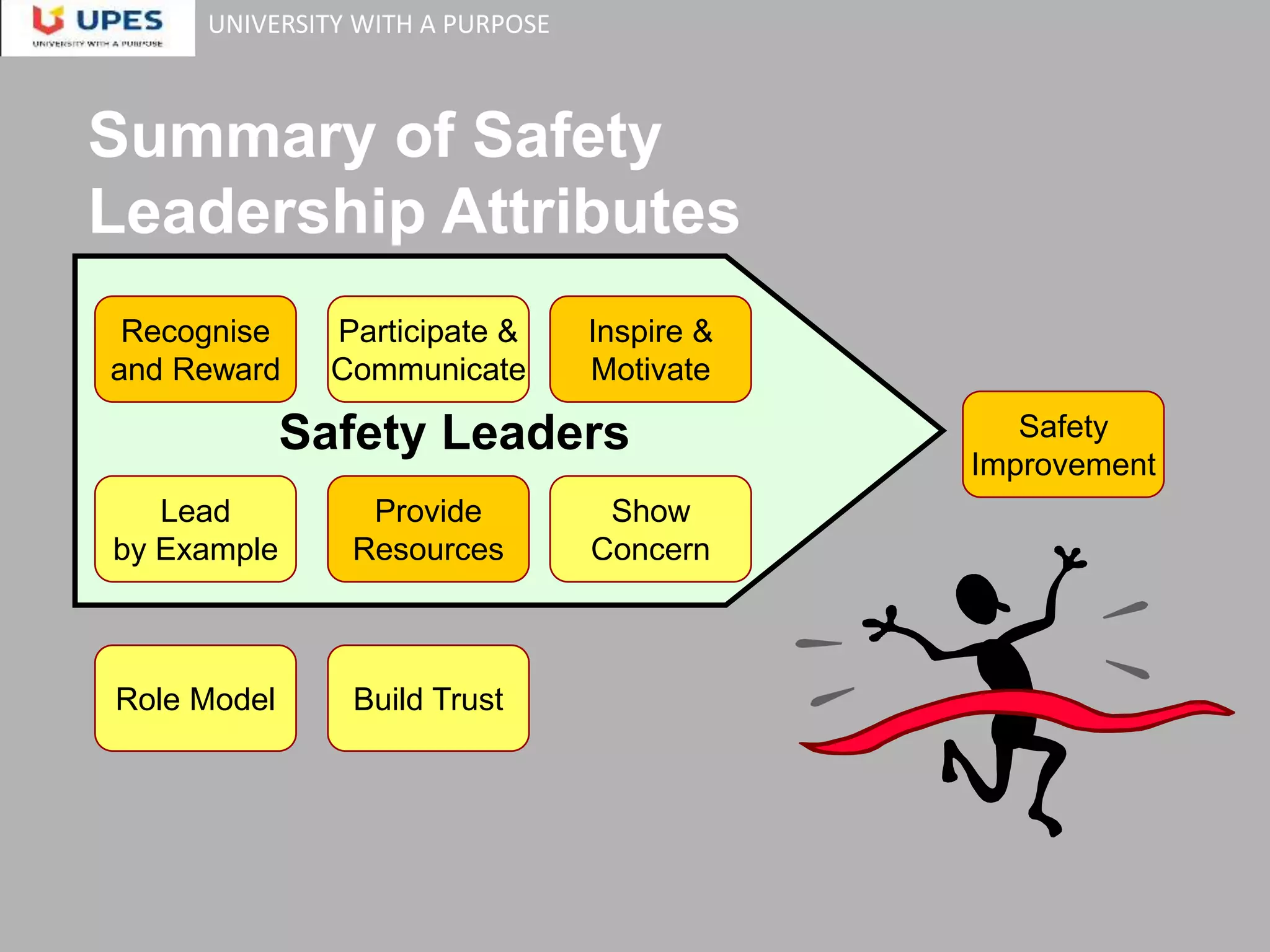
Summary of Safety
Leadership Attributes
Safety Leaders
Recognise
and Reward
Participate &
Communicate
Inspire &
Motivate
Lead
by Example
Provide
Resources
Show
Concern
Safety
Improvement
Role Model Build Trust
UNIVERSITY WITH A PURPOSE
THANK YOU

Leadership and safety culture

  • 1.
  • 2.
    •Explore and shareideas about some basic concepts of Leadership and how they can be applied in WH&S •Begin development of your own safety leadership improvement strategy Objectives: UNIVERSITY WITH A PURPOSE
  • 3.
    Leadership – Whatis it? UNIVERSITY WITH A PURPOSE
  • 4.
    Leadership is not: NotPower - •Power derives from status, money, ability to harm, access to media or control materials •A Thug who sticks a gun in you back has “power” but not leadership UNIVERSITY WITH A PURPOSE
  • 5.
    Leadership is not: NotStatus - •Status or position may enhance the opportunity for leadership •Some in a high status or position haven’t got a clue how to lead Not Authority – • A person may have subordinates, but not followers •People will only follow if a person acts as a leader UNIVERSITY WITH A PURPOSE
  • 6.
    Leadership is not: NotManagement - •Management is an organizational skill •Managers preside over procesesses, functions and program UNIVERSITY WITH A PURPOSE
  • 7.
    The leadership role,more than any other function, shapes and influences the culture that produces performance outcomes UNIVERSITY WITH A PURPOSE
  • 8.
    Impact of Leadership Excellentsafety performance is about getting the right behaviour from people. •Although necessary, it is not about systems and procedures. As a leader, you have a tremendous impact in the field by what you:  Say  Do  Don’t say or don’t do UNIVERSITY WITH A PURPOSE
  • 9.
    Visible Leadership Primary Keyfor achieving Safety Success: SAFETY LEADERSHIP = VISIBLE COMMITMENT UNIVERSITY WITH A PURPOSE
  • 10.
    Your Role asa Leader • Excellent performance requires your leadership • As a leader you should know:  how our safety programs work and your role in them  the importance of leadership in getting the right behaviours UNIVERSITY WITH A PURPOSE
  • 11.
    Leading in theField • ‘Walk the talk’ • Demonstrate your commitment with visible actions • Follow-through with actions • Never turn a blind eye • Hold others accountable Consistent Fair Firm Be UNIVERSITY WITH A PURPOSE
  • 12.
    Your Job asa Safety Leader is to… • Explain the HSE process to employees • Provide effective feedback • INTERVENE: NEVER walk past an unsafe act or condition. To do so is to approve or condone the activity or condition • Seek to understand WHY the situation or behaviour was that way And so correct the problem, not treat the symptom UNIVERSITY WITH A PURPOSE
  • 13.
    At-Risk Behaviour If yousee someone taking a risk, you are authorised to: Stop the job Talk to them Explain the risk Explain the safe way If you are ignored & they continue to take the risk, Report it UNIVERSITY WITH A PURPOSE
  • 14.
    Personalise your leadership… Usewords like I need you to… My expectations are… I want you to... Not The Client want you to… WHS Advisor requires… My boss wants… UNIVERSITY WITH A PURPOSE
  • 15.
    Actions Speak LouderThan Words • Lead by example • Employees will subconsciously follow your actions They always pick up the bad habits first! • Show them the way • Nominate individuals and teams for awards and certificates UNIVERSITY WITH A PURPOSE
  • 16.
    Recognition • Give plentyof verbal recognition to individuals and teams for jobs well done Let individuals and team known when you observe their safe behaviour Use pre-start safety talks to provide feedback • Catch your team doing the right thing!! UNIVERSITY WITH A PURPOSE
  • 17.
    Safety Leadership Journey Raised Awareness Personal Approach InspireOthers to Behave Safely System Procedures Policies Forms Compliance Licence to Operate Discover and share other ways of operating Why we are here today Leadership Ongoing Journey Transactional - Tasks (Talk at and Tell) Build Relationships Transformational (Conversation) (Consultation/Mutual Respect) UNIVERSITY WITH A PURPOSE
  • 18.
    Practical Tools ToApply Leadership UNIVERSITY WITH A PURPOSE
  • 19.
    Understanding Peoples Behaviour ABCModel Activator Events that precede behaviour and prompt it. Have 20% impact impact on behaviour E.g. Training, personal beliefs, behaviour of others, past experience, requested to do something Behaviour Things people say and their actions Behaviour determines performance Consequences Events that follow behaviour Have 80% influence on whether behaviour occurs again UNIVERSITY WITH A PURPOSE
  • 20.
    Understanding Peoples Behaviour Principlesof ABC • Majority of all incidents are caused by people behaving in unsafe ways • Understanding employee behaviour is fundamental to the success of creating a safe workplace • Premise of model is that all Behaviour (B) is a function of its immediate environment. • Factors such as Activators (A) and Consequences (C) of each behaviour trigger and sustain it UNIVERSITY WITH A PURPOSE
  • 21.
    ABC Model • Activator– Aspect of the environment, precedes and influences behaviour Eg – Others are doing it or The right tool/plant not available • Behaviour – Something you can see, every day – every task – Its either safe or unsafe • Consequence – Every behaviour is followed by a series of consequences UNIVERSITY WITH A PURPOSE
  • 22.
    ABC Model -Examples • Someone is speeding in the workplace • Why are they speeding? – Thrill, Late for work, emergency, attitude, nice road to speed • Ended up as – crash, caught by Police, someone else ran off the road • Activity - Work out the ABC! • Activity – Think of Some others • As a Leader – Ask the questions UNIVERSITY WITH A PURPOSE
  • 23.
    How we rewardUnsafe Behaviours How we punish safe behaviour indirectly Key Message ABC Model is a cultural change tool Moves culture from one that inadvertently encourages unsafe behaviour and punishes safe behaviour To one that increases positive behaviour through reinforcement UNIVERSITY WITH A PURPOSE
  • 24.
    Psychology of InfluencingOthers Reticular Activating System (RAS) • The part of the brain that determines what we are going to pay attention to • You can program your RAS • You can program other peoples RAS • Influencing Positively with RAS questions UNIVERSITY WITH A PURPOSE
  • 25.
    Influencing Positively RAS Questions- • What might happen if you fall? • What impact does it have for others if they see you doing it that way? • Have you thought about the consequences? • How can you improve on that? • Activity - Can you think of Others? UNIVERSITY WITH A PURPOSE
  • 26.
    Consult and Communicate •Intent • Look & Observe • Engage • Ask Questions • Discuss Consequences UNIVERSITY WITH A PURPOSE
  • 27.
    Leading an EffectiveToolbox Talk/Pre-Start Meeting • Target • Engage • Ask Questions • Mutually Agree UNIVERSITY WITH A PURPOSE
  • 28.
    In Short… • Youare the key to high performance. Your job as a Leader is as much about SAFETY as it as about productivity • Know and understand the expectations and systems • Ask for support whenever needed… demand it! • If in doubt, STOP THE WORK • Document your efforts UNIVERSITY WITH A PURPOSE
  • 29.
    REMEMBER YOU are responsiblefor safety YOU are the KEY to safety UNIVERSITY WITH A PURPOSE
  • 30.
    Safety Leadership Commitment Statement Whatis it? •One page written statement •Personal commitment made to your health & safety •Commitment to what you will or will not do •Share your commitment with you collogues by posting in visible location i.e. office door, work station etc Why? •Create a “total safety culture” •Next step towards achieving the our goal of “Zero Harm” At work – on the roads – in the home! UNIVERSITY WITH A PURPOSE
  • 31.
    SAFETY PERFORMANCE Safety performanceof a company can be measured by 1. Lagging indicators 2. Leading indicators
  • 32.
    Measurement of safetyperformance- leading indicators 1. HSE Training Factor (Training Hours/ employee/ annum) 2. HSE Audit Rating 3. Number of inspections, safety survey, safety sampling and safety tour 4. Man hours worked without accident 5. Safety Observations (No of observation/employees/year)
  • 33.
    Measurement of safetyperformance- lagging Indicators 1. First aid cases (First Aid Cases/1000 employee/month) 2. Lost Time Injury Frequency rate (No. of LTI cases* 1000000 / man-hours worked) 3. No of Fatality/Accident 4. Number of medical illness cases 5. Complaints from the workforce regarding safety
  • 34.
    Safety Audit:. “Asafety audit subjects every area of organization’s activity to a systematic Critical examination to reveal the strengths and weaknesses and the areas of vulnerability”. One of the first systematic methods of hazard identification used in the chemical industry was the safety audit Safety Survey: It is a detailed examination a narrow field such as specific procedures or a particular plant. Safety inspection: Which is a scheduled inspection of a unit carried out by the units own personnel. Eg. Crane inspection Safety Tour: It is unscheduled tour carried out by an outsider such as works manager or a safety representative.
  • 35.
    What is safetyCulture • Safety culture … forms the environment within which individual safety attitudes develop and persist and safety behaviours are promoted. • It is important to have a consistent way of talking about culture – the Bradley Curve (a Dupont concept) so that there is a common way of describing culture
  • 36.
    Safety Maturity ANDCULTURE – BRADLEYY CURVE
  • 37.
    • Reactive- Thereis no real order, structure or framework. Employees use their wits to stay safe. • Dependent- This is when there are published H&S standards, SWPs, and permits which the managers value and enforce the workers to use. • Independent- This is when the workers value the standards and safe working procedures, and whether managers are there or not they follow the rules • Interdependent- This is when employees actively look out for each other – brothers keepers – and ensure that they all follow the correct standard
  • 38.
    Summary of Safety LeadershipAttributes Safety Leaders Recognise and Reward Participate & Communicate Inspire & Motivate Lead by Example Provide Resources Show Concern Safety Improvement Role Model Build Trust UNIVERSITY WITH A PURPOSE
  • 39.
    UNIVERSITY WITH APURPOSE THANK YOU

Editor's Notes