Behavior Based Safety
Safety Professional’s View
Objectives Today:
• Identify differences between traditional vs
BBS
• Know “when and when not” to implement
BBS
• Explain why most traditional safety
programs don’t work!
• Understand why positive reinforcement is
much more powerful than negative
reinforcement
Why Safety Programs Do Not Work:
• Safety is a priority, not a value!
• Safety is not managed in the same
manner as production, quality, and cost
issues!
• Safety is not driven through continuous
improvement!
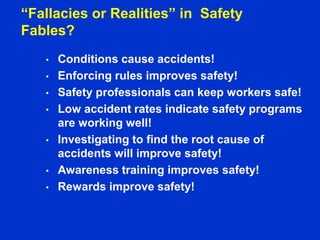
“Fallacies or Realities” in Safety
Fables?
• Conditions cause accidents!
• Enforcing rules improves safety!
• Safety professionals can keep workers safe!
• Low accident rates indicate safety programs
are working well!
• Investigating to find the root cause of
accidents will improve safety!
• Awareness training improves safety!
• Rewards improve safety!
Core Elements in Successful Safety
Programs
• A culture that says “safety” is important
around here!
• A tight accountability system!
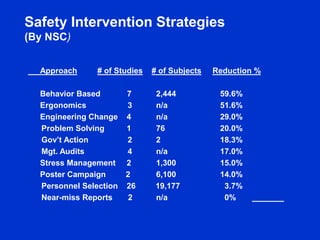
Safety Intervention Strategies
(By NSC)
Approach # of Studies # of Subjects Reduction %
Behavior Based 7 2,444 59.6%
Ergonomics 3 n/a 51.6%
Engineering Change 4 n/a 29.0%
Problem Solving 1 76 20.0%
Gov’t Action 2 2 18.3%
Mgt. Audits 4 n/a 17.0%
Stress Management 2 1,300 15.0%
Poster Campaign 2 6,100 14.0%
Personnel Selection 26 19,177 3.7%
Near-miss Reports 2 n/a 0%
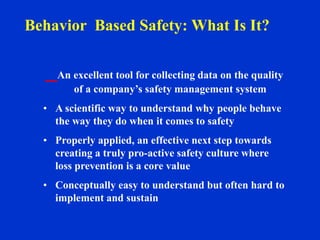
An excellent tool for collecting data on the quality
of a company’s safety management system
• A scientific way to understand why people behave
the way they do when it comes to safety
• Properly applied, an effective next step towards
creating a truly pro-active safety culture where
loss prevention is a core value
• Conceptually easy to understand but often hard to
implement and sustain
Behavior Based Safety: What Is It?
• Only about observation and feedback
• Concerned only about the behaviors of line employees
• A substitution for traditional risk management techniques
• About cheating & manipulating people & aversive control
• A focus on incident rates without a focus on behavior
• A process that does not need employee involvement
Behavior Based Safety:What It Is Not!
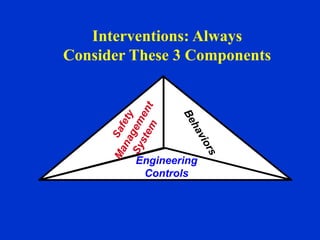
Interventions: Always
Consider These 3 Components
Engineering
Controls
• Attempts to eliminate the hazard
• Having employees work around the hazard
• Guarding or warning employees about the
hazard
• Training employees to deal safely with the
hazard
Traditional Hierarchy of Safety
Interventions Included:
• Management leadership
• vision, values, commitment
• safety goals & objectives
• costs of safety performance
• Responsibility & accountability
• defined for management & employees
• accountable for performance
• Safety organization
• safety committees
• safety staff resource
• safety budget
Safety Management System Interventions
7 components
Safety Management System Interventions
7 components (continued)
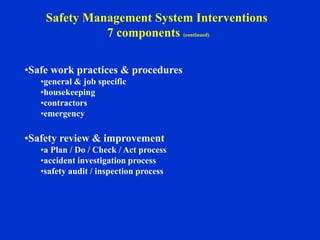
•Safe work practices & procedures
•general & job specific
•housekeeping
•contractors
•emergency
•Safety review & improvement
•a Plan / Do / Check / Act process
•accident investigation process
•safety audit / inspection process
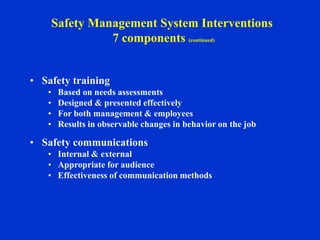
• Safety training
• Based on needs assessments
• Designed & presented effectively
• For both management & employees
• Results in observable changes in behavior on the job
• Safety communications
• Internal & external
• Appropriate for audience
• Effectiveness of communication methods
Safety Management System Interventions
7 components (continued)
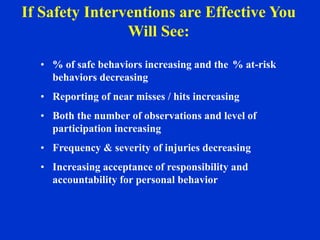
• % of safe behaviors increasing and the % at-risk
behaviors decreasing
• Reporting of near misses / hits increasing
• Both the number of observations and level of
participation increasing
• Frequency & severity of injuries decreasing
• Increasing acceptance of responsibility and
accountability for personal behavior
If Safety Interventions are Effective You
Will See:
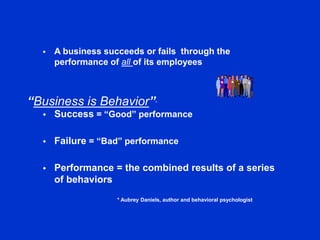
“Business is Behavior”*
 A business succeeds or fails through the
performance of all of its employees
 Success = “Good” performance
 Failure = “Bad” performance
 Performance = the combined results of a series
of behaviors
* Aubrey Daniels, author and behavioral psychologist
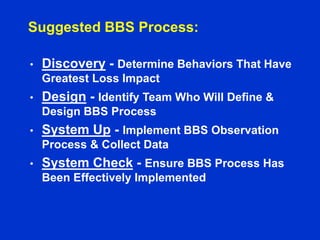
Suggested BBS Process:
• Discovery - Determine Behaviors That Have
Greatest Loss Impact
• Design - Identify Team Who Will Define &
Design BBS Process
• System Up - Implement BBS Observation
Process & Collect Data
• System Check - Ensure BBS Process Has
Been Effectively Implemented
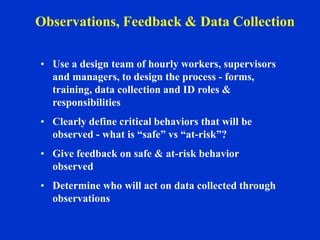
• Use a design team of hourly workers, supervisors
and managers, to design the process - forms,
training, data collection and ID roles &
responsibilities
• Clearly define critical behaviors that will be
observed - what is “safe” vs “at-risk”?
• Give feedback on safe & at-risk behavior
observed
• Determine who will act on data collected through
observations
Observations, Feedback & Data Collection
• Loss runs from insurance carrier or
broker
• OSHA logs
• First aid logs
• Near miss / hit reports
• Absenteeism / turnover reports
Use Prior Experience Data to Target Jobs for
Observation
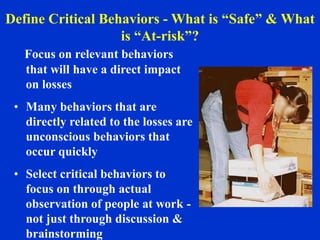
Focus on relevant behaviors
that will have a direct impact
on losses
• Many behaviors that are
directly related to the losses are
unconscious behaviors that
occur quickly
• Select critical behaviors to
focus on through actual
observation of people at work -
not just through discussion &
brainstorming
Define Critical Behaviors - What is “Safe” & What
is “At-risk”?
Obstacles To Success:
• Poorly Maintained Facilities
• Top-down Management Practices
• Poor Planning/Execution
• Inadequate Training
Keys to Success:
• Meaningful Employee Empowerment
• Designing a Well Planned and
Supported BBS Process
• Managing BBS Process with Integrity
 Activators (what needs to be done)
 Competencies (how it needs to be done)
 Consequences (what happens if it is done)
Human Behavior is a function of :
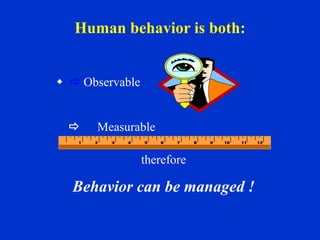
Human behavior is both:
  Observable
 Measurable
therefore
Behavior can be managed !
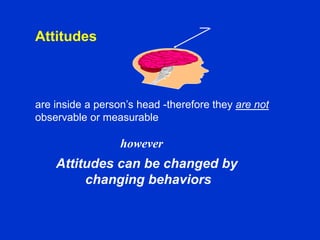
Attitudes
are inside a person’s head -therefore they are not
observable or measurable
Attitudes can be changed by
changing behaviors
however
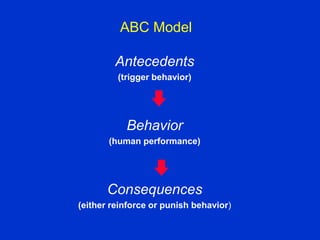
ABC Model
Antecedents
(trigger behavior)
Behavior
(human performance)
Consequences
(either reinforce or punish behavior)
Definitions:
Activators: A person, place, thing or event
that happens before a behavior takes place
that encourages you to perform that behavior.
Activators only set the stage for behavior or
performance - they don’t control it.
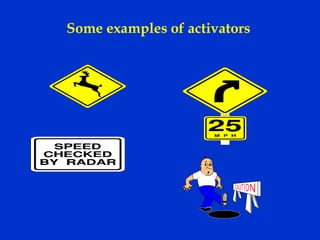
Some examples of activators
Behavior: Any directly measurable
thing that a person does, including
speaking, acting, and performing
physical functions.
Definitions:
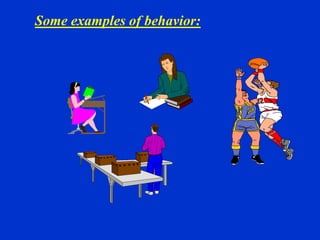
Some examples of behavior:
Definitions:
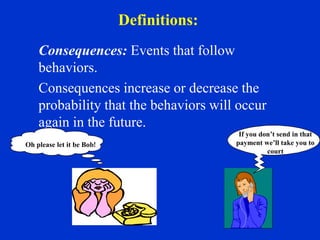
Consequences: Events that follow
behaviors.
Consequences increase or decrease the
probability that the behaviors will occur
again in the future.
Oh please let it be Bob!
If you don’t send in that
payment we’ll take you to
court
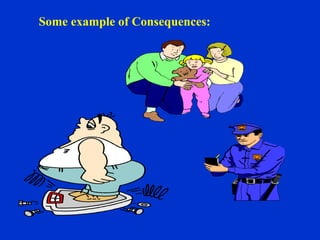
Some example of Consequences:
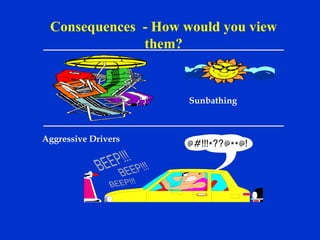
Consequences - How would you view
them?
Sunbathing
Aggressive Drivers
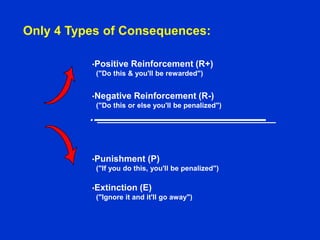
•Positive Reinforcement (R+)
("Do this & you'll be rewarded")
•Negative Reinforcement (R-)
("Do this or else you'll be penalized")
•Punishment (P)
("If you do this, you'll be penalized")
•Extinction (E)
("Ignore it and it'll go away")
Only 4 Types of Consequences:
Behavior
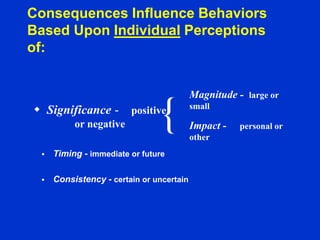
Consequences Influence Behaviors
Based Upon Individual Perceptions
of:
 Timing - immediate or future
 Consistency - certain or uncertain
 Significance - positive
or negative {
Magnitude - large or
small
Impact - personal or
other
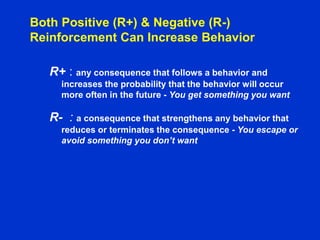
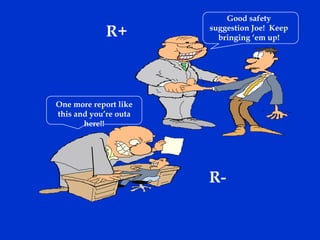
Both Positive (R+) & Negative (R-)
Reinforcement Can Increase Behavior
R+ : any consequence that follows a behavior and
increases the probability that the behavior will occur
more often in the future - You get something you want
R- : a consequence that strengthens any behavior that
reduces or terminates the consequence - You escape or
avoid something you don’t want
Good safety
suggestion Joe! Keep
bringing ‘em up!
R+
R-
One more report like
this and you’re outa
here!!
P
e
r
f
o
r
m
a
n
c
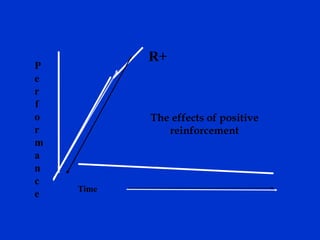
e Time
R+
The effects of positive
reinforcement
Both Punishment & Extinction
Decrease Behavior
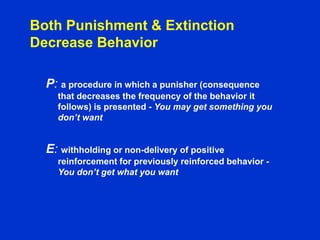
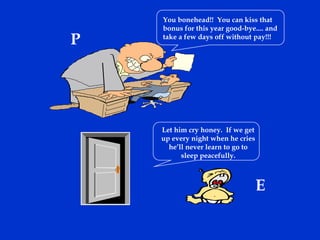
P: a procedure in which a punisher (consequence
that decreases the frequency of the behavior it
follows) is presented - You may get something you
don’t want
E: withholding or non-delivery of positive
reinforcement for previously reinforced behavior -
You don’t get what you want
You bonehead!! You can kiss that
bonus for this year good-bye.... and
take a few days off without pay!!!
P
E
Let him cry honey. If we get
up every night when he cries
he’ll never learn to go to
sleep peacefully.
P
e
r
f
o
r
m
a
n
c
e Time
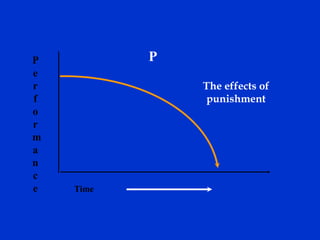
P
The effects of
punishment
P
e
r
f
o
r
m
a
n
c
e Time
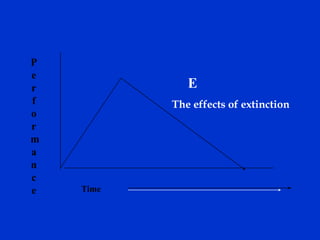
E
The effects of extinction
P
e
r
f
o
r
m
a
n
c
e Time
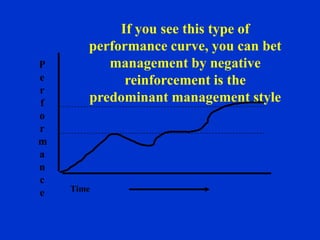
If you see this type of
performance curve, you can bet
management by negative
reinforcement is the
predominant management style
What Employees Want:
• A Safe Workplace
• A Positive Workplace
• To Take Care of One Another
• To Stop the Hurt!
What Management Wants:
• An Accident Free Workplace
• Empowered Employees
• Pro-active Rather Than Re-active Work
Process
• To Minimize Direct and Indirect Costs and
Threat of Liability From Accidents
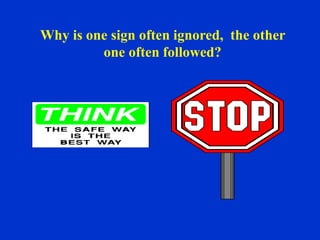
Why is one sign often ignored, the other
one often followed?
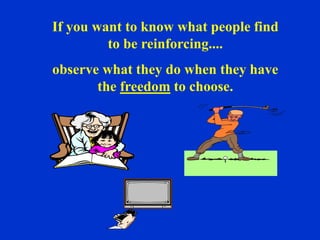
If you want to know what people find
to be reinforcing....
observe what they do when they have
the freedom to choose.
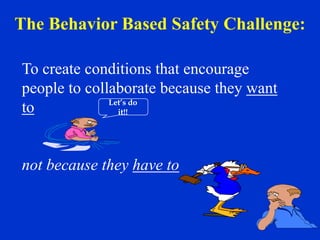
To create conditions that encourage
people to collaborate because they want
to
not because they have to
Let’s do
it!!
The Behavior Based Safety Challenge:
“Focus on the process….not
results……they will come later!”
A Values-Based Process
Avoid The Following Headline:
“Behavior Based Safety Scores Show
Significant Improvement - while
injury rate climbs!”
Why Do We Need to Change?
“If you do what you’ve always done,
you’ll get what you always got!”
W. Edwards Deming

Behavior_Based_Safety_2.ppt......,.........

  • 1.
    Behavior Based Safety SafetyProfessional’s View
  • 3.
    Objectives Today: • Identifydifferences between traditional vs BBS • Know “when and when not” to implement BBS • Explain why most traditional safety programs don’t work! • Understand why positive reinforcement is much more powerful than negative reinforcement
  • 4.
    Why Safety ProgramsDo Not Work: • Safety is a priority, not a value! • Safety is not managed in the same manner as production, quality, and cost issues! • Safety is not driven through continuous improvement!
  • 5.
    “Fallacies or Realities”in Safety Fables? • Conditions cause accidents! • Enforcing rules improves safety! • Safety professionals can keep workers safe! • Low accident rates indicate safety programs are working well! • Investigating to find the root cause of accidents will improve safety! • Awareness training improves safety! • Rewards improve safety!
  • 6.
    Core Elements inSuccessful Safety Programs • A culture that says “safety” is important around here! • A tight accountability system!
  • 7.
    Safety Intervention Strategies (ByNSC) Approach # of Studies # of Subjects Reduction % Behavior Based 7 2,444 59.6% Ergonomics 3 n/a 51.6% Engineering Change 4 n/a 29.0% Problem Solving 1 76 20.0% Gov’t Action 2 2 18.3% Mgt. Audits 4 n/a 17.0% Stress Management 2 1,300 15.0% Poster Campaign 2 6,100 14.0% Personnel Selection 26 19,177 3.7% Near-miss Reports 2 n/a 0%
  • 8.
    An excellent toolfor collecting data on the quality of a company’s safety management system • A scientific way to understand why people behave the way they do when it comes to safety • Properly applied, an effective next step towards creating a truly pro-active safety culture where loss prevention is a core value • Conceptually easy to understand but often hard to implement and sustain Behavior Based Safety: What Is It?
  • 9.
    • Only aboutobservation and feedback • Concerned only about the behaviors of line employees • A substitution for traditional risk management techniques • About cheating & manipulating people & aversive control • A focus on incident rates without a focus on behavior • A process that does not need employee involvement Behavior Based Safety:What It Is Not!
  • 10.
    Interventions: Always Consider These3 Components Engineering Controls
  • 11.
    • Attempts toeliminate the hazard • Having employees work around the hazard • Guarding or warning employees about the hazard • Training employees to deal safely with the hazard Traditional Hierarchy of Safety Interventions Included:
  • 12.
    • Management leadership •vision, values, commitment • safety goals & objectives • costs of safety performance • Responsibility & accountability • defined for management & employees • accountable for performance • Safety organization • safety committees • safety staff resource • safety budget Safety Management System Interventions 7 components
  • 13.
    Safety Management SystemInterventions 7 components (continued) •Safe work practices & procedures •general & job specific •housekeeping •contractors •emergency •Safety review & improvement •a Plan / Do / Check / Act process •accident investigation process •safety audit / inspection process
  • 14.
    • Safety training •Based on needs assessments • Designed & presented effectively • For both management & employees • Results in observable changes in behavior on the job • Safety communications • Internal & external • Appropriate for audience • Effectiveness of communication methods Safety Management System Interventions 7 components (continued)
  • 15.
    • % ofsafe behaviors increasing and the % at-risk behaviors decreasing • Reporting of near misses / hits increasing • Both the number of observations and level of participation increasing • Frequency & severity of injuries decreasing • Increasing acceptance of responsibility and accountability for personal behavior If Safety Interventions are Effective You Will See:
  • 16.
    “Business is Behavior”* A business succeeds or fails through the performance of all of its employees  Success = “Good” performance  Failure = “Bad” performance  Performance = the combined results of a series of behaviors * Aubrey Daniels, author and behavioral psychologist
  • 17.
    Suggested BBS Process: •Discovery - Determine Behaviors That Have Greatest Loss Impact • Design - Identify Team Who Will Define & Design BBS Process • System Up - Implement BBS Observation Process & Collect Data • System Check - Ensure BBS Process Has Been Effectively Implemented
  • 18.
    • Use adesign team of hourly workers, supervisors and managers, to design the process - forms, training, data collection and ID roles & responsibilities • Clearly define critical behaviors that will be observed - what is “safe” vs “at-risk”? • Give feedback on safe & at-risk behavior observed • Determine who will act on data collected through observations Observations, Feedback & Data Collection
  • 19.
    • Loss runsfrom insurance carrier or broker • OSHA logs • First aid logs • Near miss / hit reports • Absenteeism / turnover reports Use Prior Experience Data to Target Jobs for Observation
  • 20.
    Focus on relevantbehaviors that will have a direct impact on losses • Many behaviors that are directly related to the losses are unconscious behaviors that occur quickly • Select critical behaviors to focus on through actual observation of people at work - not just through discussion & brainstorming Define Critical Behaviors - What is “Safe” & What is “At-risk”?
  • 21.
    Obstacles To Success: •Poorly Maintained Facilities • Top-down Management Practices • Poor Planning/Execution • Inadequate Training
  • 22.
    Keys to Success: •Meaningful Employee Empowerment • Designing a Well Planned and Supported BBS Process • Managing BBS Process with Integrity
  • 23.
     Activators (whatneeds to be done)  Competencies (how it needs to be done)  Consequences (what happens if it is done) Human Behavior is a function of :
  • 24.
    Human behavior isboth:   Observable  Measurable therefore Behavior can be managed !
  • 25.
    Attitudes are inside aperson’s head -therefore they are not observable or measurable Attitudes can be changed by changing behaviors however
  • 26.
    ABC Model Antecedents (trigger behavior) Behavior (humanperformance) Consequences (either reinforce or punish behavior)
  • 27.
    Definitions: Activators: A person,place, thing or event that happens before a behavior takes place that encourages you to perform that behavior. Activators only set the stage for behavior or performance - they don’t control it.
  • 28.
    Some examples ofactivators
  • 29.
    Behavior: Any directlymeasurable thing that a person does, including speaking, acting, and performing physical functions. Definitions:
  • 30.
  • 31.
    Definitions: Consequences: Events thatfollow behaviors. Consequences increase or decrease the probability that the behaviors will occur again in the future. Oh please let it be Bob! If you don’t send in that payment we’ll take you to court
  • 32.
    Some example ofConsequences:
  • 33.
    Consequences - Howwould you view them? Sunbathing Aggressive Drivers
  • 34.
    •Positive Reinforcement (R+) ("Dothis & you'll be rewarded") •Negative Reinforcement (R-) ("Do this or else you'll be penalized") •Punishment (P) ("If you do this, you'll be penalized") •Extinction (E) ("Ignore it and it'll go away") Only 4 Types of Consequences: Behavior
  • 35.
    Consequences Influence Behaviors BasedUpon Individual Perceptions of:  Timing - immediate or future  Consistency - certain or uncertain  Significance - positive or negative { Magnitude - large or small Impact - personal or other
  • 36.
    Both Positive (R+)& Negative (R-) Reinforcement Can Increase Behavior R+ : any consequence that follows a behavior and increases the probability that the behavior will occur more often in the future - You get something you want R- : a consequence that strengthens any behavior that reduces or terminates the consequence - You escape or avoid something you don’t want
  • 37.
    Good safety suggestion Joe!Keep bringing ‘em up! R+ R- One more report like this and you’re outa here!!
  • 38.
  • 39.
    Both Punishment &Extinction Decrease Behavior P: a procedure in which a punisher (consequence that decreases the frequency of the behavior it follows) is presented - You may get something you don’t want E: withholding or non-delivery of positive reinforcement for previously reinforced behavior - You don’t get what you want
  • 40.
    You bonehead!! Youcan kiss that bonus for this year good-bye.... and take a few days off without pay!!! P E Let him cry honey. If we get up every night when he cries he’ll never learn to go to sleep peacefully.
  • 41.
  • 42.
  • 43.
    P e r f o r m a n c e Time If yousee this type of performance curve, you can bet management by negative reinforcement is the predominant management style
  • 44.
    What Employees Want: •A Safe Workplace • A Positive Workplace • To Take Care of One Another • To Stop the Hurt!
  • 45.
    What Management Wants: •An Accident Free Workplace • Empowered Employees • Pro-active Rather Than Re-active Work Process • To Minimize Direct and Indirect Costs and Threat of Liability From Accidents
  • 46.
    Why is onesign often ignored, the other one often followed?
  • 47.
    If you wantto know what people find to be reinforcing.... observe what they do when they have the freedom to choose.
  • 48.
    To create conditionsthat encourage people to collaborate because they want to not because they have to Let’s do it!! The Behavior Based Safety Challenge:
  • 49.
    “Focus on theprocess….not results……they will come later!” A Values-Based Process
  • 50.
    Avoid The FollowingHeadline: “Behavior Based Safety Scores Show Significant Improvement - while injury rate climbs!”
  • 51.
    Why Do WeNeed to Change? “If you do what you’ve always done, you’ll get what you always got!” W. Edwards Deming