BEHAVIOR-BASED SAFETY
Behavior-Based Safety is a process
that helps employees identify
and choose a safe behavior
over an unsafe one.
BASIC BEHAVIOR PRINCIPLES
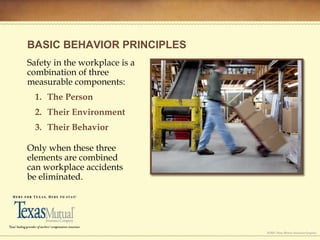
Safety in the workplace is a
combination of three
measurable components:
1. The Person
2. Their Environment
3. Their Behavior
Only when these three
elements are combined
can workplace accidents
be eliminated.
BASIC BEHAVIOR PRINCIPLES
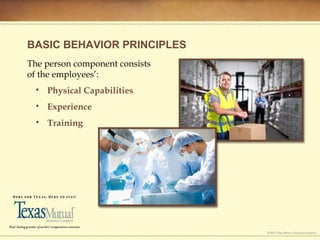
The person component consists
of the employees’:
• Physical Capabilities
• Experience
• Training
BASIC BEHAVIOR PRINCIPLES
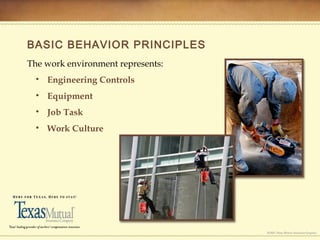
The work environment represents:
• Engineering Controls
• Equipment
• Job Task
• Work Culture
BASIC BEHAVIOR PRINCIPLES
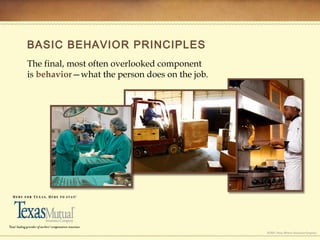
The final, most often overlooked component
is behavior—what the person does on the job.
THE BEHAVIOR-BASED SAFETY PROCESS
Behavior-based safety is based
on four key components:
• A behavioral observation
and feedback process
• A formal review of
observation data
• Improvement goals
• Reinforcement for
improvement and
goal attainment
BEHAVIORAL OBSERVATION AND FEEDBACK
This is one of the most important components of the process.
Observations provide direct, measurable information on
employees’ safe work practices.
• Employees are observed performing their routine task.
The observer documents both safe and unsafe behaviors.
• The employee is then provided positive feedback on the
safe behaviors and non-threatening feedback on the unsafe
behaviors. They are also provided with suggestions on
correcting the unsafe behaviors.
FORMAL REVIEW OF OBSERVATION DATA
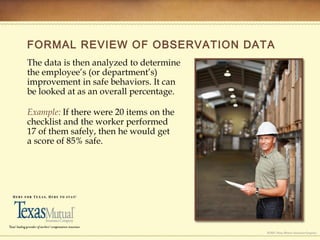
The data is then analyzed to determine
the employee’s (or department’s)
improvement in safe behaviors. It can
be looked at as an overall percentage.
Example: If there were 20 items on the
checklist and the worker performed
17 of them safely, then he would get
a score of 85% safe.
FORMAL REVIEW OF OBSERVATION DATA
The improvement between observations
could be graphed and displayed for
employees to view. When the graphs
shows improvement, it provides positive
reinforcing feedback to employees.
IMPROVEMENT GOALS
Setting improvement goals
increases the effectiveness of
feedback and the success of the
behavior-based safety process.
IMPROVEMENT GOALS
These goals can take different
forms, such as:
1. Percent Safe Goals
2. Process Goals
3. Implementation Goals
REINFORCEMENT FOR IMPROVEMENT
AND GOAL ATTAINMENT
Management must provide immediate,
positive feedback to reinforce safe
behavior. Rewards can be an effective
means of reinforcing goal attainment.
RESULTS
• Increased Efficiency
• Increased Productivity
• Increased Morale
• Increased Profitability

Behavior basedsafety by_texas mutual

  • 1.
    BEHAVIOR-BASED SAFETY Behavior-Based Safetyis a process that helps employees identify and choose a safe behavior over an unsafe one.
  • 2.
    BASIC BEHAVIOR PRINCIPLES Safetyin the workplace is a combination of three measurable components: 1. The Person 2. Their Environment 3. Their Behavior Only when these three elements are combined can workplace accidents be eliminated.
  • 3.
    BASIC BEHAVIOR PRINCIPLES Theperson component consists of the employees’: • Physical Capabilities • Experience • Training
  • 4.
    BASIC BEHAVIOR PRINCIPLES Thework environment represents: • Engineering Controls • Equipment • Job Task • Work Culture
  • 5.
    BASIC BEHAVIOR PRINCIPLES Thefinal, most often overlooked component is behavior—what the person does on the job.
  • 6.
    THE BEHAVIOR-BASED SAFETYPROCESS Behavior-based safety is based on four key components: • A behavioral observation and feedback process • A formal review of observation data • Improvement goals • Reinforcement for improvement and goal attainment
  • 7.
    BEHAVIORAL OBSERVATION ANDFEEDBACK This is one of the most important components of the process. Observations provide direct, measurable information on employees’ safe work practices. • Employees are observed performing their routine task. The observer documents both safe and unsafe behaviors. • The employee is then provided positive feedback on the safe behaviors and non-threatening feedback on the unsafe behaviors. They are also provided with suggestions on correcting the unsafe behaviors.
  • 8.
    FORMAL REVIEW OFOBSERVATION DATA The data is then analyzed to determine the employee’s (or department’s) improvement in safe behaviors. It can be looked at as an overall percentage. Example: If there were 20 items on the checklist and the worker performed 17 of them safely, then he would get a score of 85% safe.
  • 9.
    FORMAL REVIEW OFOBSERVATION DATA The improvement between observations could be graphed and displayed for employees to view. When the graphs shows improvement, it provides positive reinforcing feedback to employees.
  • 10.
    IMPROVEMENT GOALS Setting improvementgoals increases the effectiveness of feedback and the success of the behavior-based safety process.
  • 11.
    IMPROVEMENT GOALS These goalscan take different forms, such as: 1. Percent Safe Goals 2. Process Goals 3. Implementation Goals
  • 12.
    REINFORCEMENT FOR IMPROVEMENT ANDGOAL ATTAINMENT Management must provide immediate, positive feedback to reinforce safe behavior. Rewards can be an effective means of reinforcing goal attainment.
  • 13.
    RESULTS • Increased Efficiency •Increased Productivity • Increased Morale • Increased Profitability

Editor's Notes

  • #12 Percent safe goals Based on safe work practices observed. Must be based on realistic evaluation of the area’s level of safety Should be set for a short time-period: 1 to 3 months is common. Process Goals Focus on improving a specific work practice, such as using proper lifting techniques. Implementation Goals Focus on maintaining the process, such as setting a goal for how many observations are conducted a week.