This document discusses Behavior Based Safety (BBS), a program aimed at improving safety by focusing on behaviors. It provides an overview of BBS, explaining that BBS involves employees, drives safety improvement, and can lead to positive cultural changes when implemented correctly. However, BBS requires being part of an overall safety process and culture, and is not a replacement for compliance, training, or hazard removal. The document then discusses key aspects of implementing a successful BBS program, such as defining behaviors to observe and improve, understanding what drives both safe and unsafe behaviors, providing positive reinforcement, and focusing on achievements rather than failures.
In this document
Powered by AI
Introduction to Behavior Based Safety (BBS), its importance, foundational elements, and misconceptions.
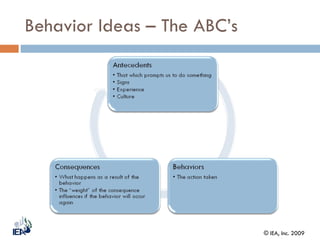
Introduction to behavior ideas and the significance of understanding behaviors for safety improvements.
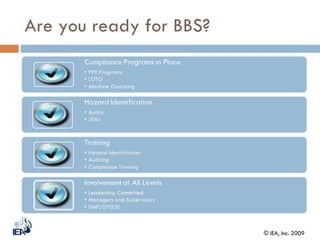
Assessing readiness for BBS, focusing on safety culture, management-employee relationships, and positive reinforcement.
Team-based approaches for implementation, defining target behaviors, antecedents, consequences, and positive reinforcement.
Effective communication strategies for behavior modification and emphasizing positive reinforcement for success.
Open floor for questions and providing contact details for further inquiries.
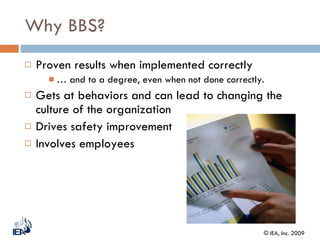
Why BBS? Provenresults when implemented correctly … and to a degree, even when not done correctly. Gets at behaviors and can lead to changing the culture of the organization Drives safety improvement Involves employees
5.
BBS is NOT….… the magic pill that makes all incidents go away. … a release of responsibility for leaders. “ Now the responsibility of the employees” … an excuse to be in (or out of) compliance. … a reason to leave hazards in the work process … a reason to eliminate training, auditing, and the completion of corrective actions. BBS will only work if it is part of an overall safety process and a fabric of the organization.
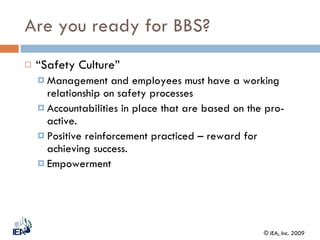
Are you readyfor BBS? “ Safety Culture” Management and employees must have a working relationship on safety processes Accountabilities in place that are based on the pro-active. Positive reinforcement practiced – reward for achieving success. Empowerment
14.
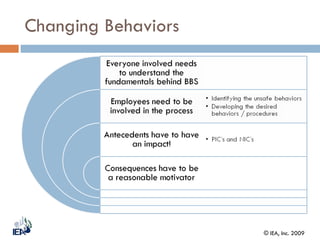
Implementation All ofthese aspects are team based! Define observable (at risk) behaviors What is it we want to look for, analyze and improve? Gain understanding of what antecedents (and prior consequences) drive those behaviors. Define factors to drive the wanted behaviors Remove any barriers to driving improvement – i.e. is the PPE of the proper form, fit, and function?
15.
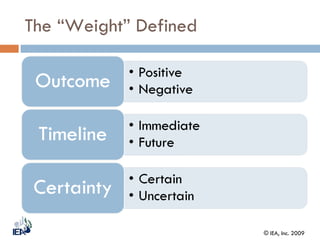
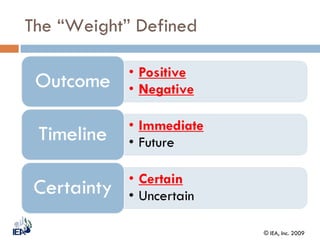
Implementation Define antecedentsand consequences for the desired behavior Positive consequences Negative consequences Focus on achievements and successes In all aspects – focus on the pro-active rather than the re-active. Rates should not be used as an indicator of success. Recognition
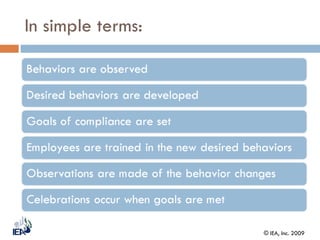
Implementation Remember thePIC’s and NIC’s Define the target behavior Observe Intervene Reward Successes Strive to improve perceptions, emotions, awareness, and attitude towards safety
18.
Other things toconsider… Choose your words carefully “ Behavior modification” Are employees rats in a maze? Dogs with an invisible fence? Make feedback a positive experience – ask for assistance in achieving the targeted behavior. Don’t confuse goals with vision – i.e. zero incidents Success builds success – it is the consequence that becomes the antecedent!