Behaviour Based Safety
Organized By:
Bharat Seats Ltd.
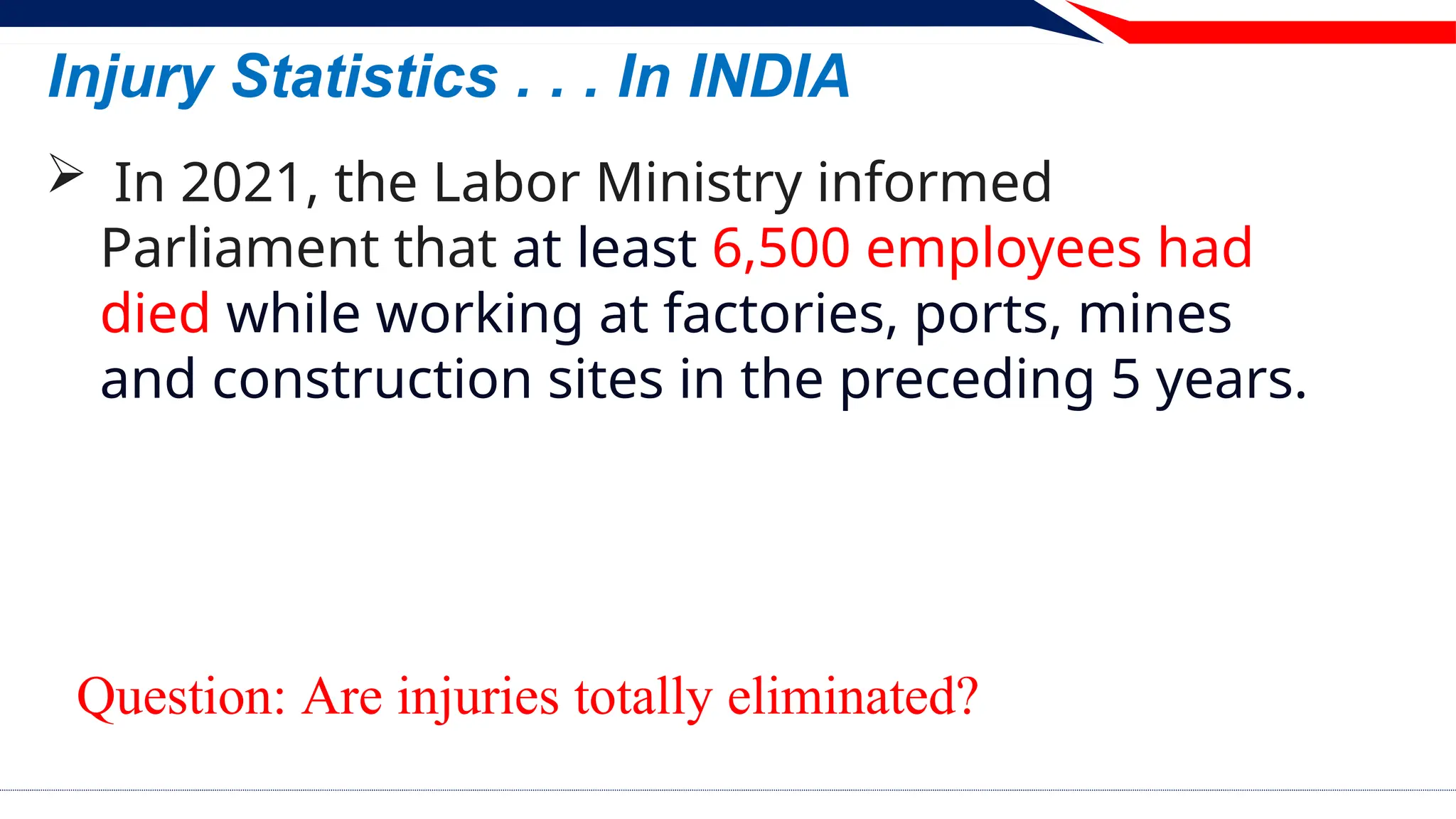
Injury Statistics . . . In INDIA
Question: Are injuries totally eliminated?
 In 2021, the Labor Ministry informed
Parliament that at least 6,500 employees had
died while working at factories, ports, mines
and construction sites in the preceding 5 years.
Session Objectives:
 Understand how safety Behaviour is shaped
 Understand Principles of BBS
 Analyze employee Behaviour
 Pinpoint, observe, and measure specific Behaviours
 Provide positive feedback
Use positive reinforcement successfully to improve safety performance
 Safety Culture Adherences periodically assessment
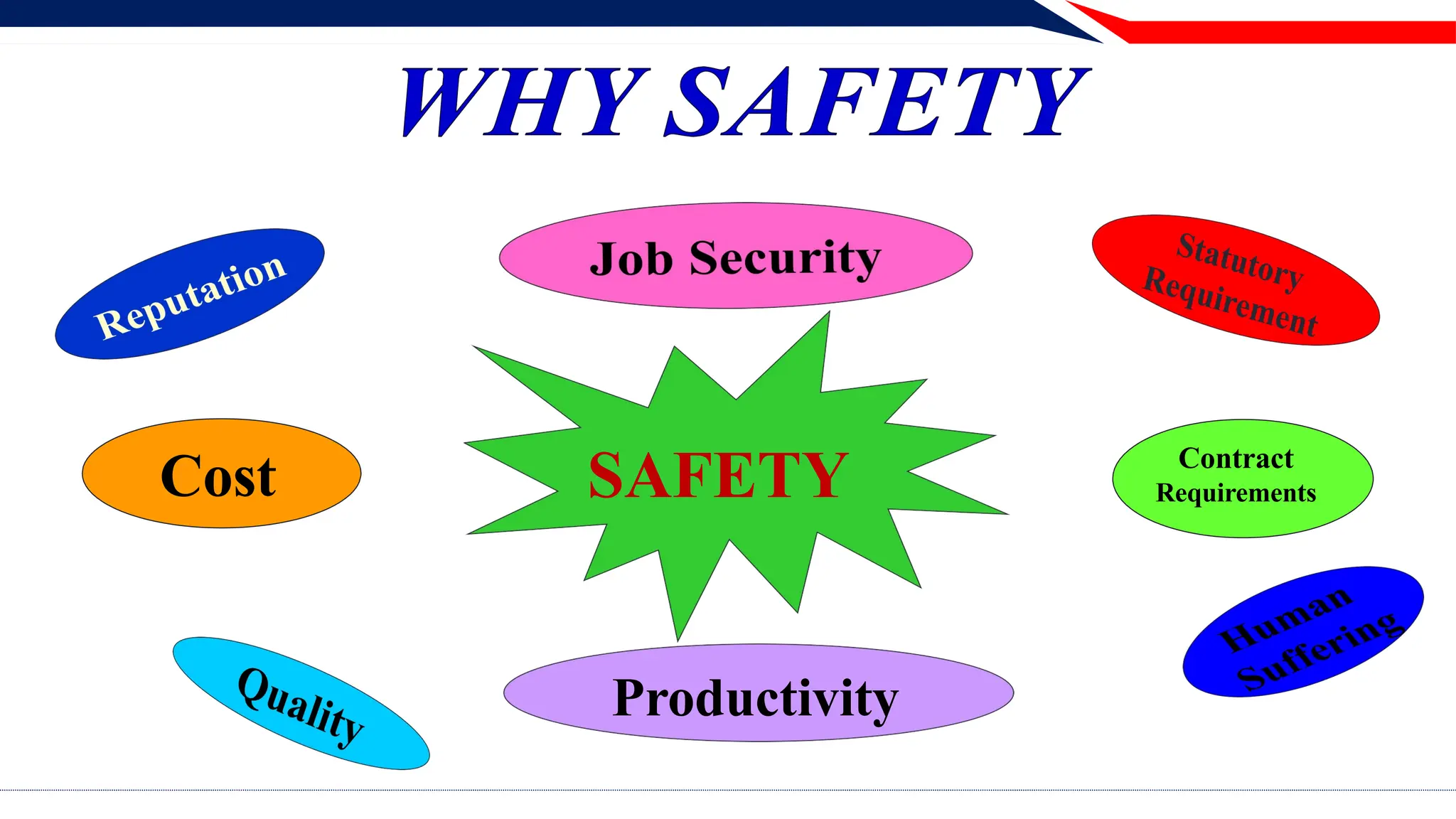
Cost
Productivity
SAFETY Contract
Requirements
Theories of Accident Causation:
The most widely known theories of accident causation:
 Domino theory
 Human factors theory
 Accident / incident theory
 Epidemiological theory
 Systems theory
 Combination theory
 Behavioural theory
Heinrich’s
Theorems
Accidents: An event which is, Unplanned & Unexpected which may or
may not have resulted in damage to property or injury to person.

Injury - Caused by accidents.

Accidents- Caused by an unsafe act –injured person or an unsafe condition – work
place.

Unsafe acts/conditions - caused by careless persons or poorly designed or
improperly maintained equipment.

Fault of persons- created by social environment or acquired by ancestry.

Social environment/ancestry (वंश परंपरा)- where and how a person was raised
and educated.
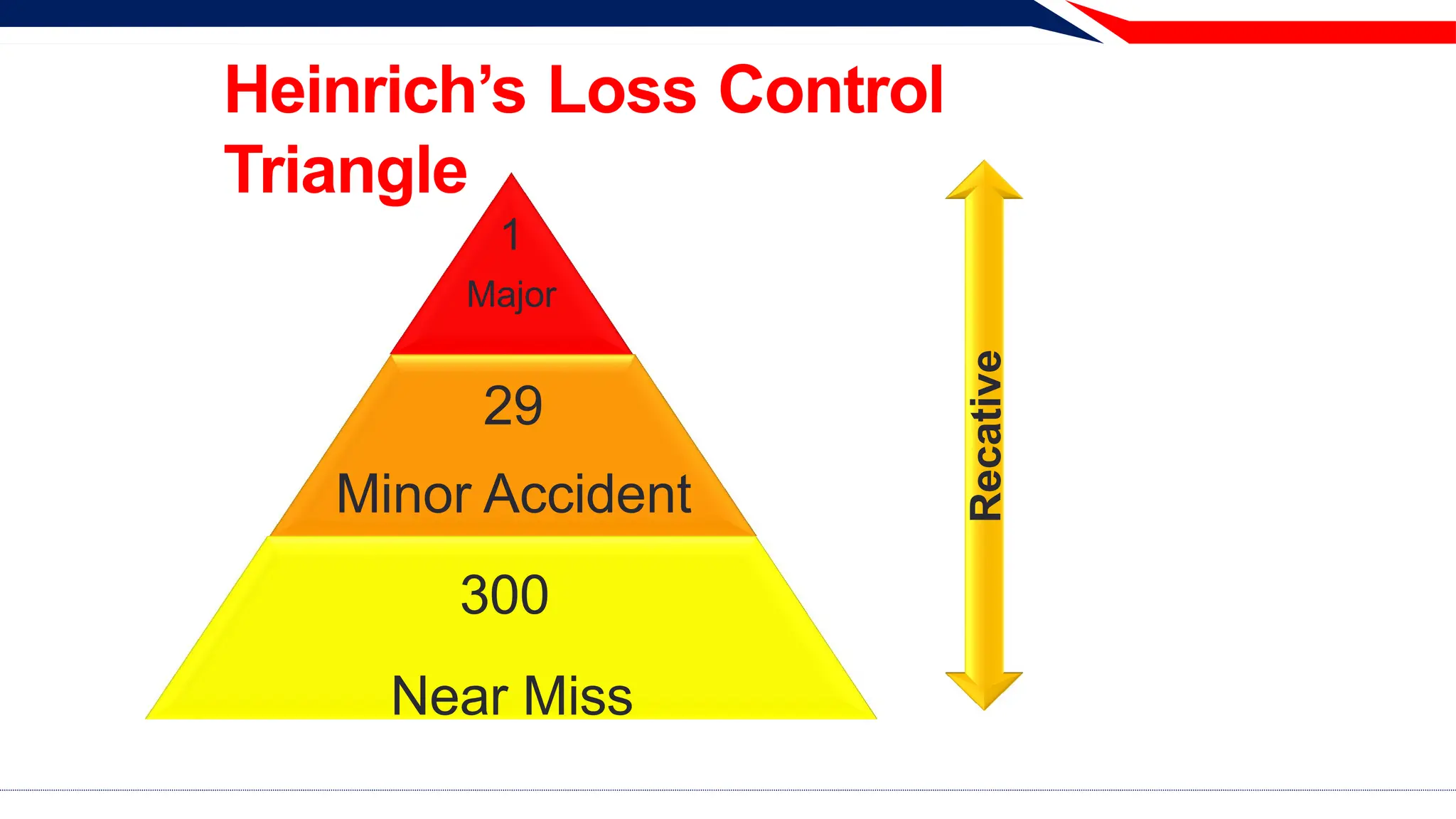
1
Major
29
Minor Accident
300
Near Miss
Heinrich’s Loss Control
Triangle
Recative
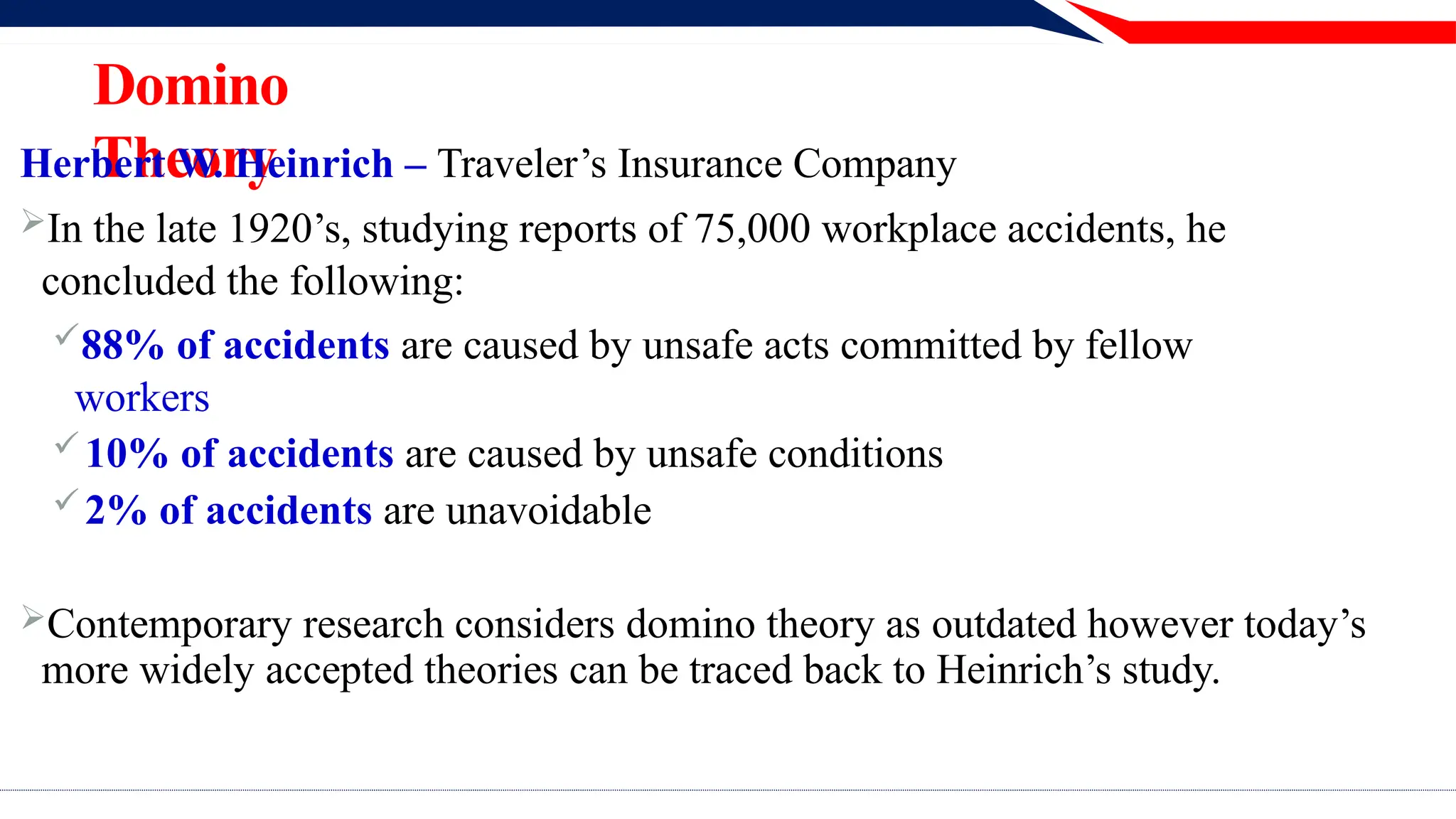
Domino
Theory
Herbert W. Heinrich – Traveler’s Insurance Company
In the late 1920’s, studying reports of 75,000 workplace accidents, he
concluded the following:
88% of accidents are caused by unsafe acts committed by fellow
workers
10% of accidents are caused by unsafe conditions
2% of accidents are unavoidable
Contemporary research considers domino theory as outdated however today’s
more widely accepted theories can be traced back to Heinrich’s study.
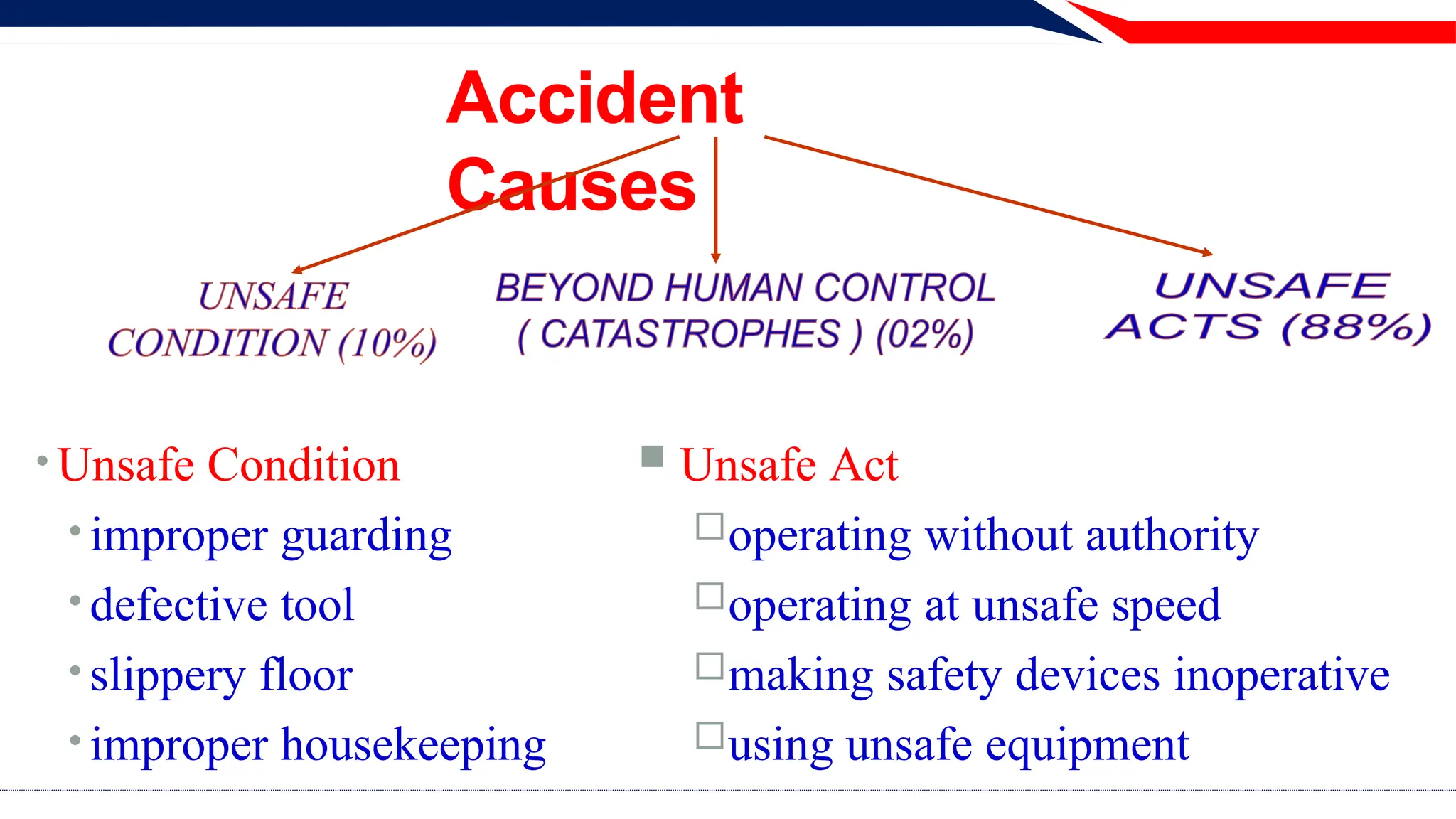
Accident
Causes
• Unsafe Condition
• improper guarding
• defective tool
• slippery floor
• improper housekeeping
 Unsafe Act
operating without authority
operating at unsafe speed
making safety devices inoperative
using unsafe equipment
Domino
Theory
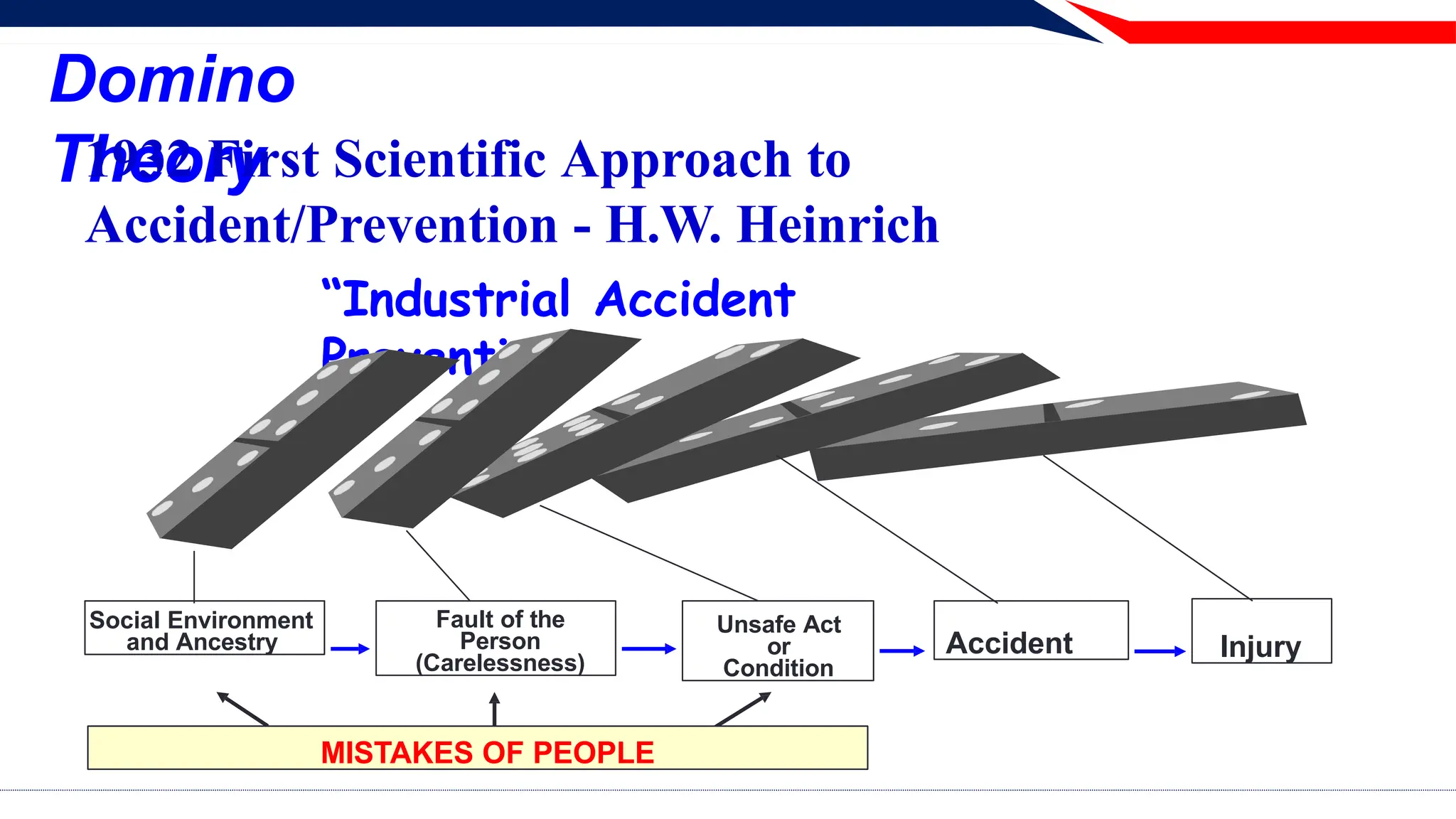
1932 First Scientific Approach to
Accident/Prevention - H.W. Heinrich
“Industrial Accident
Prevention”
Social Environment
and Ancestry
Fault of the
Person
(Carelessness)
Unsafe Act
or
Condition
Accident Injury
MISTAKES OF PEOPLE
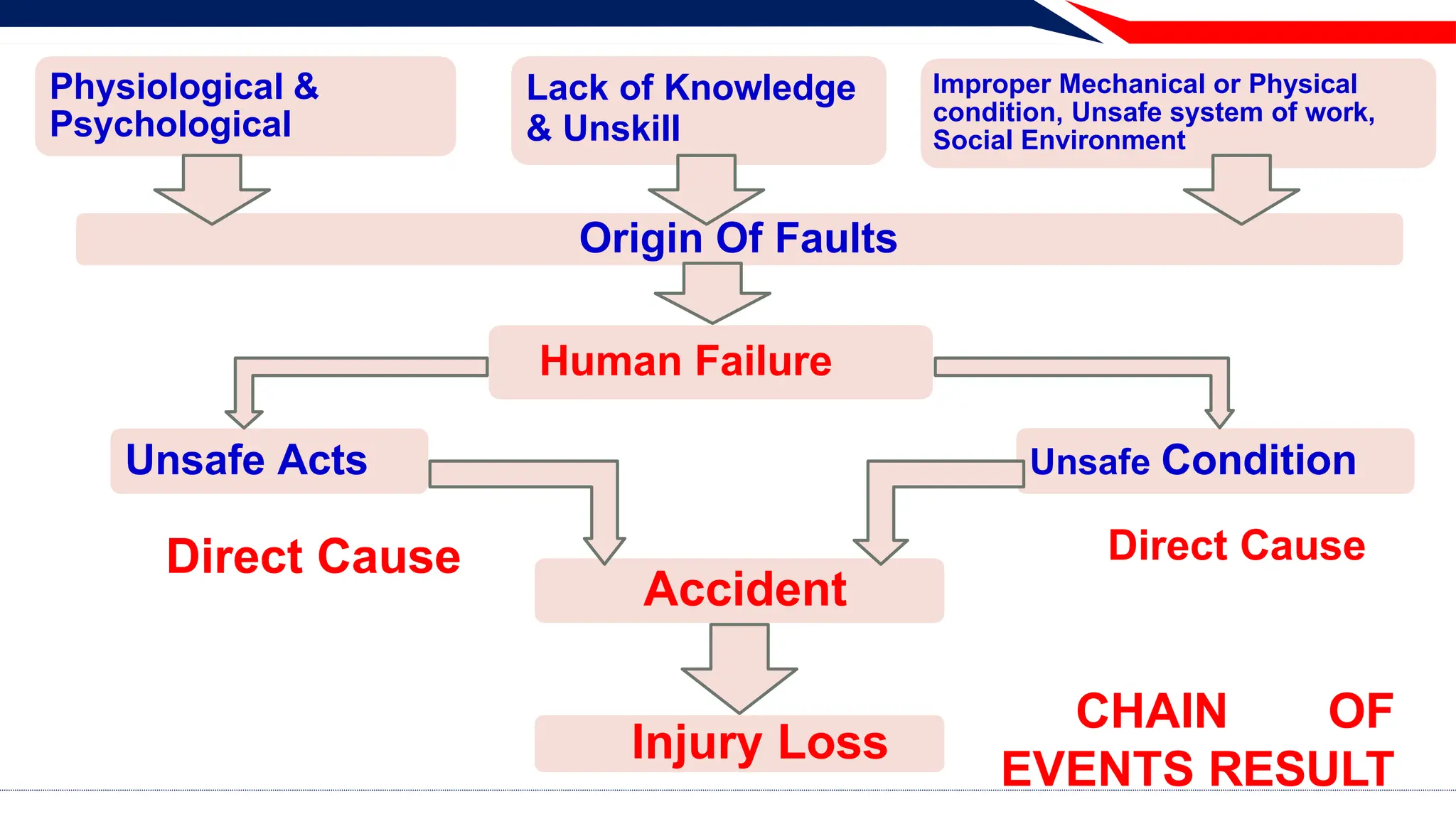
Physiological &
Psychological
Lack of Knowledge
& Unskill
Improper Mechanical or Physical
condition, Unsafe system of work,
Social Environment
Origin Of Faults
Human Failure
Unsafe Acts
Accident
Injury Loss
Direct Cause
Unsafe Condition
Direct Cause
CHAIN OF
EVENTS RESULT
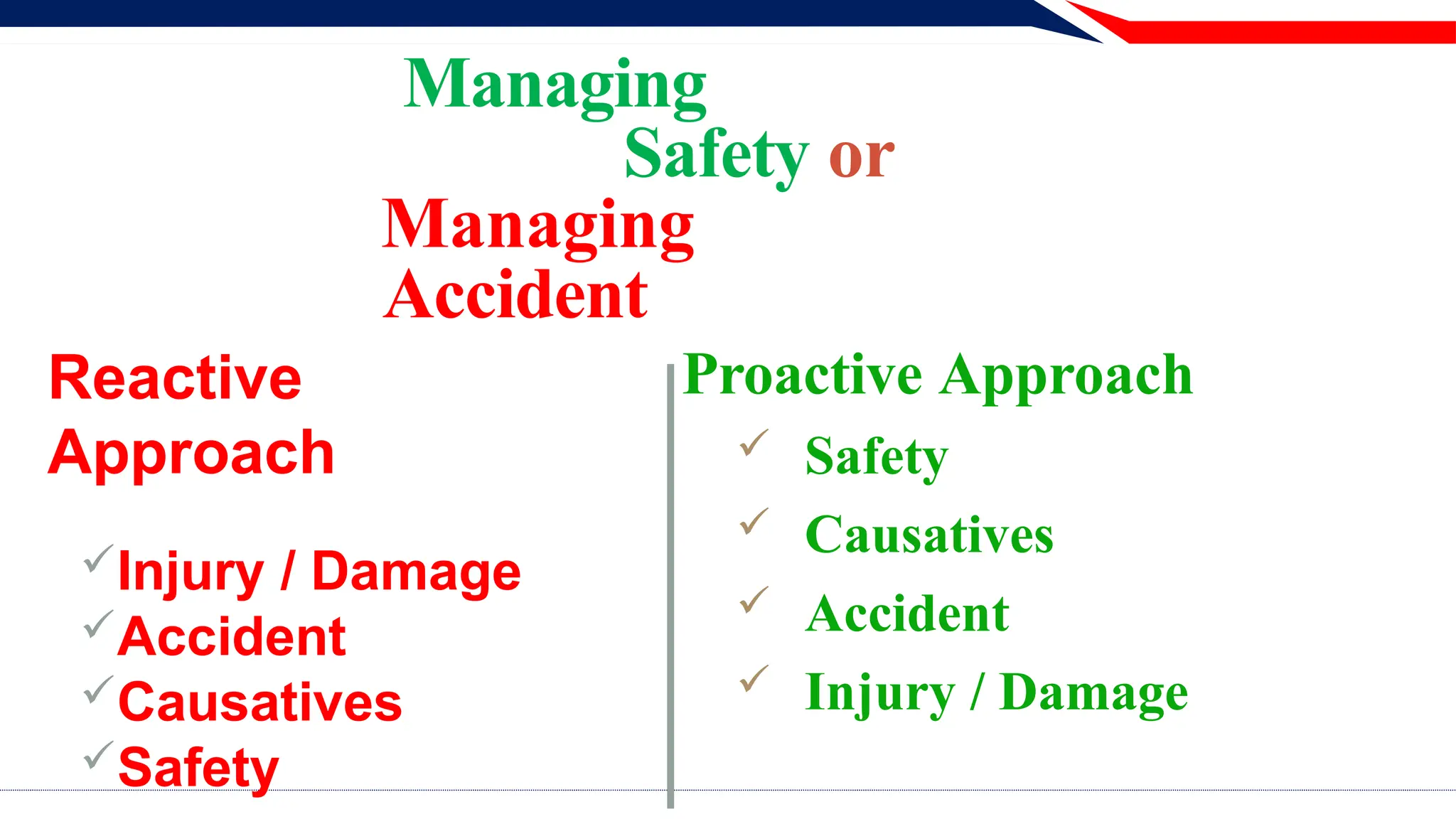
Managing
Safety or
Managing
Accident
Reactive
Approach
Injury / Damage
Accident
Causatives
Safety
Proactive Approach
 Safety
 Causatives
 Accident
 Injury / Damage
What Is Behaviour Based
Safety?
Behaviour Based Safety (BBS) is the “application of
science of Behaviour change to real world problems.”
BBS “focuses on what people do, analyses why they do
it, and then applies a research – supported intervention
strategy to improve what people do. At its very core BBS
is based on a larger scientific field called Organizational
Behaviour Analysis.
Please think . . .
How many of the above elements can be directly traced to
injury elimination just at the moment the injury is about to
occur ?
Question: Are injuries totally eliminated?
To Conclude . . .
 Good Safety Management systems exist
 Still workplace is injury prone & not safe
 Injury although declined, still persists
WHAT IS MISSING? WHERE IS THE
CATCH?
E. Scott Geller – Safety Performance Solutions, Inc., and professor of psychology
Believes in 7 basic principles of BBS
1. Direct Behaviour with activator or events antecedent to the desired Behavior, and motivate
employees to behave as desired with incentives and rewards that follow desired Behaviour.
2. Use intervention that is focused on employee Behaviour
3. Identify external factors that aid in understanding and improving employee Behaviour
4. Focus on the positive consequences that result from the desired Behaviour as a way to
motivate employees.
5. Apply scientific method to improve attempts at Behavioural interventions.
6. Use theory to integrate information rather than to limit possibilities.
7. Plan interventions with the feelings and attitudes of the individual employee in mind.
Behavioural Theory
 Activators (what needs to be done)
 Competencies (how it needs to be done)
 Consequences (what happens if it is done)
Human Behaviour is a function of :
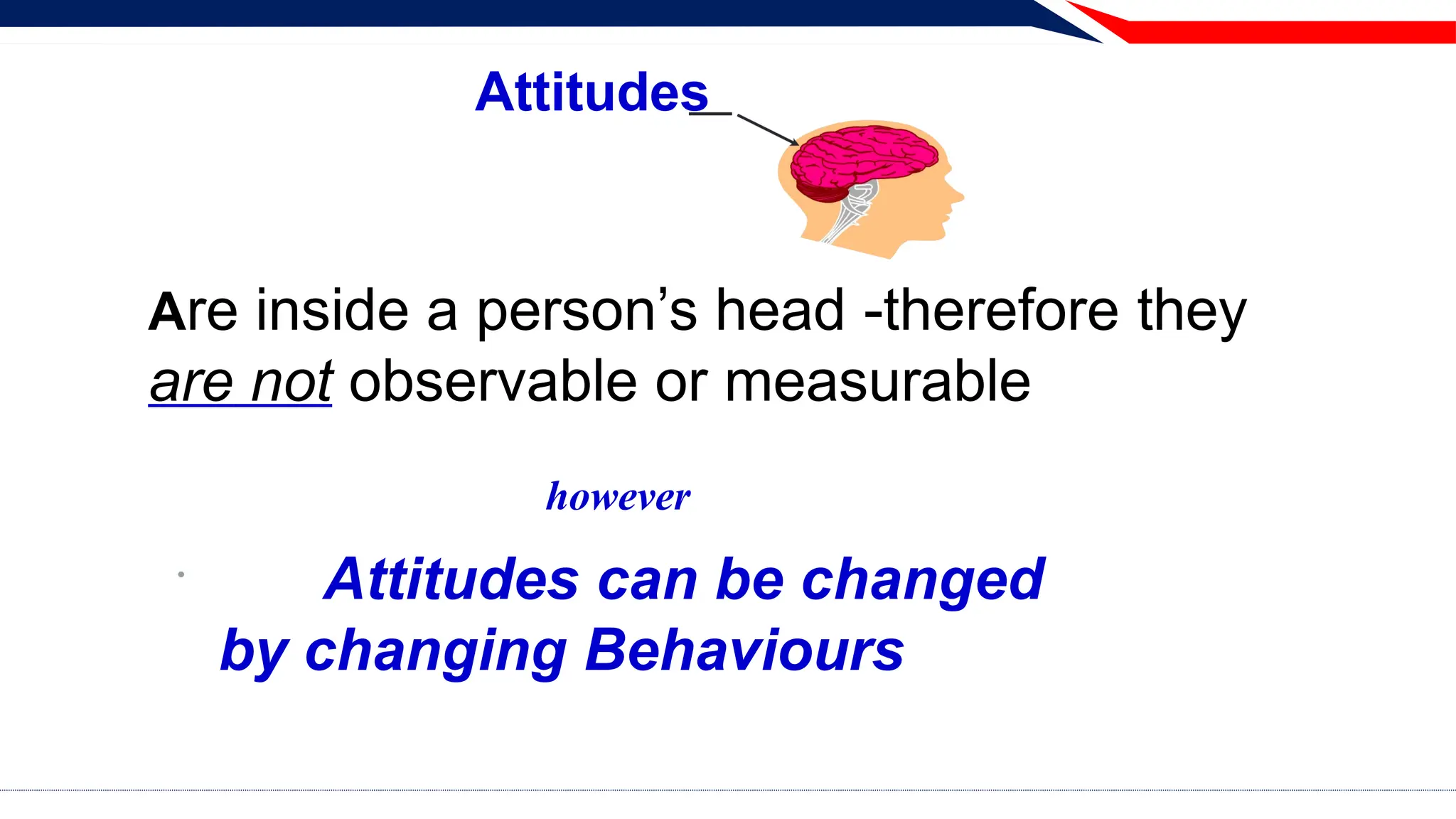
Attitudes
Are inside a person’s head -therefore they
are not observable or measurable
however

Attitudes can be changed
by changing Behaviours
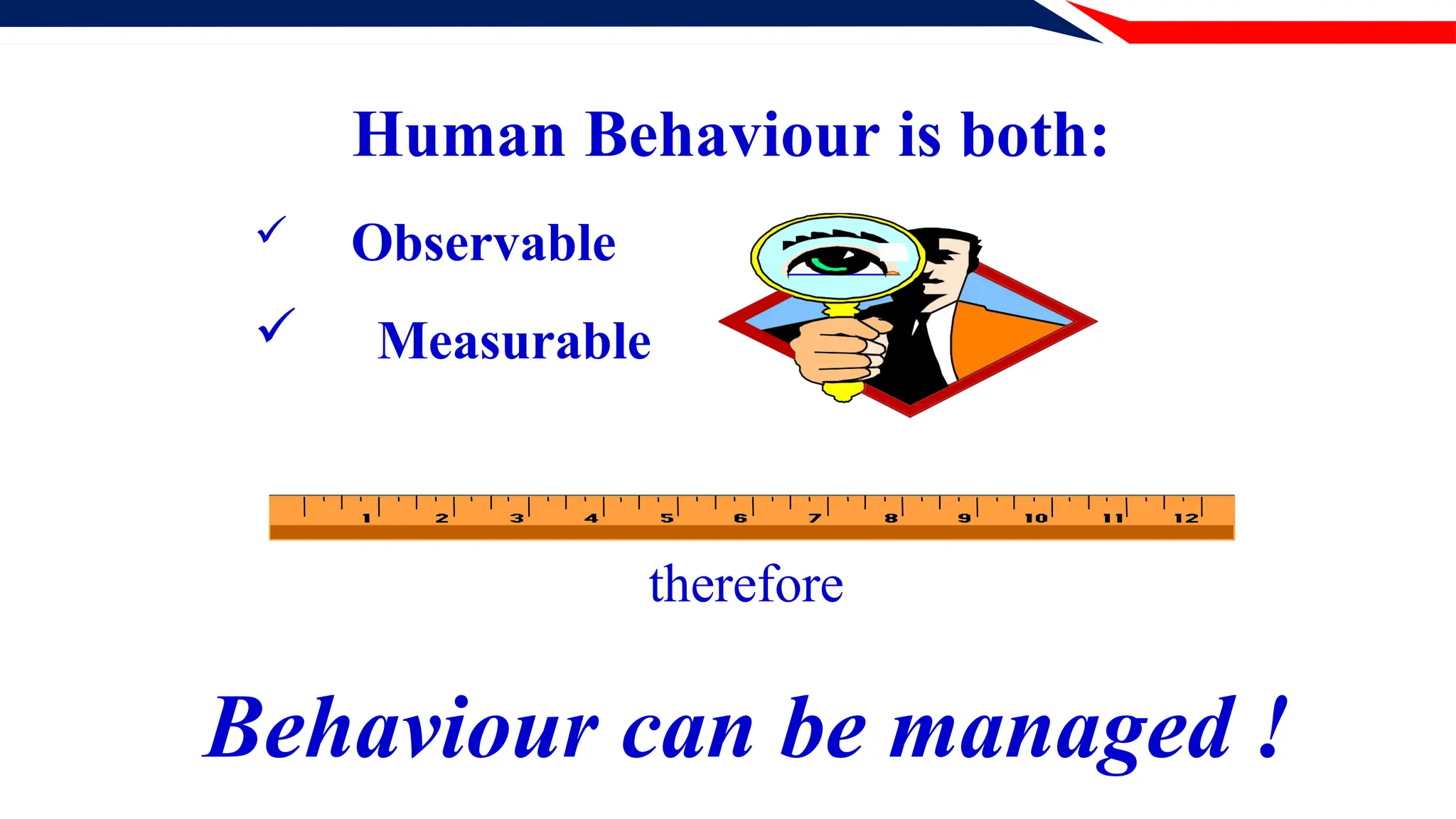
Human Behaviour is both:
 Observable
 Measurable
therefore
Behaviour can be managed !
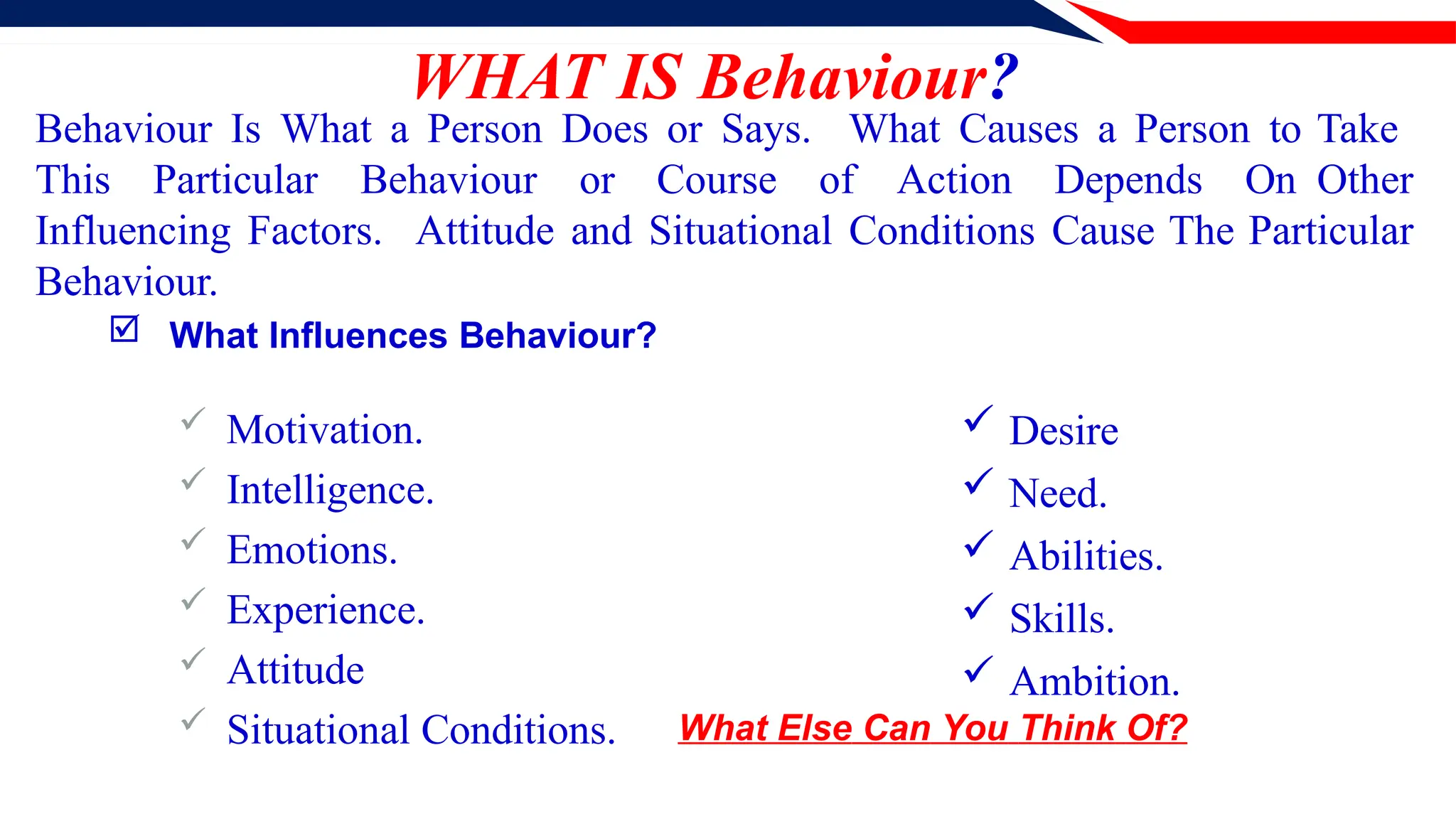
WHAT IS Behaviour?
 Motivation.
 Intelligence.
 Emotions.
 Experience.
 Attitude
 Situational Conditions.
Behaviour Is What a Person Does or Says. What Causes a Person to Take
This Particular Behaviour or Course of Action Depends On Other
Influencing Factors. Attitude and Situational Conditions Cause The Particular
Behaviour.
 What Influences Behaviour?
 Desire
 Need.
 Abilities.
 Skills.
 Ambition.
What Else Can You Think Of?
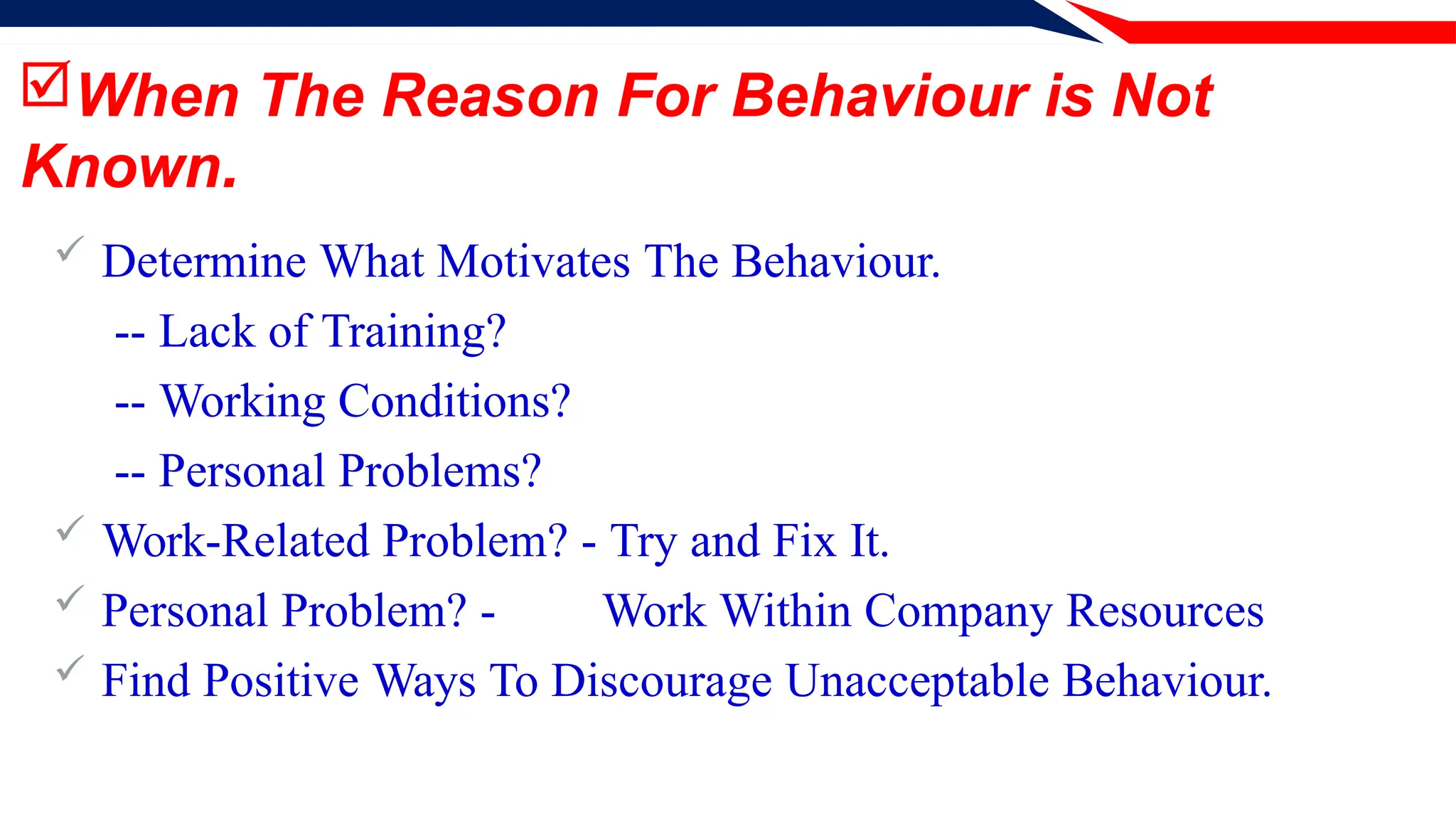
When The Reason For Behaviour is Not
Known.
 Determine What Motivates The Behaviour.
-- Lack of Training?
-- Working Conditions?
-- Personal Problems?
 Work-Related Problem? - Try and Fix It.
 Personal Problem? - Work Within Company Resources
 Find Positive Ways To Discourage Unacceptable Behaviour.
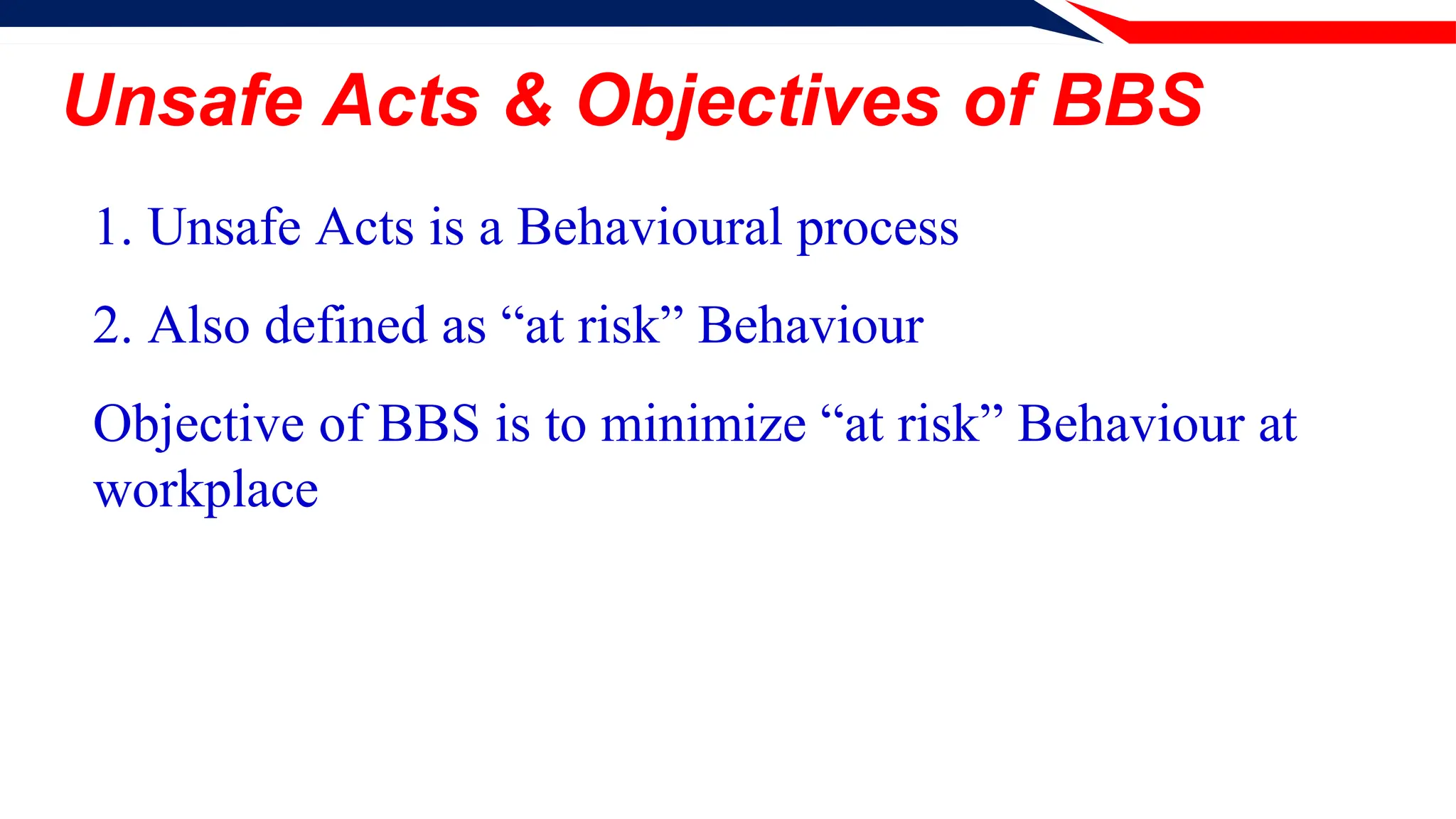
Unsafe Acts & Objectives of BBS
1. Unsafe Acts is a Behavioural process
2. Also defined as “at risk” Behaviour
Objective of BBS is to minimize “at risk” Behaviour at
workplace
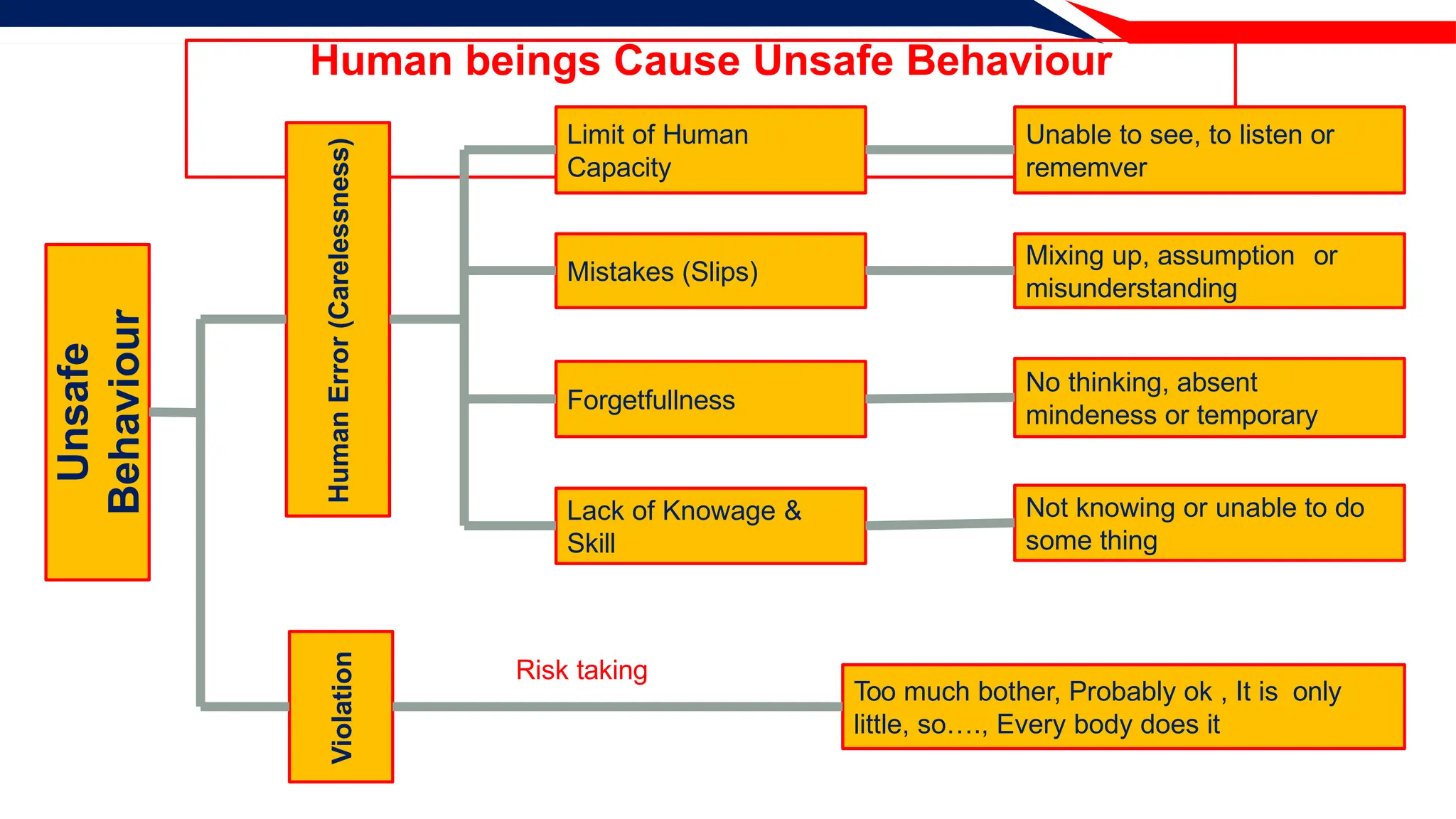
Human beings Cause Unsafe Behaviour
Unsafe
Behaviour
Violation
Human
Error
(Carelessness)
Limit of Human
Capacity
Mistakes (Slips)
Forgetfullness
Lack of Knowage &
Skill
Unable to see, to listen or
rememver
Mixing up, assumption or
misunderstanding
No thinking, absent
mindeness or temporary
Not knowing or unable to do
some thing
Too much bother, Probably ok , It is only
little, so…., Every body does it
Risk taking
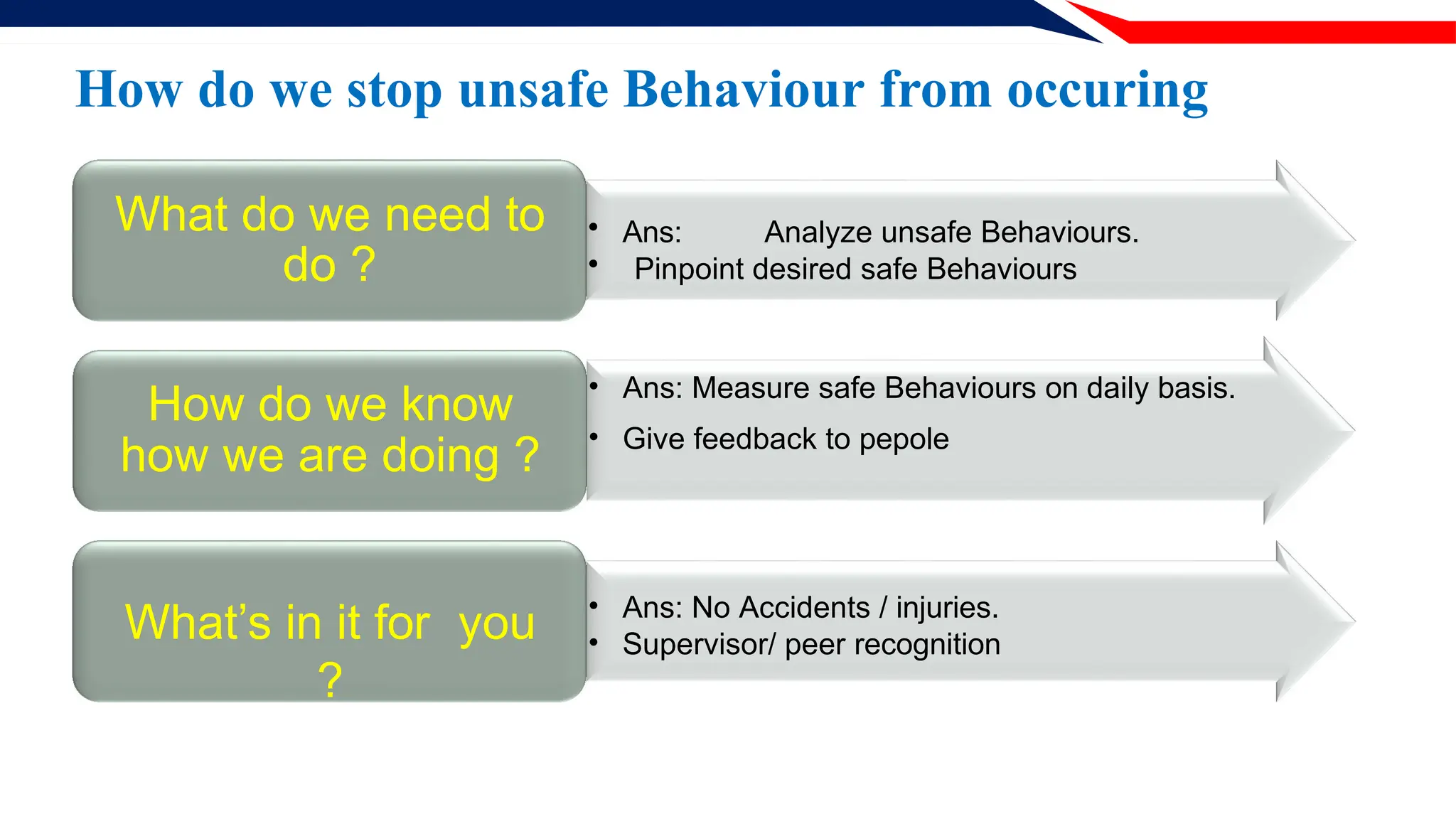
How do we stop unsafe Behaviour from occuring
• Ans: Analyze unsafe Behaviours.
• Pinpoint desired safe Behaviours
• Ans: Measure safe Behaviours on daily basis.
• Give feedback to pepole
• Ans: No Accidents / injuries.
• Supervisor/ peer recognition
What do we need to
do ?
How do we know
how we are doing ?
What’s in it for you
?
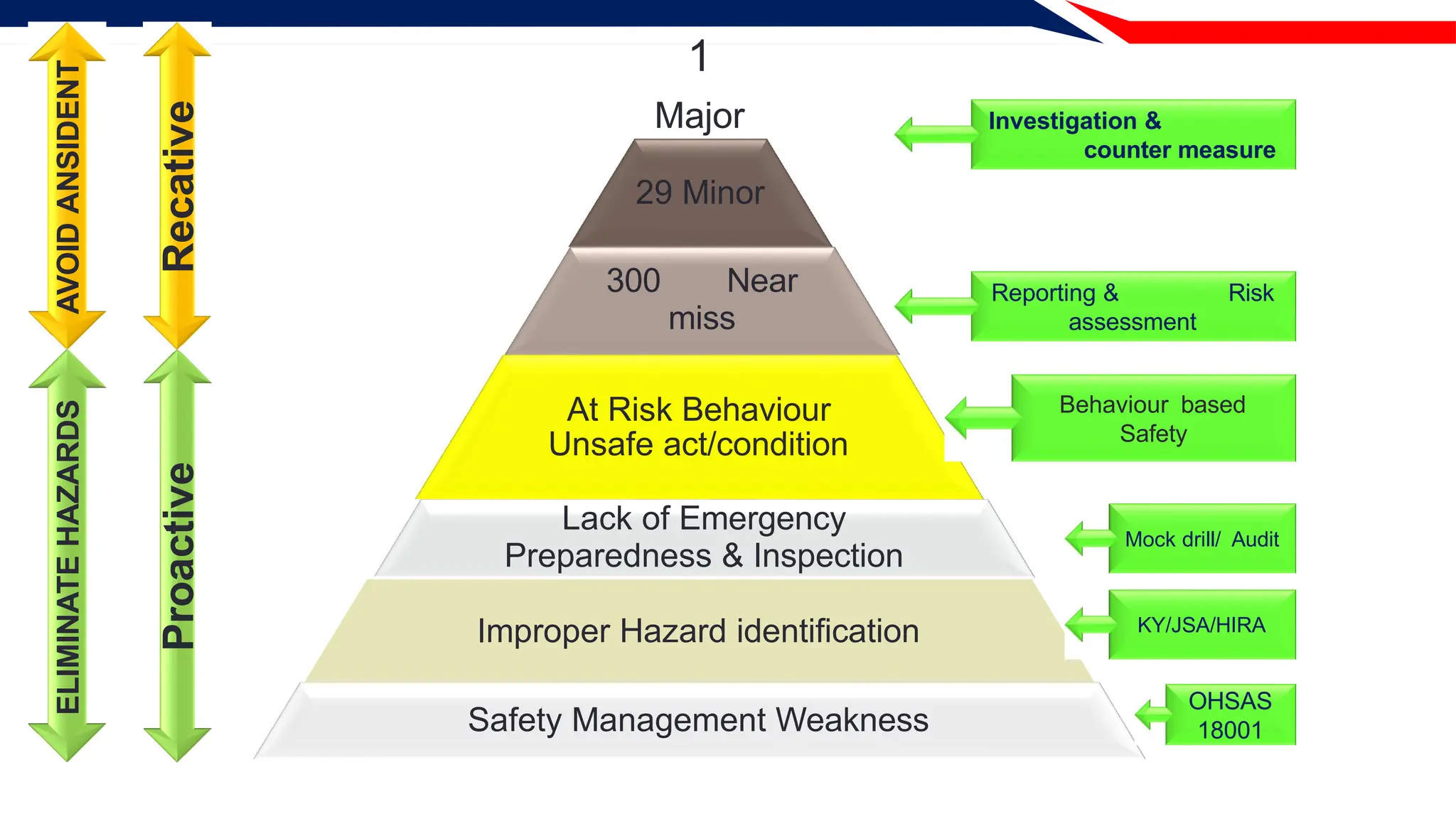
1
Major
29 Minor
300 Near
miss
At Risk Behaviour
Unsafe act/condition
Lack of Emergency
Preparedness & Inspection
Improper Hazard identification
Safety Management Weakness
Proactive
Recative
OHSAS
18001
KY/JSA/HIRA
Investigation &
counter measure
Risk
Reporting &
assessment
Behaviour based
Safety
Mock drill/ Audit
AVOID
ANSIDENT
ELIMINATE
HAZARDS
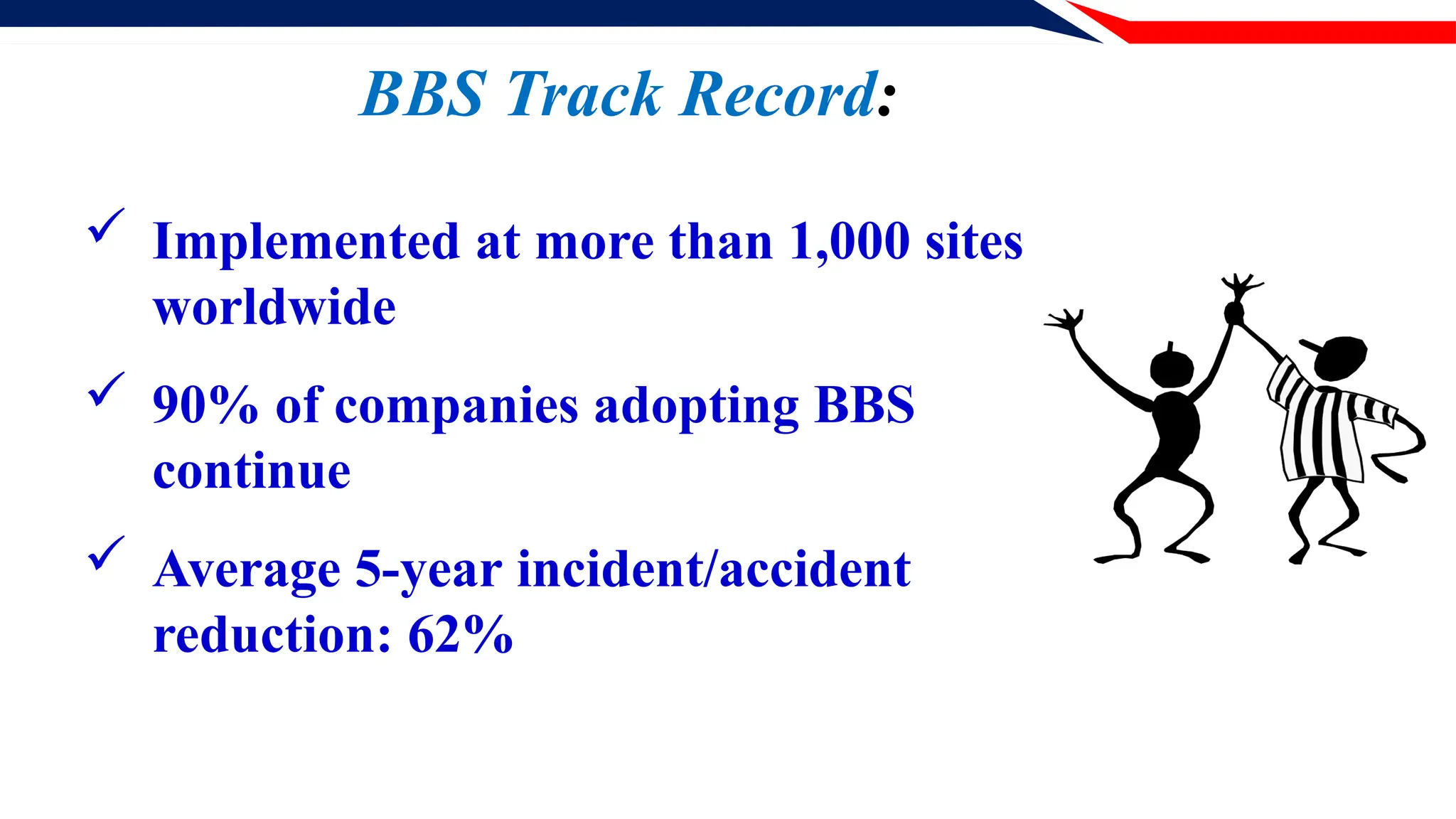
BBS Track Record:
 Implemented at more than 1,000 sites
worldwide
 90% of companies adopting BBS
continue
 Average 5-year incident/accident
reduction: 62%
Why Employees Engage in At-Risk
Behaviours
Jobs get done faster
Perception that risk is low
“Nothing is going to happen to me” attitude
At-risk Behaviour is reinforced
Lack of awareness that Behaviour is risky
ABC
Model
Based on scientific research in Behaviour analysis
Three-term contingency (if-then relationship)
A – Antecedents
• Before Behaviour
• Anything that prompts people to act
B – Behaviour
• Actions
• What we do, what we say
C – Consequences
• Effects of Behaviour
• What happens to the person as a result of the
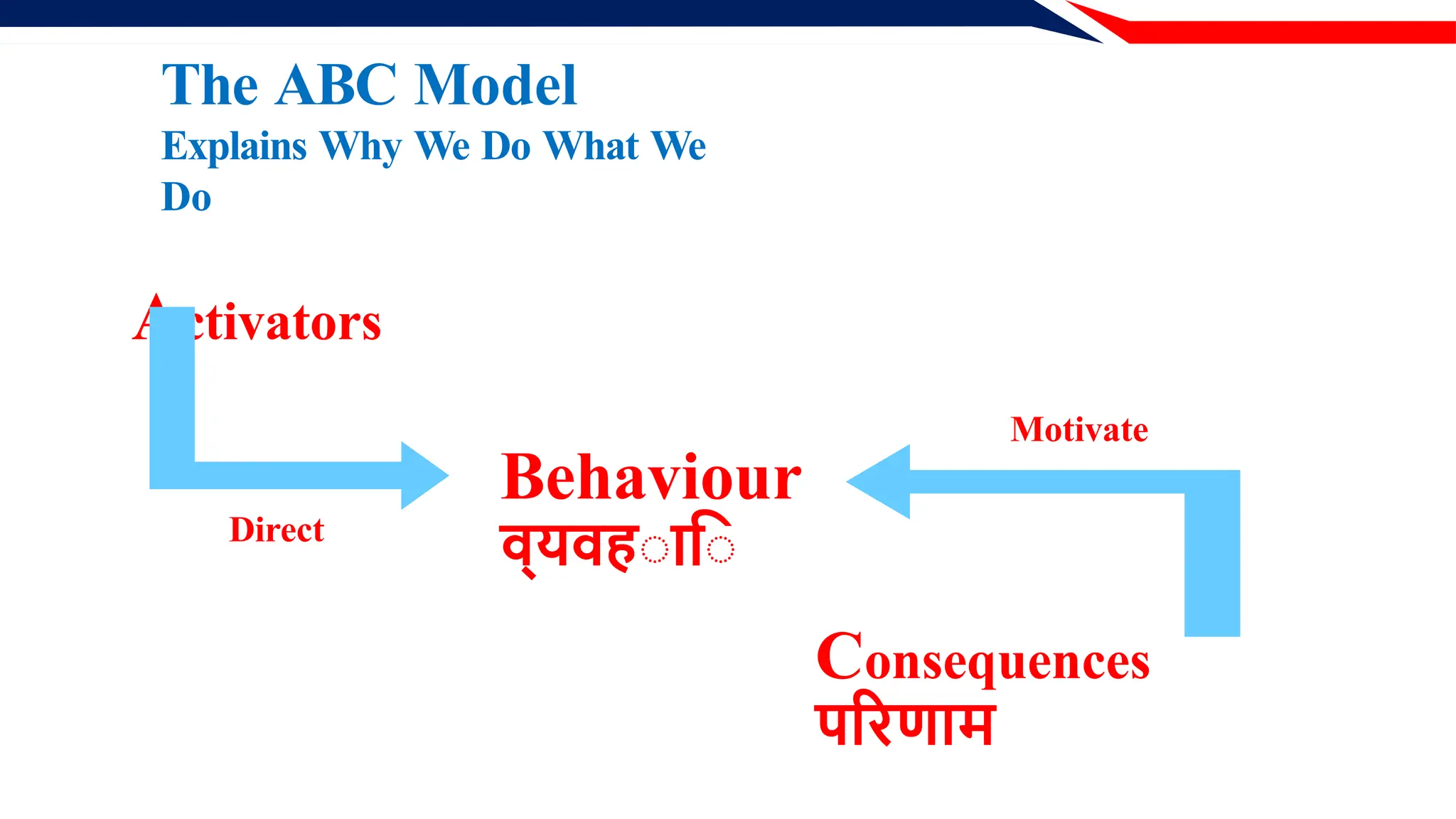
The ABC Model
Explains Why We Do What We
Do
Activators
Consequences
परिणाम
Behaviour
व्यवहाि
Direct
Motivate
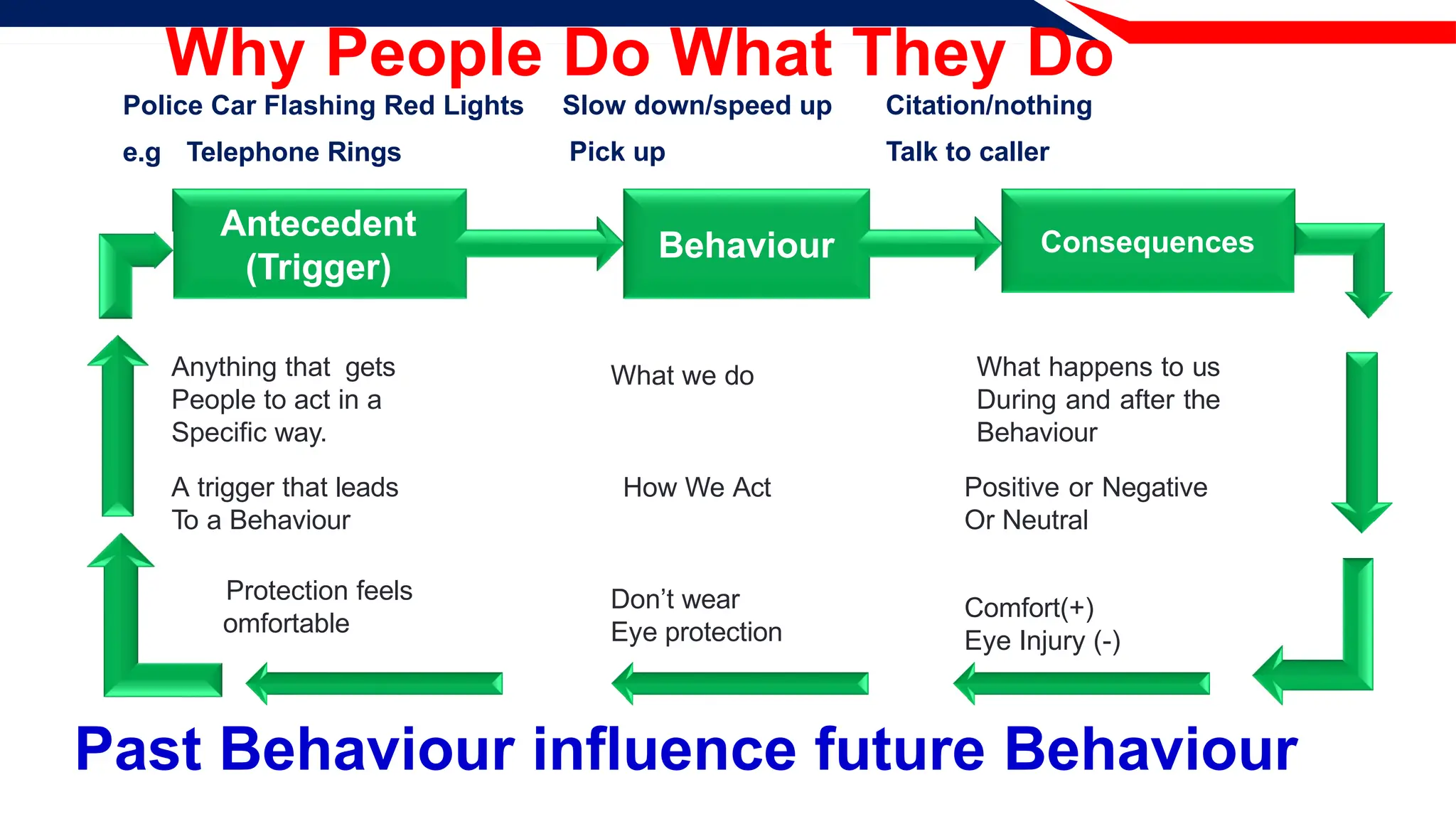
Why People Do What They Do
Antecedent
(Trigger)
Behaviour Consequences
e.g Telephone Rings
Anything that gets
People to act in a
Specific way.
A trigger that leads
To a Behaviour
Eye
unc
Protection feels
omfortable
What we do
How We Act
Don’t wear
Eye protection
What happens to us
During and after the
Behaviour
Positive or Negative
Or Neutral
Comfort(+)
Eye Injury (-)
Past Behaviour influence future Behaviour
Police Car Flashing Red Lights Slow down/speed up
Pick up
Citation/nothing
Talk to caller
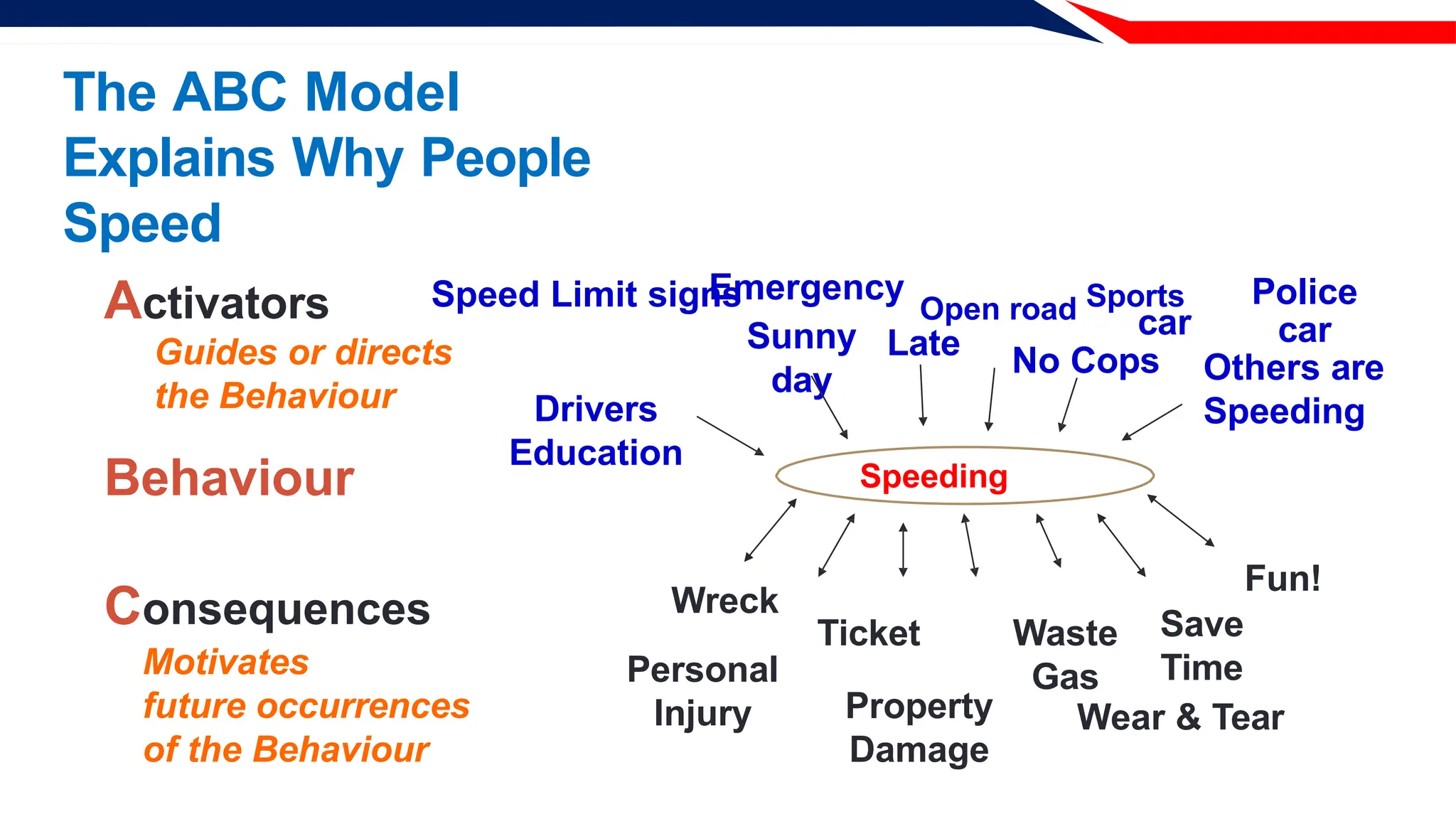
The ABC Model
Explains Why People
Speed
Speeding
Activators
Guides or directs
the Behaviour
Behaviour
Consequences
Motivates
future occurrences
of the Behaviour
Late
day
Emergency
Open road Sports
car
No Cops
Police
car
Others are
Speeding
Speed Limit signs
Sunny
Drivers
Education
Wear & Tear
Wreck
Personal
Injury
Ticket
Property
Damage
Waste
Gas
Fun!
Save
Time
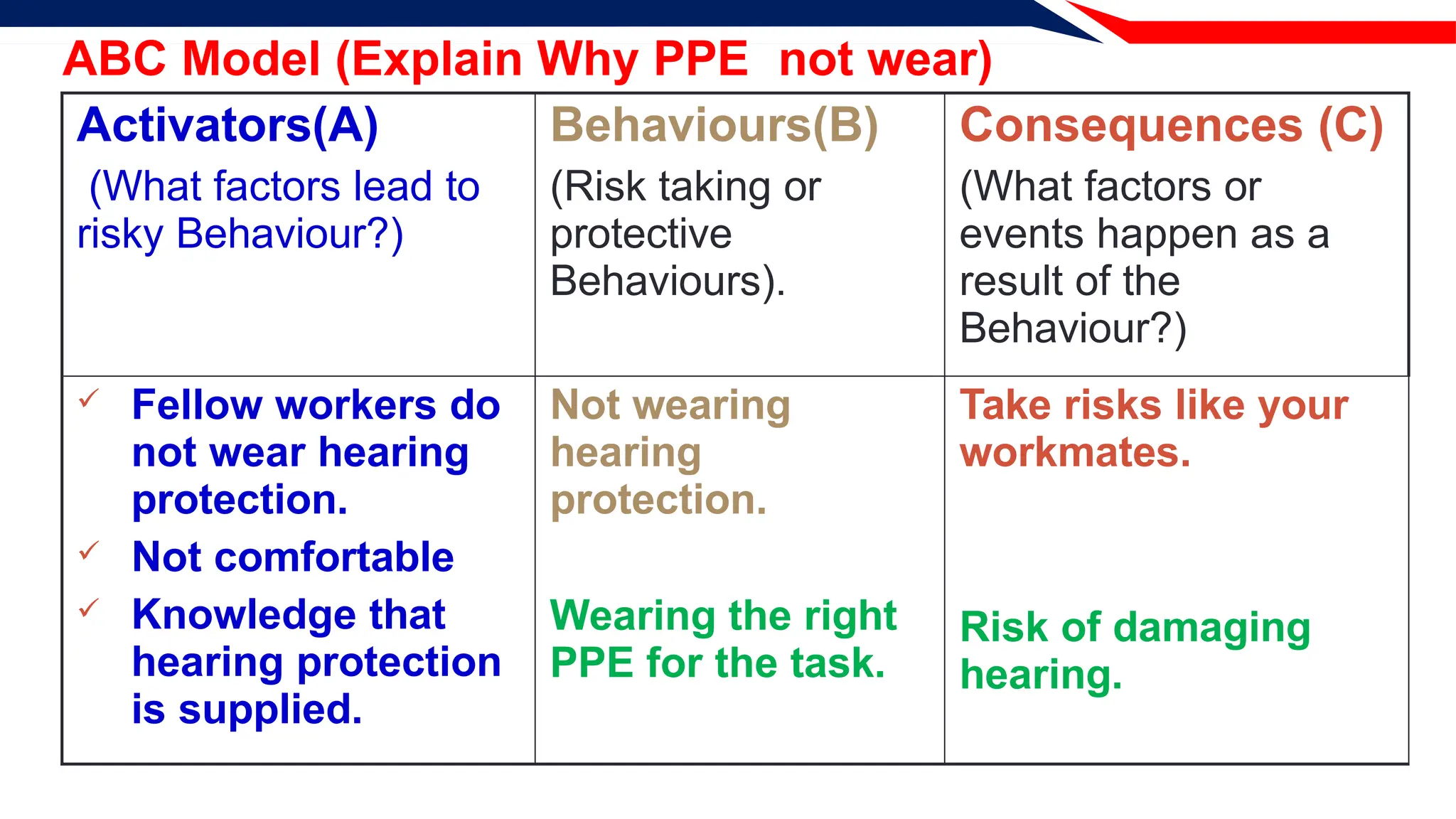
Activators(A)
(What factors lead to
risky Behaviour?)
Behaviours(B)
(Risk taking or
protective
Behaviours).
Consequences (C)
(What factors or
events happen as a
result of the
Behaviour?)
 Fellow workers do
not wear hearing
protection.
 Not comfortable
 Knowledge that
hearing protection
is supplied.
Not wearing
hearing
protection.
Wearing the right
PPE for the task.
Take risks like your
workmates.
Risk of damaging
hearing.
ABC Model (Explain Why PPE not wear)
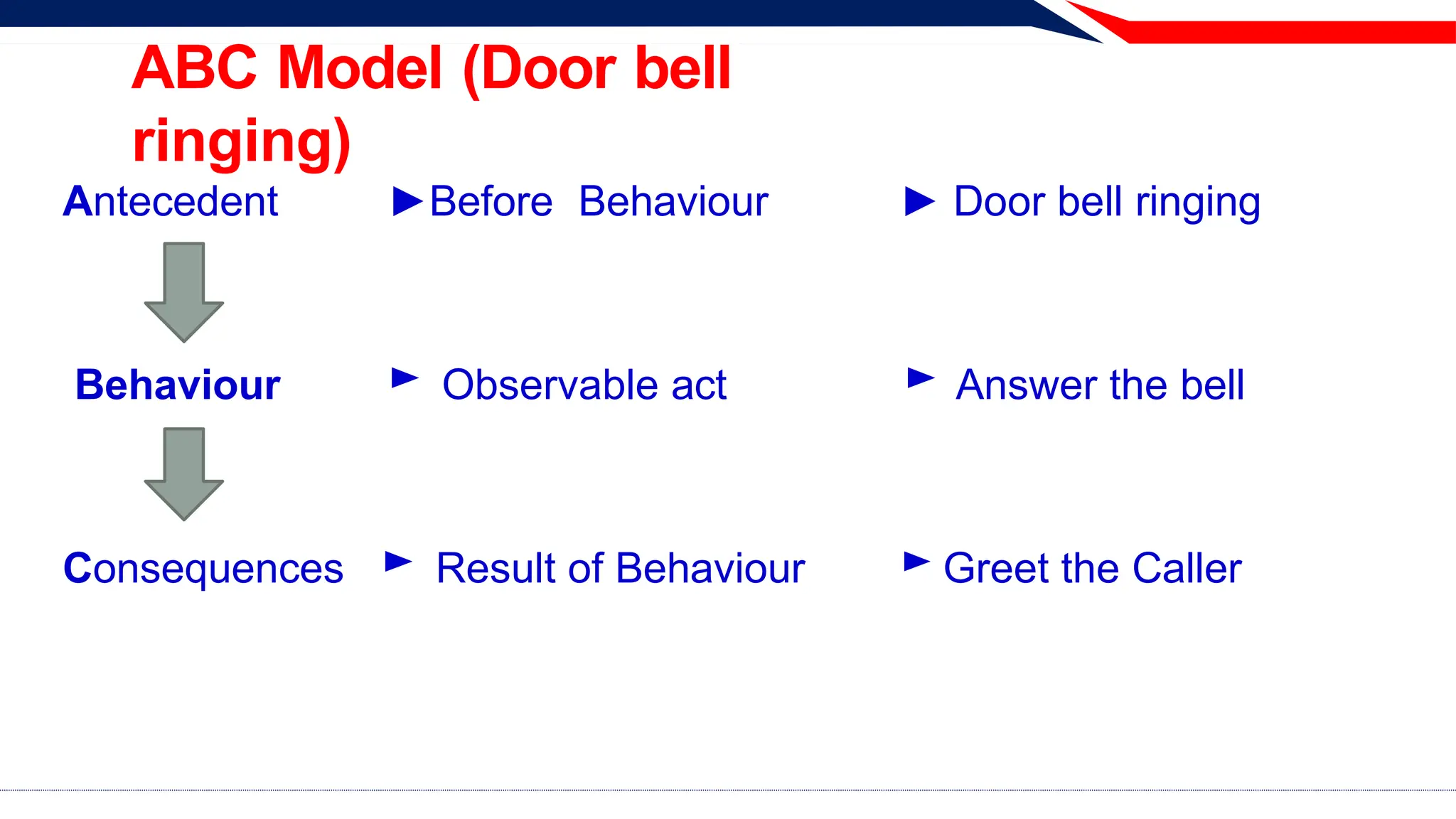
ABC Model (Door bell
ringing)
Antecedent ►Before Behaviour ► Door bell ringing
Behaviour ► Observable act ► Answer the bell
Consequences ► Result of Behaviour ► Greet the Caller
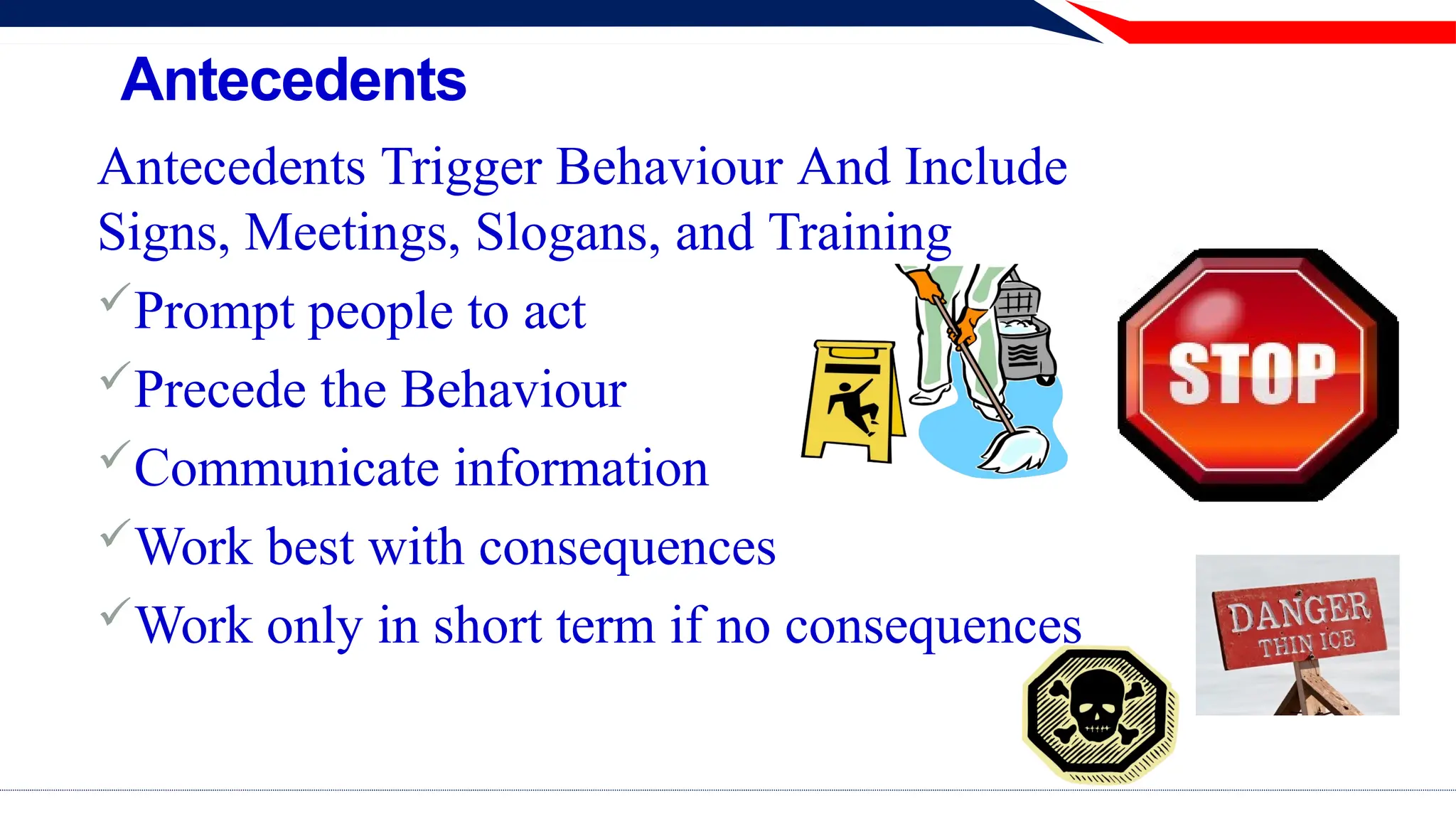
Antecedents
Antecedents Trigger Behaviour And Include
Signs, Meetings, Slogans, and Training
Prompt people to act
Precede the Behaviour
Communicate information
Work best with consequences
Work only in short term if no consequences
What are the
Antecedents
Equipment not available
Cultural norms
Time Pressure
Equipment condition
Inadequate warning
Consequences
Factor Timing ----Sooner/ Later ?
 Consistency ----Certain/ Uncertain ?
 Significance ----Positive/ Negative ?
Stronger than antecedents
“Consequences” has negative connotation(अतिरिक्त
मिलब)
Positive consequences change Behaviour
Consequences strengthen or weaken Behaviour
Four categories of consequences
1. Punishment
2. Extinction
3. Negative Reinforcement
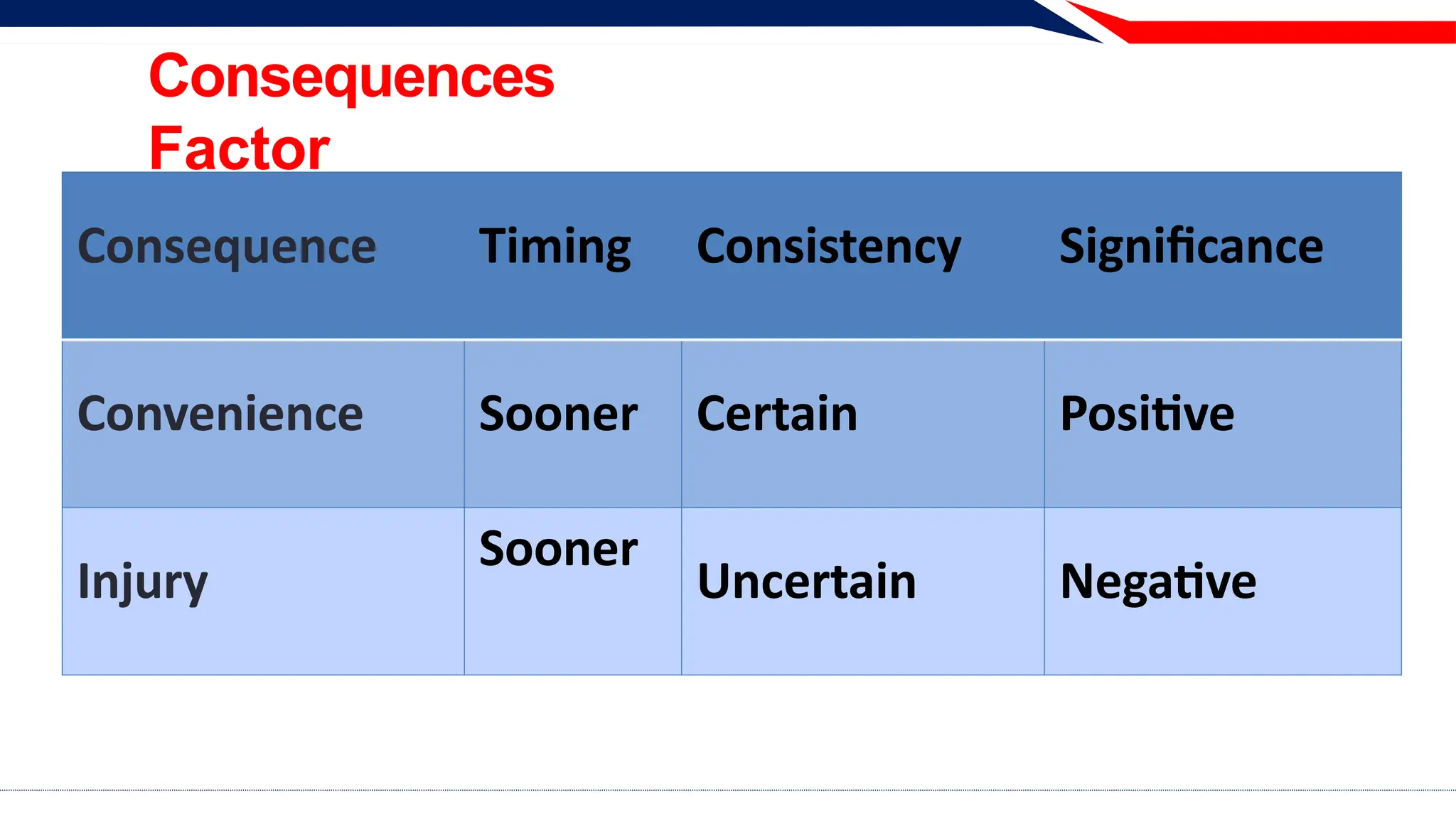
Consequence Timing Consistency Significance
Convenience Sooner Certain Positive
Injury
Sooner
Uncertain Negative
Consequences
Factor
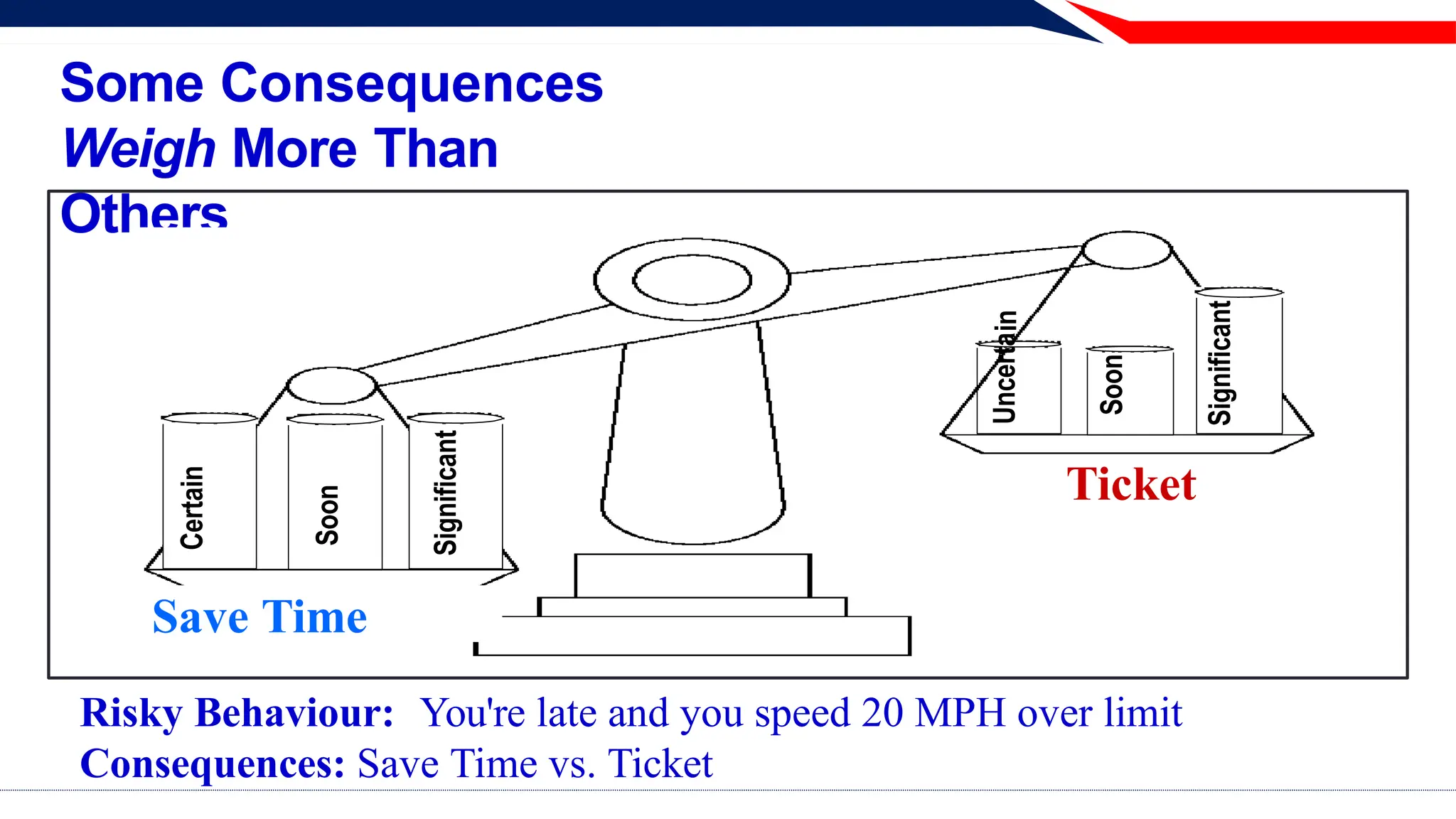
Some Consequences
Weigh More Than
Others
Risky Behaviour: You're late and you speed 20 MPH over limit
Consequences: Save Time vs. Ticket
Save Time
Ticket
Uncerta
in
Soon
Significant
Soon
Certain
Significant
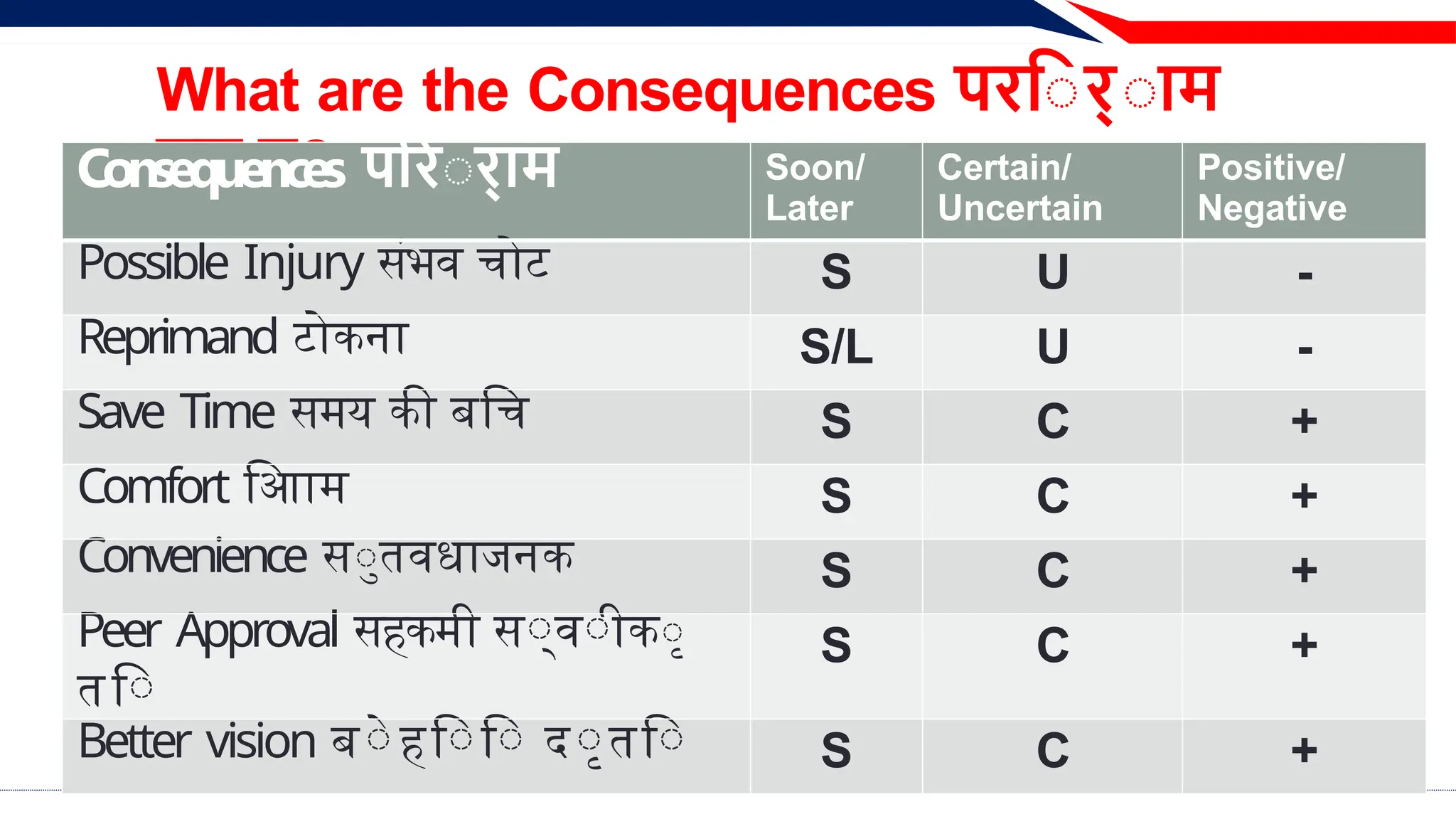
What are the Consequences परिर् ाम
क्या ह?
Consequences परिर्ाम Soon/
Later
Certain/
Uncertain
Positive/
Negative
Possible Injury संभव चोट S U -
Reprimand टोकना S/L U -
Save Time समय की बचि S C +
Comfort आिाम S C +
Convenience सुतवधाजनक S C +
Peer Approval सहकमी स्वीकृ
ति
S C +
Better vision बेहिि दृति S C +
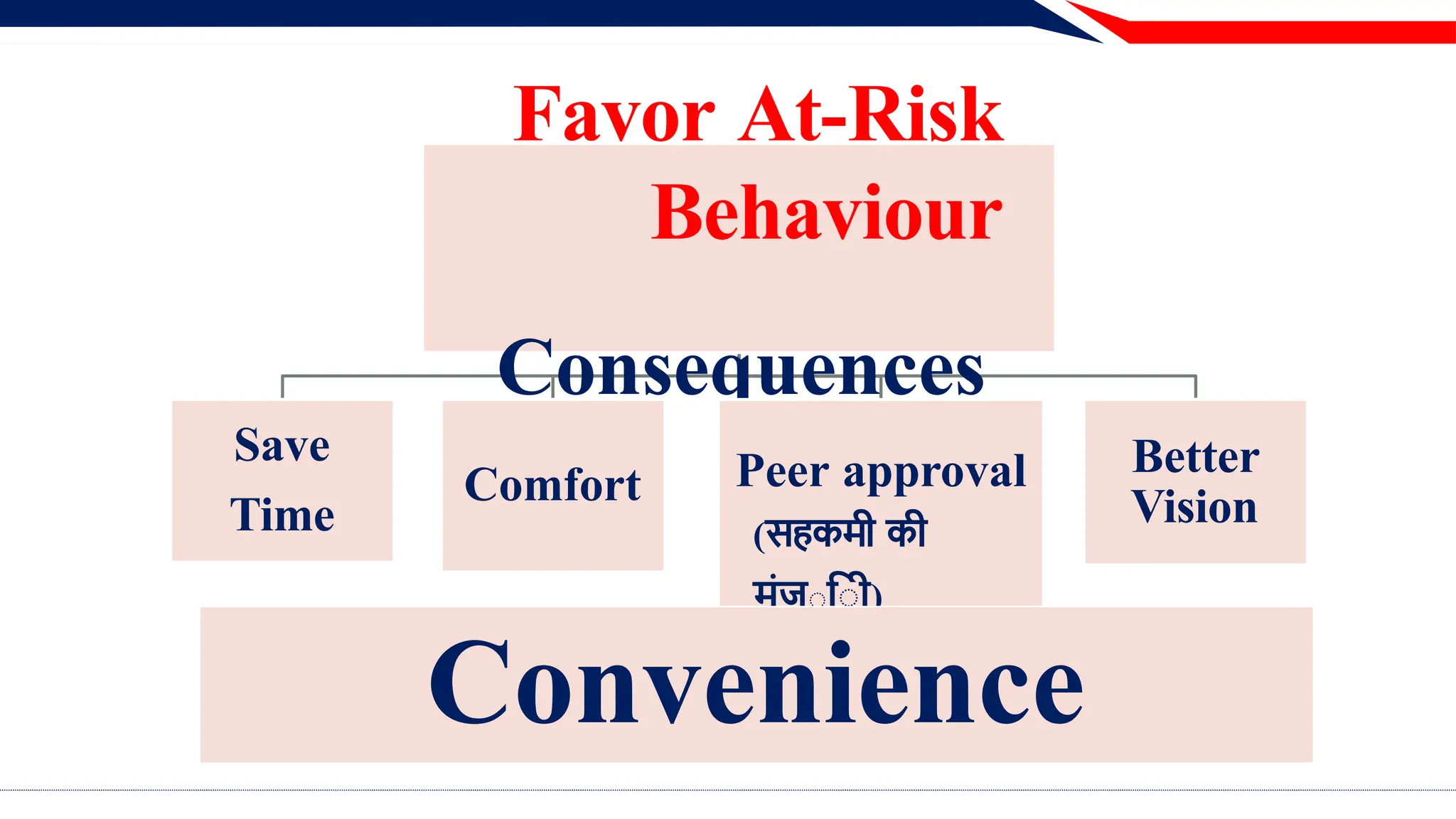
Favor At-Risk
Behaviour
Consequences
Save
Time
Comfort Peer approval
(सहकमी की
मंजू िी)
Better
Vision
Convenience
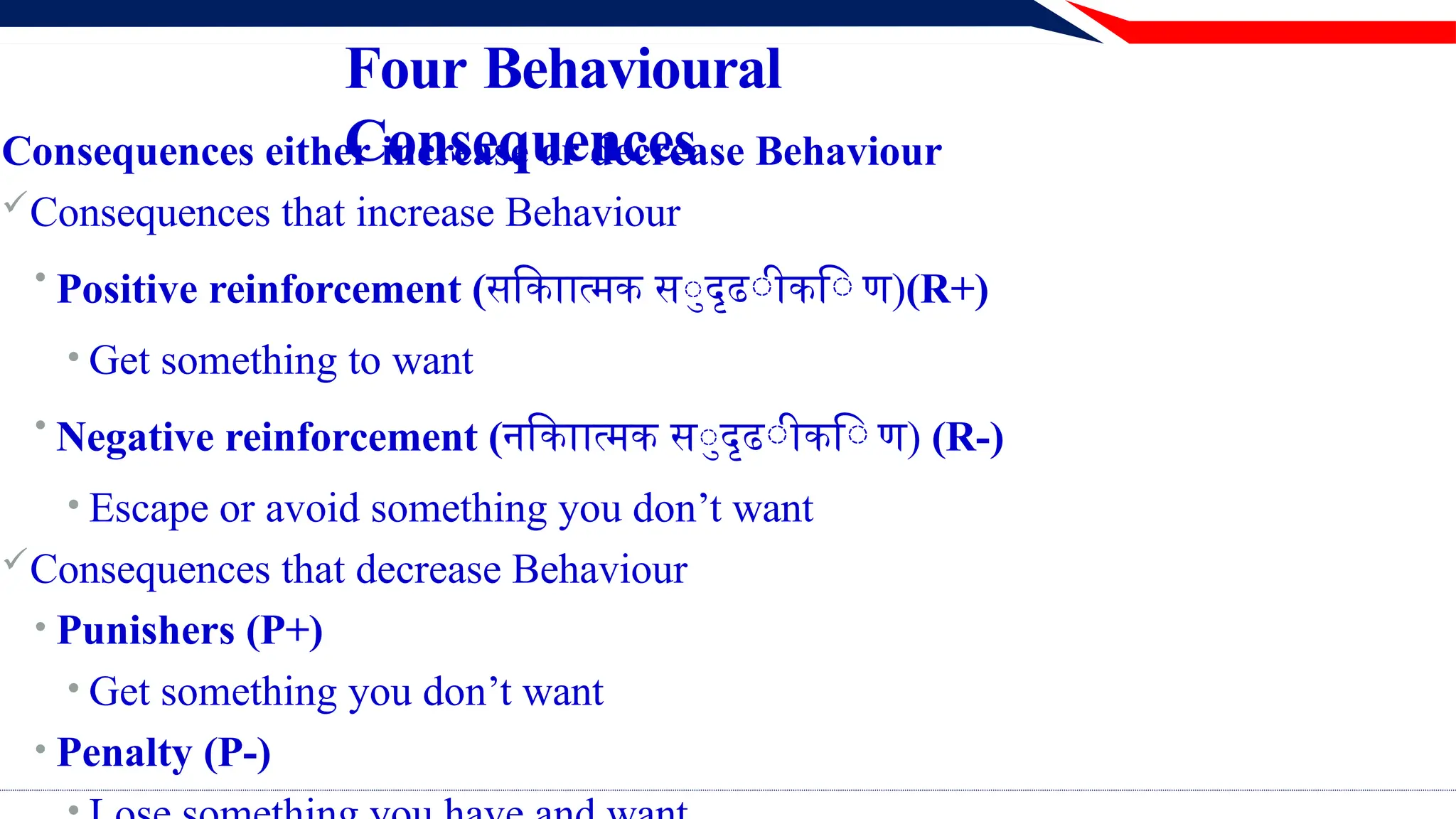
Four Behavioural
Consequences
Consequences either increase or decrease Behaviour
Consequences that increase Behaviour
• Positive reinforcement (सकािात्मक सुदृढीकि ण)(R+)
• Get something to want
• Negative reinforcement (नकािात्मक सुदृढीकि ण) (R-)
• Escape or avoid something you don’t want
Consequences that decrease Behaviour
• Punishers (P+)
• Get something you don’t want
• Penalty (P-)
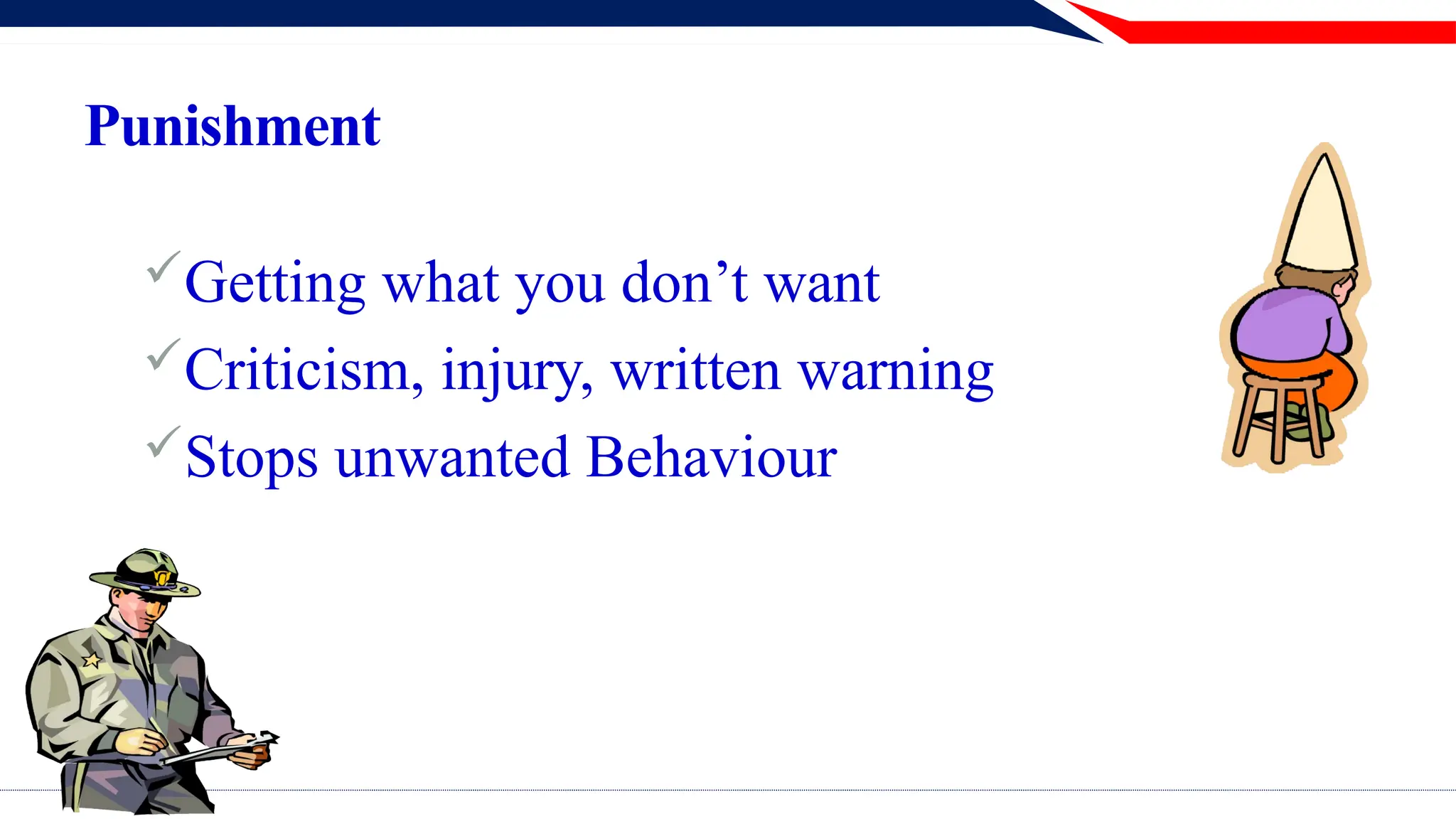
Punishment
Getting what you don’t want
Criticism, injury, written warning
Stops unwanted Behaviour
Negative
Reinforcement
 Not getting what you don’t want
 Avoiding criticism, unpleasant tasks, or accidents
 Performing desired Behaviour to avoid punishment
Performing desired Behaviour only when boss is watching
Positive
Reinforcement
 Getting what you want
Acknowledgement, recognition, better work assignments
 Maintains or increases desired Behaviour
 Gives discretionary effort (more than asked)
 Behaviour occurs more frequently
Examine the
Behaviour
Results of the consequences
How employee receives it
Behaviour increasing
Behaviour decreasing
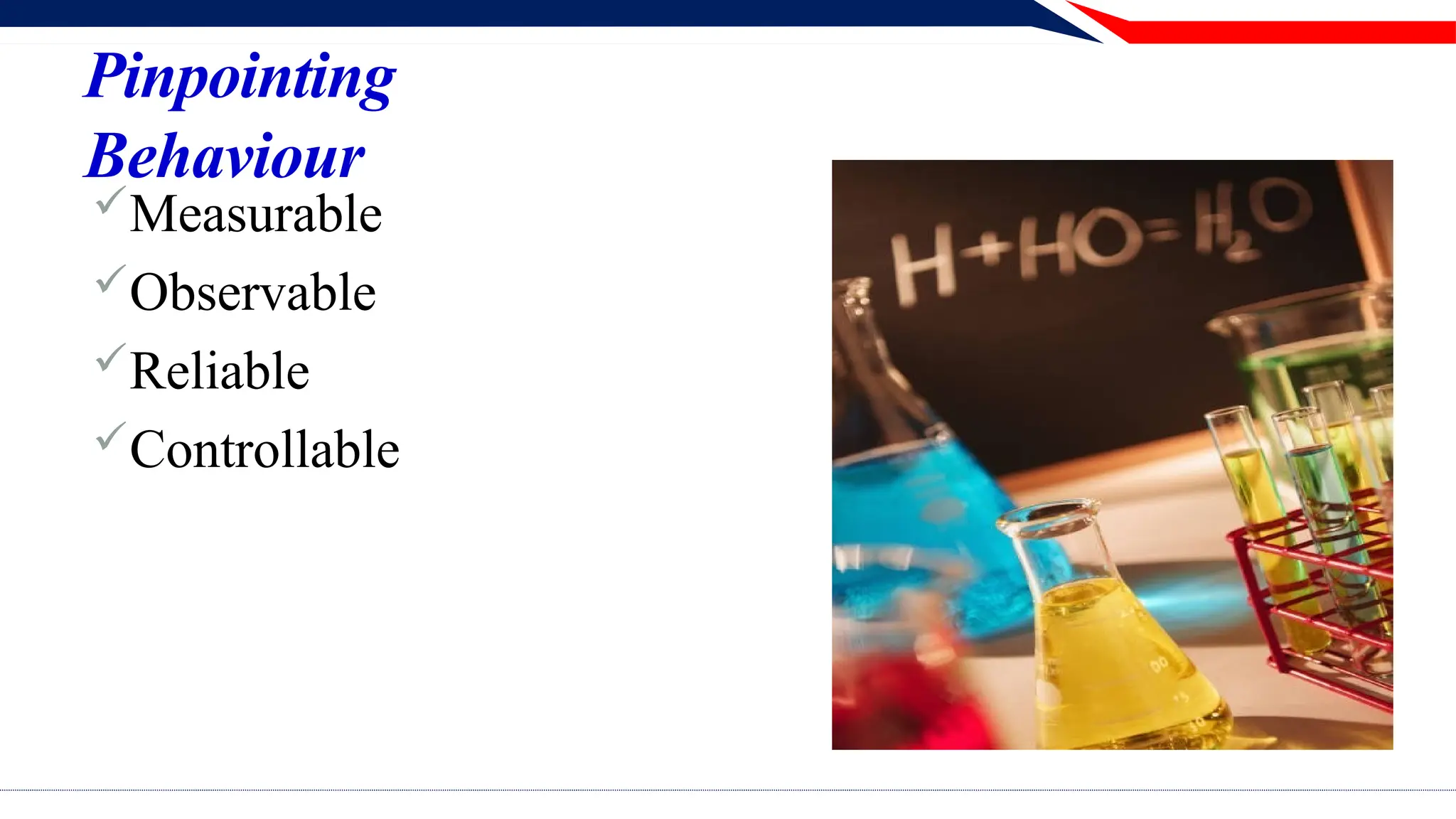
Pinpointing
Behaviour
Measurable
Observable
Reliable
Controllable
Behaviour
Observation
Observation Lead to Feedback And
Involment
Observation checklist
Spot check Behaviours
If safe Behaviour, mark “safe”
In unsafe Behaviour, mark “At Risk”
Turn card in
Observation and
Feedback
 Employees observe one another
 Improves safety-related behaviours
Observer follows checklist of critical safety-related behaviours
 Observer provides feedback to the observee
Observer and observee problem solve to identify improvements.
Observation and
Feedback
 Collect and compile observation checklists
 Graph collected data
Review resulting information periodically with all
employees
Analyze and discuss results to identify follow-up actions.
Measurement
 Records observations and analyzes
 Uses objective measurement
 Measures safety process, not just results
Gives feedback to employees and capture small
improvements
Is specific about performance and becomes positive
reinforcement
Positive Verbal Feedback
 Be specific
 Be sincere
 Deliver immediately
 Be personal
 Don’t use “but” or “however”
Corrective Verbal Feedback
 Don’t ignore unsafe Behaviour
 Acknowledge small improvements
 Be objective
 Be specific
 Use a questioning approach
Graphic Feedback
 Past performance or baseline
 Current goals
 Presented and discussed frequently
Goal
Setting
Short-term and achievable
Employee input
More opportunities for positive reinforcement
Types of Positive Reinforcement
Social reinforcement
 Written
 Verbal
 Physical
 Smile
 Humor
 Time or attention
 Just say “Thank you”
Tangible reinforcement
 Food
 Gifts
 Certificates
 Privileges
 Money
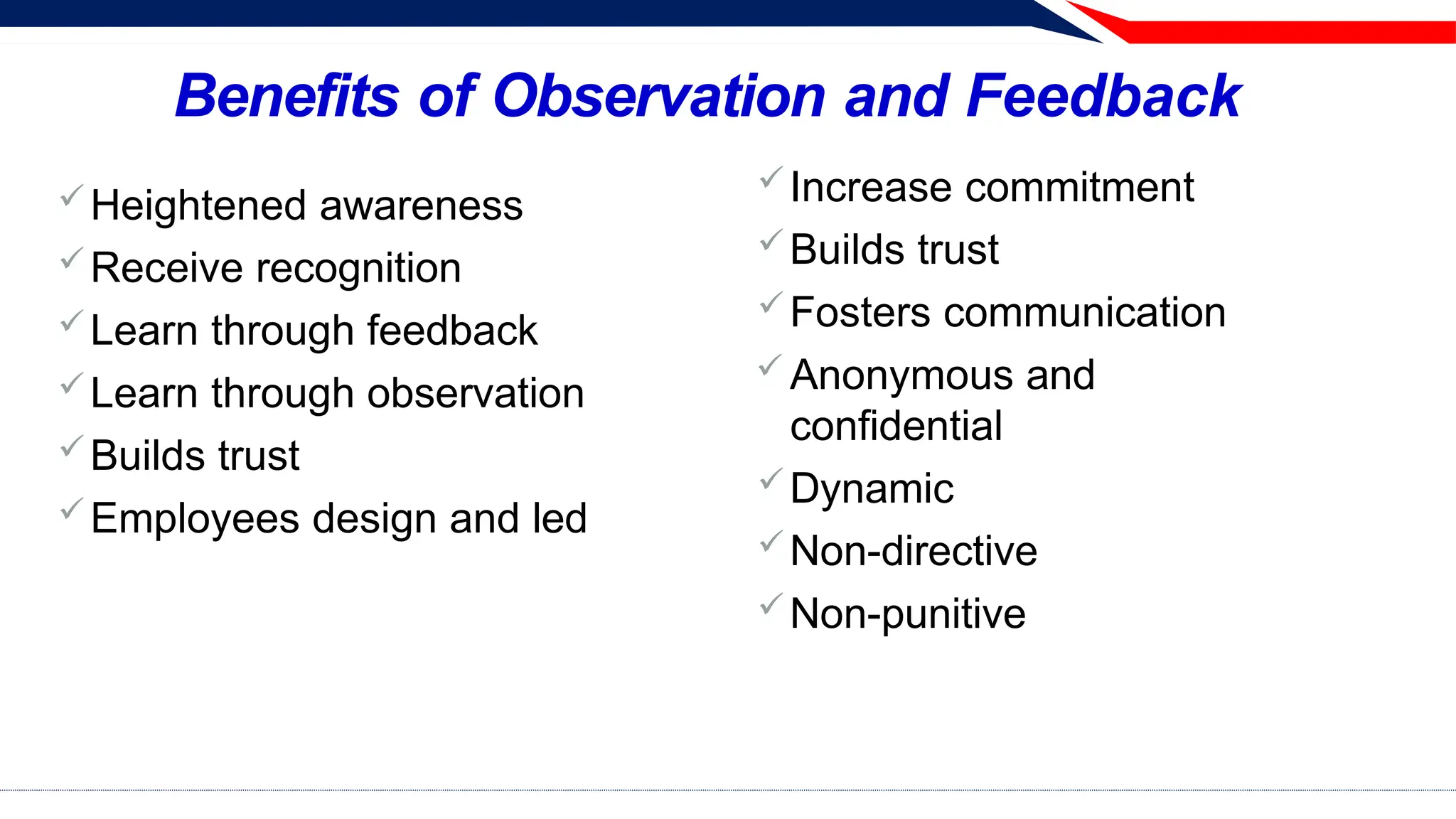
Benefits of Observation and Feedback
Heightened awareness
Receive recognition
Learn through feedback
Learn through observation
Builds trust
Employees design and led
Increase commitment
Builds trust
Fosters communication
 Anonymous and
confidential
Dynamic
Non-directive
Non-punitive
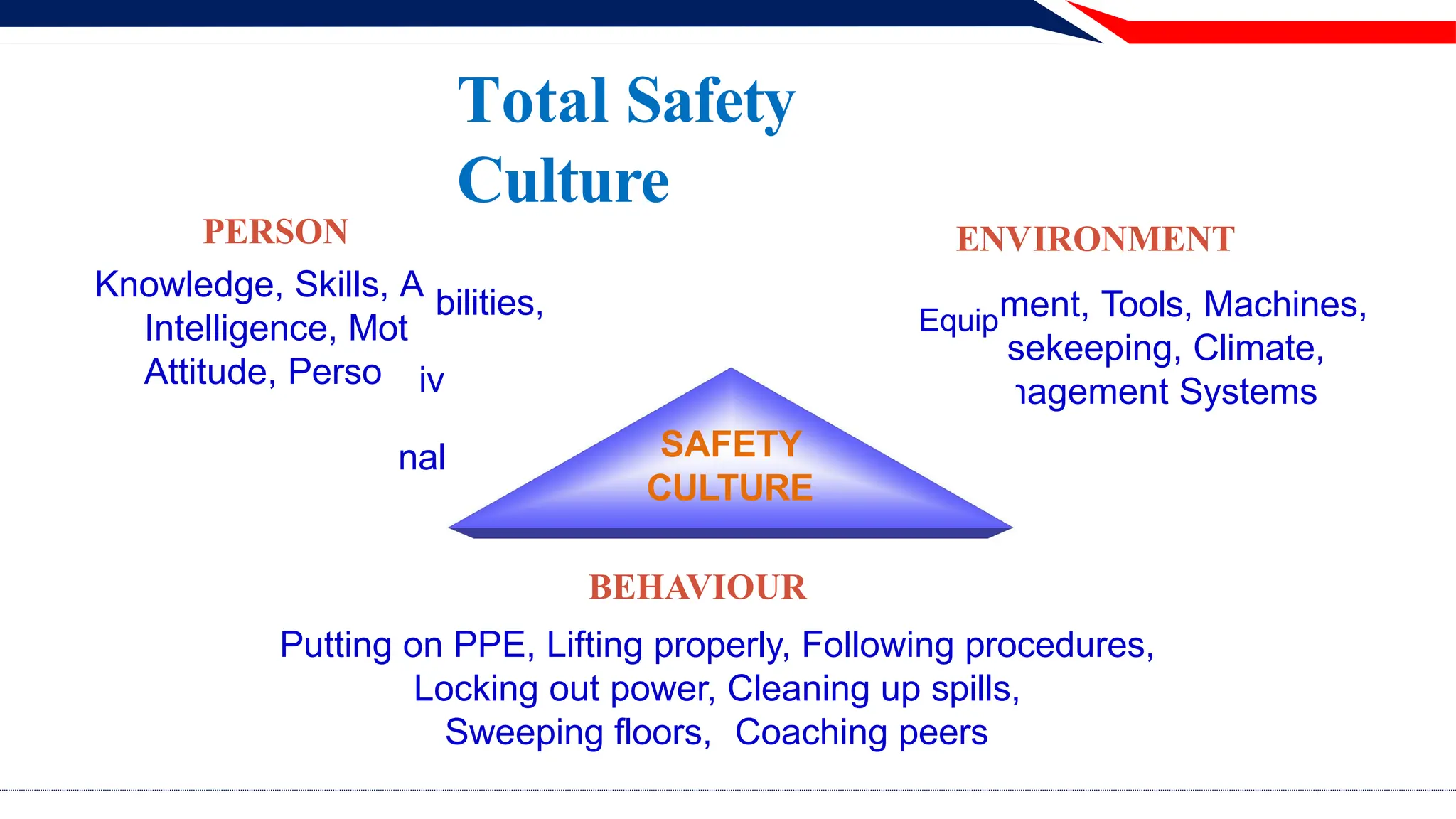
Total Safety
Culture
IRONMENT
ment, Tools, Machines,
sekeeping, Climate,
nagement Systems
BEHAVIOUR
Putting on PPE, Lifting properly, Following procedures,
Locking out power, Cleaning up spills,
Sweeping floors, Coaching peers
PERSON
Knowledge, Skills, A
Intelligence, Mot
Attitude, Perso
ENV
bilities, Equip
ives, Hou
nality Ma
SAFETY
CULTURE
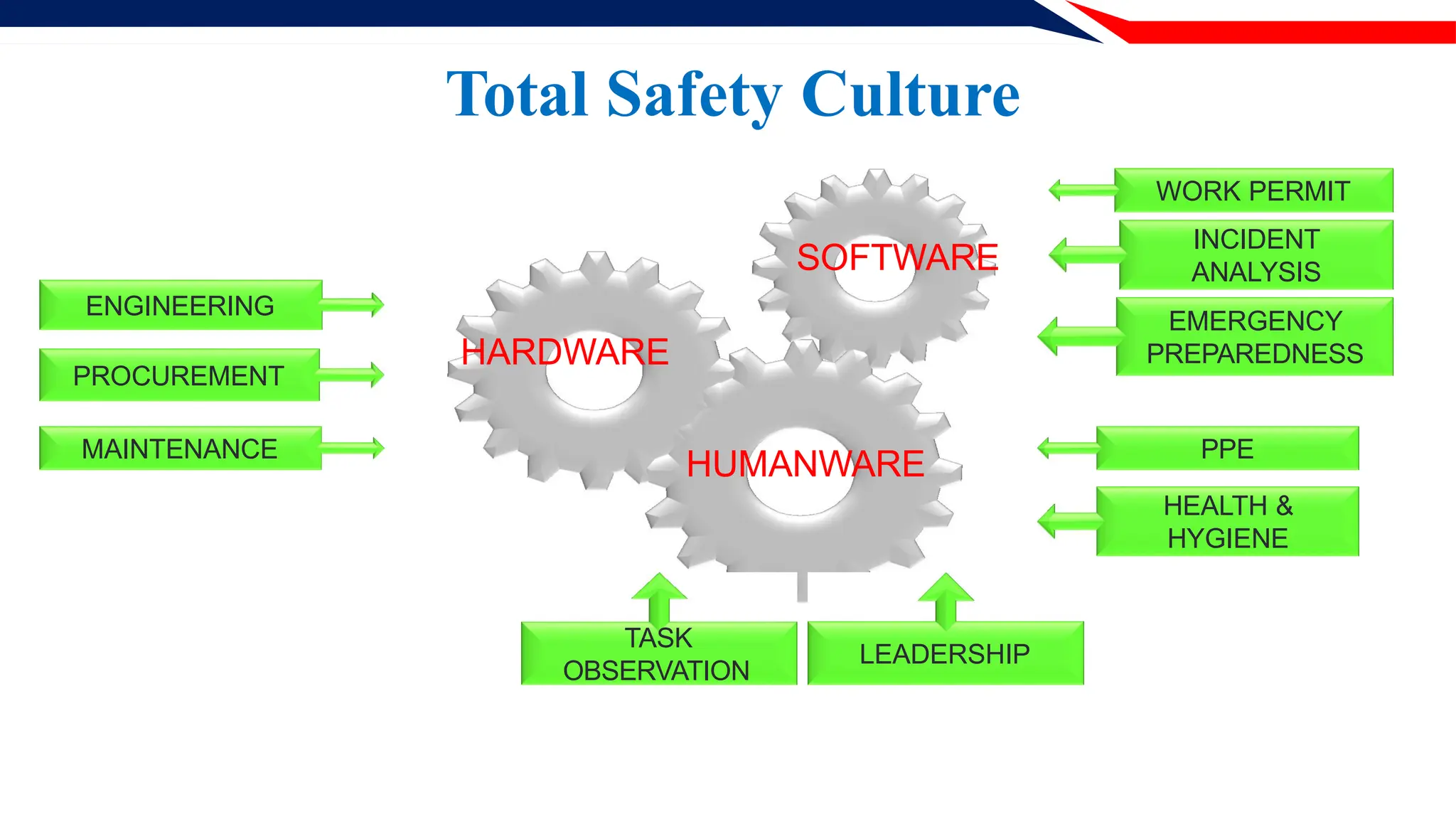
PROCUREMENT
ENGINEERING
WORK PERMIT
MAINTENANCE
INCIDENT
ANALYSIS
EMERGENCY
PREPAREDNESS
PPE
HEALTH &
HYGIENE
HUMANWARE
HARDWARE
SOFTWARE
LEADERSHIP
TASK
OBSERVATION
Total Safety Culture
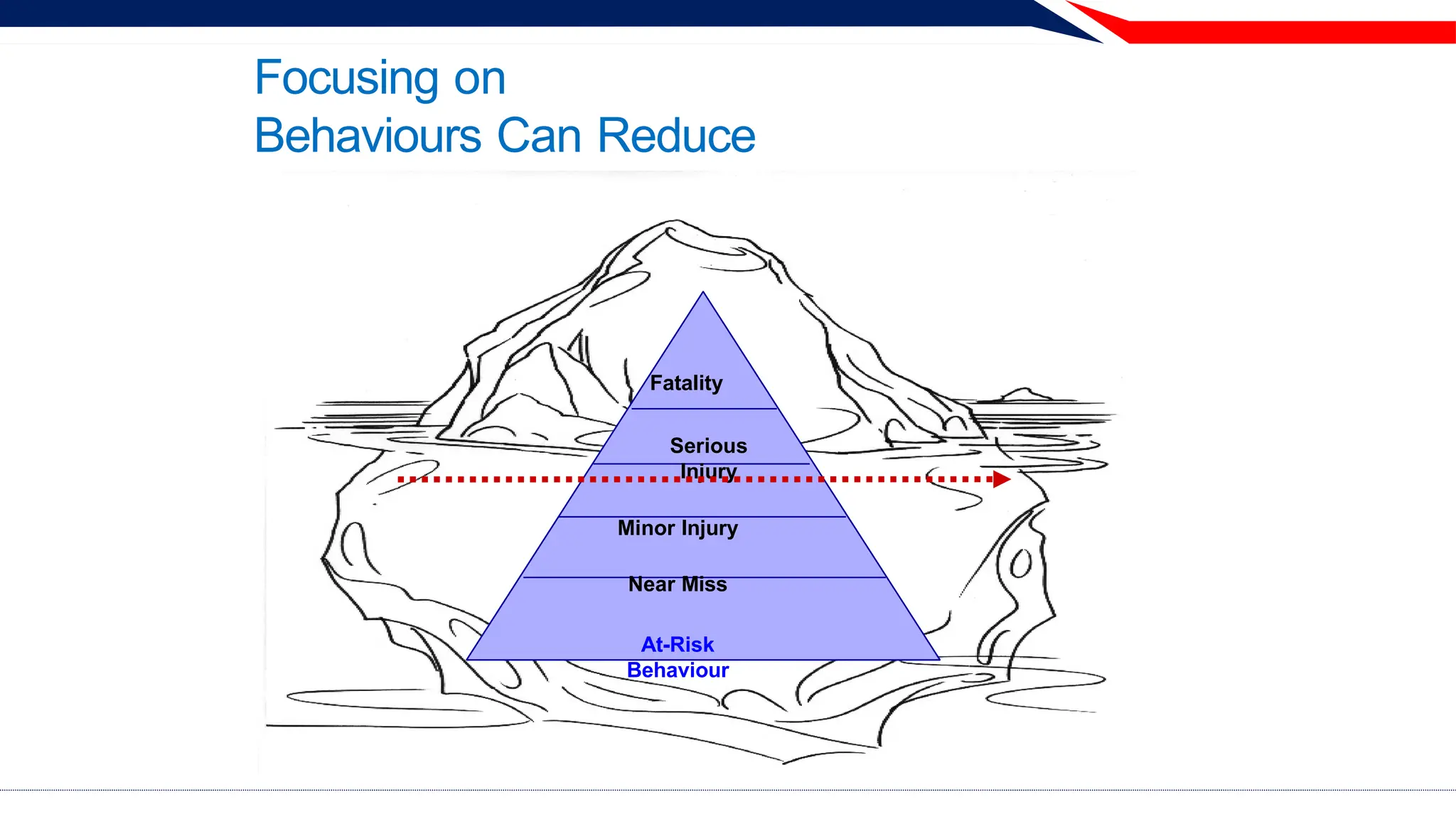
Focusing on
Behaviours Can Reduce
Injuries
Fatality
Serious
Injury
Minor Injury
Near Miss
At-Risk
Behaviour
Behaviour Based Safety for safety practices

Behaviour Based Safety for safety practices

  • 1.
    Behaviour Based Safety OrganizedBy: Bharat Seats Ltd.
  • 2.
    Injury Statistics .. . In INDIA Question: Are injuries totally eliminated?  In 2021, the Labor Ministry informed Parliament that at least 6,500 employees had died while working at factories, ports, mines and construction sites in the preceding 5 years.
  • 3.
    Session Objectives:  Understandhow safety Behaviour is shaped  Understand Principles of BBS  Analyze employee Behaviour  Pinpoint, observe, and measure specific Behaviours  Provide positive feedback Use positive reinforcement successfully to improve safety performance  Safety Culture Adherences periodically assessment
  • 4.
  • 5.
    Theories of AccidentCausation: The most widely known theories of accident causation:  Domino theory  Human factors theory  Accident / incident theory  Epidemiological theory  Systems theory  Combination theory  Behavioural theory
  • 6.
    Heinrich’s Theorems Accidents: An eventwhich is, Unplanned & Unexpected which may or may not have resulted in damage to property or injury to person.  Injury - Caused by accidents.  Accidents- Caused by an unsafe act –injured person or an unsafe condition – work place.  Unsafe acts/conditions - caused by careless persons or poorly designed or improperly maintained equipment.  Fault of persons- created by social environment or acquired by ancestry.  Social environment/ancestry (वंश परंपरा)- where and how a person was raised and educated.
  • 7.
  • 8.
    Domino Theory Herbert W. Heinrich– Traveler’s Insurance Company In the late 1920’s, studying reports of 75,000 workplace accidents, he concluded the following: 88% of accidents are caused by unsafe acts committed by fellow workers 10% of accidents are caused by unsafe conditions 2% of accidents are unavoidable Contemporary research considers domino theory as outdated however today’s more widely accepted theories can be traced back to Heinrich’s study.
  • 9.
    Accident Causes • Unsafe Condition •improper guarding • defective tool • slippery floor • improper housekeeping  Unsafe Act operating without authority operating at unsafe speed making safety devices inoperative using unsafe equipment
  • 11.
    Domino Theory 1932 First ScientificApproach to Accident/Prevention - H.W. Heinrich “Industrial Accident Prevention” Social Environment and Ancestry Fault of the Person (Carelessness) Unsafe Act or Condition Accident Injury MISTAKES OF PEOPLE
  • 12.
    Physiological & Psychological Lack ofKnowledge & Unskill Improper Mechanical or Physical condition, Unsafe system of work, Social Environment Origin Of Faults Human Failure Unsafe Acts Accident Injury Loss Direct Cause Unsafe Condition Direct Cause CHAIN OF EVENTS RESULT
  • 13.
    Managing Safety or Managing Accident Reactive Approach Injury /Damage Accident Causatives Safety Proactive Approach  Safety  Causatives  Accident  Injury / Damage
  • 14.
    What Is BehaviourBased Safety? Behaviour Based Safety (BBS) is the “application of science of Behaviour change to real world problems.” BBS “focuses on what people do, analyses why they do it, and then applies a research – supported intervention strategy to improve what people do. At its very core BBS is based on a larger scientific field called Organizational Behaviour Analysis.
  • 15.
    Please think .. . How many of the above elements can be directly traced to injury elimination just at the moment the injury is about to occur ? Question: Are injuries totally eliminated?
  • 16.
    To Conclude .. .  Good Safety Management systems exist  Still workplace is injury prone & not safe  Injury although declined, still persists WHAT IS MISSING? WHERE IS THE CATCH?
  • 17.
    E. Scott Geller– Safety Performance Solutions, Inc., and professor of psychology Believes in 7 basic principles of BBS 1. Direct Behaviour with activator or events antecedent to the desired Behavior, and motivate employees to behave as desired with incentives and rewards that follow desired Behaviour. 2. Use intervention that is focused on employee Behaviour 3. Identify external factors that aid in understanding and improving employee Behaviour 4. Focus on the positive consequences that result from the desired Behaviour as a way to motivate employees. 5. Apply scientific method to improve attempts at Behavioural interventions. 6. Use theory to integrate information rather than to limit possibilities. 7. Plan interventions with the feelings and attitudes of the individual employee in mind. Behavioural Theory
  • 18.
     Activators (whatneeds to be done)  Competencies (how it needs to be done)  Consequences (what happens if it is done) Human Behaviour is a function of :
  • 19.
    Attitudes Are inside aperson’s head -therefore they are not observable or measurable however  Attitudes can be changed by changing Behaviours
  • 20.
    Human Behaviour isboth:  Observable  Measurable therefore Behaviour can be managed !
  • 21.
    WHAT IS Behaviour? Motivation.  Intelligence.  Emotions.  Experience.  Attitude  Situational Conditions. Behaviour Is What a Person Does or Says. What Causes a Person to Take This Particular Behaviour or Course of Action Depends On Other Influencing Factors. Attitude and Situational Conditions Cause The Particular Behaviour.  What Influences Behaviour?  Desire  Need.  Abilities.  Skills.  Ambition. What Else Can You Think Of?
  • 22.
    When The ReasonFor Behaviour is Not Known.  Determine What Motivates The Behaviour. -- Lack of Training? -- Working Conditions? -- Personal Problems?  Work-Related Problem? - Try and Fix It.  Personal Problem? - Work Within Company Resources  Find Positive Ways To Discourage Unacceptable Behaviour.
  • 23.
    Unsafe Acts &Objectives of BBS 1. Unsafe Acts is a Behavioural process 2. Also defined as “at risk” Behaviour Objective of BBS is to minimize “at risk” Behaviour at workplace
  • 24.
    Human beings CauseUnsafe Behaviour Unsafe Behaviour Violation Human Error (Carelessness) Limit of Human Capacity Mistakes (Slips) Forgetfullness Lack of Knowage & Skill Unable to see, to listen or rememver Mixing up, assumption or misunderstanding No thinking, absent mindeness or temporary Not knowing or unable to do some thing Too much bother, Probably ok , It is only little, so…., Every body does it Risk taking
  • 25.
    How do westop unsafe Behaviour from occuring • Ans: Analyze unsafe Behaviours. • Pinpoint desired safe Behaviours • Ans: Measure safe Behaviours on daily basis. • Give feedback to pepole • Ans: No Accidents / injuries. • Supervisor/ peer recognition What do we need to do ? How do we know how we are doing ? What’s in it for you ?
  • 26.
    1 Major 29 Minor 300 Near miss AtRisk Behaviour Unsafe act/condition Lack of Emergency Preparedness & Inspection Improper Hazard identification Safety Management Weakness Proactive Recative OHSAS 18001 KY/JSA/HIRA Investigation & counter measure Risk Reporting & assessment Behaviour based Safety Mock drill/ Audit AVOID ANSIDENT ELIMINATE HAZARDS
  • 27.
    BBS Track Record: Implemented at more than 1,000 sites worldwide  90% of companies adopting BBS continue  Average 5-year incident/accident reduction: 62%
  • 28.
    Why Employees Engagein At-Risk Behaviours Jobs get done faster Perception that risk is low “Nothing is going to happen to me” attitude At-risk Behaviour is reinforced Lack of awareness that Behaviour is risky
  • 29.
    ABC Model Based on scientificresearch in Behaviour analysis Three-term contingency (if-then relationship) A – Antecedents • Before Behaviour • Anything that prompts people to act B – Behaviour • Actions • What we do, what we say C – Consequences • Effects of Behaviour • What happens to the person as a result of the
  • 30.
    The ABC Model ExplainsWhy We Do What We Do Activators Consequences परिणाम Behaviour व्यवहाि Direct Motivate
  • 31.
    Why People DoWhat They Do Antecedent (Trigger) Behaviour Consequences e.g Telephone Rings Anything that gets People to act in a Specific way. A trigger that leads To a Behaviour Eye unc Protection feels omfortable What we do How We Act Don’t wear Eye protection What happens to us During and after the Behaviour Positive or Negative Or Neutral Comfort(+) Eye Injury (-) Past Behaviour influence future Behaviour Police Car Flashing Red Lights Slow down/speed up Pick up Citation/nothing Talk to caller
  • 32.
    The ABC Model ExplainsWhy People Speed Speeding Activators Guides or directs the Behaviour Behaviour Consequences Motivates future occurrences of the Behaviour Late day Emergency Open road Sports car No Cops Police car Others are Speeding Speed Limit signs Sunny Drivers Education Wear & Tear Wreck Personal Injury Ticket Property Damage Waste Gas Fun! Save Time
  • 33.
    Activators(A) (What factors leadto risky Behaviour?) Behaviours(B) (Risk taking or protective Behaviours). Consequences (C) (What factors or events happen as a result of the Behaviour?)  Fellow workers do not wear hearing protection.  Not comfortable  Knowledge that hearing protection is supplied. Not wearing hearing protection. Wearing the right PPE for the task. Take risks like your workmates. Risk of damaging hearing. ABC Model (Explain Why PPE not wear)
  • 34.
    ABC Model (Doorbell ringing) Antecedent ►Before Behaviour ► Door bell ringing Behaviour ► Observable act ► Answer the bell Consequences ► Result of Behaviour ► Greet the Caller
  • 35.
    Antecedents Antecedents Trigger BehaviourAnd Include Signs, Meetings, Slogans, and Training Prompt people to act Precede the Behaviour Communicate information Work best with consequences Work only in short term if no consequences
  • 36.
    What are the Antecedents Equipmentnot available Cultural norms Time Pressure Equipment condition Inadequate warning
  • 37.
    Consequences Factor Timing ----Sooner/Later ?  Consistency ----Certain/ Uncertain ?  Significance ----Positive/ Negative ? Stronger than antecedents “Consequences” has negative connotation(अतिरिक्त मिलब) Positive consequences change Behaviour Consequences strengthen or weaken Behaviour Four categories of consequences 1. Punishment 2. Extinction 3. Negative Reinforcement
  • 38.
    Consequence Timing ConsistencySignificance Convenience Sooner Certain Positive Injury Sooner Uncertain Negative Consequences Factor
  • 39.
    Some Consequences Weigh MoreThan Others Risky Behaviour: You're late and you speed 20 MPH over limit Consequences: Save Time vs. Ticket Save Time Ticket Uncerta in Soon Significant Soon Certain Significant
  • 40.
    What are theConsequences परिर् ाम क्या ह? Consequences परिर्ाम Soon/ Later Certain/ Uncertain Positive/ Negative Possible Injury संभव चोट S U - Reprimand टोकना S/L U - Save Time समय की बचि S C + Comfort आिाम S C + Convenience सुतवधाजनक S C + Peer Approval सहकमी स्वीकृ ति S C + Better vision बेहिि दृति S C +
  • 41.
    Favor At-Risk Behaviour Consequences Save Time Comfort Peerapproval (सहकमी की मंजू िी) Better Vision Convenience
  • 42.
    Four Behavioural Consequences Consequences eitherincrease or decrease Behaviour Consequences that increase Behaviour • Positive reinforcement (सकािात्मक सुदृढीकि ण)(R+) • Get something to want • Negative reinforcement (नकािात्मक सुदृढीकि ण) (R-) • Escape or avoid something you don’t want Consequences that decrease Behaviour • Punishers (P+) • Get something you don’t want • Penalty (P-)
  • 43.
    Punishment Getting what youdon’t want Criticism, injury, written warning Stops unwanted Behaviour
  • 44.
    Negative Reinforcement  Not gettingwhat you don’t want  Avoiding criticism, unpleasant tasks, or accidents  Performing desired Behaviour to avoid punishment Performing desired Behaviour only when boss is watching
  • 45.
    Positive Reinforcement  Getting whatyou want Acknowledgement, recognition, better work assignments  Maintains or increases desired Behaviour  Gives discretionary effort (more than asked)  Behaviour occurs more frequently
  • 46.
    Examine the Behaviour Results ofthe consequences How employee receives it Behaviour increasing Behaviour decreasing
  • 47.
  • 48.
    Behaviour Observation Observation Lead toFeedback And Involment Observation checklist Spot check Behaviours If safe Behaviour, mark “safe” In unsafe Behaviour, mark “At Risk” Turn card in
  • 49.
    Observation and Feedback  Employeesobserve one another  Improves safety-related behaviours Observer follows checklist of critical safety-related behaviours  Observer provides feedback to the observee Observer and observee problem solve to identify improvements.
  • 50.
    Observation and Feedback  Collectand compile observation checklists  Graph collected data Review resulting information periodically with all employees Analyze and discuss results to identify follow-up actions.
  • 51.
    Measurement  Records observationsand analyzes  Uses objective measurement  Measures safety process, not just results Gives feedback to employees and capture small improvements Is specific about performance and becomes positive reinforcement
  • 52.
    Positive Verbal Feedback Be specific  Be sincere  Deliver immediately  Be personal  Don’t use “but” or “however” Corrective Verbal Feedback  Don’t ignore unsafe Behaviour  Acknowledge small improvements  Be objective  Be specific  Use a questioning approach Graphic Feedback  Past performance or baseline  Current goals  Presented and discussed frequently
  • 53.
    Goal Setting Short-term and achievable Employeeinput More opportunities for positive reinforcement
  • 54.
    Types of PositiveReinforcement Social reinforcement  Written  Verbal  Physical  Smile  Humor  Time or attention  Just say “Thank you” Tangible reinforcement  Food  Gifts  Certificates  Privileges  Money
  • 55.
    Benefits of Observationand Feedback Heightened awareness Receive recognition Learn through feedback Learn through observation Builds trust Employees design and led Increase commitment Builds trust Fosters communication  Anonymous and confidential Dynamic Non-directive Non-punitive
  • 56.
    Total Safety Culture IRONMENT ment, Tools,Machines, sekeeping, Climate, nagement Systems BEHAVIOUR Putting on PPE, Lifting properly, Following procedures, Locking out power, Cleaning up spills, Sweeping floors, Coaching peers PERSON Knowledge, Skills, A Intelligence, Mot Attitude, Perso ENV bilities, Equip ives, Hou nality Ma SAFETY CULTURE
  • 57.
  • 58.
    Focusing on Behaviours CanReduce Injuries Fatality Serious Injury Minor Injury Near Miss At-Risk Behaviour