BY : -
PINKY VARSHNEY
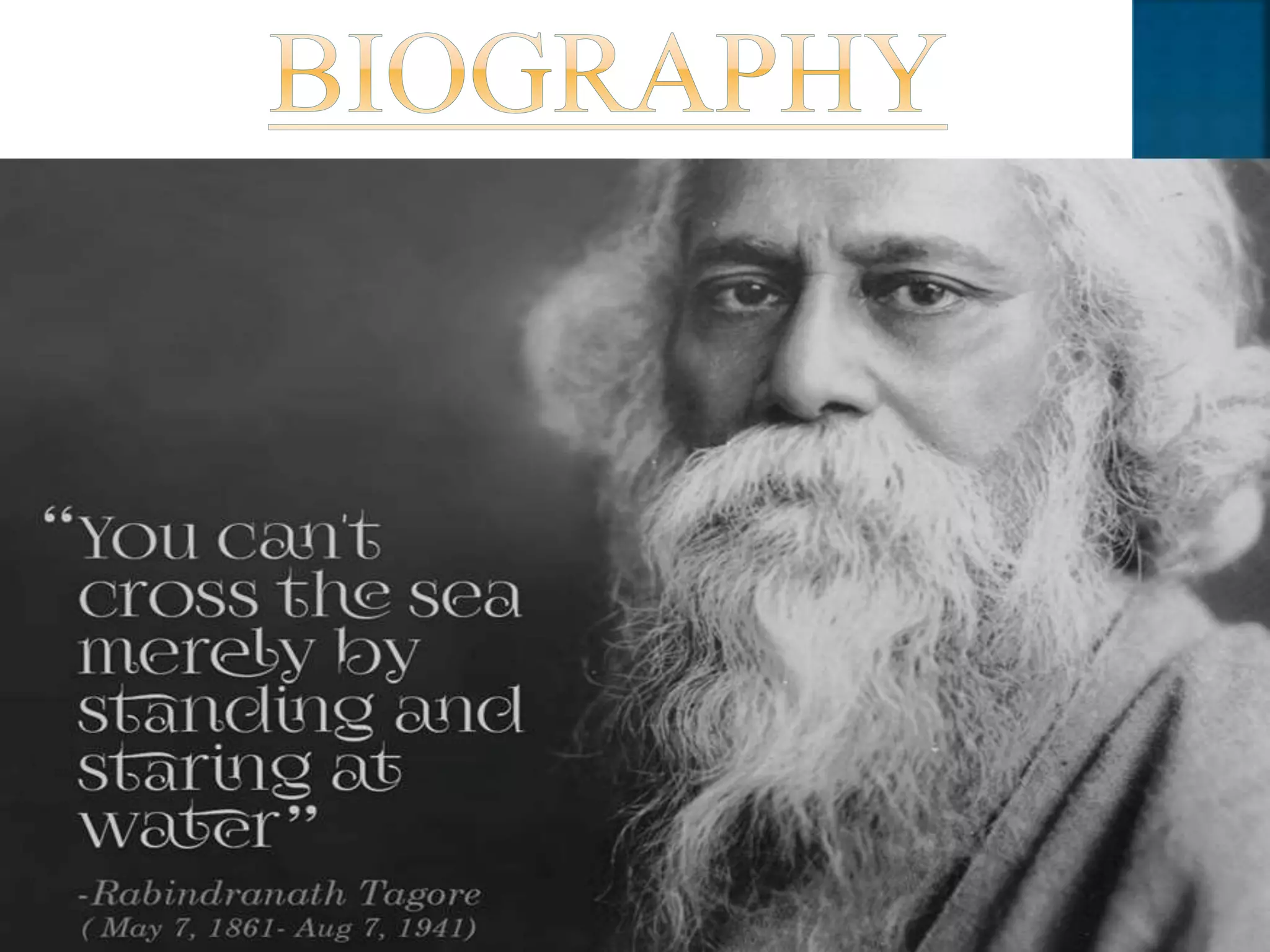
 Tagore was born on 6 may 1891 in Bengal in a prosperous family.
 At primary level his father provided him education in Sanskrit, Indian
Philosphy and Astronomy.
 For higher education he was sent to Bengal Academy and then was
sent to England from where he started writing magazines
 Eventually he turned into a poet, dramatist, philospher and painter. He
was then awarded the title of Gurudev.
 He was awarded the nobel prize in 1913 as he translated Geetanjali in
English
 The Indian govt. awarded him the degree of doctorate in
 1915 which he eventually gave away after Jalliawala Bagh incident.
 He created Vishva Bharti 22 September1921
 He was a genius in a number of fields. He was a novelist, dramatist,
actor, painter , prophet, musician, sculptor and an educationalist.
 He died in 1941.
 As an Idealist :- He believed that man should live
for ultimate truth and it liberates him from cycle
of birth and death.
Had faith in absolute values
 As a Spritualist:- He believed that every man
should try to attain spiritual perfection.
 As a humanist :- He preached human brotherhood
having faith in fundamental human mankind.He
remarked that even god depends upon him for
perfecting his universe.
 As a naturalist:- he considered nature as a great
teacher. God revealed himself through various
forms, colors and rhthym of nature.
Concept of education
 According to Tagore “God reveals himself
through nature more effectively then
through man made institutions,thus
education of child must be under natural
surroundings so that he develops love for all
things around him”.
 “The education is highest which not only
imparts knowledge and information to us but
also follows love and follows feelings
between us and living beings between us”.
The four main principles of Educational Philosphy
were:-
 Freedom :- freedom means child’s own experience
and activities.
 Creative self expression:- Tagore felt that mere
intellectual development was not the only function of
education because a large part of man cannot find
expression in mere language of words.
 Active communication with nature and man:-
Tagore insisted that education should be imparted in
an atmosphere of nature with all its colors , sounds,
forms and other manifestations.
 Internationalism:-Tagore has deep faith in unity of
man by giving expression to it through vishwabharti
the international university. Hence he expressed his
faith in intercommunication of minds.
The main aims of education were :-
 Liberation and perfection of man
 Moral development
 Unity of truth
 Education should be creative
 Self realisation
 Intellectual development
 Physical development
 International undertaking
 Love for humanity
 Freedom
 Mother tongue as medium of instruction.
 Teaching through tours and trips :- Tagore
believed that subjects can be best learnt
through tours and trips.
 Learning by activities:- Tagore believed that for
development of child’s body and mind is best
learnt by activities.
 Narration cum discussion and debate:- These
activities were organised in Tagore education
centre to develop discussion abilities in
students.
 Heuristic method:- In this method first the
students are asked questions to clarify their
doubts on topics and teachers try to satisfy them
by there correct answers. He introduced this
method as an important method of teaching.
 Tagore was a naturalist and idealist so he wants
things of beauty and virtues to be taught in the
curriculum.
 He lays stress on those subjects which make
child full and rich in knowledge
 Subjects recommended by him in curriculum
include history, geography, nature study,
language and science.
 Activities or finer subjects include music, art,
poetry, dancing and dramatics.
 He was very much concern about music and
drama as music is essence of life and drama
releases children from tension and anxiety.
Rabindra nath tagore bed

Rabindra nath tagore bed

  • 1.
    BY : - PINKYVARSHNEY
  • 3.
     Tagore wasborn on 6 may 1891 in Bengal in a prosperous family.  At primary level his father provided him education in Sanskrit, Indian Philosphy and Astronomy.  For higher education he was sent to Bengal Academy and then was sent to England from where he started writing magazines  Eventually he turned into a poet, dramatist, philospher and painter. He was then awarded the title of Gurudev.  He was awarded the nobel prize in 1913 as he translated Geetanjali in English  The Indian govt. awarded him the degree of doctorate in  1915 which he eventually gave away after Jalliawala Bagh incident.  He created Vishva Bharti 22 September1921  He was a genius in a number of fields. He was a novelist, dramatist, actor, painter , prophet, musician, sculptor and an educationalist.  He died in 1941.
  • 4.
     As anIdealist :- He believed that man should live for ultimate truth and it liberates him from cycle of birth and death. Had faith in absolute values  As a Spritualist:- He believed that every man should try to attain spiritual perfection.  As a humanist :- He preached human brotherhood having faith in fundamental human mankind.He remarked that even god depends upon him for perfecting his universe.  As a naturalist:- he considered nature as a great teacher. God revealed himself through various forms, colors and rhthym of nature.
  • 5.
    Concept of education According to Tagore “God reveals himself through nature more effectively then through man made institutions,thus education of child must be under natural surroundings so that he develops love for all things around him”.  “The education is highest which not only imparts knowledge and information to us but also follows love and follows feelings between us and living beings between us”.
  • 6.
    The four mainprinciples of Educational Philosphy were:-  Freedom :- freedom means child’s own experience and activities.  Creative self expression:- Tagore felt that mere intellectual development was not the only function of education because a large part of man cannot find expression in mere language of words.  Active communication with nature and man:- Tagore insisted that education should be imparted in an atmosphere of nature with all its colors , sounds, forms and other manifestations.  Internationalism:-Tagore has deep faith in unity of man by giving expression to it through vishwabharti the international university. Hence he expressed his faith in intercommunication of minds.
  • 7.
    The main aimsof education were :-  Liberation and perfection of man  Moral development  Unity of truth  Education should be creative  Self realisation  Intellectual development  Physical development  International undertaking  Love for humanity  Freedom  Mother tongue as medium of instruction.
  • 8.
     Teaching throughtours and trips :- Tagore believed that subjects can be best learnt through tours and trips.  Learning by activities:- Tagore believed that for development of child’s body and mind is best learnt by activities.  Narration cum discussion and debate:- These activities were organised in Tagore education centre to develop discussion abilities in students.  Heuristic method:- In this method first the students are asked questions to clarify their doubts on topics and teachers try to satisfy them by there correct answers. He introduced this method as an important method of teaching.
  • 9.
     Tagore wasa naturalist and idealist so he wants things of beauty and virtues to be taught in the curriculum.  He lays stress on those subjects which make child full and rich in knowledge  Subjects recommended by him in curriculum include history, geography, nature study, language and science.  Activities or finer subjects include music, art, poetry, dancing and dramatics.  He was very much concern about music and drama as music is essence of life and drama releases children from tension and anxiety.