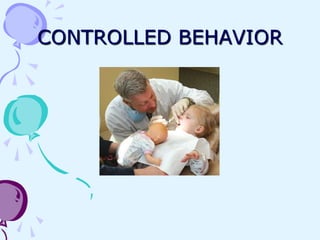
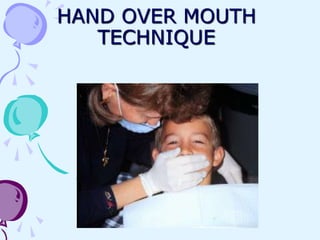
This document discusses behavior management techniques for treating children in a pediatric dental clinic. It describes how fear is one of the primary emotions acquired early in life that can influence a child's behavior. There are different types of fear like objective and subjective fear. It also classifies children's behaviors into categories like cooperative, lacking cooperative ability, potentially cooperative, controlled, uncontrolled, timid, tense cooperative, and whining. Behavior management can be achieved through non-pharmacological methods like preappointment modification, communication skills, behavior shaping techniques, and pharmacological methods like sedatives. Specific techniques discussed include tell-show-do, modeling, audioanalgesia, aversive conditioning, implosion therapy, and retraining.