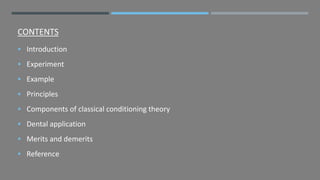
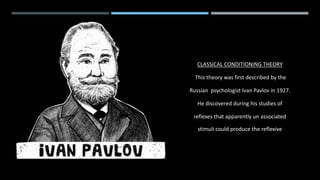
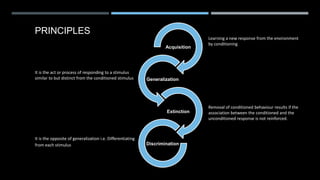
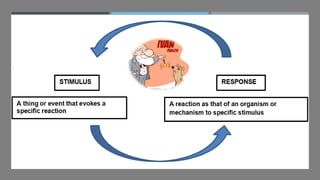
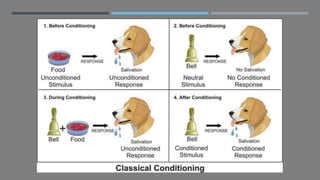
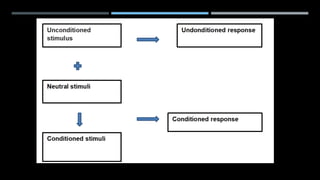
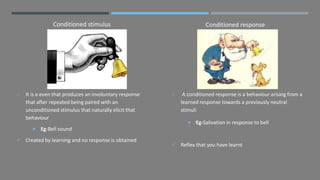
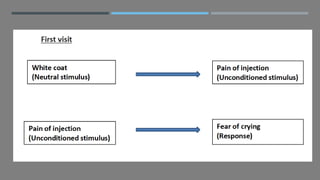
The document discusses classical conditioning theory, first introduced by Ivan Pavlov in 1927, focusing on the learning process through associations between stimuli and responses, especially in the context of pedodontics and preventive dentistry. It explains key concepts such as unconditioned and conditioned stimuli and responses, emphasizing their implications for children's reactions during dental visits. Additionally, the document outlines the merits and demerits of classical conditioning, highlighting its scientific basis while acknowledging its deterministic nature.





![Classical_Conditioning_Presentation_(M1)[1].pptx](https://cdn.slidesharecdn.com/ss_thumbnails/classicalconditioningpresentationm11-250506192714-9c533691-thumbnail.jpg?width=640&height=640&fit=bounds)
![Classical_Conditioning_Presentation_(M1)[1].pptx](https://cdn.slidesharecdn.com/ss_thumbnails/classicalconditioningpresentationm11-250506193318-eea3c01a-thumbnail.jpg?width=640&height=640&fit=bounds)


