Safety Management
Systems (SMS)
Lecturer : Khan M Shinwary
Eng.khanm.sh@gmail.com
+937884-204-93
17/8/2015 Bakhtar University Dept of BCE
2
• AFAP - As far as (reasonably) practicable
• Employer - Employer who has management control of the facility
• ER or ERP - Emergency response or Emergency response plan
• Facility - any building or structure at which Schedule 9 materials are present or likely to be
present for any purpose
• HAZID - Hazard identification
• HSR - Health and safety representative
• LOC - Loss of containment
• LOPA – Layers of protection analysis
• MA - Major accident
• MHF - Major hazard facility
• MOC – Management of change
• OHS - Occupational health & safety
• SR - Safety report
• SMS - Safety management system
Some Abbreviations & Terms
7/8/2015 Bakhtar University Dept of BCE
3
Lesson objectives
• What is a safety management system?
• The importance of SMS
• SMS models and standards
• Key elements of the SMS
• What are the key processes of an SMS?
• Effective element Safety and Health Management System
• What should the SMS do?
• Measurement of performance
• Emergency planning
• Critical success factors
7/8/2015 Bakhtar University Dept of BCE
4
What is a Safety Management
System?
• An SMS is a comprehensive and integrated system that ensures that
all work at the facility is conducted safely
• It should be fully documented, accessible and comprehensible to
those that need to use it
• It recognises the potential for errors and establishes robust defences
(control measures) which are fully implemented, to ensure that
errors do not result in accidents or near misses
• It is comprises a set of work practices and procedures for monitoring
and improving the safety and health of all aspects of the operation
7/8/2015 Bakhtar University Dept of BCE
5
The Importance of SMS
• In reviews of accidents, a common thread throughout is the
inadequacy of management systems that might have prevented the
accident from occurring
• Examples of some issues identified are
– Lack of hazard review and risk assessment to predict and
prevent incidents
– Insufficient investigation and follow up after previous incidents
– Inadequate training of staff
– Failure to implement effective mechanical integrity programs
7/8/2015 Bakhtar University Dept of BCE
6
Key Terms Used in Describing the
SMS
Comprehensive
• Describes the way that all safety issues including control measures are
managed
• Clear link between controls management and the SMS
Integrated
• The structure is logical, systematic
• Logically ties in to other management systems
• Corporate systems do not contradict onsite systems
Comprehensible
• Abbreviations and terms used mean something to employees
• Consideration of language issues
7/8/2015 Bakhtar University Dept of BCE
7
Key Terms Used in Describing the
SMS
Implemented
• Procedures are approved and in circulation
• Evidence is available – completed forms and/or checklists
• Employees are trained and knowledgeable
Accessible
• Employees are aware of how to obtain the most up to date or relevant
procedures
• Employees can obtain the SMS information needed to support control
measures
7/8/2015 Bakhtar University Dept of BCE
8
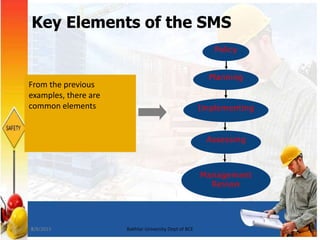
Key Elements of the SMS
From the previous
examples, there are
common elements
Policy
Planning
Implementing
Assessing
Management
Review
7/8/2015 Bakhtar University Dept of BCE
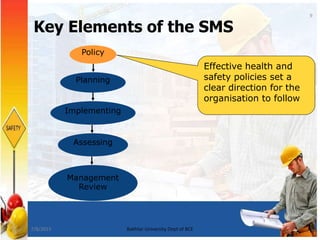
Key Elements of the SMS
Policy
Planning
Implementing
Assessing
Management
Review
Effective health and
safety policies set a
clear direction for the
organisation to follow
9
7/8/2015 Bakhtar University Dept of BCE
10
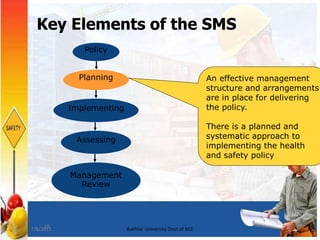
Key Elements of the SMS
An effective management
structure and arrangements
are in place for delivering
the policy.
There is a planned and
systematic approach to
implementing the health
and safety policy
Policy
Planning
Implementing
Assessing
Management
Review
7/8/2015 Bakhtar University Dept of BCE
11
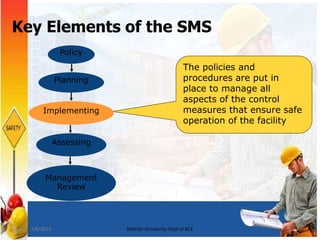
Key Elements of the SMS
The policies and
procedures are put in
place to manage all
aspects of the control
measures that ensure safe
operation of the facility
Policy
Planning
Implementing
Assessing
Management
Review
7/8/2015 Bakhtar University Dept of BCE
12
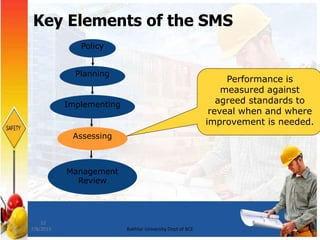
Key Elements of the SMS
Performance is
measured against
agreed standards to
reveal when and where
improvement is needed.
Policy
Planning
Implementing
Assessing
Management
Review
7/8/2015 Bakhtar University Dept of BCE
13
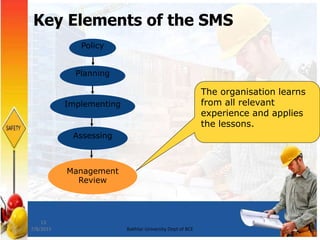
Key Elements of the SMS
The organisation learns
from all relevant
experience and applies
the lessons.
Policy
Planning
Implementing
Assessing
Management
Review
7/8/2015 Bakhtar University Dept of BCE
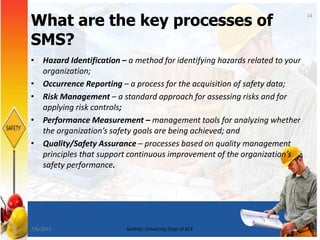
What are the key processes of
SMS?
• Hazard Identification – a method for identifying hazards related to your
organization;
• Occurrence Reporting – a process for the acquisition of safety data;
• Risk Management – a standard approach for assessing risks and for
applying risk controls;
• Performance Measurement – management tools for analyzing whether
the organization’s safety goals are being achieved; and
• Quality/Safety Assurance – processes based on quality management
principles that support continuous improvement of the organization’s
safety performance.
7/8/2015 Bakhtar University Dept of BCE
14
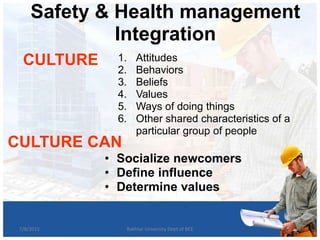
CULTURE 1. Attitudes
2. Behaviors
3. Beliefs
4. Values
5. Ways of doing things
6. Other shared characteristics of a
particular group of people
Safety & Health management
Integration
CULTURE CAN
• Socialize newcomers
• Define influence
• Determine values
157/8/2015 Bakhtar University Dept of BCE
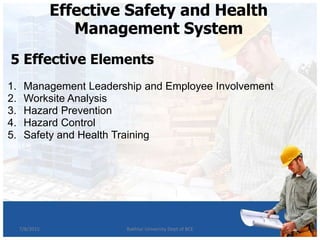
5 Effective Elements
1. Management Leadership and Employee Involvement
2. Worksite Analysis
3. Hazard Prevention
4. Hazard Control
5. Safety and Health Training
Effective Safety and Health
Management System
167/8/2015 Bakhtar University Dept of BCE
Effective Safety and Health
Management System
• 1. Management Leadership & Employee Involvement
• Visible management support, involvement, and participation in the
safety and health program
• Assign supervisors safety and health responsibility with the authority
to perform their duties
• Empower employees and involve them in the safety and health
program. Hold them accountable
• Develop safety and health policy, set annual goals and program
review
17
7/8/2015 Bakhtar University Dept of BCE
2. Worksite Analysis
Ensure that formal safety and health surveys are
conducted
Conduct and document job hazard analysis (JHA)
Develop a self-inspection program and conduct formal
and informal workplace safety and health inspections
Develop a system for tracking, reporting, and
investigating near misses, accidents/incidents and
injuries and/or illnesses
Effective Safety and Health
Management System
18
7/8/2015 Bakhtar University Dept of BCE
3. Hazard Prevention
Establish and maintain good house keeping
procedures
Establish an emergency response plan/ procedures
for providing employees with emergency medical
treatment
Develop and implement a preventive maintenance
system
Provide medical surveillance and preventive health
care
Effective Safety and Health
Management System
19
7/8/2015 Bakhtar University Dept of BCE
4. Hazard Control
Establish procedures for evaluating and
implementing engineering controls
Develop and implement safe work practices
Develop and implement administrative controls
Ensure personal protective equipment is provided,
properly used and maintained
Effective Safety and Health
Management System
20
7/8/2015 Bakhtar University Dept of BCE
5. Safety and Health Training
Identify, schedule, conduct and document
required safety and health training
Effective Safety and Health
Management System
21
7/8/2015 Bakhtar University Dept of BCE
22
What Should the SMS Do?
• The SMS is the tool with which the Employer meets the overall goal of the
Regulations
• The SMS should cover the following
– Define safety roles and responsibilities
– Ensure adequate skills, information, tools and decision-making are present in
day to day and abnormal operations
– Maintain awareness of hazards and risks
– Plan, implement, measure and evaluate MA controls and the SMS
– Develop performance requirements
– Set targets for improvement of safety at the facility
– Manage change
– Manage and maintain knowledge
– Instigate HAZID and risk assessments
– Manage adequate human resources
– Provide performance information to all levels of organisation
– Review and improve the SMS itself
7/8/2015 Bakhtar University Dept of BCE
23
What Should the SMS Do?
• Manage safe operation at the facility, including MAs, specifically
focusing on:
– Prevention
– Reduction
– Mitigation
• It is not just documentation - it is the actual implementation of
processes, procedures and practices at the facility
• Include and reflect the safety culture at the workplace
7/8/2015 Bakhtar University Dept of BCE
24
Measurement of Performance
• Performance standards/indicators must be developed and
implemented as part of the SMS (e.g. measure the effectiveness of
SMS) to support the MHF safety objectives
• The following principles apply in defining performance standards:
Make them SMART
• Specific
• Measurable
• Achievable
• Realistic
• Targeted
• The purpose of performance standards/indicators for the SMS is to
enable the objective measurement of its target and (subsequently)
effective maintenance and improvement of performance
7/8/2015 Bakhtar University Dept of BCE
25
Measurement of Performance
• Standards and systems need to be practical
• Should not place an unworkable burden on employees
• Ensure open, comprehensive and accurate reporting of errors or
problems
Is an absence of evidence of problems really indicating high
performance?
7/8/2015 Bakhtar University Dept of BCE
26
Measurement of Performance
• Performance indicators need to be meaningful and contribute to the
overall evaluation of the SMS effectiveness
• If a control is stated to be in place for prevention of an MA, then:
– Is it implemented?
– Is it effective?
– Is it audited?
– Are the results used for improving the effectiveness of controls
management?
7/8/2015 Bakhtar University Dept of BCE
27
Items to Note - Emergency
Planning
• The MHF must prepare an emergency plan addressing the on-site/off-
site consequences
• Must consult with employees and emergency services
• Plan should consider
– Accident type (e.g. major/minor, environmental, personal safety,
on-site, off-site, property damage)
– Command hierarchy and contact information
– Equipment required
– Contingency plans
• Plan should be tested, reviewed, updated
7/8/2015 Bakhtar University Dept of BCE
28
SMS - Critical Success Factors
• Adequate resources for both development and improvement
• Personnel are aware of their responsibility and accountability
• Personnel are trained/competent
• Consistent with the understanding of risk gained from the risk
assessment
• There should be sufficient focus on MAs, from planning through to
operations
• The Employer must document the basis for the facility's SMS, and the
SMS itself
7/8/2015 Bakhtar University Dept of BCE
29
Questions?
7/8/2015 Bakhtar University Dept of BCE

Safety Management System SMS

  • 1.
    Safety Management Systems (SMS) Lecturer: Khan M Shinwary Eng.khanm.sh@gmail.com +937884-204-93 17/8/2015 Bakhtar University Dept of BCE
  • 2.
    2 • AFAP -As far as (reasonably) practicable • Employer - Employer who has management control of the facility • ER or ERP - Emergency response or Emergency response plan • Facility - any building or structure at which Schedule 9 materials are present or likely to be present for any purpose • HAZID - Hazard identification • HSR - Health and safety representative • LOC - Loss of containment • LOPA – Layers of protection analysis • MA - Major accident • MHF - Major hazard facility • MOC – Management of change • OHS - Occupational health & safety • SR - Safety report • SMS - Safety management system Some Abbreviations & Terms 7/8/2015 Bakhtar University Dept of BCE
  • 3.
    3 Lesson objectives • Whatis a safety management system? • The importance of SMS • SMS models and standards • Key elements of the SMS • What are the key processes of an SMS? • Effective element Safety and Health Management System • What should the SMS do? • Measurement of performance • Emergency planning • Critical success factors 7/8/2015 Bakhtar University Dept of BCE
  • 4.
    4 What is aSafety Management System? • An SMS is a comprehensive and integrated system that ensures that all work at the facility is conducted safely • It should be fully documented, accessible and comprehensible to those that need to use it • It recognises the potential for errors and establishes robust defences (control measures) which are fully implemented, to ensure that errors do not result in accidents or near misses • It is comprises a set of work practices and procedures for monitoring and improving the safety and health of all aspects of the operation 7/8/2015 Bakhtar University Dept of BCE
  • 5.
    5 The Importance ofSMS • In reviews of accidents, a common thread throughout is the inadequacy of management systems that might have prevented the accident from occurring • Examples of some issues identified are – Lack of hazard review and risk assessment to predict and prevent incidents – Insufficient investigation and follow up after previous incidents – Inadequate training of staff – Failure to implement effective mechanical integrity programs 7/8/2015 Bakhtar University Dept of BCE
  • 6.
    6 Key Terms Usedin Describing the SMS Comprehensive • Describes the way that all safety issues including control measures are managed • Clear link between controls management and the SMS Integrated • The structure is logical, systematic • Logically ties in to other management systems • Corporate systems do not contradict onsite systems Comprehensible • Abbreviations and terms used mean something to employees • Consideration of language issues 7/8/2015 Bakhtar University Dept of BCE
  • 7.
    7 Key Terms Usedin Describing the SMS Implemented • Procedures are approved and in circulation • Evidence is available – completed forms and/or checklists • Employees are trained and knowledgeable Accessible • Employees are aware of how to obtain the most up to date or relevant procedures • Employees can obtain the SMS information needed to support control measures 7/8/2015 Bakhtar University Dept of BCE
  • 8.
    8 Key Elements ofthe SMS From the previous examples, there are common elements Policy Planning Implementing Assessing Management Review 7/8/2015 Bakhtar University Dept of BCE
  • 9.
    Key Elements ofthe SMS Policy Planning Implementing Assessing Management Review Effective health and safety policies set a clear direction for the organisation to follow 9 7/8/2015 Bakhtar University Dept of BCE
  • 10.
    10 Key Elements ofthe SMS An effective management structure and arrangements are in place for delivering the policy. There is a planned and systematic approach to implementing the health and safety policy Policy Planning Implementing Assessing Management Review 7/8/2015 Bakhtar University Dept of BCE
  • 11.
    11 Key Elements ofthe SMS The policies and procedures are put in place to manage all aspects of the control measures that ensure safe operation of the facility Policy Planning Implementing Assessing Management Review 7/8/2015 Bakhtar University Dept of BCE
  • 12.
    12 Key Elements ofthe SMS Performance is measured against agreed standards to reveal when and where improvement is needed. Policy Planning Implementing Assessing Management Review 7/8/2015 Bakhtar University Dept of BCE
  • 13.
    13 Key Elements ofthe SMS The organisation learns from all relevant experience and applies the lessons. Policy Planning Implementing Assessing Management Review 7/8/2015 Bakhtar University Dept of BCE
  • 14.
    What are thekey processes of SMS? • Hazard Identification – a method for identifying hazards related to your organization; • Occurrence Reporting – a process for the acquisition of safety data; • Risk Management – a standard approach for assessing risks and for applying risk controls; • Performance Measurement – management tools for analyzing whether the organization’s safety goals are being achieved; and • Quality/Safety Assurance – processes based on quality management principles that support continuous improvement of the organization’s safety performance. 7/8/2015 Bakhtar University Dept of BCE 14
  • 15.
    CULTURE 1. Attitudes 2.Behaviors 3. Beliefs 4. Values 5. Ways of doing things 6. Other shared characteristics of a particular group of people Safety & Health management Integration CULTURE CAN • Socialize newcomers • Define influence • Determine values 157/8/2015 Bakhtar University Dept of BCE
  • 16.
    5 Effective Elements 1.Management Leadership and Employee Involvement 2. Worksite Analysis 3. Hazard Prevention 4. Hazard Control 5. Safety and Health Training Effective Safety and Health Management System 167/8/2015 Bakhtar University Dept of BCE
  • 17.
    Effective Safety andHealth Management System • 1. Management Leadership & Employee Involvement • Visible management support, involvement, and participation in the safety and health program • Assign supervisors safety and health responsibility with the authority to perform their duties • Empower employees and involve them in the safety and health program. Hold them accountable • Develop safety and health policy, set annual goals and program review 17 7/8/2015 Bakhtar University Dept of BCE
  • 18.
    2. Worksite Analysis Ensurethat formal safety and health surveys are conducted Conduct and document job hazard analysis (JHA) Develop a self-inspection program and conduct formal and informal workplace safety and health inspections Develop a system for tracking, reporting, and investigating near misses, accidents/incidents and injuries and/or illnesses Effective Safety and Health Management System 18 7/8/2015 Bakhtar University Dept of BCE
  • 19.
    3. Hazard Prevention Establishand maintain good house keeping procedures Establish an emergency response plan/ procedures for providing employees with emergency medical treatment Develop and implement a preventive maintenance system Provide medical surveillance and preventive health care Effective Safety and Health Management System 19 7/8/2015 Bakhtar University Dept of BCE
  • 20.
    4. Hazard Control Establishprocedures for evaluating and implementing engineering controls Develop and implement safe work practices Develop and implement administrative controls Ensure personal protective equipment is provided, properly used and maintained Effective Safety and Health Management System 20 7/8/2015 Bakhtar University Dept of BCE
  • 21.
    5. Safety andHealth Training Identify, schedule, conduct and document required safety and health training Effective Safety and Health Management System 21 7/8/2015 Bakhtar University Dept of BCE
  • 22.
    22 What Should theSMS Do? • The SMS is the tool with which the Employer meets the overall goal of the Regulations • The SMS should cover the following – Define safety roles and responsibilities – Ensure adequate skills, information, tools and decision-making are present in day to day and abnormal operations – Maintain awareness of hazards and risks – Plan, implement, measure and evaluate MA controls and the SMS – Develop performance requirements – Set targets for improvement of safety at the facility – Manage change – Manage and maintain knowledge – Instigate HAZID and risk assessments – Manage adequate human resources – Provide performance information to all levels of organisation – Review and improve the SMS itself 7/8/2015 Bakhtar University Dept of BCE
  • 23.
    23 What Should theSMS Do? • Manage safe operation at the facility, including MAs, specifically focusing on: – Prevention – Reduction – Mitigation • It is not just documentation - it is the actual implementation of processes, procedures and practices at the facility • Include and reflect the safety culture at the workplace 7/8/2015 Bakhtar University Dept of BCE
  • 24.
    24 Measurement of Performance •Performance standards/indicators must be developed and implemented as part of the SMS (e.g. measure the effectiveness of SMS) to support the MHF safety objectives • The following principles apply in defining performance standards: Make them SMART • Specific • Measurable • Achievable • Realistic • Targeted • The purpose of performance standards/indicators for the SMS is to enable the objective measurement of its target and (subsequently) effective maintenance and improvement of performance 7/8/2015 Bakhtar University Dept of BCE
  • 25.
    25 Measurement of Performance •Standards and systems need to be practical • Should not place an unworkable burden on employees • Ensure open, comprehensive and accurate reporting of errors or problems Is an absence of evidence of problems really indicating high performance? 7/8/2015 Bakhtar University Dept of BCE
  • 26.
    26 Measurement of Performance •Performance indicators need to be meaningful and contribute to the overall evaluation of the SMS effectiveness • If a control is stated to be in place for prevention of an MA, then: – Is it implemented? – Is it effective? – Is it audited? – Are the results used for improving the effectiveness of controls management? 7/8/2015 Bakhtar University Dept of BCE
  • 27.
    27 Items to Note- Emergency Planning • The MHF must prepare an emergency plan addressing the on-site/off- site consequences • Must consult with employees and emergency services • Plan should consider – Accident type (e.g. major/minor, environmental, personal safety, on-site, off-site, property damage) – Command hierarchy and contact information – Equipment required – Contingency plans • Plan should be tested, reviewed, updated 7/8/2015 Bakhtar University Dept of BCE
  • 28.
    28 SMS - CriticalSuccess Factors • Adequate resources for both development and improvement • Personnel are aware of their responsibility and accountability • Personnel are trained/competent • Consistent with the understanding of risk gained from the risk assessment • There should be sufficient focus on MAs, from planning through to operations • The Employer must document the basis for the facility's SMS, and the SMS itself 7/8/2015 Bakhtar University Dept of BCE
  • 29.