Sadhana Gupta
Lecturer Bhilai Mahila Mahavidyalaya
To perform various laboratory techniques-
a) Centrifugation .
b) Chromatography-TLC , ion exchange
Chromatography.
c) Spectrophotometery.
d) Electrophoresis.
e) ELISA.
f) SDS PAGE
g) Southern Blotting
h) PCR.
AIM: To verify Lambert – beer ‘s law using spectrophotometer.
REQUIREMENTS –Spectrophotometer, cuvettes, test tubes ,pipettes or
graduated cylinders , beakers 1% methylene blue solution ,distilled water, test
tube rack ,stirring rod , tissue paper.
Principle- It is based in Beer-Lambert Law, which state that -
“for a given material sample path length and concentration of the sample are
directly proportional to the absorbance of the light.”
The Beer-Lambert law is expressed as:
A = εLc
where,
A is the amount of light absorbed for a particular wavelength by the sample
ε is the molar extinction coefficient
L is the distance covered by the light through the solution
c is the concentration of the absorbing species
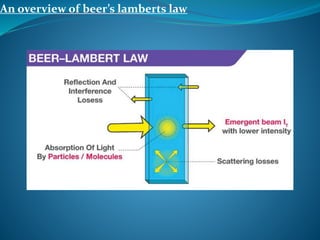
An overview of beer’s lamberts law
Procedure-
1. Prepare 1% methylene blue solution in a glass beaker .
2. Take five test tube and prepare a series from 2-10 ml and make up
it with distilled water ,and prepare a blank and unknown
separately.
3. Take the blank and transfer it to cuvette and set zero using it.
4. Measure the absorbance of the sample solutions from 2-10 ml at
600nm on spectrophotometer.
5. Measure the concentration of the unknown sample by plotting a
graph between concentration and absorbance.
Graph
Observation table-
s.n Sample solution Distilled water Conc. Absorbance at 600nm
1 blank 10ml - -
2 2ml 8ml 0.002
3 4ml 6ml 0.004
4 6ml 4ml 0.006
5 8ml 2ml 0.008
6 10ml - 0.0100
7 unknown - x
Result- A straight line graph is obt1ained which proves beer’s
lamberts law.
Precautions-
1) Always use clean and dry cuvette.
2) Wipe the cuvette with clean tissue paper.
3)Set zero each time before taking the reading.

Beers lamberts law

  • 1.
    Sadhana Gupta Lecturer BhilaiMahila Mahavidyalaya
  • 2.
    To perform variouslaboratory techniques- a) Centrifugation . b) Chromatography-TLC , ion exchange Chromatography. c) Spectrophotometery. d) Electrophoresis. e) ELISA. f) SDS PAGE g) Southern Blotting h) PCR.
  • 3.
    AIM: To verifyLambert – beer ‘s law using spectrophotometer. REQUIREMENTS –Spectrophotometer, cuvettes, test tubes ,pipettes or graduated cylinders , beakers 1% methylene blue solution ,distilled water, test tube rack ,stirring rod , tissue paper. Principle- It is based in Beer-Lambert Law, which state that - “for a given material sample path length and concentration of the sample are directly proportional to the absorbance of the light.” The Beer-Lambert law is expressed as: A = εLc where, A is the amount of light absorbed for a particular wavelength by the sample ε is the molar extinction coefficient L is the distance covered by the light through the solution c is the concentration of the absorbing species
  • 4.
    An overview ofbeer’s lamberts law
  • 5.
    Procedure- 1. Prepare 1%methylene blue solution in a glass beaker . 2. Take five test tube and prepare a series from 2-10 ml and make up it with distilled water ,and prepare a blank and unknown separately. 3. Take the blank and transfer it to cuvette and set zero using it. 4. Measure the absorbance of the sample solutions from 2-10 ml at 600nm on spectrophotometer. 5. Measure the concentration of the unknown sample by plotting a graph between concentration and absorbance. Graph
  • 6.
    Observation table- s.n Samplesolution Distilled water Conc. Absorbance at 600nm 1 blank 10ml - - 2 2ml 8ml 0.002 3 4ml 6ml 0.004 4 6ml 4ml 0.006 5 8ml 2ml 0.008 6 10ml - 0.0100 7 unknown - x
  • 7.
    Result- A straightline graph is obt1ained which proves beer’s lamberts law. Precautions- 1) Always use clean and dry cuvette. 2) Wipe the cuvette with clean tissue paper. 3)Set zero each time before taking the reading.