CALORIMETER
Calorimeter
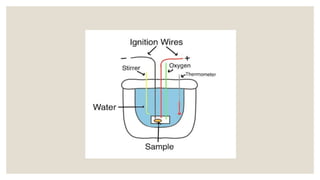
◦ A calorimeter is a device used for heat measurements necessary for calorimetry.
◦ It mainly consists of a metallic vessel made of materials which are good conductors of electricity
such as copper and aluminium etc.
◦ There is also a facility for stirring the contents of the vessel.
◦ This metallic vessel with a stirrer is kept in an insulating jacket to prevent heat loss to the
environment.
◦ There is just one opening through which a thermometer can be inserted to measure the change
in thermal properties inside.
TYPES OF CALORIMETER
◦ Adiabatic Calorimeters
◦ Reaction Calorimeters
◦ Bomb Calorimeters (Constant Volume Calorimeters)
◦ Constant Pressure Calorimeters
◦ Differential Scanning Calorimeter
BEER AND LAMBERT LAW
◦ Beer’s law states the following:
◦
◦ For a given material, the sample path length and concentration of the sample are directly
proportional to the absorbance of the light.
◦ Beer law states that concentration and absorbance are directly proportional to each other and it
was stated by August Beer.
◦ Lambert law states that absorbance and path length are directly proportional and it was stated
by Johann Heinrich Lambert.
DISCOVERY OF BEER AND LAMBERT
LAW
◦ In 1729, Pierre Bouguer discovered the law.
◦ Later, in 1760, Johann Heinrich Lambert quoted Bouger’s discovery saying that the absorbance
of a sample is directly proportional to the path length of light. Although Lambert dint claim the
discovery, he was often credited with it.
◦ In 1852, August Beer discovered a related law which stated that the absorbance is proportional
to the concentration of the sample.
BEER AND LAMBERT LAW EQUATION
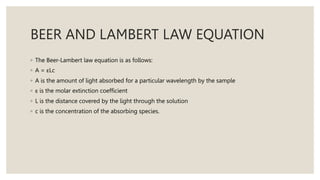
◦ The Beer-Lambert law equation is as follows:
◦ A = εLc
◦ A is the amount of light absorbed for a particular wavelength by the sample
◦ ε is the molar extinction coefficient
◦ L is the distance covered by the light through the solution
◦ c is the concentration of the absorbing species.
APPLICATIONS OF BEER AND LAMBERT
LAW
◦ This law finds applications in various fields such as:
◦ This analysis mainly concentrates on the separation, quantification, and identification of matter
by spectrophotometry.
◦ In atmosphere
◦ Solar or stellar radiation in the atmosphere can be detected
◦ The law is used in chemistry to measure the concentration of chemical solutions, analyse
oxidation, and measure polymer degradation.
◦ The Beer-Lambert law relates the attenuation of light to the material’s properties through which
the light is travelling. The law is applied to the analysis of a mixture by spectrophotometry
without extensive pre-processing of the sample.
Reference
1. Bouguer, Pierre (1729). Essai d’optique sur la gradation de la lumière [Optics essay on the
attenuation of light] (in French). Paris, France: Claude Jombert. Pp. 16
2. Lambert, J.H. (1760). Photometria sive de mensura et gradibus luminis, colorum et umbrae
[Photometry, or, On the measure and gradations of light intensity, colors, and shade] (in Latin).
Augsburg, (Germany): Eberhardt Klett.
3. Beer (1852). “Bestimmung der Absorption des rothen Lichts in farbigen Flüssigkeiten”
[Determination of the absorption of red light in colored liquids]. Annalen der Physik und
Chemie (in German). 162 (5): 78–88.
4. Pfieffer, Heinz; Liebhafshy, Herman (1951). “The Origins of Beer’s Law”. Journal of Chemical
Education (March, 1951): 123–125.
5. Mayerhöfer, Thomas G.; Pahlow, Susanne; Popp, Jürgen (2020). “The Bouguer-Beer-Lambert
Law: Shining Light on the Obscure”. ChemPhysChem. 21 (18): 2031.
doi:10.1002/cphc.202000464.

beer and lambert's law.pptx

  • 1.
  • 2.
    Calorimeter ◦ A calorimeteris a device used for heat measurements necessary for calorimetry. ◦ It mainly consists of a metallic vessel made of materials which are good conductors of electricity such as copper and aluminium etc. ◦ There is also a facility for stirring the contents of the vessel. ◦ This metallic vessel with a stirrer is kept in an insulating jacket to prevent heat loss to the environment. ◦ There is just one opening through which a thermometer can be inserted to measure the change in thermal properties inside.
  • 4.
    TYPES OF CALORIMETER ◦Adiabatic Calorimeters ◦ Reaction Calorimeters ◦ Bomb Calorimeters (Constant Volume Calorimeters) ◦ Constant Pressure Calorimeters ◦ Differential Scanning Calorimeter
  • 5.
    BEER AND LAMBERTLAW ◦ Beer’s law states the following: ◦ ◦ For a given material, the sample path length and concentration of the sample are directly proportional to the absorbance of the light. ◦ Beer law states that concentration and absorbance are directly proportional to each other and it was stated by August Beer. ◦ Lambert law states that absorbance and path length are directly proportional and it was stated by Johann Heinrich Lambert.
  • 6.
    DISCOVERY OF BEERAND LAMBERT LAW ◦ In 1729, Pierre Bouguer discovered the law. ◦ Later, in 1760, Johann Heinrich Lambert quoted Bouger’s discovery saying that the absorbance of a sample is directly proportional to the path length of light. Although Lambert dint claim the discovery, he was often credited with it. ◦ In 1852, August Beer discovered a related law which stated that the absorbance is proportional to the concentration of the sample.
  • 7.
    BEER AND LAMBERTLAW EQUATION ◦ The Beer-Lambert law equation is as follows: ◦ A = εLc ◦ A is the amount of light absorbed for a particular wavelength by the sample ◦ ε is the molar extinction coefficient ◦ L is the distance covered by the light through the solution ◦ c is the concentration of the absorbing species.
  • 8.
    APPLICATIONS OF BEERAND LAMBERT LAW ◦ This law finds applications in various fields such as: ◦ This analysis mainly concentrates on the separation, quantification, and identification of matter by spectrophotometry. ◦ In atmosphere ◦ Solar or stellar radiation in the atmosphere can be detected ◦ The law is used in chemistry to measure the concentration of chemical solutions, analyse oxidation, and measure polymer degradation. ◦ The Beer-Lambert law relates the attenuation of light to the material’s properties through which the light is travelling. The law is applied to the analysis of a mixture by spectrophotometry without extensive pre-processing of the sample.
  • 9.
    Reference 1. Bouguer, Pierre(1729). Essai d’optique sur la gradation de la lumière [Optics essay on the attenuation of light] (in French). Paris, France: Claude Jombert. Pp. 16 2. Lambert, J.H. (1760). Photometria sive de mensura et gradibus luminis, colorum et umbrae [Photometry, or, On the measure and gradations of light intensity, colors, and shade] (in Latin). Augsburg, (Germany): Eberhardt Klett. 3. Beer (1852). “Bestimmung der Absorption des rothen Lichts in farbigen Flüssigkeiten” [Determination of the absorption of red light in colored liquids]. Annalen der Physik und Chemie (in German). 162 (5): 78–88. 4. Pfieffer, Heinz; Liebhafshy, Herman (1951). “The Origins of Beer’s Law”. Journal of Chemical Education (March, 1951): 123–125. 5. Mayerhöfer, Thomas G.; Pahlow, Susanne; Popp, Jürgen (2020). “The Bouguer-Beer-Lambert Law: Shining Light on the Obscure”. ChemPhysChem. 21 (18): 2031. doi:10.1002/cphc.202000464.