
Ms. Sadhana Gupta
Content
• What is transcription?
• An overview of transcription.
• Stages of transcription.
• Functions of RNA polymerase.
• Regulation after transcription
• Functions of transcription
WHAT IS TRANSCRIPTION?
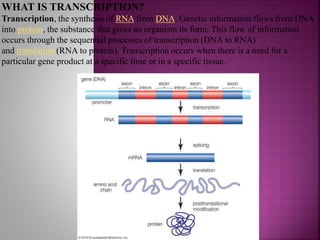
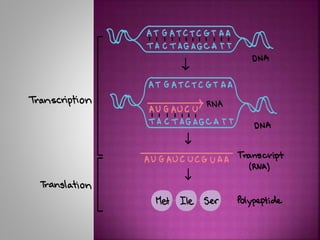
Transcription, the synthesis of RNA from DNA. Genetic information flows from DNA
into protein, the substance that gives an organism its form. This flow of information
occurs through the sequential processes of transcription (DNA to RNA)
and translation (RNA to protein). Transcription occurs when there is a need for a
particular gene product at a specific time or in a specific tissue.
OVERVIEW OF TRANSCRIPTION
Transcription is the first step in gene expression. It involves copying a gene's DNA
sequence to make an RNA molecule.
Transcription is performed by enzymes called RNA polymerases, which link
nucleotides to form an RNA strand (using a DNA strand as a template).
Transcription has three stages: initiation, elongation, and termination.
In eukaryotes, RNA molecules must be processed after transcription: they
are spliced and have a 5' cap and poly-A tail put on their ends.
Transcription is controlled separately for each gene in your genome
STAGES OF TRANSCRIPTION
Transcription of a gene takes place in three stages: initiation, elongation, and
termination.
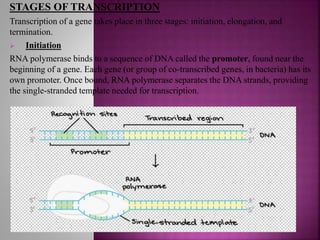
 Initiation
RNA polymerase binds to a sequence of DNA called the promoter, found near the
beginning of a gene. Each gene (or group of co-transcribed genes, in bacteria) has its
own promoter. Once bound, RNA polymerase separates the DNA strands, providing
the single-stranded template needed for transcription.
ELONGATION.
One strand of DNA, the template strand, acts as a template for RNA polymerase. As it
"reads" this template one base at a time, the polymerase builds an RNA molecule out of
complementary nucleotides, making a chain that grows from 5' to 3'. The RNA transcript
carries the same information as the non-template (coding) strand of DNA, but it contains
the base uracil (U) instead of thymine (T).
•
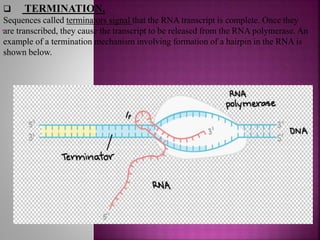
 TERMINATION.
Sequences called terminators signal that the RNA transcript is complete. Once they
are transcribed, they cause the transcript to be released from the RNA polymerase. An
example of a termination mechanism involving formation of a hairpin in the RNA is
shown below.
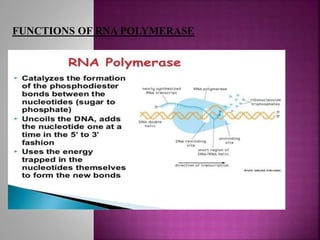
FUNCTIONS OF RNA POLYMERASE
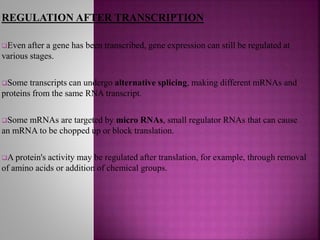
REGULATION AFTER TRANSCRIPTION
Even after a gene has been transcribed, gene expression can still be regulated at
various stages.
Some transcripts can undergo alternative splicing, making different mRNAs and
proteins from the same RNA transcript.
Some mRNAs are targeted by micro RNAs, small regulator RNAs that can cause
an mRNA to be chopped up or block translation.
A protein's activity may be regulated after translation, for example, through removal
of amino acids or addition of chemical groups.
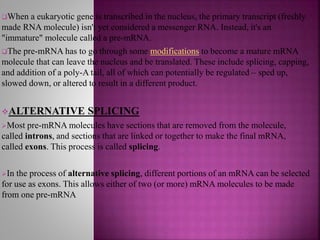
When a eukaryotic gene is transcribed in the nucleus, the primary transcript (freshly
made RNA molecule) isn't yet considered a messenger RNA. Instead, it's an
"immature" molecule called a pre-mRNA.
The pre-mRNA has to go through some modifications to become a mature mRNA
molecule that can leave the nucleus and be translated. These include splicing, capping,
and addition of a poly-A tail, all of which can potentially be regulated – sped up,
slowed down, or altered to result in a different product.
ALTERNATIVE SPLICING
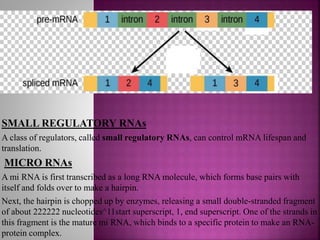
Most pre-mRNA molecules have sections that are removed from the molecule,
called introns, and sections that are linked or together to make the final mRNA,
called exons. This process is called splicing.
In the process of alternative splicing, different portions of an mRNA can be selected
for use as exons. This allows either of two (or more) mRNA molecules to be made
from one pre-mRNA
SMALL REGULATORY RNAs
A class of regulators, called small regulatory RNAs, can control mRNA lifespan and
translation.
MICRO RNAs
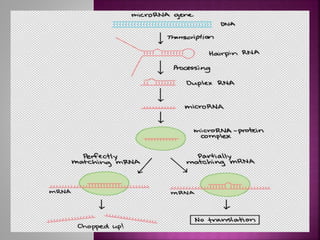
A mi RNA is first transcribed as a long RNA molecule, which forms base pairs with
itself and folds over to make a hairpin.
Next, the hairpin is chopped up by enzymes, releasing a small double-stranded fragment
of about 222222 nucleotides^11start superscript, 1, end superscript. One of the strands in
this fragment is the mature mi RNA, which binds to a specific protein to make an RNA-
protein complex.
FUNCTION OF TRANSCRIPTION
Transcription maintains the link between these DNA and RNA thus, allows cells to use
a stable nucleic acid as the genetic material while retaining most of their protein
synthesis machinery.
 Separates DNA from the site for protein synthesis also protects genetic material from
the biochemical and biophysical stresses of complex, multilayered processes.
 In addition, transcription adds another layer for intricate gene regulation, especially
in species with large genomes that require minute adjustments in metabolism.
THANK YOU

Transcription

  • 1.
  • 2.
    Content • What istranscription? • An overview of transcription. • Stages of transcription. • Functions of RNA polymerase. • Regulation after transcription • Functions of transcription
  • 3.
    WHAT IS TRANSCRIPTION? Transcription,the synthesis of RNA from DNA. Genetic information flows from DNA into protein, the substance that gives an organism its form. This flow of information occurs through the sequential processes of transcription (DNA to RNA) and translation (RNA to protein). Transcription occurs when there is a need for a particular gene product at a specific time or in a specific tissue.
  • 4.
    OVERVIEW OF TRANSCRIPTION Transcriptionis the first step in gene expression. It involves copying a gene's DNA sequence to make an RNA molecule. Transcription is performed by enzymes called RNA polymerases, which link nucleotides to form an RNA strand (using a DNA strand as a template). Transcription has three stages: initiation, elongation, and termination. In eukaryotes, RNA molecules must be processed after transcription: they are spliced and have a 5' cap and poly-A tail put on their ends. Transcription is controlled separately for each gene in your genome
  • 6.
    STAGES OF TRANSCRIPTION Transcriptionof a gene takes place in three stages: initiation, elongation, and termination.  Initiation RNA polymerase binds to a sequence of DNA called the promoter, found near the beginning of a gene. Each gene (or group of co-transcribed genes, in bacteria) has its own promoter. Once bound, RNA polymerase separates the DNA strands, providing the single-stranded template needed for transcription.
  • 7.
    ELONGATION. One strand ofDNA, the template strand, acts as a template for RNA polymerase. As it "reads" this template one base at a time, the polymerase builds an RNA molecule out of complementary nucleotides, making a chain that grows from 5' to 3'. The RNA transcript carries the same information as the non-template (coding) strand of DNA, but it contains the base uracil (U) instead of thymine (T).
  • 8.
    •  TERMINATION. Sequences calledterminators signal that the RNA transcript is complete. Once they are transcribed, they cause the transcript to be released from the RNA polymerase. An example of a termination mechanism involving formation of a hairpin in the RNA is shown below.
  • 9.
    FUNCTIONS OF RNAPOLYMERASE
  • 10.
    REGULATION AFTER TRANSCRIPTION Evenafter a gene has been transcribed, gene expression can still be regulated at various stages. Some transcripts can undergo alternative splicing, making different mRNAs and proteins from the same RNA transcript. Some mRNAs are targeted by micro RNAs, small regulator RNAs that can cause an mRNA to be chopped up or block translation. A protein's activity may be regulated after translation, for example, through removal of amino acids or addition of chemical groups.
  • 11.
    When a eukaryoticgene is transcribed in the nucleus, the primary transcript (freshly made RNA molecule) isn't yet considered a messenger RNA. Instead, it's an "immature" molecule called a pre-mRNA. The pre-mRNA has to go through some modifications to become a mature mRNA molecule that can leave the nucleus and be translated. These include splicing, capping, and addition of a poly-A tail, all of which can potentially be regulated – sped up, slowed down, or altered to result in a different product. ALTERNATIVE SPLICING Most pre-mRNA molecules have sections that are removed from the molecule, called introns, and sections that are linked or together to make the final mRNA, called exons. This process is called splicing. In the process of alternative splicing, different portions of an mRNA can be selected for use as exons. This allows either of two (or more) mRNA molecules to be made from one pre-mRNA
  • 12.
    SMALL REGULATORY RNAs Aclass of regulators, called small regulatory RNAs, can control mRNA lifespan and translation. MICRO RNAs A mi RNA is first transcribed as a long RNA molecule, which forms base pairs with itself and folds over to make a hairpin. Next, the hairpin is chopped up by enzymes, releasing a small double-stranded fragment of about 222222 nucleotides^11start superscript, 1, end superscript. One of the strands in this fragment is the mature mi RNA, which binds to a specific protein to make an RNA- protein complex.
  • 14.
    FUNCTION OF TRANSCRIPTION Transcriptionmaintains the link between these DNA and RNA thus, allows cells to use a stable nucleic acid as the genetic material while retaining most of their protein synthesis machinery.  Separates DNA from the site for protein synthesis also protects genetic material from the biochemical and biophysical stresses of complex, multilayered processes.  In addition, transcription adds another layer for intricate gene regulation, especially in species with large genomes that require minute adjustments in metabolism.
  • 15.