: Common Online Terminologies :
Made by: Pauline Estrada
Bachelor of Education
Major in Preschool Education

University of Santo Tomas
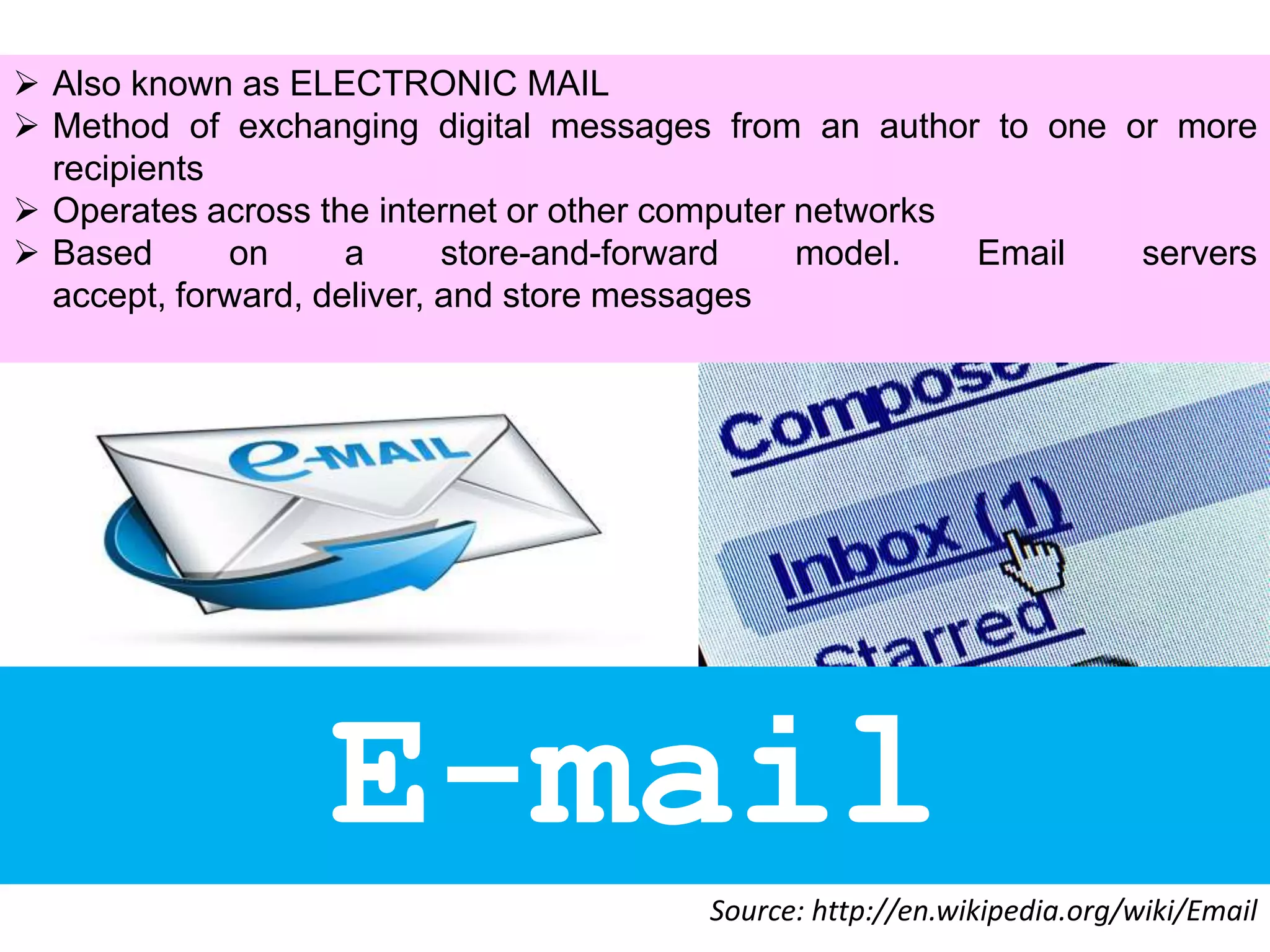
 Also known as ELECTRONIC MAIL
 Method of exchanging digital messages from an author to one or more
recipients
 Operates across the internet or other computer networks
 Based
on
a
store-and-forward
model.
Email
servers
accept, forward, deliver, and store messages

E-mail
Source: http://en.wikipedia.org/wiki/Email
BLOG
 A discussion or informational site published on the World
Wide Web and consisting of discrete entries typically
displayed in reverse chronological order.
 Provide commentary on a particular subject
 May function as more personal online diaries, or online
brand advertising
 Also a form of social networking service because readers
of a blog are allowed to leave comments

Source: http://en.wikipedia.org/wiki/Blog
 A web site that allows visitors to make changes, contributions or
corrections through a web browser.
 Originated in WikiWikiWeb, a web site with such programming
introduced in 1995

Wiki
Source: http://www.merriam-webster.com/dictionary/wiki
Social Networking
 A social structure made up of a set of social actors and a set of the dyadic
ties between actors.
 An online community of people with a common interest who use a website or
other technologies to communicate with each other and share
information, resource, etc.

Source: http://dictionary.reference.com/browse/social+network
Social Bookmarking

The practice of saving bookmarked web pages to a
public website as a way to share the links with other
internet users.
Source: http://dictionary.reference.com/browse/social+bookmarking
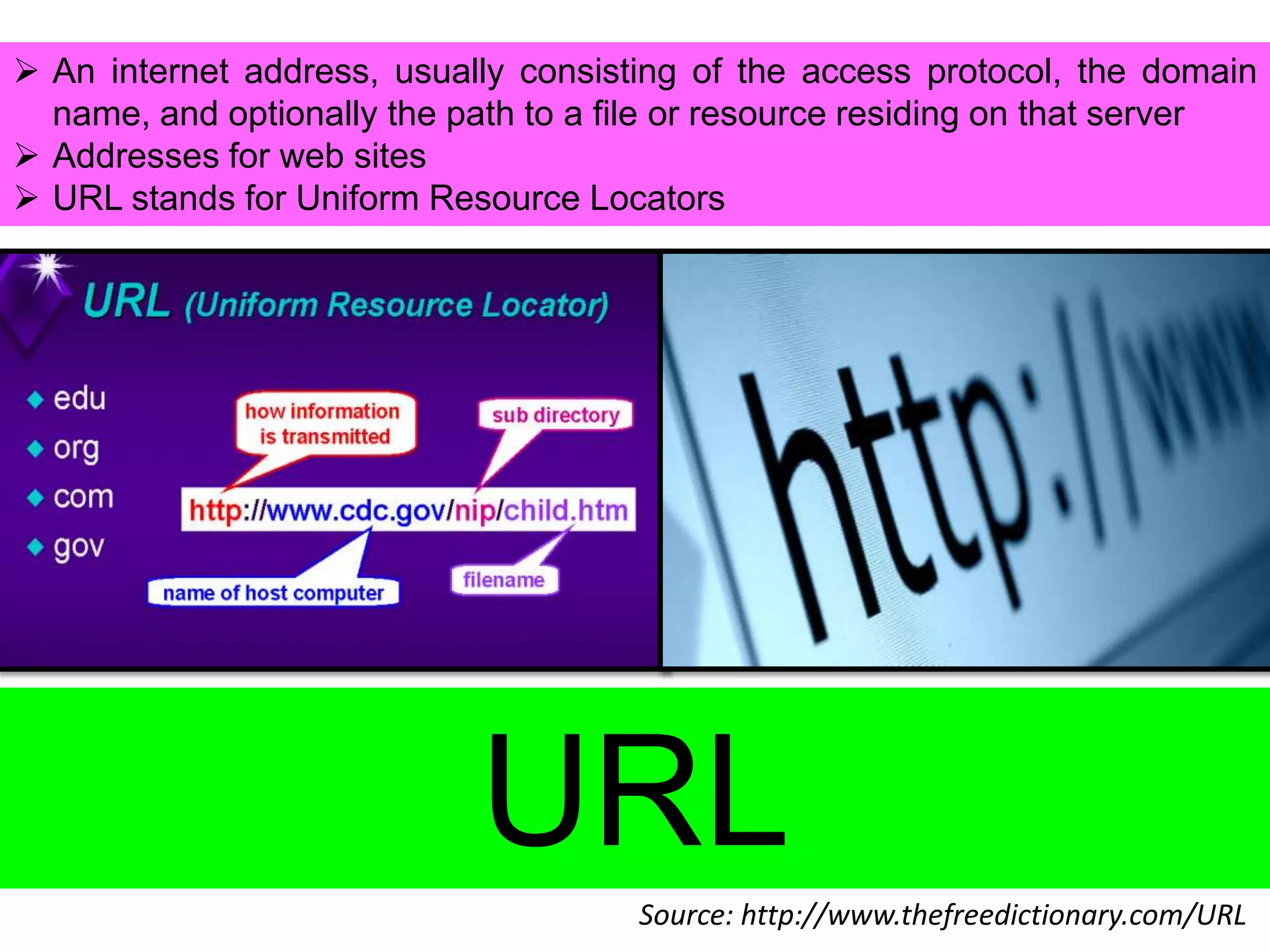
 An internet address, usually consisting of the access protocol, the domain
name, and optionally the path to a file or resource residing on that server
 Addresses for web sites
 URL stands for Uniform Resource Locators

URL
Source: http://www.thefreedictionary.com/URL
HTML
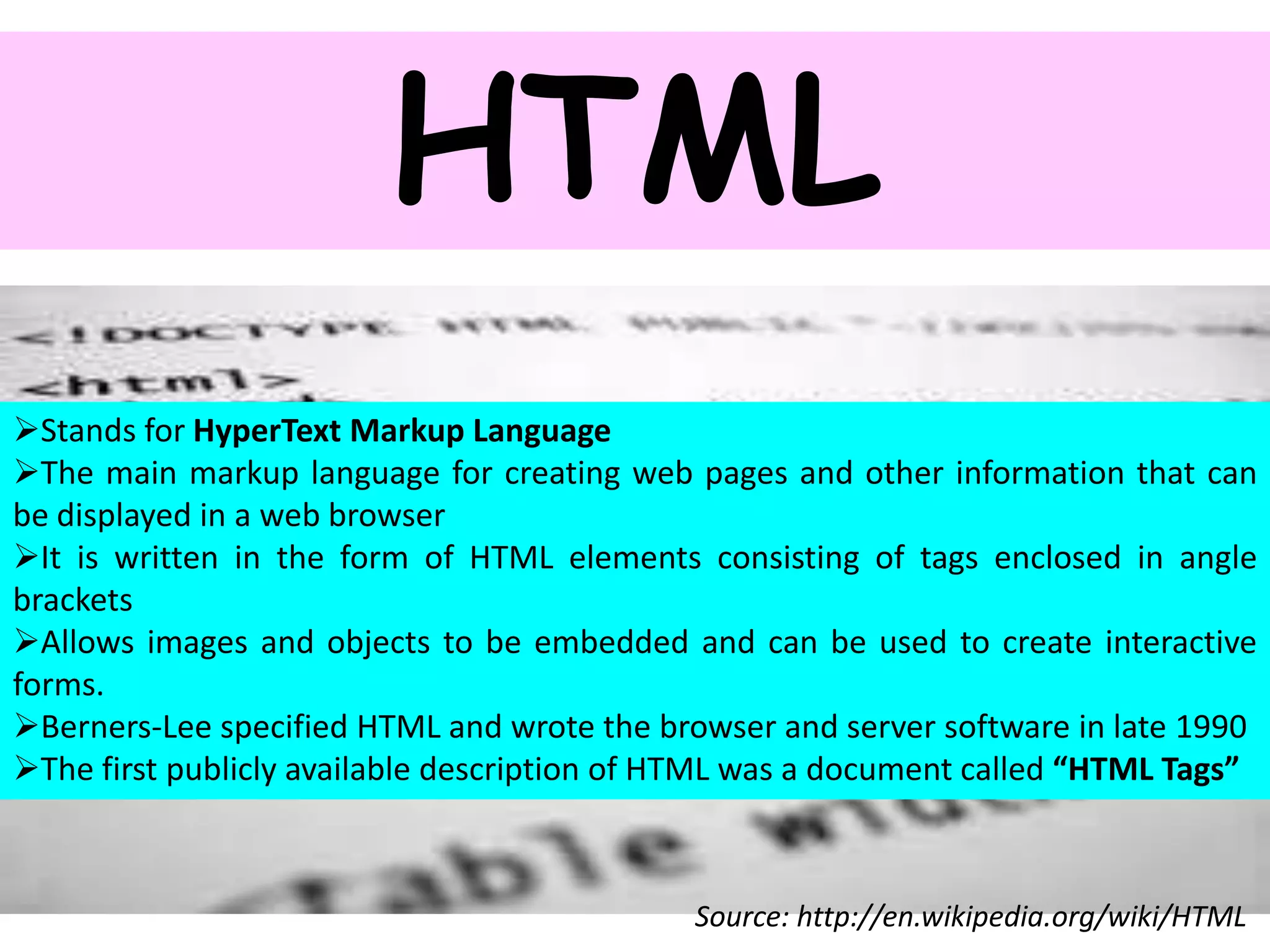
Stands for HyperText Markup Language
The main markup language for creating web pages and other information that can
be displayed in a web browser
It is written in the form of HTML elements consisting of tags enclosed in angle
brackets
Allows images and objects to be embedded and can be used to create interactive
forms.
Berners-Lee specified HTML and wrote the browser and server software in late 1990
The first publicly available description of HTML was a document called “HTML Tags”

Source: http://en.wikipedia.org/wiki/HTML
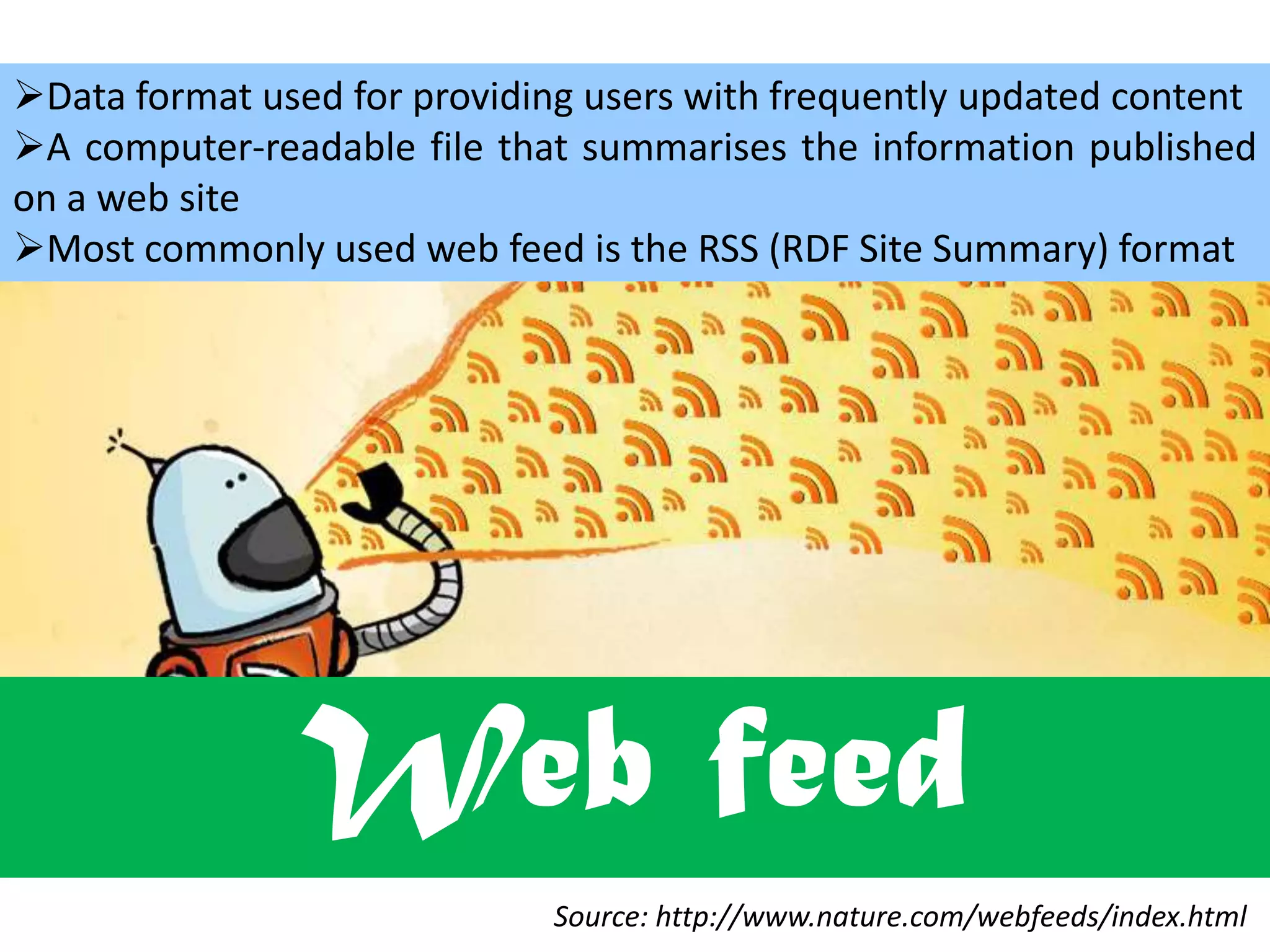
Data format used for providing users with frequently updated content
A computer-readable file that summarises the information published
on a web site
Most commonly used web feed is the RSS (RDF Site Summary) format

Web feed
Source: http://www.nature.com/webfeeds/index.html
Podcast

Also known as Netcast
Derived from “broadcast” and “pod” from the success of the iPod
A digital medium consisting of an episodic series of audio, video, PDF or ePub files
subscribed to and downloaded through web syndication or streamed online to a
computer of mobile device
A program made available in digital format for automatic download over the internet
Source: http://en.wikipedia.org/wiki/Podcast
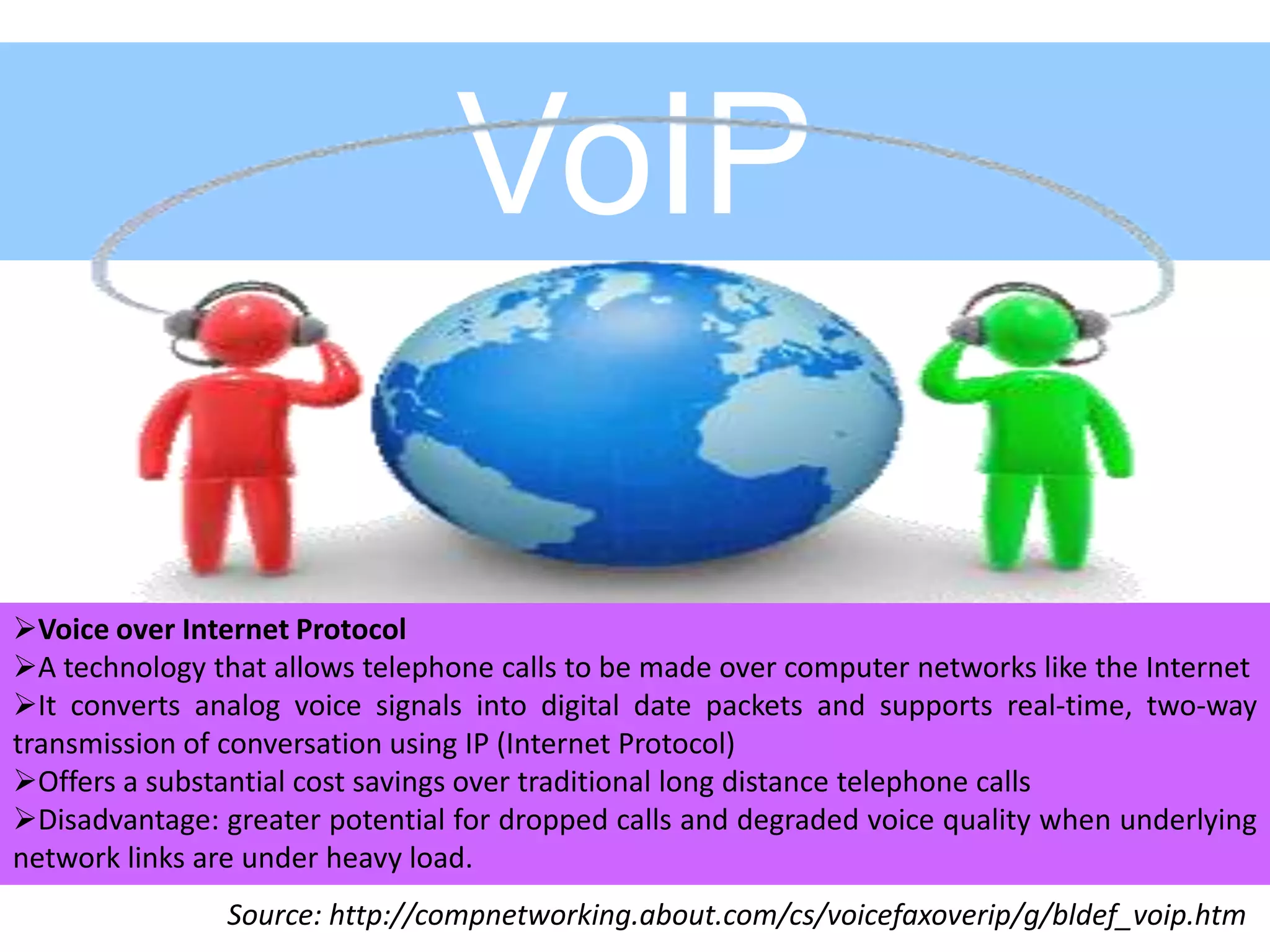
VoIP
Voice over Internet Protocol
A technology that allows telephone calls to be made over computer networks like the Internet
It converts analog voice signals into digital date packets and supports real-time, two-way
transmission of conversation using IP (Internet Protocol)
Offers a substantial cost savings over traditional long distance telephone calls
Disadvantage: greater potential for dropped calls and degraded voice quality when underlying
network links are under heavy load.
Source: http://compnetworking.about.com/cs/voicefaxoverip/g/bldef_voip.htm
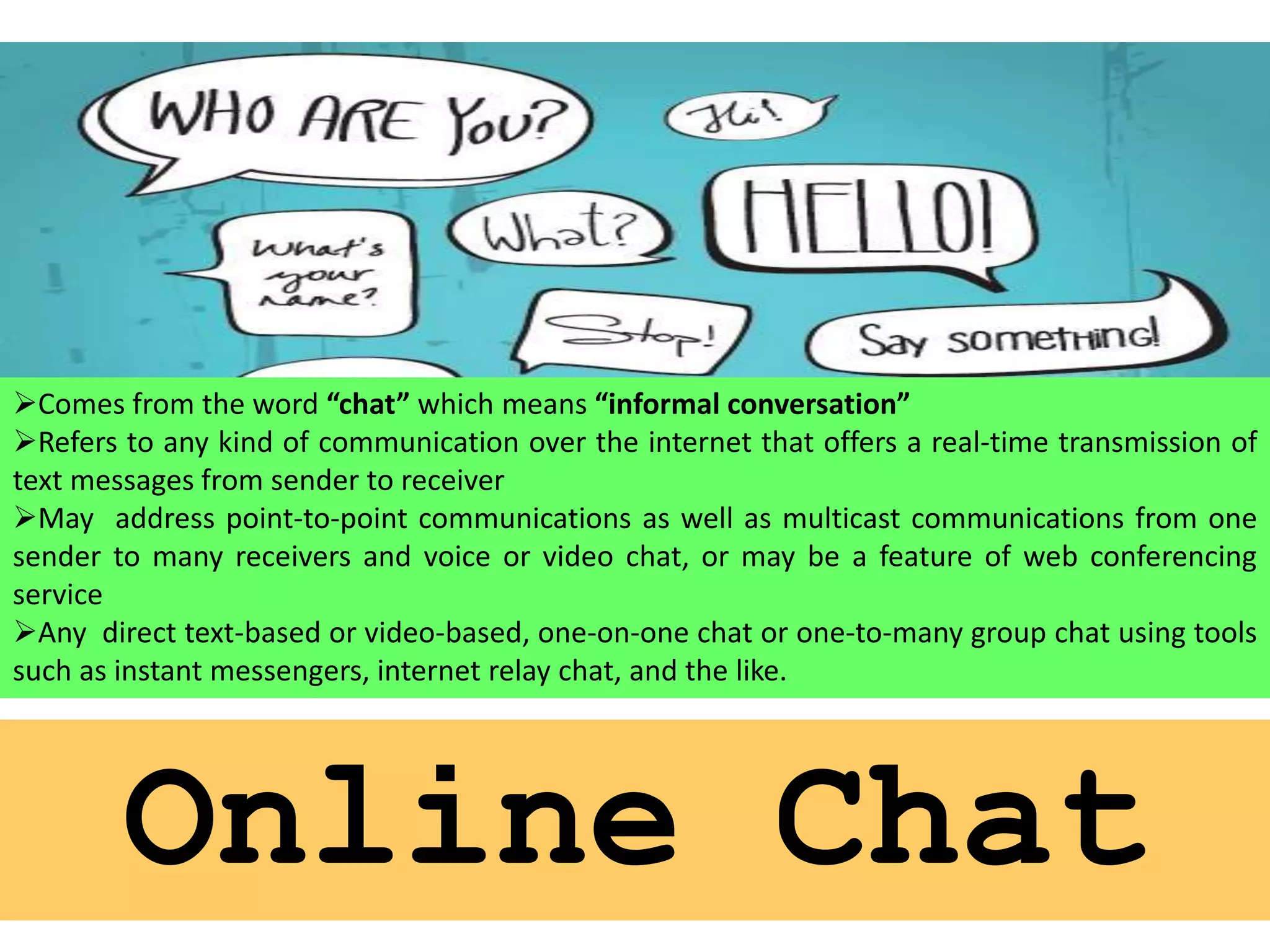
Comes from the word “chat” which means “informal conversation”
Refers to any kind of communication over the internet that offers a real-time transmission of
text messages from sender to receiver
May address point-to-point communications as well as multicast communications from one
sender to many receivers and voice or video chat, or may be a feature of web conferencing
service
Any direct text-based or video-based, one-on-one chat or one-to-many group chat using tools
such as instant messengers, internet relay chat, and the like.

Online Chat
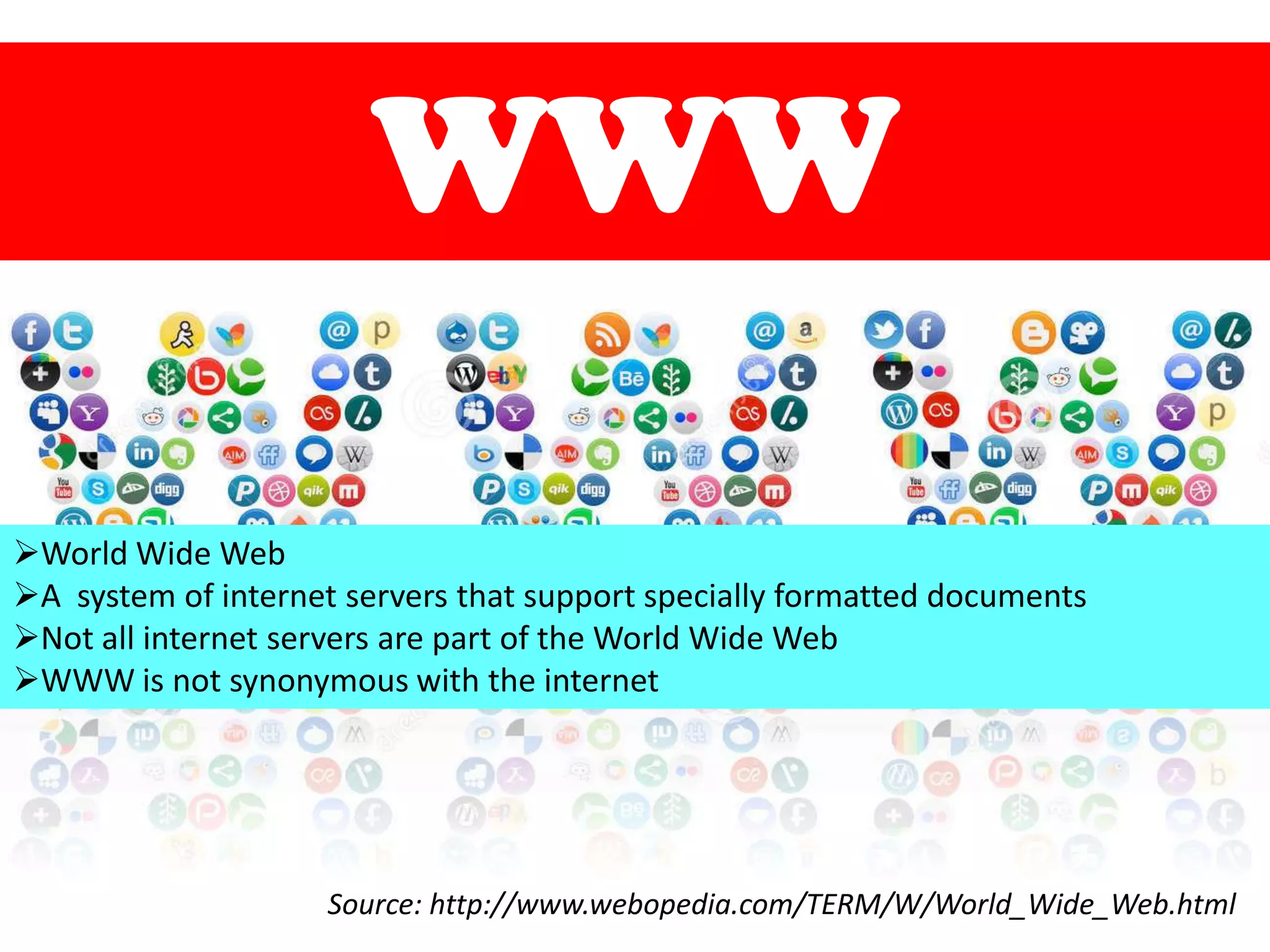
WWW
World Wide Web
A system of internet servers that support specially formatted documents
Not all internet servers are part of the World Wide Web
WWW is not synonymous with the internet

Source: http://www.webopedia.com/TERM/W/World_Wide_Web.html
Streaming
A technique for transferring data so that it can be processed as a steady and
continuous stream
Multimedia that is constantly received by and presented to an end-user while being
delivered by a provider
Refers to the delivery method of the medium rather than the medium itself
Sources: http://en.wikipedia.org/wiki/Streaming_media
http://www.webopedia.com/TERM/S/streaming.html

Common Online Terminologies

  • 1.
    : Common OnlineTerminologies : Made by: Pauline Estrada Bachelor of Education Major in Preschool Education University of Santo Tomas
  • 2.
     Also knownas ELECTRONIC MAIL  Method of exchanging digital messages from an author to one or more recipients  Operates across the internet or other computer networks  Based on a store-and-forward model. Email servers accept, forward, deliver, and store messages E-mail Source: http://en.wikipedia.org/wiki/Email
  • 3.
    BLOG  A discussionor informational site published on the World Wide Web and consisting of discrete entries typically displayed in reverse chronological order.  Provide commentary on a particular subject  May function as more personal online diaries, or online brand advertising  Also a form of social networking service because readers of a blog are allowed to leave comments Source: http://en.wikipedia.org/wiki/Blog
  • 4.
     A website that allows visitors to make changes, contributions or corrections through a web browser.  Originated in WikiWikiWeb, a web site with such programming introduced in 1995 Wiki Source: http://www.merriam-webster.com/dictionary/wiki
  • 5.
    Social Networking  Asocial structure made up of a set of social actors and a set of the dyadic ties between actors.  An online community of people with a common interest who use a website or other technologies to communicate with each other and share information, resource, etc. Source: http://dictionary.reference.com/browse/social+network
  • 6.
    Social Bookmarking The practiceof saving bookmarked web pages to a public website as a way to share the links with other internet users. Source: http://dictionary.reference.com/browse/social+bookmarking
  • 7.
     An internetaddress, usually consisting of the access protocol, the domain name, and optionally the path to a file or resource residing on that server  Addresses for web sites  URL stands for Uniform Resource Locators URL Source: http://www.thefreedictionary.com/URL
  • 8.
    HTML Stands for HyperTextMarkup Language The main markup language for creating web pages and other information that can be displayed in a web browser It is written in the form of HTML elements consisting of tags enclosed in angle brackets Allows images and objects to be embedded and can be used to create interactive forms. Berners-Lee specified HTML and wrote the browser and server software in late 1990 The first publicly available description of HTML was a document called “HTML Tags” Source: http://en.wikipedia.org/wiki/HTML
  • 9.
    Data format usedfor providing users with frequently updated content A computer-readable file that summarises the information published on a web site Most commonly used web feed is the RSS (RDF Site Summary) format Web feed Source: http://www.nature.com/webfeeds/index.html
  • 10.
    Podcast Also known asNetcast Derived from “broadcast” and “pod” from the success of the iPod A digital medium consisting of an episodic series of audio, video, PDF or ePub files subscribed to and downloaded through web syndication or streamed online to a computer of mobile device A program made available in digital format for automatic download over the internet Source: http://en.wikipedia.org/wiki/Podcast
  • 11.
    VoIP Voice over InternetProtocol A technology that allows telephone calls to be made over computer networks like the Internet It converts analog voice signals into digital date packets and supports real-time, two-way transmission of conversation using IP (Internet Protocol) Offers a substantial cost savings over traditional long distance telephone calls Disadvantage: greater potential for dropped calls and degraded voice quality when underlying network links are under heavy load. Source: http://compnetworking.about.com/cs/voicefaxoverip/g/bldef_voip.htm
  • 12.
    Comes from theword “chat” which means “informal conversation” Refers to any kind of communication over the internet that offers a real-time transmission of text messages from sender to receiver May address point-to-point communications as well as multicast communications from one sender to many receivers and voice or video chat, or may be a feature of web conferencing service Any direct text-based or video-based, one-on-one chat or one-to-many group chat using tools such as instant messengers, internet relay chat, and the like. Online Chat
  • 13.
    WWW World Wide Web Asystem of internet servers that support specially formatted documents Not all internet servers are part of the World Wide Web WWW is not synonymous with the internet Source: http://www.webopedia.com/TERM/W/World_Wide_Web.html
  • 14.
    Streaming A technique fortransferring data so that it can be processed as a steady and continuous stream Multimedia that is constantly received by and presented to an end-user while being delivered by a provider Refers to the delivery method of the medium rather than the medium itself Sources: http://en.wikipedia.org/wiki/Streaming_media http://www.webopedia.com/TERM/S/streaming.html