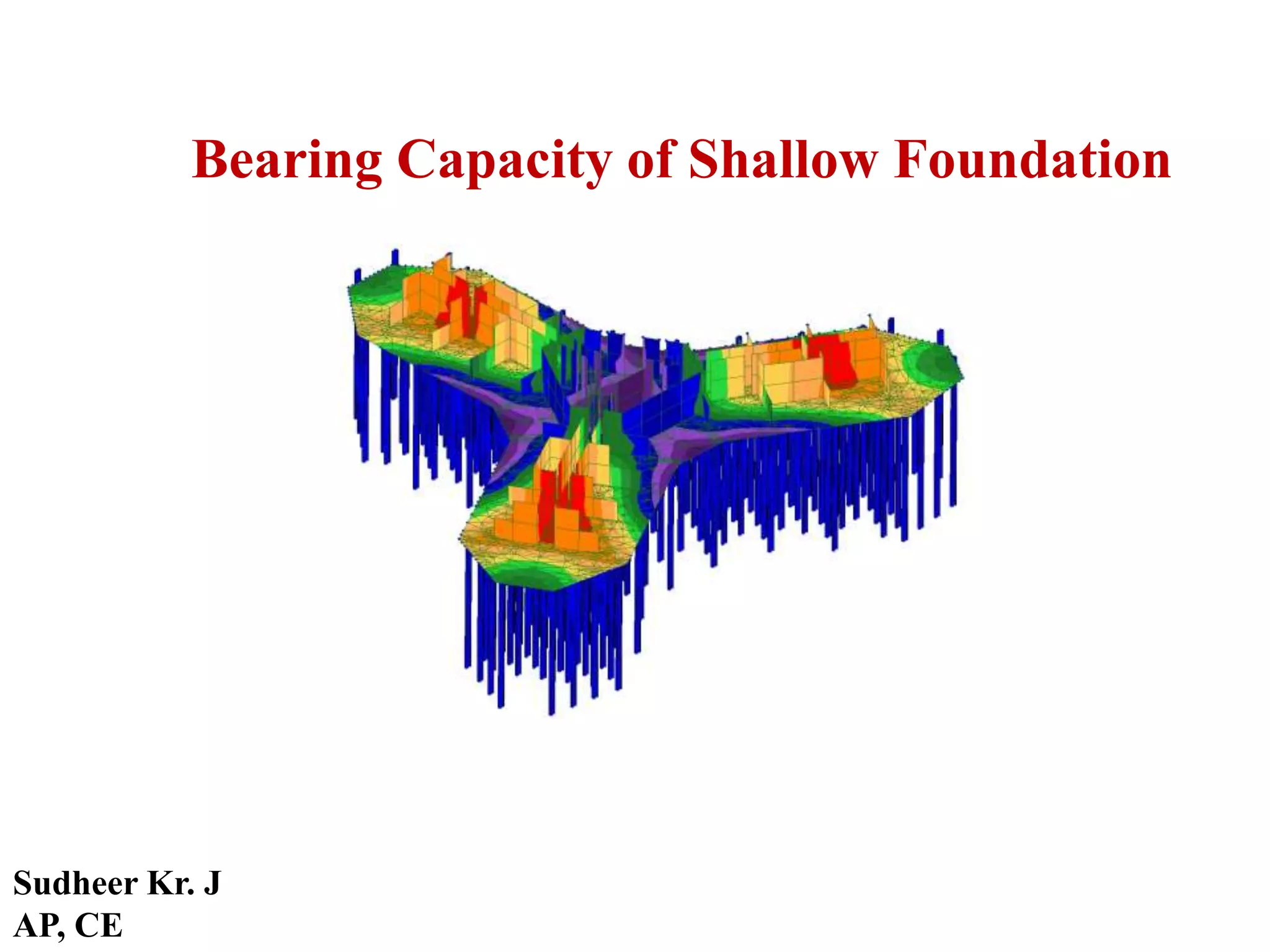
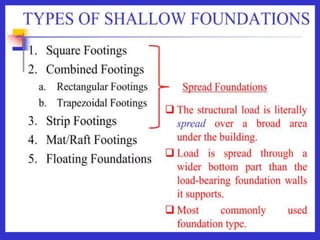
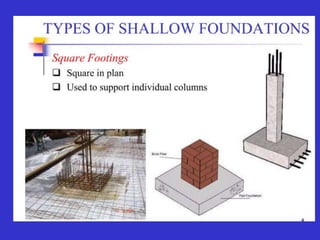
Bearing Capacity of Shallow Foundation
Sudheer Kr. J
AP, CE
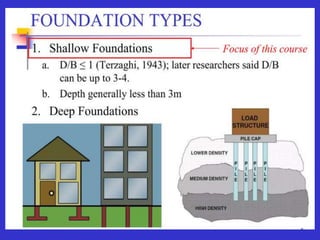
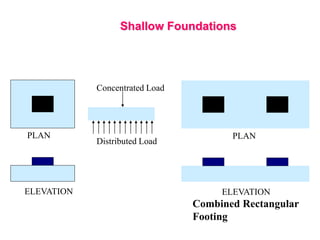
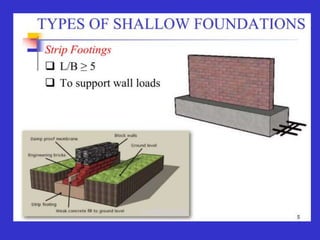
Shallow Foundations
PLAN
ELEVATION ELEVATION
PLAN
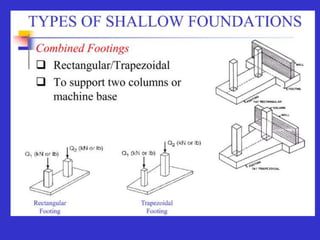
Combined Rectangular
Footing
Distributed Load
Concentrated Load
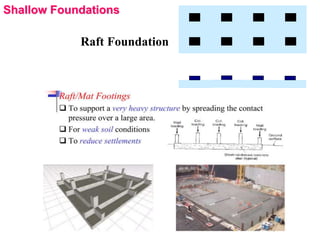
Shallow Foundations
Raft Foundation
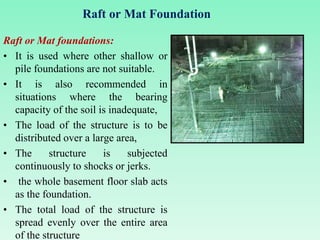
Raft or Mat Foundation
Raft or Mat foundations:
• It is used where other shallow or
pile foundations are not suitable.
• It is also recommended in
situations where the bearing
capacity of the soil is inadequate,
• The load of the structure is to be
distributed over a large area,
• The structure is subjected
continuously to shocks or jerks.
• the whole basement floor slab acts
as the foundation.
• The total load of the structure is
spread evenly over the entire area
of the structure
Raft foundations are economic when:
• The soil is weak and the load has to be spread over a large
area.
• The structure includes a basement.
• Columns are closely placed.
• Other kinds of foundations are not feasible.
• Differential settlement is to be prevented.
Why a Foundation is Provided?
• Foundation should fulfill the following objectives:
• Distribute the weight of the structure over a large area of
soil.
• Avoid unequal settlement.
• Prevent the lateral movement of the structure.
• Increase structural stability.
Why There are Different Types of Footing?
As we know that
1. there are different types of soil,
2. bearing capacity of the soil is different for each type of soil.3.
3. Depending on the soil profile, size, and load of the structure,
engineers chose different kinds of foundations.
Bearing Capacity Of Shallow Foundation
* A foundation is required for distributing
the loads of the superstructure on a large
area.
* The foundation should be designed
such that
a) The soil below does not fail in shear &
b) Settlement is within the safe limits.
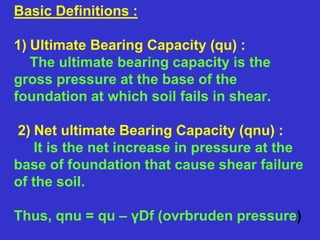
Basic Definitions :
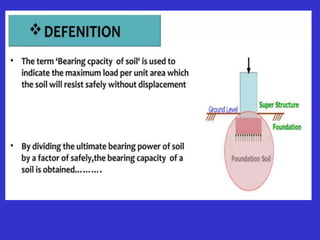
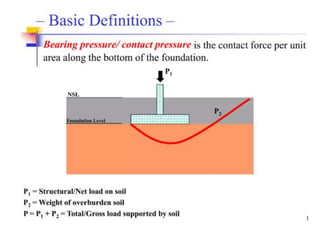
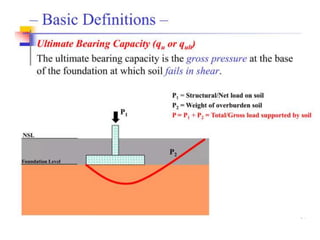
1) Ultimate Bearing Capacity (qu) :
The ultimate bearing capacity is the
gross pressure at the base of the
foundation at which soil fails in shear.
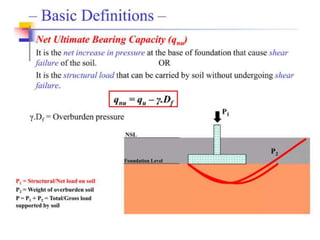
2) Net ultimate Bearing Capacity (qnu) :
It is the net increase in pressure at the
base of foundation that cause shear failure
of the soil.
Thus, qnu = qu – γDf (ovrbruden pressure)
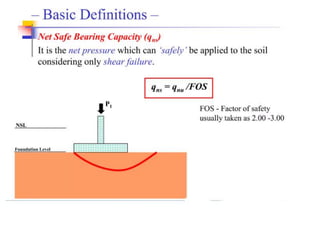
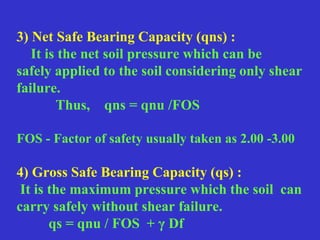
3) Net Safe Bearing Capacity (qns) :
It is the net soil pressure which can be
safely applied to the soil considering only shear
failure.
Thus, qns = qnu /FOS
FOS - Factor of safety usually taken as 2.00 -3.00
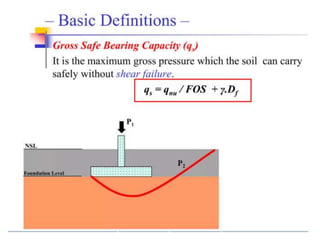
4) Gross Safe Bearing Capacity (qs) :
It is the maximum pressure which the soil can
carry safely without shear failure.
qs = qnu / FOS + γ Df
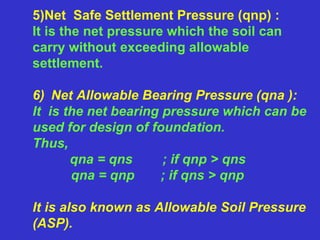
5)Net Safe Settlement Pressure (qnp) :
It is the net pressure which the soil can
carry without exceeding allowable
settlement.
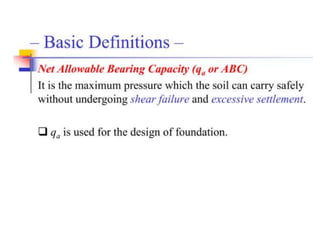
6) Net Allowable Bearing Pressure (qna ):
It is the net bearing pressure which can be
used for design of foundation.
Thus,
qna = qns ; if qnp > qns
qna = qnp ; if qns > qnp
It is also known as Allowable Soil Pressure
(ASP).
Modes of shear Failure :
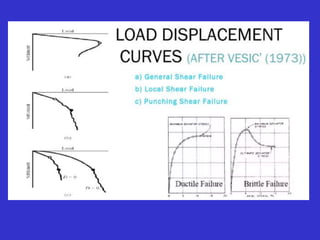
Vesic (1973) classified shear failure of soil under a
foundation base into three categories depending on
the type of soil & location of foundation.
1) General Shear failure.
2) Local Shear failure.
3) Punching Shear failure
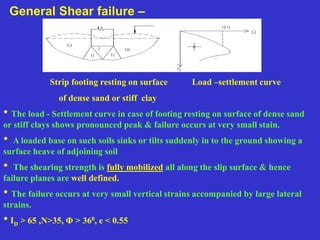
General Shear failure –
Strip footing resting on surface Load –settlement curve
of dense sand or stiff clay
* The load - Settlement curve in case of footing resting on surface of dense sand
or stiff clays shows pronounced peak & failure occurs at very small stain.
* A loaded base on such soils sinks or tilts suddenly in to the ground showing a
surface heave of adjoining soil
* The shearing strength is fully mobilized all along the slip surface & hence
failure planes are well defined.
* The failure occurs at very small vertical strains accompanied by large lateral
strains.
* ID > 65 ,N>35, Φ > 360, e < 0.55
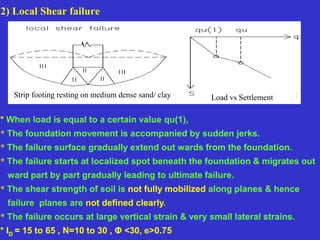
2) Local Shear failure
* When load is equal to a certain value qu(1),
* The foundation movement is accompanied by sudden jerks.
* The failure surface gradually extend out wards from the foundation.
* The failure starts at localized spot beneath the foundation & migrates out
ward part by part gradually leading to ultimate failure.
* The shear strength of soil is not fully mobilized along planes & hence
failure planes are not defined clearly.
* The failure occurs at large vertical strain & very small lateral strains.
* ID = 15 to 65 , N=10 to 30 , Φ <30, e>0.75
Strip footing resting on medium dense sand/ clay Load vs Settlement
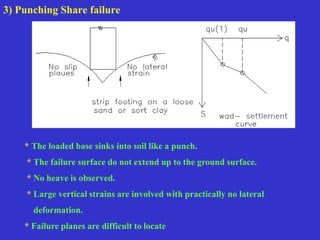
3) Punching Share failure
* The loaded base sinks into soil like a punch.
* The failure surface do not extend up to the ground surface.
* No heave is observed.
* Large vertical strains are involved with practically no lateral
deformation.
* Failure planes are difficult to locate
Terzaghi’s Method
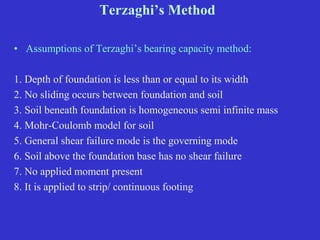
• Assumptions of Terzaghi’s bearing capacity method:
1. Depth of foundation is less than or equal to its width
2. No sliding occurs between foundation and soil
3. Soil beneath foundation is homogeneous semi infinite mass
4. Mohr-Coulomb model for soil
5. General shear failure mode is the governing mode
6. Soil above the foundation base has no shear failure
7. No applied moment present
8. It is applied to strip/ continuous footing
Terzaghi’s Bearing Capacity Analysis –
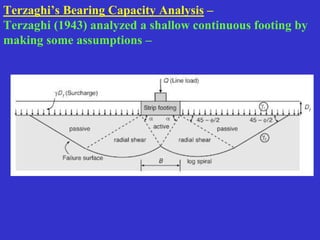
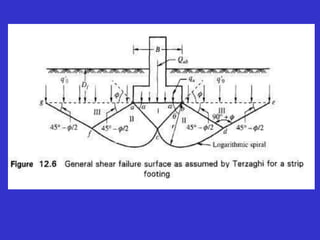
Terzaghi (1943) analyzed a shallow continuous footing by
making some assumptions –
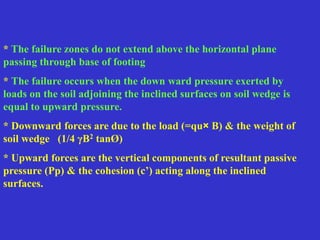
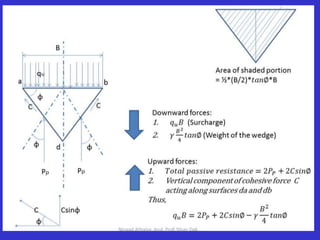
* The failure zones do not extend above the horizontal plane
passing through base of footing
* The failure occurs when the down ward pressure exerted by
loads on the soil adjoining the inclined surfaces on soil wedge is
equal to upward pressure.
* Downward forces are due to the load (=qu× B) & the weight of
soil wedge (1/4 γB2 tanØ)
* Upward forces are the vertical components of resultant passive
pressure (Pp) & the cohesion (c’) acting along the inclined
surfaces.
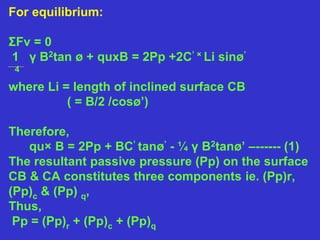
For equilibrium:
ΣFv = 0
1 γ B2tan ø + quxB = 2Pp +2C’ × Li sinø’
4
where Li = length of inclined surface CB
( = B/2 /cosø’)
Therefore,
qu× B = 2Pp + BC’ tanø’ - ¼ γ B2tanø’ –------ (1)
The resultant passive pressure (Pp) on the surface
CB & CA constitutes three components ie. (Pp)r,
(Pp)c & (Pp) q,
Thus,
Pp = (Pp)r + (Pp)c + (Pp)q
qu× B= 2[ (Pp)r +(Pp)c +(Pp)q ]+ Bc’tanø’-¼ γ B2 tanø’
Substituting; 2 (Pp)r - ¼rB2tanø1 = B × ½ γ BNr
2 (Pp)q = B × γ D Nq
& 2 (Pp)c + Bc1 tanø1 = B × C1 Nc;
We get,
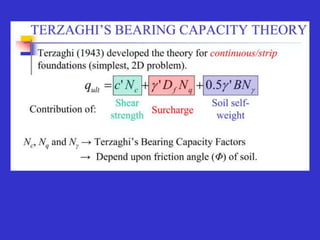
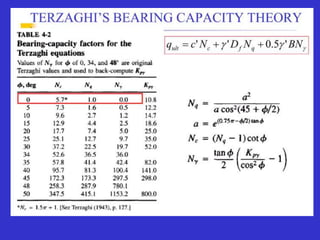
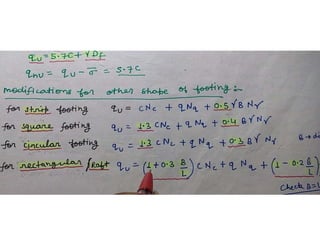
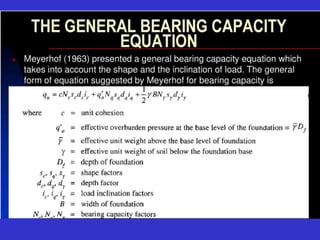
qu = C’Nc + γ Df Nq + 0.5 γ B N γ
This is Terzaghi’s Bearing capacity equation for
determining ultimate bearing capacity of strip footing.
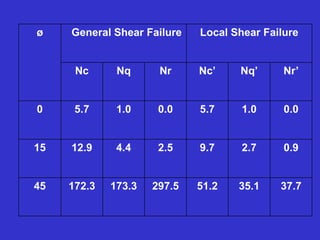
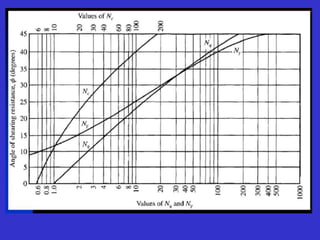
Where Nc, Nq & Nr are Terzaghi’s bearing capacity
factors & depends on angle of shearing resistance (ø)
ø General Shear Failure Local Shear Failure
Nc Nq Nr Nc’ Nq’ Nr’
0 5.7 1.0 0.0 5.7 1.0 0.0
15 12.9 4.4 2.5 9.7 2.7 0.9
45 172.3 173.3 297.5 51.2 35.1 37.7
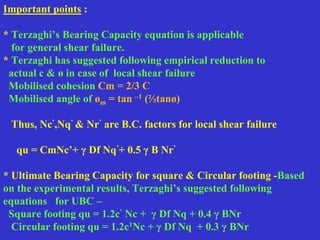
Important points :
* Terzaghi’s Bearing Capacity equation is applicable
for general shear failure.
* Terzaghi has suggested following empirical reduction to
actual c & ø in case of local shear failure
Mobilised cohesion Cm = 2/3 C
Mobilised angle of øm = tan –1 (⅔tanø)
Thus, Nc’,Nq’ & Nr’ are B.C. factors for local shear failure
qu = CmNc’+ γ Df Nq’+ 0.5 γ B Nr’
* Ultimate Bearing Capacity for square & Circular footing -Based
on the experimental results, Terzaghi’s suggested following
equations for UBC –
Square footing qu = 1.2c’ Nc + γ Df Nq + 0.4 γ BNr
Circular footing qu = 1.2c1Nc + γ Df Nq + 0.3 γ BNr
Effect of water table on Bearing Capacity :
* The equation for ultimate bearing capacity by Terzaghi
has been developed based on assumption that water table is
located at a great depth .
* If the water table is located close to foundation ; the
equation needs modification.
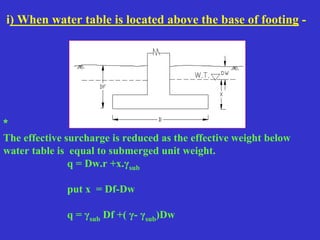
i) When water table is located above the base of footing -
*
The effective surcharge is reduced as the effective weight below
water table is equal to submerged unit weight.
q = Dw.r +x.γsub
put x = Df-Dw
q = γsub Df +( γ- γsub)Dw
Thus,
qu = c’Nc + [γsub Df +(γ - γsub )Dw] Nq + 0.5 γsub BNr
When, Dw =0
qu =c’Nc + γsub Nc + 0.5 γsub BNr
& when x = 0
qu = c’Nc + γ Df Nq + 0.5 γsub BNr
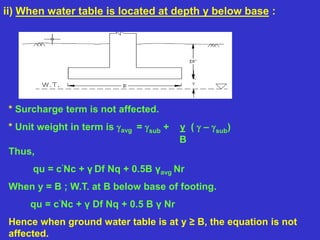
ii) When water table is located at depth y below base :
* Surcharge term is not affected.
* Unit weight in term is gavg = gsub + y ( g – gsub)
B
Thus,
qu = c’Nc + γ Df Nq + 0.5B γavg Nr
When y = B ; W.T. at B below base of footing.
qu = c’Nc + γ Df Nq + 0.5 B γ Nr
Hence when ground water table is at y ≥ B, the equation is not
affected.
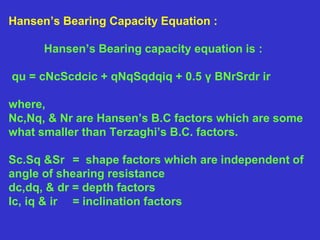
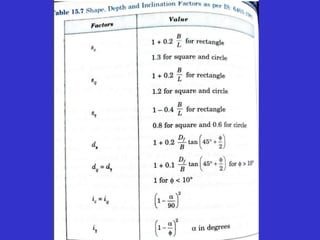
Hansen’s Bearing Capacity Equation :
Hansen’s Bearing capacity equation is :
qu = cNcScdcic + qNqSqdqiq + 0.5 γ BNrSrdr ir
where,
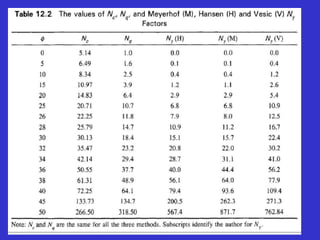
Nc,Nq, & Nr are Hansen’s B.C factors which are some
what smaller than Terzaghi’s B.C. factors.
Sc.Sq &Sr = shape factors which are independent of
angle of shearing resistance
dc,dq, & dr = depth factors
Ic, iq & ir = inclination factors
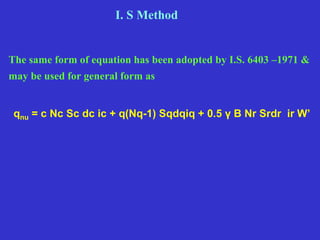
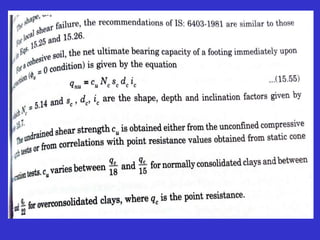
The same form of equation has been adopted by I.S. 6403 –1971 &
may be used for general form as
qnu = c Nc Sc dc ic + q(Nq-1) Sqdqiq + 0.5 γ B Nr Srdr ir W’
I. S Method
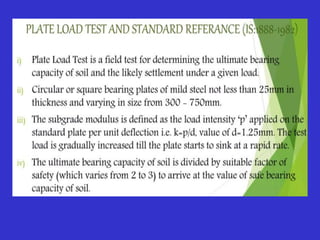
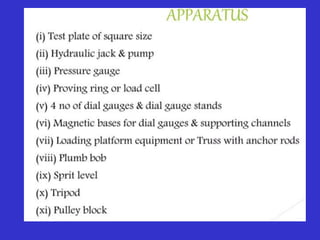
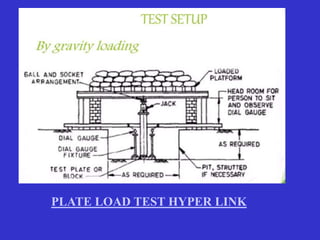
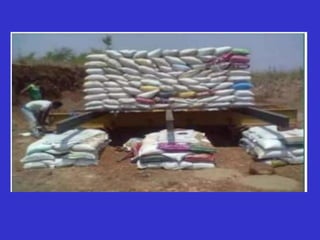
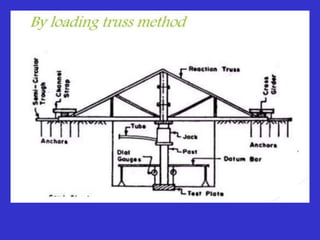
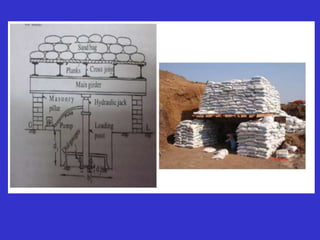
PLATE LOAD TEST HYPER LINK
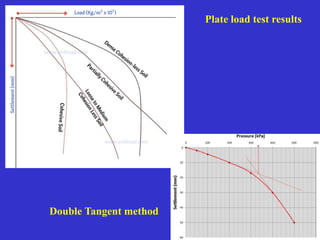
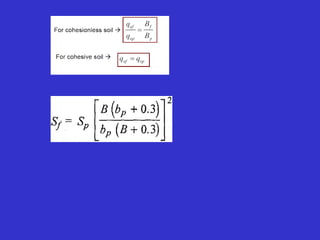
Plate load test results
Double Tangent method
Advantages of Plate Load Test
• Being able to understand the foundation behavior under
loading conditions.
• Evaluation of bearing capacity of soil at a certain depth and
prediction of settlement for a certain load.
• Shallow foundation can be calculated considering the allowable
bearing capacity, which can be predicted from the plate load
test.
• Time and cost-efficient.
• Easy to perform.
• Reliable.
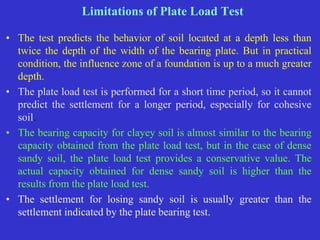
Limitations of Plate Load Test
• The test predicts the behavior of soil located at a depth less than
twice the depth of the width of the bearing plate. But in practical
condition, the influence zone of a foundation is up to a much greater
depth.
• The plate load test is performed for a short time period, so it cannot
predict the settlement for a longer period, especially for cohesive
soil.
• The bearing capacity for clayey soil is almost similar to the bearing
capacity obtained from the plate load test, but in the case of dense
sandy soil, the plate load test provides a conservative value. The
actual capacity obtained for dense sandy soil is higher than the
results from the plate load test.
• The settlement for losing sandy soil is usually greater than the
settlement indicated by the plate bearing test.
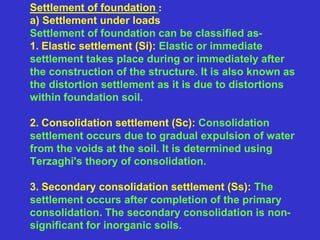
Settlement of foundation :
a) Settlement under loads
Settlement of foundation can be classified as-
1. Elastic settlement (Si): Elastic or immediate
settlement takes place during or immediately after
the construction of the structure. It is also known as
the distortion settlement as it is due to distortions
within foundation soil.
2. Consolidation settlement (Sc): Consolidation
settlement occurs due to gradual expulsion of water
from the voids at the soil. It is determined using
Terzaghi's theory of consolidation.
3. Secondary consolidation settlement (Ss): The
settlement occurs after completion of the primary
consolidation. The secondary consolidation is non-
significant for inorganic soils.
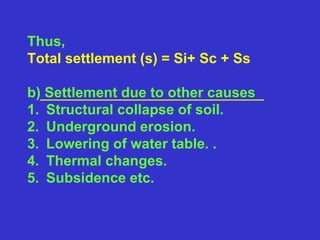
Thus,
Total settlement (s) = Si+ Sc + Ss
b) Settlement due to other causes
1. Structural collapse of soil.
2. Underground erosion.
3. Lowering of water table. .
4. Thermal changes.
5. Subsidence etc.
Elastic settlement of foundation :
a) On Cohesive soils
According to schleicher, the vertical settlement
under uniformly distributed flexible area is,
Si = q B 1- μ2/Es I
where
q -uniformly distributed load.
B - characteristic length of loaded area,
Es - modulus of elasticity of the soil.
μ - poisson's ratio.
I - influence factor which dependent upon
elastic properties of base & shape at base.
Alternatively, the value of [1- μ2/Es] I can be
determined from the plate load test.
b) On Cohesionless Soils
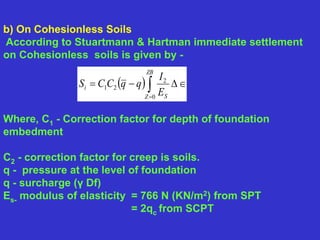
According to Stuartmann & Hartman immediate settlement
on Cohesionless soils is given by -
Where, C1 - Correction factor for depth of foundation
embedment
C2 - correction factor for creep is soils.
q - pressure at the level of foundation
q - surcharge (γ Df)
Es- modulus of elasticity = 766 N (KN/m2) from SPT
= 2qc from SCPT
  




ZB
Z S
i
E
I
q
q
C
C
S
0
2
2
1
Settlement of foundation on Cohesionless Soils
Settlement of foundations on Cohesionless soils are
generally determined indirectly using the semi-empirical
methods.
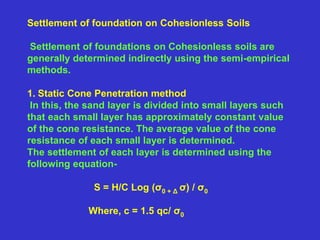
1. Static Cone Penetration method
In this, the sand layer is divided into small layers such
that each small layer has approximately constant value
of the cone resistance. The average value of the cone
resistance of each small layer is determined.
The settlement of each layer is determined using the
following equation-
S = H/C Log (σ0 + Δ σ) / σ0
Where, c = 1.5 qc/ σ0
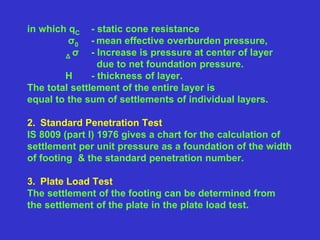
in which qC - static cone resistance
σ0 - mean effective overburden pressure,
Δ σ - Increase is pressure at center of layer
due to net foundation pressure.
H - thickness of layer.
The total settlement of the entire layer is
equal to the sum of settlements of individual layers.
2. Standard Penetration Test
IS 8009 (part I) 1976 gives a chart for the calculation of
settlement per unit pressure as a foundation of the width
of footing & the standard penetration number.
3. Plate Load Test
The settlement of the footing can be determined from
the settlement of the plate in the plate load test.
Differential Settlement
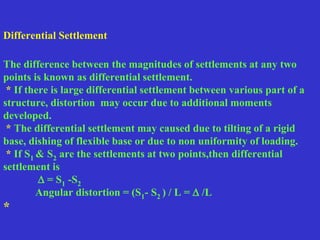
The difference between the magnitudes of settlements at any two
points is known as differential settlement.
* If there is large differential settlement between various part of a
structure, distortion may occur due to additional moments
developed.
* The differential settlement may caused due to tilting of a rigid
base, dishing of flexible base or due to non uniformity of loading.
* If S1 & S2 are the settlements at two points,then differential
settlement is
 = S1 -S2
Angular distortion = (S1- S2 ) / L =  /L
*
* It is difficult to predict the differential settlement.
* It is generally observed indirectly from the maximum
settlement.
* It is observed that the differential settlement is less
than 50% of the maximum settlement is most of the
cases.
The differential settlement can be reduced by providing
rigid rafts, founding the structures at great depth &
avoiding the eccentric loading.
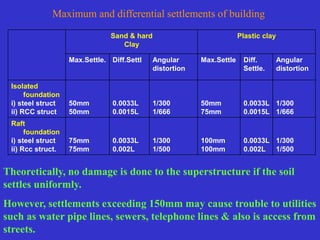
Allowable Settlement
* The allowable maximum settlement depends upon
the type of soil, the type of foundation & the
structural framing system.
* The maximum settlement ranging from 20mm to
300mm is generally permitted for various
structures.
* IS 1904-1978 gives values of the maximum &
differential settlements of different type of building.
Sand & hard
Clay
Plastic clay
Max.Settle. Diff.Settl Angular
distortion
Max.Settle Diff.
Settle.
Angular
distortion
Isolated
foundation
i) steel struct
ii) RCC struct
50mm
50mm
0.0033L
0.0015L
1/300
1/666
50mm
75mm
0.0033L
0.0015L
1/300
1/666
Raft
foundation
i) steel struct
ii) Rcc struct.
75mm
75mm
0.0033L
0.002L
1/300
1/500
100mm
100mm
0.0033L
0.002L
1/300
1/500
Theoretically, no damage is done to the superstructure if the soil
settles uniformly.
However, settlements exceeding 150mm may cause trouble to utilities
such as water pipe lines, sewers, telephone lines & also is access from
streets.
Maximum and differential settlements of building
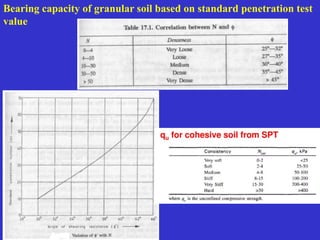
Bearing capacity of granular soil based on standard penetration test
value
OK
https://www.slideshare.net/sameerthaiyam1/pile-foundation-
87349854

BEARING CAPASITY OFSOIL.pptx

  • 1.
    Bearing Capacity ofShallow Foundation Sudheer Kr. J AP, CE
  • 6.
    Shallow Foundations PLAN ELEVATION ELEVATION PLAN CombinedRectangular Footing Distributed Load Concentrated Load
  • 8.
  • 9.
    Raft or MatFoundation Raft or Mat foundations: • It is used where other shallow or pile foundations are not suitable. • It is also recommended in situations where the bearing capacity of the soil is inadequate, • The load of the structure is to be distributed over a large area, • The structure is subjected continuously to shocks or jerks. • the whole basement floor slab acts as the foundation. • The total load of the structure is spread evenly over the entire area of the structure
  • 10.
    Raft foundations areeconomic when: • The soil is weak and the load has to be spread over a large area. • The structure includes a basement. • Columns are closely placed. • Other kinds of foundations are not feasible. • Differential settlement is to be prevented.
  • 13.
    Why a Foundationis Provided? • Foundation should fulfill the following objectives: • Distribute the weight of the structure over a large area of soil. • Avoid unequal settlement. • Prevent the lateral movement of the structure. • Increase structural stability. Why There are Different Types of Footing? As we know that 1. there are different types of soil, 2. bearing capacity of the soil is different for each type of soil.3. 3. Depending on the soil profile, size, and load of the structure, engineers chose different kinds of foundations.
  • 14.
    Bearing Capacity OfShallow Foundation * A foundation is required for distributing the loads of the superstructure on a large area. * The foundation should be designed such that a) The soil below does not fail in shear & b) Settlement is within the safe limits.
  • 22.
    Basic Definitions : 1)Ultimate Bearing Capacity (qu) : The ultimate bearing capacity is the gross pressure at the base of the foundation at which soil fails in shear. 2) Net ultimate Bearing Capacity (qnu) : It is the net increase in pressure at the base of foundation that cause shear failure of the soil. Thus, qnu = qu – γDf (ovrbruden pressure)
  • 23.
    3) Net SafeBearing Capacity (qns) : It is the net soil pressure which can be safely applied to the soil considering only shear failure. Thus, qns = qnu /FOS FOS - Factor of safety usually taken as 2.00 -3.00 4) Gross Safe Bearing Capacity (qs) : It is the maximum pressure which the soil can carry safely without shear failure. qs = qnu / FOS + γ Df
  • 24.
    5)Net Safe SettlementPressure (qnp) : It is the net pressure which the soil can carry without exceeding allowable settlement. 6) Net Allowable Bearing Pressure (qna ): It is the net bearing pressure which can be used for design of foundation. Thus, qna = qns ; if qnp > qns qna = qnp ; if qns > qnp It is also known as Allowable Soil Pressure (ASP).
  • 25.
    Modes of shearFailure : Vesic (1973) classified shear failure of soil under a foundation base into three categories depending on the type of soil & location of foundation. 1) General Shear failure. 2) Local Shear failure. 3) Punching Shear failure
  • 26.
    General Shear failure– Strip footing resting on surface Load –settlement curve of dense sand or stiff clay * The load - Settlement curve in case of footing resting on surface of dense sand or stiff clays shows pronounced peak & failure occurs at very small stain. * A loaded base on such soils sinks or tilts suddenly in to the ground showing a surface heave of adjoining soil * The shearing strength is fully mobilized all along the slip surface & hence failure planes are well defined. * The failure occurs at very small vertical strains accompanied by large lateral strains. * ID > 65 ,N>35, Φ > 360, e < 0.55
  • 27.
    2) Local Shearfailure * When load is equal to a certain value qu(1), * The foundation movement is accompanied by sudden jerks. * The failure surface gradually extend out wards from the foundation. * The failure starts at localized spot beneath the foundation & migrates out ward part by part gradually leading to ultimate failure. * The shear strength of soil is not fully mobilized along planes & hence failure planes are not defined clearly. * The failure occurs at large vertical strain & very small lateral strains. * ID = 15 to 65 , N=10 to 30 , Φ <30, e>0.75 Strip footing resting on medium dense sand/ clay Load vs Settlement
  • 28.
    3) Punching Sharefailure * The loaded base sinks into soil like a punch. * The failure surface do not extend up to the ground surface. * No heave is observed. * Large vertical strains are involved with practically no lateral deformation. * Failure planes are difficult to locate
  • 30.
    Terzaghi’s Method • Assumptionsof Terzaghi’s bearing capacity method: 1. Depth of foundation is less than or equal to its width 2. No sliding occurs between foundation and soil 3. Soil beneath foundation is homogeneous semi infinite mass 4. Mohr-Coulomb model for soil 5. General shear failure mode is the governing mode 6. Soil above the foundation base has no shear failure 7. No applied moment present 8. It is applied to strip/ continuous footing
  • 31.
    Terzaghi’s Bearing CapacityAnalysis – Terzaghi (1943) analyzed a shallow continuous footing by making some assumptions –
  • 33.
    * The failurezones do not extend above the horizontal plane passing through base of footing * The failure occurs when the down ward pressure exerted by loads on the soil adjoining the inclined surfaces on soil wedge is equal to upward pressure. * Downward forces are due to the load (=qu× B) & the weight of soil wedge (1/4 γB2 tanØ) * Upward forces are the vertical components of resultant passive pressure (Pp) & the cohesion (c’) acting along the inclined surfaces.
  • 35.
    For equilibrium: ΣFv =0 1 γ B2tan ø + quxB = 2Pp +2C’ × Li sinø’ 4 where Li = length of inclined surface CB ( = B/2 /cosø’) Therefore, qu× B = 2Pp + BC’ tanø’ - ¼ γ B2tanø’ –------ (1) The resultant passive pressure (Pp) on the surface CB & CA constitutes three components ie. (Pp)r, (Pp)c & (Pp) q, Thus, Pp = (Pp)r + (Pp)c + (Pp)q
  • 36.
    qu× B= 2[(Pp)r +(Pp)c +(Pp)q ]+ Bc’tanø’-¼ γ B2 tanø’ Substituting; 2 (Pp)r - ¼rB2tanø1 = B × ½ γ BNr 2 (Pp)q = B × γ D Nq & 2 (Pp)c + Bc1 tanø1 = B × C1 Nc; We get, qu = C’Nc + γ Df Nq + 0.5 γ B N γ This is Terzaghi’s Bearing capacity equation for determining ultimate bearing capacity of strip footing. Where Nc, Nq & Nr are Terzaghi’s bearing capacity factors & depends on angle of shearing resistance (ø)
  • 39.
    ø General ShearFailure Local Shear Failure Nc Nq Nr Nc’ Nq’ Nr’ 0 5.7 1.0 0.0 5.7 1.0 0.0 15 12.9 4.4 2.5 9.7 2.7 0.9 45 172.3 173.3 297.5 51.2 35.1 37.7
  • 41.
    Important points : *Terzaghi’s Bearing Capacity equation is applicable for general shear failure. * Terzaghi has suggested following empirical reduction to actual c & ø in case of local shear failure Mobilised cohesion Cm = 2/3 C Mobilised angle of øm = tan –1 (⅔tanø) Thus, Nc’,Nq’ & Nr’ are B.C. factors for local shear failure qu = CmNc’+ γ Df Nq’+ 0.5 γ B Nr’ * Ultimate Bearing Capacity for square & Circular footing -Based on the experimental results, Terzaghi’s suggested following equations for UBC – Square footing qu = 1.2c’ Nc + γ Df Nq + 0.4 γ BNr Circular footing qu = 1.2c1Nc + γ Df Nq + 0.3 γ BNr
  • 43.
    Effect of watertable on Bearing Capacity : * The equation for ultimate bearing capacity by Terzaghi has been developed based on assumption that water table is located at a great depth . * If the water table is located close to foundation ; the equation needs modification.
  • 44.
    i) When watertable is located above the base of footing - * The effective surcharge is reduced as the effective weight below water table is equal to submerged unit weight. q = Dw.r +x.γsub put x = Df-Dw q = γsub Df +( γ- γsub)Dw
  • 45.
    Thus, qu = c’Nc+ [γsub Df +(γ - γsub )Dw] Nq + 0.5 γsub BNr When, Dw =0 qu =c’Nc + γsub Nc + 0.5 γsub BNr & when x = 0 qu = c’Nc + γ Df Nq + 0.5 γsub BNr
  • 46.
    ii) When watertable is located at depth y below base : * Surcharge term is not affected. * Unit weight in term is gavg = gsub + y ( g – gsub) B Thus, qu = c’Nc + γ Df Nq + 0.5B γavg Nr When y = B ; W.T. at B below base of footing. qu = c’Nc + γ Df Nq + 0.5 B γ Nr Hence when ground water table is at y ≥ B, the equation is not affected.
  • 47.
    Hansen’s Bearing CapacityEquation : Hansen’s Bearing capacity equation is : qu = cNcScdcic + qNqSqdqiq + 0.5 γ BNrSrdr ir where, Nc,Nq, & Nr are Hansen’s B.C factors which are some what smaller than Terzaghi’s B.C. factors. Sc.Sq &Sr = shape factors which are independent of angle of shearing resistance dc,dq, & dr = depth factors Ic, iq & ir = inclination factors
  • 50.
    The same formof equation has been adopted by I.S. 6403 –1971 & may be used for general form as qnu = c Nc Sc dc ic + q(Nq-1) Sqdqiq + 0.5 γ B Nr Srdr ir W’ I. S Method
  • 56.
    PLATE LOAD TESTHYPER LINK
  • 60.
    Plate load testresults Double Tangent method
  • 62.
    Advantages of PlateLoad Test • Being able to understand the foundation behavior under loading conditions. • Evaluation of bearing capacity of soil at a certain depth and prediction of settlement for a certain load. • Shallow foundation can be calculated considering the allowable bearing capacity, which can be predicted from the plate load test. • Time and cost-efficient. • Easy to perform. • Reliable.
  • 63.
    Limitations of PlateLoad Test • The test predicts the behavior of soil located at a depth less than twice the depth of the width of the bearing plate. But in practical condition, the influence zone of a foundation is up to a much greater depth. • The plate load test is performed for a short time period, so it cannot predict the settlement for a longer period, especially for cohesive soil. • The bearing capacity for clayey soil is almost similar to the bearing capacity obtained from the plate load test, but in the case of dense sandy soil, the plate load test provides a conservative value. The actual capacity obtained for dense sandy soil is higher than the results from the plate load test. • The settlement for losing sandy soil is usually greater than the settlement indicated by the plate bearing test.
  • 65.
    Settlement of foundation: a) Settlement under loads Settlement of foundation can be classified as- 1. Elastic settlement (Si): Elastic or immediate settlement takes place during or immediately after the construction of the structure. It is also known as the distortion settlement as it is due to distortions within foundation soil. 2. Consolidation settlement (Sc): Consolidation settlement occurs due to gradual expulsion of water from the voids at the soil. It is determined using Terzaghi's theory of consolidation. 3. Secondary consolidation settlement (Ss): The settlement occurs after completion of the primary consolidation. The secondary consolidation is non- significant for inorganic soils.
  • 66.
    Thus, Total settlement (s)= Si+ Sc + Ss b) Settlement due to other causes 1. Structural collapse of soil. 2. Underground erosion. 3. Lowering of water table. . 4. Thermal changes. 5. Subsidence etc.
  • 67.
    Elastic settlement offoundation : a) On Cohesive soils According to schleicher, the vertical settlement under uniformly distributed flexible area is, Si = q B 1- μ2/Es I where q -uniformly distributed load. B - characteristic length of loaded area, Es - modulus of elasticity of the soil. μ - poisson's ratio. I - influence factor which dependent upon elastic properties of base & shape at base. Alternatively, the value of [1- μ2/Es] I can be determined from the plate load test.
  • 68.
    b) On CohesionlessSoils According to Stuartmann & Hartman immediate settlement on Cohesionless soils is given by - Where, C1 - Correction factor for depth of foundation embedment C2 - correction factor for creep is soils. q - pressure at the level of foundation q - surcharge (γ Df) Es- modulus of elasticity = 766 N (KN/m2) from SPT = 2qc from SCPT        ZB Z S i E I q q C C S 0 2 2 1
  • 69.
    Settlement of foundationon Cohesionless Soils Settlement of foundations on Cohesionless soils are generally determined indirectly using the semi-empirical methods. 1. Static Cone Penetration method In this, the sand layer is divided into small layers such that each small layer has approximately constant value of the cone resistance. The average value of the cone resistance of each small layer is determined. The settlement of each layer is determined using the following equation- S = H/C Log (σ0 + Δ σ) / σ0 Where, c = 1.5 qc/ σ0
  • 70.
    in which qC- static cone resistance σ0 - mean effective overburden pressure, Δ σ - Increase is pressure at center of layer due to net foundation pressure. H - thickness of layer. The total settlement of the entire layer is equal to the sum of settlements of individual layers. 2. Standard Penetration Test IS 8009 (part I) 1976 gives a chart for the calculation of settlement per unit pressure as a foundation of the width of footing & the standard penetration number. 3. Plate Load Test The settlement of the footing can be determined from the settlement of the plate in the plate load test.
  • 71.
    Differential Settlement The differencebetween the magnitudes of settlements at any two points is known as differential settlement. * If there is large differential settlement between various part of a structure, distortion may occur due to additional moments developed. * The differential settlement may caused due to tilting of a rigid base, dishing of flexible base or due to non uniformity of loading. * If S1 & S2 are the settlements at two points,then differential settlement is  = S1 -S2 Angular distortion = (S1- S2 ) / L =  /L *
  • 72.
    * It isdifficult to predict the differential settlement. * It is generally observed indirectly from the maximum settlement. * It is observed that the differential settlement is less than 50% of the maximum settlement is most of the cases. The differential settlement can be reduced by providing rigid rafts, founding the structures at great depth & avoiding the eccentric loading.
  • 73.
    Allowable Settlement * Theallowable maximum settlement depends upon the type of soil, the type of foundation & the structural framing system. * The maximum settlement ranging from 20mm to 300mm is generally permitted for various structures. * IS 1904-1978 gives values of the maximum & differential settlements of different type of building.
  • 74.
    Sand & hard Clay Plasticclay Max.Settle. Diff.Settl Angular distortion Max.Settle Diff. Settle. Angular distortion Isolated foundation i) steel struct ii) RCC struct 50mm 50mm 0.0033L 0.0015L 1/300 1/666 50mm 75mm 0.0033L 0.0015L 1/300 1/666 Raft foundation i) steel struct ii) Rcc struct. 75mm 75mm 0.0033L 0.002L 1/300 1/500 100mm 100mm 0.0033L 0.002L 1/300 1/500 Theoretically, no damage is done to the superstructure if the soil settles uniformly. However, settlements exceeding 150mm may cause trouble to utilities such as water pipe lines, sewers, telephone lines & also is access from streets. Maximum and differential settlements of building
  • 75.
    Bearing capacity ofgranular soil based on standard penetration test value
  • 77.
  • 78.