BD2K Update
Philip Bourne, PhD, FACMI
Associate Director for Data Science
Advisory Committee to the NIH Director
December 11, 2015
http://datascience.nih.gov
Slides: http://www.slideshare.net/pebourne
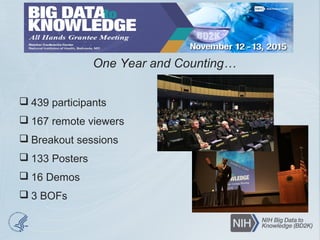
 439 participants
 167 remote viewers
 Breakout sessions
 133 Posters
 16 Demos
 3 BOFs
One Year and Counting…
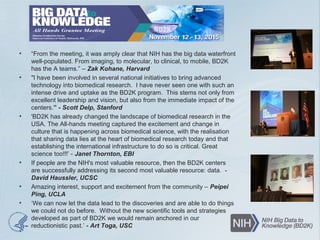
• “From the meeting, it was amply clear that NIH has the big data waterfront
well-populated. From imaging, to molecular, to clinical, to mobile, BD2K
has the A teams.” – Zak Kohane, Harvard
• "I have been involved in several national initiatives to bring advanced
technology into biomedical research. I have never seen one with such an
intense drive and uptake as the BD2K program. This stems not only from
excellent leadership and vision, but also from the immediate impact of the
centers.” - Scott Delp, Stanford
• 'BD2K has already changed the landscape of biomedical research in the
USA. The All-hands meeting captured the excitement and change in
culture that is happening across biomedical science, with the realisation
that sharing data lies at the heart of biomedical research today and that
establishing the international infrastructure to do so is critical. Great
science too!!!’ - Janet Thornton, EBI
• If people are the NIH's most valuable resource, then the BD2K centers
are successfully addressing its second most valuable resource: data. -
David Haussler, UCSC
• Amazing interest, support and excitement from the community – Peipei
Ping, UCLA
• ‘We can now let the data lead to the discoveries and are able to do things
we could not do before. Without the new scientific tools and strategies
developed as part of BD2K we would remain anchored in our
reductionistic past.’ - Art Toga, USC
Implementing ACD Big Data
Recommendations
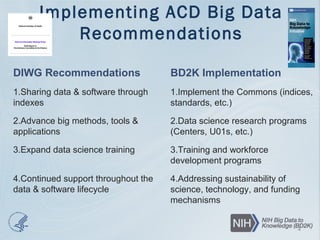
DIWG Recommendations
1.Sharing data & software through
indexes
2.Advance big methods, tools &
applications
3.Expand data science training
4.Continued support throughout the
data & software lifecycle
4
BD2K Implementation
1.Implement the Commons (indices,
standards, etc.)
2.Data science research programs
(Centers, U01s, etc.)
3.Training and workforce
development programs
4.Addressing sustainability of
science, technology, and funding
mechanisms
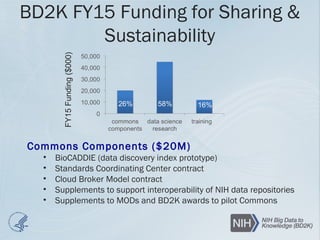
BD2K FY15 Funding for Sharing &
Sustainability
FY15Funding($000)
26% 58% 16%
Commons Components ($20M)
• BioCADDIE (data discovery index prototype)
• Standards Coordinating Center contract
• Cloud Broker Model contract
• Supplements to support interoperability of NIH data repositories
• Supplements to MODs and BD2K awards to pilot Commons
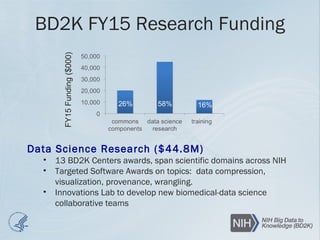
BD2K FY15 Research Funding
FY15Funding($000)
26% 58% 16%
Data Science Research ($44.8M)
• 13 BD2K Centers awards, span scientific domains across NIH
• Targeted Software Awards on topics: data compression,
visualization, provenance, wrangling.
• Innovations Lab to develop new biomedical-data science
collaborative teams
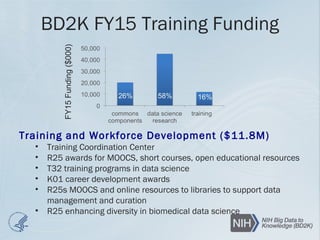
BD2K FY15 Training Funding
FY15Funding($000)
26% 58% 16%
Training and Workforce Development ($11.8M)
• Training Coordination Center
• R25 awards for MOOCS, short courses, open educational resources
• T32 training programs in data science
• K01 career development awards
• R25s MOOCS and online resources to libraries to support data
management and curation
• R25 enhancing diversity in biomedical data science
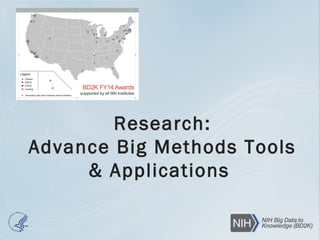
Research:
Advance Big Methods Tools
& Applications
Advance Data Science
Training
Training Programs Initiated
FY14-15
Biomedical Science Specialists
Data Science Specialists
Courses (R25) [11 awards]
Open Educational Resource (R25s) [8 awards]
Career Development (K01) [20 awards]Training
Programs
(T32/T15)
[6 awards]
Diversity
(R25) [4]
Museum
[1]
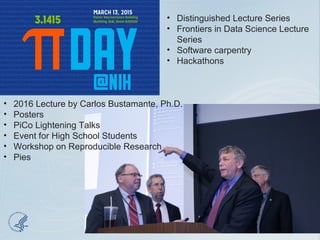
• 2016 Lecture by Carlos Bustamante, Ph.D.
• Posters
• PiCo Lightening Talks
• Event for High School Students
• Workshop on Reproducible Research
• Pies
• Distinguished Lecture Series
• Frontiers in Data Science Lecture
Series
• Software carpentry
• Hackathons
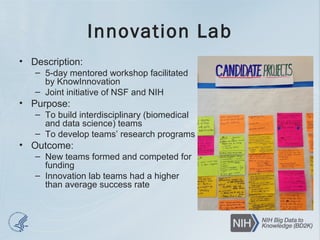
Innovation Lab
• Description:
– 5-day mentored workshop facilitated
by KnowInnovation
– Joint initiative of NSF and NIH
• Purpose:
– To build interdisciplinary (biomedical
and data science) teams
– To develop teams’ research programs
• Outcome:
– New teams formed and competed for
funding
– Innovation lab teams had a higher
than average success rate
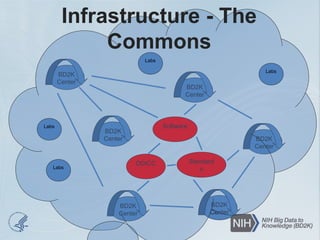
Sharing Data & Software
Through Indexes
BD2K
Center
BD2K
Center
BD2K
Center
BD2K
Center
BD2K
Center
BD2K
Center
DDICC
Software
Standard
s
Infrastructure - The
Commons
Labs
Labs
Labs
Labs
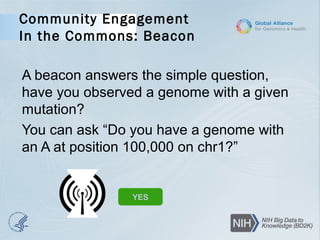
Community Engagement
In the Commons: Beacon
A beacon answers the simple question,
have you observed a genome with a given
mutation?
You can ask “Do you have a genome with
an A at position 100,000 on chr1?”
YES
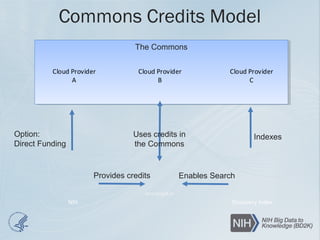
Commons Credits Model
The CommonsThe Commons
Cloud Provider
A
Cloud Provider
B
Cloud Provider
C
Investigator
NIH
Provides credits Enables Search
Discovery Index
Uses credits in
the Commons
IndexesOption:
Direct Funding
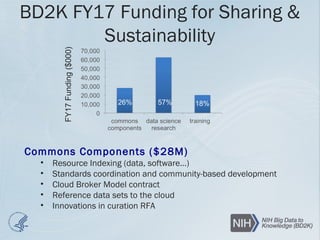
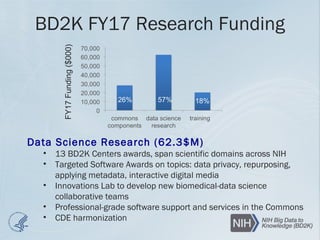
BD2K FY17 Funding for Sharing &
Sustainability
Commons Components ($28M)
• Resource Indexing (data, software…)
• Standards coordination and community-based development
• Cloud Broker Model contract
• Reference data sets to the cloud
• Innovations in curation RFA
FY17Funding($000)
26% 57% 18%
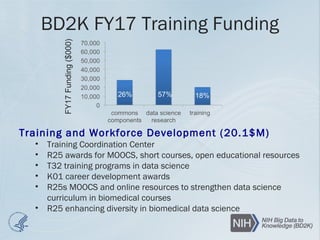
BD2K FY17 Research Funding
Data Science Research (62.3$M)
• 13 BD2K Centers awards, span scientific domains across NIH
• Targeted Software Awards on topics: data privacy, repurposing,
applying metadata, interactive digital media
• Innovations Lab to develop new biomedical-data science
collaborative teams
• Professional-grade software support and services in the Commons
• CDE harmonization
FY17Funding($000)
26% 57% 18%
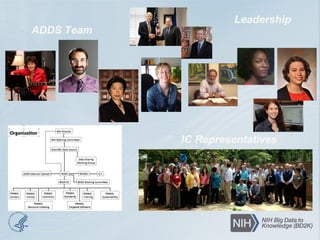
BD2K FY17 Training Funding
Training and Workforce Development (20.1$M)
• Training Coordination Center
• R25 awards for MOOCS, short courses, open educational resources
• T32 training programs in data science
• K01 career development awards
• R25s MOOCS and online resources to strengthen data science
curriculum in biomedical courses
• R25 enhancing diversity in biomedical data science
FY17Funding($000)
26% 57% 18%
ADDS Team
IC Representatives
Leadership
NIHNIH……
Turning Discovery Into HealthTurning Discovery Into Health
philip.bourne@nih.gov
https://datascience.nih.gov/
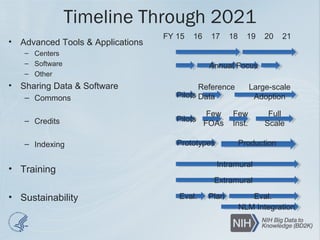
Timeline Through 2021
• Advanced Tools & Applications
– Centers
– Software
– Other
• Sharing Data & Software
– Commons
– Credits
– Indexing
• Training
• Sustainability
FY 15 16 17 18 19 20 21
Annual Focus
Pilots
Reference
Data
Large-scale
Adoption
Pilots
Few
FOAs
Few
Inst.
Full
Scale
Prototypes Production
Intramural
Extramural
Eval. Plan Eval.
NLM Integration

BD2K Update

  • 1.
    BD2K Update Philip Bourne,PhD, FACMI Associate Director for Data Science Advisory Committee to the NIH Director December 11, 2015 http://datascience.nih.gov Slides: http://www.slideshare.net/pebourne
  • 2.
     439 participants 167 remote viewers  Breakout sessions  133 Posters  16 Demos  3 BOFs One Year and Counting…
  • 3.
    • “From themeeting, it was amply clear that NIH has the big data waterfront well-populated. From imaging, to molecular, to clinical, to mobile, BD2K has the A teams.” – Zak Kohane, Harvard • "I have been involved in several national initiatives to bring advanced technology into biomedical research. I have never seen one with such an intense drive and uptake as the BD2K program. This stems not only from excellent leadership and vision, but also from the immediate impact of the centers.” - Scott Delp, Stanford • 'BD2K has already changed the landscape of biomedical research in the USA. The All-hands meeting captured the excitement and change in culture that is happening across biomedical science, with the realisation that sharing data lies at the heart of biomedical research today and that establishing the international infrastructure to do so is critical. Great science too!!!’ - Janet Thornton, EBI • If people are the NIH's most valuable resource, then the BD2K centers are successfully addressing its second most valuable resource: data. - David Haussler, UCSC • Amazing interest, support and excitement from the community – Peipei Ping, UCLA • ‘We can now let the data lead to the discoveries and are able to do things we could not do before. Without the new scientific tools and strategies developed as part of BD2K we would remain anchored in our reductionistic past.’ - Art Toga, USC
  • 4.
    Implementing ACD BigData Recommendations DIWG Recommendations 1.Sharing data & software through indexes 2.Advance big methods, tools & applications 3.Expand data science training 4.Continued support throughout the data & software lifecycle 4 BD2K Implementation 1.Implement the Commons (indices, standards, etc.) 2.Data science research programs (Centers, U01s, etc.) 3.Training and workforce development programs 4.Addressing sustainability of science, technology, and funding mechanisms
  • 5.
    BD2K FY15 Fundingfor Sharing & Sustainability FY15Funding($000) 26% 58% 16% Commons Components ($20M) • BioCADDIE (data discovery index prototype) • Standards Coordinating Center contract • Cloud Broker Model contract • Supplements to support interoperability of NIH data repositories • Supplements to MODs and BD2K awards to pilot Commons
  • 6.
    BD2K FY15 ResearchFunding FY15Funding($000) 26% 58% 16% Data Science Research ($44.8M) • 13 BD2K Centers awards, span scientific domains across NIH • Targeted Software Awards on topics: data compression, visualization, provenance, wrangling. • Innovations Lab to develop new biomedical-data science collaborative teams
  • 7.
    BD2K FY15 TrainingFunding FY15Funding($000) 26% 58% 16% Training and Workforce Development ($11.8M) • Training Coordination Center • R25 awards for MOOCS, short courses, open educational resources • T32 training programs in data science • K01 career development awards • R25s MOOCS and online resources to libraries to support data management and curation • R25 enhancing diversity in biomedical data science
  • 8.
    Research: Advance Big MethodsTools & Applications
  • 15.
  • 16.
    Training Programs Initiated FY14-15 BiomedicalScience Specialists Data Science Specialists Courses (R25) [11 awards] Open Educational Resource (R25s) [8 awards] Career Development (K01) [20 awards]Training Programs (T32/T15) [6 awards] Diversity (R25) [4] Museum [1]
  • 17.
    • 2016 Lectureby Carlos Bustamante, Ph.D. • Posters • PiCo Lightening Talks • Event for High School Students • Workshop on Reproducible Research • Pies • Distinguished Lecture Series • Frontiers in Data Science Lecture Series • Software carpentry • Hackathons
  • 18.
    Innovation Lab • Description: –5-day mentored workshop facilitated by KnowInnovation – Joint initiative of NSF and NIH • Purpose: – To build interdisciplinary (biomedical and data science) teams – To develop teams’ research programs • Outcome: – New teams formed and competed for funding – Innovation lab teams had a higher than average success rate
  • 20.
    Sharing Data &Software Through Indexes
  • 21.
  • 22.
    Community Engagement In theCommons: Beacon A beacon answers the simple question, have you observed a genome with a given mutation? You can ask “Do you have a genome with an A at position 100,000 on chr1?” YES
  • 23.
    Commons Credits Model TheCommonsThe Commons Cloud Provider A Cloud Provider B Cloud Provider C Investigator NIH Provides credits Enables Search Discovery Index Uses credits in the Commons IndexesOption: Direct Funding
  • 24.
    BD2K FY17 Fundingfor Sharing & Sustainability Commons Components ($28M) • Resource Indexing (data, software…) • Standards coordination and community-based development • Cloud Broker Model contract • Reference data sets to the cloud • Innovations in curation RFA FY17Funding($000) 26% 57% 18%
  • 25.
    BD2K FY17 ResearchFunding Data Science Research (62.3$M) • 13 BD2K Centers awards, span scientific domains across NIH • Targeted Software Awards on topics: data privacy, repurposing, applying metadata, interactive digital media • Innovations Lab to develop new biomedical-data science collaborative teams • Professional-grade software support and services in the Commons • CDE harmonization FY17Funding($000) 26% 57% 18%
  • 26.
    BD2K FY17 TrainingFunding Training and Workforce Development (20.1$M) • Training Coordination Center • R25 awards for MOOCS, short courses, open educational resources • T32 training programs in data science • K01 career development awards • R25s MOOCS and online resources to strengthen data science curriculum in biomedical courses • R25 enhancing diversity in biomedical data science FY17Funding($000) 26% 57% 18%
  • 27.
  • 28.
    NIHNIH…… Turning Discovery IntoHealthTurning Discovery Into Health philip.bourne@nih.gov https://datascience.nih.gov/
  • 29.
    Timeline Through 2021 •Advanced Tools & Applications – Centers – Software – Other • Sharing Data & Software – Commons – Credits – Indexing • Training • Sustainability FY 15 16 17 18 19 20 21 Annual Focus Pilots Reference Data Large-scale Adoption Pilots Few FOAs Few Inst. Full Scale Prototypes Production Intramural Extramural Eval. Plan Eval. NLM Integration

Editor's Notes

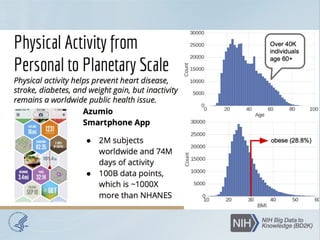
  • #11 Azumio – monitors a variety of features Nhanes –National Health and nutritional examination survey – manual collection CDC
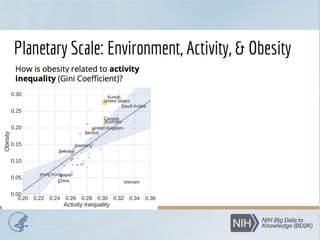
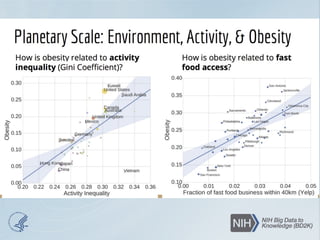
  • #15 Gini Coeff measures inequality among values of a frequency distribution. 0 equality 1 total inequality
  • #23 The Beacon project is a project to test the willingness of international sites to share genetic data in the simplest of all technical contexts. It is defined as a simple public web service that any institution can implement as a service. The service is designed merely to accept a query of the form "Do you have any genomes with an 'A' at position 100,735 on chromosome 3" (or similar data) and responds with one of "Yes" or "No." A site offering this service is called a "beacon".