Social Responsibility in
Research
Philip E. Bourne
Founding Dean School of Data Science
University of Virginia
https://www.slideshare.net/pebourne
May 2, 2023 BIMS7100 1
A Quick Story
May 2, 2023 BIMS7100 2
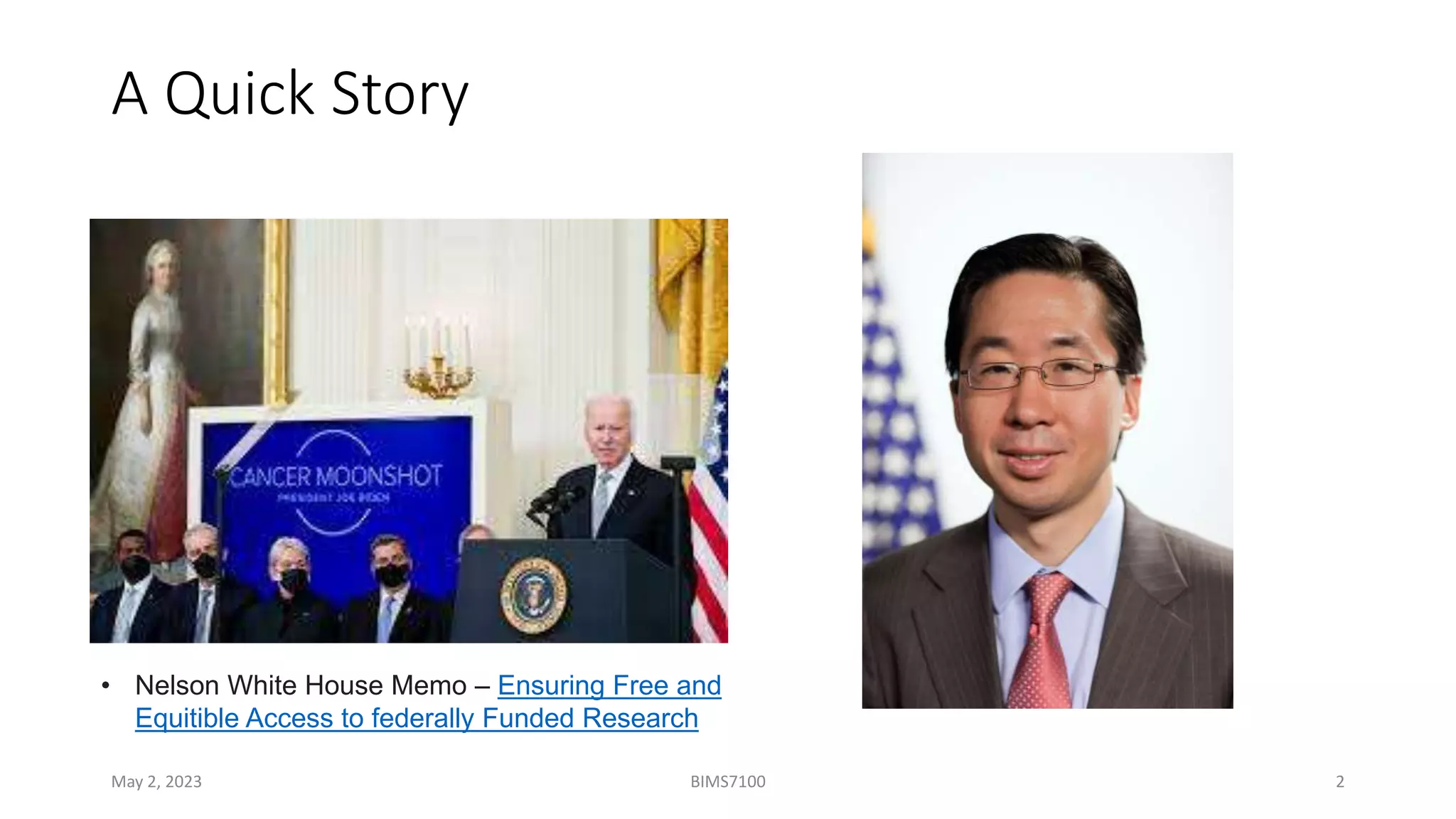
• Nelson White House Memo – Ensuring Free and
Equitible Access to federally Funded Research
What are some of the ways you can
undertake socially responsible research?
1. Open research
2. Providing protocols = reproducibility
3. Transparency with where funding comes from
4. Detailed notes – easily findable
5. Larger community considerations
6. Benefit study population
7. Making data available
8. Sharing resources eg mouse models
9. Sharing code
10. Participant informed consent
11. Upfront about the research question
12. Not over-inflating the results of research
May 2, 2023 BIMS7100 3
Social Responsibility in Research
According to ChatGPT
May 2, 2023 BIMS7100 4
Social responsibility in research refers to the ethical obligation of researchers to
conduct studies that have a positive impact on society and the environment.
This includes considering the potential risks and benefits of the research,
minimizing harm to human and animal subjects, and ensuring that the research is
conducted with integrity and transparency.
Socially responsible research also involves addressing issues of equity,
diversity, and inclusion in the research process. This includes ensuring that
research participants are representative of diverse populations, and that the
research is conducted in a culturally sensitive and respectful manner.
In addition to these ethical considerations, socially responsible research also
involves engaging with stakeholders such as community members, policy
makers, and industry partners to ensure that the research is relevant and
beneficial to society.
Overall, social responsibility in research involves a commitment to conducting
research that promotes the well-being of individuals and communities, while
minimizing harm and ensuring ethical and transparent practices.
Lets consider one social responsibility in more
detail….
Data sharing
May 2, 2023 BIMS7100 5
Data are the lifeblood of research
May 2, 2023 BIMS7100 6
https://www.youtube.com/watch?v=N2zK3sAtr-4
Lets spend 10 minutes in breakout rooms
discussing the take aways from this video – make 2
columns for the pros and cons of data sharing
May 2, 2023 BIMS7100 7
Data Sharing
• Pros
• Multiple methods of analysis –
remove analytical bias
• Save time and money
• Reproducibility
• Prevent loss of data
• Feeling good – social benefit
• Rare diseases – collaborative
• Greater collaboration across
disciplines
• Testing new hypotheses
• More ethical research – stats.
• Cons
• Privacy – expose personal info
• Unauthorized access in the cloud
• Loss of confidentiality in mar. pop.
• Safe storage for the long term
• Lack of a data dictionary
• Lose context of info –
acknowledge
• Time and money to share
• Scooping - publishing from that
• Magnification of false data
May 2, 2023 BIMS7100 8
Data Sharing Alone is Not Enough it must be
FAIR
•Findable
•Accessible
•Interoperable
•Reusable
May 2, 2023 BIMS7100 9
https://www.nature.com/articles/sdata201618
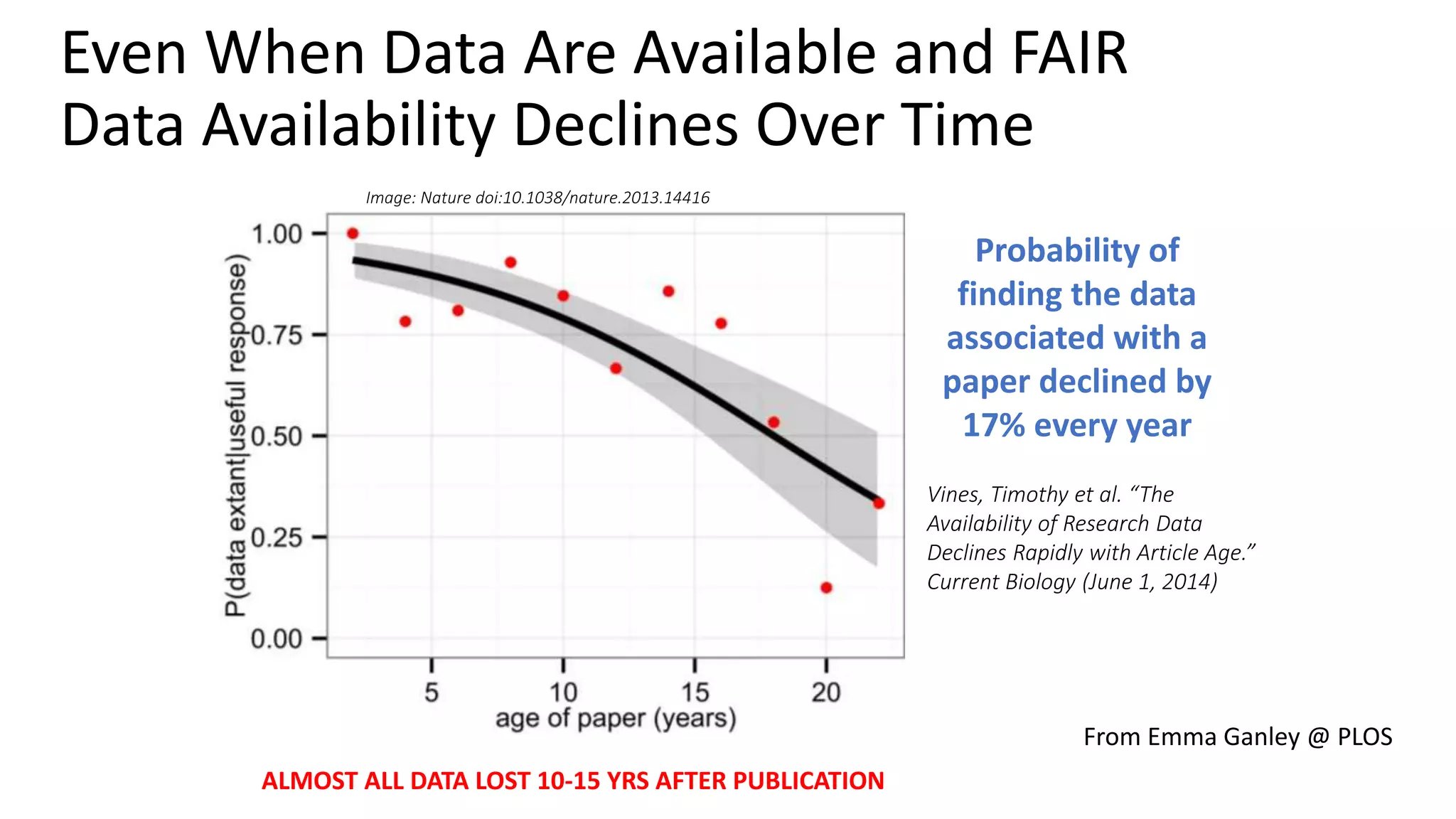
Probability of
finding the data
associated with a
paper declined by
17% every year
Vines, Timothy et al. “The
Availability of Research Data
Declines Rapidly with Article Age.”
Current Biology (June 1, 2014)
Image: Nature doi:10.1038/nature.2013.14416
Even When Data Are Available and FAIR
Data Availability Declines Over Time
ALMOST ALL DATA LOST 10-15 YRS AFTER PUBLICATION
From Emma Ganley @ PLOS
Lets spend 10 minutes discussing
1. Does it matter?
2. If yes, what should be done
that mitigates this loss?
• Hint – think of it in terms of
those who:
• Fund the research e.g. NIH
• Support the research e.g. UVA
• Publish the research e.g. journals
May 2, 2023 BIMS7100 11
Data sharing is just one aspect of social
responsible research as we determined at the
start of this lecture
May 2, 2023 BIMS7100 12
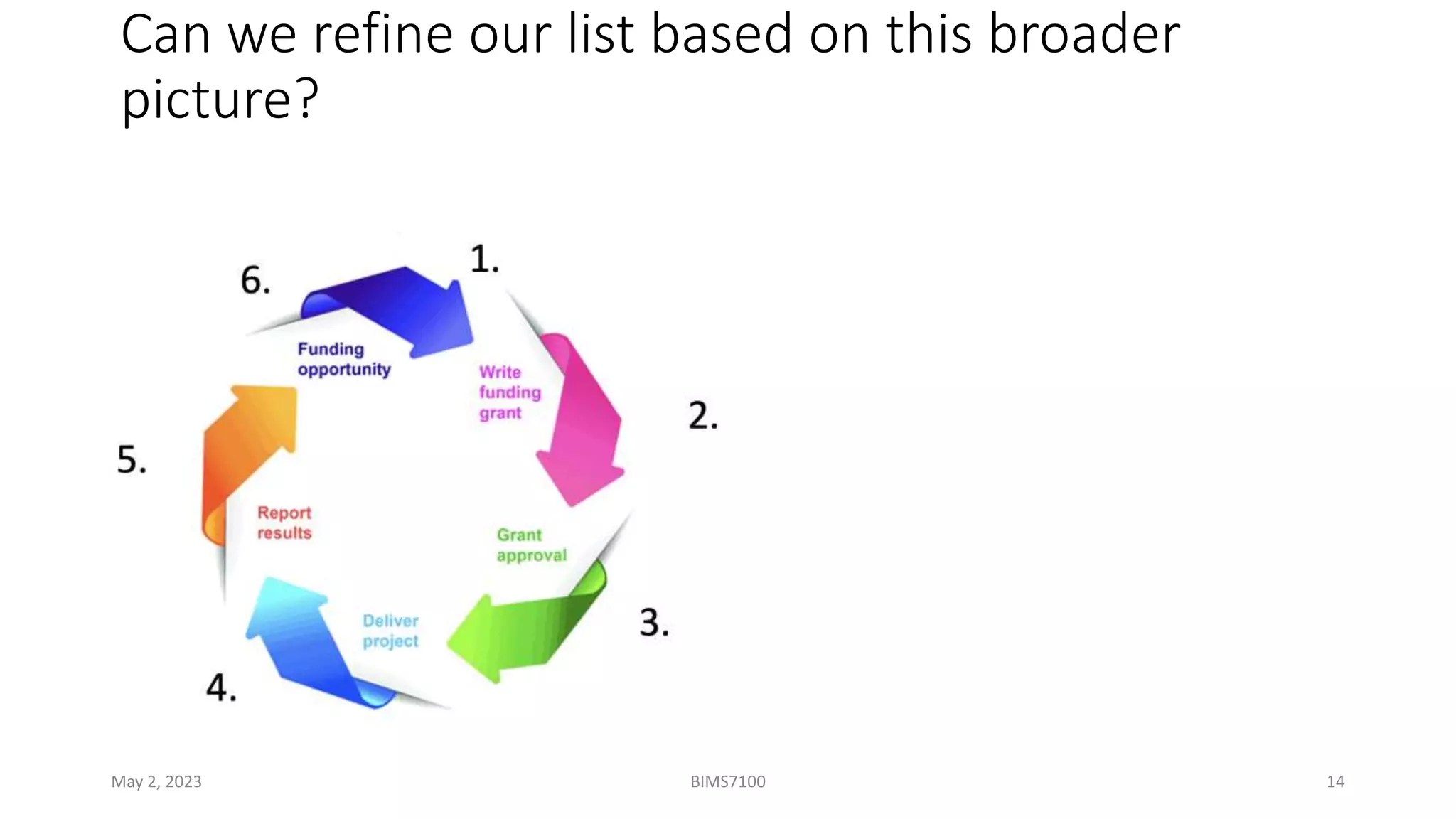
Researchers Need to Consider All Aspects of
the Research Lifecycle
Publishershttps://www.vertigoventures.com/lesson/embedding-impact/impact-research-life-cycle/
May 2, 2023 BIMS7100 13
11
1.
2.
3.
4.
5.
6.
Can we refine our list based on this broader
picture?
May 2, 2023 BIMS7100 14
References
• School of Data Science Promotion and
Tenure Guidelines
May 2, 2023 15
BIMS7100
• Nelson White House Memo – Ensuring Free and Equitible
Access to federally Funded Research
• Zivony A, Kardosh R, Timmins L, Reggev N (2023) Ten simple
rules for socially responsible science. PLoS Comput Biol 19(3):
e1010954. https://doi.org/10.1371/journal.pcbi.1010954
• On Being a Scientist: A Guide to Responsible Conduct in
Research
• Wilkinson, M., Dumontier, M., Aalbersberg, I. et al. The FAIR
Guiding Principles for scientific data management and
stewardship. Sci Data 3, 160018 (2016).
https://doi.org/10.1038/sdata.2016.18

BIMS7100-2023. Social Responsibility in Research

  • 1.
    Social Responsibility in Research PhilipE. Bourne Founding Dean School of Data Science University of Virginia https://www.slideshare.net/pebourne May 2, 2023 BIMS7100 1
  • 2.
    A Quick Story May2, 2023 BIMS7100 2 • Nelson White House Memo – Ensuring Free and Equitible Access to federally Funded Research
  • 3.
    What are someof the ways you can undertake socially responsible research? 1. Open research 2. Providing protocols = reproducibility 3. Transparency with where funding comes from 4. Detailed notes – easily findable 5. Larger community considerations 6. Benefit study population 7. Making data available 8. Sharing resources eg mouse models 9. Sharing code 10. Participant informed consent 11. Upfront about the research question 12. Not over-inflating the results of research May 2, 2023 BIMS7100 3
  • 4.
    Social Responsibility inResearch According to ChatGPT May 2, 2023 BIMS7100 4 Social responsibility in research refers to the ethical obligation of researchers to conduct studies that have a positive impact on society and the environment. This includes considering the potential risks and benefits of the research, minimizing harm to human and animal subjects, and ensuring that the research is conducted with integrity and transparency. Socially responsible research also involves addressing issues of equity, diversity, and inclusion in the research process. This includes ensuring that research participants are representative of diverse populations, and that the research is conducted in a culturally sensitive and respectful manner. In addition to these ethical considerations, socially responsible research also involves engaging with stakeholders such as community members, policy makers, and industry partners to ensure that the research is relevant and beneficial to society. Overall, social responsibility in research involves a commitment to conducting research that promotes the well-being of individuals and communities, while minimizing harm and ensuring ethical and transparent practices.
  • 5.
    Lets consider onesocial responsibility in more detail…. Data sharing May 2, 2023 BIMS7100 5
  • 6.
    Data are thelifeblood of research May 2, 2023 BIMS7100 6 https://www.youtube.com/watch?v=N2zK3sAtr-4
  • 7.
    Lets spend 10minutes in breakout rooms discussing the take aways from this video – make 2 columns for the pros and cons of data sharing May 2, 2023 BIMS7100 7
  • 8.
    Data Sharing • Pros •Multiple methods of analysis – remove analytical bias • Save time and money • Reproducibility • Prevent loss of data • Feeling good – social benefit • Rare diseases – collaborative • Greater collaboration across disciplines • Testing new hypotheses • More ethical research – stats. • Cons • Privacy – expose personal info • Unauthorized access in the cloud • Loss of confidentiality in mar. pop. • Safe storage for the long term • Lack of a data dictionary • Lose context of info – acknowledge • Time and money to share • Scooping - publishing from that • Magnification of false data May 2, 2023 BIMS7100 8
  • 9.
    Data Sharing Aloneis Not Enough it must be FAIR •Findable •Accessible •Interoperable •Reusable May 2, 2023 BIMS7100 9 https://www.nature.com/articles/sdata201618
  • 10.
    Probability of finding thedata associated with a paper declined by 17% every year Vines, Timothy et al. “The Availability of Research Data Declines Rapidly with Article Age.” Current Biology (June 1, 2014) Image: Nature doi:10.1038/nature.2013.14416 Even When Data Are Available and FAIR Data Availability Declines Over Time ALMOST ALL DATA LOST 10-15 YRS AFTER PUBLICATION From Emma Ganley @ PLOS
  • 11.
    Lets spend 10minutes discussing 1. Does it matter? 2. If yes, what should be done that mitigates this loss? • Hint – think of it in terms of those who: • Fund the research e.g. NIH • Support the research e.g. UVA • Publish the research e.g. journals May 2, 2023 BIMS7100 11
  • 12.
    Data sharing isjust one aspect of social responsible research as we determined at the start of this lecture May 2, 2023 BIMS7100 12
  • 13.
    Researchers Need toConsider All Aspects of the Research Lifecycle Publishershttps://www.vertigoventures.com/lesson/embedding-impact/impact-research-life-cycle/ May 2, 2023 BIMS7100 13 11 1. 2. 3. 4. 5. 6.
  • 14.
    Can we refineour list based on this broader picture? May 2, 2023 BIMS7100 14
  • 15.
    References • School ofData Science Promotion and Tenure Guidelines May 2, 2023 15 BIMS7100 • Nelson White House Memo – Ensuring Free and Equitible Access to federally Funded Research • Zivony A, Kardosh R, Timmins L, Reggev N (2023) Ten simple rules for socially responsible science. PLoS Comput Biol 19(3): e1010954. https://doi.org/10.1371/journal.pcbi.1010954 • On Being a Scientist: A Guide to Responsible Conduct in Research • Wilkinson, M., Dumontier, M., Aalbersberg, I. et al. The FAIR Guiding Principles for scientific data management and stewardship. Sci Data 3, 160018 (2016). https://doi.org/10.1038/sdata.2016.18

Editor's Notes

  • #11 Study by Tim Vines Probability of finding the data declined by 17% every year End result – almost all data lost 10-15 yrs after publication