The NIH Data Commons:
A Cloud-based Training Environment
Philip E. Bourne, Ph.D. FACMI
Associate Director for Data Science
National Institutes of Health
Slides adapted from Vivien Bonazzi
Agenda
•Why cloud based training is important to the NIH
•What the NIH is doing to support it
The Data Commons
is an NIH endorsed platform
that fosters the development of a digital
ecosystem
That digital ecosystem allows
transactions to occur on FAIR data*
at scale
* http://www.ncbi.nlm.nih.gov/pubmed/26978244
Data Commons is a Platform that fosters development of a digital Ecosystem
Treats products of research – data, software, methods, papers, training
materials etc. as a digital asset (object)
Digital objects need to conform to FAIR principles
- Findable, Accessible, Interoperable, Reproducible
Digital objects exist in a shared virtual space (initial)
- Find, Deposit, Manage, Share and Reuse: digital assets
Enables interactions between Producers and Consumers of digital assets
Gives currency to digital assets and the people who develop and support
them
To understand the
Data Commons Platform
(and how it works for biomedical data)
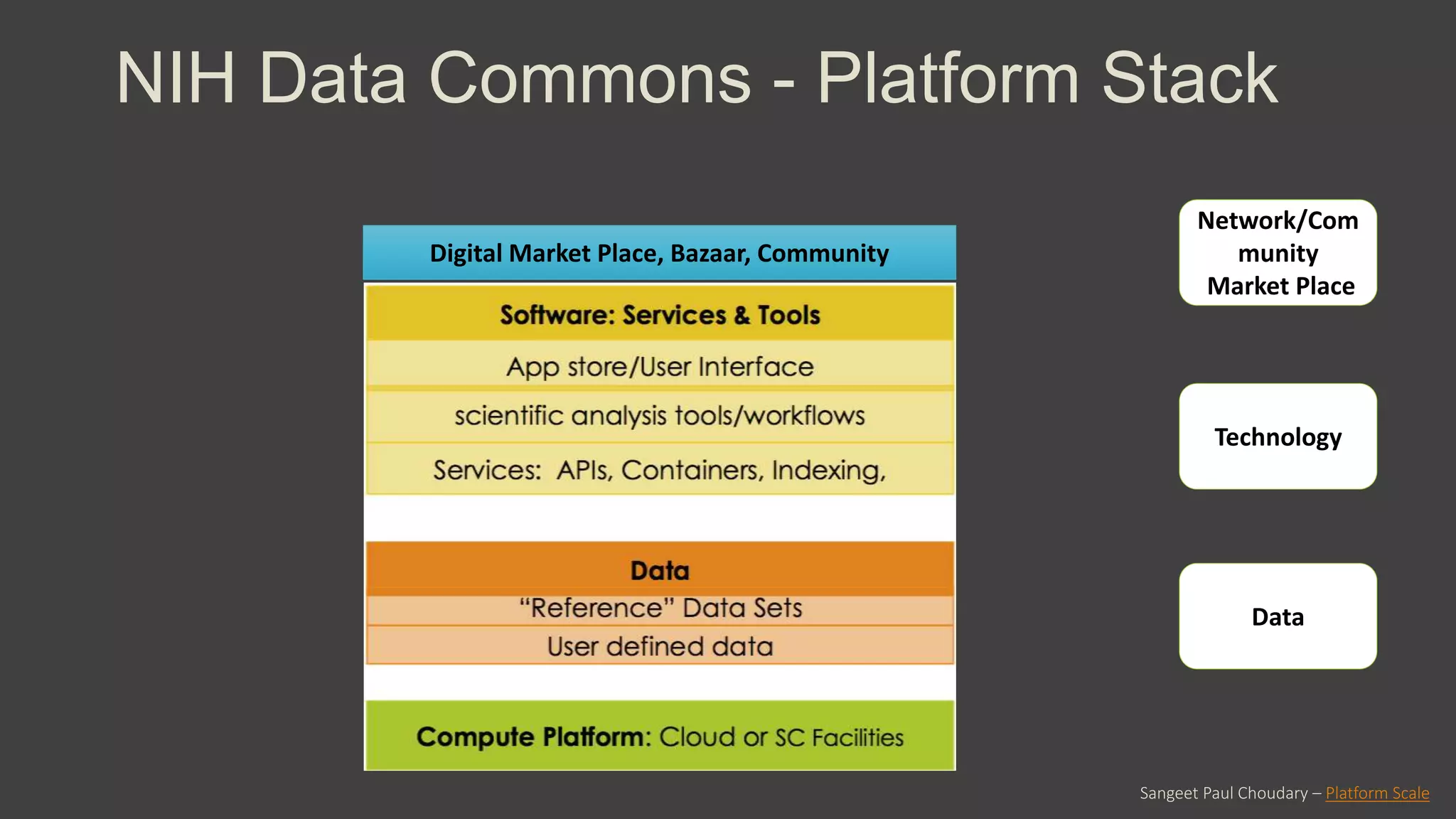
we need to use a Platform stack
to help visualize the concept
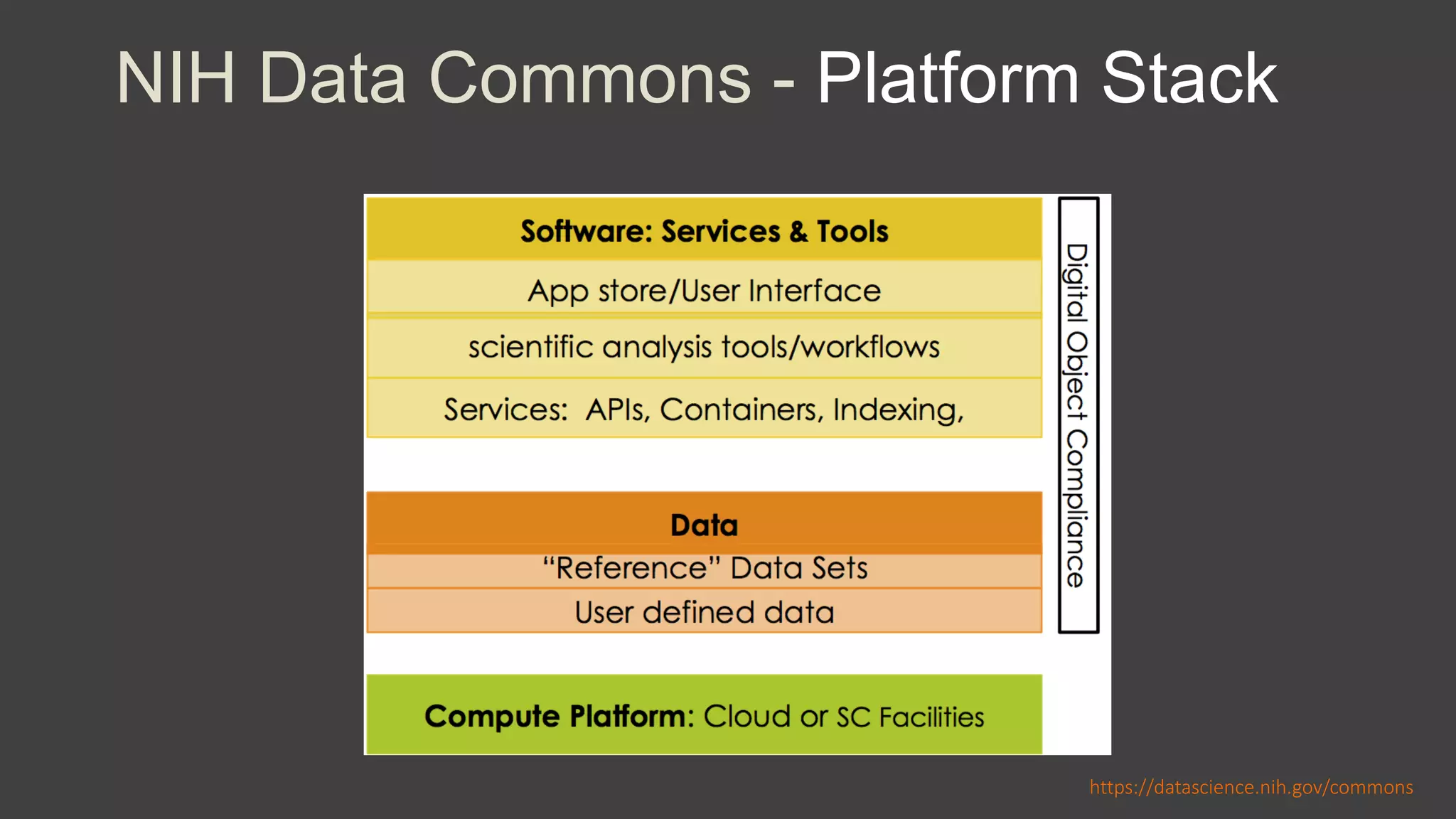
NIH Data Commons - Platform Stack
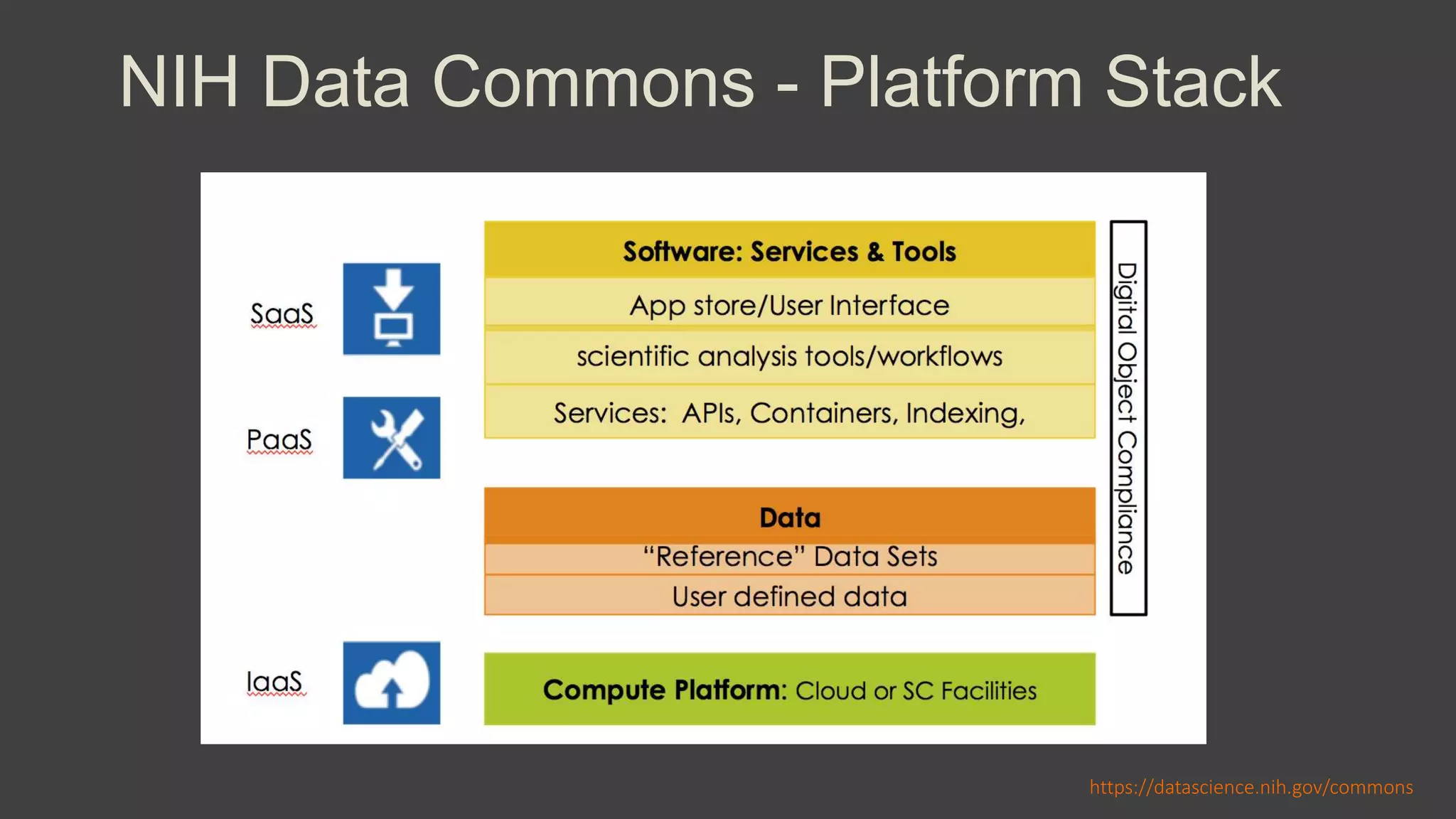
https://datascience.nih.gov/commons
NIH Data Commons - Platform Stack
Digital Market Place, Bazaar, Community
Sangeet Paul Choudary – Platform Scale
Network/Com
munity
Market Place
Technology
Data
NIH Data Commons Pilots
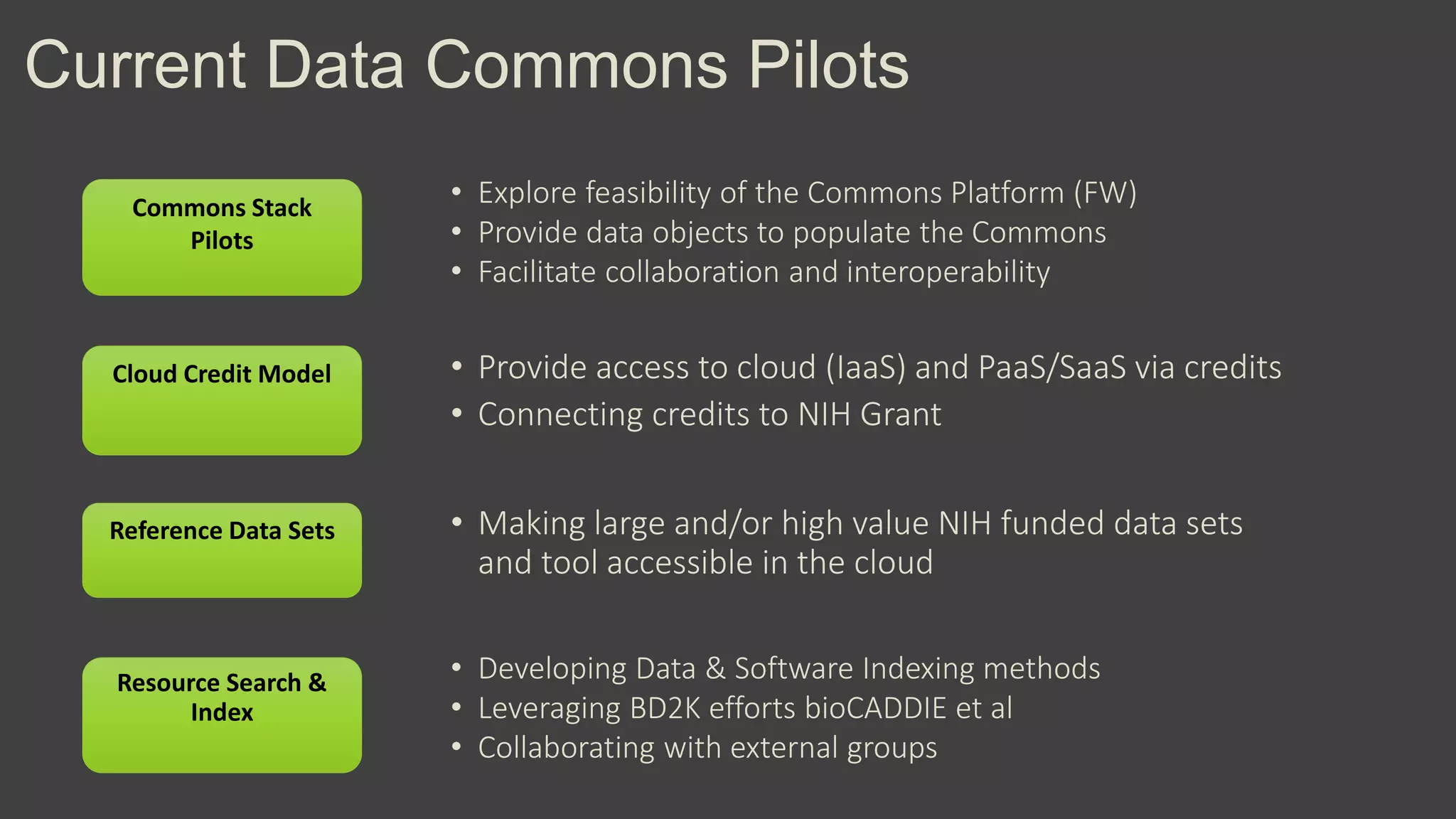
Current Data Commons Pilots
Reference Data Sets
Commons Stack
Pilots
Cloud Credit Model
Resource Search &
Index
• Explore feasibility of the Commons Platform (FW)
• Provide data objects to populate the Commons
• Facilitate collaboration and interoperability
• Provide access to cloud (IaaS) and PaaS/SaaS via credits
• Connecting credits to NIH Grant
• Making large and/or high value NIH funded data sets
and tool accessible in the cloud
• Developing Data & Software Indexing methods
• Leveraging BD2K efforts bioCADDIE et al
• Collaborating with external groups
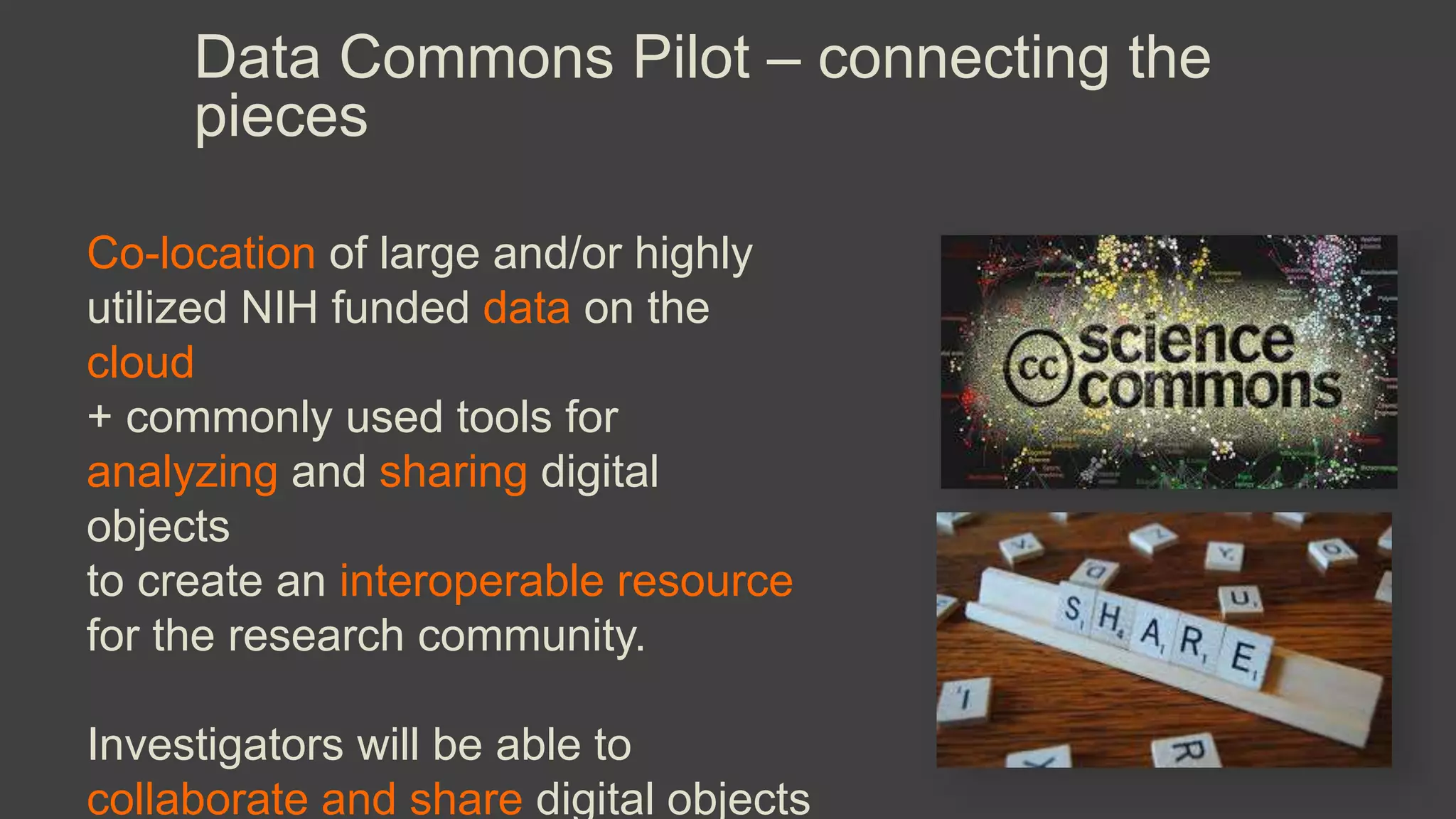
Data Commons Pilot – connecting the
pieces
Co-location of large and/or highly
utilized NIH funded data on the
cloud
+ commonly used tools for
analyzing and sharing digital
objects
to create an interoperable resource
for the research community.
Investigators will be able to
collaborate and share digital objects
Educational
Opportunities
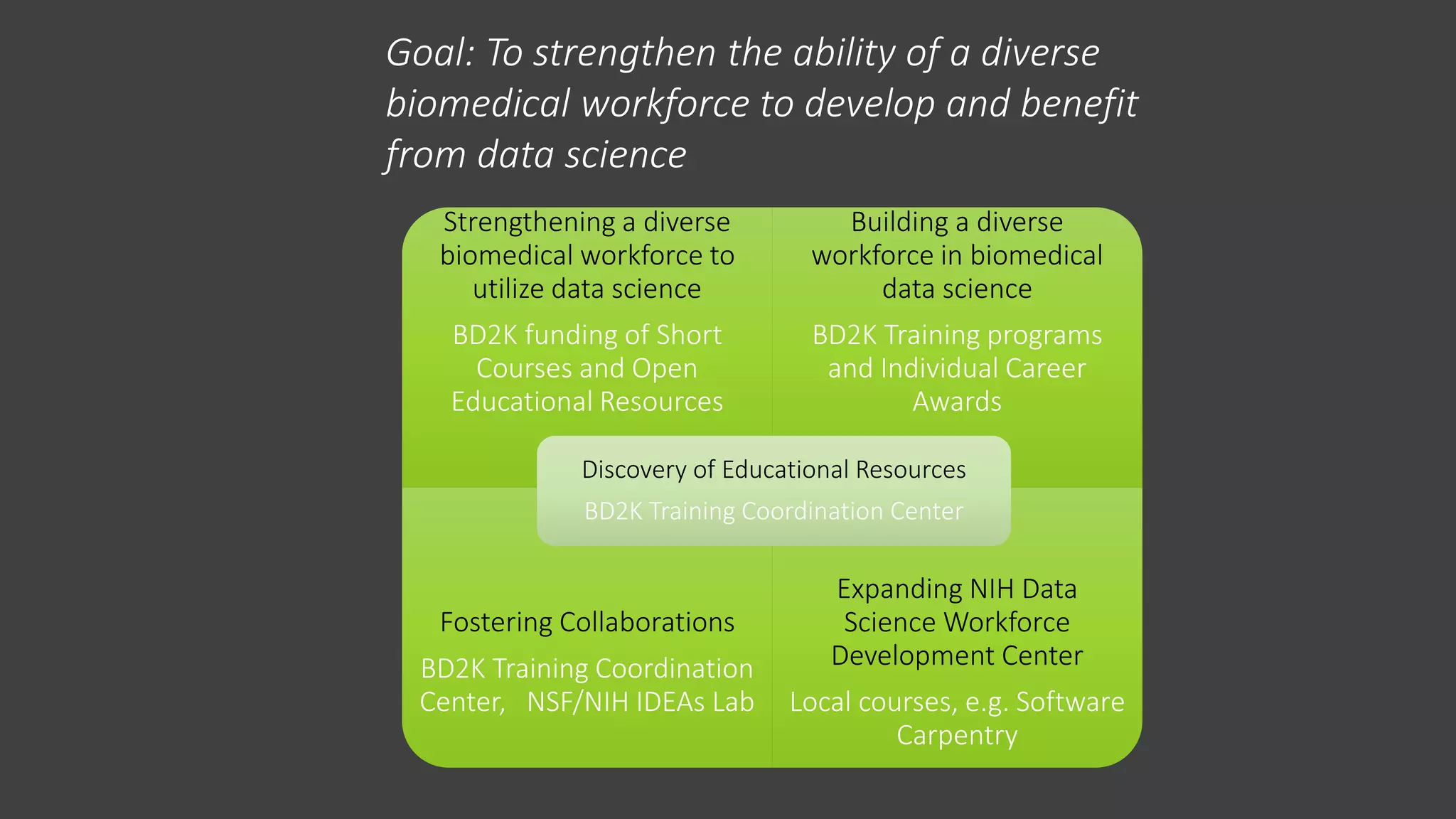
Strengthening a diverse
biomedical workforce to
utilize data science
BD2K funding of Short
Courses and Open
Educational Resources
Building a diverse
workforce in biomedical
data science
BD2K Training programs
and Individual Career
Awards
Fostering Collaborations
BD2K Training Coordination
Center, NSF/NIH IDEAs Lab
Expanding NIH Data
Science Workforce
Development Center
Local courses, e.g. Software
Carpentry
Discovery of Educational Resources
BD2K Training Coordination Center
Goal: To strengthen the ability of a diverse
biomedical workforce to develop and benefit
from data science
Thank you
• ADDS Office
- Vivien Bonazzi, Michelle Dunn, Jennie Larkin, Mark Guyer, Sonynka Ngosso
• NCBI: George Komatsoulis
• NHGRI: Valentina di Francesco
• NIGMS: Susan Gregurik
• CIT: Andrea Norris, Debbie Sinmao,
• NCI: Warren Kibbe, Tony Kerlavage, Tanja Davidsen, Ian Fore
• NIAID: JJ McGowan, Nick Weber, Darrell Hurt, Maria Giovanni, Alison Yao
• The NIH Common Fund: Betsy Wilder, Jim Anderson, Leslie Derr
• Trans NIH BD2K Executive Committee & Working groups
• Many biomedical researchers, cloud providers, IT professionals

The NIH Commons: A Cloud-based Training Environment

  • 1.
    The NIH DataCommons: A Cloud-based Training Environment Philip E. Bourne, Ph.D. FACMI Associate Director for Data Science National Institutes of Health Slides adapted from Vivien Bonazzi
  • 2.
    Agenda •Why cloud basedtraining is important to the NIH •What the NIH is doing to support it
  • 3.
    The Data Commons isan NIH endorsed platform that fosters the development of a digital ecosystem
  • 4.
    That digital ecosystemallows transactions to occur on FAIR data* at scale * http://www.ncbi.nlm.nih.gov/pubmed/26978244
  • 5.
    Data Commons isa Platform that fosters development of a digital Ecosystem Treats products of research – data, software, methods, papers, training materials etc. as a digital asset (object) Digital objects need to conform to FAIR principles - Findable, Accessible, Interoperable, Reproducible Digital objects exist in a shared virtual space (initial) - Find, Deposit, Manage, Share and Reuse: digital assets Enables interactions between Producers and Consumers of digital assets Gives currency to digital assets and the people who develop and support them
  • 6.
    To understand the DataCommons Platform (and how it works for biomedical data) we need to use a Platform stack to help visualize the concept
  • 7.
    NIH Data Commons- Platform Stack https://datascience.nih.gov/commons
  • 8.
  • 9.
    NIH Data Commons- Platform Stack Digital Market Place, Bazaar, Community Sangeet Paul Choudary – Platform Scale Network/Com munity Market Place Technology Data
  • 10.
  • 11.
    Current Data CommonsPilots Reference Data Sets Commons Stack Pilots Cloud Credit Model Resource Search & Index • Explore feasibility of the Commons Platform (FW) • Provide data objects to populate the Commons • Facilitate collaboration and interoperability • Provide access to cloud (IaaS) and PaaS/SaaS via credits • Connecting credits to NIH Grant • Making large and/or high value NIH funded data sets and tool accessible in the cloud • Developing Data & Software Indexing methods • Leveraging BD2K efforts bioCADDIE et al • Collaborating with external groups
  • 12.
    Data Commons Pilot– connecting the pieces Co-location of large and/or highly utilized NIH funded data on the cloud + commonly used tools for analyzing and sharing digital objects to create an interoperable resource for the research community. Investigators will be able to collaborate and share digital objects
  • 13.
  • 14.
    Strengthening a diverse biomedicalworkforce to utilize data science BD2K funding of Short Courses and Open Educational Resources Building a diverse workforce in biomedical data science BD2K Training programs and Individual Career Awards Fostering Collaborations BD2K Training Coordination Center, NSF/NIH IDEAs Lab Expanding NIH Data Science Workforce Development Center Local courses, e.g. Software Carpentry Discovery of Educational Resources BD2K Training Coordination Center Goal: To strengthen the ability of a diverse biomedical workforce to develop and benefit from data science
  • 15.
    Thank you • ADDSOffice - Vivien Bonazzi, Michelle Dunn, Jennie Larkin, Mark Guyer, Sonynka Ngosso • NCBI: George Komatsoulis • NHGRI: Valentina di Francesco • NIGMS: Susan Gregurik • CIT: Andrea Norris, Debbie Sinmao, • NCI: Warren Kibbe, Tony Kerlavage, Tanja Davidsen, Ian Fore • NIAID: JJ McGowan, Nick Weber, Darrell Hurt, Maria Giovanni, Alison Yao • The NIH Common Fund: Betsy Wilder, Jim Anderson, Leslie Derr • Trans NIH BD2K Executive Committee & Working groups • Many biomedical researchers, cloud providers, IT professionals

Editor's Notes

  • #7 Framework helps visualize the concept of the platform
  • #15 Short term: produce a searchable catalog of physical and virtual courses; Funding diversity awards to work with BD2K Centers; Expand IRP training started Jan 2015 e.g. Software carpentry and Train the trainers Long term: evaluation