ARTIFICAL VISION USING
EMBEDDED SYSTEM
“NO BLINDS IN THE WORLD”
Presented by
R.PRABHU
T.RAJKUMAR
||| YEAR ECE
KGISL INSTITUTE OF TECHNOLOGY
INTRODUCTION:
“We see with our brains than with our eyes”.
The sole principle used to visionise a blind is
–”DECEIVING OUR BRAINS”.
METHODS USED ARE
a)Microchips.
b)Nano tube implant.
c)Digital artificial vision.
d)Ocular prosthetics.
e)Braile type writer
BRAILLE TYPE WRITER:
;
• Using a signal processor synchronized
signals are converted to pricking pulses,
which is sensed on a bad interfaced on the
stomach or hand of blind.
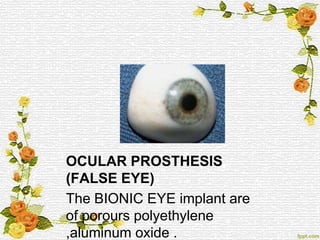
OCULAR PROSTHESIS
(FALSE EYE)
The BIONIC EYE implant are
of porours polyethylene
,aluminum oxide .
DIGITAL ARTIFICAL VISION
• MICRO COMPUTER
a)Sub-notebook computer-Employs a 233
MHZ processor, 32 MB of RAM,4 GB hard
disk,
b)MICRO CONTROLLER-Consists of
pulses 30 HZ to produce each frame
IMAGE PROCESSING
• SOBEL filter is most common approach
• They are Gx and Gy
MEMS
• A new optical device, called the
microelectromechanical systems– (MEMS-
) based adaptive optics phoropter
(MAOP), will greatly improve this process.
• The electrodes are embedded in silicone-
based substrate polydimethylsiloxane
(PDMS)
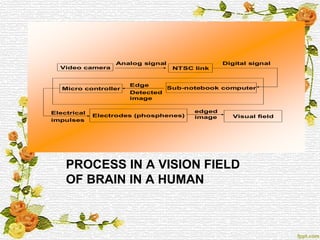
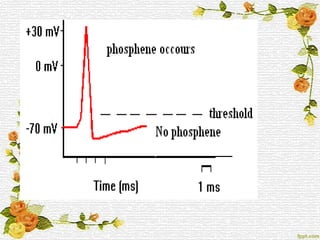
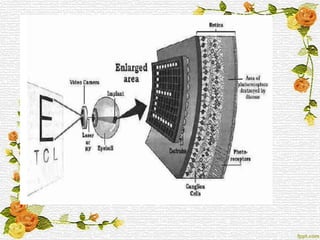
PROCESS IN A VISION FIELD
OF BRAIN IN A HUMAN
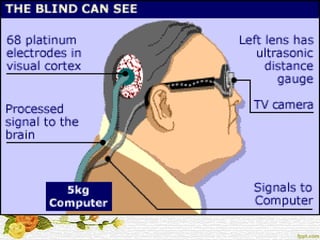
Video camera
Analog signal
NTSC link
Digital signal
Sub-notebook computerMicro controller
Edge
Detected
image
Electrical
impulses
Electrodes (phosphenes) Visual field
edged
image
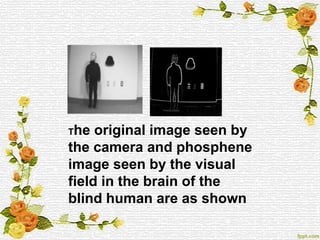
The original image seen by
the camera and phosphene
image seen by the visual
field in the brain of the
blind human are as shown
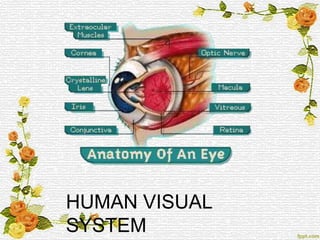
HUMAN VISUAL
SYSTEM
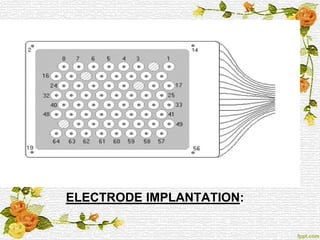
ELECTRODE IMPLANTATION:
NANOTUBES AND
NANOBATTERIES:
• Age related retinal diseases like
macular dysfunction, retinitis
pigmentosa can be averted using
nano tubes.
FUTURE APPLICATIONS:
• As now, only black and white images
are seen by this AVS system, research is
being carried to visualize coloured images
by using optical fiber technology.
• Research is being carried to
replace the electrode implantation with ray
or wave devices
• NVCS can be nano fabricated on a
single chip
CONCLUSION:
• “WISHING A REMARKABLE
PROGRESS IN THE
DEVELOPMENT OF THIS
ARTIFICIAL VISION SYSTEM,
SUCH THAT EACH AND EVERY
BLIND PERSON TODAY, IS NEVER
A BLIND TOMMOROW.”
THANK YOU

Artificial Vision Using System No Blinds In The World

  • 1.
    ARTIFICAL VISION USING EMBEDDEDSYSTEM “NO BLINDS IN THE WORLD” Presented by R.PRABHU T.RAJKUMAR ||| YEAR ECE KGISL INSTITUTE OF TECHNOLOGY
  • 2.
    INTRODUCTION: “We see withour brains than with our eyes”. The sole principle used to visionise a blind is –”DECEIVING OUR BRAINS”.
  • 3.
    METHODS USED ARE a)Microchips. b)Nanotube implant. c)Digital artificial vision. d)Ocular prosthetics. e)Braile type writer
  • 4.
    BRAILLE TYPE WRITER: ; •Using a signal processor synchronized signals are converted to pricking pulses, which is sensed on a bad interfaced on the stomach or hand of blind.
  • 5.
    OCULAR PROSTHESIS (FALSE EYE) TheBIONIC EYE implant are of porours polyethylene ,aluminum oxide .
  • 6.
    DIGITAL ARTIFICAL VISION •MICRO COMPUTER a)Sub-notebook computer-Employs a 233 MHZ processor, 32 MB of RAM,4 GB hard disk, b)MICRO CONTROLLER-Consists of pulses 30 HZ to produce each frame
  • 7.
    IMAGE PROCESSING • SOBELfilter is most common approach • They are Gx and Gy
  • 8.
    MEMS • A newoptical device, called the microelectromechanical systems– (MEMS- ) based adaptive optics phoropter (MAOP), will greatly improve this process. • The electrodes are embedded in silicone- based substrate polydimethylsiloxane (PDMS)
  • 9.
    PROCESS IN AVISION FIELD OF BRAIN IN A HUMAN Video camera Analog signal NTSC link Digital signal Sub-notebook computerMicro controller Edge Detected image Electrical impulses Electrodes (phosphenes) Visual field edged image
  • 10.
    The original imageseen by the camera and phosphene image seen by the visual field in the brain of the blind human are as shown
  • 11.
  • 13.
  • 15.
    NANOTUBES AND NANOBATTERIES: • Agerelated retinal diseases like macular dysfunction, retinitis pigmentosa can be averted using nano tubes.
  • 17.
    FUTURE APPLICATIONS: • Asnow, only black and white images are seen by this AVS system, research is being carried to visualize coloured images by using optical fiber technology. • Research is being carried to replace the electrode implantation with ray or wave devices • NVCS can be nano fabricated on a single chip
  • 18.
    CONCLUSION: • “WISHING AREMARKABLE PROGRESS IN THE DEVELOPMENT OF THIS ARTIFICIAL VISION SYSTEM, SUCH THAT EACH AND EVERY BLIND PERSON TODAY, IS NEVER A BLIND TOMMOROW.”
  • 19.