Moulding sand
ingredients
and it’s
properties
Mold
materials
• Casting can be made in :
1) Permanent mold – made up of ferrous metals
and alloys ( steel , cast iron etc )
2) Temporary mold – made up of refractory sand
and resin
• The refractory sand mold can cast high melting
alloys and bigger objects whereas permanent
mold produce small casting better quality and
dimensional accuracy .
Sources of molding sand:
• River
• Sea
• Lakes
• Desert
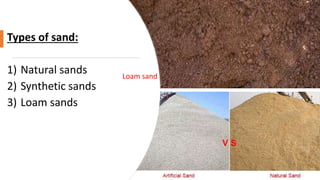
Types of sand:
1) Natural sands
2) Synthetic sands
3) Loam sands
Loam sand
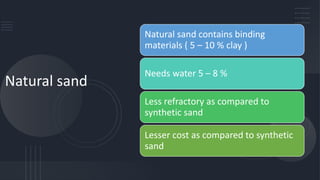
Natural sand contains binding
materials ( 5 – 10 % clay )
Needs water 5 – 8 %
Less refractory as compared to
synthetic sand
Lesser cost as compared to synthetic
sand
Natural sand
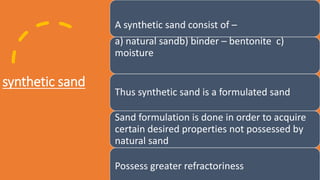
synthetic sand
A synthetic sand consist of –
a) natural sandb) binder – bentonite c)
moisture
Thus synthetic sand is a formulated sand
Sand formulation is done in order to acquire
certain desired properties not possessed by
natural sand
Possess greater refractoriness
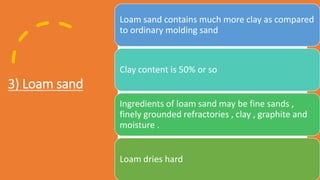
3) Loam sand
Loam sand contains much more clay as compared
to ordinary molding sand
Clay content is 50% or so
Ingredients of loam sand may be fine sands ,
finely grounded refractories , clay , graphite and
moisture .
Loam dries hard
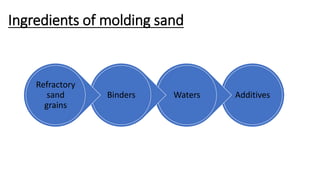
Ingredients of molding sand
Additives
Waters
Binders
Refractory
sand
grains
• Silica sand
• Magnesite
• Zircon
• Dolomite
• Silimanite
• Graphite
Specially silica sand is the best molding
sand
Refractory sand :
Binders
• Binders hold the sand grains
• Gives strength
• Clay binders are most commonly used for bonding
molding sand .
• Clay binders can be classified as :-
 fire clay
 bentonite
 iron oxide
 Kaolinite
 limonite
• The most commonly used clay binders are bentonites
as they produce strongest bond in foundry sand grains
Water
• The amount of water vary from 2 – 8 %
• Water for bonding action of clay
• It provides moldability but it reduces
strength of the sand mixture
Additives
Additives :
• Materials other than the basic ingredients are
also added in order to enhance the existing
properties and to develop certain other
properties.
• Some additives are as follows :-
 Dextrine and molasses – increase dry strength
 iron oxide –develop hot strength
 diethylene glycol – improve casting surface
finish
 silica flour – improve surface finish , hot
strength , resist metal penetration etc
 fuel oil – improve moldability
Refractory sand grain
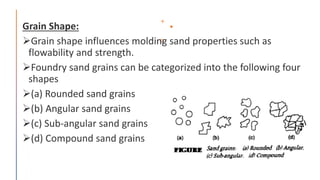
• Sand used for molding purposes can be classified according to their grain size and grain shape
Grain Size :
The grain size and distribution influence many sand properties Iike permeability,
flowability , refractoriness, surface fineness and strengths etc.
The finer the sand grains, the finer is the molding sand as a whole.
 Fine grained sands give surface fineness but possess low permeability.
Coarse and uniformly graded sands impart high permeability high flowability and
maximum refractoriness.
Normally foundry molding sands possess grain size between 0.1 to 1.0 mm.
Fine-grained sands are used for producing ornamental castings intricate and
small sized castings.
Coarser grained sands are preferred for producing large castings as they easily
permit the escape of mold gases
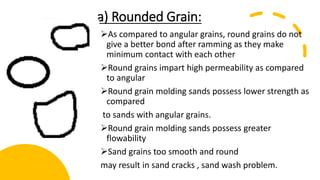
a) Rounded Grain:
As compared to angular grains, round grains do not
give a better bond after ramming as they make
minimum contact with each other
Round grains impart high permeability as compared
to angular
Round grain molding sands possess lower strength as
compared
to sands with angular grains.
Round grain molding sands possess greater
flowability
Sand grains too smooth and round
may result in sand cracks , sand wash problem.
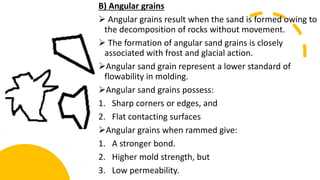
B) Angular grains
 Angular grains result when the sand is formed owing to
the decomposition of rocks without movement.
 The formation of angular sand grains is closely
associated with frost and glacial action.
Angular sand grain represent a lower standard of
flowability in molding.
Angular sand grains possess:
1. Sharp corners or edges, and
2. Flat contacting surfaces
Angular grains when rammed give:
1. A stronger bond.
2. Higher mold strength, but
3. Low permeability.
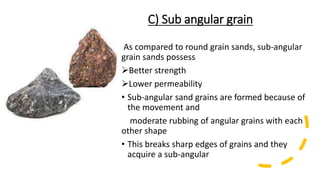
C) Sub angular grain
As compared to round grain sands, sub-angular
grain sands possess
Better strength
Lower permeability
• Sub-angular sand grains are formed because of
the movement and
moderate rubbing of angular grains with each
other shape
• This breaks sharp edges of grains and they
acquire a sub-angular
d)Compound Grains
Compound sand grains result when two or more
grains stick together so tightly that they do not get
separated either during:
1. Sieving operation, or
2. Washing operation
A compound grain may have been formed by
associating all the grains
1. of one of the three earlier described shapes i.e a, b
and c, or
2. of all the three shapes i.e, a, b and c described
above.
Compound grains tend to dissociate at higher
temperatures
PROPERTIES
OF MOLDING
SANDS
The molding sand should possess certain
desirable properties
i) Flowability
• Flowability is the ability of the molding sand
to get compacted to a uniform density.
• Flowability assists molding sand to flow and
pack all-around the pattern and take up the
required shape.
• Flowability increases as clay and water
contents increase.
(ii) Green Strength
• It is the strength of the sand in the green or moist state
• A mold having adequate green strength will retain its shape , Will
not distort , Will not collapse, even after the pattern has been
removed from the molding box.
• Until and unless the mold is hardened in contact with pattern
surface, in the absence of adequate green strength, it may not be
possible to achieve dimensional stability and high accuracy.
• Green strength helps in making and handling the molds.
(iii) Dry Strength
• It is the strength of the molding sand in the dry condition.
• A mold may either intentionally be dried, skin dried or a greensand
mold may loose its moisture and get dried while waiting for getting
poured or when it comes in contact with molten metal being poured.
• The sand (of molding cavity) thus dried must have strength to
1. withstand erosive forces due to molten metal
2. withstand pressure of molten metal, and
3. retain its shape
(iv) Hot Strength
• It is the strength of the sand (of mold cavity) above 212°F.
• In the absence of adequate hot strength, the mold may
1. enlarge
2. break, erode or
3. get cracked.
(vi) Refractoriness:
It is the ability of molding sand to withstand high temperatures
experienced during pouring without fusion , cracking or experiencing
any major physical change
As compared to casting of low melting point alloys, refractoriness is
much more essential in the production of high melting point alloy
castings (e.g steel )
v) Permeability or Porousness
• While being poured, the molten metal comes in contact with green sand mold
cavity and cores made up of core sand.
• The moisture, binders (organic compounds) and additives present there in,
produce steam and other gases.
• Though much of these gases escape through vents and open feeder heads, yet a
good amount of the same tends to pass off through the pore spaces of the
molding sand.
• Thus to provide a path for free escape of the gases, the molding sand should be
permeable or porous.
• Sands which are coarse or have rounded grains exhibit more permeability.
• Soft ramming and clay addition in lesser amounts also improves permeability.
• In the absence of adequate permeability, defects like surface blows, gas holes,
mold blast etc. may be experienced
(vii) Adhesiveness:
It is the property of molding sand owing to which, it Sticks with the walls of molding
boxes sticks with gaggers and thus makes it possible to mold Cope and Drag.
(viii) Collapsibility:
Collapsibility is that property of the molding sand which automatically gets collapsed
after the casting solidifies
breaks down in knock out and cleaning operations.
If the mold or core does not collapse, it may restrict free con-traction of the
solidifying metal and cause the same to tear or crack
• Molding sands should possess low coefficiet of expansion.
(xi) Coefficient of Expansion:
• The molding sand should possess the capacity to withstand
repeated cycles of heating and cooling during casting
operations.
• Molding sand should be chemically immune to molten
metals.
• Molding sand should be reusable.
• It should be easy to prepare and control the molding sand.
(xii) Durability :
Different types of molding sand
(i) Facing Sand:
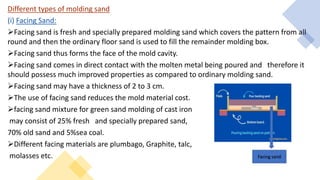
Facing sand is fresh and specially prepared molding sand which covers the pattern from all
round and then the ordinary floor sand is used to fill the remainder molding box.
Facing sand thus forms the face of the mold cavity.
Facing sand comes in direct contact with the molten metal being poured and therefore it
should possess much improved properties as compared to ordinary molding sand.
Facing sand may have a thickness of 2 to 3 cm.
The use of facing sand reduces the mold material cost.
facing sand mixture for green sand molding of cast iron
may consist of 25% fresh and specially prepared sand,
70% old sand and 5%sea coal.
Different facing materials are plumbago, Graphite, talc,
molasses etc. Facing sand
(ii) Backing Sand
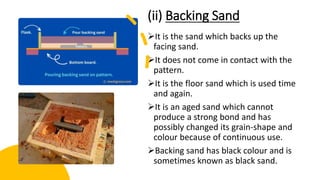
It is the sand which backs up the
facing sand.
It does not come in contact with the
pattern.
It is the floor sand which is used time
and again.
It is an aged sand which cannot
produce a strong bond and has
possibly changed its grain-shape and
colour because of continuous use.
Backing sand has black colour and is
sometimes known as black sand.
Thank You
Mihir mandal

mold materials and molding sand properties

  • 1.
  • 2.
    Mold materials • Casting canbe made in : 1) Permanent mold – made up of ferrous metals and alloys ( steel , cast iron etc ) 2) Temporary mold – made up of refractory sand and resin • The refractory sand mold can cast high melting alloys and bigger objects whereas permanent mold produce small casting better quality and dimensional accuracy . Sources of molding sand: • River • Sea • Lakes • Desert
  • 3.
    Types of sand: 1)Natural sands 2) Synthetic sands 3) Loam sands Loam sand
  • 4.
    Natural sand containsbinding materials ( 5 – 10 % clay ) Needs water 5 – 8 % Less refractory as compared to synthetic sand Lesser cost as compared to synthetic sand Natural sand
  • 5.
    synthetic sand A syntheticsand consist of – a) natural sandb) binder – bentonite c) moisture Thus synthetic sand is a formulated sand Sand formulation is done in order to acquire certain desired properties not possessed by natural sand Possess greater refractoriness
  • 6.
    3) Loam sand Loamsand contains much more clay as compared to ordinary molding sand Clay content is 50% or so Ingredients of loam sand may be fine sands , finely grounded refractories , clay , graphite and moisture . Loam dries hard
  • 7.
    Ingredients of moldingsand Additives Waters Binders Refractory sand grains
  • 8.
    • Silica sand •Magnesite • Zircon • Dolomite • Silimanite • Graphite Specially silica sand is the best molding sand Refractory sand :
  • 9.
    Binders • Binders holdthe sand grains • Gives strength • Clay binders are most commonly used for bonding molding sand . • Clay binders can be classified as :-  fire clay  bentonite  iron oxide  Kaolinite  limonite • The most commonly used clay binders are bentonites as they produce strongest bond in foundry sand grains
  • 10.
    Water • The amountof water vary from 2 – 8 % • Water for bonding action of clay • It provides moldability but it reduces strength of the sand mixture
  • 11.
    Additives Additives : • Materialsother than the basic ingredients are also added in order to enhance the existing properties and to develop certain other properties. • Some additives are as follows :-  Dextrine and molasses – increase dry strength  iron oxide –develop hot strength  diethylene glycol – improve casting surface finish  silica flour – improve surface finish , hot strength , resist metal penetration etc  fuel oil – improve moldability
  • 12.
    Refractory sand grain •Sand used for molding purposes can be classified according to their grain size and grain shape Grain Size : The grain size and distribution influence many sand properties Iike permeability, flowability , refractoriness, surface fineness and strengths etc. The finer the sand grains, the finer is the molding sand as a whole.  Fine grained sands give surface fineness but possess low permeability. Coarse and uniformly graded sands impart high permeability high flowability and maximum refractoriness. Normally foundry molding sands possess grain size between 0.1 to 1.0 mm. Fine-grained sands are used for producing ornamental castings intricate and small sized castings. Coarser grained sands are preferred for producing large castings as they easily permit the escape of mold gases
  • 14.
    a) Rounded Grain: Ascompared to angular grains, round grains do not give a better bond after ramming as they make minimum contact with each other Round grains impart high permeability as compared to angular Round grain molding sands possess lower strength as compared to sands with angular grains. Round grain molding sands possess greater flowability Sand grains too smooth and round may result in sand cracks , sand wash problem.
  • 15.
    B) Angular grains Angular grains result when the sand is formed owing to the decomposition of rocks without movement.  The formation of angular sand grains is closely associated with frost and glacial action. Angular sand grain represent a lower standard of flowability in molding. Angular sand grains possess: 1. Sharp corners or edges, and 2. Flat contacting surfaces Angular grains when rammed give: 1. A stronger bond. 2. Higher mold strength, but 3. Low permeability.
  • 16.
    C) Sub angulargrain As compared to round grain sands, sub-angular grain sands possess Better strength Lower permeability • Sub-angular sand grains are formed because of the movement and moderate rubbing of angular grains with each other shape • This breaks sharp edges of grains and they acquire a sub-angular
  • 17.
    d)Compound Grains Compound sandgrains result when two or more grains stick together so tightly that they do not get separated either during: 1. Sieving operation, or 2. Washing operation A compound grain may have been formed by associating all the grains 1. of one of the three earlier described shapes i.e a, b and c, or 2. of all the three shapes i.e, a, b and c described above. Compound grains tend to dissociate at higher temperatures
  • 18.
    PROPERTIES OF MOLDING SANDS The moldingsand should possess certain desirable properties i) Flowability • Flowability is the ability of the molding sand to get compacted to a uniform density. • Flowability assists molding sand to flow and pack all-around the pattern and take up the required shape. • Flowability increases as clay and water contents increase.
  • 19.
    (ii) Green Strength •It is the strength of the sand in the green or moist state • A mold having adequate green strength will retain its shape , Will not distort , Will not collapse, even after the pattern has been removed from the molding box. • Until and unless the mold is hardened in contact with pattern surface, in the absence of adequate green strength, it may not be possible to achieve dimensional stability and high accuracy. • Green strength helps in making and handling the molds.
  • 20.
    (iii) Dry Strength •It is the strength of the molding sand in the dry condition. • A mold may either intentionally be dried, skin dried or a greensand mold may loose its moisture and get dried while waiting for getting poured or when it comes in contact with molten metal being poured. • The sand (of molding cavity) thus dried must have strength to 1. withstand erosive forces due to molten metal 2. withstand pressure of molten metal, and 3. retain its shape
  • 21.
    (iv) Hot Strength •It is the strength of the sand (of mold cavity) above 212°F. • In the absence of adequate hot strength, the mold may 1. enlarge 2. break, erode or 3. get cracked. (vi) Refractoriness: It is the ability of molding sand to withstand high temperatures experienced during pouring without fusion , cracking or experiencing any major physical change As compared to casting of low melting point alloys, refractoriness is much more essential in the production of high melting point alloy castings (e.g steel )
  • 22.
    v) Permeability orPorousness • While being poured, the molten metal comes in contact with green sand mold cavity and cores made up of core sand. • The moisture, binders (organic compounds) and additives present there in, produce steam and other gases. • Though much of these gases escape through vents and open feeder heads, yet a good amount of the same tends to pass off through the pore spaces of the molding sand. • Thus to provide a path for free escape of the gases, the molding sand should be permeable or porous. • Sands which are coarse or have rounded grains exhibit more permeability. • Soft ramming and clay addition in lesser amounts also improves permeability. • In the absence of adequate permeability, defects like surface blows, gas holes, mold blast etc. may be experienced
  • 23.
    (vii) Adhesiveness: It isthe property of molding sand owing to which, it Sticks with the walls of molding boxes sticks with gaggers and thus makes it possible to mold Cope and Drag. (viii) Collapsibility: Collapsibility is that property of the molding sand which automatically gets collapsed after the casting solidifies breaks down in knock out and cleaning operations. If the mold or core does not collapse, it may restrict free con-traction of the solidifying metal and cause the same to tear or crack
  • 24.
    • Molding sandsshould possess low coefficiet of expansion. (xi) Coefficient of Expansion: • The molding sand should possess the capacity to withstand repeated cycles of heating and cooling during casting operations. • Molding sand should be chemically immune to molten metals. • Molding sand should be reusable. • It should be easy to prepare and control the molding sand. (xii) Durability :
  • 25.
    Different types ofmolding sand (i) Facing Sand: Facing sand is fresh and specially prepared molding sand which covers the pattern from all round and then the ordinary floor sand is used to fill the remainder molding box. Facing sand thus forms the face of the mold cavity. Facing sand comes in direct contact with the molten metal being poured and therefore it should possess much improved properties as compared to ordinary molding sand. Facing sand may have a thickness of 2 to 3 cm. The use of facing sand reduces the mold material cost. facing sand mixture for green sand molding of cast iron may consist of 25% fresh and specially prepared sand, 70% old sand and 5%sea coal. Different facing materials are plumbago, Graphite, talc, molasses etc. Facing sand
  • 26.
    (ii) Backing Sand Itis the sand which backs up the facing sand. It does not come in contact with the pattern. It is the floor sand which is used time and again. It is an aged sand which cannot produce a strong bond and has possibly changed its grain-shape and colour because of continuous use. Backing sand has black colour and is sometimes known as black sand.
  • 27.