SNS COLLEGE OF ENGINEERING
Kurumbapalayam (Po), Coimbatore – 641 107
An Autonomous Institution
Accredited by NBA – AICTE and Accredited by NAAC – UGC with ‘A’ Grade
Approved by AICTE, New Delhi & Affiliated to Anna University, Chennai
DEPARTMENT OF CIVIL ENGINEERING
COURSE NAME: CE8502 – STRUCTURAL ANALYSIS I
III YEAR/V SEMESTER
Unit 1 – Strain Energy Method
Topic 1 : Basics of Structural Analysis
12/4/2020 2/13
SNSCE/ Civil Engg /V sem / Shanmugasundaram N/ Ap/Civil
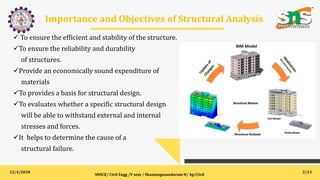
 To ensure the efficient and stability of the structure.
To ensure the reliability and durability
of structures.
Provide an economically sound expenditure of
materials
To provides a basis for structural design.
To evaluates whether a specific structural design
will be able to withstand external and internal
stresses and forces.
It helps to determine the cause of a
structural failure.
Importance and Objectives of Structural Analysis
12/4/2020 3/13
SNSCE/ Civil Engg /V sem / Shanmugasundaram N/ Ap/Civil
Objectives of Structural Analysis I
 To introduce the basic theory ‘s.
 To introduce the basics concepts of classical
methods of structural analysis.
 To introduce Strain energy method.
 To introduce Slope deflection method.
 To introduce Moment distribution method.
To introduce Stiffness matrix method.
To introduce Flexibility matrix method.
12/4/2020 4/13SNSCE/ Civil Engg /V sem / Shanmugasundaram N/ Ap/Civil
Outcome of Structural Analysis I
Analyze continuous beams, pin-jointed indeterminate plane frames and
rigid plane frames by strain energy method.
Analyze the continuous beams and rigid frames by slope defection
method.
Understand the concept of moment distribution and analysis of
continuous beams and rigid frames with and without sway.
Analyze the indeterminate pin jointed plane frames continuous beams
and rigid frames using matrix flexibility method.
Understand the concept of matrix stiffness method and analysis of
continuous beams, pin jointed trusses and rigid plane frames.
12/4/2020 5/13
SNSCE/ Civil Engg /V sem / Shanmugasundaram N/ Ap/Civil
UNIT I STRAIN ENERGY METHOD
Syllabus:
Determination of Static and Kinematic Indeterminacies – Analysis of
continuous beams, plane frames and indeterminate plane trusses by strain
energy method (up to two degree of redundancy).
12/4/2020 6/13SNSCE/ Civil Engg /V sem / Shanmugasundaram N/ Ap/Civil
1.Bending moment: It is the reaction induced in a structural element
when an external force or moment is applied to the element causing the
element to bend. The most common or simplest structural element
subjected to bending moments is the beam.
Basic definitions
12/4/2020 7/13
SNSCE/ Civil Engg /V sem / Shanmugasundaram N/ Ap/Civil
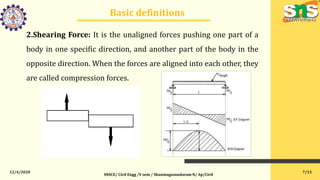
2.Shearing Force: It is the unaligned forces pushing one part of a
body in one specific direction, and another part of the body in the
opposite direction. When the forces are aligned into each other, they
are called compression forces.
Basic definitions
12/4/2020 8/13
SNSCE/ Civil Engg /V sem / Shanmugasundaram N/ Ap/Civil
Basic definitions
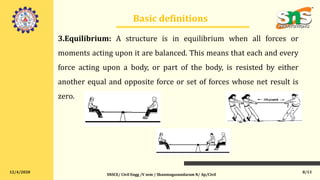
3.Equilibrium: A structure is in equilibrium when all forces or
moments acting upon it are balanced. This means that each and every
force acting upon a body, or part of the body, is resisted by either
another equal and opposite force or set of forces whose net result is
zero.
12/4/2020 9/13
SNSCE/ Civil Engg /V sem / Shanmugasundaram N/ Ap/Civil
Basic definitions
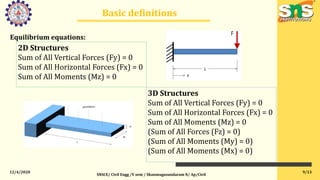
Equilibrium equations:
2D Structures
Sum of All Vertical Forces (Fy) = 0
Sum of All Horizontal Forces (Fx) = 0
Sum of All Moments (Mz) = 0
3D Structures
Sum of All Vertical Forces (Fy) = 0
Sum of All Horizontal Forces (Fx) = 0
Sum of All Moments (Mz) = 0
(Sum of All Forces (Fz) = 0)
(Sum of All Moments (My) = 0)
(Sum of All Moments (Mx) = 0)
12/4/2020 10/13
SNSCE/ Civil Engg /V sem / Shanmugasundaram N/ Ap/Civil
Basic definitions
Types of Equilibrium:
1. External equilibrium:
 External equilibrium encompasses the loads upon, and reactions of, a
structural system as a whole
2. Internal equilibrium:
 Internal equilibrium describes the various forces the are acting within
every member of the system.
 There are conditions of equilibrium that must be satisfied for both types.
12/4/2020 11/13
SNSCE/ Civil Engg /V sem / Shanmugasundaram N/ Ap/Civil
Types of Structures
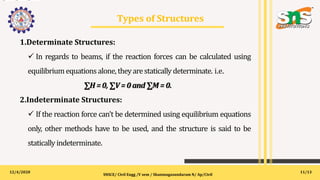
1.Determinate Structures:
 In regards to beams, if the reaction forces can be calculated using
equilibrium equations alone, theyarestaticallydeterminate. i.e.
∑H=0,∑V=0and∑M=0.
2.Indeterminate Structures:
 If the reaction force can't be determined using equilibrium equations
only, other methods have to be used, and the structure is said to be
statically indeterminate.
.
12/4/2020 12/13SNSCE/ Civil Engg /V sem / Shanmugasundaram N/ Ap/Civil
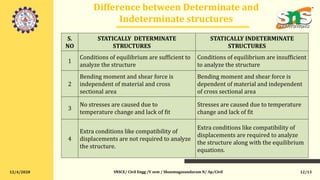
Difference between Determinate and
Indeterminate structures
S.
NO
STATICALLY DETERMINATE
STRUCTURES
STATICALLY INDETERMINATE
STRUCTURES
1
Conditions of equilibrium are sufficient to
analyze the structure
Conditions of equilibrium are insufficient
to analyze the structure
2
Bending moment and shear force is
independent of material and cross
sectional area
Bending moment and shear force is
dependent of material and independent
of cross sectional area
3
No stresses are caused due to
temperature change and lack of fit
Stresses are caused due to temperature
change and lack of fit
4
Extra conditions like compatibility of
displacements are not required to analyze
the structure.
Extra conditions like compatibility of
displacements are required to analyze
the structure along with the equilibrium
equations.
12/4/2020 13/13SNSCE/ Civil Engg /V sem / Shanmugasundaram N/ Ap/Civil
Thank You
HAPPY LEARNING

Basics of structural analysis

  • 1.
    SNS COLLEGE OFENGINEERING Kurumbapalayam (Po), Coimbatore – 641 107 An Autonomous Institution Accredited by NBA – AICTE and Accredited by NAAC – UGC with ‘A’ Grade Approved by AICTE, New Delhi & Affiliated to Anna University, Chennai DEPARTMENT OF CIVIL ENGINEERING COURSE NAME: CE8502 – STRUCTURAL ANALYSIS I III YEAR/V SEMESTER Unit 1 – Strain Energy Method Topic 1 : Basics of Structural Analysis
  • 2.
    12/4/2020 2/13 SNSCE/ CivilEngg /V sem / Shanmugasundaram N/ Ap/Civil  To ensure the efficient and stability of the structure. To ensure the reliability and durability of structures. Provide an economically sound expenditure of materials To provides a basis for structural design. To evaluates whether a specific structural design will be able to withstand external and internal stresses and forces. It helps to determine the cause of a structural failure. Importance and Objectives of Structural Analysis
  • 3.
    12/4/2020 3/13 SNSCE/ CivilEngg /V sem / Shanmugasundaram N/ Ap/Civil Objectives of Structural Analysis I  To introduce the basic theory ‘s.  To introduce the basics concepts of classical methods of structural analysis.  To introduce Strain energy method.  To introduce Slope deflection method.  To introduce Moment distribution method. To introduce Stiffness matrix method. To introduce Flexibility matrix method.
  • 4.
    12/4/2020 4/13SNSCE/ CivilEngg /V sem / Shanmugasundaram N/ Ap/Civil Outcome of Structural Analysis I Analyze continuous beams, pin-jointed indeterminate plane frames and rigid plane frames by strain energy method. Analyze the continuous beams and rigid frames by slope defection method. Understand the concept of moment distribution and analysis of continuous beams and rigid frames with and without sway. Analyze the indeterminate pin jointed plane frames continuous beams and rigid frames using matrix flexibility method. Understand the concept of matrix stiffness method and analysis of continuous beams, pin jointed trusses and rigid plane frames.
  • 5.
    12/4/2020 5/13 SNSCE/ CivilEngg /V sem / Shanmugasundaram N/ Ap/Civil UNIT I STRAIN ENERGY METHOD Syllabus: Determination of Static and Kinematic Indeterminacies – Analysis of continuous beams, plane frames and indeterminate plane trusses by strain energy method (up to two degree of redundancy).
  • 6.
    12/4/2020 6/13SNSCE/ CivilEngg /V sem / Shanmugasundaram N/ Ap/Civil 1.Bending moment: It is the reaction induced in a structural element when an external force or moment is applied to the element causing the element to bend. The most common or simplest structural element subjected to bending moments is the beam. Basic definitions
  • 7.
    12/4/2020 7/13 SNSCE/ CivilEngg /V sem / Shanmugasundaram N/ Ap/Civil 2.Shearing Force: It is the unaligned forces pushing one part of a body in one specific direction, and another part of the body in the opposite direction. When the forces are aligned into each other, they are called compression forces. Basic definitions
  • 8.
    12/4/2020 8/13 SNSCE/ CivilEngg /V sem / Shanmugasundaram N/ Ap/Civil Basic definitions 3.Equilibrium: A structure is in equilibrium when all forces or moments acting upon it are balanced. This means that each and every force acting upon a body, or part of the body, is resisted by either another equal and opposite force or set of forces whose net result is zero.
  • 9.
    12/4/2020 9/13 SNSCE/ CivilEngg /V sem / Shanmugasundaram N/ Ap/Civil Basic definitions Equilibrium equations: 2D Structures Sum of All Vertical Forces (Fy) = 0 Sum of All Horizontal Forces (Fx) = 0 Sum of All Moments (Mz) = 0 3D Structures Sum of All Vertical Forces (Fy) = 0 Sum of All Horizontal Forces (Fx) = 0 Sum of All Moments (Mz) = 0 (Sum of All Forces (Fz) = 0) (Sum of All Moments (My) = 0) (Sum of All Moments (Mx) = 0)
  • 10.
    12/4/2020 10/13 SNSCE/ CivilEngg /V sem / Shanmugasundaram N/ Ap/Civil Basic definitions Types of Equilibrium: 1. External equilibrium:  External equilibrium encompasses the loads upon, and reactions of, a structural system as a whole 2. Internal equilibrium:  Internal equilibrium describes the various forces the are acting within every member of the system.  There are conditions of equilibrium that must be satisfied for both types.
  • 11.
    12/4/2020 11/13 SNSCE/ CivilEngg /V sem / Shanmugasundaram N/ Ap/Civil Types of Structures 1.Determinate Structures:  In regards to beams, if the reaction forces can be calculated using equilibrium equations alone, theyarestaticallydeterminate. i.e. ∑H=0,∑V=0and∑M=0. 2.Indeterminate Structures:  If the reaction force can't be determined using equilibrium equations only, other methods have to be used, and the structure is said to be statically indeterminate. .
  • 12.
    12/4/2020 12/13SNSCE/ CivilEngg /V sem / Shanmugasundaram N/ Ap/Civil Difference between Determinate and Indeterminate structures S. NO STATICALLY DETERMINATE STRUCTURES STATICALLY INDETERMINATE STRUCTURES 1 Conditions of equilibrium are sufficient to analyze the structure Conditions of equilibrium are insufficient to analyze the structure 2 Bending moment and shear force is independent of material and cross sectional area Bending moment and shear force is dependent of material and independent of cross sectional area 3 No stresses are caused due to temperature change and lack of fit Stresses are caused due to temperature change and lack of fit 4 Extra conditions like compatibility of displacements are not required to analyze the structure. Extra conditions like compatibility of displacements are required to analyze the structure along with the equilibrium equations.
  • 13.
    12/4/2020 13/13SNSCE/ CivilEngg /V sem / Shanmugasundaram N/ Ap/Civil Thank You HAPPY LEARNING