











SNS COLLEGE OF ENGINEERING
DEPARTMENT OF CIVIL ENGINEERING
UNIT 4
RESPONSE OF STRUCTURES TO EARTHQUAKE
PRESENTATION BY
SHANMUGASUNDARAM .N
ASSISTANT PROFESSOR
1/30
CE6701-SD&EE/UNIT 4
by, Shanmugasundaram.N
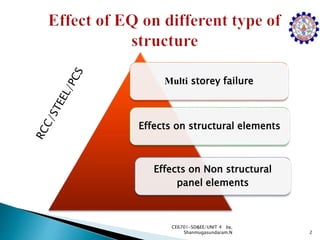
Multi storey failure
Effects on structural elements
Effects on Non structural
panel elements
2
CE6701-SD&EE/UNIT 4 by,
Shanmugasundaram.N
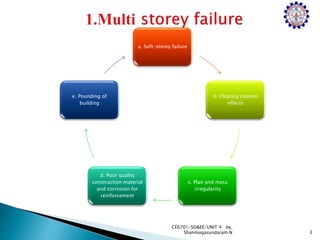
a. Soft-storey failure
b. Floating column
effects
c. Plan and mass
irregularity
d. Poor quality
construction material
and corrosion for
reinforcement
e. Pounding of
building
3
CE6701-SD&EE/UNIT 4 by,
Shanmugasundaram.N
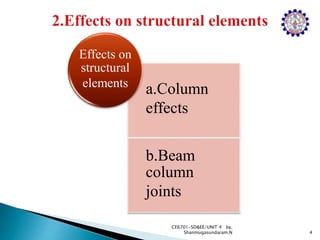
a.Column
effects
b.Beam
column
joints
Effects on
structural
elements
4
CE6701-SD&EE/UNIT 4 by,
Shanmugasundaram.N
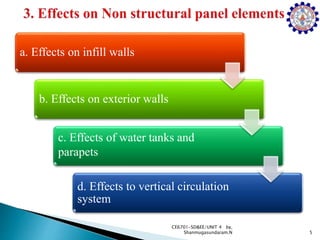
a. Effects on infill walls
b. Effects on exterior walls
c. Effects of water tanks and
parapets
d. Effects to vertical circulation
system
5
CE6701-SD&EE/UNIT 4 by,
Shanmugasundaram.N
6
CE6701-SD&EE/UNIT 4 by,
Shanmugasundaram.N
7
CE6701-SD&EE/UNIT 4 by,
Shanmugasundaram.N
8
CE6701-SD&EE/UNIT 4 by,
Shanmugasundaram.N
9
CE6701-SD&EE/UNIT 4 by,
Shanmugasundaram.N
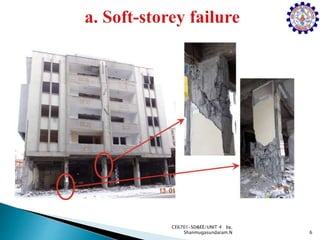
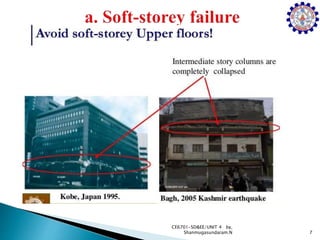
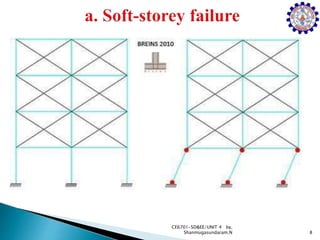
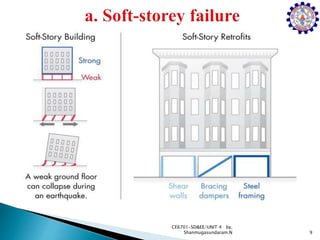
a. Soft-storey failure
1. Lesser strength and stiffness compare to upper stories
2. Due to parking
3. Create week or soft storey problems.
4. During EQ the plastic hinges are formed at the end of
columns
5. Torsion and excessive mass on upper floors
6. Lack of ductility failure in the bottom storey.
10
CE6701-SD&EE/UNIT 4 by,
Shanmugasundaram.N
11
CE6701-SD&EE/UNIT 4 by,
Shanmugasundaram.N
12
CE6701-SD&EE/UNIT 4 by,
Shanmugasundaram.N
13
CE6701-SD&EE/UNIT 4 by,
Shanmugasundaram.N
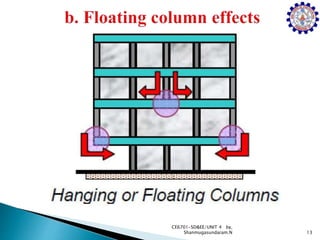
b. Floating column effects
1. Balconies are not counted in FSI. Overhanging in the upper
stories.
2. Overhang up to 1.2m to 1.5m in plan are usually provided.
3. Floating columns are provided along the overhanging perimeter of
the building.
4. Its rest at the tip of the taper overhanging beams without
considering the lateral load.
5. Load path is not available for transferring the lateral force of the
foundation. Columns begin to deform and buckle
14
CE6701-SD&EE/UNIT 4 by,
Shanmugasundaram.N
15
CE6701-SD&EE/UNIT 4 by,
Shanmugasundaram.N
16
CE6701-SD&EE/UNIT 4 by,
Shanmugasundaram.N
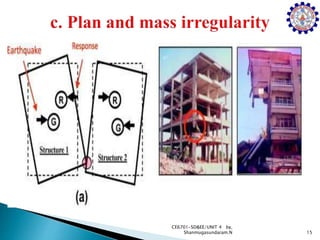
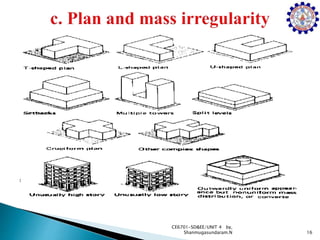
c. Plan and mass irregularity
1. C and U shaped construction, no expansion joint as report.
d. Poor quality of construction material and corrosion for
reinforcement
1. Quality control
2. Corrosion of reinforcement
3. Beam column joint, slab of staircase and column face
17
CE6701-SD&EE/UNIT 4 by,
Shanmugasundaram.N
18
CE6701-SD&EE/UNIT 4 by,
Shanmugasundaram.N
19
CE6701-SD&EE/UNIT 4 by,
Shanmugasundaram.N
E:SNSCEthanjavurTemple
20
CE6701-SD&EE/UNIT 4 by,
Shanmugasundaram.N
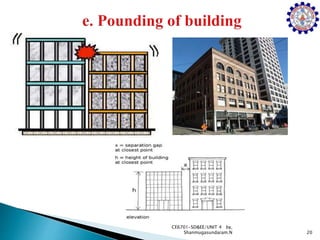
e. Pounding of building
1. Irregular response of adjacent building of different height
and of different dynamic characteristics
2. During EQ the low height building receives an unexpected
load while the taller building suffers from a major stiffness
discontinuity at the level of the top of he lower building.
21
CE6701-SD&EE/UNIT 4 by,
Shanmugasundaram.N
2. Effects on structural elements
a. Column effects
1. large tie spacing
2. Insufficient development length
3. Inadequate splicing of all column bars at the same section
4. Without ductile detailing practice
5. Presence in strong beam.
6. Mainly effects in slender column section compared to
beam section main effects
22
CE6701-SD&EE/UNIT 4 by,
Shanmugasundaram.N
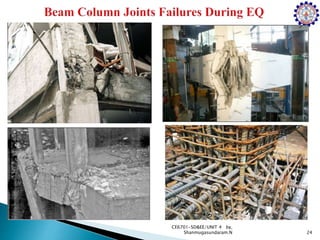
b. Beam Column joints
1. Due to inadequacy of reinforcement in beam column joints.
2. Absence of confining hoop reinforcement.
3. Inappropriate location of bar splices in columns.
4. Different cross section at beam and columns.
23
CE6701-SD&EE/UNIT 4 by,
Shanmugasundaram.N
24
CE6701-SD&EE/UNIT 4 by,
Shanmugasundaram.N
3.Effects on Non-structural panel elements.
a. Effect on infill walls
1. In India the strength and stiffness of infill walls are not considered
2. Causes are
i) Unequal distribution of lateral forces in the different frames and
overstressing
ii) Soft storey or week storey
iii) Short column or captive column effects
iv) Tensional force
v) Cracking on the infill walls. (diagonal cracks, horizontal crack etc..)
25
CE6701-SD&EE/UNIT 4 by,
Shanmugasundaram.N
b. Effect on exterior walls
1. poorly connected with RC frames- the total walls are collapsed.
C. Effects of water tanks and parapets:
1. Upper roof level construction experience large inertia forces
due to amplification of the ground acceleration along height of the
building.
2. Un-reinforcement concrete parapets with large height to
thickness ratio and not improper anchoring to the roof diaphram
may also constitute a hazard.
26
CE6701-SD&EE/UNIT 4 by,
Shanmugasundaram.N
27
CE6701-SD&EE/UNIT 4 by,
Shanmugasundaram.N
28
CE6701-SD&EE/UNIT 4 by,
Shanmugasundaram.N
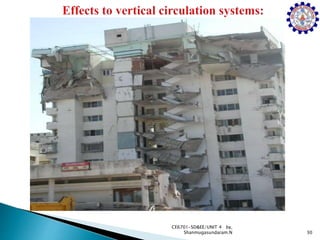
b. Effects to vertical circulation systems:
1. Staircase and lifts are only means of vertical movement in
building.
2. Due to un reinforcement walls failure
3. Stair can acting as diagonal
4. Bracing element during EQ and elevators also..
29
CE6701-SD&EE/UNIT 4 by,
Shanmugasundaram.N
30
CE6701-SD&EE/UNIT 4 by,
Shanmugasundaram.N
b. For R.C framed structure:
1. Avoid soft storey ground floors
2. Avoid soft storey upper floors
3. Avoid short column. These attract large shears and failure.
4. Avoid open ground floor & discontinuous columns.
5. Adopt proper detailing as per IS 13920-1993
6. Provide suitable foundation based on the soil conditions.
7. Adopt seismic resistant design for the building which are
located in the zone of seismicity.
31
CE6701-SD&EE/UNIT 4 by,
Shanmugasundaram.N
b. For masonry building:
1. Poor wall connections at corners offend lead to failure of
wall.
2. Infill walls with large openings cause pier effect leading to
extensive damage.
3. Disproportionate wall openings
4. Rigid roof slab, excessive load and improper distribution
can lead to roof failure.
32
CE6701-SD&EE/UNIT 4 by,
Shanmugasundaram.N
33
CE6701-SD&EE/UNIT 4 by,
Shanmugasundaram.N
34
CE6701-SD&EE/UNIT 4 by,
Shanmugasundaram.N
35
CE6701-SD&EE/UNIT 4 by,
Shanmugasundaram.N
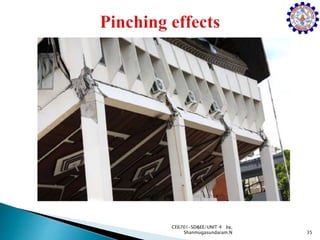
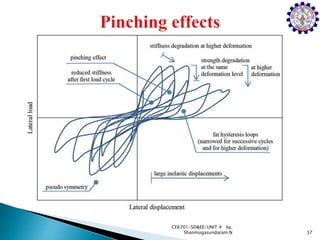
1. The influence of pinching effects response of the interior RC
beams-column joints on the seismic behaviour of multi-storey
RC frame structures.
2. Its caused by the orientation of the steel bars and the
concrete and load to deformation of the structures.
36
CE6701-SD&EE/UNIT 4 by,
Shanmugasundaram.N
37
CE6701-SD&EE/UNIT 4 by,
Shanmugasundaram.N
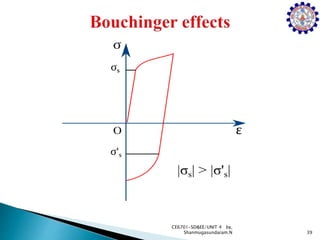
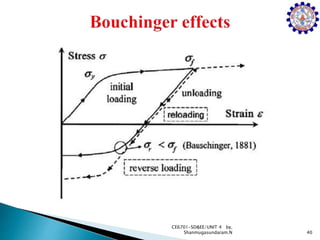
1. The Bouchinger effects referred to a property of material where the
materials stress/strain characteristic change as a result of the
microscopic stress distribution of the material.
2. For example in increase in tensile yield strength occur at the
expense of compressive yield strength.
3. The effect is named after German Engineer Johann Bouchinger
(Bauschinger)
38
CE6701-SD&EE/UNIT 4 by,
Shanmugasundaram.N
39
CE6701-SD&EE/UNIT 4 by,
Shanmugasundaram.N
40
CE6701-SD&EE/UNIT 4 by,
Shanmugasundaram.N
4. While more tensile cold working increase the tensile yield
strength, the local initial compressive yield strength after tensile
cold working is actually reduced.
5. The grater the tensile cold working the lower the compressive
yield strength.
6. The bauschinger effects is normally associated with conditions
where the yield strength of a metal decreases when the direction of
strain is changed.
41
CE6701-SD&EE/UNIT 4 by,
Shanmugasundaram.N
7. It is general phenomenon found in most polycrystalline metals.
8. The basic mechanism for the bauschinger effect is related to the
dislocation structure in the cold worked metal.
9. As deformation occurs, the dislocations will accumulate at barriers
and produce dislocation pile and tangles.
10. Based on the cold work structure two types of mechanisms are
generally used to explain the bouchinger effects.
42
CE6701-SD&EE/UNIT 4 by,
Shanmugasundaram.N
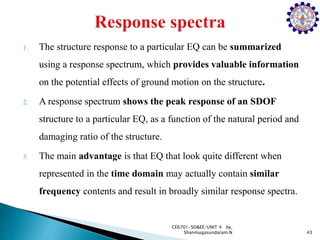
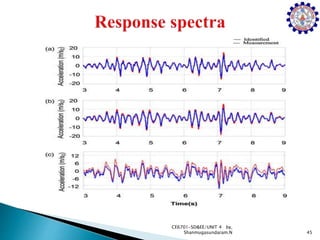
1. The structure response to a particular EQ can be summarized
using a response spectrum, which provides valuable information
on the potential effects of ground motion on the structure.
2. A response spectrum shows the peak response of an SDOF
structure to a particular EQ, as a function of the natural period and
damaging ratio of the structure.
3. The main advantage is that EQ that look quite different when
represented in the time domain may actually contain similar
frequency contents and result in broadly similar response spectra.
43
CE6701-SD&EE/UNIT 4 by,
Shanmugasundaram.N
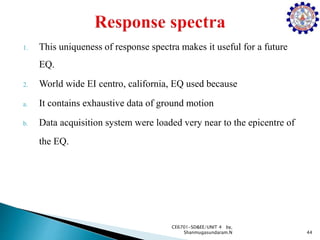
1. This uniqueness of response spectra makes it useful for a future
EQ.
2. World wide EI centro, california, EQ used because
a. It contains exhaustive data of ground motion
b. Data acquisition system were loaded very near to the epicentre of
the EQ.
44
CE6701-SD&EE/UNIT 4 by,
Shanmugasundaram.N
45
CE6701-SD&EE/UNIT 4 by,
Shanmugasundaram.N

Response of structures to earthquake - Structural dynamics and Earthquake Engineering (SD&EE)

  • 1.
    SNS COLLEGE OFENGINEERING DEPARTMENT OF CIVIL ENGINEERING UNIT 4 RESPONSE OF STRUCTURES TO EARTHQUAKE PRESENTATION BY SHANMUGASUNDARAM .N ASSISTANT PROFESSOR 1/30 CE6701-SD&EE/UNIT 4 by, Shanmugasundaram.N
  • 2.
    Multi storey failure Effectson structural elements Effects on Non structural panel elements 2 CE6701-SD&EE/UNIT 4 by, Shanmugasundaram.N
  • 3.
    a. Soft-storey failure b.Floating column effects c. Plan and mass irregularity d. Poor quality construction material and corrosion for reinforcement e. Pounding of building 3 CE6701-SD&EE/UNIT 4 by, Shanmugasundaram.N
  • 4.
  • 5.
    a. Effects oninfill walls b. Effects on exterior walls c. Effects of water tanks and parapets d. Effects to vertical circulation system 5 CE6701-SD&EE/UNIT 4 by, Shanmugasundaram.N
  • 6.
  • 7.
  • 8.
  • 9.
  • 10.
    a. Soft-storey failure 1.Lesser strength and stiffness compare to upper stories 2. Due to parking 3. Create week or soft storey problems. 4. During EQ the plastic hinges are formed at the end of columns 5. Torsion and excessive mass on upper floors 6. Lack of ductility failure in the bottom storey. 10 CE6701-SD&EE/UNIT 4 by, Shanmugasundaram.N
  • 11.
  • 12.
  • 13.
  • 14.
    b. Floating columneffects 1. Balconies are not counted in FSI. Overhanging in the upper stories. 2. Overhang up to 1.2m to 1.5m in plan are usually provided. 3. Floating columns are provided along the overhanging perimeter of the building. 4. Its rest at the tip of the taper overhanging beams without considering the lateral load. 5. Load path is not available for transferring the lateral force of the foundation. Columns begin to deform and buckle 14 CE6701-SD&EE/UNIT 4 by, Shanmugasundaram.N
  • 15.
  • 16.
  • 17.
    c. Plan andmass irregularity 1. C and U shaped construction, no expansion joint as report. d. Poor quality of construction material and corrosion for reinforcement 1. Quality control 2. Corrosion of reinforcement 3. Beam column joint, slab of staircase and column face 17 CE6701-SD&EE/UNIT 4 by, Shanmugasundaram.N
  • 18.
  • 19.
  • 20.
  • 21.
    e. Pounding ofbuilding 1. Irregular response of adjacent building of different height and of different dynamic characteristics 2. During EQ the low height building receives an unexpected load while the taller building suffers from a major stiffness discontinuity at the level of the top of he lower building. 21 CE6701-SD&EE/UNIT 4 by, Shanmugasundaram.N
  • 22.
    2. Effects onstructural elements a. Column effects 1. large tie spacing 2. Insufficient development length 3. Inadequate splicing of all column bars at the same section 4. Without ductile detailing practice 5. Presence in strong beam. 6. Mainly effects in slender column section compared to beam section main effects 22 CE6701-SD&EE/UNIT 4 by, Shanmugasundaram.N
  • 23.
    b. Beam Columnjoints 1. Due to inadequacy of reinforcement in beam column joints. 2. Absence of confining hoop reinforcement. 3. Inappropriate location of bar splices in columns. 4. Different cross section at beam and columns. 23 CE6701-SD&EE/UNIT 4 by, Shanmugasundaram.N
  • 24.
  • 25.
    3.Effects on Non-structuralpanel elements. a. Effect on infill walls 1. In India the strength and stiffness of infill walls are not considered 2. Causes are i) Unequal distribution of lateral forces in the different frames and overstressing ii) Soft storey or week storey iii) Short column or captive column effects iv) Tensional force v) Cracking on the infill walls. (diagonal cracks, horizontal crack etc..) 25 CE6701-SD&EE/UNIT 4 by, Shanmugasundaram.N
  • 26.
    b. Effect onexterior walls 1. poorly connected with RC frames- the total walls are collapsed. C. Effects of water tanks and parapets: 1. Upper roof level construction experience large inertia forces due to amplification of the ground acceleration along height of the building. 2. Un-reinforcement concrete parapets with large height to thickness ratio and not improper anchoring to the roof diaphram may also constitute a hazard. 26 CE6701-SD&EE/UNIT 4 by, Shanmugasundaram.N
  • 27.
  • 28.
  • 29.
    b. Effects tovertical circulation systems: 1. Staircase and lifts are only means of vertical movement in building. 2. Due to un reinforcement walls failure 3. Stair can acting as diagonal 4. Bracing element during EQ and elevators also.. 29 CE6701-SD&EE/UNIT 4 by, Shanmugasundaram.N
  • 30.
  • 31.
    b. For R.Cframed structure: 1. Avoid soft storey ground floors 2. Avoid soft storey upper floors 3. Avoid short column. These attract large shears and failure. 4. Avoid open ground floor & discontinuous columns. 5. Adopt proper detailing as per IS 13920-1993 6. Provide suitable foundation based on the soil conditions. 7. Adopt seismic resistant design for the building which are located in the zone of seismicity. 31 CE6701-SD&EE/UNIT 4 by, Shanmugasundaram.N
  • 32.
    b. For masonrybuilding: 1. Poor wall connections at corners offend lead to failure of wall. 2. Infill walls with large openings cause pier effect leading to extensive damage. 3. Disproportionate wall openings 4. Rigid roof slab, excessive load and improper distribution can lead to roof failure. 32 CE6701-SD&EE/UNIT 4 by, Shanmugasundaram.N
  • 33.
  • 34.
  • 35.
  • 36.
    1. The influenceof pinching effects response of the interior RC beams-column joints on the seismic behaviour of multi-storey RC frame structures. 2. Its caused by the orientation of the steel bars and the concrete and load to deformation of the structures. 36 CE6701-SD&EE/UNIT 4 by, Shanmugasundaram.N
  • 37.
  • 38.
    1. The Bouchingereffects referred to a property of material where the materials stress/strain characteristic change as a result of the microscopic stress distribution of the material. 2. For example in increase in tensile yield strength occur at the expense of compressive yield strength. 3. The effect is named after German Engineer Johann Bouchinger (Bauschinger) 38 CE6701-SD&EE/UNIT 4 by, Shanmugasundaram.N
  • 39.
  • 40.
  • 41.
    4. While moretensile cold working increase the tensile yield strength, the local initial compressive yield strength after tensile cold working is actually reduced. 5. The grater the tensile cold working the lower the compressive yield strength. 6. The bauschinger effects is normally associated with conditions where the yield strength of a metal decreases when the direction of strain is changed. 41 CE6701-SD&EE/UNIT 4 by, Shanmugasundaram.N
  • 42.
    7. It isgeneral phenomenon found in most polycrystalline metals. 8. The basic mechanism for the bauschinger effect is related to the dislocation structure in the cold worked metal. 9. As deformation occurs, the dislocations will accumulate at barriers and produce dislocation pile and tangles. 10. Based on the cold work structure two types of mechanisms are generally used to explain the bouchinger effects. 42 CE6701-SD&EE/UNIT 4 by, Shanmugasundaram.N
  • 43.
    1. The structureresponse to a particular EQ can be summarized using a response spectrum, which provides valuable information on the potential effects of ground motion on the structure. 2. A response spectrum shows the peak response of an SDOF structure to a particular EQ, as a function of the natural period and damaging ratio of the structure. 3. The main advantage is that EQ that look quite different when represented in the time domain may actually contain similar frequency contents and result in broadly similar response spectra. 43 CE6701-SD&EE/UNIT 4 by, Shanmugasundaram.N
  • 44.
    1. This uniquenessof response spectra makes it useful for a future EQ. 2. World wide EI centro, california, EQ used because a. It contains exhaustive data of ground motion b. Data acquisition system were loaded very near to the epicentre of the EQ. 44 CE6701-SD&EE/UNIT 4 by, Shanmugasundaram.N
  • 45.