SRI KRISHNA COLLEGE OF TECHNOLOGY
[An Autonomous Institution | Affiliated to Anna University and
Approved by AICTE | Accredited by NAAC with ‘A’ Grade]
KOVAIPUDUR, COIMBATORE – 641 042.
DEPARTMENT OF CIVIL ENGINEERING
COURSE : 23CE101 – Introduction to Civil Engineering (ICE)
Theory (3 Credits)
I YEAR/I SEMESTER
Module - 2
Building Components and Construction
2024-10-26 1
Dr. N. Shanmugasundaram
Selection of site
MODULE 2: Building Components and Construction 15 Hrs.
Selection of site – building components – foundation, basement, wall: stone masonry, brick masonry,
column, floor, beam, roof, reinforced concrete members, staircase, lintel, slab, truss and damp-proof
course - design and construction sequences of a building - maintenance, repairs and rehabilitation –
fundamentals of town planning and smart cities – building bye laws - green building –applications of
software and IoT in civil engineering.
2024-10-26 Introduction to civil Engineering 2
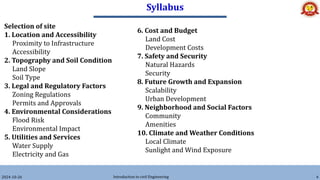
Selection of site
2024-10-26 Introduction to civil Engineering 3
Selection of site
Syllabus
6. Cost and Budget
Land Cost
Development Costs
7. Safety and Security
Natural Hazards
Security
8. Future Growth and Expansion
Scalability
Urban Development
9. Neighborhood and Social Factors
Community
Amenities
10. Climate and Weather Conditions
Local Climate
Sunlight and Wind Exposure
2024-10-26 Introduction to civil Engineering 4
Selection of site
1. Location and Accessibility
Proximity to Infrastructure
Accessibility
2. Topography and Soil Condition
Land Slope
Soil Type
3. Legal and Regulatory Factors
Zoning Regulations
Permits and Approvals
4. Environmental Considerations
Flood Risk
Environmental Impact
5. Utilities and Services
Water Supply
Electricity and Gas
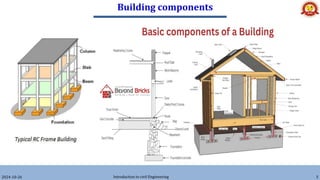
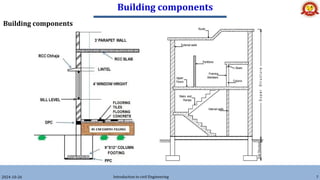
Building components
2024-10-26 Introduction to civil Engineering 5
Building components
2024-10-26 Introduction to civil Engineering 6
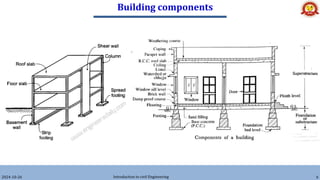
Building components
2024-10-26 Introduction to civil Engineering 7
Building components
Building components
2024-10-26 Introduction to civil Engineering 8
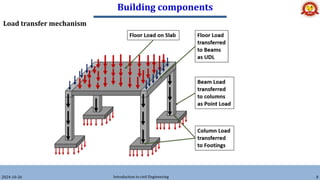
Load transfer mechanism
Building components
2024-10-26 Introduction to civil Engineering 9
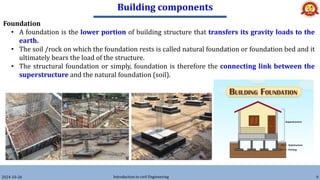
Foundation
• A foundation is the lower portion of building structure that transfers its gravity loads to the
earth.
• The soil /rock on which the foundation rests is called natural foundation or foundation bed and it
ultimately bears the load of the structure.
• The structural foundation or simply, foundation is therefore the connecting link between the
superstructure and the natural foundation (soil).
Building components
2024-10-26 Introduction to civil Engineering 10
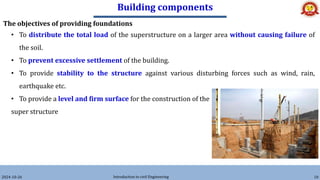
The objectives of providing foundations
• To distribute the total load of the superstructure on a larger area without causing failure of
the soil.
• To prevent excessive settlement of the building.
• To provide stability to the structure against various disturbing forces such as wind, rain,
earthquake etc.
• To provide a level and firm surface for the construction of the
super structure
Building components
2024-10-26 Introduction to civil Engineering 11
Types of foundation
• Shallow Foundation
• Deep Foundation
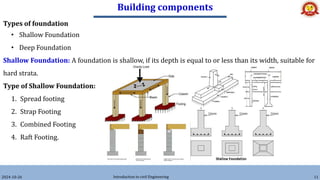
Shallow Foundation: A foundation is shallow, if its depth is equal to or less than its width, suitable for
hard strata.
Type of Shallow Foundation:
1. Spread footing
2. Strap Footing
3. Combined Footing
4. Raft Footing.
Building components
2024-10-26 Introduction to civil Engineering 12
1. Spread footing:
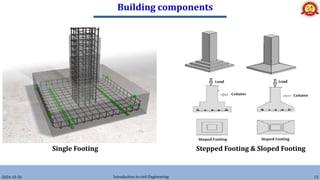
• Single Footing
• Stepped and sloped Footing
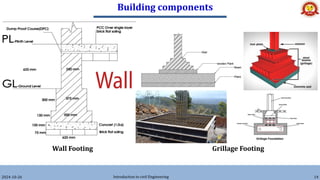
• Wall Footing
• Grillage Footing.
Single Footing: This type of foundation is suitable when there is a good strata at low depth and
depth of foundation is low and load is less.
Stepped Footing & Sloped Footing: This type of foundation is suitable when there is a good
stratum at low depth but foundation is some more deep as compared to single footing and load is
more.
Wall Footing: Wall footing is suitable for load bearing structure where depth is low and load is
also less.
Grillage Footing: When heavy structural loads from column piers are required to be transferred to a
soil of less bearing capacity.
This foundation is found lighter and more economical. It also avoids deep foundation.
Building components
2024-10-26 Introduction to civil Engineering 13
Single Footing Stepped Footing & Sloped Footing
Building components
2024-10-26 Introduction to civil Engineering 14
Wall Footing Grillage Footing
Building components
2024-10-26 Introduction to civil Engineering 15
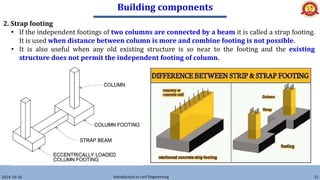
2. Strap footing
• If the independent footings of two columns are connected by a beam it is called a strap footing.
It is used when distance between column is more and combine footing is not possible.
• It is also useful when any old existing structure is so near to the footing and the existing
structure does not permit the independent footing of column.
Building components
2024-10-26 Introduction to civil Engineering 16
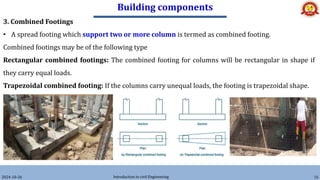
3. Combined Footings
• A spread footing which support two or more column is termed as combined footing.
Combined footings may be of the following type
Rectangular combined footings: The combined footing for columns will be rectangular in shape if
they carry equal loads.
Trapezoidal combined footing: If the columns carry unequal loads, the footing is trapezoidal shape.
Building components
2024-10-26 Introduction to civil Engineering 17
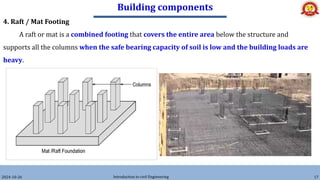
4. Raft / Mat Footing
A raft or mat is a combined footing that covers the entire area below the structure and
supports all the columns when the safe bearing capacity of soil is low and the building loads are
heavy.
Building components
2024-10-26 Introduction to civil Engineering 18
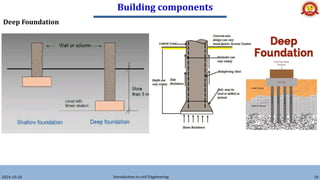
Deep Foundation
Building components
2024-10-26 Introduction to civil Engineering 19
Deep Foundation
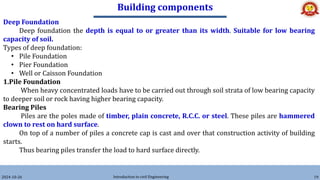
Deep foundation the depth is equal to or greater than its width. Suitable for low bearing
capacity of soil.
Types of deep foundation:
• Pile Foundation
• Pier Foundation
• Well or Caisson Foundation
1.Pile Foundation
When heavy concentrated loads have to be carried out through soil strata of low bearing capacity
to deeper soil or rock having higher bearing capacity.
Bearing Piles
Piles are the poles made of timber, plain concrete, R.C.C. or steel. These piles are hammered
clown to rest on hard surface.
On top of a number of piles a concrete cap is cast and over that construction activity of building
starts.
Thus bearing piles transfer the load to hard surface directly.
Building components
2024-10-26 Introduction to civil Engineering 20
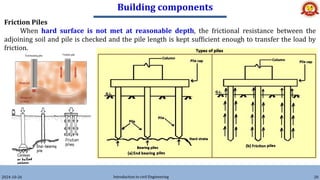
Friction Piles
When hard surface is not met at reasonable depth, the frictional resistance between the
adjoining soil and pile is checked and the pile length is kept sufficient enough to transfer the load by
friction.
Building components
2024-10-26 Introduction to civil Engineering 21
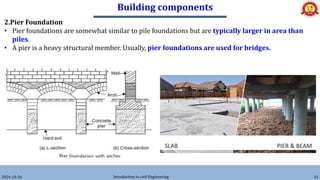
2.Pier Foundation
• Pier foundations are somewhat similar to pile foundations but are typically larger in area than
piles.
• A pier is a heavy structural member. Usually, pier foundations are used for bridges.
Building components
2024-10-26 Introduction to civil Engineering 22
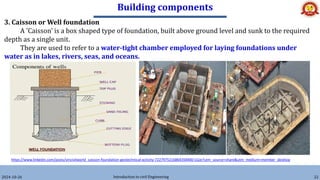
3. Caisson or Well foundation
A 'Caisson' is a box shaped type of foundation, built above ground level and sunk to the required
depth as a single unit.
They are used to refer to a water-tight chamber employed for laying foundations under
water as in lakes, rivers, seas, and oceans.
https://www.linkedin.com/posts/vincivilworld_caisson-foundation-geotechnical-activity-7227975216864358400-LGze?utm_source=share&utm_medium=member_desktop
2024-10-26
Introduction to civil
23
HAPPY LEARNING
Building components
2024-10-26 Introduction to civil Engineering 24
Building components
2024-10-26 Introduction to civil Engineering 25
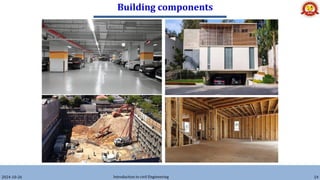
Basement
• A basement or cellar is one or more floors of a building that are completely or partly below
the ground floor.
• It is typically located beneath the ground floor and serves various purposes such as storage,
utility rooms, or even living spaces.
• The basement is constructed by excavating the ground and building walls and a floor slab
below the ground level.
• These walls are part of the building's foundation, helping to distribute the structure's weight
evenly and providing stability.
• Proper waterproofing and drainage are essential to prevent water infiltration and maintain the
basement's integrity.
Building components
2024-10-26 Introduction to civil Engineering 26
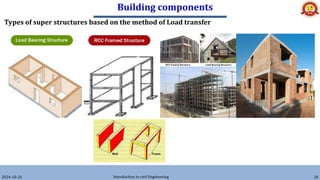
Types of super structures based on the method of Load transfer
Building components
2024-10-26 Introduction to civil Engineering 27
Building components
2024-10-26 Introduction to civil Engineering 28
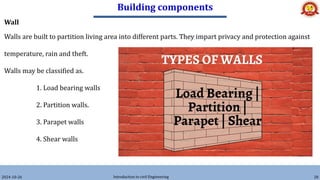
Wall
Walls are built to partition living area into different parts. They impart privacy and protection against
temperature, rain and theft.
Walls may be classified as.
1. Load bearing walls
2. Partition walls.
3. Parapet walls
4. Shear walls
Building components
2024-10-26 Introduction to civil Engineering 29
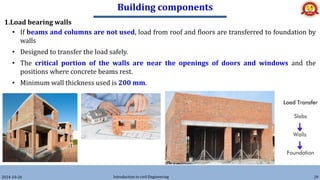
1.Load bearing walls
• If beams and columns are not used, load from roof and floors are transferred to foundation by
walls
• Designed to transfer the load safely.
• The critical portion of the walls are near the openings of doors and windows and the
positions where concrete beams rest.
• Minimum wall thickness used is 200 mm.
Building components
2024-10-26 Introduction to civil Engineering 30
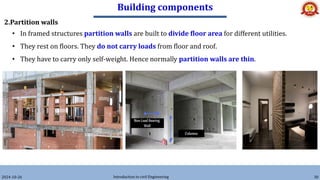
2.Partition walls
• In framed structures partition walls are built to divide floor area for different utilities.
• They rest on floors. They do not carry loads from floor and roof.
• They have to carry only self-weight. Hence normally partition walls are thin.
Building components
2024-10-26 Introduction to civil Engineering 31
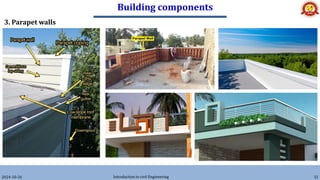
3. Parapet walls
Building components
2024-10-26 Introduction to civil Engineering 32
3. Parapet walls
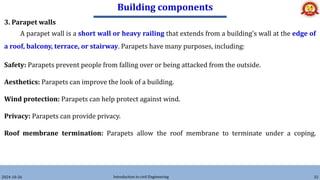
A parapet wall is a short wall or heavy railing that extends from a building's wall at the edge of
a roof, balcony, terrace, or stairway. Parapets have many purposes, including:
Safety: Parapets prevent people from falling over or being attacked from the outside.
Aesthetics: Parapets can improve the look of a building.
Wind protection: Parapets can help protect against wind.
Privacy: Parapets can provide privacy.
Roof membrane termination: Parapets allow the roof membrane to terminate under a coping.
Building components
2024-10-26 Introduction to civil Engineering 33
4.Shear walls
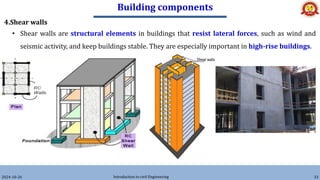
• Shear walls are structural elements in buildings that resist lateral forces, such as wind and
seismic activity, and keep buildings stable. They are especially important in high-rise buildings.
Building components
2024-10-26 Introduction to civil Engineering 34
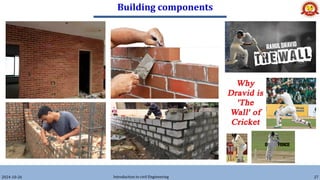
Stone masonry
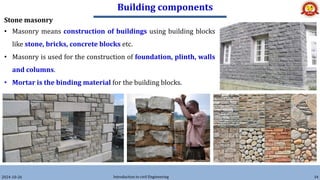
• Masonry means construction of buildings using building blocks
like stone, bricks, concrete blocks etc.
• Masonry is used for the construction of foundation, plinth, walls
and columns.
• Mortar is the binding material for the building blocks.
Building components
2024-10-26 Introduction to civil Engineering 35
Types of Stone Masonry
1. Rubble Masonry 2. Ashlar Masonry.
1. Rubble Masonry:
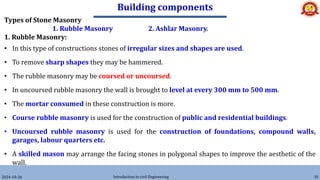
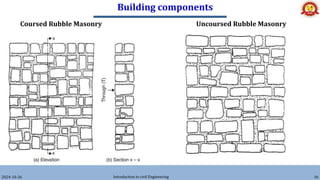
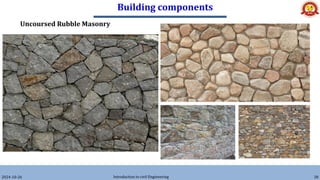
• In this type of constructions stones of irregular sizes and shapes are used.
• To remove sharp shapes they may be hammered.
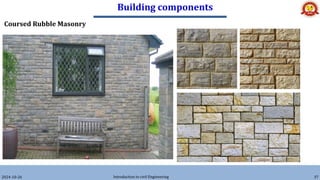
• The rubble masonry may be coursed or uncoursed.
• In uncoursed rubble masonry the wall is brought to level at every 300 mm to 500 mm.
• The mortar consumed in these construction is more.
• Course rubble masonry is used for the construction of public and residential buildings.
• Uncoursed rubble masonry is used for the construction of foundations, compound walls,
garages, labour quarters etc.
• A skilled mason may arrange the facing stones in polygonal shapes to improve the aesthetic of the
wall.
Building components
2024-10-26 Introduction to civil Engineering 36
Coursed Rubble Masonry Uncoursed Rubble Masonry
Building components
2024-10-26 Introduction to civil Engineering 37
Coursed Rubble Masonry
Building components
2024-10-26 Introduction to civil Engineering 38
Uncoursed Rubble Masonry
Building components
2024-10-26 Introduction to civil Engineering 39
2. Ashlar Masonry
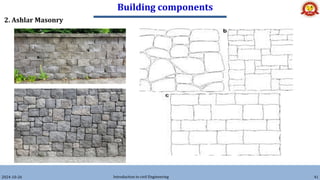
• In this type of masonry stones are dressed to get suitable shapes and sizes.
• The height of the stones varies from 250 mm to 300 mm.
• The length should not exceed three times the height.
• The dressing of the stone need not be very accurate on all sides.
• Usually good dressing is made on facing side.
• In such construction mortar consumption is less compared to rubble masonry.
• Depending upon the type of dressing – Ashlar fine dressed, Ashlar rough dressed, Ashlar rock
or quarry faced, Ashlar facing, Ashlar chamfered etc.
Building components
2024-10-26 Introduction to civil Engineering 40
2. Ashlar Masonry
Building components
2024-10-26 Introduction to civil Engineering 41
2. Ashlar Masonry
Building components
2024-10-26 Introduction to civil Engineering 42
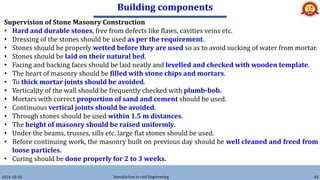
Supervision of Stone Masonry Construction
• Hard and durable stones, free from defects like flaws, cavities veins etc.
• Dressing of the stones should be used as per the requirement.
• Stones should be properly wetted before they are used so as to avoid sucking of water from mortar.
• Stones should be laid on their natural bed.
• Facing and backing faces should be laid neatly and levelled and checked with wooden template.
• The heart of masonry should be filled with stone chips and mortars.
• To thick mortar joints should be avoided.
• Verticality of the wall should be frequently checked with plumb-bob.
• Mortars with correct proportion of sand and cement should be used.
• Continuous vertical joints should be avoided.
• Through stones should be used within 1.5 m distances.
• The height of masonry should be raised uniformly.
• Under the beams, trusses, sills etc. large flat stones should be used.
• Before continuing work, the masonry built on previous day should be well cleaned and freed from
loose particles.
• Curing should be done properly for 2 to 3 weeks.
Building components
2024-10-26 Introduction to civil Engineering 43
Brick Masonry
Building components
2024-10-26 Introduction to civil Engineering 44
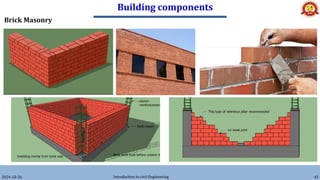
Brick Masonry
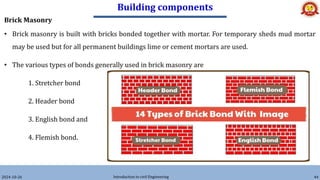
• Brick masonry is built with bricks bonded together with mortar. For temporary sheds mud mortar
may be used but for all permanent buildings lime or cement mortars are used.
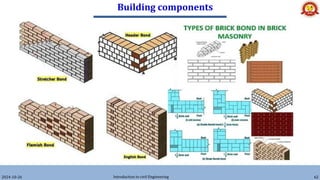
• The various types of bonds generally used in brick masonry are
1. Stretcher bond
2. Header bond
3. English bond and
4. Flemish bond.
Building components
2024-10-26 Introduction to civil Engineering 45
Brick Masonry
Building components
2024-10-26 Introduction to civil Engineering 46
Brick Masonry
Building components
2024-10-26 Introduction to civil Engineering 47
Brick Masonry
Building components
2024-10-26 Introduction to civil Engineering 48
Brick Masonry
Building components
2024-10-26 Introduction to civil Engineering 49
Brick Masonry
Building components
2024-10-26 Introduction to civil Engineering 50
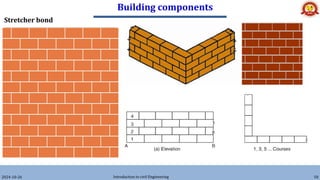
Stretcher bond
Building components
2024-10-26 Introduction to civil Engineering 51
Stretcher bond
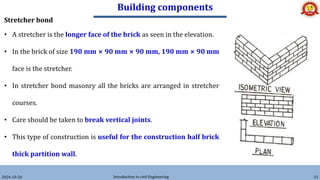
• A stretcher is the longer face of the brick as seen in the elevation.
• In the brick of size 190 mm × 90 mm × 90 mm, 190 mm × 90 mm
face is the stretcher.
• In stretcher bond masonry all the bricks are arranged in stretcher
courses.
• Care should be taken to break vertical joints.
• This type of construction is useful for the construction half brick
thick partition wall.
Building components
2024-10-26 Introduction to civil Engineering 52
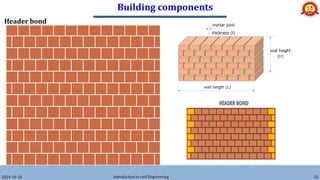
Header bond
Building components
2024-10-26 Introduction to civil Engineering 53
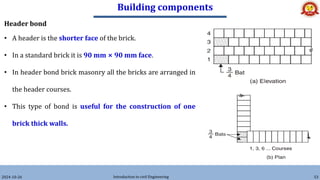
Header bond
• A header is the shorter face of the brick.
• In a standard brick it is 90 mm × 90 mm face.
• In header bond brick masonry all the bricks are arranged in
the header courses.
• This type of bond is useful for the construction of one
brick thick walls.
Building components
2024-10-26 Introduction to civil Engineering 54
English bond
Building components
2024-10-26 Introduction to civil Engineering 55
English bond
Building components
2024-10-26 Introduction to civil Engineering 56
English bond
Building components
2024-10-26 Introduction to civil Engineering 57
English bond
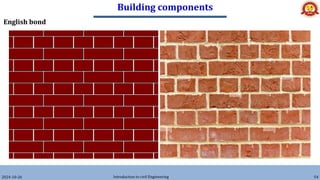
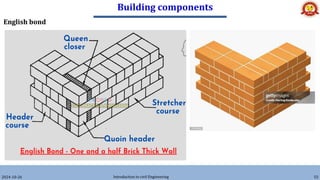
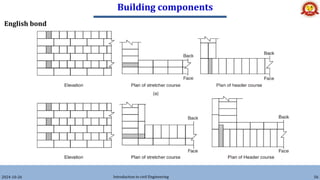
• In this alternate courses consist of headers and stretchers.
• This is considered to be the strongest bond.
• Hence it is commonly used bond for the walls of all thicknesses.
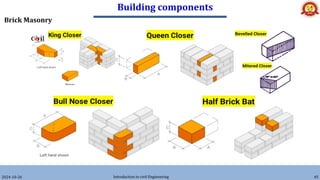
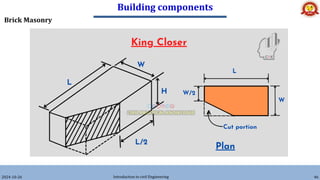
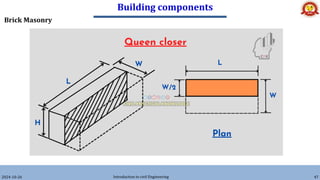
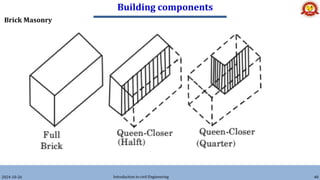
• To break continuity of vertical joints a brick is cut lengthwise into two halves and used in the
beginning and end of a wall after first header. This is called queen closer.
• Typical one brick and one and half brick thick wall with English bond.
Building components
2024-10-26 Introduction to civil Engineering 58
Flemish bond
Building components
2024-10-26 Introduction to civil Engineering 59
Flemish bond
Building components
2024-10-26 Introduction to civil Engineering 60
Flemish bond
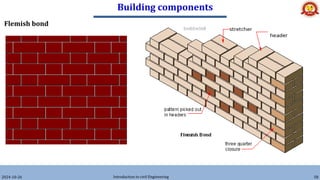
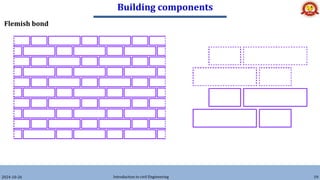
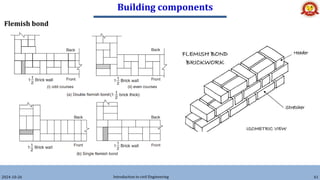
• In this type of bond each course comprises of alternate header and stretcher.
• Alternate courses start with stretcher and header.
• To break the vertical joints queen closers are required, if a course starts with header. Every
header is centrally supported on the stretcher below it.
Flemish bonds may be further classified as
• (a) Double Flemish Bond
• (b) Single Flemish Bond.
Building components
2024-10-26 Introduction to civil Engineering 61
Flemish bond
Building components
2024-10-26 Introduction to civil Engineering 62
Building components
2024-10-26 Introduction to civil Engineering 63
Points to be Observed in Supervising Brick Masonry Constructions
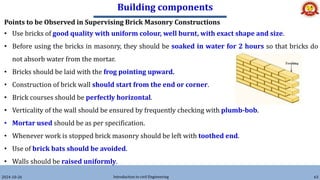
• Use bricks of good quality with uniform colour, well burnt, with exact shape and size.
• Before using the bricks in masonry, they should be soaked in water for 2 hours so that bricks do
not absorb water from the mortar.
• Bricks should be laid with the frog pointing upward.
• Construction of brick wall should start from the end or corner.
• Brick courses should be perfectly horizontal.
• Verticality of the wall should be ensured by frequently checking with plumb-bob.
• Mortar used should be as per specification.
• Whenever work is stopped brick masonry should be left with toothed end.
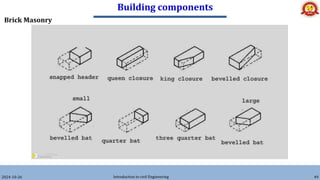
• Use of brick bats should be avoided.
• Walls should be raised uniformly.
Building components
2024-10-26 Introduction to civil Engineering 64
Points to be Observed in Supervising Brick Masonry Constructions
• In no case difference between adjoining walls be more than 1 m.
• In a day no wall should be raised by more than 1.5 m.
• To get proper key for plastering or pointing, the face joints should be raised to a depth of 12 to 20
mm, when the mortar is green.
• If plastering or pointing is not to be provided, face joints should be stuck flush and finished neatly.
• Holdfasts for doors and windows should be embedded in brick masonry with cement mortar or
concrete, at the time of constructing the wall itself.
• Brick masonry should be regularly cured for 2 weeks.
• For carrying out brick work at higher levels, only single scaffolding should be used
Building components
2024-10-26 Introduction to civil Engineering 65
Advantages of Brick Masonry Over Stone Masonry
• Since shape and size of bricks are uniform, it do not need skilled labour for the construction.
• Bricks are light in weight and hence handling them is easy.
• Bricks are easily available around cities and their transportation cost is less because their weight
is less.
• Stones are to be brought from quarries which are located only at few places.
• It is possible to use all types of mortar in brick masonry.
• For unimportant buildings even mud mortar can be used.
• Thinner walls can be constructed with bricks but it is not so with stones.
• It is easy to form openings for doors and windows.
• Dead load of brick masonry is less.
• In brick masonry mortar joints are thin and hence construction cost is reduced considerably.
• Brick masonry has better fire and weather resistance compared to stone masonry
Building components
2024-10-26 Introduction to civil Engineering 66
Disadvantages of Brick Masonry Over Stone Masonry
• Strength of brick masonry is less than that of stone masonry.
• Durability of brick masonry is less.
• Brick masonry needs plastering and plastered surface needs colour washing.
• Stone masonry don’t need them and hence maintenance cost is more in brick masonry.
• Brick masonry absorbs water and there are possibility of dampness. There is no such problem in
stone masonry.
• More architectural effects can be given in stone masonry compared to that in brick masonry.
• Stone masonry gives massive appearance and hence monumental buildings are built in stone
masonry
2024-10-26
Introduction to civil
67
HAPPY LEARNING
Building components
2024-10-26 Introduction to civil Engineering 68
Columns
Building components
2024-10-26 Introduction to civil Engineering 69
Columns
Building components
2024-10-26 Introduction to civil Engineering 70
Columns
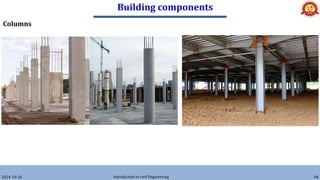
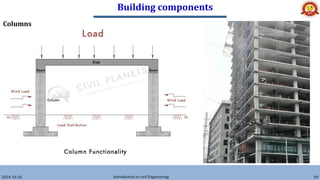
• Columns are structural elements that transfer the weight of the roof and other structures above
them to the elements below them. They are vertical compression elements that are used in
architecture and engineering.
Types
Based on Cross Section
• Circular Columns
• Square Columns
• Rectangular Columns
• "L" Shape Columns
• "T" Shape Columns, etc.,
Based on Construction Material
• Concrete Columns
• Steel Columns
• Timber Columns
• Composite Columns
• Stone Columns
• Brick Columns
Based on Loading
• Axially loaded column
• Biaxial loaded column
• Uniaxial loaded column
Building components
2024-10-26 Introduction to civil Engineering 71
Based on The Slenderness Ratio
• Short Columns
• Long Columns
Other
• Prestressed column
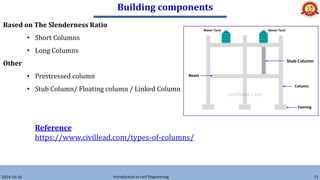
• Stub Column/ Floating column / Linked Column
Reference
https://www.civillead.com/types-of-columns/
Building components
2024-10-26 Introduction to civil Engineering 72
Circular column
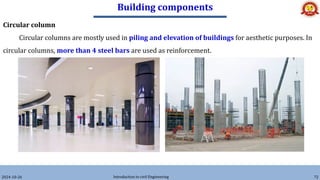
Circular columns are mostly used in piling and elevation of buildings for aesthetic purposes. In
circular columns, more than 4 steel bars are used as reinforcement.
Building components
2024-10-26 Introduction to civil Engineering 73
Square and rectangular columns
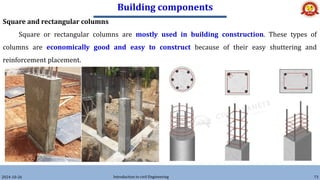
Square or rectangular columns are mostly used in building construction. These types of
columns are economically good and easy to construct because of their easy shuttering and
reinforcement placement.
Building components
2024-10-26 Introduction to civil Engineering 74
L and T Shaped Columns
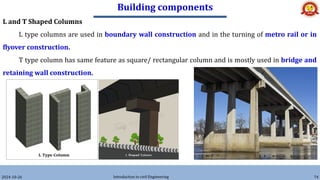
L type columns are used in boundary wall construction and in the turning of metro rail or in
flyover construction.
T type column has same feature as square/ rectangular column and is mostly used in bridge and
retaining wall construction.
Building components
2024-10-26 Introduction to civil Engineering 75
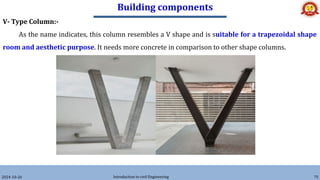
V- Type Column:-
As the name indicates, this column resembles a V shape and is suitable for a trapezoidal shape
room and aesthetic purpose. It needs more concrete in comparison to other shape columns.
Building components
2024-10-26 Introduction to civil Engineering 76
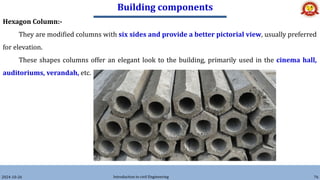
Hexagon Column:-
They are modified columns with six sides and provide a better pictorial view, usually preferred
for elevation.
These shapes columns offer an elegant look to the building, primarily used in the cinema hall,
auditoriums, verandah, etc.
Building components
2024-10-26 Introduction to civil Engineering 77
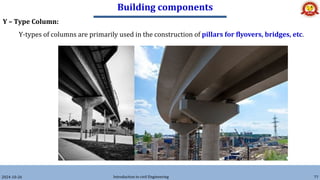
Y – Type Column:
Y-types of columns are primarily used in the construction of pillars for flyovers, bridges, etc.
Building components
2024-10-26 Introduction to civil Engineering 78
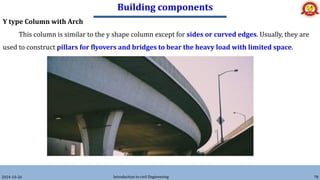
Y type Column with Arch
This column is similar to the y shape column except for sides or curved edges. Usually, they are
used to construct pillars for flyovers and bridges to bear the heavy load with limited space.
Building components
2024-10-26 Introduction to civil Engineering 79
Based On Reinforcement Type
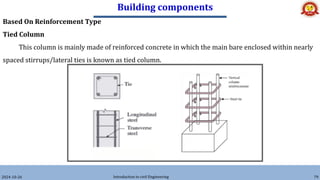
Tied Column
This column is mainly made of reinforced concrete in which the main bare enclosed within nearly
spaced stirrups/lateral ties is known as tied column.
Building components
2024-10-26 Introduction to civil Engineering 80
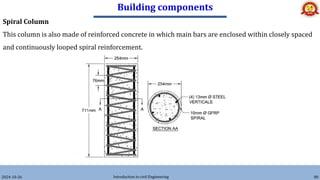
Spiral Column
This column is also made of reinforced concrete in which main bars are enclosed within closely spaced
and continuously looped spiral reinforcement.
Building components
2024-10-26 Introduction to civil Engineering 81
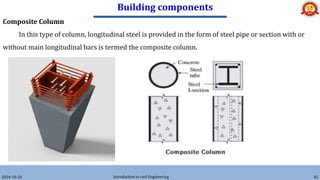
Composite Column
In this type of column, longitudinal steel is provided in the form of steel pipe or section with or
without main longitudinal bars is termed the composite column.
Building components
2024-10-26 Introduction to civil Engineering 82
Based On Loading Type
Building components
2024-10-26 Introduction to civil Engineering 83
Based on Loading Type
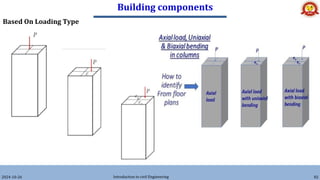
Axially loaded column
If the vertical compressive load acts on the column’s cross-section centre of gravity, it is called an
axially loaded column.
Uniaxial Eccentric loaded column
Suppose the vertical compressive load’s line of action doesn’t coincide with the column’s cross-section
centre of gravity and acts eccentrically either on the X-axis or y-axis. In that case, it is referred to as a
uniaxially eccentrically loaded column.
Biaxial Eccentric loaded column
Suppose the vertical compressive load’s line of action doesn’t coincide with the column’s cross-section
centre of gravity and doesn’t either on the X-axis or y-axis. In such a case, it is known as a biaxially
eccentrically loaded column.
Building components
2024-10-26 Introduction to civil Engineering 84
Based on Slenderness ratio
Building components
2024-10-26 Introduction to civil Engineering 85
Based on Slenderness ratio
Building components
2024-10-26 Introduction to civil Engineering 86
Based on Slenderness ratio
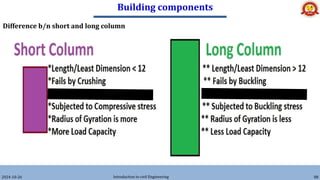
Short Column
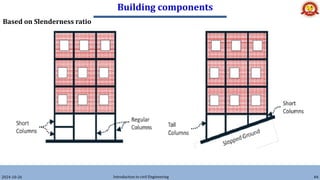
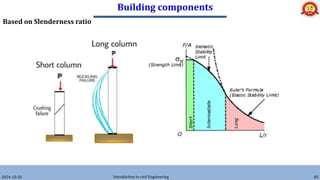
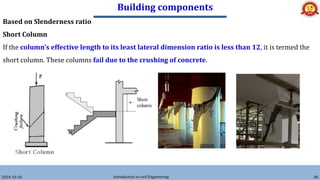
If the column’s effective length to its least lateral dimension ratio is less than 12, it is termed the
short column. These columns fail due to the crushing of concrete.
Building components
2024-10-26 Introduction to civil Engineering 87
Based on Slenderness ratio
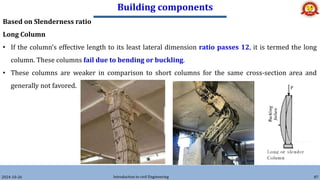
Long Column
• If the column’s effective length to its least lateral dimension ratio passes 12, it is termed the long
column. These columns fail due to bending or buckling.
• These columns are weaker in comparison to short columns for the same cross-section area and
generally not favored.
Building components
2024-10-26 Introduction to civil Engineering 88
Difference b/n short and long column
Building components
2024-10-26 Introduction to civil Engineering 89
Based On Material For Construction
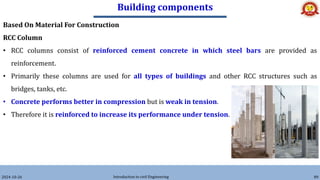
RCC Column
• RCC columns consist of reinforced cement concrete in which steel bars are provided as
reinforcement.
• Primarily these columns are used for all types of buildings and other RCC structures such as
bridges, tanks, etc.
• Concrete performs better in compression but is weak in tension.
• Therefore it is reinforced to increase its performance under tension.
Building components
2024-10-26 Introduction to civil Engineering 90
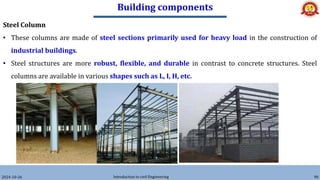
Steel Column
• These columns are made of steel sections primarily used for heavy load in the construction of
industrial buildings.
• Steel structures are more robust, flexible, and durable in contrast to concrete structures. Steel
columns are available in various shapes such as L, I, H, etc.
Building components
2024-10-26 Introduction to civil Engineering 91
Timber Column
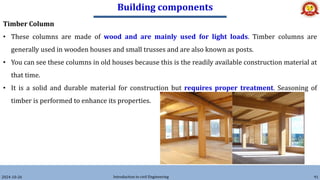
• These columns are made of wood and are mainly used for light loads. Timber columns are
generally used in wooden houses and small trusses and are also known as posts.
• You can see these columns in old houses because this is the readily available construction material at
that time.
• It is a solid and durable material for construction but requires proper treatment. Seasoning of
timber is performed to enhance its properties.
Building components
2024-10-26 Introduction to civil Engineering 92
Masonry Column
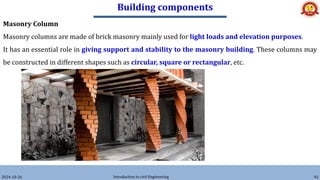
Masonry columns are made of brick masonry mainly used for light loads and elevation purposes.
It has an essential role in giving support and stability to the masonry building. These columns may
be constructed in different shapes such as circular, square or rectangular, etc.
Building components
2024-10-26 Introduction to civil Engineering 93
Stone Column
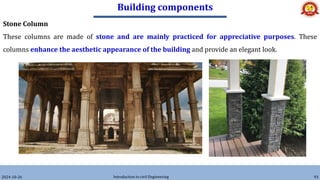
These columns are made of stone and are mainly practiced for appreciative purposes. These
columns enhance the aesthetic appearance of the building and provide an elegant look.
Building components
2024-10-26 Introduction to civil Engineering 94
Beam
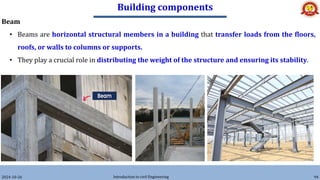
• Beams are horizontal structural members in a building that transfer loads from the floors,
roofs, or walls to columns or supports.
• They play a crucial role in distributing the weight of the structure and ensuring its stability.
Building components
2024-10-26 Introduction to civil Engineering 95
Functions of a Beam
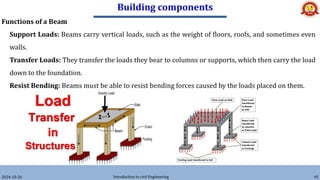
Support Loads: Beams carry vertical loads, such as the weight of floors, roofs, and sometimes even
walls.
Transfer Loads: They transfer the loads they bear to columns or supports, which then carry the load
down to the foundation.
Resist Bending: Beams must be able to resist bending forces caused by the loads placed on them.
Building components
2024-10-26 Introduction to civil Engineering 96
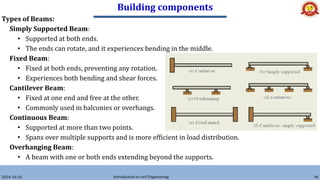
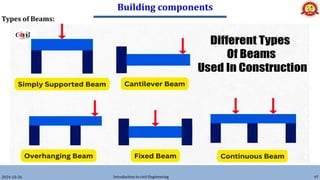
Types of Beams:
Simply Supported Beam:
• Supported at both ends.
• The ends can rotate, and it experiences bending in the middle.
Fixed Beam:
• Fixed at both ends, preventing any rotation.
• Experiences both bending and shear forces.
Cantilever Beam:
• Fixed at one end and free at the other.
• Commonly used in balconies or overhangs.
Continuous Beam:
• Supported at more than two points.
• Spans over multiple supports and is more efficient in load distribution.
Overhanging Beam:
• A beam with one or both ends extending beyond the supports.
Building components
2024-10-26 Introduction to civil Engineering 97
Types of Beams:
Building components
2024-10-26 Introduction to civil Engineering 98
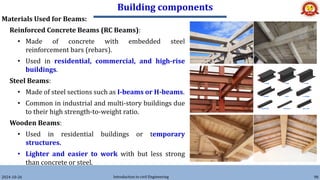
Materials Used for Beams:
Reinforced Concrete Beams (RC Beams):
• Made of concrete with embedded steel
reinforcement bars (rebars).
• Used in residential, commercial, and high-rise
buildings.
Steel Beams:
• Made of steel sections such as I-beams or H-beams.
• Common in industrial and multi-story buildings due
to their high strength-to-weight ratio.
Wooden Beams:
• Used in residential buildings or temporary
structures.
• Lighter and easier to work with but less strong
than concrete or steel.
2024-10-26
Introduction to civil
99
HAPPY LEARNING
Building components
2024-10-26 Introduction to civil Engineering 100
Flooring
Building components
2024-10-26 Introduction to civil Engineering 101
Flooring
Purpose of flooring is to get a good hard, level and beautiful surface for living. The floors
directly resting on the ground are known as ground floors while the floors of each storey are known as
upper floors.
Ground Floor
• Apart from giving good finished surface, these floors should have good damp resistance.
• The ground surface is rammed well and a layer of red earth or sand is placed which is
compacted.
• A layer of broken bricks, stones etc. is provided up to 150 mm below floor finish level and
rammed.
• While ramming the surface is kept moist to get good compaction.
• Then 1 : 4 : 8 concrete of 100 to 150 mm thickness is provided as base course. Over this bed
floor finish is laid.
Building components
2024-10-26 Introduction to civil Engineering 102
Types of flooring
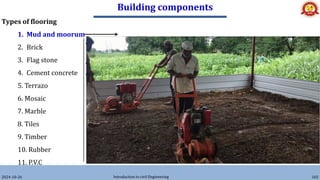
1. Mud and moorum
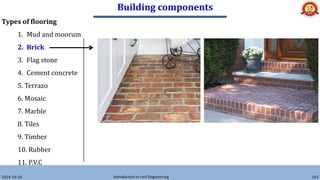
2. Brick
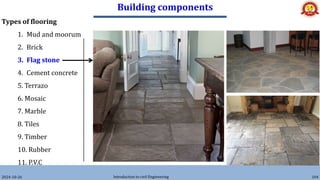
3. Flag stone
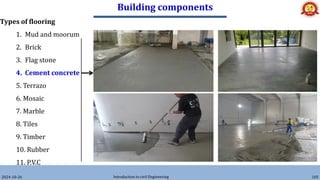
4. Cement concrete
5. Terrazo
6. Mosaic
7. Marble
8. Tiles
9. Timber
10. Rubber
11. P.V.C
• These floorings are used in low cost housing, specially in
villages.
• Over the hard layer of earth filling mud or moorum layer is provided.
• The floor needs a thin wash of cow dung at least once a weak.
Building components
2024-10-26 Introduction to civil Engineering 103
Types of flooring
1. Mud and moorum
2. Brick
3. Flag stone
4. Cement concrete
5. Terrazo
6. Mosaic
7. Marble
8. Tiles
9. Timber
10. Rubber
11. P.V.C
Building components
2024-10-26 Introduction to civil Engineering 104
Types of flooring
1. Mud and moorum
2. Brick
3. Flag stone
4. Cement concrete
5. Terrazo
6. Mosaic
7. Marble
8. Tiles
9. Timber
10. Rubber
11. P.V.C
Building components
2024-10-26 Introduction to civil Engineering 105
Types of flooring
1. Mud and moorum
2. Brick
3. Flag stone
4. Cement concrete
5. Terrazo
6. Mosaic
7. Marble
8. Tiles
9. Timber
10. Rubber
11. P.V.C
Building components
2024-10-26 Introduction to civil Engineering 106
Types of flooring
1. Mud and moorum
2. Brick
3. Flag stone
4. Cement concrete
5. Terrazo
6. Mosaic
7. Marble
8. Tiles
9. Timber
10. Rubber
11. P.V.C
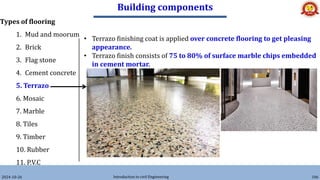
• Terrazo finishing coat is applied over concrete flooring to get pleasing
appearance.
• Terrazo finish consists of 75 to 80% of surface marble chips embedded
in cement mortar.
Building components
2024-10-26 Introduction to civil Engineering 107
Types of flooring
1. Mud and moorum
2. Brick
3. Flag stone
4. Cement concrete
5. Terrazo
6. Mosaic
7. Marble
8. Tiles
9. Timber
10. Rubber
11. P.V.C
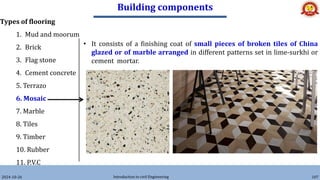
• It consists of a finishing coat of small pieces of broken tiles of China
glazed or of marble arranged in different patterns set in lime-surkhi or
cement mortar.
Building components
2024-10-26 Introduction to civil Engineering 108
Types of flooring
1. Mud and moorum
2. Brick
3. Flag stone
4. Cement concrete
5. Terrazo
6. Mosaic
7. Marble
8. Tiles
9. Timber
10. Rubber
11. P.V.C
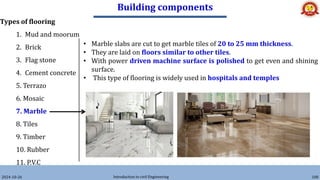
• Marble slabs are cut to get marble tiles of 20 to 25 mm thickness.
• They are laid on floors similar to other tiles.
• With power driven machine surface is polished to get even and shining
surface.
• This type of flooring is widely used in hospitals and temples
Building components
2024-10-26 Introduction to civil Engineering 109
Types of flooring
1. Mud and moorum
2. Brick
3. Flag stone
4. Cement concrete
5. Terrazo
6. Mosaic
7. Marble
8. Tiles
9. Timber
10. Rubber
11. P.V.C
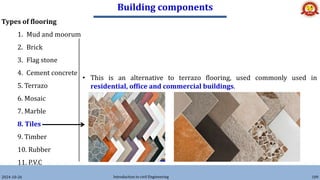
• This is an alternative to terrazo flooring, used commonly used in
residential, office and commercial buildings.
Building components
2024-10-26 Introduction to civil Engineering 110
Types of flooring
1. Mud and moorum
2. Brick
3. Flag stone
4. Cement concrete
5. Terrazo
6. Mosaic
7. Marble
8. Tiles
9. Timber
10. Rubber
11. P.V.C
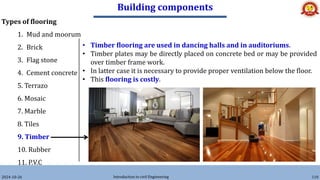
• Timber flooring are used in dancing halls and in auditoriums.
• Timber plates may be directly placed on concrete bed or may be provided
over timber frame work.
• In latter case it is necessary to provide proper ventilation below the floor.
• This flooring is costly.
Building components
2024-10-26 Introduction to civil Engineering 111
Types of flooring
1. Mud and moorum
2. Brick
3. Flag stone
4. Cement concrete
5. Terrazo
6. Mosaic
7. Marble
8. Tiles
9. Timber
10. Rubber
11. P.V.C
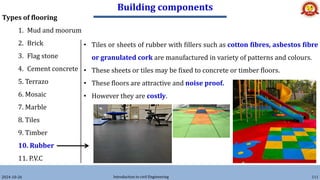
• Tiles or sheets of rubber with fillers such as cotton fibres, asbestos fibre
or granulated cork are manufactured in variety of patterns and colours.
• These sheets or tiles may be fixed to concrete or timber floors.
• These floors are attractive and noise proof.
• However they are costly.
Building components
2024-10-26 Introduction to civil Engineering 112
Types of flooring
1. Mud and moorum
2. Brick
3. Flag stone
4. Cement concrete
5. Terrazo
6. Mosaic
7. Marble
8. Tiles
9. Timber
10. Rubber
11. P.V.C
Building components
2024-10-26 Introduction to civil Engineering 113
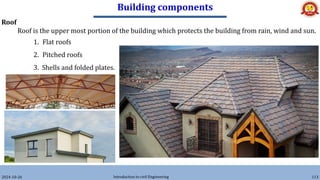
Roof
Roof is the upper most portion of the building which protects the building from rain, wind and sun.
1. Flat roofs
2. Pitched roofs
3. Shells and folded plates.
Building components
2024-10-26 Introduction to civil Engineering 114
Roof
• Flat roofs are used in plains where rainfall is less and climate is moderate.
• Pitched roofs are preferred wherever rainfall is more.
• Shells and folded plate roofs are used to cover large column free areas required for
auditoriums, factories etc.
1. Flat Roofs
• These roofs are nearly flat. However slight slope (not more than 10°) is given to drain out the
rain water.
• All types of upper storey floors can serve as flat roofs.
• Many times top of these roofs are treated with water proofing materials-like mixing water
proofing chemicals in concrete, providing coba concrete.
• With advent of reliable water proofing techniques such roofs are constructed even in areas with
heavy rain fall.
Building components
2024-10-26 Introduction to civil Engineering 115
Advantages of flat roof
• The roof can be used as a terrace for playing and celebrating functions.
• At any latter stage the roof can be converted as a floor by adding another storey.
• They can suit to any shape of the building.
• Over-head water tanks and other services can be located easily.
• They can be made fire proof easily compared to pitched roof.
Disadvantages of flat roof
• They cannot cover large column free areas.
• Leakage problem may occur at latter date also due to development of cracks.
• Once leakage problem starts, it needs costly treatments.
• The dead weight of flat roofs is more.
• In places of snow fall flat roofs are to be avoided to reduce snow load.
• The initial cost of construction is more.
• Speed of construction of flat roofs is less.
Building components
2024-10-26 Introduction to civil Engineering 116
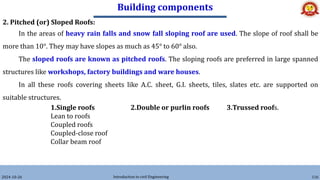
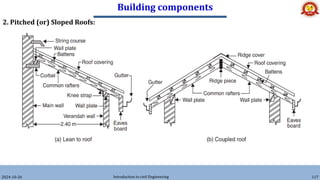
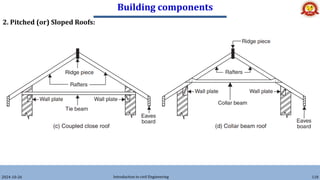
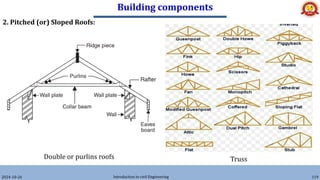
2. Pitched (or) Sloped Roofs:
In the areas of heavy rain falls and snow fall sloping roof are used. The slope of roof shall be
more than 10°. They may have slopes as much as 45° to 60° also.
The sloped roofs are known as pitched roofs. The sloping roofs are preferred in large spanned
structures like workshops, factory buildings and ware houses.
In all these roofs covering sheets like A.C. sheet, G.I. sheets, tiles, slates etc. are supported on
suitable structures.
1.Single roofs 2.Double or purlin roofs 3.Trussed roofs.
Lean to roofs
Coupled roofs
Coupled-close roof
Collar beam roof
Building components
2024-10-26 Introduction to civil Engineering 117
2. Pitched (or) Sloped Roofs:
Building components
2024-10-26 Introduction to civil Engineering 118
2. Pitched (or) Sloped Roofs:
Building components
2024-10-26 Introduction to civil Engineering 119
2. Pitched (or) Sloped Roofs:
Double or purlins roofs Truss
Building components
2024-10-26 Introduction to civil Engineering 120
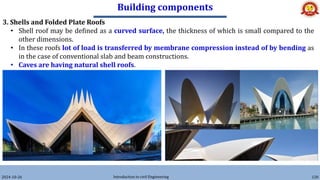
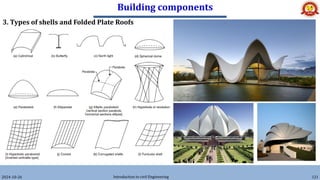
3. Shells and Folded Plate Roofs
• Shell roof may be defined as a curved surface, the thickness of which is small compared to the
other dimensions.
• In these roofs lot of load is transferred by membrane compression instead of by bending as
in the case of conventional slab and beam constructions.
• Caves are having natural shell roofs.
Building components
2024-10-26 Introduction to civil Engineering 121
3. Types of shells and Folded Plate Roofs
Building components
2024-10-26 Introduction to civil Engineering 122
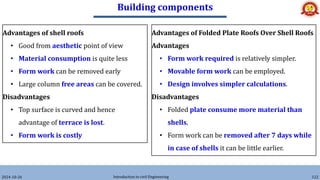
Advantages of shell roofs
• Good from aesthetic point of view
• Material consumption is quite less
• Form work can be removed early
• Large column free areas can be covered.
Disadvantages
• Top surface is curved and hence
advantage of terrace is lost.
• Form work is costly
Advantages of Folded Plate Roofs Over Shell Roofs
Advantages
• Form work required is relatively simpler.
• Movable form work can be employed.
• Design involves simpler calculations.
Disadvantages
• Folded plate consume more material than
shells.
• Form work can be removed after 7 days while
in case of shells it can be little earlier.
2024-10-26
Introduction to civil
123
HAPPY LEARNING
Building components
2024-10-26 Introduction to civil Engineering 124
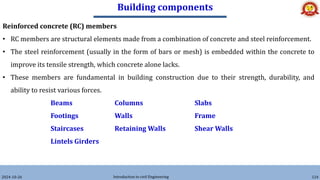
Reinforced concrete (RC) members
• RC members are structural elements made from a combination of concrete and steel reinforcement.
• The steel reinforcement (usually in the form of bars or mesh) is embedded within the concrete to
improve its tensile strength, which concrete alone lacks.
• These members are fundamental in building construction due to their strength, durability, and
ability to resist various forces.
Beams Columns Slabs
Footings Walls Frame
Staircases Retaining Walls Shear Walls
Lintels Girders
Building components
2024-10-26 Introduction to civil Engineering 125
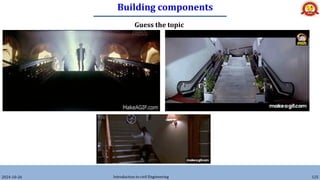
Guess the topic
Building components
2024-10-26 Introduction to civil Engineering 126
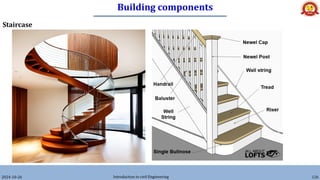
Staircase
Building components
2024-10-26 Introduction to civil Engineering 127
Staircase
Building components
2024-10-26 Introduction to civil Engineering 128
Staircase
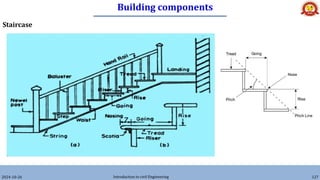
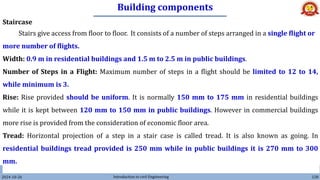
Stairs give access from floor to floor. It consists of a number of steps arranged in a single flight or
more number of flights.
Width: 0.9 m in residential buildings and 1.5 m to 2.5 m in public buildings.
Number of Steps in a Flight: Maximum number of steps in a flight should be limited to 12 to 14,
while minimum is 3.
Rise: Rise provided should be uniform. It is normally 150 mm to 175 mm in residential buildings
while it is kept between 120 mm to 150 mm in public buildings. However in commercial buildings
more rise is provided from the consideration of economic floor area.
Tread: Horizontal projection of a step in a stair case is called tread. It is also known as going. In
residential buildings tread provided is 250 mm while in public buildings it is 270 mm to 300
mm.
Building components
2024-10-26 Introduction to civil Engineering 129
Types of Stairs
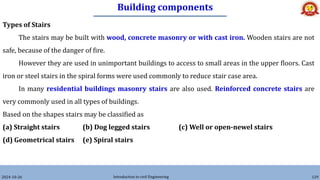
The stairs may be built with wood, concrete masonry or with cast iron. Wooden stairs are not
safe, because of the danger of fire.
However they are used in unimportant buildings to access to small areas in the upper floors. Cast
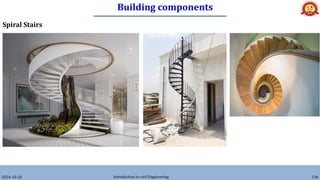
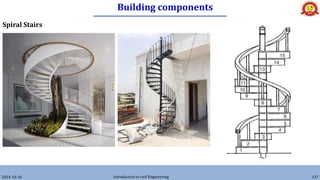
iron or steel stairs in the spiral forms were used commonly to reduce stair case area.
In many residential buildings masonry stairs are also used. Reinforced concrete stairs are
very commonly used in all types of buildings.
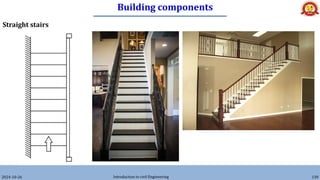
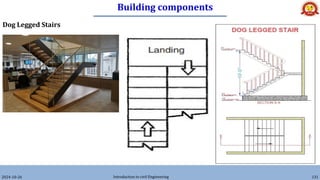
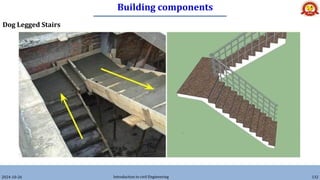
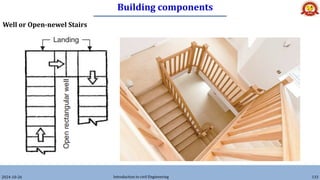
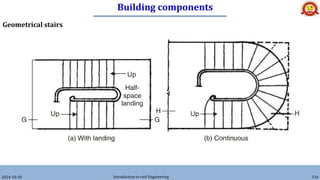
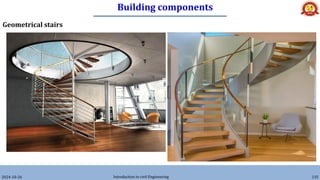
Based on the shapes stairs may be classified as
(a) Straight stairs (b) Dog legged stairs (c) Well or open-newel stairs
(d) Geometrical stairs (e) Spiral stairs
Building components
2024-10-26 Introduction to civil Engineering 130
Straight stairs
Building components
2024-10-26 Introduction to civil Engineering 131
Dog Legged Stairs
Building components
2024-10-26 Introduction to civil Engineering 132
Dog Legged Stairs
Building components
2024-10-26 Introduction to civil Engineering 133
Well or Open-newel Stairs
Building components
2024-10-26 Introduction to civil Engineering 134
Geometrical stairs
Building components
2024-10-26 Introduction to civil Engineering 135
Geometrical stairs
Building components
2024-10-26 Introduction to civil Engineering 136
Spiral Stairs
Building components
2024-10-26 Introduction to civil Engineering 137
Spiral Stairs
Building components
2024-10-26 Introduction to civil Engineering 138
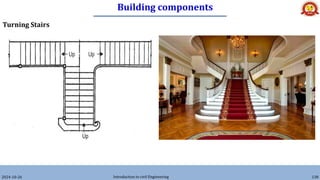
Turning Stairs
Building components
2024-10-26 Introduction to civil Engineering 139
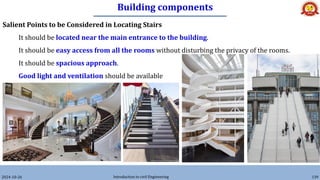
Salient Points to be Considered in Locating Stairs
It should be located near the main entrance to the building.
It should be easy access from all the rooms without disturbing the privacy of the rooms.
It should be spacious approach.
Good light and ventilation should be available
Building components
2024-10-26 Introduction to civil Engineering 140
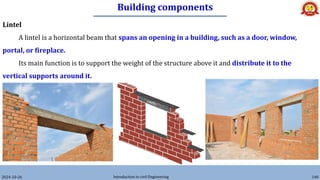
Lintel
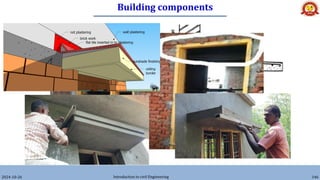
A lintel is a horizontal beam that spans an opening in a building, such as a door, window,
portal, or fireplace.
Its main function is to support the weight of the structure above it and distribute it to the
vertical supports around it.
Building components
2024-10-26 Introduction to civil Engineering 141
Lintel
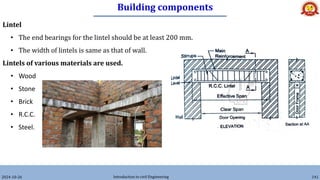
• The end bearings for the lintel should be at least 200 mm.
• The width of lintels is same as that of wall.
Lintels of various materials are used.
• Wood
• Stone
• Brick
• R.C.C.
• Steel.
Building components
2024-10-26 Introduction to civil Engineering 142
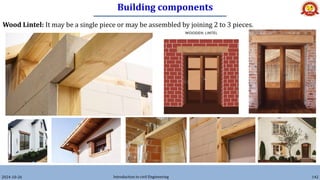
Wood Lintel: It may be a single piece or may be assembled by joining 2 to 3 pieces.
Building components
2024-10-26 Introduction to civil Engineering 143
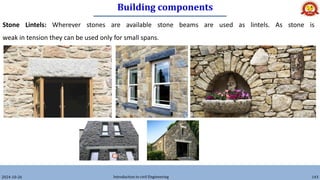
Stone Lintels: Wherever stones are available stone beams are used as lintels. As stone is
weak in tension they can be used only for small spans.
Building components
2024-10-26 Introduction to civil Engineering 144
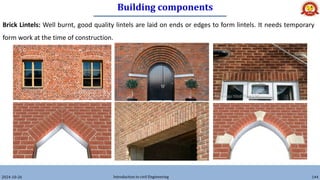
Brick Lintels: Well burnt, good quality lintels are laid on ends or edges to form lintels. It needs temporary
form work at the time of construction.
Building components
2024-10-26 Introduction to civil Engineering 145
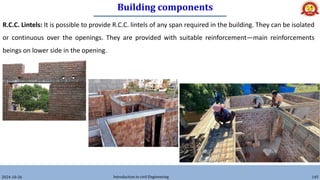
R.C.C. Lintels: It is possible to provide R.C.C. lintels of any span required in the building. They can be isolated
or continuous over the openings. They are provided with suitable reinforcement—main reinforcements
beings on lower side in the opening.
Building components
2024-10-26 Introduction to civil Engineering 146
Building components
2024-10-26 Introduction to civil Engineering 147
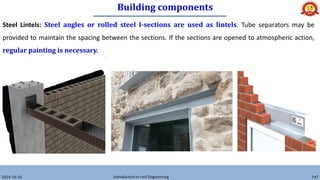
Steel Lintels: Steel angles or rolled steel I-sections are used as lintels. Tube separators may be
provided to maintain the spacing between the sections. If the sections are opened to atmospheric action,
regular painting is necessary.
Building components
2024-10-26 Introduction to civil Engineering 148
Slab
Building components
2024-10-26 Introduction to civil Engineering 149
Slab
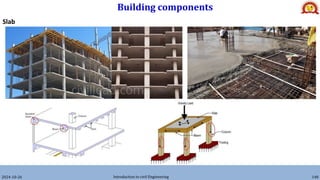
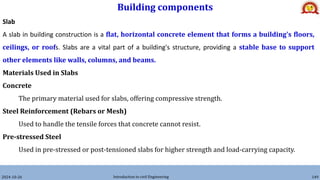
A slab in building construction is a flat, horizontal concrete element that forms a building's floors,
ceilings, or roofs. Slabs are a vital part of a building's structure, providing a stable base to support
other elements like walls, columns, and beams.
Materials Used in Slabs
Concrete
The primary material used for slabs, offering compressive strength.
Steel Reinforcement (Rebars or Mesh)
Used to handle the tensile forces that concrete cannot resist.
Pre-stressed Steel
Used in pre-stressed or post-tensioned slabs for higher strength and load-carrying capacity.
Building components
2024-10-26 Introduction to civil Engineering 150
Key Functions of Slabs
Load Distribution:
Slabs distribute the load over a large area to the beams and columns, ensuring the structure's
stability.
Support for Floors and Roofs:
They form the base for the floors in buildings and are often used to support roof structures.
Separation Between Levels:
Slabs act as a floor for one level and a ceiling for the level below in multi-story buildings.
Thermal and Acoustic Insulation:
Concrete slabs can provide good thermal mass and sound insulation.
Building components
2024-10-26 Introduction to civil Engineering 151
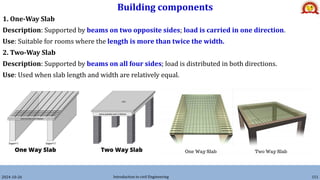
1. One-Way Slab
Description: Supported by beams on two opposite sides; load is carried in one direction.
Use: Suitable for rooms where the length is more than twice the width.
2. Two-Way Slab
Description: Supported by beams on all four sides; load is distributed in both directions.
Use: Used when slab length and width are relatively equal.
Building components
2024-10-26 Introduction to civil Engineering 152
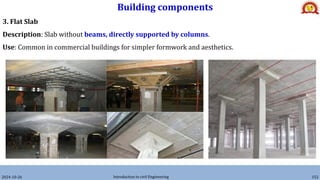
3. Flat Slab
Description: Slab without beams, directly supported by columns.
Use: Common in commercial buildings for simpler formwork and aesthetics.
Building components
2024-10-26 Introduction to civil Engineering 153
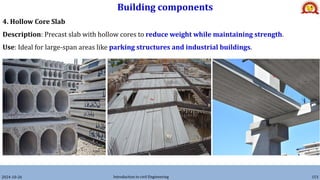
4. Hollow Core Slab
Description: Precast slab with hollow cores to reduce weight while maintaining strength.
Use: Ideal for large-span areas like parking structures and industrial buildings.
Building components
2024-10-26 Introduction to civil Engineering 154
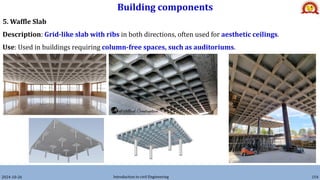
5. Waffle Slab
Description: Grid-like slab with ribs in both directions, often used for aesthetic ceilings.
Use: Used in buildings requiring column-free spaces, such as auditoriums.
Building components
2024-10-26 Introduction to civil Engineering 155
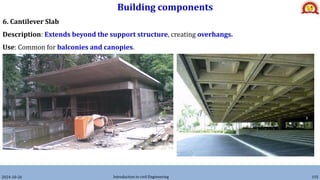
6. Cantilever Slab
Description: Extends beyond the support structure, creating overhangs.
Use: Common for balconies and canopies.
Building components
2024-10-26 Introduction to civil Engineering 156
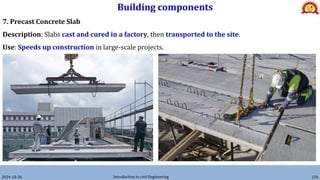
7. Precast Concrete Slab
Description: Slabs cast and cured in a factory, then transported to the site.
Use: Speeds up construction in large-scale projects.
2024-10-26
Introduction to civil
157
HAPPY LEARNING
Building components
2024-10-26 Introduction to civil Engineering 158
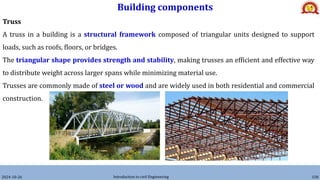
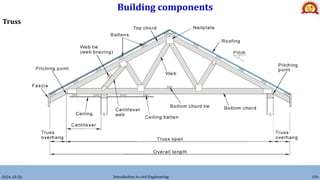
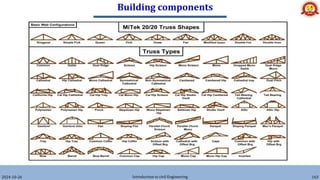
Truss
A truss in a building is a structural framework composed of triangular units designed to support
loads, such as roofs, floors, or bridges.
The triangular shape provides strength and stability, making trusses an efficient and effective way
to distribute weight across larger spans while minimizing material use.
Trusses are commonly made of steel or wood and are widely used in both residential and commercial
construction.
Building components
2024-10-26 Introduction to civil Engineering 159
Truss
Building components
2024-10-26 Introduction to civil Engineering 160
Advantages of Using Trusses
Efficient Material Use:
Trusses allow for greater spans using less material compared to solid beams.
Cost-Effective:
By minimizing the amount of material needed, trusses reduce construction costs.
Lightweight:
Despite their strength, trusses are lightweight, making them easier to install.
Versatility:
Trusses can be customized to suit a variety of architectural designs and load conditions.
Load-Bearing Capacity:
Trusses distribute loads evenly, making them ideal for supporting large roofs and floors.
Building components
2024-10-26 Introduction to civil Engineering 161
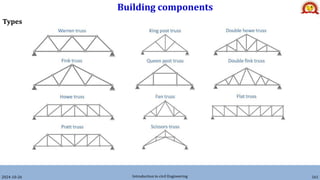
Types
Building components
2024-10-26 Introduction to civil Engineering 162
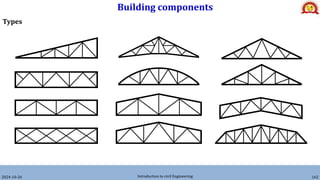
Types
Building components
2024-10-26 Introduction to civil Engineering 163
Building components
2024-10-26 Introduction to civil Engineering 164
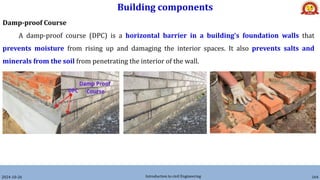
Damp-proof Course
A damp-proof course (DPC) is a horizontal barrier in a building's foundation walls that
prevents moisture from rising up and damaging the interior spaces. It also prevents salts and
minerals from the soil from penetrating the interior of the wall.
Building components
2024-10-26 Introduction to civil Engineering 165
Materials Used for Damp Proofing:
Bituminous Felt:
A common material used for horizontal DPC in walls. It is flexible and waterproof.
Polyethylene Sheets:
Often used as a membrane under floors or between wall layers.
Metal Sheets (Lead, Copper, Aluminum):
Durable and effective for preventing moisture ingress, particularly in harsh environments.
Asphalt:
Used in floors and roofs for a continuous waterproof barrier.
Liquid Waterproofing Compounds:
Applied as a coating on walls or floors to create a damp-proof layer.
Building components
2024-10-26 Introduction to civil Engineering 166
Applications of Damp Proof Units
Floors
DPC is often placed beneath concrete floors to prevent moisture from the ground from rising into
the building. It is typically placed below the concrete slab.
Walls
A damp-proof course is installed in walls just above the ground level to prevent rising damp. In
cavity walls, a DPC can also be placed between the inner and outer layers.
Foundations
DPC can be used to waterproof foundations, ensuring moisture doesn’t seep into the structure
through the base.
Roofs
In some cases, DPC is used in roofing systems to prevent moisture penetration from the top of
the building.
Building components
2024-10-26 Introduction to civil Engineering 167
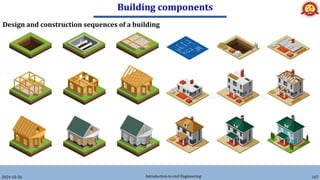
Design and construction sequences of a building
Building components
2024-10-26 Introduction to civil Engineering 168
Design and construction sequences of a building
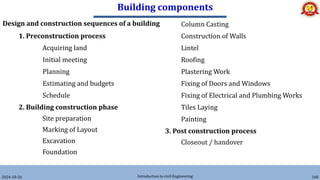
1. Preconstruction process
Acquiring land
Initial meeting
Planning
Estimating and budgets
Schedule
2. Building construction phase
Site preparation
Marking of Layout
Excavation
Foundation
Column Casting
Construction of Walls
Lintel
Roofing
Plastering Work
Fixing of Doors and Windows
Fixing of Electrical and Plumbing Works
Tiles Laying
Painting
3. Post construction process
Closeout / handover
Building components
2024-10-26 Introduction to civil Engineering 169
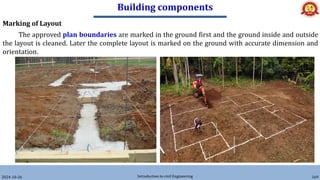
Marking of Layout
The approved plan boundaries are marked in the ground first and the ground inside and outside
the layout is cleaned. Later the complete layout is marked on the ground with accurate dimension and
orientation.
Building components
2024-10-26 Introduction to civil Engineering 170
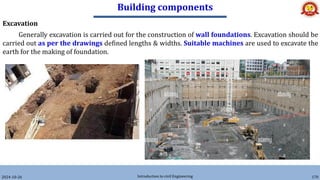
Excavation
Generally excavation is carried out for the construction of wall foundations. Excavation should be
carried out as per the drawings defined lengths & widths. Suitable machines are used to excavate the
earth for the making of foundation.
Building components
2024-10-26 Introduction to civil Engineering 171
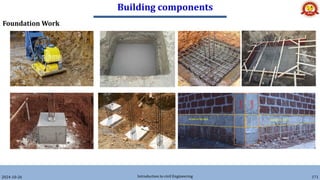
Foundation Work
Building components
2024-10-26 Introduction to civil Engineering 172
Foundation Work
1. Compacting the ground
The excavation pits are trimmed and dressed as per the requirement and the bottom is compacted using
hand compactors.
2. PCC
To form a solid bases on which the reinforcement can be tied and footing can be placed. Plain cement
concrete of the mix 1:4:8 or 1:3:6 is laid on the compacted soil in varying depth as required.
3. Footing Reinforcement
Reinforcement steel bars are tied together and placed on the PCC to form a skeleton in which the
concrete is poured and the column rods are taken from them.
Building components
2024-10-26 Introduction to civil Engineering 173
Foundation Work
4. Shuttering
To achieve proper shaped concrete, shuttering is done as per the dimensions mentioned in the drawing.
It is also done so that the concrete doesn't come in contact with the soil .
5. Footing Concrete
It is very necessary to check the levels of foundation before concrete work. There are patches where
excavated depth slightly exceeds and vice versa.
Concrete is poured as per drawing specs Depth of foundation varies from 9” to 18” and normally for
most of the cases it is considered as 12’’ depth.
Building components
2024-10-26 Introduction to civil Engineering 174
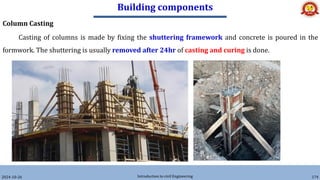
Column Casting
Casting of columns is made by fixing the shuttering framework and concrete is poured in the
formwork. The shuttering is usually removed after 24hr of casting and curing is done.
Building components
2024-10-26 Introduction to civil Engineering 175
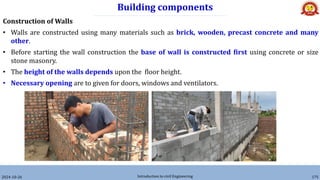
Construction of Walls
• Walls are constructed using many materials such as brick, wooden, precast concrete and many
other.
• Before starting the wall construction the base of wall is constructed first using concrete or size
stone masonry.
• The height of the walls depends upon the floor height.
• Necessary opening are to given for doors, windows and ventilators.
Building components
2024-10-26 Introduction to civil Engineering 176
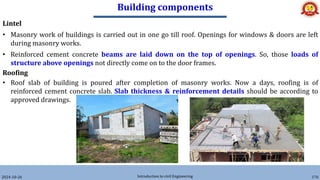
Lintel
• Masonry work of buildings is carried out in one go till roof. Openings for windows & doors are left
during masonry works.
• Reinforced cement concrete beams are laid down on the top of openings. So, those loads of
structure above openings not directly come on to the door frames.
Roofing
• Roof slab of building is poured after completion of masonry works. Now a days, roofing is of
reinforced cement concrete slab. Slab thickness & reinforcement details should be according to
approved drawings.
Building components
2024-10-26 Introduction to civil Engineering 177
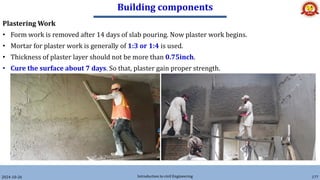
Plastering Work
• Form work is removed after 14 days of slab pouring. Now plaster work begins.
• Mortar for plaster work is generally of 1:3 or 1:4 is used.
• Thickness of plaster layer should not be more than 0.75inch.
• Cure the surface about 7 days. So that, plaster gain proper strength.
Building components
2024-10-26 Introduction to civil Engineering 178
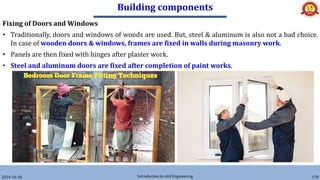
Fixing of Doors and Windows
• Traditionally, doors and windows of woods are used. But, steel & aluminum is also not a bad choice.
In case of wooden doors & windows, frames are fixed in walls during masonry work.
• Panels are then fixed with hinges after plaster work.
• Steel and aluminum doors are fixed after completion of paint works.
Building components
2024-10-26 Introduction to civil Engineering 179
Fixing of Electrical and Plumbing Works
• The necessary electrical and plumbing works are carried out before the final finishing works
such as painting and tiles laying is done so as to reduce the damage.
Building components
2024-10-26 Introduction to civil Engineering 180
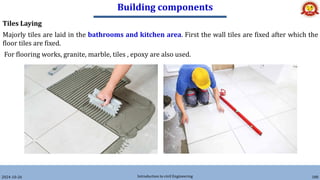
Tiles Laying
Majorly tiles are laid in the bathrooms and kitchen area. First the wall tiles are fixed after which the
floor tiles are fixed.
For flooring works, granite, marble, tiles , epoxy are also used.
Building components
2024-10-26 Introduction to civil Engineering 181
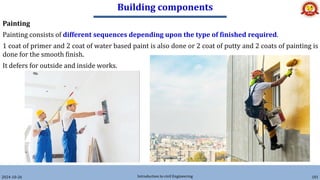
Painting
Painting consists of different sequences depending upon the type of finished required.
1 coat of primer and 2 coat of water based paint is also done or 2 coat of putty and 2 coats of painting is
done for the smooth finish.
It defers for outside and inside works.
Building components
2024-10-26 Introduction to civil Engineering 182
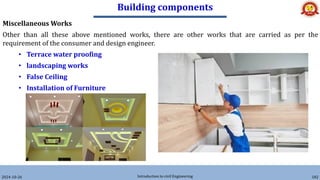
Miscellaneous Works
Other than all these above mentioned works, there are other works that are carried as per the
requirement of the consumer and design engineer.
• Terrace water proofing
• landscaping works
• False Ceiling
• Installation of Furniture
2024-10-26
Introduction to civil
183
HAPPY LEARNING
Building components
2024-10-26 Introduction to civil Engineering 184
Maintenance, repairs and rehabilitation
What is the difference between these 3?
REPAIR - 1
REHABILITATION - 2
MAINTENANCE - 3
Building components
2024-10-26 Introduction to civil Engineering 185
Maintenance, repairs and rehabilitation
Repair
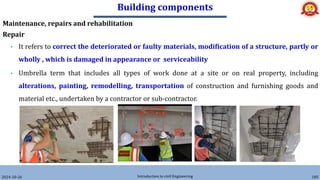
• It refers to correct the deteriorated or faulty materials, modification of a structure, partly or
wholly , which is damaged in appearance or serviceability
• Umbrella term that includes all types of work done at a site or on real property, including
alterations, painting, remodelling, transportation of construction and furnishing goods and
material etc., undertaken by a contractor or sub-contractor.
Building components
2024-10-26 Introduction to civil Engineering 186
Maintenance, repairs and rehabilitation
Rehabilitation
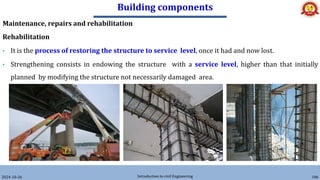
• It is the process of restoring the structure to service level, once it had and now lost.
• Strengthening consists in endowing the structure with a service level, higher than that initially
planned by modifying the structure not necessarily damaged area.
Building components
2024-10-26 Introduction to civil Engineering 187
Maintenance, repairs and rehabilitation
Maintenance
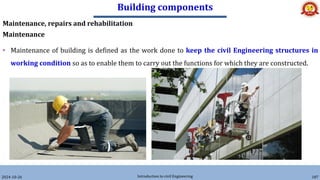
• Maintenance of building is defined as the work done to keep the civil Engineering structures in
working condition so as to enable them to carry out the functions for which they are constructed.
Building components
2024-10-26 Introduction to civil Engineering 188
Objectives of maintenance:
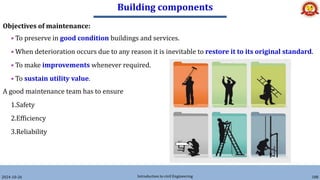
• To preserve in good condition buildings and services.
• When deterioration occurs due to any reason it is inevitable to restore it to its original standard.
• To make improvements whenever required.
• To sustain utility value.
A good maintenance team has to ensure
1.Safety
2.Efficiency
3.Reliability
Building components
2024-10-26 Introduction to civil Engineering 189
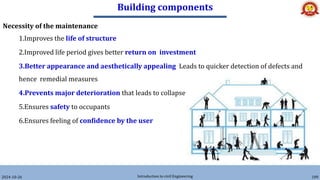
Necessity of the maintenance
1.Improves the life of structure
2.Improved life period gives better return on investment
3.Better appearance and aesthetically appealing Leads to quicker detection of defects and
hence remedial measures
4.Prevents major deterioration that leads to collapse
5.Ensures safety to occupants
6.Ensures feeling of confidence by the user
Building components
2024-10-26 Introduction to civil Engineering 190
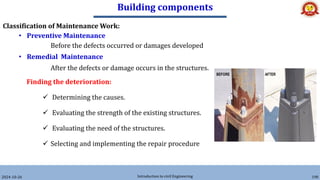
Classification of Maintenance Work:
• Preventive Maintenance
Before the defects occurred or damages developed
• Remedial Maintenance
After the defects or damage occurs in the structures.
Finding the deterioration:
 Determining the causes.
 Evaluating the strength of the existing structures.
 Evaluating the need of the structures.
 Selecting and implementing the repair procedure
Building components
2024-10-26 Introduction to civil Engineering 191
Classification of Maintenance Work:
• Routine Maintenance
 Maintenance attended to the structure periodically.
 It depends upon specifications and materials of structures ,purpose , intensity and condition of use .It
is done by the fund provided annually, which is normally 1.5% of the cost of construction.
 It includes the inspection, planning the program and executing the same.
 It includes white washing, patching repair to plaster, replacement of fitting and fixtures,
blinding of road surface
• Special Maintenance
 work not covered in routing program or the annual repair is done under special condition
 It may be done for strengthening and updating of the structure to meet the new condition of usage
or to increase its serviceability.
 It include particular or complete renewal, such as renewal of floors, roofs etc.
Building components
2024-10-26 Introduction to civil Engineering 192
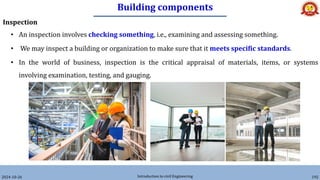
Inspection
• An inspection involves checking something, i.e., examining and assessing something.
• We may inspect a building or organization to make sure that it meets specific standards.
• In the world of business, inspection is the critical appraisal of materials, items, or systems
involving examination, testing, and gauging.
Building components
2024-10-26 Introduction to civil Engineering 193
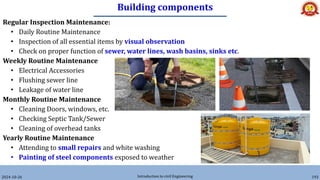
Regular Inspection Maintenance:
• Daily Routine Maintenance
• Inspection of all essential items by visual observation
• Check on proper function of sewer, water lines, wash basins, sinks etc.
Weekly Routine Maintenance
• Electrical Accessories
• Flushing sewer line
• Leakage of water line
Monthly Routine Maintenance
• Cleaning Doors, windows, etc.
• Checking Septic Tank/Sewer
• Cleaning of overhead tanks
Yearly Routine Maintenance
• Attending to small repairs and white washing
• Painting of steel components exposed to weather
Building components
2024-10-26 Introduction to civil Engineering 194
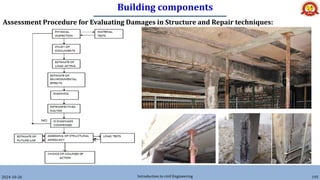
Assessment Procedure for Evaluating Damages in Structure and Repair techniques:
For assessment of damage of a structure the following general considerations have to be taken into account.
1) Physical inspection of damaged structure.
2) Presentation and documenting the damage.
3) Collection of samples and carrying out tests both in situ and in lab.
4) Studying the documents including structural aspects.
5) Estimation of loads acting on the structure.
6) Estimate of environmental effects including soil structure interaction.
7) Diagnosis.
8) Taking preventive steps not to cause further damage.
9) Retrospective analysis to get the diagnosis confirmed.
10) Assessment of structural adequacy.
11) Estimation of future use.
12) Remedial measures necessary to strengthen and repairing the structure.
13) Post repair evaluation through tests.
14) Load test to study the behaviour.
15) Choice of course of action for the restoration of structure.
Building components
2024-10-26 Introduction to civil Engineering 195
Assessment Procedure for Evaluating Damages in Structure and Repair techniques:
Building components
2024-10-26 Introduction to civil Engineering 196
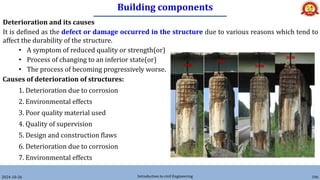
Deterioration and its causes
It is defined as the defect or damage occurred in the structure due to various reasons which tend to
affect the durability of the structure.
• A symptom of reduced quality or strength(or)
• Process of changing to an inferior state(or)
• The process of becoming progressively worse.
Causes of deterioration of structures:
1. Deterioration due to corrosion
2. Environmental effects
3. Poor quality material used
4. Quality of supervision
5. Design and construction flaws
6. Deterioration due to corrosion
7. Environmental effects
2024-10-26
Introduction to civil
197
HAPPY LEARNING
Building components
2024-10-26 Introduction to civil Engineering 198
Fundamentals of town planning and smart cities
Building components
2024-10-26 Introduction to civil Engineering 199
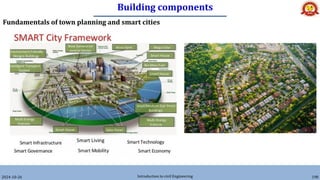
Fundamentals of town planning and smart cities
The fundamentals of town planning and the concept of smart cities are crucial to developing
sustainable, efficient, and livable urban environments.
Fundamentals of Town Planning
Town planning involves designing and organizing the physical, social, and economic infrastructure
of urban areas to ensure proper land use, connectivity, and sustainability.
Zoning
Dividing urban land into zones based on use, such as residential, commercial, industrial,
recreational, etc.
Land Use Planning
Assigning specific functions to different areas of a town, ensuring that land is used optimally for
housing, business, green spaces, and infrastructure.
Building components
2024-10-26 Introduction to civil Engineering 200
Transport and Accessibility:
Planning for efficient movement of people and goods via roads, public transport, pedestrian
pathways, and cycling routes.
Infrastructure Development:
Provision of essential services such as water supply, electricity, waste management, drainage,
and sewage systems.
Public Spaces and Recreation:
Planning for parks, playgrounds, and community spaces.
Environmental Consideration:
Incorporating green belts, conserving natural resources, and ensuring that development is
sustainable.
Building components
2024-10-26 Introduction to civil Engineering 201
Building Regulations and Housing:
Establishing rules and guidelines for building construction, height, density, and design standards.
Urban Aesthetics:
Emphasizing the visual appeal of towns through well-designed buildings, streetscapes, and public
spaces.
Economic Planning:
Supporting commercial areas, industrial hubs, and business development to boost economic
growth.
Health and Safety:
Planning for emergency services, hospitals, schools, and fire protection.
Building components
2024-10-26 Introduction to civil Engineering 202
Fundamentals of Smart Cities
Smart cities use technology and data-driven solutions to enhance the efficiency, sustainability, and
quality of life in urban areas. Here are the core elements:
ICT Integration (Information and Communication Technology):
Using digital technologies and sensors to monitor and manage city functions (traffic, utilities, public
services).
Sustainable Urban Mobility:
Promoting smart transportation systems, including electric vehicles, public transport apps, bike-
sharing, and intelligent traffic management.
Smart Infrastructure:
Embedding sensors in infrastructure (roads, bridges, buildings) for monitoring and maintenance.
Building components
2024-10-26 Introduction to civil Engineering 203
Renewable Energy and Smart Grids:
Utilizing solar, wind, and other renewable energy sources along with smart grids for energy
distribution.
Smart Waste Management:
Using smart bins, recycling systems, and IoT (Internet of Things) for waste tracking and efficient
disposal.
E-Governance:
Providing digital platforms for citizens to access public services, file complaints, and engage with
local authorities.
Smart Water Management:
Using IoT-based systems to monitor water usage, detect leaks, and manage distribution.
Building components
2024-10-26 Introduction to civil Engineering 204
Environmental Sustainability:
Incorporating green buildings, smart irrigation, air quality monitoring, and reducing carbon
footprints.
Data Analytics and Artificial Intelligence (AI):
Collecting and analyzing data from sensors and urban infrastructure to make informed decisions.
Citizen Engagement and Quality of Life:
Involving residents in decision-making processes through apps, platforms, and social media.
Smart Healthcare:
Leveraging telemedicine, health monitoring devices, and AI for better healthcare delivery.
Smart Security Systems:
Utilizing surveillance cameras, AI-based monitoring, and smart emergency response systems.
Building components
2024-10-26 Introduction to civil Engineering 205
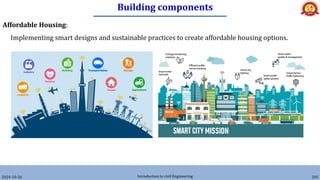
Affordable Housing:
Implementing smart designs and sustainable practices to create affordable housing options.
Building components
2024-10-26 Introduction to civil Engineering 206
Building bye laws
• It is also known as building codes or regulations, are a set of rules and guidelines established by
local, regional, or national authorities to govern the construction, renovation, and maintenance of
buildings.
• These bye-laws are essential for ensuring the safety, structural integrity, and functionality of
structures and promoting the well-being of occupants and the environment.
• However, the specifics of building bye-laws can vary significantly from one jurisdiction to
another, reflecting local conditions, cultural preferences, and technological advancements.
Building components
2024-10-26 Introduction to civil Engineering 207
Building bye laws
• Building bye-laws serve as essential legal instruments employed to govern and control various
aspects of construction, including parameters such as building coverage, height, the extent of
construction, and architectural designs.
• These regulations play a crucial role in steering and managing the development of a region in an
organised and sustainable manner.
• In addition to these primary functions, building bye-laws encompass a broader set of
responsibilities, such as promoting safety, ensuring adherence to environmental standards,
facilitating urban planning, and harmonising with the cultural and historical context of the
area.
• These multifaceted regulations thus serve as a cornerstone in the responsible and well-balanced
growth of a locality.
Building components
2024-10-26 Introduction to civil Engineering 208
Purpose of Building Bye-laws
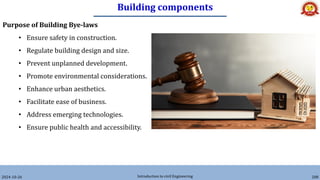
• Ensure safety in construction.
• Regulate building design and size.
• Prevent unplanned development.
• Promote environmental considerations.
• Enhance urban aesthetics.
• Facilitate ease of business.
• Address emerging technologies.
• Ensure public health and accessibility.
Building components
2024-10-26 Introduction to civil Engineering 209
Importance of Building Bye-laws
• The implementation of building bye-laws is imperative for safeguarding structures from potential
threats like noise disturbances, fire hazards, seismic activity, structural vulnerabilities, and
other unsafe practices.
• Regrettably, numerous small and medium-sized constructions in India are erected without
adhering to these regulations, resulting in unregulated and often hazardous building practices
characterized by excessive coverage and precarious development.
• This lack of oversight contributes to disorderly and unsafe urban environments.
Building components
2024-10-26 Introduction to civil Engineering 210
Objectives of Building Bye-laws
Guidelines for Architects and Engineers
Building bye-laws serve as crucial guidelines for architects and engineers, facilitating the pre-
planning of building provisions and activities, which enhances the construction process's efficiency and
effectiveness.
Preventing Unplanned Development
One of the primary roles of building bye-laws is to prevent haphazard or unplanned development,
ensuring that new constructions align with the broader urban planning goals.
Ensuring Safety
Building bye-laws are instrumental in safeguarding the lives and well-being of those who work and
reside within these structures.
They address concerns related to fire safety, noise control, health hazards, and structural integrity.
Building components
2024-10-26 Introduction to civil Engineering 211
Key Aspects Governed by Building Bye-laws
Set-back or Building Line:
• Building bye-laws dictate the minimum
open space required in front of buildings
facing a road, known as the set-back or
building line.
• This regulation aims to maintain street
aesthetics, prevent overcrowding, and
enhance safety by improving visibility.
• Set-back areas can also be repurposed as
parking spaces or green areas.
Building components
2024-10-26 Introduction to civil Engineering 212
Need for Building line:
1.If absolutely necessary, the land contained in set-back may be acquired for the purpose of
widening of the road.
2.The setback at corner improves visibility and impart safety to the moving traffic.
3.The space of setback can be used as a parking place or for developing a garden.
4.It provides protection of buildings from street disturbances.
5.It reduces the danger of fire by increasing the distance between the opposite buildings.
Building components
2024-10-26 Introduction to civil Engineering 213
Floor Space Index (FAR) or Floor Area Ratio: FAR, expressed as the ratio of a building's total floor
area to the land area it occupies, is used to control the intensity of development. It's a tool for
regulating population density. For instance, a FAR of 1.5 means the total floor area is 1.5 times the
land area.
Building components
2024-10-26 Introduction to civil Engineering 214
Built-up Area: The built-up area is the plot area minus the space allocated for open areas. Building
codes specify the maximum permissible built-up area based on the plot size to prevent
overdevelopment.
Building components
2024-10-26 Introduction to civil Engineering 215
Building components
2024-10-26 Introduction to civil Engineering 216
Size of Rooms: Building bye-laws stipulate minimum room sizes to ensure adequate space for health
and proper ventilation. Different types of rooms have specific size requirements, promoting
comfortable living conditions.
Building components
2024-10-26 Introduction to civil Engineering 217
Height of Buildings: The height of buildings is determined based on street width, to maintain urban
aesthetics and safety. Narrower streets have lower height allowances.
Building components
2024-10-26 Introduction to civil Engineering 218
Lighting and Ventilation: Building codes mandate the provision of windows and ventilators to
ensure sufficient room lighting and ventilation. The minimum opening areas are stipulated for different
climate conditions.
Building components
2024-10-26 Introduction to civil Engineering 219
Water Supply and Sanitary Provisions: Building codes set standards for water supply and sanitation
facilities, such as taps, sinks, water closets, and washbasins, based on the type of building.
Building components
2024-10-26 Introduction to civil Engineering 220
Wrong method
Building components
2024-10-26 Introduction to civil Engineering 221
Structural Designs: Building bye-laws require structures to be designed to withstand safe loads,
earthquakes, and other environmental factors. General guidelines for foundation depth, width, and
concrete usage are provided.
2024-10-26
Introduction to civil
222
HAPPY LEARNING
Building components
2024-10-26 Introduction to civil Engineering 223
Green building
Building components
2024-10-26 Introduction to civil Engineering 224
Green building
• Sustainable site planning.
• Building Design Optimization.
• Energy Performance Optimization.
• Renewal Energy Utilization.
• Water and Waste Management.
• Solid Waste Management.
• Sustainable Building materials and
Construction Technology.
• Health, well being and
Environmental Quality.
Building components
2024-10-26 Introduction to civil Engineering 225
Green building
• Green Building (also known as green construction or sustainable building) expands and
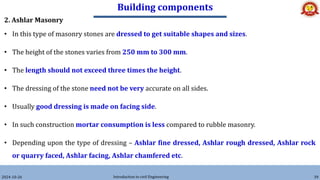
compliments the building design concerns of economy, utility, durability and comfort.
• A Green Building is one which uses less water, optimizes energy efficiency, conserves
natural resources, generates less waste and provides healthier space for occupants as
compared to conventional building.
• Green buildings are designed to reduce the overall impact on human health and natural
environment.
• Using energy, water and other resources efficiently.
• By reducing waste, pollution and environmental degradation.
Building components
2024-10-26 Introduction to civil Engineering 226
Objectives of Green Building
• Protecting Occupant Health
• Improving employee productivity
• Using energy, water and other resources more efficiently
• Reducing overall impact to the environment
• Optimal environmental and economic performance
• Satisfying and Quality Indoor spaces
Building components
2024-10-26 Introduction to civil Engineering 227
Fundamental principles of Green Buildings
• Structure design efficiency
• Energy efficiency
• Water efficiency
• Materials efficiency
• Waste and toxic reduction
Structural design efficiency
• It is the concept of sustainable building and has largest impact
on cost and performance
• It aims to minimize the environment impact associated with all
life-cycles
Energy efficiency
• The layout of the construction can be strategized so that natural
light pours for additional warmth
• Shading the roof with trees offers an eco-friendly alternative to
air conditioning
Building components
2024-10-26 Introduction to civil Engineering 228
How to make a building Green
• Sustainable site planning with bioclimatic architectural planning
• Design energy efficient lighting and HVAC ( Heating, Ventilation, and Air conditioning ) system.
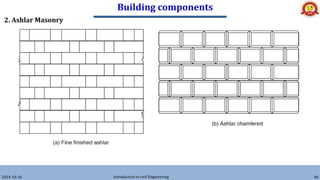
• Use low energy and renewable materials.
• Choose construction materials and interior finishes products with zero or low emissions to
improve indoor air quality.
• Use dimensional planning and other material efficiency strategies.
• Design for gray water system that recovers rain water for site irrigation and dual plumbing
system for use of recycled water for toilet flushing.
Building components
2024-10-26 Introduction to civil Engineering 229
Need of Green Buildings in present scenario
• Buildings are responsible for 40% of world wide energy flow and material use conventional
buildings have been identified as the largest source of green house gas emissions, even more than
that of the transport and industry sector.
• 8000lbs of waste are typically thrown into a landfill during the construction of a 2000sqft home.
• The buildings in the US consume more than twice as much energy as all the cars in the US.
• Buildings account for 68% of total electricity consumption in the US.
• Buildings use 80% of total drinking water consumption in the US.
• Indoor levels of pollution are commonly 2 to 5 times higher than outdoor pollution levels.
Building components
2024-10-26 Introduction to civil Engineering 230
Benefits of Green Buildings
Environmental Benefits
• Protect Biodiversity and ecosystems
• Improve air and water quality
• Reduce waste streams
• Conserve natural resources
Economic Benefits
• Reduce operating costs
• Create, Expand and Shape markets for green product
and services
• Improve Occupant Productivity
Social Benefits
• Enhance occupant comfort and health
• Heighten aesthetic qualities
• Minimize strain on local infrastructure
• Improve overall quality of life
Building components
2024-10-26 Introduction to civil Engineering 231
Merits and Demerits of Green Building
Merits
• Efficient Technologies
• Easier Maintenance
• Return of Investment
• Improved Indoor Air Quality
• Energy Efficiency
• Water Efficiency
• Waste Reduction
• Temperature Moderation
• Water Conservation
• Economical Construction for Poor
• Healthier Lifestyles and Recreation
• Improved Health
Demerits
• Initial Cost is High
• Availability of Materials is Less
• Need More time to Construct
• Need Skilled Workers
Building components
2024-10-26 Introduction to civil Engineering 232
Different Levels Of Green Building Certification
• Certified to recognize best practices (30-36 Pts)
• Silver to recognize outstanding performance(37- 44 Pts)
• Gold to recognize national excellence ( 45- 55 Pts)
• Platinum to recognize global leadership (56-75 Pts)
Building components
2024-10-26 Introduction to civil Engineering 233
Applications of software and IoT in civil engineering
• AutoCAD
• Autodesk Revit
• STAAD Pro
• SAP2000
• ETABS
• Primavera
• ArcGIS
• Microsoft excel, etc.
AutoCAD
A popular CAD software used to create civil engineering drawings,
including structural details and layouts
Building components
2024-10-26 Introduction to civil Engineering 234
Applications of software and IoT in civil engineering
Autodesk Revit
A Building Information Modeling (BIM) software that lets users design buildings and other structures
in 3D
Building components
2024-10-26 Introduction to civil Engineering 235
Applications of software and IoT in civil engineering
STAAD Pro
A sophisticated software program used to analyze and design structures like buildings, bridges, and
tunnels
Building components
2024-10-26 Introduction to civil Engineering 236
Applications of software and IoT in civil engineering
SAP2000
An all-in-one software for analysis and design that can be used on any structure project
Building components
2024-10-26 Introduction to civil Engineering 237
Applications of software and IoT in civil engineering
ETABS
A renowned CAD software used to create systems and analyze and build product designs
Building components
2024-10-26 Introduction to civil Engineering 238
Applications of software and IoT in civil engineering
Primavera
A software used by civil engineers, architects, and construction companies throughout the project
lifecycle
Building components
2024-10-26 Introduction to civil Engineering 239
Applications of software and IoT in civil engineering
ArcGIS
A map-making software used in civil engineering, urban planning, and agronomy
Building components
2024-10-26 Introduction to civil Engineering 240
Applications of IoT in civil engineering
Waste management
IoT technologies can help construction teams track and reduce waste.
Remote monitoring
IoT can improve automation and remote monitoring for many tasks, allowing operators to stay
hands-off more often.
Structural health monitoring
Monitoring strategies can help assess long-term structural behavior, schedule maintenance, and
ensure occupant safety.
Analytics
Find patterns, crunch data, perform forecasts, and integrate machine learning.
Building components
2024-10-26 Introduction to civil Engineering 241
Applications of IoT in civil engineering
Predictive maintenance
IoT-connected sensors can monitor performance factors to determine when a machine needs
repair.
Project management
Civil site engineers may use employee management software programs to keep track of employee
schedules, requests, and project details.
Fleet management
Sensors located in lorries and ships can help fleet managers calculate the speeds at which they are
traveling.
2024-10-26
Introduction to civil
242
HAPPY LEARNING

Building Components and Construction in Civil Engineering

  • 1.
    SRI KRISHNA COLLEGEOF TECHNOLOGY [An Autonomous Institution | Affiliated to Anna University and Approved by AICTE | Accredited by NAAC with ‘A’ Grade] KOVAIPUDUR, COIMBATORE – 641 042. DEPARTMENT OF CIVIL ENGINEERING COURSE : 23CE101 – Introduction to Civil Engineering (ICE) Theory (3 Credits) I YEAR/I SEMESTER Module - 2 Building Components and Construction 2024-10-26 1 Dr. N. Shanmugasundaram
  • 2.
    Selection of site MODULE2: Building Components and Construction 15 Hrs. Selection of site – building components – foundation, basement, wall: stone masonry, brick masonry, column, floor, beam, roof, reinforced concrete members, staircase, lintel, slab, truss and damp-proof course - design and construction sequences of a building - maintenance, repairs and rehabilitation – fundamentals of town planning and smart cities – building bye laws - green building –applications of software and IoT in civil engineering. 2024-10-26 Introduction to civil Engineering 2
  • 3.
    Selection of site 2024-10-26Introduction to civil Engineering 3 Selection of site
  • 4.
    Syllabus 6. Cost andBudget Land Cost Development Costs 7. Safety and Security Natural Hazards Security 8. Future Growth and Expansion Scalability Urban Development 9. Neighborhood and Social Factors Community Amenities 10. Climate and Weather Conditions Local Climate Sunlight and Wind Exposure 2024-10-26 Introduction to civil Engineering 4 Selection of site 1. Location and Accessibility Proximity to Infrastructure Accessibility 2. Topography and Soil Condition Land Slope Soil Type 3. Legal and Regulatory Factors Zoning Regulations Permits and Approvals 4. Environmental Considerations Flood Risk Environmental Impact 5. Utilities and Services Water Supply Electricity and Gas
  • 5.
  • 6.
  • 7.
    Building components 2024-10-26 Introductionto civil Engineering 7 Building components
  • 8.
    Building components 2024-10-26 Introductionto civil Engineering 8 Load transfer mechanism
  • 9.
    Building components 2024-10-26 Introductionto civil Engineering 9 Foundation • A foundation is the lower portion of building structure that transfers its gravity loads to the earth. • The soil /rock on which the foundation rests is called natural foundation or foundation bed and it ultimately bears the load of the structure. • The structural foundation or simply, foundation is therefore the connecting link between the superstructure and the natural foundation (soil).
  • 10.
    Building components 2024-10-26 Introductionto civil Engineering 10 The objectives of providing foundations • To distribute the total load of the superstructure on a larger area without causing failure of the soil. • To prevent excessive settlement of the building. • To provide stability to the structure against various disturbing forces such as wind, rain, earthquake etc. • To provide a level and firm surface for the construction of the super structure
  • 11.
    Building components 2024-10-26 Introductionto civil Engineering 11 Types of foundation • Shallow Foundation • Deep Foundation Shallow Foundation: A foundation is shallow, if its depth is equal to or less than its width, suitable for hard strata. Type of Shallow Foundation: 1. Spread footing 2. Strap Footing 3. Combined Footing 4. Raft Footing.
  • 12.
    Building components 2024-10-26 Introductionto civil Engineering 12 1. Spread footing: • Single Footing • Stepped and sloped Footing • Wall Footing • Grillage Footing. Single Footing: This type of foundation is suitable when there is a good strata at low depth and depth of foundation is low and load is less. Stepped Footing & Sloped Footing: This type of foundation is suitable when there is a good stratum at low depth but foundation is some more deep as compared to single footing and load is more. Wall Footing: Wall footing is suitable for load bearing structure where depth is low and load is also less. Grillage Footing: When heavy structural loads from column piers are required to be transferred to a soil of less bearing capacity. This foundation is found lighter and more economical. It also avoids deep foundation.
  • 13.
    Building components 2024-10-26 Introductionto civil Engineering 13 Single Footing Stepped Footing & Sloped Footing
  • 14.
    Building components 2024-10-26 Introductionto civil Engineering 14 Wall Footing Grillage Footing
  • 15.
    Building components 2024-10-26 Introductionto civil Engineering 15 2. Strap footing • If the independent footings of two columns are connected by a beam it is called a strap footing. It is used when distance between column is more and combine footing is not possible. • It is also useful when any old existing structure is so near to the footing and the existing structure does not permit the independent footing of column.
  • 16.
    Building components 2024-10-26 Introductionto civil Engineering 16 3. Combined Footings • A spread footing which support two or more column is termed as combined footing. Combined footings may be of the following type Rectangular combined footings: The combined footing for columns will be rectangular in shape if they carry equal loads. Trapezoidal combined footing: If the columns carry unequal loads, the footing is trapezoidal shape.
  • 17.
    Building components 2024-10-26 Introductionto civil Engineering 17 4. Raft / Mat Footing A raft or mat is a combined footing that covers the entire area below the structure and supports all the columns when the safe bearing capacity of soil is low and the building loads are heavy.
  • 18.
    Building components 2024-10-26 Introductionto civil Engineering 18 Deep Foundation
  • 19.
    Building components 2024-10-26 Introductionto civil Engineering 19 Deep Foundation Deep foundation the depth is equal to or greater than its width. Suitable for low bearing capacity of soil. Types of deep foundation: • Pile Foundation • Pier Foundation • Well or Caisson Foundation 1.Pile Foundation When heavy concentrated loads have to be carried out through soil strata of low bearing capacity to deeper soil or rock having higher bearing capacity. Bearing Piles Piles are the poles made of timber, plain concrete, R.C.C. or steel. These piles are hammered clown to rest on hard surface. On top of a number of piles a concrete cap is cast and over that construction activity of building starts. Thus bearing piles transfer the load to hard surface directly.
  • 20.
    Building components 2024-10-26 Introductionto civil Engineering 20 Friction Piles When hard surface is not met at reasonable depth, the frictional resistance between the adjoining soil and pile is checked and the pile length is kept sufficient enough to transfer the load by friction.
  • 21.
    Building components 2024-10-26 Introductionto civil Engineering 21 2.Pier Foundation • Pier foundations are somewhat similar to pile foundations but are typically larger in area than piles. • A pier is a heavy structural member. Usually, pier foundations are used for bridges.
  • 22.
    Building components 2024-10-26 Introductionto civil Engineering 22 3. Caisson or Well foundation A 'Caisson' is a box shaped type of foundation, built above ground level and sunk to the required depth as a single unit. They are used to refer to a water-tight chamber employed for laying foundations under water as in lakes, rivers, seas, and oceans. https://www.linkedin.com/posts/vincivilworld_caisson-foundation-geotechnical-activity-7227975216864358400-LGze?utm_source=share&utm_medium=member_desktop
  • 23.
  • 24.
  • 25.
    Building components 2024-10-26 Introductionto civil Engineering 25 Basement • A basement or cellar is one or more floors of a building that are completely or partly below the ground floor. • It is typically located beneath the ground floor and serves various purposes such as storage, utility rooms, or even living spaces. • The basement is constructed by excavating the ground and building walls and a floor slab below the ground level. • These walls are part of the building's foundation, helping to distribute the structure's weight evenly and providing stability. • Proper waterproofing and drainage are essential to prevent water infiltration and maintain the basement's integrity.
  • 26.
    Building components 2024-10-26 Introductionto civil Engineering 26 Types of super structures based on the method of Load transfer
  • 27.
  • 28.
    Building components 2024-10-26 Introductionto civil Engineering 28 Wall Walls are built to partition living area into different parts. They impart privacy and protection against temperature, rain and theft. Walls may be classified as. 1. Load bearing walls 2. Partition walls. 3. Parapet walls 4. Shear walls
  • 29.
    Building components 2024-10-26 Introductionto civil Engineering 29 1.Load bearing walls • If beams and columns are not used, load from roof and floors are transferred to foundation by walls • Designed to transfer the load safely. • The critical portion of the walls are near the openings of doors and windows and the positions where concrete beams rest. • Minimum wall thickness used is 200 mm.
  • 30.
    Building components 2024-10-26 Introductionto civil Engineering 30 2.Partition walls • In framed structures partition walls are built to divide floor area for different utilities. • They rest on floors. They do not carry loads from floor and roof. • They have to carry only self-weight. Hence normally partition walls are thin.
  • 31.
    Building components 2024-10-26 Introductionto civil Engineering 31 3. Parapet walls
  • 32.
    Building components 2024-10-26 Introductionto civil Engineering 32 3. Parapet walls A parapet wall is a short wall or heavy railing that extends from a building's wall at the edge of a roof, balcony, terrace, or stairway. Parapets have many purposes, including: Safety: Parapets prevent people from falling over or being attacked from the outside. Aesthetics: Parapets can improve the look of a building. Wind protection: Parapets can help protect against wind. Privacy: Parapets can provide privacy. Roof membrane termination: Parapets allow the roof membrane to terminate under a coping.
  • 33.
    Building components 2024-10-26 Introductionto civil Engineering 33 4.Shear walls • Shear walls are structural elements in buildings that resist lateral forces, such as wind and seismic activity, and keep buildings stable. They are especially important in high-rise buildings.
  • 34.
    Building components 2024-10-26 Introductionto civil Engineering 34 Stone masonry • Masonry means construction of buildings using building blocks like stone, bricks, concrete blocks etc. • Masonry is used for the construction of foundation, plinth, walls and columns. • Mortar is the binding material for the building blocks.
  • 35.
    Building components 2024-10-26 Introductionto civil Engineering 35 Types of Stone Masonry 1. Rubble Masonry 2. Ashlar Masonry. 1. Rubble Masonry: • In this type of constructions stones of irregular sizes and shapes are used. • To remove sharp shapes they may be hammered. • The rubble masonry may be coursed or uncoursed. • In uncoursed rubble masonry the wall is brought to level at every 300 mm to 500 mm. • The mortar consumed in these construction is more. • Course rubble masonry is used for the construction of public and residential buildings. • Uncoursed rubble masonry is used for the construction of foundations, compound walls, garages, labour quarters etc. • A skilled mason may arrange the facing stones in polygonal shapes to improve the aesthetic of the wall.
  • 36.
    Building components 2024-10-26 Introductionto civil Engineering 36 Coursed Rubble Masonry Uncoursed Rubble Masonry
  • 37.
    Building components 2024-10-26 Introductionto civil Engineering 37 Coursed Rubble Masonry
  • 38.
    Building components 2024-10-26 Introductionto civil Engineering 38 Uncoursed Rubble Masonry
  • 39.
    Building components 2024-10-26 Introductionto civil Engineering 39 2. Ashlar Masonry • In this type of masonry stones are dressed to get suitable shapes and sizes. • The height of the stones varies from 250 mm to 300 mm. • The length should not exceed three times the height. • The dressing of the stone need not be very accurate on all sides. • Usually good dressing is made on facing side. • In such construction mortar consumption is less compared to rubble masonry. • Depending upon the type of dressing – Ashlar fine dressed, Ashlar rough dressed, Ashlar rock or quarry faced, Ashlar facing, Ashlar chamfered etc.
  • 40.
    Building components 2024-10-26 Introductionto civil Engineering 40 2. Ashlar Masonry
  • 41.
    Building components 2024-10-26 Introductionto civil Engineering 41 2. Ashlar Masonry
  • 42.
    Building components 2024-10-26 Introductionto civil Engineering 42 Supervision of Stone Masonry Construction • Hard and durable stones, free from defects like flaws, cavities veins etc. • Dressing of the stones should be used as per the requirement. • Stones should be properly wetted before they are used so as to avoid sucking of water from mortar. • Stones should be laid on their natural bed. • Facing and backing faces should be laid neatly and levelled and checked with wooden template. • The heart of masonry should be filled with stone chips and mortars. • To thick mortar joints should be avoided. • Verticality of the wall should be frequently checked with plumb-bob. • Mortars with correct proportion of sand and cement should be used. • Continuous vertical joints should be avoided. • Through stones should be used within 1.5 m distances. • The height of masonry should be raised uniformly. • Under the beams, trusses, sills etc. large flat stones should be used. • Before continuing work, the masonry built on previous day should be well cleaned and freed from loose particles. • Curing should be done properly for 2 to 3 weeks.
  • 43.
    Building components 2024-10-26 Introductionto civil Engineering 43 Brick Masonry
  • 44.
    Building components 2024-10-26 Introductionto civil Engineering 44 Brick Masonry • Brick masonry is built with bricks bonded together with mortar. For temporary sheds mud mortar may be used but for all permanent buildings lime or cement mortars are used. • The various types of bonds generally used in brick masonry are 1. Stretcher bond 2. Header bond 3. English bond and 4. Flemish bond.
  • 45.
    Building components 2024-10-26 Introductionto civil Engineering 45 Brick Masonry
  • 46.
    Building components 2024-10-26 Introductionto civil Engineering 46 Brick Masonry
  • 47.
    Building components 2024-10-26 Introductionto civil Engineering 47 Brick Masonry
  • 48.
    Building components 2024-10-26 Introductionto civil Engineering 48 Brick Masonry
  • 49.
    Building components 2024-10-26 Introductionto civil Engineering 49 Brick Masonry
  • 50.
    Building components 2024-10-26 Introductionto civil Engineering 50 Stretcher bond
  • 51.
    Building components 2024-10-26 Introductionto civil Engineering 51 Stretcher bond • A stretcher is the longer face of the brick as seen in the elevation. • In the brick of size 190 mm × 90 mm × 90 mm, 190 mm × 90 mm face is the stretcher. • In stretcher bond masonry all the bricks are arranged in stretcher courses. • Care should be taken to break vertical joints. • This type of construction is useful for the construction half brick thick partition wall.
  • 52.
    Building components 2024-10-26 Introductionto civil Engineering 52 Header bond
  • 53.
    Building components 2024-10-26 Introductionto civil Engineering 53 Header bond • A header is the shorter face of the brick. • In a standard brick it is 90 mm × 90 mm face. • In header bond brick masonry all the bricks are arranged in the header courses. • This type of bond is useful for the construction of one brick thick walls.
  • 54.
    Building components 2024-10-26 Introductionto civil Engineering 54 English bond
  • 55.
    Building components 2024-10-26 Introductionto civil Engineering 55 English bond
  • 56.
    Building components 2024-10-26 Introductionto civil Engineering 56 English bond
  • 57.
    Building components 2024-10-26 Introductionto civil Engineering 57 English bond • In this alternate courses consist of headers and stretchers. • This is considered to be the strongest bond. • Hence it is commonly used bond for the walls of all thicknesses. • To break continuity of vertical joints a brick is cut lengthwise into two halves and used in the beginning and end of a wall after first header. This is called queen closer. • Typical one brick and one and half brick thick wall with English bond.
  • 58.
    Building components 2024-10-26 Introductionto civil Engineering 58 Flemish bond
  • 59.
    Building components 2024-10-26 Introductionto civil Engineering 59 Flemish bond
  • 60.
    Building components 2024-10-26 Introductionto civil Engineering 60 Flemish bond • In this type of bond each course comprises of alternate header and stretcher. • Alternate courses start with stretcher and header. • To break the vertical joints queen closers are required, if a course starts with header. Every header is centrally supported on the stretcher below it. Flemish bonds may be further classified as • (a) Double Flemish Bond • (b) Single Flemish Bond.
  • 61.
    Building components 2024-10-26 Introductionto civil Engineering 61 Flemish bond
  • 62.
  • 63.
    Building components 2024-10-26 Introductionto civil Engineering 63 Points to be Observed in Supervising Brick Masonry Constructions • Use bricks of good quality with uniform colour, well burnt, with exact shape and size. • Before using the bricks in masonry, they should be soaked in water for 2 hours so that bricks do not absorb water from the mortar. • Bricks should be laid with the frog pointing upward. • Construction of brick wall should start from the end or corner. • Brick courses should be perfectly horizontal. • Verticality of the wall should be ensured by frequently checking with plumb-bob. • Mortar used should be as per specification. • Whenever work is stopped brick masonry should be left with toothed end. • Use of brick bats should be avoided. • Walls should be raised uniformly.
  • 64.
    Building components 2024-10-26 Introductionto civil Engineering 64 Points to be Observed in Supervising Brick Masonry Constructions • In no case difference between adjoining walls be more than 1 m. • In a day no wall should be raised by more than 1.5 m. • To get proper key for plastering or pointing, the face joints should be raised to a depth of 12 to 20 mm, when the mortar is green. • If plastering or pointing is not to be provided, face joints should be stuck flush and finished neatly. • Holdfasts for doors and windows should be embedded in brick masonry with cement mortar or concrete, at the time of constructing the wall itself. • Brick masonry should be regularly cured for 2 weeks. • For carrying out brick work at higher levels, only single scaffolding should be used
  • 65.
    Building components 2024-10-26 Introductionto civil Engineering 65 Advantages of Brick Masonry Over Stone Masonry • Since shape and size of bricks are uniform, it do not need skilled labour for the construction. • Bricks are light in weight and hence handling them is easy. • Bricks are easily available around cities and their transportation cost is less because their weight is less. • Stones are to be brought from quarries which are located only at few places. • It is possible to use all types of mortar in brick masonry. • For unimportant buildings even mud mortar can be used. • Thinner walls can be constructed with bricks but it is not so with stones. • It is easy to form openings for doors and windows. • Dead load of brick masonry is less. • In brick masonry mortar joints are thin and hence construction cost is reduced considerably. • Brick masonry has better fire and weather resistance compared to stone masonry
  • 66.
    Building components 2024-10-26 Introductionto civil Engineering 66 Disadvantages of Brick Masonry Over Stone Masonry • Strength of brick masonry is less than that of stone masonry. • Durability of brick masonry is less. • Brick masonry needs plastering and plastered surface needs colour washing. • Stone masonry don’t need them and hence maintenance cost is more in brick masonry. • Brick masonry absorbs water and there are possibility of dampness. There is no such problem in stone masonry. • More architectural effects can be given in stone masonry compared to that in brick masonry. • Stone masonry gives massive appearance and hence monumental buildings are built in stone masonry
  • 67.
  • 68.
    Building components 2024-10-26 Introductionto civil Engineering 68 Columns
  • 69.
    Building components 2024-10-26 Introductionto civil Engineering 69 Columns
  • 70.
    Building components 2024-10-26 Introductionto civil Engineering 70 Columns • Columns are structural elements that transfer the weight of the roof and other structures above them to the elements below them. They are vertical compression elements that are used in architecture and engineering. Types Based on Cross Section • Circular Columns • Square Columns • Rectangular Columns • "L" Shape Columns • "T" Shape Columns, etc., Based on Construction Material • Concrete Columns • Steel Columns • Timber Columns • Composite Columns • Stone Columns • Brick Columns Based on Loading • Axially loaded column • Biaxial loaded column • Uniaxial loaded column
  • 71.
    Building components 2024-10-26 Introductionto civil Engineering 71 Based on The Slenderness Ratio • Short Columns • Long Columns Other • Prestressed column • Stub Column/ Floating column / Linked Column Reference https://www.civillead.com/types-of-columns/
  • 72.
    Building components 2024-10-26 Introductionto civil Engineering 72 Circular column Circular columns are mostly used in piling and elevation of buildings for aesthetic purposes. In circular columns, more than 4 steel bars are used as reinforcement.
  • 73.
    Building components 2024-10-26 Introductionto civil Engineering 73 Square and rectangular columns Square or rectangular columns are mostly used in building construction. These types of columns are economically good and easy to construct because of their easy shuttering and reinforcement placement.
  • 74.
    Building components 2024-10-26 Introductionto civil Engineering 74 L and T Shaped Columns L type columns are used in boundary wall construction and in the turning of metro rail or in flyover construction. T type column has same feature as square/ rectangular column and is mostly used in bridge and retaining wall construction.
  • 75.
    Building components 2024-10-26 Introductionto civil Engineering 75 V- Type Column:- As the name indicates, this column resembles a V shape and is suitable for a trapezoidal shape room and aesthetic purpose. It needs more concrete in comparison to other shape columns.
  • 76.
    Building components 2024-10-26 Introductionto civil Engineering 76 Hexagon Column:- They are modified columns with six sides and provide a better pictorial view, usually preferred for elevation. These shapes columns offer an elegant look to the building, primarily used in the cinema hall, auditoriums, verandah, etc.
  • 77.
    Building components 2024-10-26 Introductionto civil Engineering 77 Y – Type Column: Y-types of columns are primarily used in the construction of pillars for flyovers, bridges, etc.
  • 78.
    Building components 2024-10-26 Introductionto civil Engineering 78 Y type Column with Arch This column is similar to the y shape column except for sides or curved edges. Usually, they are used to construct pillars for flyovers and bridges to bear the heavy load with limited space.
  • 79.
    Building components 2024-10-26 Introductionto civil Engineering 79 Based On Reinforcement Type Tied Column This column is mainly made of reinforced concrete in which the main bare enclosed within nearly spaced stirrups/lateral ties is known as tied column.
  • 80.
    Building components 2024-10-26 Introductionto civil Engineering 80 Spiral Column This column is also made of reinforced concrete in which main bars are enclosed within closely spaced and continuously looped spiral reinforcement.
  • 81.
    Building components 2024-10-26 Introductionto civil Engineering 81 Composite Column In this type of column, longitudinal steel is provided in the form of steel pipe or section with or without main longitudinal bars is termed the composite column.
  • 82.
    Building components 2024-10-26 Introductionto civil Engineering 82 Based On Loading Type
  • 83.
    Building components 2024-10-26 Introductionto civil Engineering 83 Based on Loading Type Axially loaded column If the vertical compressive load acts on the column’s cross-section centre of gravity, it is called an axially loaded column. Uniaxial Eccentric loaded column Suppose the vertical compressive load’s line of action doesn’t coincide with the column’s cross-section centre of gravity and acts eccentrically either on the X-axis or y-axis. In that case, it is referred to as a uniaxially eccentrically loaded column. Biaxial Eccentric loaded column Suppose the vertical compressive load’s line of action doesn’t coincide with the column’s cross-section centre of gravity and doesn’t either on the X-axis or y-axis. In such a case, it is known as a biaxially eccentrically loaded column.
  • 84.
    Building components 2024-10-26 Introductionto civil Engineering 84 Based on Slenderness ratio
  • 85.
    Building components 2024-10-26 Introductionto civil Engineering 85 Based on Slenderness ratio
  • 86.
    Building components 2024-10-26 Introductionto civil Engineering 86 Based on Slenderness ratio Short Column If the column’s effective length to its least lateral dimension ratio is less than 12, it is termed the short column. These columns fail due to the crushing of concrete.
  • 87.
    Building components 2024-10-26 Introductionto civil Engineering 87 Based on Slenderness ratio Long Column • If the column’s effective length to its least lateral dimension ratio passes 12, it is termed the long column. These columns fail due to bending or buckling. • These columns are weaker in comparison to short columns for the same cross-section area and generally not favored.
  • 88.
    Building components 2024-10-26 Introductionto civil Engineering 88 Difference b/n short and long column
  • 89.
    Building components 2024-10-26 Introductionto civil Engineering 89 Based On Material For Construction RCC Column • RCC columns consist of reinforced cement concrete in which steel bars are provided as reinforcement. • Primarily these columns are used for all types of buildings and other RCC structures such as bridges, tanks, etc. • Concrete performs better in compression but is weak in tension. • Therefore it is reinforced to increase its performance under tension.
  • 90.
    Building components 2024-10-26 Introductionto civil Engineering 90 Steel Column • These columns are made of steel sections primarily used for heavy load in the construction of industrial buildings. • Steel structures are more robust, flexible, and durable in contrast to concrete structures. Steel columns are available in various shapes such as L, I, H, etc.
  • 91.
    Building components 2024-10-26 Introductionto civil Engineering 91 Timber Column • These columns are made of wood and are mainly used for light loads. Timber columns are generally used in wooden houses and small trusses and are also known as posts. • You can see these columns in old houses because this is the readily available construction material at that time. • It is a solid and durable material for construction but requires proper treatment. Seasoning of timber is performed to enhance its properties.
  • 92.
    Building components 2024-10-26 Introductionto civil Engineering 92 Masonry Column Masonry columns are made of brick masonry mainly used for light loads and elevation purposes. It has an essential role in giving support and stability to the masonry building. These columns may be constructed in different shapes such as circular, square or rectangular, etc.
  • 93.
    Building components 2024-10-26 Introductionto civil Engineering 93 Stone Column These columns are made of stone and are mainly practiced for appreciative purposes. These columns enhance the aesthetic appearance of the building and provide an elegant look.
  • 94.
    Building components 2024-10-26 Introductionto civil Engineering 94 Beam • Beams are horizontal structural members in a building that transfer loads from the floors, roofs, or walls to columns or supports. • They play a crucial role in distributing the weight of the structure and ensuring its stability.
  • 95.
    Building components 2024-10-26 Introductionto civil Engineering 95 Functions of a Beam Support Loads: Beams carry vertical loads, such as the weight of floors, roofs, and sometimes even walls. Transfer Loads: They transfer the loads they bear to columns or supports, which then carry the load down to the foundation. Resist Bending: Beams must be able to resist bending forces caused by the loads placed on them.
  • 96.
    Building components 2024-10-26 Introductionto civil Engineering 96 Types of Beams: Simply Supported Beam: • Supported at both ends. • The ends can rotate, and it experiences bending in the middle. Fixed Beam: • Fixed at both ends, preventing any rotation. • Experiences both bending and shear forces. Cantilever Beam: • Fixed at one end and free at the other. • Commonly used in balconies or overhangs. Continuous Beam: • Supported at more than two points. • Spans over multiple supports and is more efficient in load distribution. Overhanging Beam: • A beam with one or both ends extending beyond the supports.
  • 97.
    Building components 2024-10-26 Introductionto civil Engineering 97 Types of Beams:
  • 98.
    Building components 2024-10-26 Introductionto civil Engineering 98 Materials Used for Beams: Reinforced Concrete Beams (RC Beams): • Made of concrete with embedded steel reinforcement bars (rebars). • Used in residential, commercial, and high-rise buildings. Steel Beams: • Made of steel sections such as I-beams or H-beams. • Common in industrial and multi-story buildings due to their high strength-to-weight ratio. Wooden Beams: • Used in residential buildings or temporary structures. • Lighter and easier to work with but less strong than concrete or steel.
  • 99.
  • 100.
    Building components 2024-10-26 Introductionto civil Engineering 100 Flooring
  • 101.
    Building components 2024-10-26 Introductionto civil Engineering 101 Flooring Purpose of flooring is to get a good hard, level and beautiful surface for living. The floors directly resting on the ground are known as ground floors while the floors of each storey are known as upper floors. Ground Floor • Apart from giving good finished surface, these floors should have good damp resistance. • The ground surface is rammed well and a layer of red earth or sand is placed which is compacted. • A layer of broken bricks, stones etc. is provided up to 150 mm below floor finish level and rammed. • While ramming the surface is kept moist to get good compaction. • Then 1 : 4 : 8 concrete of 100 to 150 mm thickness is provided as base course. Over this bed floor finish is laid.
  • 102.
    Building components 2024-10-26 Introductionto civil Engineering 102 Types of flooring 1. Mud and moorum 2. Brick 3. Flag stone 4. Cement concrete 5. Terrazo 6. Mosaic 7. Marble 8. Tiles 9. Timber 10. Rubber 11. P.V.C • These floorings are used in low cost housing, specially in villages. • Over the hard layer of earth filling mud or moorum layer is provided. • The floor needs a thin wash of cow dung at least once a weak.
  • 103.
    Building components 2024-10-26 Introductionto civil Engineering 103 Types of flooring 1. Mud and moorum 2. Brick 3. Flag stone 4. Cement concrete 5. Terrazo 6. Mosaic 7. Marble 8. Tiles 9. Timber 10. Rubber 11. P.V.C
  • 104.
    Building components 2024-10-26 Introductionto civil Engineering 104 Types of flooring 1. Mud and moorum 2. Brick 3. Flag stone 4. Cement concrete 5. Terrazo 6. Mosaic 7. Marble 8. Tiles 9. Timber 10. Rubber 11. P.V.C
  • 105.
    Building components 2024-10-26 Introductionto civil Engineering 105 Types of flooring 1. Mud and moorum 2. Brick 3. Flag stone 4. Cement concrete 5. Terrazo 6. Mosaic 7. Marble 8. Tiles 9. Timber 10. Rubber 11. P.V.C
  • 106.
    Building components 2024-10-26 Introductionto civil Engineering 106 Types of flooring 1. Mud and moorum 2. Brick 3. Flag stone 4. Cement concrete 5. Terrazo 6. Mosaic 7. Marble 8. Tiles 9. Timber 10. Rubber 11. P.V.C • Terrazo finishing coat is applied over concrete flooring to get pleasing appearance. • Terrazo finish consists of 75 to 80% of surface marble chips embedded in cement mortar.
  • 107.
    Building components 2024-10-26 Introductionto civil Engineering 107 Types of flooring 1. Mud and moorum 2. Brick 3. Flag stone 4. Cement concrete 5. Terrazo 6. Mosaic 7. Marble 8. Tiles 9. Timber 10. Rubber 11. P.V.C • It consists of a finishing coat of small pieces of broken tiles of China glazed or of marble arranged in different patterns set in lime-surkhi or cement mortar.
  • 108.
    Building components 2024-10-26 Introductionto civil Engineering 108 Types of flooring 1. Mud and moorum 2. Brick 3. Flag stone 4. Cement concrete 5. Terrazo 6. Mosaic 7. Marble 8. Tiles 9. Timber 10. Rubber 11. P.V.C • Marble slabs are cut to get marble tiles of 20 to 25 mm thickness. • They are laid on floors similar to other tiles. • With power driven machine surface is polished to get even and shining surface. • This type of flooring is widely used in hospitals and temples
  • 109.
    Building components 2024-10-26 Introductionto civil Engineering 109 Types of flooring 1. Mud and moorum 2. Brick 3. Flag stone 4. Cement concrete 5. Terrazo 6. Mosaic 7. Marble 8. Tiles 9. Timber 10. Rubber 11. P.V.C • This is an alternative to terrazo flooring, used commonly used in residential, office and commercial buildings.
  • 110.
    Building components 2024-10-26 Introductionto civil Engineering 110 Types of flooring 1. Mud and moorum 2. Brick 3. Flag stone 4. Cement concrete 5. Terrazo 6. Mosaic 7. Marble 8. Tiles 9. Timber 10. Rubber 11. P.V.C • Timber flooring are used in dancing halls and in auditoriums. • Timber plates may be directly placed on concrete bed or may be provided over timber frame work. • In latter case it is necessary to provide proper ventilation below the floor. • This flooring is costly.
  • 111.
    Building components 2024-10-26 Introductionto civil Engineering 111 Types of flooring 1. Mud and moorum 2. Brick 3. Flag stone 4. Cement concrete 5. Terrazo 6. Mosaic 7. Marble 8. Tiles 9. Timber 10. Rubber 11. P.V.C • Tiles or sheets of rubber with fillers such as cotton fibres, asbestos fibre or granulated cork are manufactured in variety of patterns and colours. • These sheets or tiles may be fixed to concrete or timber floors. • These floors are attractive and noise proof. • However they are costly.
  • 112.
    Building components 2024-10-26 Introductionto civil Engineering 112 Types of flooring 1. Mud and moorum 2. Brick 3. Flag stone 4. Cement concrete 5. Terrazo 6. Mosaic 7. Marble 8. Tiles 9. Timber 10. Rubber 11. P.V.C
  • 113.
    Building components 2024-10-26 Introductionto civil Engineering 113 Roof Roof is the upper most portion of the building which protects the building from rain, wind and sun. 1. Flat roofs 2. Pitched roofs 3. Shells and folded plates.
  • 114.
    Building components 2024-10-26 Introductionto civil Engineering 114 Roof • Flat roofs are used in plains where rainfall is less and climate is moderate. • Pitched roofs are preferred wherever rainfall is more. • Shells and folded plate roofs are used to cover large column free areas required for auditoriums, factories etc. 1. Flat Roofs • These roofs are nearly flat. However slight slope (not more than 10°) is given to drain out the rain water. • All types of upper storey floors can serve as flat roofs. • Many times top of these roofs are treated with water proofing materials-like mixing water proofing chemicals in concrete, providing coba concrete. • With advent of reliable water proofing techniques such roofs are constructed even in areas with heavy rain fall.
  • 115.
    Building components 2024-10-26 Introductionto civil Engineering 115 Advantages of flat roof • The roof can be used as a terrace for playing and celebrating functions. • At any latter stage the roof can be converted as a floor by adding another storey. • They can suit to any shape of the building. • Over-head water tanks and other services can be located easily. • They can be made fire proof easily compared to pitched roof. Disadvantages of flat roof • They cannot cover large column free areas. • Leakage problem may occur at latter date also due to development of cracks. • Once leakage problem starts, it needs costly treatments. • The dead weight of flat roofs is more. • In places of snow fall flat roofs are to be avoided to reduce snow load. • The initial cost of construction is more. • Speed of construction of flat roofs is less.
  • 116.
    Building components 2024-10-26 Introductionto civil Engineering 116 2. Pitched (or) Sloped Roofs: In the areas of heavy rain falls and snow fall sloping roof are used. The slope of roof shall be more than 10°. They may have slopes as much as 45° to 60° also. The sloped roofs are known as pitched roofs. The sloping roofs are preferred in large spanned structures like workshops, factory buildings and ware houses. In all these roofs covering sheets like A.C. sheet, G.I. sheets, tiles, slates etc. are supported on suitable structures. 1.Single roofs 2.Double or purlin roofs 3.Trussed roofs. Lean to roofs Coupled roofs Coupled-close roof Collar beam roof
  • 117.
    Building components 2024-10-26 Introductionto civil Engineering 117 2. Pitched (or) Sloped Roofs:
  • 118.
    Building components 2024-10-26 Introductionto civil Engineering 118 2. Pitched (or) Sloped Roofs:
  • 119.
    Building components 2024-10-26 Introductionto civil Engineering 119 2. Pitched (or) Sloped Roofs: Double or purlins roofs Truss
  • 120.
    Building components 2024-10-26 Introductionto civil Engineering 120 3. Shells and Folded Plate Roofs • Shell roof may be defined as a curved surface, the thickness of which is small compared to the other dimensions. • In these roofs lot of load is transferred by membrane compression instead of by bending as in the case of conventional slab and beam constructions. • Caves are having natural shell roofs.
  • 121.
    Building components 2024-10-26 Introductionto civil Engineering 121 3. Types of shells and Folded Plate Roofs
  • 122.
    Building components 2024-10-26 Introductionto civil Engineering 122 Advantages of shell roofs • Good from aesthetic point of view • Material consumption is quite less • Form work can be removed early • Large column free areas can be covered. Disadvantages • Top surface is curved and hence advantage of terrace is lost. • Form work is costly Advantages of Folded Plate Roofs Over Shell Roofs Advantages • Form work required is relatively simpler. • Movable form work can be employed. • Design involves simpler calculations. Disadvantages • Folded plate consume more material than shells. • Form work can be removed after 7 days while in case of shells it can be little earlier.
  • 123.
  • 124.
    Building components 2024-10-26 Introductionto civil Engineering 124 Reinforced concrete (RC) members • RC members are structural elements made from a combination of concrete and steel reinforcement. • The steel reinforcement (usually in the form of bars or mesh) is embedded within the concrete to improve its tensile strength, which concrete alone lacks. • These members are fundamental in building construction due to their strength, durability, and ability to resist various forces. Beams Columns Slabs Footings Walls Frame Staircases Retaining Walls Shear Walls Lintels Girders
  • 125.
    Building components 2024-10-26 Introductionto civil Engineering 125 Guess the topic
  • 126.
    Building components 2024-10-26 Introductionto civil Engineering 126 Staircase
  • 127.
    Building components 2024-10-26 Introductionto civil Engineering 127 Staircase
  • 128.
    Building components 2024-10-26 Introductionto civil Engineering 128 Staircase Stairs give access from floor to floor. It consists of a number of steps arranged in a single flight or more number of flights. Width: 0.9 m in residential buildings and 1.5 m to 2.5 m in public buildings. Number of Steps in a Flight: Maximum number of steps in a flight should be limited to 12 to 14, while minimum is 3. Rise: Rise provided should be uniform. It is normally 150 mm to 175 mm in residential buildings while it is kept between 120 mm to 150 mm in public buildings. However in commercial buildings more rise is provided from the consideration of economic floor area. Tread: Horizontal projection of a step in a stair case is called tread. It is also known as going. In residential buildings tread provided is 250 mm while in public buildings it is 270 mm to 300 mm.
  • 129.
    Building components 2024-10-26 Introductionto civil Engineering 129 Types of Stairs The stairs may be built with wood, concrete masonry or with cast iron. Wooden stairs are not safe, because of the danger of fire. However they are used in unimportant buildings to access to small areas in the upper floors. Cast iron or steel stairs in the spiral forms were used commonly to reduce stair case area. In many residential buildings masonry stairs are also used. Reinforced concrete stairs are very commonly used in all types of buildings. Based on the shapes stairs may be classified as (a) Straight stairs (b) Dog legged stairs (c) Well or open-newel stairs (d) Geometrical stairs (e) Spiral stairs
  • 130.
    Building components 2024-10-26 Introductionto civil Engineering 130 Straight stairs
  • 131.
    Building components 2024-10-26 Introductionto civil Engineering 131 Dog Legged Stairs
  • 132.
    Building components 2024-10-26 Introductionto civil Engineering 132 Dog Legged Stairs
  • 133.
    Building components 2024-10-26 Introductionto civil Engineering 133 Well or Open-newel Stairs
  • 134.
    Building components 2024-10-26 Introductionto civil Engineering 134 Geometrical stairs
  • 135.
    Building components 2024-10-26 Introductionto civil Engineering 135 Geometrical stairs
  • 136.
    Building components 2024-10-26 Introductionto civil Engineering 136 Spiral Stairs
  • 137.
    Building components 2024-10-26 Introductionto civil Engineering 137 Spiral Stairs
  • 138.
    Building components 2024-10-26 Introductionto civil Engineering 138 Turning Stairs
  • 139.
    Building components 2024-10-26 Introductionto civil Engineering 139 Salient Points to be Considered in Locating Stairs It should be located near the main entrance to the building. It should be easy access from all the rooms without disturbing the privacy of the rooms. It should be spacious approach. Good light and ventilation should be available
  • 140.
    Building components 2024-10-26 Introductionto civil Engineering 140 Lintel A lintel is a horizontal beam that spans an opening in a building, such as a door, window, portal, or fireplace. Its main function is to support the weight of the structure above it and distribute it to the vertical supports around it.
  • 141.
    Building components 2024-10-26 Introductionto civil Engineering 141 Lintel • The end bearings for the lintel should be at least 200 mm. • The width of lintels is same as that of wall. Lintels of various materials are used. • Wood • Stone • Brick • R.C.C. • Steel.
  • 142.
    Building components 2024-10-26 Introductionto civil Engineering 142 Wood Lintel: It may be a single piece or may be assembled by joining 2 to 3 pieces.
  • 143.
    Building components 2024-10-26 Introductionto civil Engineering 143 Stone Lintels: Wherever stones are available stone beams are used as lintels. As stone is weak in tension they can be used only for small spans.
  • 144.
    Building components 2024-10-26 Introductionto civil Engineering 144 Brick Lintels: Well burnt, good quality lintels are laid on ends or edges to form lintels. It needs temporary form work at the time of construction.
  • 145.
    Building components 2024-10-26 Introductionto civil Engineering 145 R.C.C. Lintels: It is possible to provide R.C.C. lintels of any span required in the building. They can be isolated or continuous over the openings. They are provided with suitable reinforcement—main reinforcements beings on lower side in the opening.
  • 146.
  • 147.
    Building components 2024-10-26 Introductionto civil Engineering 147 Steel Lintels: Steel angles or rolled steel I-sections are used as lintels. Tube separators may be provided to maintain the spacing between the sections. If the sections are opened to atmospheric action, regular painting is necessary.
  • 148.
    Building components 2024-10-26 Introductionto civil Engineering 148 Slab
  • 149.
    Building components 2024-10-26 Introductionto civil Engineering 149 Slab A slab in building construction is a flat, horizontal concrete element that forms a building's floors, ceilings, or roofs. Slabs are a vital part of a building's structure, providing a stable base to support other elements like walls, columns, and beams. Materials Used in Slabs Concrete The primary material used for slabs, offering compressive strength. Steel Reinforcement (Rebars or Mesh) Used to handle the tensile forces that concrete cannot resist. Pre-stressed Steel Used in pre-stressed or post-tensioned slabs for higher strength and load-carrying capacity.
  • 150.
    Building components 2024-10-26 Introductionto civil Engineering 150 Key Functions of Slabs Load Distribution: Slabs distribute the load over a large area to the beams and columns, ensuring the structure's stability. Support for Floors and Roofs: They form the base for the floors in buildings and are often used to support roof structures. Separation Between Levels: Slabs act as a floor for one level and a ceiling for the level below in multi-story buildings. Thermal and Acoustic Insulation: Concrete slabs can provide good thermal mass and sound insulation.
  • 151.
    Building components 2024-10-26 Introductionto civil Engineering 151 1. One-Way Slab Description: Supported by beams on two opposite sides; load is carried in one direction. Use: Suitable for rooms where the length is more than twice the width. 2. Two-Way Slab Description: Supported by beams on all four sides; load is distributed in both directions. Use: Used when slab length and width are relatively equal.
  • 152.
    Building components 2024-10-26 Introductionto civil Engineering 152 3. Flat Slab Description: Slab without beams, directly supported by columns. Use: Common in commercial buildings for simpler formwork and aesthetics.
  • 153.
    Building components 2024-10-26 Introductionto civil Engineering 153 4. Hollow Core Slab Description: Precast slab with hollow cores to reduce weight while maintaining strength. Use: Ideal for large-span areas like parking structures and industrial buildings.
  • 154.
    Building components 2024-10-26 Introductionto civil Engineering 154 5. Waffle Slab Description: Grid-like slab with ribs in both directions, often used for aesthetic ceilings. Use: Used in buildings requiring column-free spaces, such as auditoriums.
  • 155.
    Building components 2024-10-26 Introductionto civil Engineering 155 6. Cantilever Slab Description: Extends beyond the support structure, creating overhangs. Use: Common for balconies and canopies.
  • 156.
    Building components 2024-10-26 Introductionto civil Engineering 156 7. Precast Concrete Slab Description: Slabs cast and cured in a factory, then transported to the site. Use: Speeds up construction in large-scale projects.
  • 157.
  • 158.
    Building components 2024-10-26 Introductionto civil Engineering 158 Truss A truss in a building is a structural framework composed of triangular units designed to support loads, such as roofs, floors, or bridges. The triangular shape provides strength and stability, making trusses an efficient and effective way to distribute weight across larger spans while minimizing material use. Trusses are commonly made of steel or wood and are widely used in both residential and commercial construction.
  • 159.
    Building components 2024-10-26 Introductionto civil Engineering 159 Truss
  • 160.
    Building components 2024-10-26 Introductionto civil Engineering 160 Advantages of Using Trusses Efficient Material Use: Trusses allow for greater spans using less material compared to solid beams. Cost-Effective: By minimizing the amount of material needed, trusses reduce construction costs. Lightweight: Despite their strength, trusses are lightweight, making them easier to install. Versatility: Trusses can be customized to suit a variety of architectural designs and load conditions. Load-Bearing Capacity: Trusses distribute loads evenly, making them ideal for supporting large roofs and floors.
  • 161.
    Building components 2024-10-26 Introductionto civil Engineering 161 Types
  • 162.
    Building components 2024-10-26 Introductionto civil Engineering 162 Types
  • 163.
  • 164.
    Building components 2024-10-26 Introductionto civil Engineering 164 Damp-proof Course A damp-proof course (DPC) is a horizontal barrier in a building's foundation walls that prevents moisture from rising up and damaging the interior spaces. It also prevents salts and minerals from the soil from penetrating the interior of the wall.
  • 165.
    Building components 2024-10-26 Introductionto civil Engineering 165 Materials Used for Damp Proofing: Bituminous Felt: A common material used for horizontal DPC in walls. It is flexible and waterproof. Polyethylene Sheets: Often used as a membrane under floors or between wall layers. Metal Sheets (Lead, Copper, Aluminum): Durable and effective for preventing moisture ingress, particularly in harsh environments. Asphalt: Used in floors and roofs for a continuous waterproof barrier. Liquid Waterproofing Compounds: Applied as a coating on walls or floors to create a damp-proof layer.
  • 166.
    Building components 2024-10-26 Introductionto civil Engineering 166 Applications of Damp Proof Units Floors DPC is often placed beneath concrete floors to prevent moisture from the ground from rising into the building. It is typically placed below the concrete slab. Walls A damp-proof course is installed in walls just above the ground level to prevent rising damp. In cavity walls, a DPC can also be placed between the inner and outer layers. Foundations DPC can be used to waterproof foundations, ensuring moisture doesn’t seep into the structure through the base. Roofs In some cases, DPC is used in roofing systems to prevent moisture penetration from the top of the building.
  • 167.
    Building components 2024-10-26 Introductionto civil Engineering 167 Design and construction sequences of a building
  • 168.
    Building components 2024-10-26 Introductionto civil Engineering 168 Design and construction sequences of a building 1. Preconstruction process Acquiring land Initial meeting Planning Estimating and budgets Schedule 2. Building construction phase Site preparation Marking of Layout Excavation Foundation Column Casting Construction of Walls Lintel Roofing Plastering Work Fixing of Doors and Windows Fixing of Electrical and Plumbing Works Tiles Laying Painting 3. Post construction process Closeout / handover
  • 169.
    Building components 2024-10-26 Introductionto civil Engineering 169 Marking of Layout The approved plan boundaries are marked in the ground first and the ground inside and outside the layout is cleaned. Later the complete layout is marked on the ground with accurate dimension and orientation.
  • 170.
    Building components 2024-10-26 Introductionto civil Engineering 170 Excavation Generally excavation is carried out for the construction of wall foundations. Excavation should be carried out as per the drawings defined lengths & widths. Suitable machines are used to excavate the earth for the making of foundation.
  • 171.
    Building components 2024-10-26 Introductionto civil Engineering 171 Foundation Work
  • 172.
    Building components 2024-10-26 Introductionto civil Engineering 172 Foundation Work 1. Compacting the ground The excavation pits are trimmed and dressed as per the requirement and the bottom is compacted using hand compactors. 2. PCC To form a solid bases on which the reinforcement can be tied and footing can be placed. Plain cement concrete of the mix 1:4:8 or 1:3:6 is laid on the compacted soil in varying depth as required. 3. Footing Reinforcement Reinforcement steel bars are tied together and placed on the PCC to form a skeleton in which the concrete is poured and the column rods are taken from them.
  • 173.
    Building components 2024-10-26 Introductionto civil Engineering 173 Foundation Work 4. Shuttering To achieve proper shaped concrete, shuttering is done as per the dimensions mentioned in the drawing. It is also done so that the concrete doesn't come in contact with the soil . 5. Footing Concrete It is very necessary to check the levels of foundation before concrete work. There are patches where excavated depth slightly exceeds and vice versa. Concrete is poured as per drawing specs Depth of foundation varies from 9” to 18” and normally for most of the cases it is considered as 12’’ depth.
  • 174.
    Building components 2024-10-26 Introductionto civil Engineering 174 Column Casting Casting of columns is made by fixing the shuttering framework and concrete is poured in the formwork. The shuttering is usually removed after 24hr of casting and curing is done.
  • 175.
    Building components 2024-10-26 Introductionto civil Engineering 175 Construction of Walls • Walls are constructed using many materials such as brick, wooden, precast concrete and many other. • Before starting the wall construction the base of wall is constructed first using concrete or size stone masonry. • The height of the walls depends upon the floor height. • Necessary opening are to given for doors, windows and ventilators.
  • 176.
    Building components 2024-10-26 Introductionto civil Engineering 176 Lintel • Masonry work of buildings is carried out in one go till roof. Openings for windows & doors are left during masonry works. • Reinforced cement concrete beams are laid down on the top of openings. So, those loads of structure above openings not directly come on to the door frames. Roofing • Roof slab of building is poured after completion of masonry works. Now a days, roofing is of reinforced cement concrete slab. Slab thickness & reinforcement details should be according to approved drawings.
  • 177.
    Building components 2024-10-26 Introductionto civil Engineering 177 Plastering Work • Form work is removed after 14 days of slab pouring. Now plaster work begins. • Mortar for plaster work is generally of 1:3 or 1:4 is used. • Thickness of plaster layer should not be more than 0.75inch. • Cure the surface about 7 days. So that, plaster gain proper strength.
  • 178.
    Building components 2024-10-26 Introductionto civil Engineering 178 Fixing of Doors and Windows • Traditionally, doors and windows of woods are used. But, steel & aluminum is also not a bad choice. In case of wooden doors & windows, frames are fixed in walls during masonry work. • Panels are then fixed with hinges after plaster work. • Steel and aluminum doors are fixed after completion of paint works.
  • 179.
    Building components 2024-10-26 Introductionto civil Engineering 179 Fixing of Electrical and Plumbing Works • The necessary electrical and plumbing works are carried out before the final finishing works such as painting and tiles laying is done so as to reduce the damage.
  • 180.
    Building components 2024-10-26 Introductionto civil Engineering 180 Tiles Laying Majorly tiles are laid in the bathrooms and kitchen area. First the wall tiles are fixed after which the floor tiles are fixed. For flooring works, granite, marble, tiles , epoxy are also used.
  • 181.
    Building components 2024-10-26 Introductionto civil Engineering 181 Painting Painting consists of different sequences depending upon the type of finished required. 1 coat of primer and 2 coat of water based paint is also done or 2 coat of putty and 2 coats of painting is done for the smooth finish. It defers for outside and inside works.
  • 182.
    Building components 2024-10-26 Introductionto civil Engineering 182 Miscellaneous Works Other than all these above mentioned works, there are other works that are carried as per the requirement of the consumer and design engineer. • Terrace water proofing • landscaping works • False Ceiling • Installation of Furniture
  • 183.
  • 184.
    Building components 2024-10-26 Introductionto civil Engineering 184 Maintenance, repairs and rehabilitation What is the difference between these 3? REPAIR - 1 REHABILITATION - 2 MAINTENANCE - 3
  • 185.
    Building components 2024-10-26 Introductionto civil Engineering 185 Maintenance, repairs and rehabilitation Repair • It refers to correct the deteriorated or faulty materials, modification of a structure, partly or wholly , which is damaged in appearance or serviceability • Umbrella term that includes all types of work done at a site or on real property, including alterations, painting, remodelling, transportation of construction and furnishing goods and material etc., undertaken by a contractor or sub-contractor.
  • 186.
    Building components 2024-10-26 Introductionto civil Engineering 186 Maintenance, repairs and rehabilitation Rehabilitation • It is the process of restoring the structure to service level, once it had and now lost. • Strengthening consists in endowing the structure with a service level, higher than that initially planned by modifying the structure not necessarily damaged area.
  • 187.
    Building components 2024-10-26 Introductionto civil Engineering 187 Maintenance, repairs and rehabilitation Maintenance • Maintenance of building is defined as the work done to keep the civil Engineering structures in working condition so as to enable them to carry out the functions for which they are constructed.
  • 188.
    Building components 2024-10-26 Introductionto civil Engineering 188 Objectives of maintenance: • To preserve in good condition buildings and services. • When deterioration occurs due to any reason it is inevitable to restore it to its original standard. • To make improvements whenever required. • To sustain utility value. A good maintenance team has to ensure 1.Safety 2.Efficiency 3.Reliability
  • 189.
    Building components 2024-10-26 Introductionto civil Engineering 189 Necessity of the maintenance 1.Improves the life of structure 2.Improved life period gives better return on investment 3.Better appearance and aesthetically appealing Leads to quicker detection of defects and hence remedial measures 4.Prevents major deterioration that leads to collapse 5.Ensures safety to occupants 6.Ensures feeling of confidence by the user
  • 190.
    Building components 2024-10-26 Introductionto civil Engineering 190 Classification of Maintenance Work: • Preventive Maintenance Before the defects occurred or damages developed • Remedial Maintenance After the defects or damage occurs in the structures. Finding the deterioration:  Determining the causes.  Evaluating the strength of the existing structures.  Evaluating the need of the structures.  Selecting and implementing the repair procedure
  • 191.
    Building components 2024-10-26 Introductionto civil Engineering 191 Classification of Maintenance Work: • Routine Maintenance  Maintenance attended to the structure periodically.  It depends upon specifications and materials of structures ,purpose , intensity and condition of use .It is done by the fund provided annually, which is normally 1.5% of the cost of construction.  It includes the inspection, planning the program and executing the same.  It includes white washing, patching repair to plaster, replacement of fitting and fixtures, blinding of road surface • Special Maintenance  work not covered in routing program or the annual repair is done under special condition  It may be done for strengthening and updating of the structure to meet the new condition of usage or to increase its serviceability.  It include particular or complete renewal, such as renewal of floors, roofs etc.
  • 192.
    Building components 2024-10-26 Introductionto civil Engineering 192 Inspection • An inspection involves checking something, i.e., examining and assessing something. • We may inspect a building or organization to make sure that it meets specific standards. • In the world of business, inspection is the critical appraisal of materials, items, or systems involving examination, testing, and gauging.
  • 193.
    Building components 2024-10-26 Introductionto civil Engineering 193 Regular Inspection Maintenance: • Daily Routine Maintenance • Inspection of all essential items by visual observation • Check on proper function of sewer, water lines, wash basins, sinks etc. Weekly Routine Maintenance • Electrical Accessories • Flushing sewer line • Leakage of water line Monthly Routine Maintenance • Cleaning Doors, windows, etc. • Checking Septic Tank/Sewer • Cleaning of overhead tanks Yearly Routine Maintenance • Attending to small repairs and white washing • Painting of steel components exposed to weather
  • 194.
    Building components 2024-10-26 Introductionto civil Engineering 194 Assessment Procedure for Evaluating Damages in Structure and Repair techniques: For assessment of damage of a structure the following general considerations have to be taken into account. 1) Physical inspection of damaged structure. 2) Presentation and documenting the damage. 3) Collection of samples and carrying out tests both in situ and in lab. 4) Studying the documents including structural aspects. 5) Estimation of loads acting on the structure. 6) Estimate of environmental effects including soil structure interaction. 7) Diagnosis. 8) Taking preventive steps not to cause further damage. 9) Retrospective analysis to get the diagnosis confirmed. 10) Assessment of structural adequacy. 11) Estimation of future use. 12) Remedial measures necessary to strengthen and repairing the structure. 13) Post repair evaluation through tests. 14) Load test to study the behaviour. 15) Choice of course of action for the restoration of structure.
  • 195.
    Building components 2024-10-26 Introductionto civil Engineering 195 Assessment Procedure for Evaluating Damages in Structure and Repair techniques:
  • 196.
    Building components 2024-10-26 Introductionto civil Engineering 196 Deterioration and its causes It is defined as the defect or damage occurred in the structure due to various reasons which tend to affect the durability of the structure. • A symptom of reduced quality or strength(or) • Process of changing to an inferior state(or) • The process of becoming progressively worse. Causes of deterioration of structures: 1. Deterioration due to corrosion 2. Environmental effects 3. Poor quality material used 4. Quality of supervision 5. Design and construction flaws 6. Deterioration due to corrosion 7. Environmental effects
  • 197.
  • 198.
    Building components 2024-10-26 Introductionto civil Engineering 198 Fundamentals of town planning and smart cities
  • 199.
    Building components 2024-10-26 Introductionto civil Engineering 199 Fundamentals of town planning and smart cities The fundamentals of town planning and the concept of smart cities are crucial to developing sustainable, efficient, and livable urban environments. Fundamentals of Town Planning Town planning involves designing and organizing the physical, social, and economic infrastructure of urban areas to ensure proper land use, connectivity, and sustainability. Zoning Dividing urban land into zones based on use, such as residential, commercial, industrial, recreational, etc. Land Use Planning Assigning specific functions to different areas of a town, ensuring that land is used optimally for housing, business, green spaces, and infrastructure.
  • 200.
    Building components 2024-10-26 Introductionto civil Engineering 200 Transport and Accessibility: Planning for efficient movement of people and goods via roads, public transport, pedestrian pathways, and cycling routes. Infrastructure Development: Provision of essential services such as water supply, electricity, waste management, drainage, and sewage systems. Public Spaces and Recreation: Planning for parks, playgrounds, and community spaces. Environmental Consideration: Incorporating green belts, conserving natural resources, and ensuring that development is sustainable.
  • 201.
    Building components 2024-10-26 Introductionto civil Engineering 201 Building Regulations and Housing: Establishing rules and guidelines for building construction, height, density, and design standards. Urban Aesthetics: Emphasizing the visual appeal of towns through well-designed buildings, streetscapes, and public spaces. Economic Planning: Supporting commercial areas, industrial hubs, and business development to boost economic growth. Health and Safety: Planning for emergency services, hospitals, schools, and fire protection.
  • 202.
    Building components 2024-10-26 Introductionto civil Engineering 202 Fundamentals of Smart Cities Smart cities use technology and data-driven solutions to enhance the efficiency, sustainability, and quality of life in urban areas. Here are the core elements: ICT Integration (Information and Communication Technology): Using digital technologies and sensors to monitor and manage city functions (traffic, utilities, public services). Sustainable Urban Mobility: Promoting smart transportation systems, including electric vehicles, public transport apps, bike- sharing, and intelligent traffic management. Smart Infrastructure: Embedding sensors in infrastructure (roads, bridges, buildings) for monitoring and maintenance.
  • 203.
    Building components 2024-10-26 Introductionto civil Engineering 203 Renewable Energy and Smart Grids: Utilizing solar, wind, and other renewable energy sources along with smart grids for energy distribution. Smart Waste Management: Using smart bins, recycling systems, and IoT (Internet of Things) for waste tracking and efficient disposal. E-Governance: Providing digital platforms for citizens to access public services, file complaints, and engage with local authorities. Smart Water Management: Using IoT-based systems to monitor water usage, detect leaks, and manage distribution.
  • 204.
    Building components 2024-10-26 Introductionto civil Engineering 204 Environmental Sustainability: Incorporating green buildings, smart irrigation, air quality monitoring, and reducing carbon footprints. Data Analytics and Artificial Intelligence (AI): Collecting and analyzing data from sensors and urban infrastructure to make informed decisions. Citizen Engagement and Quality of Life: Involving residents in decision-making processes through apps, platforms, and social media. Smart Healthcare: Leveraging telemedicine, health monitoring devices, and AI for better healthcare delivery. Smart Security Systems: Utilizing surveillance cameras, AI-based monitoring, and smart emergency response systems.
  • 205.
    Building components 2024-10-26 Introductionto civil Engineering 205 Affordable Housing: Implementing smart designs and sustainable practices to create affordable housing options.
  • 206.
    Building components 2024-10-26 Introductionto civil Engineering 206 Building bye laws • It is also known as building codes or regulations, are a set of rules and guidelines established by local, regional, or national authorities to govern the construction, renovation, and maintenance of buildings. • These bye-laws are essential for ensuring the safety, structural integrity, and functionality of structures and promoting the well-being of occupants and the environment. • However, the specifics of building bye-laws can vary significantly from one jurisdiction to another, reflecting local conditions, cultural preferences, and technological advancements.
  • 207.
    Building components 2024-10-26 Introductionto civil Engineering 207 Building bye laws • Building bye-laws serve as essential legal instruments employed to govern and control various aspects of construction, including parameters such as building coverage, height, the extent of construction, and architectural designs. • These regulations play a crucial role in steering and managing the development of a region in an organised and sustainable manner. • In addition to these primary functions, building bye-laws encompass a broader set of responsibilities, such as promoting safety, ensuring adherence to environmental standards, facilitating urban planning, and harmonising with the cultural and historical context of the area. • These multifaceted regulations thus serve as a cornerstone in the responsible and well-balanced growth of a locality.
  • 208.
    Building components 2024-10-26 Introductionto civil Engineering 208 Purpose of Building Bye-laws • Ensure safety in construction. • Regulate building design and size. • Prevent unplanned development. • Promote environmental considerations. • Enhance urban aesthetics. • Facilitate ease of business. • Address emerging technologies. • Ensure public health and accessibility.
  • 209.
    Building components 2024-10-26 Introductionto civil Engineering 209 Importance of Building Bye-laws • The implementation of building bye-laws is imperative for safeguarding structures from potential threats like noise disturbances, fire hazards, seismic activity, structural vulnerabilities, and other unsafe practices. • Regrettably, numerous small and medium-sized constructions in India are erected without adhering to these regulations, resulting in unregulated and often hazardous building practices characterized by excessive coverage and precarious development. • This lack of oversight contributes to disorderly and unsafe urban environments.
  • 210.
    Building components 2024-10-26 Introductionto civil Engineering 210 Objectives of Building Bye-laws Guidelines for Architects and Engineers Building bye-laws serve as crucial guidelines for architects and engineers, facilitating the pre- planning of building provisions and activities, which enhances the construction process's efficiency and effectiveness. Preventing Unplanned Development One of the primary roles of building bye-laws is to prevent haphazard or unplanned development, ensuring that new constructions align with the broader urban planning goals. Ensuring Safety Building bye-laws are instrumental in safeguarding the lives and well-being of those who work and reside within these structures. They address concerns related to fire safety, noise control, health hazards, and structural integrity.
  • 211.
    Building components 2024-10-26 Introductionto civil Engineering 211 Key Aspects Governed by Building Bye-laws Set-back or Building Line: • Building bye-laws dictate the minimum open space required in front of buildings facing a road, known as the set-back or building line. • This regulation aims to maintain street aesthetics, prevent overcrowding, and enhance safety by improving visibility. • Set-back areas can also be repurposed as parking spaces or green areas.
  • 212.
    Building components 2024-10-26 Introductionto civil Engineering 212 Need for Building line: 1.If absolutely necessary, the land contained in set-back may be acquired for the purpose of widening of the road. 2.The setback at corner improves visibility and impart safety to the moving traffic. 3.The space of setback can be used as a parking place or for developing a garden. 4.It provides protection of buildings from street disturbances. 5.It reduces the danger of fire by increasing the distance between the opposite buildings.
  • 213.
    Building components 2024-10-26 Introductionto civil Engineering 213 Floor Space Index (FAR) or Floor Area Ratio: FAR, expressed as the ratio of a building's total floor area to the land area it occupies, is used to control the intensity of development. It's a tool for regulating population density. For instance, a FAR of 1.5 means the total floor area is 1.5 times the land area.
  • 214.
    Building components 2024-10-26 Introductionto civil Engineering 214 Built-up Area: The built-up area is the plot area minus the space allocated for open areas. Building codes specify the maximum permissible built-up area based on the plot size to prevent overdevelopment.
  • 215.
  • 216.
    Building components 2024-10-26 Introductionto civil Engineering 216 Size of Rooms: Building bye-laws stipulate minimum room sizes to ensure adequate space for health and proper ventilation. Different types of rooms have specific size requirements, promoting comfortable living conditions.
  • 217.
    Building components 2024-10-26 Introductionto civil Engineering 217 Height of Buildings: The height of buildings is determined based on street width, to maintain urban aesthetics and safety. Narrower streets have lower height allowances.
  • 218.
    Building components 2024-10-26 Introductionto civil Engineering 218 Lighting and Ventilation: Building codes mandate the provision of windows and ventilators to ensure sufficient room lighting and ventilation. The minimum opening areas are stipulated for different climate conditions.
  • 219.
    Building components 2024-10-26 Introductionto civil Engineering 219 Water Supply and Sanitary Provisions: Building codes set standards for water supply and sanitation facilities, such as taps, sinks, water closets, and washbasins, based on the type of building.
  • 220.
    Building components 2024-10-26 Introductionto civil Engineering 220 Wrong method
  • 221.
    Building components 2024-10-26 Introductionto civil Engineering 221 Structural Designs: Building bye-laws require structures to be designed to withstand safe loads, earthquakes, and other environmental factors. General guidelines for foundation depth, width, and concrete usage are provided.
  • 222.
  • 223.
    Building components 2024-10-26 Introductionto civil Engineering 223 Green building
  • 224.
    Building components 2024-10-26 Introductionto civil Engineering 224 Green building • Sustainable site planning. • Building Design Optimization. • Energy Performance Optimization. • Renewal Energy Utilization. • Water and Waste Management. • Solid Waste Management. • Sustainable Building materials and Construction Technology. • Health, well being and Environmental Quality.
  • 225.
    Building components 2024-10-26 Introductionto civil Engineering 225 Green building • Green Building (also known as green construction or sustainable building) expands and compliments the building design concerns of economy, utility, durability and comfort. • A Green Building is one which uses less water, optimizes energy efficiency, conserves natural resources, generates less waste and provides healthier space for occupants as compared to conventional building. • Green buildings are designed to reduce the overall impact on human health and natural environment. • Using energy, water and other resources efficiently. • By reducing waste, pollution and environmental degradation.

  • 226.
    Building components 2024-10-26 Introductionto civil Engineering 226 Objectives of Green Building • Protecting Occupant Health • Improving employee productivity • Using energy, water and other resources more efficiently • Reducing overall impact to the environment • Optimal environmental and economic performance • Satisfying and Quality Indoor spaces
  • 227.
    Building components 2024-10-26 Introductionto civil Engineering 227 Fundamental principles of Green Buildings • Structure design efficiency • Energy efficiency • Water efficiency • Materials efficiency • Waste and toxic reduction Structural design efficiency • It is the concept of sustainable building and has largest impact on cost and performance • It aims to minimize the environment impact associated with all life-cycles Energy efficiency • The layout of the construction can be strategized so that natural light pours for additional warmth • Shading the roof with trees offers an eco-friendly alternative to air conditioning
  • 228.
    Building components 2024-10-26 Introductionto civil Engineering 228 How to make a building Green • Sustainable site planning with bioclimatic architectural planning • Design energy efficient lighting and HVAC ( Heating, Ventilation, and Air conditioning ) system. • Use low energy and renewable materials. • Choose construction materials and interior finishes products with zero or low emissions to improve indoor air quality. • Use dimensional planning and other material efficiency strategies. • Design for gray water system that recovers rain water for site irrigation and dual plumbing system for use of recycled water for toilet flushing.

  • 229.
    Building components 2024-10-26 Introductionto civil Engineering 229 Need of Green Buildings in present scenario • Buildings are responsible for 40% of world wide energy flow and material use conventional buildings have been identified as the largest source of green house gas emissions, even more than that of the transport and industry sector. • 8000lbs of waste are typically thrown into a landfill during the construction of a 2000sqft home. • The buildings in the US consume more than twice as much energy as all the cars in the US. • Buildings account for 68% of total electricity consumption in the US. • Buildings use 80% of total drinking water consumption in the US. • Indoor levels of pollution are commonly 2 to 5 times higher than outdoor pollution levels.
  • 230.
    Building components 2024-10-26 Introductionto civil Engineering 230 Benefits of Green Buildings Environmental Benefits • Protect Biodiversity and ecosystems • Improve air and water quality • Reduce waste streams • Conserve natural resources Economic Benefits • Reduce operating costs • Create, Expand and Shape markets for green product and services • Improve Occupant Productivity Social Benefits • Enhance occupant comfort and health • Heighten aesthetic qualities • Minimize strain on local infrastructure • Improve overall quality of life
  • 231.
    Building components 2024-10-26 Introductionto civil Engineering 231 Merits and Demerits of Green Building Merits • Efficient Technologies • Easier Maintenance • Return of Investment • Improved Indoor Air Quality • Energy Efficiency • Water Efficiency • Waste Reduction • Temperature Moderation • Water Conservation • Economical Construction for Poor • Healthier Lifestyles and Recreation • Improved Health Demerits • Initial Cost is High • Availability of Materials is Less • Need More time to Construct • Need Skilled Workers
  • 232.
    Building components 2024-10-26 Introductionto civil Engineering 232 Different Levels Of Green Building Certification • Certified to recognize best practices (30-36 Pts) • Silver to recognize outstanding performance(37- 44 Pts) • Gold to recognize national excellence ( 45- 55 Pts) • Platinum to recognize global leadership (56-75 Pts)
  • 233.
    Building components 2024-10-26 Introductionto civil Engineering 233 Applications of software and IoT in civil engineering • AutoCAD • Autodesk Revit • STAAD Pro • SAP2000 • ETABS • Primavera • ArcGIS • Microsoft excel, etc. AutoCAD A popular CAD software used to create civil engineering drawings, including structural details and layouts
  • 234.
    Building components 2024-10-26 Introductionto civil Engineering 234 Applications of software and IoT in civil engineering Autodesk Revit A Building Information Modeling (BIM) software that lets users design buildings and other structures in 3D
  • 235.
    Building components 2024-10-26 Introductionto civil Engineering 235 Applications of software and IoT in civil engineering STAAD Pro A sophisticated software program used to analyze and design structures like buildings, bridges, and tunnels
  • 236.
    Building components 2024-10-26 Introductionto civil Engineering 236 Applications of software and IoT in civil engineering SAP2000 An all-in-one software for analysis and design that can be used on any structure project
  • 237.
    Building components 2024-10-26 Introductionto civil Engineering 237 Applications of software and IoT in civil engineering ETABS A renowned CAD software used to create systems and analyze and build product designs
  • 238.
    Building components 2024-10-26 Introductionto civil Engineering 238 Applications of software and IoT in civil engineering Primavera A software used by civil engineers, architects, and construction companies throughout the project lifecycle
  • 239.
    Building components 2024-10-26 Introductionto civil Engineering 239 Applications of software and IoT in civil engineering ArcGIS A map-making software used in civil engineering, urban planning, and agronomy
  • 240.
    Building components 2024-10-26 Introductionto civil Engineering 240 Applications of IoT in civil engineering Waste management IoT technologies can help construction teams track and reduce waste. Remote monitoring IoT can improve automation and remote monitoring for many tasks, allowing operators to stay hands-off more often. Structural health monitoring Monitoring strategies can help assess long-term structural behavior, schedule maintenance, and ensure occupant safety. Analytics Find patterns, crunch data, perform forecasts, and integrate machine learning.
  • 241.
    Building components 2024-10-26 Introductionto civil Engineering 241 Applications of IoT in civil engineering Predictive maintenance IoT-connected sensors can monitor performance factors to determine when a machine needs repair. Project management Civil site engineers may use employee management software programs to keep track of employee schedules, requests, and project details. Fleet management Sensors located in lorries and ships can help fleet managers calculate the speeds at which they are traveling.
  • 242.