DETERMINATION OF RESIDUAL SOLVENTS
BY GAS CHROMATOGRAPHY ACCORDING
TO ICH GUIDE LINES.
BY ,
Saptarshi Das.
M.pharm,
Pharmaceutical Analysis.
Bengal School of Technology.
INTRODUCTION
 “Residual solvents in pharmaceuticals are defined
as organic volatile chemicals that are used or
produced in the manufacture of drug substances
or excipients, or in the preparation of drug
products.” (ICH, USP, EP)
[Note: residual solvents´ refers to the amount not
removed during the purification of the product´]
RESIDUAL SOLVENTS
 Residual solvents are one of the three main types of
impurities in pharmaceutical articles,the other two
being organic impurities and inorganic impurities.
 Therefore, standards to control the strength,quality,
and purity of official pharmaceutical articles in the
United States Pharmacopeia (USP) and the National
Formulary (NF),British Pharmacopeia (BP) and Most
National Pharmacopoeia frequently include a test for
residual solvents, together with procedures for the
test and acceptance criteria.
Risk based classification of residual
solvents.
 Class 1- should not be employed in the
manufacture of drug substances, excipients, and
drug products because of the unacceptable toxicities
or deleterious environmental effects of these residual
solvents.
 Class 2- should be limited in drug substances,
excipients, and drug products because of the
inherent toxicities of the residual solvents.
 Class 3- may be regarded as less toxic and of
lower risk to human health.
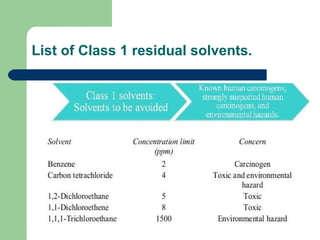
List of Class 1 residual solvents.
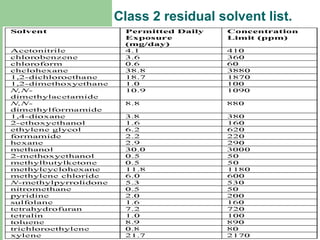
Class 2 residual solvent list.
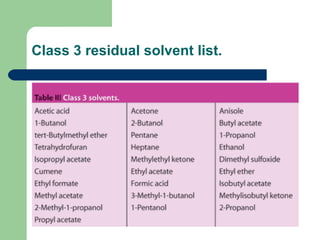
Class 3 residual solvent list.
Analytical procedure.
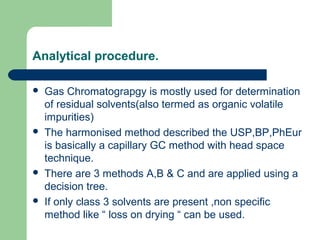
 Gas Chromatograpgy is mostly used for determination
of residual solvents(also termed as organic volatile
impurities)
 The harmonised method described the USP,BP,PhEur
is basically a capillary GC method with head space
technique.
 There are 3 methods A,B & C and are applied using a
decision tree.
 If only class 3 solvents are present ,non specific
method like “ loss on drying “ can be used.
Gas Chromatographic System to
detect residual solvents.
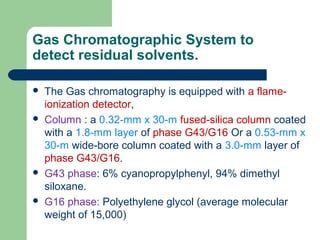
 The Gas chromatography is equipped with a flame-
ionization detector,
 Column : a 0.32-mm x 30-m fused-silica column coated
with a 1.8-mm layer of phase G43/G16 Or a 0.53-mm x
30-m wide-bore column coated with a 3.0-mm layer of
phase G43/G16.
 G43 phase: 6% cyanopropylphenyl, 94% dimethyl
siloxane.
 G16 phase: Polyethylene glycol (average molecular
weight of 15,000)
Continued..
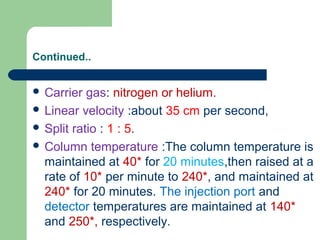
 Carrier gas: nitrogen or helium.
 Linear velocity :about 35 cm per second,
 Split ratio : 1 : 5.
 Column temperature :The column temperature is
maintained at 40* for 20 minutes,then raised at a
rate of 10* per minute to 240*, and maintained at
240* for 20 minutes. The injection port and
detector temperatures are maintained at 140*
and 250*, respectively.
Published Methodologies in USP
Procedure A
Chromatographic Conditions:
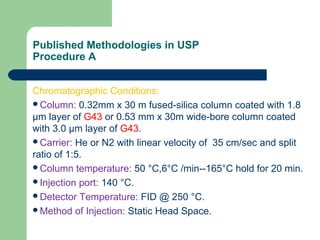
Column: 0.32mm x 30 m fused-silica column coated with 1.8
μm layer of G43 or 0.53 mm x 30m wide-bore column coated
with 3.0 μm layer of G43.
Carrier: He or N2 with linear velocity of 35 cm/sec and split
ratio of 1:5.
Column temperature: 50 °C,6°C /min--165°C hold for 20 min.
Injection port: 140 °C.
Detector Temperature: FID @ 250 °C.
Method of Injection: Static Head Space.
Published Methodologies in USP
Procedure B
Chromatographic Conditions:
GC-FID
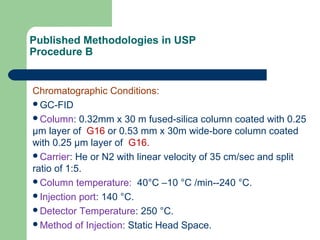
Column: 0.32mm x 30 m fused-silica column coated with 0.25
μm layer of G16 or 0.53 mm x 30m wide-bore column coated
with 0.25 μm layer of G16.
Carrier: He or N2 with linear velocity of 35 cm/sec and split
ratio of 1:5.
Column temperature: 40°C –10 °C /min--240 °C.
Injection port: 140 °C.
Detector Temperature: 250 °C.
Method of Injection: Static Head Space.
Published Methodologies in USP
Procedure C
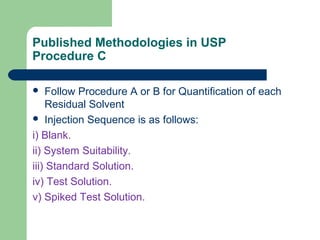
 Follow Procedure A or B for Quantification of each
Residual Solvent
 Injection Sequence is as follows:
i) Blank.
ii) System Suitability.
iii) Standard Solution.
iv) Test Solution.
v) Spiked Test Solution.
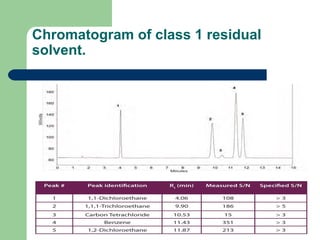
Chromatogram of class 1 residual
solvent.
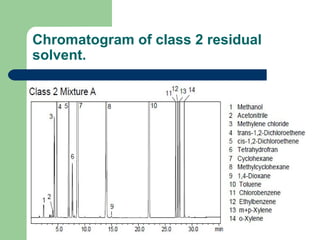
Chromatogram of class 2 residual
solvent.
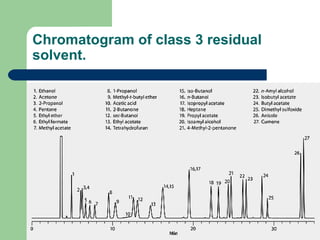
Chromatogram of class 3 residual
solvent.
Residual solvent

Residual solvent

  • 1.
    DETERMINATION OF RESIDUALSOLVENTS BY GAS CHROMATOGRAPHY ACCORDING TO ICH GUIDE LINES. BY , Saptarshi Das. M.pharm, Pharmaceutical Analysis. Bengal School of Technology.
  • 2.
    INTRODUCTION  “Residual solventsin pharmaceuticals are defined as organic volatile chemicals that are used or produced in the manufacture of drug substances or excipients, or in the preparation of drug products.” (ICH, USP, EP) [Note: residual solvents´ refers to the amount not removed during the purification of the product´]
  • 3.
    RESIDUAL SOLVENTS  Residualsolvents are one of the three main types of impurities in pharmaceutical articles,the other two being organic impurities and inorganic impurities.  Therefore, standards to control the strength,quality, and purity of official pharmaceutical articles in the United States Pharmacopeia (USP) and the National Formulary (NF),British Pharmacopeia (BP) and Most National Pharmacopoeia frequently include a test for residual solvents, together with procedures for the test and acceptance criteria.
  • 4.
    Risk based classificationof residual solvents.  Class 1- should not be employed in the manufacture of drug substances, excipients, and drug products because of the unacceptable toxicities or deleterious environmental effects of these residual solvents.  Class 2- should be limited in drug substances, excipients, and drug products because of the inherent toxicities of the residual solvents.  Class 3- may be regarded as less toxic and of lower risk to human health.
  • 5.
    List of Class1 residual solvents.
  • 6.
    Class 2 residualsolvent list.
  • 7.
    Class 3 residualsolvent list.
  • 8.
    Analytical procedure.  GasChromatograpgy is mostly used for determination of residual solvents(also termed as organic volatile impurities)  The harmonised method described the USP,BP,PhEur is basically a capillary GC method with head space technique.  There are 3 methods A,B & C and are applied using a decision tree.  If only class 3 solvents are present ,non specific method like “ loss on drying “ can be used.
  • 9.
    Gas Chromatographic Systemto detect residual solvents.  The Gas chromatography is equipped with a flame- ionization detector,  Column : a 0.32-mm x 30-m fused-silica column coated with a 1.8-mm layer of phase G43/G16 Or a 0.53-mm x 30-m wide-bore column coated with a 3.0-mm layer of phase G43/G16.  G43 phase: 6% cyanopropylphenyl, 94% dimethyl siloxane.  G16 phase: Polyethylene glycol (average molecular weight of 15,000)
  • 10.
    Continued..  Carrier gas:nitrogen or helium.  Linear velocity :about 35 cm per second,  Split ratio : 1 : 5.  Column temperature :The column temperature is maintained at 40* for 20 minutes,then raised at a rate of 10* per minute to 240*, and maintained at 240* for 20 minutes. The injection port and detector temperatures are maintained at 140* and 250*, respectively.
  • 11.
    Published Methodologies inUSP Procedure A Chromatographic Conditions: Column: 0.32mm x 30 m fused-silica column coated with 1.8 μm layer of G43 or 0.53 mm x 30m wide-bore column coated with 3.0 μm layer of G43. Carrier: He or N2 with linear velocity of 35 cm/sec and split ratio of 1:5. Column temperature: 50 °C,6°C /min--165°C hold for 20 min. Injection port: 140 °C. Detector Temperature: FID @ 250 °C. Method of Injection: Static Head Space.
  • 12.
    Published Methodologies inUSP Procedure B Chromatographic Conditions: GC-FID Column: 0.32mm x 30 m fused-silica column coated with 0.25 μm layer of G16 or 0.53 mm x 30m wide-bore column coated with 0.25 μm layer of G16. Carrier: He or N2 with linear velocity of 35 cm/sec and split ratio of 1:5. Column temperature: 40°C –10 °C /min--240 °C. Injection port: 140 °C. Detector Temperature: 250 °C. Method of Injection: Static Head Space.
  • 13.
    Published Methodologies inUSP Procedure C  Follow Procedure A or B for Quantification of each Residual Solvent  Injection Sequence is as follows: i) Blank. ii) System Suitability. iii) Standard Solution. iv) Test Solution. v) Spiked Test Solution.
  • 14.
    Chromatogram of class1 residual solvent.
  • 15.
    Chromatogram of class2 residual solvent.
  • 16.
    Chromatogram of class3 residual solvent.