FIRE SAFETY
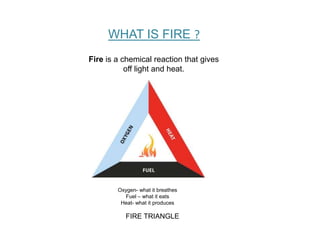
Fire is a chemical reaction that gives
off light and heat.
WHAT IS FIRE ?
FIRE TRIANGLE
Oxygen- what it breathes
Fuel – what it eats
Heat- what it produces
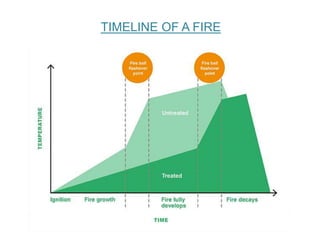
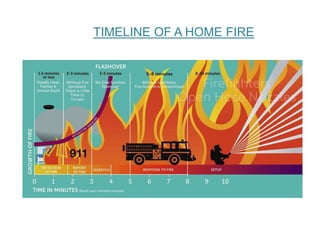
TIMELINE OF A FIRE
TIMELINE OF A HOME FIRE
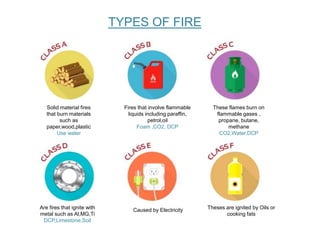
TYPES OF FIRE
Solid material fires
that burn materials
such as
paper,wood,plastic
Use water
Fires that involve flammable
liquids including paraffin,
petrol,oil
Foam ,CO2, DCP
These flames burn on
flammable gases ,
propane, butane,
methane
CO2,Water,DCP
Are fires that ignite with
metal such as Al,MG,Ti
DCP,Limestone,Soil
Caused by Electricity Theses are ignited by Oils or
cooking fats
CLASSIFICATION OF
BUILDING
[AS PER NBC 2015]
GROUP - A
GROUP - B
GROUP - C
GROUP - D
GROUP - E
GROUP - F
GROUP - G
GROUP -H
GROUP -J
RESIDENTIAL
EDUCATIONAL
INSTITUTIONAL
ASSEMBLY
BUSINESS
COMMERCIAL
INDUSTRIAL
STORAGE
HAZARDOUS
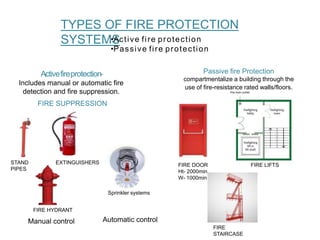
TYPES OF FIRE PROTECTION
SYSTEMS•Active fire protection
•Passive fire protection
Activefireprotection-
Includes manual or automatic fire
detection and fire suppression.
Manual control Automatic control
STAND
PIPES
EXTINGUISHERS
FIRE HYDRANT
Sprinkler systems
FIRE SUPPRESSION
Passive fire Protection
compartmentalize a building through the
use of fire-resistance rated walls/floors.
FIRE DOOR
Ht- 2000min
W- 1000min
FIRE LIFTS
FIRE
STAIRCASE
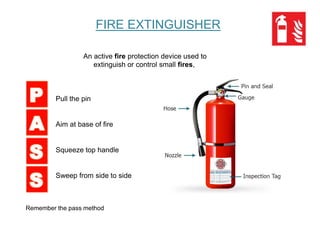
FIRE EXTINGUISHER
An active fire protection device used to
extinguish or control small fires,
Pull the pin
Aim at base of fire
Squeeze top handle
Sweep from side to side
Remember the pass method
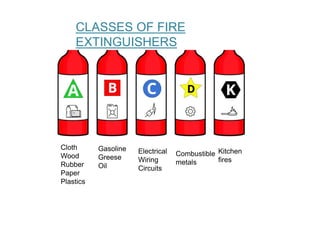
CLASSES OF FIRE
EXTINGUISHERS
Cloth
Wood
Rubber
Paper
Plastics
Gasoline
Greese
Oil
Electrical
Wiring
Circuits
Combustible
metals
Kitchen
fires
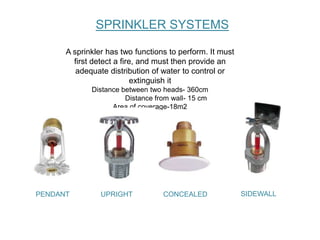
A sprinkler has two functions to perform. It must
first detect a fire, and must then provide an
adequate distribution of water to control or
extinguish it
Distance between two heads- 360cm
Distance from wall- 15 cm
Area of coverage-18m2
SPRINKLER SYSTEMS
PENDANT UPRIGHT CONCEALED SIDEWALL
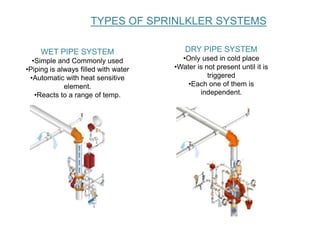
TYPES OF SPRINLKLER SYSTEMS
WET PIPE SYSTEM
•Simple and Commonly used
•Piping is always filled with water
•Automatic with heat sensitive
element.
•Reacts to a range of temp.
DRY PIPE SYSTEM
•Only used in cold place
•Water is not present until it is
triggered
•Each one of them is
independent.
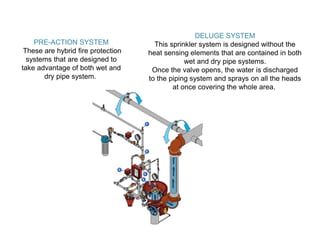
PRE-ACTION SYSTEM
These are hybrid fire protection
systems that are designed to
take advantage of both wet and
dry pipe system.
DELUGE SYSTEM
This sprinkler system is designed without the
heat sensing elements that are contained in both
wet and dry pipe systems.
Once the valve opens, the water is discharged
to the piping system and sprays on all the heads
at once covering the whole area.
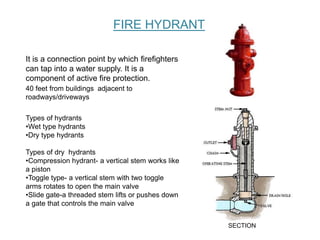
FIRE HYDRANT
It is a connection point by which firefighters
can tap into a water supply. It is a
component of active fire protection.
SECTION
Types of hydrants
•Wet type hydrants
•Dry type hydrants
Types of dry hydrants
•Compression hydrant- a vertical stem works like
a piston
•Toggle type- a vertical stem with two toggle
arms rotates to open the main valve
•Slide gate-a threaded stem lifts or pushes down
a gate that controls the main valve
40 feet from buildings adjacent to
roadways/driveways
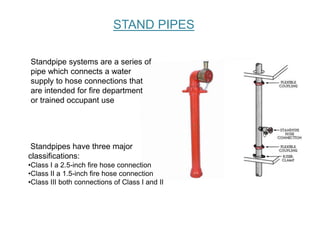
STAND PIPES
Standpipe systems are a series of
pipe which connects a water
supply to hose connections that
are intended for fire department
or trained occupant use
Standpipes have three major
classifications:
•Class I a 2.5-inch fire hose connection
•Class II a 1.5-inch fire hose connection
•Class III both connections of Class I and II
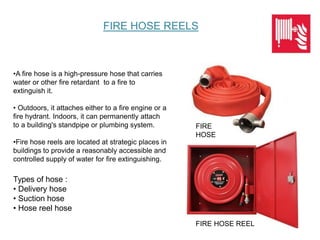
•A fire hose is a high-pressure hose that carries
water or other fire retardant to a fire to
extinguish it.
• Outdoors, it attaches either to a fire engine or a
fire hydrant. Indoors, it can permanently attach
to a building's standpipe or plumbing system.
•Fire hose reels are located at strategic places in
buildings to provide a reasonably accessible and
controlled supply of water for fire extinguishing.
FIRE HOSE REELS
FIRE
HOSE
FIRE HOSE REEL
Types of hose :
• Delivery hose
• Suction hose
• Hose reel hose
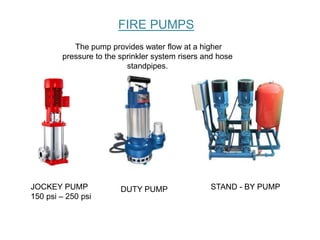
FIRE PUMPS
The pump provides water flow at a higher
pressure to the sprinkler system risers and hose
standpipes.
JOCKEY PUMP
150 psi – 250 psi
DUTY PUMP STAND - BY PUMP
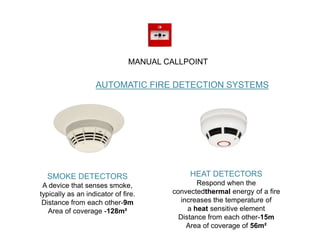
AUTOMATIC FIRE DETECTION SYSTEMS
HEAT DETECTORS
Respond when the
convectedthermal energy of a fire
increases the temperature of
a heat sensitive element
Distance from each other-15m
Area of coverage of 56m²
SMOKE DETECTORS
A device that senses smoke,
typically as an indicator of fire.
Distance from each other-9m
Area of coverage -128m²
MANUAL CALLPOINT
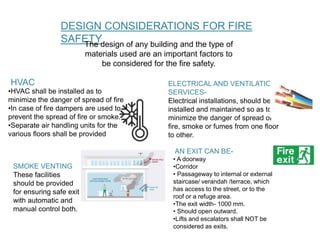
DESIGN CONSIDERATIONS FOR FIRE
SAFETYThe design of any building and the type of
materials used are an important factors to
be considered for the fire safety.
•HVAC shall be installed as to
minimize the danger of spread of fire
•In case of fire dampers are used to
prevent the spread of fire or smoke.
•Separate air handling units for the
various floors shall be provided
HVAC ELECTRICAL AND VENTILATION
SERVICES-
Electrical installations, should be
installed and maintained so as to
minimize the danger of spread of
fire, smoke or fumes from one floor
to other.
SMOKE VENTING
These facilities
should be provided
for ensuring safe exit
with automatic and
manual control both.
AN EXIT CAN BE-
• A doorway
•Corridor
• Passageway to internal or external
staircase/ verandah /terrace, which
has access to the street, or to the
roof or a refuge area.
•The exit width- 1000 mm.
• Should open outward.
•Lifts and escalators shall NOT be
considered as exits.
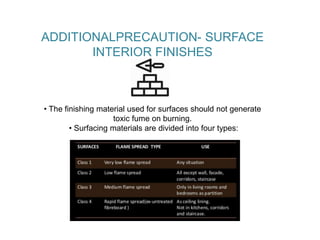
ADDITIONALPRECAUTION- SURFACE
INTERIOR FINISHES
• The finishing material used for surfaces should not generate
toxic fume on burning.
• Surfacing materials are divided into four types:
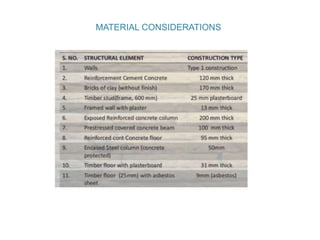
MATERIAL CONSIDERATIONS
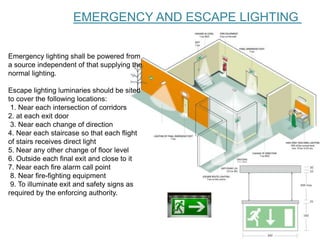
Emergency lighting shall be powered from
a source independent of that supplying the
normal lighting.
Escape lighting luminaries should be sited
to cover the following locations:
1. Near each intersection of corridors
2. at each exit door
3. Near each change of direction
4. Near each staircase so that each flight
of stairs receives direct light
5. Near any other change of floor level
6. Outside each final exit and close to it
7. Near each fire alarm call point
8. Near fire-fighting equipment
9. To illuminate exit and safety signs as
required by the enforcing authority.
EMERGENCY AND ESCAPE LIGHTING
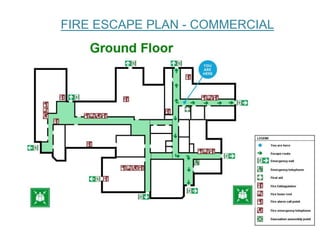
FIRE ESCAPE PLAN - COMMERCIAL
THANK YOU
PRESENTED BY
LINA
ANOUSHKA
CATHERINE

FIRE SAFETY - Anoushka Aggarwal

  • 1.
  • 2.
    Fire is achemical reaction that gives off light and heat. WHAT IS FIRE ? FIRE TRIANGLE Oxygen- what it breathes Fuel – what it eats Heat- what it produces
  • 3.
  • 4.
    TIMELINE OF AHOME FIRE
  • 5.
    TYPES OF FIRE Solidmaterial fires that burn materials such as paper,wood,plastic Use water Fires that involve flammable liquids including paraffin, petrol,oil Foam ,CO2, DCP These flames burn on flammable gases , propane, butane, methane CO2,Water,DCP Are fires that ignite with metal such as Al,MG,Ti DCP,Limestone,Soil Caused by Electricity Theses are ignited by Oils or cooking fats
  • 6.
    CLASSIFICATION OF BUILDING [AS PERNBC 2015] GROUP - A GROUP - B GROUP - C GROUP - D GROUP - E GROUP - F GROUP - G GROUP -H GROUP -J RESIDENTIAL EDUCATIONAL INSTITUTIONAL ASSEMBLY BUSINESS COMMERCIAL INDUSTRIAL STORAGE HAZARDOUS
  • 7.
    TYPES OF FIREPROTECTION SYSTEMS•Active fire protection •Passive fire protection Activefireprotection- Includes manual or automatic fire detection and fire suppression. Manual control Automatic control STAND PIPES EXTINGUISHERS FIRE HYDRANT Sprinkler systems FIRE SUPPRESSION Passive fire Protection compartmentalize a building through the use of fire-resistance rated walls/floors. FIRE DOOR Ht- 2000min W- 1000min FIRE LIFTS FIRE STAIRCASE
  • 8.
    FIRE EXTINGUISHER An activefire protection device used to extinguish or control small fires, Pull the pin Aim at base of fire Squeeze top handle Sweep from side to side Remember the pass method
  • 9.
  • 10.
    A sprinkler hastwo functions to perform. It must first detect a fire, and must then provide an adequate distribution of water to control or extinguish it Distance between two heads- 360cm Distance from wall- 15 cm Area of coverage-18m2 SPRINKLER SYSTEMS PENDANT UPRIGHT CONCEALED SIDEWALL
  • 11.
    TYPES OF SPRINLKLERSYSTEMS WET PIPE SYSTEM •Simple and Commonly used •Piping is always filled with water •Automatic with heat sensitive element. •Reacts to a range of temp. DRY PIPE SYSTEM •Only used in cold place •Water is not present until it is triggered •Each one of them is independent.
  • 12.
    PRE-ACTION SYSTEM These arehybrid fire protection systems that are designed to take advantage of both wet and dry pipe system. DELUGE SYSTEM This sprinkler system is designed without the heat sensing elements that are contained in both wet and dry pipe systems. Once the valve opens, the water is discharged to the piping system and sprays on all the heads at once covering the whole area.
  • 13.
    FIRE HYDRANT It isa connection point by which firefighters can tap into a water supply. It is a component of active fire protection. SECTION Types of hydrants •Wet type hydrants •Dry type hydrants Types of dry hydrants •Compression hydrant- a vertical stem works like a piston •Toggle type- a vertical stem with two toggle arms rotates to open the main valve •Slide gate-a threaded stem lifts or pushes down a gate that controls the main valve 40 feet from buildings adjacent to roadways/driveways
  • 14.
    STAND PIPES Standpipe systemsare a series of pipe which connects a water supply to hose connections that are intended for fire department or trained occupant use Standpipes have three major classifications: •Class I a 2.5-inch fire hose connection •Class II a 1.5-inch fire hose connection •Class III both connections of Class I and II
  • 15.
    •A fire hoseis a high-pressure hose that carries water or other fire retardant to a fire to extinguish it. • Outdoors, it attaches either to a fire engine or a fire hydrant. Indoors, it can permanently attach to a building's standpipe or plumbing system. •Fire hose reels are located at strategic places in buildings to provide a reasonably accessible and controlled supply of water for fire extinguishing. FIRE HOSE REELS FIRE HOSE FIRE HOSE REEL Types of hose : • Delivery hose • Suction hose • Hose reel hose
  • 16.
    FIRE PUMPS The pumpprovides water flow at a higher pressure to the sprinkler system risers and hose standpipes. JOCKEY PUMP 150 psi – 250 psi DUTY PUMP STAND - BY PUMP
  • 17.
    AUTOMATIC FIRE DETECTIONSYSTEMS HEAT DETECTORS Respond when the convectedthermal energy of a fire increases the temperature of a heat sensitive element Distance from each other-15m Area of coverage of 56m² SMOKE DETECTORS A device that senses smoke, typically as an indicator of fire. Distance from each other-9m Area of coverage -128m² MANUAL CALLPOINT
  • 18.
    DESIGN CONSIDERATIONS FORFIRE SAFETYThe design of any building and the type of materials used are an important factors to be considered for the fire safety. •HVAC shall be installed as to minimize the danger of spread of fire •In case of fire dampers are used to prevent the spread of fire or smoke. •Separate air handling units for the various floors shall be provided HVAC ELECTRICAL AND VENTILATION SERVICES- Electrical installations, should be installed and maintained so as to minimize the danger of spread of fire, smoke or fumes from one floor to other. SMOKE VENTING These facilities should be provided for ensuring safe exit with automatic and manual control both. AN EXIT CAN BE- • A doorway •Corridor • Passageway to internal or external staircase/ verandah /terrace, which has access to the street, or to the roof or a refuge area. •The exit width- 1000 mm. • Should open outward. •Lifts and escalators shall NOT be considered as exits.
  • 19.
    ADDITIONALPRECAUTION- SURFACE INTERIOR FINISHES •The finishing material used for surfaces should not generate toxic fume on burning. • Surfacing materials are divided into four types:
  • 20.
  • 21.
    Emergency lighting shallbe powered from a source independent of that supplying the normal lighting. Escape lighting luminaries should be sited to cover the following locations: 1. Near each intersection of corridors 2. at each exit door 3. Near each change of direction 4. Near each staircase so that each flight of stairs receives direct light 5. Near any other change of floor level 6. Outside each final exit and close to it 7. Near each fire alarm call point 8. Near fire-fighting equipment 9. To illuminate exit and safety signs as required by the enforcing authority. EMERGENCY AND ESCAPE LIGHTING
  • 22.
    FIRE ESCAPE PLAN- COMMERCIAL
  • 23.