Evaluating Proper Location for
Fire Hydrants on Main Road
Group#57 Members
Muhammad Waqas Khan
Ahsan Shahid
Muhammad Murtaza Ali
Abdul Alim Abbas
Supervisor
Engr. Zohaib
Hasaan
Table of Content
• Introduction
• Problem Statement
• Objectives
• Literature Review
• Discussion on Fire Hydrants
• Progress
Introduction
• Safety from fire hazards is necessary for the sake of life and
financial assets , for which Fire risk management is
recommended .
• Increase in population also increases the no of vehicles used
for transportation and automatically road fire accidents also
take place due to number of factors.
• For such road fire accidents , fire risk management is
necessary and here in Pakistan there is not that much
effective and efficient method for fire risk management ,
which gives quick response to the fire incident.
• So for more effective and efficient fire risk management for
road fire accident , a fire hydrant system installation is
recommended.
Problem Statement
The case study is done for University Road
Peshawar , where the traffic is at its peak due
to which the response to fire road accidents
and mitigation is not done on time because
the fire brigades from rescue departement
1122 located on Mall Road cant reach on
time to the fire incident site which results in
fatalities.
Objectives of Our Final Year Project
• The main purpose of our final year project is to provide
viable and feasible locations for providing fire hydrants on
a major busy road in Peshawar.
• Reducing the response time of mitigation procedures in
case of any fire accident.
• Designing fire hydrant mitigation solution for road fire
accidents.
Literature Review
• Research Journals
• Water for firefighting in five South African towns by (HM Myburgh
and HE Jacobs)
(To investigate Extent of usage of fire hydrants For different Fire
incident categories)
• Evaluation of Fire Flow Methodologies by (Matthew E. Benfer and
Joseph L. Scheffey Hughes Associates, Inc. Baltimore, MD)
( Methods for evaluating fire flow or water demand for fire fighting
for different type of fire related incidents)
• Books
• Firefighting Principles and Practices: 2nd Edition by William
E.Clark
• Fire Fighting & Fire Safety: Concepts, Methods, Tools &
Techniques by ( S.K Rathore).
Literature Review Contd…
• Fire Codes
• National Fire Protection Association (NFPA)
• Building Code Of Pakistan ( BCP ) Fire Safety
Provisions (2016 Edition)
• International Fire Code (IFC)
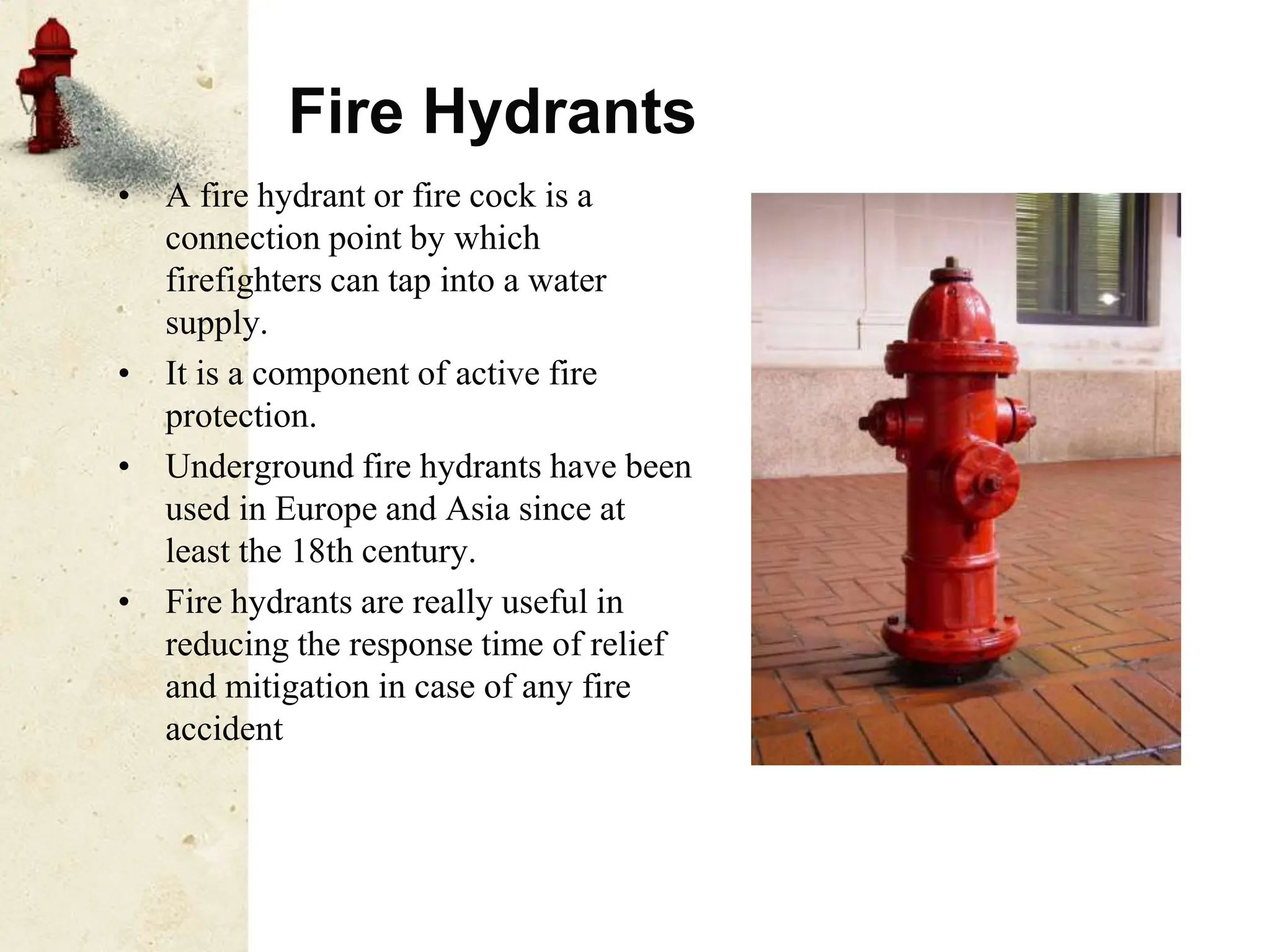
Fire Hydrants
• A fire hydrant or fire cock is a
connection point by which
firefighters can tap into a water
supply.
• It is a component of active fire
protection.
• Underground fire hydrants have been
used in Europe and Asia since at
least the 18th century.
• Fire hydrants are really useful in
reducing the response time of relief
and mitigation in case of any fire
accident
Main nature of working of fire hydrants
• Hydrants are devices for extracting water from pipelines
and water distribution systems.
• In the event of a fire outbreak, a fire hydrant can assure
fast water supply.
• Considered an active fire protection device, fire
hydrants allow firefighters to access a local water
supply quickly.
• Fire hydrants are mainly used to help with the fire
suppression but it is not the only use of fire hydrants.
Contd…….
• The primary purpose of fire hydrants is to supply water
for suppressing fire. However, they can be used for
several secondary purposes like:
• Line Flushing: Due to its high flow capability and easy
operation, fire hydrants can be used to flush main
distribution system lines.
• Testing System: To test the hydraulic capacity of the
distribution system, fire hydrants can be used.
• Other Common uses: Fire hydrants are also frequently
used as a water source for commercial construction
work, sewer cleaning, street construction, street
cleaning, etc.
How does a fire hydrant works?
• Fire hydrants are connected to a large water supply
through underground pipes. When firefighters arrive on
the scene, they connect a hose to the side of the hydrant.
Once the hose is connected, a special wrench with a
pentagon-shaped socket is used to turn the nut on the top
of the hydrant.
• Once the nut is turned, it opens a valve deep
underground that allows water to start to flow into the
hydrant.
Working Contd…..(Opening)
• Lifting the handle raises the connecting rod and plunger
off of the valve seat. The raised plunger allows water to
flow through the valve body and up the stand pipe. In
addition, raising the plunger closes off the drain port.
• The raised plunger closes off the drain port and allows
water to flow through the valve port, past the plunger.
The water then flows through flow channels up the stand
pipe, and finally out the discharge spout.
Working Contd…….. (Closing)
• Closing the handle lowers the connecting rod and
plunger down onto the valve body seat. The
lowered plunger stops water from the service line
and opens the drain port. This allows the water in
the stand pipe to drain back down and out of the
drain port into the crushed stone drain bed.
• or proper draining to occur, air must be able enter
in through the spout. Attaching a hose or some
other device to the spout can prevent air from
getting in and therefore stopping the draining
process.
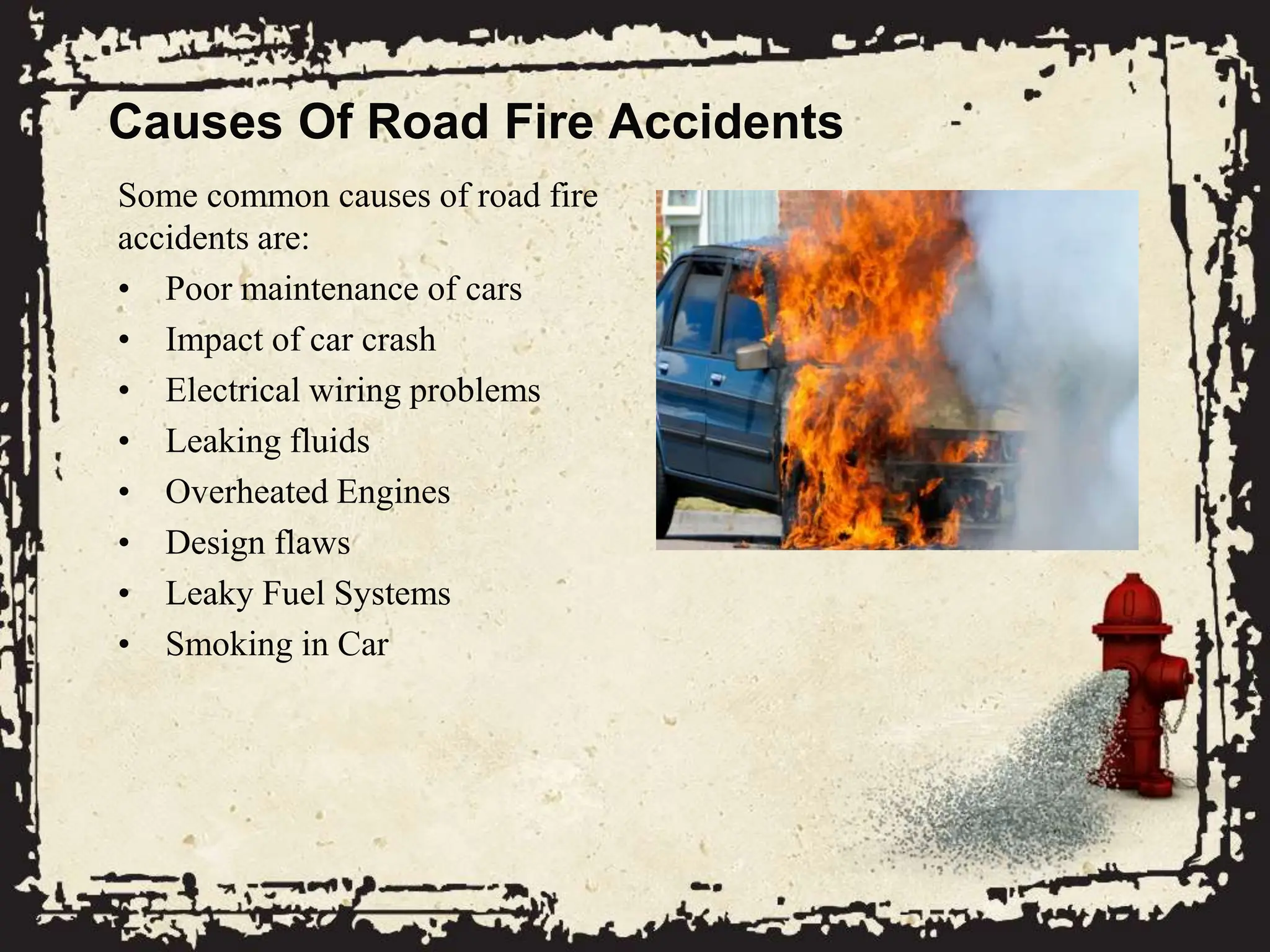
Causes Of Road Fire Accidents
Some common causes of road fire
accidents are:
• Poor maintenance of cars
• Impact of car crash
• Electrical wiring problems
• Leaking fluids
• Overheated Engines
• Design flaws
• Leaky Fuel Systems
• Smoking in Car
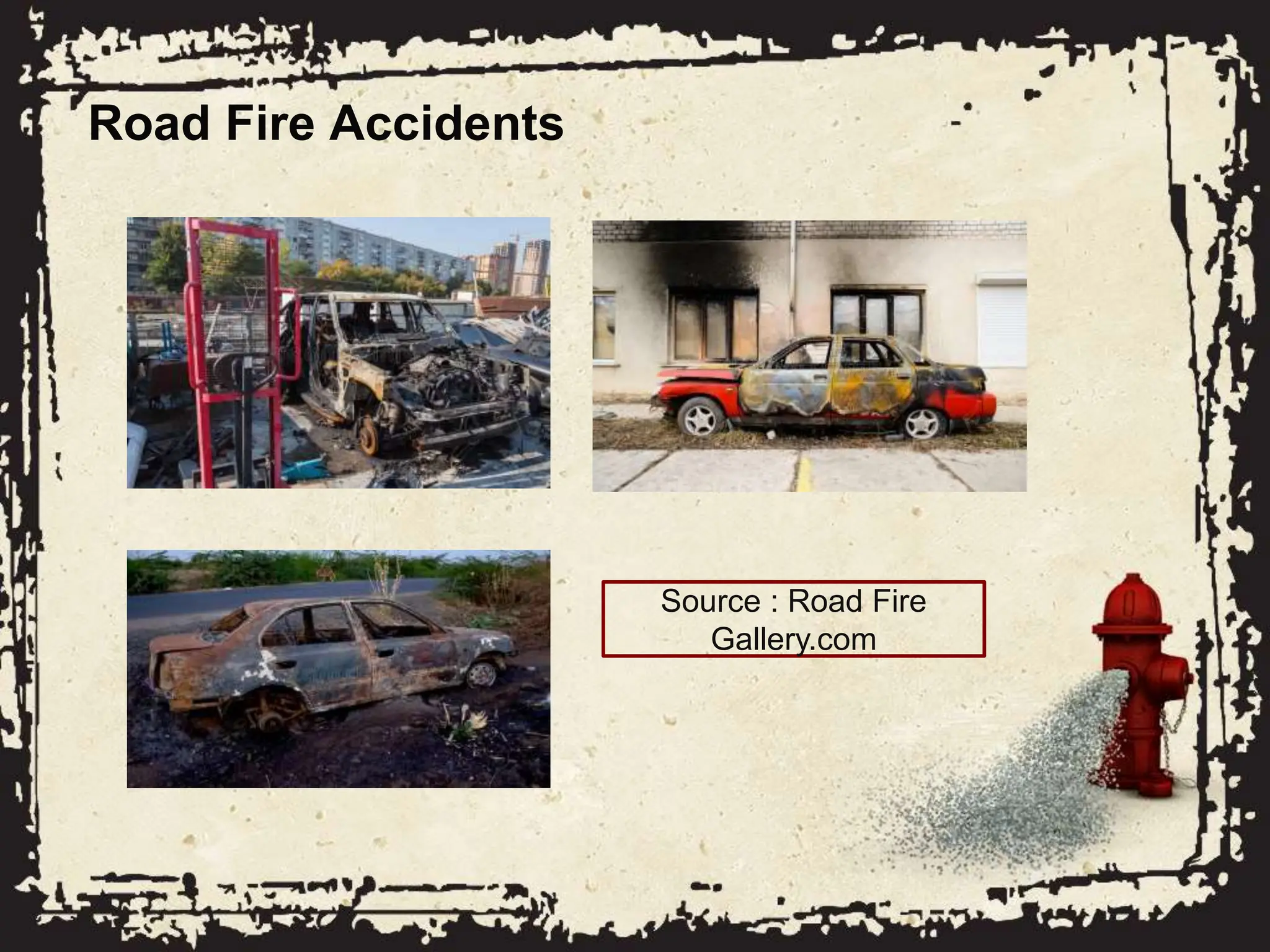
Road Fire Accidents
Source : Road Fire
Gallery.com
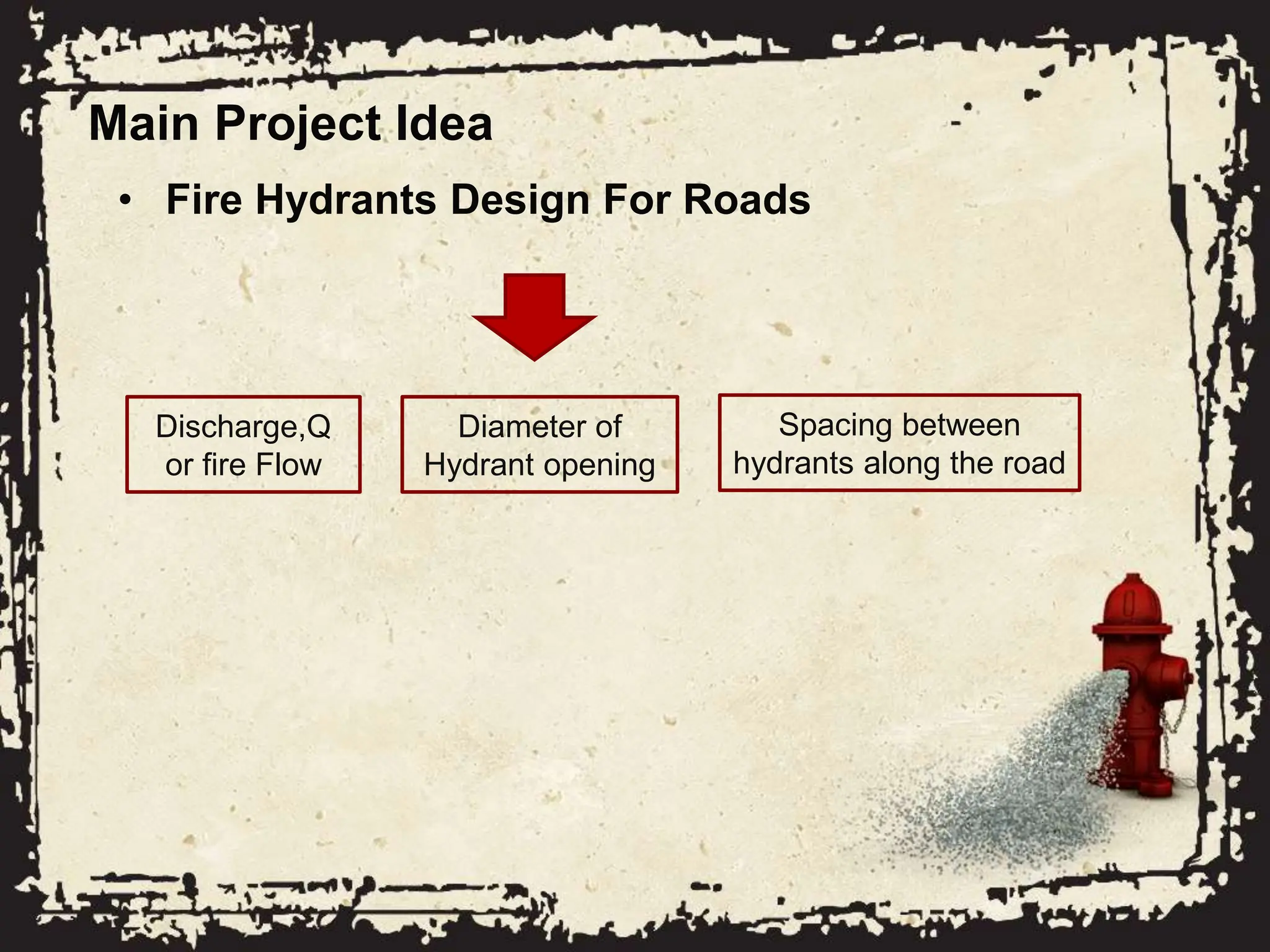
Main Project Idea
• Fire Hydrants Design For Roads
Discharge,Q
or fire Flow
Diameter of
Hydrant opening
Spacing between
hydrants along the road
Progress
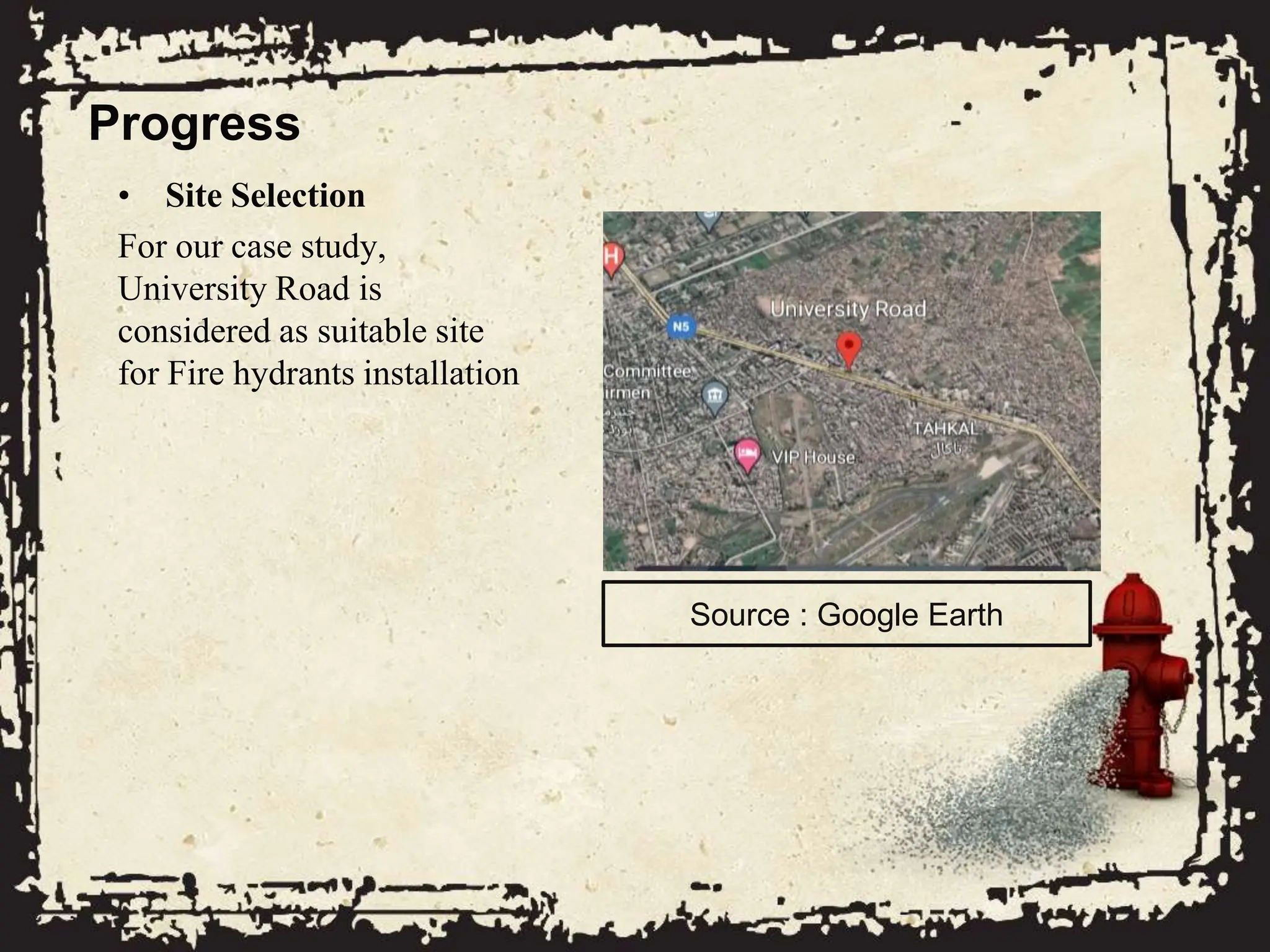
• Site Selection
For our case study,
University Road is
considered as suitable site
for Fire hydrants installation
Source : Google Earth
Progress Contd…
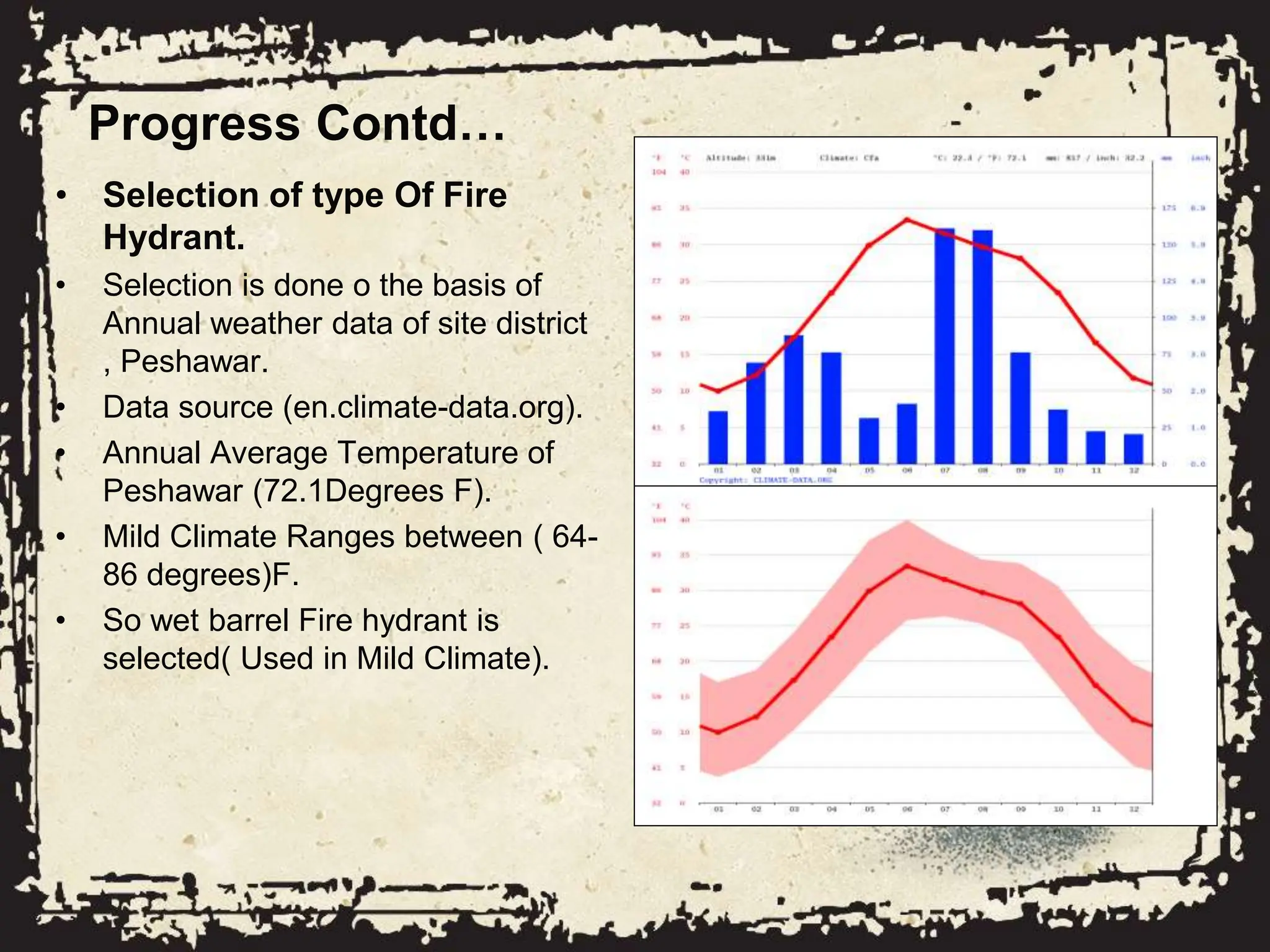
• Selection of type Of Fire
Hydrant.
• Selection is done o the basis of
Annual weather data of site district
, Peshawar.
• Data source (en.climate-data.org).
• Annual Average Temperature of
Peshawar (72.1Degrees F).
• Mild Climate Ranges between ( 64-
86 degrees)F.
• So wet barrel Fire hydrant is
selected( Used in Mild Climate).
On Going Tasks
• Data Collection of Traffic Flow from PDA, No of
Lanes , Road Dimensions, Data of road fire
accidents.
• Making Grid system on Adobe Flash interactive for
determining Spacing between hydrants.
• Methodology study for hydrants spacing.
Remaining Tasks
• Fire Flow Analysis using Software WaterCAD &
WaterGems.
• Hydrant Design ( Flow , Diameter And Spacing) And
comparison with Fire codes and standards)
• Thesis Report Writing
ANY QUESTIONS ?

Evaluating Proper Location for Fire Hydrants on Main Road

  • 2.
    Evaluating Proper Locationfor Fire Hydrants on Main Road Group#57 Members Muhammad Waqas Khan Ahsan Shahid Muhammad Murtaza Ali Abdul Alim Abbas Supervisor Engr. Zohaib Hasaan
  • 3.
    Table of Content •Introduction • Problem Statement • Objectives • Literature Review • Discussion on Fire Hydrants • Progress
  • 4.
    Introduction • Safety fromfire hazards is necessary for the sake of life and financial assets , for which Fire risk management is recommended . • Increase in population also increases the no of vehicles used for transportation and automatically road fire accidents also take place due to number of factors. • For such road fire accidents , fire risk management is necessary and here in Pakistan there is not that much effective and efficient method for fire risk management , which gives quick response to the fire incident. • So for more effective and efficient fire risk management for road fire accident , a fire hydrant system installation is recommended.
  • 5.
    Problem Statement The casestudy is done for University Road Peshawar , where the traffic is at its peak due to which the response to fire road accidents and mitigation is not done on time because the fire brigades from rescue departement 1122 located on Mall Road cant reach on time to the fire incident site which results in fatalities.
  • 6.
    Objectives of OurFinal Year Project • The main purpose of our final year project is to provide viable and feasible locations for providing fire hydrants on a major busy road in Peshawar. • Reducing the response time of mitigation procedures in case of any fire accident. • Designing fire hydrant mitigation solution for road fire accidents.
  • 7.
    Literature Review • ResearchJournals • Water for firefighting in five South African towns by (HM Myburgh and HE Jacobs) (To investigate Extent of usage of fire hydrants For different Fire incident categories) • Evaluation of Fire Flow Methodologies by (Matthew E. Benfer and Joseph L. Scheffey Hughes Associates, Inc. Baltimore, MD) ( Methods for evaluating fire flow or water demand for fire fighting for different type of fire related incidents) • Books • Firefighting Principles and Practices: 2nd Edition by William E.Clark • Fire Fighting & Fire Safety: Concepts, Methods, Tools & Techniques by ( S.K Rathore).
  • 8.
    Literature Review Contd… •Fire Codes • National Fire Protection Association (NFPA) • Building Code Of Pakistan ( BCP ) Fire Safety Provisions (2016 Edition) • International Fire Code (IFC)
  • 9.
    Fire Hydrants • Afire hydrant or fire cock is a connection point by which firefighters can tap into a water supply. • It is a component of active fire protection. • Underground fire hydrants have been used in Europe and Asia since at least the 18th century. • Fire hydrants are really useful in reducing the response time of relief and mitigation in case of any fire accident
  • 10.
    Main nature ofworking of fire hydrants • Hydrants are devices for extracting water from pipelines and water distribution systems. • In the event of a fire outbreak, a fire hydrant can assure fast water supply. • Considered an active fire protection device, fire hydrants allow firefighters to access a local water supply quickly. • Fire hydrants are mainly used to help with the fire suppression but it is not the only use of fire hydrants.
  • 11.
    Contd……. • The primarypurpose of fire hydrants is to supply water for suppressing fire. However, they can be used for several secondary purposes like: • Line Flushing: Due to its high flow capability and easy operation, fire hydrants can be used to flush main distribution system lines. • Testing System: To test the hydraulic capacity of the distribution system, fire hydrants can be used. • Other Common uses: Fire hydrants are also frequently used as a water source for commercial construction work, sewer cleaning, street construction, street cleaning, etc.
  • 12.
    How does afire hydrant works? • Fire hydrants are connected to a large water supply through underground pipes. When firefighters arrive on the scene, they connect a hose to the side of the hydrant. Once the hose is connected, a special wrench with a pentagon-shaped socket is used to turn the nut on the top of the hydrant. • Once the nut is turned, it opens a valve deep underground that allows water to start to flow into the hydrant.
  • 13.
    Working Contd…..(Opening) • Liftingthe handle raises the connecting rod and plunger off of the valve seat. The raised plunger allows water to flow through the valve body and up the stand pipe. In addition, raising the plunger closes off the drain port. • The raised plunger closes off the drain port and allows water to flow through the valve port, past the plunger. The water then flows through flow channels up the stand pipe, and finally out the discharge spout.
  • 14.
    Working Contd…….. (Closing) •Closing the handle lowers the connecting rod and plunger down onto the valve body seat. The lowered plunger stops water from the service line and opens the drain port. This allows the water in the stand pipe to drain back down and out of the drain port into the crushed stone drain bed. • or proper draining to occur, air must be able enter in through the spout. Attaching a hose or some other device to the spout can prevent air from getting in and therefore stopping the draining process.
  • 15.
    Causes Of RoadFire Accidents Some common causes of road fire accidents are: • Poor maintenance of cars • Impact of car crash • Electrical wiring problems • Leaking fluids • Overheated Engines • Design flaws • Leaky Fuel Systems • Smoking in Car
  • 16.
    Road Fire Accidents Source: Road Fire Gallery.com
  • 17.
    Main Project Idea •Fire Hydrants Design For Roads Discharge,Q or fire Flow Diameter of Hydrant opening Spacing between hydrants along the road
  • 18.
    Progress • Site Selection Forour case study, University Road is considered as suitable site for Fire hydrants installation Source : Google Earth
  • 19.
    Progress Contd… • Selectionof type Of Fire Hydrant. • Selection is done o the basis of Annual weather data of site district , Peshawar. • Data source (en.climate-data.org). • Annual Average Temperature of Peshawar (72.1Degrees F). • Mild Climate Ranges between ( 64- 86 degrees)F. • So wet barrel Fire hydrant is selected( Used in Mild Climate).
  • 20.
    On Going Tasks •Data Collection of Traffic Flow from PDA, No of Lanes , Road Dimensions, Data of road fire accidents. • Making Grid system on Adobe Flash interactive for determining Spacing between hydrants. • Methodology study for hydrants spacing.
  • 21.
    Remaining Tasks • FireFlow Analysis using Software WaterCAD & WaterGems. • Hydrant Design ( Flow , Diameter And Spacing) And comparison with Fire codes and standards) • Thesis Report Writing
  • 22.