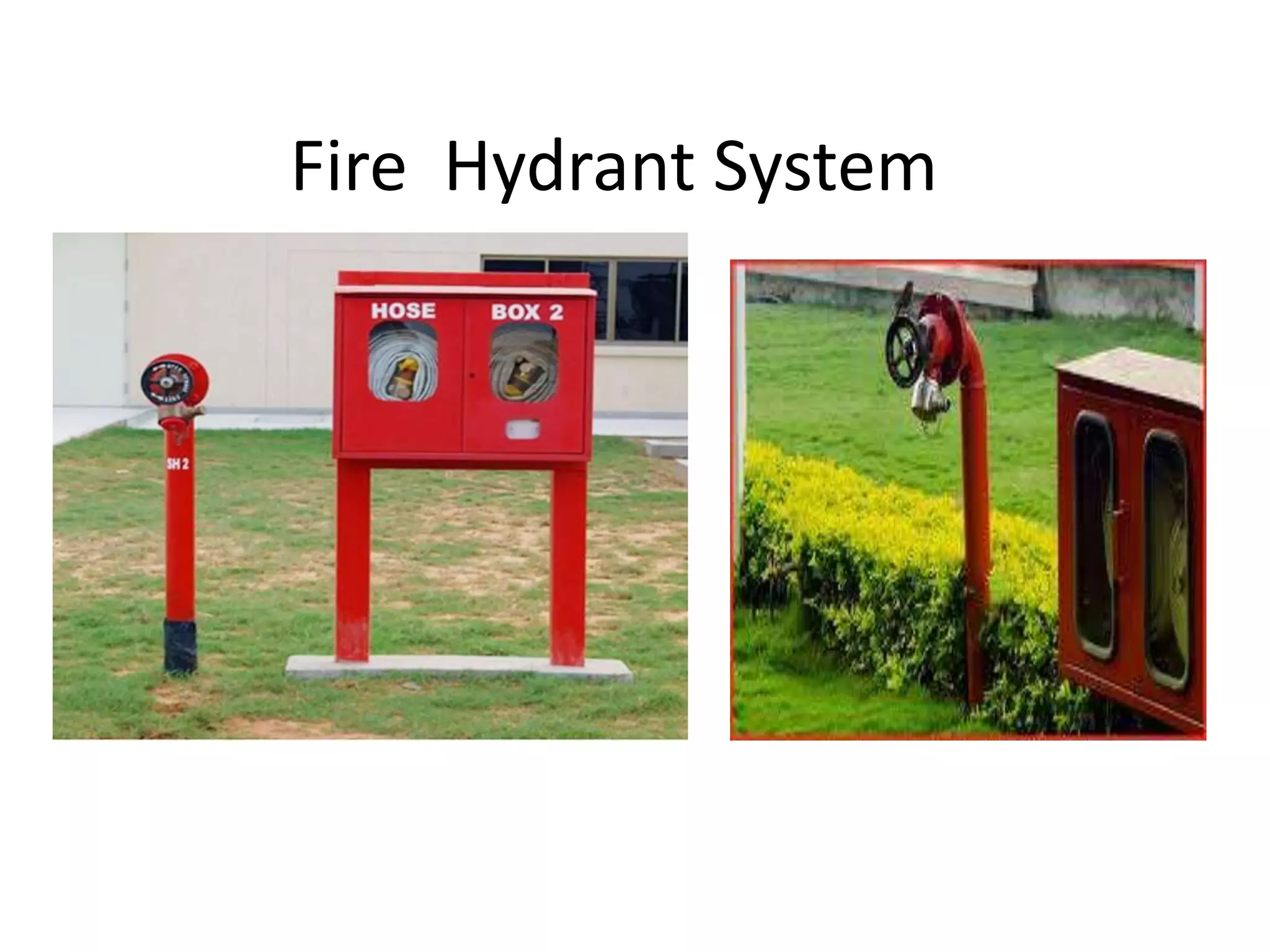
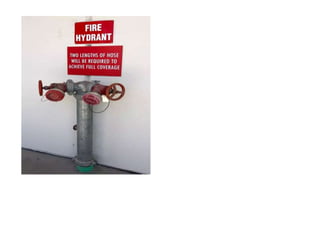
Fire Hydrant System
• Fire Fighting Hydrant Systems are the most commonly used
systems, in many residential and industrial projects. If you
have ever seen a “Red” colour pipe, circulating around a
building or factory, you have seen a Fire Hydrant Pipe.
Introduction
• A fire hydrant is a visible connection point placed in
defined locations for firefighters to tap into a water
supply. All buildings, parking areas, roadsides, mines,
industrial areas, etc. must have fire hydrants.
• They are designed to provide the water required by
firefighters instantly to fight and extinguish a fire.
Basics
• This is very effective extinguishing system suitable for various
plants and high-rise buildings as well as commercial
complexes.
• The system mainly consists of water storage reservoir
(underground or aboveground), pump set, hydrant valves,
hoses, branch pipes with nozzles and hose boxes.
• In case of fire, the hose can be connected to the hydrant valve with the
nozzles at the outlet end and the pump can be started. For automatic
operation of the pump the jockey pump is provided which normally
pressurize the pipes and as soon as the valve is open and pressure
reduces the main pump starts automatically.
How do Fire Hydrant Systems Function?
• A special well is dug, called “Fire Well”, where water is stored throughout
the year for 365days.
• This water well is connected to the pump room. From the pump room,
there are two to three main pipes. These pipes form a network of pipe
that cover the factory compound and the factory.
• The pump has the work, to continuously filling all the pipes connected
with water under pressure. The pressure is nearly 7bar to 10bar.
• When a fire is seen by a person, he activates the hydrant system and
points it in the direction of the fire. A very strong flow of water now,
attacks the fire and the fire is eventually extinguished. The pump
continuously pumps the water to maintain the system pressure.
Advantages
• Fire Hydrant Systems are very strong and can be used from medium to
large sized fires. Fire Hydrant Systems, have a long range. Since the Fire
Hydrant System is spread out, the fire hydrant can attack fire from
different angles. This entire systems requires low maintenance and
virtually, does not leak water. Besides this, Fire Hydrant Systems have a
long life.
• Being fixed installation it is very easy for operation and maintenance.
• For major fire this is most useful system to control and extinguish since the
availability of water and pressure at the base of fire.
• As the hydrant ring outside building is underground there is no hindrance for
vehicles and do not affect due to fire.
Disadvantages of Hydrant system
• There are few disadvantages. The first is that it
has to be manually activated. The flow of Fire
Hydrant System is so strong that, there are
two men required to hold the water hose.
fire hydrant system .pptx

fire hydrant system .pptx

  • 1.
  • 2.
    • Fire FightingHydrant Systems are the most commonly used systems, in many residential and industrial projects. If you have ever seen a “Red” colour pipe, circulating around a building or factory, you have seen a Fire Hydrant Pipe.
  • 3.
    Introduction • A firehydrant is a visible connection point placed in defined locations for firefighters to tap into a water supply. All buildings, parking areas, roadsides, mines, industrial areas, etc. must have fire hydrants. • They are designed to provide the water required by firefighters instantly to fight and extinguish a fire.
  • 4.
    Basics • This isvery effective extinguishing system suitable for various plants and high-rise buildings as well as commercial complexes. • The system mainly consists of water storage reservoir (underground or aboveground), pump set, hydrant valves, hoses, branch pipes with nozzles and hose boxes. • In case of fire, the hose can be connected to the hydrant valve with the nozzles at the outlet end and the pump can be started. For automatic operation of the pump the jockey pump is provided which normally pressurize the pipes and as soon as the valve is open and pressure reduces the main pump starts automatically.
  • 5.
    How do FireHydrant Systems Function? • A special well is dug, called “Fire Well”, where water is stored throughout the year for 365days. • This water well is connected to the pump room. From the pump room, there are two to three main pipes. These pipes form a network of pipe that cover the factory compound and the factory. • The pump has the work, to continuously filling all the pipes connected with water under pressure. The pressure is nearly 7bar to 10bar. • When a fire is seen by a person, he activates the hydrant system and points it in the direction of the fire. A very strong flow of water now, attacks the fire and the fire is eventually extinguished. The pump continuously pumps the water to maintain the system pressure.
  • 6.
    Advantages • Fire HydrantSystems are very strong and can be used from medium to large sized fires. Fire Hydrant Systems, have a long range. Since the Fire Hydrant System is spread out, the fire hydrant can attack fire from different angles. This entire systems requires low maintenance and virtually, does not leak water. Besides this, Fire Hydrant Systems have a long life. • Being fixed installation it is very easy for operation and maintenance. • For major fire this is most useful system to control and extinguish since the availability of water and pressure at the base of fire. • As the hydrant ring outside building is underground there is no hindrance for vehicles and do not affect due to fire.
  • 7.
    Disadvantages of Hydrantsystem • There are few disadvantages. The first is that it has to be manually activated. The flow of Fire Hydrant System is so strong that, there are two men required to hold the water hose.