ECG BASICS
DR SNEHAL
• DEFINITION: An ECG is recording(gram) of the electrical activity(electro)
generated by the cells of the heart(cardio) that reaches the body surface.
• It basically plots
---> Voltage on its vertical axis which is the summation of electrical activation
of all cardiac cells on the body surface. Indicates chamber enlargement and axis.
---> Time on its horizontal axis which indicates HR, Rhythm & intervals
during electrical activity.
HISTORY
• 1842 - Italian scientist Carlo Matteucci realizes that electricity is associated with the
heart beat.
• 1876 - Irish scientist Marey analyzes the electric pattern of frog’s heart.
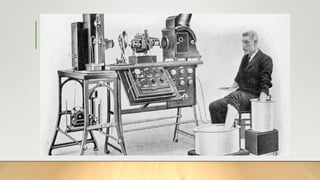
• 1895 - William Einthoven , credited for the invention of EKG.
• 1906 - using the string electrometer EKG, William Einthoven diagnoses some heart
problems.
• 1924 - the noble prize for physiology/medicine is given to William Einthoven for his
work on EKG.
• 1938 - AHA and Cardiac society of Great Britain defined the position of chest leads.
• 1942- Goldberger increased Wilson’s Unipolar lead voltage by 50% and made
Augmented leads(aVR, aVL & aVF).
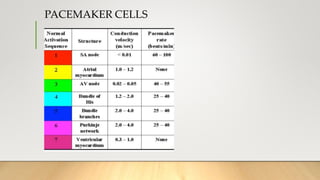
PACEMAKER CELLS
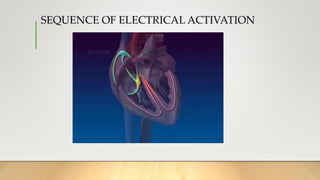
SEQUENCE OF ELECTRICAL ACTIVATION
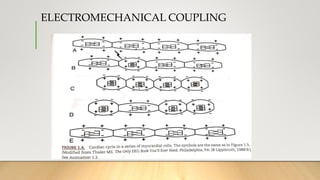
ELECTROMECHANICAL COUPLING
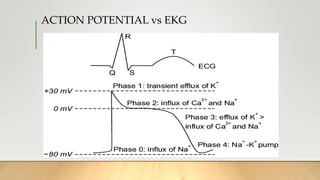
ACTION POTENTIAL vs EKG
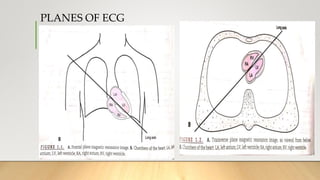
PLANES OF ECG
ECG LEADS
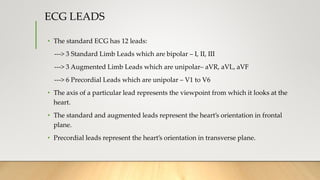
• The standard ECG has 12 leads:
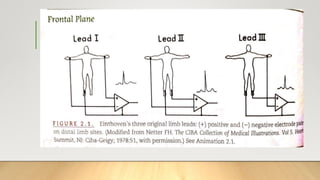
---> 3 Standard Limb Leads which are bipolar – I, II, III
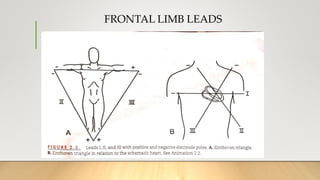
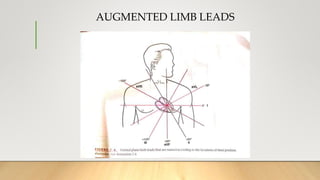
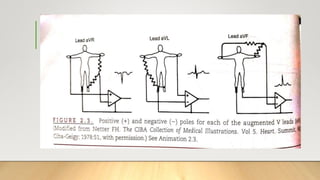
---> 3 Augmented Limb Leads which are unipolar– aVR, aVL, aVF
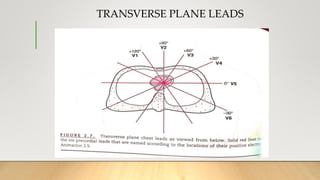
---> 6 Precordial Leads which are unipolar – V1 to V6
• The axis of a particular lead represents the viewpoint from which it looks at the
heart.
• The standard and augmented leads represent the heart’s orientation in frontal
plane.
• Precordial leads represent the heart’s orientation in transverse plane.
FRONTAL LIMB LEADS
AUGMENTED LIMB LEADS
TRANSVERSE PLANE LEADS
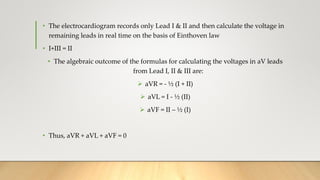
• The electrocardiogram records only Lead I & II and then calculate the voltage in
remaining leads in real time on the basis of Einthoven law
• I+III = II
• The algebraic outcome of the formulas for calculating the voltages in aV leads
from Lead I, II & III are:
 aVR = - ½ (I + II)
 aVL = I - ½ (II)
 aVF = II – ½ (I)
• Thus, aVR + aVL + aVF = 0
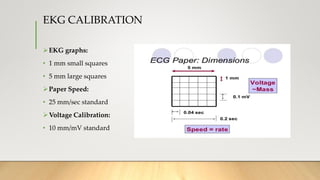
EKG CALIBRATION
EKG graphs:
• 1 mm small squares
• 5 mm large squares
Paper Speed:
• 25 mm/sec standard
Voltage Calibration:
• 10 mm/mV standard
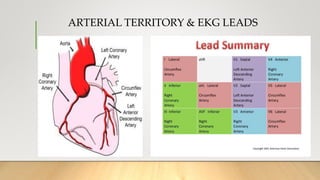
ARTERIAL TERRITORY & EKG LEADS
INTERPRETATION
OF NORMAL ECG
Steps involved
• Heart Rate
• Rhythm
• Axis
• Wave morphology
• Intervals and segments analysis
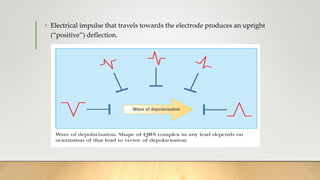
• Electrical impulse that travels towards the electrode produces an upright
(“positive”) deflection.
Determining the Heart Rate
• Rule of 300
• Rule of 1500
• 10 second rule
Rule of 300
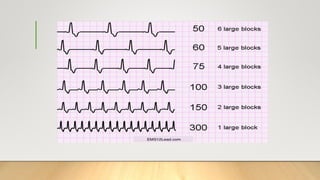
• 300 divided by number of big boxes between RR interval.
• EKG speed is 25mm/sec ---> 5 big box ---> so, per minute
is 5 x 60 = 300 box.
• This works only when rhythm is regular.
• Better applicable when HR < 100.
Rule of 1500
• 1500 divided by number of small boxes between RR
interval.
• Each big box contains 5 small boxes, hence 300 x 5 = 1500.
• Better applicable during tachycardia ( HR > 100).
Rule of 10
• Used when rhythm is irregular
• Rhythm strip runs for 10 sec ---> count number of QRS in
10sec strip & multiply by 6
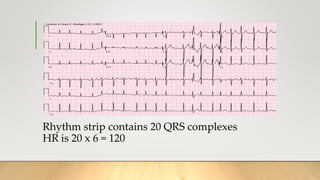
Rhythm strip contains 20 QRS complexes
HR is 20 x 6 = 120
Axis determination
• The QRS axis represents the net overall direction of the heart’s electrical activity.
• Abnormalities of axis can hint at:
---> Ventricular enlargement
---> Conduction blocks (i.e. hemiblocks)
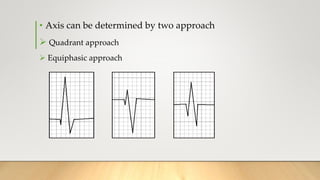
• Axis can be determined by two approach
 Quadrant approach
 Equiphasic approach
QRS genesis
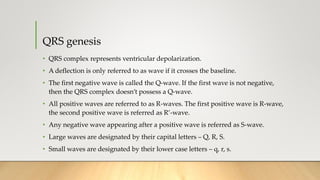
• QRS complex represents ventricular depolarization.
• A deflection is only referred to as wave if it crosses the baseline.
• The first negative wave is called the Q-wave. If the first wave is not negative,
then the QRS complex doesn’t possess a Q-wave.
• All positive waves are referred to as R-waves. The first positive wave is R-wave,
the second positive wave is referred as R’-wave.
• Any negative wave appearing after a positive wave is referred as S-wave.
• Large waves are designated by their capital letters – Q, R, S.
• Small waves are designated by their lower case letters – q, r, s.
Contd..
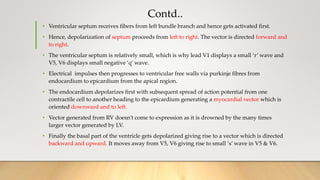
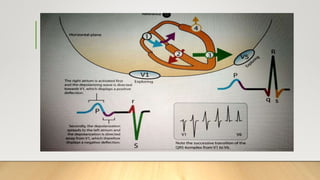
• Ventricular septum receives fibers from left bundle branch and hence gets activated first.
• Hence, depolarization of septum proceeds from left to right. The vector is directed forward and
to right.
• The ventricular septum is relatively small, which is why lead V1 displays a small ‘r’ wave and
V5, V6 displays small negative ‘q’ wave.
• Electrical impulses then progresses to ventricular free walls via purkinje fibres from
endocardium to epicardium from the apical region.
• The endocardium depolarizes first with subsequent spread of action potential from one
contractile cell to another heading to the epicardium generating a myocardial vector which is
oriented downward and to left.
• Vector generated from RV doesn’t come to expression as it is drowned by the many times
larger vector generated by LV.
• Finally the basal part of the ventricle gets depolarized giving rise to a vector which is directed
backward and upward. It moves away from V5, V6 giving rise to small ‘s’ wave in V5 & V6.
Contd..
• q – waves are present only in leftward oriented leads – I, aVL, V5, V6.
• Presence of ‘q’ in V1, V2, V3 is pathological.
• Presence of ‘q’ wave in rightward oriented leads should not qualify for the
criteria of pathological ‘q’ wave.
• Pathological q-wave - > 40msec in width and > 25% of QRS amplitude present in
two contiguous lead.
• R-wave should progress from V1---->V5. Tallest in V5 & V6 having a dominant
R-wave.
Pathological q-waves other than infarction
• LVH / RVH
• Bundle branch blocks / Fascicular blocks
• Pre-excitation syndrome
• Left pneumothorax
• Acute cor pulmonale
• Cardiomyopathies
• Amyloidosis
• Dextrocardia
• perimyocarditis
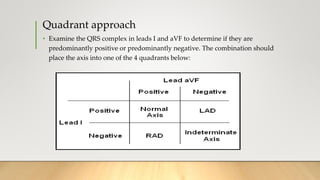
Quadrant approach
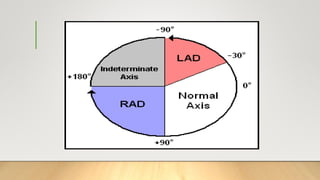
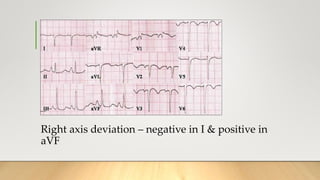
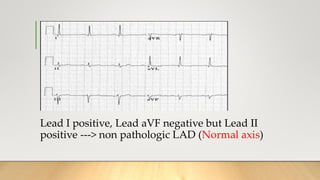
• Examine the QRS complex in leads I and aVF to determine if they are
predominantly positive or predominantly negative. The combination should
place the axis into one of the 4 quadrants below:
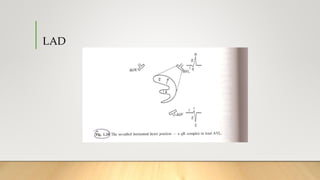
LAD
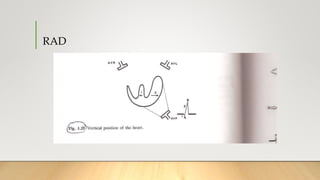
RAD
Right axis deviation – negative in I & positive in
aVF
Lead I positive, Lead aVF negative but Lead II
positive ---> non pathologic LAD (Normal axis)
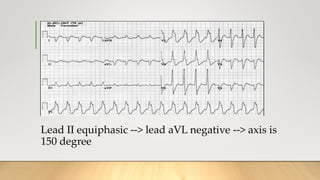
Equiphasic approach
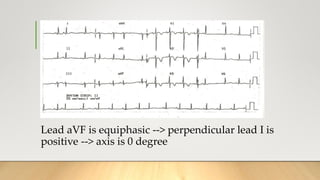
• Most equiphasic QRS complex.
• Identified Lead lies 90° away from the equiphasic lead.
• The fact that QRS complex is equally positive and negative indicates that the net
vector is perpendicular to the axis of this particular lead.
• Next see if in perpendicular lead QRS is upright or negative.
• If upright, that is the QRS axis.
• If negative, move 90 degree away in the opposite direction of the perpendicular
lead.
Lead aVF is equiphasic --> perpendicular lead I is
positive --> axis is 0 degree
Lead II equiphasic --> lead aVL negative --> axis is
150 degree
• kjkg
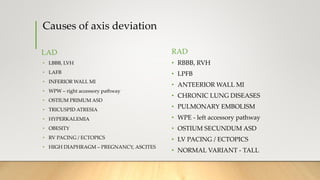
Causes of axis deviation
LAD
• LBBB, LVH
• LAFB
• INFERIOR WALL MI
• WPW – right accessory pathway
• OSTIUM PRIMUM ASD
• TRICUSPID ATRESIA
• HYPERKALEMIA
• OBESITY
• RV PACING / ECTOPICS
• HIGH DIAPHRAGM – PREGNANCY, ASCITES
RAD
• RBBB, RVH
• LPFB
• ANTEERIOR WALL MI
• CHRONIC LUNG DISEASES
• PULMONARY EMBOLISM
• WPE - left accessory pathway
• OSTIUM SECUNDUM ASD
• LV PACING / ECTOPICS
• NORMAL VARIANT - TALL
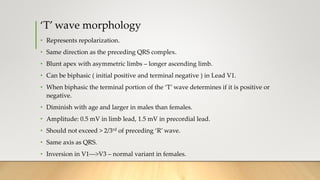
‘T’ wave morphology
• Represents repolarization.
• Same direction as the preceding QRS complex.
• Blunt apex with asymmetric limbs – longer ascending limb.
• Can be biphasic ( initial positive and terminal negative ) in Lead V1.
• When biphasic the terminal portion of the ‘T’ wave determines if it is positive or
negative.
• Diminish with age and larger in males than females.
• Amplitude: 0.5 mV in limb lead, 1.5 mV in precordial lead.
• Should not exceed > 2/3rd of preceding ‘R’ wave.
• Same axis as QRS.
• Inversion in V1--->V3 – normal variant in females.
‘P’ wave morphology
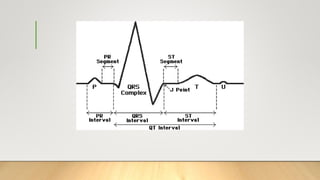
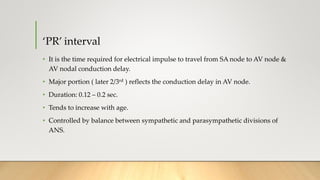
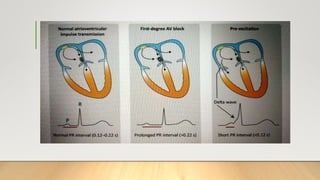
‘PR’ interval
• It is the time required for electrical impulse to travel from SA node to AV node &
AV nodal conduction delay.
• Major portion ( later 2/3rd ) reflects the conduction delay in AV node.
• Duration: 0.12 – 0.2 sec.
• Tends to increase with age.
• Controlled by balance between sympathetic and parasympathetic divisions of
ANS.
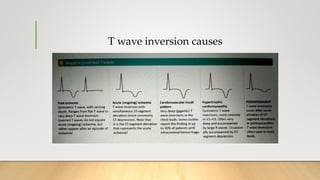
T wave inversion causes
‘ST’ SEGMENT MORPHOLOGY
• Represents preliminary phase of repolarization.
• Forms ‘J’ point at its junction with QRS – forms a distinct angle with the
downslope of ‘R’ or upslope of ‘S’ wave.
• Proceeds horizontally and curves gently into ‘T’ wave.
• Located at same horizontal level as the baseline formed by ‘TP’ segment.
• Displacement upto 1mm ( upward or downward) is common in precordial leads
especially V1--->V3.
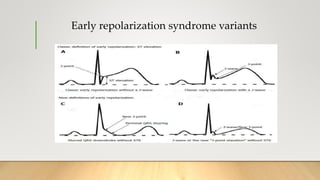
• Early repolarization variants are considered normal except in symptomatic and
high risk individuals.
Early repolarization syndrome variants
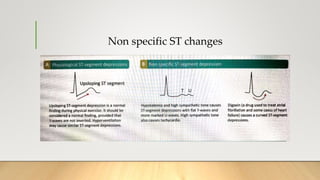
Non specific ST changes
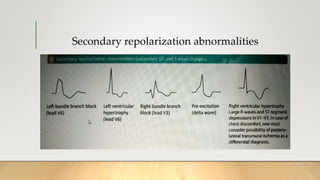
Secondary repolarization abnormalities
Causes of ST segment elevation
• Acute MI
• Left bundle branch block (brugada)
• Acute pericarditis
• Benign early repolarization
syndrome
• Hyperkalemia
• LV aneurysm
• Brugada syndrome
• Pulmonary embolism
• Pneumothorax
• Aortic dissection
• Hypothermia
• CNS pathologies with raised ICT
• Prinzmetals’s angina
• Post electrical cardioversion
• Short QT syndrome ( V3 to V5)
• Cholecystitis / subdiaphragmatic
abscess
• Cocaine abuse
• Drugs- digoxin, isoprenaline,
quinidine, procainamide, TCA’s
Causes of ST segment depression
• Ischemia
• LVH
• Hypokalemia
• Hypomagnesemia
• ICH
• Digoxin effect
• Post electrical cardioversion
• Exercise and deep inspiration
‘QT’ interval
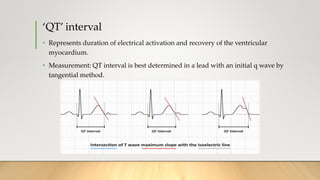
• Represents duration of electrical activation and recovery of the ventricular
myocardium.
• Measurement: QT interval is best determined in a lead with an initial q wave by
tangential method.
Contd..
• QT interval is rate dependent. To ensure complete recovery from one cardiac
cycle before the next cardiac cycle begins, the duration of recovery must decrease
as the rate of activation increases.
• Therefore normality of QT interval can be determined only by correcting for the
heart rate ----> QTc
• Bazett: QTcB = QT/RR1/2
• Fridericia: QTcFri = QT/RR1/3
• Framingham: QTcFra = QT+0.154 (1−RR)
• Hodges: QTcH = QT+0.00175 ([60/RR]−60)
• Rautaharju: QTcR = QT−0.185 (RR−1) + k (k=+0.006 seconds for men and
+0 seconds for women)
Contd..
Normal QTc values:
• QTc is prolonged if > 440ms in men or > 460ms in women.
• QTc > 500 is associated with increased risk of torsades de pointes.
• QTc is abnormally short if < 350ms.
• A useful rule of thumb is that a normal QT is less than half the preceding RR
interval.
Causes for QT prolongation:
• Electrolytes – hypo K+, Mg2+, Ca2+
• Increasing age
• Females
• Bradycardia
• MI / LVF
• ROSC - post cardiac arrest
• Hypothermia
• Recent cardioversions
• Congenital long QT
• Raised ICT
• Hepatic dysfunction
Drugs causing QT prolongation
Short QT interval
• Digoxin effect
• Hypercalcemia
• Short QT syndromes
ECG change in dextrocardia
• Right axis deviation
• Positive QRS complexes (with upright P and T waves) in aVR
• Lead I: inversion of all complexes, aka ‘global negativity’ (inverted P wave,
negative QRS, inverted T wave)
• Absent R-wave progression in the chest leads (dominant S waves throughout)
• These changes can be reversed by placing the precordial leads in a mirror-image
position on the right side of the chest and reversing the left and right arm leads.
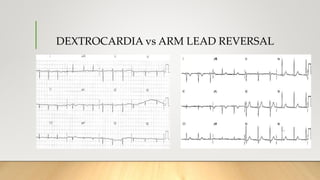
• D/D – Accidental lead reversal, specifically reversal of the left and right arm
electrode.
DEXTROCARDIA vs ARM LEAD REVERSAL

Ecg basics

  • 1.
  • 2.
    • DEFINITION: AnECG is recording(gram) of the electrical activity(electro) generated by the cells of the heart(cardio) that reaches the body surface. • It basically plots ---> Voltage on its vertical axis which is the summation of electrical activation of all cardiac cells on the body surface. Indicates chamber enlargement and axis. ---> Time on its horizontal axis which indicates HR, Rhythm & intervals during electrical activity.
  • 3.
    HISTORY • 1842 -Italian scientist Carlo Matteucci realizes that electricity is associated with the heart beat. • 1876 - Irish scientist Marey analyzes the electric pattern of frog’s heart. • 1895 - William Einthoven , credited for the invention of EKG. • 1906 - using the string electrometer EKG, William Einthoven diagnoses some heart problems. • 1924 - the noble prize for physiology/medicine is given to William Einthoven for his work on EKG. • 1938 - AHA and Cardiac society of Great Britain defined the position of chest leads. • 1942- Goldberger increased Wilson’s Unipolar lead voltage by 50% and made Augmented leads(aVR, aVL & aVF).
  • 5.
  • 6.
  • 7.
  • 8.
  • 9.
  • 10.
    ECG LEADS • Thestandard ECG has 12 leads: ---> 3 Standard Limb Leads which are bipolar – I, II, III ---> 3 Augmented Limb Leads which are unipolar– aVR, aVL, aVF ---> 6 Precordial Leads which are unipolar – V1 to V6 • The axis of a particular lead represents the viewpoint from which it looks at the heart. • The standard and augmented leads represent the heart’s orientation in frontal plane. • Precordial leads represent the heart’s orientation in transverse plane.
  • 11.
  • 12.
  • 15.
  • 17.
    • The electrocardiogramrecords only Lead I & II and then calculate the voltage in remaining leads in real time on the basis of Einthoven law • I+III = II • The algebraic outcome of the formulas for calculating the voltages in aV leads from Lead I, II & III are:  aVR = - ½ (I + II)  aVL = I - ½ (II)  aVF = II – ½ (I) • Thus, aVR + aVL + aVF = 0
  • 18.
    EKG CALIBRATION EKG graphs: •1 mm small squares • 5 mm large squares Paper Speed: • 25 mm/sec standard Voltage Calibration: • 10 mm/mV standard
  • 19.
  • 20.
  • 21.
    Steps involved • HeartRate • Rhythm • Axis • Wave morphology • Intervals and segments analysis
  • 23.
    • Electrical impulsethat travels towards the electrode produces an upright (“positive”) deflection.
  • 24.
    Determining the HeartRate • Rule of 300 • Rule of 1500 • 10 second rule
  • 25.
    Rule of 300 •300 divided by number of big boxes between RR interval. • EKG speed is 25mm/sec ---> 5 big box ---> so, per minute is 5 x 60 = 300 box. • This works only when rhythm is regular. • Better applicable when HR < 100.
  • 26.
    Rule of 1500 •1500 divided by number of small boxes between RR interval. • Each big box contains 5 small boxes, hence 300 x 5 = 1500. • Better applicable during tachycardia ( HR > 100).
  • 27.
    Rule of 10 •Used when rhythm is irregular • Rhythm strip runs for 10 sec ---> count number of QRS in 10sec strip & multiply by 6
  • 29.
    Rhythm strip contains20 QRS complexes HR is 20 x 6 = 120
  • 30.
    Axis determination • TheQRS axis represents the net overall direction of the heart’s electrical activity. • Abnormalities of axis can hint at: ---> Ventricular enlargement ---> Conduction blocks (i.e. hemiblocks)
  • 31.
    • Axis canbe determined by two approach  Quadrant approach  Equiphasic approach
  • 32.
    QRS genesis • QRScomplex represents ventricular depolarization. • A deflection is only referred to as wave if it crosses the baseline. • The first negative wave is called the Q-wave. If the first wave is not negative, then the QRS complex doesn’t possess a Q-wave. • All positive waves are referred to as R-waves. The first positive wave is R-wave, the second positive wave is referred as R’-wave. • Any negative wave appearing after a positive wave is referred as S-wave. • Large waves are designated by their capital letters – Q, R, S. • Small waves are designated by their lower case letters – q, r, s.
  • 33.
    Contd.. • Ventricular septumreceives fibers from left bundle branch and hence gets activated first. • Hence, depolarization of septum proceeds from left to right. The vector is directed forward and to right. • The ventricular septum is relatively small, which is why lead V1 displays a small ‘r’ wave and V5, V6 displays small negative ‘q’ wave. • Electrical impulses then progresses to ventricular free walls via purkinje fibres from endocardium to epicardium from the apical region. • The endocardium depolarizes first with subsequent spread of action potential from one contractile cell to another heading to the epicardium generating a myocardial vector which is oriented downward and to left. • Vector generated from RV doesn’t come to expression as it is drowned by the many times larger vector generated by LV. • Finally the basal part of the ventricle gets depolarized giving rise to a vector which is directed backward and upward. It moves away from V5, V6 giving rise to small ‘s’ wave in V5 & V6.
  • 35.
    Contd.. • q –waves are present only in leftward oriented leads – I, aVL, V5, V6. • Presence of ‘q’ in V1, V2, V3 is pathological. • Presence of ‘q’ wave in rightward oriented leads should not qualify for the criteria of pathological ‘q’ wave. • Pathological q-wave - > 40msec in width and > 25% of QRS amplitude present in two contiguous lead. • R-wave should progress from V1---->V5. Tallest in V5 & V6 having a dominant R-wave.
  • 36.
    Pathological q-waves otherthan infarction • LVH / RVH • Bundle branch blocks / Fascicular blocks • Pre-excitation syndrome • Left pneumothorax • Acute cor pulmonale • Cardiomyopathies • Amyloidosis • Dextrocardia • perimyocarditis
  • 37.
    Quadrant approach • Examinethe QRS complex in leads I and aVF to determine if they are predominantly positive or predominantly negative. The combination should place the axis into one of the 4 quadrants below:
  • 38.
  • 39.
  • 41.
    Right axis deviation– negative in I & positive in aVF
  • 42.
    Lead I positive,Lead aVF negative but Lead II positive ---> non pathologic LAD (Normal axis)
  • 43.
    Equiphasic approach • Mostequiphasic QRS complex. • Identified Lead lies 90° away from the equiphasic lead. • The fact that QRS complex is equally positive and negative indicates that the net vector is perpendicular to the axis of this particular lead. • Next see if in perpendicular lead QRS is upright or negative. • If upright, that is the QRS axis. • If negative, move 90 degree away in the opposite direction of the perpendicular lead.
  • 44.
    Lead aVF isequiphasic --> perpendicular lead I is positive --> axis is 0 degree
  • 45.
    Lead II equiphasic--> lead aVL negative --> axis is 150 degree • kjkg
  • 46.
    Causes of axisdeviation LAD • LBBB, LVH • LAFB • INFERIOR WALL MI • WPW – right accessory pathway • OSTIUM PRIMUM ASD • TRICUSPID ATRESIA • HYPERKALEMIA • OBESITY • RV PACING / ECTOPICS • HIGH DIAPHRAGM – PREGNANCY, ASCITES RAD • RBBB, RVH • LPFB • ANTEERIOR WALL MI • CHRONIC LUNG DISEASES • PULMONARY EMBOLISM • WPE - left accessory pathway • OSTIUM SECUNDUM ASD • LV PACING / ECTOPICS • NORMAL VARIANT - TALL
  • 47.
    ‘T’ wave morphology •Represents repolarization. • Same direction as the preceding QRS complex. • Blunt apex with asymmetric limbs – longer ascending limb. • Can be biphasic ( initial positive and terminal negative ) in Lead V1. • When biphasic the terminal portion of the ‘T’ wave determines if it is positive or negative. • Diminish with age and larger in males than females. • Amplitude: 0.5 mV in limb lead, 1.5 mV in precordial lead. • Should not exceed > 2/3rd of preceding ‘R’ wave. • Same axis as QRS. • Inversion in V1--->V3 – normal variant in females.
  • 48.
  • 49.
    ‘PR’ interval • Itis the time required for electrical impulse to travel from SA node to AV node & AV nodal conduction delay. • Major portion ( later 2/3rd ) reflects the conduction delay in AV node. • Duration: 0.12 – 0.2 sec. • Tends to increase with age. • Controlled by balance between sympathetic and parasympathetic divisions of ANS.
  • 51.
  • 52.
    ‘ST’ SEGMENT MORPHOLOGY •Represents preliminary phase of repolarization. • Forms ‘J’ point at its junction with QRS – forms a distinct angle with the downslope of ‘R’ or upslope of ‘S’ wave. • Proceeds horizontally and curves gently into ‘T’ wave. • Located at same horizontal level as the baseline formed by ‘TP’ segment. • Displacement upto 1mm ( upward or downward) is common in precordial leads especially V1--->V3. • Early repolarization variants are considered normal except in symptomatic and high risk individuals.
  • 53.
  • 54.
  • 55.
  • 56.
    Causes of STsegment elevation • Acute MI • Left bundle branch block (brugada) • Acute pericarditis • Benign early repolarization syndrome • Hyperkalemia • LV aneurysm • Brugada syndrome • Pulmonary embolism • Pneumothorax • Aortic dissection • Hypothermia • CNS pathologies with raised ICT • Prinzmetals’s angina • Post electrical cardioversion • Short QT syndrome ( V3 to V5) • Cholecystitis / subdiaphragmatic abscess • Cocaine abuse • Drugs- digoxin, isoprenaline, quinidine, procainamide, TCA’s
  • 57.
    Causes of STsegment depression • Ischemia • LVH • Hypokalemia • Hypomagnesemia • ICH • Digoxin effect • Post electrical cardioversion • Exercise and deep inspiration
  • 58.
    ‘QT’ interval • Representsduration of electrical activation and recovery of the ventricular myocardium. • Measurement: QT interval is best determined in a lead with an initial q wave by tangential method.
  • 59.
    Contd.. • QT intervalis rate dependent. To ensure complete recovery from one cardiac cycle before the next cardiac cycle begins, the duration of recovery must decrease as the rate of activation increases. • Therefore normality of QT interval can be determined only by correcting for the heart rate ----> QTc • Bazett: QTcB = QT/RR1/2 • Fridericia: QTcFri = QT/RR1/3 • Framingham: QTcFra = QT+0.154 (1−RR) • Hodges: QTcH = QT+0.00175 ([60/RR]−60) • Rautaharju: QTcR = QT−0.185 (RR−1) + k (k=+0.006 seconds for men and +0 seconds for women)
  • 60.
    Contd.. Normal QTc values: •QTc is prolonged if > 440ms in men or > 460ms in women. • QTc > 500 is associated with increased risk of torsades de pointes. • QTc is abnormally short if < 350ms. • A useful rule of thumb is that a normal QT is less than half the preceding RR interval.
  • 61.
    Causes for QTprolongation: • Electrolytes – hypo K+, Mg2+, Ca2+ • Increasing age • Females • Bradycardia • MI / LVF • ROSC - post cardiac arrest • Hypothermia • Recent cardioversions • Congenital long QT • Raised ICT • Hepatic dysfunction
  • 62.
    Drugs causing QTprolongation
  • 63.
    Short QT interval •Digoxin effect • Hypercalcemia • Short QT syndromes
  • 64.
    ECG change indextrocardia • Right axis deviation • Positive QRS complexes (with upright P and T waves) in aVR • Lead I: inversion of all complexes, aka ‘global negativity’ (inverted P wave, negative QRS, inverted T wave) • Absent R-wave progression in the chest leads (dominant S waves throughout) • These changes can be reversed by placing the precordial leads in a mirror-image position on the right side of the chest and reversing the left and right arm leads. • D/D – Accidental lead reversal, specifically reversal of the left and right arm electrode.
  • 65.
    DEXTROCARDIA vs ARMLEAD REVERSAL