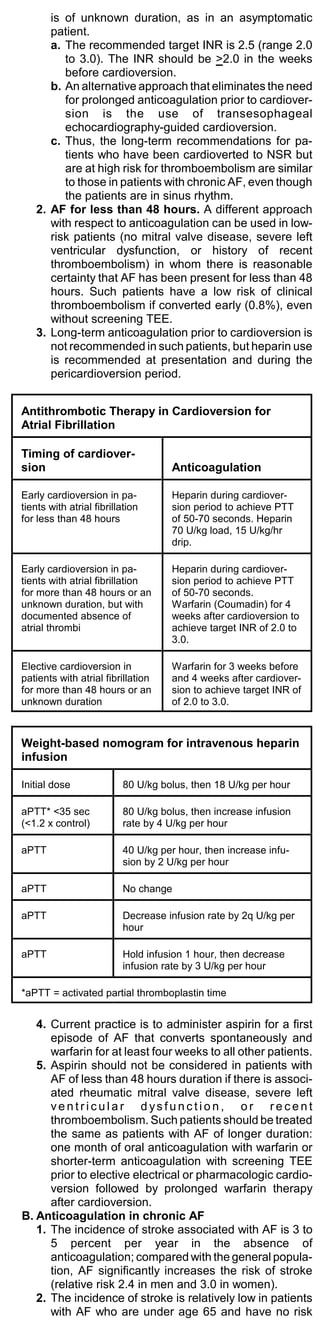
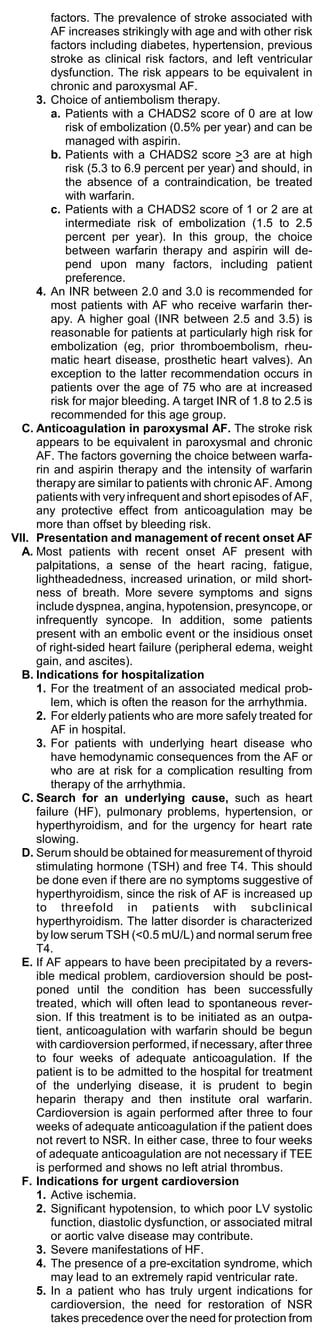
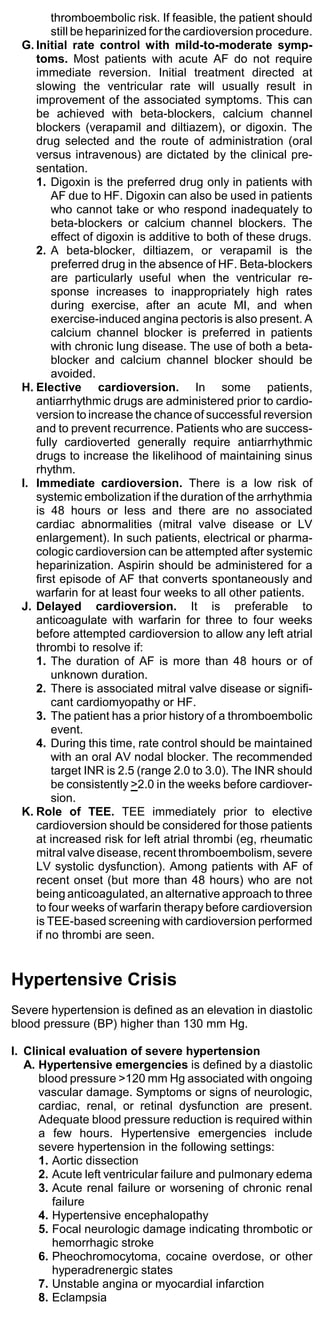
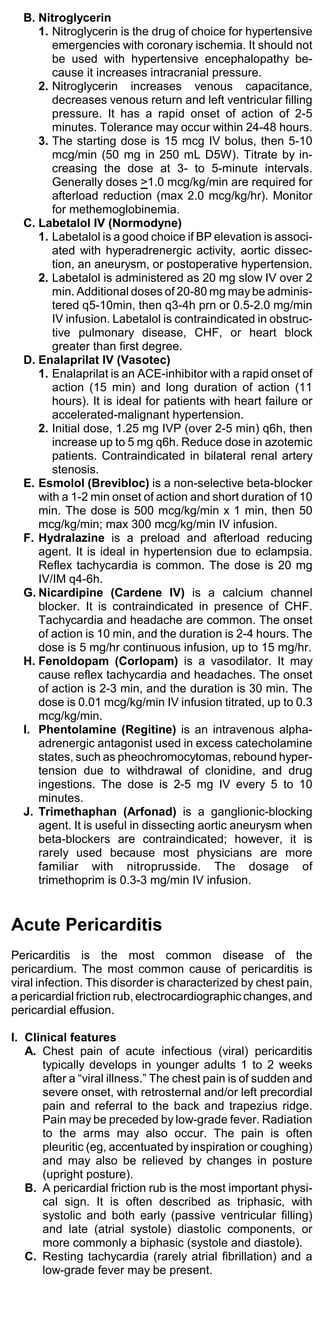
Critical Care and Cardiac
Medicine

Current Clinical Strategies
2006 Edition

Matthew Brenner, MD
Associate Professor of Medicine
Pulmonary and Critical Care Division
University of California, Irvine

Copyright © 2007 Current Clinical Strategies Publishing. All
rights reserved. This book, or any parts thereof, may not be
reproduced or stored in an information retrieval network or
internet without the written permission of the publisher. The
reader is advised to consult the drug package insert and
other references before using any therapeutic agent. No
liability exists, expressed or implied, for errors or omissions
in this text.

Printed in USA                          ISBN 1-929622-72-4
Critical and Cardiac Care
Patient Management
T. Scott Gallacher, MD, MS

Critical Care History and Physical
Examination
Chief complaint: Reason for admission to the ICU.
History of present illness: This section should included
   pertinent chronological events leading up to the hospi-
   talization. It should include events during hospitalization
   and eventual admission to the ICU.
Prior cardiac history: Angina (stable, unstable, changes
   in frequency), exacerbating factors (exertional, rest
   angina). History of myocardial infarction, heart failure,
   coronary artery bypass graft surgery, angioplasty.
   Previous exercise treadmill testing, ECHO, ejection
   fraction. Request old ECG, ECHO, impedance cardiog-
   raphy, stress test results, and angiographic studies.
Chest pain characteristics:
   A. Pain: Quality of pain, pressure, squeezing, tightness
   B. Onset of pain: Exertional, awakening from sleep,
        relationship to activities of daily living (ADLs), such
        as eating, walking, bathing, and grooming.
   C. Severity and quality: Pressure, tightness, sharp,
        pleuritic
   D. Radiation: Arm, jaw, shoulder
   E. Associated symptoms: Diaphoresis, dyspnea,
        back pain, GI symptoms.
   F. Duration: Minutes, hours, days.
   G. Relieving factors: Nitroclycerine, rest.
Cardiac risk factors: Age, male, diabetes,
   hypercholesteremia, low HDL, hypertension, smoking,
   previous coronary artery disease, family history of
   arteriosclerosis (eg, myocardial infarction in males less
   than 50 years old, stroke).
Congestive heart failure symptoms: Orthopnea (number
   of pillows), paroxysmal nocturnal dyspnea, dyspnea on
   exertional, edema.
Peripheral vascular disease symptoms: Claudication,
   transient ischemic attack, cerebral vascular accident.
COPD exacerbation symptoms: Shortness of breath,
   fever, chills, wheezing, sputum production, hemoptysis
   (quantify), corticosteroid use, previous intubation.
Past medical history: Peptic ulcer disease, renal disease,
   diabetes, COPD. Functional status prior to hospitaliza-
   tion.
Medications: Dose and frequency. Use of nitroglycerine,
   beta-agonist, steroids.
Allergies: Penicillin, contrast dye, aspirin; describe the
   specific reaction (eg, anaphylaxis, wheezing, rash,
   hypotension).
Social history: Tobacco use, alcohol consumption,
   intravenous drug use.
Review of systems: Review symptoms related to each
organ system.


Critical Care Physical Examination
Vital signs:
    Temperature, pulse, respiratory rate, BP (vital signs
    should be given in ranges)
    Input/Output: IV fluid volume/urine output.
    Special parameters: Oxygen saturation, pulmonary
    artery wedge pressure (PAWP), systemic vascular
    resistance (SVR), ventilator settings, impedance cardi-
    ography.
General: Mental status, Glasgow coma score, degree of
distress.
HEENT: PERRLA, EOMI, carotid pulse.
Lungs: Inspection, percussion, auscultation for wheezes,
crackles.
Cardiac: Lateral displacement of point of maximal impulse;
irregular rate,, irregular rhythm (atrial fibrillation); S3 gallop
(LV dilation), S4 (myocardial infarction), holosystolic apex
murmur (mitral regurgitation).
Cardiac murmurs: 1/6 = faint; 2/6 = clear; 3/6 - loud; 4/6 =
palpable; 5/6 = heard with stethoscope off the chest; 6/6 =
heard without stethoscope.
Abdomen: Bowel sounds normoactive, abdomen soft and
nontender.
Extremities: Cyanosis, clubbing, edema, peripheral pulses
2+.
Skin: Capillary refill, skin turgor.
Neuro
    Deficits in strength, sensation.
    Deep tendon reflexes: 0 = absent; 1 = diminished; 2 =
        normal; 3 = brisk; 4 = hyperactive clonus.
    Motor Strength: 0 = no contractility; 1 = contractility but
        no joint motion; 2 = motion without gravity; 3 =
motion against gravity; 4 = motion against some
      resistance; 5 = motion against full resistance (nor-
      mal).
Labs: CBC, INR/PTT; chem 7, chem 12, Mg, pH/pCO2/pO2.
CXR, ECG, impedance cardiography, other diagnostic
studies.

Impression/Problem list: Discuss diagnosis and plan for
each problem by system.
Neurologic Problems: List and discuss neurologic prob-
lems
Pulmonary Problems: Ventilator management.
Cardiac Problems: Arrhythmia, chest pain, angina.
GI Problems: H2 blockers, nasogastric tubes, nutrition.
Genitourinary Problems: Fluid status: IV fluids, electrolyte
therapy.
Renal Problems: Check BUN, creatinine. Monitor fluids
and electrolytes. Monitor inputs and outputs.
Hematologic Problems: Blood or blood products, DVT
prophylaxis, check hematocrit/hemoglobin.
Infectious Disease: Plans for antibiotic therapy; antibiotic
day number, culture results.
Endocrine/Nutrition: Serum glucose control, parenteral or
enteral nutrition, diet.


Admission Check List
1. Call and request old chart, ECG, and x-rays.
2. Stat labs: CBC, chem 7, cardiac enzymes (myoglobin,
   troponin, CPK), INR, PTT, C&S, ABG, UA, cardiac
   enzymes (myoglobin, troponin, CPK).
3. Labs: Toxicology screens and drug levels.
4. Cultures: Blood culture x 2, urine and sputum culture
   (before initiating antibiotics), sputum Gram stain, urinaly-
   sis. . . . . . . . . . . . . . . . . .
5. CXR, ECG, diagnostic studies.
6. Discuss case with resident, attending, and family.


Critical Care Progress Note
ICU Day Number:
Antibiotic Day Number:
Subjective: Patient is awake and alert. Note any events
that occurred overnight.
Objective: Temperature, maximum temperature, pulse,
respiratory rate, BP, 24- hr input and output, pulmonary
artery pressure, pulmonary capillary wedge pressure,
cardiac output.
Lungs: Clear bilaterally
Cardiac: Regular rate and rhythm, no murmur, no rubs.
Abdomen: Bowel sounds normoactive, soft-nontender.
Neuro: No local deficits in strength, sensation.
Extremities: No cyanosis, clubbing, edema, peripheral
pulses 2+.
Labs: CBC, ABG, chem 7.
ECG:         Chest x-ray:
Impression and Plan: Give an overall impression, and
then discuss impression and plan by organ system:
   Cardiovascular:
   Pulmonary:
   Neurological:
   Gastrointestinal:
   Renal:
   Infectious:
   Endocrine:
   Nutrition:
Procedure Note
A procedure note should be written in the chart when a
procedure is performed. Procedure notes are brief operative
notes.


  Procedure Note

  Date and time:
  Procedure:
  Indications:
  Patient Consent: Document that the indications,
  risks and alternatives to the procedure were ex-
  plained to the patient. Note that the patient was given
  the opportunity to ask questions and that the patient
  consented to the procedure in writing.
  Lab tests: Relevant labs, such as the INR and CBC
  Anesthesia: Local with 2% lidocaine
  Description of Procedure: Briefly describe the pro-
  cedure, including sterile prep, anesthesia method,
  patient position, devices used, anatomic location of
  procedure, and outcome.
  Complications and Estimated Blood Loss (EBL):
  Disposition: Describe how the patient tolerated the
       procedure.
  Specimens: Describe any specimens obtained and
  labs tests which were ordered.
  Name of Physician: Name of person performing
  procedure and supervising staff.


Discharge Note
The discharge note should be written in the patient’s chart
prior to discharge.


  Discharge Note

  Date/time:
  Diagnoses:
  Treatment: Briefly describe treatment provided dur-
  ing hospitalization, including surgical procedures and
  antibiotic therapy.
  Studies Performed: Electrocardiograms, CT scans,
  CXR.
  Discharge Medications:
  Follow-up Arrangements:


Fluids and Electrolytes
Maintenance Fluids Guidelines:
   70 kg Adult: D5 1/4 NS with KCI 20 mEq/Liter at 125
   mL/hr.
Specific Replacement Fluids for Specific Losses:
   Gastric (nasogastric tube, emesis): D5 1/2 NS with
   KCL 20 mEq/L.
   Diarrhea: D5LR with KCI 15 mEq/liter. Provide 1 liter
   of replacement for each 1 kg or 2.2 lb of body weight
   lost.
   Bile: D5LR with sodium bicarbonate 25 mEq/liter (1/2
   amp).
   Pancreatic: D5LR with sodium bicarbonate 50
   mEq/liter (1 amp).


Blood Component Therapy
  A. Packed red blood cells (PRBCs). Each unit pro-
     vides 250-400 cc of volume, and each unit should
     raise hemoglobin by 1 gm/dL and hematocrit by 3%.
     PRBCs are usually requested in two unit increments.
  B. Type and screen. Blood is tested for A, B, Rh
     antigens, and antibodies to donor erythrocytes. If
     blood products are required, the blood can be rapidly
     prepared by the blood bank. O negative blood is
     used when type and screen information is not avail-
     able, but the need for transfusion is emergent.
  C. Type and cross match sets aside specific units of
     packed donor red blood cells. If blood is needed on
     an urgent basis, type and cross should be requested.
  D. Platelets. Indicated for bleeding if there is
     thrombocytopenia or platelet dysfunction in the
     setting of uncontrolled bleeding. Each unit of platelet
     concentrate should raise the platelet count by 5,000-
     10,000. Platelets are usually transfused 6-10 units at
     a time, which should increase the platelet count by
     40-60,000. Thrombocytopenia is defined as a platelet
     count of less than 60,000. For surgery, the count
     should be greater than 50,000.
  E. Fresh Frozen Plasma (FFP) is used for active
     bleeding secondary to liver disease, warfarin over-
dose, dilutional coagulopathy secondary to multiple
     blood transfusions, disseminated intravascular
     coagulopathy, and vitamin K and coagulation factor
     deficiencies. Administration of FFP requires ABO
     typing, but not cross matching.
     1. Each unit contains coagulation factors in normal
        concentration.
     2. Two to four units are usually required for thera-
        peutic intervention.
  F. Cryoprecipitate
     1. Indicated in patients with Hemophilia A, Von
        Willebrand's disease, and any state of
        hypofibrinogenemia requiring replacement (DIC),
        or reversal of thrombolytic therapy.
     2. Cryoprecipitate contains factor VIII, fibrinogen,
        and Von Willebrand factor. The goal of therapy is
        to maintain the fibrinogen level above 100 mL/dL,
        which is usually achieved with 10 units given over
        3-5 minutes.


Central Parenteral Nutrition
Infuse 40-50 mL/hr of amino acid dextrose solution in the
first 24 hr; increase daily by 40 mL/hr increments until
providing 1.3-2 x basal energy requirement and 1.2-1.7 gm
protein/kg/d (see formula, page 169)
Standard Solution per Liter
   Amino acid solution (Aminosyn) 7-10% 500 mL
   Dextrose 40-70%                             500 mL
   Sodium                                      35 mEq
   Potassium                                   36 mEq
   Chloride                                    35 mEq
   Calcium                                     4.5 mEq
   Phosphate                                   9 mMol
   Magnesium                                   8.0 mEq
   Acetate                                     82-104 mEq
   Multi-Trace Element Formula                 1 mL/d
   Regular insulin (if indicated)              10-20 U/L
   Multivitamin 12 (2 amp)                     10 mL/d
   Vitamin K (in solution, SQ, IM)             10 mg/week
   Vitamin B 12                                1000 mcg/week
Fat Emulsion:
   -Intralipid 20% 500 mL/d IVPB infused in parallel with
         standard solution at 1 mL/min x 15 min; if no ad-
         verse reactions, increase to 20-50 mL/hr. Serum
         triglyceride level should be checked 6h after end of
         infusion (maintain <250 mg/dL).
Cyclic Total Parenteral Nutrition
   -12-hour night schedule; taper continuous infusion in
         morning by reducing rate to half original rate for 1
         hour. Further reduce rate by half for an additional
         hour, then discontinue. Restart TPN in evening.
         Taper at beginning and end of cycle. Final rate
         should be 185 mL/hr for 9-10h with 2 hours of taper
         at each end, for total of 2000 mL.
Peripheral Parenteral Supplementation
      -Amino acid solution (ProCalamine) 3% up to 3 L/d at
            125 cc/h OR
      -Combine 500 mL amino acid solution 7% or 10%
            (Aminosyn) and 500 mL 20% dextrose and
            electrolyte additive. Infuse at up to 100 cc/hr in
            parallel with intralipid 10% or 20% at 1 mL/min for
            15 min (test dose); if no adverse reactions, infuse
            500 mL/d at 20 mL/hr.
Special Medications
      -Famotidine (Pepcid) 20 mg IV q12h or 40 mg/day in
            TPN OR
      -Ranitidine (Zantac) 50 mg IV q6-8h.
      -Insulin sliding scale or continuous IV infusion.
Labs
      Baseline: Draw labs below. Chest x-ray, plain film for
            tube placement
      Daily Labs: Chem 7, osmolality, CBC, cholesterol,
            triglyceride (6h after end of infusion), serum
            phosphate, magnesium, calcium, urine specific
            gravity.
      Weekly Labs: Protein, iron, TIBC, INR/PTT, 24h urine
            nitrogen and creatinine. Pre-albumin, transferrin,
            albumin, total protein, AST, ALT, GGT, alkaline
            phosphatase, LDH, amylase, total bilirubin.


Enteral Nutrition
General Measures: Daily weights, nasoduodenal feeding
tube. Head of bed at 30 degrees while enteral feeding and
2 hours after completion. Record bowel movements.

Continuous Enteral Infusion: Initial enteral solution
 (Osmolite, Pulmocare, Jevity) 30 mL/hr. Measure
 residual volume q1h x 12h, then tid; hold feeding for 1 h
 if residual is more than 100 mL of residual. Increase rate
 by 25-50 mL/hr at 24 hr intervals as tolerated until final
 rate of 50-100 mL/hr (1 cal/mL) as tolerated. Three
tablespoons of protein powder (Promix) may be added
  to each 500 cc of solution. Flush tube with 100 cc water
  q8h.
Enteral Bolus Feeding: Give 50-100 mL of enteral
  solution (Osmolite, Pulmocare, Jevity) q3h initially.
  Increase amount in 50 mL steps to max of 250-300 mL
  q3-4h; 30 kcal of nonprotein calories/d and 1.5 gm
  protein/kg/d. Before each feeding measure residual
  volume, and delay feeding by 1 h if >100 mL. Flush tube
  with 100 cc of water after each bolus.
Special Medications:
  -Metoclopramide (Reglan) 10-20 mg PO, IM, IV, or in J
    tube q6h.
  -Famotidine (Pepcid) 20 mg J-tube q12h OR
  -Ranitidine (Zantac) 150 mg in J-tube bid.
Symptomatic Medications:
  -Loperamide (Imodium) 24 mg PO or in J-tube q6h, max
    16 mg/d prn OR
  -Diphenoxylate/atropine (Lomotil) 5-10 mL (2.5 mg/5 mL)
    PO or in J-tube q4-6h, max 12 tabs/d OR
  -Kaopectate 30 cc PO or in J-tube q6h.


Radiographic Evaluation of Common
Interventions
I. Central intravenous lines
    A. Central venous catheters should be located well
        above the right atrium, and not in a neck vein. Rule
        out pneumothorax by checking that the lung mark-
        ings extend completely to the rib cages on both
        sides. Examine for hydropericardium (“water bottle”
        sign, mediastinal widening).
    B. Pulmonary artery catheter tips should be located
        centrally and posteriorly, and not more than 3-5 cm
        from midline.
II. Endotracheal tubes. Verify that the tube is located 3
     cm below the vocal cords and 2-4cm above the carina;
     the tip of tube should be at the level of aortic arch.
III. Tracheostomies. Verify by chest x-ray that the tube is
     located halfway between the stoma and the carina; the
     tube should be parallel to the long axis of the trachea.
     The tube should be approximately 2/3 of width of the
     trachea; the cuff should not cause bulging of the trachea
     walls. Check for subcutaneous air in the neck tissue and
     for mediastinal widening secondary to air leakage.
IV. Nasogastric tubes and feeding tubes. Verify that the
     tube is in the stomach and not coiled in the esophagus
     or trachea. The tip of the tube should not be near the
     gastroesophageal junction.
V. Chest tubes. A chest tube for pneumothorax drainage
     should be near the level of the third intercostal space. If
     the tube is intended to drain a free-flowing pleural
     effusion, it should be located inferior-posteriorly, at or
     about the level of the eighth intercostal space. Verify
     that the side port of the tube is within the thorax.
VI. Mechanical ventilation. Obtain a chest x-ray to rule out
     pneumothorax, subcutaneous emphysema,
     pneumomediastinum, or subpleural air cysts. Lung
     infiltrates or atelectasis may diminish or disappear after
     initiation of mechanical ventilation because of increased
     aeration of the affected lung lobe.


Arterial Line Placement
Procedure
1. Obtain a 20-gauge 1 1/2-2 inch catheter over needle
   assembly (Angiocath), arterial line setup (transducer,
   tubing and pressure bag containing heparinized saline),
   arm board, sterile dressing, lidocaine, 3 cc syringe, 25-
   gauge needle, and 3-O silk suture.
2. The radial artery is the most frequently used artery. Use
   the Allen test to verify the patency of the radial and
   ulnar arteries. Place the extremity on an arm board with
   a gauze roll behind the wrist to maintain
   hyperextension.
3. Prep the skin with povidone-iodine and drape; infiltrate
   1% lidocaine using a 25-gauge needle. Choose a site
   where the artery is most superficial and distal.
4. Palpate the artery with the left hand, and advance the
   catheter-over-needle assembly into the artery at a 30-
   degree angle to the skin. When a flash of blood is seen,
   hold the needle in place and advance the catheter into
   the artery. Occlude the artery with manual pressure
   while the pressure tubing is connected.
5. Advance the guide wire into the artery, and pass the
   catheter over the guide wire. Suture the catheter in
   place with 3-0 silk and apply dressing.


Central Venous Catheterization
I. Indications for central venous catheter cannulation:
     Monitoring of central venous pressures in shock or heart
     failure; management of fluid status; insertion of a
     transvenous pacemaker; administration of total
     parenteral nutrition; administration of vesicants
     (chemotherapeutic agents).
II. Location: The internal jugular approach is relatively
     contraindicated in patients with a carotid bruit, stenosis,
     or an aneurysm. The subclavian approach has an
     increased risk of pneumothorax in patients with emphy-
     sema or bullae. The external jugular or internal jugular
     approach is preferable in patients with coagulopathy or
     thrombocytopenia because of the ease of external
     compression. In patients with unilateral lung pathology
     or a chest tube already in place, the catheter should be
     placed on the side of predominant pathology or on the
     side with the chest tube if present.
III. Technique for insertion of external jugular vein
     catheter
     1. The external jugular vein extends from the angle of
         the mandible to behind the middle of the clavicle,
         where it joins with the subclavian vein. Place the
         patient in Trendelenburg's position. Cleanse skin with
         Betadine-iodine solution, and, using sterile tech-
         nique, inject 1% lidocaine to produce a skin weal.
         Apply digital pressure to the external jugular vein
         above the clavicle to distend the vein.
     2. With a 16-gauge thin wall needle, advance the
         needle into the vein. Then pass a J-guide wire
         through the needle; the wire should advance without
         resistance. Remove the needle, maintaining control
         over the guide wire at all times. Nick the skin with a
         No. 11 scalpel blade.
     3. With the guide wire in place, pass the central cathe-
         ter over the wire and remove the guide wire after the
         catheter is in place. Cover the catheter hub with a
         finger to prevent air embolization.
     4. Attach a syringe to the catheter hub and ensure that
         there is free back-flow of dark venous blood. Attach
         the catheter to an intravenous infusion.
     5. Secure the catheter in place with 2-0 silk suture and
         tape. The catheter should be replaced weekly or if
         there is any sign of infection.
     6. Obtain a chest x-ray to confirm position and rule out
         pneumothorax.
IV.Internal jugular vein cannulation. The internal jugular
     vein is positioned behind the stemocleidomastoid
     muscle lateral to the carotid artery. The catheter should
     be placed at a location at the upper confluence of the
     two bellies of the stemocleidomastoid, at the level of the
     cricoid cartilage.
     1. Place the patient in Trendelenburg's position and
         turn the patient's head to the contralateral side.
     2. Choose a location on the right or left. If lung function
         is symmetrical and no chest tubes are in place, the
         right side is preferred because of the direct path to
         the superior vena cava. Prepare the skin with
         Betadine solution using sterile technique and place
         a drape. Infiltrate the skin and deeper tissues with 1%
         lidocaine.
     3. Palpate the carotid artery. Using a 22-gauge scout
         needle and syringe, direct the needle lateral to the
         carotid artery towards the ipsilateral nipple at a 30-
         degree angle to the neck. While aspirating, advance
         the needle until the vein is located and blood flows
         back into the syringe.
     4. Remove the scout needle and advance a 16-gauge,
         thin wall catheter-over-needle with an attached
         syringe along the same path as the scout needle.
         When back flow of blood is noted into the syringe,
         advance the catheter into the vein. Remove the
         needle and confirm back flow of blood through the
         catheter and into the syringe. Remove the syringe,
         and use a finger to cover the catheter hub to prevent
         air embolization.
     5. With the 16-gauge catheter in position, advance a
         0.89 mm x 45 cm spring guide wire through the
         catheter. The guidewire should advance easily
         without resistance.
     6. With the guidewire in position, remove the catheter
         and use a No. 11 scalpel blade to nick the skin.
     7. Place the central vein catheter over the wire, holding
         the wire secure at all times. Pass the catheter into the
         vein, remove the guidewire, and suture the catheter
         with 0 silk suture, tape, and connect it to an IV infu-
         sion.
     8. Obtain a chest x-ray to rule out pneumothorax and
         confirm position of the catheter.
V. Subclavian vein cannulation. The subclavian vein is
     located in the angle formed by the medial a of the
     clavicle and the first rib.
     1. Position the patient supine with a rolled towel located
          between the patient's scapulae, and turn the patient's
          head towards the contralateral side. Prepare the area
          with Betadine iodine solution, and, using sterile
technique, drape the area and infiltrate 1% lidocaine
      into the skin and tissues.
   2. Advance the 16-gauge catheter-over-needle, with
      syringe attached, into a location inferior to the mid-
      point of the clavicle, until the clavicle bone and
      needle come in contact.
   3. Slowly probe down with the needle until the needle
      slips under the clavicle, and advance it slowly to-
      wards the vein until the catheter needle enters the
      vein and a back flow of venous blood enters the
      syringe. Remove the syringe, and cover the catheter
      hub with a finger to prevent air embolization.
   4. With the 16-gauge catheter in position, advance a
      0.89 mm x 45 cm spring guide wire through the
      catheter. The guide wire should advance easily
      without resistance.
   5. With the guide wire in position, remove the catheter,
      and use a No. 11 scalpel blade to nick the skin.
   6. Place the central line catheter over the wire, holding
      the wire secure at all times. Pass the catheter into
      the vein, and suture the catheter with 2-0 silk suture,
      tape, and connect to an IV infusion.
   7. Obtain a chest x-ray to confirm position and rule out
      pneumothorax.
VI.Pulmonary artery catheterization procedure
   A. Using sterile technique, cannulate a vein using the
      technique above. The subclavian vein or internal
      jugular vein is commonly used.
   B. Advance a guide wire through the cannula, then
      remove the cannula, but leave the guide wire in
      place. Keep the guide wire under control at all times.
      Nick the skin with a number 11 scalpel blade adja-
      cent to the guide wire, and pass a number 8 French
      introducer over the wire into the vein. Remove the
      wire and connect the introducer to an IV fluid infu-
      sion, and suture with 2-0 silk.
   C. Pass the proximal end of the pulmonary artery
      catheter (Swan Ganz) to an assistant for connection
      to a continuous flush transducer system.
   D. Flush the distal and proximal ports with heparin
      solution, remove all bubbles, and check balloon
      integrity by inflating 2 cc of air. Check the pressure
      transducer by quickly moving the distal tip and
      watching the monitor for response.
   E. Pass the catheter through the introducer into the
      vein, then inflate the balloon with 1.0 cc of air, and
      advance the catheter until the balloon is in or near
      the right atrium.
   F. The approximate distance to the entrance of the right
      atrium is determined from the site of insertion:
      Right internal jugular vein: 10-15 cm.
      Subclavian vein: 10 cm.
      Femoral vein: 35.45 cm.
   G. Advance the inflated balloon, while monitoring
      pressures and wave forms as the PA catheter is
      advanced. Advance the catheter through the right
      ventricle into the main pulmonary artery until the
      catheter enters a distal branch of the pulmonary
      artery and is stopped (as evidenced by a pulmonary
      wedge pressure waveform).
   H. Do not advance the catheter while the balloon is
      deflated, and do not withdraw the catheter with the
      balloon inflated. After placement, obtain a chest X-
      ray to ensure that the tip of catheter is no farther than
      3-5 cm from the mid-line, and no pneumothorax is
      present.


Normal Pulmonary Artery Catheter
Values
Right atrial pressure          1-7 mm Hg
           RVP systolic        15-25 mm Hg
           RVP diastolic       8-15 mm Hg
Pulmonary artery pressure
           PAP systolic        15-25 mm Hg
           PAP diastolic       8-15 mm Hg
           PAP mean            10-20 mm Hg
Cardiovascular Disorders
Roham T. Zamanian, MD
Farhad Mazdisnian, MD
Michael Krutzik, MD

Acute Coronary Syndromes (ST-
Segment Elevation MI, Non-ST-Seg-
ment Elevation MI, and Unstable
Angina)

Acute myocardial infarction (AMI) and unstable angina are
part of a spectrum known as the acute coronary syndromes
(ACS), which have in common a ruptured atheromatous
plaque. Plaque rupture results in platelet activation,
adhesion, and aggregation, leading to partial or total
occlusion of the artery.
    These syndromes include ST-segment elevation MI,
non-ST-segment elevation MI, and unstable angina. The
ECG presentation of ACS includes ST-segment elevation
infarction, ST-segment depression (including non–Q-wave
MI and unstable angina), and nondiagnostic ST-segment
and T-wave abnormalities. Patients with ST-segment
elevation MI require immediate reperfusion, mechanically
or pharmacologically. The clinical presentation of myocar-
dial ischemia is most often acute chest pain or discomfort.

I. Characteristics of chest pain and associated symp-
   toms
   A. Ischemic chest pain can be characterized by the the
      OPQRST mnemonic. Symptoms associated with the
      highest relative risk of myocardial infarction (MI)
      include radiation to an upper extremity, particularly
      when there is radiation to both arms, and pain associ-
      ated with diaphoresis or with nausea and vomiting.
      The patient should be asked if current pain is reminis-
      cent of prior MI.
      1. Onset. Ischemic pain is typically gradual in onset,
         although the intensity of the discomfort may wax
         and wane.
      2. Provocation and palliation. Ischemic pain is
         generally provoked by an activity. Ischemic pain
         does not change with respiration or position. It may
         or may not respond to nitroglycerin.
      3. Quality. Ischemic pain is often characterized more
         as a discomfort than pain, and it may be difficult to
         describe. The patient may describe the pain as
         squeezing, tightness, pressure, constriction, crush-
         ing, strangling, burning, heartburn, fullness in the
         chest, band-like sensation, knot in the center of the
         chest, lump in throat, ache, heavy weight on chest.
         It is usually not described as sharp, fleeting, knife-
         like, stabbing, or pins and needles-like. The patient
         may place his clenched fist in the center of the
         chest, which is known as the "Levine sign."
      4. Radiation. Ischemic pain often radiates to other
         parts of the body including the upper abdomen
         (epigastrium), shoulders, arms (upper and forearm),
         wrist, fingers, neck and throat, lower jaw and teeth
         (but not upper jaw), and not infrequently to the back
         (specifically the interscapular region). Pain radiating
         to the upper extremities is highly suggestive of
         ischemic pain.
      5. Site. Ischemic pain is not felt in one specific spot,
         but rather it is a diffuse discomfort that may be
         difficult to localize. The patient often indicates the
         entire chest, rather than localizing it to a specific
         area by pointing a single finger.
      6. Time course. Angina is usually brief (two to five
         minutes) and is relieved by rest or with nitroglycerin.
         In comparison, patients with an acute coronary
         syndrome (ACS) may have chest pain at rest, and
         the duration is variable but generally lasts longer
         than 30 minutes. Classic anginal pain lasting more
         than 20 minutes is particularly suggestive of an
         ACS.
      7. Associated symptoms. Ischemic pain is often
         associated with is shortness of breath, which may
         reflect pulmonary congestion. Other symptoms may
         include belching, nausea, indigestion, vomiting,
         diaphoresis, dizziness, lightheadedness, clammi-
         ness, and fatigue. Elderly women and diabetics are
         more likely to present with such "atypical" symp-
         toms in lieu of classic chest pain.
   B. Characteristics of nonischemic chest discomfort:
      1. Pleuritic pain, sharp or knife-like pain related to
         respiratory movements or cough.
      2. Primary or sole location in the mid or lower abdomi-
         nal region.
      3. Any discomfort localized with one finger.
4. Any discomfort reproduced by movement or palpa-
        tion.
     5. Constant pain lasting for days.
     6. Fleeting pains lasting for a few seconds or less.
     7. Pain radiating into the lower extremities or above
        the mandible.
  C. Some patients with ACS present with atypical types of
     chest pain. Acute ischemia is diagnosed in 22 percent
     of patients who present with sharp or stabbing pain
     and 13 percent who presented with pleuritic-type pain.
  D. Atypical symptoms. Some patients with acute
     coronary syndrome (ACS) present with atypical
     symptoms rather than chest pain. One-third have no
     chest pain on presentation to the hospital. These
     patients often present with symptoms such as
     dyspnea alone, nausea and/or vomiting, palpitations,
     syncope, or cardiac arrest. They are more likely to be
     older, diabetic, and women.
  E. Additional history and exam
     1. Historical features increasing likelihood of ACS
        a. Patients with a prior history of coronary heart
           disease (CHD) have a significantly increased risk
           of recurrent ischemic events.
        b. A prior history of other vascular disease is asso-
           ciated with a risk of cardiac ischemic events
           comparable to that seen with a prior history of
           CHD.
        c. Risk factors for CHD, including especially age,
           sex, diabetes, hypertension, hyperlipidemia, and
           cigarette smoking.
        d. Recent cocaine use.
     2. Focused physical exam
        a. Responsiveness, airway, breathing and circula-
           tion.
        b. Evidence of systemic hypoperfusion
           (hypotension; tachycardia; impaired cognition;
           cool, clammy, pale, ashen skin). Cardiogenic
           shock complicating acute MI requires aggressive
           evaluation and management.
        c. Ventricular arrhythmias. Sustained ventricular
           tachyarrhythmias in the periinfarction period
           must be treated immediately because of their
           deleterious effect on cardiac output, possible
           exacerbation of myocardial ischemia, and the
           risk of deterioration into VF.
        d. Evidence of heart failure (jugular venous disten-
           tion, rales, S3 gallop, hypotension, tachycardia).
        e. A screening neurologic examination should be
           performed to assess for focal lesions or cognitive
           deficits that might preclude safe use of thrombo-
           lytic therapy.


  Differential diagnosis of severe or prolonged
  chest pain

  Myocardial infarction
  Unstable angina
  Aortic dissection
  Gastrointestinal disease (esophagitis, esophageal spasm,
  peptic ulcer disease, biliary colic, pancreatitis)
  Pericarditis
  Chest-wall pain (musculoskeletal or neurologic)
  Pulmonary disease (pulmonary embolism, pneumonia, pleu-
  risy, pneumothorax)
  Psychogenic hyperventilation syndrome


         f. Exam findings increasing likelihood of MI.
             Findings on physical examination associated
             with significantly increased risk of myocardial
             infarction are hypotension (systolic blood
             pressure <80) and signs of pump failure (ie,
             new or worsening pulmonary crackles, new S3,
             new or worsening MR murmur).
II.Immediate management
   A. During the initial assessment phase, the following
      steps should be accomplished for any patient with
      significant risk of ACS:
      1. Airway, breathing, and circulation assessed
      2. 12-lead ECG obtained
      3. Resuscitation equipment brought nearby
      4. Cardiac monitor attached
      5. Oxygen given
      6. IV access and blood work obtained
      7. Aspirin 162 to 325 mg given
      8. Nitrates and morphine given (unless contraindi-
         cated)
   B. Twelve-lead ECG should be obtained in all patients
      with possible coronary ischemia. The 12-lead ECG
      provides the basis for initial diagnosis and manage-
      ment. The initial ECG is often not diagnostic in
      patients with ACS. The ECG should be repeated at 5
      to 10 minute intervals, if the initial ECG is not diag-
      nostic but the patient remains symptomatic and there
      is a high clinical suspicion for MI.
C. Cardiac monitoring should be initiated with emer-
      gency resuscitation equipment (including a
      defibrillator and airway equipment) nearby.
   D. Supplemental oxygen should be initiated to main-
      tain oxygen saturation above 90 percent.
   E. Intravenous access should be established, with
      blood drawn for initial laboratory work, including
      cardiac biomarkers.
   F. Aspirin should be given to all patients at a dose of
      162 to 325 mg to chew and swallow, unless there is
      a compelling contraindication (eg, history of
      anaphylactic reaction) or it has been taken prior to
      presentation.
   G. Sublingual nitroglycerin should be administered at
      a dose of 0.4 mg every five minutes for a total of
      three doses, after which an assessment should be
      made about the need for intravenous nitroglycerin.
      Before this is done, all men should be questioned
      about the use of sildenafil (Viagra), vardenafil
      (Levitra), or tadalafil (Cialis); nitrates are contraindi-
      cated if these drugs have been used in the last 24
      hours (36 hours with tadalafil) because of the risk of
      severe hypotension.
      1. Extreme care should also be taken before giving
         nitrates in the setting of an inferior myocardial
         infarction with possible involvement of the right
         ventricle. Nitrate use can cause severe
         hypotension in this setting.
   H. Intravenous morphine sulfate at an initial dose of
      2 to 4 mg, with increments of 2 to 8 mg, repeated at
      5 to 15 minute intervals, should be given for the relief
      of chest pain and anxiety.
III. ECG-based management of the Four major
      ischemic syndromes
   A. ST elevation (Q wave) MI is manifested by Q waves
      that are usually preceded by hyperacute T waves
      and ST elevations, and followed by T wave inver-
      sions. Clinically significant ST segment elevation is
      considered to be present if it is greater than 1 mm
      (0.1 mV) in at least two anatomically contiguous
      leads.
   B. Non-ST elevation (Non-Q wave) MI is manifested by
      ST depressions or T-wave inversions without Q
      waves.
   C. Noninfarction subendocardial ischemia (classic
      angina), manifested by transient ST segment depres-
      sions.
   D. Noninfarction transmural ischemia (Prinzmetal’s
      variant angina) is manifested by transient ST seg-
      ment elevations or paradoxical T wave normalization.
   E. Localization of ischemia. The anatomic location of
      a transmural infarct is determined by which ECG
      leads show ST elevation and/or increased T wave
      positivity:
      1. Acute transmural anterior wall ischemia - one or
         more of the precordial leads (V1-V6)
      2. Anteroseptal ischemia - leads V1 to V3
      3. Apical or lateral ischemia - leads aVL and I, and
         leads V4 to V6
      4. Inferior wall ischemia - leads II, III, and aVF
      5. Right ventricular ischemia - right-sided precordial
         leads
   F. The right-sided leads V4R, V5R, and V6R should be
      obtained if there is evidence of inferior wall ischemia,
      demonstrated by ST elevation in leads II, III, and
      aVF. The posterior leads V7, V8, and V9 may also be
      helpful if there is evidence of posterior wall ischemia,
      as suggested by prominent R waves and ST depres-
      sions in leads V1 and V2.
   G. Serial ECGs. The initial ECG is often not diagnostic
      in patients with ACS. Therefore, if the initial ECG is
      not diagnostic, but the patient remains symptomatic
      and there is a high clinical suspicion for MI, it is
      recommended that the ECG be repeated at 5 to 10
      minute intervals.
   H. LBBB or pacing. Both LBBB, which is present in 7
      percent of patients with an acute MI, and pacing can
      interfere with the electrocardiographic diagnosis of
      coronary ischemia. Careful evaluation of the ECG
      may show some evidence of ACS in patients with
      these abnormalities. The clinical history and cardiac
      enzymes are of primary importance in diagnosing an
      ACS in this setting.
   I. ST elevation. Regardless of the presence or ab-
      sence of Q waves, an ST elevation MI (STEMI) is
      diagnosed in the following circumstances:
      1. ST segment elevation >1 mm is present in two or
         more anatomically contiguous leads.
      2. The elevations are considered to represent
         ischemia and not pericarditis or left ventricular
         aneurysm.
   J. The patient should also be presumed to have an
      acute STEMI if the ECG shows a left bundle branch
      block that is not known to be old and the clinical
      suspicion for an ACS is high.
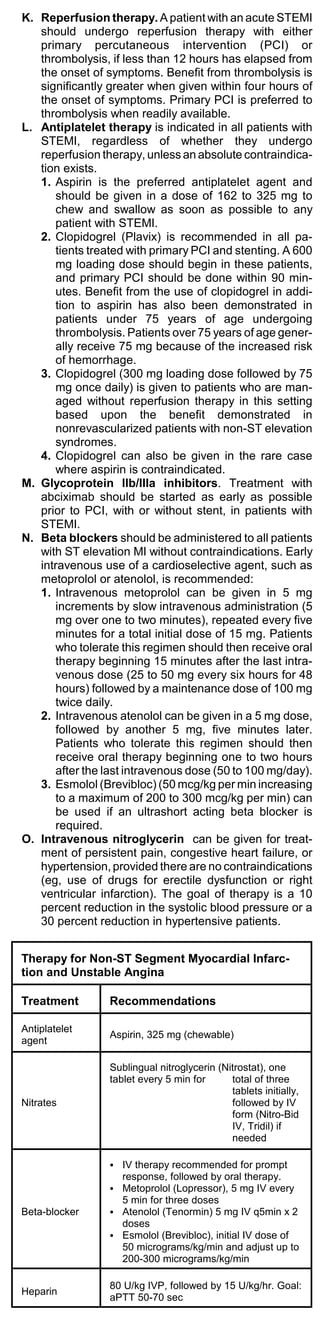
K. Reperfusion therapy. A patient with an acute STEMI
   should undergo reperfusion therapy with either
   primary percutaneous intervention (PCI) or
   thrombolysis, if less than 12 hours has elapsed from
   the onset of symptoms. Benefit from thrombolysis is
   significantly greater when given within four hours of
   the onset of symptoms. Primary PCI is preferred to
   thrombolysis when readily available.
L. Antiplatelet therapy is indicated in all patients with
   STEMI, regardless of whether they undergo
   reperfusion therapy, unless an absolute contraindica-
   tion exists.
   1. Aspirin is the preferred antiplatelet agent and
      should be given in a dose of 162 to 325 mg to
      chew and swallow as soon as possible to any
      patient with STEMI.
   2. Clopidogrel (Plavix) is recommended in all pa-
      tients treated with primary PCI and stenting. A 600
      mg loading dose should begin in these patients,
      and primary PCI should be done within 90 min-
      utes. Benefit from the use of clopidogrel in addi-
      tion to aspirin has also been demonstrated in
      patients under 75 years of age undergoing
      thrombolysis. Patients over 75 years of age gener-
      ally receive 75 mg because of the increased risk
      of hemorrhage.
   3. Clopidogrel (300 mg loading dose followed by 75
      mg once daily) is given to patients who are man-
      aged without reperfusion therapy in this setting
      based upon the benefit demonstrated in
      nonrevascularized patients with non-ST elevation
      syndromes.
   4. Clopidogrel can also be given in the rare case
      where aspirin is contraindicated.
M. Glycoprotein IIb/IIIa inhibitors. Treatment with
   abciximab should be started as early as possible
   prior to PCI, with or without stent, in patients with
   STEMI.
N. Beta blockers should be administered to all patients
   with ST elevation MI without contraindications. Early
   intravenous use of a cardioselective agent, such as
   metoprolol or atenolol, is recommended:
   1. Intravenous metoprolol can be given in 5 mg
      increments by slow intravenous administration (5
      mg over one to two minutes), repeated every five
      minutes for a total initial dose of 15 mg. Patients
      who tolerate this regimen should then receive oral
      therapy beginning 15 minutes after the last intra-
      venous dose (25 to 50 mg every six hours for 48
      hours) followed by a maintenance dose of 100 mg
      twice daily.
   2. Intravenous atenolol can be given in a 5 mg dose,
      followed by another 5 mg, five minutes later.
      Patients who tolerate this regimen should then
      receive oral therapy beginning one to two hours
      after the last intravenous dose (50 to 100 mg/day).
   3. Esmolol (Brevibloc) (50 mcg/kg per min increasing
      to a maximum of 200 to 300 mcg/kg per min) can
      be used if an ultrashort acting beta blocker is
      required.
O. Intravenous nitroglycerin can be given for treat-
   ment of persistent pain, congestive heart failure, or
   hypertension, provided there are no contraindications
   (eg, use of drugs for erectile dysfunction or right
   ventricular infarction). The goal of therapy is a 10
   percent reduction in the systolic blood pressure or a
   30 percent reduction in hypertensive patients.


Therapy for Non-ST Segment Myocardial Infarc-
tion and Unstable Angina

Treatment        Recommendations

Antiplatelet
                 Aspirin, 325 mg (chewable)
agent

                 Sublingual nitroglycerin (Nitrostat), one
                 tablet every 5 min for      total of three
                                             tablets initially,
Nitrates                                     followed by IV
                                             form (Nitro-Bid
                                             IV, Tridil) if
                                             needed

                 C IV therapy recommended for prompt
                   response, followed by oral therapy.
                 C Metoprolol (Lopressor), 5 mg IV every
                   5 min for three doses
Beta-blocker     C Atenolol (Tenormin) 5 mg IV q5min x 2
                   doses
                 C Esmolol (Brevibloc), initial IV dose of
                   50 micrograms/kg/min and adjust up to
                   200-300 micrograms/kg/min

                 80 U/kg IVP, followed by 15 U/kg/hr. Goal:
Heparin
                 aPTT 50-70 sec
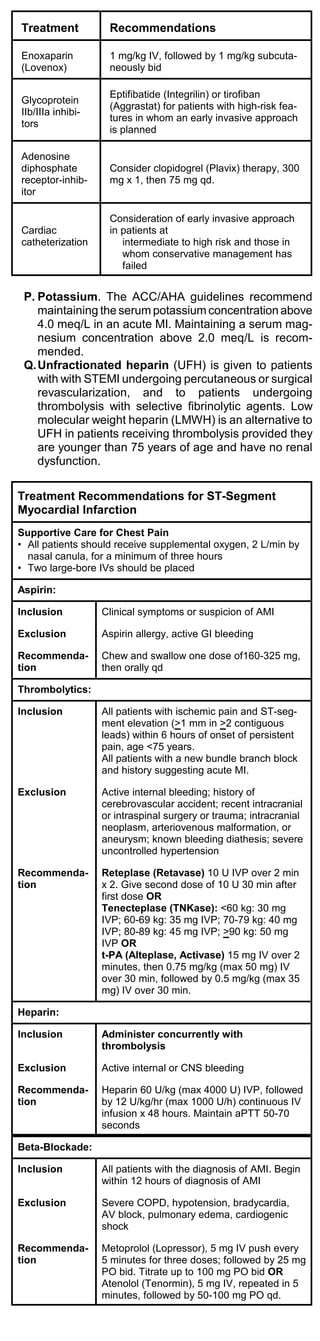
Treatment           Recommendations

Enoxaparin          1 mg/kg IV, followed by 1 mg/kg subcuta-
(Lovenox)           neously bid

                    Eptifibatide (Integrilin) or tirofiban
Glycoprotein
                    (Aggrastat) for patients with high-risk fea-
IIb/IIIa inhibi-
                    tures in whom an early invasive approach
tors
                    is planned

Adenosine
diphosphate         Consider clopidogrel (Plavix) therapy, 300
receptor-inhib-     mg x 1, then 75 mg qd.
itor

                    Consideration of early invasive approach
Cardiac             in patients at
catheterization        intermediate to high risk and those in
                       whom conservative management has
                       failed


 P. Potassium. The ACC/AHA guidelines recommend
    maintaining the serum potassium concentration above
    4.0 meq/L in an acute MI. Maintaining a serum mag-
    nesium concentration above 2.0 meq/L is recom-
    mended.
 Q. Unfractionated heparin (UFH) is given to patients
    with with STEMI undergoing percutaneous or surgical
    revascularization, and to patients undergoing
    thrombolysis with selective fibrinolytic agents. Low
    molecular weight heparin (LMWH) is an alternative to
    UFH in patients receiving thrombolysis provided they
    are younger than 75 years of age and have no renal
    dysfunction.

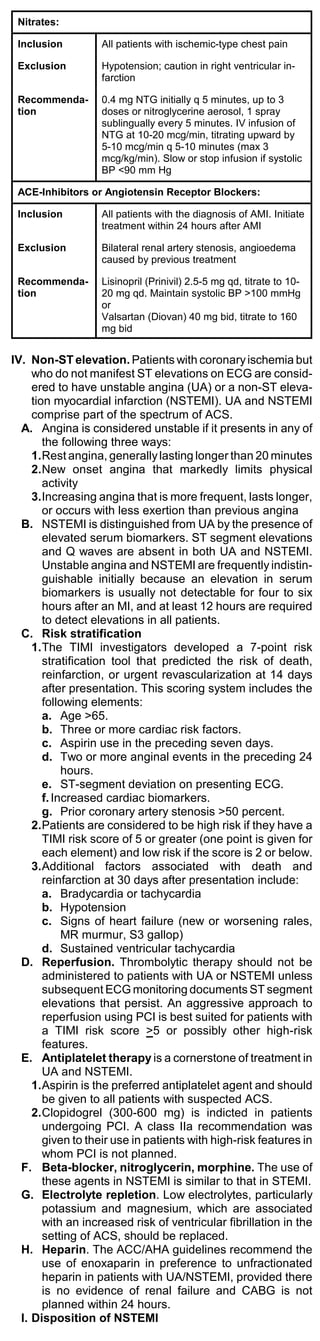
Treatment Recommendations for ST-Segment
Myocardial Infarction
Supportive Care for Chest Pain
• All patients should receive supplemental oxygen, 2 L/min by
  nasal canula, for a minimum of three hours
• Two large-bore IVs should be placed

Aspirin:

Inclusion          Clinical symptoms or suspicion of AMI

Exclusion          Aspirin allergy, active GI bleeding

Recommenda-        Chew and swallow one dose of160-325 mg,
tion               then orally qd

Thrombolytics:

Inclusion          All patients with ischemic pain and ST-seg-
                   ment elevation (>1 mm in >2 contiguous
                   leads) within 6 hours of onset of persistent
                   pain, age <75 years.
                   All patients with a new bundle branch block
                   and history suggesting acute MI.

Exclusion          Active internal bleeding; history of
                   cerebrovascular accident; recent intracranial
                   or intraspinal surgery or trauma; intracranial
                   neoplasm, arteriovenous malformation, or
                   aneurysm; known bleeding diathesis; severe
                   uncontrolled hypertension

Recommenda-        Reteplase (Retavase) 10 U IVP over 2 min
tion               x 2. Give second dose of 10 U 30 min after
                   first dose OR
                   Tenecteplase (TNKase): <60 kg: 30 mg
                   IVP; 60-69 kg: 35 mg IVP; 70-79 kg: 40 mg
                   IVP; 80-89 kg: 45 mg IVP; >90 kg: 50 mg
                   IVP OR
                   t-PA (Alteplase, Activase) 15 mg IV over 2
                   minutes, then 0.75 mg/kg (max 50 mg) IV
                   over 30 min, followed by 0.5 mg/kg (max 35
                   mg) IV over 30 min.

Heparin:

Inclusion          Administer concurrently with
                   thrombolysis

Exclusion          Active internal or CNS bleeding

Recommenda-        Heparin 60 U/kg (max 4000 U) IVP, followed
tion               by 12 U/kg/hr (max 1000 U/h) continuous IV
                   infusion x 48 hours. Maintain aPTT 50-70
                   seconds

Beta-Blockade:

Inclusion          All patients with the diagnosis of AMI. Begin
                   within 12 hours of diagnosis of AMI

Exclusion          Severe COPD, hypotension, bradycardia,
                   AV block, pulmonary edema, cardiogenic
                   shock

Recommenda-        Metoprolol (Lopressor), 5 mg IV push every
tion               5 minutes for three doses; followed by 25 mg
                   PO bid. Titrate up to 100 mg PO bid OR
                   Atenolol (Tenormin), 5 mg IV, repeated in 5
                   minutes, followed by 50-100 mg PO qd.
Nitrates:

 Inclusion         All patients with ischemic-type chest pain

 Exclusion         Hypotension; caution in right ventricular in-
                   farction

 Recommenda-       0.4 mg NTG initially q 5 minutes, up to 3
 tion              doses or nitroglycerine aerosol, 1 spray
                   sublingually every 5 minutes. IV infusion of
                   NTG at 10-20 mcg/min, titrating upward by
                   5-10 mcg/min q 5-10 minutes (max 3
                   mcg/kg/min). Slow or stop infusion if systolic
                   BP <90 mm Hg

 ACE-Inhibitors or Angiotensin Receptor Blockers:

 Inclusion         All patients with the diagnosis of AMI. Initiate
                   treatment within 24 hours after AMI

 Exclusion         Bilateral renal artery stenosis, angioedema
                   caused by previous treatment

 Recommenda-       Lisinopril (Prinivil) 2.5-5 mg qd, titrate to 10-
 tion              20 mg qd. Maintain systolic BP >100 mmHg
                   or
                   Valsartan (Diovan) 40 mg bid, titrate to 160
                   mg bid


IV. Non-ST elevation. Patients with coronary ischemia but
     who do not manifest ST elevations on ECG are consid-
     ered to have unstable angina (UA) or a non-ST eleva-
     tion myocardial infarction (NSTEMI). UA and NSTEMI
     comprise part of the spectrum of ACS.
  A. Angina is considered unstable if it presents in any of
        the following three ways:
     1.Rest angina, generally lasting longer than 20 minutes
     2.New onset angina that markedly limits physical
        activity
     3.Increasing angina that is more frequent, lasts longer,
        or occurs with less exertion than previous angina
  B. NSTEMI is distinguished from UA by the presence of
        elevated serum biomarkers. ST segment elevations
        and Q waves are absent in both UA and NSTEMI.
        Unstable angina and NSTEMI are frequently indistin-
        guishable initially because an elevation in serum
        biomarkers is usually not detectable for four to six
        hours after an MI, and at least 12 hours are required
        to detect elevations in all patients.
  C. Risk stratification
     1.The TIMI investigators developed a 7-point risk
        stratification tool that predicted the risk of death,
        reinfarction, or urgent revascularization at 14 days
        after presentation. This scoring system includes the
        following elements:
        a. Age >65.
        b. Three or more cardiac risk factors.
        c. Aspirin use in the preceding seven days.
        d. Two or more anginal events in the preceding 24
             hours.
        e. ST-segment deviation on presenting ECG.
        f. Increased cardiac biomarkers.
        g. Prior coronary artery stenosis >50 percent.
     2.Patients are considered to be high risk if they have a
        TIMI risk score of 5 or greater (one point is given for
        each element) and low risk if the score is 2 or below.
     3.Additional factors associated with death and
        reinfarction at 30 days after presentation include:
        a. Bradycardia or tachycardia
        b. Hypotension
        c. Signs of heart failure (new or worsening rales,
             MR murmur, S3 gallop)
        d. Sustained ventricular tachycardia
  D. Reperfusion. Thrombolytic therapy should not be
        administered to patients with UA or NSTEMI unless
        subsequent ECG monitoring documents ST segment
        elevations that persist. An aggressive approach to
        reperfusion using PCI is best suited for patients with
        a TIMI risk score >5 or possibly other high-risk
        features.
  E. Antiplatelet therapy is a cornerstone of treatment in
        UA and NSTEMI.
     1.Aspirin is the preferred antiplatelet agent and should
        be given to all patients with suspected ACS.
     2.Clopidogrel (300-600 mg) is indicted in patients
        undergoing PCI. A class IIa recommendation was
        given to their use in patients with high-risk features in
        whom PCI is not planned.
  F. Beta-blocker, nitroglycerin, morphine. The use of
        these agents in NSTEMI is similar to that in STEMI.
  G. Electrolyte repletion. Low electrolytes, particularly
        potassium and magnesium, which are associated
        with an increased risk of ventricular fibrillation in the
        setting of ACS, should be replaced.
  H. Heparin. The ACC/AHA guidelines recommend the
        use of enoxaparin in preference to unfractionated
        heparin in patients with UA/NSTEMI, provided there
        is no evidence of renal failure and CABG is not
        planned within 24 hours.
  I. Disposition of NSTEMI
1.High-risk patients have a high-risk ACS if ST
      segment depression (>0.05 mV [0.5 mm]) is present
      in two or more contiguous leads and/or the TIMI risk
      score is >5. This patient is admitted to an intensive
      care unit, coronary care unit, or monitored cardiac
      unit depending upon the persistence of symptoms
      and evidence of hemodynamic compromise. Those
      with persistent pain or hemodynamic compromise
      generally undergo urgent angiography and
      revascularization. Others with resolution of symp-
      toms and stable hemodynamics are typically referred
      for early elective angiography and revascularization
      if appropriate.
      a. If there is no ST segment elevation or depression
           or new LBBB, regardless of the presence or
           absence of Q waves, the patient with definite or
           probable ACS should still be admitted to a moni-
           tored care unit for further evaluation. Those
           patients manifesting high-risk features either on
           presentation or during their emergency room
           course should be considered for early PCI.
    2.Moderate-risk patient. Patients who have no ECG
      changes and are at moderate risk for ACS can be
      admitted to a chest pain observation unit, if available,
      for further evaluation because a small percentage (2
      to 4 percent) will have an ACS.
    3.Low-risk patient. Patients with no ECG changes, a
      TIMI risk score below 3, and no other concerning
      features in their presentation can be considered for
      early provocative testing or possible discharge with
      outpatient follow-up. Patients at very low risk in
      whom there is clear objective evidence for a non-
      ischemic cause of their chest pain can be discharged
      with outpatient follow-up.
V. Cardiac biomarkers (enzymes). Serial serum
   biomarkers (also called cardiac enzymes) of acute
   myocardial damage, such as troponin T and I, creatine
   kinase (CK)-MB, and myoglobin, are essential for
   confirming the diagnosis of infarction. The most com-
   monly used are troponin T or I and CK-MB, which can
   be measured by rapid bedside assay.
   A. Sensitivity and specificity. An elevation in the
      serum concentration of one or more of the above
      markers is seen in virtually all patients with an acute
      MI. However, the sensitivity of these tests is relatively
      low until four to six hours after symptom onset. Thus,
      a negative test in this time period does not exclude
      infarction. Furthermore, some patients do not show
      a biomarker elevation for as long as 12 hours.
   B. Therefore, in patients who have an acute STEMI,
      reperfusion therapy should not await the results of
      cardiac biomarkers. In patients without diagnostic ST
      segment elevation, serial biomarker testing is per-
      formed after four or more hours if the initial values
      are indeterminate, the ECG remains nondiagnostic,
      and clinical suspicion remains high.


  Common Markers for Acute Myocardial Infarction

  Marker         Initial         Mean            Time to
                 Elevation       Time to         Return to
                 After MI        Peak Ele-       Baseline
                                 vations

  Myoglobin      1-4 h           6-7 h           18-24 h

  CTnl           3-12 h          10-24 h         3-10 d

  CTnT           3-12 h          12-48 h         5-14 d

  CKMB           4-12 h          10-24 h         48-72 h

  CKMBiso        2-6 h           12 h            38 h

  CTnI, CTnT = troponins of cardiac myofibrils; CPK-MB, MM =
  tissue isoforms of creatine kinase.


   C. Unstable angina. Patients with cardiac biomarker
      elevations and unstable angina are considered to
      have an NSTEMI and should be treated appropri-
      ately.
   D. Treadmill stress testing and echocardiography is
      recommended for patients with a suspicion of coro-
      nary ischemia.


Heart Failure Caused by Systolic
Left Ventricular Dysfunction
Over four million persons have HF in the United States.
The mortality rate is 50 percent at two years and 60 to 70
percent at three years. Heart failure (HF) can result from
any structural or functional cardiac disorder that impairs the
ability of the ventricle to fill with or eject blood. It is charac-
terized by dyspnea and fatigue, and signs of fluid retention.

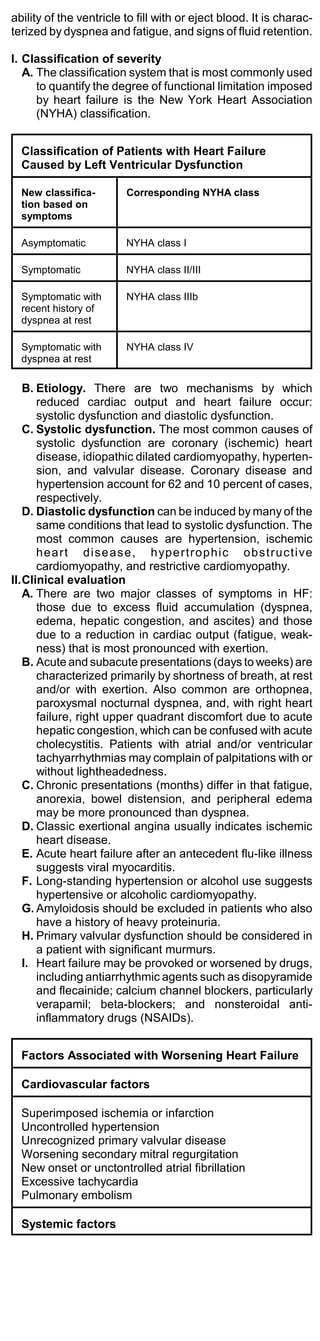
I. Classification of severity
   A. The classification system that is most commonly used
      to quantify the degree of functional limitation imposed
      by heart failure is the New York Heart Association
      (NYHA) classification.


  Classification of Patients with Heart Failure
  Caused by Left Ventricular Dysfunction

  New classifica-        Corresponding NYHA class
  tion based on
  symptoms

  Asymptomatic           NYHA class I

  Symptomatic            NYHA class II/III

  Symptomatic with       NYHA class IIIb
  recent history of
  dyspnea at rest

  Symptomatic with       NYHA class IV
  dyspnea at rest

   B. Etiology. There are two mechanisms by which
      reduced cardiac output and heart failure occur:
      systolic dysfunction and diastolic dysfunction.
   C. Systolic dysfunction. The most common causes of
      systolic dysfunction are coronary (ischemic) heart
      disease, idiopathic dilated cardiomyopathy, hyperten-
      sion, and valvular disease. Coronary disease and
      hypertension account for 62 and 10 percent of cases,
      respectively.
   D. Diastolic dysfunction can be induced by many of the
      same conditions that lead to systolic dysfunction. The
      most common causes are hypertension, ischemic
      heart dise ase, hypertrophic obstructive
      cardiomyopathy, and restrictive cardiomyopathy.
II.Clinical evaluation
   A. There are two major classes of symptoms in HF:
      those due to excess fluid accumulation (dyspnea,
      edema, hepatic congestion, and ascites) and those
      due to a reduction in cardiac output (fatigue, weak-
      ness) that is most pronounced with exertion.
   B. Acute and subacute presentations (days to weeks) are
      characterized primarily by shortness of breath, at rest
      and/or with exertion. Also common are orthopnea,
      paroxysmal nocturnal dyspnea, and, with right heart
      failure, right upper quadrant discomfort due to acute
      hepatic congestion, which can be confused with acute
      cholecystitis. Patients with atrial and/or ventricular
      tachyarrhythmias may complain of palpitations with or
      without lightheadedness.
   C. Chronic presentations (months) differ in that fatigue,
      anorexia, bowel distension, and peripheral edema
      may be more pronounced than dyspnea.
   D. Classic exertional angina usually indicates ischemic
      heart disease.
   E. Acute heart failure after an antecedent flu-like illness
      suggests viral myocarditis.
   F. Long-standing hypertension or alcohol use suggests
      hypertensive or alcoholic cardiomyopathy.
   G. Amyloidosis should be excluded in patients who also
      have a history of heavy proteinuria.
   H. Primary valvular dysfunction should be considered in
      a patient with significant murmurs.
   I. Heart failure may be provoked or worsened by drugs,
      including antiarrhythmic agents such as disopyramide
      and flecainide; calcium channel blockers, particularly
      verapamil; beta-blockers; and nonsteroidal anti-
      inflammatory drugs (NSAIDs).


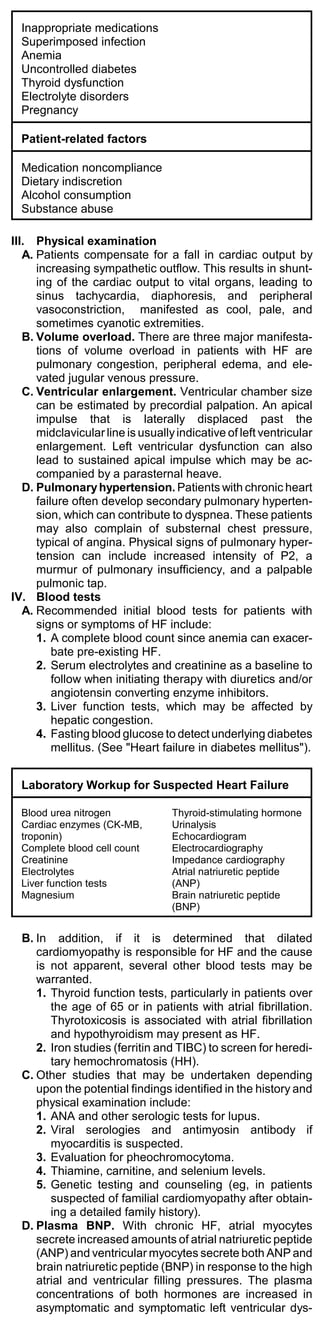
  Factors Associated with Worsening Heart Failure

  Cardiovascular factors

  Superimposed ischemia or infarction
  Uncontrolled hypertension
  Unrecognized primary valvular disease
  Worsening secondary mitral regurgitation
  New onset or unctontrolled atrial fibrillation
  Excessive tachycardia
  Pulmonary embolism

  Systemic factors
Inappropriate medications
  Superimposed infection
  Anemia
  Uncontrolled diabetes
  Thyroid dysfunction
  Electrolyte disorders
  Pregnancy

  Patient-related factors

  Medication noncompliance
  Dietary indiscretion
  Alcohol consumption
  Substance abuse

III. Physical examination
   A. Patients compensate for a fall in cardiac output by
      increasing sympathetic outflow. This results in shunt-
      ing of the cardiac output to vital organs, leading to
      sinus tachycardia, diaphoresis, and peripheral
      vasoconstriction, manifested as cool, pale, and
      sometimes cyanotic extremities.
   B. Volume overload. There are three major manifesta-
      tions of volume overload in patients with HF are
      pulmonary congestion, peripheral edema, and ele-
      vated jugular venous pressure.
   C. Ventricular enlargement. Ventricular chamber size
      can be estimated by precordial palpation. An apical
      impulse that is laterally displaced past the
      midclavicular line is usually indicative of left ventricular
      enlargement. Left ventricular dysfunction can also
      lead to sustained apical impulse which may be ac-
      companied by a parasternal heave.
   D. Pulmonary hypertension. Patients with chronic heart
      failure often develop secondary pulmonary hyperten-
      sion, which can contribute to dyspnea. These patients
      may also complain of substernal chest pressure,
      typical of angina. Physical signs of pulmonary hyper-
      tension can include increased intensity of P2, a
      murmur of pulmonary insufficiency, and a palpable
      pulmonic tap.
IV. Blood tests
   A. Recommended initial blood tests for patients with
      signs or symptoms of HF include:
      1. A complete blood count since anemia can exacer-
          bate pre-existing HF.
      2. Serum electrolytes and creatinine as a baseline to
          follow when initiating therapy with diuretics and/or
          angiotensin converting enzyme inhibitors.
      3. Liver function tests, which may be affected by
          hepatic congestion.
      4. Fasting blood glucose to detect underlying diabetes
          mellitus. (See "Heart failure in diabetes mellitus").


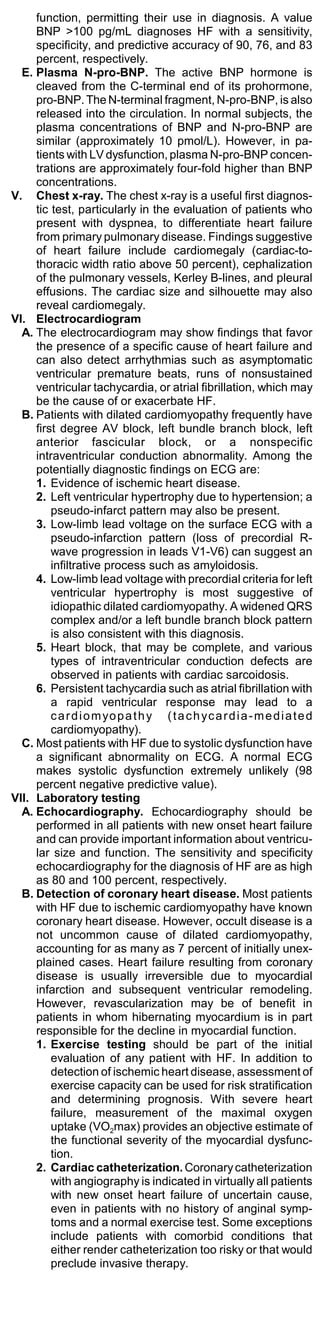
  Laboratory Workup for Suspected Heart Failure

  Blood urea nitrogen              Thyroid-stimulating hormone
  Cardiac enzymes (CK-MB,          Urinalysis
  troponin)                        Echocardiogram
  Complete blood cell count        Electrocardiography
  Creatinine                       Impedance cardiography
  Electrolytes                     Atrial natriuretic peptide
  Liver function tests             (ANP)
  Magnesium                        Brain natriuretic peptide
                                   (BNP)


  B. In addition, if it is determined that dilated
     cardiomyopathy is responsible for HF and the cause
     is not apparent, several other blood tests may be
     warranted.
     1. Thyroid function tests, particularly in patients over
        the age of 65 or in patients with atrial fibrillation.
        Thyrotoxicosis is associated with atrial fibrillation
        and hypothyroidism may present as HF.
     2. Iron studies (ferritin and TIBC) to screen for heredi-
        tary hemochromatosis (HH).
  C. Other studies that may be undertaken depending
     upon the potential findings identified in the history and
     physical examination include:
     1. ANA and other serologic tests for lupus.
     2. Viral serologies and antimyosin antibody if
        myocarditis is suspected.
     3. Evaluation for pheochromocytoma.
     4. Thiamine, carnitine, and selenium levels.
     5. Genetic testing and counseling (eg, in patients
        suspected of familial cardiomyopathy after obtain-
        ing a detailed family history).
  D. Plasma BNP. With chronic HF, atrial myocytes
     secrete increased amounts of atrial natriuretic peptide
     (ANP) and ventricular myocytes secrete both ANP and
     brain natriuretic peptide (BNP) in response to the high
     atrial and ventricular filling pressures. The plasma
     concentrations of both hormones are increased in
     asymptomatic and symptomatic left ventricular dys-
function, permitting their use in diagnosis. A value
     BNP >100 pg/mL diagnoses HF with a sensitivity,
     specificity, and predictive accuracy of 90, 76, and 83
     percent, respectively.
  E. Plasma N-pro-BNP. The active BNP hormone is
     cleaved from the C-terminal end of its prohormone,
     pro-BNP. The N-terminal fragment, N-pro-BNP, is also
     released into the circulation. In normal subjects, the
     plasma concentrations of BNP and N-pro-BNP are
     similar (approximately 10 pmol/L). However, in pa-
     tients with LV dysfunction, plasma N-pro-BNP concen-
     trations are approximately four-fold higher than BNP
     concentrations.
V. Chest x-ray. The chest x-ray is a useful first diagnos-
     tic test, particularly in the evaluation of patients who
     present with dyspnea, to differentiate heart failure
     from primary pulmonary disease. Findings suggestive
     of heart failure include cardiomegaly (cardiac-to-
     thoracic width ratio above 50 percent), cephalization
     of the pulmonary vessels, Kerley B-lines, and pleural
     effusions. The cardiac size and silhouette may also
     reveal cardiomegaly.
VI. Electrocardiogram
  A. The electrocardiogram may show findings that favor
     the presence of a specific cause of heart failure and
     can also detect arrhythmias such as asymptomatic
     ventricular premature beats, runs of nonsustained
     ventricular tachycardia, or atrial fibrillation, which may
     be the cause of or exacerbate HF.
  B. Patients with dilated cardiomyopathy frequently have
     first degree AV block, left bundle branch block, left
     anterior fascicular block, or a nonspecific
     intraventricular conduction abnormality. Among the
     potentially diagnostic findings on ECG are:
     1. Evidence of ischemic heart disease.
     2. Left ventricular hypertrophy due to hypertension; a
         pseudo-infarct pattern may also be present.
     3. Low-limb lead voltage on the surface ECG with a
         pseudo-infarction pattern (loss of precordial R-
         wave progression in leads V1-V6) can suggest an
         infiltrative process such as amyloidosis.
     4. Low-limb lead voltage with precordial criteria for left
         ventricular hypertrophy is most suggestive of
         idiopathic dilated cardiomyopathy. A widened QRS
         complex and/or a left bundle branch block pattern
         is also consistent with this diagnosis.
     5. Heart block, that may be complete, and various
         types of intraventricular conduction defects are
         observed in patients with cardiac sarcoidosis.
     6. Persistent tachycardia such as atrial fibrillation with
         a rapid ventricular response may lead to a
         c a r d i o m yo p a t h y ( t a c h yc a r d i a - m e d i a t e d
         cardiomyopathy).
  C. Most patients with HF due to systolic dysfunction have
     a significant abnormality on ECG. A normal ECG
     makes systolic dysfunction extremely unlikely (98
     percent negative predictive value).
VII. Laboratory testing
  A. Echocardiography. Echocardiography should be
     performed in all patients with new onset heart failure
     and can provide important information about ventricu-
     lar size and function. The sensitivity and specificity
     echocardiography for the diagnosis of HF are as high
     as 80 and 100 percent, respectively.
  B. Detection of coronary heart disease. Most patients
     with HF due to ischemic cardiomyopathy have known
     coronary heart disease. However, occult disease is a
     not uncommon cause of dilated cardiomyopathy,
     accounting for as many as 7 percent of initially unex-
     plained cases. Heart failure resulting from coronary
     disease is usually irreversible due to myocardial
     infarction and subsequent ventricular remodeling.
     However, revascularization may be of benefit in
     patients in whom hibernating myocardium is in part
     responsible for the decline in myocardial function.
     1. Exercise testing should be part of the initial
         evaluation of any patient with HF. In addition to
         detection of ischemic heart disease, assessment of
         exercise capacity can be used for risk stratification
         and determining prognosis. With severe heart
         failure, measurement of the maximal oxygen
         uptake (VO2max) provides an objective estimate of
         the functional severity of the myocardial dysfunc-
         tion.
     2. Cardiac catheterization. Coronary catheterization
         with angiography is indicated in virtually all patients
         with new onset heart failure of uncertain cause,
         even in patients with no history of anginal symp-
         toms and a normal exercise test. Some exceptions
         include patients with comorbid conditions that
         either render catheterization too risky or that would
         preclude invasive therapy.
VIII. Treatment of heart failure due to systolic dysfunc-
      tion
  A. Treatment of the underlying cardiac disease
      1. Hypertension is the primary cause of HF in 13
         percent of patients.
      2. Angiotensin converting enzyme (ACE) inhibitors,
         beta-blockers, and angiotensin II receptor blockers
         (ARBs) are the preferred antihypertensive agents
         because they improve survival in patients with HF.
         Beta-blockers can also provide anginal relief in
         patients with ischemic heart disease and rate
         control in atrial fibrillation. Beta-blocker therapy
         should always be initiated at very low doses.
      3. Renovascular disease testing is indicated in
         patients in whom the history is suggestive (severe
         or refractory hypertension, a sudden rise in blood
         pressure, or repeated episodes of flash pulmonary
         edema).
      4. Ischemic heart disease. Coronary atherosclerosis
         is the most common cause of cardiomyopathy,
         comprising 50 to 75 percent of patients with HF. All
         patients with ischemic heart disease should be
         treated medically for relief of angina and with risk-
         factor reduction. Myocardial revascularization with
         angioplasty or bypass surgery may improve symp-
         tom status, exercise capacity. Revascularization
         should also be considered in patients with a history
         of repeated episodes of acute left ventricular
         dysfunction and flash pulmonary edema.
      5. Valvular disease is the primary cause of HF in 10
         to 12 percent of patients. Surgical correction of
         valvular disease can lead to improvement in car-
         diac function.
      6. Other factors that can cause, or worsen, HF
         include alcohol abuse, cocaine abuse, obstructive
         sleep apnea, nutritional deficiencies, myocarditis,
         hemochromatosis, sarcoidosis, and rheumatologic
         disorders, such as systemic lupus erythematosus.


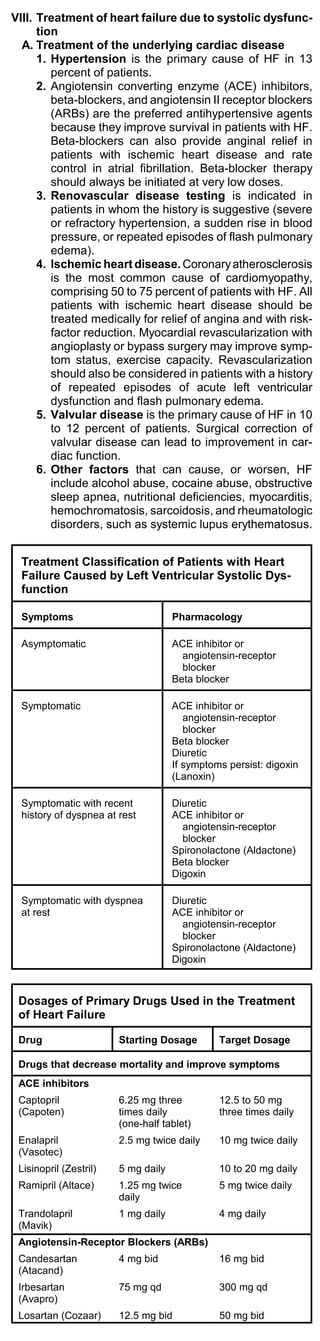
  Treatment Classification of Patients with Heart
  Failure Caused by Left Ventricular Systolic Dys-
  function

  Symptoms                           Pharmacology

  Asymptomatic                       ACE inhibitor or
                                       angiotensin-receptor
                                       blocker
                                     Beta blocker

  Symptomatic                        ACE inhibitor or
                                        angiotensin-receptor
                                        blocker
                                     Beta blocker
                                     Diuretic
                                     If symptoms persist: digoxin
                                     (Lanoxin)

  Symptomatic with recent            Diuretic
  history of dyspnea at rest         ACE inhibitor or
                                       angiotensin-receptor
                                       blocker
                                     Spironolactone (Aldactone)
                                     Beta blocker
                                     Digoxin

  Symptomatic with dyspnea           Diuretic
  at rest                            ACE inhibitor or
                                       angiotensin-receptor
                                       blocker
                                     Spironolactone (Aldactone)
                                     Digoxin


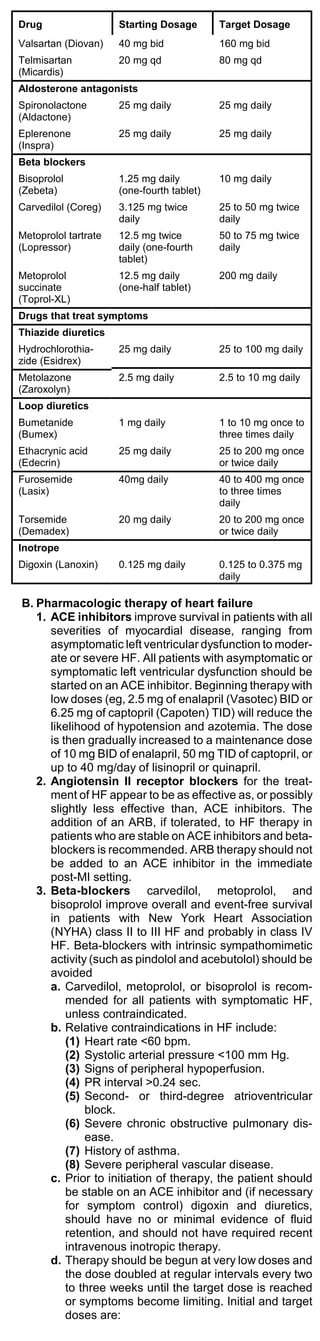
 Dosages of Primary Drugs Used in the Treatment
 of Heart Failure

 Drug                   Starting Dosage        Target Dosage

 Drugs that decrease mortality and improve symptoms
 ACE inhibitors
 Captopril              6.25 mg three          12.5 to 50 mg
 (Capoten)              times daily            three times daily
                        (one-half tablet)
 Enalapril              2.5 mg twice daily     10 mg twice daily
 (Vasotec)
 Lisinopril (Zestril)   5 mg daily             10 to 20 mg daily
 Ramipril (Altace)      1.25 mg twice          5 mg twice daily
                        daily
 Trandolapril           1 mg daily             4 mg daily
 (Mavik)
 Angiotensin-Receptor Blockers (ARBs)
 Candesartan            4 mg bid               16 mg bid
 (Atacand)
 Irbesartan             75 mg qd               300 mg qd
 (Avapro)
 Losartan (Cozaar)      12.5 mg bid            50 mg bid
Drug                  Starting Dosage       Target Dosage
Valsartan (Diovan)    40 mg bid             160 mg bid
Telmisartan           20 mg qd              80 mg qd
(Micardis)
Aldosterone antagonists
Spironolactone        25 mg daily           25 mg daily
(Aldactone)
Eplerenone            25 mg daily           25 mg daily
(Inspra)
Beta blockers
Bisoprolol            1.25 mg daily         10 mg daily
(Zebeta)              (one-fourth tablet)
Carvedilol (Coreg)    3.125 mg twice        25 to 50 mg twice
                      daily                 daily
Metoprolol tartrate   12.5 mg twice         50 to 75 mg twice
(Lopressor)           daily (one-fourth     daily
                      tablet)
Metoprolol            12.5 mg daily         200 mg daily
succinate             (one-half tablet)
(Toprol-XL)
Drugs that treat symptoms
Thiazide diuretics
Hydrochlorothia-      25 mg daily           25 to 100 mg daily
zide (Esidrex)
Metolazone            2.5 mg daily          2.5 to 10 mg daily
(Zaroxolyn)
Loop diuretics
Bumetanide            1 mg daily            1 to 10 mg once to
(Bumex)                                     three times daily
Ethacrynic acid       25 mg daily           25 to 200 mg once
(Edecrin)                                   or twice daily
Furosemide            40mg daily            40 to 400 mg once
(Lasix)                                     to three times
                                            daily
Torsemide             20 mg daily           20 to 200 mg once
(Demadex)                                   or twice daily
Inotrope
Digoxin (Lanoxin)     0.125 mg daily        0.125 to 0.375 mg
                                            daily

B. Pharmacologic therapy of heart failure
   1. ACE inhibitors improve survival in patients with all
      severities of myocardial disease, ranging from
      asymptomatic left ventricular dysfunction to moder-
      ate or severe HF. All patients with asymptomatic or
      symptomatic left ventricular dysfunction should be
      started on an ACE inhibitor. Beginning therapy with
      low doses (eg, 2.5 mg of enalapril (Vasotec) BID or
      6.25 mg of captopril (Capoten) TID) will reduce the
      likelihood of hypotension and azotemia. The dose
      is then gradually increased to a maintenance dose
      of 10 mg BID of enalapril, 50 mg TID of captopril, or
      up to 40 mg/day of lisinopril or quinapril.
   2. Angiotensin II receptor blockers for the treat-
      ment of HF appear to be as effective as, or possibly
      slightly less effective than, ACE inhibitors. The
      addition of an ARB, if tolerated, to HF therapy in
      patients who are stable on ACE inhibitors and beta-
      blockers is recommended. ARB therapy should not
      be added to an ACE inhibitor in the immediate
      post-MI setting.
   3. Beta-blockers carvedilol, metoprolol, and
      bisoprolol improve overall and event-free survival
      in patients with New York Heart Association
      (NYHA) class II to III HF and probably in class IV
      HF. Beta-blockers with intrinsic sympathomimetic
      activity (such as pindolol and acebutolol) should be
      avoided
      a. Carvedilol, metoprolol, or bisoprolol is recom-
          mended for all patients with symptomatic HF,
          unless contraindicated.
      b. Relative contraindications in HF include:
          (1) Heart rate <60 bpm.
          (2) Systolic arterial pressure <100 mm Hg.
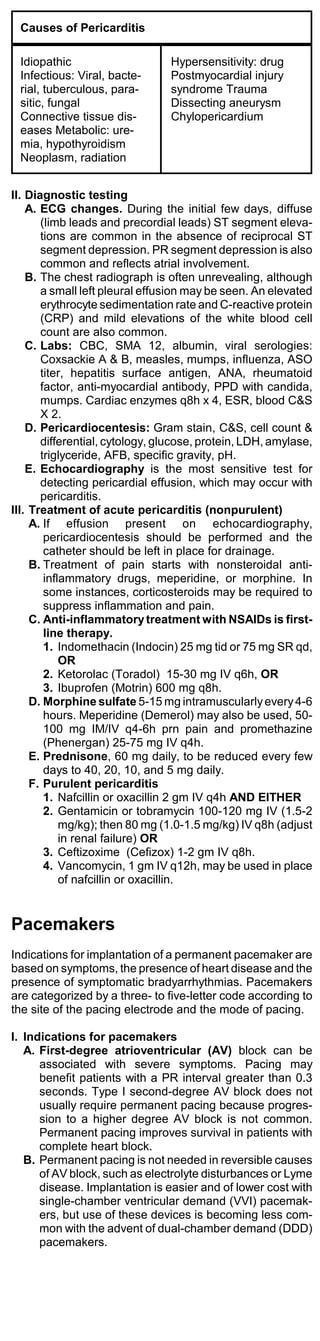
          (3) Signs of peripheral hypoperfusion.
          (4) PR interval >0.24 sec.
          (5) Second- or third-degree atrioventricular
              block.
          (6) Severe chronic obstructive pulmonary dis-
              ease.
          (7) History of asthma.
          (8) Severe peripheral vascular disease.
      c. Prior to initiation of therapy, the patient should
          be stable on an ACE inhibitor and (if necessary
          for symptom control) digoxin and diuretics,
          should have no or minimal evidence of fluid
          retention, and should not have required recent
          intravenous inotropic therapy.
      d. Therapy should be begun at very low doses and
          the dose doubled at regular intervals every two
          to three weeks until the target dose is reached
          or symptoms become limiting. Initial and target
          doses are:
(1) Carvedilol (Coreg), 3.125 mg BID and 25 to
               50 mg BID (the higher dose being used in
               subjects over 85 kg).
         (2) Metoprolol (Toprol), 6.25 mg BID and 50 to
               75 mg BID, and for extended-release
               metoprolol, 12.5 or 25 mg daily and 200
               mg/day.
         (3) Bisoprolol (Ziac), 1.25 mg QD and 5 to 10
               mg QD.
         (4) The patient should weigh himself daily and
               call the physician if there has been a 1 to 1.5
               kg weight gain. Weight gain may be treated
               with diuretics, but resistant edema or more
               severe decompensation may require dose
               reduction or cessation of the beta-blocker.
   4. Digoxin is given to patients with HF and systolic
      dysfunction to control symptoms (fatigue, dyspnea,
      and exercise intolerance) and, in atrial fibrillation, to
      control the ventricular rate. Digoxin should be
      started in left ventricular systolic dysfunction (left
      ventricular ejection fraction [LVEF] <40 percent)
      who continue to have symptoms despite appropri-
      ate therapy including an ACE inhibitor, beta-
      blocker, and, if necessary for fluid control, a di-
      uretic. The usual daily dose is 0.125 to 0.25 mg,
      based upon renal function. The serum digoxin
      concentration should be maintained between 0.5
      and 0.8 ng/mL.
   5. Diuretics. Sodium and water retention lead to
      pulmonary and peripheral edema.
      a. A loop diuretic should be given to control pulmo-
         nary and/or peripheral edema. The most com-
         monly used loop diuretic is furosemide (Lasix),
         but some patients respond better to bumetanide
         (Bumex) or torsemide (Demadex) because of
         superior and more predictable absorption.
      b. The usual starting dose in outpatients with HF is
         20 to 40 mg of furosemide. In patients who are
         volume overloaded, a reasonable goal is weight
         reduction of 0.5 to 1.0 kg/day. If a patient does
         not respond, the diuretic dose should initially be
         increased.
      c. In patients with HF and a normal glomerular
         filtration rate, the maximum doses are 40 to 80
         mg of furosemide, 2 to 3 mg of bumetanide, or
         20 to 50 mg of torsemide. In patients with renal
         insufficiency, a higher maximum dose of 160 to
         200 mg of furosemide or its equivalent can be
         given.
      d. Intravenous diuretics (either as a bolus or a
         continuous infusion) are more potent than their
         equivalent oral doses and may be required for
         unstable or severe disease. Thiazide diuretics
         can be added for a synergistic effect.
      e. A continuous infusion of a loop diuretic may
         improve diuresis and reduce toxicity when
         compared to intermittent bolus injections. Urine
         output is significantly greater.
   6. Aldosterone antagonists. Spironolactone and
      eplerenone, which compete with aldosterone for
      the mineralocorticoid receptor, prolong survival in
      selected patients with HF. Eplerenone has greater
      specificity for the mineralocorticoid receptor and a
      lower incidence of endocrine side effects.
      a. Therapy should be initiated with spironolactone,
         and switch to eplerenone (25 to 50 mg/day) if
         endocrine side effects occur. The serum potas-
         sium should be monitored.
C. Drugs that are contraindicated in HF
   1. Nonsteroidal anti-inflammatory drugs (NSAIDs)
      can cause a worsening of pre-existing HF because
      of systemic vasoconstriction. NSAID may blunt the
      renal effects of diuretics and may reverse the effect
      of angiotensin converting enzyme (ACE) inhibitors.
   2. Thiazolidinediones are oral hypoglycemic agents
      that increase insulin sensitivity. Drugs in this class
      cause fluid retention, which may precipitate HF.
      Patients with HF who are currently taking
      thiazolidinediones should be carefully followed for
      signs and symptoms of HF, and the agent should
      be stopped if signs of fluid retention develop.
      Thiazolidinediones should not be used in patients
      with New York Heart Association class III or IV HF.
   3. Metformin (Glucophage). Patients with HF who
      take metformin are at increased risk of potentially
      lethal lactic acidosis. Metformin is contraindicated
      in patients with HF.
   4. Cilostazol suppresses platelet aggregation and is
      a direct arterial vasodilator. In patients with HF, oral
      phosphodiesterase inhibitors has been associated
      with increased mortality. HF of any severity is a
      contraindication to the use of cilostazol.
   5. Sildenafil (Viagra) is a phosphodiesterase inhibitor
      that is used in the treatment of impotence. The
      drug is a vasodilator that can lower systemic blood
pressure. Sildenafil may be potentially hazardous
         in HF.
     6. Antiarrhythmic agents. Most antiarrhythmic drugs
         have some negative inotropic activity and can
         precipitate HF. The further reduction in LV function
         can also impair the elimination of these drugs,
         resulting in drug toxicity. In addition, some
         antiarrhythmic drugs have a proarrhythmic effect.
         Amiodarone is safe and is the preferred drug to
         treat ventricular arrhythmias in HF
  D. Lifestyle modification
     1. Cessation of smoking.
     2. Restriction of alcohol consumption.
     3. Salt restriction to 2 to 3 g of sodium per day to
         minimize fluid accumulation.
     4. Water restriction in patients who are hyponatremic
         may minimize pulmonary congestion.
     5. Daily weight monitoring to detect fluid accumulation
         before it becomes symptomatic.
     6. Weight reduction in obese subjects with a goal of
         being within 10 percent of ideal body weight.
     7. A cardiac rehabilitation program for stable patients.
IX. Management of refractory HF
  A. Intravenous inotropes and vasodilators. Patients
     with decompensated HF are often hospitalized and an
     intravenous infusion of a positive inotropic agent
     and/or a vasodilator is initiated. Inotropic drugs, such
     as dobutamine, dopamine, milrinone, and amrinone,
     and vasodilators, such as nitroprusside, nitroglycerin,
     and nesiritide, can acutely improve hemodynamics
     and relieve symptoms.
  B. Symptomatic improvement has been demonstrated in
     patients after treatment with a continuous infusion of
     dobutamine (5 to 7.5 µg/kg per min) for three to five
     days. The benefit can last for 30 days or more. There
     is no evidence for a survival benefit, and intermittent,
     dobutamine may increase mortality. Use of intrave-
     nous dobutamine or milrinone is limited to the in-
     patient management of severe decompensated heart
     failure.


  Treatment of Acute Heart Failure/Pulmonary
  Edema

  • Oxygen therapy, 2 L/min by nasal canula
  • Furosemide (Lasix) 20-80 mg IV
  • Nitroglycerine start at 10-20 mcg/min and titrate to BP (use
    with caution if inferior/right ventricular infarction suspected)
  • Sublingual nitroglycerin 0.4 mg
  • Morphine sulfate 2-4 mg IV. Avoid if inferior wall MI sus-
    pected or if hypotensive or presence of tenuous airway
  • Potassium supplementation prn


Atrial Fibrillation
Atrial fibrillation (AF) is more prevalent in men and with
increasing age. AF can have adverse consequences
related to a reduction in cardiac output and to atrial throm-
bus formation that can lead to systemic embolization.

I. Classification
   A. Atrial fibrillation occurs in the normal heart and in the
      presence of organic heart disease. Classification of
      Atrial fibrillation:
      1. Paroxysmal (ie, self-terminating) AF in which the
          episodes of AF generally last less than seven days
          (usually less than 24 hours) and may be recurrent.
      2. Persistent AF fails to self-terminate and lasts for
          longer than seven days. Persistent AF may also be
          paroxysmal if it recurs after reversion. AF is consid-
          ered recurrent when the patient experiences two or
          more episodes.
      3. Permanent AF is considered to be present if the
          arrhythmia lasts for more than one year and cardio-
          version either has not been attempted or has failed.
      4. “Lone” AF describes paroxysmal, persistent, or
          permanent AF in individuals without structural heart
          disease.
   B. If the AF is secondary to cardiac surgery, pericarditis,
      myocardial infarction (MI), hyperthyroidism, pulmonary
      embolism, pulmonary disease, or other reversible
      causes, therapy is directed toward the underlying
      disease as well as the AF.
II.Clinical evaluation
   A. History and physical examination. Associated
      symptoms with AF should be sought; the clinical type
      or “pattern” should be defined; the onset or date of
      discovery of the AF; the frequency and duration of AF
      episodes; any precipitating causes and modes of
      termination of AF; the response to drug therapy; and
      the presence of heart disease or potentially reversible
      causes (eg, hyperthyroidism).
   B. The frequency and duration of AF episodes are
      determined from the history. Symptoms include
palpitations, weakness, dizziness, and dyspnea.
      However, among patients with paroxysmal AF, up to
      90% of episodes are not recognized by the patient.
   C. Electrocardiogram is used to verify the presence of
      AF; identify left ventricular hypertrophy, pre-excitation,
      bundle branch block, or prior MI; define P-wave
      duration and morphology as well as other atrial
      arrhythmias on earlier ECGs.
   D. Chest x-ray may be useful in assessing the lungs,
      vasculature, and cardiac outline.
   E. E c h o c a r d i o g r a m .  The       transthoracic
      echocardiography is required to evaluate the size of
      the right and left atria and the size and function of the
      right and left ventricles; to detect possible valvular
      heart disease, left ventricular hypertrophy, and
      pericardial disease; and to assess peak right ventricu-
      lar pressure. It may also identify a left atrial thrombus,
      although the sensitivity is low. Transesophageal
      echocardiography is much more sensitive for atrial
      thrombi and can be used to determine the need for
      three to four weeks of anticoagulation prior to cardio-
      version.
   F. Assessment for hyperthyroidism. A low-serum
      thyroid-stimulating hormone (TSH) value is found in
      5.4% of patients with AF; only 1% have clinical
      hyperthyroidism. Measurement of serum TSH and free
      T4 is indicated in all patients with a first episode of AF,
      when the ventricular response to AF is difficult to
      control, or when AF recurs unexpectedly after cardio-
      version. Patients with low values (<0.5 mU/L) and
      normal serum free T4 probably have subclinical
      hyperthyroidism.
   G. Additional testing
      1. Exercise testing is often used to assess the ade-
         quacy of rate control in permanent AF, to repro-
         duce exercise-induced AF, and to evaluate for
         ischemic heart disease.
      2. Holter monitoring or event recorders are used to
         identify the arrhythmia if it is intermittent and not
         captured on routine electrocardiography.
      3. Electrophysiologic studies may be required with
         wide QRS complex tachycardia or a possible
         predisposing arrhythmia, such as atrial flutter or a
         paroxysmal supraventricular tachycardia.
III. General treatment issues


  Risk-based Approach to Antithrombotic Therapy
  in Atrial Fibrillation

  Patient features                Antithrombotic therapy

  Age <60 years                   Aspirin (325 mg per day)
  No heart disease (line          or no therapy
  AF)

  Age <60 years                   Aspirin (325 mg per day)
  Hear disease by no risk
  factors*

  Age >60 years                   Aspirin (325 mg per day)
  No risk factors*

  Age >60 years                   Oral anticoagulation
  With diabetes mellitus          (INR 2 to 3)
  or CAD                          Addition of aspirin, 81 to
                                  162 mg/day is optional

  Age >75 years, espe-            Oral anticoagulation
  cially women                    (INR . 2.0)

  Heart failure (HF)              Oral anticoagulation
  LVEF <0.35                      (INR 2 to 3)
  Thyrotoxicosis
  Hypertension

  Rheumatic heart dis-            Oral anticoagulation
  ease (mitral stenosis)          (INR 2.5 to 3.5 or higher
  Prosthetic heart valves         may be apropriate)
  Prior thromboembolism
  Persistent atrial throm-
  bus on TEE

  *Risk factors for thromboembolism include heart
  failure, left ventricular ejection fraction (LVEF) less
  than 0.35, and hypertension.

  A. Rate control with chronic anticoagulation is recom-
     mended for the majority of patients with AF.
  B. Beta-blockers (eg, atenolol or metoprolol), diltiazem,
     and verapamil are recommended for rate control at
     both rest and exercise; digoxin is not effective during
     exercise and should be used in patients with heart
     failure or as a second-line agent.
C. Anticoagulation should be achieved with adjusted-
     dose warfarin unless the patient is considered at low
     embolic risk or has a contraindication. Aspirin may be
     used in such patients.
  D. When rhythm control is chosen, both DC and pharma-
     cologic cardioversion are appropriate options. To
     prevent dislodgment of pre-existing thrombi, warfarin
     therapy should be given for three to four weeks prior
     to cardioversion unless transesophageal
     echocardiography demonstrates no left atrial thrombi.
     Anticoagulation is continued for at least one month
     after cardioversion to prevent de novo thrombus
     formation.
  E. After cardioversion, antiarrhythmic drugs to maintain
     sinus rhythm are not recommended, since the risks
     outweigh the benefits, except for patients with persis-
     tent symptoms during rate control that interfere with
     the patient’s quality of life. Recommended drugs are
     amiodarone, disopyramide, propafenone, and sotalol.
IV. Rhythm control
  A. Reversion to NSR. Patients with AF of more than 48
     hours duration or unknown duration may have atrial
     thrombi that can embolize. In such patients, cardiover-
     sion should be delayed until the patient has been
     anticoagulated at appropriate levels for three to four
     weeks or transesophageal echocardiography has
     excluded atrial thrombi.
     1. DC cardioversion is indicated in patients who are
        hemodynamically unstable. In stable patients in
        whom spontaneous reversion due to correction of
        an underlying disease is not likely, either DC or
        pharmacologic cardioversion can be performed.
        Electrical cardioversion is usually preferred be-
        cause of greater efficacy and a low risk of
        proarrhythmia. The overall success rate of electri-
        cal cardioversion for AF is 75 to 93 percent and is
        related inversely both to the duration of AF and to
        left atrial size.
     2. A number of antiarrhythmic drugs are more effec-
        tive than placebo, converting 30 to 60 percent of
        patients. Evidence of efficacy is best established
        for dofetilide, flecainide, ibutilide, propafenone,
        amiodarone, and quinidine.
     3. Rate control with an atrioventricular (AV) nodal
        blocker (beta-blocker, diltiazem, or verapamil), or (if
        the patient has heart failure or hypotension) digoxin
        should be attained before instituting a class IA
        drug.
  B. Maintenance of NSR. Only 20 to 30 percent of
     patients who are successfully cardioverted maintain
     NSR for more than one year without chronic
     antiarrhythmic therapy. This is more likely to occur in
     patients with AF for less than one year, no enlarge-
     ment of the left atrium (ie, <4.0 cm), and a reversible
     cause of AF such as hyperthyroidism, pericarditis,
     pulmonary embolism, or cardiac surgery.
     1. Prophylactic antiarrhythmic drug therapy is indi-
        cated only in patients who have a moderate-to-high
        risk for recurrence because the risks generally
        outweigh the benefits of maintenance
        antiarrhythmic drug therapy except in patients with
        persistent symptoms on a rate control regimen.
     2. Evidence of efficacy is best for amiodarone,
        propafenone, disopyramide, sotalol, flecainide, and
        quinidine. Flecainide may be preferred in patients
        with no or minimal heart disease, while amiodarone
        is preferred in patients with a reduced left ventricu-
        lar (LV) ejection fraction or heart failure and sotalol
        in patients with coronary heart disease. Concurrent
        administration of an AV nodal blocker is indicated
        in patients who have demonstrated a moderate-to-
        rapid ventricular response to AF.
     3. Amiodarone is significantly more effective for
        maintenance of sinus rhythm than other
        antiarrhythmic drugs. Amiodarone should be used
        as first-line therapy in patients without heart failure.
V. Rate control in chronic AF. Rapid ventricular rate in
     patients with AF should be prevented because of
     hemodynamic instability and/or symptoms.
  A. Rate control in AF is usually achieved by slowing AV
     nodal conduction with a beta-blocker, diltiazem,
     verapamil, or, in patients with heart failure or
     hypotension, digoxin. Amiodarone is also effective in
     patients who are not cardioverted to NSR.
  B. Heart rate control include:
     1. Rest heart rate <80 beats/min.
     2. 24-hour Holter average <100 beats/min and no
        heart rate >110% of the age-predicted maximum.
     3. Heart rate <110 beats/min in six minute walk.
  C. Nonpharmacologic approaches. The medical
     approaches to either rate or rhythm control described
     above are not always effective.
     1. Rhythm control. Alternative methods to maintain
        NSR in patients who are refractory to conventional
        therapy include surgery, radiofrequency catheter
        ablation, and pacemakers.
2. Rate control. Radio-frequency AV nodal-His
        bundle ablation with permanent pacemaker place-
        ment or AV nodal conduction modification are
        nonpharmacologic therapies for achieving rate
        control in patients who do not respond to pharma-
        cologic therapy.


  Intravenous Agents for Heart Rate Control in
  Atrial Fibrillation

  Drug       Load-          On-       Mainte-        Major Side
             ing            set       nance          Effects
             Dose                     Dose

  Diltiaz    0.25           2–7       5–15 mg        Hypotension,
  em         mg/kg          min       per hour       heart block,
             IV over                  infusion       HF
             2 min

  Esmol      0.5            1         0.05–0.2       Hypotension,
  ol         mg/kg          min       mg/kg/mi       heart block,
             over 1                   n              bradycardia,
             min                                     asthma, HF

  Metop      2.5–5          5         5 mg IV        Hypotension,
  rolol      mg IV          min       q6h            heart block,
             bolus                                   bradycardia,
             over 2                                  asthma, HF
             min up
             to 3
             doses

  Verap      0.075–0        3–5       5-10 mg        Hypotension,
  amil       .15            min       IV q6h         heart block,
             mg/kg                                   HF
             IV over
             2 min

  Digoxi     0.25 mg        2h        0.125–0.       Digitalis toxic-
  n          IV q2h,                  25 mg          ity, heart
             up to                    daily          block, brady-
             1.5 mg                                  cardia


  Oral Agents for Heart Rate Control

  Drug        Loading            Usual           Major Side Ef-
              Dose               Mainte-         fects
                                 nance
                                 Dose

  Digoxin     0.25 mg            0.125–0.3       Digitalis toxicity,
              PO q2h ;           75 mg           heart block, brady-
              up to 1.5          daily           cardia
              mg

  Diltiaze    NA                 120–360         Hypotension,
  m Ex-                          mg daily        heart block, HF
  tended
  Re-
  lease

  Metopr      NA                 25–100          Hypotension,
  olol                           mg BID          heart block,
                                                 bradycardia,
                                                 asthma, HF

  Propra      NA                 80–240          Hypotension,
  nolol                          mg daily        heart block,
  Ex-                                            bradycardia,
  tended                                         asthma, HF
  Re-
  lease

  Verapa      NA                 120–360         Hypotension,
  mil Ex-                        mg daily        heart block, HF,
  tended                                         digoxin
  Re-                                            interaction
  lease

  Amioda      800 mg             200 mg          Pulmonary toxic-
  rone        daily for 1        daily           ity, skin discolor-
              wk                                 ation, hypo or
              600 mg                             hyperthyroidism,
              daily for 1                        corneal deposits,
              wk                                 optic neuropathy,
              400 mg                             warfarin interac-
              daily for                          tion, proarrhyth-
              4–6 wk                             mia (QT prolonga-
                                                 tion)

VI. Prevention of systemic embolization
  A. Anticoagulation during restoration of NSR
     1. AF for more than 48 hours or unknown dura-
        tion. Outpatients without a contraindication to
        warfarin who have been in AF for more than 48
        hours should receive three to four weeks of warfa-
        rin prior to and after cardioversion. This approach
        is also recommended for patients with AF who
        have valvular disease, evidence of left ventricular
        dysfunction, recent thromboembolism, or when AF
is of unknown duration, as in an asymptomatic
      patient.
      a. The recommended target INR is 2.5 (range 2.0
         to 3.0). The INR should be >2.0 in the weeks
         before cardioversion.
      b. An alternative approach that eliminates the need
         for prolonged anticoagulation prior to cardiover-
         sion is the use of transesophageal
         echocardiography-guided cardioversion.
      c. Thus, the long-term recommendations for pa-
         tients who have been cardioverted to NSR but
         are at high risk for thromboembolism are similar
         to those in patients with chronic AF, even though
         the patients are in sinus rhythm.
   2. AF for less than 48 hours. A different approach
      with respect to anticoagulation can be used in low-
      risk patients (no mitral valve disease, severe left
      ventricular dysfunction, or history of recent
      thromboembolism) in whom there is reasonable
      certainty that AF has been present for less than 48
      hours. Such patients have a low risk of clinical
      thromboembolism if converted early (0.8%), even
      without screening TEE.
   3. Long-term anticoagulation prior to cardioversion is
      not recommended in such patients, but heparin use
      is recommended at presentation and during the
      pericardioversion period.


Antithrombotic Therapy in Cardioversion for
Atrial Fibrillation

Timing of cardiover-
sion                                Anticoagulation

Early cardioversion in pa-          Heparin during cardiover-
tients with atrial fibrillation     sion period to achieve PTT
for less than 48 hours              of 50-70 seconds. Heparin
                                    70 U/kg load, 15 U/kg/hr
                                    drip.

Early cardioversion in pa-          Heparin during cardiover-
tients with atrial fibrillation     sion period to achieve PTT
for more than 48 hours or an        of 50-70 seconds.
unknown duration, but with          Warfarin (Coumadin) for 4
documented absence of               weeks after cardioversion to
atrial thrombi                      achieve target INR of 2.0 to
                                    3.0.

Elective cardioversion in           Warfarin for 3 weeks before
patients with atrial fibrillation   and 4 weeks after cardiover-
for more than 48 hours or an        sion to achieve target INR of
unknown duration                    of 2.0 to 3.0.


Weight-based nomogram for intravenous heparin
infusion

Initial dose              80 U/kg bolus, then 18 U/kg per hour

aPTT* <35 sec             80 U/kg bolus, then increase infusion
(<1.2 x control)          rate by 4 U/kg per hour

aPTT                      40 U/kg per hour, then increase infu-
                          sion by 2 U/kg per hour

aPTT                      No change

aPTT                      Decrease infusion rate by 2q U/kg per
                          hour

aPTT                      Hold infusion 1 hour, then decrease
                          infusion rate by 3 U/kg per hour

*aPTT = activated partial thromboplastin time


   4. Current practice is to administer aspirin for a first
      episode of AF that converts spontaneously and
      warfarin for at least four weeks to all other patients.
   5. Aspirin should not be considered in patients with
      AF of less than 48 hours duration if there is associ-
      ated rheumatic mitral valve disease, severe left
      ventricular dysfunction, or recent
      thromboembolism. Such patients should be treated
      the same as patients with AF of longer duration:
      one month of oral anticoagulation with warfarin or
      shorter-term anticoagulation with screening TEE
      prior to elective electrical or pharmacologic cardio-
      version followed by prolonged warfarin therapy
      after cardioversion.
B. Anticoagulation in chronic AF
   1. The incidence of stroke associated with AF is 3 to
      5 percent per year in the absence of
      anticoagulation; compared with the general popula-
      tion, AF significantly increases the risk of stroke
      (relative risk 2.4 in men and 3.0 in women).
   2. The incidence of stroke is relatively low in patients
      with AF who are under age 65 and have no risk
factors. The prevalence of stroke associated with
         AF increases strikingly with age and with other risk
         factors including diabetes, hypertension, previous
         stroke as clinical risk factors, and left ventricular
         dysfunction. The risk appears to be equivalent in
         chronic and paroxysmal AF.
     3. Choice of antiembolism therapy.
         a. Patients with a CHADS2 score of 0 are at low
            risk of embolization (0.5% per year) and can be
            managed with aspirin.
         b. Patients with a CHADS2 score >3 are at high
            risk (5.3 to 6.9 percent per year) and should, in
            the absence of a contraindication, be treated
            with warfarin.
         c. Patients with a CHADS2 score of 1 or 2 are at
            intermediate risk of embolization (1.5 to 2.5
            percent per year). In this group, the choice
            between warfarin therapy and aspirin will de-
            pend upon many factors, including patient
            preference.
     4. An INR between 2.0 and 3.0 is recommended for
         most patients with AF who receive warfarin ther-
         apy. A higher goal (INR between 2.5 and 3.5) is
         reasonable for patients at particularly high risk for
         embolization (eg, prior thromboembolism, rheu-
         matic heart disease, prosthetic heart valves). An
         exception to the latter recommendation occurs in
         patients over the age of 75 who are at increased
         risk for major bleeding. A target INR of 1.8 to 2.5 is
         recommended for this age group.
  C. Anticoagulation in paroxysmal AF. The stroke risk
     appears to be equivalent in paroxysmal and chronic
     AF. The factors governing the choice between warfa-
     rin and aspirin therapy and the intensity of warfarin
     therapy are similar to patients with chronic AF. Among
     patients with very infrequent and short episodes of AF,
     any protective effect from anticoagulation may be
     more than offset by bleeding risk.
VII. Presentation and management of recent onset AF
  A. Most patients with recent onset AF present with
     palpitations, a sense of the heart racing, fatigue,
     lightheadedness, increased urination, or mild short-
     ness of breath. More severe symptoms and signs
     include dyspnea, angina, hypotension, presyncope, or
     infrequently syncope. In addition, some patients
     present with an embolic event or the insidious onset
     of right-sided heart failure (peripheral edema, weight
     gain, and ascites).
  B. Indications for hospitalization
     1. For the treatment of an associated medical prob-
         lem, which is often the reason for the arrhythmia.
     2. For elderly patients who are more safely treated for
         AF in hospital.
     3. For patients with underlying heart disease who
         have hemodynamic consequences from the AF or
         who are at risk for a complication resulting from
         therapy of the arrhythmia.
  C. Search for an underlying cause, such as heart
     failure (HF), pulmonary problems, hypertension, or
     hyperthyroidism, and for the urgency for heart rate
     slowing.
  D. Serum should be obtained for measurement of thyroid
     stimulating hormone (TSH) and free T4. This should
     be done even if there are no symptoms suggestive of
     hyperthyroidism, since the risk of AF is increased up
     to threefold in patients with subclinical
     hyperthyroidism. The latter disorder is characterized
     by low serum TSH (<0.5 mU/L) and normal serum free
     T4.
  E. If AF appears to have been precipitated by a revers-
     ible medical problem, cardioversion should be post-
     poned until the condition has been successfully
     treated, which will often lead to spontaneous rever-
     sion. If this treatment is to be initiated as an outpa-
     tient, anticoagulation with warfarin should be begun
     with cardioversion performed, if necessary, after three
     to four weeks of adequate anticoagulation. If the
     patient is to be admitted to the hospital for treatment
     of the underlying disease, it is prudent to begin
     heparin therapy and then institute oral warfarin.
     Cardioversion is again performed after three to four
     weeks of adequate anticoagulation if the patient does
     not revert to NSR. In either case, three to four weeks
     of adequate anticoagulation are not necessary if TEE
     is performed and shows no left atrial thrombus.
  F. Indications for urgent cardioversion
     1. Active ischemia.
     2. Significant hypotension, to which poor LV systolic
         function, diastolic dysfunction, or associated mitral
         or aortic valve disease may contribute.
     3. Severe manifestations of HF.
     4. The presence of a pre-excitation syndrome, which
         may lead to an extremely rapid ventricular rate.
     5. In a patient who has truly urgent indications for
         cardioversion, the need for restoration of NSR
         takes precedence over the need for protection from
thromboembolic risk. If feasible, the patient should
         still be heparinized for the cardioversion procedure.
  G. Initial rate control with mild-to-moderate symp-
     toms. Most patients with acute AF do not require
     immediate reversion. Initial treatment directed at
     slowing the ventricular rate will usually result in
     improvement of the associated symptoms. This can
     be achieved with beta-blockers, calcium channel
     blockers (verapamil and diltiazem), or digoxin. The
     drug selected and the route of administration (oral
     versus intravenous) are dictated by the clinical pre-
     sentation.
     1. Digoxin is the preferred drug only in patients with
         AF due to HF. Digoxin can also be used in patients
         who cannot take or who respond inadequately to
         beta-blockers or calcium channel blockers. The
         effect of digoxin is additive to both of these drugs.
     2. A beta-blocker, diltiazem, or verapamil is the
         preferred drug in the absence of HF. Beta-blockers
         are particularly useful when the ventricular re-
         sponse increases to inappropriately high rates
         during exercise, after an acute MI, and when
         exercise-induced angina pectoris is also present. A
         calcium channel blocker is preferred in patients
         with chronic lung disease. The use of both a beta-
         blocker and calcium channel blocker should be
         avoided.
  H. Elective cardioversion. In some patients,
     antiarrhythmic drugs are administered prior to cardio-
     version to increase the chance of successful reversion
     and to prevent recurrence. Patients who are success-
     fully cardioverted generally require antiarrhythmic
     drugs to increase the likelihood of maintaining sinus
     rhythm.
  I. Immediate cardioversion. There is a low risk of
     systemic embolization if the duration of the arrhythmia
     is 48 hours or less and there are no associated
     cardiac abnormalities (mitral valve disease or LV
     enlargement). In such patients, electrical or pharma-
     cologic cardioversion can be attempted after systemic
     heparinization. Aspirin should be administered for a
     first episode of AF that converts spontaneously and
     warfarin for at least four weeks to all other patients.
  J. Delayed cardioversion. It is preferable to
     anticoagulate with warfarin for three to four weeks
     before attempted cardioversion to allow any left atrial
     thrombi to resolve if:
     1. The duration of AF is more than 48 hours or of
         unknown duration.
     2. There is associated mitral valve disease or signifi-
         cant cardiomyopathy or HF.
     3. The patient has a prior history of a thromboembolic
         event.
     4. During this time, rate control should be maintained
         with an oral AV nodal blocker. The recommended
         target INR is 2.5 (range 2.0 to 3.0). The INR should
         be consistently >2.0 in the weeks before cardiover-
         sion.
  K. Role of TEE. TEE immediately prior to elective
     cardioversion should be considered for those patients
     at increased risk for left atrial thrombi (eg, rheumatic
     mitral valve disease, recent thromboembolism, severe
     LV systolic dysfunction). Among patients with AF of
     recent onset (but more than 48 hours) who are not
     being anticoagulated, an alternative approach to three
     to four weeks of warfarin therapy before cardioversion
     is TEE-based screening with cardioversion performed
     if no thrombi are seen.


Hypertensive Crisis
Severe hypertension is defined as an elevation in diastolic
blood pressure (BP) higher than 130 mm Hg.

I. Clinical evaluation of severe hypertension
   A. Hypertensive emergencies is defined by a diastolic
      blood pressure >120 mm Hg associated with ongoing
      vascular damage. Symptoms or signs of neurologic,
      cardiac, renal, or retinal dysfunction are present.
      Adequate blood pressure reduction is required within
      a few hours. Hypertensive emergencies include
      severe hypertension in the following settings:
      1. Aortic dissection
      2. Acute left ventricular failure and pulmonary edema
      3. Acute renal failure or worsening of chronic renal
         failure
      4. Hypertensive encephalopathy
      5. Focal neurologic damage indicating thrombotic or
         hemorrhagic stroke
      6. Pheochromocytoma, cocaine overdose, or other
         hyperadrenergic states
      7. Unstable angina or myocardial infarction
      8. Eclampsia
B. Hypertensive urgency is defined as diastolic blood
       pressure >130 mm Hg without evidence of vascular
       damage; the disorder is asymptomatic and no retinal
       lesions are present.
    C. Secondary hypertension includes renovascular
       hypertension, pheochromocytoma, cocaine use,
       withdrawal from alpha-2 stimulants, clonidine, beta-
       blockers or alcohol, and noncompliance with
       antihypertensive medications.
II. Initial assessment of severe hypertension
    A. When severe hypertension is noted, the measure-
       ment should be repeated in both arms to detect any
       significant differences. Peripheral pulses should be
       assessed for absence or delay, which suggests
       dissecting aortic dissection. Evidence of pulmonary
       edema should be sought.
    B. Target organ damage is suggested by chest pain,
       neurologic signs, altered mental status, profound
       headache, dyspnea, abdominal pain, hematuria, focal
       neurologic signs (paralysis or paresthesia), or hyper-
       tensive retinopathy.
    C. Prescription drug use should be assessed, including
       missed doses of antihypertensives. History of recent
       cocaine or amphetamine use should be sought.
    D. If focal neurologic signs are present, a CT scan may
       be required to differentiate hypertensive
       encephalopathy from a stroke syndrome.
III. Laboratory evaluation
    A. Complete blood cell count, urinalysis for protein,
       glucose, and blood; urine sediment examination;
       chemistry panel (SMA-18).
    B. If chest pain is present, cardiac enzymes are ob-
       tained.
    C. If the history suggests a hyperadrenergic state, the
       possibility of a pheochromocytoma should be ex-
       cluded with a 24-hour urine for catecholamines. A
       urine drug screen may be necessary to exclude illicit
       drug use.
    D. Electrocardiogram should be completed.
    E. Suspected primary aldosteronism can be excluded
       with a 24-hour urine potassium and an assessment of
       plasma renin activity. Renal artery stenosis can be
       excluded with captopril renography and intravenous
       pyelography.
IV. Management of hypertensive emergencies
    A. The patient should be hospitalized for intravenous
       access, continuous intra-arterial blood pressure
       monitoring, and electrocardiographic monitoring.
       Volume status and urinary output should be moni-
       tored. Rapid, uncontrolled reductions in blood pres-
       sure should be avoided because coma, stroke,
       myocardial infarction, acute renal failure, or death
       may result.
    B. The goal of initial therapy is to terminate ongoing
       target organ damage. The mean arterial pressure
       should be lowered not more than 20-25%, or to a
       diastolic blood pressure of 100 mm Hg over 15 to 30
       minutes. Blood pressure should be controlled over a
       few hours.
V.Management of hypertensive urgencies
    A. The initial goal in patients with severe asymptomatic
       hypertension should be a reduction in blood pressure
       to 160/110 over several hours with conventional oral
       therapy.
    B. If the patient is not volume depleted, furosemide
       (Lasix) is given in a dosage of 20 mg if renal function
       is normal, and higher if renal insufficiency is present.
       A calcium channel blocker (isradipine ([DynaCirc], 5
       mg or felodipine [Plendil], 5 mg) should be added. A
       dose of captopril (Capoten)(12.5 mg) can be added if
       the response is not adequate. This regimen should
       lower the blood pressure to a safe level over three to
       six hours and the patient can be discharged on a
       regimen of once-a-day medications.
VI. Parenteral antihypertensive agents
    A. Nitroprusside (Nipride)
       1. Nitroprusside is the drug of choice in almost all
           hypertensive emergencies (except myocardial
           ischemia or renal impairment). It dilates both ar-
           teries and veins, and it reduces afterload and
           preload. Onset of action is nearly instantaneous,
           and the effects disappear 1-2 minutes after discon-
           tinuation.
       2. The starting dosage is 0.25-0.5 mcg/kg/min by
           continuous infusion with a range of 0.25-8.0
           mcg/kg/min. Titrate dose to gradually reduce blood
           pressure over minutes to hours.
       3. When treatment is prolonged or when renal insuffi-
           ciency is present, the risk of cyanide and
           thiocyanate toxicity is increased. Signs of
           thiocyanate toxicity include disorientation, fatigue,
           hallucinations, nausea, toxic psychosis, and sei-
           zures.
B. Nitroglycerin
     1. Nitroglycerin is the drug of choice for hypertensive
        emergencies with coronary ischemia. It should not
        be used with hypertensive encephalopathy be-
        cause it increases intracranial pressure.
     2. Nitroglycerin increases venous capacitance,
        decreases venous return and left ventricular filling
        pressure. It has a rapid onset of action of 2-5
        minutes. Tolerance may occur within 24-48 hours.
     3. The starting dose is 15 mcg IV bolus, then 5-10
        mcg/min (50 mg in 250 mL D5W). Titrate by in-
        creasing the dose at 3- to 5-minute intervals.
        Generally doses >1.0 mcg/kg/min are required for
        afterload reduction (max 2.0 mcg/kg/hr). Monitor
        for methemoglobinemia.
  C. Labetalol IV (Normodyne)
     1. Labetalol is a good choice if BP elevation is associ-
        ated with hyperadrenergic activity, aortic dissec-
        tion, an aneurysm, or postoperative hypertension.
     2. Labetalol is administered as 20 mg slow IV over 2
        min. Additional doses of 20-80 mg may be adminis-
        tered q5-10min, then q3-4h prn or 0.5-2.0 mg/min
        IV infusion. Labetalol is contraindicated in obstruc-
        tive pulmonary disease, CHF, or heart block
        greater than first degree.
  D. Enalaprilat IV (Vasotec)
     1. Enalaprilat is an ACE-inhibitor with a rapid onset of
        action (15 min) and long duration of action (11
        hours). It is ideal for patients with heart failure or
        accelerated-malignant hypertension.
     2. Initial dose, 1.25 mg IVP (over 2-5 min) q6h, then
        increase up to 5 mg q6h. Reduce dose in azotemic
        patients. Contraindicated in bilateral renal artery
        stenosis.
  E. Esmolol (Brevibloc) is a non-selective beta-blocker
     with a 1-2 min onset of action and short duration of 10
     min. The dose is 500 mcg/kg/min x 1 min, then 50
     mcg/kg/min; max 300 mcg/kg/min IV infusion.
  F. Hydralazine is a preload and afterload reducing
     agent. It is ideal in hypertension due to eclampsia.
     Reflex tachycardia is common. The dose is 20 mg
     IV/IM q4-6h.
  G. Nicardipine (Cardene IV) is a calcium channel
     blocker. It is contraindicated in presence of CHF.
     Tachycardia and headache are common. The onset
     of action is 10 min, and the duration is 2-4 hours. The
     dose is 5 mg/hr continuous infusion, up to 15 mg/hr.
  H. Fenoldopam (Corlopam) is a vasodilator. It may
     cause reflex tachycardia and headaches. The onset
     of action is 2-3 min, and the duration is 30 min. The
     dose is 0.01 mcg/kg/min IV infusion titrated, up to 0.3
     mcg/kg/min.
  I. Phentolamine (Regitine) is an intravenous alpha-
     adrenergic antagonist used in excess catecholamine
     states, such as pheochromocytomas, rebound hyper-
     tension due to withdrawal of clonidine, and drug
     ingestions. The dose is 2-5 mg IV every 5 to 10
     minutes.
  J. Trimethaphan (Arfonad) is a ganglionic-blocking
     agent. It is useful in dissecting aortic aneurysm when
     beta-blockers are contraindicated; however, it is
     rarely used because most physicians are more
     familiar with nitroprusside. The dosage of
     trimethoprim is 0.3-3 mg/min IV infusion.


Acute Pericarditis
Pericarditis is the most common disease of the
pericardium. The most common cause of pericarditis is
viral infection. This disorder is characterized by chest pain,
a pericardial friction rub, electrocardiographic changes, and
pericardial effusion.

I. Clinical features
   A. Chest pain of acute infectious (viral) pericarditis
      typically develops in younger adults 1 to 2 weeks
      after a “viral illness.” The chest pain is of sudden and
      severe onset, with retrosternal and/or left precordial
      pain and referral to the back and trapezius ridge.
      Pain may be preceded by low-grade fever. Radiation
      to the arms may also occur. The pain is often
      pleuritic (eg, accentuated by inspiration or coughing)
      and may also be relieved by changes in posture
      (upright posture).
   B. A pericardial friction rub is the most important physi-
      cal sign. It is often described as triphasic, with
      systolic and both early (passive ventricular filling)
      and late (atrial systole) diastolic components, or
      more commonly a biphasic (systole and diastole).
   C. Resting tachycardia (rarely atrial fibrillation) and a
      low-grade fever may be present.
Causes of Pericarditis

 Idiopathic                     Hypersensitivity: drug
 Infectious: Viral, bacte-      Postmyocardial injury
 rial, tuberculous, para-       syndrome Trauma
 sitic, fungal                  Dissecting aneurysm
 Connective tissue dis-         Chylopericardium
 eases Metabolic: ure-
 mia, hypothyroidism
 Neoplasm, radiation


II. Diagnostic testing
    A. ECG changes. During the initial few days, diffuse
       (limb leads and precordial leads) ST segment eleva-
       tions are common in the absence of reciprocal ST
       segment depression. PR segment depression is also
       common and reflects atrial involvement.
    B. The chest radiograph is often unrevealing, although
       a small left pleural effusion may be seen. An elevated
       erythrocyte sedimentation rate and C-reactive protein
       (CRP) and mild elevations of the white blood cell
       count are also common.
    C. Labs: CBC, SMA 12, albumin, viral serologies:
       Coxsackie A & B, measles, mumps, influenza, ASO
       titer, hepatitis surface antigen, ANA, rheumatoid
       factor, anti-myocardial antibody, PPD with candida,
       mumps. Cardiac enzymes q8h x 4, ESR, blood C&S
       X 2.
    D. Pericardiocentesis: Gram stain, C&S, cell count &
       differential, cytology, glucose, protein, LDH, amylase,
       triglyceride, AFB, specific gravity, pH.
    E. Echocardiography is the most sensitive test for
       detecting pericardial effusion, which may occur with
       pericarditis.
III. Treatment of acute pericarditis (nonpurulent)
     A. If effusion present on echocardiography,
        pericardiocentesis should be performed and the
        catheter should be left in place for drainage.
     B. Treatment of pain starts with nonsteroidal anti-
        inflammatory drugs, meperidine, or morphine. In
        some instances, corticosteroids may be required to
        suppress inflammation and pain.
     C. Anti-inflammatory treatment with NSAIDs is first-
        line therapy.
        1. Indomethacin (Indocin) 25 mg tid or 75 mg SR qd,
            OR
        2. Ketorolac (Toradol) 15-30 mg IV q6h, OR
        3. Ibuprofen (Motrin) 600 mg q8h.
     D. Morphine sulfate 5-15 mg intramuscularly every 4-6
        hours. Meperidine (Demerol) may also be used, 50-
        100 mg IM/IV q4-6h prn pain and promethazine
        (Phenergan) 25-75 mg IV q4h.
     E. Prednisone, 60 mg daily, to be reduced every few
        days to 40, 20, 10, and 5 mg daily.
     F. Purulent pericarditis
        1. Nafcillin or oxacillin 2 gm IV q4h AND EITHER
        2. Gentamicin or tobramycin 100-120 mg IV (1.5-2
            mg/kg); then 80 mg (1.0-1.5 mg/kg) IV q8h (adjust
            in renal failure) OR
        3. Ceftizoxime (Cefizox) 1-2 gm IV q8h.
        4. Vancomycin, 1 gm IV q12h, may be used in place
            of nafcillin or oxacillin.


Pacemakers
Indications for implantation of a permanent pacemaker are
based on symptoms, the presence of heart disease and the
presence of symptomatic bradyarrhythmias. Pacemakers
are categorized by a three- to five-letter code according to
the site of the pacing electrode and the mode of pacing.

I. Indications for pacemakers
   A. First-degree atrioventricular (AV) block can be
      associated with severe symptoms. Pacing may
      benefit patients with a PR interval greater than 0.3
      seconds. Type I second-degree AV block does not
      usually require permanent pacing because progres-
      sion to a higher degree AV block is not common.
      Permanent pacing improves survival in patients with
      complete heart block.
   B. Permanent pacing is not needed in reversible causes
      of AV block, such as electrolyte disturbances or Lyme
      disease. Implantation is easier and of lower cost with
      single-chamber ventricular demand (VVI) pacemak-
      ers, but use of these devices is becoming less com-
      mon with the advent of dual-chamber demand (DDD)
      pacemakers.
Generic Pacemaker Codes

  Posi-      Posi-       Position    Position     Posi-
  tion 1     tion 2      3 (re-      4            tion 5
  (cham-     (cham-      sponse      (progra      (antitac
  ber        ber         to sens-    mmable       hy-
  paced)     sensed      ing)        func-        arrhyth-
             )                       tions;       mia
                                     rate         func-
                                     modula-      tions)
                                     tion)

  V--ven-    V–ventr     T–trig-     P–progra     P--pac-
  tricle     icle        gered       mmable       ing
                                     rate         (antitach
                                     and/or       y-
                                     output       arrhyth-
                                                  mia)

  A--        A–atriu     I--inhib-   M--          S--
  atrium     m           ited        multipro-    shock
                                     grammab
                                     ility of
                                     rate, out-
                                     put, sen-
                                     sitivity,
                                     etc.

  D--dual    D--dual     D--dual     C--          D--dual
  (A & V)    (A & V)     (T & I)     commun       (P + S)
                                     icating
                                     (teleme-
                                     try)

  O--        O--         O--none     R--rate      O--none
  none       none                    modula-
                                     tion
                                     O--none


    C. Sick sinus syndrome (or sinus node dysfunction) is
       the most common reason for permanent pacing.
       Symptoms are related to the bradyarrhythmias of
       sick sinus syndrome. VVI mode is typically used in
       patients with sick sinus syndrome, but recent studies
       have shown that DDD pacing improves morbidity,
       mortality and quality of life.
II. Temporary pacemakers
    A. Temporary pacemaker leads generally are inserted
       percutaneously, then positioned in the right ventricu-
       lar apex and attached to an external generator.
       Temporary pacing is used to stabilize patients
       awaiting permanent pacemaker implantation, to
       correct a transient symptomatic bradycardia due to
       drug toxicity or to suppress Torsades de Pointes by
       maintaining a rate of 85-100 beats per minute until
       the cause has been eliminated.
    B. Temporary pacing may also be used in a prophylac-
       tic fashion in patients at risk of symptomatic
       bradycardia during a surgical procedure or high-
       degree AV block in the setting of an acute myocar-
       dial infarction.
    C. In emergent situations, ventricular pacing can be
       instituted immediately by transcutaneous pacing
       using electrode pads applied to the chest wall.

References: See page 168.
Pulmonary Disorders
T. Scott Gallacher, MD
Ryan Klein, MD
Michael Krutzik, MD
Thomas Vovan, MD

Orotracheal Intubation
Endotracheal Tube Size (interior diameter):
      Women 7.0-9.0 mm
      Men 8.0-10.0 mm
1. Prepare suction apparatus. Have Ambu bag and mask
   apparatus setup with 100% oxygen; and ensure that
   patient can be adequately bag ventilated and suction
   apparatus is available.
2. If sedation and/or paralysis is required, consider rapid
   sequence induction as follows:
   A. Fentanyl (Sublimaze) 50 mcg increments IV (1
       mcg/kg) with:
   B. Midazolam (Versed) 1 mg IV q2-3 min. max 0.1-0.15
       mg/kg followed by:
   C. Succinylcholine (Anectine) 0.6-1.0 mg/kg, at appro-
       priate intervals; or vecuronium (Norcuron) 0.1 mg/kg
       IV x 1.
   D. Propofol (Diprivan): 0.5 mg/kg IV bolus.
   E. Etomidate (Amidate): 0.3-0.4 mg/kg IV.
3. Position the patient's head in the sniffing position with
   head flexed at neck and extended. If necessary, elevate
   the head with a small pillow.
4. Ventilate the patient with bag mask apparatus and
   hyperoxygenate with 100% oxygen.
5. Hold laryngoscope handle with left hand, and use right
   hand to open the patient’s mouth. Insert blade along the
   right side of mouth to the base of tongue, and push the
   tongue to the left. If using curved blade, advance it to
   the vallecula (superior to epiglottis), and lift anteriorly,
   being careful not to exert pressure on the teeth. If using
   a straight blade, place beneath the epiglottis and lift
   anteriorly.
6. Place endotracheal tube (ETT) into right corner of mouth
   and pass it through the vocal cords; stop just after the
   cuff disappears behind vocal cords. If unsuccessful after
   30 seconds, stop and resume bag and mask ventilation
   before re-attempting. A stilette to maintain the shape of
   the ETT in a hockey stick shape may be used. Remove
   stilette after intubation.
7. Inflate cuff with syringe keeping cuff pressure <20 cm
   H2O, and attach the tube to an Ambu bag or ventilator.
   Confirm bilateral, equal expansion of the chest and
   equal bilateral breath sounds. Auscultate the abdomen
   to confirm that the ETT is not in the esophagus. If there
   is any question about proper ETT location, repeat
   laryngoscopy with tube in place to be sure it is
   endotracheal. Remove the tube immediately if there is
   any doubt about proper location. Secure the tube with
   tape and note centimeter mark at the mouth. Suction the
   oropharynx and trachea.
8. Confirm proper tube placement with a chest x-ray (tip of
    ETT should be between the carina and thoracic inlet, or
    level with the top of the aortic notch).


Nasotracheal Intubation
Nasotracheal intubation is the preferred method of
intubation if prolonged intubation is anticipated (increased
patient comfort). Intubation will be facilitated if the patient
is awake and spontaneously breathing. There is an
increased incidence of sinusitis with nasotracheal
intubation.

  1. Spray the nasal passage with a vasoconstrictor such
     as cocaine 4% or phenylephrine 0.25% (Neo-
     Synephrine). If sedation is required before
     nasotracheal intubation, administer midazolam
     (Versed) 0.05-0.1 mg/kg IV push. Lubricate the nasal
     airway with lidocaine ointment.
     Tube Size:
        Women 7.0 mm tube
        Men 8.0, 9.0 mm tube
  2. Place the nasotracheal tube into the nasal passage,
     and guide it into nasopharynx along a U-shaped path.
     Monitor breath sounds by listening and feeling the
     end of tube. As the tube enters the oropharynx,
     gradually guide the tube downward. If the breath
     sounds stop, withdraw the tube 1-2 cm until breath
     sounds are heard again. Reposition the tube, and, if
     necessary, extend the head and advance. If difficulty
     is encountered, perform direct laryngoscopy and
     insert tube under direct visualization.
  3. Successful intubation occurs when the tube passes
     through the cords; a cough may occur and breath
     sounds will reach maximum intensity if the tube is
correctly positioned. Confirm correct placement by
     checking for bilateral breath sounds and expansion of
     the chest.
  4. Confirm proper tube placement with chest x-ray.


Respiratory Failure and Ventilator
Management
I. Indications for ventilatory support. Respirations >35,
    vital capacity <15 mL/kg, negative inspiratory force <-25,
    pO2 <60 on 50% 02. pH <7.2, pCO2 >55, severe, pro-
    gressive, symptomatic hypercapnia and/or hypoxia,
    severe metabolic acidosis.
II. Initiation of ventilator support
    A. Noninvasive positive pressure ventilation may be
        safely utilized in acute hypercapnic respiratory failure,
        avoiding the need for invasive ventilation and accom-
        panying complications. It is not useful in normocapnic
        or hypoxemic respiratory failure.
    B. Intubation
        1. Prepare suction apparatus, laryngoscope,
           endotracheal tube (No. 8); clear airway and place
           oral airway, hyperventilate with bag and mask
           attached to high-flow oxygen.
        2. Midazolam (Versed) 1-2 mg IV boluses until
           sedated.
        3. Intubate, inflate cuff, ventilate with bag, auscultate
           chest, and suction trachea.
    C. Initial orders
        1. Assist control (AC) 8-14 breaths/min, tidal vol-
           ume = 750 mL (6 cc/kg ideal body weight), FiO2 =
           100%, PEEP = 3-5 cm H2O, Set rate so that minute
           ventilation (VE) is approximately 10 L/min. Alterna-
           tively, use intermittent mandatory ventilation (IMV)
           mode with same tidal volume and rate to achieve
           near-total ventilatory support. Pressure support at
           5-15 cm H2O in addition to IMV may be added.
        2. ABG should be obtained. Check ABG for adequate
           ventilation and oxygenation. If PO2 is adequate
           and pulse oximetry is >98%, then titrate FiO2 to a
           safe level (FIO2<60%) by observing the saturation
           via pulse oximetry. Repeat ABG when target FiO2
           is reached.
        3. Chest x-ray for tube placement, measure cuff
           pressure q8h (maintain <20 mm Hg), pulse
           oximeter, arterial line, and/or monitor end tidal
           CO2. Maintain oxygen saturation >90-95%.


Ventilator Management
  A. Decreased minute ventilation. Evaluate patient and
     rule out complications (endotracheal tube
     malposition, cuff leak, excessive secretions,
     bronchospasms, pneumothorax, worsening pulmo-
     nary disease, sedative drugs, pulmonary infection).
     Readjust ventilator rate to maintain mechanically
     assisted minute ventilation of 10 L/min. If peak airway
     pressure (AWP) is >45 cm H2O, decrease tidal
     volume to 7-8 L/kg (with increase in rate if neces-
     sary), or decrease ventilator flow rate.
  B. Arterial saturation >94% and pO2 >100, reduce
     FIO2 (each 1% decrease in FIO2 reduces pO2 by 7
     mm Hg); once FIO2 is <60%, PEEP may be reduced
     by increments of 2 cm H2O until PEEP is 3-5cm H2O.
     Maintain O2 saturation of >90% (pO2 >60).
  C. Arterial saturation <90% and pO2 <60, increase
     FIO2 up to 60-100%, then consider increasing PEEP
     by increments of 3-5 cm H2O (PEEP >10 requires a
     PA catheter). Add additional PEEP until oxygenation
     is adequate with an FIO2 of <60%.
  D. Excessively low pH, (pH <7.33 because of respira-
     tory acidosis/hypercapnia): Increase rate and/or tidal
     volume. Keep peak airway pressure <40-50 cm H2O
     if possible.
  E. Excessively high pH (>7.48 because of respiratory
     alkalosis/hypocapnia): Reduce rate and/or tidal
     volume. If the patient is breathing rapidly above
     ventilator rate, consider sedation.
  F. Patient “fighting ventilator”: Consider IMV or SIMV
     mode, or add sedation with or without paralysis.
     Paralytic agents should not be used without concur-
     rent amnesia and/or sedation.
  G. Sedation
     1. Midazolam (Versed) 0.05 mg/kg IVP x1, then
         0.02-0.1 mg/kg/hr IV infusion. Titrate in increments
         of 25-50%.
     2. Lorazepam (Ativan) 1-2 mg IV ql-2h pm sedation
         or 0.05 mg/kg IVP x1, then 0.025-0.2 mg/kg/hr IV
         infusion. Titrate in increments of 25-50%.
     3. Morphine sulfate 2-5 mg IV q1h or 0.03-0.05
         mg/kg/h IV infusion (100 mg in 250 mL D5W)
         titrated.
4. Propofol (Diprivan): 50 mcg/kg bolus over 5 min,
        then 5-50 mcg/kg/min. Titrate in increments of 5
        mcg/kg/min.
  H. Paralysis (with simultaneous amnesia)
     1. Vecuronium (Norcuron) 0.1 mg/kg IV, then 0.06
        mg/kg/h IV infusion; intermediate acting, maximum
        neuromuscular blockade within 3-5 min. Half-life
        60 min, OR
     2. Cisatracurium (Nimbex) 0.15 mg/kg IV, then 0.3
        mcg/kg/min IV infusion, titrate between 0.5-10
        mcg/kg/min. Intermediate acting with half-life of 25
        minutes. Drug of choice for patients with renal or
        liver impairment, OR
     3. Pancuronium (Pavulon) 0.08 mg/kg IV, then 0.03
        mg/kg/h infusion. Long acting, half-life 110 min-
        utes; may cause tachycardia and/or hypertension,
        OR
     4. Atracurium (Tracrium) 0.5 mg/kg IV, then 0.3-0.6
        mg/kg/h infusion, short acting; half-life 20 minutes.
        Histamine releasing properties may cause
        bronchospasm and/or hypotension.
     5. Monitor level of paralysis with a peripheral nerve
        stimulator. Adjust neuromuscular blocker dosage
        to achieve a “train-of-four” (TOF) of 90-95%; if
        inverse ratio ventilation is being used, maintain
        TOF at 100%.
  I. Loss at tidal volume: If a difference between the
     tidal volume setting and the delivered volume occurs,
     check for a leak in the ventilator or inspiratory line.
     Check for a poor seal between the endotracheal tube
     cuff or malposition of the cuff in the subglottic area. If
     a chest tube is present, check for air leak.
  J. High peak pressure: If peak pressure is >40-50,
     consider bronchospasm, secretion, pneumothorax,
     ARDS, agitation. Suction the patient and auscultate
     lungs. Obtain chest radiograph if pneumothorax,
     pneumonia or ARDS is suspected. Check “plateau
     pressure” to differentiate airway resistance from
     compliance causes.


Inverse Ratio Ventilation
1. Indications: ARDS physiology, pAO2 <60 mm Hg, FIO2
   >0.6, peak airway pressure >45 cm H20, or PEEP > 15
   cm H20. This type of ventilatory support requires heavy
   sedation and respiratory muscle relaxation.
2. Set oxygen concentration (FIO2) at 1.0; inspiratory
   pressure at 1/2 to 1/3 of the peak airway pressure on
   standard ventilation. Set the inspiration: expiration ratio
   at 1: 1; set rate at <15 breaths/min. Maintain tidal
   volume by adjusting inspiratory pressures.
3. Monitor PaO2, oxygen saturation (by pulse oximetry),
   PaCO2, end tidal PCO2, PEEP, mean airway pressure,
   heart rate, blood pressure, SVO2, and cardiac output.
4. It SaO2 remains <0.9, consider increasing I:E ratio (2:1,
   3:1), but attempt to keep I:E ratio <2:1. If SaO2 remains
   <0.9, increase PEEP or return to conventional mode. If
   hypotension develops, rule out tension pneumothorax,
   administer intravascular volume or pressor agents,
   decrease I:E ratio, or return to conventional ventilation
   mode.


Ventilator Weaning
I. Ventilator weaning parameters
    A. Patient alert and rested
    B. PaO2 >70 mm Hg on FiO2 <50%
    C. PaCO2 <50 mm Hg; pH >7.25
    D. Negative Inspiratory Force (NIF) less than -40 cm
       H2O
    E. Vital Capacity >10-15 mL/kg (800-1000 mL)
    F. Minute Ventilation (VE) <10 L/min; respirations <24
       breaths per min
    G. Maximal voluntary minute (MVV) ventilation doubles
       that of resting minute ventilation (VE).
    H. PEEP <5 cm H2O
    I. Tidal volume 5-8 mL/kg
    J. Respiratory rate to tidal volume ratio <105
    K. No chest wall or cardiovascular instability or exces-
       sive secretions
II. Weaning protocols
    A. Weaning is considered when patient medical condi-
       tion (ie, cardiac, pulmonary) status has stabilized.
    B. Indications for termination of weaning trial
       1. PaO2 falls below 55 mm Hg
       2. Acute hypercapnia
       3. Deterioration of vital signs or clinical status (ar-
          rhythmia)
    C. Rapid T-tube weaning method for short-term (<7
       days) ventilator patients without COPD
       1. Obtain baseline respiratory rate, pulse, blood
          pressure and arterial blood gases or oximetry.
          Discontinue sedation, have the well-rested patient
sit in bed or chair. Provide bronchodilators and
        suctioning if needed.
     2. Attach endotracheal tube to a T-tube with FiO2
        >10% greater than previous level. Set T-tube
        flow-by rate to exceed peak inspiratory flow.
     3. Patients who are tried on T-tube trial should be
        observed closely for signs of deterioration. After
        initial 15-minute interval of spontaneous ventila-
        tion, resume mechanical ventilation and check
        oxygen saturation or draw an arterial blood gas
        sample.
     4. If the 30-minute blood gas is acceptable, a 60-
        minute interval may be attempted. After each
        interval, the patient is placed back on the ventila-
        tor for an equal amount of time.
     5. If the 60-minute interval blood gas is accept-
        able and the patient is without dyspnea, and if
        blood gases are acceptable, extubation may be
        considered.
  D. Pressure support ventilation weaning method
     1. Pressure support ventilation is initiated at 5-25
        cm H2O. Set level to maintain the spontaneous
        tidal volume at 7-15 mL/kg.
     2. Gradually decrease the level of pressure
        support ventilation in increments of 3-5 cm H2O
        according to the ability of the patient to maintain
        satisfactory minute ventilation.
     3. Extubation can be considered at a pressure
        support ventilation level of 5 cm H2O provided that
        the patient can maintain stable respiratory status
        and blood gasses.
  E. Intermittent mandatory ventilation (IMV) weaning
     method
     1. Obtain baseline vital signs and draw baseline
        arterial blood gases or pulse oximetry. Discon-
        tinue sedation; consider adding pressure support
        of 10-15 cm H2O.
     2. Change the ventilator from assist control to
        IMV mode; or if already on IMV mode, decrease
        the rate as follows:
        a. Patients with no underlying lung disease
             and on ventilator for a brief period (<1 week).
             (1) Decrease IMV rate at 30 min intervals by
                 1-3 breath per min at each step, starting at
                 rate of 8-10 until a rate for zero is reached.
             (2) If each step is tolerated and ABG is ade-
                 quate (pH >7.3-7.35), extubation may be
                 considered.
             (3) Alternatively: The patient may be watched
                 on minimal support (ie, pressure support
                 with CPAP) after IMV rate of zero is
                 reached. If no deterioration is noted,
                 extubation may be accomplished.
        b. Patients with COPD or prolonged ventilator
             support (>1 week)
             (1) Begin with IMV at frequency of 8
                 breath/minute, with tidal volume of 10
                 mL/kg, with an FiO2 10% greater than
                 previous setting. Check end-tidal CO2.
             (2) ABG should be drawn at 30- and 60-min-
                 ute intervals to check for adequate ventila-
                 tion and oxygenation. If the patient and/or
                 blood gas deteriorate during weaning trial,
                 then return to previous stable setting.
             (3) Decrease IMV rate in increments of 1-2
                 breath per hour if the patient is clinical
                 status and blood gases remain stable.
                 Check ABG and saturation one-half hour
                 after a new rate is set.
             (4) If the patient tolerates an IMV rate of zero,
                 decrease the pressure to support in incre-
                 ments of 2-5 cm H2O per hour until a pres-
                 sure support of 5 cm H2O is reached.
             (5) Observe the patient for an additional 24
                 hours on minimal support before
                 extubation.
     3. Causes of inability to wean patients from
        ventilators: Bronchospasm, active pulmonary
        infection, secretions, small endotracheal tube,
        weakness of respiratory muscle, low cardiac
        output.


Pulmonary Embolism
More than 500,000 patients are diagnosed with pulmonary
emboli annually, resulting in 200,000 deaths. Pulmonary
embolism is associated with a mortality rate of 30 percent
if untreated. Accurate diagnosis with ventilation/perfusion
lung scanning or pulmonary angiography followed by
therapy with anticoagulants significantly decreases the
mortality rate to 2 to 8 percent.
I. Pathophysiology
   A. Pulmonary emboli usually arise from thrombi in the
      deep venous system of the lower extremities; how-
      ever, they may also originate in the pelvic, renal, or
      upper extremity veins and in the right heart
   B. Risk factors. Patients with pulmonary emboli usually
      have risk factors for the development of venous
      thrombosis.
      1. Immobilization.
      2. Surgery within the last three months.
      3. History of venous thromboembolism.
      4. Malignancy is an increased risk associated with
         obesity (relative risk 2.9), heavy cigarette smoking
         25 to 34 cigarettes per day, and hypertension.
   C. Patients with pulmonary emboli without identifiable
      risk factors (idiopathic or primary venous
      thromboembolism) may have unsuspected underlying
      abnormalities that favor the development of
      thromboembolic disease. Factor V Leiden mutation
      should be particularly suspected in this setting, being
      seen in up to 40 percent of cases. High concentrations
      of factor VIII are present in 11 percent and confer a
      sixfold risk for venous thromboembolism.
   D. When idiopathic venous thromboembolism recurs,
      occult malignancy should also be suspected, being
      present in 17 percent of such patients. Venous
      thromboembolism may be the presenting sign of
      pancreatic or prostate cancers, breast, lung, uterine,
      or brain malignancies.
II.Clinical manifestations. Sixty-five to 90 percent of
   pulmonary emboli arise from the lower extremities.
   However, the majority of patients with pulmonary embo-
   lism have no leg symptoms.
   A. The most common symptoms are dyspnea (73 per-
      cent), pleuritic pain (66 percent), cough (37 percent)
      and hemoptysis (13 percent).
   B. The most common signs are tachypnea (70 percent),
      rales (51 percent), tachycardia (30 percent), a fourth
      heart sound (24 percent), and an accentuated pul-
      monic component of the second heart sound (23
      percent).
   C. The syndrome of pleuritic pain or hemoptysis without
      cardiovascular collapse is the most commonly recog-
      nized syndrome (65 percent); isolated dyspnea is
      observed in 22 percent. Circulatory collapse is uncom-
      mon (8 percent).
   D. Fever, usually with a temperature <102.0ºF, occurs in
      14 percent of patients with pulmonary embolism.


   Frequency of Symptoms and Signs in Pulmonary
   Embolism

   Symptoms           Freq-      Signs             Freq-
                      uency                        uency
                      (%)                          (%)

   Dyspnea            84         Tachypnea         92
   Pleuritic chest    74         (>16/min)         58
   pain               59         Rales             53
   Apprehension       53         Accentuated       44
   Cough              30         S2                43
   Hemoptysis         27         Tachycardia       36
   Sweating           14         Fever             34
   Non-pleuritic                 (>37.8EC)         32
   chest pain                    Diaphoresis
                                 S3 or S4 gallop
                                 Thrombophlebi
                                 tis


III.  Laboratory abnormalities are nonspecific and
      include leukocytosis, an increase in the erythrocyte
      sedimentation rate (ESR), and an elevated serum
      LDH or AST (SGOT) with a normal serum bilirubin.
      Arterial blood gases usually reveal hypoxemia,
      hypocapnia, and respiratory alkalosis.
   A. Massive pulmonary embolus with hypotension and
      respiratory collapse can lead to hypercapnia and a
      combined respiratory and metabolic acidosis. Addi-
      tionally, the PaO2 is between 85 and 105 mm Hg in 18
      percent of patients with pulmonary embolism, and up
      to 6 percent may have a normal alveolar-arterial
      gradient for oxygen. Arterial blood gas measurements
      do not play a major role in excluding or establishing
      the diagnosis of pulmonary embolism.
   B. Serum troponin I and troponin T are elevated in 30
      to 50 percent of patients with a moderate to large
      pulmonary embolism because of acute right heart
      overload. Although not useful for diagnosis, elevated
      troponins are predictive of an adverse prognosis,
      being associated with marked increases in the inci-
      dence of prolonged hypotension and in-hospital
      mortality.
   C. Electrocardiography is often abnormal (70 percent);
      however, the findings are insensitive and nonspecific.
      The most common abnormalities are nonspecific ST
      segment and T wave changes (49 percent). The
presence of T-wave inversion in the precordial leads
     may correlate with more severe right ventricular
     dysfunction.
  D. Chest radiography. The most frequent radiographic
     abnormalities are atelectasis, observed in 69 percent
     of pulmonary emboli. Pleural effusion is noted in 47
     percent.
IV. Diagnostic evaluation
  A. Ventilation/perfusion lung scanning is the most
     frequently used test to aid in the diagnosis of PE in
     patients in whom a careful physical examination and
     routine diagnostic tests have failed to reveal a specific
     diagnosis to explain the pulmonary symptoms.
  B. A high probability lung scan indicates a high likelihood
     of emboli, particularly in patients with a high pretest
     probability of pulmonary emboli (95 percent). High
     probability lung scans, however, are not very sensitive
     for PE (42 percent sensitivity). The majority of pulmo-
     nary emboli produce lung scan defects that are
     intermediate (41 percent of emboli) or low probability
     (16 percent).
  C. Noninvasive lower extremity tests. Noninvasive
     assessment for deep venous thrombosis may be
     helpful in the evaluation of patients with intermediate
     clinical and scan probabilities for pulmonary emboli.
     Color-flow Doppler with compression ultrasound has
     high sensitivity (89 to 100 percent) and specificity (89
     to 100 percent) for the detection of a first episode of
     proximal venous thrombosis.
  D. D-dimers are detectable at levels greater than 500
     ng/mL in nearly all patients with PE. However, an
     elevated D-dimer concentration is insufficient to
     establish the diagnosis of PE because such values
     are nonspecific and are commonly present in hospital-
     ized patients, particularly those with malignancy or
     recent surgery.
  E. Pulmonary angiography. Many patients require
     angiography to confirm or exclude PE with certainty.
     Angiography is the definitive diagnostic technique. A
     negative pulmonary angiogram with magnification
     excludes clinically relevant pulmonary embolism.
  F. Helical CT scanning. Initial reports suggested that
     the technique had a very high sensitivity, but subse-
     quent studies found sensitivities ranging from 53 to 87
     percent.


  Pretest Probability of Pulmonary Embolism

  High probability - 90 percent
    Presence of at least one of three symptoms (sud-
    den onset dyspnea, chest pain, fainting) not other-
    wise explained and associated with: (1) any two of
    the following abnormalities: electrocardiographic
    signs of right ventricular overload, radiographic
    signs of oligemia, amputation of a hilar artery, or
    pulmonary consolidation compatible with infarction;
    (2) any one of the above three radiographic abnor-
    malities.

  Intermediate probability - 50 percent
    Presence of at least one of the above symptoms,
    not explained otherwise, but not associated with
    the above electrocardiographic and radiographic
    abnormalities, or associated with
    electrocardiographic signs of right ventricular over-
    load only.
  Low probability - 10 percent
   Absence of the above three symptoms, or identifi-
   cation of an alternative diagnosis that may account
   for their presence (eg, exacerbation of COPD,
   pneumonia, lung edema, myocardial infarction,
   pneumothorax, and others)

V. Recommendations. The combination of clinical as-
   sessment, lung scanning, D-dimer testing, and venous
   ultrasound will confirm or exclude acute pulmonary
   emboli in many patients.
   A. In patients with suspected pulmonary embolism and
       leg symptoms, initial testing with venous
       ultrasonography should be considered.
   B. Anticoagulation can be safely withheld from patients
       with a low pretest clinical probability and a negative
       D-dimer.
   C. Anticoagulation also can be safely withheld from
       patients with low or moderate pretest clinical proba-
       bility, a non-high probability lung scan, and either
       negative serial venous ultrasounds or a negative D-
       dimer.
Weight-based nomogram for intravenous heparin
  infusion

  Initial dose         80 U/kg bolus, then 18 U/kg per
                       hour

  aPTT* <35 sec        80 U/kg bolus, then increase infu-
  (<1.2 x control)     sion rate by 4 U/kg per hour

  aPTT                 40 U/kg per hour, then increase
                       infusion by 2 U/kg per hour

  aPTT                 No change

  aPTT                 Decrease infusion rate by 2q U/kg
                       per hour

  aPTT                 Hold infusion 1 hour, then de-
                       crease infusion rate by 3 U/kg per
                       hour

  *aPTT = activated partial thromboplastin time


Asthma
Asthma is the most common chronic disease among
children. Asthma triggers include viral infections; environ-
mental pollutants, such as tobacco smoke; aspirin,
nonsteroidal anti-inflammatory drugs, and sustained
exercise, particularly in cold environments.

I. Diagnosis
    A. Symptoms of asthma may include episodic com-
       plaints of breathing difficulties, seasonal or nighttime
       cough, prolonged shortness of breath after a respira-
       tory infection, or difficulty sustaining exercise.
    B. Wheezing does not always represent asthma.
       Wheezing may persist for weeks after an acute
       bronchitis episode. Patients with chronic obstructive
       pulmonary disease may have a reversible component
       superimposed on their fixed obstruction. Etiologic
       clues include a personal history of allergic disease,
       such as rhinitis or atopic dermatitis, and a family
       history of allergic disease.
    C. The frequency of daytime and nighttime symptoms,
       duration of exacerbations and asthma triggers should
       be assessed.
    D. Physical examination. Hyperventilation, use of
       accessory muscles of respiration, audible wheezing,
       and a prolonged expiratory phase are common.
       Increased nasal secretions or congestion, polyps, and
       eczema may be present.
    E. Measurement of lung function. An increase in the
       forced expiratory volume in one second (FEV1) of
       12% after treatment with an inhaled beta2 agonist is
       sufficient to make the diagnosis of asthma. A 12%
       change in peak expiratory flow rate (PEFR) measured
       on a peak-flow meter is also diagnostic.
II. Treatment of asthma
    A. Beta2 agonists
       1. Inhaled short-acting beta2-adrenergic agonists are
          the most effective drugs available for treatment of
          acute bronchospasm and for prevention of
          exercise-induced asthma. Levalbuterol (Xopenex),
          the R-isomer of racemic albuterol, offers no signifi-
          cant advantage over racemic albuterol.
       2. Salmeterol (Serevent), a long-acting beta2 agonist,
          has a relatively slow onset of action and a pro-
          longed effect.
          a. Salmeterol should not be used in the treatment
              of acute bronchospasm. Patients taking
              salmeterol should use a short-acting beta2
              agonist as needed to control acute symptoms.
              Twice-daily inhalation of salmeterol has been
              effective for maintenance treatment in combina-
              tion with inhaled corticosteroids.
          b. Fluticasone/Salmeterol (Advair Diskus) is a
              long-acting beta agonist and corticosteroid
              combination; dry-powder inhaler [100, 250 or
              500 g/puff],1 puff q12h.
       3. Formoterol (Foradil) is a long-acting beta2 agonist
          like salmeterol. It should only be used in patients
          who already take an inhaled corticosteroid. Patients
          taking formoterol should use a short-acting beta2
          agonist as needed to control acute symptoms. For
          maintenance treatment of asthma in adults and
          children at least 5 years old, the recommended
          dosage is 1 puff bid.
       4. Adverse effects of beta2 agonists. Tachycardia,
          palpitations, tremor and paradoxical bronchospasm
          can occur. High doses can cause hypokalemia.
Drugs for Asthma

Drug                    Formulation          Dosage

Inhaled beta2-adrenergic agonists, short-acting

Albuterol               metered-dose         2 puffs q4-6h
Proventil               inhaler (90          PRN
Proventil-HFA           μg/puff)
Ventolin
Ventolin                dry-powder in-       1-2 capsules q4-
Rotacaps                haler (200           6h PRN
                        μg/inhalation)

Albuterol               nebulized            2.5 mg q4-6h
Proventil                                    PRN
  multi-dose vials
Ventolin Nebules
Ventolin

Levalbuterol -          nebulized            0.63-1.25 mg q6-
Xopenex                                      8h PRN

Inhaled beta2-adrenergic agonist, long-acting

Formoterol -            oral inhaler (12     1 cap q12h via
Foradil                 μg/capsule)          inhaler

Salmeterol              metered-dose         2 puffs q12h
Serevent                inhaler (21
Serevent Diskus         μg/puff)             1 inhalation q12h
                        dry-powder in-
                        haler (50
                        μg/inhalation)

Fluticasone/Sal         dry-powder in-       1 puff q12h
meterol Advair          haler (100, 250 or
Diskus                  500 μg/puff)

Inhaled Corticosteroids

Beclomethasone
dipropionate
Beclovent               metered-dose         4-8 puffs bid
Vanceril                inhaler (42
Vanceril Double-        μg/puff) (84         2-4 puffs bid
Strength                μg/puff)

Budesonide              dry-powder in-       1-2 inhalations
Pulmicort               haler (200           bid
Turbuhaler              μg/inhalation)

Flunisolide -           metered-dose         2-4 puffs bid
AeroBid                    inhaler
                        (250 μg/puff)

Fluticasone             metered-dose         2-4 puffs bid
Flovent                 inhaler              (44 μg/puff)
                        (44, 110 or 220      1 inhalation bid
Flovent Rotadisk        μg/puff)             (100
                        dry-powder in-       μg/inhalation)
                        haler (50, 100 or
                        250 μg/inhalation)

Triamcinolone           metered-dose         2 puffs tid-qid or 4
acetonide               inhaler (100         puffs bid
Azmacort                μg/puff)

Leukotriene Modifiers

Montelukast -           tablets              10 mg qhs
Singulair

Zafirlukast -           tablets              20 mg bid
Accolate

Zileuton - Zyflo        tablets              600 mg qid

Mast Cell Stabilizers

Cromolyn                metered-dose         2-4 puffs tid-qid
Intal                   inhaler (800
                        μg/puff)

Nedocromil              metered-dose         2-4 puffs bid-qid
Tilade                  inhaler (1.75
                        mg/puff)

Phosphodiesterase Inhibitor

Theophylline
Slo-Bid Gyrocaps,       extended-release     100-300 mg bid
Theo-Dur, Unidur        capsules or tab-
                        lets


   B. Inhaled corticosteroids
      1. Regular use of an inhaled corticosteroid can
         suppress inflammation, decrease bronchial
         hyperresponsiveness and decrease symptoms.
         Inhaled corticosteroids are recommended for
         most patients.
      2. Adverse effects. Inhaled corticosteroids are
         usually free of toxicity. Dose-dependent slowing
         of linear growth may occur within 6-12 weeks in
         some children. Decreased bone density, glau-
coma and cataract formation have been re-
         ported. Churg-Strauss vasculitis has been re-
         ported rarely. Dysphonia and oral candidiasis
         can occur. The use of a spacer device and
         rinsing the mouth after inhalation decreases the
         incidence of candidiasis.
   C. Leukotriene modifiers
      1. Leukotrienes increase production of mucus and
         edema of the airway wall, and may cause
         bronchoconstriction. Montelukast and zafirlukast
         are leukotriene receptor antagonists. Zileuton
         inhibits synthesis of leukotrienes.
      2. Montelukast (Singulair) is modestly effective
         for maintenance treatment of intermittent or
         persistent asthma. It is taken once daily in the
         evening. It is less effective than inhaled
         corticosteroids, but addition of montelukast may
         permit a reduction in corticosteroid dosage.
         Montelukast added to oral or inhaled
         corticosteroids can improve symptoms.
      3. Zafirlukast (Accolate) is modestly effective for
         maintenance treatment of mild-to-moderate
         asthma It is less effective than inhaled
         corticosteroids. Taking zafirlukast with food
         markedly decreases its bioavailability.
         Theophylline can decrease its effect. Zafirlukast
         increases serum concentrations of oral anticoag-
         ulants and may cause bleeding. Infrequent
         adverse effects include mild headache, gastroin-
         testinal disturbances and increased serum
         aminotransferase activity. Drug-induced lupus
         and Churg-Strauss vasculitis have been re-
         ported.
      4. Zileuton (Zyflo) is modestly effective for mainte-
         nance treatment, but it is taken four times a day
         and patients must be monitored for hepatic
         toxicity.
   D. Cromolyn (Intal) and nedocromil (Tilade)
      1. Cromolyn sodium, an inhibitor of mast cell
         degranulation, can decrease airway
         hyperresponsiveness in some patients with
         asthma. The drug has no bronchodilating activity
         and is useful only for prophylaxis. Cromolyn has
         virtually no systemic toxicity.
      2. Nedocromil has similar effects as cromolyn. Both
         cromolyn and nedocromil are much less effective
         than inhaled corticosteroids.
   E. Theophylline
      1. Oral theophylline has a slower onset of action
         than inhaled beta2 agonists and has limited
         usefulness for treatment of acute symptoms. It
         can, however, reduce the frequency and severity
         of symptoms, especially in nocturnal asthma, and
         can decrease inhaled corticosteroid require-
         ments.
      2. When theophylline is used alone, serum concen-
         trations between 8-12 mcg/mL provide a modest
         improvement is FEV1. Serum levels of 15-20
         mcg/mL are only minimally more effective and
         are associated with a higher incidence of cardio-
         vascular adverse events.
   F. Oral corticosteroids are the most effective drugs
      available for acute exacerbations of asthma unre-
      sponsive to bronchodilators.
      1. Oral corticosteroids decrease symptoms and
         may prevent an early relapse. Chronic use of oral
         corticosteroids can cause glucose intolerance,
         weight gain, increased blood pressure, osteopo-
         rosis, cataracts, immunosuppression and de-
         creased growth in children. Alternate-day use of
         corticosteroids can decrease the incidence of
         adverse effects, but not of osteoporosis.
      2. P r e d n i s o n e ,   prednisolone           or
         methylprednisolone (Solu-Medrol), 40-60 mg
         qd; for children, 1-2 mg/kg/day to a maximum of
         60 mg/day. Therapy is continued for 3-10 days.
         The oral steroid dosage does not need to be
         tapered after short-course “burst” therapy if the
         patient is receiving inhaled steroid therapy.

Pharmacotherapy for Asthma Based on Disease
Classification

Classifi-     Long-term control         Quick-relief medica-
cation        medications               tions

Mild inter-                             Short-acting beta2
mittent                                 agonist as needed

Mild per-     Low-dose inhaled          Short-acting beta2
sistent       corticosteroid or         agonist as needed
              cromolyn sodium (Intal)
              or nedocromil (Tilade)
Classifi-    Long-term control          Quick-relief medica-
 cation       medications                tions

 Moderate     Medium-dose inhaled        Short-acting beta2
 persistent   corticosteroid plus a      agonist as needed
              long-acting
              bronchodilator (long-
              acting beta2 agonist)

 Severe       High-dose inhaled          Short-acting beta2
 persistent   corticosteroid plus a      agonist as needed
              long-acting
              bronchodilator and sys-
              temic corticosteroid


III. Management of acute exacerbations
     A. High-dose, short-acting beta2 agonists delivered by
        a metered-dose inhaler with a volume spacer or via
        a nebulizer remains the mainstay of urgent treat-
        ment.
     B. Most patients require therapy with systemic
        corticosteroids to resolve symptoms and prevent
        relapse. Hospitalization should be considered if the
        PEFR remains less than 70% of predicted. Patients
        with a PEFR less than 50% of predicted who exhibit
        an increasing pCO2 level and declining mental status
        are candidates for intubation.
     C. Non-invasive ventilation with bilevel positive airway
        pressure (BIPAP) may be used to relieve the work-
        of-breathing while awaiting the effects of acute
        treatment, provided that consciousness and the
        ability to protect the airway have not been compro-
        mised.


Chronic Obstructive Pulmonary
Disease
Chronic obstructive pulmonary disease (COPD) is the most
common cause of death in the United States and currently
kills more than 100,000 Americans each year. COPD is
characterized by airflow limitation that is not fully reversible.
Airflow limitation is usually both progressive and associated
with an abnormal inflammatory response of the lungs to
noxious particles or gases.

I. Pathophysiology
   A. Airflow obstruction is the result of both small airway
      disease (obstructive bronchiolitis) and parenchymal
      destruction (emphysema). Airflow obstruction can be
      accompanied by partially reversible airways
      hyperreactivity.
   B. Alpha-1 antitrypsin (AAT) deficiency is the only
      genetic abnormality that predisposes to lung disease
      similar to COPD. Severe AAT deficiency has a fre-
      quency of about 1 in 3,000 live births. These individu-
      als may have liver disease in infancy or in old age, or
      they may develop AAT-COPD in their thirties or
      forties, especially if they smoke. About 2 percent of
      patients with COPD or sustained asthma may have
      severe AAT deficiency. Persons with known COPD, or
      asthma with non-remittent airflow obstruction should
      be screened for AAT deficiency.
II.Clinical features
   A. Patients with COPD have usually been smoking at
      least 20 cigarettes per day for 20 or more years
      before symptoms develop. Chronic productive cough,
      sometimes with wheezing, often begins when patients
      are in their forties.
   B. Dyspnea on effort does not usually begin until the mid
      sixties or early seventies. Sputum production initially
      occurs only in the morning. Sputum is usually mucoid
      but becomes purulent with an exacerbation. Acute
      chest illnesses may occur intermittently, and are
      characterized by increased cough, purulent sputum,
      wheezing, dyspnea, and occasionally fever.
   C. Late in the course of the illness, an exacerbation may
      cause hypoxemia with cyanosis. Associated findings
      also include:
      1. Weight loss.
      2. Hypercapnia with more severe hypoxemia in the
         setting of end-stage disease.
         Morning headache, which suggests hypercapnia.
      3. Cor pulmonale with right heart failure and edema.
         These abnormalities can develop in patients with
         hypoxemia and hypercapnia.
   D. Physical examination of the chest early in the
      disease may show only prolonged expiration and
      wheezes on forced exhalation. As obstruction pro-
      gresses, hyperinflation becomes evident, and the
      anteroposterior diameter of the chest increases. The
      diaphragm is depressed. Breath sounds are de-
      creased and heart sounds become distant. Coarse
      crackles may be heard at the lung bases. Wheezes
      are frequently heard.
1. Patients with end-stage COPD may lean forward
      with arms outstretched and weight supported on
      the palms. Other signs in a patient with end-stage
      disease may include:
      a. The full use of the accessory respiratory mus-
         cles of the neck and shoulder girdle.
      b. Expiration through pursed lips.
      c. Paradoxical retraction of the lower interspaces
         during inspiration (Hoover’s sign).
      d. Cyanosis.
      e. An enlarged, tender liver secondary to right
         heart failure.
      f. Asterixis due to severe hypercapnia.
E. Plain chest radiography. Emphysema is character-
   ized by over distention of the lungs as indicated on
   frontal chest radiographs by a low, flat diaphragm and
   a long, narrow heart shadow. Flattening of the dia-
   phragmatic contour and an increased retrosternal
   airspace are present on the lateral projection. Rapid
   tapering of the vascular shadows accompanied by
   hypertransradiancy of the lungs is a sign of emphy-
   sema. Bullae, presenting as radiolucent areas larger
   than one centimeter in diameter and surrounded by
   arcuate hairline shadows, are proof of emphysema.
F. Pulmonary function tests are necessary for diagnos-
   ing and assessing the severity of airflow obstruction,
   and are helpful in following its progress. The FEV1 has
   less variability than other measurements of airways
   dynamics. In the mildest degree of airflow obstruction,
   the FEV1/FVC ratio falls below 0.70 and the FEV1
   percent predicted is normal. Up to 30 percent of
   patients have an increase of 15 percent or more in
   their FEV1 following inhalation of a beta-agonist.
G. Arterial blood gases reveal mild or moderate
   hypoxemia without hypercapnia in the early stages. As
   the disease progresses, hypoxemia becomes more
   severe and hypercapnia supervenes. The frequency
   of erythrocytosis increases as arterial PO2 falls below
   55 mm Hg.
H. Sputum examination. In stable chronic bronchitis,
   sputum is mucoid. During an exacerbation, sputum
   usually becomes purulent with an influx of neutrophils.
   The Gram stain usually shows a mixture of organisms.
   The most frequent pathogens cultured from the
   sputum are Streptococcus pneumoniae and
   Haemophilus influenzae.


Diagnosis of chronic obstructive pulmonary dis-
ease (COPD)

History
  Smoking history
    Age at initiation
    Average amount smoked per day
    Date when stopped smoking or a current smoker
  Environmental history
  Cough
    Chronic productive cough for at least one quarter
    of the year for two successive years is the defining
    characteristic of chronic bronchitis. Sputum, blood
    or blood streaking in the sputum.
  Wheezing
  Acute chest illnesses
    Frequency of episodes of increased cough and
    sputum with wheezing.
  Dyspnea
    Amount of effort required to induce uncomfortable
    breathing.

Physical examination
 Chest
    The presence of severe emphysema is indicated
    by: overdistention of the lungs in the stable posi-
    tion; decreased intensity of breath and heart
    sounds and prolonged expiratory phase.
    Wheezes during auscultation on slow or forced
    breathing and prolongation of forced expiratory
    time.
    Severe disease is indicated by pursed-lip breath-
    ing, use of accessory respiratory muscles, retrac-
    tion of lower interspaces.
 Other
 Unusual positions to relieve dyspnea at rest.
 Digital clubbing suggests the possibility of lung
 cancer or bronchiectasis.
 Mild dependent edema may be seen in the absence
 of right heart failure.
Differential diagnosis of COPD


   Diagnosis        Features

   COPD             Onset in mid-life
                    Symptoms slowly progressive
                    Long smoking history
                    Dyspnea during exercise
                    Largely irreversible airflow limitation

   Asthma           Onset in childhood
                    Symptoms vary from day to day
                    Symptoms at night/early morning
                    Allergy, rhinitis, and/or eczema also
                    present
                    Family history of asthma
                    Largely reversible airflow limitation

   Heart failure    Fine basilar crackles
                    Chest X-ray shows dilated heart,
                    pulmonary edema
                    Pulmonary function tests indicate
                    volume restriction, not airflow limita-
                    tion

   Bronchiecta      Large volumes of purulent sputum
   sis              Commonly associated with bacterial
                    infection
                    Coarse crackles/clubbing on
                    auscultation
                    Chest X-ray/CT shows bronchial
                    dilation, bronchial wall thickening

   Tuberculo-       Onset all ages
   sis              Chest X-ray shows lung infiltrate
                    Microbiological confirmation
                    High local prevalence of tuberculosis

   Obliterative     Onset in younger age, nonsmokers
   bronchiolitis    May have history of rheumatoid ar-
                    thritis or fume exposure
                    CT on expiration shows hypodense
                    areas

   Diffuse          Most patients are male and non-
   panbronchio      smokers. Almost all have chronic
   litis            sinusitis
                    Chest X-ray and HRCT show diffuse
                    small centrilobular nodular opacities
                    and hyperinflation


   Classification of Severity of Chronic Obstructive
   Pulmonary Disease

   Stage           Characteristics

   0: At risk      Normal spirometry
                   Chronic symptoms (cough, sputum
                   production)

   I: Mild         FEV1/FVC <70 percent
   COPD            FEV1 >80 percent predicted
                   With or without chronic symptoms
                   (cough, sputum production)

   II: Moder-      FEV1/FVC <70 percent
   ate COPD        30 percent <FEV1 <80 percent pre-
                   dicted
                     IIA: 50 percent <FEV1 <80 percent
                     predicted
                     IIB: 30 percent <FEV1 <50 percent
                     predicted

   Severe          FEV1/FVC <70 percent
   COPD            FEV1 30 percent predicted or FEV1
                   <50 percent
                     predicted plus respiratory failure or
                     clinical signs of right heart failure

III.  Management of Acute Exacerbations of Chronic
      Obstructive Pulmonary Disease
   A. Criteria for hospital admission. Acute respiratory
      acidemia and/or worsening hypoxemia justify hospital-
      ization. Specific risk factors for relapse after emer-
      gency room (ER) discharge include a prior ER visit
      within one week, a greater number of doses of
      nebulized bronchodilator required during the ER visit,
      use of supplemental oxygen at home, prior relapse
      after an ER visit, use of aminophylline in the ER, and
      the use of corticosteroids and/or antibiotics.
B. Pharmacologic treatment
   1. Inhaled beta-adrenergic agonists, such as
      albuterol, are the mainstay of therapy for an acute
      exacerbation of COPD because of their rapid onset
      of action and efficacy in producing bronchodilation.
   2. Typical doses of albuterol are 180 mcg (two puffs)
      by metered dose inhaler, or 500 mcg by nebulizer,
      given every one to two hours.
   3. Anticholinergic bronchodilators, such as
      ipratropium bromide, may be used in combination
      with beta-adrenergic agonists to produce
      bronchodilation in excess of that achieved by either
      agent alone.
      a. Ipratropium may be administered during acute
         exacerbations either by nebulizer (500 mcg
         every two to four hours), or via MDI (two puffs
         [36 mcg] every two to four hours with a spacer).
         Glycopyrrolate is available for nebulized use in
         COPD (1 to 2 mg every two to four hours).
   4. Parenteral corticosteroids are frequently used for
      acute exacerbations of COPD. Methylprednisolone
      (60 to 125 mg intravenously, two to four times
      daily) commonly is given.
   5. Antibiotics are recommended for acute exacerba-
      tions of COPD characterized by increased volume
      and purulence of secretions. A 10-day course of
      amoxicillin, doxycycline, or trimethoprim-
      sulfamethoxazole should be prescribed.


Choice of empirical antibiotic therapy for COPD
exacerbation

First-line treatment             Dosage*

Amoxicillin (Amoxil, Trimox,
                                 500 mg tid
Wymox)

Trimethoprim-sulfamethoxaz
                                 1 tablet (80/400 mg) bid
ole (Bactrim, Cotrim, Septra)

Doxycycline                      100 mg bid

Erythromycin                     250-500 mg qid

Second-line treatment**

Amoxicillin and clavulanate
                                 500-875 mg bid
(Augmentin)

Second- or third-generation
cephalosporin (eg,               250-500 mg bid
cefuroxime [Ceftin])

Macrolides

Clarithromycin (Biaxin)          250-500 mg bid

                                 500 mg on day 1, then 250
Azithromycin (Zithromax)
                                 mg qd X 4 days

Quinolones

Ciprofloxacin (Cipro)            500-750 mg bid

Levofloxacin (Levaquin)***       500 mg qd

*May need adjustment in patients with renal or hepatic insuffi-
ciency.
**For patients in whom first-line therapy has failed and those
with moderate to severe disease or resistant or
gram-negative pathogens.
***Although the newer quinolones have better activity against
Streptococcus pneumoniae, ciprofloxacin may be preferable
in patients with gram-negative organisms.


   6. Methylxanthines. Aminophylline and theophylline
      are not recommended for the management of acute
      exacerbations of COPD.
C. Oxygen therapy
   1. Supplemental oxygen should achieve a target
      PaO2 of 60 to 65 mm Hg, with a hemoglobin satura-
      tion exceeding 90 percent.
   2. Venturi masks are the preferred means of oxygen
      delivery because they permit a precise delivered
      fraction of inspired oxygen (FiO2).
   3. Nasal cannulae can provide flow rates up to 6
      L/min with an associated FiO2 of approximately 44
      percent. Nasal cannulae are also more comfortable
      for the patient and permit oral feedings.
   4. Facemasks can be used when higher inspired
      concentrations of oxygen are needed. Simple
      facemasks using flow rates of 6 to 10 L/min provide
      an FiO2 up to 55 percent.
   5. Non-rebreather masks with a reservoir, one-way
      valves, and a tight face seal can deliver an inspired
      oxygen concentration up to 90 percent.
D. Mechanical ventilation. Patients with life-threatening
     respiratory failure require ventilatory assistance.
     1. Noninvasive positive pressure ventilation (NIPPV)
        is effective and less morbid than intubation for
        selected patients with acute exacerbations of
        COPD. Early use of NIPPV is recommended when
        each of the following is present:
        a. Respiratory distress with moderate-to-severe
            dyspnea.
        b. pH less than 7.35 or PaCO2 above 45 mm Hg.
        c. Respiratory rate of 25/minute or greater.
     2. NIPPV is contraindicated in the presence of cardio-
        vascular instability (eg, hypotension, serious
        dysrhythmias, myocardial ischemia), craniofacial
        trauma or burns, inability to protect the airway, or
        when indications for emergent intubation are
        present. Approximately 26 to 31 percent of patients
        initially treated with NIPPV ultimately require
        intubation and mechanical ventilation.
IV. Management of Stable Chronic Obstructive Pul-
     monary Disease (COPD).
  A. Determination of FEV1 and FVC by spirometry is the
     only reliable method of detecting mild airflow limitation
     and is therefore mandatory for all adults with a history
     of cigarette smoking. Spirometry is useful to monitor
     the course of the disease. A plain chest radiograph is
     indicated to exclude the presence of other disorders
     associated with airflow limitation.
  B. Bronchodilators. Bronchodilators can improve
     symptoms and reduce airflow limitation in patients with
     COPD. Use of a metered dose inhaler (MDI) results in
     a bronchodilator response equivalent to that of a
     nebulizer. Nebulizer therapy may still be necessary if
     dyspnea and severe bronchospasm during impair
     proper MDI technique.
     1. Selective       beta-2      agonists      are     the
        sympathomimetic agents of choice. Beta-2 agonists
        can cause tremor and a reflex tachycardia.
        Hypokalemia can also occur and should be moni-
        tored in patients at risk. Scheduled use of short-
        acting beta-2 agonists, such as albuterol, does not
        offer advantages over as-needed use.
  C. Anticholinergic bronchodilators, such as inhaled
     ipratropium, are first-line treatments for COPD. The
     long-acting inhaled anticholinergic agent, tiotropium,
     confers longer bronchodilation than ipratropium and
     lessens the frequency of acute exacerbations in
     patients with moderate COPD. The effects of
     anticholinergics and beta-2 agonists are additive.
     Combination therapy may be simplified with a metered
     dose inhaler that delivers a combination of ipratropium
     and albuterol.
     1. The recommended dose of ipratropium (2 puffs qid)
        is suboptimal; higher doses (3 to 6 puffs) provide
        additional benefit without significant side effects.

  Therapy at each stage of COPD
  Stage               Characteristics      Recommended
                                           treatments

  ALL                                      Avoidance of risk
                                           factor(s)
                                           Influenza vacci-
                                           nation

  0: At risk          Chronic symp-
                      toms (cough,
                        sputum)
                      Exposure to risk
                      factor(s)


  I: Mild COPD        FEV1/FVC <70         Short-acting
                      percent              bronchodilator
                      FEV1 >80 per-        when needed
                      cent predicted
                      with or without
                      symptoms

  II: Moderate        IIA
  COPD

                      FEV1/FVC <70         Regu-      In-
                      percent              lar        haled
                      50 percent           treat-     gluco
                      <FEV1 <80 per-       ment       rticos
                      cent                 with       teroid
                      With or without      one or     s if
                      symptoms             more       signif
                                           bronch     icant
                                           o-         symp
                                           dialtors   toms
                                           Rehabi     and
                                           litation   lung
                                                      func-
                                                      tion
                                                      respo
                                                      nse
IIB

                    FEV1/FVC <70          Regu-       In-
                    percent               lar         haled
                    50 percent            treat-      gluco
                    <FEV1 <50 per-        ment        rticos
                    cent                  with        teroid
                    With our without      one or      s if
                    symptoms              more        sig-
                                          bronch      nifica
                                          odilator    nt
                                          s           symp
                                          Reha-       toms
                                          bilitatio   and
                                          n           lung
                                                      func-
                                                      tion
                                                      re-
                                                      spon
                                                      se or
                                                      if
                                                      re-
                                                      peate
                                                      d
                                                      exac
                                                      er-
                                                      batio
                                                      ns

III: Severe COPD    FEV1/FVC <70          Regular treat-
                    percent               ment with one or
                    FEV1 <30 per-         more bronchodi-
                    cent predicted or     lators
                      presence of         Inhaled
                      respiratory or      glucorticosteroids
                      right heart fail-   if significant
                      ure                 symptoms and
                                          lung function re-
                                          sponse or if re-
                                          peated exacer-
                                          bations
                                          Treatment of
                                          complications
                                          Rehabilitation
                                          Long-term oxy-
                                          gen therapy if
                                          respiratory failure
                                          Surgical treat-
                                          ments


D. Theophylline provides clear benefits to some patients
   with COPD. Theophylline decreases dyspnea and
   improves arterial blood gases, FEV1, FVC, and respi-
   ratory muscle function. Theophylline also has pulmo-
   nary vasodilator and cardiac inotropic effects. Patients
   with COPD can be adequately treated with serum
   levels in the 8 to 12 mcg/mL range. A long-acting
   preparation at night may reduce the nocturnal
   dyspnea.
E. Supplemental oxygen
   1. Arterial blood gases or pulse oximetry is useful for
       detecting hypoxemia and hypercapnia. Oxygen
       therapy in ambulatory outpatients has physiologic
       and symptomatic benefits and prolongs life.
   2. Noninvasive ventilatory support may be utilized in
       the treatment of acute and chronic respiratory
       insufficiency.
F. Corticosteroids. Twenty percent of stable patients
   with COPD demonstrate objective improvement in
   airflow with oral corticosteroids. Chronic steroid
   therapy should be considered only in patients who
   have continued symptoms despite maximal therapy
   with other agents. Only patients with documented
   improvement in airflow during a trial should be consid-
   ered for long-term therapy. Alternate day or inhaled
   steroids should be considered in steroid-responding
   patients.
G. Prevention and treatment of infection.
   Pneumococcal vaccination is recommended for all
   patients with COPD, with revaccination after more
   than five years for those at risk for significant declines
   in immune function.
   1. Annual influenza vaccine is recommended in
       patients with COPD.
   2. Antiviral agents should be considered in
       nonimmunized patients at high risk for contracting
       influenza.
   3. Antibiotics have been shown to be beneficial in the
       treatment of acute infectious exacerbations of
       COPD. Examination of the sputum gram stain for
       purulence may be of help in determining the need
       for antibiotics.
H. Surgical management
   1. Lung volume reduction surgery (LVRS) is rec-
       ommended in patients with upper lobe predominant
       disease and low exercise capacity.
   2. Indications for lung transplantation
       a. FEV1 is <25 percent of predicted, OR
       b. PaCO2 is >55 mm Hg (7.3 kPa), OR
       c. Cor pulmonale is present.
       d. Candidates must be under 65 years of age, not
           have dysfunction of major organs other than the
lung, and not have active or recent malignancy
           or infection with HIV, hepatitis B, or hepatitis C
           viruses.


Pleural Effusion
I. Indications. The indication for diagnostic thoracentesis
   is the new finding of a pleural effusion.
   A. Pre-thoracentesis chest x-ray: A bilateral
       decubitus x-ray should be obtained before the
       thoracentesis. Thoracentesis is safe when fluid
       freely layers out and is greater than 10 mm in depth
       on the decubitus film.
   B. Labs: CBC, ABG, SMA 12, protein, albumin, amy-
       lase, rheumatoid factor, ANA, ESR. INR/PTT, UA.
       Chest x-ray PA & LAT repeat after thoracentesis,
       bilateral decubitus, ECG.
   C. Pleural fluid analysis:
       1. Tube 1. LDH, protein, amylase, triglyceride,
          glucose (10 mL).
       2. Tube 2. Gram stain, C&S, AFB, fungal C&S, (20-
          60 mL, heparinized).
       3. Tube 3. Cell count and differential (5-10 mL,
          EDTA).
       4. Tube 4. Antigen tests for S. pneumoniae, H.
          influenza (25-50 mL, heparinized).
       5. Syringe. pH (2 mL collected anaerobically,
          heparinized on ice).
       6. Bottle. Cytology.


  Differential Diagnosis

  Pleural Fluid         Transudate             Exudate
  Parameters

  LDH (IU)              <200                   >200

  Pleural               <0.6                   >0.6
  LDH/serum
  LDH

  Total protein         <3.0                   >3.0
  (g/dL)

  Pleural Pro-          <0.5                   >0.5
  tein/serum
  Protein

II. Separation of transudates and exudates
    A. Transudates. Transudates are largely caused by
       imbalances in hydrostatic and oncotic pressures in
       the chest. However, they can also result from move-
       ment of fluid from the peritoneal or retroperitoneal
       spaces, or from iatrogenic causes, such as
       crystalloid infusion into a central venous catheter
       that has migrated.
    B. Exudates. Exudative pleural effusions are caused
       by infection, malignancy, immunologic responses,
       lymphatic abnormalities, noninfectious inflammation,
       iatrogenic causes, and movement of fluid from below
       the diaphragm. Exudates result from pleural and
       lung inflammation or from impaired lymphatic drain-
       age of the pleural space. Exudates can also result
       from movement of fluid from the peritoneal space, as
       seen with pancreatitis, chylous ascites, and
       peritoneal carcinomatosis.


 Diagnoses that can be established definitively by
 pleural fluid analysis
 Disease                   Diagnostic pleural fluid test
 Empyema                   Observation (pus, putrid odor); cul-
                           ture

 Malignancy                Positive cytology

 Lupus pleuritis           LE cells present; pleural fluid se-
                           rum ANA >1.0

 Tuberculous pleurisy      Positive AFB stain, culture

 Esophageal rupture        High salivary amylase, pleural fluid
                           acidosis (often as low as 6.00)

 fungal pleurisy           Positive KOH stain, culture

 Chylothorax               Triglycerides (>110 mg/dL); lipopro-
                           tein electrophoresis (chylomicrons)

 Hemothorax                Hematocrit (pleural fluid/blood
                           >0.5)

 Urinothorax               Creatinine (pleural fluid/serum
                           >1.0)
Disease                    Diagnostic pleural fluid test
Peritoneal dialysis        Protein (<1g/dL); glucose (300 to
                           400 mg/dL)

Extravascular migra-       Observation (milky if lipids are in-
tion of central venous     fused); pleural fluid/serum glucose
catheter                   >1.0

Rheumatoid pleurisy        Characteristic cytology


C. Diagnostic criteria. The most practical method of
   separating transudates and exudates is measure-
   ment of serum and pleural fluid protein and LDH. If
   at least one of the following three criteria is present,
   the fluid is virtually always an exudate; if none is
   present, the fluid is virtually always a transudate:
   1. Pleural fluid protein/serum protein ratio greater
       than 0.5.
   2. Pleural fluid LDH/serum LDH ratio greater than
       0.6.
   3. Pleural fluid LDH greater than two thirds the
       upper limits of normal of the serum LDH.


Causes of Transudative Pleural Effusions

Effusion always transudative

Congestive heart failure         Urinothorax
Hepatic hydrothorax              Atelectasis
Nephrotic syndrome               Constrictive pericarditis
Peritoneal dialysis              Trapped lung
Hypoalbuminemia                  Superior vena caval obstruc-
                                 tion

Classic exudates that can be transudates

Malignancy                       Sarcoidosis
Pulmonary embolism               Hypothyroid pleural effusion


 D. An exudate is best determined by any one of
    the following:
    1. Pleural fluid protein >2.9 g/dL
    2. Pleural fluid cholesterol >45 mg/dL
    3. Pleural fluid LDH >60 percent of upper limits of
       normal serum value


Causes of exudative pleural effusions
Infectious                       Increased negative
     Bacterial pneumonia         intrapleural pressure
     Tuberculous pleurisy             Atelectasis
     Parasites                        Trapped lung
     Fungal disease                   Cholesterol effusion
     Atypical pneumonia
     (viral, mycoplasma)
     Nocardia, Actinomyces
     Subphrenic abscess
     Hepatic abscess
     Splenic abscess
     Hepatitis
     Spontaneous esopha-
     geal rupture
Iatrogenic                       Endocrine dysfunction
     Drug-induced                    Hypothyroidism
     Esophageal perforation          Ovarian
     Esophageal                      hyperstimulation syn-
     sclerotherapy                   drome
     Central venous catheter
     misplacement/migration
     Enteral feeding tube in
     pleural space
Malignancy                       Lymphatic abnormalities
     Carcinoma                       Malignancy
     Lymphoma                        Chylothorax
     Mesothelioma                    Yellow nail syndrome
     Leukemia                        Lymphangiomyomatosi
     Chylothorax                     s
     Paraproteinemia (multi-         Lymphangiectasia
     ple myeloma,
     Waldenstrom’s
     macroglobulinemia)
Other inflammatory disor-        Movement of fluid from ab-
ders                             domen to pleural space
     Pancreatitis (acute,            Pancreatitis
     chronic)                        Pancreatic pseudocyst
     Benign asbestos pleural         Meigs’ syndrome
     effusion                        Carcinoma
     Pulmonary embolism              Chylous ascites
     Radiation therapy               Subphrenic abscess
     Uremic pleurisy                 Hepatic abscess (bac-
     Sarcoidosis                     terial, amebic)
     Postcardiac injury syn-         Splenic abscess, infarc-
     drome                           tion
     Hemothorax
     ARDS
III. Chemical analysis
     A. Pleural fluid protein and LDH
        1. Most transudates have absolute total protein
           concentrations below 3.0 g/dL; however, acute
           diuresis in congestive heart failure can elevate
           protein levels into the exudative range.
        2. Tuberculous pleural effusions virtually always
           have total protein concentrations above 4.0 g/dL.
           When pleural fluid protein concentrations are in
           the 7.0 to 8.0 g/dL range, Waldenstrom's
           macroglobulinemia and multiple myeloma should
           be considered.
        3. Pleural fluid LDH levels above 1000 IU/L are
           found in empyema, rheumatoid pleurisy, and
           pleural paragonimiasis, and are sometimes
           observed with malignancy. Pleural fluid second-
           ary to Pneumocystis carinii pneumonia has a
           pleural fluid/serum LDH ratio greater than 1.0 and
           a pleural fluid/serum protein ratio of less than 0.5.
     B. Pleural fluid glucose. A low pleural fluid glucose
        concentration (less than 60 mg/dL), or a pleural
        fluid/serum glucose ratio less than 0.5) narrows the
        differential diagnosis of the exudate to the following
        possibilities:
        1. Rheumatoid pleurisy
        2. Complicated parapneumonic effusion or
           empyema
        3. Malignant effusion
        4. Tuberculous pleurisy
        5. Lupus pleuritis
        6. Esophageal rupture
     C. All transudates and all other exudates have pleural
        fluid glucose concentrations similar to that of blood
        glucose. The lowest glucose concentrations are
        found in rheumatoid pleurisy and empyema, with
        glucose being undetectable in some cases. In
        comparison, when the glucose concentration is low
        in tuberculous pleurisy, lupus pleuritis, and malig-
        nancy, it usually falls into the range of 30 to 50
        mg/dL.
     D. Pleural fluid pH. Pleural fluid pH should always be
        measured in a blood gas machine. A pleural fluid pH
        below 7.30 with a normal arterial blood pH is found
        with the same diagnoses associated with low pleural
        fluid glucose concentrations. The pH of normal
        pleural fluid is approximately 7.60. Transudates
        have a pleural fluid pH in the 7.40 to 7.55 range,
        while the majority of exudates range from 7.30 to
        7.45.
     E. Pleural fluid amylase. The finding of an amy-
        lase-rich pleural effusion, defined as either a pleural
        fluid amylase greater than the upper limits of normal
        for serum amylase or a pleural fluid to serum amy-
        lase ratio greater than 1.0, narrows the differential
        diagnosis of an exudative effusion to the following
        major possibilities:
        1. Acute pancreatitis
        2. Chronic pancreatic pleural effusion
        3. Esophageal rupture
        4. Malignancy
        5. Other rare causes of an amylase-rich pleural
           effusion include pneumonia, ruptured ectopic
           pregnancy, hydronephrosis, and cirrhosis. Pan-
           creatic disease is associated with pancreatic
           isoenzymes, while malignancy and esophageal
           rupture are characterized by a predominance of
           salivary isoenzymes.
IV. Pleural fluid nucleated cells
     A. Counts above 50,000/μL are usually found only in
        complicated parapneumonic effusions, including
        empyema.
     B. Exudative effusions from bacterial pneumonia, acute
        pancreatitis, and lupus pleuritis usually have total
        nucleated cell counts above 10,000/μL
     C. Chronic exudates, typified by tuberculous pleurisy
        and malignancy, typically have nucleated cell counts
        below 5000/μL.
     D. Pleural fluid lymphocytosis. Pleural fluid
        lymphocytosis, particularly with lymphocyte counts
        representing 85 to 95 percent of the total nucleated
        cells, suggests tuberculous pleurisy, lymphoma,
        sarcoidosis, chronic rheumatoid pleurisy, yellow nail
        syndrome, or chylothorax. Carcinomatous pleural
        effusions will be lymphocyte predominant in over
        one-half of cases; however, the percentage of
        lymphocytes is usually between 50 and 70 percent.
     E. Pleural fluid eosinophilia.             Pleural fluid
        eosinophilia (pleural fluid eosinophils representing
        more than 10 percent of the total nucleated cells)
        usually suggests a benign, self-limited disease, and
        is commonly associated with air or blood in the
        pleural space. The differential diagnosis of pleural
        fluid eosinophilia includes:
        1. Pneumothorax
        2. Hemothorax
        3. Pulmonary infarction
4. Benign asbestos pleural effusion
      5. Parasitic disease
      6. Fungal      infection     (coccidioidomycosis,
         cryptococcosis, histoplasmosis)
      7. Drugs
      8. Malignancy (carcinoma, lymphoma)
      9. Pleural fluid eosinophilia appears to be rare with
         tuberculous pleurisy on the initial thoracentesis
   F. Mesothelial cells are found in small numbers in
      normal pleural fluid, are prominent in transudative
      pleural effusions, and are variable in exudative
      effusions. Tuberculosis is unlikely if there are more
      than five percent mesothelial cells.
   G. Treatment: Chest tube drainage is indicated for
      complicated parapneumonic effusions (pH <7.10,
      glucose <40 mEq/dL, LDH >1000 IU/L) and frank
      empyema.
References: See page 168.


Trauma
Blanding U. Jones, MD

Pneumothorax
I. Management of pneumothorax
   A. Small primary spontaneous pneumothorax (<10-
      15%): (not associated with underlying pulmonary
      diseases). If the patient is not dyspneic
      1. Observe for 4-8 hours and repeat a chest x-ray.
      2. If the pneumothorax does not increase in size and
         the patient remains asymptomatic, consider dis-
         charge home with instructions to rest and curtail all
         strenuous activities. The patient should return if
         there is an increase in dyspnea or recurrence of
         chest pain.
   B. Secondary spontaneous pneumothorax (associ-
      ated with underlying pulmonary pathology, em-
      physema) or primary spontaneous pneumothorax
      >15%, or if patient is symptomatic.
      1. Give high-flow oxygen by nasal cannula. A needle
         thoracotomy should be placed at the anterior,
         second intercostal space in the midclavicular line.

       2. Anesthetize and prep the area, then insert a 16-
          gauge needle with an internal catheter and a 60
          mL syringe, attached via a 3-way stopcock. Aspi-
          rate until no more air is aspirated. If no additional
          air can be aspirated, and the volume of aspirated
          air is <4 liters, occlude the catheter and observe
          for 4 hours.
       3. If symptoms abate and chest-x-ray does not show
          recurrence of the pneumothorax, the catheter can
          be removed, and the patient can be discharged
          home with instructions.
       4. If the aspirated air is >4 liters and additional air is
          aspirated without resistance, this represents an
          active bronchopleural fistula with continued air
          leak. Admission is required for insertion of a chest
          tube.
    C. Traumatic pneumothorax associated with a
       penetrating injury, hemothorax, mechanical
       ventilation, tension pneumothorax, or if
       pneumothorax does not resolve after needle
       aspiration: Give high- flow oxygen and insert a chest
       tube. Do not delay the management of a tension
       pneumothorax until radiographic confirmation; insert
       needle thoracotomy or chest tube immediately.
    D. Iatrogenic pneumothorax
       1. Iatrogenic pneumothoraces include lung puncture
          caused by thoracentesis or central line placement.
       2. Administer oxygen by nasal cannula.
       3. If the pneumothorax is less than 10% and the
          patient is asymptomatic, observe and repeat
          chest x-ray in 4 hours. If unchanged, manage
          expectantly with close follow-up, and repeat chest
          x-ray in 24 hours.
       4. If the pneumothorax is more than 10% and/or
          the patient is symptomatic, perform a tube
          thoracostomy under negative pressure.
II. Technique of chest tube insertion
    A. Place patient in supine position, with involved side
       elevated 20 degrees. Abduct the arm to 90 degrees.
       The usual site is the fourth or fifth intercostal space,
       between the mid-axillary and anterior axillary line
       (drainage of air or free fluid). The point at which the
       anterior axillary fold meets the chest wall is a useful
       guide. Alternatively, the second or third intercostal
       space, in the midclavicular line, may be used for
       pneumothorax drainage alone (air only).
    B. Cleanse the skin with Betadine iodine solution, and
       drape the field. Determine the intrathoracic tube
distance (lateral chest wall to the apices), and mark
     the length of tube with a clamp.
  C. Infiltrate 1% lidocaine into the skin, subcutaneous
     tissues, intercostal muscles, periosteum, and pleura
     using a 25-gauge needle. Use a scalpel to make a
     transverse skin incision, 2 centimeters wide, located
     over the rib, just inferior to the interspace where the
     tube will penetrate the chest wall.
  D. Use a Kelly clamp to bluntly dissect a subcutaneous
     tunnel from the skin incision, extending just over the
     superior margin of the lower rib. Avoid the nerve,
     artery and vein located at the upper margin of the
     intercostal space.
  E. Penetrate the pleura with the clamp, and open the
     pleura 1 centimeter. With a gloved finger, explore the
     subcutaneous tunnel, and palpate the lung medially.
     Exclude possible abdominal penetration, and ensure
     correct location within pleural space; use finger to
     remove any local pleural adhesions.
  F. Use the Kelly clamp to grasp the tip of the
     thoracostomy tube (36 F, internal diameter 12 mm),
     and direct it into the pleural space in a posterior,
     superior direction for pneumothorax evacuation.
     Direct the tube inferiorly for pleural fluid removal.
     Guide the tube into the pleural space until the last
     hole is inside the pleural space and not inside the
     subcutaneous tissue.
  G. Attach the tube to a underwater seal apparatus
     containing sterile normal saline, and adjust to 20 cm
     H2O of negative pressure, or attach to suction if leak
     is severe. Suture the tube to the skin of the chest wall
     using O silk. Apply Vaseline gauze, 4 x 4 gauze
     sponges, and elastic tape. Obtain a chest x-ray to
     verify correct placement and evaluate reexpansion of
     the lung.


Tension Pneumothorax
I. Clinical evaluation
    A. Clinical signs: Severe hemodynamic and/or respira-
       tory compromise; contralaterally deviated trachea;
       decreased or absent breath sounds and
       hyperresonance to percussion on the affected side;
       jugular venous distention, asymmetrical chest wall
       motion with respiration.
    B. Radiologic signs: Flattening or inversion of the
       ipsilateral hemidiaphragm; contralateral shifting of
       the mediastinum; flattening of the cardio-mediastinal
       contour and spreading of the ribs on the ipsilateral
       side.
II. Acute management
    A. A temporary large-bore IV catheter may be inserted
       into the ipsilateral pleural space, at the level of the
       second intercostal space at the midclavicular line
       until the chest tube is placed.
    B. A chest tube should be placed emergently.
    C. Draw blood for CBC, INR, PTT, type and cross-
       matching, chem 7, toxicology screen.
    D. Send pleural fluid for hematocrit, amylase and pH (to
       rule out esophageal rupture).
    E. Indications for cardiothoracic exploration: Severe
       or persistent hemodynamic instability despite ag-
       gressive fluid resuscitation, persistent active blood
       loss from chest tube, more than 200 cc/hr for 3
       consecutive hours, or >1 1/2 L of acute blood loss
       after chest tube placement.


Cardiac Tamponade
I. General considerations
    A. Cardiac tamponade occurs most commonly second-
       ary to penetrating injuries.
    B. Beck's Triad: Venous pressure elevation, drop in
       the arterial pressure, muffled heart sounds. Other
       signs include enlarged cardiac silhouette on chest x-
       ray; signs and symptoms of hypovolemic shock;
       pulseless electrical activity, decreased voltage on
       ECG.
    C. Kussmaul's sign is characterized by a rise in venous
       pressure with inspiration. Pulsus paradoxus or
       elevated venous pressure may be absent when
       associated with hypovolemia.
II. Management
    A. Pericardiocentesis is indicated if the patient is unre-
       sponsive to resuscitation measures for hypovolemic
       shock, or if there is a high likelihood of injury to the
       myocardium or one of the great vessels.
    B. All patients who have a positive pericardiocentesis
       (recovery of non-clotting blood) because of trauma,
       require an open thoracotomy with inspection of the
       myocardium and the great vessels.
C. Rule out other causes of cardiac tamponade such as
     pericarditis, penetration of central line through the
     vena cava, atrium, or ventricle, or infection.
  D. Consider other causes of hemodynamic instability
     that may mimic cardiac tamponade (tension
     pneumothorax, massive pulmonary embolism, shock
     secondary to massive hemothorax).


Pericardiocentesis
I. General considerations
    A. If acute cardiac tamponade with hemodynamic
       instability is suspected,                  emergency
       pericardiocentesis should be performed; infusion of
       Ringer's lactate, crystalloid, colloid and/or blood may
       provide temporizing measures.
II. Management
    A. Protect airway and administer oxygen. If patient can
       be stabilized, pericardiocentesis should be per-
       formed in the operating room or catheter lab. The
       para-xiphoid approach is used for pericardiocentesis.
    B. Place patient in supine position with chest ele-
       vated at 30-45 degrees, then cleanse and drape
       peri-xiphoid area. Infiltrate lidocaine 1% with epi-
       nephrine (if time permits) into skin and deep tissues.
    C. Attach a long, large bore (12-18 cm, 16-18 gauge),
       short bevel cardiac needle to a 50 cc syringe with
       a 3-way stop cock. Use an alligator clip to attach a V-
       lead of the ECG to the metal of the needle.
    D. Advance the needle just below costal margin,
       immediately to the left and inferior to the xiphoid
       process. Apply suction to the syringe while advancing
       the needle slowly at a 45 -degree horizontal angle
       towards the mid point of the left clavicle.
    E. As the needle penetrates the pericardium, resis-
       tance will be felt, and a “popping” sensation will be
       noted.
    F. Monitor the ECG for ST segment elevation (indicat-
       ing ventricular heart muscle contact); or PR segment
       elevation (indicating atrial epicardial contact). After
       the needle comes in contact with the epicardium,
       withdraw the needle slightly. Ectopic ventricular beats
       are associated with cardiac penetration.
    G. Aspirate as much blood as possible. Blood from the
       pericardial space usually will not clot. Blood, inadver-
       tently, drawn from inside the ventricles or atrium
       usually will clot. If fluid is not obtained, redirect the
       needle more towards the head. Stabilize the needle
       by attaching a hemostat or Kelly clamp.
    H. Consider emergency thoracotomy to determine the
       cause of hemopericardium (especially if active
       bleeding). If the patient does not improve, consider
       other problems that may resemble tamponade, such
       as tension pneumothorax, pulmonary embolism, or
       shock secondary to massive hemothorax.

References: See page 168.
Hematologic Disorders
Thomas Vovan, MD

Transfusion Reactions
I. Acute hemolytic transfusion reaction
     A. Transfusion reactions are rare and most commonly
        associated with ABO incompatibility, usually related
        to a clerical error. Early symptoms include sudden
        onset of anxiety, flushing, tachycardia, and
        hypotension. Chest and back pain, fever, and
        dyspnea are common.
     B. Life-threatening manifestations include vascular
        collapse (shock), renal failure, bronchospasm, and
        disseminated intravascular coagulation.
     C. Hemoglobinuria, and hemoglobinemia occurs be-
        cause of intravascular red cell lysis.
     D. The direct antiglobulin test (direct Coombs test) is
        positive. The severity of reaction is usually related to
        the volume of RBCs infused.
     E. Management
        1. The transfusion should be discontinued immedi-
            ately, and the unused donor blood and a sample
            of recipient’s venous blood should be sent for
            retyping and repeat cross match, including a direct
            and indirect Coombs test.
        2. Urine analysis should be checked for free hemo-
            globin and centrifuged plasma for pink coloration
            (indicating free hemoglobin).
        3. Hypotension should be treated with normal saline.
            Vasopressors may be used if volume replacement
            alone is inadequate to maintain blood pressure.
        4. Maintain adequate renal perfusion with volume
            replacement. Furosemide may be used to main-
            tain urine output after adequate volume replace-
            ment has been achieved.
        5. Monitor INR/PTT, platelets, fibrinogen, and fibrin
            degradation products for evidence of dissemi-
            nated intravascular coagulation. Replace required
            clotting factors with fresh frozen plasma, platelets,
            and/or cryoprecipitate.
II. Febrile transfusion reaction (nonhemolytic)
     A. Febrile transfusion reactions occur in 0.5-3% of
        transfusions. It is most commonly seen in patients
        receiving multiple transfusions. Chills develop,
        followed by fever, usually during or within a few hours
        of transfusion. This reaction may be severe but is
        usually mild and self limited.
     B. Management
        1. Symptomatic and supportive care should be
            provided wi th acetaminophen and
            diphenhydramine. Meperidine 50 mg IV is useful
            in treating chills. A WBC filter should be used for
            the any subsequent transfusions.
        2. More serious transfusion reactions must be ex-
            cluded (eg, acute hemolytic reaction or bacterial
            contamination of donor blood).
III. Transfusion-related noncardiogenic pulmonary
     edema
     A. This reaction is characterized by sudden develop-
        ment of severe respiratory distress, associated with
        fever, chills, chest pain, and hypotension.
     B. Chest radiograph demonstrates diffuse pulmonary
        edema. This reaction may be severe and life threat-
        ening but generally resolves within 48 hours.
     C. Management
        1. Treatment of pulmonary edema and hypoxemia
            may include mechanical ventilatory support and
            hemodynamic monitoring.
        2. Diuretics are useful only if fluid overload is pres-
            ent. Use a WBC filter should be used for any
            subsequent transfusions.


Disseminated Intravascular Coagula-
tion
I. Clinical manifestations
    A. Disseminated intravascular coagulation (DIC) is
       manifest by generalized ecchymosis and petechiae,
       bleeding from peripheral IV sites, central catheters,
       surgical wounds, and oozing from gums.
    B. Gastrointestinal and urinary tract bleeding are fre-
       quently encountered. Grayish discoloration or
       cyanosis of the distal fingers, toes, or ears may occur
       because of intravascular thrombosis. Large, sharply
       demarcated, ecchymotic areas may be seen as a
       result of thrombosis.
II. Diagnosis
    A. Fibrin degradation products are the most sensitive
       screening test for DIC; however, no single laboratory
       parameter is diagnostic of DIC.
B. Peripheral smear: Evidence of microangiopathic
       hemolysis, with schistocytes and thrombocytopenia,
       is often present. A persistently normal platelet count
       nearly excludes the diagnosis of acute DIC.
    C. Coagulation studies: INR, PTT, and thrombin time
       are generally prolonged. Fibrinogen levels are
       usually depleted (<150 mg/dL). Fibrin degradation
       products (>10 mg/dL) and D-dimer is elevated (>0.5
       mg/dL).
III.Management of disseminated intravascular coagula-
    tion
    A. The primary underlying precipitating condition (eg,
       sepsis) should be treated. Severe DIC with
       hypocoagulability may be treated with replacement of
       clotting factors. Hypercoagulability is managed with
       heparin.
    B. Severe hemorrhage and shock is managed with
       fluids and red blood cell transfusions.
    C. If the patient is at high risk of bleeding or actively
       bleeding with DIC: Replace fibrinogen with 10 units
       of cryoprecipitate. Replace clotting factors with 2-4
       units of fresh frozen plasma. Replace platelets with
       platelet pheresis.
    D. If factor replacement therapy is transfused,
       fibrinogen and platelet levels should be obtained 30-
       60 minutes post-transfusion and every 4-6 hours
       thereafter to determine the efficacy of therapy. Each
       unit of platelets should increase the platelet count by
       5000-10,000/mcL. Each unit of cryoprecipitate should
       increase the fibrinogen level by 5-10 mg/dL.
    E. Heparin
       1. Indications for heparin include evidence of fibrin
           deposition (ie, dermal necrosis, acral ischemia,
           venous thromboembolism). Heparin is used when
           the coagulopathy is believed to be secondary to a
           retained, dead fetus, amniotic fluid embolus, giant
           hemangioma, aortic aneurysm, solid tumors, or
           promyelocytic leukemia. Heparin is also used
           when clotting factors cannot be corrected with
           replacement therapy alone.
       2. Heparin therapy is initiated at a relatively low dose
           (5-10 U/kg/hr) by continuous IV infusion without a
           bolus. Coagulation parameters must then be
           followed to guide therapy. The heparin dose may
           be increased by 2.5 U/kg/hr until the desired effect
           is achieved.


Thrombolytic-associated Bleeding
I. Clinical presentation: Post-fibrinolysis hemorrhage
    may present as a sudden neurologic deficit (intracranial
    bleeding), massive GI bleeding, progressive back pain
    accompanied by hypotension (retroperitoneal bleeding),
    or a gradual decline in hemoglobin without overt evi-
    dence of bleeding.
II. Laboratory evaluation
    A. Low fibrinogen (<100 mg/dL) and elevated fibrin
       degradation products confirm the presence of a lytic
       state. Elevated thrombin time and PTT may suggest
       a persistent lytic state; however, both are prolonged
       in the presence of heparin. Prolonged reptilase time
       identifies the persistent lytic state in the presence of
       heparin.
    B. Depleted fibrinogen in the fibrinolytic state will be
       reflected by an elevated PTT, thrombin time, or
       reptilase time. The post-transfusion fibrinogen level
       is a useful indicator of response to replacement
       therapy.
    C. The bleeding time may be a helpful guide to platelet
       replacement therapy if the patient has persistent
       bleeding despite factor replacement with
       cryoprecipitate and fresh frozen plasma.
III.Management
    A. Discontinue thrombolytics, aspirin, and heparin
       immediately, and consider protamine reversal of
       heparin and cryoprecipitate to replenish fibrinogen.
    B. Place two large-bore IV catheters for volume replace-
       ment. If possible, apply local pressure to bleeding
       sites. Blood specimens should be sent for INR/PTT,
       fibrinogen, and thrombin time. Reptilase time should
       be checked if the patient is also receiving heparin.
       Patient's blood should be typed and crossed because
       urgent transfusion may be needed.
    C. Transfusion
       1. Cryoprecipitate (10 units over 10 minutes) should
           be transfused to correct the lytic state. Transfu-
           sions may be repeated until the fibrinogen level is
           above 100 mg/dL or hemostasis is achieved.
           Cryoprecipitate is rich in fibrinogen and factor VIII.
       2. Fresh frozen plasma transfusion is also important
           for replacement of factor VIII and V. If bleeding
           persists after cryoprecipitate and FFP replace-
           ment, check a bleeding time and consider platelet
           transfusion if bleeding time is greater than 9
minutes. If bleeding time is less than 9 minutes,
        then antifibrinolytic drugs may be warranted.
  D. Antifibrinolytic agents
     1. Aminocaproic acid (EACA) inhibits the conversion
        of plasminogen to plasmin. It is used when re-
        placement of blood products are not sufficient to
        attain hemostasis.
     2. Loading dose: 5 g or 0.1 g/kg IV infused in 250 cc
        NS over 30-60 min, followed by continuous infu-
        sion at 0.5-2.0 g/h until bleeding is controlled. Use
        with caution in upper urinary tract bleeding be-
        cause of the potential for obstruction.

References: See page 168.


Infectious Diseases
Guy Foster, MD
Farhad Mazdisnian, MD
Michael Krutzik, MD
Georgina Heal, MD

Bacterial Meningitis
Meningitis is an infection of the meninges and the
cerebrospinal fluid (CSF) of the subarachnoid space and
the cerebral ventricles. Meningitis is one of the ten most
common infectious causes of death. Neurologic sequelae
are common among survivors.

I. Epidemiology
   A. Causative organisms in adults
        1. Up to age 60, S. pneumoniae is responsible for 60
           percent of cases, followed by N. meningitidis (20
           percent), H. influenzae (10 percent), L.
           monocytogenes (6 percent), and group B strepto-
           coccus (4 percent).
        2. Age 60 and above, almost 70 percent of cases are
           caused by S. pneumoniae, 20 percent to L.
           monocytogenes, and 3 to 4 percent each to N.
           meningitidis, group B streptococcus, and H.
           influenzae. An increased prevalence of L.
           monocytogenes occurs in the elderly.
   B. Predisposing factors. Major mechanisms for
        developing meningitis:
        1. Colonization of the nasopharynx with subsequent
           bloodstream invasion and subsequent central
           nervous system (CNS) invasion
        2. Invasion of the CNS following bacteremia due to
           a localized source, such as infective endocarditis
           or a urinary tract infection
        3. Direct entry of organisms into the CNS from a
           contiguous infection (eg, sinuses, mastoid),
           trauma, neurosurgery, or medical devices (eg,
           shunts or intracerebral pressure monitors).
   C. Host factors that can predispose to meningitis include
        asplenia, complement deficiency, corticosteroid
        excess, and HIV infection. Other predisposing factors
        for meningitis include:
        1. Recent exposure to someone with meningitis
        2. A recent infection (especially respiratory or otic
           infection)
        3. Recent travel, particularly to areas with endemic
           meningococcal disease such as sub-Saharan
           Africa
        4. Injection drug use
        5. Recent head trauma
        6. Otorrhea or rhinorrhea
II.Clinical features. Patients with bacterial meningitis
   appear ill and often present soon after symptom onset.
   A. Presenting manifestations. The classic triad of acute
      bacterial meningitis consists of fever, nuchal rigidity,
      and a change in mental status, although many pa-
      tients do not have all three features. Most patients
      have high fevers, often greater than 38ºC, but a small
      percentage have hypothermia.
   B. Headache is also common. The headache is severe
      and generalized. It is not easily confused with normal
      headaches.
   C. Fever is present in 95 percent at presentation and
      developed in another 4 percent within the first 24
      hours.
   D. Nuchal rigidity is present in 88 percent.
   E. Mental status is altered in 78 percent. Most were
      confused or lethargic, but 22 percent are responsive
      only to pain and 6 percent are unresponsive to all
      stimuli.
   F. Significant photophobia is common.
   G. Neurologic complications such as seizures, focal
      neurologic deficits (including cranial nerve palsies),
      and papilledema, may be present early or occur later
      in the course. Seizures occur in 15 to 30 percent and
      focal neurologic deficits in 20 to 30 percent. Hearing
loss is a late complication. Dexamethasone therapy
   may reduce the rate of neurologic sequelae.
H. N. meningitidis can cause petechiae and palpable
   purpura.
I. Examination for nuchal rigidity. Passive or active
   flexion of the neck will usually result in an inability to
   touch the chin to the chest.
   1. Brudzinski sign refers to spontaneous flexion of the
       hips during flexion of the neck.
   2. The Kernig sign refers to the inability or reluctance
       to allow full extension of the knee when the hip is
       flexed 90º.
   3. The sensitivity of meningeal signs is extremely low
       (5 percent for each sign and 30 percent for nuchal
       rigidity); the specificity was 95 percent for each sign
       and 68 percent for nuchal rigidity.
J. Initial blood tests should include a complete blood
   count with differential and platelet count, and two sets
   of blood cultures. A specimen of cerebrospinal fluid
   (CSF) should be obtained for cell count and differen-
   tial, glucose and protein concentration, Gram stain,
   and culture. Characteristic findings in bacterial menin-
   gitis include a CSF glucose concentration below 45
   mg/dL, a protein concentration above 500 mg/dL, and
   a white blood cell count above 1000/microL, usually
   composed primarily of neutrophils. Most often the
   white blood cell count is elevated with a shift toward
   immature forms. Severe infection can be associated
   with leukopenia. The platelet count may be reduced if
   disseminated intravascular coagulation or
   meningococcal bacteremia is present.
   1. Blood cultures are often positive. Approximately
       50 to 75 percent of patients with bacterial meningi-
       tis have positive blood cultures. Cultures obtained
       after antimicrobial therapy are much less likely to
       be positive, particularly for meningococcus. Tests
       of serum and urine for bacterial antigens are
       unhelpful.
K. Lumbar puncture. Every patient with suspected
   meningitis should have CSF obtained unless the
   procedure is contraindicated. Risk factors for an occult
   mass lesion on CT scan include the presence of
   impaired cellular immunity, history of previous central
   nervous system disease, a seizure within the previous
   week, reduced level of consciousness, and focal
   motor or cranial abnormalities. A CT scan is recom-
   mended before an LP only in patients with suspected
   bacterial meningitis who have one or more risk factors
   for a mass lesion.
   1. Opening pressure is typically elevated in patients
       with bacterial meningitis. The mean opening pres-
       sure is 350 mm H2O (normal up to 200 mm H2O).
   2. CSF analysis. When the clinical diagnosis strongly
       suggests meningitis, CSF Gram stain, culture, and
       analysis can distinguish between bacterial and viral
       infection. A Gram stain should be obtained when-
       ever there is suspicion of bacterial meningitis. The
       following findings may be seen:
   3. Gram positive diplococci suggest pneumococcal
       infection.
   4. Gram negative diplococci suggest meningococcal
       infection.
   5. Small pleomorphic Gram negative coccobacilli
       suggest Haemophilus influenzae.
   6. Gram positive rods and coccobacilli suggest
       listerial infection.


Utility of CSF Analysis in Infectious Causes of
CNS Infection

         Glucose          Protein             Total WBC

       <1      10-     >5      50-     >1       10     5-
       0       45      00      500     000      0-     100
       mg/     mg/     mg/     mg/              100
       dL      dL      dL      dL               0

Mo     Ba      Ba      Ba      Vir     Ba       Ba     Ear
re     cter    cter    cter    al      cter     cter   ly
co     ial     ial     ial     me      ial      ial    bac
mm     me      me      me      nin     me       or     teri
on     nin     nin     nin     giti    nin      vira   al
       giti    giti    giti    s       giti     l      me
       s       s       s               s        me     nin
                                                nin    giti
                                                giti   s
                                                s

                               Ly                      Vir
                               me                      al
                               dis                     me
                               eas                     nin
                               e                       giti
                                                       s
Me                        Me
                                   nin                       nin
                                   gea                       gea
                                   l                         l
                                   syp                       syp
                                   hili                      hilis
                                   s

                                                             TB
                                                             me
                                                             nin
                                                             giti
                                                             s

  Les     TB      Me       TB               So      En       Enc
  s       me      nin      me               me      cep      eph
  co      nin     gea      nin              cas     hali     aliti
  mm      giti    l        giti             es      tis      s
  on      s       syp      s                of      (inc     (inc
                  hili                      mu      ludi     ludi
                  s                         mp      ng       ng
                                            s       We       Her
                                                    st       pes
                                                    Nil      sim
                                                    e        ple
                                                    viru     x
                                                    s)       viru
                                                             s)

  Common self-limited forms of viral meningitis usually have a
  CSF protein concentration below 100 mg/dL (1 g/L) and a total
  WBC less than 100/μL. In addition to the total WBC, the percent
  neutrophils also may be helpful: more than 50 percent suggests
  bacterial meningitis while a value below 10 percent is compati-
  ble with viral infection


III. Treatment of bacterial meningitis in adults
   A. Antibiotic therapy should be initiated immediately after
      the results of lumbar puncture (LP) or immediately
      after LP alone if the clinical suspicion is high. A
      screening CT scan is not necessary in the majority of
      patients. Risk factors for cerebral herniation include
      presence of impaired cellular immunity, history of
      previous central nervous system disease, or a seizure
      within the previous week reduced level of conscious-
      ness, focal motor or cranial abnormalities, and
      papilledema. Should LP be delayed by the need for
      cranial imaging, blood cultures should be obtained
      and antibiotics should be administered empirically
      before the imaging study, followed as soon as possi-
      ble by the LP. In addition, dexamethasone (0.15
      mg/kg IV every six hours) should be given shortly
      before or at the same time as the antibiotics clinical
      and laboratory evidence suggests bacterial meningitis.
   B. Empiric drug regimen. Selected third-generation
      cephalosporins, such as cefotaxime and ceftriaxone,
      are the beta-lactams of choice in the empiric treatment
      of meningitis.
      1. Cefotaxime and ceftriaxone are equivalent or
         superior to penicillin and ampicillin because of their
         consistent CSF penetration and their activity
         against the major pathogens of meningitis with one
         notable exception, some penicillin-resistant S.
         pneumoniae. Ceftazidime, another third-generation
         cephalosporin, is much less active against
         penicillin-resistant pneumococci than cefotaxime
         and ceftriaxone.


  Empiric antibiotic therapy in adults with sus-
  pected bacterial meningitis and a nondiagnostic
  CSF gram stain

  Suggested antibiotics            Most likely pathogens

  Immunocompetent adults

  Age 18 to 60 years               S. Pneumoniae, N. Men-
   Ceftriaxone (2 g twice          ingitis
   daily) OR, less prefer-         H. influenzae, and,
   ably, cefotaxime (2 g           much less often,
   every four to six or six        L. monocytogenes and
   to eight hours) AND             group B streptococci
   vancomycin (2 g/day
   in two to four divided
   doses) if
   cephalosporin-resis-
   tant pneumococci in
   community


  Age >60 years                    S. Pneumoniae, L.
   As above plus                   monocytogenes, and,
   ampicillin (200 mg/kg           less often, group B
   per day in six divided          streptococci, N. Menin-
   doses                           gitis,
                                   H. influenzae
Suggested antibiotics          Most likely pathogens

Impaired cellular immu-        L. Monocytogenes,
nity                           gram negative bacilli
  Ceftazidime (2 g every
  eight hours) PLUS
  Ampicillin (2 g every
  four hours) AND
  vancomycin (2 g/day
  in two to four divided
  doses) if
  cephalosporin-resis-
  tant pneumococci in
  community

   2. Intravenous antibiotics should be directed at the
       presumed pathogen if the Gram stain is diagnostic.
       Antibiotic therapy should then be modified once the
       CSF culture results are available.
       a. If Gram positive cocci are seen in community-
           acquired meningitis, S. pneumoniae should be
           the suspected pathogen. However, in the setting
           of neurosurgery or head trauma within the past
           month, a neurosurgical device, or a CSF leak,
           Staphylococcus aureus and coagulase negative
           staphylococci are more common and
           vancomycin is required.
       b. If Gram negative cocci are seen, N. meningitidis
           is the probable pathogen.
       c. Gram positive bacilli suggest Listeria.
       d. Gram negative bacilli usually represent
           Enterobacteriaceae (eg, Klebsiella, Escherichia
           coli) in cases of community-acquired meningitis.
       e. If there is a history of neurosurgery or head
           trauma within the past month, a neurosurgical
           device, or a CSF leak in patients with Gram
           negative rods, ceftriaxone should be replaced
           with ceftazidime since such patients are at
           greater risk for Pseudomonas and Acinetobacter
           infection.
C. Adjuvant dexamethasone. Permanent neurologic
   sequelae, such as hearing loss and focal neurologic
   deficits, are not uncommon in survivors of bacterial
   meningitis, particularly with pneumococcal meningitis.
   Intravenous dexamethasone (0.15 mg/kg every six
   hours) should be given shortly before or at the time of
   initiation of antibiotic therapy in adults with suspected
   bacterial meningitis who have a Glasgow coma score
   of 8 to 11. Dexamethasone should be continued for
   four days if the Gram stain or the CSF culture reveals
   S. pneumoniae. Dexamethasone should be discontin-
   ued if the Gram stain and/or culture reveal another
   pathogen or no meningitis.
D. Choice of agent when pathogen is unknown.
   Antibiotic selection must be empiric when lumbar
   puncture is delayed or Gram stain of the CSF does
   not reveal a pathogen.
   1. In adults up to age 60, S. pneumoniae was respon-
       sible for 60 percent of cases, followed by N.
       meningitidis (20 percent), H. influenzae (10 per-
       cent), L. monocytogenes (6 percent), and group B
       streptococcus (4 percent).
   2. In adults >60 years of age, almost 70 percent of
       cases are caused by S. pneumoniae, 20 percent to
       L. monocytogenes, and 3 to 4 percent each to N.
       meningitidis, group B streptococcus, and H.
       influenzae. An increased prevalence of L.
       monocytogenes in the elderly has been noted.
   3. No known immune deficiency. Meningococcus,
       pneumococcus, and, less often, H. influenzae and
       group B streptococcus are the most likely causes of
       community-acquired bacterial meningitis in adoles-
       cents and adults up to the age of 60. Such patients
       should be treated with intravenous ceftriaxone (2 g
       BID) or cefotaxime (2 g every six to eight hours). If
       cephalosporin resistance occurs in more than 3
       percent S. pneumoniae isolates, vancomycin
       should be added (2 g/day intravenously in two to
       four divided doses if renal function is normal). Beta-
       lactams should be continued even if in vitro tests
       suggest possible intermediate or resistant organ-
       isms, since they will provide synergy with
       vancomycin. Adults >60 years of age, in whom 20
       percent of cases are due to listeria, should receive
       ampicillin (200 mg/kg per day IV in six divided
       doses).
Antibiotic recommendations for adults with sus-
pected meningitis with a positive cerebrospinal
fluid gram stain or culture

Bacterial type          Recommended antibiotic
                        regimen

Morphology on CSF Gram stain

Gram positive cocci     Vancomycin (500 mg Q6h) ‡
                        PLUS either
                        ceftriaxone (2 g Q12h) or, less
                        preferably, cefotaxime (2 g
                        Q4-6h or Q6-8h)

Gram negative           Penicillin G (4 million U Q4h)
cocci                   or, if H. Influenzae (which typi-
                        cally appears as small,
                        pleomorphic rods) is sus-
                        pected, ceftriaxone (2 g Q12h)
                        or cefotaxime (2 g Q6-8h)

Gram positive ba-       Ampicillin (2 g Q4h) PLUS
cilli                   gentamicin (1-2 mg/kg Q8h)

Gram negative ba-       Ceftriaxone (2 g Q12h) or
cilli                   cefotaxime (2 g Q6-8h) PLUS
                        gentamicin (1-2 mg/kg Q8h)

Growth in CSF culture

S. pneumoniae           Vancomycin (500 mg Q6h)‡
                        PLUS either ceftriaxone (2 g
                        Q12h) or, less preferably,
                        cefotaxime (2 g Q4-6h or Q6-
                        8h) for 14 days; vancomycin
                        can be discontinued if the iso-
                        late is not cephalosporin-re-
                        sistant

N. meningitis           Penicillin G (4 million units
                        Q4h) for seven days

H. influenzae           Ceftriaxone (2 g Q12h) or
                        cefotaxime (2 g Q6h) for
                        seven days

L. Monocytogenes        Ampicillin (2 g Q4h) or penicil-
                        lin G (3-4 million U Q4h)
                        PLUS gentamicin (1-2 mg/kg
                        Q8h); ampicillin is given for
                        two to four weeks in
                        immunocompetent patients
                        and for at lease six to eight
                        w e e k s                 i n
                        immunocompromised pa-
                        tients; gentamicin is gen until
                        the patient improves (usually
                        10 to 14 days) or, in poor re-
                        sponders, for up to three
                        weeks if there are no signs of
                        nephrotoxicity and ototoxicity

Group B strepto-        Penicillin G (4 million U Q4h)
cocci                   for two to three weeks

Enterobacteriaceae      Ceftriaxone (2 g Q12h) or
                        cefotaxime (2 g Q6h-8h)
                        PLUS gentamicin (1-2 mg/kg
                        Q8h) for three weeks

Pseudomonas or          ceftazidime (2 g Q8h) PLUS
acinetobacter           gentamicin (1-2 mg/kg Q8h)
                        for 21 days

  4. Impaired cellular immunity due to lymphoma,
     cytotoxic chemotherapy, or high-dose
     glucocorticoids requires coverage against L.
     monocytogenes and Gram negative bacilli as well
     as S. pneumoniae. Patients should receive
     ceftazidime (2 g every eight hours) and ampicillin
     (200 mg/kg per day IV in six divided doses).
     Vancomycin should be added (2 g/day intrave-
     nously in two to four divided doses if renal function
     is normal) if there is possible cephalosporin-resis-
     tant pneumococci.
  5. Nosocomial infection. Empiric therapy must cover
     both Gram negative (such as Klebsiella
     pneumoniae and Pseudomonas aeruginosa) and
     Gram positive nosocomial pathogens. Ceftazidime
     (2 g every eight hours) plus vancomycin (2 g/day
     intravenously in two to four divided doses if renal
     function is normal) is recommended.
E. Prevention
     1. Vaccines are available for S. pneumoniae, N.
        meningitidis, and H. influenzae.
        a. Pneumococcal vaccine is administered to
           chronically ill and older adults (over age 65).
        b. Meningococcal vaccine is not warranted as
           postexposure prophylaxis unless the strain is
           documented to have a capsular serotype repre-
           sented in the vaccine (type A, C, Y or W-135).
           Meningococcal vaccination is indicated for
           patients with asplenia and complement deficien-
           cies.
        c. H. influenzae vaccine. A marked reduction in
           H. influenzae meningitis has been associated
           with the near universal use of a H. influenzae
           vaccine.
     2. Chemoprophylaxis
        a. Neisseria meningitidis. Chemoprophylaxis of
           close contacts consists of rifampin (600 mg PO
           every 12 h for a total of four doses in adults),
           ciprofloxacin (500 mg PO once), and ceftriaxone
           (250 mg IM once).


  Antimicrobial chemoprophylaxis regimens for
  meningococcal infection

  Drug           Age            Dose           Duration
                 group

  Rifampin       Children       5 mg/kg        Two days
  (oral)         <1 month       every 12
                 Children       hours          Two days
                 >1 month       20 mg/kg
                 Adults         every 12       Two days
                                hours
                                600 mg
                                every 12
                                hours

  Ciprofloxa     Adults         500 mg         Single
  cin (IM)                                     dose

  Ceftriaxon     Children       125 mg         Single
  e (IM)         <12 years                     dose
                 Older chil-    250 mg
                 dren and                      Single
                 adults                        dose

         b. H. influenzae. Unvaccinated, young children
            (less than four years of age) who have close
            contact with patients with H. influenzae type b
            meningitis require rifampin (20 mg/kg with a max
            of 600 mg/day PO for four days).


Community-Acquired Pneumonia
Four million cases of Community-acquired pneumonia
(CAP) occur annually. Bacteria are the most common
cause of pneumonia and have been divided into two
groups: “typical” and “atypical”: “Typical” organisms include
Streptococcus pneumoniae, Haemophilus influenzae,
Staphylococcus aureus, and other Gram negative bacteria.
Atypical” refers to pneumonia caused by Legionella sp,
Mycoplasma pneumoniae, and Chlamydia pneumoniae.


I. Pathophysiology
   A. Pneumococcal pneumonia
      1. S. pneumoniae is the most common cause of
         CAP. The organism is isolated in only 5 to 18
         percent. Risk factors for pneumococcal pneumo-
         nia include: advanced age, cigarette smoking,
         dementia, malnutrition, the presence of chronic
         illnesses, and human immunodeficiency virus
         (HIV) infection.
      2. Pneumonia caused by pneumococcus is usually
         associated with cough, sputum production, and
         fever. Bacteremia accompanies the pneumonia in
         20 to 30 percent of cases. A parapneumonic
         pleural effusion is present in the majority of pa-
         tients, but empyema occurs in only two percent of
         cases.
      3. Penicillin resistance is an increasing problem.
   B. Other bacteria. H. influenzae (generally other than
      type B), S. aureus, Legionella, and Gram negative
      bacteria each account for 3 to 10 percent of cases of
      CAP.
      1. The patient population and clinical presentation of
         H. influenzae pneumonia is similar to that with
         pneumococcal disease.
      2. S. aureus pneumonia that is community-acquired
         is usually seen in the elderly and in younger
patients who are recovering from influenza (post-
         influenza pneumonia).
      3. Legionella accounts for 2 to 8 percent of cases of
         CAP. Among patients with pneumonia who can be
         treated as outpatients, the frequency of Legion-
         naires’ disease is less than 1 percent. Legionella
         is much more frequent in hospitalized patients,
         especially those admitted to intensive care units.
      4. Gram-negative bacilli, especially P. aeruginosa,
         are an uncommon cause of CAP except in pa-
         tients with neutropenia, cystic fibrosis, late stage
         HIV infection and bronchiectasis.
      5. Other bacteria that can cause CAP include
         Neisseria meningitidis, Moraxella catarrhalis, and
         Streptococcus pyogenes.
      6. Anaerobic organisms may be the cause of aspira-
         tion pneumonia and lung abscess.
II.Diagnostic approach
   A. Clinical evaluation. CAP caused by pyogenic
      organisms presents with the sudden onset of rigors,
      fever, pleuritic chest pain, and cough productive of
      purulent sputum. Chest pain occurs in 30 percent of
      cases, chills in 40 to 50 percent, and rigors in 15
      percent.
   B. On physical examination, 80 percent are febrile,
      although this finding is frequently absent in older
      patients. A respiratory rate above 24 breaths/minute
      is noted in 45 to 70 percent of patients; tachycardia
      is also common. Chest examination reveals audible
      rales in most patients, while one-third have consoli-
      dation.
   C. The major blood test abnormality is leukocytosis
      (15,000 and 30,000 per mm3) with a leftward shift.
      Leukopenia can occur.
   D. Chest radiographs. The presence of an infiltrate on
      plain chest radiograph is the “gold standard” for
      diagnosing pneumonia. The radiographic appear-
      ances include lobar consolidation, interstitial infil-
      trates, and cavitation.
   E. Sputum examination. An etiologic agent is found in
      51 percent of patients. A specimen that has greater
      than 25 PMN and less than 10 epithelial cells per low
      power field represents a purulent specimen. Gram
      stain and culture may identify the cause of the
      pneumonia.
   F. Blood cultures should be obtained in patients who
      require hospitalization.
   G. Urinary antigen testing for pneumococcal cell wall
      components has a sensitivity of 70 to 90 percent;
      specificity is 80 to 100 percent. Urinary antigen
      testing is also available for Legionella species and is
      highly sensitive and specific and inexpensive. Urinary
      antigen testing is recommended for both S.
      pneumoniae and Legionella, particularly in patients
      with risk factors for Legionella infection (eg, smoking,
      chronic lung disease, immunosuppression, and CAP
      requiring hospitalization).


  Causes of Community-acquired Pneumonia

  Etiology                         Prevalence (percent)

  Streptococcus                            20-60
  pneumoniae                               3-10
  Hemophilus influenzae                     3-5
  Staphylococcus aureus                    3-10
  Gram-negative bacilli                    6-10
  Aspiration                                3-5
  Miscellaneous                             2-8
  Legionella sp.                            1-6
  Mycoplasma pneumoniae                     4-6
  Chlamydia pneumoniae                     2-15
  Viruses

III. Treatment of Community-Acquired Pneumonia
     A. Empiric regimens. For uncomplicated pneumonia
        in patients who do not require hospitalization,
        macrolide therapy is recommended. Erythromycin
        is the least expensive macrolide but is associated
        with gastrointestinal upset in many patients.
        Azithromycin (Zithromax [500 mg PO QD]) is
        recommended because it causes less gastrointesti-
        nal upset; if macrolide resistance in the community
        is high, doxycycline (100 mg PO twice a day)
        should be considered. Telithromycin (Ketek) or a
        quinolone is also reasonable if macrolide resis-
        tance is prevalent. Quinolones are not recom-
        mended for patients with CAP because achievable
        tissue concentrations of these agents will be close
        to the minimum inhibitory concentration for
        pneumococcus and resistance may emerge with
        overuse.
     B. Duration of therapy. The usual recommended
        duration of therapy is 7 to 14 days. Three days of
azithromycin may be as effective as longer course
       of antibiotics. For a hospitalized patient, ceftriaxone
       (Rocephin [2 g IV QD]) with or without azithromycin
       (depending upon the likelihood of an atypical
       organism) is recommended. For more severely ill
       patients who might have an atypical pneumonia or
       patients admitted to an ICU, therapy consists of a
       quinolone, such as levofloxacin (Levaquin [500 mg
       IV QD]) or azithromycin to treat legionella infection
       as well as mycoplasma and chlamydia. Consider-
       ation should be given to adding a second agent for
       pneumococcus to levofloxacin. Ceftriaxone should
       be given with azithromycin in these sicker patients.


Recommended Empiric Drug Therapy for Pa-
tients with Community-Acquired Pneumonia

Clinical Situa-     Primary Treat-       Alternative(s)
tion                ment

Younger (<60        Macrolide anti-      Levofloxacin or
yr) outpatients     biotics              doxycycline
without under-      (azithromycin,
lying disease       clarithromycin,
                    dirithromycin,
                    or
                    erythromycin)

Older (>60 yr)      Levofloxacin or      Beta-lactamase in-
outpatients with    cefuroxime or        hibitor (with
underlying dis-     Trimethoprim-        macrolide if
ease                sulfa-               legionella infection
                    methoxazole          suspected)
                    Add
                    vancomycin in
                    severe, life-
                    threatening
                    pneumonias

Gross aspira-       Clindamycin IV       Cefotetan,
tion suspected                           ampicillin/sulbactam


Common Antimicrobial Agents for Community-
Acquired Pneumonia in Adults

Type               Agent                   Dosage

Oral therapy

Macrolides         Erythromycin            500 mg PO qid
                   Clarithromycin          500 mg PO bid
                   (Biaxin)                500 mg PO on day
                   Azithromycin            1, then 250 mg qd
                   (Zithromax)             x 4 days

Beta-              Amoxicillin-            500 mg tid or 875
lactam/beta-       clavulanate             mg PO bid
lactamase in-      (Augmentin)
hibitor            Augmentin XR            2 tabs q12h

Quinolones         Ciprofloxacin           500 mg PO bid
                   (Cipro)                 500 mg PO qd
                   Levofloxacin            400 mg PO bid
                   (Levaquin)
                   Ofloxacin (Floxin)

Tetracycline       Doxycycline             100 m g PO bid

Sulfonamide        Trimethoprim-           160 mg/800 mg
                   sulfamethoxazole        (DS) PO bid

Intravenous Therapy

Cephalosporin
s                  Cefuroxime              0.75-1.5 g IV q8h
  Second-gen-      (Kefurox, Zinacef)
eration            Ceftizoxime             1-2 g IV q8h
                   (Cefizox)               1-2 g IV q8h
 Third-genera-     Ceftazidime             1-2 g IV q8h
 tion (anti-       (Fortaz)
 Pseudomo-         Cefoperazone
 nas               (Cefobid)
 aeruginosa)

Beta-              Ampicillin-             1.5 g IV q6h
lactam/beta-       sulbactam
lactamase in-      (Unasyn)                3.375 g IV q6h
hibitors           Piperacillin/tazoba
                   ctam (Zosyn)            3.1 g IV q6h
                   Ticarcillin-
                   clavulanate
                   (Timentin)

Quinolones         Ciprofloxacin           400 mg IV q12h
                   (Cipro)                 500 mg IV q24h
                   Levofloxacin            400 mg IV q12h
                   (Levaquin)
                   Ofloxacin (Floxin)
Type               Agent                 Dosage

  Aminoglycosid      Gentamicin            Load 2.0 mg/kg IV,
  es                 Amikacin              then 1.5 mg/kg
                                           q8h

  Vancomycin         Vancomycin            1 gm IV q12h


A. Patients initially treated with intravenous antibiotics can
   be switched to oral agents when the patient is afebrile.
   The regimens for the hospitalized patient are also
   appropriate for patients admitted from long-term care
   facilities. Discharged from the hospital may be com-
   pleted once oral therapy.
B.Most patients respond to a course of 10 to 14 days of
   antibiotics, although 3 to 5 days of azithromycin is an
   alternative in ambulatory patients.
C.Response to therapy. Some improvement in the
   patient’s clinical course should be seen within 48 to 72
   hours. Fever in patients with lobar pneumonia often
   takes 72 hours or longer to improve. The chest x-ray
   usually clears within four weeks in patients younger than
   50 years of age without underlying pulmonary disease.
D.The nonresponding patient
   1. If the patient does not improve within 72 hours, an
      organism which is not covered by the initial antibiotic
      regimen should be considered. This could be the
      result of drug resistance, nonbacterial infection,
      unusual pathogens (eg, Pneumocystis carinii or
      Mycobacterium tuberculosis), drug fever, or a compli-
      cation such as postobstructive pneumonia,
      empyema, or abscess. The differential diagnosis also
      includes noninfectious etiologies, such as malig-
      nancy, inflammatory conditions, or heart failure.
   2. When evaluating a patient who is not responding to
      therapy, it is important to repeat the history to include
      travel and pet exposures to look for unusual patho-
      gens. Bronchoscopy can be performed to evaluate
      the airway for obstruction due to a foreign body or
      malignancy. Previously unsuspected pathogens may
      include P. carinii or M. tuberculosis.


Pneumocystis Carinii Pneumonia
PCP is the most common life-threatening opportunistic
infection occurring in patients with HIV disease. In the era
of PCP prophylaxis and highly active antiretroviral therapy,
the incidence of PCP is decreasing. The incidence of PCP
has declined steadily from 50% in 1987 to 25% currently.

I. Risk factors for Pneumocystis carinii pneumonia
     A. Patients with CD4 counts of 200 cells/µL or less are
        4.9 times more likely to develop PCP.
     B. Candidates for PCP prophylaxis include: patients with
        a prior history of PCP, patients with a CD4 cell count
        of less than 200 cells/µL, and HIV-infected patients
        with thrush or persistent fever.
II. Clinical presentation
     A. PCP usually presents with fever, dry cough, and
        shortness of breath or dyspnea on exertion with a
        gradual onset over several weeks. Tachypnea may
        be pronounced. Circumoral, acral, and mucous
        membrane cyanosis may be evident.
     B. Laboratory findings
        1. Complete blood count and sedimentation rate
           shows no characteristic pattern in patients with
           PCP. The serum LDH concentration is frequently
           increased.
        2. Arterial blood gas measurements generally show
           increases in P(A-a)O2, although PaO2 values vary
           widely depending on disease severity. Up to 25%
           of patients may have a PaO2 of 80 mm Hg or
           above while breathing room air.
        3. Pulmonary function tests. Patients with PCP
           usually have a decreased diffusing capacity for
           carbon monoxide (DLCO).
     C. Radiographic presentation
        1. PCP in AIDS patients usually causes a diffuse
           interstitial infiltrate. High resolution computerized
           tomography (HRCT) may be helpful for those
           patients who have normal chest radiographic
           findings.
        2. Pneumatoceles (cavities, cysts, blebs, or bullae)
           and spontaneous pneumothoraces are common in
           patients with PCP.
III. Laboratory diagnosis
     A. Sputum induction. The least invasive means of
        establishing a specific diagnosis is the examination of
        sputum induced by inhalation of a 3-5% saline mist.
        The sensitivity of induced sputum examination for
        PCP is 74-77% and the negative predictive value is
        58-64%. If the sputum tests negative, an invasive
diagnostic procedure is required to confirm the
      diagnosis of PCP.
   B. Transbronchial biopsy and bronchoalveolar
      lavage. The sensitivity of transbronchial biopsy for
      PCP is 98%. The sensitivity of bronchoalveolar is
      90%.
   C. Open-lung biopsy should be reserved for patients
      with progressive pulmonary disease in whom the less
      invasive procedures are nondiagnostic.
IV. Diagnostic algorithm
   A. If the chest radiograph of a symptomatic patient
      appears normal, a DLCO should be performed.
      Patients with significant symptoms, a normal-appear-
      ing chest radiograph, and a normal DLCO should
      undergo high-resolution CT. Patients with abnormal
      findings at any of these steps should proceed to
      sputum induction or bronchoscopy. Sputum speci-
      mens collected by induction that reveal P. carinii
      should also be stained for acid-fast organisms and
      fungi, and the specimen should be cultured for
      mycobacteria and fungi.
   B. Patients whose sputum examinations do not show P.
      carinii or another pathogen should undergo bron-
      choscopy.
   C. Lavage fluid is stained for P. carinii, acid-fast organ-
      isms, and fungi. Also, lavage fluid is cultured for
      mycobacteria and fungi and inoculated onto cell
      culture for viral isolation. Touch imprints are made
      from tissue specimens and stained for P. carinii. Fluid
      is cultured for mycobacteria and fungi, and stained
      for P. carinii, acid-fast organisms, and fungi. If all
      procedures are nondiagnostic and the lung disease
      is progressive, open-lung biopsy may be considered.
V. Treatment of Pneumocystic carinii pneumonia
   A. Trimethoprim-sulfamethoxazole DS (Bactrim DS,
      Septra DS) is the recommended initial therapy for
      PCP. Dosage is 15-20 mg/kg/day of TMP IV divided
      q6h for 14-21 days. Adverse effects include rash
      (33%), elevation of liver enzymes (44%), nausea and
      vomiting (50%), anemia (40%), creatinine elevation
      (33%), and hyponatremia (94%).
   B. Pentamidine is an alternative in patients who have
      adverse reactions or fail to respond to TMP-SMX.
      The dosage is 4 mg/kg/day IV for 14-21 days. Ad-
      verse effects include anemia (33%), creatinine
      elevation (60%), LFT elevation (63%), and
      hyponatremia (56%). Pancreatitis, hypoglycemia, and
      hyperglycemia are common side effects.
   C. Corticosteroids. Adjunctive corticosteroid treatment
      is beneficial with anti-PCP therapy in patients with a
      partial pressure of oxygen (PaO2) less than 70 mm
      Hg, (A-a)DO2 greater than 35 mm Hg, or oxygen
      saturation less than 90% on room air. Contraindica-
      tions include suspected tuberculosis or disseminated
      fungal infection. Treatment with methylprednisolone
      (SoluMedrol) should begin at the same time as anti-
      PCP therapy. The dosage is 30 mg IV q12h x 5 days,
      then 30 mg IV qd x 5 days, then 15 mg qd x 11 days
      OR prednisone, 40 mg twice daily for 5 days, then 40
      mg daily for 5 days, and then 20 mg daily until day 21
      of therapy.
VI. Prophylaxis
   A. HIV-infected patients who have CD4 counts less than
      200 cells/mcL should receive prophylaxis against
      PCP. If CD4 count increases to greater than 200
      cells/mcL after receiving antiretroviral therapy, PCP
      prophylaxis can be safely discontinued.
   B. Trimethoprim-sulfamethoxazole (once daily to
      three times weekly) is the preferred regimen for PCP
      prophylaxis.
   C. Dapsone (100 mg daily or twice weekly) is a prophy-
      lactic regimen for patients who can not tolerate TMP-
      SMX.
   D. Aerosolized pentamidine (NebuPent) 300 mg in 6
      mL water nebulized over 20 min q4 weeks is another
      alternative.


Antiretroviral Therapy and Opportu-
nistic Infections in AIDS
I. Antiretroviral therapy
   A. A combination of three agents is recommended as
      initial therapy. The preferred options are 2 nucleo-
      sides plus 1 protease inhibitor or 1 non-nucleoside.
      Alternative options are 2 protease inhibitors plus 1
      nucleoside or 1 non-nucleoside. Combinations of 1
      nucleoside, 1 non-nucleoside, and 1 protease inhibi-
      tor are also effective.
   B. Nucleoside analogs
      1. Abacavir (Ziagen) 300 mg PO bid [300 mg].
      2. Didanosine (Videx) 200 mg PO bid [chewable
          tabs: 25, 50, 100, 150 mg]; oral ulcers discourage
          common usage.
      3. Lamivudine (Epivir) 150 mg PO bid [tab: 150 mg].
4. Stavudine (Zerit) 40 mg PO bid [cap: 15, 20, 30,
           40 mg].
       5. Zalcitabine (Hivid) 0.75 mg PO tid [tab: 0.375, 0.75
           mg].
       6. Zidovudine (Retrovir, AZT) 200 mg PO tid or 300
           mg PO bid [cap: 100, 300 mg].
       7. Zidovudine 300 mg/lamivudine 150 mg (Combivir)
           1 tab PO bid.
    C. Protease inhibitors
       1. Amprenavir (Agenerase) 1200 mg PO bid [50, 150
           mg]
       2. Indinavir (Crixivan) 800 mg PO tid [cap: 200, 400
           mg].
       3. Nelfinavir (Viracept) 750 mg PO tid [tab: 250 mg]
       4. Ritonavir (Norvir) 600 mg PO bid [cap: 100 mg].
       5. Saquinavir ( Invirase) 600 mg PO tid [cap: 200
           mg].
    D. Non-nucleoside analogs
       1. Delavirdine (Rescriptor) 400 mg PO tid [tab: 100
           mg]
       2. Efavirenz (Sustiva) 600 mg qhs [50, 100, 200 mg]
       3. Nevirapine (Viramune) 200 mg PO bid [tab: 200
           mg]
II. Oral candidiasis
    A. Fluconazole (Diflucan), acute: 200 mg PO x 1, then
       100 mg qd x 5 days OR
    B. Ketoconazole (Nizoral), acute: 400 mg po qd 1-2
       weeks or until resolved OR
    C. Clotrimazole (Mycelex) troches 10 mg dissolved
       slowly in mouth 5 times/d.
III. Candida esophagitis
    A. Fluconazole (Diflucan) 200 mg PO x 1, then 100 mg
       PO qd until improved.
    B. Ketoconazole (Nizoral) 200 mg po bid.
IV. Primary or recurrent mucocutaneous HSV.
       Acyclovir (Zovirax), 200-400 mg PO 5 times a day for
       10 days, or 5 mg/kg IV q8h; or in cases of acyclovir
       resistance, foscarnet 40 mg/kg IV q8h for 21 days.
V. Herpes simplex encephalitis. Acyclovir 10 mg/kg IV
    q8h x 10-21 days.
VI. Herpes varicella zoster
    A. Acyclovir (Zovirax) 10 mg/kg IV over 60 min q8h OR
    B. Valacyclovir (Valtrex) 1000 mg PO tid x 7 days
       [caplet: 500 mg].
VII.Cytomegalovirus infections
     A. Ganciclovir (Cytovene) 5 mg/kg IV (dilute in 100 mL
         D5W over 60 min) q12h x 14-21 days (concurrent
         use with zidovudine increases hematological toxic-
         ity).
     B. Suppressive treatment for CMV: Ganciclovir
         (Cytovene) 5 mg/kg IV qd, or 6 mg/kg IV 5 times/wk,
         or 1000 mg orally tid with food.
VIII. Toxoplasmosis
     A. Pyrimethamine 200 mg PO loading dose, then 50-
         75 mg qd plus leucovorin calcium (folinic acid) 10-
         20 mg PO qd for 6-8 weeks for acute therapy AND
     B. Sulfadiazine (1.0-1.5 gm PO q6h) or clindamycin
         450 mg PO qid/600-900 mg IV q6h.
     C. Suppressive treatment for toxoplasmosis
       1. Pyrimethamine 25-50 mg PO qd with or without
           sulfadiazine 0.5-1.0 gm PO q6h; and folinic acid 5-
           10 mg PO qd OR
       2. Pyrimethamine 50 mg PO qd; and clindamycin
           300 mg PO q6h; and folinic acid 5-10 mg PO qd.
IX. Cryptococcus neoformans meningitis
     A. Amphotericin B at 0.7 mg/kg/d IV for 14 days or until
         clinically stable, followed by fluconazole (Diflucan)
         400 mg qd to complete 10 weeks of therapy, fol-
         lowed by suppressive therapy with fluconazole
         (Diflucan) 200 mg PO qd indefinitely.
     B. Amphotericin B lipid complex (Abelcet) may be used
         in place of non-liposomal amphotericin B if the
         patient is intolerant to non-liposomal amphotericin
         B. The dosage is 5 mg/kg IV q24h.
X. Active tuberculosis
     A. Isoniazid (INH) 300 mg PO qd; and rifabutin 300 mg
         PO qd; and pyrazinamide 15-25 mg/kg PO qd (500
         mg PO bid-tid); and ethambutol 15-25 mg/kg PO qd
         (400 mg PO bid-tid).
     B. All four drugs are continued for 2 months; isoniazid
         and rifabutin (depending on susceptibility testing)
         are continued for a period of at least 9 months and
         at least 6 months after the last negative cultures.
     C. Pyridoxine (vitamin B6) 50 mg PO qd, concurrent
         with INH.
XI. Disseminated mycobacterium avium complex
     (MAC)
     A. Azithromycin (Zithromax) 500-1000 mg PO qd or
         clarithromycin (Biaxin) 500 mg PO bid; AND
     B. Ethambutol 15-25 mg/kg PO qd (400 mg bid-tid)
         AND
     C. Rifabutin 300 mg/d (two 150 mg tablets qd).
     D. Prophylaxis for MAC
       1. Clarithromycin (Biaxin) 500 mg PO bid OR
       2. Rifabutin (Mycobutin) 300 mg PO qd or 150 mg
           PO bid.
XII.Disseminated coccidioidomycosis
    A. Amphotericin B (Fungizone) 0.8 mg/kg IV qd OR
    B. Amphotericin B lipid complex (Abelcet) 5 mg/kg IV
       q24h OR
    C. Fluconazole (Diflucan) 400-800 mg PO or IV qd.
XIII. Disseminated histoplasmosis
    A. Amphotericin B (Fungizone) 0.5-0.8 mg/kg IV qd,
       until total dose 15 mg/kg OR
    B. Amphotericin B lipid complex (Abelcet) 5 mg/kg IV
       q24h OR
    C. Itraconazole (Sporanox) 200 mg PO bid.
    D. Suppressive treatment for histoplasmosis:
       Itraconazole (Sporanox) 200 mg PO bid.


Sepsis
About 400,000 cases of sepsis, 200,000 cases of septic
shock, and 100,000 deaths from both occur each year.

I. Pathophysiology
   A. Sepsis is defined as the systemic response to infec-
      tion. In the absence of infection, it is called systemic
      inflammatory response syndrome and is character-
      ized by at least two of the following: temperature
      greater than 38°C or less than 36°C; heart rate
      greater than 90 beats per minute; respiratory rate
      more than 20/minute or PaCO2 less than 32 mm Hg;
      and an alteration in white blood cell count
      (>12,000/mm3 or <4,000/mm3).
   B. Septic shock is defined as sepsis-induced
      hypotension that persists despite fluid resuscitation
      and is associated with tissue hypoperfusion.
   C. The initial cardiovascular response to sepsis includes
      decreased systemic vascular resistance and de-
      pressed ventricular function. Low systemic vascular
      resistance occurs. If this initial cardiovascular re-
      sponse is uncompensated, generalized tissue
      hypoperfusion results. Aggressive fluid resuscitation
      may improve cardiac output and systemic blood
      pressure, resulting in the typical hemodynamic
      pattern of septic shock (ie, high cardiac index and low
      systemic vascular resistance).
   D. Although gram-negative bacteremia is commonly
      found in patients with sepsis, gram-positive infection
      may affect 30-40% of patients. Fungal, viral and para-
      sitic infections are usually encountered in
      immunocompromised patients.


  Defining sepsis and related disorders

  Term              Definition

  Systemic          The systemic inflammatory response to a
  inflammatory      severe clinical insult manifested by >2 of
  response syn-     the following conditions: Temperature
  drome (SIRS)      >38EC or <36EC, heart rate >90
                    beats/min, respiratory rate >20
                    breaths/min or PaCO2 <32 mm Hg, white
                    blood cell count >12,000 cells/mm3 ,
                    <4000 cells/mm3 , or >10% band cells

  Sepsis            The presence of SIRS caused by an in-
                    fectious process; sepsis is considered
                    severe if hypotension or systemic mani-
                    festations of hypoperfusion (lactic acido-
                    sis, oliguria, change in mental status) is
                    present.

  Septic shock      Sepsis-induced hypotension despite ade-
                    quate fluid resuscitation, along with the
                    presence of perfusion abnormalities that
                    may induce lactic acidosis, oliguria, or an
                    alteration in mental status.

  Multiple organ    The presence of altered organ function in
  dysfunction       an acutely ill patient such that homeosta-
  syndrome          sis cannot be maintained without interven-
  (MODS)            tion


    E. Sources of bacteremia leading to sepsis include the
       urinary, respiratory and GI tracts, and skin and soft
       tissues (including catheter sites). The source of
       bacteremia is unknown in 30% of patients.
    F. Escherichia coli is the most frequently encountered
       gram-negative organism, followed by Klebsiella
       pneumoniae, Enterobacter aerogenes or cloacae,
       Serratia marcescens, Pseudomonas aeruginosa,
       Proteus mirabilis, Providencia, and Bacteroides
       species. Up to 16% of sepsis cases are polymicrobic.
    G. Gram-positive organisms, including methicillin-
       sensitive and methicillin-resistant Staphylococcus
       aureus and Staphylococcus epidermidis, are associ-
       ated with catheter or line-related infections.
II. Diagnosis
    A. A patient who is hypotensive and in shock should be
       evaluated to identify the site of infection, and monitor
for end-organ dysfunction. History should be ob-
      tained and a physical examination performed.
   B. The early phases of septic shock may produce
      evidence of volume depletion, such as dry mucous
      membranes, and cool, clammy skin. After resuscita-
      tion with fluids, however, the clinical picture resem-
      bles hyperdynamic shock, including tachycardia,
      bounding pulses with a widened pulse pressure, a
      hyperdynamic precordium on palpation, and warm
      extremities.
   C. Signs of infection include fever, localized erythema
      or tenderness, consolidation on chest examination,
      abdominal tenderness, and meningismus. Signs of
      end-organ hypoperfusion include tachypnea, oliguria,
      cyanosis, mottling of the skin, digital ischemia,
      abdominal tenderness, and altered mental status.
   D. Laboratory studies should include arterial blood
      gases, lactic acid level, electrolytes, renal function,
      liver function tests, and chest radiograph. Cultures of
      blood, urine, and sputum should be obtained before
      antibiotics are administered. Cultures of pleural,
      peritoneal, and cerebrospinal fluid may be appropri-
      ate. If thrombocytopenia or bleeding is present, tests
      for disseminated intravascular coagulation should
      include fibrinogen, d-dimer assay, platelet count,
      peripheral smear for schistocytes, prothrombin time,
      and partial thromboplastin time.


  Manifestations of Sepsis

  Clinical features               Laboratory findings
  Temperature instability         Respiratory alkaloses
  Tachypnea                       Hypoxemia
  Hyperventilation                Increased serum lactate
  Altered mental status           levels
  Oliguria                        Leukocytosis and increased
  Tachycardia                     neutrophil concentration
  Peripheral vasodilation         Eosinopenia
                                  Thrombocytopenia
                                  Anemia
                                  Proteinuria
                                  Mildly elevated serum biliru-
                                  bin levels


III. Treatment of septic shock
     A. Early management of septic shock is aimed at
        restoring mean arterial pressure to 65 to 75 mm Hg
        to improve organ perfusion. Continuous SVO2
        monitoring is recommended to insure optimal organ
        perfusion at the cellular level. Clinical clues to
        adequate tissue perfusion include skin temperature,
        mental status, and urine output. Urine output should
        be maintained at >20 to 30 mL/hr. Lactic acid levels
        should decrease within 24 hours if therapy is effec-
        tive.
     B. Intravenous access and monitoring
        1. Intravenous access is most rapidly obtained
           through peripheral sites with two 16- to 18-gauge
           catheters. More stable access can be achieved
           later with central intravenous access. Placement
           of a large-bore introducer catheter in the right
           internal jugular or left subclavian vein allows the
           most rapid rate of infusion.
        2. Arterial lines should be placed to allow for more
           reliable monitoring of blood pressure. Pulmonary
           artery catheters measure cardiac output, systemic
           vascular resistance, pulmonary artery wedge
           pressure, and mixed venous oxygen saturation.
           These data are useful in providing rapid assess-
           ment of response to various therapies.
     C. Fluids
        1. Aggressive volume resuscitation is essential in
           treatment of septic shock. Most patients require 4
           to 8 L of crystalloid. Fluid should be administered
           as a bolus. The mean arterial pressure should be
           increased to 65 to 75 mm Hg and organ perfusion
           should be improved within 1 hour of the onset of
           hypotension.
        2. Repeated boluses of crystalloid (isotonic sodium
           chloride solution or lactated Ringer's injection),
           500 to 1,000 mL, should be given intravenously
           over 5 to 10 minutes, until mean arterial pressure
           and tissue perfusion are adequate (about 4 to 8 L
           total over 24 hours for the typical patient). Boluses
           of 250 mL are appropriate for patients who are
           elderly or who have heart disease or suspected
           pulmonary edema. Red blood cells should be
           reserved for patients with a hemoglobin value of
           less than 10 g/dL and either evidence of de-
           creased oxygen delivery or significant risk from
           anemia (eg, coronary artery disease).
     D. Vasoactive agents
        1. Patients who do not respond to fluid therapy
           should receive vasoactive agents. The primary
           goal is to increase mean arterial pressure to 65 to
           75 mm Hg.
2. Dopamine (Intropin) traditionally has been used
         as the initial therapy in hypotension, primarily
         because it is thought to increase systemic blood
         pressure. However, dopamine is a relatively weak
         vasoconstrictor in septic shock.


 Hemodynamic effects of vasoactive agents

 Agent           Dose              Effect

                                   CO         MAP        SVR

 Dopamine        5-20
                                   2+         1+         3+
 (Intropin)      mcg/kg/min

 Norepin-
 ephrine         0.05-0.5
                                   -/0/+      2+         4+
 (Levophed       mcg/kg/min
 )

 Dobutamin
                 10                           -/0/+
 e                                 2+                    -/0
                 mcg/kg/min
 (Dobutrex)

 Epineph-        0.05-2
                                   3+         2+         4+
 rine            mcg/kg/min

 Phenyleph
 rine            2-10
                                   0          2+         4+
 (Neo-Syne       mcg/kg/min
 phrine)


     3. Norepinephrine (Levophed) is superior to
        dopamine in the treatment of hypotension associ-
        ated with septic shock. Norepinephrine is the
        agent of choice for treatment of hypotension
        related to septic shock.
     4. Dobutamine (Dobutrex) should be reserved for
        patients with a persistently low cardiac index or
        underlying left ventricular dysfunction.
  E. Antibiotics should be administered within 2 hours
     of the recognition of sepsis. Use of vancomycin
     should be restricted to settings in which the caus-
     ative agent is most likely resistant Enterococcus,
     methicillin-resistant Staphylococcus aureus, or
     high-level penicillin-resistant Streptococcus
     pneumoniae.


Recommended Antibiotics in Septic Shock

Suspected
source           Recommended antibiotics

Pneumonia        Third or 4th-generation cephalosporin
                 (cefepime, ceftazidime, cefotaxime,
                 ceftizoxime) plus macrolide
                 (antipseudomonal beta lactam plus
                 aminoglycoside if hospital-acquired) + an-
                 aerobic coverage with metronidazole or
                 clindamycin.

Urinary tract    Ampicillin plus gentamicin (Garamycin) or
                 third-generation cephalosporin (ceftazidime,
                 cefotaxime, ceftizoxime) or a quinolone
                 (ciprofloxacin, levofloxacin).

Skin or soft     Nafcillin (add metronidazole [Flagyl] or
tissue           clindamycin if anaerobic infection suspected)

Meningitis       Third-generation cephalosporin (ceftazidime,
                 cefotaxime, ceftizoxime)

Intra-abdomin    Third-generation cephalosporin (ceftazidime,
al               cefotaxime, ceftizoxime) plus metronidazole
                 or clindamycin

Primary          Ticarcillin/clavulanate (Timentin) or
bacteremia       piperacillin/tazobactam(Zosyn)


Dosages of Antibiotics Used in Sepsis

Agent                         Dosage

Cefepime (Maxipime)           2 gm IV q12h; if neutropenic,
                              use 2 gm q8h

Ceftizoxime (Cefizox)         2 gm IV q8h

Ceftazidime (Fortaz)          2 g IV q8h

Cefotaxime (Claforan)         2 gm q4-6h

Cefuroxime (Kefurox,          1.5 g IV q8h
Zinacef)

Cefoxitin (Mefoxin)           2 gm q6h
Agent                        Dosage

Cefotetan (Cefotan)          2 gm IV q12h

Piperacillin/tazobactam      3.375-4.5 gm IV q6h
(Zosyn)

Ticarcillin/clavulanate      3.1 gm IV q4-6h (200-300
(Timentin)                   mg/kg/d)

Ampicillin                   1-3.0 gm IV q6h

Ampicillin/sulbactam         3.0 gm IV q6h
(Unasyn)

Nafcillin (Nafcil)           2 gm IV q4-6h

Piperacillin, ticarcillin,   3 gm IV q4-6h
mezlocillin

Meropenem (Merrem)           1 gm IV q8h

Imipenem/cilastatin          1.0 gm IV q6h
(Primaxin)

Gentamicin or                2 mg/kg IV loading dose, then
tobramycin                   1.7 mg/kg IV q8h

Amikacin (Amikin)            7.5 mg/kg IV loading dose, then
                             5 mg/kg IV q8h

Vancomycin                   1 gm IV q12h

Metronidazole (Flagyl)       500 mg IV q6-8h

Clindamycin (Cleocin)        600-900 mg IV q8h

Linezolid (Zyvox)            600 mg IV/PO q12h

Quinupristin/dalfopristin    7.5 mg/kg IV q8h
(Synercid)


     1. Initial treatment of life-threatening sepsis
        usually consists of a third or 4th-generation
        cephalosporin (cefepime, ceftazidime, cefotaxime,
        ceftizoxime) or piperacillin/tazobactam (Zosyn).
        An aminoglycoside (gentamicin, tobramycin, or
        amikacin) should also be included.
        Antipseudomonal coverage is important for
        hospital- or institutional-acquired infections.
        Appropriate choices include an antipseudomonal
        penicillin, cephalosporin, or an aminoglycoside.
     2. Methicillin-resistant staphylococci. If line
        sepsis or an infected implanted device is a possi-
        bility, vancomycin should be added to the regimen
        to cover for methicillin-resistant Staph aureus and
        methicillin-resistant Staph epidermidis.
     3. Vancomycin-resistant enterococcus (VRE):
         An increasing number of enterococcal strains are
         resistant to ampicillin and gentamicin. The inci-
         dence of vancomycin-resistant enterococcus
         (VRE) is rapidly increasing.
         a. Linezolid (Zyvox) is an oral or parenteral
             agent active against vancomycin-resistant
             enterococci, including E. faecium and E.
             faecalis. Linezolid is also active against
             methicillin-resistant staphylococcus aureus.
         b. Quinupristin/dalfopristin (Synercid) is a
             parenteral agent active against strains of
             vancomycin-resistant enterococcus faecium,
             but not enterococcus faecalis. Most strains of
             VRE are enterococcus faecium.
  F. Other therapies
     1. Hydrocortisone (100 mg every 8 hours) in
         patients with refractory shock significantly im-
         proves hemodynamics and survival rates.
         Corticosteroids may be beneficial in patients with
         refractory shock caused by an Addison’s crisis.
     2. Activated protein C (drotrecogin alfa [Xigris])
         has antithrombotic, profibrinolytic, and
         anti-inflammatory properties. Activated protein C
         reduces the risk of death by 20%. Activated
         protein C is approved for treatment of patients
         with severe sepsis who are at high risk of death.
         Drotrecogin alfa is administered as 24 mcg/kg/hr
         for 96 hours. There is a small risk of bleeding.
         Contraindications are thrombocytopenia,
coagulopathy, recent surgery or recent hemor-
           rhage.


Peritonitis
I. Acute Peritonitis
    A. Acute peritonitis is inflammation of the peritoneum or
       peritoneal fluid from bacteria or intestinal contents in
       the peritoneal cavity. Secondary peritonitis results
       from perforation of a viscus caused by acute appendi-
       citis or diverticulitis, perforation of an ulcer, or trauma.
       Primary peritonitis refers to peritonitis arising without
       a recognizable preceding cause. Tertiary peritonitis
       consists of persistent intra-abdominal sepsis without
       a discrete focus of infection, usually occurring after
       surgical treatment of peritonitis.
    B. Clinical features
       1. Acute peritonitis presents with abdominal pain,
           abdominal tenderness, and the absence of bowel
           sounds. Severe, sudden-onset abdominal pain
           suggests a ruptured viscus. Signs of peritoneal
           irritation include abdominal tenderness, rebound
           tenderness, and abdominal rigidity.
       2. In severe cases, fever, hypotension, tachycardia,
           and acidosis may occur. Spontaneous bacterial
           peritonitis arising from ascites will often present
           with only subtle signs.
    C. Diagnosis
       1. Plain abdominal radiographs and a chest x-ray
           may detect free air in the abdominal cavity caused
           by a perforated viscus. CT and/or ultrasonography
           can identify the presence of free fluid or an ab-
           scess.
       2. Paracentesis
           a. Tube 1 - Cell count and differential (1-2 mL,
               EDTA purple top tube)
           b. Tube 2 - Gram stain of sediment; C&S, AFB,
               fungal C&S (3-4 mL); inject 10-20 mL into
               anaerobic and aerobic culture bottle at the
               bedside.
           c. Tube 3 - Glucose, protein, albumin, LDH,
               triglyceride, specific gravity, amylase, (2-3 mL,
               red top tube). Serum/fluid albumin gradient
               should be determined.
           d. Syringe - pH (3 mL).
    D. Treatment of acute peritonitis
       1. Resuscitation with intravenous fluids and correc-
           tion of metabolic and electrolyte disturbances are
           the initial steps. Laparotomy is a cornerstone of
           therapy for secondary or tertiary acute peritonitis.
       2. Broad-spectrum systemic antibiotics are critical to
           cover bowel flora, including anaerobic species.
       3. Mild to moderate infection (community-ac-
           quired)
           a. Cefotetan (Cefotan) 1-2 gm IV q12h OR
           b. Ampicillin/sulbactam (Unasyn) 3.0 gm IV q6h
               OR
           c. Ticarcillin/clavulanate (Timentin) 3.1 gm IV q6h
       4. Severe infection (hospital-acquired)
           a. Cefepime (Maxipime) 2 gm IV q12h and
               metronidazole (Flagyl) 500 mg IV q6h OR
           b. Piperacillin/tazobactam (Zosyn) 3.375 gm IV
               q6h OR
           c. Imipenem/cilastatin (Primaxin) 1 g IV q6h OR
           d. Ciprofloxacin (Cipro) 400 mg IV q12h and
               clindamycin 600 mg IV q8h OR
           e. Gentamicin or tobramycin 100-120 mg (1.5
               mg/kg); then 80 mg IV q8h (3-5 mg/kg/d) and
               metronidazole (Flagyl) 500 mg IV q6h.
II. Spontaneous bacterial peritonitis
    A. SBP, which has no obvious precipitating cause,
       occurs almost exclusively in cirrhotic patients
    B. Diagnosis
       1. Spontaneous bacterial peritonitis is diagnosed by
           paracentesis in which the ascitic fluid is found to
           have 250 or more polymorphonuclear (PMN) cells
           per cubic millimeter.
    C. Therapy
       1. Antibiotics are the cornerstone of managing SBP,
           and laparotomy has no place in therapy for SBP,
           unless perforation is present. Three to 5 days of
           intravenous treatment with broad-spectrum antibi-
           otics is usually adequate, at which time efficacy
           can be determined by estimating the ascitic fluid
           PMN cell count.
       2. Option 1:
           a. Cefotaxime (Claforan) 2 gm IV q4-6h
       3. Option 2:
           a. Ticarcillin/clavulanate (Timentin) 3.1 gm IV q6h
               OR
           b. Piperacillin/tazobactam (Zosyn) 3.375 gm IV
               q6h or 4.5 gm IV q8h.
4. Option 3 if extended-spectrum beta-lactamase
        (ESBL):
        a. Imipenem/cilastatin (Primaxin) 1.0 gm IV q6h.
           OR
        b. Ciprofloxacin (Cipro) 400 mg IV q12h OR
        c. Levofloxacin (Levaquin) 500 mg IV q24h.


Gastrointestinal Disorders
Michael Krutzik, MD
H.L. Daneschvar, MD
S.E. Wilson, MD
Roham T. Zamanian, MD

Upper Gastrointestinal Bleeding
When bleeding is believed to be caused by a source
proximal to the ligament of Treitz or the source of bleeding
is indeterminant, flexible upper gastrointestinal endoscopy
is indicated after initial resuscitation and stabilization.

I. Clinical evaluation
    A. Initial evaluation of upper GI bleeding should estimate
       the severity, duration, location, and cause of bleed-
       ing. A history of bleeding occurring after forceful
       vomiting suggests Mallory-Weiss Syndrome.
    B. Abdominal pain, melena, hematochezia (bright red
       blood per rectum), history of peptic ulcer, cirrhosis or
       prior bleeding episodes may be present.
    C. Precipitating factors. Use of aspirin, nonsteroidal
       anti-inflammatory drugs, alcohol, or anticoagulants
       should be sought.
II. Physical examination
    A. General: Pallor and shallow, rapid respirations may
       be present; tachycardia indicates a 10% blood
       volume loss. Postural hypotension (increase in pulse
       of 20 and a systolic blood pressure fall of 10-15
       mmHg), indicates a 20-30% loss.
    B. Skin: Delayed capillary refill and stigmata of liver dis-
       ease (jaundice, spider angiomas, parotid gland hy-
       pertrophy) should be sought.
    C. Abdomen: Scars, tenderness, masses, hepatomeg-
       aly, and dilated abdominal veins should be evaluated.
       Stool occult blood should be checked.
III. Laboratory evaluation: CBC, SMA 12, liver function
     tests, amylase, INR/PTT, type and cross for pRBC,
     ECG.
IV. Differential diagnosis of upper bleeding: Peptic
     ulcer, gastritis, esophageal varices, Mallory-Weiss tear,
     esophagitis, swallowed blood from epistaxis, malig-
     nancy (esophageal, gastric), angiodysplasias, aorto-en-
     teric fistula, hematobilia.
V. Management of upper gastrointestinal bleeding
     A. If the bleeding appears to have stopped or has
         significantly slowed, medical therapy with H2
         blockers and saline lavage is usually all that is
         required.
     B. Two 14- to16-gauge IV lines should be placed.
         Normal saline solution should be infused until blood
         is ready, then transfuse 2-6 units of pRBCs as fast
         as possible.
     C. A large bore nasogastric tube should be placed,
         followed by lavage with 2 L of room temperature tap
         water. The tube should then be connected to low
         intermittent suction, and the lavage should be
         repeated hourly. The NG tube may be removed
         when bleeding is no longer active.
     D. Oxygen is administered by nasal cannula. Urine
         output should be monitored.
     E. Serial hematocrits should be checked and main-
         tained greater than 30%. Coagulopathy should be
         assessed and corrected with fresh frozen plasma,
         vitamin K, cryoprecipitate, and platelets.
     F. Definitive diagnosis requires upper endoscopy, at
         which time electrocoagulation, banding, and/or local
         injection of vasoconstrictors at bleeding sites may
         be completed. Surgical consultation should be
         requested in unstable patients or patients who
         require more than 6 units of pRBCs.

 Clinical Indicators of Gastrointestinal Bleeding
 and Probable Source

                      Probability of        Probability of
                      Upper Gastro-         Lower Gastro-
 Clinical Indica-     intestinal            intestinal
 tor                  source                Source

 Hematemesis          Almost certain        Rare

 Melena               Probable              Possible
Hematochezia         Possible              Probable

 Blood-streaked       Rare                  Almost certain
 stool

 Occult blood in      Possible              Possible
 stool

VI. Peptic Ulcer Disease
     A. Peptic ulcer disease is the commonest cause of
        upper gastrointestinal bleeding, responsible for 27-
        40% of all upper gastrointestinal bleeding episodes.
        Duodenal ulcer is more frequent than gastric ulcer.
        Three fourths of all peptic ulcer hemorrhages sub-
        side spontaneously.
     B. Upper gastrointestinal endoscopy is the most effec-
        tive diagnostic technique for peptic ulcer disease.
        Endoscopic therapy is the method of choice for
        controlling active ulcer hemorrhage.
     C. Proton-pump inhibitor administration is effective
        in decreasing rebleeding rates with bleeding ulcers.
        Therapy consists of intravenous pantoprazole.
        1. Pantoprazole (Protonix) dosage is 80 mg IV,
            followed by continuous infusion with 8 mg/hr,
            then 40 mg PO bid when active bleeding has
            subsided.
        2. Twice daily dosing of oral proton pump inhibitors
            may be a reasonable alternative when intrave-
            nous formulations are not available. Oral
            omeprazole (Prilosec) for duodenal ulcer: 20 mg
            qd for 4-8 weeks. Gastric ulcers: 20 mg bid.
            Lansoprazole (Prevacid), 15 mg qd.
            Esomeprazole (Nexium) 20-40 mg qd.
     D. Indications for surgical operation include (1)
        severe hemorrhage unresponsive to initial
        resuscitative measures; (2) failure of endoscopic or
        other nonsurgical therapies; and (3) perforation,
        obstruction, or suspicion of malignancy.
     E. Duodenal ulcer hemorrhage. Suture ligation of the
        ulcer-associated bleeding artery combined with a
        vagotomy is indicated for duodenal ulcer hemor-
        rhage that does not respond to medical therapy.
        Truncal vagotomy and pyloroplasty is widely used
        because it is rapidly and easily accomplished.
     F. Gastric ulcer hemorrhage is most often managed
        by truncal vagotomy and pyloroplasty with wedge
        excision of ulcer.
     G. Transcatheter angiographic embolization of the
        bleeding artery responsible for ulcer hemorrhage is
        recommended in patients who fail endoscopic
        attempts at control and who are poor surgical candi-
        dates.
VII. Hemorrhagic Gastritis
     A. The diffuse mucosal inflammation of gastritis rarely
        manifest as severe or life-threatening hemorrhage.
        Hemorrhagic gastritis accounts for 4% of upper
        gastrointestinal hemorrhage. The bleeding is usually
        mild and self-limited. When coagulopathy accompa-
        nies cirrhosis and portal hypertension, however,
        gastric mucosal bleeding can be brisk and refrac-
        tory.
     B. Endoscopic therapy can be effective for multiple
        punctate bleeding sites, but when diffuse mucosal
        hemorrhage is present, selective intra-arterial
        infusion of vasopressin may control bleeding. For
        the rare case in which surgical intervention is re-
        quired, total gastrectomy is the most effective
        procedure.
VIII. Mallory-Weiss syndrome
     A. This disorder is defined as a mucosal tear at the
        gastroesophageal junction following forceful retching
        and vomiting.
     B. Treatment is supportive, and the majority of patients
        stop bleeding spontaneously. Endoscopic coagula-
        tion or operative suturing may rarely be necessary.


Esophageal Varices
Esophageal varices eventually develop in most patients
with cirrhosis, but variceal bleeding occurs in only one third
of them. The initiating event in the development of portal
hypertension is increased resistance to portal outflow.


  Causes of Portal Hypertension

  Presinusoidal
        Extrahepatic causes
        Portal vein thrombosis
        Extrinsic compression of the portal vein
        Cavernous transformation of the portal vein
        Intrahepatic causes
        Sarcoidosis
        Primary biliary cirrhosis
Hepatoportal sclerosis
        Schistosomiasis
  Sinusoidal: Cirrhosis, alcoholic hepatitis
  Postsinusoidal
        Budd-Chiari syndrome (hepatic vein thrombosis)
        Veno-occlusive disease
        Severe congestive heart failure
        Restrictive heart disease


I. Pathophysiology
    A. Varices develop annually in 5% to 15% of patients
       with cirrhosis, and varices enlarge by 4% to 10%
       each year. Each episode of variceal hemorrhage
       carries a 20% to 30% risk of death.
    B. After an acute variceal hemorrhage, bleeding re-
       solves spontaneously in 50% of patients. Bleeding is
       least likely to stop in patients with large varices and
       a Child-Pugh class C cirrhotic liver.
II. Management of variceal hemorrhage
    A. Primary prophylaxis
       1. All patients with cirrhosis should undergo endos-
          copy to screen for varices every 2 to 3 years.
       2. Propranolol (Inderal) and nadolol (Corgard) re-
          duce portal pressure through beta blockade.
                                                 2

          Beta-blockade reduces the risk of bleeding by
          45% and bleeding-related death by 50%. The
          beta-blocker dose is adjusted to decrease the
          resting heart rate by 25% from its baseline, but not
          to less than 55 to 60 beats/min.
       3. Propranolol (Inderal) is given at 10 to 480 mg
          daily, in divided doses, or nadolol (Corgard) 40 to
          320 mg daily in a single dose.
    B. Treatment of acute hemorrhage
       1. Variceal bleeding should be considered in any
          patient who presents with significant upper gastro-
          intestinal bleeding. Signs of cirrhosis may include
          spider angiomas, palmar erythema, leukonychia,
          clubbing, parotid enlargement, and Dupuytren's
          contracture. Jaundice, lower extremity edema and
          ascites are indicative of decompensated liver
          disease.
       2. The severity of the bleeding episode can be
          assessed on the basis of orthostatic changes (eg,
          resting tachycardia, postural hypotension), which
          indicates one-third or more of blood volume loss.
       3. Blood should be replaced as soon as possible.
          While blood for transfusion is being made avail-
          able, intravascular volume should be replenished
          with normal saline solution. Once euvolemia is
          established, the intravenous infusion should be
          changed to solutions with a lower sodium content
          (5% dextrose with 1/2 or 1/4 normal saline). Blood
          should be transfused to maintain a hematocrit of
          at least 30%. Serial hematocrit estimations should
          be obtained during continued bleeding.
       4. Fresh frozen plasma is administered to patients
          who have been given massive transfusions. Each
          3 units of PRBC should be accompanied by
          CaCL2 1 gm IV over 30 min. Clotting factors
          should be assessed. Platelet transfusions are
          reserved for counts below 50,000/mL in an ac-
          tively bleeding patient.
       5. If the patient's sensorium is altered because of
          hepatic encephalopathy, the risk of aspiration
          mandates endotracheal intubation. Placement of
          a large-caliber nasogastric tube (22 F or 24 F)
          permits tap water lavage for removal of blood and
          clots in preparation for endoscopy.
       6. Octreotide acetate (Sandostatin) is a synthetic,
          analogue of somatostatin, which causes
          splanchnic vasoconstriction. Octreotide is the drug
          of choice in the pharmacologic management of
          acute variceal bleeding. Octreotide infusion should
          be started with a loading dose of 50 micrograms,
          followed by an infusion of 50 micrograms/hr.
          Treatment is continued until hemorrhage sub-
          sides. Definitive endoscopic therapy is performed
          shortly after hemostasis is achieved.
       7. Endoscopic therapy
          a. A sclerosant (eg, morrhuate [Scleromate]) is
              injected into each varix. Complications include
              bleeding ulcers, dysphagia due to strictures,
              and pleural effusions.
          b. Endoscopic variceal ligation with elastic bands
              is an alternative to sclerotherapy because of
              fewer complications and similar efficacy.
          c. If bleeding persists (or recurs within 48 hours
              of the initial episode) despite pharmacologic
              therapy and two endoscopic therapeutic at-
              tempts at least 24 hours apart, patients should
              be considered for salvage therapy with TIPS or
              surgical treatment (transection of esophageal
              varices and devascularization of the stomach,
              portacaval shunt, or liver transplantation).
       8. Transjugular intrahepatic portosystemic shunt
          (TIPS) consists of the angiographic creation of a
shunt between hepatic and portal veins which is
        kept open by a fenestrated metal stent. It decom-
        presses the portal system, controlling active
        variceal bleeding over 90% of the time. Complica-
        tions include secondary bleeding, worsening
        encephalopathy in 20%, and stent thrombosis or
        stenosis.
  C. Secondary prophylaxis
     1. A patient who has survived an episode of variceal
        hemorrhage has an overall risk of rebleeding that
        approaches 70% at 1 year.
     2. Endoscopic sclerotherapy decreases the risk of
        rebleeding (50% versus 70%) and death (30% to
        60% versus 50% to 75%). Endoscopic variceal
        ligation is superior to sclerotherapy. Banding is
        carried out every 2 to 3 weeks until obliteration.


Lower Gastrointestinal Bleeding
The spontaneous remission rates for lower gastrointestinal
bleeding is 80 percent. No source of bleeding can be
identified in 12 percent of patients, and bleeding is recur-
rent in 25 percent. Bleeding has usually ceased by the time
the patient presents to the emergency room.

I. Clinical evaluation
    A. The severity of blood loss and hemodynamic status
       should be assessed immediately. Initial management
       consists of resuscitation with crystalloid solutions
       (lactated Ringers) and blood products if necessary.
    B. The duration and quantity of bleeding should be
       assessed; however, the duration of bleeding is often
       underestimated.
    C. Risk factors that may have contributed to the bleed-
       ing include nonsteroidal anti-inflammatory drugs,
       anticoagulants, colonic diverticulitis, renal failure,
       coagulopathy, colonic polyps, and hemorrhoids.
       Patients may have a prior history of hemorrhoids,
       diverticulosis, inflammatory bowel disease, peptic
       ulcer, gastritis, cirrhosis, or esophageal varices.
    D. Hematochezia. Bright red or maroon output per
       rectum suggests a lower GI source; however, 12 to
       20% of patients with an upper GI bleed may have
       hematochezia as a result of rapid blood loss.
    E. Melena. Sticky, black, foul-smelling stools suggest a
       source proximal to the ligament of Treitz, but Melena
       can also result from bleeding in the small intestine or
       proximal colon.
    F. Clinical findings
       1. Abdominal pain may result from ischemic bowel,
          inflammatory bowel disease, or a ruptured aneu-
          rysm.
       2. Painless massive bleeding suggests vascular
          bleeding from diverticula, angiodysplasia, or hem-
          orrhoids.
       3. Bloody diarrhea suggests inflammatory bowel
          disease or an infectious origin.
       4. Bleeding with rectal pain is seen with anal fis-
          sures, hemorrhoids, and rectal ulcers.
       5. Chronic constipation suggests hemorrhoidal
          bleeding. New onset of constipation or thin stools
          suggests a left sided colonic malignancy.
       6. Blood on the toilet paper or dripping into the toilet
          water suggests a perianal source of bleeding, such
          as hemorrhoids or an anal fissure.
       7. Blood coating the outside of stools suggests a
          lesion in the anal canal.
       8. Blood streaking or mixed in with the stool may
          results from polyps or a malignancy in the de-
          scending colon.
       9. Maroon colored stools often indicate small bowel
          and proximal colon bleeding.
II. Physical examination
    A. Postural hypotension indicates a 20% blood volume
       loss, whereas, overt signs of shock (pallor,
       hypotension, tachycardia) indicates a 30 to 40 per-
       cent blood loss.
    B. The skin may be cool and pale with delayed refill if
       bleeding has been significant.
    C. Stigmata of liver disease, including jaundice, caput
       medusae, gynecomastia and palmar erythema,
       should be sought because patients with these find-
       ings frequently have GI bleeding.
III. Differential diagnosis of lower GI bleeding
    A. Angiodysplasia and diverticular disease of the right
       colon accounts for the vast majority of episodes of
       acute lower GI bleeding. Most acute lower GI bleed-
       ing originates from the colon however 15 to 20
       percent of episodes arise from the small intestine and
       the upper GI tract.
    B. Elderly patients. Diverticulosis and angiodysplasia
       are the most common causes of lower GI bleeding.
C. Younger patients. Hemorrhoids, anal fissures and
     inflammatory bowel disease are most common
     causes of lower GI bleeding.

 Clinical Indicators of Gastrointestinal Bleeding
 and Probable Source

                      Probability of Up-   Probability of
                      per Gastrointesti-   Lower Gastroin-
 Clinical Indicator   nal source           testinal Source

 Hematemesis          Almost certain       Rare

 Melena               Probable             Possible

 Hematochezia         Possible             Probable

 Blood-streaked       Rare                 Almost certain
 stool

 Occult blood in      Possible             Possible
 stool


IV.   Diagnosis and management of lower gastrointes-
      tinal bleeding
   A. Rapid clinical evaluation and resuscitation should
      precede diagnostic studies. Intravenous fluids (1 to 2
      liters) should be infused over 10- 20 minutes to
      restore intravascular volume, and blood should be
      transfused if there is rapid ongoing blood loss or if
      hypotension or tachycardia are present.
      Coagulopathy is corrected with fresh frozen plasma,
      platelets, and cryoprecipitate.
   B. When small amounts of bright red blood are passed
      per rectum, then lower GI tract can be assumed to be
      the source. In patients with large volume maroon
      stools, nasogastric tube aspiration should be per-
      formed to exclude massive upper gastrointestinal
      hemorrhage.
   C. If the nasogastric aspirate contains no blood then
      anoscopy and sigmoidoscopy should be performed to
      determine weather a colonic mucosal abnormality
      (ischemic or infectious colitis) or hemorrhoids might
      be the cause of bleeding.
   D. Colonoscopy in a patient with massive lower GI
      bleeding is often nondiagnostic, but it can detect
      ulcerative colitis, antibiotic-associated colitis, or
      ischemic colon.
   E. Polyethylene glycol-electrolyte solution (CoLyte or
      GoLytely) should be administered by means of a
      nasogastric tube (Four liters of solution is given over
      a 2-3 hour period), allowing for diagnostic and thera-
      peutic colonoscopy.
V. Definitive management of lower gastrointestinal
   bleeding
   A. Colonoscopy
      1. Colonoscopy is the procedure of choice for diag-
          nosing colonic causes of GI bleeding. It should be
          performed after adequate preparation of the bowel.
          If the bowel cannot be adequately prepared be-
          cause of persistent, acute bleeding, a bleeding
          scan or angiography is preferable.
      2. If colonoscopy fails to reveal the source of the
          bleeding, the patient should be observed because,
          in 80% of cases, bleeding ceases spontaneously.
   B. Radionuclide scan or bleeding scan. Technetium-
      labeled (tagged) red blood cell bleeding scans can
      detect bleeding sites when bleeding is intermittent.
      Localization may not he a precise enough to allow
      segmental colon resection.
   C. Angiography. Selective mesenteric angiography
      detects arterial bleeding that occurs at rates of 0.5
      mL/per minute or faster. Diverticular bleeding causes
      pooling of contrast medium within a diverticulum.
      Bleeding angiodysplastic lesions appear as abnormal
      vasculature. When active bleeding is seen with
      diverticular disease or angiodysplasia, selective
      arterial infusion of vasopressin may be effective.
   D. Surgery
      1. If bleeding continues and no source can be found,
          surgical intervention is usually warranted. Surgical
          resection may be indicated for patients with recur-
          rent diverticular bleeding, or for patients who have
          had persistent bleeding from colonic
          angiodysplasia and have required blood transfu-
          sions.
      2. Surgical management of lower gastrointestinal
          bleeding is ideally undertaken with a secure knowl-
          edge of the location and cause of the bleeding
          lesion. A segmental bowel resection to include the
          lesion and followed by a primary anastomosis is
          usually safe and appropriate in all but the most
          unstable patients.
VI. Diverticulosis
   A. Diverticulosis of the colon is present in more than
      50% of the population by age 60 years. Bleeding from
      diverticula is relatively rare, affecting only 4% to 17%
      of patients at risk.
   B. In most cases, bleeding ceases spontaneously, but in
      10% to 20% of cases, the bleeding continues. The
      risk of rebleeding after an episode of bleeding is 25%.
      Right-sided colonic diverticula occur less frequently
      than left-sided or sigmoid diverticula but are responsi-
      ble for a disproportionate incidence of diverticular
      bleeding.
   C. Operative management of diverticular bleeding is
      indicated when bleeding continues and is not amena-
      ble to angiographic or endoscopic therapy. It also
      should be considered in patients with recurrent
      bleeding in the same colonic segment. The operation
      usually consists of a segmental bowel resection
      (usually a right colectomy or sigmoid colectomy)
      followed by a primary anastomosis.
VII. Arteriovenous malformations
   A. AVMs or angiodysplasias are vascular lesions that
      occur primarily in the distal ileum, cecum, and as-
      cending colon of elderly patients. The arteriographic
      criteria for identification of an AVM include a cluster of
      small arteries, visualization of a vascular tuft, and
      early and prolonged filling of the draining vein.
   B. The typical pattern of bleeding of an AVM is recurrent
      and episodic, with most individual bleeding episodes
      being self-limited. Anemia is frequent, and continued
      massive bleeding is distinctly uncommon. After
      nondiagnostic colonoscopy, enteroscopy should be
      considered.
   C. Endoscopic therapy for AVMs may include heater
      probe, laser, bipolar electrocoagulation, or argon
      beam coagulation. Operative management is usually
      reserved for patients with continued bleeding, ane-
      mia, repetitive transfusion requirements, and failure of
      endoscopic management. Surgical management
      consists of segmental bowel resection with primary
      anastomosis.
VIII. Inflammatory bowel disease
   A. Ulcerative colitis and, less frequently, Crohn's colitis
      or enteritis may present with major or massive lower
      gastrointestinal bleeding. Infectious colitis can also
      manifest with bleeding, although it is rarely massive.
   B. When the bleeding is minor to moderate, therapy
      directed at the inflammatory condition is appropriate.
      When the bleeding is major and causes
      hemodynamic instability, surgical intervention is
      usually required. When operative intervention is
      indicated, the patient is explored through a midline
      laparotomy, and a total abdominal colectomy with end
      ileostomy and oversewing of the distal rectal stump is
      the preferred procedure.
IX. Tumors of the colon and rectum
   A. Colon and rectal tumors account for 5% to 10% of all
      hospitalizations for lower gastrointestinal bleeding.
      Visible bleeding from a benign colonic or rectal polyp
      is distinctly unusual. Major or massive hemorrhage
      rarely is caused by a colorectal neoplasm; however,
      chronic bleeding is common. When the neoplasm is
      in the right colon, bleeding is often occult and mani-
      fests as weakness or anemia.
   B. More distal neoplasms are often initially confused with
      hemorrhoidal bleeding. For this reason, the treatment
      of hemorrhoids should always be preceded by flexible
      sigmoidoscopy in patients older than age 40 or 50
      years. In younger patients, treatment of hemorrhoids
      without further investigation may be appropriate if
      there are no risk factors for neoplasm, there is a
      consistent clinical history, and there is anoscopic
      evidence of recent bleeding from enlarged internal
      hemorrhoids.
X. Anorectal disease
   A. When bleeding occurs only with bowel movements
      and is visible on the toilet tissue or the surface of the
      stool, it is designated outlet bleeding. Outlet bleeding
      is most often associated with internal hemorrhoids or
      anal fissures.
   B. Anal fissures are most commonly seen in young
      patients and are associated with severe pain during
      and after defecation. Other benign anorectal bleeding
      sources are proctitis secondary to inflammatory bowel
      disease, infection, or radiation injury. Additionally,
      stercoral ulcers can develop in patients with chronic
      constipation.
   C. Surgery for anorectal problems is typically undertaken
      only after failure of conservative medical therapy with
      high-fiber diets, stool softeners, and/or
      hemorrhoidectomy.
XI. Ischemic colitis
   A. Ischemic colitis is seen in elderly patients with known
      vascular disease. The abdomen pain may be post-
      prandial and associated with bloody diarrhea or rectal
      bleeding. Severe blood loss is unusual but can occur.
B. Abdominal films may reveal "thumb-printing" caused
     by submucosal edema. Colonoscopy reveals a well-
     demarcated area of hyperemia, edema and mucosal
     ulcerations. The splenic flexure and descending colon
     are the most common sites. Most episodes resolve
     spontaneously, however, vascular bypass or resec-
     tion may be required.


Acute Pancreatitis
The incidence of acute pancreatitis ranges from 54 to 238
episodes per 1 million per year. Patients with mild pancre-
atitis respond well to conservative therapy, but those with
severe pancreatitis may have a progressively downhill
course to respiratory failure, sepsis, and death (less than
10%).

I. Etiology
   A. Alcohol-induced pancreatitis. Consumption of large
      quantities of alcohol may cause acute pancreatitis.
   B. Cholelithiasis. Common bile duct or pancreatic duct
      obstruction by a stone may cause acute pancreatitis.
      (90% of all cases of pancreatitis occur secondary to
      alcohol consumption or cholelithiasis).
   C. Idiopathic pancreatitis. The cause of pancreatitis
      cannot be determined in 10 percent of patients.
   D. Hypertriglyceridemia. Elevation of serum triglycer-
      ides (>l,000mg/dL) has been linked with acute pan-
      creatitis.
   E. Pancreatic duct disruption. In younger patients, a
      malformation of the pancreatic ducts (eg, pancreatic
      divisum) with subsequent obstruction is often the
      cause of pancreatitis. In older patients without an
      apparent underlying etiology, cancerous lesions of
      the ampulla of Vater, pancreas or duodenum must be
      ruled out as possible causes of obstructive pancreati-
      tis.
   F. Iatrogenic pancreatitis. Radiocontrast studies of the
      hepatobiliary system (eg, cholangiogram, ERCP) can
      cause acute pancreatitis in 2-3% of patients undergo-
      ing studies.
   G. Trauma. Blunt or penetrating trauma of any kind to
      the peri-pancreatic or peri-hepatic regions may
      induce acute pancreatitis. Extensive surgical manipu-
      lation can also induce pancreatitis during laparotomy.


  Causes of Acute Pancreatitis

  Alcoholism                      Infections
  Cholelithiasis                  Microlithiasis
  Drugs                           Pancreas divisum
  Hypertriglyceridemia            Trauma
  Idiopathic causes

  Medications Associated with Acute Pancreatitis

  Definitive Association:         Probable Association:
  Azathioprine (Imuran)           Acetaminophen
  Sulfonamides                    Nitrofurantoin
  Thiazide diuretics              Methyldopa
  Furosemide (Lasix)              Erythromycin
  Estrogens                       Salicylates
  Tetracyclines                   Metronidazole
  Valproic acid (Depakote)        NSAIDS
  Pentamidine                     ACE-inhibitors
  Didanosine (Videx)


II. Pathophysiology. Acute pancreatitis results when an
     initiating event causes the extrusion of zymogen gran-
     ules, from pancreatic acinar cells, into the interstitium of
     the pancreas. Zymogen particles cause the activation of
     trypsinogen into trypsin. Trypsin causes auto-digestion
     of pancreatic tissues.
III. Clinical presentation
     A. Signs and symptoms. Pancreatitis usually presents
         with mid-epigastric pain that radiates to the back,
         associated with nausea and vomiting. The pain is
         sudden in onset, progressively increases in intensity,
         and becomes constant. The severity of pain often
         causes the patient to move continuously in search of
         a more comfortable position.
     B. Physical examination
         1. Patients with acute pancreatitis often appear very
             ill. Findings that suggest severe pancreatitis
             include hypotension and tachypnea with de-
             creased basilar breath sounds. Flank ecchymoses
             (Grey Tuner's Sign) or periumbilical ecchymoses
             (Cullen's sign) may be indicative of hemorrhagic
             pancreatitis.
         2. Abdominal distension and tenderness in the
             epigastrium are common. Fever and tachycardia
             are often present. Guarding, rebound tenderness,
             and hypoactive or absent bowel sounds indicate
             peritoneal irritation. Deep palpation of abdominal
organs should be avoided in the setting of sus-
           pected pancreatitis.
IV. Laboratory testing
    A. Leukocytosis. An elevated WBC with a left shift and
       elevated hematocrit (indicating hemoconcentration)
       and hyperglycemia are common. Pre-renal azotemia
       may result from dehydration. Hypoalbuminemia,
       hypertriglyceridemia, hypocalcemia,
       hyperbilirubinemia, and mild elevations of trans-
       aminases and alkaline phosphatase are common.
    B. Elevated amylase. An elevated amylase level often
       confirms the clinical diagnosis of pancreatitis.
    C. Elevated lipase. Lipase measurements are more
       specific for pancreatitis than amylase levels, but less
       sensitive. Hyperlipasemia may also occur in patients
       with renal failure, perforated ulcer disease, bowel
       infarction and bowel obstruction.
    D. Abdominal Radiographs may reveal non-specific
       findings of pancreatitis, such as "sentinel loops"
       (dilated loops of small bowel in the vicinity of the
       pancreas), ileus and, pancreatic calcifications.
    E. Ultrasonography demonstrates the entire pancreas
       in only 20 percent of patients with acute pancreatitis.
       Its greatest utility is in evaluation of patients with
       possible gallstone disease.
    F. Helical high resolution computed tomography is
       the imaging modality of choice in acute pancreatitis.
       CT findings will be normal in 14-29% of patients with
       mild pancreatitis. Pancreatic necrosis, pseudocysts
       and abscesses are readily detected by CT.


  Selected Conditions Other Than Pancreatitis
  Associated with Amylase Elevation

  Carcinoma of the pancreas     Acute alcoholism
  Common bile duct obstruc-     Diabetic ketoacidosis
  tion                          Lung cancer
  Post-ERCP                     Ovarian neoplasm
  Mesenteric infarction         Renal failure
  Pancreatic trauma             Ruptured ectopic pregnancy
  Perforated viscus             Salivary gland infection
  Renal failure                 Macroamylasemia


V. Prognosis. Ranson's criteria is used to determine
   prognosis in acute pancreatitis. Patients with two or
   fewer risk factors have a mortality rate of less than 1
   percent, those with three or four risk-factors a mortality
   rate of 16 percent, five or six risk factors, a mortality
   rate of 40 percent, and seven or eight risk factors, a
   mortality rate approaching 100 percent.


  Ranson's Criteria for Acute Pancreatitis

  At admission                During initial 48 hours

  1. Age >55 years            1. Hematocrit drop >10%
  2. WBC >16,000/mm3          2. BUN rise >5 mg/dL
  3. Blood glucose >200       3. Arterial pO2 <60 mm Hg
  mg/dL                       4. Base deficit >4 mEq/L
  4. Serum LDH >350 IU/L      5. Serum calcium <8.0 mg/dL
  5. AST >250 U/L             6. Estimated fluid sequestration
                              >6 L


VI. Treatment of pancreatitis
    A. Expectant management. Most cases of acute
       pancreatitis will improve within three to seven days.
       Management consists of prevention of complications
       of severe pancreatitis.
    B. NPO and bowel rest. Patients should take nothing
       by mouth. Total parenteral nutrition should be
       instituted for those patients fasting for more than five
       days. A nasogastric tube is warranted if vomiting or
       ileus.
    C. IV fluid resuscitation. Vigorous intravenous
       hydration is necessary. A decrease in urine output
       to less than 30 mL per hour is an indication of
       inadequate fluid replacement.
    D. Pain control. Morphine is discouraged because it
       may cause Oddi's sphincter spasm, which may
       exacerbate the pancreatitis. Meperidine (Demerol),
       25-100 mg IV/IM q4-6h, is favored. Ketorolac
       (Toradol), 60 mg IM/IV, then 15-30 mg IM/IV q6h, is
       also used.
    E. Antibiotics. Routine use of antibiotics is not recom-
       mended in most cases of acute pancreatitis. In
       cases of infectious pancreatitis, treatment with
       cefoxitin (1-2 g IV q6h), cefotetan (1-2 g IV q12h),
       imipenem (1.0 gm IV q6h), or ampicillin/sulbactam
       (1.5-3.0 g IV q6h) may be appropriate.
    F. Alcohol withdrawal prophylaxis. Alcoholics may
       require alcohol withdrawal prophylaxis with
       lorazepam (Ativan) 1-2mg IM/IV q4-6h as needed x
       3 days, thiamine 100mg IM/IV qd x 3 days, folic acid
       1 mg IM/IV qd x 3 days, multivitamin qd.
G. Octreotide. Somatostatin is also a potent inhibitor
        of pancreatic exocrine secretion. Octreotide is a
        somatostatin analogue, which has been effective in
        reducing mortality from bile-induced pancreatitis.
        Clinical trials, however, have failed to document a
        significant reduction in mortality
     H. Blood sugar monitoring and insulin administra-
        tion. Serum glucose levels should be monitored.
VII. Complications
     A. Chronic pancreatitis
     B. Severe hemorrhagic pancreatitis
     C. Pancreatic pseudocysts
     D. Infectious pancreatitis with development of sepsis
        (occurs in up to 5% of all patients with pancreatitis)
     E. Portal vein thrombosis


Hepatic Encephalopathy
Hepatic encephalopathy develops when ammonia and
toxins, which are usually metabolized (detoxified) by the
liver, enter into the systemic circulation. Hepatic
encephalopathy can be diagnosed in 50-70% of patients
with chronic hepatic failure.

I. Clinical manifestations
    A. Hepatic encephalopathy manifests as mild changes
       in personality to altered motor functions and/or level
       of consciousness.
    B. Most episodes are precipitated by identifiable factors,
       including gastrointestinal bleeding, excessive protein
       intake, constipation, excessive diuresis, hypokalemia,
       hyponatremia or hypernatremia, azotemia, infection,
       poor compliance with lactulose therapy, sedatives
       (benzodiazepines, barbiturates, antiemetics), hepatic
       insult (alcohol, drugs, viral hepatitis), surgery, or
       hepatocellular carcinoma.
    C. Hepatic encephalopathy is a diagnosis of exclusion.
       Therefore, if a patient with acute or chronic liver
       failure suddenly develops altered mental status,
       concomitant problems must be excluded, such as
       intracranial lesions (hemorrhage, infarct, tumor,
       abscess), infections (meningitis, encephalitis, sepsis),
       metabolic encephalopathies (hyperglycemia or hypo-
       glycemia, uremia, electrolyte imbalance), alcohol
       i n t o xi c a t i o n o r wi t h d r a wa l , W e r n i c k e ' s
       encephalopathy, drug toxicity (sedatives, psychoac-
       tive medications), or postictal encephalopathy.
    D. Physical exam may reveal hepatosplenomegaly,
       ascites, jaundice, spider angiomas, gynecomastia,
       testicular atrophy, and asterixis.
    E. Computed tomography may be useful to exclude
       intracranial abscess or hemorrhage. Laboratory
       evaluation may include serum ammonia, CBC,
       electrolyte panel, liver profile, INR/PTT, UA, and
       blood cultures.
II. Treatment of hepatic encephalopathy
    A. Flumazenil (Romazicon) may transiently improve
       the mental state in patients with hepatic
       encephalopathy. Dosage is 0.2 mg (2 mL) IV over 30
       seconds q1min until a total dose of 3 mg; if a partial
       response occurs, continue 0.5 mg doses until a total
       of 5 mg. Excessive doses of flumazenil may precipi-
       tate seizures.
    B. Lactulose is a non-absorbable disaccharide, which
       decreases the absorption of ammonia into the blood
       stream. Lactulose can be given orally, through a
       nasogastric tube, or rectally (less effective). The
       dosage is 30-45 mL PO q1h x 3 doses, then 15-45
       mL PO bid-qid titrate to produce 2-4 soft stools/d. A
       laxative such as magnesium sulfate and an enema
       are given before lactulose therapy is started.
       Lactulose enema (300 mL of lactulose in 700 mL of
       tap water), 250 mL PR q6h.
    C. Neomycin, a poorly absorbed antibiotic, alters
       intestinal flora and reduces the release of ammonia
       into the blood (initially 1-2 g orally four times a day).
       Because chronic neomycin use can cause
       nephrotoxicity and ototoxicity, neomycin should be
       used for short periods of time, and the dose should
       be decreased to 1-2 g/day after achievement of the
       desired clinical effect. Alternatively, metronidazole
       can be given at 250 mg orally three times a day alone
       or with neomycin.
    D. Dietary protein is initially withheld, and intravenous
       glucose is administered to prevent excessive endog-
       enous protein breakdown. As the patient improves,
       dietary protein can be reinstated at a level of 20 gm
       per day and then increased gradually to a minimum
       of 60 gm per day. If adequate oral intake of protein
       cannot be achieved, therapy with oral or enteral
       formulas of casein hydrolysates (Ensure) or amino
       acids (FreAmine) is indicated.

References: See page 168.
Toxicologic Disorders
Hans Poggemeyer, MD

Poisoning and Drug Overdose
I. Management of poisoning and drug overdose
    A. Stabilize vital signs; maintain airway, breathing and
       circulation.
    B. Consider intubation if patient has depressed mental
       status and is at risk for aspiration or respiratory
       failure.
    C. Establish IV access and administer oxygen.
    D. Draw blood for baseline labs (see below).
    E. If altered mental status is present, administer D50W
       50 mL IV push, followed by naloxone (Narcan) 2 mg
       IV, followed by thiamine 100 mg IV.
II. Gastrointestinal decontamination
    A. Gastric lavage
       1. Studies have challenged the safety and efficacy of
           gastric lavage. Lavage retrieves less than 30% of
           the toxic agent when performed 1 hour after
           ingestion. Gastric lavage may propel toxins into
           the duodenum, and accidental placement of the
           tube into the trachea or mainstem bronchus may
           occur.
       2. Gastric lavage may be considered if the patient
           has ingested a potentially life-threatening amount
           of poison and the procedure can be undertaken
           within 60 minutes of ingestion.
       3. Contraindications: Acid, alkali, or hydrocarbons.
       4. Place the patient in Trendelenburg's position and
           left lateral decubitus. Insert a large bore (32-40)
           french Ewald orogastric tube. A smaller NG tube
           may be used but may be less effective in retriev-
           ing large particles.
       5. After tube placement has been confirmed by
           auscultation, aspirate stomach contents and
           lavage with 200 cc aliquots of saline or water until
           clear (up to 2 L). The first 100 cc of fluid should be
           sent for toxicology analysis.
    B. Activated charcoal
       1. Activated charcoal is not effective for alcohols,
           aliphatic hydrocarbons, caustics, cyanide, ele-
           mental metals (boric acid, iron, lithium, lead), or
           pesticides.
       2. The oral or nasogastric dose is 50 gm mixed with
           sorbitol. The dose should be repeated at 25-50
           gm q4-6h for 24-48 hours if massive ingestion,
           sustained release products, tricyclic antidepres-
           sants, phenothiazines, sertraline (Zoloft),
           paroxetine (Paxil), carbamazepine, digoxin,
           phenobarbital, phenytoin, valproate, salicylate,
           doxepin, or theophylline were ingested.
       3. Give oral cathartic (70% sorbitol) with charcoal.
    C. Whole bowel irrigation
       1. Whole bowel irrigation can prevent further absorp-
           tion in cases of massive ingestion, delayed pre-
           sentation, or in overdoses of enteric coated or
           sustained release pills. This treatment may be
           useful in eliminating objects, such as batteries, or
           ingested packets of drugs.
       2. Administer GoLytely, or CoLyte orally at 1.6-2.0
           liter per hour until fecal effluent is clear.
    D. Hemodialysis: Indications include ingestion of
       phenobarbital, theophylline, chloral hydrate,
       salicylate, ethanol, lithium, ethylene glycol, isopropyl
       alcohol, procainamide, and methanol, or severe
       metabolic acidosis.
    E. Hemoperfusion: May be more effective than
       hemodialysis except for bromides, heavy metals,
       lithium, and ethylene glycol. Hemoperfusion is
       effective for disopyramide, phenytoin, barbiturates,
       theophylline.
Toxicologic Syndromes
I. Characteristics of common toxicologic syndromes
   A. Cholinergic poisoning: Salivation, bradycardia,
      defecation, lacrimation, emesis, urination, miosis.
   B. Anticholinergic poisoning: Dry skin, flushing,
      fever, urinary retention, mydriasis, thirst, delirium,
      conduction delays, tachycardia, ileus.
   C. Sympathomimetic poisoning: Agitation, hyperten-
      s i o n , s e i z u r e , t a c h yc a r d i a , m yd r i a s i s ,
      vasoconstriction.
   D. Narcotic poisoning: Lethargy, hypotension, hypo-
      ventilation, miosis, coma, ileus.
   E. Withdrawal syndrome: Diarrhea, lacrimation,
      mydriasis, cramps, tachycardia, hallucination.
   F. Salicylate poisoning: Fever, respiratory alkalosis,
      or mixed acid-base disturbance, hyperpnea,
      hypokalemia, tinnitus.
   G. Causes of toxic seizures: Amoxapine,
      anticholinergics, camphor, carbon monoxide, co-
      caine, ergotamine, isoniazid, lead, lindane, lithium,
      LSD, parathion, phencyclidine, phenothiazines,
      propoxyphene propranolol, strychnine, theophylline,
      tricyclic antidepressants, normeperidine (metabolite
      of meperidine), thiocyanate.
   H. Causes of toxic cardiac arrhythmias: Arsenic,
      beta-blockers, chloral hydrate, chloroquine,
      clonidine, calcium channel blockers, cocaine, cya-
      nide, carbon monoxide, digitalis, ethanol, phenol,
      phenothiazine, tricyclics.
   I. Extrapyramidal syndromes: Dysphagia,
      dysphonia, trismus, rigidity, torticollis, laryngospasm.


Acetaminophen Overdose
I. Clinical features
    A. Acute lethal dose = 13-25 g. Acetaminophen is partly
       metabolized to N-acetyl-p-benzoquinonimine which
       is conjugated by glutathione. Hepatic glutathione
       stores can be depleted in acetaminophen overdose,
       leading to centrilobular hepatic necrosis.
    B. Liver failure occurs 3 days after ingestion if un-
       treated. Liver failure presents with right upper quad-
       rant pain, elevated liver function tests, coagulopathy,
       hypoglycemia, renal failure and encephalopathy.
II. Treatment
    A. Gastrointestinal decontamination should consist of
       gastric lavage followed by activated charcoal. Resid-
       ual charcoal should be removed with saline lavage
       prior to giving N-acetyl-cysteine (NAC).
    B. Check acetaminophen level 4 hours after ingestion.
       A nomogram should be used to determine if treat-
       ment is necessary (see next page). Start treatment if
       level is above the nontoxic range or if the level is
       potentially toxic but the time of ingestion is unknown.
    C. Therapy must start no later than 8-12 hours after
       ingestion. Treatment after 16-24 hours of non-sus-
       tained release formulation is significantly less effec-
       tive, but should still be accomplished.
    D. Oral N-acetyl-cysteine (Mucomyst): 140 mg/kg PO
       followed by 70 mg/kg PO q4h x 17 doses (total 1330
       mg/kg over 72 h). Repeat loading dose if emesis
       occurs. Complete all doses even after
       acetaminophen level falls below critical value.
    E. Hemodialysis and hemoperfusion are somewhat
       effective, but should not take the place of NAC
       treatment.


Cocaine Overdose
I. Clinical evaluation
    A. Cocaine can be used intravenously, smoked, in-
       gested, or inhaled nasally. Street cocaine often is cut
       with other substances including amphetamines, LSD,
       PCP, heroin, strychnine, lidocaine, talc, and quinine.
    B. One-third of fatalities occur within 1 hour, with an-
       other third occurring 6-24 hours later.
    C. Persons may transport cocaine by swallowing
       wrapped packets, and some users may hastily
       swallow packets of cocaine to avoid arrest.
II. Clinical features
    A. CNS: Sympathetic stimulation, agitation, seizures,
       tremor, headache, subarachnoid hemorrhage,
       ischemic cerebral stoke, psychosis, hallucinations,
       fever, mydriasis, formication (sensation of insects
       crawling on skin).
    B. Cardiovascular: Atrial and ventricular arrhythmias,
       myocardial infarction, hypertension, hypotension,
       myocarditis, aortic rupture, cardiomyopathy.
    C. Pulmonary: Noncardiogenic pulmonary edema,
       pneumomediastinum, alveolar hemorrhage, hyper-
       sensitivity pneumonitis, bronchiolitis obliterans.
D. Other: Rhabdomyolysis, mesenteric ischemia,
       hepatitis.
III.Treatment
    A. Treatment consists of supportive care because no
       antidote exists. GI decontamination, including re-
       peated activated charcoal, whole bowel irrigation and
       endoscopic evaluation is provided if oral ingestion is
       suspected.
    B. Hyperadrenergic symptoms should be treated with
       benzodiazepines, such as lorazepam.
    C. Seizures: Treat with lorazepam, phenytoin, or
       phenobarbital.
    D. Arrhythmias
       1. Treat hyperadrenergic state and supraventricular
          tachycardia with lorazepam and propranolol.
       2. Ventricular arrhythmias are treated with lidocaine
          or propranolol.
    E. Hypertension
       1. Use lorazepam first for tachycardia and hyperten-
          sion.
       2. If no response, use labetalol because it has alpha
          and beta blocking effects.
       3. If hypertension remains severe, administer sodium
          nitroprusside or esmolol drip.
    F. Myocardial ischemia and infarction: Treat with
       thrombolysis, heparin, aspirin, beta-blockers, nitro-
       glycerin. Control hypertension and exclude CNS
       bleeding before using thrombolytic therapy.


Cyclic Antidepressant Overdose
I. Clinical features
    A. Antidepressants have prolonged body clearance
       rates, and cannot be removal by forced diuresis,
       hemodialysis, and hemoperfusion. Delayed absorp-
       tion is common because of decreased GI motility
       from anticholinergic effects. Cyclic antidepressants
       undergo extensive enterohepatic recirculation.
    B. CNS: Lethargy, coma, hallucinations, seizures,
       myoclonic jerks.
    C. Anticholinergic crises: Blurred vision, dilated
       pupils, urinary retention, dry mouth, ileus,
       hyperthermia.
    D. Cardiac: Hypotension, ventricular tachyarrhythmias,
       sinus tachycardia.
    E. ECG: Sinus tachycardia, right bundle branch block,
       right axis deviation, increased PR and QT interval,
       QRS >100 msec, or right axis deviation. Prolonga-
       tion of the QRS width is a more reliable predictor of
       CNS and cardiac toxicity than the serum level.
II. Treatment
    A. Gastrointestinal decontamination and systemic
       drug removal
       1. Magnesium citrate 300 mL via nasogastric tube x
          1 dose.
       2. Activated charcoal premixed with sorbitol 50 gm
          via nasogastric tube q4-6h around-the-clock until
          the serum level decreases to therapeutic range.
          Maintain the head-of-bed at a 30-45 degree angle
          to prevent aspiration.
       3. Cardiac toxicity
          a. Alkalinization is a cardioprotective measure
             and it has no influence on drug elimination. The
             goal of treatment is to achieve an arterial pH of
             7.50-7.55. If mechanical ventilation is neces-
             sary, hyperventilate to maintain desired pH.
          b. Administer sodium bicarbonate 50-100 mEq (1-
             2 amps or 1-2 mEq/kg) IV over 5-10 min.
             Followed by infusion of sodium bicarbonate, 2
             amps in 1 liter of D5W at 100-150 cc/h. Adjust
             IV rate to maintain desired pH.
       4. Seizures
          a. Administer lorazepam or diazepam IV followed
             by phenytoin.
          b. Physostigmine, 1-2 mg slow IV over 3-4 min, is
             necessary if seizures continue.


Digoxin Overdose
I. Clinical features
   A. The therapeutic window of digoxin is 0.8-2.0 ng/mL.
      Drugs that increase digoxin levels include verapamil,
      quinidine, amiodarone, flecainide, erythromycin, and
      tetracycline. Hypokalemia, hypomagnesemia and
      hypercalcemia enhance digoxin toxicity.
   B. CNS: Confusion, lethargy; yellow-green visual halo.
   C. Cardiac: Common dysrhythmias include ventricular
      tachycardia or fibrillation; variable atrioventricular
      block, atrioventricular dissociation; sinus
      bradycardia, junctional tachycardia, premature
      ventricular contractions.
   D. GI: Nausea, vomiting.
E. Metabolic: Hypokalemia enhances the toxic effects
       of digoxin on the myocardial tissue and may be
       present in patients on diuretics.
II. Treatment
    A. Gastrointestinal decontamination: Gastric lavage,
       followed by repeated doses of activated charcoal, is
       effective; hemodialysis is ineffective.
    B. Treat bradycardia with atropine, isoproterenol, and
       cardiac pacing.
    C. Treat ventricular arrhythmias with lidocaine or
       phenytoin. Avoid       procainamide and quinidine
       because they are proarrhythmic and slow AV con-
       duction.
    D. Electrical DC cardioversion may be dangerous in
       severe toxicity. Hypomagnesemia and hypokalemia
       should be corrected.
    E. Digibind (Digoxin-specific Fab antibody frag-
       ment)
       1. Indication: Life-threatening arrhythmias refractory
           to conventional therapy.
       2. Dosage of Digoxin immune Fab:

     (number of 40 mg vials)= Digoxin level (ng/mL) x
body weight (kg)
                                         100
     3. Dissolve the digoxin immune Fab in 100-150 mL
        of NS and infuse IV over 15-30 minutes. A 0.22
        micron in-line filter should be used during infu-
        sion.
     4. Hypokalemia, heart failure, and anaphylaxis may
        occur. The complex is renally excreted; after
        administration, serum digoxin levels may be
        artificially high because both free and bound
        digoxin is measured.


Ethylene Glycol Ingestion
I. Clinical features
    A. Ethylene glycol is found in antifreeze, detergents,
       and polishes.
    B. Toxicity: Half-life 3-5 hours; the half-life increases to
       17 hours if coingested with alcohol. The minimal
       lethal dose is 1.0-1.5 cc/kg, and the lethal blood level
       is 200 mg/dL.
    C. Anion gap metabolic acidosis and severe osmolar
       gap is often present. CNS depression and cranial
       nerve dysfunction (facial and vestibulocochlear
       palsies) are common.
    D. GI symptoms such as flank pain. Oxalate crystals
       may be seen in the urine sediment. Other findings
       may include hypocalcemia (due to calcium oxalate
       formation); tetany, seizures, and prolonged QT.
II. Treatment
    A. Fomepizole (Antizol) loading dose 15 mg/kg IV; then
       10 mg/kg IV q12h x 4, then 15 mg/kg IV q12h until
       ethylene glycol level is <20 mg/dL.
    B. Pyridoxine 100 mg IV qid x 2 days and thiamine 100
       mg IV qid x 2 days.
    C. If definitive therapy is not immediately available, 3-4
       ounces of whiskey (or equivalent) may be given
       orally.
    D. Hemodialysis indications: Severe refractory meta-
       bolic acidosis, crystalluria, serum ethylene glycol level
       >50 mg/dL; keep glycol level <10 mg/dL.


Gamma-hydroxybutyrate Ingestion
I. Clinical features
    A. Gamma-hydroxybutyrate (GHB) was used as an
       anesthetic agent but was banned because of the
       occurrence of seizures. Gamma-hydroxybutyrate is
       now an abused substance at dance clubs because of
       the euphoric effects of the drug. It is also abused by
       body builders because of a mistaken belief that it has
       anabolic properties. Gamma-hydroxybutyrate is a
       clear, odorless, oily, salty liquid. It is rapidly absorbed
       within 20-40 minutes of ingestion and metabolized in
       the liver. The half-life of GHB is 20-30 min.
    B. Gamma-hydroxybutyrate is not routinely included on
       toxicological screens, but it can be detected in the
       blood and urine by gas chromatography within 12
       hours of ingestion. Gamma hydroxybutyrate may
       cause respiratory depression, coma, seizures, and
       severe agitation. Cardiac effects include hypotension,
       cardiac arrest, and severe vomiting.
II. Treatment
    A. Gastric lavage is not indicated due to rapid absorp-
       tion of GHB.
    B. Immediate care consists of support of ventilation and
       circulation. Agitation should be treated with
       benzodiazepines, haloperidol, or propofol. Seizures
       should be treated with lorazepam, phenytoin, or
       valproic acid.
Iron Overdose
I. Clinical features
   A. Toxicity is caused by free radical organ damage to
      the GI mucosa, liver, kidney, heart, and lungs. The
      cause of death is usually shock and liver failure.


  Toxic dosages and serum levels

  Nontoxic         <10-20 mg/kg of elemental iron
                   (0-100 mcg/dL)

  Toxic            >20 mg/kg of elemental iron
                   (350-1000 mcg/dL)

  Lethal           >180-300 mg/kg of elemental iron
                   (>1000 mcg/dL)

    B. Two hours after ingestion: Severe hemorrhagic
       gastritis; vomiting, diarrhea, lethargy, tachycardia,
       and hypotension.
    C. Twelve hours after ingestion: Improvement and
       stabilization.
    D. 12-48 hours after ingestion: GI bleeding, coma,
       seizures, pulmonary edema, circulatory collapse,
       hepatic and renal failure, coagulopathy,
       hypoglycemia, and severe metabolic acidosis.
II. Treatment
    A. Administer deferoxamine if iron levels reach toxic
       values. Deferoxamine 100 mg binds 9 mg of free
       elemental iron. The deferoxamine dosage is 10-15
       mg/kg/hr IV infusion.
    B. Treat until 24 hours after vin rose colored urine
       clears. Serum iron levels during chelation are not
       accurate. Deferoxamine can cause hypotension,
       allergic reactions such as pruritus, urticarial wheals,
       rash, anaphylaxis, tachycardia, fever, and leg
       cramps.
    C. Gastrointestinal decontamination
       1. Charcoal is not effective in absorbing elemental
           iron. Abdominal x-rays should be evaluated for
           remaining iron tablets. Consider whole bowel
           lavage if iron pills are past the stomach and
           cannot be removed by gastric lavage (see page
           128).
       2. Hemodialysis is indicated for severe toxicity.


Isopropyl Alcohol Ingestion
I. Clinical features
    A. Isopropyl alcohol is found in rubbing alcohol,
       solvents, and antifreeze.
    B. Toxicity: Lethal dose: 3-4 g/kg
       1. Lethal blood level: 400 mg/dL
       2. Half-life = 3 hours
    C. Metabolism: Isopropyl alcohol is metabolized to
       acetone. Toxicity is characterized by an anion gap
       metabolic acidosis with high serum ketone level; mild
       osmolar gap; mildly elevated glucose.
    D. CNS depression, headache, nystagmus; cardiovas-
       cular depression, abdominal pain and vomiting, and
       pulmonary edema may occur.
II. Treatment
    A. Treatment consists of supportive care. No antidote is
       available; ethanol is not indicated.
    B. Hemodialysis: Indications: refractory hypotension,
       coma, potentially lethal blood levels.


Lithium Overdose
I. Clinical features
    A. Lithium has a narrow therapeutic window of 0.8-1.2
       mEq/L.
    B. Drugs that will increase lithium level include NSAIDs,
       phenothiazines, thiazide and loop diuretics (by
       causing hyponatremia).
    C. Toxicity
       1.5-3.0 mEq/L = moderate toxicity
       3.0-4.0 mEq/L = severe toxicity
    D. Toxicity in chronic lithium users occurs at much
       lower serum levels than with acute ingestions.
    E. Common manifestations include seizures,
       encephalopathy, hyperreflexia, tremor, nausea,
       vomiting, diarrhea, hypotension. Nephrogenic diabe-
       tes insipidus and hypothyroidism may also occur.
       Conduction block and dysrhythmias are rare, but
       reversible T-wave depression may occur.
II. Treatment
A. Correct hyponatremia with aggressive normal saline
     hydration. Follow lithium levels until <1.0 mEq/L.
  B. Forced solute diuresis: Hydrate with normal saline
     infusion to maintain urine output at 2-4 cc/kg/hr; use
     furosemide (Lasix) 40-80 mg IV doses as needed.
  C. Gastrointestinal decontamination
     1. Administer gastric lavage. Activated charcoal is
        ineffective. Whole bowel irrigation may be useful.
     2. Indications for hemodialysis: Level >4 mEq/L;
        CNS or cardiovascular impairment with level of
        2.5-4.0 mEq/L.


Methanol Ingestion
I. Clinical features
    A. Methanol is found in antifreeze, Sterno, cleaners,
       and paints.
    B. Toxicity
       1. 10 cc causes blindness
       2. Minimal lethal dose = 1-5 g/kg
       3. Lethal blood level = 80 mg/dL
       4. Symptomatic in 40 minutes to 72 hours.
    C. Signs and Symptoms
       1. Severe osmolar and anion gap metabolic acidosis.
       2. Visual changes occur because of optic nerve
          toxicity, leading to blindness.
       3. Nausea, vomiting, abdominal pain, pancreatitis,
          and altered mental status.
II. Treatment
    A. Ethanol 10% is infuse in D5W as 7.5 cc/kg load then
       1.4 cc/kg/h drip to keep blood alcohol level between
       100-150 mg/dL. Continue therapy until the methanol
       level is below 20-25 mg/dL.
    B. Give folate 50 mg IV q4h to enhance formic acid
       metabolism.
    C. Correct acidosis and electrolyte imbalances.
    D. Hemodialysis: Indications: peak methanol level >50
       mg/dL; formic acid level >20 mg/dL; severe metabolic
       acidosis; acute renal failure; any visual compromise.


Salicylate Overdose
I. Clinical features
    A. Toxicity
       150-300 mg/kg - mild toxicity
       300-500 mg/kg - moderate toxicity
       >500 mg/kg - severe toxicity
    B. Chronic use can cause toxicity at much lower levels
       (ie, 25 mg/dL) than occurs with acute use.
    C. Acid/Base Abnormalities: Patients present initially
       with a respiratory alkalosis because of central hyper-
       ventilation. Later an anion gap metabolic acidosis
       occurs.
    D. CNS: Tinnitus, lethargy, irritability, seizures, coma,
       cerebral edema.
    E. GI: Nausea, vomiting, liver failure, GI bleeding.
    F. Cardiac: Hypotension, sinus tachycardia, AV block,
       wide complex tachycardia.
    G. Pulmonary: Non-cardiogenic pulmonary edema,
       adult respiratory distress syndrome.
    H. Metabolic: Renal failure; coagulopathy because of
       decreased factor VII; hyperthermia because of
       uncoupled oxidative phosphorylation. Hypoglycemia
       may occur in children, but it is rare in adults.
II. Treatment
    A. Provide supportive care and GI decontamination.
       Aspirin may form concretions or drug bezoars, and
       ingestion of enteric coated preparations may lead to
       delayed toxicity.
    B. Multiple dose activated charcoal, whole bowel irriga-
       tion, and serial salicylate levels are indicated.
       Hypotension should be treated vigorously with fluids.
       Abnormalities should be corrected, especially
       hypokalemia. Urine output should be maintained at
       200 cc/h or more. Metabolic acidosis should be
       treated with bicarbonate 50-100 mEq (1-2 amps) IVP.
    C. Renal clearance is increased by alkalinization of urine
       with a bicarbonate infusion (2-3 amps in 1 liter of
       D5W IV at 150-200 mL/h), keeping the urine pH at
       7.5-8.5.
    D. Hemodialysis is indicated for seizures, cardiac or
       renal failure, intractable acidosis, acute salicylate
       level >120 mg/dL or chronic level >50 mg/dL (thera-
       peutic level 15-25 mg/dL).
Theophylline Toxicity
I. Clinical features
    A. Drug interactions can increase serum theophylline
       level, including quinolone and macrolide antibiotics,
       propranolol, cimetidine, and oral contraceptives. Liver
       disease or heart failure will decrease clearance.
    B. Serum toxicity levels
       20-40 mg/dL - mild
       40-70 mg/dL - moderate
       >70 mg/dL - life threatening
    C. Toxicity in chronic users occurs at lower serum levels
       than with short-term users. Seizures and arrhythmias
       can occur at therapeutic or minimally supra-therapeu-
       tic levels.
    D. CNS: Hyperventilation, agitation, and tonic-clonic
       seizures.
    E. Cardiac: Sinus tachycardia, multi-focal atrial tachy-
       cardia, supraventricular tachycardia, ventricular
       tachycardia and fibrillation, premature ventricular
       contractions, hypotension or hypertension.
    F. Gastrointestinal: Vomiting, diarrhea, hematemesis.
    G. Musculoskeletal: Tremor, myoclonic jerks
    H. Metabolic: Hypokalemia, hypomagnesemia,
       h yp o p h o s p h a t e m i a , h yp e r g l yc e m i a , a n d
       hypercalcemia.
II. Treatment
    A. Gastrointestinal decontamination and systemic
       drug removal
       1. Activated charcoal premixed with sorbitol, 50 gm
           PO or via nasogastric tube q4h around-the-clock
           until theophylline level is less than 20 mcg/mL.
           Maintain head-of-bed at 30 degrees to prevent
           charcoal aspiration.
       2. Hemodialysis is as effective as repeated oral
           doses of activated charcoal and should be used
           when charcoal hemoperfusion is not feasible.
       3. Indications for charcoal hemoperfusion: Coma,
           seizures, hemodynamic instability, theophylline
           level >60 mcg/mL; rebound in serum levels may
           occur after discontinuation of hemoperfusion.
       4. Seizures are generally refractory to
           anticonvulsants. High doses of lorazepam, diaze-
           pam or phenobarbital should be used; phenytoin
           is less effective.
       5. Treatment of hypotension
           a. Normal saline fluid bolus.
           b.Norepinephrine 8-12 mcg/min IV infusion or
           c. Phenylephrine 20-200 mcg/min IV infusion.
       6. Treatment of ventricular arrhythmias
           a. Amiodarone 150-300 mg IV over 10 min, then 1
              mg/min x 6 hours, followed by 0.5 mg/min IV
              infusion. Lidocaine should be avoided because
              it has epileptogenic properties.
           b.Esmolol (Brevibloc) 500 mcg/kg/min loading
              dose, then 50-300 mcg/kg/min continuous IV
              drip.


Warfarin (Coumadin) Overdose
I. Clinical management
   A. Elimination measures: Gastric lavage and activated
      charcoal if recent oral ingestion of warfarin
      (Coumadin).
   B. Reversal of coumadin anticoagulation:
      Coagulopathy should be corrected rapidly or slowly
      depending on the following factors: 1) Intensity of
      hypocoagulability, 2) severity or risk of bleeding, 3)
      need for reinstitution of anticoagulation.
   C. Emergent reversal
      1. Fresh frozen plasma: Replace vitamin K depend-
         ent factors with FFP 2-4 units; repeat in 4 hours if
         prothrombin time remains prolonged.
      2. Vitamin K, 25 mg in 50 cc NS, to infuse no faster
         than 1 mg/min; risk of anaphylactoid reactions and
         shock; slow infusion minimizes risk.
   D. Reversal over 24-48 Hours: Vitamin K 10-25 mg
      subcutaneously. Full reversal of anticoagulation will
      result in resistance to further Coumadin therapy for
      several days.
   E. Partial correction: Lower dose vitamin K (0.5-1.0
      mg) will lower prothrombin time without interfering
      with reinitiation of Coumadin.

References: See page 168.
Neurologic Disorders
Hans Poggemeyer, MD

Acute Ischemic Stroke
I. Initial general assessment. Sudden loss of focal brain
   function is the core feature of the onset of ischemic
   stroke. The goals in this initial phase include:
   A. Medically stabilize the patient.
   B. Reverse any conditions that are contributing to the
      patient’s problem.
   C. Assess the pathophysiologic basis of the neurologic
      symptoms.
   D. Screen for potential contraindications to thrombolysis
      in acute ischemic stroke patients.
   E. Diagnosing an intracerebral hemorrhage (ICH) or
      subarachnoid hemorrhage (SAH) as soon as possible
      can be lifesaving. The presence of onset headache
      and vomiting favor the diagnosis of ICH or SAH
      compared with a thromboembolic stroke, while the
      abrupt onset of impaired cerebral function without
      focal symptoms favors the diagnosis of SAH.
   F. History and physical examination should distinguish
      between seizures, syncope, migraine, and
      hypoglycemia, which can mimic acute ischemia. In
      patients with focal signs and altered level of con-
      sciousness, it is important to determine whether the
      patient takes insulin or oral hypoglycemic agents, has
      a history of a seizure disorder or drug overdose or
      abuse, medications on admission, or recent trauma.


  Acute stroke differential diagnosis

  Migraine
  Intracerebral hemorrhage
  Head trauma
  Brain tumor
  Todd’s palsy (paresis, aphasia, neglect, etc., after a
  seizure episode)
  Functional deficit (conversion reaction)
  Systemic infection
  Toxic-metabolic disturbances (hypoglycemia, acute
  renal failure, hepatic insufficiency, exogenous drug
    intoxication)

  G. Physical examination should evaluate the neck and
     retroorbital regions for vascular bruits, and palpate of
     pulses in the neck, arms, and legs to assess for their
     absence, asymmetry, or irregular rate.
     1. The heart should be auscultated for murmurs.
        Fluctuations in blood pressure occasionally pre-
        cede fluctuations in clinical signs.
     2. The skin should be examined for signs of
        endocarditis, cholesterol emboli, purpura, or
        ecchymoses. The funduscopic examination may
        reveal cholesterol emboli or papilledema. The head
        should be examined for signs of trauma. A tongue
        laceration may occur during a seizure.
     3. The neck should be immobilized until evaluated
        radiographically for evidence of serious trauma if
        there is a suspicion of a fall. The chest x-ray is
        helpful if it shows cardiomegaly, metastases, or a
        widened mediastinum suggesting aortic dissection.
        Examination of the extremities is important to
        detect deep vein thrombosis.
     4. Breathing. Patients with increased ICP due to
        hemorrhage, vertebrobasilar ischemia, or
        bihemispheric ischemia can present with a de-
        creased respiratory drive or muscular airway
        obstruction. Intubation may be necessary to restore
        adequate ventilation. Patients with adequate
        ventilation should have the oxygen saturation
        monitored. Patients who are hypoxic should receive
        supplemental oxygen.
  H. Immediate laboratory studies
     1. All patients with acute neurologic deterioration or
        acute stroke should have an electrocardiogram.
        Chest radiography is indicated if lung or heart
        disease is suspected. Oxygen saturation or arterial
        blood gas tests are indicated if hypoxia is sus-
        pected.
     2. Blood studies include:
        a. Complete blood count including platelets, and
           erythrocyte sedimentation rate.
        b. Electrolytes, urea nitrogen, creatinine.
        c. Serum glucose. Finger stick for faster glucose
           measurement if diabetic, taking insulin or oral
           hypoglycemic agents, or if there is clinical suspi-
           cion for hypoglycemia.
        d. Liver function tests.
        e. Prothrombin time and partial thromboplastin
           time.
f. Toxicology screen and blood alcohol level in
         selected patients.
      g. Blood for type and cross match in case fresh
         frozen is needed to reverse a coagulopathy if
         ICH is present.
      h. Urine human chorionic gonadotropin in women
         of child-bearing potential.
      i. Consider evaluation for hypercoagulable state in
         young patients without apparent stroke risk
         factors.


Laboratory studies

Complete blood count and erythrocyte sedimentation rate
Electrolytes, urea nitrogen, creatinine, glucose
Liver function tests
Prothrombin time and partial thromboplastin time
Toxicology screen
Blood for type and cross match
Urine human chorionic gonadotropin in women of
child-bearing potential
Consider evaluation for hypercoagulable state in young pa-
tients without apparent stroke risk factors


   3. Anticoagulant use is a common cause of
       intracerebral hemorrhage. Thus, the prothrombin
       and partial thromboplastin time and the platelet
       count should be checked. The effects of warfarin
       are corrected with intravenous vitamin K and fresh-
       frozen plasma (typically 4 units) in patients with
       intracerebral hemorrhage.
   4. A drug overdose can mimic an acute stroke. In
       addition, cocaine, intravenous drug abuse, and
       amphetamines can cause an ischemic stroke or
       intracranial hemorrhage. Hyponatremia and throm-
       botic thrombocytopenic purpura (TTP) can present
       with focal neurologic deficits, suggesting the need
       for measurement of serum electrolytes and a
       complete blood count with platelet count.
   5. Hyperglycemia, defined as a blood glucose level
       >108 mg/dL, is associated with poor functional
       outcome from acute stroke at presentation. Stress
       hyperglycemia is common in stroke patients,
       although newly diagnosed diabetes may be de-
       tected. Treatment with fluids and insulin to reduce
       serum glucose to less than 300 mg/dL is recom-
       mended.
   6. Hypoglycemia can cause focal neurologic deficits
       mimicking stroke. The blood sugar should be
       checked and rapidly corrected if low. Glucose
       should be administered immediately after drawing
       a blood sample in "stroke" patients known to take
       insulin or oral hypoglycemic agents.
   7. Fever. Primary central nervous system infection,
       such as meningitis, subdural empyema, brain
       abscess, and infective endocarditis, need to be
       excluded as the etiology of fever. Common etiolo-
       gies of fever include aspiration pneumonia and
       urinary tract infection. Fever may contribute to brain
       injury in patients with an acute stroke. Maintaining
       normothermia is recommended after an acute
       stroke. Prophylactic administration of
       acetaminophen (1 g four times daily) is more
       effective in preventing fever than placebo (5 versus
       36 percent).
   8. Blood pressure management. Acute manage-
       ment of blood pressure (BP) may vary according to
       the type of stroke.
       a. Ischemic stroke. Blood pressure should not be
          treated acutely in the patient with ischemic
          stroke unless the hypertension is extreme (dia-
          stolic BP above 120 mm Hg and/or systolic BP
          above 220 mm Hg), or the patient has active
          ischemic coronary disease, heart failure, or
          aortic dissection. If pharmacologic therapy is
          given, intravenous labetalol is the drug of
          choice.
       b. Intracranial hemorrhage. With ICH, intrave-
          nous labetalol, nitroprusside, or nicardipine,
          should be given if the systolic pressure is above
          170 mm Hg. The goal is to maintain the systolic
          pressure between 140 and 160 mm Hg. Intrave-
          nous labetalol is the first drug of choice in the
          acute phase since it allows rapid titration.
I. Neurologic evaluation. The history should focus
   upon the time of symptom onset, the course of symp-
   toms over time, possible embolic sources, items in the
   differential diagnosis, and concomitant diseases. The
   neurologic examination should attempt to confirm the
   findings from the history and provide a quantifiable
   examination for further assessment over time.
J. Neuroimaging studies are used to exclude hemor-
   rhage as a cause of the deficit, to assess the degree
   of brain injury, and to identify the vascular lesion
   responsible for the ischemic deficit.
1. Computed tomography. In the hyperacute phase,
      a non-contrast CT (NCCT) scan is usually ordered
      to exclude or confirm hemorrhage. A NCCT scan
      should be obtained as soon as the patient is medi-
      cally stable.
      a. Noncontrast CT. Early signs of infarction in-
         clude: Subtle parenchymal hypodensity, which
         can be detected in 45 to 85 percent of cases.
         Early focal brain swelling is present in up to 40
         percent of patients with early infarction and also
         has been adversely related to outcome. A
         hyperdense middle cerebral artery (MCA) can
         be visualized in 30 to 40 percent of patients with
         an MCA distribution stroke, indicating the pres-
         ence of thrombus inside the artery lumen (bright
         artery sign).
   2. Transcranial Doppler ultrasound (TCD) visual-
      izes intracranial vessels of the circle of Willis. It is
      a noninvasive means of assessing the patency of
      intracranial vessels.
   3. Carotid duplex ultrasound is as a noninvasive
      examination to evaluate extracranial atherosclerotic
      disease. It may help to establish the source of an
      embolic stroke, but is not used acutely.

Initial management of acute stroke

Determine whether stroke is ischemic or hemorrhagic by
  computed tomography
Consider administration of t-PA if less than three hours from
  stroke onset
General management:
• Blood pressure (avoid hypotension)
• Assure adequate oxygenation
• Administer intravenous glucose
• Take dysphagia/aspiration precautions
• Consider prophylaxis for venous thrombosis if the patient
  is unable to walk
• Suppress fever, if present
• Assess stroke mechanism (eg, atrial fibrillation, hyperten-
  sion)
• Consider aspirin or clopidogrel (Plavix) therapy if ischemic
  stroke and no contraindications (begin 24 hours after t-
  PA).


Antiplatelet Agents for Prevention of Ischemic
Stoke

• Enteric-coated aspirin (Ecotrin) 325 mg PO qd
• Clopidogrel (Plavix) 75 mg PO qd
• Extended-release aspirin 25 mg with dipyridamole 200 mg
  (Aggrenox) one tab PO qd

Eligibility criteria for the treatment of acute
ischemic stroke with recombinant tissue
plasminogen activator (rt-PA)

Inclusion criteria
  Clinical diagnosis of ischemic stroke, with the on-
  set of symptoms within three hours of the initiation
  of treatment (if the exact time of stroke onset is not
  know, it is defined as the last time the patient was
  known to be normal), and with a measurable neu-
  rologic deficit.

Exclusion criteria
  Historical
     Stroke or head trauma within the prior 3
     months
     Any prior history of intracranial hemorrhage
     Major surgery within 14 days
     Gastrointestinal or genitourinary bleeding within
     the previous 21 days

Clinical
  Rapid improving stroke symptoms
  Only minor and isolated neurologic signs
  Seizure at the onset of stroke with postictal resid-
  ual neurologic impairments
  Symptoms suggestive of subarachnoid hemor-
  rhage, even if the CT is normal
  Clinical presentation consistent with acute MI or
  post-MI pericarditis
  Persistent systolic BP >185 diastolic >110 mm Hg,
  or requiring aggressive therapy to control BP
  Pregnancy or lactation
  Active bleeding or acute trauma (fracture)

Laboratory
  Platelets <100,000/mm3
  Serum glucose <50 mg/dL or >400 mg/dL
  INR >1.5 if on warfarin
  Elevated partial thromboplastin time if on heparin
Head CT scan
   Evidence of hemorrhage
   Evidence major early infarct signs, such as diffuse
   swelling of the affected hemisphere, parenchymal
   hypodensity, and /or effacement of >35 percent of
   the middle cerebral artery territory

  K. Thrombolytic therapy. Patients presenting within
     three hours of symptom onset may be given IV
     alteplase (Activase) (0.9 mg/kg up to 90 mg; 10
     percent as a bolus, then a 60 minute infusion).


Elevated Intracranial Pressure
Cerebrospinal fluid (CSF) pressure in excess of 250 mm
CSF is usually a manifestation of serious neurologic
disease. Intracranial hypertension is most often associated
with rapidly expanding mass lesions, CSF outflow obstruc-
tion, or cerebral venous congestion.

I. Clinical evaluation
   A. Increased intracranial pressure may manifest as
      headache caused by traction on pain-sensitive
      cerebral blood vessels or dura mater.
   B. Papilledema is the most reliable sign of ICP, al-
      though it fails to develop in many patients with
      increased ICP. Retinal venous pulsations, when
      present, imply that CSF pressure is normal or not
      significantly elevated. Patients with increased ICP
      often complain of worsening headache, in the morn-
      ing.


 Causes of Increased Intracranial Pressure

 Diffuse cerebral edema           Space-occupying le-
   Meningitis                     sions
   Encephalitis                     Intracerebral hemor-
   Hepatic                          rhage
   encephalopathy                   Epidural hemorrhage
   Reye's syndrome                  Subdural hemorrhage
   Acute liver failure              Tumor
   Electrolyte shifts               Abscess
   Dialysis                       Hydrocephalus
   Hypertensive                     Subarachnoid hemor-
   encephalopathy                   rhage
   Posthypoxic brain in-            Meningitis
   jury                             Aqueductal stenosis
   Lead encephalopathy              Idiopathic
   Uncompensated                  Miscellaneous
   hypercarbia                      Pseudotumor cerebri
   Head trauma                      Craniosynostosis
   Diffuse axonal injury            Venous sinus throm-
                                    bosis

II. Intracranial pressure monitoring
    A. Clinical signs of elevated ICP, such as the Cushing
        response (systemic hypertension, bradycardia, and
        irregular respirations), are usually a late findings and
        may never even occur; therefore, ICP should be
        directly measured with an invasive device.
    B. Normal intracranial pressures range from approxi-
        mately 10-20 cm H2O (or about 5 to 15 mm Hg).
        Ventricular catheterization involves insertion of a
        sterile catheter into the lateral ventricle.


 Treatment of Elevated Intracranial Pressure

 Treatment    Dose          Advantages        Limitations


 Hypocarbia   pCO2 25 to Immediate on-        Hypotension,
 b        y   33 mm Hg set, well toler-       barotrauma, dura-
 hypervent-   respiratory ated                tion usually hours
 ilation      rate of 10 to                   or less
              16/min


 Osmotic      Mannitol 0.5 Rapid onset, H y p o t e n s i o n ,
              to 1 g/kg IV titratable, pre- hypokalemia, du-
              push         dictable         ration hours or
                                            days


 Barbiturates Pentobarbit Mutes BP and Hypotension, fixed
              al 25 mg/kg respiratory fluc- pupils (small), du-
              slow IV infu- tuations        ration days
              sion over 3-
              4 hours


 He micran - Timing criti- L a r g e s u s - Surgical risk, tis-
 iectomy     cal           tained ICP re- sue herniation
                           duction           through wound


III. Treatment of increased intracranial pressure
A. Positioning the patient in an upright position with
      the head of the bed at 30 degrees will lower ICP.
   B. Hyperventilation is the most rapid and effective
      means of lowering ICP, but the effects are short
      lived because the body quickly compensates. The
      pCO2 should be maintained between 25-33 mm Hg
   C. Mannitol can quickly lower ICP, although the effect
      is not long lasting and may lead to dehydration or
      electrolyte imbalance. Dosage is 0.5-1 gm/kg (37.5-
      50 gm) IV q6h; keep osmolarity <315; do not give
      for more than 48h.
   D. Corticosteroids are best used to treat increased
      ICP in the setting of vasogenic edema caused by
      brain tumors or abscesses; however, these agents
      have little value in the setting of stroke or head
      trauma. Dosage is dexamethasone (Decadron) 10
      mg IV or IM, followed by 4-6 mg IV, IM or PO q6h.
   E. Barbiturate coma is used for medically intractable
      ICP elevation when other medical therapies have
      failed. There is a reduction in ICP by decreasing
      cerebral metabolism. The pentobarbital loading
      dose is 25 mg/kg body weight over 3-4 hours,
      followed by 2-3 mg/kg/hr IV infusion. Blood levels
      are periodically checked and adjusted to 30-40
      mg/dL. Patients require mechanical ventilation,
      intracranial pressure monitoring, and continuous
      electroencephalographic monitoring.
   F. Management of blood pressure. Beta-blockers or
      mixed beta and alpha blockers provide the best
      antihypertensive effects without causing significant
      cerebral vasodilatation that can lead to elevated
      ICP.


Management of Status Epilepticus
An estimated 152,000 cases of status epilepticus occur per
year in the United States, resulting in 42,000 deaths per
year. Status epilepticus is defined as two or more sequen-
tial seizures without full recovery of consciousness be-
tween seizures, or more than 30 minutes of continuous
seizure activity. Practically speaking, any person who
exhibits persistent seizure activity or who does not regain
consciousness for five minutes or more after a witnessed
seizure should be considered to have status epilepticus.
Status epilepticus is classified into generalized (tonic-
clonic, myoclonic, absence, atonic, akinetic) and partial
(simple or complex) status epilepticus.

I. Epidemiology
   A. Status epilepticus of partial onset accounts for the
      majority of episodes. 69 percent of episodes in adults
      and 64 percent of episodes in children are partial
      onset, followed by secondarily generalized status
      epilepticus in 43 percent of adults and 36 percent of
      children. The incidence of status epilepticus is
      bimodally distributed, occurring most frequently
      during the first year of life and after the age of 60
      years. A variety in adults, the major causes were low
      levels of antiepileptic drugs (34 percent) and
      cerebrovascular disease (22 percent), including
      acute or remote stroke and hemorrhage.


 Systemic Complications of Generalized Convul-
 sive Status Epilepticus


 Metabolic Lactic acidosis Renal
  Hypercapnia                  Acute renal failure from
  Hypoglycemia                rhabdomyolysis
  Hyperkalemia                Myoglobinuria
  Hyponatremia                Cardiac/respiratory
  CSF/serum                   Hypoxia
 leukocytosis                 Arrhythmia
 Autonomic                    High output failure
 Hyperpyrexia                 Pneumonia
  Failure of cerebral autoregulation
  Vomiting
  Incontinence


II. Management of Status Epilepticus
     A. A single generalized seizure with complete recovery
        does not require treatment. Once the diagnosis of
        status epilepticus is made, however, treatment
        should be initiated immediately.
     B. Physicians first should assess the patient's airway
        and oxygenation. If the airway is clear and
        intubation is not immediately required, blood pres-
        sure and pulse should be checked and oxygen
        administered. In patients with a history of seizures,
        an attempt should be made to determine whether
        medications have been taken recently. A screening
        neurologic examination should be performed to
        check for signs of a focal intracranial lesion.
C. Intravenous access should be obtained, and blood
        should be sent to the laboratory for measurement of
        serum electrolyte, blood urea nitrogen, glucose, and
        antiepileptic drug levels, as well as a toxic drug
        screen and complete blood cell count. An isotonic
        saline infusion should be initiated.
     D. Glucose, 50 mL of 50 percent, should be given
        immediately if hypoglycemia is suspected because
        hypoglycemia may precipitate status epilepticus and
        is quickly reversible. If the physician cannot check
        for hypoglycemia or there is any doubt, glucose
        should be administered empirically. Thiamine (100
        mg) should be given along with the glucose, be-
        cause glucose infusion increases the risk of
        Wernicke's encephalopathy in susceptible patients.
     E. Blood gas levels should be determined to ensure
        adequate oxygenation. Initially, acidosis,
        hyperpyrexia, and hypertension need not be
        treated, because these are common findings in
        early status epilepticus and should resolve on their
        own with general treatment. If seizures persist after
        initial measures, medication should be adminis-
        tered. Imaging with computed tomography is recom-
        mended after stabilization of the airway and circula-
        tion. If imaging is negative, lumbar puncture is
        required to rule out infectious etiologies.
III. Electroencephalography
     A. Electroencephalography (EEG) is extremely useful
        in the diagnosis and management of status
        epilepticus. EEG can establish the diagnosis in less
        obvious circumstances.
     B. EEG also can help to confirm that an episode of
        status epilepticus has ended. Patients with status
        epilepticus who fail to recover rapidly and com-
        pletely should be monitored with EEG for at least 24
        hours after an episode.
IV. Pharmacologic management
     A. Benzodiazepines
        1. The benzodiazepines are some of the most
             effective drugs in the treatment of acute seizures
             and status epilepticus. The benzodiazepines
             most commonly used to treat status epilepticus
             are diazepam (Valium), lorazepam (Ativan), and
             midazolam (Versed).
        2. Lorazepam (Ativan)
             a. Lorazepam has emerged as the preferred
                benzodiazepine for acute management of
                status epilepticus. Lorazepam is less lipid-
                soluble than diazepam, with a distribution
                half-life of two to three hours versus 15 min-
                utes for diazepam. Therefore, it has a longer
                duration of clinical effect. Lorazepam also
                binds the GABAergic receptor more tightly
                than diazepam, resulting in a longer duration
                of action.
             b. Anticonvulsant effects of lorazepam last six to
                12 hours, and the typical dose ranges from 4
                to 8 mg (0.1 mg/kg). Lorazepam has a broad
                spectrum of efficacy, terminating seizures in
                75 to 80 percent of cases. Adverse effects
                include respiratory suppression, hypotension,
                sedation, and local tissue irritation.
        3. Phenytoin
             a. Phenytoin (Dilantin) is one of the most effec-
                tive drugs for treating acute seizures and
                status epilepticus. In addition, it is effective in
                the management of chronic epilepsy.
             b. The main advantage of phenytoin is the lack
                of a significant sedating effect. Arrhythmias
                and hypotension have been reported with the
                IV formulation. These effects are associated
                with a more rapid rate of administration and
                the propylene glycol vehicle used as its dilu-
                ent. In addition, local irritation, phlebitis, and
                dizziness may accompany intravenous ad-
                ministration.

 Antiepileptic Drugs Used in Status Epilepticus

 Drug             Loading         Mainte-          Adverse
                  dose            nance            effects
                                  dosage

                                                   Respiratory
 Lorazepam                                         depression,
                  4-8 mg          None
 (Ativan)                                          hypotension,
                                                   sialorrhea

                  15 to 18 mg
                                                   Cardiac de-
 Phenytoin        per kg at 50    5 mg per kg
                                                   pression,
 (Dilantin)       mg per min-     per day
                                                   hypotension
                  ute

                  18 to 20 mg                      Cardiac de-
 Fosphenytoi                      4-6 mg
                  per kg                           pression,
 n (Cerebyx)                      PE/kg/day
                  phenytoin                        hypotension,
Drug            Loading        Mainte-           Adverse
                dose           nance             effects
                               dosage

                equivalents
                at 150 mg                        paresthesias
                per minute

                               2 mg per
Phenobarbi-                                      Respiratory
                20 mg per kg   kg/kg IV
tal                                              suppression
                               q12h

                                                 Hypotension,
                               1-1.5 mg per
Pentobarbital   10 mg per kg                     respiratory
                               kg per hour
                                                 suppression

                               0.05 to 0.6       Hypotension,
Midazolam       0.2 mg per
                               mg per kg         respiratory
(Versed)        kg
                               per hour          suppression

                               5 to 10 mg        Respiratory
                               per kg per        depression,
Propofol
                2 mg per kg    hour initially,   hypotension,
(Diprivan)
                               then 2-10         lipemia, aci-
                               mg/kg/hr          dosis


   4. Fosphenytoin
      a. Fosphenytoin (Cerebyx) is a water-soluble pro-
         drug of phenytoin that completely converts to
         phenytoin. Thus, the adverse events that are
         related to propylene glycol are avoided. Like
         phenytoin, fosphenytoin is useful in treating
         acute partial and generalized tonic-clonic sei-
         zures. Fosphenytoin is converted to phenytoin
         within eight to 15 minutes. Because 1.5 mg of
         fosphenytoin is equivalent to 1 mg of phenytoin,
         the dosage, concentration, and infusion rate of
         intravenous fosphenytoin are expressed as
         phenytoin equivalents (PE).
Protocol for Management of Status Epilepticus

At: zero minutes
Initiate general systemic support of the airway (insert
nasal airway or intubate if needed)

I. Check blood pressure.

II. Begin nasal oxygen.

III. Monitor ECG and respiration.

IV. Check temperature frequently.

V. Obtain history.

VI. Perform neurologic examination.

Send sample serum for evaluation of electrolytes,
blood urea nitrogen, glucose level, complete blood
cell count, toxic drug screen, and anticonvulsant
levels; check arterial blood gas values.
Start IV line containing isotonic saline at a low infu-
sion rate.
Inject 50 mL of 50 percent glucose IV and 100 mg of
thiamine IV.
Call EEG laboratory to start recording as soon as
feasible.
Administer lorazepam (Ativan) at 0.1 to 0.15 mg per
kg IV (2 mg per minute); if seizures persist, adminis-
ter fosphenytoin (Cerebyx) at 18 mg per kg IV (150
mg per minute, with an additional 7 mg per kg if sei-
zures continue).

At: 20 to 30 minutes, if seizures persist
Intubate, insert bladder catheter, start EEG record-
ing, check temperature.
Administer phenobarbital in a loading dose of 20 mg
per kg IV (100 mg per minute).

At: 40 to 60 minutes, if seizures persist
Begin pentobarbital infusion at 5 mg per kg IV initial
dose, then IV push until seizures have stopped, us-
ing EEG monitoring; continue pentobarbital infusion
at 1 mg per kg per hour; slow infusion rate every four
to six hours to determine if seizures have stopped,
with EEG guidance; monitor blood pressure and
respiration carefully. Support blood pressure with
pressors if needed.
or
Begin midazolam (Versed) at 0.2 mg per kg, then at
a dosage of 0.05-0.6 mg/kg/min, titrated to EEG
monitoring.
or
Begin propofol (Diprivan) at 1 to 2 mg per kg loading
dose, followed by 2 to 10 mg per kg per hour. Adjust
maintenance dosage on the basis of EEG monitor-
ing.

      b. The initial dose of fosphenytoin is 15 to 20 mg
         PE per kg, given at 150 mg PE per minute.
         Fosphenytoin may be administered IV or IM,
         although IM administration has a 3-hour delayed
         peak effect.
      c. Adverse effects that are unique to fosphenytoin
         include perineal paresthesias and pruritus.
         Unlike phenytoin, fosphenytoin does not cause
         local irritation. Intravenous therapy has been
         associated with hypotension, so continuous
         cardiac and blood pressure monitoring are
         recommended.
   5. Phenobarbital
      a. Phenobarbital is used after lorazepam or
         phenytoin has failed to control status
         epilepticus. The normal loading dose is 15 to 20
         mg per kg. Because high-dose phenobarbital is
         sedating, airway protection is important, and
         aspiration is a major concern. Intravenous
         phenobarbital also is associated with
         hypotension. It is diluted in 60 to 80 percent
         propylene glycol, which is associated with renal
         failure, myocardial depression, and seizures.
Endocrinologic and
Nephrologic Disorders
Michael Krutzik, MD
Guy Foster, MD

Diabetic Ketoacidosis
Diabetic ketoacidosis is defined by hyperglycemia, meta-
bolic acidosis, and
ketosis.

I. Clinical presentation
    A. Diabetes is newly diagnosed in 20% of cases of
       diabetic ketoacidosis. In patients with known diabe-
       tes, precipitating factors include infection, noncompli-
       ance with insulin, myocardial infarction, and gastroin-
       testinal bleeding.
    B. Symptoms of DKA include polyuria, polydipsia,
       fatigue, nausea, and vomiting, developing over 1 to 2
       days. Abdominal pain is prominent in 25%.
    C. Physical examination
       1. Patients are typically flushed, tachycardic,
          tachypneic, and volume depleted with dry mucous
          membranes. Kussmaul's respiration (rapid, deep
          breathing and air hunger) occurs when the serum
          pH is between 7.0 and 7.24.
       2. A fruity odor on the breath indicates the presence
          of acetone, a byproduct of diabetic ketoacidosis.
       3. Fever, although seldom present, indicates infec-
          tion. Eighty percent of patients with diabetic
          ketoacidosis have altered mental status. Most are
          awake but confused; 10% are comatose.
    D. Laboratory findings
       1. Serum glucose level >300 mg/dL
       2. pH <7.35, pCO2 <40 mm Hg
       3. Bicarbonate level below normal with an elevated
          anion gap
       4. Presence of ketones in the serum
II. Differential diagnosis
    A. Differential diagnosis of ketosis-causing condi-
       tions
       1. Alcoholic ketoacidosis occurs with heavy drink-
          ing and vomiting. It does not cause an elevated
          glucose.
       2. Starvation ketosis occurs after 24 hours without
          food and is not usually confused with DKA because
          glucose and serum pH are normal.
    B. Differential diagnosis of acidosis-causing condi-
       tions
       1. Metabolic acidoses are divided into increased
          anion gap (>14 mEq/L) and normal anion gap;
          anion gap = sodium - (CI- + HCO3-).
       2. Anion gap acidoses can be caused by
          ketoacidoses, lactic acidosis, uremia, salicylate,
          methanol, ethanol, or ethylene glycol poisoning.
       3. Non-anion gap acidoses are associated with a
          normal glucose level and absent serum ketones.
          Causes of non-anion gap acidoses include renal or
          gastrointestinal bicarbonate loss.
    C. Hyperglycemia caused by hyperosmolar
       nonketotic coma occurs in patients with type 2
       diabetes with severe hyperglycemia. Patients are
       usually elderly and have a precipitating illness.
       Glucose level is markedly elevated (>600 mg/dL),
       osmolarity is increased, and ketosis is minimal.
III. Treatment of diabetic ketoacidosis
    A. Fluid resuscitation
       1. Fluid deficits average 5 liters or 50 mL/kg. Resusci-
          tation consists of 1 liter of normal saline over the
          first hour and a second liter over the second and
          third hours. Thereafter, 1/2 normal saline should be
          infused at 100-120 mL/hr.
       2. When the glucose level decreases to 250 mg/dL,
          5% dextrose should be added to the replacement
          fluids to prevent hypoglycemia. If the glucose level
          declines rapidly, 10% dextrose should be infused
          along with regular insulin until the anion gap
          normalizes.
    B. Insulin
       1. An initial loading dose consists of 0.1 U/kg IV
          bolus. Insulin is then infused at 0.1 U/kg per hour.
          The biologic half-life of IV insulin is less than 20
          minutes. The insulin infusion should be adjusted
          each hour so that the glucose decline does not
          exceed 100 mg/dL per hour.
       2. The insulin infusion rate may be decreased when
          the bicarbonate level is greater than 20 mEq/L, the
          anion gap is less than 16 mEq/L, or the glucose is
          <250 mg/dL.
    C. Potassium
1. The most common preventable cause of death in
        patients with DKA is hypokalemia. The typical
        deficit is between 300 and 500 mEq.
     2. Potassium chloride should be started when fluid
        therapy is started. In most patients, the initial rate
        of potassium replacement is 20 mEq/h, but
        hypokalemia requires more aggressive replace-
        ment (40 mEq/h).
     3. All patients should receive potassium replacement,
        except for those with renal failure, no urine output,
        or an initial serum potassium level greater than 6.0
        mEq/L.
  D. Sodium. For every 100 mg/dL that glucose is ele-
     vated, the sodium level should be assumed to be
     higher than the measured value by 1.6 mEq/L.
  E. Phosphate. Diabetic ketoacidosis depletes phos-
     phate stores. Serum phosphate level should be
     checked after 4 hours of treatment. If it is below 1.5
     mg/dL, potassium phosphate should be added to the
     IV solution in place of KCl.
  F. Bicarbonate therapy is not required unless the
     arterial pH value is <7.0. For a pH of <7.0, add 50
     mEq of sodium bicarbonate to the first liter of IV fluid.
  G. Magnesium. The usual magnesium deficit is 2-3 gm.
     If the patient's magnesium level is less than 1.8
     mEq/L or if tetany is present, magnesium sulfate is
     given as 5g in 500 mL of 0.45% normal saline over 5
     hours.
  H. Additional therapies
     1. A nasogastric tube should be inserted in semi-
        conscious patients to protect against aspiration.
     2. Deep vein thrombosis prophylaxis with subcuta-
        neous heparin should be provided for patients who
        are elderly, unconscious, or severely hyperosmolar
        (5,000 U every 12 hours).
IV. Monitoring of therapy
  A. Serum bicarbonate level and anion gap should be
     monitored to determine the effectiveness of insulin
     therapy.
  B. Glucose levels should be checked at 1-2 hour
     intervals during IV insulin administration.
  C. Electrolyte levels should be assessed every 2 hours
     for the first 6-8 hours, and then q8h. Phosphorus and
     magnesium levels should be checked after 4 hours of
     treatment.
  D. Plasma and urine ketones are helpful in diagnosing
     diabetic ketoacidosis, but are not necessary during
     therapy.
V.Determining the underlying cause
  A. Infection is the underlying cause of diabetic
     ketoacidosis in 50% of cases. Infection of the urinary
     tract, respiratory tract, skin, sinuses, ears, or teeth
     should be sought. Fever is unusual in diabetic
     ketoacidosis and indicates infection when present. If
     infection is suspected, antibiotics should be promptly
     initiated.
  B. Omission of insulin doses is often a precipitating
     factor. Myocardial infarction, ischemic stroke, and ab-
     dominal catastrophes may precipitate DKA.
VI. Initiation of subcutaneous insulin
  A. When the serum bicarbonate and anion gap levels
     are normal, subcutaneous regular insulin can be
     started.
  B. Intravenous and subcutaneous administration of
     insulin should overlap to avoid redevelopment of
     ketoacidosis. The intravenous infusion may be
     stopped 1 hour after the first subcutaneous injection
     of insulin.
  C. Estimation of subcutaneous insulin requirements
     1. Multiply the final insulin infusion rate times 24
        hours. Two-thirds of the total dose is given in the
        morning as two-thirds NPH and one-third regular
        insulin. The remaining one-third of the total dose is
        given before supper as one-half NPH and one-half
        regular insulin.
     2. Subsequent doses should be adjusted according to
        the patient's blood glucose response.


Acute Renal Failure
Acute renal failure is defined as a sudden decrease in renal
function sufficient to increase the concentration of nitroge-
nous wastes in the blood. It is characterized by an increas-
ing BUN and creatinine.

I. Clinical presentation of acute renal failure
   A. Oliguria is a common indicator of acute renal failure,
      and it is marked by a decrease in urine output to less
      than 30 mL/h. Acute renal failure may be oliguric
      (<500 L/day) or nonoliguric (>30 mL/h). Anuria (<100
      mL/day) does not usually occur in renal failure, and
      its presence suggests obstruction or a vascular
      cause.
   B. Acute renal failure may also be manifest by
encephalopathy, volume overload, pericarditis,
       bleeding, anemia, hyperkalemia, hyperphosphatemia,
       hypocalcemia, and metabolic acidemia.
II. Clinical causes of renal failure
    A. Prerenal insult
       1. Prerenal insult is the most common cause of acute
          renal failure, accounting for 70% of cases.
          Prerenal failure is usually caused by reduced renal
          perfusion secondary to extracellular fluid loss
          (diarrhea, diuresis, GI hemorrhage) or secondary
          to extracellular fluid sequestration (pancreatitis,
          sepsis), inadequate cardiac output, renal
          vasoconstriction (sepsis, liver disease, drugs), or
          inadequate fluid intake or replacement.
       2. Most patients with prerenal azotemia have
          oliguria, a history of large fluid losses (vomiting,
          diarrhea, burns), and evidence of intravascular
          volume depletion (thirst, weight loss, orthostatic
          hypotension, tachycardia, flat neck veins, dry
          mucous membranes). Patients with congestive
          heart failure may have total body volume excess
          (distended neck veins, pulmonary and pedal
          edema) but still have compromised renal perfusion
          and prerenal azotemia because of diminished
          cardiac output.
       3. Causes of prerenal failure are usually reversible if
          recognized and treated early; otherwise, pro-
          longed renal hypoperfusion can lead to acute
          tubular necrosis and permanent renal insuffi-
          ciency.
    B. Intrarenal insult
       1. Acute tubular necrosis (ATN) is the most com-
          mon intrinsic renal disease leading to ARF.
          a. Prolonged renal hypoperfusion is the most
              common cause of ATN.
          b. Nephrotoxic agents (aminoglycosides, heavy
              metals, radiocontrast media, ethylene glycol)
              represent exogenous nephrotoxins. ATN may
              also occur as a result of endogenous
              nephrotoxins, such as intratubular pigments
              (hemoglobinuria), intratubular proteins
              (myeloma), and intratubular crystals (uric acid).
       2. Acute interstitial nephritis (AIN) is an allergic
          reaction secondary to drugs (NSAIDs, β-lactams).
       3. Arteriolar injury occurs secondary to hyperten-
          sion, vasculitis, microangiopathic disorders.
       4. Glomerulonephritis secondary to immunologi-
          cally mediated inflammation may cause intrarenal
          damage.
    C. Postrenal insult results from obstruction of urine
       flow. Postrenal insult is the least common cause of
       acute renal failure, accounting for 10%. Postrenal
       insult may be caused by obstruction secondary to
       prostate cancer, benign prostatic hypertrophy, or
       renal calculi. Postrenal insult may be caused by
       amyloidosis, uric acid crystals, multiple myeloma,
       methotrexate, or acyclovir.
III.Clinical evaluation of acute renal failure
    A. Initial evaluation of renal failure should determine
       whether the cause is decreased renal perfusion,
       obstructed urine flow, or disorders of the renal paren-
       chyma. Volume status (orthostatic pulse, blood
       pressure, fluid intake and output, daily weights,
       hemodynamic parameters), nephrotoxic medications,
       and pattern of urine output should be assessed.
    B. Prerenal azotemia is likely when there is a history of
       heart failure or extracellular fluid volume loss or
       depletion.
    C. Postrenal azotemia is suggested by a history of
       decreased size or force of the urine stream, anuria,
       flank pain, hematuria or pyuria, or cancer of the
       bladder, prostate or pelvis.
    D. Intrarenal insult is suggested by a history of pro-
       longed volume depletion (often post-surgical),
       pigmenturia, hemolysis, rhabdomyolysis, or
       nephrotoxins. Intrarenal insult is suggested by recent
       radiocontrast, aminoglycoside use, or vascular
       catheterization. Interstitial nephritis may be implicated
       by a history of medication rash, fever, or arthralgias.
    E. Chronic renal failure is suggested by diabetes
       mellitus, normochromic normocytic anemia,
       hypercalcemia, and hyperphosphatemia.
IV. Physical examination
    A. Cardiac output, volume status, bladder size, and
       systemic disease manifestations should be assessed.
    B. Prerenal azotemia is suggested by impaired cardiac
       output (neck vein distention, pulmonary rales, pedal
       edema). Volume depletion is suggested by orthostatic
       blood pressure changes, weight loss, low urine
       output, or diuretic use.
    C. Flank, suprapubic, or abdominal masses may
       indicate an obstructive cause.
    D. Skin rash suggests drug-induced interstitial nephritis;
       palpable purpura suggests vasculitis; nonpalpable
       purpura suggests thrombotic thrombocytopenic
       purpura or hemolytic-uremic syndrome.
E. Bladder catheterization is useful to rule out sus-
      pected bladder outlet obstruction. A residual volume
      of more than 100 mL suggests bladder outlet obstruc-
      tion.
   F. Central venous monitoring is used to measure
      cardiac output and left ventricular filling pressure if
      prerenal failure is suspected.
V. Laboratory evaluation
   A. Spot urine sodium concentration
      1. Spot urine sodium can help distinguish between
          prerenal azotemia and acute tubular necrosis.
      2. Prerenal failure causes increased reabsorption of
          salt and water and will manifest as a low spot urine
          sodium concentration <20 mEq/L and a low frac-
          tional sodium excretion <1%, and a urine/plasma
          creatinine ration of >40. Fractional excretion of
          sodium (%) = ([urine sodium/plasma sodium] ÷
          [urine creatinine/plasma creatinine] x 100).
      3. If tubular necrosis is the cause, the spot urine
          concentration will be >40 mEq/L, and fractional
          excretion of sodium will be >1%.
   B. Urinalysis
      1. Normal urine sediment is a strong indicator of
          prerenal azotemia or may be an indicator of
          obstructive uropathy.
      2. Hematuria, pyuria, or crystals may be asso-
          ciated with postrenal obstructive azotemia.
      3. Abundant cells, casts, or protein suggests an
          intrarenal disorder.
      4. Red cells alone may indicate vascular disorders.
          RBC casts and abundant protein suggest glomeru-
          lar disease (glomerulonephritis).
      5. White cell casts and eosinophilic casts indicate
          interstitial nephritis.
      6. Renal epithelial cell casts and pigmented
          granular casts are associated with acute tubular
          necrosis.
   C. Ultrasound is useful for evaluation of suspected
      postrenal obstruction (nephrolithiasis). The presence
      of small (<10 cm in length), scarred kidneys is diag-
      nostic of chronic renal insufficiency.
VI. Management of acute renal failure
   A. Reversible disorders, such as obstruction, should be
      excluded, and hypovolemia should be corrected with
      volume replacement. Cardiac output should be
      maintained. In critically ill patients, a pulmonary artery
      catheter should be used for evaluation and monitor-
      ing.
   B. Extracellular fluid volume expansion. Infusion of a
      1-2 liter crystalloid fluid bolus may confirm suspected
      volume depletion.
   C. If the patient remains oliguric despite euvolemia, IV
      diuretics may be administered. A large single dose of
      furosemide (100-200 mg) may be administered
      intravenously to promote diuresis. If urine flow is not
      improved, the dose of furosemide may be doubled.
      Furosemide may be repeated in 2 hours, or a contin-
      uous IV infusion of 10-40 mg/hr (max 1000 mg/day)
      may be used.
   D. The dosage or dosing intervals of renally excreted
      drugs should be modified.
   E. Hyperkalemia is the most immediately life-threaten-
      ing complication of renal failure. Serum potassium
      values greater than 6.5 mEq/L may lead to
      arrhythmias and cardiac arrest. Potassium should be
      removed from IV solutions. Hyperkalemia may be
      treated with sodium polystyrene sulfonate
      (Kayexalate), 30-60 gm PO/PR every 4-6 hours.
   F. Hyperphosphatemia can be controlled with alu-
      minum hydroxide antacids (eg, Amphojel or Basaljel),
      15-30 ml or one to three capsules PO with meals,
      should be used.
   G. Fluids. After normal volume has been restored, fluid
      intake should be reduced to an amount equal to uri-
      nary and other losses plus insensible losses of 300-
      500 mL/day. In oliguric patients, daily fluid intake may
      need to be restricted to less than 1 L.
   H. Nutritional therapy. A renal diet consisting of daily
      high biologic value protein intake of 0.5 gm/kg/d,
      sodium 2 g, potassium 40-60 mg/day, and at least 35
      kcal/kg of nonprotein calories is recommended.
      Phosphorus should be restricted to 800 mg/day
   I. Dialysis. Indications for dialysis include uremic
      pericarditis, severe hyperkalemia, pulmonary edema,
      persistent severe metabolic acidosis (pH less than
      7.2), and symptomatic uremia.


Hyperkalemia
Body potassium is 98% intracellular. Only 2% of total body
potassium, about 70 mEq, is in the extracellular fluid, with
the normal concentration of 3.5-5 mEq/L.
I. Pathophysiology of potassium homeostasis
    A. The normal upper limit of plasma K is 5-5.5 mEq/L,
       with a mean K level of 4.3.
    B. External potassium balance. Normal dietary K
       intake is 1-1.5 mEq/kg in the form of vegetables and
       meats. The kidney is the primary organ for preserving
       external K balance, excreting 90% of the daily K
       burden.
    C. Internal potassium balance. Potassium transfer to
       and from tissues, is affected by insulin, acid-base
       status, catecholamines, aldosterone, plasma
       osmolality, cellular necrosis, and glucagon.
II. Clinical disorders of external potassium balance
    A. Chronic renal failure. The kidney is able to excrete
       the dietary intake of potassium until the glomerular
       filtration rate falls below 10 cc/minute or until urine
       output falls below 1 L/day. Renal failure is advanced
       before hyperkalemia occurs.
    B. Impaired renal tubular function. Renal diseases
       may cause hyperkalemia, and the renal tubular
       acidosis caused by these conditions may worsen
       hyperkalemia.
    C. Primary adrenal insufficiency (Addison's disease)
       is now a rare cause of hyperkalemia. Diagnosis is
       indicated by the combination of hyperkalemia and
       hyponatremia and is confirmed by a low aldosterone
       and a low plasma cortisol level that does not respond
       to adrenocorticotropic hormone treatment.
    D. Drugs that may cause hyperkalemia include
       nonsteroidal anti-inflammatory drugs, angiotensin-
       converting enzyme inhibitors, cyclosporine, and
       potassium-sparing diuretics. Hyperkalemia is espe-
       cially common when these drugs are given to pa-
       tients at risk for hyperkalemia (diabetics, renal failure,
       advanced age).
    E. Excessive potassium intake
       1. Long-term potassium supplementation results in
           hyperkalemia most often when an underlying
           impairment in renal excretion already exists.
       2. Intravenous administration of 0.5 mEq/kg over 1
           hour increases serum levels by 0.6 mEq/L.
           Hyperkalemia often results when infusions of
           greater than 40 mEq/hour are given.
III. Clinical disorders of internal potassium balance
    A. Diabetic patients are at particular risk for severe
       hyperkalemia because of renal insufficiency and
       hyporeninemic hypoaldosteronism.
    B. Systemic acidosis reduces renal excretion of
       potassium and moves potassium out of cells, result-
       ing in hyperkalemia.
    C. Endogenous potassium release from muscle injury,
       tumor lysis, or chemotherapy may elevate serum
       potassium.
IV. Manifestations of hyperkalemia
    A. Hyperkalemia, unless severe, is usually asymptom-
       atic. The effect of hyperkalemia on the heart be-
       comes significant above 6 mEq/L. As levels increase,
       the initial ECG change is tall peaked T waves. The
       QT interval is normal or diminished.
    B. As K levels rise further, the PR interval becomes
       prolonged, then the P wave amplitude decreases.
       The QRS complex eventually widens into a sine
       wave pattern, with subsequent cardiac standstill.
    C. At serum K is >7 mEq/L, muscle weakness may lead
       to a flaccid paralysis. Sensory abnormalities, im-
       paired speech and respiratory arrest may follow.
V. Pseudohyperkalemia
    A. Potassium may be falsely elevated by hemolysis
       during phlebotomy, when K is released from ischemic
       muscle distal to a tourniquet, and because of erythro-
       cyte fragility disorders.
    B. Falsely high laboratory measurement of serum
       potassium may occur with markedly elevated platelet
       counts (>106 platelet/mm3) or white blood cell counts
       (>50,000/mm3).
VI. Diagnostic approach to hyperkalemia
    A. The serum K level should be repeat tested to rule out
       laboratory error. If significant thrombocytosis or
       leukocytosis is present, a plasma potassium level
       should be determined.
    B. The 24-hour urine output, urinary K excretion, blood
       urea nitrogen, and serum creatinine should be
       measured. Renal K retention is diagnosed when
       urinary K excretion is less than 20 mEq/day.
    C. High urinary K, excretion of >20 mEq/day, is indica-
       tive of excessive K intake as the cause.
VII. Renal hyperkalemia
    A. If urinary K excretion is low and urine output is in the
       oliguric range, and creatinine clearance is lower than
       20 cc/minute, renal failure is the probable cause.
       Prerenal azotemia resulting from volume depletion
       must be ruled out because the hyperkalemia will
       respond to volume restoration.
    B. When urinary K excretion is low, yet blood urea
       nitrogen and creatinine levels are not elevated and
       urine volume is at least 1 L daily and renal sodium
excretion is adequate (about 20 mEq/day), then
        either a defect in the secretion of renin or aldosterone
        or tubular resistance to aldosterone is likely. Low
        plasma renin and aldosterone levels, will confirm the
        diagnosis of hyporeninemic hypoaldosteronism.
        Addison's disease is suggested by a low serum
        cortisol, and the diagnosis is confirmed with a ACTH
        (Cortrosyn) stimulation test.
  C.    When inadequate K excretion is not caused by
        hypoaldosteronism, a tubular defect in K clearance is
        suggested. Urinary tract obstruction, renal transplant,
        lupus, or a medication should be considered.
VIII.   Extrarenal hyperkalemia
  A.    When hyperkalemia occurs along with high urinary K
        excretion of >20 mEq/day, excessive intake of K is
        the cause. Potassium excess in IV fluids, diet, or
        medication should be sought. A concomitant underly-
        ing renal defect in K excretion is also likely to be
        present.
  B.    Blood sugar should be measured to rule out insulin
        deficiency; blood pH and serum bicarbonate should
        be measured to rule out acidosis.
  C.    Endogenous sources of K, such as tissue necrosis,
        hypercatabolism, hematoma, gastrointestinal bleed-
        ing, or intravascular hemolysis should be excluded.
IX.     Management of hyperkalemia
  A.    Acute treatment of hyperkalemia
        1. Calcium
           a. If the electrocardiogram shows loss of P waves
              or widening of QRS complexes, calcium should
              be given IV; calcium reduces the cell membrane
              threshold potential.
           b. Calcium chloride (10%) 2-3 g should be given
              over 5 minutes. In patients with circulatory
              compromise, 1 g of calcium chloride IV should
              be given over 3 minutes.
           c. If the serum K level is greater than 7 mEq/L,
              calcium should be given. If digitalis intoxication
              is suspected, calcium must be given cautiously.
              Coexisting hyponatremia should be treated with
              hypertonic saline.
        2. Insulin: If the only ECG abnormalities are peaked
           T waves and the serum level is under 7 mEq/L,
           treatment should begin with insulin (regular insulin,
           5-10 U by IV push) with 50% dextrose water
           (D50W) 50 mL IV push. Repeated insulin doses of
           10 U and glucose can be given every 15 minutes
           for maximal effect.
        3. Sodium bicarbonate promotes cellular uptake of
           K. It should be given as 1-2 vials (50-mEq/vials) IV
           push.
        4. Potassium elimination measures
           a. Sodium polystyrene sulfonate (Kayexalate) is a
              cation exchange resin which binds to potassium
              in the lower GI tract. Dosage is 30-60 gm pre-
              mixed with sorbitol 20% PO/PR.
           b. Furosemide (Lasix) 100 mg IV should be given
              to promote kaliuresis.
           c. Emergent hemodialysis for hyperkalemia is
              rarely necessary except when refractory meta-
              bolic acidosis is present.


Hypokalemia
Hypokalemia is characterized by a serum potassium
concentration of less than 3.5 mEq/L. Ninety-eight percent
of K is intracellular.

I. Pathophysiology of hypokalemia
   A. Cellular redistribution of potassium. Hypokalemia
      may result from the intracellular shift of potassium by
      insulin, beta-2 agonist drugs, stress induced
      catecholamine release, thyrotoxic periodic paralysis,
      and alkalosis-induced shift (metabolic or respiratory).
   B. Nonrenal potassium loss
      1. Gastrointestinal loss can be caused by diarrhea,
         laxative abuse, villous adenoma, biliary drainage,
         enteric fistula, clay ingestion, potassium binding
         resin ingestion, or nasogastric suction.
      2. Sweating, prolonged low-potassium diet,
         hemodialysis and peritoneal dialysis may also
         cause nonrenal potassium loss.
   C. Renal potassium loss
      1. Hypertensive high renin states. Malignant
         hypertension, renal artery stenosis, renin-produc-
         ing tumors.
      2. Hypertensive low renin, high aldosterone
         states. Primary hyperaldosteronism (adenoma or
         hyperplasia).
      3. Hypertensive low renin, low aldosterone states.
         Congenital adrenal hyperplasia (11 or 17 hydroxy-
         lase deficiency), Cushing's syndrome or disease,
         exogenous mineralocorticoids (Florinef, licorice,
         chewing tobacco), Liddle's syndrome.
4. Normotensive states
          a. Metabolic acidosis. Renal tubular acidosis
              (type I or II)
          b. Metabolic alkalosis (urine chloride <10
              mEq/day). Vomiting
          c. Metabolic alkalosis (urine chloride >10
              mEq/day). Bartter's syndrome, diuretics, mag-
              nesium depletion, normotensive hyperaldo-
              steronism
       5. Drugs associated with potassium loss include
          amphotericin B, ticarcillin, piperacillin, and loop
          diuretics.
II. Clinical effects of hypokalemia
    A. Cardiac effects. The most lethal consequence of
       hypokalemia is cardiac arrhythmia.
       Electrocardiographic effects include a depressed ST
       segment, decreased T-wave amplitude, U waves,
       and a prolonged QT-U interval.
    B. Musculoskeletal effects. The initial manifestation of
       K depletion is muscle weakness, which can lead to
       paralysis. In severe cases, respiratory muscle paraly-
       sis may occur.
    C. Gastrointestinal effects. Nausea, vomiting, consti-
       pation, and paralytic ileus may develop.
III. Diagnostic evaluation
    A. The 24-hour urinary potassium excretion should be
       measured. If >20 mEq/day, excessive urinary K loss
       is the cause. If <20 mEq/d, low K intake, or non-
       urinary K loss is the cause.
    B. In patients with excessive renal K loss and hyperten-
       sion, plasma renin and aldosterone should be mea-
       sured to differentiate adrenal from non-adrenal
       causes of hyperaldosteronism.
    C. If hypertension is absent and serum pH is acidotic,
       renal tubular acidosis should be considered. If hyper-
       tension is absent and serum pH is normal to alkalotic,
       a high urine chloride (>10 mEq/d) suggests
       hypokalemia secondary to diuretics or Bartter's
       syndrome. A low urine chloride (<10 mEq/d) suggests
       vomiting.
IV. Emergency treatment of hypokalemia
    A. Indications           for urgent      replacement.
       Electrocardiographic abnormalities, myocardial
       infarction, hypoxia, digitalis intoxication, marked
       muscle weakness, or respiratory muscle paralysis.
    B. Intravenous potassium therapy
       1. Intravenous KCL is usually used unless concomi-
          tant hypophosphatemia is present, where potas-
          sium phosphate is indicated.
       2. The maximal rate of intravenous K replacement is
          30 mEq/hour. The K concentration of IV fluids
          should be 80 mEq/L or less if given via a periph-
          eral vein. Frequent monitoring of serum K and
          constant electrocardiographic monitoring is recom-
          mended when potassium levels are being re-
          placed.
V.Non-emergent treatment of hypokalemia
    A. Attempts should be made to normalize K levels if
       <3.5 mEq/L.
    B. Oral supplementation is significantly safer than IV.
       Liquid formulations are preferred due to rapid oral
       absorption, compared to sustained release formula-
       tions, which are absorbed over several hours.
       1. KCL elixir 20-40 mEq qd-tid PO after meals.
       2. Micro-K, 10 mEq tabs, 2-3 tabs tid PO after meals
          (40-100 mEq/d).


Hypomagnesemia
Magnesium deficiency occurs in up to 11% of hospitalized
patients. The normal range of serum magnesium is 1.5 to
2.0 mEq/L, which is maintained by the kidney, intestine,
and bone.

I. Pathophysiology
   A. Decreased magnesium intake. Protein-calorie
      malnutrition, prolonged parenteral fluid administration,
      and catabolic illness are common causes of
      hypomagnesemia.
   B. Gastrointestinal losses of magnesium may result
      from prolonged nasogastric suction, laxative abuse,
      and pancreatitis.
   C. Renal losses of magnesium
      1. Renal loss of magnesium may occur secondary to
         renal tubular acidosis, glomerulonephritis, interstitial
         nephritis, or acute tubular necrosis.
      2. H yp e r t h yr o i d i s m , h yp e r c a l c e m i a , and
         hypophosphatemia may cause magnesium loss.
      3. Agents that enhance renal magnesium excretion
         include alcohol, loop and thiazide diuretics,
         amphotericin B, aminoglycosides, cisplatin, and
         pentamidine.
D. Alterations in magnesium distribution
      1. Redistribution of circulating magnesium occurs by
         extracellular to intracellular shifts, sequestration,
         hungry bone syndrome, or by acute administration
         of glucose, insulin, or amino acids.
      2. Magnesium depletion can be caused by large
         quantities of parenteral fluids and pancreatitis-
         induced sequestration of magnesium.
II.Clinical manifestations of hypomagnesemia
   A. Neuromuscular findings may include positive
      Chvostek's and Trousseau's signs, tremors, myoclonic
      jerks, seizures, and coma.
   B. Cardiovascular. Ventricular tachycardia, ventricular
      fibrillation, atrial fibrillation, multifocal atrial tachycar-
      dia, ventricular ectopic beats, hypertension, enhance-
      ment of digoxin-induced dysrhythmias, and cardio-
      myopathies.
   C. ECG changes include ventricular arrhythmias (extra-
      systoles, tachycardia) and atrial arrhythmias (atrial
      fibrillation, supraventricular tachycardia, torsades de
      Pointes). Prolonged PR and QT intervals, ST segment
      depression, T-wave inversions, wide QRS complexes,
      and tall T-waves may occur.
III. Clinical evaluation
   A. Hypomagnesemia is diagnosed when the serum
      magnesium is less than 0.7-0.8 mmol/L. Symptoms of
      magnesium deficiency occur when the serum magne-
      sium concentration is less than 0.5 mmol/L. A 24-hour
      urine collection for magnesium is the first step in the
      evaluation of hypomagnesemia. Hypomagnesia
      caused by renal magnesium loss is associated with
      magnesium excretion that exceeds 24 mg/day.
   B. Low urinary magnesium excretion (<1 mmol/day), with
      concomitant serum hypomagnesemia, suggests
      magnesium deficiency due to decreased intake,
      nonrenal losses, or redistribution of magnesium.
IV. Treatment of hypomagnesemia
   A. Asymptomatic magnesium deficiency
      1. In hospitalized patients, the daily magnesium
         requirements can be provided through either a
         balanced diet, as oral magnesium supplements
         (0.36-0.46 mEq/kg/day), or 16-30 mEq/day in a
         parenteral nutrition formulation.
      2. Magnesium oxide is better absorbed and less likely
         to cause diarrhea than magnesium sulfate. Magne-
         sium oxide preparations include Mag-Ox 400 (240
         mg elemental magnesium per 400 mg tablet), Uro-
         Mag (84 mg elemental magnesium per 400 mg
         tablet), and magnesium chloride (Slo-Mag) 64
         mg/tab, 1-2 tabs bid.
   B. Symptomatic magnesium deficiency
      1. Serum magnesium <0.5 mmol/L requires IV magne-
         sium repletion with electrocardiographic and respi-
         ratory monitoring.
      2. Magnesium sulfate 1-6 gm in 500 mL of D5W can
         be infused IV at 1 gm/hr. An additional 6-9 gm of
         MgSO4 should be given by continuous infusion over
         the next 24 hours.


Hypermagnesemia
Serum magnesium has a normal range of 0.8-1.2 mmol/L.
Magnesium homeostasis is regulated by renal and gastro-
intestinal mechanisms. Hypermagnesemia is usually
iatrogenic and is frequently seen in conjunction with renal
insufficiency.

I. Clinical evaluation of hypermagnesemia
   A. Causes of hypermagnesemia
      1. Renal. Creatinine clearance <30 mL/minute.
      2. Nonrenal. Excessive use of magnesium cathartics,
         especially with renal failure; iatrogenic
         overtreatment with magnesium sulfate.
   B. C a r d i o v a s c u l a r manifestations            of
      hypermagnesemia
      1. Hypermagnesemia <10 mEq/L. Delayed
         interventricular conduction, first-degree heart block,
         prolongation of the Q-T interval.
      2. Levels greater than 10 mEq/L. Low-grade heart
         block progressing to complete heart block and
         asystole occurs at levels greater than 12.5 mmol/L
         (>6.25 mmol/L).
   C. Neuromuscular effects
      1. Hyporeflexia occurs at a magnesium level >4
         mEq/L (>2 mmol/L); diminution of deep tendon
         reflexes is an early sign of magnesium toxicity.
      2. Respiratory depression due to respiratory muscle
         paralysis, somnolence and coma occur at levels
         >13 mEq/L (6.5 mmol/L).
      3. Hypermagnesemia should always be considered
         when these symptoms occur in patients with renal
         failure, in those receiving therapeutic magnesium,
         and in laxative abuse.
II.Treatment of hypermagnesemia
   A. Asymptomatic, hemodynamically stable patients.
      Moderate hypermagnesemia can be managed by
      elimination of intake.
   B. Severe hypermagnesemia
      1. Furosemide 20-40 mg IV q3-4h should be given as
         needed. Saline diuresis should be initiated with
         0.9% saline, infused at 120 cc/h to replace urine
         loss.
      2. If ECG abnormalities (peaked T waves, loss of P
         waves, or widened QRS complexes) or if respira-
         tory depression is present, IV calcium gluconate
         should be given as 1-3 ampules (10% solution, 1
         gm per 10 mL amp), added to saline infusate.
         Calcium gluconate can be infused to reverse acute
         cardiovascular toxicity or respiratory failure as 15
         mg/kg over a 4-hour period.
      3. Parenteral insulin and glucose can be given to shift
         magnesium into cells. Dialysis is necessary for
         patients who have severe hypermagnesemia.


Disorders of Water and Sodium Bal-
ance
I. Pathophysiology of water and sodium balance
   A. Volitional intake of water is regulated by thirst. Mainte-
      nance intake of water is the amount of water sufficient
      to offset obligatory losses.
   B. Maintenance water needs
         = 100 mL/kg for first 10 kg of body weight
         + 50 mL/kg for next 10 kg
         + 20 mL/kg for weight greater than 20 kg
   C. Clinical signs of hyponatremia. Confusion, agita-
      tion, lethargy, seizures, and coma.
   D. Pseudohyponatremia
      1. Elevation of blood glucose may creates an osmotic
         gradient that pulls water from cells into the
         extracellular fluid, diluting the extracellular sodium.
         The contribution of hyperglycemia to hyponatremia
         can be estimated using the following formula:
         Expected change in serum sodium = (serum
         glucose - 100) x 0.016
      2. Marked elevation of plasma lipids or protein can
         also result in erroneous hyponatremia because of
         laboratory inaccuracy. The percentage of plasma
         water can be estimated with the following formula:
         % plasma water = 100 - [0.01 x lipids (mg/dL)] -
         [0.73 x protein (g/dL)]
II.Diagnostic evaluation of hyponatremia
   A. Pseudohyponatremia should be excluded by repeat
      testing. The cause of the hyponatremia should be
      determined based on history, physical exam, urine
      osmolality, serum osmolality, urine sodium and
      chloride. An assessment of volume status should
      determine if the patient is volume contracted, normal
      volume, or volume expanded.
   B. Classification of hyponatremic patients based on
      urine osmolality
      1. Low-urine osmolality (50-180 mOsm/L) indicates
         primary excessive water intake (psychogenic water
         drinking).
      2. High-urine osmolality (urine osmolality >serum
         osmolality)
         a. High-urine sodium (>40 mEq/L) and volume
              contraction indicates a renal source of sodium
              loss and fluid loss (excessive diuretic use, salt-
              wasting nephropathy, Addison's disease,
              osmotic diuresis).
         b. High-urine sodium (>40 mEq/L) and normal
              volume is most likely caused by water reten-
              tion due to a drug effect, hypothyroidism, or the
              syndrome of inappropriate antidiuretic hor-
              mone secretion. In SIADH, the urine sodium
              level is usually high. SIADH is found in the
              presence of a malignant tumor or a disorder of
              the pulmonary or central nervous system.
         c. Low-urine sodium (<20 mEq/L) and volume
              contraction, dry mucous membranes, de-
              creased skin turgor, and orthostatic
              hypotension indicate an extrarenal source of
              fluid loss (gastrointestinal disease, burns).
         d. Low-urine sodium (<20 mEq/L) and volume-
              expansion, and edema is caused by conges-
              tive heart failure, cirrhosis with ascites, or
              nephrotic syndrome. Effective arterial blood
              volume is decreased. Decreased renal perfu-
              sion causes increased reabsorption of water.
Drugs Associated with SIADH

  Acetaminophen                   Isoproterenol
  Barbiturates                    Prostaglandin E1
  Carbamazepine                   Meperidine
  Chlorpropamide                  Nicotine
  Clofibrate                      Tolbutamide
  Cyclophosphamide                Vincristine
  Indomethacin


III. Treatment of water excess hyponatremia
     A. Determine the volume of water excess
           Water excess = total body water x ([140/measured
           sodium] -1)
     B. Treatment of asymptomatic hyponatremia. Water
        intake should be restricted to 1,000 mL/day. Food
        alone in the diet contains this much water, so no
        liquids should be consumed. If an intravenous
        solution is needed, an isotonic solution of 0.9%
        sodium chloride (normal saline) should be used.
        Dextrose should not be used in the infusion because
        the dextrose is metabolized into water.
     C. Treatment of symptomatic hyponatremia
        1. If neurologic symptoms of hyponatremia are
           present, the serum sodium level should be cor-
           rected with hypertonic saline. Excessively rapid
           correction of sodium may result in a syndrome of
           central pontine demyelination.
        2. The serum sodium should be raised at a rate of 1
           mEq/L per hour. If hyponatremia has been
           chronic, the rate should be limited to 0.5 mEq/L
           per hour. The goal of initial therapy is a serum
           sodium of 125-130 mEq/L, then water restriction
           should be continued until the level normalizes.
        3. The amount of hypertonic saline needed is esti-
           mated using the following formula:
         Sodium needed (mEq) = 0.6 x wt in kg x (desired sodium -
         measured sodium)
      4. Hypertonic 3% sodium chloride contains 513
         mEq/L of sodium. The calculated volume required
         should be administered over the period required
         to raise the serum sodium level at a rate of 0.5-1
         mEq/L per hour. Concomitant administration of
         furosemide may be required to lessen the risk of
         fluid overload.
IV.Hypernatremia
   A. Clinical manifestations of hypernatremia: Clinical
      manifestations include tremulousness, irritability,
      ataxia, spasticity, mental confusion, seizures, and
      coma.
   B. Causes of hypernatremia
      1. Net sodium gain or net water loss will cause
         hypernatremia
      2. Failure to replace obligate water losses may
         cause hypernatremia, as in patients unable to
         obtain water because of an altered mental status
         or severe debilitating disease.
      3. Diabetes insipidus: If urine volume is high but
         urine osmolality is low, diabetes insipidus is the
         most likely cause.


  Drugs Associated with Diabetes Insipidus

  Ethanol                       Glyburide
  Phenytoin                     Amphotericin B
  Chlorpromazine                Colchicine
  Lithium                       Vinblastine


   C. Diagnosis of hypernatremia
      1. Assessment of urine volume and osmolality are
          essential in the evaluation of hyperosmolality. The
          usual renal response to hypernatremia is the
          excretion of the minimum volume (<500 mL/day)
          of maximally concentrated urine (urine osmolality
          >800 mOsm/kg). These findings suggest
          extrarenal water loss.
      2. Diabetes insipidus generally presents with
          polyuria and hypotonic urine (urine osmolality
          <250 mOsm/kg).
V. Management of hypernatremia
   A. If there is evidence of hemodynamic compromise
      (eg, orthostatic hypotension, marked oliguria), fluid
      deficits should be corrected initially with isotonic
      saline. Once hemodynamic stability is achieved, the
      remaining free water deficit should be corrected with
      5% dextrose water or 0.45% NaCl.
   B. The water deficit can be estimated using the follow-
      ing formula:
          Water deficit = 0.6 x wt in kg x (1 - [140/measured
          sodium]).
   C. The change in sodium concentration should not
      exceed 1 mEq/liter/hour. One-half of the calculated
      water deficit can be administered in the first 24
      hours, followed by correction of the remaining deficit
      over the next 1-2 days. The serum sodium concen-
tration and ECF volume status should be evaluated
      every 6 hours. Excessively rapid correction of
      hypernatremia may lead to lethargy and seizures
      secondary to cerebral edema.
   D. Maintenance fluid needs from ongoing renal and
      insensible losses must also be provided. If the
      patient is conscious and able to drink, water should
      be given orally or by nasogastric tube.
   E. Treatment of diabetes insipidus
      1. Vasopressin (Pitressin) 5-10 U IV/SQ q6h; fast
          onset of action with short duration.
      2. Desmopressin (DDAVP) 2-4 mcg IV/SQ q12h;
          slow onset of action with long duration of effect.
VI.Mixed disorders
   A. Water excess and saline deficit occurs when
      severe vomiting and diarrhea occur in a patient who
      is given only water. Clinical signs of volume contrac-
      tion and a low serum sodium are present. Saline
      deficit is replaced and free water intake restricted
      until the serum sodium level has normalized.
   B. Water and saline excess often occurs with heart
      failure, manifesting as edema and a low serum
      sodium. An increase in the extracellular fluid volume,
      as evidenced by edema, is a saline excess. A
      marked excess of free water expands the
      extracellular fluid volume, causing apparent hypo-
      natremia. However, the important derangement in
      edema is an excess of sodium. Sodium and water
      restriction and use of furosemide are usually indi-
      cated in addition to treatment of the underlying
      disorder.
   C. Water and saline deficit is frequently caused by
      vomiting and high fever and is characterized by signs
      of volume contraction and an elevated serum so-
      dium. Saline and free water should be replaced in
      addition to maintenance amounts of water.


Hypercalcemic Crisis
Hypercalcemic crisis is defined as an elevation in serum
calcium that is associated with volume depletion, mental
status changes, and life-threatening cardiac arrhythmias.
Hypercalcemic crisis is most commonly caused by malig-
nancy-associated bone resorption.

I. Diagnosis
   A. Hypercalcemic crisis is often complicated by nausea,
      vomiting, hypovolemia, mental status changes, and
      hypotension.
   B. A correction for the low albumin level must be made
      because ionized calcium is the physiologically impor-
      tant form of calcium.

     Corrected serum calcium (mg/dL) = serum calcium +
     0.8 x (4.0 - albumin [g/dL])

    C. Most patients in hypercalcemic crisis have a cor-
       rected serum calcium level greater than 13 mg/dL.
    D. The ECG often demonstrates a short QT interval.
       Bradyarrhythmias, heart blocks, and cardiac arrest
       may also occur.
II. Treatment of hypercalcemic crisis
    A. Normal saline should be administered until the
       patient is normovolemic. If signs of fluid overload
       develop, furosemide (Lasix) can be given to promote
       sodium and calcium diuresis. Thiazide diuretics,
       vitamin D supplements and antacids containing
       sodium bicarbonate should be discontinued.
    B. Pamidronate disodium (Aredia) is the agent of choice
       for long-term treatment of hypercalcemia. A single
       dose of 90-mg infused IV over 24 hours should
       normalize calcium levels in 4 to 7 days. The
       pamidronate dose of 30- to 90-mg IV infusion may be
       repeated 7 days after the initial dose. Smaller doses
       (30 or 60 mg IV over 4 hours) are given every few
       weeks to maintain normal calcium levels.
    C. Calcitonin (Calcimar, Miacalcin) has the advantage of
       decreasing serum calcium levels within hours; 4 to 8
       U/kg SQ/IM q12h. Calcitonin should be used in
       conjunction with pamidronate in severely
       hypercalcemic patients.


Hypophosphatemia
Clinical manifestations of hypophosphatemia include heart
failure, muscle weakness, tremor, ataxia, seizures, coma,
respiratory failure, delayed weaning from ventilator,
hemolysis, and rhabdomyolysis.

I. Differential diagnosis of hypophosphatemia
   A. Increased urinary excretion: Hyperparathyroidism,
      renal tubular defects, diuretics.
   B. Decrease in GI absorption: Malnutrition,
malabsorption, phosphate binding minerals
       (aluminum-containing antacids).
    C. Abnormal vitamin D metabolism: Vitamin D defi-
       ciency, familial hypophosphatemia, tumor-associated
       hypercalcemia.
    D. Intracellular shifts of phosphate: Diabetic
       ketoacidosis, respiratory alkalosis, alcohol with-
       drawal, recovery phase of starvation.
II. Labs: Phosphate, SMA 12, LDH, magnesium, calcium,
    albumin, PTH, urine electrolytes. 24-hr urine phosphate,
    and creatinine.
III. Diagnostic approach to hypophosphatemia
    A. 24-hr urine phosphate
       1. If 24-hour urine phosphate is less than 100
           mg/day, the cause is gastrointestinal losses
           (emesis, diarrhea, NG suction, phosphate bind-
           ers), vitamin D deficit, refeeding, recovery from
           burns, alkalosis, alcoholism, or DKA.
       2. If 24-hour urine phosphate is greater than 100
           mg/day, the cause is renal losses,
           hyperparathyroidism, hypomagnesemia, hypo-
           kalemia, acidosis, diuresis, renal tubular defects,
           or vitamin D deficiency.
IV. Treatment
    A. Mild hypophosphatemia (1.0-2.5 mEq/dL)
       1. Na or K phosphate 0.25 mMol/kg IV infusion at the
           rate of 10 mMol/hr (in NS or D5W 150-250 mL),
           may repeat as needed.
       2. Neutral phosphate (Nutra-Phos), 2 packs PO bid-
           tid (250 mg elemental phosphorus/pack.
    B. Severe hypophosphatemia (<1.0 mEq/dL)
       1. Administer Na or K phosphate 0.5 m Moles/Kg IV
           infusion at the rate of 10 mMoles/hr (NS or D5W
           150-250 mL), may repeat as needed.
       2. Add potassium phosphate to IV solution in place
           of KCl (max 80 mEq/L infused at 100-150 mL/h).
           Max IV dose 7.5 mg phosphorus/kg/6h OR 2.5-5
           mg elemental phosphorus/kg IV over 6h. Give as
           potassium or sodium phosphate (93 mg phos-
           phate/mL and 4 mEq Na+ or K+/mL). Do not mix
           calcium and phosphorus in same IV.


Hyperphosphatemia
I. Clinical manifestations of hyperphosphatemia:
    Hypotension, bradycardia, arrhythmias, bronchospasm,
    apnea, laryngeal spasm, tetany, seizures, weakness,
    psychosis, confusion.
II. Clinical evaluation of hyperphosphatemia
    A. Exogenous phosphate administration: Enemas,
       laxatives, diphosphonates, vitamin D excess.
    B. Endocrine disturbances: Hypoparathyroidism,
       acromegaly, PTH resistance.
    C. Labs: Phosphate, SMA 12, calcium, parathyroid
       hormone. 24-hr urine phosphate, creatinine.
III. Therapy: Correct hypocalcemia, restrict dietary
     phosphate, saline diuresis.
     A. Moderate hyperphosphatemia
        1. Aluminum hydroxide (Amphojel) 5-10 mL or 1-2
           tablets PO ac tid; aluminum containing agents
           bind to intestinal phosphate, and decreases
           absorption OR
        2. Aluminum carbonate (Basaljel) 5-10 mL or 1-2
           tablets PO ac tid OR
        3. Calcium carbonate (Oscal) (250 or 500 mg
           elemental calcium/tab) 1-2 gm elemental cal-
           cium PO ac tid. Keep calcium-phosphate product
           <70; start only if phosphate <5.5.
     B. Severe hyperphosphatemia
        1. Volume expansion with 0.9% saline 1 L over 1h
           if the patient is not azotemic.
        2. Dialysis is recommended for patients with renal
           failure.

References

References may be obtained at www.ccspublishing.com.

Commonly Used Drug Levels
Drug                                    Therapeutic Range*
Amikacin . . . . . . . . . . . . . .    Peak 25-30; trough <10 mc-
g/mL
Amiodarone . . . . . . . . . . .        1.0-3.0 mcg/mL
Amitriptyline . . . . . . . . . . .     100-250 ng/mL
Carbamazepine . . . . . . . .           4-10 mcg/mL
Chloramphenicol . . . . . . .           Peak 10-15; trough <5 mcg/mL
Desipramine . . . . . . . . . . .       150-300 ng/mL
Digoxin . . . . . . . . . . . . . . .   0.8-2.0 ng/mL
Disopyramide . . . . . . . . . .        2-5 mcg/mL
Doxepin . . . . . . . . . . . . . .     75-200 ng/mL
Flecainide . . . . . . . . . . . . .    0.2-1.0 mcg/mL
Gentamicin . . . . . . . . . . . .      Peak 6.0-8.0; trough <2.0
mcg/mL
Imipramine . . . . . . . . . . . .      150-300 ng/mL
Lidocaine . . . . . . . . . . . . .     2-5 mcg/mL
Lithium . . . . . . . . . . . . . . .   0.5-1.4 mEq/L
Nortriptyline . . . . . . . . . . .     50-150 ng/mL
Phenobarbital . . . . . . . . . .       10-30 mEq/mL
Phenytoin** . . . . . . . . . . . .     8-20 mcg/mL
Procainamide . . . . . . . . . .        4.0-8.0 mcg/mL
Quinidine . . . . . . . . . . . . .     2.5-5.0 mcg/mL
Salicylate . . . . . . . . . . . . .    15-25 mg/dL
Theophylline . . . . . . . . . . .      8-20 mcg/mL
Valproic acid . . . . . . . . . . .     50-100 mcg/mL
Vancomycin . . . . . . . . . . .        Peak 30-40; trough <10 mc-
g/mL

* The therapeutic range of some drugs may vary depend-
ing on the reference lab used.
** Therapeutic range of phenytoin is 4-10 mcg/mL in
presence of significant azotemia and/or hypoalbuminemia.


 Drugs that Prolong the QT-Interval


 Amiodarone                              Naratriptan
 Bepridil                                Nicardipine
 Chlorpromazine                          Octreotide
 Desipramine                             Pentamidine
 Disopyramide                            Pimozide
 Dofetilide                              Probucol
 Droperidol                              Procainamide
 Erythromycin                            Quetiapine
 Flecainide                              Quinidine
 Fluoxetine                              Risperidone
 Foscarnet                               salmeterol
 Fosphenytoin                            Sotalol
 Gatifolixin                             Sparfloxacin
 Halofantrine                            Sumatriptan
 Haloperidol                             Tamoxifen
 Ibutilide                               Thioridazine
 Isradipine                              Venlafaxine
 Mesoridazine                            Zolmitriptan
 Moxifloxacin

Critical care medicine brenner

  • 1.
    Critical Care andCardiac Medicine Current Clinical Strategies 2006 Edition Matthew Brenner, MD Associate Professor of Medicine Pulmonary and Critical Care Division University of California, Irvine Copyright © 2007 Current Clinical Strategies Publishing. All rights reserved. This book, or any parts thereof, may not be reproduced or stored in an information retrieval network or internet without the written permission of the publisher. The reader is advised to consult the drug package insert and other references before using any therapeutic agent. No liability exists, expressed or implied, for errors or omissions in this text. Printed in USA ISBN 1-929622-72-4
  • 2.
    Critical and CardiacCare Patient Management T. Scott Gallacher, MD, MS Critical Care History and Physical Examination Chief complaint: Reason for admission to the ICU. History of present illness: This section should included pertinent chronological events leading up to the hospi- talization. It should include events during hospitalization and eventual admission to the ICU. Prior cardiac history: Angina (stable, unstable, changes in frequency), exacerbating factors (exertional, rest angina). History of myocardial infarction, heart failure, coronary artery bypass graft surgery, angioplasty. Previous exercise treadmill testing, ECHO, ejection fraction. Request old ECG, ECHO, impedance cardiog- raphy, stress test results, and angiographic studies. Chest pain characteristics: A. Pain: Quality of pain, pressure, squeezing, tightness B. Onset of pain: Exertional, awakening from sleep, relationship to activities of daily living (ADLs), such as eating, walking, bathing, and grooming. C. Severity and quality: Pressure, tightness, sharp, pleuritic D. Radiation: Arm, jaw, shoulder E. Associated symptoms: Diaphoresis, dyspnea, back pain, GI symptoms. F. Duration: Minutes, hours, days. G. Relieving factors: Nitroclycerine, rest. Cardiac risk factors: Age, male, diabetes, hypercholesteremia, low HDL, hypertension, smoking, previous coronary artery disease, family history of arteriosclerosis (eg, myocardial infarction in males less than 50 years old, stroke). Congestive heart failure symptoms: Orthopnea (number of pillows), paroxysmal nocturnal dyspnea, dyspnea on exertional, edema. Peripheral vascular disease symptoms: Claudication, transient ischemic attack, cerebral vascular accident. COPD exacerbation symptoms: Shortness of breath, fever, chills, wheezing, sputum production, hemoptysis (quantify), corticosteroid use, previous intubation. Past medical history: Peptic ulcer disease, renal disease, diabetes, COPD. Functional status prior to hospitaliza- tion. Medications: Dose and frequency. Use of nitroglycerine, beta-agonist, steroids. Allergies: Penicillin, contrast dye, aspirin; describe the specific reaction (eg, anaphylaxis, wheezing, rash, hypotension). Social history: Tobacco use, alcohol consumption, intravenous drug use. Review of systems: Review symptoms related to each organ system. Critical Care Physical Examination Vital signs: Temperature, pulse, respiratory rate, BP (vital signs should be given in ranges) Input/Output: IV fluid volume/urine output. Special parameters: Oxygen saturation, pulmonary artery wedge pressure (PAWP), systemic vascular resistance (SVR), ventilator settings, impedance cardi- ography. General: Mental status, Glasgow coma score, degree of distress. HEENT: PERRLA, EOMI, carotid pulse. Lungs: Inspection, percussion, auscultation for wheezes, crackles. Cardiac: Lateral displacement of point of maximal impulse; irregular rate,, irregular rhythm (atrial fibrillation); S3 gallop (LV dilation), S4 (myocardial infarction), holosystolic apex murmur (mitral regurgitation). Cardiac murmurs: 1/6 = faint; 2/6 = clear; 3/6 - loud; 4/6 = palpable; 5/6 = heard with stethoscope off the chest; 6/6 = heard without stethoscope. Abdomen: Bowel sounds normoactive, abdomen soft and nontender. Extremities: Cyanosis, clubbing, edema, peripheral pulses 2+. Skin: Capillary refill, skin turgor. Neuro Deficits in strength, sensation. Deep tendon reflexes: 0 = absent; 1 = diminished; 2 = normal; 3 = brisk; 4 = hyperactive clonus. Motor Strength: 0 = no contractility; 1 = contractility but no joint motion; 2 = motion without gravity; 3 =
  • 3.
    motion against gravity;4 = motion against some resistance; 5 = motion against full resistance (nor- mal). Labs: CBC, INR/PTT; chem 7, chem 12, Mg, pH/pCO2/pO2. CXR, ECG, impedance cardiography, other diagnostic studies. Impression/Problem list: Discuss diagnosis and plan for each problem by system. Neurologic Problems: List and discuss neurologic prob- lems Pulmonary Problems: Ventilator management. Cardiac Problems: Arrhythmia, chest pain, angina. GI Problems: H2 blockers, nasogastric tubes, nutrition. Genitourinary Problems: Fluid status: IV fluids, electrolyte therapy. Renal Problems: Check BUN, creatinine. Monitor fluids and electrolytes. Monitor inputs and outputs. Hematologic Problems: Blood or blood products, DVT prophylaxis, check hematocrit/hemoglobin. Infectious Disease: Plans for antibiotic therapy; antibiotic day number, culture results. Endocrine/Nutrition: Serum glucose control, parenteral or enteral nutrition, diet. Admission Check List 1. Call and request old chart, ECG, and x-rays. 2. Stat labs: CBC, chem 7, cardiac enzymes (myoglobin, troponin, CPK), INR, PTT, C&S, ABG, UA, cardiac enzymes (myoglobin, troponin, CPK). 3. Labs: Toxicology screens and drug levels. 4. Cultures: Blood culture x 2, urine and sputum culture (before initiating antibiotics), sputum Gram stain, urinaly- sis. . . . . . . . . . . . . . . . . . 5. CXR, ECG, diagnostic studies. 6. Discuss case with resident, attending, and family. Critical Care Progress Note ICU Day Number: Antibiotic Day Number: Subjective: Patient is awake and alert. Note any events that occurred overnight. Objective: Temperature, maximum temperature, pulse, respiratory rate, BP, 24- hr input and output, pulmonary artery pressure, pulmonary capillary wedge pressure, cardiac output. Lungs: Clear bilaterally Cardiac: Regular rate and rhythm, no murmur, no rubs. Abdomen: Bowel sounds normoactive, soft-nontender. Neuro: No local deficits in strength, sensation. Extremities: No cyanosis, clubbing, edema, peripheral pulses 2+. Labs: CBC, ABG, chem 7. ECG: Chest x-ray: Impression and Plan: Give an overall impression, and then discuss impression and plan by organ system: Cardiovascular: Pulmonary: Neurological: Gastrointestinal: Renal: Infectious: Endocrine: Nutrition:
  • 4.
    Procedure Note A procedurenote should be written in the chart when a procedure is performed. Procedure notes are brief operative notes. Procedure Note Date and time: Procedure: Indications: Patient Consent: Document that the indications, risks and alternatives to the procedure were ex- plained to the patient. Note that the patient was given the opportunity to ask questions and that the patient consented to the procedure in writing. Lab tests: Relevant labs, such as the INR and CBC Anesthesia: Local with 2% lidocaine Description of Procedure: Briefly describe the pro- cedure, including sterile prep, anesthesia method, patient position, devices used, anatomic location of procedure, and outcome. Complications and Estimated Blood Loss (EBL): Disposition: Describe how the patient tolerated the procedure. Specimens: Describe any specimens obtained and labs tests which were ordered. Name of Physician: Name of person performing procedure and supervising staff. Discharge Note The discharge note should be written in the patient’s chart prior to discharge. Discharge Note Date/time: Diagnoses: Treatment: Briefly describe treatment provided dur- ing hospitalization, including surgical procedures and antibiotic therapy. Studies Performed: Electrocardiograms, CT scans, CXR. Discharge Medications: Follow-up Arrangements: Fluids and Electrolytes Maintenance Fluids Guidelines: 70 kg Adult: D5 1/4 NS with KCI 20 mEq/Liter at 125 mL/hr. Specific Replacement Fluids for Specific Losses: Gastric (nasogastric tube, emesis): D5 1/2 NS with KCL 20 mEq/L. Diarrhea: D5LR with KCI 15 mEq/liter. Provide 1 liter of replacement for each 1 kg or 2.2 lb of body weight lost. Bile: D5LR with sodium bicarbonate 25 mEq/liter (1/2 amp). Pancreatic: D5LR with sodium bicarbonate 50 mEq/liter (1 amp). Blood Component Therapy A. Packed red blood cells (PRBCs). Each unit pro- vides 250-400 cc of volume, and each unit should raise hemoglobin by 1 gm/dL and hematocrit by 3%. PRBCs are usually requested in two unit increments. B. Type and screen. Blood is tested for A, B, Rh antigens, and antibodies to donor erythrocytes. If blood products are required, the blood can be rapidly prepared by the blood bank. O negative blood is used when type and screen information is not avail- able, but the need for transfusion is emergent. C. Type and cross match sets aside specific units of packed donor red blood cells. If blood is needed on an urgent basis, type and cross should be requested. D. Platelets. Indicated for bleeding if there is thrombocytopenia or platelet dysfunction in the setting of uncontrolled bleeding. Each unit of platelet concentrate should raise the platelet count by 5,000- 10,000. Platelets are usually transfused 6-10 units at a time, which should increase the platelet count by 40-60,000. Thrombocytopenia is defined as a platelet count of less than 60,000. For surgery, the count should be greater than 50,000. E. Fresh Frozen Plasma (FFP) is used for active bleeding secondary to liver disease, warfarin over-
  • 5.
    dose, dilutional coagulopathysecondary to multiple blood transfusions, disseminated intravascular coagulopathy, and vitamin K and coagulation factor deficiencies. Administration of FFP requires ABO typing, but not cross matching. 1. Each unit contains coagulation factors in normal concentration. 2. Two to four units are usually required for thera- peutic intervention. F. Cryoprecipitate 1. Indicated in patients with Hemophilia A, Von Willebrand's disease, and any state of hypofibrinogenemia requiring replacement (DIC), or reversal of thrombolytic therapy. 2. Cryoprecipitate contains factor VIII, fibrinogen, and Von Willebrand factor. The goal of therapy is to maintain the fibrinogen level above 100 mL/dL, which is usually achieved with 10 units given over 3-5 minutes. Central Parenteral Nutrition Infuse 40-50 mL/hr of amino acid dextrose solution in the first 24 hr; increase daily by 40 mL/hr increments until providing 1.3-2 x basal energy requirement and 1.2-1.7 gm protein/kg/d (see formula, page 169) Standard Solution per Liter Amino acid solution (Aminosyn) 7-10% 500 mL Dextrose 40-70% 500 mL Sodium 35 mEq Potassium 36 mEq Chloride 35 mEq Calcium 4.5 mEq Phosphate 9 mMol Magnesium 8.0 mEq Acetate 82-104 mEq Multi-Trace Element Formula 1 mL/d Regular insulin (if indicated) 10-20 U/L Multivitamin 12 (2 amp) 10 mL/d Vitamin K (in solution, SQ, IM) 10 mg/week Vitamin B 12 1000 mcg/week Fat Emulsion: -Intralipid 20% 500 mL/d IVPB infused in parallel with standard solution at 1 mL/min x 15 min; if no ad- verse reactions, increase to 20-50 mL/hr. Serum triglyceride level should be checked 6h after end of infusion (maintain <250 mg/dL). Cyclic Total Parenteral Nutrition -12-hour night schedule; taper continuous infusion in morning by reducing rate to half original rate for 1 hour. Further reduce rate by half for an additional hour, then discontinue. Restart TPN in evening. Taper at beginning and end of cycle. Final rate should be 185 mL/hr for 9-10h with 2 hours of taper at each end, for total of 2000 mL. Peripheral Parenteral Supplementation -Amino acid solution (ProCalamine) 3% up to 3 L/d at 125 cc/h OR -Combine 500 mL amino acid solution 7% or 10% (Aminosyn) and 500 mL 20% dextrose and electrolyte additive. Infuse at up to 100 cc/hr in parallel with intralipid 10% or 20% at 1 mL/min for 15 min (test dose); if no adverse reactions, infuse 500 mL/d at 20 mL/hr. Special Medications -Famotidine (Pepcid) 20 mg IV q12h or 40 mg/day in TPN OR -Ranitidine (Zantac) 50 mg IV q6-8h. -Insulin sliding scale or continuous IV infusion. Labs Baseline: Draw labs below. Chest x-ray, plain film for tube placement Daily Labs: Chem 7, osmolality, CBC, cholesterol, triglyceride (6h after end of infusion), serum phosphate, magnesium, calcium, urine specific gravity. Weekly Labs: Protein, iron, TIBC, INR/PTT, 24h urine nitrogen and creatinine. Pre-albumin, transferrin, albumin, total protein, AST, ALT, GGT, alkaline phosphatase, LDH, amylase, total bilirubin. Enteral Nutrition General Measures: Daily weights, nasoduodenal feeding tube. Head of bed at 30 degrees while enteral feeding and 2 hours after completion. Record bowel movements. Continuous Enteral Infusion: Initial enteral solution (Osmolite, Pulmocare, Jevity) 30 mL/hr. Measure residual volume q1h x 12h, then tid; hold feeding for 1 h if residual is more than 100 mL of residual. Increase rate by 25-50 mL/hr at 24 hr intervals as tolerated until final rate of 50-100 mL/hr (1 cal/mL) as tolerated. Three
  • 6.
    tablespoons of proteinpowder (Promix) may be added to each 500 cc of solution. Flush tube with 100 cc water q8h. Enteral Bolus Feeding: Give 50-100 mL of enteral solution (Osmolite, Pulmocare, Jevity) q3h initially. Increase amount in 50 mL steps to max of 250-300 mL q3-4h; 30 kcal of nonprotein calories/d and 1.5 gm protein/kg/d. Before each feeding measure residual volume, and delay feeding by 1 h if >100 mL. Flush tube with 100 cc of water after each bolus. Special Medications: -Metoclopramide (Reglan) 10-20 mg PO, IM, IV, or in J tube q6h. -Famotidine (Pepcid) 20 mg J-tube q12h OR -Ranitidine (Zantac) 150 mg in J-tube bid. Symptomatic Medications: -Loperamide (Imodium) 24 mg PO or in J-tube q6h, max 16 mg/d prn OR -Diphenoxylate/atropine (Lomotil) 5-10 mL (2.5 mg/5 mL) PO or in J-tube q4-6h, max 12 tabs/d OR -Kaopectate 30 cc PO or in J-tube q6h. Radiographic Evaluation of Common Interventions I. Central intravenous lines A. Central venous catheters should be located well above the right atrium, and not in a neck vein. Rule out pneumothorax by checking that the lung mark- ings extend completely to the rib cages on both sides. Examine for hydropericardium (“water bottle” sign, mediastinal widening). B. Pulmonary artery catheter tips should be located centrally and posteriorly, and not more than 3-5 cm from midline. II. Endotracheal tubes. Verify that the tube is located 3 cm below the vocal cords and 2-4cm above the carina; the tip of tube should be at the level of aortic arch. III. Tracheostomies. Verify by chest x-ray that the tube is located halfway between the stoma and the carina; the tube should be parallel to the long axis of the trachea. The tube should be approximately 2/3 of width of the trachea; the cuff should not cause bulging of the trachea walls. Check for subcutaneous air in the neck tissue and for mediastinal widening secondary to air leakage. IV. Nasogastric tubes and feeding tubes. Verify that the tube is in the stomach and not coiled in the esophagus or trachea. The tip of the tube should not be near the gastroesophageal junction. V. Chest tubes. A chest tube for pneumothorax drainage should be near the level of the third intercostal space. If the tube is intended to drain a free-flowing pleural effusion, it should be located inferior-posteriorly, at or about the level of the eighth intercostal space. Verify that the side port of the tube is within the thorax. VI. Mechanical ventilation. Obtain a chest x-ray to rule out pneumothorax, subcutaneous emphysema, pneumomediastinum, or subpleural air cysts. Lung infiltrates or atelectasis may diminish or disappear after initiation of mechanical ventilation because of increased aeration of the affected lung lobe. Arterial Line Placement Procedure 1. Obtain a 20-gauge 1 1/2-2 inch catheter over needle assembly (Angiocath), arterial line setup (transducer, tubing and pressure bag containing heparinized saline), arm board, sterile dressing, lidocaine, 3 cc syringe, 25- gauge needle, and 3-O silk suture. 2. The radial artery is the most frequently used artery. Use the Allen test to verify the patency of the radial and ulnar arteries. Place the extremity on an arm board with a gauze roll behind the wrist to maintain hyperextension. 3. Prep the skin with povidone-iodine and drape; infiltrate 1% lidocaine using a 25-gauge needle. Choose a site where the artery is most superficial and distal. 4. Palpate the artery with the left hand, and advance the catheter-over-needle assembly into the artery at a 30- degree angle to the skin. When a flash of blood is seen, hold the needle in place and advance the catheter into the artery. Occlude the artery with manual pressure while the pressure tubing is connected. 5. Advance the guide wire into the artery, and pass the catheter over the guide wire. Suture the catheter in place with 3-0 silk and apply dressing. Central Venous Catheterization
  • 7.
    I. Indications forcentral venous catheter cannulation: Monitoring of central venous pressures in shock or heart failure; management of fluid status; insertion of a transvenous pacemaker; administration of total parenteral nutrition; administration of vesicants (chemotherapeutic agents). II. Location: The internal jugular approach is relatively contraindicated in patients with a carotid bruit, stenosis, or an aneurysm. The subclavian approach has an increased risk of pneumothorax in patients with emphy- sema or bullae. The external jugular or internal jugular approach is preferable in patients with coagulopathy or thrombocytopenia because of the ease of external compression. In patients with unilateral lung pathology or a chest tube already in place, the catheter should be placed on the side of predominant pathology or on the side with the chest tube if present. III. Technique for insertion of external jugular vein catheter 1. The external jugular vein extends from the angle of the mandible to behind the middle of the clavicle, where it joins with the subclavian vein. Place the patient in Trendelenburg's position. Cleanse skin with Betadine-iodine solution, and, using sterile tech- nique, inject 1% lidocaine to produce a skin weal. Apply digital pressure to the external jugular vein above the clavicle to distend the vein. 2. With a 16-gauge thin wall needle, advance the needle into the vein. Then pass a J-guide wire through the needle; the wire should advance without resistance. Remove the needle, maintaining control over the guide wire at all times. Nick the skin with a No. 11 scalpel blade. 3. With the guide wire in place, pass the central cathe- ter over the wire and remove the guide wire after the catheter is in place. Cover the catheter hub with a finger to prevent air embolization. 4. Attach a syringe to the catheter hub and ensure that there is free back-flow of dark venous blood. Attach the catheter to an intravenous infusion. 5. Secure the catheter in place with 2-0 silk suture and tape. The catheter should be replaced weekly or if there is any sign of infection. 6. Obtain a chest x-ray to confirm position and rule out pneumothorax. IV.Internal jugular vein cannulation. The internal jugular vein is positioned behind the stemocleidomastoid muscle lateral to the carotid artery. The catheter should be placed at a location at the upper confluence of the two bellies of the stemocleidomastoid, at the level of the cricoid cartilage. 1. Place the patient in Trendelenburg's position and turn the patient's head to the contralateral side. 2. Choose a location on the right or left. If lung function is symmetrical and no chest tubes are in place, the right side is preferred because of the direct path to the superior vena cava. Prepare the skin with Betadine solution using sterile technique and place a drape. Infiltrate the skin and deeper tissues with 1% lidocaine. 3. Palpate the carotid artery. Using a 22-gauge scout needle and syringe, direct the needle lateral to the carotid artery towards the ipsilateral nipple at a 30- degree angle to the neck. While aspirating, advance the needle until the vein is located and blood flows back into the syringe. 4. Remove the scout needle and advance a 16-gauge, thin wall catheter-over-needle with an attached syringe along the same path as the scout needle. When back flow of blood is noted into the syringe, advance the catheter into the vein. Remove the needle and confirm back flow of blood through the catheter and into the syringe. Remove the syringe, and use a finger to cover the catheter hub to prevent air embolization. 5. With the 16-gauge catheter in position, advance a 0.89 mm x 45 cm spring guide wire through the catheter. The guidewire should advance easily without resistance. 6. With the guidewire in position, remove the catheter and use a No. 11 scalpel blade to nick the skin. 7. Place the central vein catheter over the wire, holding the wire secure at all times. Pass the catheter into the vein, remove the guidewire, and suture the catheter with 0 silk suture, tape, and connect it to an IV infu- sion. 8. Obtain a chest x-ray to rule out pneumothorax and confirm position of the catheter. V. Subclavian vein cannulation. The subclavian vein is located in the angle formed by the medial a of the clavicle and the first rib. 1. Position the patient supine with a rolled towel located between the patient's scapulae, and turn the patient's head towards the contralateral side. Prepare the area with Betadine iodine solution, and, using sterile
  • 8.
    technique, drape thearea and infiltrate 1% lidocaine into the skin and tissues. 2. Advance the 16-gauge catheter-over-needle, with syringe attached, into a location inferior to the mid- point of the clavicle, until the clavicle bone and needle come in contact. 3. Slowly probe down with the needle until the needle slips under the clavicle, and advance it slowly to- wards the vein until the catheter needle enters the vein and a back flow of venous blood enters the syringe. Remove the syringe, and cover the catheter hub with a finger to prevent air embolization. 4. With the 16-gauge catheter in position, advance a 0.89 mm x 45 cm spring guide wire through the catheter. The guide wire should advance easily without resistance. 5. With the guide wire in position, remove the catheter, and use a No. 11 scalpel blade to nick the skin. 6. Place the central line catheter over the wire, holding the wire secure at all times. Pass the catheter into the vein, and suture the catheter with 2-0 silk suture, tape, and connect to an IV infusion. 7. Obtain a chest x-ray to confirm position and rule out pneumothorax. VI.Pulmonary artery catheterization procedure A. Using sterile technique, cannulate a vein using the technique above. The subclavian vein or internal jugular vein is commonly used. B. Advance a guide wire through the cannula, then remove the cannula, but leave the guide wire in place. Keep the guide wire under control at all times. Nick the skin with a number 11 scalpel blade adja- cent to the guide wire, and pass a number 8 French introducer over the wire into the vein. Remove the wire and connect the introducer to an IV fluid infu- sion, and suture with 2-0 silk. C. Pass the proximal end of the pulmonary artery catheter (Swan Ganz) to an assistant for connection to a continuous flush transducer system. D. Flush the distal and proximal ports with heparin solution, remove all bubbles, and check balloon integrity by inflating 2 cc of air. Check the pressure transducer by quickly moving the distal tip and watching the monitor for response. E. Pass the catheter through the introducer into the vein, then inflate the balloon with 1.0 cc of air, and advance the catheter until the balloon is in or near the right atrium. F. The approximate distance to the entrance of the right atrium is determined from the site of insertion: Right internal jugular vein: 10-15 cm. Subclavian vein: 10 cm. Femoral vein: 35.45 cm. G. Advance the inflated balloon, while monitoring pressures and wave forms as the PA catheter is advanced. Advance the catheter through the right ventricle into the main pulmonary artery until the catheter enters a distal branch of the pulmonary artery and is stopped (as evidenced by a pulmonary wedge pressure waveform). H. Do not advance the catheter while the balloon is deflated, and do not withdraw the catheter with the balloon inflated. After placement, obtain a chest X- ray to ensure that the tip of catheter is no farther than 3-5 cm from the mid-line, and no pneumothorax is present. Normal Pulmonary Artery Catheter Values Right atrial pressure 1-7 mm Hg RVP systolic 15-25 mm Hg RVP diastolic 8-15 mm Hg Pulmonary artery pressure PAP systolic 15-25 mm Hg PAP diastolic 8-15 mm Hg PAP mean 10-20 mm Hg
  • 9.
    Cardiovascular Disorders Roham T.Zamanian, MD Farhad Mazdisnian, MD Michael Krutzik, MD Acute Coronary Syndromes (ST- Segment Elevation MI, Non-ST-Seg- ment Elevation MI, and Unstable Angina) Acute myocardial infarction (AMI) and unstable angina are part of a spectrum known as the acute coronary syndromes (ACS), which have in common a ruptured atheromatous plaque. Plaque rupture results in platelet activation, adhesion, and aggregation, leading to partial or total occlusion of the artery. These syndromes include ST-segment elevation MI, non-ST-segment elevation MI, and unstable angina. The ECG presentation of ACS includes ST-segment elevation infarction, ST-segment depression (including non–Q-wave MI and unstable angina), and nondiagnostic ST-segment and T-wave abnormalities. Patients with ST-segment elevation MI require immediate reperfusion, mechanically or pharmacologically. The clinical presentation of myocar- dial ischemia is most often acute chest pain or discomfort. I. Characteristics of chest pain and associated symp- toms A. Ischemic chest pain can be characterized by the the OPQRST mnemonic. Symptoms associated with the highest relative risk of myocardial infarction (MI) include radiation to an upper extremity, particularly when there is radiation to both arms, and pain associ- ated with diaphoresis or with nausea and vomiting. The patient should be asked if current pain is reminis- cent of prior MI. 1. Onset. Ischemic pain is typically gradual in onset, although the intensity of the discomfort may wax and wane. 2. Provocation and palliation. Ischemic pain is generally provoked by an activity. Ischemic pain does not change with respiration or position. It may or may not respond to nitroglycerin. 3. Quality. Ischemic pain is often characterized more as a discomfort than pain, and it may be difficult to describe. The patient may describe the pain as squeezing, tightness, pressure, constriction, crush- ing, strangling, burning, heartburn, fullness in the chest, band-like sensation, knot in the center of the chest, lump in throat, ache, heavy weight on chest. It is usually not described as sharp, fleeting, knife- like, stabbing, or pins and needles-like. The patient may place his clenched fist in the center of the chest, which is known as the "Levine sign." 4. Radiation. Ischemic pain often radiates to other parts of the body including the upper abdomen (epigastrium), shoulders, arms (upper and forearm), wrist, fingers, neck and throat, lower jaw and teeth (but not upper jaw), and not infrequently to the back (specifically the interscapular region). Pain radiating to the upper extremities is highly suggestive of ischemic pain. 5. Site. Ischemic pain is not felt in one specific spot, but rather it is a diffuse discomfort that may be difficult to localize. The patient often indicates the entire chest, rather than localizing it to a specific area by pointing a single finger. 6. Time course. Angina is usually brief (two to five minutes) and is relieved by rest or with nitroglycerin. In comparison, patients with an acute coronary syndrome (ACS) may have chest pain at rest, and the duration is variable but generally lasts longer than 30 minutes. Classic anginal pain lasting more than 20 minutes is particularly suggestive of an ACS. 7. Associated symptoms. Ischemic pain is often associated with is shortness of breath, which may reflect pulmonary congestion. Other symptoms may include belching, nausea, indigestion, vomiting, diaphoresis, dizziness, lightheadedness, clammi- ness, and fatigue. Elderly women and diabetics are more likely to present with such "atypical" symp- toms in lieu of classic chest pain. B. Characteristics of nonischemic chest discomfort: 1. Pleuritic pain, sharp or knife-like pain related to respiratory movements or cough. 2. Primary or sole location in the mid or lower abdomi- nal region. 3. Any discomfort localized with one finger.
  • 10.
    4. Any discomfortreproduced by movement or palpa- tion. 5. Constant pain lasting for days. 6. Fleeting pains lasting for a few seconds or less. 7. Pain radiating into the lower extremities or above the mandible. C. Some patients with ACS present with atypical types of chest pain. Acute ischemia is diagnosed in 22 percent of patients who present with sharp or stabbing pain and 13 percent who presented with pleuritic-type pain. D. Atypical symptoms. Some patients with acute coronary syndrome (ACS) present with atypical symptoms rather than chest pain. One-third have no chest pain on presentation to the hospital. These patients often present with symptoms such as dyspnea alone, nausea and/or vomiting, palpitations, syncope, or cardiac arrest. They are more likely to be older, diabetic, and women. E. Additional history and exam 1. Historical features increasing likelihood of ACS a. Patients with a prior history of coronary heart disease (CHD) have a significantly increased risk of recurrent ischemic events. b. A prior history of other vascular disease is asso- ciated with a risk of cardiac ischemic events comparable to that seen with a prior history of CHD. c. Risk factors for CHD, including especially age, sex, diabetes, hypertension, hyperlipidemia, and cigarette smoking. d. Recent cocaine use. 2. Focused physical exam a. Responsiveness, airway, breathing and circula- tion. b. Evidence of systemic hypoperfusion (hypotension; tachycardia; impaired cognition; cool, clammy, pale, ashen skin). Cardiogenic shock complicating acute MI requires aggressive evaluation and management. c. Ventricular arrhythmias. Sustained ventricular tachyarrhythmias in the periinfarction period must be treated immediately because of their deleterious effect on cardiac output, possible exacerbation of myocardial ischemia, and the risk of deterioration into VF. d. Evidence of heart failure (jugular venous disten- tion, rales, S3 gallop, hypotension, tachycardia). e. A screening neurologic examination should be performed to assess for focal lesions or cognitive deficits that might preclude safe use of thrombo- lytic therapy. Differential diagnosis of severe or prolonged chest pain Myocardial infarction Unstable angina Aortic dissection Gastrointestinal disease (esophagitis, esophageal spasm, peptic ulcer disease, biliary colic, pancreatitis) Pericarditis Chest-wall pain (musculoskeletal or neurologic) Pulmonary disease (pulmonary embolism, pneumonia, pleu- risy, pneumothorax) Psychogenic hyperventilation syndrome f. Exam findings increasing likelihood of MI. Findings on physical examination associated with significantly increased risk of myocardial infarction are hypotension (systolic blood pressure <80) and signs of pump failure (ie, new or worsening pulmonary crackles, new S3, new or worsening MR murmur). II.Immediate management A. During the initial assessment phase, the following steps should be accomplished for any patient with significant risk of ACS: 1. Airway, breathing, and circulation assessed 2. 12-lead ECG obtained 3. Resuscitation equipment brought nearby 4. Cardiac monitor attached 5. Oxygen given 6. IV access and blood work obtained 7. Aspirin 162 to 325 mg given 8. Nitrates and morphine given (unless contraindi- cated) B. Twelve-lead ECG should be obtained in all patients with possible coronary ischemia. The 12-lead ECG provides the basis for initial diagnosis and manage- ment. The initial ECG is often not diagnostic in patients with ACS. The ECG should be repeated at 5 to 10 minute intervals, if the initial ECG is not diag- nostic but the patient remains symptomatic and there is a high clinical suspicion for MI.
  • 11.
    C. Cardiac monitoringshould be initiated with emer- gency resuscitation equipment (including a defibrillator and airway equipment) nearby. D. Supplemental oxygen should be initiated to main- tain oxygen saturation above 90 percent. E. Intravenous access should be established, with blood drawn for initial laboratory work, including cardiac biomarkers. F. Aspirin should be given to all patients at a dose of 162 to 325 mg to chew and swallow, unless there is a compelling contraindication (eg, history of anaphylactic reaction) or it has been taken prior to presentation. G. Sublingual nitroglycerin should be administered at a dose of 0.4 mg every five minutes for a total of three doses, after which an assessment should be made about the need for intravenous nitroglycerin. Before this is done, all men should be questioned about the use of sildenafil (Viagra), vardenafil (Levitra), or tadalafil (Cialis); nitrates are contraindi- cated if these drugs have been used in the last 24 hours (36 hours with tadalafil) because of the risk of severe hypotension. 1. Extreme care should also be taken before giving nitrates in the setting of an inferior myocardial infarction with possible involvement of the right ventricle. Nitrate use can cause severe hypotension in this setting. H. Intravenous morphine sulfate at an initial dose of 2 to 4 mg, with increments of 2 to 8 mg, repeated at 5 to 15 minute intervals, should be given for the relief of chest pain and anxiety. III. ECG-based management of the Four major ischemic syndromes A. ST elevation (Q wave) MI is manifested by Q waves that are usually preceded by hyperacute T waves and ST elevations, and followed by T wave inver- sions. Clinically significant ST segment elevation is considered to be present if it is greater than 1 mm (0.1 mV) in at least two anatomically contiguous leads. B. Non-ST elevation (Non-Q wave) MI is manifested by ST depressions or T-wave inversions without Q waves. C. Noninfarction subendocardial ischemia (classic angina), manifested by transient ST segment depres- sions. D. Noninfarction transmural ischemia (Prinzmetal’s variant angina) is manifested by transient ST seg- ment elevations or paradoxical T wave normalization. E. Localization of ischemia. The anatomic location of a transmural infarct is determined by which ECG leads show ST elevation and/or increased T wave positivity: 1. Acute transmural anterior wall ischemia - one or more of the precordial leads (V1-V6) 2. Anteroseptal ischemia - leads V1 to V3 3. Apical or lateral ischemia - leads aVL and I, and leads V4 to V6 4. Inferior wall ischemia - leads II, III, and aVF 5. Right ventricular ischemia - right-sided precordial leads F. The right-sided leads V4R, V5R, and V6R should be obtained if there is evidence of inferior wall ischemia, demonstrated by ST elevation in leads II, III, and aVF. The posterior leads V7, V8, and V9 may also be helpful if there is evidence of posterior wall ischemia, as suggested by prominent R waves and ST depres- sions in leads V1 and V2. G. Serial ECGs. The initial ECG is often not diagnostic in patients with ACS. Therefore, if the initial ECG is not diagnostic, but the patient remains symptomatic and there is a high clinical suspicion for MI, it is recommended that the ECG be repeated at 5 to 10 minute intervals. H. LBBB or pacing. Both LBBB, which is present in 7 percent of patients with an acute MI, and pacing can interfere with the electrocardiographic diagnosis of coronary ischemia. Careful evaluation of the ECG may show some evidence of ACS in patients with these abnormalities. The clinical history and cardiac enzymes are of primary importance in diagnosing an ACS in this setting. I. ST elevation. Regardless of the presence or ab- sence of Q waves, an ST elevation MI (STEMI) is diagnosed in the following circumstances: 1. ST segment elevation >1 mm is present in two or more anatomically contiguous leads. 2. The elevations are considered to represent ischemia and not pericarditis or left ventricular aneurysm. J. The patient should also be presumed to have an acute STEMI if the ECG shows a left bundle branch block that is not known to be old and the clinical suspicion for an ACS is high.
  • 12.
    K. Reperfusion therapy.A patient with an acute STEMI should undergo reperfusion therapy with either primary percutaneous intervention (PCI) or thrombolysis, if less than 12 hours has elapsed from the onset of symptoms. Benefit from thrombolysis is significantly greater when given within four hours of the onset of symptoms. Primary PCI is preferred to thrombolysis when readily available. L. Antiplatelet therapy is indicated in all patients with STEMI, regardless of whether they undergo reperfusion therapy, unless an absolute contraindica- tion exists. 1. Aspirin is the preferred antiplatelet agent and should be given in a dose of 162 to 325 mg to chew and swallow as soon as possible to any patient with STEMI. 2. Clopidogrel (Plavix) is recommended in all pa- tients treated with primary PCI and stenting. A 600 mg loading dose should begin in these patients, and primary PCI should be done within 90 min- utes. Benefit from the use of clopidogrel in addi- tion to aspirin has also been demonstrated in patients under 75 years of age undergoing thrombolysis. Patients over 75 years of age gener- ally receive 75 mg because of the increased risk of hemorrhage. 3. Clopidogrel (300 mg loading dose followed by 75 mg once daily) is given to patients who are man- aged without reperfusion therapy in this setting based upon the benefit demonstrated in nonrevascularized patients with non-ST elevation syndromes. 4. Clopidogrel can also be given in the rare case where aspirin is contraindicated. M. Glycoprotein IIb/IIIa inhibitors. Treatment with abciximab should be started as early as possible prior to PCI, with or without stent, in patients with STEMI. N. Beta blockers should be administered to all patients with ST elevation MI without contraindications. Early intravenous use of a cardioselective agent, such as metoprolol or atenolol, is recommended: 1. Intravenous metoprolol can be given in 5 mg increments by slow intravenous administration (5 mg over one to two minutes), repeated every five minutes for a total initial dose of 15 mg. Patients who tolerate this regimen should then receive oral therapy beginning 15 minutes after the last intra- venous dose (25 to 50 mg every six hours for 48 hours) followed by a maintenance dose of 100 mg twice daily. 2. Intravenous atenolol can be given in a 5 mg dose, followed by another 5 mg, five minutes later. Patients who tolerate this regimen should then receive oral therapy beginning one to two hours after the last intravenous dose (50 to 100 mg/day). 3. Esmolol (Brevibloc) (50 mcg/kg per min increasing to a maximum of 200 to 300 mcg/kg per min) can be used if an ultrashort acting beta blocker is required. O. Intravenous nitroglycerin can be given for treat- ment of persistent pain, congestive heart failure, or hypertension, provided there are no contraindications (eg, use of drugs for erectile dysfunction or right ventricular infarction). The goal of therapy is a 10 percent reduction in the systolic blood pressure or a 30 percent reduction in hypertensive patients. Therapy for Non-ST Segment Myocardial Infarc- tion and Unstable Angina Treatment Recommendations Antiplatelet Aspirin, 325 mg (chewable) agent Sublingual nitroglycerin (Nitrostat), one tablet every 5 min for total of three tablets initially, Nitrates followed by IV form (Nitro-Bid IV, Tridil) if needed C IV therapy recommended for prompt response, followed by oral therapy. C Metoprolol (Lopressor), 5 mg IV every 5 min for three doses Beta-blocker C Atenolol (Tenormin) 5 mg IV q5min x 2 doses C Esmolol (Brevibloc), initial IV dose of 50 micrograms/kg/min and adjust up to 200-300 micrograms/kg/min 80 U/kg IVP, followed by 15 U/kg/hr. Goal: Heparin aPTT 50-70 sec
  • 13.
    Treatment Recommendations Enoxaparin 1 mg/kg IV, followed by 1 mg/kg subcuta- (Lovenox) neously bid Eptifibatide (Integrilin) or tirofiban Glycoprotein (Aggrastat) for patients with high-risk fea- IIb/IIIa inhibi- tures in whom an early invasive approach tors is planned Adenosine diphosphate Consider clopidogrel (Plavix) therapy, 300 receptor-inhib- mg x 1, then 75 mg qd. itor Consideration of early invasive approach Cardiac in patients at catheterization intermediate to high risk and those in whom conservative management has failed P. Potassium. The ACC/AHA guidelines recommend maintaining the serum potassium concentration above 4.0 meq/L in an acute MI. Maintaining a serum mag- nesium concentration above 2.0 meq/L is recom- mended. Q. Unfractionated heparin (UFH) is given to patients with with STEMI undergoing percutaneous or surgical revascularization, and to patients undergoing thrombolysis with selective fibrinolytic agents. Low molecular weight heparin (LMWH) is an alternative to UFH in patients receiving thrombolysis provided they are younger than 75 years of age and have no renal dysfunction. Treatment Recommendations for ST-Segment Myocardial Infarction Supportive Care for Chest Pain • All patients should receive supplemental oxygen, 2 L/min by nasal canula, for a minimum of three hours • Two large-bore IVs should be placed Aspirin: Inclusion Clinical symptoms or suspicion of AMI Exclusion Aspirin allergy, active GI bleeding Recommenda- Chew and swallow one dose of160-325 mg, tion then orally qd Thrombolytics: Inclusion All patients with ischemic pain and ST-seg- ment elevation (>1 mm in >2 contiguous leads) within 6 hours of onset of persistent pain, age <75 years. All patients with a new bundle branch block and history suggesting acute MI. Exclusion Active internal bleeding; history of cerebrovascular accident; recent intracranial or intraspinal surgery or trauma; intracranial neoplasm, arteriovenous malformation, or aneurysm; known bleeding diathesis; severe uncontrolled hypertension Recommenda- Reteplase (Retavase) 10 U IVP over 2 min tion x 2. Give second dose of 10 U 30 min after first dose OR Tenecteplase (TNKase): <60 kg: 30 mg IVP; 60-69 kg: 35 mg IVP; 70-79 kg: 40 mg IVP; 80-89 kg: 45 mg IVP; >90 kg: 50 mg IVP OR t-PA (Alteplase, Activase) 15 mg IV over 2 minutes, then 0.75 mg/kg (max 50 mg) IV over 30 min, followed by 0.5 mg/kg (max 35 mg) IV over 30 min. Heparin: Inclusion Administer concurrently with thrombolysis Exclusion Active internal or CNS bleeding Recommenda- Heparin 60 U/kg (max 4000 U) IVP, followed tion by 12 U/kg/hr (max 1000 U/h) continuous IV infusion x 48 hours. Maintain aPTT 50-70 seconds Beta-Blockade: Inclusion All patients with the diagnosis of AMI. Begin within 12 hours of diagnosis of AMI Exclusion Severe COPD, hypotension, bradycardia, AV block, pulmonary edema, cardiogenic shock Recommenda- Metoprolol (Lopressor), 5 mg IV push every tion 5 minutes for three doses; followed by 25 mg PO bid. Titrate up to 100 mg PO bid OR Atenolol (Tenormin), 5 mg IV, repeated in 5 minutes, followed by 50-100 mg PO qd.
  • 14.
    Nitrates: Inclusion All patients with ischemic-type chest pain Exclusion Hypotension; caution in right ventricular in- farction Recommenda- 0.4 mg NTG initially q 5 minutes, up to 3 tion doses or nitroglycerine aerosol, 1 spray sublingually every 5 minutes. IV infusion of NTG at 10-20 mcg/min, titrating upward by 5-10 mcg/min q 5-10 minutes (max 3 mcg/kg/min). Slow or stop infusion if systolic BP <90 mm Hg ACE-Inhibitors or Angiotensin Receptor Blockers: Inclusion All patients with the diagnosis of AMI. Initiate treatment within 24 hours after AMI Exclusion Bilateral renal artery stenosis, angioedema caused by previous treatment Recommenda- Lisinopril (Prinivil) 2.5-5 mg qd, titrate to 10- tion 20 mg qd. Maintain systolic BP >100 mmHg or Valsartan (Diovan) 40 mg bid, titrate to 160 mg bid IV. Non-ST elevation. Patients with coronary ischemia but who do not manifest ST elevations on ECG are consid- ered to have unstable angina (UA) or a non-ST eleva- tion myocardial infarction (NSTEMI). UA and NSTEMI comprise part of the spectrum of ACS. A. Angina is considered unstable if it presents in any of the following three ways: 1.Rest angina, generally lasting longer than 20 minutes 2.New onset angina that markedly limits physical activity 3.Increasing angina that is more frequent, lasts longer, or occurs with less exertion than previous angina B. NSTEMI is distinguished from UA by the presence of elevated serum biomarkers. ST segment elevations and Q waves are absent in both UA and NSTEMI. Unstable angina and NSTEMI are frequently indistin- guishable initially because an elevation in serum biomarkers is usually not detectable for four to six hours after an MI, and at least 12 hours are required to detect elevations in all patients. C. Risk stratification 1.The TIMI investigators developed a 7-point risk stratification tool that predicted the risk of death, reinfarction, or urgent revascularization at 14 days after presentation. This scoring system includes the following elements: a. Age >65. b. Three or more cardiac risk factors. c. Aspirin use in the preceding seven days. d. Two or more anginal events in the preceding 24 hours. e. ST-segment deviation on presenting ECG. f. Increased cardiac biomarkers. g. Prior coronary artery stenosis >50 percent. 2.Patients are considered to be high risk if they have a TIMI risk score of 5 or greater (one point is given for each element) and low risk if the score is 2 or below. 3.Additional factors associated with death and reinfarction at 30 days after presentation include: a. Bradycardia or tachycardia b. Hypotension c. Signs of heart failure (new or worsening rales, MR murmur, S3 gallop) d. Sustained ventricular tachycardia D. Reperfusion. Thrombolytic therapy should not be administered to patients with UA or NSTEMI unless subsequent ECG monitoring documents ST segment elevations that persist. An aggressive approach to reperfusion using PCI is best suited for patients with a TIMI risk score >5 or possibly other high-risk features. E. Antiplatelet therapy is a cornerstone of treatment in UA and NSTEMI. 1.Aspirin is the preferred antiplatelet agent and should be given to all patients with suspected ACS. 2.Clopidogrel (300-600 mg) is indicted in patients undergoing PCI. A class IIa recommendation was given to their use in patients with high-risk features in whom PCI is not planned. F. Beta-blocker, nitroglycerin, morphine. The use of these agents in NSTEMI is similar to that in STEMI. G. Electrolyte repletion. Low electrolytes, particularly potassium and magnesium, which are associated with an increased risk of ventricular fibrillation in the setting of ACS, should be replaced. H. Heparin. The ACC/AHA guidelines recommend the use of enoxaparin in preference to unfractionated heparin in patients with UA/NSTEMI, provided there is no evidence of renal failure and CABG is not planned within 24 hours. I. Disposition of NSTEMI
  • 15.
    1.High-risk patients havea high-risk ACS if ST segment depression (>0.05 mV [0.5 mm]) is present in two or more contiguous leads and/or the TIMI risk score is >5. This patient is admitted to an intensive care unit, coronary care unit, or monitored cardiac unit depending upon the persistence of symptoms and evidence of hemodynamic compromise. Those with persistent pain or hemodynamic compromise generally undergo urgent angiography and revascularization. Others with resolution of symp- toms and stable hemodynamics are typically referred for early elective angiography and revascularization if appropriate. a. If there is no ST segment elevation or depression or new LBBB, regardless of the presence or absence of Q waves, the patient with definite or probable ACS should still be admitted to a moni- tored care unit for further evaluation. Those patients manifesting high-risk features either on presentation or during their emergency room course should be considered for early PCI. 2.Moderate-risk patient. Patients who have no ECG changes and are at moderate risk for ACS can be admitted to a chest pain observation unit, if available, for further evaluation because a small percentage (2 to 4 percent) will have an ACS. 3.Low-risk patient. Patients with no ECG changes, a TIMI risk score below 3, and no other concerning features in their presentation can be considered for early provocative testing or possible discharge with outpatient follow-up. Patients at very low risk in whom there is clear objective evidence for a non- ischemic cause of their chest pain can be discharged with outpatient follow-up. V. Cardiac biomarkers (enzymes). Serial serum biomarkers (also called cardiac enzymes) of acute myocardial damage, such as troponin T and I, creatine kinase (CK)-MB, and myoglobin, are essential for confirming the diagnosis of infarction. The most com- monly used are troponin T or I and CK-MB, which can be measured by rapid bedside assay. A. Sensitivity and specificity. An elevation in the serum concentration of one or more of the above markers is seen in virtually all patients with an acute MI. However, the sensitivity of these tests is relatively low until four to six hours after symptom onset. Thus, a negative test in this time period does not exclude infarction. Furthermore, some patients do not show a biomarker elevation for as long as 12 hours. B. Therefore, in patients who have an acute STEMI, reperfusion therapy should not await the results of cardiac biomarkers. In patients without diagnostic ST segment elevation, serial biomarker testing is per- formed after four or more hours if the initial values are indeterminate, the ECG remains nondiagnostic, and clinical suspicion remains high. Common Markers for Acute Myocardial Infarction Marker Initial Mean Time to Elevation Time to Return to After MI Peak Ele- Baseline vations Myoglobin 1-4 h 6-7 h 18-24 h CTnl 3-12 h 10-24 h 3-10 d CTnT 3-12 h 12-48 h 5-14 d CKMB 4-12 h 10-24 h 48-72 h CKMBiso 2-6 h 12 h 38 h CTnI, CTnT = troponins of cardiac myofibrils; CPK-MB, MM = tissue isoforms of creatine kinase. C. Unstable angina. Patients with cardiac biomarker elevations and unstable angina are considered to have an NSTEMI and should be treated appropri- ately. D. Treadmill stress testing and echocardiography is recommended for patients with a suspicion of coro- nary ischemia. Heart Failure Caused by Systolic Left Ventricular Dysfunction Over four million persons have HF in the United States. The mortality rate is 50 percent at two years and 60 to 70 percent at three years. Heart failure (HF) can result from any structural or functional cardiac disorder that impairs the
  • 16.
    ability of theventricle to fill with or eject blood. It is charac- terized by dyspnea and fatigue, and signs of fluid retention. I. Classification of severity A. The classification system that is most commonly used to quantify the degree of functional limitation imposed by heart failure is the New York Heart Association (NYHA) classification. Classification of Patients with Heart Failure Caused by Left Ventricular Dysfunction New classifica- Corresponding NYHA class tion based on symptoms Asymptomatic NYHA class I Symptomatic NYHA class II/III Symptomatic with NYHA class IIIb recent history of dyspnea at rest Symptomatic with NYHA class IV dyspnea at rest B. Etiology. There are two mechanisms by which reduced cardiac output and heart failure occur: systolic dysfunction and diastolic dysfunction. C. Systolic dysfunction. The most common causes of systolic dysfunction are coronary (ischemic) heart disease, idiopathic dilated cardiomyopathy, hyperten- sion, and valvular disease. Coronary disease and hypertension account for 62 and 10 percent of cases, respectively. D. Diastolic dysfunction can be induced by many of the same conditions that lead to systolic dysfunction. The most common causes are hypertension, ischemic heart dise ase, hypertrophic obstructive cardiomyopathy, and restrictive cardiomyopathy. II.Clinical evaluation A. There are two major classes of symptoms in HF: those due to excess fluid accumulation (dyspnea, edema, hepatic congestion, and ascites) and those due to a reduction in cardiac output (fatigue, weak- ness) that is most pronounced with exertion. B. Acute and subacute presentations (days to weeks) are characterized primarily by shortness of breath, at rest and/or with exertion. Also common are orthopnea, paroxysmal nocturnal dyspnea, and, with right heart failure, right upper quadrant discomfort due to acute hepatic congestion, which can be confused with acute cholecystitis. Patients with atrial and/or ventricular tachyarrhythmias may complain of palpitations with or without lightheadedness. C. Chronic presentations (months) differ in that fatigue, anorexia, bowel distension, and peripheral edema may be more pronounced than dyspnea. D. Classic exertional angina usually indicates ischemic heart disease. E. Acute heart failure after an antecedent flu-like illness suggests viral myocarditis. F. Long-standing hypertension or alcohol use suggests hypertensive or alcoholic cardiomyopathy. G. Amyloidosis should be excluded in patients who also have a history of heavy proteinuria. H. Primary valvular dysfunction should be considered in a patient with significant murmurs. I. Heart failure may be provoked or worsened by drugs, including antiarrhythmic agents such as disopyramide and flecainide; calcium channel blockers, particularly verapamil; beta-blockers; and nonsteroidal anti- inflammatory drugs (NSAIDs). Factors Associated with Worsening Heart Failure Cardiovascular factors Superimposed ischemia or infarction Uncontrolled hypertension Unrecognized primary valvular disease Worsening secondary mitral regurgitation New onset or unctontrolled atrial fibrillation Excessive tachycardia Pulmonary embolism Systemic factors
  • 17.
    Inappropriate medications Superimposed infection Anemia Uncontrolled diabetes Thyroid dysfunction Electrolyte disorders Pregnancy Patient-related factors Medication noncompliance Dietary indiscretion Alcohol consumption Substance abuse III. Physical examination A. Patients compensate for a fall in cardiac output by increasing sympathetic outflow. This results in shunt- ing of the cardiac output to vital organs, leading to sinus tachycardia, diaphoresis, and peripheral vasoconstriction, manifested as cool, pale, and sometimes cyanotic extremities. B. Volume overload. There are three major manifesta- tions of volume overload in patients with HF are pulmonary congestion, peripheral edema, and ele- vated jugular venous pressure. C. Ventricular enlargement. Ventricular chamber size can be estimated by precordial palpation. An apical impulse that is laterally displaced past the midclavicular line is usually indicative of left ventricular enlargement. Left ventricular dysfunction can also lead to sustained apical impulse which may be ac- companied by a parasternal heave. D. Pulmonary hypertension. Patients with chronic heart failure often develop secondary pulmonary hyperten- sion, which can contribute to dyspnea. These patients may also complain of substernal chest pressure, typical of angina. Physical signs of pulmonary hyper- tension can include increased intensity of P2, a murmur of pulmonary insufficiency, and a palpable pulmonic tap. IV. Blood tests A. Recommended initial blood tests for patients with signs or symptoms of HF include: 1. A complete blood count since anemia can exacer- bate pre-existing HF. 2. Serum electrolytes and creatinine as a baseline to follow when initiating therapy with diuretics and/or angiotensin converting enzyme inhibitors. 3. Liver function tests, which may be affected by hepatic congestion. 4. Fasting blood glucose to detect underlying diabetes mellitus. (See "Heart failure in diabetes mellitus"). Laboratory Workup for Suspected Heart Failure Blood urea nitrogen Thyroid-stimulating hormone Cardiac enzymes (CK-MB, Urinalysis troponin) Echocardiogram Complete blood cell count Electrocardiography Creatinine Impedance cardiography Electrolytes Atrial natriuretic peptide Liver function tests (ANP) Magnesium Brain natriuretic peptide (BNP) B. In addition, if it is determined that dilated cardiomyopathy is responsible for HF and the cause is not apparent, several other blood tests may be warranted. 1. Thyroid function tests, particularly in patients over the age of 65 or in patients with atrial fibrillation. Thyrotoxicosis is associated with atrial fibrillation and hypothyroidism may present as HF. 2. Iron studies (ferritin and TIBC) to screen for heredi- tary hemochromatosis (HH). C. Other studies that may be undertaken depending upon the potential findings identified in the history and physical examination include: 1. ANA and other serologic tests for lupus. 2. Viral serologies and antimyosin antibody if myocarditis is suspected. 3. Evaluation for pheochromocytoma. 4. Thiamine, carnitine, and selenium levels. 5. Genetic testing and counseling (eg, in patients suspected of familial cardiomyopathy after obtain- ing a detailed family history). D. Plasma BNP. With chronic HF, atrial myocytes secrete increased amounts of atrial natriuretic peptide (ANP) and ventricular myocytes secrete both ANP and brain natriuretic peptide (BNP) in response to the high atrial and ventricular filling pressures. The plasma concentrations of both hormones are increased in asymptomatic and symptomatic left ventricular dys-
  • 18.
    function, permitting theiruse in diagnosis. A value BNP >100 pg/mL diagnoses HF with a sensitivity, specificity, and predictive accuracy of 90, 76, and 83 percent, respectively. E. Plasma N-pro-BNP. The active BNP hormone is cleaved from the C-terminal end of its prohormone, pro-BNP. The N-terminal fragment, N-pro-BNP, is also released into the circulation. In normal subjects, the plasma concentrations of BNP and N-pro-BNP are similar (approximately 10 pmol/L). However, in pa- tients with LV dysfunction, plasma N-pro-BNP concen- trations are approximately four-fold higher than BNP concentrations. V. Chest x-ray. The chest x-ray is a useful first diagnos- tic test, particularly in the evaluation of patients who present with dyspnea, to differentiate heart failure from primary pulmonary disease. Findings suggestive of heart failure include cardiomegaly (cardiac-to- thoracic width ratio above 50 percent), cephalization of the pulmonary vessels, Kerley B-lines, and pleural effusions. The cardiac size and silhouette may also reveal cardiomegaly. VI. Electrocardiogram A. The electrocardiogram may show findings that favor the presence of a specific cause of heart failure and can also detect arrhythmias such as asymptomatic ventricular premature beats, runs of nonsustained ventricular tachycardia, or atrial fibrillation, which may be the cause of or exacerbate HF. B. Patients with dilated cardiomyopathy frequently have first degree AV block, left bundle branch block, left anterior fascicular block, or a nonspecific intraventricular conduction abnormality. Among the potentially diagnostic findings on ECG are: 1. Evidence of ischemic heart disease. 2. Left ventricular hypertrophy due to hypertension; a pseudo-infarct pattern may also be present. 3. Low-limb lead voltage on the surface ECG with a pseudo-infarction pattern (loss of precordial R- wave progression in leads V1-V6) can suggest an infiltrative process such as amyloidosis. 4. Low-limb lead voltage with precordial criteria for left ventricular hypertrophy is most suggestive of idiopathic dilated cardiomyopathy. A widened QRS complex and/or a left bundle branch block pattern is also consistent with this diagnosis. 5. Heart block, that may be complete, and various types of intraventricular conduction defects are observed in patients with cardiac sarcoidosis. 6. Persistent tachycardia such as atrial fibrillation with a rapid ventricular response may lead to a c a r d i o m yo p a t h y ( t a c h yc a r d i a - m e d i a t e d cardiomyopathy). C. Most patients with HF due to systolic dysfunction have a significant abnormality on ECG. A normal ECG makes systolic dysfunction extremely unlikely (98 percent negative predictive value). VII. Laboratory testing A. Echocardiography. Echocardiography should be performed in all patients with new onset heart failure and can provide important information about ventricu- lar size and function. The sensitivity and specificity echocardiography for the diagnosis of HF are as high as 80 and 100 percent, respectively. B. Detection of coronary heart disease. Most patients with HF due to ischemic cardiomyopathy have known coronary heart disease. However, occult disease is a not uncommon cause of dilated cardiomyopathy, accounting for as many as 7 percent of initially unex- plained cases. Heart failure resulting from coronary disease is usually irreversible due to myocardial infarction and subsequent ventricular remodeling. However, revascularization may be of benefit in patients in whom hibernating myocardium is in part responsible for the decline in myocardial function. 1. Exercise testing should be part of the initial evaluation of any patient with HF. In addition to detection of ischemic heart disease, assessment of exercise capacity can be used for risk stratification and determining prognosis. With severe heart failure, measurement of the maximal oxygen uptake (VO2max) provides an objective estimate of the functional severity of the myocardial dysfunc- tion. 2. Cardiac catheterization. Coronary catheterization with angiography is indicated in virtually all patients with new onset heart failure of uncertain cause, even in patients with no history of anginal symp- toms and a normal exercise test. Some exceptions include patients with comorbid conditions that either render catheterization too risky or that would preclude invasive therapy.
  • 19.
    VIII. Treatment ofheart failure due to systolic dysfunc- tion A. Treatment of the underlying cardiac disease 1. Hypertension is the primary cause of HF in 13 percent of patients. 2. Angiotensin converting enzyme (ACE) inhibitors, beta-blockers, and angiotensin II receptor blockers (ARBs) are the preferred antihypertensive agents because they improve survival in patients with HF. Beta-blockers can also provide anginal relief in patients with ischemic heart disease and rate control in atrial fibrillation. Beta-blocker therapy should always be initiated at very low doses. 3. Renovascular disease testing is indicated in patients in whom the history is suggestive (severe or refractory hypertension, a sudden rise in blood pressure, or repeated episodes of flash pulmonary edema). 4. Ischemic heart disease. Coronary atherosclerosis is the most common cause of cardiomyopathy, comprising 50 to 75 percent of patients with HF. All patients with ischemic heart disease should be treated medically for relief of angina and with risk- factor reduction. Myocardial revascularization with angioplasty or bypass surgery may improve symp- tom status, exercise capacity. Revascularization should also be considered in patients with a history of repeated episodes of acute left ventricular dysfunction and flash pulmonary edema. 5. Valvular disease is the primary cause of HF in 10 to 12 percent of patients. Surgical correction of valvular disease can lead to improvement in car- diac function. 6. Other factors that can cause, or worsen, HF include alcohol abuse, cocaine abuse, obstructive sleep apnea, nutritional deficiencies, myocarditis, hemochromatosis, sarcoidosis, and rheumatologic disorders, such as systemic lupus erythematosus. Treatment Classification of Patients with Heart Failure Caused by Left Ventricular Systolic Dys- function Symptoms Pharmacology Asymptomatic ACE inhibitor or angiotensin-receptor blocker Beta blocker Symptomatic ACE inhibitor or angiotensin-receptor blocker Beta blocker Diuretic If symptoms persist: digoxin (Lanoxin) Symptomatic with recent Diuretic history of dyspnea at rest ACE inhibitor or angiotensin-receptor blocker Spironolactone (Aldactone) Beta blocker Digoxin Symptomatic with dyspnea Diuretic at rest ACE inhibitor or angiotensin-receptor blocker Spironolactone (Aldactone) Digoxin Dosages of Primary Drugs Used in the Treatment of Heart Failure Drug Starting Dosage Target Dosage Drugs that decrease mortality and improve symptoms ACE inhibitors Captopril 6.25 mg three 12.5 to 50 mg (Capoten) times daily three times daily (one-half tablet) Enalapril 2.5 mg twice daily 10 mg twice daily (Vasotec) Lisinopril (Zestril) 5 mg daily 10 to 20 mg daily Ramipril (Altace) 1.25 mg twice 5 mg twice daily daily Trandolapril 1 mg daily 4 mg daily (Mavik) Angiotensin-Receptor Blockers (ARBs) Candesartan 4 mg bid 16 mg bid (Atacand) Irbesartan 75 mg qd 300 mg qd (Avapro) Losartan (Cozaar) 12.5 mg bid 50 mg bid
  • 20.
    Drug Starting Dosage Target Dosage Valsartan (Diovan) 40 mg bid 160 mg bid Telmisartan 20 mg qd 80 mg qd (Micardis) Aldosterone antagonists Spironolactone 25 mg daily 25 mg daily (Aldactone) Eplerenone 25 mg daily 25 mg daily (Inspra) Beta blockers Bisoprolol 1.25 mg daily 10 mg daily (Zebeta) (one-fourth tablet) Carvedilol (Coreg) 3.125 mg twice 25 to 50 mg twice daily daily Metoprolol tartrate 12.5 mg twice 50 to 75 mg twice (Lopressor) daily (one-fourth daily tablet) Metoprolol 12.5 mg daily 200 mg daily succinate (one-half tablet) (Toprol-XL) Drugs that treat symptoms Thiazide diuretics Hydrochlorothia- 25 mg daily 25 to 100 mg daily zide (Esidrex) Metolazone 2.5 mg daily 2.5 to 10 mg daily (Zaroxolyn) Loop diuretics Bumetanide 1 mg daily 1 to 10 mg once to (Bumex) three times daily Ethacrynic acid 25 mg daily 25 to 200 mg once (Edecrin) or twice daily Furosemide 40mg daily 40 to 400 mg once (Lasix) to three times daily Torsemide 20 mg daily 20 to 200 mg once (Demadex) or twice daily Inotrope Digoxin (Lanoxin) 0.125 mg daily 0.125 to 0.375 mg daily B. Pharmacologic therapy of heart failure 1. ACE inhibitors improve survival in patients with all severities of myocardial disease, ranging from asymptomatic left ventricular dysfunction to moder- ate or severe HF. All patients with asymptomatic or symptomatic left ventricular dysfunction should be started on an ACE inhibitor. Beginning therapy with low doses (eg, 2.5 mg of enalapril (Vasotec) BID or 6.25 mg of captopril (Capoten) TID) will reduce the likelihood of hypotension and azotemia. The dose is then gradually increased to a maintenance dose of 10 mg BID of enalapril, 50 mg TID of captopril, or up to 40 mg/day of lisinopril or quinapril. 2. Angiotensin II receptor blockers for the treat- ment of HF appear to be as effective as, or possibly slightly less effective than, ACE inhibitors. The addition of an ARB, if tolerated, to HF therapy in patients who are stable on ACE inhibitors and beta- blockers is recommended. ARB therapy should not be added to an ACE inhibitor in the immediate post-MI setting. 3. Beta-blockers carvedilol, metoprolol, and bisoprolol improve overall and event-free survival in patients with New York Heart Association (NYHA) class II to III HF and probably in class IV HF. Beta-blockers with intrinsic sympathomimetic activity (such as pindolol and acebutolol) should be avoided a. Carvedilol, metoprolol, or bisoprolol is recom- mended for all patients with symptomatic HF, unless contraindicated. b. Relative contraindications in HF include: (1) Heart rate <60 bpm. (2) Systolic arterial pressure <100 mm Hg. (3) Signs of peripheral hypoperfusion. (4) PR interval >0.24 sec. (5) Second- or third-degree atrioventricular block. (6) Severe chronic obstructive pulmonary dis- ease. (7) History of asthma. (8) Severe peripheral vascular disease. c. Prior to initiation of therapy, the patient should be stable on an ACE inhibitor and (if necessary for symptom control) digoxin and diuretics, should have no or minimal evidence of fluid retention, and should not have required recent intravenous inotropic therapy. d. Therapy should be begun at very low doses and the dose doubled at regular intervals every two to three weeks until the target dose is reached or symptoms become limiting. Initial and target doses are:
  • 21.
    (1) Carvedilol (Coreg),3.125 mg BID and 25 to 50 mg BID (the higher dose being used in subjects over 85 kg). (2) Metoprolol (Toprol), 6.25 mg BID and 50 to 75 mg BID, and for extended-release metoprolol, 12.5 or 25 mg daily and 200 mg/day. (3) Bisoprolol (Ziac), 1.25 mg QD and 5 to 10 mg QD. (4) The patient should weigh himself daily and call the physician if there has been a 1 to 1.5 kg weight gain. Weight gain may be treated with diuretics, but resistant edema or more severe decompensation may require dose reduction or cessation of the beta-blocker. 4. Digoxin is given to patients with HF and systolic dysfunction to control symptoms (fatigue, dyspnea, and exercise intolerance) and, in atrial fibrillation, to control the ventricular rate. Digoxin should be started in left ventricular systolic dysfunction (left ventricular ejection fraction [LVEF] <40 percent) who continue to have symptoms despite appropri- ate therapy including an ACE inhibitor, beta- blocker, and, if necessary for fluid control, a di- uretic. The usual daily dose is 0.125 to 0.25 mg, based upon renal function. The serum digoxin concentration should be maintained between 0.5 and 0.8 ng/mL. 5. Diuretics. Sodium and water retention lead to pulmonary and peripheral edema. a. A loop diuretic should be given to control pulmo- nary and/or peripheral edema. The most com- monly used loop diuretic is furosemide (Lasix), but some patients respond better to bumetanide (Bumex) or torsemide (Demadex) because of superior and more predictable absorption. b. The usual starting dose in outpatients with HF is 20 to 40 mg of furosemide. In patients who are volume overloaded, a reasonable goal is weight reduction of 0.5 to 1.0 kg/day. If a patient does not respond, the diuretic dose should initially be increased. c. In patients with HF and a normal glomerular filtration rate, the maximum doses are 40 to 80 mg of furosemide, 2 to 3 mg of bumetanide, or 20 to 50 mg of torsemide. In patients with renal insufficiency, a higher maximum dose of 160 to 200 mg of furosemide or its equivalent can be given. d. Intravenous diuretics (either as a bolus or a continuous infusion) are more potent than their equivalent oral doses and may be required for unstable or severe disease. Thiazide diuretics can be added for a synergistic effect. e. A continuous infusion of a loop diuretic may improve diuresis and reduce toxicity when compared to intermittent bolus injections. Urine output is significantly greater. 6. Aldosterone antagonists. Spironolactone and eplerenone, which compete with aldosterone for the mineralocorticoid receptor, prolong survival in selected patients with HF. Eplerenone has greater specificity for the mineralocorticoid receptor and a lower incidence of endocrine side effects. a. Therapy should be initiated with spironolactone, and switch to eplerenone (25 to 50 mg/day) if endocrine side effects occur. The serum potas- sium should be monitored. C. Drugs that are contraindicated in HF 1. Nonsteroidal anti-inflammatory drugs (NSAIDs) can cause a worsening of pre-existing HF because of systemic vasoconstriction. NSAID may blunt the renal effects of diuretics and may reverse the effect of angiotensin converting enzyme (ACE) inhibitors. 2. Thiazolidinediones are oral hypoglycemic agents that increase insulin sensitivity. Drugs in this class cause fluid retention, which may precipitate HF. Patients with HF who are currently taking thiazolidinediones should be carefully followed for signs and symptoms of HF, and the agent should be stopped if signs of fluid retention develop. Thiazolidinediones should not be used in patients with New York Heart Association class III or IV HF. 3. Metformin (Glucophage). Patients with HF who take metformin are at increased risk of potentially lethal lactic acidosis. Metformin is contraindicated in patients with HF. 4. Cilostazol suppresses platelet aggregation and is a direct arterial vasodilator. In patients with HF, oral phosphodiesterase inhibitors has been associated with increased mortality. HF of any severity is a contraindication to the use of cilostazol. 5. Sildenafil (Viagra) is a phosphodiesterase inhibitor that is used in the treatment of impotence. The drug is a vasodilator that can lower systemic blood
  • 22.
    pressure. Sildenafil maybe potentially hazardous in HF. 6. Antiarrhythmic agents. Most antiarrhythmic drugs have some negative inotropic activity and can precipitate HF. The further reduction in LV function can also impair the elimination of these drugs, resulting in drug toxicity. In addition, some antiarrhythmic drugs have a proarrhythmic effect. Amiodarone is safe and is the preferred drug to treat ventricular arrhythmias in HF D. Lifestyle modification 1. Cessation of smoking. 2. Restriction of alcohol consumption. 3. Salt restriction to 2 to 3 g of sodium per day to minimize fluid accumulation. 4. Water restriction in patients who are hyponatremic may minimize pulmonary congestion. 5. Daily weight monitoring to detect fluid accumulation before it becomes symptomatic. 6. Weight reduction in obese subjects with a goal of being within 10 percent of ideal body weight. 7. A cardiac rehabilitation program for stable patients. IX. Management of refractory HF A. Intravenous inotropes and vasodilators. Patients with decompensated HF are often hospitalized and an intravenous infusion of a positive inotropic agent and/or a vasodilator is initiated. Inotropic drugs, such as dobutamine, dopamine, milrinone, and amrinone, and vasodilators, such as nitroprusside, nitroglycerin, and nesiritide, can acutely improve hemodynamics and relieve symptoms. B. Symptomatic improvement has been demonstrated in patients after treatment with a continuous infusion of dobutamine (5 to 7.5 µg/kg per min) for three to five days. The benefit can last for 30 days or more. There is no evidence for a survival benefit, and intermittent, dobutamine may increase mortality. Use of intrave- nous dobutamine or milrinone is limited to the in- patient management of severe decompensated heart failure. Treatment of Acute Heart Failure/Pulmonary Edema • Oxygen therapy, 2 L/min by nasal canula • Furosemide (Lasix) 20-80 mg IV • Nitroglycerine start at 10-20 mcg/min and titrate to BP (use with caution if inferior/right ventricular infarction suspected) • Sublingual nitroglycerin 0.4 mg • Morphine sulfate 2-4 mg IV. Avoid if inferior wall MI sus- pected or if hypotensive or presence of tenuous airway • Potassium supplementation prn Atrial Fibrillation Atrial fibrillation (AF) is more prevalent in men and with increasing age. AF can have adverse consequences related to a reduction in cardiac output and to atrial throm- bus formation that can lead to systemic embolization. I. Classification A. Atrial fibrillation occurs in the normal heart and in the presence of organic heart disease. Classification of Atrial fibrillation: 1. Paroxysmal (ie, self-terminating) AF in which the episodes of AF generally last less than seven days (usually less than 24 hours) and may be recurrent. 2. Persistent AF fails to self-terminate and lasts for longer than seven days. Persistent AF may also be paroxysmal if it recurs after reversion. AF is consid- ered recurrent when the patient experiences two or more episodes. 3. Permanent AF is considered to be present if the arrhythmia lasts for more than one year and cardio- version either has not been attempted or has failed. 4. “Lone” AF describes paroxysmal, persistent, or permanent AF in individuals without structural heart disease. B. If the AF is secondary to cardiac surgery, pericarditis, myocardial infarction (MI), hyperthyroidism, pulmonary embolism, pulmonary disease, or other reversible causes, therapy is directed toward the underlying disease as well as the AF. II.Clinical evaluation A. History and physical examination. Associated symptoms with AF should be sought; the clinical type or “pattern” should be defined; the onset or date of discovery of the AF; the frequency and duration of AF episodes; any precipitating causes and modes of termination of AF; the response to drug therapy; and the presence of heart disease or potentially reversible causes (eg, hyperthyroidism). B. The frequency and duration of AF episodes are determined from the history. Symptoms include
  • 23.
    palpitations, weakness, dizziness,and dyspnea. However, among patients with paroxysmal AF, up to 90% of episodes are not recognized by the patient. C. Electrocardiogram is used to verify the presence of AF; identify left ventricular hypertrophy, pre-excitation, bundle branch block, or prior MI; define P-wave duration and morphology as well as other atrial arrhythmias on earlier ECGs. D. Chest x-ray may be useful in assessing the lungs, vasculature, and cardiac outline. E. E c h o c a r d i o g r a m . The transthoracic echocardiography is required to evaluate the size of the right and left atria and the size and function of the right and left ventricles; to detect possible valvular heart disease, left ventricular hypertrophy, and pericardial disease; and to assess peak right ventricu- lar pressure. It may also identify a left atrial thrombus, although the sensitivity is low. Transesophageal echocardiography is much more sensitive for atrial thrombi and can be used to determine the need for three to four weeks of anticoagulation prior to cardio- version. F. Assessment for hyperthyroidism. A low-serum thyroid-stimulating hormone (TSH) value is found in 5.4% of patients with AF; only 1% have clinical hyperthyroidism. Measurement of serum TSH and free T4 is indicated in all patients with a first episode of AF, when the ventricular response to AF is difficult to control, or when AF recurs unexpectedly after cardio- version. Patients with low values (<0.5 mU/L) and normal serum free T4 probably have subclinical hyperthyroidism. G. Additional testing 1. Exercise testing is often used to assess the ade- quacy of rate control in permanent AF, to repro- duce exercise-induced AF, and to evaluate for ischemic heart disease. 2. Holter monitoring or event recorders are used to identify the arrhythmia if it is intermittent and not captured on routine electrocardiography. 3. Electrophysiologic studies may be required with wide QRS complex tachycardia or a possible predisposing arrhythmia, such as atrial flutter or a paroxysmal supraventricular tachycardia. III. General treatment issues Risk-based Approach to Antithrombotic Therapy in Atrial Fibrillation Patient features Antithrombotic therapy Age <60 years Aspirin (325 mg per day) No heart disease (line or no therapy AF) Age <60 years Aspirin (325 mg per day) Hear disease by no risk factors* Age >60 years Aspirin (325 mg per day) No risk factors* Age >60 years Oral anticoagulation With diabetes mellitus (INR 2 to 3) or CAD Addition of aspirin, 81 to 162 mg/day is optional Age >75 years, espe- Oral anticoagulation cially women (INR . 2.0) Heart failure (HF) Oral anticoagulation LVEF <0.35 (INR 2 to 3) Thyrotoxicosis Hypertension Rheumatic heart dis- Oral anticoagulation ease (mitral stenosis) (INR 2.5 to 3.5 or higher Prosthetic heart valves may be apropriate) Prior thromboembolism Persistent atrial throm- bus on TEE *Risk factors for thromboembolism include heart failure, left ventricular ejection fraction (LVEF) less than 0.35, and hypertension. A. Rate control with chronic anticoagulation is recom- mended for the majority of patients with AF. B. Beta-blockers (eg, atenolol or metoprolol), diltiazem, and verapamil are recommended for rate control at both rest and exercise; digoxin is not effective during exercise and should be used in patients with heart failure or as a second-line agent.
  • 24.
    C. Anticoagulation shouldbe achieved with adjusted- dose warfarin unless the patient is considered at low embolic risk or has a contraindication. Aspirin may be used in such patients. D. When rhythm control is chosen, both DC and pharma- cologic cardioversion are appropriate options. To prevent dislodgment of pre-existing thrombi, warfarin therapy should be given for three to four weeks prior to cardioversion unless transesophageal echocardiography demonstrates no left atrial thrombi. Anticoagulation is continued for at least one month after cardioversion to prevent de novo thrombus formation. E. After cardioversion, antiarrhythmic drugs to maintain sinus rhythm are not recommended, since the risks outweigh the benefits, except for patients with persis- tent symptoms during rate control that interfere with the patient’s quality of life. Recommended drugs are amiodarone, disopyramide, propafenone, and sotalol. IV. Rhythm control A. Reversion to NSR. Patients with AF of more than 48 hours duration or unknown duration may have atrial thrombi that can embolize. In such patients, cardiover- sion should be delayed until the patient has been anticoagulated at appropriate levels for three to four weeks or transesophageal echocardiography has excluded atrial thrombi. 1. DC cardioversion is indicated in patients who are hemodynamically unstable. In stable patients in whom spontaneous reversion due to correction of an underlying disease is not likely, either DC or pharmacologic cardioversion can be performed. Electrical cardioversion is usually preferred be- cause of greater efficacy and a low risk of proarrhythmia. The overall success rate of electri- cal cardioversion for AF is 75 to 93 percent and is related inversely both to the duration of AF and to left atrial size. 2. A number of antiarrhythmic drugs are more effec- tive than placebo, converting 30 to 60 percent of patients. Evidence of efficacy is best established for dofetilide, flecainide, ibutilide, propafenone, amiodarone, and quinidine. 3. Rate control with an atrioventricular (AV) nodal blocker (beta-blocker, diltiazem, or verapamil), or (if the patient has heart failure or hypotension) digoxin should be attained before instituting a class IA drug. B. Maintenance of NSR. Only 20 to 30 percent of patients who are successfully cardioverted maintain NSR for more than one year without chronic antiarrhythmic therapy. This is more likely to occur in patients with AF for less than one year, no enlarge- ment of the left atrium (ie, <4.0 cm), and a reversible cause of AF such as hyperthyroidism, pericarditis, pulmonary embolism, or cardiac surgery. 1. Prophylactic antiarrhythmic drug therapy is indi- cated only in patients who have a moderate-to-high risk for recurrence because the risks generally outweigh the benefits of maintenance antiarrhythmic drug therapy except in patients with persistent symptoms on a rate control regimen. 2. Evidence of efficacy is best for amiodarone, propafenone, disopyramide, sotalol, flecainide, and quinidine. Flecainide may be preferred in patients with no or minimal heart disease, while amiodarone is preferred in patients with a reduced left ventricu- lar (LV) ejection fraction or heart failure and sotalol in patients with coronary heart disease. Concurrent administration of an AV nodal blocker is indicated in patients who have demonstrated a moderate-to- rapid ventricular response to AF. 3. Amiodarone is significantly more effective for maintenance of sinus rhythm than other antiarrhythmic drugs. Amiodarone should be used as first-line therapy in patients without heart failure. V. Rate control in chronic AF. Rapid ventricular rate in patients with AF should be prevented because of hemodynamic instability and/or symptoms. A. Rate control in AF is usually achieved by slowing AV nodal conduction with a beta-blocker, diltiazem, verapamil, or, in patients with heart failure or hypotension, digoxin. Amiodarone is also effective in patients who are not cardioverted to NSR. B. Heart rate control include: 1. Rest heart rate <80 beats/min. 2. 24-hour Holter average <100 beats/min and no heart rate >110% of the age-predicted maximum. 3. Heart rate <110 beats/min in six minute walk. C. Nonpharmacologic approaches. The medical approaches to either rate or rhythm control described above are not always effective. 1. Rhythm control. Alternative methods to maintain NSR in patients who are refractory to conventional therapy include surgery, radiofrequency catheter ablation, and pacemakers.
  • 25.
    2. Rate control.Radio-frequency AV nodal-His bundle ablation with permanent pacemaker place- ment or AV nodal conduction modification are nonpharmacologic therapies for achieving rate control in patients who do not respond to pharma- cologic therapy. Intravenous Agents for Heart Rate Control in Atrial Fibrillation Drug Load- On- Mainte- Major Side ing set nance Effects Dose Dose Diltiaz 0.25 2–7 5–15 mg Hypotension, em mg/kg min per hour heart block, IV over infusion HF 2 min Esmol 0.5 1 0.05–0.2 Hypotension, ol mg/kg min mg/kg/mi heart block, over 1 n bradycardia, min asthma, HF Metop 2.5–5 5 5 mg IV Hypotension, rolol mg IV min q6h heart block, bolus bradycardia, over 2 asthma, HF min up to 3 doses Verap 0.075–0 3–5 5-10 mg Hypotension, amil .15 min IV q6h heart block, mg/kg HF IV over 2 min Digoxi 0.25 mg 2h 0.125–0. Digitalis toxic- n IV q2h, 25 mg ity, heart up to daily block, brady- 1.5 mg cardia Oral Agents for Heart Rate Control Drug Loading Usual Major Side Ef- Dose Mainte- fects nance Dose Digoxin 0.25 mg 0.125–0.3 Digitalis toxicity, PO q2h ; 75 mg heart block, brady- up to 1.5 daily cardia mg Diltiaze NA 120–360 Hypotension, m Ex- mg daily heart block, HF tended Re- lease Metopr NA 25–100 Hypotension, olol mg BID heart block, bradycardia, asthma, HF Propra NA 80–240 Hypotension, nolol mg daily heart block, Ex- bradycardia, tended asthma, HF Re- lease Verapa NA 120–360 Hypotension, mil Ex- mg daily heart block, HF, tended digoxin Re- interaction lease Amioda 800 mg 200 mg Pulmonary toxic- rone daily for 1 daily ity, skin discolor- wk ation, hypo or 600 mg hyperthyroidism, daily for 1 corneal deposits, wk optic neuropathy, 400 mg warfarin interac- daily for tion, proarrhyth- 4–6 wk mia (QT prolonga- tion) VI. Prevention of systemic embolization A. Anticoagulation during restoration of NSR 1. AF for more than 48 hours or unknown dura- tion. Outpatients without a contraindication to warfarin who have been in AF for more than 48 hours should receive three to four weeks of warfa- rin prior to and after cardioversion. This approach is also recommended for patients with AF who have valvular disease, evidence of left ventricular dysfunction, recent thromboembolism, or when AF
  • 26.
    is of unknownduration, as in an asymptomatic patient. a. The recommended target INR is 2.5 (range 2.0 to 3.0). The INR should be >2.0 in the weeks before cardioversion. b. An alternative approach that eliminates the need for prolonged anticoagulation prior to cardiover- sion is the use of transesophageal echocardiography-guided cardioversion. c. Thus, the long-term recommendations for pa- tients who have been cardioverted to NSR but are at high risk for thromboembolism are similar to those in patients with chronic AF, even though the patients are in sinus rhythm. 2. AF for less than 48 hours. A different approach with respect to anticoagulation can be used in low- risk patients (no mitral valve disease, severe left ventricular dysfunction, or history of recent thromboembolism) in whom there is reasonable certainty that AF has been present for less than 48 hours. Such patients have a low risk of clinical thromboembolism if converted early (0.8%), even without screening TEE. 3. Long-term anticoagulation prior to cardioversion is not recommended in such patients, but heparin use is recommended at presentation and during the pericardioversion period. Antithrombotic Therapy in Cardioversion for Atrial Fibrillation Timing of cardiover- sion Anticoagulation Early cardioversion in pa- Heparin during cardiover- tients with atrial fibrillation sion period to achieve PTT for less than 48 hours of 50-70 seconds. Heparin 70 U/kg load, 15 U/kg/hr drip. Early cardioversion in pa- Heparin during cardiover- tients with atrial fibrillation sion period to achieve PTT for more than 48 hours or an of 50-70 seconds. unknown duration, but with Warfarin (Coumadin) for 4 documented absence of weeks after cardioversion to atrial thrombi achieve target INR of 2.0 to 3.0. Elective cardioversion in Warfarin for 3 weeks before patients with atrial fibrillation and 4 weeks after cardiover- for more than 48 hours or an sion to achieve target INR of unknown duration of 2.0 to 3.0. Weight-based nomogram for intravenous heparin infusion Initial dose 80 U/kg bolus, then 18 U/kg per hour aPTT* <35 sec 80 U/kg bolus, then increase infusion (<1.2 x control) rate by 4 U/kg per hour aPTT 40 U/kg per hour, then increase infu- sion by 2 U/kg per hour aPTT No change aPTT Decrease infusion rate by 2q U/kg per hour aPTT Hold infusion 1 hour, then decrease infusion rate by 3 U/kg per hour *aPTT = activated partial thromboplastin time 4. Current practice is to administer aspirin for a first episode of AF that converts spontaneously and warfarin for at least four weeks to all other patients. 5. Aspirin should not be considered in patients with AF of less than 48 hours duration if there is associ- ated rheumatic mitral valve disease, severe left ventricular dysfunction, or recent thromboembolism. Such patients should be treated the same as patients with AF of longer duration: one month of oral anticoagulation with warfarin or shorter-term anticoagulation with screening TEE prior to elective electrical or pharmacologic cardio- version followed by prolonged warfarin therapy after cardioversion. B. Anticoagulation in chronic AF 1. The incidence of stroke associated with AF is 3 to 5 percent per year in the absence of anticoagulation; compared with the general popula- tion, AF significantly increases the risk of stroke (relative risk 2.4 in men and 3.0 in women). 2. The incidence of stroke is relatively low in patients with AF who are under age 65 and have no risk
  • 27.
    factors. The prevalenceof stroke associated with AF increases strikingly with age and with other risk factors including diabetes, hypertension, previous stroke as clinical risk factors, and left ventricular dysfunction. The risk appears to be equivalent in chronic and paroxysmal AF. 3. Choice of antiembolism therapy. a. Patients with a CHADS2 score of 0 are at low risk of embolization (0.5% per year) and can be managed with aspirin. b. Patients with a CHADS2 score >3 are at high risk (5.3 to 6.9 percent per year) and should, in the absence of a contraindication, be treated with warfarin. c. Patients with a CHADS2 score of 1 or 2 are at intermediate risk of embolization (1.5 to 2.5 percent per year). In this group, the choice between warfarin therapy and aspirin will de- pend upon many factors, including patient preference. 4. An INR between 2.0 and 3.0 is recommended for most patients with AF who receive warfarin ther- apy. A higher goal (INR between 2.5 and 3.5) is reasonable for patients at particularly high risk for embolization (eg, prior thromboembolism, rheu- matic heart disease, prosthetic heart valves). An exception to the latter recommendation occurs in patients over the age of 75 who are at increased risk for major bleeding. A target INR of 1.8 to 2.5 is recommended for this age group. C. Anticoagulation in paroxysmal AF. The stroke risk appears to be equivalent in paroxysmal and chronic AF. The factors governing the choice between warfa- rin and aspirin therapy and the intensity of warfarin therapy are similar to patients with chronic AF. Among patients with very infrequent and short episodes of AF, any protective effect from anticoagulation may be more than offset by bleeding risk. VII. Presentation and management of recent onset AF A. Most patients with recent onset AF present with palpitations, a sense of the heart racing, fatigue, lightheadedness, increased urination, or mild short- ness of breath. More severe symptoms and signs include dyspnea, angina, hypotension, presyncope, or infrequently syncope. In addition, some patients present with an embolic event or the insidious onset of right-sided heart failure (peripheral edema, weight gain, and ascites). B. Indications for hospitalization 1. For the treatment of an associated medical prob- lem, which is often the reason for the arrhythmia. 2. For elderly patients who are more safely treated for AF in hospital. 3. For patients with underlying heart disease who have hemodynamic consequences from the AF or who are at risk for a complication resulting from therapy of the arrhythmia. C. Search for an underlying cause, such as heart failure (HF), pulmonary problems, hypertension, or hyperthyroidism, and for the urgency for heart rate slowing. D. Serum should be obtained for measurement of thyroid stimulating hormone (TSH) and free T4. This should be done even if there are no symptoms suggestive of hyperthyroidism, since the risk of AF is increased up to threefold in patients with subclinical hyperthyroidism. The latter disorder is characterized by low serum TSH (<0.5 mU/L) and normal serum free T4. E. If AF appears to have been precipitated by a revers- ible medical problem, cardioversion should be post- poned until the condition has been successfully treated, which will often lead to spontaneous rever- sion. If this treatment is to be initiated as an outpa- tient, anticoagulation with warfarin should be begun with cardioversion performed, if necessary, after three to four weeks of adequate anticoagulation. If the patient is to be admitted to the hospital for treatment of the underlying disease, it is prudent to begin heparin therapy and then institute oral warfarin. Cardioversion is again performed after three to four weeks of adequate anticoagulation if the patient does not revert to NSR. In either case, three to four weeks of adequate anticoagulation are not necessary if TEE is performed and shows no left atrial thrombus. F. Indications for urgent cardioversion 1. Active ischemia. 2. Significant hypotension, to which poor LV systolic function, diastolic dysfunction, or associated mitral or aortic valve disease may contribute. 3. Severe manifestations of HF. 4. The presence of a pre-excitation syndrome, which may lead to an extremely rapid ventricular rate. 5. In a patient who has truly urgent indications for cardioversion, the need for restoration of NSR takes precedence over the need for protection from
  • 28.
    thromboembolic risk. Iffeasible, the patient should still be heparinized for the cardioversion procedure. G. Initial rate control with mild-to-moderate symp- toms. Most patients with acute AF do not require immediate reversion. Initial treatment directed at slowing the ventricular rate will usually result in improvement of the associated symptoms. This can be achieved with beta-blockers, calcium channel blockers (verapamil and diltiazem), or digoxin. The drug selected and the route of administration (oral versus intravenous) are dictated by the clinical pre- sentation. 1. Digoxin is the preferred drug only in patients with AF due to HF. Digoxin can also be used in patients who cannot take or who respond inadequately to beta-blockers or calcium channel blockers. The effect of digoxin is additive to both of these drugs. 2. A beta-blocker, diltiazem, or verapamil is the preferred drug in the absence of HF. Beta-blockers are particularly useful when the ventricular re- sponse increases to inappropriately high rates during exercise, after an acute MI, and when exercise-induced angina pectoris is also present. A calcium channel blocker is preferred in patients with chronic lung disease. The use of both a beta- blocker and calcium channel blocker should be avoided. H. Elective cardioversion. In some patients, antiarrhythmic drugs are administered prior to cardio- version to increase the chance of successful reversion and to prevent recurrence. Patients who are success- fully cardioverted generally require antiarrhythmic drugs to increase the likelihood of maintaining sinus rhythm. I. Immediate cardioversion. There is a low risk of systemic embolization if the duration of the arrhythmia is 48 hours or less and there are no associated cardiac abnormalities (mitral valve disease or LV enlargement). In such patients, electrical or pharma- cologic cardioversion can be attempted after systemic heparinization. Aspirin should be administered for a first episode of AF that converts spontaneously and warfarin for at least four weeks to all other patients. J. Delayed cardioversion. It is preferable to anticoagulate with warfarin for three to four weeks before attempted cardioversion to allow any left atrial thrombi to resolve if: 1. The duration of AF is more than 48 hours or of unknown duration. 2. There is associated mitral valve disease or signifi- cant cardiomyopathy or HF. 3. The patient has a prior history of a thromboembolic event. 4. During this time, rate control should be maintained with an oral AV nodal blocker. The recommended target INR is 2.5 (range 2.0 to 3.0). The INR should be consistently >2.0 in the weeks before cardiover- sion. K. Role of TEE. TEE immediately prior to elective cardioversion should be considered for those patients at increased risk for left atrial thrombi (eg, rheumatic mitral valve disease, recent thromboembolism, severe LV systolic dysfunction). Among patients with AF of recent onset (but more than 48 hours) who are not being anticoagulated, an alternative approach to three to four weeks of warfarin therapy before cardioversion is TEE-based screening with cardioversion performed if no thrombi are seen. Hypertensive Crisis Severe hypertension is defined as an elevation in diastolic blood pressure (BP) higher than 130 mm Hg. I. Clinical evaluation of severe hypertension A. Hypertensive emergencies is defined by a diastolic blood pressure >120 mm Hg associated with ongoing vascular damage. Symptoms or signs of neurologic, cardiac, renal, or retinal dysfunction are present. Adequate blood pressure reduction is required within a few hours. Hypertensive emergencies include severe hypertension in the following settings: 1. Aortic dissection 2. Acute left ventricular failure and pulmonary edema 3. Acute renal failure or worsening of chronic renal failure 4. Hypertensive encephalopathy 5. Focal neurologic damage indicating thrombotic or hemorrhagic stroke 6. Pheochromocytoma, cocaine overdose, or other hyperadrenergic states 7. Unstable angina or myocardial infarction 8. Eclampsia
  • 29.
    B. Hypertensive urgencyis defined as diastolic blood pressure >130 mm Hg without evidence of vascular damage; the disorder is asymptomatic and no retinal lesions are present. C. Secondary hypertension includes renovascular hypertension, pheochromocytoma, cocaine use, withdrawal from alpha-2 stimulants, clonidine, beta- blockers or alcohol, and noncompliance with antihypertensive medications. II. Initial assessment of severe hypertension A. When severe hypertension is noted, the measure- ment should be repeated in both arms to detect any significant differences. Peripheral pulses should be assessed for absence or delay, which suggests dissecting aortic dissection. Evidence of pulmonary edema should be sought. B. Target organ damage is suggested by chest pain, neurologic signs, altered mental status, profound headache, dyspnea, abdominal pain, hematuria, focal neurologic signs (paralysis or paresthesia), or hyper- tensive retinopathy. C. Prescription drug use should be assessed, including missed doses of antihypertensives. History of recent cocaine or amphetamine use should be sought. D. If focal neurologic signs are present, a CT scan may be required to differentiate hypertensive encephalopathy from a stroke syndrome. III. Laboratory evaluation A. Complete blood cell count, urinalysis for protein, glucose, and blood; urine sediment examination; chemistry panel (SMA-18). B. If chest pain is present, cardiac enzymes are ob- tained. C. If the history suggests a hyperadrenergic state, the possibility of a pheochromocytoma should be ex- cluded with a 24-hour urine for catecholamines. A urine drug screen may be necessary to exclude illicit drug use. D. Electrocardiogram should be completed. E. Suspected primary aldosteronism can be excluded with a 24-hour urine potassium and an assessment of plasma renin activity. Renal artery stenosis can be excluded with captopril renography and intravenous pyelography. IV. Management of hypertensive emergencies A. The patient should be hospitalized for intravenous access, continuous intra-arterial blood pressure monitoring, and electrocardiographic monitoring. Volume status and urinary output should be moni- tored. Rapid, uncontrolled reductions in blood pres- sure should be avoided because coma, stroke, myocardial infarction, acute renal failure, or death may result. B. The goal of initial therapy is to terminate ongoing target organ damage. The mean arterial pressure should be lowered not more than 20-25%, or to a diastolic blood pressure of 100 mm Hg over 15 to 30 minutes. Blood pressure should be controlled over a few hours. V.Management of hypertensive urgencies A. The initial goal in patients with severe asymptomatic hypertension should be a reduction in blood pressure to 160/110 over several hours with conventional oral therapy. B. If the patient is not volume depleted, furosemide (Lasix) is given in a dosage of 20 mg if renal function is normal, and higher if renal insufficiency is present. A calcium channel blocker (isradipine ([DynaCirc], 5 mg or felodipine [Plendil], 5 mg) should be added. A dose of captopril (Capoten)(12.5 mg) can be added if the response is not adequate. This regimen should lower the blood pressure to a safe level over three to six hours and the patient can be discharged on a regimen of once-a-day medications. VI. Parenteral antihypertensive agents A. Nitroprusside (Nipride) 1. Nitroprusside is the drug of choice in almost all hypertensive emergencies (except myocardial ischemia or renal impairment). It dilates both ar- teries and veins, and it reduces afterload and preload. Onset of action is nearly instantaneous, and the effects disappear 1-2 minutes after discon- tinuation. 2. The starting dosage is 0.25-0.5 mcg/kg/min by continuous infusion with a range of 0.25-8.0 mcg/kg/min. Titrate dose to gradually reduce blood pressure over minutes to hours. 3. When treatment is prolonged or when renal insuffi- ciency is present, the risk of cyanide and thiocyanate toxicity is increased. Signs of thiocyanate toxicity include disorientation, fatigue, hallucinations, nausea, toxic psychosis, and sei- zures.
  • 30.
    B. Nitroglycerin 1. Nitroglycerin is the drug of choice for hypertensive emergencies with coronary ischemia. It should not be used with hypertensive encephalopathy be- cause it increases intracranial pressure. 2. Nitroglycerin increases venous capacitance, decreases venous return and left ventricular filling pressure. It has a rapid onset of action of 2-5 minutes. Tolerance may occur within 24-48 hours. 3. The starting dose is 15 mcg IV bolus, then 5-10 mcg/min (50 mg in 250 mL D5W). Titrate by in- creasing the dose at 3- to 5-minute intervals. Generally doses >1.0 mcg/kg/min are required for afterload reduction (max 2.0 mcg/kg/hr). Monitor for methemoglobinemia. C. Labetalol IV (Normodyne) 1. Labetalol is a good choice if BP elevation is associ- ated with hyperadrenergic activity, aortic dissec- tion, an aneurysm, or postoperative hypertension. 2. Labetalol is administered as 20 mg slow IV over 2 min. Additional doses of 20-80 mg may be adminis- tered q5-10min, then q3-4h prn or 0.5-2.0 mg/min IV infusion. Labetalol is contraindicated in obstruc- tive pulmonary disease, CHF, or heart block greater than first degree. D. Enalaprilat IV (Vasotec) 1. Enalaprilat is an ACE-inhibitor with a rapid onset of action (15 min) and long duration of action (11 hours). It is ideal for patients with heart failure or accelerated-malignant hypertension. 2. Initial dose, 1.25 mg IVP (over 2-5 min) q6h, then increase up to 5 mg q6h. Reduce dose in azotemic patients. Contraindicated in bilateral renal artery stenosis. E. Esmolol (Brevibloc) is a non-selective beta-blocker with a 1-2 min onset of action and short duration of 10 min. The dose is 500 mcg/kg/min x 1 min, then 50 mcg/kg/min; max 300 mcg/kg/min IV infusion. F. Hydralazine is a preload and afterload reducing agent. It is ideal in hypertension due to eclampsia. Reflex tachycardia is common. The dose is 20 mg IV/IM q4-6h. G. Nicardipine (Cardene IV) is a calcium channel blocker. It is contraindicated in presence of CHF. Tachycardia and headache are common. The onset of action is 10 min, and the duration is 2-4 hours. The dose is 5 mg/hr continuous infusion, up to 15 mg/hr. H. Fenoldopam (Corlopam) is a vasodilator. It may cause reflex tachycardia and headaches. The onset of action is 2-3 min, and the duration is 30 min. The dose is 0.01 mcg/kg/min IV infusion titrated, up to 0.3 mcg/kg/min. I. Phentolamine (Regitine) is an intravenous alpha- adrenergic antagonist used in excess catecholamine states, such as pheochromocytomas, rebound hyper- tension due to withdrawal of clonidine, and drug ingestions. The dose is 2-5 mg IV every 5 to 10 minutes. J. Trimethaphan (Arfonad) is a ganglionic-blocking agent. It is useful in dissecting aortic aneurysm when beta-blockers are contraindicated; however, it is rarely used because most physicians are more familiar with nitroprusside. The dosage of trimethoprim is 0.3-3 mg/min IV infusion. Acute Pericarditis Pericarditis is the most common disease of the pericardium. The most common cause of pericarditis is viral infection. This disorder is characterized by chest pain, a pericardial friction rub, electrocardiographic changes, and pericardial effusion. I. Clinical features A. Chest pain of acute infectious (viral) pericarditis typically develops in younger adults 1 to 2 weeks after a “viral illness.” The chest pain is of sudden and severe onset, with retrosternal and/or left precordial pain and referral to the back and trapezius ridge. Pain may be preceded by low-grade fever. Radiation to the arms may also occur. The pain is often pleuritic (eg, accentuated by inspiration or coughing) and may also be relieved by changes in posture (upright posture). B. A pericardial friction rub is the most important physi- cal sign. It is often described as triphasic, with systolic and both early (passive ventricular filling) and late (atrial systole) diastolic components, or more commonly a biphasic (systole and diastole). C. Resting tachycardia (rarely atrial fibrillation) and a low-grade fever may be present.
  • 31.
    Causes of Pericarditis Idiopathic Hypersensitivity: drug Infectious: Viral, bacte- Postmyocardial injury rial, tuberculous, para- syndrome Trauma sitic, fungal Dissecting aneurysm Connective tissue dis- Chylopericardium eases Metabolic: ure- mia, hypothyroidism Neoplasm, radiation II. Diagnostic testing A. ECG changes. During the initial few days, diffuse (limb leads and precordial leads) ST segment eleva- tions are common in the absence of reciprocal ST segment depression. PR segment depression is also common and reflects atrial involvement. B. The chest radiograph is often unrevealing, although a small left pleural effusion may be seen. An elevated erythrocyte sedimentation rate and C-reactive protein (CRP) and mild elevations of the white blood cell count are also common. C. Labs: CBC, SMA 12, albumin, viral serologies: Coxsackie A & B, measles, mumps, influenza, ASO titer, hepatitis surface antigen, ANA, rheumatoid factor, anti-myocardial antibody, PPD with candida, mumps. Cardiac enzymes q8h x 4, ESR, blood C&S X 2. D. Pericardiocentesis: Gram stain, C&S, cell count & differential, cytology, glucose, protein, LDH, amylase, triglyceride, AFB, specific gravity, pH. E. Echocardiography is the most sensitive test for detecting pericardial effusion, which may occur with pericarditis. III. Treatment of acute pericarditis (nonpurulent) A. If effusion present on echocardiography, pericardiocentesis should be performed and the catheter should be left in place for drainage. B. Treatment of pain starts with nonsteroidal anti- inflammatory drugs, meperidine, or morphine. In some instances, corticosteroids may be required to suppress inflammation and pain. C. Anti-inflammatory treatment with NSAIDs is first- line therapy. 1. Indomethacin (Indocin) 25 mg tid or 75 mg SR qd, OR 2. Ketorolac (Toradol) 15-30 mg IV q6h, OR 3. Ibuprofen (Motrin) 600 mg q8h. D. Morphine sulfate 5-15 mg intramuscularly every 4-6 hours. Meperidine (Demerol) may also be used, 50- 100 mg IM/IV q4-6h prn pain and promethazine (Phenergan) 25-75 mg IV q4h. E. Prednisone, 60 mg daily, to be reduced every few days to 40, 20, 10, and 5 mg daily. F. Purulent pericarditis 1. Nafcillin or oxacillin 2 gm IV q4h AND EITHER 2. Gentamicin or tobramycin 100-120 mg IV (1.5-2 mg/kg); then 80 mg (1.0-1.5 mg/kg) IV q8h (adjust in renal failure) OR 3. Ceftizoxime (Cefizox) 1-2 gm IV q8h. 4. Vancomycin, 1 gm IV q12h, may be used in place of nafcillin or oxacillin. Pacemakers Indications for implantation of a permanent pacemaker are based on symptoms, the presence of heart disease and the presence of symptomatic bradyarrhythmias. Pacemakers are categorized by a three- to five-letter code according to the site of the pacing electrode and the mode of pacing. I. Indications for pacemakers A. First-degree atrioventricular (AV) block can be associated with severe symptoms. Pacing may benefit patients with a PR interval greater than 0.3 seconds. Type I second-degree AV block does not usually require permanent pacing because progres- sion to a higher degree AV block is not common. Permanent pacing improves survival in patients with complete heart block. B. Permanent pacing is not needed in reversible causes of AV block, such as electrolyte disturbances or Lyme disease. Implantation is easier and of lower cost with single-chamber ventricular demand (VVI) pacemak- ers, but use of these devices is becoming less com- mon with the advent of dual-chamber demand (DDD) pacemakers.
  • 32.
    Generic Pacemaker Codes Posi- Posi- Position Position Posi- tion 1 tion 2 3 (re- 4 tion 5 (cham- (cham- sponse (progra (antitac ber ber to sens- mmable hy- paced) sensed ing) func- arrhyth- ) tions; mia rate func- modula- tions) tion) V--ven- V–ventr T–trig- P–progra P--pac- tricle icle gered mmable ing rate (antitach and/or y- output arrhyth- mia) A-- A–atriu I--inhib- M-- S-- atrium m ited multipro- shock grammab ility of rate, out- put, sen- sitivity, etc. D--dual D--dual D--dual C-- D--dual (A & V) (A & V) (T & I) commun (P + S) icating (teleme- try) O-- O-- O--none R--rate O--none none none modula- tion O--none C. Sick sinus syndrome (or sinus node dysfunction) is the most common reason for permanent pacing. Symptoms are related to the bradyarrhythmias of sick sinus syndrome. VVI mode is typically used in patients with sick sinus syndrome, but recent studies have shown that DDD pacing improves morbidity, mortality and quality of life. II. Temporary pacemakers A. Temporary pacemaker leads generally are inserted percutaneously, then positioned in the right ventricu- lar apex and attached to an external generator. Temporary pacing is used to stabilize patients awaiting permanent pacemaker implantation, to correct a transient symptomatic bradycardia due to drug toxicity or to suppress Torsades de Pointes by maintaining a rate of 85-100 beats per minute until the cause has been eliminated. B. Temporary pacing may also be used in a prophylac- tic fashion in patients at risk of symptomatic bradycardia during a surgical procedure or high- degree AV block in the setting of an acute myocar- dial infarction. C. In emergent situations, ventricular pacing can be instituted immediately by transcutaneous pacing using electrode pads applied to the chest wall. References: See page 168.
  • 33.
    Pulmonary Disorders T. ScottGallacher, MD Ryan Klein, MD Michael Krutzik, MD Thomas Vovan, MD Orotracheal Intubation Endotracheal Tube Size (interior diameter): Women 7.0-9.0 mm Men 8.0-10.0 mm 1. Prepare suction apparatus. Have Ambu bag and mask apparatus setup with 100% oxygen; and ensure that patient can be adequately bag ventilated and suction apparatus is available. 2. If sedation and/or paralysis is required, consider rapid sequence induction as follows: A. Fentanyl (Sublimaze) 50 mcg increments IV (1 mcg/kg) with: B. Midazolam (Versed) 1 mg IV q2-3 min. max 0.1-0.15 mg/kg followed by: C. Succinylcholine (Anectine) 0.6-1.0 mg/kg, at appro- priate intervals; or vecuronium (Norcuron) 0.1 mg/kg IV x 1. D. Propofol (Diprivan): 0.5 mg/kg IV bolus. E. Etomidate (Amidate): 0.3-0.4 mg/kg IV. 3. Position the patient's head in the sniffing position with head flexed at neck and extended. If necessary, elevate the head with a small pillow. 4. Ventilate the patient with bag mask apparatus and hyperoxygenate with 100% oxygen. 5. Hold laryngoscope handle with left hand, and use right hand to open the patient’s mouth. Insert blade along the right side of mouth to the base of tongue, and push the tongue to the left. If using curved blade, advance it to the vallecula (superior to epiglottis), and lift anteriorly, being careful not to exert pressure on the teeth. If using a straight blade, place beneath the epiglottis and lift anteriorly. 6. Place endotracheal tube (ETT) into right corner of mouth and pass it through the vocal cords; stop just after the cuff disappears behind vocal cords. If unsuccessful after 30 seconds, stop and resume bag and mask ventilation before re-attempting. A stilette to maintain the shape of the ETT in a hockey stick shape may be used. Remove stilette after intubation. 7. Inflate cuff with syringe keeping cuff pressure <20 cm H2O, and attach the tube to an Ambu bag or ventilator. Confirm bilateral, equal expansion of the chest and equal bilateral breath sounds. Auscultate the abdomen to confirm that the ETT is not in the esophagus. If there is any question about proper ETT location, repeat laryngoscopy with tube in place to be sure it is endotracheal. Remove the tube immediately if there is any doubt about proper location. Secure the tube with tape and note centimeter mark at the mouth. Suction the oropharynx and trachea. 8. Confirm proper tube placement with a chest x-ray (tip of ETT should be between the carina and thoracic inlet, or level with the top of the aortic notch). Nasotracheal Intubation Nasotracheal intubation is the preferred method of intubation if prolonged intubation is anticipated (increased patient comfort). Intubation will be facilitated if the patient is awake and spontaneously breathing. There is an increased incidence of sinusitis with nasotracheal intubation. 1. Spray the nasal passage with a vasoconstrictor such as cocaine 4% or phenylephrine 0.25% (Neo- Synephrine). If sedation is required before nasotracheal intubation, administer midazolam (Versed) 0.05-0.1 mg/kg IV push. Lubricate the nasal airway with lidocaine ointment. Tube Size: Women 7.0 mm tube Men 8.0, 9.0 mm tube 2. Place the nasotracheal tube into the nasal passage, and guide it into nasopharynx along a U-shaped path. Monitor breath sounds by listening and feeling the end of tube. As the tube enters the oropharynx, gradually guide the tube downward. If the breath sounds stop, withdraw the tube 1-2 cm until breath sounds are heard again. Reposition the tube, and, if necessary, extend the head and advance. If difficulty is encountered, perform direct laryngoscopy and insert tube under direct visualization. 3. Successful intubation occurs when the tube passes through the cords; a cough may occur and breath sounds will reach maximum intensity if the tube is
  • 34.
    correctly positioned. Confirmcorrect placement by checking for bilateral breath sounds and expansion of the chest. 4. Confirm proper tube placement with chest x-ray. Respiratory Failure and Ventilator Management I. Indications for ventilatory support. Respirations >35, vital capacity <15 mL/kg, negative inspiratory force <-25, pO2 <60 on 50% 02. pH <7.2, pCO2 >55, severe, pro- gressive, symptomatic hypercapnia and/or hypoxia, severe metabolic acidosis. II. Initiation of ventilator support A. Noninvasive positive pressure ventilation may be safely utilized in acute hypercapnic respiratory failure, avoiding the need for invasive ventilation and accom- panying complications. It is not useful in normocapnic or hypoxemic respiratory failure. B. Intubation 1. Prepare suction apparatus, laryngoscope, endotracheal tube (No. 8); clear airway and place oral airway, hyperventilate with bag and mask attached to high-flow oxygen. 2. Midazolam (Versed) 1-2 mg IV boluses until sedated. 3. Intubate, inflate cuff, ventilate with bag, auscultate chest, and suction trachea. C. Initial orders 1. Assist control (AC) 8-14 breaths/min, tidal vol- ume = 750 mL (6 cc/kg ideal body weight), FiO2 = 100%, PEEP = 3-5 cm H2O, Set rate so that minute ventilation (VE) is approximately 10 L/min. Alterna- tively, use intermittent mandatory ventilation (IMV) mode with same tidal volume and rate to achieve near-total ventilatory support. Pressure support at 5-15 cm H2O in addition to IMV may be added. 2. ABG should be obtained. Check ABG for adequate ventilation and oxygenation. If PO2 is adequate and pulse oximetry is >98%, then titrate FiO2 to a safe level (FIO2<60%) by observing the saturation via pulse oximetry. Repeat ABG when target FiO2 is reached. 3. Chest x-ray for tube placement, measure cuff pressure q8h (maintain <20 mm Hg), pulse oximeter, arterial line, and/or monitor end tidal CO2. Maintain oxygen saturation >90-95%. Ventilator Management A. Decreased minute ventilation. Evaluate patient and rule out complications (endotracheal tube malposition, cuff leak, excessive secretions, bronchospasms, pneumothorax, worsening pulmo- nary disease, sedative drugs, pulmonary infection). Readjust ventilator rate to maintain mechanically assisted minute ventilation of 10 L/min. If peak airway pressure (AWP) is >45 cm H2O, decrease tidal volume to 7-8 L/kg (with increase in rate if neces- sary), or decrease ventilator flow rate. B. Arterial saturation >94% and pO2 >100, reduce FIO2 (each 1% decrease in FIO2 reduces pO2 by 7 mm Hg); once FIO2 is <60%, PEEP may be reduced by increments of 2 cm H2O until PEEP is 3-5cm H2O. Maintain O2 saturation of >90% (pO2 >60). C. Arterial saturation <90% and pO2 <60, increase FIO2 up to 60-100%, then consider increasing PEEP by increments of 3-5 cm H2O (PEEP >10 requires a PA catheter). Add additional PEEP until oxygenation is adequate with an FIO2 of <60%. D. Excessively low pH, (pH <7.33 because of respira- tory acidosis/hypercapnia): Increase rate and/or tidal volume. Keep peak airway pressure <40-50 cm H2O if possible. E. Excessively high pH (>7.48 because of respiratory alkalosis/hypocapnia): Reduce rate and/or tidal volume. If the patient is breathing rapidly above ventilator rate, consider sedation. F. Patient “fighting ventilator”: Consider IMV or SIMV mode, or add sedation with or without paralysis. Paralytic agents should not be used without concur- rent amnesia and/or sedation. G. Sedation 1. Midazolam (Versed) 0.05 mg/kg IVP x1, then 0.02-0.1 mg/kg/hr IV infusion. Titrate in increments of 25-50%. 2. Lorazepam (Ativan) 1-2 mg IV ql-2h pm sedation or 0.05 mg/kg IVP x1, then 0.025-0.2 mg/kg/hr IV infusion. Titrate in increments of 25-50%. 3. Morphine sulfate 2-5 mg IV q1h or 0.03-0.05 mg/kg/h IV infusion (100 mg in 250 mL D5W) titrated.
  • 35.
    4. Propofol (Diprivan):50 mcg/kg bolus over 5 min, then 5-50 mcg/kg/min. Titrate in increments of 5 mcg/kg/min. H. Paralysis (with simultaneous amnesia) 1. Vecuronium (Norcuron) 0.1 mg/kg IV, then 0.06 mg/kg/h IV infusion; intermediate acting, maximum neuromuscular blockade within 3-5 min. Half-life 60 min, OR 2. Cisatracurium (Nimbex) 0.15 mg/kg IV, then 0.3 mcg/kg/min IV infusion, titrate between 0.5-10 mcg/kg/min. Intermediate acting with half-life of 25 minutes. Drug of choice for patients with renal or liver impairment, OR 3. Pancuronium (Pavulon) 0.08 mg/kg IV, then 0.03 mg/kg/h infusion. Long acting, half-life 110 min- utes; may cause tachycardia and/or hypertension, OR 4. Atracurium (Tracrium) 0.5 mg/kg IV, then 0.3-0.6 mg/kg/h infusion, short acting; half-life 20 minutes. Histamine releasing properties may cause bronchospasm and/or hypotension. 5. Monitor level of paralysis with a peripheral nerve stimulator. Adjust neuromuscular blocker dosage to achieve a “train-of-four” (TOF) of 90-95%; if inverse ratio ventilation is being used, maintain TOF at 100%. I. Loss at tidal volume: If a difference between the tidal volume setting and the delivered volume occurs, check for a leak in the ventilator or inspiratory line. Check for a poor seal between the endotracheal tube cuff or malposition of the cuff in the subglottic area. If a chest tube is present, check for air leak. J. High peak pressure: If peak pressure is >40-50, consider bronchospasm, secretion, pneumothorax, ARDS, agitation. Suction the patient and auscultate lungs. Obtain chest radiograph if pneumothorax, pneumonia or ARDS is suspected. Check “plateau pressure” to differentiate airway resistance from compliance causes. Inverse Ratio Ventilation 1. Indications: ARDS physiology, pAO2 <60 mm Hg, FIO2 >0.6, peak airway pressure >45 cm H20, or PEEP > 15 cm H20. This type of ventilatory support requires heavy sedation and respiratory muscle relaxation. 2. Set oxygen concentration (FIO2) at 1.0; inspiratory pressure at 1/2 to 1/3 of the peak airway pressure on standard ventilation. Set the inspiration: expiration ratio at 1: 1; set rate at <15 breaths/min. Maintain tidal volume by adjusting inspiratory pressures. 3. Monitor PaO2, oxygen saturation (by pulse oximetry), PaCO2, end tidal PCO2, PEEP, mean airway pressure, heart rate, blood pressure, SVO2, and cardiac output. 4. It SaO2 remains <0.9, consider increasing I:E ratio (2:1, 3:1), but attempt to keep I:E ratio <2:1. If SaO2 remains <0.9, increase PEEP or return to conventional mode. If hypotension develops, rule out tension pneumothorax, administer intravascular volume or pressor agents, decrease I:E ratio, or return to conventional ventilation mode. Ventilator Weaning I. Ventilator weaning parameters A. Patient alert and rested B. PaO2 >70 mm Hg on FiO2 <50% C. PaCO2 <50 mm Hg; pH >7.25 D. Negative Inspiratory Force (NIF) less than -40 cm H2O E. Vital Capacity >10-15 mL/kg (800-1000 mL) F. Minute Ventilation (VE) <10 L/min; respirations <24 breaths per min G. Maximal voluntary minute (MVV) ventilation doubles that of resting minute ventilation (VE). H. PEEP <5 cm H2O I. Tidal volume 5-8 mL/kg J. Respiratory rate to tidal volume ratio <105 K. No chest wall or cardiovascular instability or exces- sive secretions II. Weaning protocols A. Weaning is considered when patient medical condi- tion (ie, cardiac, pulmonary) status has stabilized. B. Indications for termination of weaning trial 1. PaO2 falls below 55 mm Hg 2. Acute hypercapnia 3. Deterioration of vital signs or clinical status (ar- rhythmia) C. Rapid T-tube weaning method for short-term (<7 days) ventilator patients without COPD 1. Obtain baseline respiratory rate, pulse, blood pressure and arterial blood gases or oximetry. Discontinue sedation, have the well-rested patient
  • 36.
    sit in bedor chair. Provide bronchodilators and suctioning if needed. 2. Attach endotracheal tube to a T-tube with FiO2 >10% greater than previous level. Set T-tube flow-by rate to exceed peak inspiratory flow. 3. Patients who are tried on T-tube trial should be observed closely for signs of deterioration. After initial 15-minute interval of spontaneous ventila- tion, resume mechanical ventilation and check oxygen saturation or draw an arterial blood gas sample. 4. If the 30-minute blood gas is acceptable, a 60- minute interval may be attempted. After each interval, the patient is placed back on the ventila- tor for an equal amount of time. 5. If the 60-minute interval blood gas is accept- able and the patient is without dyspnea, and if blood gases are acceptable, extubation may be considered. D. Pressure support ventilation weaning method 1. Pressure support ventilation is initiated at 5-25 cm H2O. Set level to maintain the spontaneous tidal volume at 7-15 mL/kg. 2. Gradually decrease the level of pressure support ventilation in increments of 3-5 cm H2O according to the ability of the patient to maintain satisfactory minute ventilation. 3. Extubation can be considered at a pressure support ventilation level of 5 cm H2O provided that the patient can maintain stable respiratory status and blood gasses. E. Intermittent mandatory ventilation (IMV) weaning method 1. Obtain baseline vital signs and draw baseline arterial blood gases or pulse oximetry. Discon- tinue sedation; consider adding pressure support of 10-15 cm H2O. 2. Change the ventilator from assist control to IMV mode; or if already on IMV mode, decrease the rate as follows: a. Patients with no underlying lung disease and on ventilator for a brief period (<1 week). (1) Decrease IMV rate at 30 min intervals by 1-3 breath per min at each step, starting at rate of 8-10 until a rate for zero is reached. (2) If each step is tolerated and ABG is ade- quate (pH >7.3-7.35), extubation may be considered. (3) Alternatively: The patient may be watched on minimal support (ie, pressure support with CPAP) after IMV rate of zero is reached. If no deterioration is noted, extubation may be accomplished. b. Patients with COPD or prolonged ventilator support (>1 week) (1) Begin with IMV at frequency of 8 breath/minute, with tidal volume of 10 mL/kg, with an FiO2 10% greater than previous setting. Check end-tidal CO2. (2) ABG should be drawn at 30- and 60-min- ute intervals to check for adequate ventila- tion and oxygenation. If the patient and/or blood gas deteriorate during weaning trial, then return to previous stable setting. (3) Decrease IMV rate in increments of 1-2 breath per hour if the patient is clinical status and blood gases remain stable. Check ABG and saturation one-half hour after a new rate is set. (4) If the patient tolerates an IMV rate of zero, decrease the pressure to support in incre- ments of 2-5 cm H2O per hour until a pres- sure support of 5 cm H2O is reached. (5) Observe the patient for an additional 24 hours on minimal support before extubation. 3. Causes of inability to wean patients from ventilators: Bronchospasm, active pulmonary infection, secretions, small endotracheal tube, weakness of respiratory muscle, low cardiac output. Pulmonary Embolism More than 500,000 patients are diagnosed with pulmonary emboli annually, resulting in 200,000 deaths. Pulmonary embolism is associated with a mortality rate of 30 percent if untreated. Accurate diagnosis with ventilation/perfusion lung scanning or pulmonary angiography followed by therapy with anticoagulants significantly decreases the mortality rate to 2 to 8 percent.
  • 37.
    I. Pathophysiology A. Pulmonary emboli usually arise from thrombi in the deep venous system of the lower extremities; how- ever, they may also originate in the pelvic, renal, or upper extremity veins and in the right heart B. Risk factors. Patients with pulmonary emboli usually have risk factors for the development of venous thrombosis. 1. Immobilization. 2. Surgery within the last three months. 3. History of venous thromboembolism. 4. Malignancy is an increased risk associated with obesity (relative risk 2.9), heavy cigarette smoking 25 to 34 cigarettes per day, and hypertension. C. Patients with pulmonary emboli without identifiable risk factors (idiopathic or primary venous thromboembolism) may have unsuspected underlying abnormalities that favor the development of thromboembolic disease. Factor V Leiden mutation should be particularly suspected in this setting, being seen in up to 40 percent of cases. High concentrations of factor VIII are present in 11 percent and confer a sixfold risk for venous thromboembolism. D. When idiopathic venous thromboembolism recurs, occult malignancy should also be suspected, being present in 17 percent of such patients. Venous thromboembolism may be the presenting sign of pancreatic or prostate cancers, breast, lung, uterine, or brain malignancies. II.Clinical manifestations. Sixty-five to 90 percent of pulmonary emboli arise from the lower extremities. However, the majority of patients with pulmonary embo- lism have no leg symptoms. A. The most common symptoms are dyspnea (73 per- cent), pleuritic pain (66 percent), cough (37 percent) and hemoptysis (13 percent). B. The most common signs are tachypnea (70 percent), rales (51 percent), tachycardia (30 percent), a fourth heart sound (24 percent), and an accentuated pul- monic component of the second heart sound (23 percent). C. The syndrome of pleuritic pain or hemoptysis without cardiovascular collapse is the most commonly recog- nized syndrome (65 percent); isolated dyspnea is observed in 22 percent. Circulatory collapse is uncom- mon (8 percent). D. Fever, usually with a temperature <102.0ºF, occurs in 14 percent of patients with pulmonary embolism. Frequency of Symptoms and Signs in Pulmonary Embolism Symptoms Freq- Signs Freq- uency uency (%) (%) Dyspnea 84 Tachypnea 92 Pleuritic chest 74 (>16/min) 58 pain 59 Rales 53 Apprehension 53 Accentuated 44 Cough 30 S2 43 Hemoptysis 27 Tachycardia 36 Sweating 14 Fever 34 Non-pleuritic (>37.8EC) 32 chest pain Diaphoresis S3 or S4 gallop Thrombophlebi tis III. Laboratory abnormalities are nonspecific and include leukocytosis, an increase in the erythrocyte sedimentation rate (ESR), and an elevated serum LDH or AST (SGOT) with a normal serum bilirubin. Arterial blood gases usually reveal hypoxemia, hypocapnia, and respiratory alkalosis. A. Massive pulmonary embolus with hypotension and respiratory collapse can lead to hypercapnia and a combined respiratory and metabolic acidosis. Addi- tionally, the PaO2 is between 85 and 105 mm Hg in 18 percent of patients with pulmonary embolism, and up to 6 percent may have a normal alveolar-arterial gradient for oxygen. Arterial blood gas measurements do not play a major role in excluding or establishing the diagnosis of pulmonary embolism. B. Serum troponin I and troponin T are elevated in 30 to 50 percent of patients with a moderate to large pulmonary embolism because of acute right heart overload. Although not useful for diagnosis, elevated troponins are predictive of an adverse prognosis, being associated with marked increases in the inci- dence of prolonged hypotension and in-hospital mortality. C. Electrocardiography is often abnormal (70 percent); however, the findings are insensitive and nonspecific. The most common abnormalities are nonspecific ST segment and T wave changes (49 percent). The
  • 38.
    presence of T-waveinversion in the precordial leads may correlate with more severe right ventricular dysfunction. D. Chest radiography. The most frequent radiographic abnormalities are atelectasis, observed in 69 percent of pulmonary emboli. Pleural effusion is noted in 47 percent. IV. Diagnostic evaluation A. Ventilation/perfusion lung scanning is the most frequently used test to aid in the diagnosis of PE in patients in whom a careful physical examination and routine diagnostic tests have failed to reveal a specific diagnosis to explain the pulmonary symptoms. B. A high probability lung scan indicates a high likelihood of emboli, particularly in patients with a high pretest probability of pulmonary emboli (95 percent). High probability lung scans, however, are not very sensitive for PE (42 percent sensitivity). The majority of pulmo- nary emboli produce lung scan defects that are intermediate (41 percent of emboli) or low probability (16 percent). C. Noninvasive lower extremity tests. Noninvasive assessment for deep venous thrombosis may be helpful in the evaluation of patients with intermediate clinical and scan probabilities for pulmonary emboli. Color-flow Doppler with compression ultrasound has high sensitivity (89 to 100 percent) and specificity (89 to 100 percent) for the detection of a first episode of proximal venous thrombosis. D. D-dimers are detectable at levels greater than 500 ng/mL in nearly all patients with PE. However, an elevated D-dimer concentration is insufficient to establish the diagnosis of PE because such values are nonspecific and are commonly present in hospital- ized patients, particularly those with malignancy or recent surgery. E. Pulmonary angiography. Many patients require angiography to confirm or exclude PE with certainty. Angiography is the definitive diagnostic technique. A negative pulmonary angiogram with magnification excludes clinically relevant pulmonary embolism. F. Helical CT scanning. Initial reports suggested that the technique had a very high sensitivity, but subse- quent studies found sensitivities ranging from 53 to 87 percent. Pretest Probability of Pulmonary Embolism High probability - 90 percent Presence of at least one of three symptoms (sud- den onset dyspnea, chest pain, fainting) not other- wise explained and associated with: (1) any two of the following abnormalities: electrocardiographic signs of right ventricular overload, radiographic signs of oligemia, amputation of a hilar artery, or pulmonary consolidation compatible with infarction; (2) any one of the above three radiographic abnor- malities. Intermediate probability - 50 percent Presence of at least one of the above symptoms, not explained otherwise, but not associated with the above electrocardiographic and radiographic abnormalities, or associated with electrocardiographic signs of right ventricular over- load only. Low probability - 10 percent Absence of the above three symptoms, or identifi- cation of an alternative diagnosis that may account for their presence (eg, exacerbation of COPD, pneumonia, lung edema, myocardial infarction, pneumothorax, and others) V. Recommendations. The combination of clinical as- sessment, lung scanning, D-dimer testing, and venous ultrasound will confirm or exclude acute pulmonary emboli in many patients. A. In patients with suspected pulmonary embolism and leg symptoms, initial testing with venous ultrasonography should be considered. B. Anticoagulation can be safely withheld from patients with a low pretest clinical probability and a negative D-dimer. C. Anticoagulation also can be safely withheld from patients with low or moderate pretest clinical proba- bility, a non-high probability lung scan, and either negative serial venous ultrasounds or a negative D- dimer.
  • 39.
    Weight-based nomogram forintravenous heparin infusion Initial dose 80 U/kg bolus, then 18 U/kg per hour aPTT* <35 sec 80 U/kg bolus, then increase infu- (<1.2 x control) sion rate by 4 U/kg per hour aPTT 40 U/kg per hour, then increase infusion by 2 U/kg per hour aPTT No change aPTT Decrease infusion rate by 2q U/kg per hour aPTT Hold infusion 1 hour, then de- crease infusion rate by 3 U/kg per hour *aPTT = activated partial thromboplastin time Asthma Asthma is the most common chronic disease among children. Asthma triggers include viral infections; environ- mental pollutants, such as tobacco smoke; aspirin, nonsteroidal anti-inflammatory drugs, and sustained exercise, particularly in cold environments. I. Diagnosis A. Symptoms of asthma may include episodic com- plaints of breathing difficulties, seasonal or nighttime cough, prolonged shortness of breath after a respira- tory infection, or difficulty sustaining exercise. B. Wheezing does not always represent asthma. Wheezing may persist for weeks after an acute bronchitis episode. Patients with chronic obstructive pulmonary disease may have a reversible component superimposed on their fixed obstruction. Etiologic clues include a personal history of allergic disease, such as rhinitis or atopic dermatitis, and a family history of allergic disease. C. The frequency of daytime and nighttime symptoms, duration of exacerbations and asthma triggers should be assessed. D. Physical examination. Hyperventilation, use of accessory muscles of respiration, audible wheezing, and a prolonged expiratory phase are common. Increased nasal secretions or congestion, polyps, and eczema may be present. E. Measurement of lung function. An increase in the forced expiratory volume in one second (FEV1) of 12% after treatment with an inhaled beta2 agonist is sufficient to make the diagnosis of asthma. A 12% change in peak expiratory flow rate (PEFR) measured on a peak-flow meter is also diagnostic. II. Treatment of asthma A. Beta2 agonists 1. Inhaled short-acting beta2-adrenergic agonists are the most effective drugs available for treatment of acute bronchospasm and for prevention of exercise-induced asthma. Levalbuterol (Xopenex), the R-isomer of racemic albuterol, offers no signifi- cant advantage over racemic albuterol. 2. Salmeterol (Serevent), a long-acting beta2 agonist, has a relatively slow onset of action and a pro- longed effect. a. Salmeterol should not be used in the treatment of acute bronchospasm. Patients taking salmeterol should use a short-acting beta2 agonist as needed to control acute symptoms. Twice-daily inhalation of salmeterol has been effective for maintenance treatment in combina- tion with inhaled corticosteroids. b. Fluticasone/Salmeterol (Advair Diskus) is a long-acting beta agonist and corticosteroid combination; dry-powder inhaler [100, 250 or 500 g/puff],1 puff q12h. 3. Formoterol (Foradil) is a long-acting beta2 agonist like salmeterol. It should only be used in patients who already take an inhaled corticosteroid. Patients taking formoterol should use a short-acting beta2 agonist as needed to control acute symptoms. For maintenance treatment of asthma in adults and children at least 5 years old, the recommended dosage is 1 puff bid. 4. Adverse effects of beta2 agonists. Tachycardia, palpitations, tremor and paradoxical bronchospasm can occur. High doses can cause hypokalemia.
  • 40.
    Drugs for Asthma Drug Formulation Dosage Inhaled beta2-adrenergic agonists, short-acting Albuterol metered-dose 2 puffs q4-6h Proventil inhaler (90 PRN Proventil-HFA μg/puff) Ventolin Ventolin dry-powder in- 1-2 capsules q4- Rotacaps haler (200 6h PRN μg/inhalation) Albuterol nebulized 2.5 mg q4-6h Proventil PRN multi-dose vials Ventolin Nebules Ventolin Levalbuterol - nebulized 0.63-1.25 mg q6- Xopenex 8h PRN Inhaled beta2-adrenergic agonist, long-acting Formoterol - oral inhaler (12 1 cap q12h via Foradil μg/capsule) inhaler Salmeterol metered-dose 2 puffs q12h Serevent inhaler (21 Serevent Diskus μg/puff) 1 inhalation q12h dry-powder in- haler (50 μg/inhalation) Fluticasone/Sal dry-powder in- 1 puff q12h meterol Advair haler (100, 250 or Diskus 500 μg/puff) Inhaled Corticosteroids Beclomethasone dipropionate Beclovent metered-dose 4-8 puffs bid Vanceril inhaler (42 Vanceril Double- μg/puff) (84 2-4 puffs bid Strength μg/puff) Budesonide dry-powder in- 1-2 inhalations Pulmicort haler (200 bid Turbuhaler μg/inhalation) Flunisolide - metered-dose 2-4 puffs bid AeroBid inhaler (250 μg/puff) Fluticasone metered-dose 2-4 puffs bid Flovent inhaler (44 μg/puff) (44, 110 or 220 1 inhalation bid Flovent Rotadisk μg/puff) (100 dry-powder in- μg/inhalation) haler (50, 100 or 250 μg/inhalation) Triamcinolone metered-dose 2 puffs tid-qid or 4 acetonide inhaler (100 puffs bid Azmacort μg/puff) Leukotriene Modifiers Montelukast - tablets 10 mg qhs Singulair Zafirlukast - tablets 20 mg bid Accolate Zileuton - Zyflo tablets 600 mg qid Mast Cell Stabilizers Cromolyn metered-dose 2-4 puffs tid-qid Intal inhaler (800 μg/puff) Nedocromil metered-dose 2-4 puffs bid-qid Tilade inhaler (1.75 mg/puff) Phosphodiesterase Inhibitor Theophylline Slo-Bid Gyrocaps, extended-release 100-300 mg bid Theo-Dur, Unidur capsules or tab- lets B. Inhaled corticosteroids 1. Regular use of an inhaled corticosteroid can suppress inflammation, decrease bronchial hyperresponsiveness and decrease symptoms. Inhaled corticosteroids are recommended for most patients. 2. Adverse effects. Inhaled corticosteroids are usually free of toxicity. Dose-dependent slowing of linear growth may occur within 6-12 weeks in some children. Decreased bone density, glau-
  • 41.
    coma and cataractformation have been re- ported. Churg-Strauss vasculitis has been re- ported rarely. Dysphonia and oral candidiasis can occur. The use of a spacer device and rinsing the mouth after inhalation decreases the incidence of candidiasis. C. Leukotriene modifiers 1. Leukotrienes increase production of mucus and edema of the airway wall, and may cause bronchoconstriction. Montelukast and zafirlukast are leukotriene receptor antagonists. Zileuton inhibits synthesis of leukotrienes. 2. Montelukast (Singulair) is modestly effective for maintenance treatment of intermittent or persistent asthma. It is taken once daily in the evening. It is less effective than inhaled corticosteroids, but addition of montelukast may permit a reduction in corticosteroid dosage. Montelukast added to oral or inhaled corticosteroids can improve symptoms. 3. Zafirlukast (Accolate) is modestly effective for maintenance treatment of mild-to-moderate asthma It is less effective than inhaled corticosteroids. Taking zafirlukast with food markedly decreases its bioavailability. Theophylline can decrease its effect. Zafirlukast increases serum concentrations of oral anticoag- ulants and may cause bleeding. Infrequent adverse effects include mild headache, gastroin- testinal disturbances and increased serum aminotransferase activity. Drug-induced lupus and Churg-Strauss vasculitis have been re- ported. 4. Zileuton (Zyflo) is modestly effective for mainte- nance treatment, but it is taken four times a day and patients must be monitored for hepatic toxicity. D. Cromolyn (Intal) and nedocromil (Tilade) 1. Cromolyn sodium, an inhibitor of mast cell degranulation, can decrease airway hyperresponsiveness in some patients with asthma. The drug has no bronchodilating activity and is useful only for prophylaxis. Cromolyn has virtually no systemic toxicity. 2. Nedocromil has similar effects as cromolyn. Both cromolyn and nedocromil are much less effective than inhaled corticosteroids. E. Theophylline 1. Oral theophylline has a slower onset of action than inhaled beta2 agonists and has limited usefulness for treatment of acute symptoms. It can, however, reduce the frequency and severity of symptoms, especially in nocturnal asthma, and can decrease inhaled corticosteroid require- ments. 2. When theophylline is used alone, serum concen- trations between 8-12 mcg/mL provide a modest improvement is FEV1. Serum levels of 15-20 mcg/mL are only minimally more effective and are associated with a higher incidence of cardio- vascular adverse events. F. Oral corticosteroids are the most effective drugs available for acute exacerbations of asthma unre- sponsive to bronchodilators. 1. Oral corticosteroids decrease symptoms and may prevent an early relapse. Chronic use of oral corticosteroids can cause glucose intolerance, weight gain, increased blood pressure, osteopo- rosis, cataracts, immunosuppression and de- creased growth in children. Alternate-day use of corticosteroids can decrease the incidence of adverse effects, but not of osteoporosis. 2. P r e d n i s o n e , prednisolone or methylprednisolone (Solu-Medrol), 40-60 mg qd; for children, 1-2 mg/kg/day to a maximum of 60 mg/day. Therapy is continued for 3-10 days. The oral steroid dosage does not need to be tapered after short-course “burst” therapy if the patient is receiving inhaled steroid therapy. Pharmacotherapy for Asthma Based on Disease Classification Classifi- Long-term control Quick-relief medica- cation medications tions Mild inter- Short-acting beta2 mittent agonist as needed Mild per- Low-dose inhaled Short-acting beta2 sistent corticosteroid or agonist as needed cromolyn sodium (Intal) or nedocromil (Tilade)
  • 42.
    Classifi- Long-term control Quick-relief medica- cation medications tions Moderate Medium-dose inhaled Short-acting beta2 persistent corticosteroid plus a agonist as needed long-acting bronchodilator (long- acting beta2 agonist) Severe High-dose inhaled Short-acting beta2 persistent corticosteroid plus a agonist as needed long-acting bronchodilator and sys- temic corticosteroid III. Management of acute exacerbations A. High-dose, short-acting beta2 agonists delivered by a metered-dose inhaler with a volume spacer or via a nebulizer remains the mainstay of urgent treat- ment. B. Most patients require therapy with systemic corticosteroids to resolve symptoms and prevent relapse. Hospitalization should be considered if the PEFR remains less than 70% of predicted. Patients with a PEFR less than 50% of predicted who exhibit an increasing pCO2 level and declining mental status are candidates for intubation. C. Non-invasive ventilation with bilevel positive airway pressure (BIPAP) may be used to relieve the work- of-breathing while awaiting the effects of acute treatment, provided that consciousness and the ability to protect the airway have not been compro- mised. Chronic Obstructive Pulmonary Disease Chronic obstructive pulmonary disease (COPD) is the most common cause of death in the United States and currently kills more than 100,000 Americans each year. COPD is characterized by airflow limitation that is not fully reversible. Airflow limitation is usually both progressive and associated with an abnormal inflammatory response of the lungs to noxious particles or gases. I. Pathophysiology A. Airflow obstruction is the result of both small airway disease (obstructive bronchiolitis) and parenchymal destruction (emphysema). Airflow obstruction can be accompanied by partially reversible airways hyperreactivity. B. Alpha-1 antitrypsin (AAT) deficiency is the only genetic abnormality that predisposes to lung disease similar to COPD. Severe AAT deficiency has a fre- quency of about 1 in 3,000 live births. These individu- als may have liver disease in infancy or in old age, or they may develop AAT-COPD in their thirties or forties, especially if they smoke. About 2 percent of patients with COPD or sustained asthma may have severe AAT deficiency. Persons with known COPD, or asthma with non-remittent airflow obstruction should be screened for AAT deficiency. II.Clinical features A. Patients with COPD have usually been smoking at least 20 cigarettes per day for 20 or more years before symptoms develop. Chronic productive cough, sometimes with wheezing, often begins when patients are in their forties. B. Dyspnea on effort does not usually begin until the mid sixties or early seventies. Sputum production initially occurs only in the morning. Sputum is usually mucoid but becomes purulent with an exacerbation. Acute chest illnesses may occur intermittently, and are characterized by increased cough, purulent sputum, wheezing, dyspnea, and occasionally fever. C. Late in the course of the illness, an exacerbation may cause hypoxemia with cyanosis. Associated findings also include: 1. Weight loss. 2. Hypercapnia with more severe hypoxemia in the setting of end-stage disease. Morning headache, which suggests hypercapnia. 3. Cor pulmonale with right heart failure and edema. These abnormalities can develop in patients with hypoxemia and hypercapnia. D. Physical examination of the chest early in the disease may show only prolonged expiration and wheezes on forced exhalation. As obstruction pro- gresses, hyperinflation becomes evident, and the anteroposterior diameter of the chest increases. The diaphragm is depressed. Breath sounds are de- creased and heart sounds become distant. Coarse crackles may be heard at the lung bases. Wheezes are frequently heard.
  • 43.
    1. Patients withend-stage COPD may lean forward with arms outstretched and weight supported on the palms. Other signs in a patient with end-stage disease may include: a. The full use of the accessory respiratory mus- cles of the neck and shoulder girdle. b. Expiration through pursed lips. c. Paradoxical retraction of the lower interspaces during inspiration (Hoover’s sign). d. Cyanosis. e. An enlarged, tender liver secondary to right heart failure. f. Asterixis due to severe hypercapnia. E. Plain chest radiography. Emphysema is character- ized by over distention of the lungs as indicated on frontal chest radiographs by a low, flat diaphragm and a long, narrow heart shadow. Flattening of the dia- phragmatic contour and an increased retrosternal airspace are present on the lateral projection. Rapid tapering of the vascular shadows accompanied by hypertransradiancy of the lungs is a sign of emphy- sema. Bullae, presenting as radiolucent areas larger than one centimeter in diameter and surrounded by arcuate hairline shadows, are proof of emphysema. F. Pulmonary function tests are necessary for diagnos- ing and assessing the severity of airflow obstruction, and are helpful in following its progress. The FEV1 has less variability than other measurements of airways dynamics. In the mildest degree of airflow obstruction, the FEV1/FVC ratio falls below 0.70 and the FEV1 percent predicted is normal. Up to 30 percent of patients have an increase of 15 percent or more in their FEV1 following inhalation of a beta-agonist. G. Arterial blood gases reveal mild or moderate hypoxemia without hypercapnia in the early stages. As the disease progresses, hypoxemia becomes more severe and hypercapnia supervenes. The frequency of erythrocytosis increases as arterial PO2 falls below 55 mm Hg. H. Sputum examination. In stable chronic bronchitis, sputum is mucoid. During an exacerbation, sputum usually becomes purulent with an influx of neutrophils. The Gram stain usually shows a mixture of organisms. The most frequent pathogens cultured from the sputum are Streptococcus pneumoniae and Haemophilus influenzae. Diagnosis of chronic obstructive pulmonary dis- ease (COPD) History Smoking history Age at initiation Average amount smoked per day Date when stopped smoking or a current smoker Environmental history Cough Chronic productive cough for at least one quarter of the year for two successive years is the defining characteristic of chronic bronchitis. Sputum, blood or blood streaking in the sputum. Wheezing Acute chest illnesses Frequency of episodes of increased cough and sputum with wheezing. Dyspnea Amount of effort required to induce uncomfortable breathing. Physical examination Chest The presence of severe emphysema is indicated by: overdistention of the lungs in the stable posi- tion; decreased intensity of breath and heart sounds and prolonged expiratory phase. Wheezes during auscultation on slow or forced breathing and prolongation of forced expiratory time. Severe disease is indicated by pursed-lip breath- ing, use of accessory respiratory muscles, retrac- tion of lower interspaces. Other Unusual positions to relieve dyspnea at rest. Digital clubbing suggests the possibility of lung cancer or bronchiectasis. Mild dependent edema may be seen in the absence of right heart failure.
  • 44.
    Differential diagnosis ofCOPD Diagnosis Features COPD Onset in mid-life Symptoms slowly progressive Long smoking history Dyspnea during exercise Largely irreversible airflow limitation Asthma Onset in childhood Symptoms vary from day to day Symptoms at night/early morning Allergy, rhinitis, and/or eczema also present Family history of asthma Largely reversible airflow limitation Heart failure Fine basilar crackles Chest X-ray shows dilated heart, pulmonary edema Pulmonary function tests indicate volume restriction, not airflow limita- tion Bronchiecta Large volumes of purulent sputum sis Commonly associated with bacterial infection Coarse crackles/clubbing on auscultation Chest X-ray/CT shows bronchial dilation, bronchial wall thickening Tuberculo- Onset all ages sis Chest X-ray shows lung infiltrate Microbiological confirmation High local prevalence of tuberculosis Obliterative Onset in younger age, nonsmokers bronchiolitis May have history of rheumatoid ar- thritis or fume exposure CT on expiration shows hypodense areas Diffuse Most patients are male and non- panbronchio smokers. Almost all have chronic litis sinusitis Chest X-ray and HRCT show diffuse small centrilobular nodular opacities and hyperinflation Classification of Severity of Chronic Obstructive Pulmonary Disease Stage Characteristics 0: At risk Normal spirometry Chronic symptoms (cough, sputum production) I: Mild FEV1/FVC <70 percent COPD FEV1 >80 percent predicted With or without chronic symptoms (cough, sputum production) II: Moder- FEV1/FVC <70 percent ate COPD 30 percent <FEV1 <80 percent pre- dicted IIA: 50 percent <FEV1 <80 percent predicted IIB: 30 percent <FEV1 <50 percent predicted Severe FEV1/FVC <70 percent COPD FEV1 30 percent predicted or FEV1 <50 percent predicted plus respiratory failure or clinical signs of right heart failure III. Management of Acute Exacerbations of Chronic Obstructive Pulmonary Disease A. Criteria for hospital admission. Acute respiratory acidemia and/or worsening hypoxemia justify hospital- ization. Specific risk factors for relapse after emer- gency room (ER) discharge include a prior ER visit within one week, a greater number of doses of nebulized bronchodilator required during the ER visit, use of supplemental oxygen at home, prior relapse after an ER visit, use of aminophylline in the ER, and the use of corticosteroids and/or antibiotics.
  • 45.
    B. Pharmacologic treatment 1. Inhaled beta-adrenergic agonists, such as albuterol, are the mainstay of therapy for an acute exacerbation of COPD because of their rapid onset of action and efficacy in producing bronchodilation. 2. Typical doses of albuterol are 180 mcg (two puffs) by metered dose inhaler, or 500 mcg by nebulizer, given every one to two hours. 3. Anticholinergic bronchodilators, such as ipratropium bromide, may be used in combination with beta-adrenergic agonists to produce bronchodilation in excess of that achieved by either agent alone. a. Ipratropium may be administered during acute exacerbations either by nebulizer (500 mcg every two to four hours), or via MDI (two puffs [36 mcg] every two to four hours with a spacer). Glycopyrrolate is available for nebulized use in COPD (1 to 2 mg every two to four hours). 4. Parenteral corticosteroids are frequently used for acute exacerbations of COPD. Methylprednisolone (60 to 125 mg intravenously, two to four times daily) commonly is given. 5. Antibiotics are recommended for acute exacerba- tions of COPD characterized by increased volume and purulence of secretions. A 10-day course of amoxicillin, doxycycline, or trimethoprim- sulfamethoxazole should be prescribed. Choice of empirical antibiotic therapy for COPD exacerbation First-line treatment Dosage* Amoxicillin (Amoxil, Trimox, 500 mg tid Wymox) Trimethoprim-sulfamethoxaz 1 tablet (80/400 mg) bid ole (Bactrim, Cotrim, Septra) Doxycycline 100 mg bid Erythromycin 250-500 mg qid Second-line treatment** Amoxicillin and clavulanate 500-875 mg bid (Augmentin) Second- or third-generation cephalosporin (eg, 250-500 mg bid cefuroxime [Ceftin]) Macrolides Clarithromycin (Biaxin) 250-500 mg bid 500 mg on day 1, then 250 Azithromycin (Zithromax) mg qd X 4 days Quinolones Ciprofloxacin (Cipro) 500-750 mg bid Levofloxacin (Levaquin)*** 500 mg qd *May need adjustment in patients with renal or hepatic insuffi- ciency. **For patients in whom first-line therapy has failed and those with moderate to severe disease or resistant or gram-negative pathogens. ***Although the newer quinolones have better activity against Streptococcus pneumoniae, ciprofloxacin may be preferable in patients with gram-negative organisms. 6. Methylxanthines. Aminophylline and theophylline are not recommended for the management of acute exacerbations of COPD. C. Oxygen therapy 1. Supplemental oxygen should achieve a target PaO2 of 60 to 65 mm Hg, with a hemoglobin satura- tion exceeding 90 percent. 2. Venturi masks are the preferred means of oxygen delivery because they permit a precise delivered fraction of inspired oxygen (FiO2). 3. Nasal cannulae can provide flow rates up to 6 L/min with an associated FiO2 of approximately 44 percent. Nasal cannulae are also more comfortable for the patient and permit oral feedings. 4. Facemasks can be used when higher inspired concentrations of oxygen are needed. Simple facemasks using flow rates of 6 to 10 L/min provide an FiO2 up to 55 percent. 5. Non-rebreather masks with a reservoir, one-way valves, and a tight face seal can deliver an inspired oxygen concentration up to 90 percent.
  • 46.
    D. Mechanical ventilation.Patients with life-threatening respiratory failure require ventilatory assistance. 1. Noninvasive positive pressure ventilation (NIPPV) is effective and less morbid than intubation for selected patients with acute exacerbations of COPD. Early use of NIPPV is recommended when each of the following is present: a. Respiratory distress with moderate-to-severe dyspnea. b. pH less than 7.35 or PaCO2 above 45 mm Hg. c. Respiratory rate of 25/minute or greater. 2. NIPPV is contraindicated in the presence of cardio- vascular instability (eg, hypotension, serious dysrhythmias, myocardial ischemia), craniofacial trauma or burns, inability to protect the airway, or when indications for emergent intubation are present. Approximately 26 to 31 percent of patients initially treated with NIPPV ultimately require intubation and mechanical ventilation. IV. Management of Stable Chronic Obstructive Pul- monary Disease (COPD). A. Determination of FEV1 and FVC by spirometry is the only reliable method of detecting mild airflow limitation and is therefore mandatory for all adults with a history of cigarette smoking. Spirometry is useful to monitor the course of the disease. A plain chest radiograph is indicated to exclude the presence of other disorders associated with airflow limitation. B. Bronchodilators. Bronchodilators can improve symptoms and reduce airflow limitation in patients with COPD. Use of a metered dose inhaler (MDI) results in a bronchodilator response equivalent to that of a nebulizer. Nebulizer therapy may still be necessary if dyspnea and severe bronchospasm during impair proper MDI technique. 1. Selective beta-2 agonists are the sympathomimetic agents of choice. Beta-2 agonists can cause tremor and a reflex tachycardia. Hypokalemia can also occur and should be moni- tored in patients at risk. Scheduled use of short- acting beta-2 agonists, such as albuterol, does not offer advantages over as-needed use. C. Anticholinergic bronchodilators, such as inhaled ipratropium, are first-line treatments for COPD. The long-acting inhaled anticholinergic agent, tiotropium, confers longer bronchodilation than ipratropium and lessens the frequency of acute exacerbations in patients with moderate COPD. The effects of anticholinergics and beta-2 agonists are additive. Combination therapy may be simplified with a metered dose inhaler that delivers a combination of ipratropium and albuterol. 1. The recommended dose of ipratropium (2 puffs qid) is suboptimal; higher doses (3 to 6 puffs) provide additional benefit without significant side effects. Therapy at each stage of COPD Stage Characteristics Recommended treatments ALL Avoidance of risk factor(s) Influenza vacci- nation 0: At risk Chronic symp- toms (cough, sputum) Exposure to risk factor(s) I: Mild COPD FEV1/FVC <70 Short-acting percent bronchodilator FEV1 >80 per- when needed cent predicted with or without symptoms II: Moderate IIA COPD FEV1/FVC <70 Regu- In- percent lar haled 50 percent treat- gluco <FEV1 <80 per- ment rticos cent with teroid With or without one or s if symptoms more signif bronch icant o- symp dialtors toms Rehabi and litation lung func- tion respo nse
  • 47.
    IIB FEV1/FVC <70 Regu- In- percent lar haled 50 percent treat- gluco <FEV1 <50 per- ment rticos cent with teroid With our without one or s if symptoms more sig- bronch nifica odilator nt s symp Reha- toms bilitatio and n lung func- tion re- spon se or if re- peate d exac er- batio ns III: Severe COPD FEV1/FVC <70 Regular treat- percent ment with one or FEV1 <30 per- more bronchodi- cent predicted or lators presence of Inhaled respiratory or glucorticosteroids right heart fail- if significant ure symptoms and lung function re- sponse or if re- peated exacer- bations Treatment of complications Rehabilitation Long-term oxy- gen therapy if respiratory failure Surgical treat- ments D. Theophylline provides clear benefits to some patients with COPD. Theophylline decreases dyspnea and improves arterial blood gases, FEV1, FVC, and respi- ratory muscle function. Theophylline also has pulmo- nary vasodilator and cardiac inotropic effects. Patients with COPD can be adequately treated with serum levels in the 8 to 12 mcg/mL range. A long-acting preparation at night may reduce the nocturnal dyspnea. E. Supplemental oxygen 1. Arterial blood gases or pulse oximetry is useful for detecting hypoxemia and hypercapnia. Oxygen therapy in ambulatory outpatients has physiologic and symptomatic benefits and prolongs life. 2. Noninvasive ventilatory support may be utilized in the treatment of acute and chronic respiratory insufficiency. F. Corticosteroids. Twenty percent of stable patients with COPD demonstrate objective improvement in airflow with oral corticosteroids. Chronic steroid therapy should be considered only in patients who have continued symptoms despite maximal therapy with other agents. Only patients with documented improvement in airflow during a trial should be consid- ered for long-term therapy. Alternate day or inhaled steroids should be considered in steroid-responding patients. G. Prevention and treatment of infection. Pneumococcal vaccination is recommended for all patients with COPD, with revaccination after more than five years for those at risk for significant declines in immune function. 1. Annual influenza vaccine is recommended in patients with COPD. 2. Antiviral agents should be considered in nonimmunized patients at high risk for contracting influenza. 3. Antibiotics have been shown to be beneficial in the treatment of acute infectious exacerbations of COPD. Examination of the sputum gram stain for purulence may be of help in determining the need for antibiotics. H. Surgical management 1. Lung volume reduction surgery (LVRS) is rec- ommended in patients with upper lobe predominant disease and low exercise capacity. 2. Indications for lung transplantation a. FEV1 is <25 percent of predicted, OR b. PaCO2 is >55 mm Hg (7.3 kPa), OR c. Cor pulmonale is present. d. Candidates must be under 65 years of age, not have dysfunction of major organs other than the
  • 48.
    lung, and nothave active or recent malignancy or infection with HIV, hepatitis B, or hepatitis C viruses. Pleural Effusion I. Indications. The indication for diagnostic thoracentesis is the new finding of a pleural effusion. A. Pre-thoracentesis chest x-ray: A bilateral decubitus x-ray should be obtained before the thoracentesis. Thoracentesis is safe when fluid freely layers out and is greater than 10 mm in depth on the decubitus film. B. Labs: CBC, ABG, SMA 12, protein, albumin, amy- lase, rheumatoid factor, ANA, ESR. INR/PTT, UA. Chest x-ray PA & LAT repeat after thoracentesis, bilateral decubitus, ECG. C. Pleural fluid analysis: 1. Tube 1. LDH, protein, amylase, triglyceride, glucose (10 mL). 2. Tube 2. Gram stain, C&S, AFB, fungal C&S, (20- 60 mL, heparinized). 3. Tube 3. Cell count and differential (5-10 mL, EDTA). 4. Tube 4. Antigen tests for S. pneumoniae, H. influenza (25-50 mL, heparinized). 5. Syringe. pH (2 mL collected anaerobically, heparinized on ice). 6. Bottle. Cytology. Differential Diagnosis Pleural Fluid Transudate Exudate Parameters LDH (IU) <200 >200 Pleural <0.6 >0.6 LDH/serum LDH Total protein <3.0 >3.0 (g/dL) Pleural Pro- <0.5 >0.5 tein/serum Protein II. Separation of transudates and exudates A. Transudates. Transudates are largely caused by imbalances in hydrostatic and oncotic pressures in the chest. However, they can also result from move- ment of fluid from the peritoneal or retroperitoneal spaces, or from iatrogenic causes, such as crystalloid infusion into a central venous catheter that has migrated. B. Exudates. Exudative pleural effusions are caused by infection, malignancy, immunologic responses, lymphatic abnormalities, noninfectious inflammation, iatrogenic causes, and movement of fluid from below the diaphragm. Exudates result from pleural and lung inflammation or from impaired lymphatic drain- age of the pleural space. Exudates can also result from movement of fluid from the peritoneal space, as seen with pancreatitis, chylous ascites, and peritoneal carcinomatosis. Diagnoses that can be established definitively by pleural fluid analysis Disease Diagnostic pleural fluid test Empyema Observation (pus, putrid odor); cul- ture Malignancy Positive cytology Lupus pleuritis LE cells present; pleural fluid se- rum ANA >1.0 Tuberculous pleurisy Positive AFB stain, culture Esophageal rupture High salivary amylase, pleural fluid acidosis (often as low as 6.00) fungal pleurisy Positive KOH stain, culture Chylothorax Triglycerides (>110 mg/dL); lipopro- tein electrophoresis (chylomicrons) Hemothorax Hematocrit (pleural fluid/blood >0.5) Urinothorax Creatinine (pleural fluid/serum >1.0)
  • 49.
    Disease Diagnostic pleural fluid test Peritoneal dialysis Protein (<1g/dL); glucose (300 to 400 mg/dL) Extravascular migra- Observation (milky if lipids are in- tion of central venous fused); pleural fluid/serum glucose catheter >1.0 Rheumatoid pleurisy Characteristic cytology C. Diagnostic criteria. The most practical method of separating transudates and exudates is measure- ment of serum and pleural fluid protein and LDH. If at least one of the following three criteria is present, the fluid is virtually always an exudate; if none is present, the fluid is virtually always a transudate: 1. Pleural fluid protein/serum protein ratio greater than 0.5. 2. Pleural fluid LDH/serum LDH ratio greater than 0.6. 3. Pleural fluid LDH greater than two thirds the upper limits of normal of the serum LDH. Causes of Transudative Pleural Effusions Effusion always transudative Congestive heart failure Urinothorax Hepatic hydrothorax Atelectasis Nephrotic syndrome Constrictive pericarditis Peritoneal dialysis Trapped lung Hypoalbuminemia Superior vena caval obstruc- tion Classic exudates that can be transudates Malignancy Sarcoidosis Pulmonary embolism Hypothyroid pleural effusion D. An exudate is best determined by any one of the following: 1. Pleural fluid protein >2.9 g/dL 2. Pleural fluid cholesterol >45 mg/dL 3. Pleural fluid LDH >60 percent of upper limits of normal serum value Causes of exudative pleural effusions Infectious Increased negative Bacterial pneumonia intrapleural pressure Tuberculous pleurisy Atelectasis Parasites Trapped lung Fungal disease Cholesterol effusion Atypical pneumonia (viral, mycoplasma) Nocardia, Actinomyces Subphrenic abscess Hepatic abscess Splenic abscess Hepatitis Spontaneous esopha- geal rupture Iatrogenic Endocrine dysfunction Drug-induced Hypothyroidism Esophageal perforation Ovarian Esophageal hyperstimulation syn- sclerotherapy drome Central venous catheter misplacement/migration Enteral feeding tube in pleural space Malignancy Lymphatic abnormalities Carcinoma Malignancy Lymphoma Chylothorax Mesothelioma Yellow nail syndrome Leukemia Lymphangiomyomatosi Chylothorax s Paraproteinemia (multi- Lymphangiectasia ple myeloma, Waldenstrom’s macroglobulinemia) Other inflammatory disor- Movement of fluid from ab- ders domen to pleural space Pancreatitis (acute, Pancreatitis chronic) Pancreatic pseudocyst Benign asbestos pleural Meigs’ syndrome effusion Carcinoma Pulmonary embolism Chylous ascites Radiation therapy Subphrenic abscess Uremic pleurisy Hepatic abscess (bac- Sarcoidosis terial, amebic) Postcardiac injury syn- Splenic abscess, infarc- drome tion Hemothorax ARDS
  • 50.
    III. Chemical analysis A. Pleural fluid protein and LDH 1. Most transudates have absolute total protein concentrations below 3.0 g/dL; however, acute diuresis in congestive heart failure can elevate protein levels into the exudative range. 2. Tuberculous pleural effusions virtually always have total protein concentrations above 4.0 g/dL. When pleural fluid protein concentrations are in the 7.0 to 8.0 g/dL range, Waldenstrom's macroglobulinemia and multiple myeloma should be considered. 3. Pleural fluid LDH levels above 1000 IU/L are found in empyema, rheumatoid pleurisy, and pleural paragonimiasis, and are sometimes observed with malignancy. Pleural fluid second- ary to Pneumocystis carinii pneumonia has a pleural fluid/serum LDH ratio greater than 1.0 and a pleural fluid/serum protein ratio of less than 0.5. B. Pleural fluid glucose. A low pleural fluid glucose concentration (less than 60 mg/dL), or a pleural fluid/serum glucose ratio less than 0.5) narrows the differential diagnosis of the exudate to the following possibilities: 1. Rheumatoid pleurisy 2. Complicated parapneumonic effusion or empyema 3. Malignant effusion 4. Tuberculous pleurisy 5. Lupus pleuritis 6. Esophageal rupture C. All transudates and all other exudates have pleural fluid glucose concentrations similar to that of blood glucose. The lowest glucose concentrations are found in rheumatoid pleurisy and empyema, with glucose being undetectable in some cases. In comparison, when the glucose concentration is low in tuberculous pleurisy, lupus pleuritis, and malig- nancy, it usually falls into the range of 30 to 50 mg/dL. D. Pleural fluid pH. Pleural fluid pH should always be measured in a blood gas machine. A pleural fluid pH below 7.30 with a normal arterial blood pH is found with the same diagnoses associated with low pleural fluid glucose concentrations. The pH of normal pleural fluid is approximately 7.60. Transudates have a pleural fluid pH in the 7.40 to 7.55 range, while the majority of exudates range from 7.30 to 7.45. E. Pleural fluid amylase. The finding of an amy- lase-rich pleural effusion, defined as either a pleural fluid amylase greater than the upper limits of normal for serum amylase or a pleural fluid to serum amy- lase ratio greater than 1.0, narrows the differential diagnosis of an exudative effusion to the following major possibilities: 1. Acute pancreatitis 2. Chronic pancreatic pleural effusion 3. Esophageal rupture 4. Malignancy 5. Other rare causes of an amylase-rich pleural effusion include pneumonia, ruptured ectopic pregnancy, hydronephrosis, and cirrhosis. Pan- creatic disease is associated with pancreatic isoenzymes, while malignancy and esophageal rupture are characterized by a predominance of salivary isoenzymes. IV. Pleural fluid nucleated cells A. Counts above 50,000/μL are usually found only in complicated parapneumonic effusions, including empyema. B. Exudative effusions from bacterial pneumonia, acute pancreatitis, and lupus pleuritis usually have total nucleated cell counts above 10,000/μL C. Chronic exudates, typified by tuberculous pleurisy and malignancy, typically have nucleated cell counts below 5000/μL. D. Pleural fluid lymphocytosis. Pleural fluid lymphocytosis, particularly with lymphocyte counts representing 85 to 95 percent of the total nucleated cells, suggests tuberculous pleurisy, lymphoma, sarcoidosis, chronic rheumatoid pleurisy, yellow nail syndrome, or chylothorax. Carcinomatous pleural effusions will be lymphocyte predominant in over one-half of cases; however, the percentage of lymphocytes is usually between 50 and 70 percent. E. Pleural fluid eosinophilia. Pleural fluid eosinophilia (pleural fluid eosinophils representing more than 10 percent of the total nucleated cells) usually suggests a benign, self-limited disease, and is commonly associated with air or blood in the pleural space. The differential diagnosis of pleural fluid eosinophilia includes: 1. Pneumothorax 2. Hemothorax 3. Pulmonary infarction
  • 51.
    4. Benign asbestospleural effusion 5. Parasitic disease 6. Fungal infection (coccidioidomycosis, cryptococcosis, histoplasmosis) 7. Drugs 8. Malignancy (carcinoma, lymphoma) 9. Pleural fluid eosinophilia appears to be rare with tuberculous pleurisy on the initial thoracentesis F. Mesothelial cells are found in small numbers in normal pleural fluid, are prominent in transudative pleural effusions, and are variable in exudative effusions. Tuberculosis is unlikely if there are more than five percent mesothelial cells. G. Treatment: Chest tube drainage is indicated for complicated parapneumonic effusions (pH <7.10, glucose <40 mEq/dL, LDH >1000 IU/L) and frank empyema. References: See page 168. Trauma Blanding U. Jones, MD Pneumothorax I. Management of pneumothorax A. Small primary spontaneous pneumothorax (<10- 15%): (not associated with underlying pulmonary diseases). If the patient is not dyspneic 1. Observe for 4-8 hours and repeat a chest x-ray. 2. If the pneumothorax does not increase in size and the patient remains asymptomatic, consider dis- charge home with instructions to rest and curtail all strenuous activities. The patient should return if there is an increase in dyspnea or recurrence of chest pain. B. Secondary spontaneous pneumothorax (associ- ated with underlying pulmonary pathology, em- physema) or primary spontaneous pneumothorax >15%, or if patient is symptomatic. 1. Give high-flow oxygen by nasal cannula. A needle thoracotomy should be placed at the anterior, second intercostal space in the midclavicular line. 2. Anesthetize and prep the area, then insert a 16- gauge needle with an internal catheter and a 60 mL syringe, attached via a 3-way stopcock. Aspi- rate until no more air is aspirated. If no additional air can be aspirated, and the volume of aspirated air is <4 liters, occlude the catheter and observe for 4 hours. 3. If symptoms abate and chest-x-ray does not show recurrence of the pneumothorax, the catheter can be removed, and the patient can be discharged home with instructions. 4. If the aspirated air is >4 liters and additional air is aspirated without resistance, this represents an active bronchopleural fistula with continued air leak. Admission is required for insertion of a chest tube. C. Traumatic pneumothorax associated with a penetrating injury, hemothorax, mechanical ventilation, tension pneumothorax, or if pneumothorax does not resolve after needle aspiration: Give high- flow oxygen and insert a chest tube. Do not delay the management of a tension pneumothorax until radiographic confirmation; insert needle thoracotomy or chest tube immediately. D. Iatrogenic pneumothorax 1. Iatrogenic pneumothoraces include lung puncture caused by thoracentesis or central line placement. 2. Administer oxygen by nasal cannula. 3. If the pneumothorax is less than 10% and the patient is asymptomatic, observe and repeat chest x-ray in 4 hours. If unchanged, manage expectantly with close follow-up, and repeat chest x-ray in 24 hours. 4. If the pneumothorax is more than 10% and/or the patient is symptomatic, perform a tube thoracostomy under negative pressure. II. Technique of chest tube insertion A. Place patient in supine position, with involved side elevated 20 degrees. Abduct the arm to 90 degrees. The usual site is the fourth or fifth intercostal space, between the mid-axillary and anterior axillary line (drainage of air or free fluid). The point at which the anterior axillary fold meets the chest wall is a useful guide. Alternatively, the second or third intercostal space, in the midclavicular line, may be used for pneumothorax drainage alone (air only). B. Cleanse the skin with Betadine iodine solution, and drape the field. Determine the intrathoracic tube
  • 52.
    distance (lateral chestwall to the apices), and mark the length of tube with a clamp. C. Infiltrate 1% lidocaine into the skin, subcutaneous tissues, intercostal muscles, periosteum, and pleura using a 25-gauge needle. Use a scalpel to make a transverse skin incision, 2 centimeters wide, located over the rib, just inferior to the interspace where the tube will penetrate the chest wall. D. Use a Kelly clamp to bluntly dissect a subcutaneous tunnel from the skin incision, extending just over the superior margin of the lower rib. Avoid the nerve, artery and vein located at the upper margin of the intercostal space. E. Penetrate the pleura with the clamp, and open the pleura 1 centimeter. With a gloved finger, explore the subcutaneous tunnel, and palpate the lung medially. Exclude possible abdominal penetration, and ensure correct location within pleural space; use finger to remove any local pleural adhesions. F. Use the Kelly clamp to grasp the tip of the thoracostomy tube (36 F, internal diameter 12 mm), and direct it into the pleural space in a posterior, superior direction for pneumothorax evacuation. Direct the tube inferiorly for pleural fluid removal. Guide the tube into the pleural space until the last hole is inside the pleural space and not inside the subcutaneous tissue. G. Attach the tube to a underwater seal apparatus containing sterile normal saline, and adjust to 20 cm H2O of negative pressure, or attach to suction if leak is severe. Suture the tube to the skin of the chest wall using O silk. Apply Vaseline gauze, 4 x 4 gauze sponges, and elastic tape. Obtain a chest x-ray to verify correct placement and evaluate reexpansion of the lung. Tension Pneumothorax I. Clinical evaluation A. Clinical signs: Severe hemodynamic and/or respira- tory compromise; contralaterally deviated trachea; decreased or absent breath sounds and hyperresonance to percussion on the affected side; jugular venous distention, asymmetrical chest wall motion with respiration. B. Radiologic signs: Flattening or inversion of the ipsilateral hemidiaphragm; contralateral shifting of the mediastinum; flattening of the cardio-mediastinal contour and spreading of the ribs on the ipsilateral side. II. Acute management A. A temporary large-bore IV catheter may be inserted into the ipsilateral pleural space, at the level of the second intercostal space at the midclavicular line until the chest tube is placed. B. A chest tube should be placed emergently. C. Draw blood for CBC, INR, PTT, type and cross- matching, chem 7, toxicology screen. D. Send pleural fluid for hematocrit, amylase and pH (to rule out esophageal rupture). E. Indications for cardiothoracic exploration: Severe or persistent hemodynamic instability despite ag- gressive fluid resuscitation, persistent active blood loss from chest tube, more than 200 cc/hr for 3 consecutive hours, or >1 1/2 L of acute blood loss after chest tube placement. Cardiac Tamponade I. General considerations A. Cardiac tamponade occurs most commonly second- ary to penetrating injuries. B. Beck's Triad: Venous pressure elevation, drop in the arterial pressure, muffled heart sounds. Other signs include enlarged cardiac silhouette on chest x- ray; signs and symptoms of hypovolemic shock; pulseless electrical activity, decreased voltage on ECG. C. Kussmaul's sign is characterized by a rise in venous pressure with inspiration. Pulsus paradoxus or elevated venous pressure may be absent when associated with hypovolemia. II. Management A. Pericardiocentesis is indicated if the patient is unre- sponsive to resuscitation measures for hypovolemic shock, or if there is a high likelihood of injury to the myocardium or one of the great vessels. B. All patients who have a positive pericardiocentesis (recovery of non-clotting blood) because of trauma, require an open thoracotomy with inspection of the myocardium and the great vessels.
  • 53.
    C. Rule outother causes of cardiac tamponade such as pericarditis, penetration of central line through the vena cava, atrium, or ventricle, or infection. D. Consider other causes of hemodynamic instability that may mimic cardiac tamponade (tension pneumothorax, massive pulmonary embolism, shock secondary to massive hemothorax). Pericardiocentesis I. General considerations A. If acute cardiac tamponade with hemodynamic instability is suspected, emergency pericardiocentesis should be performed; infusion of Ringer's lactate, crystalloid, colloid and/or blood may provide temporizing measures. II. Management A. Protect airway and administer oxygen. If patient can be stabilized, pericardiocentesis should be per- formed in the operating room or catheter lab. The para-xiphoid approach is used for pericardiocentesis. B. Place patient in supine position with chest ele- vated at 30-45 degrees, then cleanse and drape peri-xiphoid area. Infiltrate lidocaine 1% with epi- nephrine (if time permits) into skin and deep tissues. C. Attach a long, large bore (12-18 cm, 16-18 gauge), short bevel cardiac needle to a 50 cc syringe with a 3-way stop cock. Use an alligator clip to attach a V- lead of the ECG to the metal of the needle. D. Advance the needle just below costal margin, immediately to the left and inferior to the xiphoid process. Apply suction to the syringe while advancing the needle slowly at a 45 -degree horizontal angle towards the mid point of the left clavicle. E. As the needle penetrates the pericardium, resis- tance will be felt, and a “popping” sensation will be noted. F. Monitor the ECG for ST segment elevation (indicat- ing ventricular heart muscle contact); or PR segment elevation (indicating atrial epicardial contact). After the needle comes in contact with the epicardium, withdraw the needle slightly. Ectopic ventricular beats are associated with cardiac penetration. G. Aspirate as much blood as possible. Blood from the pericardial space usually will not clot. Blood, inadver- tently, drawn from inside the ventricles or atrium usually will clot. If fluid is not obtained, redirect the needle more towards the head. Stabilize the needle by attaching a hemostat or Kelly clamp. H. Consider emergency thoracotomy to determine the cause of hemopericardium (especially if active bleeding). If the patient does not improve, consider other problems that may resemble tamponade, such as tension pneumothorax, pulmonary embolism, or shock secondary to massive hemothorax. References: See page 168.
  • 54.
    Hematologic Disorders Thomas Vovan,MD Transfusion Reactions I. Acute hemolytic transfusion reaction A. Transfusion reactions are rare and most commonly associated with ABO incompatibility, usually related to a clerical error. Early symptoms include sudden onset of anxiety, flushing, tachycardia, and hypotension. Chest and back pain, fever, and dyspnea are common. B. Life-threatening manifestations include vascular collapse (shock), renal failure, bronchospasm, and disseminated intravascular coagulation. C. Hemoglobinuria, and hemoglobinemia occurs be- cause of intravascular red cell lysis. D. The direct antiglobulin test (direct Coombs test) is positive. The severity of reaction is usually related to the volume of RBCs infused. E. Management 1. The transfusion should be discontinued immedi- ately, and the unused donor blood and a sample of recipient’s venous blood should be sent for retyping and repeat cross match, including a direct and indirect Coombs test. 2. Urine analysis should be checked for free hemo- globin and centrifuged plasma for pink coloration (indicating free hemoglobin). 3. Hypotension should be treated with normal saline. Vasopressors may be used if volume replacement alone is inadequate to maintain blood pressure. 4. Maintain adequate renal perfusion with volume replacement. Furosemide may be used to main- tain urine output after adequate volume replace- ment has been achieved. 5. Monitor INR/PTT, platelets, fibrinogen, and fibrin degradation products for evidence of dissemi- nated intravascular coagulation. Replace required clotting factors with fresh frozen plasma, platelets, and/or cryoprecipitate. II. Febrile transfusion reaction (nonhemolytic) A. Febrile transfusion reactions occur in 0.5-3% of transfusions. It is most commonly seen in patients receiving multiple transfusions. Chills develop, followed by fever, usually during or within a few hours of transfusion. This reaction may be severe but is usually mild and self limited. B. Management 1. Symptomatic and supportive care should be provided wi th acetaminophen and diphenhydramine. Meperidine 50 mg IV is useful in treating chills. A WBC filter should be used for the any subsequent transfusions. 2. More serious transfusion reactions must be ex- cluded (eg, acute hemolytic reaction or bacterial contamination of donor blood). III. Transfusion-related noncardiogenic pulmonary edema A. This reaction is characterized by sudden develop- ment of severe respiratory distress, associated with fever, chills, chest pain, and hypotension. B. Chest radiograph demonstrates diffuse pulmonary edema. This reaction may be severe and life threat- ening but generally resolves within 48 hours. C. Management 1. Treatment of pulmonary edema and hypoxemia may include mechanical ventilatory support and hemodynamic monitoring. 2. Diuretics are useful only if fluid overload is pres- ent. Use a WBC filter should be used for any subsequent transfusions. Disseminated Intravascular Coagula- tion I. Clinical manifestations A. Disseminated intravascular coagulation (DIC) is manifest by generalized ecchymosis and petechiae, bleeding from peripheral IV sites, central catheters, surgical wounds, and oozing from gums. B. Gastrointestinal and urinary tract bleeding are fre- quently encountered. Grayish discoloration or cyanosis of the distal fingers, toes, or ears may occur because of intravascular thrombosis. Large, sharply demarcated, ecchymotic areas may be seen as a result of thrombosis. II. Diagnosis A. Fibrin degradation products are the most sensitive screening test for DIC; however, no single laboratory parameter is diagnostic of DIC.
  • 55.
    B. Peripheral smear:Evidence of microangiopathic hemolysis, with schistocytes and thrombocytopenia, is often present. A persistently normal platelet count nearly excludes the diagnosis of acute DIC. C. Coagulation studies: INR, PTT, and thrombin time are generally prolonged. Fibrinogen levels are usually depleted (<150 mg/dL). Fibrin degradation products (>10 mg/dL) and D-dimer is elevated (>0.5 mg/dL). III.Management of disseminated intravascular coagula- tion A. The primary underlying precipitating condition (eg, sepsis) should be treated. Severe DIC with hypocoagulability may be treated with replacement of clotting factors. Hypercoagulability is managed with heparin. B. Severe hemorrhage and shock is managed with fluids and red blood cell transfusions. C. If the patient is at high risk of bleeding or actively bleeding with DIC: Replace fibrinogen with 10 units of cryoprecipitate. Replace clotting factors with 2-4 units of fresh frozen plasma. Replace platelets with platelet pheresis. D. If factor replacement therapy is transfused, fibrinogen and platelet levels should be obtained 30- 60 minutes post-transfusion and every 4-6 hours thereafter to determine the efficacy of therapy. Each unit of platelets should increase the platelet count by 5000-10,000/mcL. Each unit of cryoprecipitate should increase the fibrinogen level by 5-10 mg/dL. E. Heparin 1. Indications for heparin include evidence of fibrin deposition (ie, dermal necrosis, acral ischemia, venous thromboembolism). Heparin is used when the coagulopathy is believed to be secondary to a retained, dead fetus, amniotic fluid embolus, giant hemangioma, aortic aneurysm, solid tumors, or promyelocytic leukemia. Heparin is also used when clotting factors cannot be corrected with replacement therapy alone. 2. Heparin therapy is initiated at a relatively low dose (5-10 U/kg/hr) by continuous IV infusion without a bolus. Coagulation parameters must then be followed to guide therapy. The heparin dose may be increased by 2.5 U/kg/hr until the desired effect is achieved. Thrombolytic-associated Bleeding I. Clinical presentation: Post-fibrinolysis hemorrhage may present as a sudden neurologic deficit (intracranial bleeding), massive GI bleeding, progressive back pain accompanied by hypotension (retroperitoneal bleeding), or a gradual decline in hemoglobin without overt evi- dence of bleeding. II. Laboratory evaluation A. Low fibrinogen (<100 mg/dL) and elevated fibrin degradation products confirm the presence of a lytic state. Elevated thrombin time and PTT may suggest a persistent lytic state; however, both are prolonged in the presence of heparin. Prolonged reptilase time identifies the persistent lytic state in the presence of heparin. B. Depleted fibrinogen in the fibrinolytic state will be reflected by an elevated PTT, thrombin time, or reptilase time. The post-transfusion fibrinogen level is a useful indicator of response to replacement therapy. C. The bleeding time may be a helpful guide to platelet replacement therapy if the patient has persistent bleeding despite factor replacement with cryoprecipitate and fresh frozen plasma. III.Management A. Discontinue thrombolytics, aspirin, and heparin immediately, and consider protamine reversal of heparin and cryoprecipitate to replenish fibrinogen. B. Place two large-bore IV catheters for volume replace- ment. If possible, apply local pressure to bleeding sites. Blood specimens should be sent for INR/PTT, fibrinogen, and thrombin time. Reptilase time should be checked if the patient is also receiving heparin. Patient's blood should be typed and crossed because urgent transfusion may be needed. C. Transfusion 1. Cryoprecipitate (10 units over 10 minutes) should be transfused to correct the lytic state. Transfu- sions may be repeated until the fibrinogen level is above 100 mg/dL or hemostasis is achieved. Cryoprecipitate is rich in fibrinogen and factor VIII. 2. Fresh frozen plasma transfusion is also important for replacement of factor VIII and V. If bleeding persists after cryoprecipitate and FFP replace- ment, check a bleeding time and consider platelet transfusion if bleeding time is greater than 9
  • 56.
    minutes. If bleedingtime is less than 9 minutes, then antifibrinolytic drugs may be warranted. D. Antifibrinolytic agents 1. Aminocaproic acid (EACA) inhibits the conversion of plasminogen to plasmin. It is used when re- placement of blood products are not sufficient to attain hemostasis. 2. Loading dose: 5 g or 0.1 g/kg IV infused in 250 cc NS over 30-60 min, followed by continuous infu- sion at 0.5-2.0 g/h until bleeding is controlled. Use with caution in upper urinary tract bleeding be- cause of the potential for obstruction. References: See page 168. Infectious Diseases Guy Foster, MD Farhad Mazdisnian, MD Michael Krutzik, MD Georgina Heal, MD Bacterial Meningitis Meningitis is an infection of the meninges and the cerebrospinal fluid (CSF) of the subarachnoid space and the cerebral ventricles. Meningitis is one of the ten most common infectious causes of death. Neurologic sequelae are common among survivors. I. Epidemiology A. Causative organisms in adults 1. Up to age 60, S. pneumoniae is responsible for 60 percent of cases, followed by N. meningitidis (20 percent), H. influenzae (10 percent), L. monocytogenes (6 percent), and group B strepto- coccus (4 percent). 2. Age 60 and above, almost 70 percent of cases are caused by S. pneumoniae, 20 percent to L. monocytogenes, and 3 to 4 percent each to N. meningitidis, group B streptococcus, and H. influenzae. An increased prevalence of L. monocytogenes occurs in the elderly. B. Predisposing factors. Major mechanisms for developing meningitis: 1. Colonization of the nasopharynx with subsequent bloodstream invasion and subsequent central nervous system (CNS) invasion 2. Invasion of the CNS following bacteremia due to a localized source, such as infective endocarditis or a urinary tract infection 3. Direct entry of organisms into the CNS from a contiguous infection (eg, sinuses, mastoid), trauma, neurosurgery, or medical devices (eg, shunts or intracerebral pressure monitors). C. Host factors that can predispose to meningitis include asplenia, complement deficiency, corticosteroid excess, and HIV infection. Other predisposing factors for meningitis include: 1. Recent exposure to someone with meningitis 2. A recent infection (especially respiratory or otic infection) 3. Recent travel, particularly to areas with endemic meningococcal disease such as sub-Saharan Africa 4. Injection drug use 5. Recent head trauma 6. Otorrhea or rhinorrhea II.Clinical features. Patients with bacterial meningitis appear ill and often present soon after symptom onset. A. Presenting manifestations. The classic triad of acute bacterial meningitis consists of fever, nuchal rigidity, and a change in mental status, although many pa- tients do not have all three features. Most patients have high fevers, often greater than 38ºC, but a small percentage have hypothermia. B. Headache is also common. The headache is severe and generalized. It is not easily confused with normal headaches. C. Fever is present in 95 percent at presentation and developed in another 4 percent within the first 24 hours. D. Nuchal rigidity is present in 88 percent. E. Mental status is altered in 78 percent. Most were confused or lethargic, but 22 percent are responsive only to pain and 6 percent are unresponsive to all stimuli. F. Significant photophobia is common. G. Neurologic complications such as seizures, focal neurologic deficits (including cranial nerve palsies), and papilledema, may be present early or occur later in the course. Seizures occur in 15 to 30 percent and focal neurologic deficits in 20 to 30 percent. Hearing
  • 57.
    loss is alate complication. Dexamethasone therapy may reduce the rate of neurologic sequelae. H. N. meningitidis can cause petechiae and palpable purpura. I. Examination for nuchal rigidity. Passive or active flexion of the neck will usually result in an inability to touch the chin to the chest. 1. Brudzinski sign refers to spontaneous flexion of the hips during flexion of the neck. 2. The Kernig sign refers to the inability or reluctance to allow full extension of the knee when the hip is flexed 90º. 3. The sensitivity of meningeal signs is extremely low (5 percent for each sign and 30 percent for nuchal rigidity); the specificity was 95 percent for each sign and 68 percent for nuchal rigidity. J. Initial blood tests should include a complete blood count with differential and platelet count, and two sets of blood cultures. A specimen of cerebrospinal fluid (CSF) should be obtained for cell count and differen- tial, glucose and protein concentration, Gram stain, and culture. Characteristic findings in bacterial menin- gitis include a CSF glucose concentration below 45 mg/dL, a protein concentration above 500 mg/dL, and a white blood cell count above 1000/microL, usually composed primarily of neutrophils. Most often the white blood cell count is elevated with a shift toward immature forms. Severe infection can be associated with leukopenia. The platelet count may be reduced if disseminated intravascular coagulation or meningococcal bacteremia is present. 1. Blood cultures are often positive. Approximately 50 to 75 percent of patients with bacterial meningi- tis have positive blood cultures. Cultures obtained after antimicrobial therapy are much less likely to be positive, particularly for meningococcus. Tests of serum and urine for bacterial antigens are unhelpful. K. Lumbar puncture. Every patient with suspected meningitis should have CSF obtained unless the procedure is contraindicated. Risk factors for an occult mass lesion on CT scan include the presence of impaired cellular immunity, history of previous central nervous system disease, a seizure within the previous week, reduced level of consciousness, and focal motor or cranial abnormalities. A CT scan is recom- mended before an LP only in patients with suspected bacterial meningitis who have one or more risk factors for a mass lesion. 1. Opening pressure is typically elevated in patients with bacterial meningitis. The mean opening pres- sure is 350 mm H2O (normal up to 200 mm H2O). 2. CSF analysis. When the clinical diagnosis strongly suggests meningitis, CSF Gram stain, culture, and analysis can distinguish between bacterial and viral infection. A Gram stain should be obtained when- ever there is suspicion of bacterial meningitis. The following findings may be seen: 3. Gram positive diplococci suggest pneumococcal infection. 4. Gram negative diplococci suggest meningococcal infection. 5. Small pleomorphic Gram negative coccobacilli suggest Haemophilus influenzae. 6. Gram positive rods and coccobacilli suggest listerial infection. Utility of CSF Analysis in Infectious Causes of CNS Infection Glucose Protein Total WBC <1 10- >5 50- >1 10 5- 0 45 00 500 000 0- 100 mg/ mg/ mg/ mg/ 100 dL dL dL dL 0 Mo Ba Ba Ba Vir Ba Ba Ear re cter cter cter al cter cter ly co ial ial ial me ial ial bac mm me me me nin me or teri on nin nin nin giti nin vira al giti giti giti s giti l me s s s s me nin nin giti giti s s Ly Vir me al dis me eas nin e giti s
  • 58.
    Me Me nin nin gea gea l l syp syp hili hilis s TB me nin giti s Les TB Me TB So En Enc s me nin me me cep eph co nin gea nin cas hali aliti mm giti l giti es tis s on s syp s of (inc (inc hili mu ludi ludi s mp ng ng s We Her st pes Nil sim e ple viru x s) viru s) Common self-limited forms of viral meningitis usually have a CSF protein concentration below 100 mg/dL (1 g/L) and a total WBC less than 100/μL. In addition to the total WBC, the percent neutrophils also may be helpful: more than 50 percent suggests bacterial meningitis while a value below 10 percent is compati- ble with viral infection III. Treatment of bacterial meningitis in adults A. Antibiotic therapy should be initiated immediately after the results of lumbar puncture (LP) or immediately after LP alone if the clinical suspicion is high. A screening CT scan is not necessary in the majority of patients. Risk factors for cerebral herniation include presence of impaired cellular immunity, history of previous central nervous system disease, or a seizure within the previous week reduced level of conscious- ness, focal motor or cranial abnormalities, and papilledema. Should LP be delayed by the need for cranial imaging, blood cultures should be obtained and antibiotics should be administered empirically before the imaging study, followed as soon as possi- ble by the LP. In addition, dexamethasone (0.15 mg/kg IV every six hours) should be given shortly before or at the same time as the antibiotics clinical and laboratory evidence suggests bacterial meningitis. B. Empiric drug regimen. Selected third-generation cephalosporins, such as cefotaxime and ceftriaxone, are the beta-lactams of choice in the empiric treatment of meningitis. 1. Cefotaxime and ceftriaxone are equivalent or superior to penicillin and ampicillin because of their consistent CSF penetration and their activity against the major pathogens of meningitis with one notable exception, some penicillin-resistant S. pneumoniae. Ceftazidime, another third-generation cephalosporin, is much less active against penicillin-resistant pneumococci than cefotaxime and ceftriaxone. Empiric antibiotic therapy in adults with sus- pected bacterial meningitis and a nondiagnostic CSF gram stain Suggested antibiotics Most likely pathogens Immunocompetent adults Age 18 to 60 years S. Pneumoniae, N. Men- Ceftriaxone (2 g twice ingitis daily) OR, less prefer- H. influenzae, and, ably, cefotaxime (2 g much less often, every four to six or six L. monocytogenes and to eight hours) AND group B streptococci vancomycin (2 g/day in two to four divided doses) if cephalosporin-resis- tant pneumococci in community Age >60 years S. Pneumoniae, L. As above plus monocytogenes, and, ampicillin (200 mg/kg less often, group B per day in six divided streptococci, N. Menin- doses gitis, H. influenzae
  • 59.
    Suggested antibiotics Most likely pathogens Impaired cellular immu- L. Monocytogenes, nity gram negative bacilli Ceftazidime (2 g every eight hours) PLUS Ampicillin (2 g every four hours) AND vancomycin (2 g/day in two to four divided doses) if cephalosporin-resis- tant pneumococci in community 2. Intravenous antibiotics should be directed at the presumed pathogen if the Gram stain is diagnostic. Antibiotic therapy should then be modified once the CSF culture results are available. a. If Gram positive cocci are seen in community- acquired meningitis, S. pneumoniae should be the suspected pathogen. However, in the setting of neurosurgery or head trauma within the past month, a neurosurgical device, or a CSF leak, Staphylococcus aureus and coagulase negative staphylococci are more common and vancomycin is required. b. If Gram negative cocci are seen, N. meningitidis is the probable pathogen. c. Gram positive bacilli suggest Listeria. d. Gram negative bacilli usually represent Enterobacteriaceae (eg, Klebsiella, Escherichia coli) in cases of community-acquired meningitis. e. If there is a history of neurosurgery or head trauma within the past month, a neurosurgical device, or a CSF leak in patients with Gram negative rods, ceftriaxone should be replaced with ceftazidime since such patients are at greater risk for Pseudomonas and Acinetobacter infection. C. Adjuvant dexamethasone. Permanent neurologic sequelae, such as hearing loss and focal neurologic deficits, are not uncommon in survivors of bacterial meningitis, particularly with pneumococcal meningitis. Intravenous dexamethasone (0.15 mg/kg every six hours) should be given shortly before or at the time of initiation of antibiotic therapy in adults with suspected bacterial meningitis who have a Glasgow coma score of 8 to 11. Dexamethasone should be continued for four days if the Gram stain or the CSF culture reveals S. pneumoniae. Dexamethasone should be discontin- ued if the Gram stain and/or culture reveal another pathogen or no meningitis. D. Choice of agent when pathogen is unknown. Antibiotic selection must be empiric when lumbar puncture is delayed or Gram stain of the CSF does not reveal a pathogen. 1. In adults up to age 60, S. pneumoniae was respon- sible for 60 percent of cases, followed by N. meningitidis (20 percent), H. influenzae (10 per- cent), L. monocytogenes (6 percent), and group B streptococcus (4 percent). 2. In adults >60 years of age, almost 70 percent of cases are caused by S. pneumoniae, 20 percent to L. monocytogenes, and 3 to 4 percent each to N. meningitidis, group B streptococcus, and H. influenzae. An increased prevalence of L. monocytogenes in the elderly has been noted. 3. No known immune deficiency. Meningococcus, pneumococcus, and, less often, H. influenzae and group B streptococcus are the most likely causes of community-acquired bacterial meningitis in adoles- cents and adults up to the age of 60. Such patients should be treated with intravenous ceftriaxone (2 g BID) or cefotaxime (2 g every six to eight hours). If cephalosporin resistance occurs in more than 3 percent S. pneumoniae isolates, vancomycin should be added (2 g/day intravenously in two to four divided doses if renal function is normal). Beta- lactams should be continued even if in vitro tests suggest possible intermediate or resistant organ- isms, since they will provide synergy with vancomycin. Adults >60 years of age, in whom 20 percent of cases are due to listeria, should receive ampicillin (200 mg/kg per day IV in six divided doses).
  • 60.
    Antibiotic recommendations foradults with sus- pected meningitis with a positive cerebrospinal fluid gram stain or culture Bacterial type Recommended antibiotic regimen Morphology on CSF Gram stain Gram positive cocci Vancomycin (500 mg Q6h) ‡ PLUS either ceftriaxone (2 g Q12h) or, less preferably, cefotaxime (2 g Q4-6h or Q6-8h) Gram negative Penicillin G (4 million U Q4h) cocci or, if H. Influenzae (which typi- cally appears as small, pleomorphic rods) is sus- pected, ceftriaxone (2 g Q12h) or cefotaxime (2 g Q6-8h) Gram positive ba- Ampicillin (2 g Q4h) PLUS cilli gentamicin (1-2 mg/kg Q8h) Gram negative ba- Ceftriaxone (2 g Q12h) or cilli cefotaxime (2 g Q6-8h) PLUS gentamicin (1-2 mg/kg Q8h) Growth in CSF culture S. pneumoniae Vancomycin (500 mg Q6h)‡ PLUS either ceftriaxone (2 g Q12h) or, less preferably, cefotaxime (2 g Q4-6h or Q6- 8h) for 14 days; vancomycin can be discontinued if the iso- late is not cephalosporin-re- sistant N. meningitis Penicillin G (4 million units Q4h) for seven days H. influenzae Ceftriaxone (2 g Q12h) or cefotaxime (2 g Q6h) for seven days L. Monocytogenes Ampicillin (2 g Q4h) or penicil- lin G (3-4 million U Q4h) PLUS gentamicin (1-2 mg/kg Q8h); ampicillin is given for two to four weeks in immunocompetent patients and for at lease six to eight w e e k s i n immunocompromised pa- tients; gentamicin is gen until the patient improves (usually 10 to 14 days) or, in poor re- sponders, for up to three weeks if there are no signs of nephrotoxicity and ototoxicity Group B strepto- Penicillin G (4 million U Q4h) cocci for two to three weeks Enterobacteriaceae Ceftriaxone (2 g Q12h) or cefotaxime (2 g Q6h-8h) PLUS gentamicin (1-2 mg/kg Q8h) for three weeks Pseudomonas or ceftazidime (2 g Q8h) PLUS acinetobacter gentamicin (1-2 mg/kg Q8h) for 21 days 4. Impaired cellular immunity due to lymphoma, cytotoxic chemotherapy, or high-dose glucocorticoids requires coverage against L. monocytogenes and Gram negative bacilli as well as S. pneumoniae. Patients should receive ceftazidime (2 g every eight hours) and ampicillin (200 mg/kg per day IV in six divided doses). Vancomycin should be added (2 g/day intrave- nously in two to four divided doses if renal function is normal) if there is possible cephalosporin-resis- tant pneumococci. 5. Nosocomial infection. Empiric therapy must cover both Gram negative (such as Klebsiella pneumoniae and Pseudomonas aeruginosa) and Gram positive nosocomial pathogens. Ceftazidime (2 g every eight hours) plus vancomycin (2 g/day intravenously in two to four divided doses if renal function is normal) is recommended.
  • 61.
    E. Prevention 1. Vaccines are available for S. pneumoniae, N. meningitidis, and H. influenzae. a. Pneumococcal vaccine is administered to chronically ill and older adults (over age 65). b. Meningococcal vaccine is not warranted as postexposure prophylaxis unless the strain is documented to have a capsular serotype repre- sented in the vaccine (type A, C, Y or W-135). Meningococcal vaccination is indicated for patients with asplenia and complement deficien- cies. c. H. influenzae vaccine. A marked reduction in H. influenzae meningitis has been associated with the near universal use of a H. influenzae vaccine. 2. Chemoprophylaxis a. Neisseria meningitidis. Chemoprophylaxis of close contacts consists of rifampin (600 mg PO every 12 h for a total of four doses in adults), ciprofloxacin (500 mg PO once), and ceftriaxone (250 mg IM once). Antimicrobial chemoprophylaxis regimens for meningococcal infection Drug Age Dose Duration group Rifampin Children 5 mg/kg Two days (oral) <1 month every 12 Children hours Two days >1 month 20 mg/kg Adults every 12 Two days hours 600 mg every 12 hours Ciprofloxa Adults 500 mg Single cin (IM) dose Ceftriaxon Children 125 mg Single e (IM) <12 years dose Older chil- 250 mg dren and Single adults dose b. H. influenzae. Unvaccinated, young children (less than four years of age) who have close contact with patients with H. influenzae type b meningitis require rifampin (20 mg/kg with a max of 600 mg/day PO for four days). Community-Acquired Pneumonia Four million cases of Community-acquired pneumonia (CAP) occur annually. Bacteria are the most common cause of pneumonia and have been divided into two groups: “typical” and “atypical”: “Typical” organisms include Streptococcus pneumoniae, Haemophilus influenzae, Staphylococcus aureus, and other Gram negative bacteria. Atypical” refers to pneumonia caused by Legionella sp, Mycoplasma pneumoniae, and Chlamydia pneumoniae. I. Pathophysiology A. Pneumococcal pneumonia 1. S. pneumoniae is the most common cause of CAP. The organism is isolated in only 5 to 18 percent. Risk factors for pneumococcal pneumo- nia include: advanced age, cigarette smoking, dementia, malnutrition, the presence of chronic illnesses, and human immunodeficiency virus (HIV) infection. 2. Pneumonia caused by pneumococcus is usually associated with cough, sputum production, and fever. Bacteremia accompanies the pneumonia in 20 to 30 percent of cases. A parapneumonic pleural effusion is present in the majority of pa- tients, but empyema occurs in only two percent of cases. 3. Penicillin resistance is an increasing problem. B. Other bacteria. H. influenzae (generally other than type B), S. aureus, Legionella, and Gram negative bacteria each account for 3 to 10 percent of cases of CAP. 1. The patient population and clinical presentation of H. influenzae pneumonia is similar to that with pneumococcal disease. 2. S. aureus pneumonia that is community-acquired is usually seen in the elderly and in younger
  • 62.
    patients who arerecovering from influenza (post- influenza pneumonia). 3. Legionella accounts for 2 to 8 percent of cases of CAP. Among patients with pneumonia who can be treated as outpatients, the frequency of Legion- naires’ disease is less than 1 percent. Legionella is much more frequent in hospitalized patients, especially those admitted to intensive care units. 4. Gram-negative bacilli, especially P. aeruginosa, are an uncommon cause of CAP except in pa- tients with neutropenia, cystic fibrosis, late stage HIV infection and bronchiectasis. 5. Other bacteria that can cause CAP include Neisseria meningitidis, Moraxella catarrhalis, and Streptococcus pyogenes. 6. Anaerobic organisms may be the cause of aspira- tion pneumonia and lung abscess. II.Diagnostic approach A. Clinical evaluation. CAP caused by pyogenic organisms presents with the sudden onset of rigors, fever, pleuritic chest pain, and cough productive of purulent sputum. Chest pain occurs in 30 percent of cases, chills in 40 to 50 percent, and rigors in 15 percent. B. On physical examination, 80 percent are febrile, although this finding is frequently absent in older patients. A respiratory rate above 24 breaths/minute is noted in 45 to 70 percent of patients; tachycardia is also common. Chest examination reveals audible rales in most patients, while one-third have consoli- dation. C. The major blood test abnormality is leukocytosis (15,000 and 30,000 per mm3) with a leftward shift. Leukopenia can occur. D. Chest radiographs. The presence of an infiltrate on plain chest radiograph is the “gold standard” for diagnosing pneumonia. The radiographic appear- ances include lobar consolidation, interstitial infil- trates, and cavitation. E. Sputum examination. An etiologic agent is found in 51 percent of patients. A specimen that has greater than 25 PMN and less than 10 epithelial cells per low power field represents a purulent specimen. Gram stain and culture may identify the cause of the pneumonia. F. Blood cultures should be obtained in patients who require hospitalization. G. Urinary antigen testing for pneumococcal cell wall components has a sensitivity of 70 to 90 percent; specificity is 80 to 100 percent. Urinary antigen testing is also available for Legionella species and is highly sensitive and specific and inexpensive. Urinary antigen testing is recommended for both S. pneumoniae and Legionella, particularly in patients with risk factors for Legionella infection (eg, smoking, chronic lung disease, immunosuppression, and CAP requiring hospitalization). Causes of Community-acquired Pneumonia Etiology Prevalence (percent) Streptococcus 20-60 pneumoniae 3-10 Hemophilus influenzae 3-5 Staphylococcus aureus 3-10 Gram-negative bacilli 6-10 Aspiration 3-5 Miscellaneous 2-8 Legionella sp. 1-6 Mycoplasma pneumoniae 4-6 Chlamydia pneumoniae 2-15 Viruses III. Treatment of Community-Acquired Pneumonia A. Empiric regimens. For uncomplicated pneumonia in patients who do not require hospitalization, macrolide therapy is recommended. Erythromycin is the least expensive macrolide but is associated with gastrointestinal upset in many patients. Azithromycin (Zithromax [500 mg PO QD]) is recommended because it causes less gastrointesti- nal upset; if macrolide resistance in the community is high, doxycycline (100 mg PO twice a day) should be considered. Telithromycin (Ketek) or a quinolone is also reasonable if macrolide resis- tance is prevalent. Quinolones are not recom- mended for patients with CAP because achievable tissue concentrations of these agents will be close to the minimum inhibitory concentration for pneumococcus and resistance may emerge with overuse. B. Duration of therapy. The usual recommended duration of therapy is 7 to 14 days. Three days of
  • 63.
    azithromycin may beas effective as longer course of antibiotics. For a hospitalized patient, ceftriaxone (Rocephin [2 g IV QD]) with or without azithromycin (depending upon the likelihood of an atypical organism) is recommended. For more severely ill patients who might have an atypical pneumonia or patients admitted to an ICU, therapy consists of a quinolone, such as levofloxacin (Levaquin [500 mg IV QD]) or azithromycin to treat legionella infection as well as mycoplasma and chlamydia. Consider- ation should be given to adding a second agent for pneumococcus to levofloxacin. Ceftriaxone should be given with azithromycin in these sicker patients. Recommended Empiric Drug Therapy for Pa- tients with Community-Acquired Pneumonia Clinical Situa- Primary Treat- Alternative(s) tion ment Younger (<60 Macrolide anti- Levofloxacin or yr) outpatients biotics doxycycline without under- (azithromycin, lying disease clarithromycin, dirithromycin, or erythromycin) Older (>60 yr) Levofloxacin or Beta-lactamase in- outpatients with cefuroxime or hibitor (with underlying dis- Trimethoprim- macrolide if ease sulfa- legionella infection methoxazole suspected) Add vancomycin in severe, life- threatening pneumonias Gross aspira- Clindamycin IV Cefotetan, tion suspected ampicillin/sulbactam Common Antimicrobial Agents for Community- Acquired Pneumonia in Adults Type Agent Dosage Oral therapy Macrolides Erythromycin 500 mg PO qid Clarithromycin 500 mg PO bid (Biaxin) 500 mg PO on day Azithromycin 1, then 250 mg qd (Zithromax) x 4 days Beta- Amoxicillin- 500 mg tid or 875 lactam/beta- clavulanate mg PO bid lactamase in- (Augmentin) hibitor Augmentin XR 2 tabs q12h Quinolones Ciprofloxacin 500 mg PO bid (Cipro) 500 mg PO qd Levofloxacin 400 mg PO bid (Levaquin) Ofloxacin (Floxin) Tetracycline Doxycycline 100 m g PO bid Sulfonamide Trimethoprim- 160 mg/800 mg sulfamethoxazole (DS) PO bid Intravenous Therapy Cephalosporin s Cefuroxime 0.75-1.5 g IV q8h Second-gen- (Kefurox, Zinacef) eration Ceftizoxime 1-2 g IV q8h (Cefizox) 1-2 g IV q8h Third-genera- Ceftazidime 1-2 g IV q8h tion (anti- (Fortaz) Pseudomo- Cefoperazone nas (Cefobid) aeruginosa) Beta- Ampicillin- 1.5 g IV q6h lactam/beta- sulbactam lactamase in- (Unasyn) 3.375 g IV q6h hibitors Piperacillin/tazoba ctam (Zosyn) 3.1 g IV q6h Ticarcillin- clavulanate (Timentin) Quinolones Ciprofloxacin 400 mg IV q12h (Cipro) 500 mg IV q24h Levofloxacin 400 mg IV q12h (Levaquin) Ofloxacin (Floxin)
  • 64.
    Type Agent Dosage Aminoglycosid Gentamicin Load 2.0 mg/kg IV, es Amikacin then 1.5 mg/kg q8h Vancomycin Vancomycin 1 gm IV q12h A. Patients initially treated with intravenous antibiotics can be switched to oral agents when the patient is afebrile. The regimens for the hospitalized patient are also appropriate for patients admitted from long-term care facilities. Discharged from the hospital may be com- pleted once oral therapy. B.Most patients respond to a course of 10 to 14 days of antibiotics, although 3 to 5 days of azithromycin is an alternative in ambulatory patients. C.Response to therapy. Some improvement in the patient’s clinical course should be seen within 48 to 72 hours. Fever in patients with lobar pneumonia often takes 72 hours or longer to improve. The chest x-ray usually clears within four weeks in patients younger than 50 years of age without underlying pulmonary disease. D.The nonresponding patient 1. If the patient does not improve within 72 hours, an organism which is not covered by the initial antibiotic regimen should be considered. This could be the result of drug resistance, nonbacterial infection, unusual pathogens (eg, Pneumocystis carinii or Mycobacterium tuberculosis), drug fever, or a compli- cation such as postobstructive pneumonia, empyema, or abscess. The differential diagnosis also includes noninfectious etiologies, such as malig- nancy, inflammatory conditions, or heart failure. 2. When evaluating a patient who is not responding to therapy, it is important to repeat the history to include travel and pet exposures to look for unusual patho- gens. Bronchoscopy can be performed to evaluate the airway for obstruction due to a foreign body or malignancy. Previously unsuspected pathogens may include P. carinii or M. tuberculosis. Pneumocystis Carinii Pneumonia PCP is the most common life-threatening opportunistic infection occurring in patients with HIV disease. In the era of PCP prophylaxis and highly active antiretroviral therapy, the incidence of PCP is decreasing. The incidence of PCP has declined steadily from 50% in 1987 to 25% currently. I. Risk factors for Pneumocystis carinii pneumonia A. Patients with CD4 counts of 200 cells/µL or less are 4.9 times more likely to develop PCP. B. Candidates for PCP prophylaxis include: patients with a prior history of PCP, patients with a CD4 cell count of less than 200 cells/µL, and HIV-infected patients with thrush or persistent fever. II. Clinical presentation A. PCP usually presents with fever, dry cough, and shortness of breath or dyspnea on exertion with a gradual onset over several weeks. Tachypnea may be pronounced. Circumoral, acral, and mucous membrane cyanosis may be evident. B. Laboratory findings 1. Complete blood count and sedimentation rate shows no characteristic pattern in patients with PCP. The serum LDH concentration is frequently increased. 2. Arterial blood gas measurements generally show increases in P(A-a)O2, although PaO2 values vary widely depending on disease severity. Up to 25% of patients may have a PaO2 of 80 mm Hg or above while breathing room air. 3. Pulmonary function tests. Patients with PCP usually have a decreased diffusing capacity for carbon monoxide (DLCO). C. Radiographic presentation 1. PCP in AIDS patients usually causes a diffuse interstitial infiltrate. High resolution computerized tomography (HRCT) may be helpful for those patients who have normal chest radiographic findings. 2. Pneumatoceles (cavities, cysts, blebs, or bullae) and spontaneous pneumothoraces are common in patients with PCP. III. Laboratory diagnosis A. Sputum induction. The least invasive means of establishing a specific diagnosis is the examination of sputum induced by inhalation of a 3-5% saline mist. The sensitivity of induced sputum examination for PCP is 74-77% and the negative predictive value is 58-64%. If the sputum tests negative, an invasive
  • 65.
    diagnostic procedure isrequired to confirm the diagnosis of PCP. B. Transbronchial biopsy and bronchoalveolar lavage. The sensitivity of transbronchial biopsy for PCP is 98%. The sensitivity of bronchoalveolar is 90%. C. Open-lung biopsy should be reserved for patients with progressive pulmonary disease in whom the less invasive procedures are nondiagnostic. IV. Diagnostic algorithm A. If the chest radiograph of a symptomatic patient appears normal, a DLCO should be performed. Patients with significant symptoms, a normal-appear- ing chest radiograph, and a normal DLCO should undergo high-resolution CT. Patients with abnormal findings at any of these steps should proceed to sputum induction or bronchoscopy. Sputum speci- mens collected by induction that reveal P. carinii should also be stained for acid-fast organisms and fungi, and the specimen should be cultured for mycobacteria and fungi. B. Patients whose sputum examinations do not show P. carinii or another pathogen should undergo bron- choscopy. C. Lavage fluid is stained for P. carinii, acid-fast organ- isms, and fungi. Also, lavage fluid is cultured for mycobacteria and fungi and inoculated onto cell culture for viral isolation. Touch imprints are made from tissue specimens and stained for P. carinii. Fluid is cultured for mycobacteria and fungi, and stained for P. carinii, acid-fast organisms, and fungi. If all procedures are nondiagnostic and the lung disease is progressive, open-lung biopsy may be considered. V. Treatment of Pneumocystic carinii pneumonia A. Trimethoprim-sulfamethoxazole DS (Bactrim DS, Septra DS) is the recommended initial therapy for PCP. Dosage is 15-20 mg/kg/day of TMP IV divided q6h for 14-21 days. Adverse effects include rash (33%), elevation of liver enzymes (44%), nausea and vomiting (50%), anemia (40%), creatinine elevation (33%), and hyponatremia (94%). B. Pentamidine is an alternative in patients who have adverse reactions or fail to respond to TMP-SMX. The dosage is 4 mg/kg/day IV for 14-21 days. Ad- verse effects include anemia (33%), creatinine elevation (60%), LFT elevation (63%), and hyponatremia (56%). Pancreatitis, hypoglycemia, and hyperglycemia are common side effects. C. Corticosteroids. Adjunctive corticosteroid treatment is beneficial with anti-PCP therapy in patients with a partial pressure of oxygen (PaO2) less than 70 mm Hg, (A-a)DO2 greater than 35 mm Hg, or oxygen saturation less than 90% on room air. Contraindica- tions include suspected tuberculosis or disseminated fungal infection. Treatment with methylprednisolone (SoluMedrol) should begin at the same time as anti- PCP therapy. The dosage is 30 mg IV q12h x 5 days, then 30 mg IV qd x 5 days, then 15 mg qd x 11 days OR prednisone, 40 mg twice daily for 5 days, then 40 mg daily for 5 days, and then 20 mg daily until day 21 of therapy. VI. Prophylaxis A. HIV-infected patients who have CD4 counts less than 200 cells/mcL should receive prophylaxis against PCP. If CD4 count increases to greater than 200 cells/mcL after receiving antiretroviral therapy, PCP prophylaxis can be safely discontinued. B. Trimethoprim-sulfamethoxazole (once daily to three times weekly) is the preferred regimen for PCP prophylaxis. C. Dapsone (100 mg daily or twice weekly) is a prophy- lactic regimen for patients who can not tolerate TMP- SMX. D. Aerosolized pentamidine (NebuPent) 300 mg in 6 mL water nebulized over 20 min q4 weeks is another alternative. Antiretroviral Therapy and Opportu- nistic Infections in AIDS I. Antiretroviral therapy A. A combination of three agents is recommended as initial therapy. The preferred options are 2 nucleo- sides plus 1 protease inhibitor or 1 non-nucleoside. Alternative options are 2 protease inhibitors plus 1 nucleoside or 1 non-nucleoside. Combinations of 1 nucleoside, 1 non-nucleoside, and 1 protease inhibi- tor are also effective. B. Nucleoside analogs 1. Abacavir (Ziagen) 300 mg PO bid [300 mg]. 2. Didanosine (Videx) 200 mg PO bid [chewable tabs: 25, 50, 100, 150 mg]; oral ulcers discourage common usage. 3. Lamivudine (Epivir) 150 mg PO bid [tab: 150 mg].
  • 66.
    4. Stavudine (Zerit)40 mg PO bid [cap: 15, 20, 30, 40 mg]. 5. Zalcitabine (Hivid) 0.75 mg PO tid [tab: 0.375, 0.75 mg]. 6. Zidovudine (Retrovir, AZT) 200 mg PO tid or 300 mg PO bid [cap: 100, 300 mg]. 7. Zidovudine 300 mg/lamivudine 150 mg (Combivir) 1 tab PO bid. C. Protease inhibitors 1. Amprenavir (Agenerase) 1200 mg PO bid [50, 150 mg] 2. Indinavir (Crixivan) 800 mg PO tid [cap: 200, 400 mg]. 3. Nelfinavir (Viracept) 750 mg PO tid [tab: 250 mg] 4. Ritonavir (Norvir) 600 mg PO bid [cap: 100 mg]. 5. Saquinavir ( Invirase) 600 mg PO tid [cap: 200 mg]. D. Non-nucleoside analogs 1. Delavirdine (Rescriptor) 400 mg PO tid [tab: 100 mg] 2. Efavirenz (Sustiva) 600 mg qhs [50, 100, 200 mg] 3. Nevirapine (Viramune) 200 mg PO bid [tab: 200 mg] II. Oral candidiasis A. Fluconazole (Diflucan), acute: 200 mg PO x 1, then 100 mg qd x 5 days OR B. Ketoconazole (Nizoral), acute: 400 mg po qd 1-2 weeks or until resolved OR C. Clotrimazole (Mycelex) troches 10 mg dissolved slowly in mouth 5 times/d. III. Candida esophagitis A. Fluconazole (Diflucan) 200 mg PO x 1, then 100 mg PO qd until improved. B. Ketoconazole (Nizoral) 200 mg po bid. IV. Primary or recurrent mucocutaneous HSV. Acyclovir (Zovirax), 200-400 mg PO 5 times a day for 10 days, or 5 mg/kg IV q8h; or in cases of acyclovir resistance, foscarnet 40 mg/kg IV q8h for 21 days. V. Herpes simplex encephalitis. Acyclovir 10 mg/kg IV q8h x 10-21 days. VI. Herpes varicella zoster A. Acyclovir (Zovirax) 10 mg/kg IV over 60 min q8h OR B. Valacyclovir (Valtrex) 1000 mg PO tid x 7 days [caplet: 500 mg]. VII.Cytomegalovirus infections A. Ganciclovir (Cytovene) 5 mg/kg IV (dilute in 100 mL D5W over 60 min) q12h x 14-21 days (concurrent use with zidovudine increases hematological toxic- ity). B. Suppressive treatment for CMV: Ganciclovir (Cytovene) 5 mg/kg IV qd, or 6 mg/kg IV 5 times/wk, or 1000 mg orally tid with food. VIII. Toxoplasmosis A. Pyrimethamine 200 mg PO loading dose, then 50- 75 mg qd plus leucovorin calcium (folinic acid) 10- 20 mg PO qd for 6-8 weeks for acute therapy AND B. Sulfadiazine (1.0-1.5 gm PO q6h) or clindamycin 450 mg PO qid/600-900 mg IV q6h. C. Suppressive treatment for toxoplasmosis 1. Pyrimethamine 25-50 mg PO qd with or without sulfadiazine 0.5-1.0 gm PO q6h; and folinic acid 5- 10 mg PO qd OR 2. Pyrimethamine 50 mg PO qd; and clindamycin 300 mg PO q6h; and folinic acid 5-10 mg PO qd. IX. Cryptococcus neoformans meningitis A. Amphotericin B at 0.7 mg/kg/d IV for 14 days or until clinically stable, followed by fluconazole (Diflucan) 400 mg qd to complete 10 weeks of therapy, fol- lowed by suppressive therapy with fluconazole (Diflucan) 200 mg PO qd indefinitely. B. Amphotericin B lipid complex (Abelcet) may be used in place of non-liposomal amphotericin B if the patient is intolerant to non-liposomal amphotericin B. The dosage is 5 mg/kg IV q24h. X. Active tuberculosis A. Isoniazid (INH) 300 mg PO qd; and rifabutin 300 mg PO qd; and pyrazinamide 15-25 mg/kg PO qd (500 mg PO bid-tid); and ethambutol 15-25 mg/kg PO qd (400 mg PO bid-tid). B. All four drugs are continued for 2 months; isoniazid and rifabutin (depending on susceptibility testing) are continued for a period of at least 9 months and at least 6 months after the last negative cultures. C. Pyridoxine (vitamin B6) 50 mg PO qd, concurrent with INH. XI. Disseminated mycobacterium avium complex (MAC) A. Azithromycin (Zithromax) 500-1000 mg PO qd or clarithromycin (Biaxin) 500 mg PO bid; AND B. Ethambutol 15-25 mg/kg PO qd (400 mg bid-tid) AND C. Rifabutin 300 mg/d (two 150 mg tablets qd). D. Prophylaxis for MAC 1. Clarithromycin (Biaxin) 500 mg PO bid OR 2. Rifabutin (Mycobutin) 300 mg PO qd or 150 mg PO bid.
  • 67.
    XII.Disseminated coccidioidomycosis A. Amphotericin B (Fungizone) 0.8 mg/kg IV qd OR B. Amphotericin B lipid complex (Abelcet) 5 mg/kg IV q24h OR C. Fluconazole (Diflucan) 400-800 mg PO or IV qd. XIII. Disseminated histoplasmosis A. Amphotericin B (Fungizone) 0.5-0.8 mg/kg IV qd, until total dose 15 mg/kg OR B. Amphotericin B lipid complex (Abelcet) 5 mg/kg IV q24h OR C. Itraconazole (Sporanox) 200 mg PO bid. D. Suppressive treatment for histoplasmosis: Itraconazole (Sporanox) 200 mg PO bid. Sepsis About 400,000 cases of sepsis, 200,000 cases of septic shock, and 100,000 deaths from both occur each year. I. Pathophysiology A. Sepsis is defined as the systemic response to infec- tion. In the absence of infection, it is called systemic inflammatory response syndrome and is character- ized by at least two of the following: temperature greater than 38°C or less than 36°C; heart rate greater than 90 beats per minute; respiratory rate more than 20/minute or PaCO2 less than 32 mm Hg; and an alteration in white blood cell count (>12,000/mm3 or <4,000/mm3). B. Septic shock is defined as sepsis-induced hypotension that persists despite fluid resuscitation and is associated with tissue hypoperfusion. C. The initial cardiovascular response to sepsis includes decreased systemic vascular resistance and de- pressed ventricular function. Low systemic vascular resistance occurs. If this initial cardiovascular re- sponse is uncompensated, generalized tissue hypoperfusion results. Aggressive fluid resuscitation may improve cardiac output and systemic blood pressure, resulting in the typical hemodynamic pattern of septic shock (ie, high cardiac index and low systemic vascular resistance). D. Although gram-negative bacteremia is commonly found in patients with sepsis, gram-positive infection may affect 30-40% of patients. Fungal, viral and para- sitic infections are usually encountered in immunocompromised patients. Defining sepsis and related disorders Term Definition Systemic The systemic inflammatory response to a inflammatory severe clinical insult manifested by >2 of response syn- the following conditions: Temperature drome (SIRS) >38EC or <36EC, heart rate >90 beats/min, respiratory rate >20 breaths/min or PaCO2 <32 mm Hg, white blood cell count >12,000 cells/mm3 , <4000 cells/mm3 , or >10% band cells Sepsis The presence of SIRS caused by an in- fectious process; sepsis is considered severe if hypotension or systemic mani- festations of hypoperfusion (lactic acido- sis, oliguria, change in mental status) is present. Septic shock Sepsis-induced hypotension despite ade- quate fluid resuscitation, along with the presence of perfusion abnormalities that may induce lactic acidosis, oliguria, or an alteration in mental status. Multiple organ The presence of altered organ function in dysfunction an acutely ill patient such that homeosta- syndrome sis cannot be maintained without interven- (MODS) tion E. Sources of bacteremia leading to sepsis include the urinary, respiratory and GI tracts, and skin and soft tissues (including catheter sites). The source of bacteremia is unknown in 30% of patients. F. Escherichia coli is the most frequently encountered gram-negative organism, followed by Klebsiella pneumoniae, Enterobacter aerogenes or cloacae, Serratia marcescens, Pseudomonas aeruginosa, Proteus mirabilis, Providencia, and Bacteroides species. Up to 16% of sepsis cases are polymicrobic. G. Gram-positive organisms, including methicillin- sensitive and methicillin-resistant Staphylococcus aureus and Staphylococcus epidermidis, are associ- ated with catheter or line-related infections. II. Diagnosis A. A patient who is hypotensive and in shock should be evaluated to identify the site of infection, and monitor
  • 68.
    for end-organ dysfunction.History should be ob- tained and a physical examination performed. B. The early phases of septic shock may produce evidence of volume depletion, such as dry mucous membranes, and cool, clammy skin. After resuscita- tion with fluids, however, the clinical picture resem- bles hyperdynamic shock, including tachycardia, bounding pulses with a widened pulse pressure, a hyperdynamic precordium on palpation, and warm extremities. C. Signs of infection include fever, localized erythema or tenderness, consolidation on chest examination, abdominal tenderness, and meningismus. Signs of end-organ hypoperfusion include tachypnea, oliguria, cyanosis, mottling of the skin, digital ischemia, abdominal tenderness, and altered mental status. D. Laboratory studies should include arterial blood gases, lactic acid level, electrolytes, renal function, liver function tests, and chest radiograph. Cultures of blood, urine, and sputum should be obtained before antibiotics are administered. Cultures of pleural, peritoneal, and cerebrospinal fluid may be appropri- ate. If thrombocytopenia or bleeding is present, tests for disseminated intravascular coagulation should include fibrinogen, d-dimer assay, platelet count, peripheral smear for schistocytes, prothrombin time, and partial thromboplastin time. Manifestations of Sepsis Clinical features Laboratory findings Temperature instability Respiratory alkaloses Tachypnea Hypoxemia Hyperventilation Increased serum lactate Altered mental status levels Oliguria Leukocytosis and increased Tachycardia neutrophil concentration Peripheral vasodilation Eosinopenia Thrombocytopenia Anemia Proteinuria Mildly elevated serum biliru- bin levels III. Treatment of septic shock A. Early management of septic shock is aimed at restoring mean arterial pressure to 65 to 75 mm Hg to improve organ perfusion. Continuous SVO2 monitoring is recommended to insure optimal organ perfusion at the cellular level. Clinical clues to adequate tissue perfusion include skin temperature, mental status, and urine output. Urine output should be maintained at >20 to 30 mL/hr. Lactic acid levels should decrease within 24 hours if therapy is effec- tive. B. Intravenous access and monitoring 1. Intravenous access is most rapidly obtained through peripheral sites with two 16- to 18-gauge catheters. More stable access can be achieved later with central intravenous access. Placement of a large-bore introducer catheter in the right internal jugular or left subclavian vein allows the most rapid rate of infusion. 2. Arterial lines should be placed to allow for more reliable monitoring of blood pressure. Pulmonary artery catheters measure cardiac output, systemic vascular resistance, pulmonary artery wedge pressure, and mixed venous oxygen saturation. These data are useful in providing rapid assess- ment of response to various therapies. C. Fluids 1. Aggressive volume resuscitation is essential in treatment of septic shock. Most patients require 4 to 8 L of crystalloid. Fluid should be administered as a bolus. The mean arterial pressure should be increased to 65 to 75 mm Hg and organ perfusion should be improved within 1 hour of the onset of hypotension. 2. Repeated boluses of crystalloid (isotonic sodium chloride solution or lactated Ringer's injection), 500 to 1,000 mL, should be given intravenously over 5 to 10 minutes, until mean arterial pressure and tissue perfusion are adequate (about 4 to 8 L total over 24 hours for the typical patient). Boluses of 250 mL are appropriate for patients who are elderly or who have heart disease or suspected pulmonary edema. Red blood cells should be reserved for patients with a hemoglobin value of less than 10 g/dL and either evidence of de- creased oxygen delivery or significant risk from anemia (eg, coronary artery disease). D. Vasoactive agents 1. Patients who do not respond to fluid therapy should receive vasoactive agents. The primary goal is to increase mean arterial pressure to 65 to 75 mm Hg.
  • 69.
    2. Dopamine (Intropin)traditionally has been used as the initial therapy in hypotension, primarily because it is thought to increase systemic blood pressure. However, dopamine is a relatively weak vasoconstrictor in septic shock. Hemodynamic effects of vasoactive agents Agent Dose Effect CO MAP SVR Dopamine 5-20 2+ 1+ 3+ (Intropin) mcg/kg/min Norepin- ephrine 0.05-0.5 -/0/+ 2+ 4+ (Levophed mcg/kg/min ) Dobutamin 10 -/0/+ e 2+ -/0 mcg/kg/min (Dobutrex) Epineph- 0.05-2 3+ 2+ 4+ rine mcg/kg/min Phenyleph rine 2-10 0 2+ 4+ (Neo-Syne mcg/kg/min phrine) 3. Norepinephrine (Levophed) is superior to dopamine in the treatment of hypotension associ- ated with septic shock. Norepinephrine is the agent of choice for treatment of hypotension related to septic shock. 4. Dobutamine (Dobutrex) should be reserved for patients with a persistently low cardiac index or underlying left ventricular dysfunction. E. Antibiotics should be administered within 2 hours of the recognition of sepsis. Use of vancomycin should be restricted to settings in which the caus- ative agent is most likely resistant Enterococcus, methicillin-resistant Staphylococcus aureus, or high-level penicillin-resistant Streptococcus pneumoniae. Recommended Antibiotics in Septic Shock Suspected source Recommended antibiotics Pneumonia Third or 4th-generation cephalosporin (cefepime, ceftazidime, cefotaxime, ceftizoxime) plus macrolide (antipseudomonal beta lactam plus aminoglycoside if hospital-acquired) + an- aerobic coverage with metronidazole or clindamycin. Urinary tract Ampicillin plus gentamicin (Garamycin) or third-generation cephalosporin (ceftazidime, cefotaxime, ceftizoxime) or a quinolone (ciprofloxacin, levofloxacin). Skin or soft Nafcillin (add metronidazole [Flagyl] or tissue clindamycin if anaerobic infection suspected) Meningitis Third-generation cephalosporin (ceftazidime, cefotaxime, ceftizoxime) Intra-abdomin Third-generation cephalosporin (ceftazidime, al cefotaxime, ceftizoxime) plus metronidazole or clindamycin Primary Ticarcillin/clavulanate (Timentin) or bacteremia piperacillin/tazobactam(Zosyn) Dosages of Antibiotics Used in Sepsis Agent Dosage Cefepime (Maxipime) 2 gm IV q12h; if neutropenic, use 2 gm q8h Ceftizoxime (Cefizox) 2 gm IV q8h Ceftazidime (Fortaz) 2 g IV q8h Cefotaxime (Claforan) 2 gm q4-6h Cefuroxime (Kefurox, 1.5 g IV q8h Zinacef) Cefoxitin (Mefoxin) 2 gm q6h
  • 70.
    Agent Dosage Cefotetan (Cefotan) 2 gm IV q12h Piperacillin/tazobactam 3.375-4.5 gm IV q6h (Zosyn) Ticarcillin/clavulanate 3.1 gm IV q4-6h (200-300 (Timentin) mg/kg/d) Ampicillin 1-3.0 gm IV q6h Ampicillin/sulbactam 3.0 gm IV q6h (Unasyn) Nafcillin (Nafcil) 2 gm IV q4-6h Piperacillin, ticarcillin, 3 gm IV q4-6h mezlocillin Meropenem (Merrem) 1 gm IV q8h Imipenem/cilastatin 1.0 gm IV q6h (Primaxin) Gentamicin or 2 mg/kg IV loading dose, then tobramycin 1.7 mg/kg IV q8h Amikacin (Amikin) 7.5 mg/kg IV loading dose, then 5 mg/kg IV q8h Vancomycin 1 gm IV q12h Metronidazole (Flagyl) 500 mg IV q6-8h Clindamycin (Cleocin) 600-900 mg IV q8h Linezolid (Zyvox) 600 mg IV/PO q12h Quinupristin/dalfopristin 7.5 mg/kg IV q8h (Synercid) 1. Initial treatment of life-threatening sepsis usually consists of a third or 4th-generation cephalosporin (cefepime, ceftazidime, cefotaxime, ceftizoxime) or piperacillin/tazobactam (Zosyn). An aminoglycoside (gentamicin, tobramycin, or amikacin) should also be included. Antipseudomonal coverage is important for hospital- or institutional-acquired infections. Appropriate choices include an antipseudomonal penicillin, cephalosporin, or an aminoglycoside. 2. Methicillin-resistant staphylococci. If line sepsis or an infected implanted device is a possi- bility, vancomycin should be added to the regimen to cover for methicillin-resistant Staph aureus and methicillin-resistant Staph epidermidis. 3. Vancomycin-resistant enterococcus (VRE): An increasing number of enterococcal strains are resistant to ampicillin and gentamicin. The inci- dence of vancomycin-resistant enterococcus (VRE) is rapidly increasing. a. Linezolid (Zyvox) is an oral or parenteral agent active against vancomycin-resistant enterococci, including E. faecium and E. faecalis. Linezolid is also active against methicillin-resistant staphylococcus aureus. b. Quinupristin/dalfopristin (Synercid) is a parenteral agent active against strains of vancomycin-resistant enterococcus faecium, but not enterococcus faecalis. Most strains of VRE are enterococcus faecium. F. Other therapies 1. Hydrocortisone (100 mg every 8 hours) in patients with refractory shock significantly im- proves hemodynamics and survival rates. Corticosteroids may be beneficial in patients with refractory shock caused by an Addison’s crisis. 2. Activated protein C (drotrecogin alfa [Xigris]) has antithrombotic, profibrinolytic, and anti-inflammatory properties. Activated protein C reduces the risk of death by 20%. Activated protein C is approved for treatment of patients with severe sepsis who are at high risk of death. Drotrecogin alfa is administered as 24 mcg/kg/hr for 96 hours. There is a small risk of bleeding. Contraindications are thrombocytopenia,
  • 71.
    coagulopathy, recent surgeryor recent hemor- rhage. Peritonitis I. Acute Peritonitis A. Acute peritonitis is inflammation of the peritoneum or peritoneal fluid from bacteria or intestinal contents in the peritoneal cavity. Secondary peritonitis results from perforation of a viscus caused by acute appendi- citis or diverticulitis, perforation of an ulcer, or trauma. Primary peritonitis refers to peritonitis arising without a recognizable preceding cause. Tertiary peritonitis consists of persistent intra-abdominal sepsis without a discrete focus of infection, usually occurring after surgical treatment of peritonitis. B. Clinical features 1. Acute peritonitis presents with abdominal pain, abdominal tenderness, and the absence of bowel sounds. Severe, sudden-onset abdominal pain suggests a ruptured viscus. Signs of peritoneal irritation include abdominal tenderness, rebound tenderness, and abdominal rigidity. 2. In severe cases, fever, hypotension, tachycardia, and acidosis may occur. Spontaneous bacterial peritonitis arising from ascites will often present with only subtle signs. C. Diagnosis 1. Plain abdominal radiographs and a chest x-ray may detect free air in the abdominal cavity caused by a perforated viscus. CT and/or ultrasonography can identify the presence of free fluid or an ab- scess. 2. Paracentesis a. Tube 1 - Cell count and differential (1-2 mL, EDTA purple top tube) b. Tube 2 - Gram stain of sediment; C&S, AFB, fungal C&S (3-4 mL); inject 10-20 mL into anaerobic and aerobic culture bottle at the bedside. c. Tube 3 - Glucose, protein, albumin, LDH, triglyceride, specific gravity, amylase, (2-3 mL, red top tube). Serum/fluid albumin gradient should be determined. d. Syringe - pH (3 mL). D. Treatment of acute peritonitis 1. Resuscitation with intravenous fluids and correc- tion of metabolic and electrolyte disturbances are the initial steps. Laparotomy is a cornerstone of therapy for secondary or tertiary acute peritonitis. 2. Broad-spectrum systemic antibiotics are critical to cover bowel flora, including anaerobic species. 3. Mild to moderate infection (community-ac- quired) a. Cefotetan (Cefotan) 1-2 gm IV q12h OR b. Ampicillin/sulbactam (Unasyn) 3.0 gm IV q6h OR c. Ticarcillin/clavulanate (Timentin) 3.1 gm IV q6h 4. Severe infection (hospital-acquired) a. Cefepime (Maxipime) 2 gm IV q12h and metronidazole (Flagyl) 500 mg IV q6h OR b. Piperacillin/tazobactam (Zosyn) 3.375 gm IV q6h OR c. Imipenem/cilastatin (Primaxin) 1 g IV q6h OR d. Ciprofloxacin (Cipro) 400 mg IV q12h and clindamycin 600 mg IV q8h OR e. Gentamicin or tobramycin 100-120 mg (1.5 mg/kg); then 80 mg IV q8h (3-5 mg/kg/d) and metronidazole (Flagyl) 500 mg IV q6h. II. Spontaneous bacterial peritonitis A. SBP, which has no obvious precipitating cause, occurs almost exclusively in cirrhotic patients B. Diagnosis 1. Spontaneous bacterial peritonitis is diagnosed by paracentesis in which the ascitic fluid is found to have 250 or more polymorphonuclear (PMN) cells per cubic millimeter. C. Therapy 1. Antibiotics are the cornerstone of managing SBP, and laparotomy has no place in therapy for SBP, unless perforation is present. Three to 5 days of intravenous treatment with broad-spectrum antibi- otics is usually adequate, at which time efficacy can be determined by estimating the ascitic fluid PMN cell count. 2. Option 1: a. Cefotaxime (Claforan) 2 gm IV q4-6h 3. Option 2: a. Ticarcillin/clavulanate (Timentin) 3.1 gm IV q6h OR b. Piperacillin/tazobactam (Zosyn) 3.375 gm IV q6h or 4.5 gm IV q8h.
  • 72.
    4. Option 3if extended-spectrum beta-lactamase (ESBL): a. Imipenem/cilastatin (Primaxin) 1.0 gm IV q6h. OR b. Ciprofloxacin (Cipro) 400 mg IV q12h OR c. Levofloxacin (Levaquin) 500 mg IV q24h. Gastrointestinal Disorders Michael Krutzik, MD H.L. Daneschvar, MD S.E. Wilson, MD Roham T. Zamanian, MD Upper Gastrointestinal Bleeding When bleeding is believed to be caused by a source proximal to the ligament of Treitz or the source of bleeding is indeterminant, flexible upper gastrointestinal endoscopy is indicated after initial resuscitation and stabilization. I. Clinical evaluation A. Initial evaluation of upper GI bleeding should estimate the severity, duration, location, and cause of bleed- ing. A history of bleeding occurring after forceful vomiting suggests Mallory-Weiss Syndrome. B. Abdominal pain, melena, hematochezia (bright red blood per rectum), history of peptic ulcer, cirrhosis or prior bleeding episodes may be present. C. Precipitating factors. Use of aspirin, nonsteroidal anti-inflammatory drugs, alcohol, or anticoagulants should be sought. II. Physical examination A. General: Pallor and shallow, rapid respirations may be present; tachycardia indicates a 10% blood volume loss. Postural hypotension (increase in pulse of 20 and a systolic blood pressure fall of 10-15 mmHg), indicates a 20-30% loss. B. Skin: Delayed capillary refill and stigmata of liver dis- ease (jaundice, spider angiomas, parotid gland hy- pertrophy) should be sought. C. Abdomen: Scars, tenderness, masses, hepatomeg- aly, and dilated abdominal veins should be evaluated. Stool occult blood should be checked. III. Laboratory evaluation: CBC, SMA 12, liver function tests, amylase, INR/PTT, type and cross for pRBC, ECG. IV. Differential diagnosis of upper bleeding: Peptic ulcer, gastritis, esophageal varices, Mallory-Weiss tear, esophagitis, swallowed blood from epistaxis, malig- nancy (esophageal, gastric), angiodysplasias, aorto-en- teric fistula, hematobilia. V. Management of upper gastrointestinal bleeding A. If the bleeding appears to have stopped or has significantly slowed, medical therapy with H2 blockers and saline lavage is usually all that is required. B. Two 14- to16-gauge IV lines should be placed. Normal saline solution should be infused until blood is ready, then transfuse 2-6 units of pRBCs as fast as possible. C. A large bore nasogastric tube should be placed, followed by lavage with 2 L of room temperature tap water. The tube should then be connected to low intermittent suction, and the lavage should be repeated hourly. The NG tube may be removed when bleeding is no longer active. D. Oxygen is administered by nasal cannula. Urine output should be monitored. E. Serial hematocrits should be checked and main- tained greater than 30%. Coagulopathy should be assessed and corrected with fresh frozen plasma, vitamin K, cryoprecipitate, and platelets. F. Definitive diagnosis requires upper endoscopy, at which time electrocoagulation, banding, and/or local injection of vasoconstrictors at bleeding sites may be completed. Surgical consultation should be requested in unstable patients or patients who require more than 6 units of pRBCs. Clinical Indicators of Gastrointestinal Bleeding and Probable Source Probability of Probability of Upper Gastro- Lower Gastro- Clinical Indica- intestinal intestinal tor source Source Hematemesis Almost certain Rare Melena Probable Possible
  • 73.
    Hematochezia Possible Probable Blood-streaked Rare Almost certain stool Occult blood in Possible Possible stool VI. Peptic Ulcer Disease A. Peptic ulcer disease is the commonest cause of upper gastrointestinal bleeding, responsible for 27- 40% of all upper gastrointestinal bleeding episodes. Duodenal ulcer is more frequent than gastric ulcer. Three fourths of all peptic ulcer hemorrhages sub- side spontaneously. B. Upper gastrointestinal endoscopy is the most effec- tive diagnostic technique for peptic ulcer disease. Endoscopic therapy is the method of choice for controlling active ulcer hemorrhage. C. Proton-pump inhibitor administration is effective in decreasing rebleeding rates with bleeding ulcers. Therapy consists of intravenous pantoprazole. 1. Pantoprazole (Protonix) dosage is 80 mg IV, followed by continuous infusion with 8 mg/hr, then 40 mg PO bid when active bleeding has subsided. 2. Twice daily dosing of oral proton pump inhibitors may be a reasonable alternative when intrave- nous formulations are not available. Oral omeprazole (Prilosec) for duodenal ulcer: 20 mg qd for 4-8 weeks. Gastric ulcers: 20 mg bid. Lansoprazole (Prevacid), 15 mg qd. Esomeprazole (Nexium) 20-40 mg qd. D. Indications for surgical operation include (1) severe hemorrhage unresponsive to initial resuscitative measures; (2) failure of endoscopic or other nonsurgical therapies; and (3) perforation, obstruction, or suspicion of malignancy. E. Duodenal ulcer hemorrhage. Suture ligation of the ulcer-associated bleeding artery combined with a vagotomy is indicated for duodenal ulcer hemor- rhage that does not respond to medical therapy. Truncal vagotomy and pyloroplasty is widely used because it is rapidly and easily accomplished. F. Gastric ulcer hemorrhage is most often managed by truncal vagotomy and pyloroplasty with wedge excision of ulcer. G. Transcatheter angiographic embolization of the bleeding artery responsible for ulcer hemorrhage is recommended in patients who fail endoscopic attempts at control and who are poor surgical candi- dates. VII. Hemorrhagic Gastritis A. The diffuse mucosal inflammation of gastritis rarely manifest as severe or life-threatening hemorrhage. Hemorrhagic gastritis accounts for 4% of upper gastrointestinal hemorrhage. The bleeding is usually mild and self-limited. When coagulopathy accompa- nies cirrhosis and portal hypertension, however, gastric mucosal bleeding can be brisk and refrac- tory. B. Endoscopic therapy can be effective for multiple punctate bleeding sites, but when diffuse mucosal hemorrhage is present, selective intra-arterial infusion of vasopressin may control bleeding. For the rare case in which surgical intervention is re- quired, total gastrectomy is the most effective procedure. VIII. Mallory-Weiss syndrome A. This disorder is defined as a mucosal tear at the gastroesophageal junction following forceful retching and vomiting. B. Treatment is supportive, and the majority of patients stop bleeding spontaneously. Endoscopic coagula- tion or operative suturing may rarely be necessary. Esophageal Varices Esophageal varices eventually develop in most patients with cirrhosis, but variceal bleeding occurs in only one third of them. The initiating event in the development of portal hypertension is increased resistance to portal outflow. Causes of Portal Hypertension Presinusoidal Extrahepatic causes Portal vein thrombosis Extrinsic compression of the portal vein Cavernous transformation of the portal vein Intrahepatic causes Sarcoidosis Primary biliary cirrhosis
  • 74.
    Hepatoportal sclerosis Schistosomiasis Sinusoidal: Cirrhosis, alcoholic hepatitis Postsinusoidal Budd-Chiari syndrome (hepatic vein thrombosis) Veno-occlusive disease Severe congestive heart failure Restrictive heart disease I. Pathophysiology A. Varices develop annually in 5% to 15% of patients with cirrhosis, and varices enlarge by 4% to 10% each year. Each episode of variceal hemorrhage carries a 20% to 30% risk of death. B. After an acute variceal hemorrhage, bleeding re- solves spontaneously in 50% of patients. Bleeding is least likely to stop in patients with large varices and a Child-Pugh class C cirrhotic liver. II. Management of variceal hemorrhage A. Primary prophylaxis 1. All patients with cirrhosis should undergo endos- copy to screen for varices every 2 to 3 years. 2. Propranolol (Inderal) and nadolol (Corgard) re- duce portal pressure through beta blockade. 2 Beta-blockade reduces the risk of bleeding by 45% and bleeding-related death by 50%. The beta-blocker dose is adjusted to decrease the resting heart rate by 25% from its baseline, but not to less than 55 to 60 beats/min. 3. Propranolol (Inderal) is given at 10 to 480 mg daily, in divided doses, or nadolol (Corgard) 40 to 320 mg daily in a single dose. B. Treatment of acute hemorrhage 1. Variceal bleeding should be considered in any patient who presents with significant upper gastro- intestinal bleeding. Signs of cirrhosis may include spider angiomas, palmar erythema, leukonychia, clubbing, parotid enlargement, and Dupuytren's contracture. Jaundice, lower extremity edema and ascites are indicative of decompensated liver disease. 2. The severity of the bleeding episode can be assessed on the basis of orthostatic changes (eg, resting tachycardia, postural hypotension), which indicates one-third or more of blood volume loss. 3. Blood should be replaced as soon as possible. While blood for transfusion is being made avail- able, intravascular volume should be replenished with normal saline solution. Once euvolemia is established, the intravenous infusion should be changed to solutions with a lower sodium content (5% dextrose with 1/2 or 1/4 normal saline). Blood should be transfused to maintain a hematocrit of at least 30%. Serial hematocrit estimations should be obtained during continued bleeding. 4. Fresh frozen plasma is administered to patients who have been given massive transfusions. Each 3 units of PRBC should be accompanied by CaCL2 1 gm IV over 30 min. Clotting factors should be assessed. Platelet transfusions are reserved for counts below 50,000/mL in an ac- tively bleeding patient. 5. If the patient's sensorium is altered because of hepatic encephalopathy, the risk of aspiration mandates endotracheal intubation. Placement of a large-caliber nasogastric tube (22 F or 24 F) permits tap water lavage for removal of blood and clots in preparation for endoscopy. 6. Octreotide acetate (Sandostatin) is a synthetic, analogue of somatostatin, which causes splanchnic vasoconstriction. Octreotide is the drug of choice in the pharmacologic management of acute variceal bleeding. Octreotide infusion should be started with a loading dose of 50 micrograms, followed by an infusion of 50 micrograms/hr. Treatment is continued until hemorrhage sub- sides. Definitive endoscopic therapy is performed shortly after hemostasis is achieved. 7. Endoscopic therapy a. A sclerosant (eg, morrhuate [Scleromate]) is injected into each varix. Complications include bleeding ulcers, dysphagia due to strictures, and pleural effusions. b. Endoscopic variceal ligation with elastic bands is an alternative to sclerotherapy because of fewer complications and similar efficacy. c. If bleeding persists (or recurs within 48 hours of the initial episode) despite pharmacologic therapy and two endoscopic therapeutic at- tempts at least 24 hours apart, patients should be considered for salvage therapy with TIPS or surgical treatment (transection of esophageal varices and devascularization of the stomach, portacaval shunt, or liver transplantation). 8. Transjugular intrahepatic portosystemic shunt (TIPS) consists of the angiographic creation of a
  • 75.
    shunt between hepaticand portal veins which is kept open by a fenestrated metal stent. It decom- presses the portal system, controlling active variceal bleeding over 90% of the time. Complica- tions include secondary bleeding, worsening encephalopathy in 20%, and stent thrombosis or stenosis. C. Secondary prophylaxis 1. A patient who has survived an episode of variceal hemorrhage has an overall risk of rebleeding that approaches 70% at 1 year. 2. Endoscopic sclerotherapy decreases the risk of rebleeding (50% versus 70%) and death (30% to 60% versus 50% to 75%). Endoscopic variceal ligation is superior to sclerotherapy. Banding is carried out every 2 to 3 weeks until obliteration. Lower Gastrointestinal Bleeding The spontaneous remission rates for lower gastrointestinal bleeding is 80 percent. No source of bleeding can be identified in 12 percent of patients, and bleeding is recur- rent in 25 percent. Bleeding has usually ceased by the time the patient presents to the emergency room. I. Clinical evaluation A. The severity of blood loss and hemodynamic status should be assessed immediately. Initial management consists of resuscitation with crystalloid solutions (lactated Ringers) and blood products if necessary. B. The duration and quantity of bleeding should be assessed; however, the duration of bleeding is often underestimated. C. Risk factors that may have contributed to the bleed- ing include nonsteroidal anti-inflammatory drugs, anticoagulants, colonic diverticulitis, renal failure, coagulopathy, colonic polyps, and hemorrhoids. Patients may have a prior history of hemorrhoids, diverticulosis, inflammatory bowel disease, peptic ulcer, gastritis, cirrhosis, or esophageal varices. D. Hematochezia. Bright red or maroon output per rectum suggests a lower GI source; however, 12 to 20% of patients with an upper GI bleed may have hematochezia as a result of rapid blood loss. E. Melena. Sticky, black, foul-smelling stools suggest a source proximal to the ligament of Treitz, but Melena can also result from bleeding in the small intestine or proximal colon. F. Clinical findings 1. Abdominal pain may result from ischemic bowel, inflammatory bowel disease, or a ruptured aneu- rysm. 2. Painless massive bleeding suggests vascular bleeding from diverticula, angiodysplasia, or hem- orrhoids. 3. Bloody diarrhea suggests inflammatory bowel disease or an infectious origin. 4. Bleeding with rectal pain is seen with anal fis- sures, hemorrhoids, and rectal ulcers. 5. Chronic constipation suggests hemorrhoidal bleeding. New onset of constipation or thin stools suggests a left sided colonic malignancy. 6. Blood on the toilet paper or dripping into the toilet water suggests a perianal source of bleeding, such as hemorrhoids or an anal fissure. 7. Blood coating the outside of stools suggests a lesion in the anal canal. 8. Blood streaking or mixed in with the stool may results from polyps or a malignancy in the de- scending colon. 9. Maroon colored stools often indicate small bowel and proximal colon bleeding. II. Physical examination A. Postural hypotension indicates a 20% blood volume loss, whereas, overt signs of shock (pallor, hypotension, tachycardia) indicates a 30 to 40 per- cent blood loss. B. The skin may be cool and pale with delayed refill if bleeding has been significant. C. Stigmata of liver disease, including jaundice, caput medusae, gynecomastia and palmar erythema, should be sought because patients with these find- ings frequently have GI bleeding. III. Differential diagnosis of lower GI bleeding A. Angiodysplasia and diverticular disease of the right colon accounts for the vast majority of episodes of acute lower GI bleeding. Most acute lower GI bleed- ing originates from the colon however 15 to 20 percent of episodes arise from the small intestine and the upper GI tract. B. Elderly patients. Diverticulosis and angiodysplasia are the most common causes of lower GI bleeding.
  • 76.
    C. Younger patients.Hemorrhoids, anal fissures and inflammatory bowel disease are most common causes of lower GI bleeding. Clinical Indicators of Gastrointestinal Bleeding and Probable Source Probability of Up- Probability of per Gastrointesti- Lower Gastroin- Clinical Indicator nal source testinal Source Hematemesis Almost certain Rare Melena Probable Possible Hematochezia Possible Probable Blood-streaked Rare Almost certain stool Occult blood in Possible Possible stool IV. Diagnosis and management of lower gastrointes- tinal bleeding A. Rapid clinical evaluation and resuscitation should precede diagnostic studies. Intravenous fluids (1 to 2 liters) should be infused over 10- 20 minutes to restore intravascular volume, and blood should be transfused if there is rapid ongoing blood loss or if hypotension or tachycardia are present. Coagulopathy is corrected with fresh frozen plasma, platelets, and cryoprecipitate. B. When small amounts of bright red blood are passed per rectum, then lower GI tract can be assumed to be the source. In patients with large volume maroon stools, nasogastric tube aspiration should be per- formed to exclude massive upper gastrointestinal hemorrhage. C. If the nasogastric aspirate contains no blood then anoscopy and sigmoidoscopy should be performed to determine weather a colonic mucosal abnormality (ischemic or infectious colitis) or hemorrhoids might be the cause of bleeding. D. Colonoscopy in a patient with massive lower GI bleeding is often nondiagnostic, but it can detect ulcerative colitis, antibiotic-associated colitis, or ischemic colon. E. Polyethylene glycol-electrolyte solution (CoLyte or GoLytely) should be administered by means of a nasogastric tube (Four liters of solution is given over a 2-3 hour period), allowing for diagnostic and thera- peutic colonoscopy. V. Definitive management of lower gastrointestinal bleeding A. Colonoscopy 1. Colonoscopy is the procedure of choice for diag- nosing colonic causes of GI bleeding. It should be performed after adequate preparation of the bowel. If the bowel cannot be adequately prepared be- cause of persistent, acute bleeding, a bleeding scan or angiography is preferable. 2. If colonoscopy fails to reveal the source of the bleeding, the patient should be observed because, in 80% of cases, bleeding ceases spontaneously. B. Radionuclide scan or bleeding scan. Technetium- labeled (tagged) red blood cell bleeding scans can detect bleeding sites when bleeding is intermittent. Localization may not he a precise enough to allow segmental colon resection. C. Angiography. Selective mesenteric angiography detects arterial bleeding that occurs at rates of 0.5 mL/per minute or faster. Diverticular bleeding causes pooling of contrast medium within a diverticulum. Bleeding angiodysplastic lesions appear as abnormal vasculature. When active bleeding is seen with diverticular disease or angiodysplasia, selective arterial infusion of vasopressin may be effective. D. Surgery 1. If bleeding continues and no source can be found, surgical intervention is usually warranted. Surgical resection may be indicated for patients with recur- rent diverticular bleeding, or for patients who have had persistent bleeding from colonic angiodysplasia and have required blood transfu- sions. 2. Surgical management of lower gastrointestinal bleeding is ideally undertaken with a secure knowl- edge of the location and cause of the bleeding lesion. A segmental bowel resection to include the lesion and followed by a primary anastomosis is usually safe and appropriate in all but the most unstable patients.
  • 77.
    VI. Diverticulosis A. Diverticulosis of the colon is present in more than 50% of the population by age 60 years. Bleeding from diverticula is relatively rare, affecting only 4% to 17% of patients at risk. B. In most cases, bleeding ceases spontaneously, but in 10% to 20% of cases, the bleeding continues. The risk of rebleeding after an episode of bleeding is 25%. Right-sided colonic diverticula occur less frequently than left-sided or sigmoid diverticula but are responsi- ble for a disproportionate incidence of diverticular bleeding. C. Operative management of diverticular bleeding is indicated when bleeding continues and is not amena- ble to angiographic or endoscopic therapy. It also should be considered in patients with recurrent bleeding in the same colonic segment. The operation usually consists of a segmental bowel resection (usually a right colectomy or sigmoid colectomy) followed by a primary anastomosis. VII. Arteriovenous malformations A. AVMs or angiodysplasias are vascular lesions that occur primarily in the distal ileum, cecum, and as- cending colon of elderly patients. The arteriographic criteria for identification of an AVM include a cluster of small arteries, visualization of a vascular tuft, and early and prolonged filling of the draining vein. B. The typical pattern of bleeding of an AVM is recurrent and episodic, with most individual bleeding episodes being self-limited. Anemia is frequent, and continued massive bleeding is distinctly uncommon. After nondiagnostic colonoscopy, enteroscopy should be considered. C. Endoscopic therapy for AVMs may include heater probe, laser, bipolar electrocoagulation, or argon beam coagulation. Operative management is usually reserved for patients with continued bleeding, ane- mia, repetitive transfusion requirements, and failure of endoscopic management. Surgical management consists of segmental bowel resection with primary anastomosis. VIII. Inflammatory bowel disease A. Ulcerative colitis and, less frequently, Crohn's colitis or enteritis may present with major or massive lower gastrointestinal bleeding. Infectious colitis can also manifest with bleeding, although it is rarely massive. B. When the bleeding is minor to moderate, therapy directed at the inflammatory condition is appropriate. When the bleeding is major and causes hemodynamic instability, surgical intervention is usually required. When operative intervention is indicated, the patient is explored through a midline laparotomy, and a total abdominal colectomy with end ileostomy and oversewing of the distal rectal stump is the preferred procedure. IX. Tumors of the colon and rectum A. Colon and rectal tumors account for 5% to 10% of all hospitalizations for lower gastrointestinal bleeding. Visible bleeding from a benign colonic or rectal polyp is distinctly unusual. Major or massive hemorrhage rarely is caused by a colorectal neoplasm; however, chronic bleeding is common. When the neoplasm is in the right colon, bleeding is often occult and mani- fests as weakness or anemia. B. More distal neoplasms are often initially confused with hemorrhoidal bleeding. For this reason, the treatment of hemorrhoids should always be preceded by flexible sigmoidoscopy in patients older than age 40 or 50 years. In younger patients, treatment of hemorrhoids without further investigation may be appropriate if there are no risk factors for neoplasm, there is a consistent clinical history, and there is anoscopic evidence of recent bleeding from enlarged internal hemorrhoids. X. Anorectal disease A. When bleeding occurs only with bowel movements and is visible on the toilet tissue or the surface of the stool, it is designated outlet bleeding. Outlet bleeding is most often associated with internal hemorrhoids or anal fissures. B. Anal fissures are most commonly seen in young patients and are associated with severe pain during and after defecation. Other benign anorectal bleeding sources are proctitis secondary to inflammatory bowel disease, infection, or radiation injury. Additionally, stercoral ulcers can develop in patients with chronic constipation. C. Surgery for anorectal problems is typically undertaken only after failure of conservative medical therapy with high-fiber diets, stool softeners, and/or hemorrhoidectomy. XI. Ischemic colitis A. Ischemic colitis is seen in elderly patients with known vascular disease. The abdomen pain may be post- prandial and associated with bloody diarrhea or rectal bleeding. Severe blood loss is unusual but can occur.
  • 78.
    B. Abdominal filmsmay reveal "thumb-printing" caused by submucosal edema. Colonoscopy reveals a well- demarcated area of hyperemia, edema and mucosal ulcerations. The splenic flexure and descending colon are the most common sites. Most episodes resolve spontaneously, however, vascular bypass or resec- tion may be required. Acute Pancreatitis The incidence of acute pancreatitis ranges from 54 to 238 episodes per 1 million per year. Patients with mild pancre- atitis respond well to conservative therapy, but those with severe pancreatitis may have a progressively downhill course to respiratory failure, sepsis, and death (less than 10%). I. Etiology A. Alcohol-induced pancreatitis. Consumption of large quantities of alcohol may cause acute pancreatitis. B. Cholelithiasis. Common bile duct or pancreatic duct obstruction by a stone may cause acute pancreatitis. (90% of all cases of pancreatitis occur secondary to alcohol consumption or cholelithiasis). C. Idiopathic pancreatitis. The cause of pancreatitis cannot be determined in 10 percent of patients. D. Hypertriglyceridemia. Elevation of serum triglycer- ides (>l,000mg/dL) has been linked with acute pan- creatitis. E. Pancreatic duct disruption. In younger patients, a malformation of the pancreatic ducts (eg, pancreatic divisum) with subsequent obstruction is often the cause of pancreatitis. In older patients without an apparent underlying etiology, cancerous lesions of the ampulla of Vater, pancreas or duodenum must be ruled out as possible causes of obstructive pancreati- tis. F. Iatrogenic pancreatitis. Radiocontrast studies of the hepatobiliary system (eg, cholangiogram, ERCP) can cause acute pancreatitis in 2-3% of patients undergo- ing studies. G. Trauma. Blunt or penetrating trauma of any kind to the peri-pancreatic or peri-hepatic regions may induce acute pancreatitis. Extensive surgical manipu- lation can also induce pancreatitis during laparotomy. Causes of Acute Pancreatitis Alcoholism Infections Cholelithiasis Microlithiasis Drugs Pancreas divisum Hypertriglyceridemia Trauma Idiopathic causes Medications Associated with Acute Pancreatitis Definitive Association: Probable Association: Azathioprine (Imuran) Acetaminophen Sulfonamides Nitrofurantoin Thiazide diuretics Methyldopa Furosemide (Lasix) Erythromycin Estrogens Salicylates Tetracyclines Metronidazole Valproic acid (Depakote) NSAIDS Pentamidine ACE-inhibitors Didanosine (Videx) II. Pathophysiology. Acute pancreatitis results when an initiating event causes the extrusion of zymogen gran- ules, from pancreatic acinar cells, into the interstitium of the pancreas. Zymogen particles cause the activation of trypsinogen into trypsin. Trypsin causes auto-digestion of pancreatic tissues. III. Clinical presentation A. Signs and symptoms. Pancreatitis usually presents with mid-epigastric pain that radiates to the back, associated with nausea and vomiting. The pain is sudden in onset, progressively increases in intensity, and becomes constant. The severity of pain often causes the patient to move continuously in search of a more comfortable position. B. Physical examination 1. Patients with acute pancreatitis often appear very ill. Findings that suggest severe pancreatitis include hypotension and tachypnea with de- creased basilar breath sounds. Flank ecchymoses (Grey Tuner's Sign) or periumbilical ecchymoses (Cullen's sign) may be indicative of hemorrhagic pancreatitis. 2. Abdominal distension and tenderness in the epigastrium are common. Fever and tachycardia are often present. Guarding, rebound tenderness, and hypoactive or absent bowel sounds indicate peritoneal irritation. Deep palpation of abdominal
  • 79.
    organs should beavoided in the setting of sus- pected pancreatitis. IV. Laboratory testing A. Leukocytosis. An elevated WBC with a left shift and elevated hematocrit (indicating hemoconcentration) and hyperglycemia are common. Pre-renal azotemia may result from dehydration. Hypoalbuminemia, hypertriglyceridemia, hypocalcemia, hyperbilirubinemia, and mild elevations of trans- aminases and alkaline phosphatase are common. B. Elevated amylase. An elevated amylase level often confirms the clinical diagnosis of pancreatitis. C. Elevated lipase. Lipase measurements are more specific for pancreatitis than amylase levels, but less sensitive. Hyperlipasemia may also occur in patients with renal failure, perforated ulcer disease, bowel infarction and bowel obstruction. D. Abdominal Radiographs may reveal non-specific findings of pancreatitis, such as "sentinel loops" (dilated loops of small bowel in the vicinity of the pancreas), ileus and, pancreatic calcifications. E. Ultrasonography demonstrates the entire pancreas in only 20 percent of patients with acute pancreatitis. Its greatest utility is in evaluation of patients with possible gallstone disease. F. Helical high resolution computed tomography is the imaging modality of choice in acute pancreatitis. CT findings will be normal in 14-29% of patients with mild pancreatitis. Pancreatic necrosis, pseudocysts and abscesses are readily detected by CT. Selected Conditions Other Than Pancreatitis Associated with Amylase Elevation Carcinoma of the pancreas Acute alcoholism Common bile duct obstruc- Diabetic ketoacidosis tion Lung cancer Post-ERCP Ovarian neoplasm Mesenteric infarction Renal failure Pancreatic trauma Ruptured ectopic pregnancy Perforated viscus Salivary gland infection Renal failure Macroamylasemia V. Prognosis. Ranson's criteria is used to determine prognosis in acute pancreatitis. Patients with two or fewer risk factors have a mortality rate of less than 1 percent, those with three or four risk-factors a mortality rate of 16 percent, five or six risk factors, a mortality rate of 40 percent, and seven or eight risk factors, a mortality rate approaching 100 percent. Ranson's Criteria for Acute Pancreatitis At admission During initial 48 hours 1. Age >55 years 1. Hematocrit drop >10% 2. WBC >16,000/mm3 2. BUN rise >5 mg/dL 3. Blood glucose >200 3. Arterial pO2 <60 mm Hg mg/dL 4. Base deficit >4 mEq/L 4. Serum LDH >350 IU/L 5. Serum calcium <8.0 mg/dL 5. AST >250 U/L 6. Estimated fluid sequestration >6 L VI. Treatment of pancreatitis A. Expectant management. Most cases of acute pancreatitis will improve within three to seven days. Management consists of prevention of complications of severe pancreatitis. B. NPO and bowel rest. Patients should take nothing by mouth. Total parenteral nutrition should be instituted for those patients fasting for more than five days. A nasogastric tube is warranted if vomiting or ileus. C. IV fluid resuscitation. Vigorous intravenous hydration is necessary. A decrease in urine output to less than 30 mL per hour is an indication of inadequate fluid replacement. D. Pain control. Morphine is discouraged because it may cause Oddi's sphincter spasm, which may exacerbate the pancreatitis. Meperidine (Demerol), 25-100 mg IV/IM q4-6h, is favored. Ketorolac (Toradol), 60 mg IM/IV, then 15-30 mg IM/IV q6h, is also used. E. Antibiotics. Routine use of antibiotics is not recom- mended in most cases of acute pancreatitis. In cases of infectious pancreatitis, treatment with cefoxitin (1-2 g IV q6h), cefotetan (1-2 g IV q12h), imipenem (1.0 gm IV q6h), or ampicillin/sulbactam (1.5-3.0 g IV q6h) may be appropriate. F. Alcohol withdrawal prophylaxis. Alcoholics may require alcohol withdrawal prophylaxis with lorazepam (Ativan) 1-2mg IM/IV q4-6h as needed x 3 days, thiamine 100mg IM/IV qd x 3 days, folic acid 1 mg IM/IV qd x 3 days, multivitamin qd.
  • 80.
    G. Octreotide. Somatostatinis also a potent inhibitor of pancreatic exocrine secretion. Octreotide is a somatostatin analogue, which has been effective in reducing mortality from bile-induced pancreatitis. Clinical trials, however, have failed to document a significant reduction in mortality H. Blood sugar monitoring and insulin administra- tion. Serum glucose levels should be monitored. VII. Complications A. Chronic pancreatitis B. Severe hemorrhagic pancreatitis C. Pancreatic pseudocysts D. Infectious pancreatitis with development of sepsis (occurs in up to 5% of all patients with pancreatitis) E. Portal vein thrombosis Hepatic Encephalopathy Hepatic encephalopathy develops when ammonia and toxins, which are usually metabolized (detoxified) by the liver, enter into the systemic circulation. Hepatic encephalopathy can be diagnosed in 50-70% of patients with chronic hepatic failure. I. Clinical manifestations A. Hepatic encephalopathy manifests as mild changes in personality to altered motor functions and/or level of consciousness. B. Most episodes are precipitated by identifiable factors, including gastrointestinal bleeding, excessive protein intake, constipation, excessive diuresis, hypokalemia, hyponatremia or hypernatremia, azotemia, infection, poor compliance with lactulose therapy, sedatives (benzodiazepines, barbiturates, antiemetics), hepatic insult (alcohol, drugs, viral hepatitis), surgery, or hepatocellular carcinoma. C. Hepatic encephalopathy is a diagnosis of exclusion. Therefore, if a patient with acute or chronic liver failure suddenly develops altered mental status, concomitant problems must be excluded, such as intracranial lesions (hemorrhage, infarct, tumor, abscess), infections (meningitis, encephalitis, sepsis), metabolic encephalopathies (hyperglycemia or hypo- glycemia, uremia, electrolyte imbalance), alcohol i n t o xi c a t i o n o r wi t h d r a wa l , W e r n i c k e ' s encephalopathy, drug toxicity (sedatives, psychoac- tive medications), or postictal encephalopathy. D. Physical exam may reveal hepatosplenomegaly, ascites, jaundice, spider angiomas, gynecomastia, testicular atrophy, and asterixis. E. Computed tomography may be useful to exclude intracranial abscess or hemorrhage. Laboratory evaluation may include serum ammonia, CBC, electrolyte panel, liver profile, INR/PTT, UA, and blood cultures. II. Treatment of hepatic encephalopathy A. Flumazenil (Romazicon) may transiently improve the mental state in patients with hepatic encephalopathy. Dosage is 0.2 mg (2 mL) IV over 30 seconds q1min until a total dose of 3 mg; if a partial response occurs, continue 0.5 mg doses until a total of 5 mg. Excessive doses of flumazenil may precipi- tate seizures. B. Lactulose is a non-absorbable disaccharide, which decreases the absorption of ammonia into the blood stream. Lactulose can be given orally, through a nasogastric tube, or rectally (less effective). The dosage is 30-45 mL PO q1h x 3 doses, then 15-45 mL PO bid-qid titrate to produce 2-4 soft stools/d. A laxative such as magnesium sulfate and an enema are given before lactulose therapy is started. Lactulose enema (300 mL of lactulose in 700 mL of tap water), 250 mL PR q6h. C. Neomycin, a poorly absorbed antibiotic, alters intestinal flora and reduces the release of ammonia into the blood (initially 1-2 g orally four times a day). Because chronic neomycin use can cause nephrotoxicity and ototoxicity, neomycin should be used for short periods of time, and the dose should be decreased to 1-2 g/day after achievement of the desired clinical effect. Alternatively, metronidazole can be given at 250 mg orally three times a day alone or with neomycin. D. Dietary protein is initially withheld, and intravenous glucose is administered to prevent excessive endog- enous protein breakdown. As the patient improves, dietary protein can be reinstated at a level of 20 gm per day and then increased gradually to a minimum of 60 gm per day. If adequate oral intake of protein cannot be achieved, therapy with oral or enteral formulas of casein hydrolysates (Ensure) or amino acids (FreAmine) is indicated. References: See page 168.
  • 81.
    Toxicologic Disorders Hans Poggemeyer,MD Poisoning and Drug Overdose I. Management of poisoning and drug overdose A. Stabilize vital signs; maintain airway, breathing and circulation. B. Consider intubation if patient has depressed mental status and is at risk for aspiration or respiratory failure. C. Establish IV access and administer oxygen. D. Draw blood for baseline labs (see below). E. If altered mental status is present, administer D50W 50 mL IV push, followed by naloxone (Narcan) 2 mg IV, followed by thiamine 100 mg IV. II. Gastrointestinal decontamination A. Gastric lavage 1. Studies have challenged the safety and efficacy of gastric lavage. Lavage retrieves less than 30% of the toxic agent when performed 1 hour after ingestion. Gastric lavage may propel toxins into the duodenum, and accidental placement of the tube into the trachea or mainstem bronchus may occur. 2. Gastric lavage may be considered if the patient has ingested a potentially life-threatening amount of poison and the procedure can be undertaken within 60 minutes of ingestion. 3. Contraindications: Acid, alkali, or hydrocarbons. 4. Place the patient in Trendelenburg's position and left lateral decubitus. Insert a large bore (32-40) french Ewald orogastric tube. A smaller NG tube may be used but may be less effective in retriev- ing large particles. 5. After tube placement has been confirmed by auscultation, aspirate stomach contents and lavage with 200 cc aliquots of saline or water until clear (up to 2 L). The first 100 cc of fluid should be sent for toxicology analysis. B. Activated charcoal 1. Activated charcoal is not effective for alcohols, aliphatic hydrocarbons, caustics, cyanide, ele- mental metals (boric acid, iron, lithium, lead), or pesticides. 2. The oral or nasogastric dose is 50 gm mixed with sorbitol. The dose should be repeated at 25-50 gm q4-6h for 24-48 hours if massive ingestion, sustained release products, tricyclic antidepres- sants, phenothiazines, sertraline (Zoloft), paroxetine (Paxil), carbamazepine, digoxin, phenobarbital, phenytoin, valproate, salicylate, doxepin, or theophylline were ingested. 3. Give oral cathartic (70% sorbitol) with charcoal. C. Whole bowel irrigation 1. Whole bowel irrigation can prevent further absorp- tion in cases of massive ingestion, delayed pre- sentation, or in overdoses of enteric coated or sustained release pills. This treatment may be useful in eliminating objects, such as batteries, or ingested packets of drugs. 2. Administer GoLytely, or CoLyte orally at 1.6-2.0 liter per hour until fecal effluent is clear. D. Hemodialysis: Indications include ingestion of phenobarbital, theophylline, chloral hydrate, salicylate, ethanol, lithium, ethylene glycol, isopropyl alcohol, procainamide, and methanol, or severe metabolic acidosis. E. Hemoperfusion: May be more effective than hemodialysis except for bromides, heavy metals, lithium, and ethylene glycol. Hemoperfusion is effective for disopyramide, phenytoin, barbiturates, theophylline.
  • 82.
    Toxicologic Syndromes I. Characteristicsof common toxicologic syndromes A. Cholinergic poisoning: Salivation, bradycardia, defecation, lacrimation, emesis, urination, miosis. B. Anticholinergic poisoning: Dry skin, flushing, fever, urinary retention, mydriasis, thirst, delirium, conduction delays, tachycardia, ileus. C. Sympathomimetic poisoning: Agitation, hyperten- s i o n , s e i z u r e , t a c h yc a r d i a , m yd r i a s i s , vasoconstriction. D. Narcotic poisoning: Lethargy, hypotension, hypo- ventilation, miosis, coma, ileus. E. Withdrawal syndrome: Diarrhea, lacrimation, mydriasis, cramps, tachycardia, hallucination. F. Salicylate poisoning: Fever, respiratory alkalosis, or mixed acid-base disturbance, hyperpnea, hypokalemia, tinnitus. G. Causes of toxic seizures: Amoxapine, anticholinergics, camphor, carbon monoxide, co- caine, ergotamine, isoniazid, lead, lindane, lithium, LSD, parathion, phencyclidine, phenothiazines, propoxyphene propranolol, strychnine, theophylline, tricyclic antidepressants, normeperidine (metabolite of meperidine), thiocyanate. H. Causes of toxic cardiac arrhythmias: Arsenic, beta-blockers, chloral hydrate, chloroquine, clonidine, calcium channel blockers, cocaine, cya- nide, carbon monoxide, digitalis, ethanol, phenol, phenothiazine, tricyclics. I. Extrapyramidal syndromes: Dysphagia, dysphonia, trismus, rigidity, torticollis, laryngospasm. Acetaminophen Overdose I. Clinical features A. Acute lethal dose = 13-25 g. Acetaminophen is partly metabolized to N-acetyl-p-benzoquinonimine which is conjugated by glutathione. Hepatic glutathione stores can be depleted in acetaminophen overdose, leading to centrilobular hepatic necrosis. B. Liver failure occurs 3 days after ingestion if un- treated. Liver failure presents with right upper quad- rant pain, elevated liver function tests, coagulopathy, hypoglycemia, renal failure and encephalopathy. II. Treatment A. Gastrointestinal decontamination should consist of gastric lavage followed by activated charcoal. Resid- ual charcoal should be removed with saline lavage prior to giving N-acetyl-cysteine (NAC). B. Check acetaminophen level 4 hours after ingestion. A nomogram should be used to determine if treat- ment is necessary (see next page). Start treatment if level is above the nontoxic range or if the level is potentially toxic but the time of ingestion is unknown. C. Therapy must start no later than 8-12 hours after ingestion. Treatment after 16-24 hours of non-sus- tained release formulation is significantly less effec- tive, but should still be accomplished. D. Oral N-acetyl-cysteine (Mucomyst): 140 mg/kg PO followed by 70 mg/kg PO q4h x 17 doses (total 1330 mg/kg over 72 h). Repeat loading dose if emesis occurs. Complete all doses even after acetaminophen level falls below critical value. E. Hemodialysis and hemoperfusion are somewhat effective, but should not take the place of NAC treatment. Cocaine Overdose I. Clinical evaluation A. Cocaine can be used intravenously, smoked, in- gested, or inhaled nasally. Street cocaine often is cut with other substances including amphetamines, LSD, PCP, heroin, strychnine, lidocaine, talc, and quinine. B. One-third of fatalities occur within 1 hour, with an- other third occurring 6-24 hours later. C. Persons may transport cocaine by swallowing wrapped packets, and some users may hastily swallow packets of cocaine to avoid arrest. II. Clinical features A. CNS: Sympathetic stimulation, agitation, seizures, tremor, headache, subarachnoid hemorrhage, ischemic cerebral stoke, psychosis, hallucinations, fever, mydriasis, formication (sensation of insects crawling on skin). B. Cardiovascular: Atrial and ventricular arrhythmias, myocardial infarction, hypertension, hypotension, myocarditis, aortic rupture, cardiomyopathy. C. Pulmonary: Noncardiogenic pulmonary edema, pneumomediastinum, alveolar hemorrhage, hyper- sensitivity pneumonitis, bronchiolitis obliterans.
  • 83.
    D. Other: Rhabdomyolysis,mesenteric ischemia, hepatitis. III.Treatment A. Treatment consists of supportive care because no antidote exists. GI decontamination, including re- peated activated charcoal, whole bowel irrigation and endoscopic evaluation is provided if oral ingestion is suspected. B. Hyperadrenergic symptoms should be treated with benzodiazepines, such as lorazepam. C. Seizures: Treat with lorazepam, phenytoin, or phenobarbital. D. Arrhythmias 1. Treat hyperadrenergic state and supraventricular tachycardia with lorazepam and propranolol. 2. Ventricular arrhythmias are treated with lidocaine or propranolol. E. Hypertension 1. Use lorazepam first for tachycardia and hyperten- sion. 2. If no response, use labetalol because it has alpha and beta blocking effects. 3. If hypertension remains severe, administer sodium nitroprusside or esmolol drip. F. Myocardial ischemia and infarction: Treat with thrombolysis, heparin, aspirin, beta-blockers, nitro- glycerin. Control hypertension and exclude CNS bleeding before using thrombolytic therapy. Cyclic Antidepressant Overdose I. Clinical features A. Antidepressants have prolonged body clearance rates, and cannot be removal by forced diuresis, hemodialysis, and hemoperfusion. Delayed absorp- tion is common because of decreased GI motility from anticholinergic effects. Cyclic antidepressants undergo extensive enterohepatic recirculation. B. CNS: Lethargy, coma, hallucinations, seizures, myoclonic jerks. C. Anticholinergic crises: Blurred vision, dilated pupils, urinary retention, dry mouth, ileus, hyperthermia. D. Cardiac: Hypotension, ventricular tachyarrhythmias, sinus tachycardia. E. ECG: Sinus tachycardia, right bundle branch block, right axis deviation, increased PR and QT interval, QRS >100 msec, or right axis deviation. Prolonga- tion of the QRS width is a more reliable predictor of CNS and cardiac toxicity than the serum level. II. Treatment A. Gastrointestinal decontamination and systemic drug removal 1. Magnesium citrate 300 mL via nasogastric tube x 1 dose. 2. Activated charcoal premixed with sorbitol 50 gm via nasogastric tube q4-6h around-the-clock until the serum level decreases to therapeutic range. Maintain the head-of-bed at a 30-45 degree angle to prevent aspiration. 3. Cardiac toxicity a. Alkalinization is a cardioprotective measure and it has no influence on drug elimination. The goal of treatment is to achieve an arterial pH of 7.50-7.55. If mechanical ventilation is neces- sary, hyperventilate to maintain desired pH. b. Administer sodium bicarbonate 50-100 mEq (1- 2 amps or 1-2 mEq/kg) IV over 5-10 min. Followed by infusion of sodium bicarbonate, 2 amps in 1 liter of D5W at 100-150 cc/h. Adjust IV rate to maintain desired pH. 4. Seizures a. Administer lorazepam or diazepam IV followed by phenytoin. b. Physostigmine, 1-2 mg slow IV over 3-4 min, is necessary if seizures continue. Digoxin Overdose I. Clinical features A. The therapeutic window of digoxin is 0.8-2.0 ng/mL. Drugs that increase digoxin levels include verapamil, quinidine, amiodarone, flecainide, erythromycin, and tetracycline. Hypokalemia, hypomagnesemia and hypercalcemia enhance digoxin toxicity. B. CNS: Confusion, lethargy; yellow-green visual halo. C. Cardiac: Common dysrhythmias include ventricular tachycardia or fibrillation; variable atrioventricular block, atrioventricular dissociation; sinus bradycardia, junctional tachycardia, premature ventricular contractions. D. GI: Nausea, vomiting.
  • 84.
    E. Metabolic: Hypokalemiaenhances the toxic effects of digoxin on the myocardial tissue and may be present in patients on diuretics. II. Treatment A. Gastrointestinal decontamination: Gastric lavage, followed by repeated doses of activated charcoal, is effective; hemodialysis is ineffective. B. Treat bradycardia with atropine, isoproterenol, and cardiac pacing. C. Treat ventricular arrhythmias with lidocaine or phenytoin. Avoid procainamide and quinidine because they are proarrhythmic and slow AV con- duction. D. Electrical DC cardioversion may be dangerous in severe toxicity. Hypomagnesemia and hypokalemia should be corrected. E. Digibind (Digoxin-specific Fab antibody frag- ment) 1. Indication: Life-threatening arrhythmias refractory to conventional therapy. 2. Dosage of Digoxin immune Fab: (number of 40 mg vials)= Digoxin level (ng/mL) x body weight (kg) 100 3. Dissolve the digoxin immune Fab in 100-150 mL of NS and infuse IV over 15-30 minutes. A 0.22 micron in-line filter should be used during infu- sion. 4. Hypokalemia, heart failure, and anaphylaxis may occur. The complex is renally excreted; after administration, serum digoxin levels may be artificially high because both free and bound digoxin is measured. Ethylene Glycol Ingestion I. Clinical features A. Ethylene glycol is found in antifreeze, detergents, and polishes. B. Toxicity: Half-life 3-5 hours; the half-life increases to 17 hours if coingested with alcohol. The minimal lethal dose is 1.0-1.5 cc/kg, and the lethal blood level is 200 mg/dL. C. Anion gap metabolic acidosis and severe osmolar gap is often present. CNS depression and cranial nerve dysfunction (facial and vestibulocochlear palsies) are common. D. GI symptoms such as flank pain. Oxalate crystals may be seen in the urine sediment. Other findings may include hypocalcemia (due to calcium oxalate formation); tetany, seizures, and prolonged QT. II. Treatment A. Fomepizole (Antizol) loading dose 15 mg/kg IV; then 10 mg/kg IV q12h x 4, then 15 mg/kg IV q12h until ethylene glycol level is <20 mg/dL. B. Pyridoxine 100 mg IV qid x 2 days and thiamine 100 mg IV qid x 2 days. C. If definitive therapy is not immediately available, 3-4 ounces of whiskey (or equivalent) may be given orally. D. Hemodialysis indications: Severe refractory meta- bolic acidosis, crystalluria, serum ethylene glycol level >50 mg/dL; keep glycol level <10 mg/dL. Gamma-hydroxybutyrate Ingestion I. Clinical features A. Gamma-hydroxybutyrate (GHB) was used as an anesthetic agent but was banned because of the occurrence of seizures. Gamma-hydroxybutyrate is now an abused substance at dance clubs because of the euphoric effects of the drug. It is also abused by body builders because of a mistaken belief that it has anabolic properties. Gamma-hydroxybutyrate is a clear, odorless, oily, salty liquid. It is rapidly absorbed within 20-40 minutes of ingestion and metabolized in the liver. The half-life of GHB is 20-30 min. B. Gamma-hydroxybutyrate is not routinely included on toxicological screens, but it can be detected in the blood and urine by gas chromatography within 12 hours of ingestion. Gamma hydroxybutyrate may cause respiratory depression, coma, seizures, and severe agitation. Cardiac effects include hypotension, cardiac arrest, and severe vomiting. II. Treatment A. Gastric lavage is not indicated due to rapid absorp- tion of GHB. B. Immediate care consists of support of ventilation and circulation. Agitation should be treated with benzodiazepines, haloperidol, or propofol. Seizures should be treated with lorazepam, phenytoin, or valproic acid.
  • 85.
    Iron Overdose I. Clinicalfeatures A. Toxicity is caused by free radical organ damage to the GI mucosa, liver, kidney, heart, and lungs. The cause of death is usually shock and liver failure. Toxic dosages and serum levels Nontoxic <10-20 mg/kg of elemental iron (0-100 mcg/dL) Toxic >20 mg/kg of elemental iron (350-1000 mcg/dL) Lethal >180-300 mg/kg of elemental iron (>1000 mcg/dL) B. Two hours after ingestion: Severe hemorrhagic gastritis; vomiting, diarrhea, lethargy, tachycardia, and hypotension. C. Twelve hours after ingestion: Improvement and stabilization. D. 12-48 hours after ingestion: GI bleeding, coma, seizures, pulmonary edema, circulatory collapse, hepatic and renal failure, coagulopathy, hypoglycemia, and severe metabolic acidosis. II. Treatment A. Administer deferoxamine if iron levels reach toxic values. Deferoxamine 100 mg binds 9 mg of free elemental iron. The deferoxamine dosage is 10-15 mg/kg/hr IV infusion. B. Treat until 24 hours after vin rose colored urine clears. Serum iron levels during chelation are not accurate. Deferoxamine can cause hypotension, allergic reactions such as pruritus, urticarial wheals, rash, anaphylaxis, tachycardia, fever, and leg cramps. C. Gastrointestinal decontamination 1. Charcoal is not effective in absorbing elemental iron. Abdominal x-rays should be evaluated for remaining iron tablets. Consider whole bowel lavage if iron pills are past the stomach and cannot be removed by gastric lavage (see page 128). 2. Hemodialysis is indicated for severe toxicity. Isopropyl Alcohol Ingestion I. Clinical features A. Isopropyl alcohol is found in rubbing alcohol, solvents, and antifreeze. B. Toxicity: Lethal dose: 3-4 g/kg 1. Lethal blood level: 400 mg/dL 2. Half-life = 3 hours C. Metabolism: Isopropyl alcohol is metabolized to acetone. Toxicity is characterized by an anion gap metabolic acidosis with high serum ketone level; mild osmolar gap; mildly elevated glucose. D. CNS depression, headache, nystagmus; cardiovas- cular depression, abdominal pain and vomiting, and pulmonary edema may occur. II. Treatment A. Treatment consists of supportive care. No antidote is available; ethanol is not indicated. B. Hemodialysis: Indications: refractory hypotension, coma, potentially lethal blood levels. Lithium Overdose I. Clinical features A. Lithium has a narrow therapeutic window of 0.8-1.2 mEq/L. B. Drugs that will increase lithium level include NSAIDs, phenothiazines, thiazide and loop diuretics (by causing hyponatremia). C. Toxicity 1.5-3.0 mEq/L = moderate toxicity 3.0-4.0 mEq/L = severe toxicity D. Toxicity in chronic lithium users occurs at much lower serum levels than with acute ingestions. E. Common manifestations include seizures, encephalopathy, hyperreflexia, tremor, nausea, vomiting, diarrhea, hypotension. Nephrogenic diabe- tes insipidus and hypothyroidism may also occur. Conduction block and dysrhythmias are rare, but reversible T-wave depression may occur. II. Treatment
  • 86.
    A. Correct hyponatremiawith aggressive normal saline hydration. Follow lithium levels until <1.0 mEq/L. B. Forced solute diuresis: Hydrate with normal saline infusion to maintain urine output at 2-4 cc/kg/hr; use furosemide (Lasix) 40-80 mg IV doses as needed. C. Gastrointestinal decontamination 1. Administer gastric lavage. Activated charcoal is ineffective. Whole bowel irrigation may be useful. 2. Indications for hemodialysis: Level >4 mEq/L; CNS or cardiovascular impairment with level of 2.5-4.0 mEq/L. Methanol Ingestion I. Clinical features A. Methanol is found in antifreeze, Sterno, cleaners, and paints. B. Toxicity 1. 10 cc causes blindness 2. Minimal lethal dose = 1-5 g/kg 3. Lethal blood level = 80 mg/dL 4. Symptomatic in 40 minutes to 72 hours. C. Signs and Symptoms 1. Severe osmolar and anion gap metabolic acidosis. 2. Visual changes occur because of optic nerve toxicity, leading to blindness. 3. Nausea, vomiting, abdominal pain, pancreatitis, and altered mental status. II. Treatment A. Ethanol 10% is infuse in D5W as 7.5 cc/kg load then 1.4 cc/kg/h drip to keep blood alcohol level between 100-150 mg/dL. Continue therapy until the methanol level is below 20-25 mg/dL. B. Give folate 50 mg IV q4h to enhance formic acid metabolism. C. Correct acidosis and electrolyte imbalances. D. Hemodialysis: Indications: peak methanol level >50 mg/dL; formic acid level >20 mg/dL; severe metabolic acidosis; acute renal failure; any visual compromise. Salicylate Overdose I. Clinical features A. Toxicity 150-300 mg/kg - mild toxicity 300-500 mg/kg - moderate toxicity >500 mg/kg - severe toxicity B. Chronic use can cause toxicity at much lower levels (ie, 25 mg/dL) than occurs with acute use. C. Acid/Base Abnormalities: Patients present initially with a respiratory alkalosis because of central hyper- ventilation. Later an anion gap metabolic acidosis occurs. D. CNS: Tinnitus, lethargy, irritability, seizures, coma, cerebral edema. E. GI: Nausea, vomiting, liver failure, GI bleeding. F. Cardiac: Hypotension, sinus tachycardia, AV block, wide complex tachycardia. G. Pulmonary: Non-cardiogenic pulmonary edema, adult respiratory distress syndrome. H. Metabolic: Renal failure; coagulopathy because of decreased factor VII; hyperthermia because of uncoupled oxidative phosphorylation. Hypoglycemia may occur in children, but it is rare in adults. II. Treatment A. Provide supportive care and GI decontamination. Aspirin may form concretions or drug bezoars, and ingestion of enteric coated preparations may lead to delayed toxicity. B. Multiple dose activated charcoal, whole bowel irriga- tion, and serial salicylate levels are indicated. Hypotension should be treated vigorously with fluids. Abnormalities should be corrected, especially hypokalemia. Urine output should be maintained at 200 cc/h or more. Metabolic acidosis should be treated with bicarbonate 50-100 mEq (1-2 amps) IVP. C. Renal clearance is increased by alkalinization of urine with a bicarbonate infusion (2-3 amps in 1 liter of D5W IV at 150-200 mL/h), keeping the urine pH at 7.5-8.5. D. Hemodialysis is indicated for seizures, cardiac or renal failure, intractable acidosis, acute salicylate level >120 mg/dL or chronic level >50 mg/dL (thera- peutic level 15-25 mg/dL).
  • 87.
    Theophylline Toxicity I. Clinicalfeatures A. Drug interactions can increase serum theophylline level, including quinolone and macrolide antibiotics, propranolol, cimetidine, and oral contraceptives. Liver disease or heart failure will decrease clearance. B. Serum toxicity levels 20-40 mg/dL - mild 40-70 mg/dL - moderate >70 mg/dL - life threatening C. Toxicity in chronic users occurs at lower serum levels than with short-term users. Seizures and arrhythmias can occur at therapeutic or minimally supra-therapeu- tic levels. D. CNS: Hyperventilation, agitation, and tonic-clonic seizures. E. Cardiac: Sinus tachycardia, multi-focal atrial tachy- cardia, supraventricular tachycardia, ventricular tachycardia and fibrillation, premature ventricular contractions, hypotension or hypertension. F. Gastrointestinal: Vomiting, diarrhea, hematemesis. G. Musculoskeletal: Tremor, myoclonic jerks H. Metabolic: Hypokalemia, hypomagnesemia, h yp o p h o s p h a t e m i a , h yp e r g l yc e m i a , a n d hypercalcemia. II. Treatment A. Gastrointestinal decontamination and systemic drug removal 1. Activated charcoal premixed with sorbitol, 50 gm PO or via nasogastric tube q4h around-the-clock until theophylline level is less than 20 mcg/mL. Maintain head-of-bed at 30 degrees to prevent charcoal aspiration. 2. Hemodialysis is as effective as repeated oral doses of activated charcoal and should be used when charcoal hemoperfusion is not feasible. 3. Indications for charcoal hemoperfusion: Coma, seizures, hemodynamic instability, theophylline level >60 mcg/mL; rebound in serum levels may occur after discontinuation of hemoperfusion. 4. Seizures are generally refractory to anticonvulsants. High doses of lorazepam, diaze- pam or phenobarbital should be used; phenytoin is less effective. 5. Treatment of hypotension a. Normal saline fluid bolus. b.Norepinephrine 8-12 mcg/min IV infusion or c. Phenylephrine 20-200 mcg/min IV infusion. 6. Treatment of ventricular arrhythmias a. Amiodarone 150-300 mg IV over 10 min, then 1 mg/min x 6 hours, followed by 0.5 mg/min IV infusion. Lidocaine should be avoided because it has epileptogenic properties. b.Esmolol (Brevibloc) 500 mcg/kg/min loading dose, then 50-300 mcg/kg/min continuous IV drip. Warfarin (Coumadin) Overdose I. Clinical management A. Elimination measures: Gastric lavage and activated charcoal if recent oral ingestion of warfarin (Coumadin). B. Reversal of coumadin anticoagulation: Coagulopathy should be corrected rapidly or slowly depending on the following factors: 1) Intensity of hypocoagulability, 2) severity or risk of bleeding, 3) need for reinstitution of anticoagulation. C. Emergent reversal 1. Fresh frozen plasma: Replace vitamin K depend- ent factors with FFP 2-4 units; repeat in 4 hours if prothrombin time remains prolonged. 2. Vitamin K, 25 mg in 50 cc NS, to infuse no faster than 1 mg/min; risk of anaphylactoid reactions and shock; slow infusion minimizes risk. D. Reversal over 24-48 Hours: Vitamin K 10-25 mg subcutaneously. Full reversal of anticoagulation will result in resistance to further Coumadin therapy for several days. E. Partial correction: Lower dose vitamin K (0.5-1.0 mg) will lower prothrombin time without interfering with reinitiation of Coumadin. References: See page 168.
  • 88.
    Neurologic Disorders Hans Poggemeyer,MD Acute Ischemic Stroke I. Initial general assessment. Sudden loss of focal brain function is the core feature of the onset of ischemic stroke. The goals in this initial phase include: A. Medically stabilize the patient. B. Reverse any conditions that are contributing to the patient’s problem. C. Assess the pathophysiologic basis of the neurologic symptoms. D. Screen for potential contraindications to thrombolysis in acute ischemic stroke patients. E. Diagnosing an intracerebral hemorrhage (ICH) or subarachnoid hemorrhage (SAH) as soon as possible can be lifesaving. The presence of onset headache and vomiting favor the diagnosis of ICH or SAH compared with a thromboembolic stroke, while the abrupt onset of impaired cerebral function without focal symptoms favors the diagnosis of SAH. F. History and physical examination should distinguish between seizures, syncope, migraine, and hypoglycemia, which can mimic acute ischemia. In patients with focal signs and altered level of con- sciousness, it is important to determine whether the patient takes insulin or oral hypoglycemic agents, has a history of a seizure disorder or drug overdose or abuse, medications on admission, or recent trauma. Acute stroke differential diagnosis Migraine Intracerebral hemorrhage Head trauma Brain tumor Todd’s palsy (paresis, aphasia, neglect, etc., after a seizure episode) Functional deficit (conversion reaction) Systemic infection Toxic-metabolic disturbances (hypoglycemia, acute renal failure, hepatic insufficiency, exogenous drug intoxication) G. Physical examination should evaluate the neck and retroorbital regions for vascular bruits, and palpate of pulses in the neck, arms, and legs to assess for their absence, asymmetry, or irregular rate. 1. The heart should be auscultated for murmurs. Fluctuations in blood pressure occasionally pre- cede fluctuations in clinical signs. 2. The skin should be examined for signs of endocarditis, cholesterol emboli, purpura, or ecchymoses. The funduscopic examination may reveal cholesterol emboli or papilledema. The head should be examined for signs of trauma. A tongue laceration may occur during a seizure. 3. The neck should be immobilized until evaluated radiographically for evidence of serious trauma if there is a suspicion of a fall. The chest x-ray is helpful if it shows cardiomegaly, metastases, or a widened mediastinum suggesting aortic dissection. Examination of the extremities is important to detect deep vein thrombosis. 4. Breathing. Patients with increased ICP due to hemorrhage, vertebrobasilar ischemia, or bihemispheric ischemia can present with a de- creased respiratory drive or muscular airway obstruction. Intubation may be necessary to restore adequate ventilation. Patients with adequate ventilation should have the oxygen saturation monitored. Patients who are hypoxic should receive supplemental oxygen. H. Immediate laboratory studies 1. All patients with acute neurologic deterioration or acute stroke should have an electrocardiogram. Chest radiography is indicated if lung or heart disease is suspected. Oxygen saturation or arterial blood gas tests are indicated if hypoxia is sus- pected. 2. Blood studies include: a. Complete blood count including platelets, and erythrocyte sedimentation rate. b. Electrolytes, urea nitrogen, creatinine. c. Serum glucose. Finger stick for faster glucose measurement if diabetic, taking insulin or oral hypoglycemic agents, or if there is clinical suspi- cion for hypoglycemia. d. Liver function tests. e. Prothrombin time and partial thromboplastin time.
  • 89.
    f. Toxicology screenand blood alcohol level in selected patients. g. Blood for type and cross match in case fresh frozen is needed to reverse a coagulopathy if ICH is present. h. Urine human chorionic gonadotropin in women of child-bearing potential. i. Consider evaluation for hypercoagulable state in young patients without apparent stroke risk factors. Laboratory studies Complete blood count and erythrocyte sedimentation rate Electrolytes, urea nitrogen, creatinine, glucose Liver function tests Prothrombin time and partial thromboplastin time Toxicology screen Blood for type and cross match Urine human chorionic gonadotropin in women of child-bearing potential Consider evaluation for hypercoagulable state in young pa- tients without apparent stroke risk factors 3. Anticoagulant use is a common cause of intracerebral hemorrhage. Thus, the prothrombin and partial thromboplastin time and the platelet count should be checked. The effects of warfarin are corrected with intravenous vitamin K and fresh- frozen plasma (typically 4 units) in patients with intracerebral hemorrhage. 4. A drug overdose can mimic an acute stroke. In addition, cocaine, intravenous drug abuse, and amphetamines can cause an ischemic stroke or intracranial hemorrhage. Hyponatremia and throm- botic thrombocytopenic purpura (TTP) can present with focal neurologic deficits, suggesting the need for measurement of serum electrolytes and a complete blood count with platelet count. 5. Hyperglycemia, defined as a blood glucose level >108 mg/dL, is associated with poor functional outcome from acute stroke at presentation. Stress hyperglycemia is common in stroke patients, although newly diagnosed diabetes may be de- tected. Treatment with fluids and insulin to reduce serum glucose to less than 300 mg/dL is recom- mended. 6. Hypoglycemia can cause focal neurologic deficits mimicking stroke. The blood sugar should be checked and rapidly corrected if low. Glucose should be administered immediately after drawing a blood sample in "stroke" patients known to take insulin or oral hypoglycemic agents. 7. Fever. Primary central nervous system infection, such as meningitis, subdural empyema, brain abscess, and infective endocarditis, need to be excluded as the etiology of fever. Common etiolo- gies of fever include aspiration pneumonia and urinary tract infection. Fever may contribute to brain injury in patients with an acute stroke. Maintaining normothermia is recommended after an acute stroke. Prophylactic administration of acetaminophen (1 g four times daily) is more effective in preventing fever than placebo (5 versus 36 percent). 8. Blood pressure management. Acute manage- ment of blood pressure (BP) may vary according to the type of stroke. a. Ischemic stroke. Blood pressure should not be treated acutely in the patient with ischemic stroke unless the hypertension is extreme (dia- stolic BP above 120 mm Hg and/or systolic BP above 220 mm Hg), or the patient has active ischemic coronary disease, heart failure, or aortic dissection. If pharmacologic therapy is given, intravenous labetalol is the drug of choice. b. Intracranial hemorrhage. With ICH, intrave- nous labetalol, nitroprusside, or nicardipine, should be given if the systolic pressure is above 170 mm Hg. The goal is to maintain the systolic pressure between 140 and 160 mm Hg. Intrave- nous labetalol is the first drug of choice in the acute phase since it allows rapid titration. I. Neurologic evaluation. The history should focus upon the time of symptom onset, the course of symp- toms over time, possible embolic sources, items in the differential diagnosis, and concomitant diseases. The neurologic examination should attempt to confirm the findings from the history and provide a quantifiable examination for further assessment over time. J. Neuroimaging studies are used to exclude hemor- rhage as a cause of the deficit, to assess the degree of brain injury, and to identify the vascular lesion responsible for the ischemic deficit.
  • 90.
    1. Computed tomography.In the hyperacute phase, a non-contrast CT (NCCT) scan is usually ordered to exclude or confirm hemorrhage. A NCCT scan should be obtained as soon as the patient is medi- cally stable. a. Noncontrast CT. Early signs of infarction in- clude: Subtle parenchymal hypodensity, which can be detected in 45 to 85 percent of cases. Early focal brain swelling is present in up to 40 percent of patients with early infarction and also has been adversely related to outcome. A hyperdense middle cerebral artery (MCA) can be visualized in 30 to 40 percent of patients with an MCA distribution stroke, indicating the pres- ence of thrombus inside the artery lumen (bright artery sign). 2. Transcranial Doppler ultrasound (TCD) visual- izes intracranial vessels of the circle of Willis. It is a noninvasive means of assessing the patency of intracranial vessels. 3. Carotid duplex ultrasound is as a noninvasive examination to evaluate extracranial atherosclerotic disease. It may help to establish the source of an embolic stroke, but is not used acutely. Initial management of acute stroke Determine whether stroke is ischemic or hemorrhagic by computed tomography Consider administration of t-PA if less than three hours from stroke onset General management: • Blood pressure (avoid hypotension) • Assure adequate oxygenation • Administer intravenous glucose • Take dysphagia/aspiration precautions • Consider prophylaxis for venous thrombosis if the patient is unable to walk • Suppress fever, if present • Assess stroke mechanism (eg, atrial fibrillation, hyperten- sion) • Consider aspirin or clopidogrel (Plavix) therapy if ischemic stroke and no contraindications (begin 24 hours after t- PA). Antiplatelet Agents for Prevention of Ischemic Stoke • Enteric-coated aspirin (Ecotrin) 325 mg PO qd • Clopidogrel (Plavix) 75 mg PO qd • Extended-release aspirin 25 mg with dipyridamole 200 mg (Aggrenox) one tab PO qd Eligibility criteria for the treatment of acute ischemic stroke with recombinant tissue plasminogen activator (rt-PA) Inclusion criteria Clinical diagnosis of ischemic stroke, with the on- set of symptoms within three hours of the initiation of treatment (if the exact time of stroke onset is not know, it is defined as the last time the patient was known to be normal), and with a measurable neu- rologic deficit. Exclusion criteria Historical Stroke or head trauma within the prior 3 months Any prior history of intracranial hemorrhage Major surgery within 14 days Gastrointestinal or genitourinary bleeding within the previous 21 days Clinical Rapid improving stroke symptoms Only minor and isolated neurologic signs Seizure at the onset of stroke with postictal resid- ual neurologic impairments Symptoms suggestive of subarachnoid hemor- rhage, even if the CT is normal Clinical presentation consistent with acute MI or post-MI pericarditis Persistent systolic BP >185 diastolic >110 mm Hg, or requiring aggressive therapy to control BP Pregnancy or lactation Active bleeding or acute trauma (fracture) Laboratory Platelets <100,000/mm3 Serum glucose <50 mg/dL or >400 mg/dL INR >1.5 if on warfarin Elevated partial thromboplastin time if on heparin
  • 91.
    Head CT scan Evidence of hemorrhage Evidence major early infarct signs, such as diffuse swelling of the affected hemisphere, parenchymal hypodensity, and /or effacement of >35 percent of the middle cerebral artery territory K. Thrombolytic therapy. Patients presenting within three hours of symptom onset may be given IV alteplase (Activase) (0.9 mg/kg up to 90 mg; 10 percent as a bolus, then a 60 minute infusion). Elevated Intracranial Pressure Cerebrospinal fluid (CSF) pressure in excess of 250 mm CSF is usually a manifestation of serious neurologic disease. Intracranial hypertension is most often associated with rapidly expanding mass lesions, CSF outflow obstruc- tion, or cerebral venous congestion. I. Clinical evaluation A. Increased intracranial pressure may manifest as headache caused by traction on pain-sensitive cerebral blood vessels or dura mater. B. Papilledema is the most reliable sign of ICP, al- though it fails to develop in many patients with increased ICP. Retinal venous pulsations, when present, imply that CSF pressure is normal or not significantly elevated. Patients with increased ICP often complain of worsening headache, in the morn- ing. Causes of Increased Intracranial Pressure Diffuse cerebral edema Space-occupying le- Meningitis sions Encephalitis Intracerebral hemor- Hepatic rhage encephalopathy Epidural hemorrhage Reye's syndrome Subdural hemorrhage Acute liver failure Tumor Electrolyte shifts Abscess Dialysis Hydrocephalus Hypertensive Subarachnoid hemor- encephalopathy rhage Posthypoxic brain in- Meningitis jury Aqueductal stenosis Lead encephalopathy Idiopathic Uncompensated Miscellaneous hypercarbia Pseudotumor cerebri Head trauma Craniosynostosis Diffuse axonal injury Venous sinus throm- bosis II. Intracranial pressure monitoring A. Clinical signs of elevated ICP, such as the Cushing response (systemic hypertension, bradycardia, and irregular respirations), are usually a late findings and may never even occur; therefore, ICP should be directly measured with an invasive device. B. Normal intracranial pressures range from approxi- mately 10-20 cm H2O (or about 5 to 15 mm Hg). Ventricular catheterization involves insertion of a sterile catheter into the lateral ventricle. Treatment of Elevated Intracranial Pressure Treatment Dose Advantages Limitations Hypocarbia pCO2 25 to Immediate on- Hypotension, b y 33 mm Hg set, well toler- barotrauma, dura- hypervent- respiratory ated tion usually hours ilation rate of 10 to or less 16/min Osmotic Mannitol 0.5 Rapid onset, H y p o t e n s i o n , to 1 g/kg IV titratable, pre- hypokalemia, du- push dictable ration hours or days Barbiturates Pentobarbit Mutes BP and Hypotension, fixed al 25 mg/kg respiratory fluc- pupils (small), du- slow IV infu- tuations ration days sion over 3- 4 hours He micran - Timing criti- L a r g e s u s - Surgical risk, tis- iectomy cal tained ICP re- sue herniation duction through wound III. Treatment of increased intracranial pressure
  • 92.
    A. Positioning thepatient in an upright position with the head of the bed at 30 degrees will lower ICP. B. Hyperventilation is the most rapid and effective means of lowering ICP, but the effects are short lived because the body quickly compensates. The pCO2 should be maintained between 25-33 mm Hg C. Mannitol can quickly lower ICP, although the effect is not long lasting and may lead to dehydration or electrolyte imbalance. Dosage is 0.5-1 gm/kg (37.5- 50 gm) IV q6h; keep osmolarity <315; do not give for more than 48h. D. Corticosteroids are best used to treat increased ICP in the setting of vasogenic edema caused by brain tumors or abscesses; however, these agents have little value in the setting of stroke or head trauma. Dosage is dexamethasone (Decadron) 10 mg IV or IM, followed by 4-6 mg IV, IM or PO q6h. E. Barbiturate coma is used for medically intractable ICP elevation when other medical therapies have failed. There is a reduction in ICP by decreasing cerebral metabolism. The pentobarbital loading dose is 25 mg/kg body weight over 3-4 hours, followed by 2-3 mg/kg/hr IV infusion. Blood levels are periodically checked and adjusted to 30-40 mg/dL. Patients require mechanical ventilation, intracranial pressure monitoring, and continuous electroencephalographic monitoring. F. Management of blood pressure. Beta-blockers or mixed beta and alpha blockers provide the best antihypertensive effects without causing significant cerebral vasodilatation that can lead to elevated ICP. Management of Status Epilepticus An estimated 152,000 cases of status epilepticus occur per year in the United States, resulting in 42,000 deaths per year. Status epilepticus is defined as two or more sequen- tial seizures without full recovery of consciousness be- tween seizures, or more than 30 minutes of continuous seizure activity. Practically speaking, any person who exhibits persistent seizure activity or who does not regain consciousness for five minutes or more after a witnessed seizure should be considered to have status epilepticus. Status epilepticus is classified into generalized (tonic- clonic, myoclonic, absence, atonic, akinetic) and partial (simple or complex) status epilepticus. I. Epidemiology A. Status epilepticus of partial onset accounts for the majority of episodes. 69 percent of episodes in adults and 64 percent of episodes in children are partial onset, followed by secondarily generalized status epilepticus in 43 percent of adults and 36 percent of children. The incidence of status epilepticus is bimodally distributed, occurring most frequently during the first year of life and after the age of 60 years. A variety in adults, the major causes were low levels of antiepileptic drugs (34 percent) and cerebrovascular disease (22 percent), including acute or remote stroke and hemorrhage. Systemic Complications of Generalized Convul- sive Status Epilepticus Metabolic Lactic acidosis Renal Hypercapnia Acute renal failure from Hypoglycemia rhabdomyolysis Hyperkalemia Myoglobinuria Hyponatremia Cardiac/respiratory CSF/serum Hypoxia leukocytosis Arrhythmia Autonomic High output failure Hyperpyrexia Pneumonia Failure of cerebral autoregulation Vomiting Incontinence II. Management of Status Epilepticus A. A single generalized seizure with complete recovery does not require treatment. Once the diagnosis of status epilepticus is made, however, treatment should be initiated immediately. B. Physicians first should assess the patient's airway and oxygenation. If the airway is clear and intubation is not immediately required, blood pres- sure and pulse should be checked and oxygen administered. In patients with a history of seizures, an attempt should be made to determine whether medications have been taken recently. A screening neurologic examination should be performed to check for signs of a focal intracranial lesion.
  • 93.
    C. Intravenous accessshould be obtained, and blood should be sent to the laboratory for measurement of serum electrolyte, blood urea nitrogen, glucose, and antiepileptic drug levels, as well as a toxic drug screen and complete blood cell count. An isotonic saline infusion should be initiated. D. Glucose, 50 mL of 50 percent, should be given immediately if hypoglycemia is suspected because hypoglycemia may precipitate status epilepticus and is quickly reversible. If the physician cannot check for hypoglycemia or there is any doubt, glucose should be administered empirically. Thiamine (100 mg) should be given along with the glucose, be- cause glucose infusion increases the risk of Wernicke's encephalopathy in susceptible patients. E. Blood gas levels should be determined to ensure adequate oxygenation. Initially, acidosis, hyperpyrexia, and hypertension need not be treated, because these are common findings in early status epilepticus and should resolve on their own with general treatment. If seizures persist after initial measures, medication should be adminis- tered. Imaging with computed tomography is recom- mended after stabilization of the airway and circula- tion. If imaging is negative, lumbar puncture is required to rule out infectious etiologies. III. Electroencephalography A. Electroencephalography (EEG) is extremely useful in the diagnosis and management of status epilepticus. EEG can establish the diagnosis in less obvious circumstances. B. EEG also can help to confirm that an episode of status epilepticus has ended. Patients with status epilepticus who fail to recover rapidly and com- pletely should be monitored with EEG for at least 24 hours after an episode. IV. Pharmacologic management A. Benzodiazepines 1. The benzodiazepines are some of the most effective drugs in the treatment of acute seizures and status epilepticus. The benzodiazepines most commonly used to treat status epilepticus are diazepam (Valium), lorazepam (Ativan), and midazolam (Versed). 2. Lorazepam (Ativan) a. Lorazepam has emerged as the preferred benzodiazepine for acute management of status epilepticus. Lorazepam is less lipid- soluble than diazepam, with a distribution half-life of two to three hours versus 15 min- utes for diazepam. Therefore, it has a longer duration of clinical effect. Lorazepam also binds the GABAergic receptor more tightly than diazepam, resulting in a longer duration of action. b. Anticonvulsant effects of lorazepam last six to 12 hours, and the typical dose ranges from 4 to 8 mg (0.1 mg/kg). Lorazepam has a broad spectrum of efficacy, terminating seizures in 75 to 80 percent of cases. Adverse effects include respiratory suppression, hypotension, sedation, and local tissue irritation. 3. Phenytoin a. Phenytoin (Dilantin) is one of the most effec- tive drugs for treating acute seizures and status epilepticus. In addition, it is effective in the management of chronic epilepsy. b. The main advantage of phenytoin is the lack of a significant sedating effect. Arrhythmias and hypotension have been reported with the IV formulation. These effects are associated with a more rapid rate of administration and the propylene glycol vehicle used as its dilu- ent. In addition, local irritation, phlebitis, and dizziness may accompany intravenous ad- ministration. Antiepileptic Drugs Used in Status Epilepticus Drug Loading Mainte- Adverse dose nance effects dosage Respiratory Lorazepam depression, 4-8 mg None (Ativan) hypotension, sialorrhea 15 to 18 mg Cardiac de- Phenytoin per kg at 50 5 mg per kg pression, (Dilantin) mg per min- per day hypotension ute 18 to 20 mg Cardiac de- Fosphenytoi 4-6 mg per kg pression, n (Cerebyx) PE/kg/day phenytoin hypotension,
  • 94.
    Drug Loading Mainte- Adverse dose nance effects dosage equivalents at 150 mg paresthesias per minute 2 mg per Phenobarbi- Respiratory 20 mg per kg kg/kg IV tal suppression q12h Hypotension, 1-1.5 mg per Pentobarbital 10 mg per kg respiratory kg per hour suppression 0.05 to 0.6 Hypotension, Midazolam 0.2 mg per mg per kg respiratory (Versed) kg per hour suppression 5 to 10 mg Respiratory per kg per depression, Propofol 2 mg per kg hour initially, hypotension, (Diprivan) then 2-10 lipemia, aci- mg/kg/hr dosis 4. Fosphenytoin a. Fosphenytoin (Cerebyx) is a water-soluble pro- drug of phenytoin that completely converts to phenytoin. Thus, the adverse events that are related to propylene glycol are avoided. Like phenytoin, fosphenytoin is useful in treating acute partial and generalized tonic-clonic sei- zures. Fosphenytoin is converted to phenytoin within eight to 15 minutes. Because 1.5 mg of fosphenytoin is equivalent to 1 mg of phenytoin, the dosage, concentration, and infusion rate of intravenous fosphenytoin are expressed as phenytoin equivalents (PE).
  • 95.
    Protocol for Managementof Status Epilepticus At: zero minutes Initiate general systemic support of the airway (insert nasal airway or intubate if needed) I. Check blood pressure. II. Begin nasal oxygen. III. Monitor ECG and respiration. IV. Check temperature frequently. V. Obtain history. VI. Perform neurologic examination. Send sample serum for evaluation of electrolytes, blood urea nitrogen, glucose level, complete blood cell count, toxic drug screen, and anticonvulsant levels; check arterial blood gas values. Start IV line containing isotonic saline at a low infu- sion rate. Inject 50 mL of 50 percent glucose IV and 100 mg of thiamine IV. Call EEG laboratory to start recording as soon as feasible. Administer lorazepam (Ativan) at 0.1 to 0.15 mg per kg IV (2 mg per minute); if seizures persist, adminis- ter fosphenytoin (Cerebyx) at 18 mg per kg IV (150 mg per minute, with an additional 7 mg per kg if sei- zures continue). At: 20 to 30 minutes, if seizures persist Intubate, insert bladder catheter, start EEG record- ing, check temperature. Administer phenobarbital in a loading dose of 20 mg per kg IV (100 mg per minute). At: 40 to 60 minutes, if seizures persist Begin pentobarbital infusion at 5 mg per kg IV initial dose, then IV push until seizures have stopped, us- ing EEG monitoring; continue pentobarbital infusion at 1 mg per kg per hour; slow infusion rate every four to six hours to determine if seizures have stopped, with EEG guidance; monitor blood pressure and respiration carefully. Support blood pressure with pressors if needed. or Begin midazolam (Versed) at 0.2 mg per kg, then at a dosage of 0.05-0.6 mg/kg/min, titrated to EEG monitoring. or Begin propofol (Diprivan) at 1 to 2 mg per kg loading dose, followed by 2 to 10 mg per kg per hour. Adjust maintenance dosage on the basis of EEG monitor- ing. b. The initial dose of fosphenytoin is 15 to 20 mg PE per kg, given at 150 mg PE per minute. Fosphenytoin may be administered IV or IM, although IM administration has a 3-hour delayed peak effect. c. Adverse effects that are unique to fosphenytoin include perineal paresthesias and pruritus. Unlike phenytoin, fosphenytoin does not cause local irritation. Intravenous therapy has been associated with hypotension, so continuous cardiac and blood pressure monitoring are recommended. 5. Phenobarbital a. Phenobarbital is used after lorazepam or phenytoin has failed to control status epilepticus. The normal loading dose is 15 to 20 mg per kg. Because high-dose phenobarbital is sedating, airway protection is important, and aspiration is a major concern. Intravenous phenobarbital also is associated with hypotension. It is diluted in 60 to 80 percent propylene glycol, which is associated with renal failure, myocardial depression, and seizures.
  • 96.
    Endocrinologic and Nephrologic Disorders MichaelKrutzik, MD Guy Foster, MD Diabetic Ketoacidosis Diabetic ketoacidosis is defined by hyperglycemia, meta- bolic acidosis, and ketosis. I. Clinical presentation A. Diabetes is newly diagnosed in 20% of cases of diabetic ketoacidosis. In patients with known diabe- tes, precipitating factors include infection, noncompli- ance with insulin, myocardial infarction, and gastroin- testinal bleeding. B. Symptoms of DKA include polyuria, polydipsia, fatigue, nausea, and vomiting, developing over 1 to 2 days. Abdominal pain is prominent in 25%. C. Physical examination 1. Patients are typically flushed, tachycardic, tachypneic, and volume depleted with dry mucous membranes. Kussmaul's respiration (rapid, deep breathing and air hunger) occurs when the serum pH is between 7.0 and 7.24. 2. A fruity odor on the breath indicates the presence of acetone, a byproduct of diabetic ketoacidosis. 3. Fever, although seldom present, indicates infec- tion. Eighty percent of patients with diabetic ketoacidosis have altered mental status. Most are awake but confused; 10% are comatose. D. Laboratory findings 1. Serum glucose level >300 mg/dL 2. pH <7.35, pCO2 <40 mm Hg 3. Bicarbonate level below normal with an elevated anion gap 4. Presence of ketones in the serum II. Differential diagnosis A. Differential diagnosis of ketosis-causing condi- tions 1. Alcoholic ketoacidosis occurs with heavy drink- ing and vomiting. It does not cause an elevated glucose. 2. Starvation ketosis occurs after 24 hours without food and is not usually confused with DKA because glucose and serum pH are normal. B. Differential diagnosis of acidosis-causing condi- tions 1. Metabolic acidoses are divided into increased anion gap (>14 mEq/L) and normal anion gap; anion gap = sodium - (CI- + HCO3-). 2. Anion gap acidoses can be caused by ketoacidoses, lactic acidosis, uremia, salicylate, methanol, ethanol, or ethylene glycol poisoning. 3. Non-anion gap acidoses are associated with a normal glucose level and absent serum ketones. Causes of non-anion gap acidoses include renal or gastrointestinal bicarbonate loss. C. Hyperglycemia caused by hyperosmolar nonketotic coma occurs in patients with type 2 diabetes with severe hyperglycemia. Patients are usually elderly and have a precipitating illness. Glucose level is markedly elevated (>600 mg/dL), osmolarity is increased, and ketosis is minimal. III. Treatment of diabetic ketoacidosis A. Fluid resuscitation 1. Fluid deficits average 5 liters or 50 mL/kg. Resusci- tation consists of 1 liter of normal saline over the first hour and a second liter over the second and third hours. Thereafter, 1/2 normal saline should be infused at 100-120 mL/hr. 2. When the glucose level decreases to 250 mg/dL, 5% dextrose should be added to the replacement fluids to prevent hypoglycemia. If the glucose level declines rapidly, 10% dextrose should be infused along with regular insulin until the anion gap normalizes. B. Insulin 1. An initial loading dose consists of 0.1 U/kg IV bolus. Insulin is then infused at 0.1 U/kg per hour. The biologic half-life of IV insulin is less than 20 minutes. The insulin infusion should be adjusted each hour so that the glucose decline does not exceed 100 mg/dL per hour. 2. The insulin infusion rate may be decreased when the bicarbonate level is greater than 20 mEq/L, the anion gap is less than 16 mEq/L, or the glucose is <250 mg/dL. C. Potassium
  • 97.
    1. The mostcommon preventable cause of death in patients with DKA is hypokalemia. The typical deficit is between 300 and 500 mEq. 2. Potassium chloride should be started when fluid therapy is started. In most patients, the initial rate of potassium replacement is 20 mEq/h, but hypokalemia requires more aggressive replace- ment (40 mEq/h). 3. All patients should receive potassium replacement, except for those with renal failure, no urine output, or an initial serum potassium level greater than 6.0 mEq/L. D. Sodium. For every 100 mg/dL that glucose is ele- vated, the sodium level should be assumed to be higher than the measured value by 1.6 mEq/L. E. Phosphate. Diabetic ketoacidosis depletes phos- phate stores. Serum phosphate level should be checked after 4 hours of treatment. If it is below 1.5 mg/dL, potassium phosphate should be added to the IV solution in place of KCl. F. Bicarbonate therapy is not required unless the arterial pH value is <7.0. For a pH of <7.0, add 50 mEq of sodium bicarbonate to the first liter of IV fluid. G. Magnesium. The usual magnesium deficit is 2-3 gm. If the patient's magnesium level is less than 1.8 mEq/L or if tetany is present, magnesium sulfate is given as 5g in 500 mL of 0.45% normal saline over 5 hours. H. Additional therapies 1. A nasogastric tube should be inserted in semi- conscious patients to protect against aspiration. 2. Deep vein thrombosis prophylaxis with subcuta- neous heparin should be provided for patients who are elderly, unconscious, or severely hyperosmolar (5,000 U every 12 hours). IV. Monitoring of therapy A. Serum bicarbonate level and anion gap should be monitored to determine the effectiveness of insulin therapy. B. Glucose levels should be checked at 1-2 hour intervals during IV insulin administration. C. Electrolyte levels should be assessed every 2 hours for the first 6-8 hours, and then q8h. Phosphorus and magnesium levels should be checked after 4 hours of treatment. D. Plasma and urine ketones are helpful in diagnosing diabetic ketoacidosis, but are not necessary during therapy. V.Determining the underlying cause A. Infection is the underlying cause of diabetic ketoacidosis in 50% of cases. Infection of the urinary tract, respiratory tract, skin, sinuses, ears, or teeth should be sought. Fever is unusual in diabetic ketoacidosis and indicates infection when present. If infection is suspected, antibiotics should be promptly initiated. B. Omission of insulin doses is often a precipitating factor. Myocardial infarction, ischemic stroke, and ab- dominal catastrophes may precipitate DKA. VI. Initiation of subcutaneous insulin A. When the serum bicarbonate and anion gap levels are normal, subcutaneous regular insulin can be started. B. Intravenous and subcutaneous administration of insulin should overlap to avoid redevelopment of ketoacidosis. The intravenous infusion may be stopped 1 hour after the first subcutaneous injection of insulin. C. Estimation of subcutaneous insulin requirements 1. Multiply the final insulin infusion rate times 24 hours. Two-thirds of the total dose is given in the morning as two-thirds NPH and one-third regular insulin. The remaining one-third of the total dose is given before supper as one-half NPH and one-half regular insulin. 2. Subsequent doses should be adjusted according to the patient's blood glucose response. Acute Renal Failure Acute renal failure is defined as a sudden decrease in renal function sufficient to increase the concentration of nitroge- nous wastes in the blood. It is characterized by an increas- ing BUN and creatinine. I. Clinical presentation of acute renal failure A. Oliguria is a common indicator of acute renal failure, and it is marked by a decrease in urine output to less than 30 mL/h. Acute renal failure may be oliguric (<500 L/day) or nonoliguric (>30 mL/h). Anuria (<100 mL/day) does not usually occur in renal failure, and its presence suggests obstruction or a vascular cause. B. Acute renal failure may also be manifest by
  • 98.
    encephalopathy, volume overload,pericarditis, bleeding, anemia, hyperkalemia, hyperphosphatemia, hypocalcemia, and metabolic acidemia. II. Clinical causes of renal failure A. Prerenal insult 1. Prerenal insult is the most common cause of acute renal failure, accounting for 70% of cases. Prerenal failure is usually caused by reduced renal perfusion secondary to extracellular fluid loss (diarrhea, diuresis, GI hemorrhage) or secondary to extracellular fluid sequestration (pancreatitis, sepsis), inadequate cardiac output, renal vasoconstriction (sepsis, liver disease, drugs), or inadequate fluid intake or replacement. 2. Most patients with prerenal azotemia have oliguria, a history of large fluid losses (vomiting, diarrhea, burns), and evidence of intravascular volume depletion (thirst, weight loss, orthostatic hypotension, tachycardia, flat neck veins, dry mucous membranes). Patients with congestive heart failure may have total body volume excess (distended neck veins, pulmonary and pedal edema) but still have compromised renal perfusion and prerenal azotemia because of diminished cardiac output. 3. Causes of prerenal failure are usually reversible if recognized and treated early; otherwise, pro- longed renal hypoperfusion can lead to acute tubular necrosis and permanent renal insuffi- ciency. B. Intrarenal insult 1. Acute tubular necrosis (ATN) is the most com- mon intrinsic renal disease leading to ARF. a. Prolonged renal hypoperfusion is the most common cause of ATN. b. Nephrotoxic agents (aminoglycosides, heavy metals, radiocontrast media, ethylene glycol) represent exogenous nephrotoxins. ATN may also occur as a result of endogenous nephrotoxins, such as intratubular pigments (hemoglobinuria), intratubular proteins (myeloma), and intratubular crystals (uric acid). 2. Acute interstitial nephritis (AIN) is an allergic reaction secondary to drugs (NSAIDs, β-lactams). 3. Arteriolar injury occurs secondary to hyperten- sion, vasculitis, microangiopathic disorders. 4. Glomerulonephritis secondary to immunologi- cally mediated inflammation may cause intrarenal damage. C. Postrenal insult results from obstruction of urine flow. Postrenal insult is the least common cause of acute renal failure, accounting for 10%. Postrenal insult may be caused by obstruction secondary to prostate cancer, benign prostatic hypertrophy, or renal calculi. Postrenal insult may be caused by amyloidosis, uric acid crystals, multiple myeloma, methotrexate, or acyclovir. III.Clinical evaluation of acute renal failure A. Initial evaluation of renal failure should determine whether the cause is decreased renal perfusion, obstructed urine flow, or disorders of the renal paren- chyma. Volume status (orthostatic pulse, blood pressure, fluid intake and output, daily weights, hemodynamic parameters), nephrotoxic medications, and pattern of urine output should be assessed. B. Prerenal azotemia is likely when there is a history of heart failure or extracellular fluid volume loss or depletion. C. Postrenal azotemia is suggested by a history of decreased size or force of the urine stream, anuria, flank pain, hematuria or pyuria, or cancer of the bladder, prostate or pelvis. D. Intrarenal insult is suggested by a history of pro- longed volume depletion (often post-surgical), pigmenturia, hemolysis, rhabdomyolysis, or nephrotoxins. Intrarenal insult is suggested by recent radiocontrast, aminoglycoside use, or vascular catheterization. Interstitial nephritis may be implicated by a history of medication rash, fever, or arthralgias. E. Chronic renal failure is suggested by diabetes mellitus, normochromic normocytic anemia, hypercalcemia, and hyperphosphatemia. IV. Physical examination A. Cardiac output, volume status, bladder size, and systemic disease manifestations should be assessed. B. Prerenal azotemia is suggested by impaired cardiac output (neck vein distention, pulmonary rales, pedal edema). Volume depletion is suggested by orthostatic blood pressure changes, weight loss, low urine output, or diuretic use. C. Flank, suprapubic, or abdominal masses may indicate an obstructive cause. D. Skin rash suggests drug-induced interstitial nephritis; palpable purpura suggests vasculitis; nonpalpable purpura suggests thrombotic thrombocytopenic purpura or hemolytic-uremic syndrome.
  • 99.
    E. Bladder catheterizationis useful to rule out sus- pected bladder outlet obstruction. A residual volume of more than 100 mL suggests bladder outlet obstruc- tion. F. Central venous monitoring is used to measure cardiac output and left ventricular filling pressure if prerenal failure is suspected. V. Laboratory evaluation A. Spot urine sodium concentration 1. Spot urine sodium can help distinguish between prerenal azotemia and acute tubular necrosis. 2. Prerenal failure causes increased reabsorption of salt and water and will manifest as a low spot urine sodium concentration <20 mEq/L and a low frac- tional sodium excretion <1%, and a urine/plasma creatinine ration of >40. Fractional excretion of sodium (%) = ([urine sodium/plasma sodium] ÷ [urine creatinine/plasma creatinine] x 100). 3. If tubular necrosis is the cause, the spot urine concentration will be >40 mEq/L, and fractional excretion of sodium will be >1%. B. Urinalysis 1. Normal urine sediment is a strong indicator of prerenal azotemia or may be an indicator of obstructive uropathy. 2. Hematuria, pyuria, or crystals may be asso- ciated with postrenal obstructive azotemia. 3. Abundant cells, casts, or protein suggests an intrarenal disorder. 4. Red cells alone may indicate vascular disorders. RBC casts and abundant protein suggest glomeru- lar disease (glomerulonephritis). 5. White cell casts and eosinophilic casts indicate interstitial nephritis. 6. Renal epithelial cell casts and pigmented granular casts are associated with acute tubular necrosis. C. Ultrasound is useful for evaluation of suspected postrenal obstruction (nephrolithiasis). The presence of small (<10 cm in length), scarred kidneys is diag- nostic of chronic renal insufficiency. VI. Management of acute renal failure A. Reversible disorders, such as obstruction, should be excluded, and hypovolemia should be corrected with volume replacement. Cardiac output should be maintained. In critically ill patients, a pulmonary artery catheter should be used for evaluation and monitor- ing. B. Extracellular fluid volume expansion. Infusion of a 1-2 liter crystalloid fluid bolus may confirm suspected volume depletion. C. If the patient remains oliguric despite euvolemia, IV diuretics may be administered. A large single dose of furosemide (100-200 mg) may be administered intravenously to promote diuresis. If urine flow is not improved, the dose of furosemide may be doubled. Furosemide may be repeated in 2 hours, or a contin- uous IV infusion of 10-40 mg/hr (max 1000 mg/day) may be used. D. The dosage or dosing intervals of renally excreted drugs should be modified. E. Hyperkalemia is the most immediately life-threaten- ing complication of renal failure. Serum potassium values greater than 6.5 mEq/L may lead to arrhythmias and cardiac arrest. Potassium should be removed from IV solutions. Hyperkalemia may be treated with sodium polystyrene sulfonate (Kayexalate), 30-60 gm PO/PR every 4-6 hours. F. Hyperphosphatemia can be controlled with alu- minum hydroxide antacids (eg, Amphojel or Basaljel), 15-30 ml or one to three capsules PO with meals, should be used. G. Fluids. After normal volume has been restored, fluid intake should be reduced to an amount equal to uri- nary and other losses plus insensible losses of 300- 500 mL/day. In oliguric patients, daily fluid intake may need to be restricted to less than 1 L. H. Nutritional therapy. A renal diet consisting of daily high biologic value protein intake of 0.5 gm/kg/d, sodium 2 g, potassium 40-60 mg/day, and at least 35 kcal/kg of nonprotein calories is recommended. Phosphorus should be restricted to 800 mg/day I. Dialysis. Indications for dialysis include uremic pericarditis, severe hyperkalemia, pulmonary edema, persistent severe metabolic acidosis (pH less than 7.2), and symptomatic uremia. Hyperkalemia Body potassium is 98% intracellular. Only 2% of total body potassium, about 70 mEq, is in the extracellular fluid, with the normal concentration of 3.5-5 mEq/L.
  • 100.
    I. Pathophysiology ofpotassium homeostasis A. The normal upper limit of plasma K is 5-5.5 mEq/L, with a mean K level of 4.3. B. External potassium balance. Normal dietary K intake is 1-1.5 mEq/kg in the form of vegetables and meats. The kidney is the primary organ for preserving external K balance, excreting 90% of the daily K burden. C. Internal potassium balance. Potassium transfer to and from tissues, is affected by insulin, acid-base status, catecholamines, aldosterone, plasma osmolality, cellular necrosis, and glucagon. II. Clinical disorders of external potassium balance A. Chronic renal failure. The kidney is able to excrete the dietary intake of potassium until the glomerular filtration rate falls below 10 cc/minute or until urine output falls below 1 L/day. Renal failure is advanced before hyperkalemia occurs. B. Impaired renal tubular function. Renal diseases may cause hyperkalemia, and the renal tubular acidosis caused by these conditions may worsen hyperkalemia. C. Primary adrenal insufficiency (Addison's disease) is now a rare cause of hyperkalemia. Diagnosis is indicated by the combination of hyperkalemia and hyponatremia and is confirmed by a low aldosterone and a low plasma cortisol level that does not respond to adrenocorticotropic hormone treatment. D. Drugs that may cause hyperkalemia include nonsteroidal anti-inflammatory drugs, angiotensin- converting enzyme inhibitors, cyclosporine, and potassium-sparing diuretics. Hyperkalemia is espe- cially common when these drugs are given to pa- tients at risk for hyperkalemia (diabetics, renal failure, advanced age). E. Excessive potassium intake 1. Long-term potassium supplementation results in hyperkalemia most often when an underlying impairment in renal excretion already exists. 2. Intravenous administration of 0.5 mEq/kg over 1 hour increases serum levels by 0.6 mEq/L. Hyperkalemia often results when infusions of greater than 40 mEq/hour are given. III. Clinical disorders of internal potassium balance A. Diabetic patients are at particular risk for severe hyperkalemia because of renal insufficiency and hyporeninemic hypoaldosteronism. B. Systemic acidosis reduces renal excretion of potassium and moves potassium out of cells, result- ing in hyperkalemia. C. Endogenous potassium release from muscle injury, tumor lysis, or chemotherapy may elevate serum potassium. IV. Manifestations of hyperkalemia A. Hyperkalemia, unless severe, is usually asymptom- atic. The effect of hyperkalemia on the heart be- comes significant above 6 mEq/L. As levels increase, the initial ECG change is tall peaked T waves. The QT interval is normal or diminished. B. As K levels rise further, the PR interval becomes prolonged, then the P wave amplitude decreases. The QRS complex eventually widens into a sine wave pattern, with subsequent cardiac standstill. C. At serum K is >7 mEq/L, muscle weakness may lead to a flaccid paralysis. Sensory abnormalities, im- paired speech and respiratory arrest may follow. V. Pseudohyperkalemia A. Potassium may be falsely elevated by hemolysis during phlebotomy, when K is released from ischemic muscle distal to a tourniquet, and because of erythro- cyte fragility disorders. B. Falsely high laboratory measurement of serum potassium may occur with markedly elevated platelet counts (>106 platelet/mm3) or white blood cell counts (>50,000/mm3). VI. Diagnostic approach to hyperkalemia A. The serum K level should be repeat tested to rule out laboratory error. If significant thrombocytosis or leukocytosis is present, a plasma potassium level should be determined. B. The 24-hour urine output, urinary K excretion, blood urea nitrogen, and serum creatinine should be measured. Renal K retention is diagnosed when urinary K excretion is less than 20 mEq/day. C. High urinary K, excretion of >20 mEq/day, is indica- tive of excessive K intake as the cause. VII. Renal hyperkalemia A. If urinary K excretion is low and urine output is in the oliguric range, and creatinine clearance is lower than 20 cc/minute, renal failure is the probable cause. Prerenal azotemia resulting from volume depletion must be ruled out because the hyperkalemia will respond to volume restoration. B. When urinary K excretion is low, yet blood urea nitrogen and creatinine levels are not elevated and urine volume is at least 1 L daily and renal sodium
  • 101.
    excretion is adequate(about 20 mEq/day), then either a defect in the secretion of renin or aldosterone or tubular resistance to aldosterone is likely. Low plasma renin and aldosterone levels, will confirm the diagnosis of hyporeninemic hypoaldosteronism. Addison's disease is suggested by a low serum cortisol, and the diagnosis is confirmed with a ACTH (Cortrosyn) stimulation test. C. When inadequate K excretion is not caused by hypoaldosteronism, a tubular defect in K clearance is suggested. Urinary tract obstruction, renal transplant, lupus, or a medication should be considered. VIII. Extrarenal hyperkalemia A. When hyperkalemia occurs along with high urinary K excretion of >20 mEq/day, excessive intake of K is the cause. Potassium excess in IV fluids, diet, or medication should be sought. A concomitant underly- ing renal defect in K excretion is also likely to be present. B. Blood sugar should be measured to rule out insulin deficiency; blood pH and serum bicarbonate should be measured to rule out acidosis. C. Endogenous sources of K, such as tissue necrosis, hypercatabolism, hematoma, gastrointestinal bleed- ing, or intravascular hemolysis should be excluded. IX. Management of hyperkalemia A. Acute treatment of hyperkalemia 1. Calcium a. If the electrocardiogram shows loss of P waves or widening of QRS complexes, calcium should be given IV; calcium reduces the cell membrane threshold potential. b. Calcium chloride (10%) 2-3 g should be given over 5 minutes. In patients with circulatory compromise, 1 g of calcium chloride IV should be given over 3 minutes. c. If the serum K level is greater than 7 mEq/L, calcium should be given. If digitalis intoxication is suspected, calcium must be given cautiously. Coexisting hyponatremia should be treated with hypertonic saline. 2. Insulin: If the only ECG abnormalities are peaked T waves and the serum level is under 7 mEq/L, treatment should begin with insulin (regular insulin, 5-10 U by IV push) with 50% dextrose water (D50W) 50 mL IV push. Repeated insulin doses of 10 U and glucose can be given every 15 minutes for maximal effect. 3. Sodium bicarbonate promotes cellular uptake of K. It should be given as 1-2 vials (50-mEq/vials) IV push. 4. Potassium elimination measures a. Sodium polystyrene sulfonate (Kayexalate) is a cation exchange resin which binds to potassium in the lower GI tract. Dosage is 30-60 gm pre- mixed with sorbitol 20% PO/PR. b. Furosemide (Lasix) 100 mg IV should be given to promote kaliuresis. c. Emergent hemodialysis for hyperkalemia is rarely necessary except when refractory meta- bolic acidosis is present. Hypokalemia Hypokalemia is characterized by a serum potassium concentration of less than 3.5 mEq/L. Ninety-eight percent of K is intracellular. I. Pathophysiology of hypokalemia A. Cellular redistribution of potassium. Hypokalemia may result from the intracellular shift of potassium by insulin, beta-2 agonist drugs, stress induced catecholamine release, thyrotoxic periodic paralysis, and alkalosis-induced shift (metabolic or respiratory). B. Nonrenal potassium loss 1. Gastrointestinal loss can be caused by diarrhea, laxative abuse, villous adenoma, biliary drainage, enteric fistula, clay ingestion, potassium binding resin ingestion, or nasogastric suction. 2. Sweating, prolonged low-potassium diet, hemodialysis and peritoneal dialysis may also cause nonrenal potassium loss. C. Renal potassium loss 1. Hypertensive high renin states. Malignant hypertension, renal artery stenosis, renin-produc- ing tumors. 2. Hypertensive low renin, high aldosterone states. Primary hyperaldosteronism (adenoma or hyperplasia). 3. Hypertensive low renin, low aldosterone states. Congenital adrenal hyperplasia (11 or 17 hydroxy- lase deficiency), Cushing's syndrome or disease, exogenous mineralocorticoids (Florinef, licorice, chewing tobacco), Liddle's syndrome.
  • 102.
    4. Normotensive states a. Metabolic acidosis. Renal tubular acidosis (type I or II) b. Metabolic alkalosis (urine chloride <10 mEq/day). Vomiting c. Metabolic alkalosis (urine chloride >10 mEq/day). Bartter's syndrome, diuretics, mag- nesium depletion, normotensive hyperaldo- steronism 5. Drugs associated with potassium loss include amphotericin B, ticarcillin, piperacillin, and loop diuretics. II. Clinical effects of hypokalemia A. Cardiac effects. The most lethal consequence of hypokalemia is cardiac arrhythmia. Electrocardiographic effects include a depressed ST segment, decreased T-wave amplitude, U waves, and a prolonged QT-U interval. B. Musculoskeletal effects. The initial manifestation of K depletion is muscle weakness, which can lead to paralysis. In severe cases, respiratory muscle paraly- sis may occur. C. Gastrointestinal effects. Nausea, vomiting, consti- pation, and paralytic ileus may develop. III. Diagnostic evaluation A. The 24-hour urinary potassium excretion should be measured. If >20 mEq/day, excessive urinary K loss is the cause. If <20 mEq/d, low K intake, or non- urinary K loss is the cause. B. In patients with excessive renal K loss and hyperten- sion, plasma renin and aldosterone should be mea- sured to differentiate adrenal from non-adrenal causes of hyperaldosteronism. C. If hypertension is absent and serum pH is acidotic, renal tubular acidosis should be considered. If hyper- tension is absent and serum pH is normal to alkalotic, a high urine chloride (>10 mEq/d) suggests hypokalemia secondary to diuretics or Bartter's syndrome. A low urine chloride (<10 mEq/d) suggests vomiting. IV. Emergency treatment of hypokalemia A. Indications for urgent replacement. Electrocardiographic abnormalities, myocardial infarction, hypoxia, digitalis intoxication, marked muscle weakness, or respiratory muscle paralysis. B. Intravenous potassium therapy 1. Intravenous KCL is usually used unless concomi- tant hypophosphatemia is present, where potas- sium phosphate is indicated. 2. The maximal rate of intravenous K replacement is 30 mEq/hour. The K concentration of IV fluids should be 80 mEq/L or less if given via a periph- eral vein. Frequent monitoring of serum K and constant electrocardiographic monitoring is recom- mended when potassium levels are being re- placed. V.Non-emergent treatment of hypokalemia A. Attempts should be made to normalize K levels if <3.5 mEq/L. B. Oral supplementation is significantly safer than IV. Liquid formulations are preferred due to rapid oral absorption, compared to sustained release formula- tions, which are absorbed over several hours. 1. KCL elixir 20-40 mEq qd-tid PO after meals. 2. Micro-K, 10 mEq tabs, 2-3 tabs tid PO after meals (40-100 mEq/d). Hypomagnesemia Magnesium deficiency occurs in up to 11% of hospitalized patients. The normal range of serum magnesium is 1.5 to 2.0 mEq/L, which is maintained by the kidney, intestine, and bone. I. Pathophysiology A. Decreased magnesium intake. Protein-calorie malnutrition, prolonged parenteral fluid administration, and catabolic illness are common causes of hypomagnesemia. B. Gastrointestinal losses of magnesium may result from prolonged nasogastric suction, laxative abuse, and pancreatitis. C. Renal losses of magnesium 1. Renal loss of magnesium may occur secondary to renal tubular acidosis, glomerulonephritis, interstitial nephritis, or acute tubular necrosis. 2. H yp e r t h yr o i d i s m , h yp e r c a l c e m i a , and hypophosphatemia may cause magnesium loss. 3. Agents that enhance renal magnesium excretion include alcohol, loop and thiazide diuretics, amphotericin B, aminoglycosides, cisplatin, and pentamidine.
  • 103.
    D. Alterations inmagnesium distribution 1. Redistribution of circulating magnesium occurs by extracellular to intracellular shifts, sequestration, hungry bone syndrome, or by acute administration of glucose, insulin, or amino acids. 2. Magnesium depletion can be caused by large quantities of parenteral fluids and pancreatitis- induced sequestration of magnesium. II.Clinical manifestations of hypomagnesemia A. Neuromuscular findings may include positive Chvostek's and Trousseau's signs, tremors, myoclonic jerks, seizures, and coma. B. Cardiovascular. Ventricular tachycardia, ventricular fibrillation, atrial fibrillation, multifocal atrial tachycar- dia, ventricular ectopic beats, hypertension, enhance- ment of digoxin-induced dysrhythmias, and cardio- myopathies. C. ECG changes include ventricular arrhythmias (extra- systoles, tachycardia) and atrial arrhythmias (atrial fibrillation, supraventricular tachycardia, torsades de Pointes). Prolonged PR and QT intervals, ST segment depression, T-wave inversions, wide QRS complexes, and tall T-waves may occur. III. Clinical evaluation A. Hypomagnesemia is diagnosed when the serum magnesium is less than 0.7-0.8 mmol/L. Symptoms of magnesium deficiency occur when the serum magne- sium concentration is less than 0.5 mmol/L. A 24-hour urine collection for magnesium is the first step in the evaluation of hypomagnesemia. Hypomagnesia caused by renal magnesium loss is associated with magnesium excretion that exceeds 24 mg/day. B. Low urinary magnesium excretion (<1 mmol/day), with concomitant serum hypomagnesemia, suggests magnesium deficiency due to decreased intake, nonrenal losses, or redistribution of magnesium. IV. Treatment of hypomagnesemia A. Asymptomatic magnesium deficiency 1. In hospitalized patients, the daily magnesium requirements can be provided through either a balanced diet, as oral magnesium supplements (0.36-0.46 mEq/kg/day), or 16-30 mEq/day in a parenteral nutrition formulation. 2. Magnesium oxide is better absorbed and less likely to cause diarrhea than magnesium sulfate. Magne- sium oxide preparations include Mag-Ox 400 (240 mg elemental magnesium per 400 mg tablet), Uro- Mag (84 mg elemental magnesium per 400 mg tablet), and magnesium chloride (Slo-Mag) 64 mg/tab, 1-2 tabs bid. B. Symptomatic magnesium deficiency 1. Serum magnesium <0.5 mmol/L requires IV magne- sium repletion with electrocardiographic and respi- ratory monitoring. 2. Magnesium sulfate 1-6 gm in 500 mL of D5W can be infused IV at 1 gm/hr. An additional 6-9 gm of MgSO4 should be given by continuous infusion over the next 24 hours. Hypermagnesemia Serum magnesium has a normal range of 0.8-1.2 mmol/L. Magnesium homeostasis is regulated by renal and gastro- intestinal mechanisms. Hypermagnesemia is usually iatrogenic and is frequently seen in conjunction with renal insufficiency. I. Clinical evaluation of hypermagnesemia A. Causes of hypermagnesemia 1. Renal. Creatinine clearance <30 mL/minute. 2. Nonrenal. Excessive use of magnesium cathartics, especially with renal failure; iatrogenic overtreatment with magnesium sulfate. B. C a r d i o v a s c u l a r manifestations of hypermagnesemia 1. Hypermagnesemia <10 mEq/L. Delayed interventricular conduction, first-degree heart block, prolongation of the Q-T interval. 2. Levels greater than 10 mEq/L. Low-grade heart block progressing to complete heart block and asystole occurs at levels greater than 12.5 mmol/L (>6.25 mmol/L). C. Neuromuscular effects 1. Hyporeflexia occurs at a magnesium level >4 mEq/L (>2 mmol/L); diminution of deep tendon reflexes is an early sign of magnesium toxicity. 2. Respiratory depression due to respiratory muscle paralysis, somnolence and coma occur at levels >13 mEq/L (6.5 mmol/L). 3. Hypermagnesemia should always be considered when these symptoms occur in patients with renal failure, in those receiving therapeutic magnesium, and in laxative abuse.
  • 104.
    II.Treatment of hypermagnesemia A. Asymptomatic, hemodynamically stable patients. Moderate hypermagnesemia can be managed by elimination of intake. B. Severe hypermagnesemia 1. Furosemide 20-40 mg IV q3-4h should be given as needed. Saline diuresis should be initiated with 0.9% saline, infused at 120 cc/h to replace urine loss. 2. If ECG abnormalities (peaked T waves, loss of P waves, or widened QRS complexes) or if respira- tory depression is present, IV calcium gluconate should be given as 1-3 ampules (10% solution, 1 gm per 10 mL amp), added to saline infusate. Calcium gluconate can be infused to reverse acute cardiovascular toxicity or respiratory failure as 15 mg/kg over a 4-hour period. 3. Parenteral insulin and glucose can be given to shift magnesium into cells. Dialysis is necessary for patients who have severe hypermagnesemia. Disorders of Water and Sodium Bal- ance I. Pathophysiology of water and sodium balance A. Volitional intake of water is regulated by thirst. Mainte- nance intake of water is the amount of water sufficient to offset obligatory losses. B. Maintenance water needs = 100 mL/kg for first 10 kg of body weight + 50 mL/kg for next 10 kg + 20 mL/kg for weight greater than 20 kg C. Clinical signs of hyponatremia. Confusion, agita- tion, lethargy, seizures, and coma. D. Pseudohyponatremia 1. Elevation of blood glucose may creates an osmotic gradient that pulls water from cells into the extracellular fluid, diluting the extracellular sodium. The contribution of hyperglycemia to hyponatremia can be estimated using the following formula: Expected change in serum sodium = (serum glucose - 100) x 0.016 2. Marked elevation of plasma lipids or protein can also result in erroneous hyponatremia because of laboratory inaccuracy. The percentage of plasma water can be estimated with the following formula: % plasma water = 100 - [0.01 x lipids (mg/dL)] - [0.73 x protein (g/dL)] II.Diagnostic evaluation of hyponatremia A. Pseudohyponatremia should be excluded by repeat testing. The cause of the hyponatremia should be determined based on history, physical exam, urine osmolality, serum osmolality, urine sodium and chloride. An assessment of volume status should determine if the patient is volume contracted, normal volume, or volume expanded. B. Classification of hyponatremic patients based on urine osmolality 1. Low-urine osmolality (50-180 mOsm/L) indicates primary excessive water intake (psychogenic water drinking). 2. High-urine osmolality (urine osmolality >serum osmolality) a. High-urine sodium (>40 mEq/L) and volume contraction indicates a renal source of sodium loss and fluid loss (excessive diuretic use, salt- wasting nephropathy, Addison's disease, osmotic diuresis). b. High-urine sodium (>40 mEq/L) and normal volume is most likely caused by water reten- tion due to a drug effect, hypothyroidism, or the syndrome of inappropriate antidiuretic hor- mone secretion. In SIADH, the urine sodium level is usually high. SIADH is found in the presence of a malignant tumor or a disorder of the pulmonary or central nervous system. c. Low-urine sodium (<20 mEq/L) and volume contraction, dry mucous membranes, de- creased skin turgor, and orthostatic hypotension indicate an extrarenal source of fluid loss (gastrointestinal disease, burns). d. Low-urine sodium (<20 mEq/L) and volume- expansion, and edema is caused by conges- tive heart failure, cirrhosis with ascites, or nephrotic syndrome. Effective arterial blood volume is decreased. Decreased renal perfu- sion causes increased reabsorption of water.
  • 105.
    Drugs Associated withSIADH Acetaminophen Isoproterenol Barbiturates Prostaglandin E1 Carbamazepine Meperidine Chlorpropamide Nicotine Clofibrate Tolbutamide Cyclophosphamide Vincristine Indomethacin III. Treatment of water excess hyponatremia A. Determine the volume of water excess Water excess = total body water x ([140/measured sodium] -1) B. Treatment of asymptomatic hyponatremia. Water intake should be restricted to 1,000 mL/day. Food alone in the diet contains this much water, so no liquids should be consumed. If an intravenous solution is needed, an isotonic solution of 0.9% sodium chloride (normal saline) should be used. Dextrose should not be used in the infusion because the dextrose is metabolized into water. C. Treatment of symptomatic hyponatremia 1. If neurologic symptoms of hyponatremia are present, the serum sodium level should be cor- rected with hypertonic saline. Excessively rapid correction of sodium may result in a syndrome of central pontine demyelination. 2. The serum sodium should be raised at a rate of 1 mEq/L per hour. If hyponatremia has been chronic, the rate should be limited to 0.5 mEq/L per hour. The goal of initial therapy is a serum sodium of 125-130 mEq/L, then water restriction should be continued until the level normalizes. 3. The amount of hypertonic saline needed is esti- mated using the following formula: Sodium needed (mEq) = 0.6 x wt in kg x (desired sodium - measured sodium) 4. Hypertonic 3% sodium chloride contains 513 mEq/L of sodium. The calculated volume required should be administered over the period required to raise the serum sodium level at a rate of 0.5-1 mEq/L per hour. Concomitant administration of furosemide may be required to lessen the risk of fluid overload. IV.Hypernatremia A. Clinical manifestations of hypernatremia: Clinical manifestations include tremulousness, irritability, ataxia, spasticity, mental confusion, seizures, and coma. B. Causes of hypernatremia 1. Net sodium gain or net water loss will cause hypernatremia 2. Failure to replace obligate water losses may cause hypernatremia, as in patients unable to obtain water because of an altered mental status or severe debilitating disease. 3. Diabetes insipidus: If urine volume is high but urine osmolality is low, diabetes insipidus is the most likely cause. Drugs Associated with Diabetes Insipidus Ethanol Glyburide Phenytoin Amphotericin B Chlorpromazine Colchicine Lithium Vinblastine C. Diagnosis of hypernatremia 1. Assessment of urine volume and osmolality are essential in the evaluation of hyperosmolality. The usual renal response to hypernatremia is the excretion of the minimum volume (<500 mL/day) of maximally concentrated urine (urine osmolality >800 mOsm/kg). These findings suggest extrarenal water loss. 2. Diabetes insipidus generally presents with polyuria and hypotonic urine (urine osmolality <250 mOsm/kg). V. Management of hypernatremia A. If there is evidence of hemodynamic compromise (eg, orthostatic hypotension, marked oliguria), fluid deficits should be corrected initially with isotonic saline. Once hemodynamic stability is achieved, the remaining free water deficit should be corrected with 5% dextrose water or 0.45% NaCl. B. The water deficit can be estimated using the follow- ing formula: Water deficit = 0.6 x wt in kg x (1 - [140/measured sodium]). C. The change in sodium concentration should not exceed 1 mEq/liter/hour. One-half of the calculated water deficit can be administered in the first 24 hours, followed by correction of the remaining deficit over the next 1-2 days. The serum sodium concen-
  • 106.
    tration and ECFvolume status should be evaluated every 6 hours. Excessively rapid correction of hypernatremia may lead to lethargy and seizures secondary to cerebral edema. D. Maintenance fluid needs from ongoing renal and insensible losses must also be provided. If the patient is conscious and able to drink, water should be given orally or by nasogastric tube. E. Treatment of diabetes insipidus 1. Vasopressin (Pitressin) 5-10 U IV/SQ q6h; fast onset of action with short duration. 2. Desmopressin (DDAVP) 2-4 mcg IV/SQ q12h; slow onset of action with long duration of effect. VI.Mixed disorders A. Water excess and saline deficit occurs when severe vomiting and diarrhea occur in a patient who is given only water. Clinical signs of volume contrac- tion and a low serum sodium are present. Saline deficit is replaced and free water intake restricted until the serum sodium level has normalized. B. Water and saline excess often occurs with heart failure, manifesting as edema and a low serum sodium. An increase in the extracellular fluid volume, as evidenced by edema, is a saline excess. A marked excess of free water expands the extracellular fluid volume, causing apparent hypo- natremia. However, the important derangement in edema is an excess of sodium. Sodium and water restriction and use of furosemide are usually indi- cated in addition to treatment of the underlying disorder. C. Water and saline deficit is frequently caused by vomiting and high fever and is characterized by signs of volume contraction and an elevated serum so- dium. Saline and free water should be replaced in addition to maintenance amounts of water. Hypercalcemic Crisis Hypercalcemic crisis is defined as an elevation in serum calcium that is associated with volume depletion, mental status changes, and life-threatening cardiac arrhythmias. Hypercalcemic crisis is most commonly caused by malig- nancy-associated bone resorption. I. Diagnosis A. Hypercalcemic crisis is often complicated by nausea, vomiting, hypovolemia, mental status changes, and hypotension. B. A correction for the low albumin level must be made because ionized calcium is the physiologically impor- tant form of calcium. Corrected serum calcium (mg/dL) = serum calcium + 0.8 x (4.0 - albumin [g/dL]) C. Most patients in hypercalcemic crisis have a cor- rected serum calcium level greater than 13 mg/dL. D. The ECG often demonstrates a short QT interval. Bradyarrhythmias, heart blocks, and cardiac arrest may also occur. II. Treatment of hypercalcemic crisis A. Normal saline should be administered until the patient is normovolemic. If signs of fluid overload develop, furosemide (Lasix) can be given to promote sodium and calcium diuresis. Thiazide diuretics, vitamin D supplements and antacids containing sodium bicarbonate should be discontinued. B. Pamidronate disodium (Aredia) is the agent of choice for long-term treatment of hypercalcemia. A single dose of 90-mg infused IV over 24 hours should normalize calcium levels in 4 to 7 days. The pamidronate dose of 30- to 90-mg IV infusion may be repeated 7 days after the initial dose. Smaller doses (30 or 60 mg IV over 4 hours) are given every few weeks to maintain normal calcium levels. C. Calcitonin (Calcimar, Miacalcin) has the advantage of decreasing serum calcium levels within hours; 4 to 8 U/kg SQ/IM q12h. Calcitonin should be used in conjunction with pamidronate in severely hypercalcemic patients. Hypophosphatemia Clinical manifestations of hypophosphatemia include heart failure, muscle weakness, tremor, ataxia, seizures, coma, respiratory failure, delayed weaning from ventilator, hemolysis, and rhabdomyolysis. I. Differential diagnosis of hypophosphatemia A. Increased urinary excretion: Hyperparathyroidism, renal tubular defects, diuretics. B. Decrease in GI absorption: Malnutrition,
  • 107.
    malabsorption, phosphate bindingminerals (aluminum-containing antacids). C. Abnormal vitamin D metabolism: Vitamin D defi- ciency, familial hypophosphatemia, tumor-associated hypercalcemia. D. Intracellular shifts of phosphate: Diabetic ketoacidosis, respiratory alkalosis, alcohol with- drawal, recovery phase of starvation. II. Labs: Phosphate, SMA 12, LDH, magnesium, calcium, albumin, PTH, urine electrolytes. 24-hr urine phosphate, and creatinine. III. Diagnostic approach to hypophosphatemia A. 24-hr urine phosphate 1. If 24-hour urine phosphate is less than 100 mg/day, the cause is gastrointestinal losses (emesis, diarrhea, NG suction, phosphate bind- ers), vitamin D deficit, refeeding, recovery from burns, alkalosis, alcoholism, or DKA. 2. If 24-hour urine phosphate is greater than 100 mg/day, the cause is renal losses, hyperparathyroidism, hypomagnesemia, hypo- kalemia, acidosis, diuresis, renal tubular defects, or vitamin D deficiency. IV. Treatment A. Mild hypophosphatemia (1.0-2.5 mEq/dL) 1. Na or K phosphate 0.25 mMol/kg IV infusion at the rate of 10 mMol/hr (in NS or D5W 150-250 mL), may repeat as needed. 2. Neutral phosphate (Nutra-Phos), 2 packs PO bid- tid (250 mg elemental phosphorus/pack. B. Severe hypophosphatemia (<1.0 mEq/dL) 1. Administer Na or K phosphate 0.5 m Moles/Kg IV infusion at the rate of 10 mMoles/hr (NS or D5W 150-250 mL), may repeat as needed. 2. Add potassium phosphate to IV solution in place of KCl (max 80 mEq/L infused at 100-150 mL/h). Max IV dose 7.5 mg phosphorus/kg/6h OR 2.5-5 mg elemental phosphorus/kg IV over 6h. Give as potassium or sodium phosphate (93 mg phos- phate/mL and 4 mEq Na+ or K+/mL). Do not mix calcium and phosphorus in same IV. Hyperphosphatemia I. Clinical manifestations of hyperphosphatemia: Hypotension, bradycardia, arrhythmias, bronchospasm, apnea, laryngeal spasm, tetany, seizures, weakness, psychosis, confusion. II. Clinical evaluation of hyperphosphatemia A. Exogenous phosphate administration: Enemas, laxatives, diphosphonates, vitamin D excess. B. Endocrine disturbances: Hypoparathyroidism, acromegaly, PTH resistance. C. Labs: Phosphate, SMA 12, calcium, parathyroid hormone. 24-hr urine phosphate, creatinine. III. Therapy: Correct hypocalcemia, restrict dietary phosphate, saline diuresis. A. Moderate hyperphosphatemia 1. Aluminum hydroxide (Amphojel) 5-10 mL or 1-2 tablets PO ac tid; aluminum containing agents bind to intestinal phosphate, and decreases absorption OR 2. Aluminum carbonate (Basaljel) 5-10 mL or 1-2 tablets PO ac tid OR 3. Calcium carbonate (Oscal) (250 or 500 mg elemental calcium/tab) 1-2 gm elemental cal- cium PO ac tid. Keep calcium-phosphate product <70; start only if phosphate <5.5. B. Severe hyperphosphatemia 1. Volume expansion with 0.9% saline 1 L over 1h if the patient is not azotemic. 2. Dialysis is recommended for patients with renal failure. References References may be obtained at www.ccspublishing.com. Commonly Used Drug Levels Drug Therapeutic Range* Amikacin . . . . . . . . . . . . . . Peak 25-30; trough <10 mc- g/mL Amiodarone . . . . . . . . . . . 1.0-3.0 mcg/mL Amitriptyline . . . . . . . . . . . 100-250 ng/mL Carbamazepine . . . . . . . . 4-10 mcg/mL Chloramphenicol . . . . . . . Peak 10-15; trough <5 mcg/mL Desipramine . . . . . . . . . . . 150-300 ng/mL Digoxin . . . . . . . . . . . . . . . 0.8-2.0 ng/mL Disopyramide . . . . . . . . . . 2-5 mcg/mL Doxepin . . . . . . . . . . . . . . 75-200 ng/mL Flecainide . . . . . . . . . . . . . 0.2-1.0 mcg/mL Gentamicin . . . . . . . . . . . . Peak 6.0-8.0; trough <2.0 mcg/mL
  • 108.
    Imipramine . .. . . . . . . . . . 150-300 ng/mL Lidocaine . . . . . . . . . . . . . 2-5 mcg/mL Lithium . . . . . . . . . . . . . . . 0.5-1.4 mEq/L Nortriptyline . . . . . . . . . . . 50-150 ng/mL Phenobarbital . . . . . . . . . . 10-30 mEq/mL Phenytoin** . . . . . . . . . . . . 8-20 mcg/mL Procainamide . . . . . . . . . . 4.0-8.0 mcg/mL Quinidine . . . . . . . . . . . . . 2.5-5.0 mcg/mL Salicylate . . . . . . . . . . . . . 15-25 mg/dL Theophylline . . . . . . . . . . . 8-20 mcg/mL Valproic acid . . . . . . . . . . . 50-100 mcg/mL Vancomycin . . . . . . . . . . . Peak 30-40; trough <10 mc- g/mL * The therapeutic range of some drugs may vary depend- ing on the reference lab used. ** Therapeutic range of phenytoin is 4-10 mcg/mL in presence of significant azotemia and/or hypoalbuminemia. Drugs that Prolong the QT-Interval Amiodarone Naratriptan Bepridil Nicardipine Chlorpromazine Octreotide Desipramine Pentamidine Disopyramide Pimozide Dofetilide Probucol Droperidol Procainamide Erythromycin Quetiapine Flecainide Quinidine Fluoxetine Risperidone Foscarnet salmeterol Fosphenytoin Sotalol Gatifolixin Sparfloxacin Halofantrine Sumatriptan Haloperidol Tamoxifen Ibutilide Thioridazine Isradipine Venlafaxine Mesoridazine Zolmitriptan Moxifloxacin