ABC OF
ANTITHROMBOTIC THERAPY
To Peck Lin, Philomena, and Aloysius
To Janet, Edward, Eleanor, and Rosalind
ABC OF
 ANTITHROMBOTIC THERAPY


                                           Edited by


                                   GREGORY Y H LIP
Professor of cardiovascular medicine and director, haemostasis, thrombosis and vascular biology unit,
                    university department of medicine, City Hospital, Birmingham
                                                and

                                  ANDREW D BLANN
           Senior lecturer in medicine, haemostasis, thrombosis and vascular biology unit,
                   university department of medicine, City Hospital, Birmingham
© BMJ Publishing Group 2003


     All rights reserved. No part of this publication may be reproduced, stored in a retrieval system,
           or transmitted, in any form or by any means, electronic, mechanical, photocopying,
           recording and/or otherwise, without the prior written permission of the publishers.

                                         First published in 2003

                     by BMJ Publishing Group Ltd, BMA House, Tavistock Square,
                                        London WC1H 9JR

                                           www.bmjbooks.com

                            British Library Cataloguing in Publication Data
                  A catalogue record for this book is available from the British Library

                                           ISBN 0 7279 17714

                  Typeset by BMJ Electronic Production and Newgen Imaging Systems
                         Printed and bound in Spain by GraphyCems, Navarra

Cover image depicts a deep vein thrombosis scan of a leg vein blocked by a thrombus (blood clot, white)
in a patient with deep vein thrombosis. With permission from James King-Holmes/Science Photo Library
Contents

     Contributors                                                                 vi
     Preface                                                                      vii

1    An overview of antithrombotic therapy                                         1
     Andrew D Blann, Martin J Landray, Gregory Y H Lip

2    Bleeding risks of antithrombotic therapy                                      5
     David A Fitzmaurice, Andrew D Blann, Gregory Y H Lip

3    Venous thromboembolism: pathophysiology, clinical features, and prevention    9
     Alexander G G Turpie, Bernard S P Chin, Gregory Y H Lip

4    Venous thromboembolism: treatment strategies                                 13
     Alexander G G Turpie, Bernard S P Chin, Gregory Y H Lip

5    Antithrombotic therapy for atrial fibrillation: clinical aspects             16
     Gregory Y H Lip, Robert G Hart, Dwayne S G Conway

6    Antithrombotic therapy for atrial fibrillation: pathophysiology,
     acute atrial fibrillation, and cardioversion                                 20
     Gregory Y H Lip, Robert G Hart, Dwayne S G Conway

7    Antithrombotic therapy in peripheral vascular disease                        24
     Andrew J Makin, Stanley H Silverman, Gregory Y H Lip

8    Antithrombotic therapy for cerebrovascular disorders                         28
     Gregory Y H Lip, Sridhar Kamath, Robert G Hart

9    Valvar heart disease and prosthetic heart valves                             31
     Ira Goldsmith, Alexander G G Turpie, Gregory Y H Lip

10   Antithrombotic therapy in myocardial infarction and stable angina            35
     Gregory Y H Lip, Bernard S P Chin, Neeraj Prasad

11   Antithrombotic therapy in acute coronary syndromes                           38
     Robert D S Watson, Bernard S P Chin, Gregory Y H Lip

12   Antithrombotic strategies in acute coronary syndromes and
     percutaneous coronary interventions                                          42
     Derek L Connolly, Gregory Y H Lip, Bernard S P Chin

13   Antithrombotic therapy in chronic heart failure in sinus rhythm              46
     Gregory Y H Lip, Bernard S P Chin

14   Antithrombotic therapy in special circumstances. I—pregnancy and cancer      51
     Bernd Jilma, Sridhar Kamath, Gregory Y H Lip

15   Antithrombotic therapy in special circumstances. II—children,
     thrombophilia, and miscellaneous conditions                                  55
     Bernd Jilma, Sridhar Kamath, Gregory Y H Lip

16   Anticoagulation in hospitals and general practice                            59
     Andrew D Blann, David A Fitzmaurice, Gregory Y H Lip

     Index                                                                        63


                                                                                   v
Contributors

Andrew D Blann                                                    Sridhar Kamath
Senior lecturer in medicine, haemostasis, thrombosis and          Research fellow, haemostasis, thrombosis and vascular biology
vascular biology unit, university department of medicine, City    unit, university department of medicine, City Hospital,
Hospital, Birmingham                                              Birmingham

Bernard S P Chin                                                  Martin J Landray
Research fellow, haemostasis, thrombosis and vascular biology     Lecturer in medicine, haemostasis, thrombosis and vascular
unit, university department of medicine, City Hospital,           biology unit, university department of medicine, City Hospital,
Birmingham                                                        Birmingham

Derek L Connolly                                                  Gregory Y H Lip
Consultant cardiologist, department of cardiology and vascular    Professor of cardiovascular medicine and director, haemostasis,
medicine, Sandwell and West Birmingham Hospitals NHS              thrombosis and vascular biology unit, university department of
Trust, Sandwell Hospital, West Bromwich                           medicine, City Hospital, Birmingham

Dwayne S G Conway                                                 Andrew J Makin
Research fellow, haemostasis, thrombosis and vascular biology     Research fellow, haemostasis, thrombosis and vascular biology
unit, university department of medicine, City Hospital,           unit, university department of medicine, City Hospital,
Birmingham                                                        Birmingham

David A Fitzmaurice                                               Neeraj Prasad
Reader in primary care and general practice, Medical School,      Consultant cardiologist, City Hospital, Birmingham
University of Birmingham, Edgbaston, Birmingham
                                                                  Stanley H Silverman
Ira Goldsmith                                                     Consultant vascular surgeon, City Hospital, Birmingham
Research fellow in cardiothoracic surgery, haemostasis,
thrombosis and vascular biology unit, university department of    Alexander G G Turpie
medicine, City Hospital, Birmingham                               Professor of medicine, McMaster University, Hamilton,
                                                                  Ontario, Canada
Robert G Hart
Professor of neurology, department of medicine (neurology),       Robert D S Watson
University of Texas Health Sciences Center, San Antonio, USA      Consultant cardiologist, City Hospital, Birmingham

Bernd Jilma
Associate professor in the department of clinical pharmacology,
Vienna University Hospital, Vienna, Austria


vi
Preface

The seeds for this book were sown with the establishment of the haemostasis, thrombosis and vascular biology unit at the university
department of medicine, City Hospital, Birmingham—with the coming together of clinicians and scientists interested
in thrombosis and vascular biology, bridging the previous divide in thrombosis between basic science research and the application
to clinical practice. Indeed, thrombosis is the underlying pathophysiological process in a wide variety of conditions. A greater
understanding of the mechanisms leading to thrombosis, and newer developments in the field of antithrombotic therapy make the
field all the more dynamic and exciting.
    The multidisciplinary team effort and the wide range of research areas studied in our unit forms the core content of the ABC of
Antithrombotic Therapy. In major textbooks on thrombosis the scope is comprehensive, background details on physiology and
pathophysiology are abundant, and treatment options are listed to exhaustion—the patient may sometimes almost disappear in the
wealth of information. Our approach in this book—typical of the ABC series in the British Medical Journal —tries to synthesise and
integrate the extensive research and clinical data that are needed to manage a particular situation as masterly as it is possible. We
hope we have produced a patient-oriented guide with relevant information from clinical epidemiology, pathophysiology, common
sense clinical judgement, and evidence based treatment options, with reference to recently published antithrombotic therapy
guidelines from the American College of Chest Physicians, British Society for Haematology, European Society of Cardiology,
American College of Cardiology, and American Heart Association.
    Our expectant readers are physicians, general practitioners, medical or nursing students, nurses, and healthcare scientists who
care for patients presenting with thrombosis-related problems, and thus, the scope is necessarily wide, ranging from venous
thromboembolism to atrial fibrillation and stroke, and to thrombosis in cancer and thrombophilic states. Chapters on clinical
pharmacology and bleeding risk, as well as anticoagulation monitoring are included. Furthermore, this book includes additional
chapters which were not included in the 14 issues of this series when it first appeared in the British Medical Journal.
    We thank our excellent colleagues for their help, encouragement and contributions, as well as Sally Carter at BMJ Books for
encouraging us to complete the series and book, nearly to schedule.

                                                                                                                   Gregory Y H Lip
                                                                                                                   Andrew D Blann
                                                                                                            Birmingham, April 2003
1       An overview of antithrombotic therapy
Andrew D Blann, Martin J Landray, Gregory Y H Lip


Many of the common problems in clinical practice today relate
to thrombosis. The underlying final pathophysiological process                                                   Agonists                             Plasma
in myocardial infarction and stroke is thrombus formation                        Exposed sub                 Collagen
                                                                                 endothelium                Adrenaline
(thrombogenesis). Common cardiovascular disorders such as                                                      ADP
atrial fibrillation and heart failure are also associated with                                             Thromboxane                    Thrombin                 Fibrinogen
thrombogenesis. Thrombosis is also a clinical problem in
various cancers and after surgery, especially orthopaedic.                                                                   el                recepto gpIIb/IIa
                                                                                                                       ogr                            r block
                                                                                                                p id                                         ers
                                                                                                         C lo


Pathophysiology                                                                                                                   Receptors           gpIIb/IIa

Over 150 years ago Virchow recognised three prerequisites
                                                                                                                                               Second
for thrombogenesis: abnormal blood flow, vessel wall                                                                                          messengers
abnormalities, and blood constituent abnormalities. This                                               Arachadonic
                                                                                                       acid pathway                                        Di
                                                                                                                                                             py
concept has been extended by modern knowledge of the                                                                                                           rid
                                                                                                                                                                  am
                                                                                                                                                                    ole
endothelial function, flow characteristics, and blood                             Soluble                                         Shape change
                                                                                                            in
constituents including haemorheological factors, clotting                       coagulation              pir                      granule release
                                                                                  factors              As                          aggregation
factors, and platelet physiology. As thrombus consists of
platelets and fibrin (and often bystanding erythrocytes and
white blood cells), optimum antithrombotic prophylactic
                                                                                                  Thrombosis
therapy can and should be directed towards both.

                                                                       Routes to inhibiting platelet function

Antiplatelet drugs
Aspirin and agents acting on the cyclo-oxygenase pathway                        Cellular components                                                  Soluble components
                                                                                     of the blood                                                        of the blood
Aspirin irreversibly inhibits cyclo-oxygenase by acetylation of                     (eg platelets)                                                     (eg fibrinogen)
amino acids that are next to the active site. In platelets, this is
                                                                                                                                    Smoking, inflammation
the rate limiting step in synthesis of thromboxane A2, and
inhibition occurs in the megakaryocyte so that all budding                       Activated platelets                                                 Hyperfibrinogenaemia

platelets are dysfunctional. Because platelets are unable to                                                             Thrombus
regenerate fresh cyclo-oxygenase in response, the effect of
aspirin remains as long as the lifespan of the platelet (generally                                       Pro-coagulant changes
                                                                                                   (eg increased VWF, factor V release
about 10 days). A severe weakness of aspirin is that its specificity                             decreased membrane thrombomodulin)
for cyclo-oxygenase means it has little effect on other pathways
of platelet activation. Thus aspirin fails to prevent aggregation                                  Components of the blood vessel wall
induced by thrombin and only partially inhibits that induced by
ADP and high dose collagen. Antithrombotic doses used in               Key components of Virchow’s triad (VWF=von Willebrand factor)
clinical trials have varied widely from less than 50 mg to over
1200 mg/day, with no evidence of any difference in clinical
efficacy. Absorption is over 80% with extensive presystemic            Contraindications to aspirin
metabolism to salicylic acid. Only the parent acetylsalicylic acid     Absolute                                              Relative
has any significant effect on platelet function.                       x Active gastrointestinal                             x History of ulceration or dyspepsia
     Adverse effects of aspirin include haemorrhage,                     ulceration                                          x Children under 12 years old
hypersensitivity and skin rashes, alopecia, and purpura.               x Hypersensitivity                                    x Bleeding disorders
     Sulfinpyrazone also inhibits cyclo-oxygenase (thus                x Thrombocytopenia                                    x Warfarin treatment
producing an aspirin-like state), but is reversible, and also
inhibits serotonin uptake by platelets. Iloprost is a prostacyclin
analogue that exerts its effects by promoting vasodilatation and
                                                                                                       Arachadonic acid
inhibiting platelet aggregation induced by ADP, thereby
opposing the effects of thromboxane A2.                                            Aspirin                                    Cyclo-oxygenase


                                                                                                        Endoperoxides
Dipyridamole
Dipyridamole inhibits phosphodiesterase, thus preventing the
inactivation of cyclic AMP, intraplatelet levels of which are                    Prostacyclin                                                 Thromboxane
increased, resulting in reduced activation of cytoplasmic second                  synthetase                                                   synthetase
messengers. However, it may also exert its effect in other ways,
such as stimulating prostacyclin release and inhibiting                          Prostacyclin                                                 Thromboxane
thromboxane A2 formation. The influence of this drug on these
pathways causes reduced platelet aggregability and adhesion in         Platelet metabolism influenced by aspirin


                                                                                                                                                                                1
ABC of Antithrombotic Therapy

vitro with increased platelet survival in vivo. Its effect is relatively
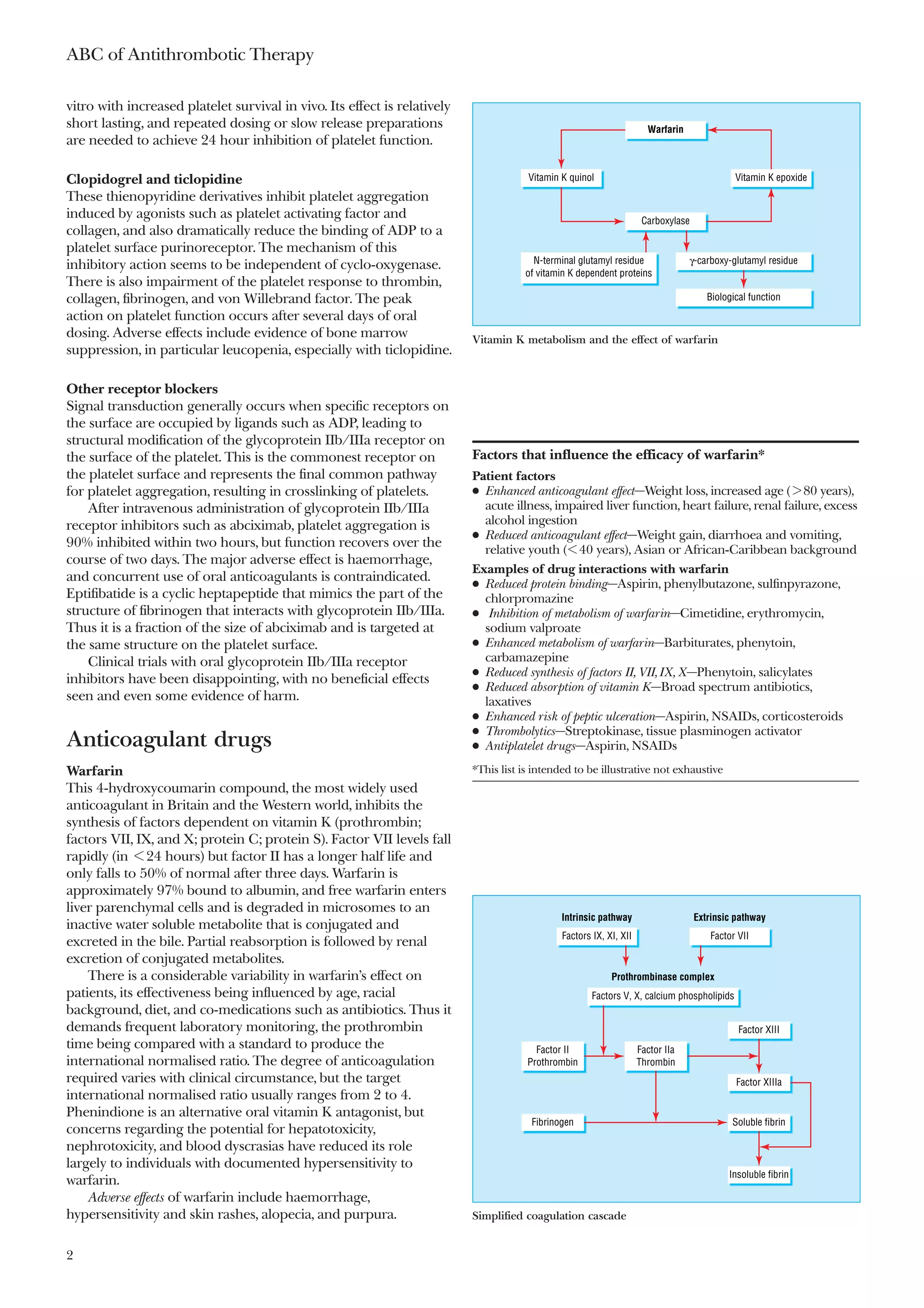
short lasting, and repeated dosing or slow release preparations                                                        Warfarin
are needed to achieve 24 hour inhibition of platelet function.

Clopidogrel and ticlopidine                                                            Vitamin K quinol                                       Vitamin K epoxide
These thienopyridine derivatives inhibit platelet aggregation
induced by agonists such as platelet activating factor and                                                            Carboxylase
collagen, and also dramatically reduce the binding of ADP to a
platelet surface purinoreceptor. The mechanism of this
inhibitory action seems to be independent of cyclo-oxygenase.                           N-terminal glutamyl residue               γ-carboxy-glutamyl residue
                                                                                      of vitamin K dependent proteins
There is also impairment of the platelet response to thrombin,
collagen, fibrinogen, and von Willebrand factor. The peak                                                                              Biological function
action on platelet function occurs after several days of oral
dosing. Adverse effects include evidence of bone marrow                    Vitamin K metabolism and the effect of warfarin
suppression, in particular leucopenia, especially with ticlopidine.

Other receptor blockers
Signal transduction generally occurs when specific receptors on
the surface are occupied by ligands such as ADP, leading to
structural modification of the glycoprotein IIb/IIIa receptor on
the surface of the platelet. This is the commonest receptor on             Factors that influence the efficacy of warfarin*
the platelet surface and represents the final common pathway               Patient factors
for platelet aggregation, resulting in crosslinking of platelets.          x Enhanced anticoagulant effect—Weight loss, increased age ( > 80 years),
    After intravenous administration of glycoprotein IIb/IIIa                acute illness, impaired liver function, heart failure, renal failure, excess
receptor inhibitors such as abciximab, platelet aggregation is               alcohol ingestion
                                                                           x Reduced anticoagulant effect—Weight gain, diarrhoea and vomiting,
90% inhibited within two hours, but function recovers over the
                                                                             relative youth ( < 40 years), Asian or African-Caribbean background
course of two days. The major adverse effect is haemorrhage,
                                                                           Examples of drug interactions with warfarin
and concurrent use of oral anticoagulants is contraindicated.
                                                                           x Reduced protein binding—Aspirin, phenylbutazone, sulfinpyrazone,
Eptifibatide is a cyclic heptapeptide that mimics the part of the            chlorpromazine
structure of fibrinogen that interacts with glycoprotein IIb/IIIa.         x Inhibition of metabolism of warfarin—Cimetidine, erythromycin,
Thus it is a fraction of the size of abciximab and is targeted at            sodium valproate
the same structure on the platelet surface.                                x Enhanced metabolism of warfarin—Barbiturates, phenytoin,
    Clinical trials with oral glycoprotein IIb/IIIa receptor                 carbamazepine
                                                                           x Reduced synthesis of factors II, VII, IX, X—Phenytoin, salicylates
inhibitors have been disappointing, with no beneficial effects
                                                                           x Reduced absorption of vitamin K—Broad spectrum antibiotics,
seen and even some evidence of harm.                                         laxatives
                                                                           x Enhanced risk of peptic ulceration—Aspirin, NSAIDs, corticosteroids
                                                                           x Thrombolytics—Streptokinase, tissue plasminogen activator
Anticoagulant drugs                                                        x Antiplatelet drugs—Aspirin, NSAIDs

Warfarin                                                                   *This list is intended to be illustrative not exhaustive
This 4-hydroxycoumarin compound, the most widely used
anticoagulant in Britain and the Western world, inhibits the
synthesis of factors dependent on vitamin K (prothrombin;
factors VII, IX, and X; protein C; protein S). Factor VII levels fall
rapidly (in < 24 hours) but factor II has a longer half life and
only falls to 50% of normal after three days. Warfarin is
approximately 97% bound to albumin, and free warfarin enters
liver parenchymal cells and is degraded in microsomes to an
                                                                                               Intrinsic pathway                    Extrinsic pathway
inactive water soluble metabolite that is conjugated and
                                                                                               Factors IX, XI, XII                     Factor VII
excreted in the bile. Partial reabsorption is followed by renal
excretion of conjugated metabolites.
    There is a considerable variability in warfarin’s effect on                                             Prothrombinase complex
patients, its effectiveness being influenced by age, racial                                            Factors V, X, calcium phospholipids
background, diet, and co-medications such as antibiotics. Thus it
demands frequent laboratory monitoring, the prothrombin                                                                                        Factor XIII
time being compared with a standard to produce the                                       Factor II                   Factor IIa
international normalised ratio. The degree of anticoagulation                          Prothrombin                   Thrombin
required varies with clinical circumstance, but the target                                                                                    Factor XIIIa
international normalised ratio usually ranges from 2 to 4.
Phenindione is an alternative oral vitamin K antagonist, but
                                                                                        Fibrinogen                                           Soluble fibrin
concerns regarding the potential for hepatotoxicity,
nephrotoxicity, and blood dyscrasias have reduced its role
largely to individuals with documented hypersensitivity to
                                                                                                                                            Insoluble fibrin
warfarin.
    Adverse effects of warfarin include haemorrhage,
hypersensitivity and skin rashes, alopecia, and purpura.                   Simplified coagulation cascade


2
An overview of antithrombotic therapy

Melagatran
This oral thrombin inhibitor undergoing phase III trials seems                                                               Low molecular weight heparin
                                                                                                                             Unfractionated heparin
to be well tolerated, with few clinically significant bleeding
                                                                                                                             Enoxaparin sodium (Lovenox) [3.8:1]
problems, in patients with venous thromboembolism. Although
                                                                                                                             Nadroparin calcium (Fraxiparin) [3.6:1]
considerable pharmacokinetic and animal data exist, solid                                                                    Dalteparin sodium (Fragmin) [2.7:1]
evidence of its effectiveness compared with warfarin and                                         0.7


                                                                              % of composition
heparin in patients at high or low risk is still awaited.
                                                                                                 0.6
Heparin                                                                                          0.5
Heparin is a glycosaminoglycan whose major anticoagulant effect
is accounted for by a pentasaccharide with a high affinity for                                   0.4
antithrombin III. This binding results in a conformational change                                0.3
in antithrombin III so that inactivation of coagulation enzymes
thrombin (IIa), factor IXa, and factor Xa is markedly enhanced. Its                              0.2
short half life means it must be given continuously, and its                                     0.1
extensive first pass metabolism means it must be given
parenterally, preferably by continuous intravenous infusion, and it                               0
                                                                                                       0        5000         10 000           15 000            20 000
is therefore inappropriate for home use. The effect on the                                                                                    Molecular weight (Da)
intrinsic clotting cascade must be monitored carefully by
                                                                                                                                  Greater antithrombin activity
measuring the activated partial thromboplastin time (APTT),
                                                                           Greater anti-Xa activity                               Less anti-Xa activity
generally aiming for a value 1.5 to 2.5 times that of control.             Resistant to PF4                                       Sensitive to PF4
     Unfractionated heparin consists of a heterogeneous mixture            Little non-specific binding                            Non-specific binding
of polysaccharides with an average molecular weight of                     Greater inhibition of thrombin generation              Less inhibition of thrombin generation
15 000 Da. Low molecular weight heparins (4000-6000 Da) are
weaker inhibitors of thrombin but inhibit factor Xa to a similar         The three low molecular weight heparins that have been evaluated in clinical
                                                                         trials of acute coronary syndromes are shown with their respective anti-Xa
extent. Different commercial preparations of low molecular               and antithrombin activity (PF4=platelet factor 4)
weight heparin vary in the ratio of anti-Xa to antithrombin
activity, although the clinical relevance of this is uncertain. Better
absorption after subcutaneous administration and reduced
protein binding result in greatly improved bioavailability. The
effective half life after subcutaneous injection is four hours,
allowing an injection once daily in most circumstances. These
more predictable pharmacokinetics allow the dose to be
calculated on the basis of the patient’s weight and reduce the           Comparison of low molecular weight and unfractionated
requirement for frequent monitoring. In those rare cases where           heparins
monitoring is deemed necessary, measurement of plasma levels
of anti-Xa activity is needed. Tests of APTT are unhelpful.                                                   Unfractionated                      Low molecular
     Major adverse effects of heparin include haemorrhage,                                                    heparin                             weight heparin
osteoporosis, alopecia, thrombocytopenia, and hypersensitivity.          Action                               Anti-XIIa, XIa, IXa, VIIa,          Mostly anti-Xa
                                                                                                              antithrombin
At present, the risk of haemorrhage seems to be similar with
                                                                         Route of                             Subcutaneous                        Subcutaneous
low molecular weight and unfractionated heparin. However, the
                                                                         administration                       Intravenous
risk of heparin induced thrombocytopenia seems to be less with
                                                                         Absorption from                      Slow                                Improved
the low molecular weight form.                                           subcutaneous route
                                                                         Protein binding      Proteins in plasma and on                           Reduced
Hirudin and direct thrombin inhibitors                                                        endothelium
Hirudin, a 65 amino acid residue anticoagulant peptide with a            Bioavailability      Subcutaneous—10-30% at                               > 90%
relative molecular mass of 7000 Da purified from the leech                                    low doses, 90% at higher
Hirudo medicinalis, binds thrombin with high specificity and                                  doses
sensitivity. With a true half life of about an hour and a half life                           Intravenous—100%
effect on the APTT of two to three hours, it may be seen as an                                by definition
alternative to heparin in indications such as unstable angina            Effective half life  Subcutaneous—1.5 hours                              4 hours
and in coronary angioplasty.                                                                  Intravenous—30 min
    Many derivatives are available, with hirulog and argatroban          Between and within Extensive                                             Minimal
                                                                         individual variation
among the best developed. However, trials of the former have
                                                                         Monitoring           APTT                                                Not required
been discouraging: no clear benefit over heparin was shown.
                                                                                                                                                  (anti-Xa activity)
Conversely, argatroban may have a role in the anticoagulation
                                                                         Elimination                          Liver and kidney                    Kidney
of patients unable to tolerate heparin as a result of heparin
induced thrombocytopenia. Furthermore, in a clinical trial of
patients with heparin induced thrombocytopenia, use of
argatroban was associated with a reduction in levels of plasma
platelet activation markers.


Thrombolytic agents
These agents lyse pre-existing thrombus, either by potentiating
the body’s own fibrinolytic pathways (such as streptokinase) or

                                                                                                                                                                           3
ABC of Antithrombotic Therapy

by mimicking natural thrombolytic molecules (such as tissue
                                                                         Fibrinolytic drugs
plasminogen activator). The common agents in clinical use are
derived from bacterial products (streptokinase) or                       Examples               Source                        Mechanism of action
manufactured using recombinant DNA technology                            Streptokinase          Group C haemolytic            Complexes with and
(recombinant tissue plasminogen activator). Newer drugs aim to                                  streptococci                  activates plasminogen
be less antigenic and more thrombus specific in an attempt to            Urokinase              Trypsin-like chemical         Direct acting
increase efficacy and specificity of various agents; on present                                 produced by kidney            plasminogen activator
evidence, however, the differences between thrombolytic agents           Reteplase              Recombinant DNA               Acivates plasminogen,
are only marginal. Because of the lack of site specificity for these     (recombinant           technology                    non-immunogenic
drugs, the major adverse effect is that of haemorrhage                   tissue
                                                                         plasminogen
(gastrointestinal, intracranial, etc). The other important adverse
                                                                         activator)
effect is that of hypersensitivity reaction, especially with
streptokinase. This usually manifests as flushing, breathlessness,
rash, urticaria, and hypotension. Severe anaphylaxis is rare.
Hypersensitivity reactions are avoided by using tissue
                                                                         Contraindications to thrombolysis
plasminogen activator or recombinant tissue plasminogen
activator, which are not antigenic.                                      Absolute                                      Relative
                                                                         x Recent or current haemorrhage,              x Previous peptic ulceration
                                                                           trauma, or surgery                          x Warfarin
Streptokinase                                                            x Active peptic ulceration                    x Liver disease
Derived from streptococci, this product is an effective                  x Coagulation defects                         x Previous use of anistreplase
thrombolytic agent for the treatment of acute myocardial                 x Oesophageal varices                           or streptokinase within four
infarction and pulmonary thromboembolism. Acting by                      x Coma                                          years (use alternative agent)
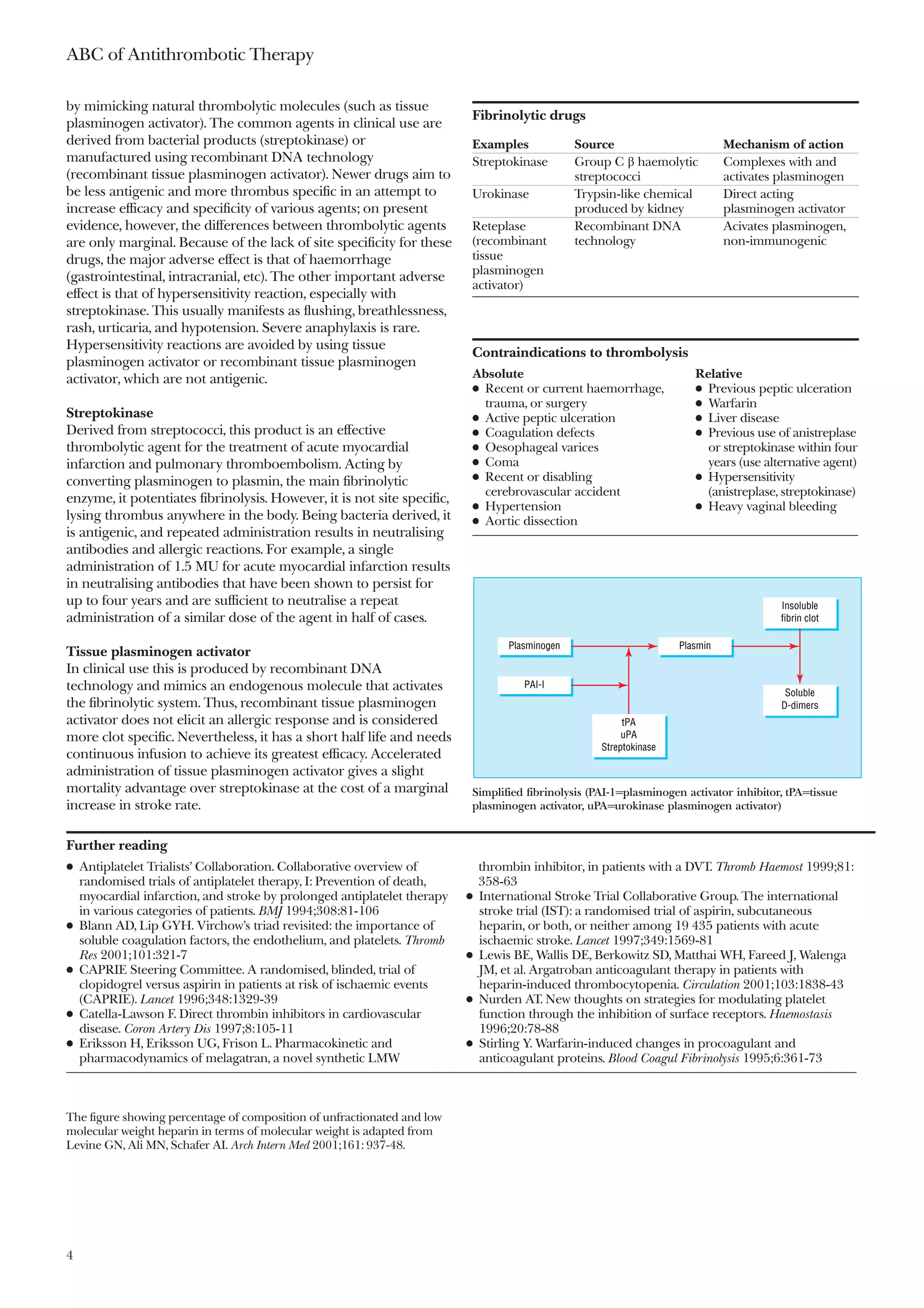
converting plasminogen to plasmin, the main fibrinolytic                 x Recent or disabling                         x Hypersensitivity
                                                                           cerebrovascular accident                      (anistreplase, streptokinase)
enzyme, it potentiates fibrinolysis. However, it is not site specific,
                                                                         x Hypertension                                x Heavy vaginal bleeding
lysing thrombus anywhere in the body. Being bacteria derived, it         x Aortic dissection
is antigenic, and repeated administration results in neutralising
antibodies and allergic reactions. For example, a single
administration of 1.5 MU for acute myocardial infarction results
in neutralising antibodies that have been shown to persist for
up to four years and are sufficient to neutralise a repeat                                                                             Insoluble
administration of a similar dose of the agent in half of cases.                                                                        fibrin clot

                                                                                  Plasminogen                       Plasmin
Tissue plasminogen activator
In clinical use this is produced by recombinant DNA
technology and mimics an endogenous molecule that activates                          PAI-I
                                                                                                                                        Soluble
the fibrinolytic system. Thus, recombinant tissue plasminogen                                                                          D-dimers
activator does not elicit an allergic response and is considered                                         tPA
more clot specific. Nevertheless, it has a short half life and needs                                     uPA
                                                                                                    Streptokinase
continuous infusion to achieve its greatest efficacy. Accelerated
administration of tissue plasminogen activator gives a slight
mortality advantage over streptokinase at the cost of a marginal         Simplified fibrinolysis (PAI-1=plasminogen activator inhibitor, tPA=tissue
increase in stroke rate.                                                 plasminogen activator, uPA=urokinase plasminogen activator)


Further reading
x Antiplatelet Trialists’ Collaboration. Collaborative overview of           thrombin inhibitor, in patients with a DVT. Thromb Haemost 1999;81:
  randomised trials of antiplatelet therapy, I: Prevention of death,         358-63
  myocardial infarction, and stroke by prolonged antiplatelet therapy    x   International Stroke Trial Collaborative Group. The international
  in various categories of patients. BMJ 1994;308:81-106                     stroke trial (IST): a randomised trial of aspirin, subcutaneous
x Blann AD, Lip GYH. Virchow’s triad revisited: the importance of            heparin, or both, or neither among 19 435 patients with acute
  soluble coagulation factors, the endothelium, and platelets. Thromb        ischaemic stroke. Lancet 1997;349:1569-81
  Res 2001;101:321-7                                                     x   Lewis BE, Wallis DE, Berkowitz SD, Matthai WH, Fareed J, Walenga
x CAPRIE Steering Committee. A randomised, blinded, trial of                 JM, et al. Argatroban anticoagulant therapy in patients with
  clopidogrel versus aspirin in patients at risk of ischaemic events         heparin-induced thrombocytopenia. Circulation 2001;103:1838-43
  (CAPRIE). Lancet 1996;348:1329-39                                      x   Nurden AT. New thoughts on strategies for modulating platelet
x Catella-Lawson F. Direct thrombin inhibitors in cardiovascular             function through the inhibition of surface receptors. Haemostasis
  disease. Coron Artery Dis 1997;8:105-11                                    1996;20:78-88
x Eriksson H, Eriksson UG, Frison L. Pharmacokinetic and                 x   Stirling Y. Warfarin-induced changes in procoagulant and
  pharmacodynamics of melagatran, a novel synthetic LMW                      anticoagulant proteins. Blood Coagul Fibrinolysis 1995;6:361-73


The figure showing percentage of composition of unfractionated and low
molecular weight heparin in terms of molecular weight is adapted from
Levine GN, Ali MN, Schafer AI. Arch Intern Med 2001;161: 937-48.


4
2       Bleeding risks of antithrombotic therapy
David A Fitzmaurice, Andrew D Blann, Gregory Y H Lip


Many of the common cardiovascular disorders (especially in
                                                                       Questions to ask when considering oral anticoagulation
elderly people) are linked to thrombosis—such as ischaemic
                                                                       x Is there a definite indication (such as atrial fibrillation)?
heart disease, atrial fibrillation, valve disease, hypertension, and   x Is there a high risk of bleeding or strong contraindication against
atherosclerotic vascular disease—requiring the use of                    anticoagulation?
antithrombotic therapy. This raises questions regarding the            x Will concurrent medication or disease states increase bleeding risk
appropriate use of antithrombotic therapy in older people,               or interfere with anticoagulation control?
especially because strategies such as anticoagulation with             x Is drug compliance and attendance at anticoagulant clinic for
                                                                         monitoring likely to be a problem?
warfarin need regular monitoring of the international
                                                                       x Will there be regular review of the patient, especially with regard to
normalised ratio (INR), a measure of the induced haemorrhagic            risks and benefits of anticoagulation?
tendency, and carry a risk of bleeding. The presence of
concomitant physical and medical problems increases the
interactions and risks associated with warfarin, and
anticoagulation in elderly patients often needs an assessment of

                                                                               S                                 D
the overall risk:benefit ratio.
    Physical frailty in elderly people may reduce access to                     patient’s prothrombin time ISI
                                                                        INR=
anticoagulant clinics for INR monitoring. The decline in                            mean normal time
cognitive function in some elderly patients also may reduce             ISI=international sensitivity ratio. The
compliance with anticoagulation and the appreciation of                 mean normal prothrombin time is often
bleeding risks and drug interactions. However, in recent studies        generated from samples from local
                                                                        healthy subjects or a commercially
of anticoagulation in elderly people, no significant associations
                                                                        available standard. The exact value of the
of anticoagulant control were found with age, sex, social
                                                                        ISI depends on the thromboplastin used
circumstances, mobility, domicillary supervision of medication,         in the prothrombin time method
or indications for anticoagulation.


Warfarin
Bleeding is the most serious and common complication of
warfarin treatment. For any given patient, the potential benefit
from prevention of thromboembolic disease needs to be
balanced against the potential harm from induced
haemorrhagic side effects.

Minor bleeds
Most bleeding problems are clinically minor, although patients
are unlikely to view such bleeds in these terms. The problems
include nose bleeds, bruising, and excessive bleeding after
minor injury such as shaving. Patients should be made aware of
these common problems and be reassured that these events are
expected in patients receiving warfarin treatment. Menorrhagia
is surprisingly rare as a major clinical problem, even though it
can be severe.


More serious problems
Patients need access to medical care if they have serious
problems. Such problems are generally due to a high INR.
Usually, spontaneous bruising, any bleeding that is difficult to
arrest, frank haematuria, any evidence of gastrointestinal
bleeding, and haemoptysis, need urgent assessment. The
definition of minor or major bleeding lacks clarity: in many
cases the patient presents with a concern that may need follow         Purpura, petechiae, and haematoma secondary to
                                                                       over-anticoagulation
up, and a minor bleed can only be defined as such in retrospect.
In most cases, evidence of bleeding suggests some underlying
pathology but may also be due to drug interactions. For
example, a patient with recurrent haemoptysis may be found to
have hereditary telangectasia. Further investigation of the cause        Sudden, unexplained changes to the
of bleeding should always be considered, particularly if the             efficacy of warfarin may be caused by the
bleeding is recurrent. It is also important in these instances to        consumption of over the counter
check for concomitant drug use, particularly drugs received              multivitamin tablets or foodstuffs that
                                                                         contain high levels of vitamin K
over the counter. Patients should be aware that aspirin and


                                                                                                                                              5
ABC of Antithrombotic Therapy

non-steroidal anti-inflammatory drugs are particularly
                                                                        Patients at high risk of bleeding with warfarin
dangerous in combination with warfarin; however, even
                                                                        x Age > 75 years
supposedly safe drugs such as paracetamol can affect a patient’s        x History of uncontrolled hypertension (defined as systolic blood
bleeding tendency.                                                        pressure > 180mm Hg or diastolic blood pressure > 100 mm Hg)
                                                                        x Alcohol excess (acute or chronic), liver disease
Incidence of bleeding problems                                          x Poor drug compliance or clinic attendance
The incidence of severe bleeding problems that may bring                x Bleeding lesions (especially gastrointestinal blood loss, such as
patients to an accident and emergency unit has probably been              peptic ulcer disease, or recent cerebral haemorrhage)
                                                                        x Bleeding tendency (including coagulation defects,
overestimated. The annual incidence of fatality caused by
                                                                          thrombocytopenia) or concomitant use of non-steroidal
warfarin administration has been estimated to be 1%. However,             anti-inflammatory drugs and antibiotics
this is based on old data, and, although difficult to prove, the        x Instability of INR control and INR > 3
overall improvement in anticoagulation control in the past
10-15 years means that a more realistic figure is about 0.2%.
Methodological problems have hampered the interpretation of
previously reported data, particularly with regard to definitions
of major and minor bleeding episodes, with some investigators
accepting hospital admission for transfusion of up to 4 units of
blood as being “minor.” Certainly, the most serious “major”
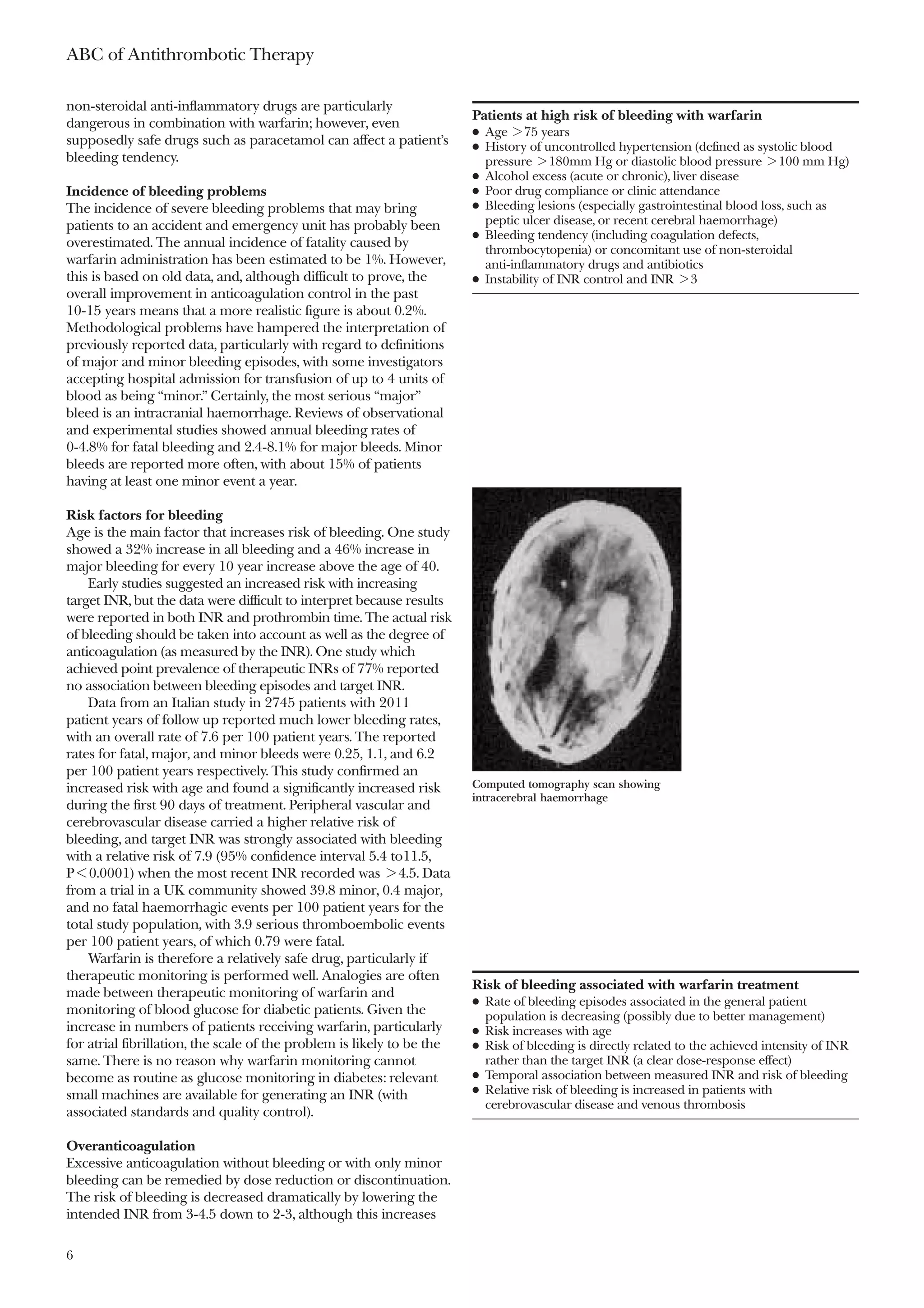
bleed is an intracranial haemorrhage. Reviews of observational
and experimental studies showed annual bleeding rates of
0-4.8% for fatal bleeding and 2.4-8.1% for major bleeds. Minor
bleeds are reported more often, with about 15% of patients
having at least one minor event a year.

Risk factors for bleeding
Age is the main factor that increases risk of bleeding. One study
showed a 32% increase in all bleeding and a 46% increase in
major bleeding for every 10 year increase above the age of 40.
    Early studies suggested an increased risk with increasing
target INR, but the data were difficult to interpret because results
were reported in both INR and prothrombin time. The actual risk
of bleeding should be taken into account as well as the degree of
anticoagulation (as measured by the INR). One study which
achieved point prevalence of therapeutic INRs of 77% reported
no association between bleeding episodes and target INR.
    Data from an Italian study in 2745 patients with 2011
patient years of follow up reported much lower bleeding rates,
with an overall rate of 7.6 per 100 patient years. The reported
rates for fatal, major, and minor bleeds were 0.25, 1.1, and 6.2
per 100 patient years respectively. This study confirmed an
increased risk with age and found a significantly increased risk        Computed tomography scan showing
                                                                        intracerebral haemorrhage
during the first 90 days of treatment. Peripheral vascular and
cerebrovascular disease carried a higher relative risk of
bleeding, and target INR was strongly associated with bleeding
with a relative risk of 7.9 (95% confidence interval 5.4 to11.5,
P < 0.0001) when the most recent INR recorded was > 4.5. Data
from a trial in a UK community showed 39.8 minor, 0.4 major,
and no fatal haemorrhagic events per 100 patient years for the
total study population, with 3.9 serious thromboembolic events
per 100 patient years, of which 0.79 were fatal.
    Warfarin is therefore a relatively safe drug, particularly if
therapeutic monitoring is performed well. Analogies are often
                                                                        Risk of bleeding associated with warfarin treatment
made between therapeutic monitoring of warfarin and
                                                                        x Rate of bleeding episodes associated in the general patient
monitoring of blood glucose for diabetic patients. Given the              population is decreasing (possibly due to better management)
increase in numbers of patients receiving warfarin, particularly        x Risk increases with age
for atrial fibrillation, the scale of the problem is likely to be the   x Risk of bleeding is directly related to the achieved intensity of INR
same. There is no reason why warfarin monitoring cannot                   rather than the target INR (a clear dose-response effect)
become as routine as glucose monitoring in diabetes: relevant           x Temporal association between measured INR and risk of bleeding
small machines are available for generating an INR (with                x Relative risk of bleeding is increased in patients with
                                                                          cerebrovascular disease and venous thrombosis
associated standards and quality control).

Overanticoagulation
Excessive anticoagulation without bleeding or with only minor
bleeding can be remedied by dose reduction or discontinuation.
The risk of bleeding is decreased dramatically by lowering the
intended INR from 3-4.5 down to 2-3, although this increases


6
Bleeding risks of antithrombotic therapy

the risk of thrombosis. If bleeding becomes substantial, 2-5 mg
of oral or subcutaneous vitamin K may be needed. In patients                                                                                                            ASP
with prosthetic valves, vitamin K should perhaps be avoided                  Myocardial infarction
                                                                        (P=0.002) 36% reduction,                                                                        PLA
because of the risk of valve thrombosis unless there is life              but only 45 fewer events
threatening intracranial bleeding. Alternatives to vitamin K
include a concentrate of the prothrombin group of coagulation
factors including II, IX, and X, fresh frozen plasma 15 ml/kg,
                                                                                    Stroke (P=0.88)
and recombinant factor VIIa.


Aspirin                                                                                               0              1             2            3              4              5
                                                                                                                                               Events per 100 patient years
Aspirin has little effect in terms of bruising but can cause
serious gastrointestinal bleeding. The risk of gastrointestinal                                                   GI bleeds       Cerebral bleeds

bleeding is related to dose and should not be problematic at                                              ASP        107                14
                                                                                                                  (fatal=5)
doses of 75 mg/day given as thromboprophylaxis. There is
currently no consensus as to optimal dose of aspirin for stroke                                           PLA        55                 15
                                                                                                                  (fatal=3)
prevention in atrial fibrillation. A meta-analysis of randomised
controlled trials using aspirin showed that a mean dose of
273 mg/day, increased absolute risk of haemorrhagic stroke to          Myocardial infarction, stroke, and bleeding in the hypertension optimal
                                                                       treatment trial (HOT) study (ASP=aspirin, PLA=placebo)
12 events per 10 000 people. This relatively small increase must
be weighed against the reduced risk of myocardial infarction (to
137 events per 10 000) and ischaemic stroke (to 39 events per
10 000). However, in one trial of patients with well controlled
hypertension, use of aspirin 75 mg prevented 1.5 myocardial              Aspirin daily No of      Events/patients                    Odds ratio               Odds       2P
                                                                         dose (mg) trials*     Aspirin          Control           (95% CI random)           reduction
infarctions per 1000 patients a year, which was in addition to                                  (%)              (%)               Aspirin:control            (SD)
the benefit achieved by lowering the blood pressure, with no
                                                                         500-1500       34 1621/11 215 1930/11 236                                          19% (3) <0.00001
effect on stroke. Although there was no increase in the number                               (14.5%)     (17.2%)
of fatal bleeding events (seven in patients taking aspirin,              160-325        19 1526/13 240 1963/13 273                                          25% (3) <0.00001
                                                                                             (11.5%)     (14.8%)
compared with eight in the placebo group), there was a 1.8%
                                                                         75-150         12 370/3370     519/3406                                            32% (6) <0.00001
increase in non-fatal, major bleeding events (129 events in                                  (11.0%)     (15.2%)
patients taking aspirin, compared with 70 in the placebo group)          <75             3  316/1827    354/1828                                            13% (8)      NS
                                                                                             (17.3%)     (19.4%)
and minor bleeds (156 and 87, respectively).                             Total          65 3833/29 652 4766/29 743                                          23% (2) <0.00001
                                                                                             (12.9%)     (16.0%)
                                                                                                                          0       0.5     1     1.5     2
                                                                         Heterogeneity between 4 dose categories:          Aspirin                Aspirin
Risk of bleeding                                                         χ2=3; df=7.7; P=0.06                              better                   worse

                                                                         *Some trials contributed to more than one daily dose category.
There have been conflicting results concerning the role of age
as an independent risk factor for haemorrhage induced by                 Typical odds ratio for each category shown as square (with area proportional to the variance of
                                                                         observed-expected) together with its 99% confidence interval (horizontal line). Typical odds ratio
anticoagulants. Advanced age ( > 75 years), intensity of                 for the total shown as diamond with its 95% confidence interval (horizontal line = width of
anticoagulation (especially INR > 4), history of cerebral vascular       diamond). Vertical dotted line passes through point estimate of typical odds ratio for total.

disease (recent or remote), and concomitant use of drugs that          Effect of different doses of aspirin in secondary prevention of vascular events
interfere with haemostasis (aspirin or non-steroidal                   (There is no significant difference in benefit with different aspirin doses, but at
anti-inflammatory drugs) are probably the most important               higher doses adverse effects are more likely)
variables determining patients’ risk of major life threatening
bleeding complications while they are receiving anticoagulation
treatment.
    Generally elderly people have increased sensitivity to the         Variables that may influence the risk of bleeding in
anticoagulant effect of warfarin, and require a lower mean daily       elderly people
dose to achieve a given anticoagulant intensity. For example,          x Increased sensitivity to the effect of anticoagulation, perhaps due to
patients aged > 75 years need less than half the daily warfarin          increased receptor affinity or lower dietary vitamin K intake
dose of patients aged < 35 for an equivalent level of                  x Concurrent use of drugs that increase bleeding risk
                                                                       x Associated comorbidity and other diseases that decrease
anticoagulation. Whatever the mechanism it is clear that warfarin
                                                                         compliance and increase the risk of bleeding
therapy needs careful justification for being given to elderly
patients, and the dose needs modification and careful monitoring.
    As there is an exponential increase in bleeding risk with a
linear increase in anticoagulant effect, there will be a substantial
increase in bleeding risk with overanticoagulation. For example,
                                                                       Possible reasons for increased sensitivity to anticoagulation
the annual risk of bleeding rises from 1.6% in elderly people
                                                                       in elderly people
not treated with anticoagulant drugs (based on the “Sixty-Plus”
                                                                       x Lower body weight
study), to 5% (relative risk 3) at an INR of 2.5, and to 50%           x Differences in pharmacokinetics, with a tendency towards reduced
(relative risk 30) at an INR of 4. In another study, total bleeding      drug clearance in the elderly either due to decreases in renal or
events were 39% in a group of 31 patients with an INR of 7               hepatic blood flow and function with age per se or disease
compared with 13% in a group of 100 with a stable INR (odds              processes
ratio 5.4, 95% CI 2.1-13.9). The greatest risk factor for being in     x Change in receptor sensitivity
                                                                       x Lower dietary vitamin K intake in the elderly may perhaps be the
this group was (apart from having a high target INR) antibiotic
                                                                         more important cause
therapy in the preceding four weeks.


                                                                                                                                                                                  7
ABC of Antithrombotic Therapy

    Multiple drug therapy or polypharmacy is quite common,
                                                                              Further reading
with the consequence of adverse drug interactions, the risk of
                                                                              x Blann AD, Hewitt J, Siddique F, Bareford D. Racial background is a
which rises exponentially with the number of drugs given
                                                                                determinant of average warfarin dose required to maintain the INR
simultaneously and with concurrent diseases. Typical drug                       between 2.0 and 3.0. Br J Haematol 1999;10:207-9
interactions include changes in absorption across intestinal                  x Erhardtsten E, Nony P, Dechavanne M, Ffrench P, Boissel JP,
mucosae and hepatic metabolism. Patients should be cautioned                    Hedner U. The effect of recombinant factor VIIa (NovoSevenTM) in
about the risk of warfarin-drug interactions when their                         healthy volunteers receiving acenocoumarol to an International
medication list is altered. The decline in cognitive function in                Normalized Ratio above 2.0. Blood Coag Fibrin 1998;9:741-8
some elderly patients may mean they do not realise that some                  x Fitzmaurice DA, Hobbs FDR, Murray ET, Hodder, RL, Allan TF,
                                                                                Rose, PE. Oral anticoagulation management in primary care with
drugs can interact with anticoagulants and so they do not
                                                                                the use of computerised decision support and near-patient testing.
mention their use of oral anticoagulants to doctors or                          A randomised controlled trial. Arch Intern Med 2000;160:2323-48
pharmacists. However, elderly patients are likely to attend clinic            x Gurwitz JH, Goldberg RJ, Holden A, Knapic N, Ansell J. Age-related
less often than younger patients, suggesting a greater degree of                risks of long term oral anticoagulant therapy. Arch Intern Med
INR stability.                                                                  1988;148:1733-6
    Many diseases associated with stroke and thromboembolism                  x He J, Whelton PK, Vu B, Klag MJ. Aspirin and risk of haemorrhagic
                                                                                stroke. JAMA 1998;280:1930-5
are more common with increasing age. Older patients are often
                                                                              x Haemostasis and Thrombosis Task Force of the British Society for
at highest risk, and appropriate anticoagulation therapy reduces                Haematology. Guidelines on oral anticoagulation: third edition. Br J
morbidity and mortality. Careful and continuing evaluation of                   Haematol 1998;101:374-87
patients is necessary to ensure that the risks of bleeding do not             x Landefeld CS, Beyth RJ. Anticoagulant related bleeding: clinical
outweigh the benefits from anticoagulation.                                     epidemiology, prediction, and prevention. Am J Med 1993;95:315-28
                                                                              x Levine MN, Hirsh J, Landefeld CS, Raskob G. Haemorrhagic
The diagram showing the results of the hypertension optimal treatment           complications of anticoagulant treatment. Chest 1992;102:352-63S
trial is adapted from Hansson L, et al. Lancet 1998;351:1755-62. The figure   x Panneerselvan S, Baglin C, Lefort W, Baglin T. Analysis of risk
showing the effect of different doses of aspirin in secondary prevention of     factors for over-anticoagulation in patients receiving long-term
vascular events is reproduced from Clinical Evidence (June issue 7), BMJ        warfarin. Br J Haematol 1998;103:422-4
Publishing Group, 2002.
                                                                              x Palareti G, Leali N, Coccheri S, Poggi M, Manotti C, D’Angelo A,
                                                                                et al. Bleeding complications of oral anticoagulant treatment: an
                                                                                inception-cohort, prospective collaborative study (ISCOAT). Lancet
                                                                                1996;348:423-8
                                                                              x van der Meer FJM, Rosendaal FR, Vandenbroucke, Briet E. Bleeding
                                                                                complications in oral anticoagulant therapy. Arch Int Med
                                                                                1993;153:1557-62
                                                                              x Hutton BA, Lensing AWA, Kraaijenhagen RA, Prins MH. Safety of
                                                                                treatment with oral anticoagulants in the elderly. Drugs and Aging
                                                                                1999;14:303-12


8
3 Venous thromboembolism: pathophysiology,
clinical features, and prevention
Alexander G G Turpie, Bernard S P Chin, Gregory Y H Lip


Venous thromboembolism is a common complication among
hospital inpatients and contributes to longer hospital stays,
morbidity, and mortality. Some venous thromboembolisms may
be subclinical, whereas others present as sudden pulmonary
embolus or symptomatic deep vein thrombosis. Ultrasonic
Doppler and venographic techniques have shown deep vein
thrombosis of the lower limb to occur in half of all major lower
limb orthopaedic operations performed without antithrombotic
prophylaxis. Deep vein thrombosis of the lower limb is also seen
in a quarter of patients with acute myocardial infarction, and
more than half of patients with acute ischaemic stroke.
    Deep vein thrombosis of the lower limb normally starts in
the calf veins. About 10-20% of thromboses extend proximally,
and a further 1-5% go on to develop fatal pulmonary
embolism. Appropriate antithrombotic measures can reduce
this complication. Until recently, some clinicians were reluctant
to provide such prophylaxis routinely. As unfounded fears of
major bleeding complications from anticoagulant regimens
wane, preventive treatments are used more often with medical
and surgical patients. However, the risk of bleeding can be
serious and this has particular bearing in postoperative patients.
    Venous thromboembolism can also arise spontaneously in             Pulmonary angiography showing large pulmonary embolus in left
ambulant individuals, particularly if they have associated risk        pulmonary artery
factors such as thrombophilia, previous thrombosis, or cancer.
However, in over half of these patients, no specific predisposing
factors can be identified at presentation.


Pathophysiology                                                            Venous thromboembolism often
                                                                           manifests clinically as deep vein
Thrombus formation and propagation depend on the presence                  thrombosis or pulmonary embolism, and
of abnormalities of blood flow, blood vessel wall, and blood               is possibly one of the preventable
clotting components, known collectively as Virchow’s triad.                complications that occur in hospitalised
Abnormalities of blood flow or venous stasis normally occur                patients
after prolonged immobility or confinement to bed. Venous
obstruction can arise from external compression by enlarged
lymph nodes, bulky tumours, or intravascular compression by
previous thromboses. Increased oestrogens at pharmacological
levels, as seen with oral contraceptive use and with hormone           Risk factors and conditions predisposing to venous
replacement therapy in postmenopausal women, have been                 thromboembolism
associated with a threefold increased risk in the small initial risk
                                                                       x   History of venous thromboembolism
of venous thromboembolism. Cancers, particularly
                                                                       x   Prolonged immobility
adenocarcinomas and metastatic cancers, are also associated            x   Prolonged confinement to bed or lower limb paralysis
with increased venous thromboembolism. Indeed, on                      x   Surgery, particularly lower limb orthopaedic operations, and major
presentation, some idiopathic venous thromboembolisms have                 pelvic or abdominal operations
revealed occult cancers at follow up. Both oestrogens at               x   Trauma—For example, hip fractures and acute spinal injury
pharmacological levels and cancer can also activate the clotting       x   Obesity
                                                                       x   Major medical illnesses such as acute myocardial infarction,
system.
                                                                           ischaemic stroke, congestive cardiac failure, acute respiratory failure
                                                                       x   Oestrogen use in pharmacological doses—For example, oral
                                                                           contraception pills, hormone replacement therapy
Clinical presentation and diagnosis                                    x   Cancer, especially metastatic adenocarcinomas
                                                                       x   Age > 40 years
Deep vein thrombosis                                                   x   Aquired hypercoagulable states—Lupus anticoagulant and
Deep vein thrombosis commonly presents with pain, erythema,                antiphospholipid antibodies, hyperhomocysteinaemia,
tenderness, and swelling of the affected limb. Thus, in lower              dysfibrinogenaemia, myeloproliferative disorders such as
limb deep vein thrombosis, the affected leg is usually swollen             polycythaemia rubra vera
with the circumference of the calf larger than the unaffected          x   Inherited hypercoaguable states—Activated protein C resistance
                                                                           (factor V Leiden mutation), protein C deficiency, protein S
side. Other causes of leg swelling, erythema, and tenderness
                                                                           deficiency, antithrombin deficiency, prothrombin gene mutation
include a ruptured Baker’s cyst and infective cellulitis. The


                                                                                                                                                9
ABC of Antithrombotic Therapy

diagnosis of deep vein thrombosis is therefore more likely when
                                                                      Modified pretest probability for deep vein thrombosis
risk factors are present and less so if there are features
suggesting alternative diagnoses. For example, ruptured               Clinical feature                                                            Score
Baker’s cysts commonly appear in the context of osteoarthritis        Tenderness along entire deep vein system                                     1.0
and rheumatoid arthritis. Infective cellulitis is unlikely to         Swelling of the entire leg                                                   1.0
be bilateral, with clearly demarcated areas of erythema               Greater than 3 cm difference in calf circumference                           1.0
extending proximally. Breaks in the skin, particularly between        Pitting oedema                                                               1.0
the toes, and coexistent fungal infection are additional clues to     Collateral superficial veins                                                 1.0
cellulitis.                                                           Risk factors present:
    Objective diagnosis of venous thromboembolism is                    Active cancer                                                               1.0
important for optimal management. Although the clinical
                                                                        Prolonged immobility or paralysis                                           1.0
diagnosis of venous thromboembolism is imprecise, various
                                                                        Recent surgery or major medical illness                                     1.0
probability models based on clinical features have proved to be
                                                                      Alternative diagnosis likely (ruptured Baker’s cyst in                      − 2.0
practical and reliable (interobserver reliability, = 0.85) in         rheumatoid arthritis, superficial thrombophlebitis, or
predicting the likelihood of venous thromboembolism. These            infective cellulitis)
models should be used in conjunction with objective diagnostic
                                                                      Score > 3 = high probablility; 1-2 = moderate probability < 0 = low probability
tests.
    Compression ultrasonography remains the non-invasive
investigation of choice for the diagnosis of clinically suspected
deep vein thrombosis. It is highly sensitive in detecting proximal
deep vein thrombosis although less accurate for isolated calf
deep vein thrombosis. In patients with suspected thrombosis

                                                                           D-dimer µg/L
and a negative compression ultrasound result, the test should be
repeated in seven days because studies have shown that patients
with two or more negative tests over a week who are untreated                             20 000

have a less than 2% risk of proximal extension or subsequent
                                                                                          10 000
deep vein thrombosis.
    Impedance plethysmography is slightly less specific and                                5000
sensitive than ultrasonography but may still have a role in
pregnant women and suspected recurrent deep vein
thrombosis. The gold standard is invasive contrast venography,
which is still used when a definitive answer is needed. Newer                              1000

imaging techniques are being developed, and tools such as                                   500
magnetic resonance venography or computed tomography
could possibly detect pelvic vein thromboses, but further testing
is needed to establish their role in the diagnosis of deep vein
thrombosis.                                                                                 100
    Blood tests such as fibrin D-dimer add to the diagnostic
accuracy of the non-invasive tests. In one study, the sensitivity
and specificity of a D-dimer concentration of > 500 g/l for the                               0
                                                                                                        Pulmonary        No pulmonary
presence of pulmonary embolism were 98% and 39%,                                                        embolism          embolism
respectively, which give positive and negative predictive
values of 44% and 98%. The sensitivity of the test even               Plasma D-dimer concentrations on day of presentation according
remained high at three and seven days after presentation              to final diagnosis
(96% and 93%).


Investigations for suspected venous thromboembolism by pretest clinical probability
Pretest probability   Fibrin D-dimer         Other investigations                                                   Comment
Deep vein
thrombosis:
  Low                    Negative                                                                        No further investigations needed
  Low or moderate        Positive      Negative ultrasound compression                       Consider venography or repeat ultrasound after a week
  Moderate or high       Positive      Positive ultrasound compression                                       Treat with anticoagulants
  High                   Positive      Negative ultrasound compression                       Consider venography to rule out deep vein thrombosis,
                                                                                             especially in high risk patients and those with recurrent
                                                                                                                pulmonary emboli
Pulmonary
embolism:
  Low                    Negative                     No                                                 No further investigation needed
  Low or moderate        Positive       Proceed to ventilation-perfusion                   If non-diagnostic ventilation-perfusion scan consider serial
                                                     scan                                  compression ultrasound over two weeks to rule out venous
                                                                                                                thromboembolism
  High                   Positive       Proceed to ventilation-perfusion                     If non-diagnostic ventilation-perfusion scans, proceed to
                                             scan (or ultrasound)                                venography or pulmonary angiography as needed


10
Venous thromboembolism: pathophysiology, clinical features, and prevention

Pulmonary embolism
                                                                     Clinical probability for pulmonary embolism
Patients presenting with acute pulmonary embolism often
complain of sudden onset of breathlessness with haemoptysis          Clinical feature                                                       Score
or pleuritic chest pain, or collapse with shock in the absence of    Deep vein thrombosis suspected:
other causes. Deep vein thrombosis may not be suspected                Clinical features of deep vein thrombosis                              3.0
clinically, but its presence, along with thrombotic risk factors,      Recent prolonged immobility or surgery                                 1.5
will make the diagnosis of pulmonary embolism more likely. A           Active cancer                                                          1.0
similar clinical probability model to that for deep vein               History of deep vein thrombosis or pulmonary                           1.5
thrombosis has been developed for pulmonary embolism.                  embolism
    Pulmonary angiography is the gold standard investigation         Haemoptysis                                                              1.0
for pulmonary embolism, but it is invasive and associated with       Resting heart rate > 100 beats/min                                       1.5
0.5% mortality. A ventilation-perfusion scan using technetium        No alternative explanation for acute breathlessness or                   3.0
DTPA (ditriaminopentaric acid) is more widely used. However          pleuritic chest pain
this investigation is non-specific, and is diagnostic in only 30%
                                                                     > 6 = high probability (60%); 2-6 = moderate probability (20%); < 1.5 = low
of cases. Spiral computed tomography scans are more reliable         probability (3-4%)
but diagnosis is limited to emboli in larger vessels only.
Measurement of fibrin D-dimer levels, used for deep vein
thrombosis, is helpful, as is compression ultrasound in the
detection of occult deep vein thrombosis.

                                                                     Thromboembolic risk stratification for surgery patients
Prevention strategies                                                x Low risk—Uncomplicated surgery in patients aged < 40 years with
                                                                       minimal immobility postoperatively and no risk factors
An appropriate strategy for the prevention of venous                 x Moderate risk—Any surgery in patients aged 40-60 years, major
thromboembolism include pharmacological or physical                    surgery in patients < 40 years and no other risk factors, minor
methods. To optimise treatment, patients should be stratified          surgery in patients with one or more risk factors
into risk categories to allow the most appropriate prophylactic      x High risk—Major surgery in patients aged > 60 years, major surgery
measure to be used.                                                    in patients aged 40-60 years with one or more risk factors
                                                                     x Very high risk—Major surgery in patients aged > 40 years with
    Prophylactic drugs include unfractionated heparin, low
                                                                       previous venous thromboembolism, cancer or known
molecular weight heparin, oral anticoagulants (such as                 hypercoagulable state, major orthopaedic surgery, elective
coumarins), thrombin inhibitors (such as hirudin), and specific        neurosurgery, multiple trauma, or acute spinal cord injury
factor Xa inhibitors (such as fondaparinux). The recently
approved fondaparinux reduces the risk of venous
thromboembolism after orthopaedic surgery by more than half
compared with low molecular weight heparin and seems likely
to become the treatment of choice after universal availability.
    Prophylactic physical methods include the use of
compression elastic stockings, intermittent pneumatic
compression (which provides rythmic external compression at
35-40 mm Hg for about 10 seconds every minute), and early
mobilisation to improve venous blood flow in conditions
predisposing to venous stasis.

General surgery
Patients at low risk undergoing general surgery do not need
specific prophylaxis other than early mobilisation. In moderate
risk patients, fixed low doses of unfractionated heparin (5000 IU
every 12 hours) or low molecular weight heparin (3400 anti-Xa
units or equivalent) once daily is sufficient. Higher doses of low
molecular weight heparin (more than 3400 IU anti-Xa daily)
should be reserved for high risk general surgery and
orthopaedic operations. Compression elastic stockings and
intermittent pneumatic compression may protect high risk
                                                                     Ventilation-perfusion scan showing massive pulmonary thromboembolism,
patients when used with anticoagulants. They are also effective      showing a mismatch between (left) perfusion and (right) ventilation scans
when used alone in moderate risk patients where
anticoagulants are contraindicated.

Orthopaedic surgery
In very high risk patients, such as those undergoing major           Key points
orthopaedic operations, high dose low molecular weight               x Understanding Virchow’s triad aids the treatment of venous
heparin or warfarin is appropriate. The current recommended            thromboembolism
length of anticoagulant prophylaxis is 7-10 days with low            x Numerous situations and risk factors can contribute to venous
molecular weight heparin or warfarin. Extended use may                 thromboembolism
provide additional benefit. Routine screening with duplex            x Diagnosis of venous thromboembolism depends upon a
                                                                       combination of history, risk factors, and investigations
ultrasonography is not helpful. Hirudin seems to be superior to
                                                                     x Antithrombotic prophylaxis is safe and effective
low molecular weight heparin and low dose unfractionated


                                                                                                                                                    11
ABC of Antithrombotic Therapy

heparin as prophylaxis in patients undergoing elective hip
                                                                      Evidence based use of antithrombotic prophylaxis
replacements but is still not universally available.
                                                                      General surgery
                                                                      x Low risk— Early mobilisation
Neurosurgery, multiple traumas, and spinal cord injuries
                                                                      x Moderate risk—UH 5000 IU 12 hourly starting two hours before
Intermittent pneumatic compression is the prophylaxis of                surgery, or low molecular weight heparin < 3400 anti-Xa IU daily*,
choice for elective neurosurgery. Among the low molecular               or compression elastic stockings, or intermittent pneumatic
weight heparins, only enoxaparin 30 mg twice daily has been             compression
shown to reduce venous thromboembolism without excess                 x High risk—Low molecular weight heparin > 3400 anti-Xa IU daily†
bleeding after elective neurosurgery, multiple traumas, or spinal       plus compression elastic stockings, or unfractionated heparin 5000
cord injuries and so may be used in these situations. Other low         IU eight hourly starting two hours before surgery plus compression
                                                                        elastic stockings, or intermittent pneumatic compression if
molecular weight heparins have either not been tested or have
                                                                        anticoagulation contraindicated
not conclusively been shown to be of benefit in this setting.         x Very high risk—Perioperative warfarin (INR 2-3), low molecular
                                                                        weight heparin > 3400 anti-Xa IU daily† plus compression elastic
Medical conditions                                                      stockings, or prolonged low molecular weight heparin therapy plus
In general medical patients including heart failure and                 compression elastic stockings
respiratory failure, both unfractionated heparin and low              Major orthopaedic surgery
molecular weight heparin have been shown to be effective in           x Elective hip replacement—Recombinant hirudin 15 mg twice daily,
reducing the risk of venous thromboembolism. Low molecular              unfractionated heparin 3500 IU eight hourly with postoperative
                                                                        adjustments (APTT 1.2-1.5), or low molecular weight heparin
weight heparin has been shown to be more effective than
                                                                         > 3400 anti-Xa IU daily†, or perioperative warfarin (INR 2-3), or
heparin in stroke. Low dose heparin has been shown to be                fondaparinux 2.5 mg daily
effective in acute myocardial infarction but this is now largely      x Elective knee replacement—Low molecular weight heparin > 3400
historic because myocardial infarction patients receive                 anti-Xa IU daily†, or perioperative warfarin (INR 2-3), or
therapeutic dose anticoagulants.                                        fondaparinux 2.5 mg daily, intermittent pneumatic compression
                                                                      x Surgery for hip fracture—Low molecular weight heparin > 3400
                                                                        anti-Xa IU daily†, or perioperative warfarin (INR 2-3), or
Other considerations
                                                                        fondaparinux 2.5 mg daily
Combined approaches using drugs and physical methods may
                                                                      Elective neurosurgery
be better at preventing thromboembolism than physical
                                                                      x Intermittent pneumatic compression, enoxaparin 30 mg twice daily
methods alone. However, compression elastic stockings and
                                                                      Acute spinal cord injury
intermittent pneumatic compression may be used for moderate
                                                                      x Enoxaparin 30 mg twice daily
or high risk patients when anticoagulation is contraindicated or
                                                                      Trauma
best avoided. Inferior vena cava filter placement should be
                                                                      x Enoxaparin 30 mg twice daily
reserved for patients at very high risk of venous
                                                                      Acute myocardial infarction
thromboembolism where anticoagulation as well as physical
                                                                      x Low dose unfractionated heparin 5000 IU twice daily, full dose
methods are contraindicated. Inferior vena cava filter placement        unfractionated heparin 40 000 IU infusion over 24 hours, elastic
tends to cause a long term increase of recurrent deep vein              stockings, and early mobilisation
thrombosis, even though the immediate risk of postoperative           Ischaemic stroke
pulmonary embolism is reduced.                                        x Low dose unfractionated heparin 5000 IU twice daily
                                                                      Other medical conditions including congestive heart failure
                                                                      x Enoxaparin 40 mg once daily or 30 U twice daily, dalteparin 2500
Further reading                                                         IU daily, low dose unfractionated heparin 5000 IU twice daily
x Haemostasis and Thrombosis Task Force of the British Society for    Cancer patients receiving chemotherapy
  Haematology. Guidelines on anticoagulation: third edition. Br J     x Low dose warfarin (INR < 2), dalteparin 2500 IU daily
  Haematol 1998;101:374-87
x Hyers TM, Agnelli G, Hull RD, Morris TA, Samama M, Tapson V, et     *Dalteparin 2500 IU once daily starting two hours before surgery
                                                                      Enoxaparin 20 mg once daily starting two hours before surgery
  al. Antithrombotic therapy for venous thromboembolic disease.       Nadroparin 3100 IU once daily starting two hours before surgery
  Chest 2001;119:176-93S                                              Tinzaparin 3500 IU once daily starting two hours before surgery
x Kearon C, Hirsh J. Management of anticoagulation before and after   †Dalteparin 5000 IU once daily starting 10-12 hours before surgery
                                                                      Danaparoid 750 IU twice daily starting one to two hours before surgery
  elective surgery. N Engl J Med 1997;336:1506-11                     Enoxaparin 40 mg once daily starting 10-12 hours before surgery or 30 mg
x Simonneau G, Sors H, Charbonnier B, Page Y, Labaan JP, Azarian      twice daily starting after surgery
  R et al. A comparison of low molecular weight heparin with          Tinzaparin 50 IU/kg once daily starting two hours before surgery
  unfractionated heparin for acute pulmonary embolism. N Engl J
  Med 1997:337;663-9
x Turpie AG, Bauer KA, Eriksson BI, Lassen MR. Fondaparinus vs
  enoxaparin for the prevention of venous thromboembolism in
  major orthopedic surgery: a meta-analysis of 4 randomised double
  blind studies. Arch Intern Med 2002;162:1833-40                     The box showing evidence based use of antithrombotic prophylaxis is
x Walker ID, Greaves M, Preston FE. Guideline: Investigation and      adapted from the 6th ACCP guidelines Geerts WH, et al. Chest
  management of heritable thrombophilia. Br J Haematol                2001;119:132-75S. The figure showing Plasma D-dimer concentrations on
  2001:114;512-28                                                     day of presentation according to final diagnosis is adapted from
                                                                      Bounameaux H, et al. Lancet 1991;337:196-200.


12
4       Venous thromboembolism: treatment strategies
Alexander G G Turpie, Bernard S P Chin, Gregory Y H Lip


Pulmonary embolism and deep vein thrombosis are treated
using similar drugs and physical methods. The efficacy of
intravenous infusion of unfractionated heparin was first proved
in a randomised trial in 1960. Subsequently, trials concentrated
on the dose, duration of infusion, mode of administration, and
combination with warfarin treatment. Later trials have reported
the efficacy and cost effectiveness of low molecular weight
heparin compared with unfractionated heparin.


Unfractionated heparin
Unfractionated heparin, administered by continuous infusion or
subcutaneous injections adjusted to achieve activated partial
thromboplastin time (APTT) greater than 1.5, is effective as
initial treatment of venous thromboembolism. Initial
heparinisation should be followed by long term anticoagulation
with oral anticoagulants. APTT is a global coagulation test and
not specific for heparin, and it is also influenced by various
plasma proteins and clotting factors. Measuring plasma heparin       Right ileofemoral deep vein thrombosis
levels is more accurate but it is impractical and expensive. A
sensible approach is to standardise the APTT with plasma
heparin within each laboratory.
     The most common mistake when starting heparin
treatment is failure to achieve adequate anticoagulation. APTT
ratios of less than 1.5 during the first few days of heparin
                                                                         Antithrombotic treatment is often
therapy increase the long term risk of venous                            inadequate in the first few days,
thromboembolism recurrence. Hence, the initial bolus dose                predisposing to recurrences.
should be adequate and APTT monitored every six hours                    Anticoagulation with warfarin after
during the first 24 hours of heparin infusion.                           discharge should continue for at least
     Oral anticoagulants may be started at the same time and             three months, possibly six months. Low
should be continued for at least three to six months, depending          molecular weight heparin is as efficacious
on the individual. The optimal duration of intravenous heparin           as unfractionated heparin in prophylaxis
                                                                         and treatment
treatment is five to seven days because this is the time needed to
obtain an adequate and persistent reduction in the vitamin K
dependent clotting factors with oral anticoagulants such as
warfarin. Heparin can then be stopped when concomitant use
with warfarin has achieved an international normalised ratio
(INR) of 2-3 for at least 48 hours. In patients with large
ileofemoral vein thromboses or major pulmonary embolism,             Initial antithrombotic therapy for deep vein thrombosis with
heparin infusion can be continued for up to 10 days.                 unfractionated heparin
     Heparin use for more than five to six days is associated with   1   Check baseline APTT, prothrombin time, full blood count
a rare risk of thrombocytopenia. In a recent trial, only one of      2   Confirm there are no contraindications to heparin therapy
308 patients (0.32%) who received unfractionated heparin for         3   Intravenous bolus 5000 IU
acute pulmonary embolism developed a thrombocytopenia,               4   Choose between:
whereas none of 304 patients receiving low molecular weight              Continuous unfractionated heparin infusion—Start infusion at
                                                                         18 IU/kg/hour (∼30 000/24 hours in a 70 kg man)
heparin had this problem. The thrombocytopenia is normally
                                                                         Check APTT every six hours for first 24 hours, then daily thereafter
mild, but precipitous falls in platelet count to less than               Aim for APTT 1.5-2.5 × normal
100 × 109/l can occur. When this happens, antibody mediated              Recheck APTT at six hours after each adjustment
injury to platelets should be suspected. As this condition may be        Continue infusion for five to seven days
associated with arterial or venous thromboembolism, heparin              Subcutaneous—Start at 17 500 IU every 12 hours (or 250 IU/kg
                                                                         every 12 hours)
should be stopped and warfarin use delayed. Alternative
                                                                     5   Check platelet count daily for thrombocytopenia
anticoagulation cover should be given by danaparoid, a               6   Warfarin therapy can be started on the first day of heparin therapy
heparinoid, or hirudin, a thrombin inhibitor, until the platelet         according to local protocol
count rises above 100 000 and it is safe to start warfarin.          7   Continue heparin for at least four to five days after starting warfarin
Unfractionated heparin has also been reported to increase            8   Stop heparin when INR greater than 2 for more than 48 hours
                                                                     9   Continue warfarin therapy for at least three months keeping INR
platelet activation in vivo: low molecular weight heparin had no
                                                                         between 2 and 3 (target 2.5)
such effect.


                                                                                                                                             13
ABC of Antithrombotic Therapy


Low molecular weight heparin
Low molecular weight heparin has a more predictable relation
                                                                        Advantages of low molecular weight heparin over
between dose and response than unfractionated heparin and
                                                                        unfractionated heparin
does not need monitoring or adjustments if the dose is based
on patient body weight. Low molecular weight heparin is also            x   More reliable relation between dose and response
                                                                        x   Does not need monitoring
associated with lower risk of thrombocytopenia. Its use in deep
                                                                        x   Does not need dose adjustments
vein thrombosis and pulmonary embolism is now firmly                    x   Lower incidence of thrombocytopenia
established: many trials and meta-analysis have confirmed its           x   No excess bleeding
superior efficacy, safer profile, and greater cost effectiveness over   x   Can be administered by patient at home
unfractionated heparins. However, all low molecular weight              x   Saves about five to six days’ admission per patient
heparins are different, and trials for one product cannot be
extrapolated to another. The introduction of low molecular
weight heparin has advanced antithrombotic therapy by
providing effective anticoagulation without the need for
monitoring or adjustments. It also allows patients with
uncomplicated deep vein thrombosis to be treated in the
community, saving an average of four to five days’ admission per        Duration of anticoagulation therapy for venous
patient.                                                                thromboembolism*
                                                                        Three to six months
Coumarins                                                               x First event with reversible† or time limited risk factor (patient may
                                                                          have underlying factor V Leiden or prothrombin 20210 mutation)
Warfarin is the most widely used oral anticoagulant for treating
                                                                        More than six months
venous thromboembolism. It is well absorbed from the gut,
                                                                        x Idiopathic venous thromboembolism, first event
metabolised in the liver, and excreted in urine. The lag time for
                                                                        A year to life time
warfarin to take effect may be related to the natural clearance of
                                                                        x First event‡ with cancer (until resolved), anticardiolipin antibody,
normal clotting factors from plasma. Of the vitamin K                     antithrombin deficiency
dependent clotting factors, factor II takes the longest to clear.       x Recurrent event, idiopathic or with thrombophilia
Warfarin monitoring is performed using an INR rather than
                                                                        *All recommendations are subject to modification by individual characteristics
prothrombin time, which may vary between laboratories.                  including patient preference, age, comorbidity, and likelihood of recurrence
Warfarin interacts with many other drugs and alcohol. It is also        †Reversible or time limited risk factors such as surgery, trauma, immobilisation,
                                                                        and oestrogen use
teratogenic and may induce spontaneous abortion.                        ‡Proper duration of therapy is unclear in first event with homozygous factor V
    A target INR range of 2-3 is standard for treatment of              Leiden, homocystinaemia, deficiency of protein C or S, or multiple
                                                                        thrombophilias; and in recurrent events with reversible risk factors
venous thromboembolism. Higher levels tend to increase
incidence of bleeding without reducing recurrent
thromboembolism and so are unnecessary. The exception to
this is for patients with the antiphospholipid antibody
syndrome, where the risk of recurrent venous
thromboembolism is high. Here, an INR of 3-4.5 is
recommended. Warfarin should be started in conjunction with                 Recent trials with the oral thrombin
heparin or low molecular weight heparin when the diagnosis of               inhibitor, ximelagatran suggest that, in
venous thromboembolism is confirmed, although local                         certain circumstances, this agent may be
protocols may vary in their starting doses and titration                    an alternative to warfarin for the
schedule. As indicated, heparin should be continued                         management of venous thromboembolism,
concomitantly for five days and until INR is > 2.                           without the need for anticoagulation
                                                                            monitoring
    Warfarin therapy should then be maintained for at least
three months in all patients. However, it has recently been
established that longer treatments (such as six months) may be
necessary. Patients without a readily identifiable risk factor
(idiopathic venous thromboembolism) have higher rates of
recurrences. These recurrences can be reduced by prolonged
anticoagulation. However, there is a corresponding rise in              Thrombolytic regimens for pulmonary embolism
bleeding complications with prolonged anticoagulation.                  1 Check suitability of patient for thrombolysis
Current recommendations advocate anticoagulation for at least           2 Choose between:
six months for the first presentation of idiopathic venous                Streptokinase—250 000 IU loading dose then 100 000 IU/hour for
thromboembolism. Patients with recurrent venous                           24 hours
thromboembolism and hypercoagulable states (acquired or                   Urokinase—4400 IU/kg loading dose then 2200 IU/kg/hour for
                                                                          12 hours
inherited) or with cancer (especially while receiving
                                                                          Alteplase—100 mg intravenously over an hour
chemotherapy) should take anticoagulation therapy for at least          3 Check APTT two to four hours after starting infusion:
a year, and perhaps indefinitely.                                          > 10 seconds prolongation indicates active fibrinolysis
                                                                        4 Start heparin at 5000-10 000 IU loading followed by
                                                                          15-25 units/kg/hour when APTT < 2
Thrombolytic therapy                                                    5 Adjust according to local protocol to keep APTT 1.5-2.5
Unlike heparin and warfarin, which prevent extension and
recurrences of thrombosis, thrombolytic agents (including
streptokinase, urokinase, and tissue plasminogen activator) lyse
the thrombi. It is therefore unsurprising that patients with


14
Venous thromboembolism: treatment strategies

pulmonary embolism treated with streptokinase and urokinase
                                                                         Indications for inferior vena cava filter placement
are three times more likely to show clot resolution than patients
taking heparin alone. Even so, thrombolytic therapy of                   x Patients at high risk of proximal deep vein thrombosis extension
                                                                           where anticoagulation is contraindicated
pulmonary embolism does not dissolve the clot completely as it
                                                                         x Recurrent venous thromboembolism despite adequate
does with acute coronary thrombosis, and increases the risk of             anticoagulation
bleeding. Occasionally, thrombolytic therapy is administered via         x Chronic recurrent venous thromboembolism with pulmonary
a catheter placed in the pulmonary artery. The catheter can be             hypertension
used to “disrupt” the thrombus before starting the drug.                 x Simultaneous surgical pulmonary embolectomy or endarterectomy
    Until there is more evidence that thrombolytic therapy
reduces mortality in pulmonary embolism, this treatment
should be reserved for patients with massive pulmonary
embolism, cardiorespiratory compromise, and low risk of                  Mechanical and surgical treatment of pulmonary embolism
bleeding. Evidence is emerging that streptokinase can decrease
                                                                         x Inferior vena cava filter placement
swelling and pain in deep vein thrombosis. Again, further trials           Indications—See box above
are needed before this can be recommended routinely.                     x Pulmonary embolectomy
                                                                           Indication—Massive pulmonary embolism compromising cardiac
                                                                           output where thrombolysis has failed or is contraindicated
Physical methods                                                           Experienced cardiac surgical cover essential
                                                                           Where available, catheter transvenous extraction of emboli may be
Non-drug treatments include physically preventing
                                                                           an alternative to pulmonary embolectomy
embolisation of the thrombi and extraction of thromboemboli              x Pulmonary endarterectomy
(usually from the pulmonary vasculature).                                  Indication—Chronic recurrent pulmonary embolism with secondary
    Inferior vena cava filters may be used when anticoagulation is         pulmonary hypertension
contraindicated in patients at high risk of proximal deep vein
thrombosis extension or embolisation. The filter is normally
inserted via the internal jugular or femoral vein. It is then
advanced under fluoroscopic guidance to the inferior vena cava.
Filters are now available that are easy to insert, and complications
are low in skilled hands. For now, this technique should be
considered in patients with recurrent symptomatic pulmonary
embolism and as primary prophylaxis of thromboembolism in
patients at high risk of bleeding (such as patients with extensive
trauma or visceral cancer), although the evidence is based on
uncontrolled case series. The only randomised trial showed a
reduction in pulmonary embolism but no improvement in short
or long term survival, because of greater risk of recurrent deep
vein thrombosis in patients who received a filter.
    Other mechanical and surgical treatments are usually
reserved for massive pulmonary embolism where drug
treatments have failed or are contraindicated. None of these
methods has shown a long term reduction in mortality, but
better techniques have led to acceptable complication rates and
warrant further evaluation.
                                                                         Vena cavagram showing umbrella delivery device for
                                                                         filter inserted into the inferior vena cava through the
Treatment during pregnancy                                               jugular vein

Unfractionated heparin and low molecular weight heparin do
not cross the placenta and are probably safe for the fetus during
pregnancy. Oral anticoagulants cross the placenta and can
                                                                         Further reading
cause fetal bleeding and malformations. Pregnant women with
venous thromboembolism can be treated with therapeutic doses             x Decousus H, Leizorovicz A, Parent F, Page Y, Tardy B, Girard P, et al.
                                                                           A clinical trial of vena caval filters in the prevention of pulmonary
of subcutaneous heparin or low molecular weight heparin until
                                                                           embolism in patients with proximal deep vein thrombosis. N Engl J
after delivery, when warfarin can be used safely. These issues are         Med 1998;338:409-15
developed in chapter 14.                                                 x Geerts WH, Heit JA, Clagett GP, Pineo GF, Colwell CW, Anderson
                                                                           FA Jr, et al. Prevention of venous thromboembolism. Chest
The data on duration of anticoagulation therapy for venous                 2000;119:132-75S
thromboembolism is adapted from the 6th ACCP guidelines Hyers TM,        x Heit JA, O’Fallon WM, Petterson T, Lohse CM, Silverstein MD,
et al. Antithrombotic therapy for venous thromboembolic disease. Chest     Mohr DN, et al. Relative impact of risk factors for deep vein
2001;119:176-93S                                                           thrombosis and pulmonary embolism. Arch Intern Med
                                                                           2002;162:1245-8
                                                                         x Levine M, Gent M, Hirsch J, Leclerc J, Anderson D, Weitz J, et al. A
                                                                           comparison of low-molecular-weight heparin administered
                                                                           primarily at home with unfractionated heparin administered in the
                                                                           hospital for proximal deep-vein thrombosis. N Engl J Med
                                                                           1996;334:677-81
                                                                         x Walker ID, Greaves M, Preston FE. Guideline: investigation and
                                                                           management of heritable thrombophilia. Br J Haematol
                                                                           2001;114:512-28


                                                                                                                                              15
5 Antithrombotic therapy for atrial fibrillation:
clinical aspects
Gregory Y H Lip, Robert G Hart, Dwayne S G Conway


Atrial fibrillation is the commonest sustained disorder of
cardiac rhythm. Although patients often present with symptoms
caused by haemodynamic disturbance associated with the
rhythm itself, the condition carries an increased risk of arterial
thromboembolism and ischaemic stroke due to embolisation of
thrombi that form within the left atrium of the heart. Presence
of the arrhythmia confers about a fivefold increase in stroke
risk, an absolute risk of about 4.5% a year, although the precise
annual stroke risk ranges from < 1% to > 12%, according to
the presence or absence of certain clinical and
echocardiographically identifiable risk factors.
    From trial data, patients with paroxysmal atrial fibrillation
seem to carry the same risk as those with persistent atrial
fibrillation. The same criteria can be used to identify high risk
patients, although it is unclear whether the risk is dependent on
the frequency and duration of the paroxysms.


                                                                        Severely damaged left atrial appendage
Evidence from clinical trials                                           endocardial surface with thrombotic mass in a
                                                                        patient with atrial fibrillation and mitral valve
It is well established that antithrombotic therapy confers              disease
thromboprophylaxis in patients with atrial fibrillation who are at
risk of thromboembolism. A recent meta-analysis of
antithrombotic therapy in atrial fibrillation showed that adjusted
dose warfarin reduced stroke by about 60%, with absolute risk            Randomised controlled trials have
                                                                         shown the benefit of warfarin and, to a
reductions of 3% a year for primary prevention and 8% a year for
                                                                         lesser extent, aspirin in reducing the
secondary prevention (numbers needed to treat for one year to            incidence of stroke in patients with
prevent one stroke of 33 and 13, respectively). In contrast, aspirin     atrial fibrillation without greatly
reduced stroke by about 20%, with absolute risk reductions of            increasing the risk of haemorrhagic
1.5% a year for primary prevention and 2.5% a year for                   stroke and extracranial haemorrhage.
secondary prevention (numbers needed to treat of 66 and 40,              However, anticoagulant therapy is still
respectively). Relative to aspirin, adjusted dose warfarin reduced       underprescribed in patients with atrial
the risk by about 40%, and the relative risk reduction was similar       fibrillation, particularly in elderly
for primary and secondary prevention, and for disabling and              patients, who stand to benefit most
non-disabling strokes. However, these data, obtained from well
planned clinical trials recruiting patients with relatively stable
conditions, are unlikely to be fully extrapolable to all patients in
general practice, so that some caution is advised.
     Overall, warfarin (generally at a dose to maintain an                                                      Relative risk reduction (95% CI)
international normalised ratio (INR) of 2-3) is significantly more             AFASAK I
effective than aspirin in treating atrial fibrillation in patients at
                                                                                    SPAF
high risk of stroke, especially in preventing disabling
cardioembolic strokes. The effect of aspirin seems to be on the                  BAATAF
smaller, non-cardioembolic strokes from which elderly, and often
                                                                                    CAFA
hypertensive, patients with atrial fibrillation are not spared.
     Recent clinical trials have suggested that there is no role for             SPINAF

minidose warfarin (1 mg/day regardless of INR), alone or in                         EAFT
combination with antiplatelet agents or aspirin, as
thromboprophylaxis in atrial fibrillation. However, the role of           All trials (n=6)                      62% (48% to 72%)
other antiplatelet agents (such as indobufen and dipyridamole) in                        100               50                  0                   -50               -100
atrial fibrillation is still unclear. One small trial (SIFA) compared                      Warfarin better                                               Warfarin worse
treatment with indobufen, a reversible cyclo-oxygenase inhibitor,
with full dose warfarin for secondary prevention and found no           Meta-analysis of trials comparing warfarin with placebo in reducing the risk
statistical difference between the two groups, who were well            of thromboembolism in patients with atrial fibrillation
matched for confounding risk factors. Trials of other antiplatelet      AFASAK=Copenhagen atrial fibrillation, aspirin, and anticoagulation study;
                                                                        BAATAF=Boston area anticoagulation trial for atrial fibrillation;
and antithrombotic drugs (including low molecular weight                CAFA=Canadian atrial fibrillation anticoagulation study; EAFT=European
heparin) have been performed but have generally been too small          atrial fibrillation trial; SPAF=Stroke prevention in atrial fibrillation study;
and underpowered to show significant differences. Large                 SPINAF=Stroke prevention in non-rheumatic atrial fibrillation


16
Antithrombotic therapy for atrial fibrillation: clinical aspects

multinational trials comparing a direct thrombin inhibitor
                                                                                                                    Relative risk reduction (95% CI)
(ximelagatran) with adjusted dose warfarin in over 7000 patients
with atrial fibrillation at high risk of stroke and thromboembolism               AFASAK I
suggest that this agent may be an alternative to warfarin, without                   SPAF I
the need for anticoagulation monitoring.
    The reduction in relative risk with warfarin applies equally                       EAFT

to primary and secondary prevention but, as history of stroke                       ESPS II
confers an increased annual stroke risk (12% v 4.5%), the
                                                                                     LASAF
absolute risk reduction is greater for secondary prevention. The
number of patients with atrial fibrillation needing treatment                        UK-TIA
with warfarin to prevent one stroke is therefore about three
                                                                             All trials (n=6)                                          22% (2% to 38%)
times greater in primary prevention (37) than in secondary
prevention (12).                                                                            100                50                  0                   -50              -100
    Treatment with full dose anticoagulation carries the                                      Aspirin better                                                 Aspirin worse
potential risk of major bleeding, including intracranial
haemorrhage. Meta-analysis of the initial five primary                    Meta-analysis of trials comparing aspirin with placebo in reducing risk of
                                                                          thromboembolism in patients with atrial fibrillation
prevention trials plus a further secondary prevention trial               AFASAK=Copenhagen atrial fibrillation, aspirin, and anticoagulation study;
suggests the risk of haemorrhagic stroke is only marginally               EAFT=European atrial fibrillation trial; ESPS II= European stroke prevention
increased from 0.1% to 0.3% a year. Higher rates of major                 study II; LASAF=Low-dose aspirin, stroke, and atrial fibrillation pilot study;
haemorrhage were seen in elderly patients and those with                  SPAF=Stroke prevention in atrial fibrillation study; UK-TIA=United Kingdom
                                                                          TIA study
higher intensity anticoagulation. Further recent trials have
confirmed an increased bleeding risk in patients with INR > 3.

Antiplatelet therapy in atrial fibrillation
Several clinical trials have studied the effects of aspirin in atrial
                                                                                                                    Relative risk reduction (95% CI)
fibrillation, with doses ranging from 25 mg twice daily to 1200 mg
a day. Overall, aspirin reduces the relative risk of stroke by about              AFASAK I
20% (a figure which just reaches statistical significance) with no               AFASAK II
apparent benefit of increasing aspirin dose. Aspirin seems to
                                                                                       EAFT
carry greater benefit in reducing smaller non-disabling strokes
than disabling strokes. This may be due to an effect primarily on                    PATAF
carotid and cerebral artery platelet thrombus formation, rather
                                                                                    SPAF II
than on formation of intra-atrial thrombus. A meta-analysis of
trials directly comparing full dose warfarin with aspirin                   All trials (n=5)                                    36% (14% to 52%)
confirmed significant reductions in stroke risk about three times
                                                                                           100               50                    0                   -50              -100
greater with warfarin. The SPAF III trial demonstrates that
                                                                                             Warfarin better                                                 Aspirin better
addition of fixed low doses of warfarin to aspirin treatment is not
sufficient to achieve the benefits of full dose warfarin alone.           Meta-analysis of trials comparing warfarin with aspirin in reducing risk of
                                                                          thromboembolism in patients with atrial fibrillation
                                                                          AFASAK=Copenhagen atrial fibrillation, aspirin, and anticoagulation study;
Putting the evidence into practice
                                                                          EAFT=European atrial fibrillation trial; PATAF=Prevention of arterial
Despite the evidence from the trials, many doctors are reluctant          thromboembolism in atrial fibrillation; SPAF=Stroke prevention in atrial
to start warfarin treatment for patients with atrial fibrillation. This   fibrillation study
could be due to fears (of patient and doctor) of haemorrhagic
complications in an elderly population, logistical problems of
INR monitoring, and a lack of consensus guidelines on which
patients to treat and the ideal target INR. Such attitudes may
result in otherwise avoidable stroke and arterial
thromboembolism. A systematic evidence based approach needs               Independent predictors of ischaemic stroke in non-valve
to be encouraged, targeting appropriate antithrombotic therapy            atrial fibrillation
at those patients who stand to gain most benefit (those at greatest       Consistent predictors
risk of thromboembolism) and using levels of anticoagulation              x Old age
                                                                          x Hypertension
that have been proved both effective and reasonably safe for both
                                                                          x Previous stroke or transient ischaemic attack
primary and secondary prevention of stroke, if we are to realise in       x Left ventricular dysfunction*
clinical practice the large reduction in incidence of stroke
                                                                          Inconsistent predictors
achieved in the clinical trials.                                          x Diabetes
                                                                          x Systolic blood pressure > 160 mm Hg†
                                                                          x Women, especially older than 75 years
Who to treat?                                                             x Postmenopausal hormone replacement therapy
                                                                          x Coronary artery disease
Even though there are impressive figures for relative risk
                                                                          Factors which decrease the risk of stroke
reduction with warfarin, the figures for absolute risk reduction
                                                                          x Moderate to severe mitral regurgitation
(more important in clinical practice) depend greatly on the               x Regular alcohol use ( > 14 drinks in two weeks)
underlying risk of stroke if untreated. Elderly patients are often
                                                                          *Recent clinical congestive cardiac failure or moderate to severe systolic
denied anticoagulant therapy because of fears of increased                dysfunction on echocardiography
haemorrhage risk. However, the benefits of anticoagulant                  †In some analyses, systolic blood pressure > 160 mm Hg remained an
                                                                          independent predictor after adjustment for hypertension
therapy are greater for elderly patients because of the increased


                                                                                                                                                                          17
ABC of Antithrombotic Therapy

underlying thromboembolic risk. Conversely, young patients at
                                                                                      Practical guidelines for antithrombotic therapy in non-valvar
relatively low risk of stroke have less to gain from full dose
                                                                                      atrial fibrillation
anticoagulation as there may be little difference between the
number of strokes prevented and the number of haemorrhagic                            Assess risk, and reassess regularly
complications. Risk stratification is possible using the clinical                     High risk (annual risk of cerebrovascular accident=8-12%)
and echocardiographic parameters and can be used to target                            x All patients with previous transient ischaemic attack or
                                                                                        cerebrovascular accident
treatment at the most appropriate patients.
                                                                                      x All patients aged >75 with diabetes or hypertension
    Risk stratification for thromboprophylaxis can be                                 x All patients with clinical evidence of valve disease, heart failure,
undertaken in many ways. Clinical risk factors would assist with                        thyroid disease, and impaired left ventricular function on
risk stratification in most cases. Although echocardiography is                         echocardiography*
not mandatory, it would help refine risk stratification in cases of                   Treatment—Give warfarin (target INR 2-3) if no contraindications and
uncertainty. Based on echocardiographic data on 1066 patients,                        possible in practice
the Atrial Fibrillation Investigators reported that the only                          Moderate risk (annual risk of cerebrovascular accident=4%)
independent predictor of stroke risk was moderate or severe left                      x All patients < 65 with clinical risk factors: diabetes, hypertension,
ventricular dysfunction on two dimensional echocardiography.                             peripheral vascular disease, ischaemic heart disease
                                                                                      x All patients > 65 not in high risk group
Left atrial size on M mode echocardiography was not an
                                                                                      Treatment—Either warfarin (INR 2-3) or aspirin 75-300 mg daily. In
independent predictor on multivariate analysis.                                       view of insufficient clear cut evidence, treatment may be decided on
Transoesophageal echocardiography is rarely needed to                                 individual cases. Referral and echocardiography may help
undertake risk stratification, but “high risk” features include the                   Low risk (annual risk=1%)
presence of dense spontaneous echocardiographic contrast                              x All patients aged < 65 with no history of embolism, hypertension,
                                                                                        diabetes, or other clinical risk factors
                                                                                      Treatment—Give aspirin 75-300 mg daily
                                                                                      *Echocardiogram not needed for routine risk assessment but refines clinical risk
                                                                                      stratification in case of moderate or severe left ventricular dysfunction (see figure
                                                                                      below) and valve disease. A large atrium per se is not an independent risk factor
                                                                                      on multivariate analysis


                                                                                                                           20
                                                                                         Stroke rate, % per patient year


                                                                                                                           15


                                                                                                                           10


                                                                                                                            5


                                                                                                                            0
                                                                                                                                  Normal           Mild               Moderate-severe
                                                                                                                                LV function   LV dysfunction          LV dysfunction
Two dimensional echocardiography
showing left atrial thrombus in patient with                                          Effect of left ventricular funtion on stroke rate in atrial fibrillation
prosthetic valve                                                                      LV=left ventricle


Different risk stratification schemes for primary prevention of stroke in non-valvar atrial fibrillation

                                                                                                                                Risk

Study                                                 High                                  Intermediate                                                              Low
Atrial Fibrillation                                             High to intermediate risk:                                                                       Age < 65 years
Investigators (1994)                                                 Age > 65 years                                                                            No high risk features
                                                                 History of hypertension
                                                                        Diabetes
American College of                             Age > 75 years                             Age 65-75 years                                                       Age < 65 years
Chest Physicians                           History of hypertension                             Diabetes                                                          No risk factors
Consensus (1998)                        Left ventricular dysfunction†           Coronary disease (thyrotoxicosis)*
                                           > 1 moderate risk factor
Stroke Prevention in Atrial                Women aged >75 years                       History of hypertension                                               No high risk features
Fibrillation                      Systolic blood pressure > 160 mm Hg                    No high risk features                                            No history of hypertension
                                        Left ventricular dysfunction‡
Lip (1999)                           Patients aged > 75 years and with         Patients aged < 65 years with clinical                                   Patients aged < 65 years with
                                          diabetes or hypertension              risk factors: diabetes, hypertension,                                           no risk factors
                                  Patients with clinical evidence of heart           peripheral arterial disease,
                                   failure, thyroid disease, and impaired              ischaemic heart disease
                                         left ventricular function on           Patients aged > 65 not in high risk
                                              echocardiography§                                 group

*Patients with thyrotoxicosis were excluded from participation in the test cohort
†Moderate to severe left ventricular dysfunction on echocardiography
‡Recent congestive heart failure or fractional shortening <25% by M mode echocardiography
§Echocardiography not needed for routine risk assessment but refines clinical risk stratification in case of impaired left ventricular function and valve disease


18
Antithrombotic therapy for atrial fibrillation: clinical aspects

(often with low atrial appendage velocities, indicating stasis), the
                                                                             Recommendations for anticoagulation for cardioversion of
presence of thrombus of the atrial appendage, and complex
                                                                             atrial fibrillation
aortic plaque.
                                                                             x For elective cardioversion of atrial fibrillation of > 48 hours
                                                                               duration start warfarin treatment (INR 2-3) three weeks before and
Which INR range?                                                               continue for four weeks after cardioversion
                                                                             x In urgent and emergency cardioversion administer intravenous
The evidence suggests that INR levels greater than 3 may result                heparin followed by warfarin
in an excess rate of haemorrhage, whereas low dose warfarin                  x Treat atrial flutter similarly
                                                                             x No anticoagulation treatment is required for supraventricular
regimens (with INR maintained below 1.5) do not achieve the
                                                                               tachycardia or atrial fibrillation of < 48 hours duration
reductions in stroke of higher doses. An INR range of between                x Continue anticoagulation in patients with multiple risk factors or
2 and 3 has been shown to be highly effective without leading to               those at high risk of recurrent thromboembolism
excessive haemorrhage and should therefore be recommended
                                                                             Based on the 6th ACCP Consensus Conference on Antithrombotic Therapy
for all patients with atrial fibrillation treated with warfarin unless
they have another indication for higher levels of anticoagulation
(such as a mechanical heart valve). Although INR monitoring is
often coordinated by hospital based anticoagulant clinics, general
practitioners are likely to play a more important part with the
development of near patient INR testing.
    Particular care must be taken and INR levels closely
                                                                                                                   Atrial fibrillation >2 days
monitored when warfarin is used in elderly patients. It has been                                                             duration
suggested that an INR of between 1.6 and 2.5 can provide
substantial, albeit partial, efficacy (estimated to be nearly 90% of
the highest intensities). Given the uncertainty about the safety                                   Yes                  Candidate for                  No
                                                                                                                       anticoagulation?
of INRs > 2.5 for atrial fibrillation patients over 75 years, a
target INR of 2 (range 1.6-2.5) may be a reasonable                                           Heparin                                                      TTE
                                                                                           Start warfarin                                                  TOE
compromise between an increased risk of haemorrhage and a
reduced risk of thrombotic stroke for some patients within this
                                                                                                                                                        Clot
age group, in the absence of additional risk factors, pending                                                                                    No   present?           Yes
                                                                                           TTE and TOE
further data about the safety of higher intensities.
    The ongoing MRC sponsored Birmingham atrial fibrillation
                                                                                                  Clot                                                             Reconsider
trial of anticoagulation in the aged (BAFTA) is comparing                                                                                  Cardioversion
                                                                                                present?                                                         anticoagulation
                                                                                    Yes                       No
warfarin with aspirin in atrial fibrillation patients over 75 years
to further define the relative benefits and risks.
                                                                                   2-4 weeks
                                                                                                      Cardioversion
                                                                                    warfarin

DC cardioversion
No hard evidence exists in the literature that restoration of                                          Candidate for
                                                                                          Yes           warfarin?              No
sinus rhythm by whatever means reduces stroke risk.
Transoesophageal echocardiography performed immediately
before cardioversion (to exclude intra-atrial thrombus) may                           Stop heparin if           Heparin for >24 hours
allow DC cardioversion to be performed without prior                                      INR >2                 after cardioversion
anticoagulation. However, as the thromboembolic risk may                               Warfarin for
                                                                                     minimum 4 weeks
persist for a few weeks postprocedure, it is still recommended
that patients receive warfarin for at least four weeks afterwards.
                                                                             Guidelines for transoesophageal echocardiography guided cardioversion
The figures showing a severely damaged left atrial appendage endocardial     TOE=transoesophageal echocardiography; TTE=transthoracic
surface is reproduced from Goldsmith I et al, Am Heart J 2000;140:777-84     echocardiography
with permission from Mosby Inc. The figures showing results of trials
comparing warfarin with placebo, aspirin with placebo, and warfarin with
aspirin are adapted from Hart RG et al, Ann Intern Med 1999;131:492-501.
The independent predictors of ischaemic stroke are adapted from
Hart RG et al, Ann Intern Med 1999;131:688-95. The practical guidelines
for antithrombotic therapy in non-valvar patients is adapted from Lip        Further reading
GYH, Lancet 1999;353:4-6. The table containing risk stratification schemes
for primary prevention of stroke is adapted from Pearce LA et al, Am J Med   x Hart RG, Pearce LA, Rothbart RM, McAnulty JH, Asinger RW,
2000;109:45-51. Guidelines for transoesophageal echocardiography               Halperin JL. Stroke with intermittent atrial fibrillation: incidence
guided cardioversion is adapted from the ACUTE Study, N Engl J Med             and predictors during aspirin therapy. Stroke Prevention in Atrial
2001;344:1411-20. The recommendations for anticoagulation for                  Fibrillation Investigators. J Am Coll Cardiol 2000;35:183-7
cardioversion of atrial fibrillation are based on the 6th ACCP Consensus     x Lip GYH. Does atrial fibrillation confer a hypercoagulable state?
Conference on Antithrombotic Therapy. Albers GW et al, Chest                   Lancet 1995;346:1313-4
2001;119:194-206S.                                                           x Lip GYH. Thromboprophylaxis for atrial fibrillation. Lancet 1999;
                                                                               353:4-6
                                                                             x Lip GYH, Kamath S, Freestone B. Acute atrial fibrillation. Clinical
                                                                               Evidence June Issue 7. BMJ Publishing Group. 2002
                                                                             x Straus SE, Majumdar SR, McAlister FA. New edvidence for stroke
                                                                               prevention: scientific review. JAMA 2002;288:1388
                                                                             x Thomson R, Parkin D, Eccles M, Sudlow M, Robinson A. Decision
                                                                               analysis and guidelines for anticoagulant therapy to prevent stroke
                                                                               in patients with atrial fibrillation. Lancet 2000;355:956-62


                                                                                                                                                                               19
6 Antithrombotic therapy for atrial fibrillation:
pathophysiology, acute atrial fibrillation, and
cardioversion
Gregory Y H Lip, Robert G Hart, Dwayne S G Conway


Pathophysiology of thromboembolism                                              Structural                 Increased stasis     Abnormal haemostasis or
in atrial fibrillation                                                        abnormalities                                         platelet function

The pathophysiological mechanism for thrombus formation                                       Mitral
                                                                                              valve
and embolism seems to be abnormalities in blood flow within                                   prolapse
                                                                                                                 Large
the fibrillating (and possibly dilated) left atrium. These                                                    left atrium
abnormalities predispose to thrombus formation and arterial
embolism, especially in the presence of underlying heart
disease. The latter (including valvar heart disease, hypertensive
heart disease, and poor left ventricular function) substantially                                                 Large left
increases the risk for stroke and thromboembolism in patients                                                    ventricle,
with atrial fibrillation. For example, the thromboembolic risk of                                              low ejection
                                                                                                                                    Atherosclerosis
                                                                                                                  fraction
atrial fibrillation is 18 times greater if valvar heart disease is                        Mitral annular
                                                                                                                                    (aortic, cerebrovascular)
present. In addition, a history of stroke, transient ischaemic                            calcification
attack, or other thromboembolism substantially increases the
risk of stroke in atrial fibrillation (by 2.5 times). Hypertension
and diabetes are also common risk factors for stroke, increasing        Virchow’s triad of thrombogenesis needs the presence of structural
                                                                        abnormalities (for example—atherosclerosis, valve disease), abnormal flow
the risk of stroke in atrial fibrillation by nearly twofold.            (stasis in left atria, heart failure), and abnormal blood constituents (for
                                                                        example—clotting factors, platelets, etc). All are present in “high risk” patients
Anatomical aspects                                                      with atrial fibrillation
A left atrial diameter of > 4.0 cm was previously regarded as
the strongest single predictor of increased risk of
thromboembolisation, but atrial dilatation rarely occurs in
isolation without associated clinical risk factors such as
hypertension. Thus, in the most recent analysis from the Atrial
Fibrillation Investigators, isolated left atrial dilatation by M
mode echocardiography was not independently predictive of                In patients with paroxysmal atrial
stroke and thromboembolism on multivariate analysis.                     fibrillation, thromboembolic events
Nevertheless, patients with lone atrial fibrillation (that is, those     seem to cluster in the transition from
who have no underlying cause for their arrhythmia), have been            atrial fibrillation to sinus rhythm,
shown to have a low risk of stroke and usually have an atrial size       perhaps reflecting embolisation of a
 < 4.0 cm. Left atrial enlargement has also been associated with         preformed clot
the presence of “spontaneous echocontrast” on
transoesophageal echocardiography. With scanning electron
microscopy, the endocardium of the left atrial appendage shows
evidence of damage in mitral valve disease, especially in the
presence of atrial fibrillation.

Mechanical aspects
The loss of atrial systolic function reduces stroke volume, leading
to a corresponding reduction in cardiac output and increased
atrial stasis. The latter results in increased propensity to thrombus
formation. The prevalence of thrombus in the left atrial
appendage, detected as an incidental finding during
transoesophageal echocardiography, has been reported to be
about 10-15% in patients admitted with acute atrial fibrillation
and up to 30% in patients with atrial fibrillation and recent stroke.
    Indeed, after cardioversion from atrial fibrillation to sinus
rhythm, there is risk of thromboembolism of about 7% if
anticoagulation is not used, with the highest risk one to two
weeks after cardioversion. This may reflect mechanical reasons
(embolisation of preformed thrombus), but it is more likely that
this increased risk is related to atrial dysfunction after
cardioversion (“stunning”) and the delay of the return of atrial
systolic function, which can be up to three weeks or more after         Thrombus in the left atrial appendage of patient with mitral valve disease at
cardioversion.                                                          surgery


20
Antithrombotic therapy for atrial fibrillation:
                                                              pathophysiology, acute atrial fibrillation, and cardioversion
Atrial fibrillation and hypercoagulability
It has been recognised for over 150 years that abnormalities in
the blood vessel wall, blood flow, and blood constituents
(Virchow’s triad) may increase the propensity for thrombus
formation. Clinical and echocardiographic criteria can help
identify the first two of Virchow’s postulates for
thrombogenesis—namely, abnormalities of blood flow and vessels,
such as valvar heart disease and cardiac impairment. Patients with
atrial fibrillation also show abnormalities of haemostatic and
platelet markers that are unrelated to aetiology and underlying
structural heart disease (and alter with antithrombotic therapy
and cardioversion), which point towards the presence of a
hypercoagulable state in this common arrhythmia. Thus, atrial            The development of intra-atrial
fibrillation has been described as an arrhythmia which confers a         thrombus, and thus the immediate risk
prothrombotic or hypercoaguable state.                                   of thromboembolism, is thought to be
                                                                         temporally related to the duration of the
                                                                         arrhythmia, with minimal risk if the
Anticoagulation for atrial fibrillation                                  arrhythmia has been present for
                                                                         <48 hours
in special circumstances
Acute atrial fibrillation
In patients presenting with de novo atrial fibrillation, a clear
history of arrhythmia onset is needed to guide appropriate
antithrombotic therapy and timing of cardioversion.
    Although no randomised trials have specifically addressed
the issue, there is evidence that cardioversion may be safely
performed without anticoagulation if the arrhythmia has been
present for < 48 hours. However, in one series intra-atrial
thrombus was detected by transoesophageal echocardiography
in about 15% of patients presenting with acute atrial fibrillation
(apparent duration < 48 hours), raising the possibility that the
development of intra-atrial thrombus may be faster than                 Benefits of anticoagulant treatment in patients with
previously suspected, or that in many apparent cases of acute           non-rheumatic atrial fibrillation in preventing stroke
atrial fibrillation the arrhythmia developed asymptomatically
                                                                                                                            NNT (95% CI)
 > 48 hours before. Thus, in cases of uncertainty, anticoagulation
                                                                        Stroke risk                                     to prevent one stroke
is needed. Again, no randomised prospective studies have
                                                                        Low:                                           Aspirin 227 (132 to 2500)
addressed the use of intravenous unfractionated heparin or                Age < 65 years, no major risk factors
subcutaneous low molecular weight heparin derivatives, but                (including previous stroke, systemic
both drugs have been used with good results in the acute and              embolism, or transient ischaemic attack;
pericardioversion periods.                                                hypertension; and poor left ventricular
                                                                          function as determined by a clinical
                                                                          history of heart failure or left ventricular
Atrial fibrillation patients presenting with acute stroke
                                                                          ejection fraction < 50%)
The role of antiplatelet drugs after acute stroke in sinus rhythm is
                                                                        Low moderate:                                  Aspirin 152 (88 to 1667)
well proved, but there is less certainty about the potential benefits     Age 65-75 years, no major risk factors        Warfarin 54 (46 to 69)
and hazards of anticoagulant treatment in patients with atrial          High moderate:                                  Warfarin 32 (28 to 42)
fibrillation, particularly the timing of administration. Although         Age 65-75 years, no major risk factors
the benefits of secondary stroke prevention using warfarin in             but either diabetes or coronary heart
atrial fibrillation patients are dramatic, it must be certain that        disease
there is no ongoing intracerebral haemorrhage (or risk of new           High:                                           Warfarin 14 (12 to 17)
intracerebral haemorrhage) before starting the drug.                      Age < 75 years with hypertension, left
    Previous consensus guidelines from the American College               ventricular dysfunction, or both, or age
                                                                           > 75 without other risk factors
of Chest Physicians state that before any antithrombotic drug is
                                                                        Very high:                                       Warfarin 8 (7 to 10)
started computed tomography or magnetic resonance imaging
                                                                          Age > 75 years with hypertension, left
scan should be done to confirm the absence of intracranial                ventricular dysfunction, or both, or any
haemorrhage and to assess the size of any cerebral infarction. In         age and previous stroke, transient
atrial fibrillation patients with no evidence of haemorrhage and          ischaemic attack, or systemic embolism
small infarct size (or no evidence of infarction) warfarin (INR         NNT = number needed to treat
2.0-3.0) can be given with minimal risk, provided patients are
normotensive. In atrial fibrillation patients with large areas of
cerebral infarction, the start of warfarin treatment should be
delayed for two weeks because of the potential risk of
haemorrhagic transformation. The presence of intracranial
haemorrhage is an absolute contraindication to the immediate
and future use of anticoagulation for stroke prevention in atrial
fibrillation. The mortality benefits of aspirin treatment in acute
stroke seen in the international stroke trial and Chinese acute


                                                                                                                                             21
ABC of Antithrombotic Therapy

stroke trial were less marked in patients with atrial fibrillation,
                                                                                Rate versus rhythm in atrial fibrillation: ischaemic strokes
presumably because of the presence of preformed intra-atrial
thrombus rather than new localised platelet thrombus adhering                                                  Rate
to carotid and cerebral artery atheroma.                                                                      control Rhythm       Relative ratio
                                                                                Study                n          (%)   control         (95% CI)        p
Cardioversion of persistent atrial fibrillation                                 AFFIRM              4917        5.7     7.3              1.28        0.12
Although there are no randomised studies to show that                                                                               (0.95 to1.72)
successful cardioversion of atrial fibrillation reduces the number              RACE                 522         5.5         7.9         1.44        0.44
of subsequent thromboembolic events, the improvement in                                                                             (0.75 to 2.78)
haemodynamic function and observed reduction in indices of                      STAF                 266         1.0         3.0         3.01        0.52
                                                                                                                                   (0.35 to 25.30)
clotting suggest that this may be the case. However,
                                                                                PIAF                 252         0.8         0.8         1.02        0.49
cardioversion is known to increase the short term risk of
                                                                                                                                    (0.73 to 2.16)
thromboembolism, and thus, unless the arrhythmia has been
                                                                                Total               5957         5.0         6.5         1.28        0.08
present for less than 48 hours, thromboprophylactic measures                                                                        (0.98 to 1.66)
are needed. The mechanism behind pericardioversion
thromboembolism is complex and not entirely understood, but
it is likely to be associated with the return of atrial systole,
temporary “stunning” of the left atrium before return of systolic
function, and possibly an increase in thrombotic tendency
caused by the procedure itself. The increase in thromboembolic                  Ischaemic stroke in the AFFIRM study
risk may therefore persist for two weeks or more after successful
cardioversion.                                                                                                           Rhythm control      Rate control
     The American College of Chest Physicians (ACCP) sixth                      Ischaemic stroke                            84 (7.3%)*        79 (5.7%)*
recommendations for pericardioversion anticoagulation have                      INR >2.0                                    18 (22%)          24 (30%)
been summarised in the previous chapter. However, the recent                    INR < 2.0                                   17 (20%)          28 (35%)
ACUTE study found that by excluding thrombus on                                 Not taking warfarin                         48 (58%)          26 (33%)
transoesophageal echocardiography before cardioversion, the                     Atrial fibrillation at time of event        25 (36%)          45 (69%)
need for prior anticoagulation could be safely avoided. Patients
                                                                                *Event rates derived from Kaplan Meier analysis, p = 0.680
treated in this manner had similar rates of thromboembolism as
those treated with the standard antithrombotic regimen but
their haemorrhage rates were reduced. Transoesophageal
echocardiography guided technique also allowed faster
cardioversion of patients and resulted in higher initial success
rates, although by eight weeks there was no substantial
difference in death rates, maintenance of sinus rhythm, or in
functional status between the two groups. Transoesophageal
echocardiography guided cardioversion is now regarded by
many as the optimum approach to cardioversion and is
recognised as a suitable alternative to standard practice by the
ACCP. This point is included in the recent American Heart
Association (AHA)/American College of Cardiology
(ACC)/European Society of Cardiology (ESC) guideline
recommendations.
     Recent trials comparing a “rate control” strategy with a
“rhythm control” strategy for persistent atrial fibrillation showed
an excess of thromboembolism in the patients randomised to
rhythm control (that is—cardioversion), as such events
happened in patients successfully cardioverted, the
anticoagulation stopped and on recurrence of atrial fibrillation,
thromboembolism occurred. Thus, anticoagulation should be
considered long term in patients postcardioversion at high risk
of stroke and thromboembolim, or high arrhythmia recurrence                     Electrical cardioversion of atrial fibrillation
risk after cardioversion.

The box showing the benefits of anticoagulant treatment in patients with
non-rheumatic atrial fibrillation in preventing stroke is adapted from Straus
SE, et al. JAMA 2002;288:1388. The table showing the rate versus rhythm in
atrial fibrillation: ischaemic strokes is adapted from Verheught FWA et al.
J Am Coll Cardiol 2003;41:130A. The table showing ischaemic stroke in the
AFFIRM study is adapted from the AFFIRM Investigators New Engl J Med
2002;347:1825-33. The box showing the recommendations for
antithrombotic therapy to prevent ischaemic stroke and systemic embolism
in patients with atrial fibrillation undergoing cardioversion is adapted from
the ACC/AHA/ESC guidelines Eur Heart J 2001;22:1852-93


22
Antithrombotic therapy for atrial fibrillation:
                                                                 pathophysiology, acute atrial fibrillation, and cardioversion

Recommendations for antithrombotic therapy to prevent ischaemic stroke and sytemic embolism in patients with atrial
fibrillation undergoing cardioversion*
Class 1
x Administer anticoagulation therapy regardless of the method (electrical or pharmacological) used to restore sinus rhythm
x Anticoagulate patients with atrial fibrillation lasting more that 48 hours or of unknown duration for at least three to four weeks before and after
  cardioversion (INR 2.0-3.0)
x Perform immediate cardioversion in patients with acute (recent onset) atrial fibrillation accompanied by symptoms or signs of haemodynamic
  instability resulting in angina pectoris, myocardial infarction, shock, or pulmonary oedema, without waiting for prior anticoagulation
  —If not contraindicated, administer heparin concurrently by an initial intravenous bolus injection followed by a continuous infusion in a dose
    adjusted to prolong the activated partial thromboplastin time at 1.5-2.0 times the reference control value
  —Next, provide oral anticoagulation (INR 2.0-3.0) for at least three to four weeks, as for patients who are undergoing elective cardioversion
  —Limited data from recent studies support subcutaneous administration of low molecular weight heparin in this indication
x Screening for the precence of thrombus in the left atrium or left atrial appendage by transoesophageal echocardiography is an alternative to
  routine preanticoagulation in candidates for cardioversion of atrial fibrillation
  —Anticoagulate patients in whom no thrombus is identified with intravenous unfractionated heparin by an initial bolus injection before
    cardioversion, followed by a continuous infusion in a dose adjusted to prolong the activated partial thromboplastin time at 1.5-2.0 times the
    reference control value
  —Next, provide oral anticoagulation (INR 2.0-3.0) for at least three to four weeks, as for patients who are undergoing elective cardioversion
  —Limited data from recent studies support subcutaneous administration of low molecular weight heparin in this indication
  —Treat patients in whom thrombus is identified by transoesophageal echocardiography with oral anticoagulation (INR 2.0-3.0) for at least three
    to four weeks before and after restoration of sinus rhythm
Class IIb
x Cardioversion without transoesophageal echocardiography guidance during the first 48 hours after the onset of atrial fibrillation
  —In these cases, anticoagulation before and after cardioversion is optional, depending on assessment of risk
x Anticoagulate patients with atrial flutter undergoing cardioversion in the same way as for patients with atrial fibrillation
ACC/AHA Classification
Class I —Conditions for which there is evidence or general agreement or both that a given procedure or treatment if useful and effective
Class II —Conditions for which there is conflicting evidence or a divergence of opinion about the usefulness and efficacy of a procedure or
treatment
Class IIa—Weight of evidence and opinion is in favour of usefulness and efficacy
ClassIIb—Usefulness and efficacy is less well established by evidence and opinion
Class III —Conditions for which there is evidence or general agreement or both that the procedure or treatment is not useful and in some cases
may be harmful
*Data from Fuster V et al. J Am Cardiol 2001;38:1231.


                                                                           Further reading
                                                                           x Rate Control Versus Electrical Cardioversion for Persistent Atrial
                                                                             Fibrillation Study Group. A comparison of rate control and rhythm
                                                                             control in patients with recurrent persistent atrial fibrillation. New
                                                                             Engl J Med 2002;347:1834-40
                                                                           x AFFIRM Investigators. Survival in patients presenting with atrial
                                                                             fibrillation follow up investigation of rhythm management study.
                                                                             New Engl J Med 2002;347:1825-33
                                                                           x Lip GYH. The prothrombotic state in atrial fibrillation: new
                                                                             insights, more questions, and clear answers needed. Am Heart J
                                                                             2000;140:348-50
                                                                           x Fuster V, Ryden LE, Asinger RW, Cannom DS, Crijns HJ, Frye RL,
                                                                             et al. ACC/AHA/ESC guidelines for the management of patients
                                                                             with atrial fibrillation. A report of the American College of
                                                                             Cardiology, American Heart Association Task Force on practice
                                                                             guidelines and the European society of Cardiology Committee for
                                                                             Practice Guidelines and Policy Conferences developed in
                                                                             collaboration with the North American Society of Pacing and
                                                                             Electrophysiology. Eur Heart J 2001;22:1852-923


                                                                                                                                                 23
7 Antithrombotic therapy in peripheral
vascular disease
Andrew J Makin, Stanley H Silverman, Gregory Y H Lip


Atherosclerotic peripheral vascular disease is symptomatic as
intermittent claudication in 2-3% of men and 1-2 % of women
aged over 60 years. However, the prevalence of asymptomatic
peripheral vascular disease, generally shown by a reduced ankle
to brachial systolic pressure index, is three to four times greater.
Peripheral vascular disease is also a significant cause of hospital
admission, and is an important predicator of cardiovascular
mortality. Pain at rest and critical ischaemia are usually the
result of progression of atherosclerotic disease, leading to
multilevel arterial occlusion. Other causes of arterial
insufficiency—including fibromuscular dysplasia, inflammatory
conditions, and congenital malformations—are much rarer.
                                                                       Ischaemic ulcer on foot
Therapeutic objectives in peripheral vascular disease include
relieving symptoms and preventing the disease, and any
associated events, progressing.
                                                                       Antithrombotic therapy in peripheral vascular disease
    The symptoms of peripheral vascular disease are
progressive. A claudicating patient encouraged to exercise tends       Clinical problem               Antithrombotic therapy of choice
to report a symptomatic improvement. This effect is generally          Intermittent claudication      Aspirin (to reduce risk of stroke and
not accepted to be an improvement in the diseased segment of                                          myocardial infarction)
blood vessel, but the formation of collateral vessels perfusing                                       Clopidogrel
the ischaemic tissue.                                                  Diabetes                       Aspirin (to reduce risk of stroke and
    Vasodilating agents, such as naftidrofuryl, have little value in                                  myocardial infarction)
                                                                                                      Clopidogrel
managing claudication and peripheral vascular disease as their
                                                                       Embolic arterial occlusion     Intravenous heparin and emergency
effect is small and does not stop progression of the disease.
                                                                                                      surgical intervention
Cilostazol has been shown to increase absolute walking distance
                                                                       Acute on chronic arterial      Heparin and angioplasty,
in some patients by up to 47%. However, it has no clear                occlusion                      intra-arterial thrombolysis or early
antithrombotic effect and has not been shown to stop disease                                          surgery
progression.                                                           Intraoperative anticoagulation Heparin
    Unfortunately, not all progression is amenable to                  during vascular surgery
improvement and, without the appropriate risk factor                   Infrainguinal vein bypass and Aspirin (to reduce risk of stroke and
management, progression to rest pain and necrosis can be rapid.        infrainguinal prosthetic       myocardial infarction)
                                                                       bypass                         Clopidogrel (if unable to take aspirin)
                                                                       Infrainguinal bypass at high   Aspirin or consider warfarin
                                                                       thrombotic risk
Intermittent claudication                                              Carotid endarterectomy         Aspirin or clopidogrel
The role of aspirin as an antiplatelet agent has been shown to         Symptomatic carotid stenosis Consider warfarin or aspirin plus
be beneficial beyond doubt. In peripheral vascular disease it          and too unwell for surgery     dipyridamole
reduces the frequency of thrombotic events in the peripheral
arteries and reduces overall cardiovascular mortality in
claudicating patients. The dose of aspirin has been the subject
of some debate, but 81-325 mg daily has been shown to be of                                               160
                                                                          Event rate/1000 patients/year


                                                                                                                    Event rate per year
value. Larger doses have no apparent additional benefit but
                                                                                                                            Placebo     7.7%
increase the risk of adverse effects. Aspirin has been shown to                                                             Aspirin     5.8%
                                                                                                          120
reduce the progression of atherosclerosis in a few trials, but this                                                         Clopidogrel 5.3%
remains unsubstantiated.
    The role of dipyridamole remains controversial. Several
                                                                                                           80                               77
small studies have shown the benefit of giving it in conjunction                                                                                             19
with aspirin, but it is uncertain if dipyridamole alone is superior                                                                                                    24
                                                                                                                                            58
to aspirin.                                                                                                                                 53
                                                                                                           40
    In aspirin intolerant patients there is now a clear role for
clopidogrel 75 mg once a day. This is as effective as aspirin in
preventing cardiovascular events. If a thrombotic event has                                                 0
occurred (whether the patient is taking aspirin or not) there                                                   0     3     6     9    12        15   18   21     24        27   30   33   36
may be an advantage in using clopidogrel to prevent further                                                                                                Time from randomisation (months)
events, especially in peripheral vascular disease.
    In non-critical peripheral ischaemia, there is no indication       Survival curve from CAPRIE study showing the benefits of aspirin and
for warfarin treatment as the complexities of management and           clopidogrel on vascular events, with placebo rates from the Antiplatelet
bleeding risks seem to far outweigh the benefits, unless the           Trialists’ Collaboration


24
Antithrombotic therapy in peripheral vascular disease

patient has concomitant problems needing anticoagulation
such as atrial fibrillation.


Critical ischaemia
Rest pain and gangrene are markers of critical ischaemia. This
is nearly always the result of extensive vessel occlusion with
absent pedal pulses. The patient will almost certainly be
immobile because of pain and arterial insufficiency making
walking impossible. These patients need prophylaxis against
venous thromboembolism.
    Patients giving a short history of rest pain of sudden onset
require full, immediate anticoagulation with low molecular
weight heparin or intravenous unfractionated heparin (the
latter with a target activated partial prothrombin time (APTT)
ratio of 1.5-2.5). Warfarin should be avoided initially until
investigations and possible interventions are complete.                            Gangrenous toe indicating critical ischaemia
    Patients with chronic, progressive pain at rest also need full
anticoagulation. Although the evidence is limited, these patients
are often treated with warfarin to prevent progression,
especially if remedial surgery is not possible. The international
normalised ratio (INR) should be kept in the range of 2-3.
    Acute thromboembolic occlusion of the peripheral arteries
requires immediate anticoagulation with intravenous
unfractionated heparin to prevent propagation of the thrombus
and to guard against further embolism. Surgical intervention or,
less commonly, thrombolytic therapy is indicated. Once the
embolus has been cleared, the source needs to be investigated
and this usually requires treatment with warfarin long term.


Peripheral artery revascularisation
When the ischaemia reaches a state where peripheral artery
revascularisation or reconstruction is necessary, the
requirements for antithrombotic therapy change.
    Neointimal hyperplasia is a considerable problem in the
long term survival of a graft as its consequences (reduced blood
flow caused by reduced lumen) in some respects mimic those of
the original disease. Hyperplasia of smooth muscle cells can
occur along the entire length of a vein graft, but particularly
does so at the anastomoses of prosthetic grafts.
    Aspirin has no apparent effect on graft survival in humans.
One trial showed that low molecular weight heparin had a                           Peripheral angiogram showing chronic occlusions with
profound beneficial effect on graft patency, when compared with                    multiple collateral vessels
aspirin and dipyridamole over three months, suggesting that
early treatment with low molecular weight heparin suppresses
neointimal hyperplasia. In the United Kingdom most low
molecular weight heparins have licences only for 14 days’


Risk of thrombosis with different vein grafts

                                                                                                                                          Recommended
Site of proximal       Site of distal                                                                                                     antithrombotic
anastomosis            anastomosis                 Graft material        Other factors                                Thrombotic risk     therapy
Aorta                  Iliac or femoral            Prosthetic                                                         Low                 Antiplatelet*
Axilla                 Femoral                     Prosthetic                                                         Medium              Antiplatelet
Femoral                Popliteal (above knee       Vein                                                               Low                 Antiplatelet*
                       joint)                      Prosthetic                                                         Low                 Antiplatelet*
                       Distal (below knee)         Vein                  Good flow ( > 100 ml/min) and                Medium              Antiplatelet
                                                                         good distal arteries
                                                                         Poor flow ( < 50 ml/min) or poor             High                Antiplatelet
                                                                         distal arteries                                                  Consider warfarin
                                                   Prosthetic                                                         High                Antiplatelet
                                                                                                                                          Consider warfarin
*Antiplatelet therapy not indicated for graft survival but recommended as prophylaxis against cardiovascular events


                                                                                                                                                           25
ABC of Antithrombotic Therapy

treatment, and, until more data are available, the prolonged use of
low molecular weight heparin cannot be recommended.
                                                                       Problems in patients undergoing
Infrainguinal bypass                                                   infrainguinal bypass
Antiplatelet treatment has no beneficial role for graft patency in     + The thrombogenic characteristics of prosthetic
short (femoral-popliteal) bypass with native vein grafts because       graft materials
                                                                       + The poor flow states associated with some grafts,
these are high flow and non-thrombogenic. None the less,
                                                                       for example, long bypasses passing over the knee
aspirin has been shown to reduce all cardiovascular end points         joint
in patients with peripheral vascular disease, and so should be         + The medium to long term complication of
continued. Anticoagulation with warfarin has not been shown            neointimal hyperplasia
to be of benefit.
    Patients with prosthetic femoral-popliteal bypass are a
different consideration. Taking aspirin with dipyridamole
reduces platelet accumulation at the anastomosis. Starting
antiplatelet treatment preoperatively leads to improved patency
rates, especially in “high risk” (low flow, prosthetic) grafts once
the increased complication rate of postoperative wound
haematoma has passed. Again, aspirin (with or without
dipyridamole) is recommended.                                           Peripheral arterial disease

    High risk grafts need to be dealt with cautiously. All patients     Intermittent claudication 26 201/3123   249/3140 -22.3 86.6                                          23 (9)
                                                                                                       (6.4)      (7.9)
should continue taking aspirin (or clopidogrel). The use of
                                                                        Peripheral grafting      12   67/1249   81/1248    -7.3   29.1                                       22 (16)
warfarin needs to be judged carefully. In cases of poor run off,                                       (5.4)     (6.5)
marginal quality vein, and previous graft failure, oral                 Peripheral angioplasty    4   12/472     17/474    -2.0   5.8                                        29 (35)
anticoagulation has been shown to improve primary patency                                              (2.5)      (3.6)
and limb salvage rates with a target INR of 2-3. If this is being       Subtotal                 42 280/4844    347/4862   -31.6 121.5                                       23 (8)
                                                                                                      (5.8)       (7.1)
considered then full heparinisation should begin immediately                                                                             0      0.5     1.0   1.5     2.0
after the operation while oral anticoagulation is started.                                                                               Antiplatelet         Antiplatelet
                                                                                                                                         better                    worse
Naturally, older patients are more likely to have bleeding
complications, including intracranial haemorrhage, and this            Meta-analysis from the Antithrombotic Trialists’ Collaboration showing the
should be considered.                                                  benefits of antiplatelet treatment in patients with peripheral vascular disease


Aortoiliac and aortofemoral grafts
Large aortoiliac and aortofemoral grafts are at low risk of
thrombosis. Primary patency rates of 80-90% can be expected at
five to ten years. Thus, specific antithrombotic therapy is not
indicated. However, once again, the presence of peripheral
vascular disease needs antiplatelet therapy to reduce all
cardiovascular end points.                                               Among high risk patients, antiplatelet
                                                                         treatment reduces the combined outcome
                                                                         of any serious vascular event by about a
Percutaneous transluminal angioplasty                                    quarter, non-fatal myocardial infarction
Almost all patients undergoing percutaneous transluminal                 by a third, non-fatal stroke by a quarter,
angioplasty have atherosclerotic peripheral vascular disease. As         and vascular mortality by a sixth (with no
such, they should all be treated with aspirin or clopidogrel.            apparent adverse effect on other deaths)
    Studies with radiolabelled platelets have found substantial
platelet accumulation at the sites of angioplasty, and antiplatelet
treatment reduces this. In coronary angiography, this treatment
has been shown to reduce the incidence of new thrombus at the
site of the angioplasty. However, in similar coronary artery
studies, antiplatelet treatment has no effect on restenosis
compared with placebo. It is unclear how these results will
extrapolate to peripheral angioplasty, and there are insufficient
data to make recommendations in peripheral vascular disease.
    Similarly there have not been enough studies to                    Suggestions from the Antithrombotic
recommend the use of dipyridamole, ticlopidine, or clopidogrel         Trialists’ Collaboration
as an adjunct to aspirin. Although the long term use of
                                                                       x Clopidogrel reduced serious vascular events by
antiplatelet drugs is not known to have any long term effect on          10% compared with aspirin, which was similar to
restenosis, the drug should be used to prevent cardiovascular            the 12% reduction observed with its analogue
mortality in patients undergoing percutaneous transluminal               ticlopidine
angioplasty.                                                           x Addition of dipyridamole to aspirin produced no
                                                                         significant further reduction in vascular events
Carotid stenosis                                                         compared with aspirin alone
Evidence for treatment of asymptomatic carotid stenosis of
greater than 50% is unclear. One trial showed no reduction in
stroke rate in patients treated with aspirin for two to three years.
However, it is increasingly accepted that atherosclerosis affects
all arteries to a greater or lesser extent. With this in mind, and


26
Antithrombotic therapy in peripheral vascular disease

the evidence for using aspirin in lower limb atherosclerosis, it is
                                                                      Further reading
still recommended that these patients have antiplatelet
treatment to prevent all cardiovascular events.                       + Jackson MR, Clagett GP. Antithrombotic therapy in peripheral
                                                                        arterial occlusive disease. Chest 2001;119:293-9S
     Treating patients who have had a transient ischaemic attack
                                                                      + CAPRIE Steering Committee. A randomised, blinded, trial of
or known ischaemic stroke with aspirin has clear benefit as             clopidogrel versus aspirin in patients at risk of ischaemic events
shown by the Antiplatelet Trialists’ Collaboration. The dose is         (CAPRIE). Lancet 1996;348:1329-39
not clear, but 81-325 mg should be effective without                  + Antiplatelet Trialists’ Collaboration. Collaborative overview of
unacceptable bleeding risk. Clopidogrel (75 mg daily) is                randomised trials of antiplatelet therapy I: prevention of death,
recommended for aspirin intolerant patients. Limited evidence           myocardial infarction, and stroke by prolonged antiplatelet therapy
shows that the combination of aspirin and dipyridamole                  in various categories of patients. BMJ 1994;308:81-106
                                                                      + Antiplatelet Trialists’ Collaboration. Collaborative overview of
(400 mg daily) may be more beneficial to these patients than
                                                                        randomised trials of antiplatelet therapy II: maintenance of
aspirin alone.                                                          vascular graft or arterial patency by antiplatelet therapy. BMJ
     Inadequate data exist on the use of warfarin in symptomatic        1994;308:159-68
carotid stenosis, and so this cannot be recommended because of        + Antithrombotic Trialists’ Collaboration. Collaborative meta-analysis
possible bleeding complications.                                        of randomised trials of antiplatelet therapy for prevention of death,
     Carotid endarterectomy is the treatment of choice for all          myocardial infarction and stroke in high risk patients. BMJ
                                                                        2002;324:71-86
symptomatic carotid stenosis. Aspirin treatment should be
continued in the perioperative period to prevent platelet
deposition at the site of the endarterectomy and thus reduce
intraoperative and postoperative stroke. Platelet deposition is
known to start immediately after the operation, and aspirin
started in the first few postoperative days seems to provide
much less benefit. In patients with symptomatic disease who are       The survival curve from the CAPRIE study is adapted from CAPRIE
not undergoing endarterectomy antiplatelet therapy is essential       Steering Committee, Lancet 1996;348:1329-39. The table showing the
to reduce the incidence of ischaemic stroke. Again, warfarin          graft risk of thrombosis and the table of antithrombotic therapy in
should not be used as not enough evidence exists. In all patients     peripheral vascular disease are adapted from Jackson MR, Clagett GP,
                                                                      Chest 2001;119: 293-9S. The meta-analysis showing the benefits of
with cerebrovascular or carotid disease, antiplatelet therapy is      antiplatelet treatment in patients with peripheral vascular disease is
recommended at all stages to decrease the risk of cardiovascular      adapted from the Antithrombotic Trialist’s Collaboration, BMJ
events.                                                               2002;324:71-86.


                                                                                                                                               27
8 Antithrombotic therapy for cerebrovascular
disorders
Gregory Y H Lip, Sridhar Kamath, Robert G Hart


Stroke remains one of the leading causes of death and disability
throughout the world. It is the third commonest cause of death           Symptomatic carotid
                                                                             stenosis >70%
in developed countries, exceeded only by coronary artery
                                                                                  Major stroke
disease and cancer.
     The incidence of stroke is 1-2 cases in 1000 people a year in                Minor stroke
the Western world, and is probably slightly higher among                   Transient ischaemic
African-Caribbeans than other ethnic groups. Cerebrovascular                              attack
disorders are uncommon in people aged < 40 years, but there               Transient monocular
                                                                                      blindness
is a definite increase with age, with an incidence of 10 cases in                Asymptomatic
1000 people aged > 75 in a year. Stroke is slightly more                        carotid disease                                                                 Stroke
common in men, but women tend to have a poorer prognosis                        General elderly                                                                 Vascular death
                                                                               male population
because of a higher mean age at onset. The incidence of stroke                                     0                 3                  6            9            12              15
has been declining in recent decades in many Western countries
                                                                                                                                                            Annual probability (%)
because of better population control of hypertension, smoking,
and other risk factors. However, the absolute number of strokes         Annual risk of stroke or vascular death among patients in various high risk
continues to increase because of the ageing population, which is        subgroups
predicted to peak in 2015. Thus, the present annual incidence
of 700 000 strokes in the United States is expected to rise to
1 100 000 in 2015, without further advances in prevention.
     About 80-85% of the strokes are ischaemic, with the rest
                                                                                                                               Stroke
primarily haemorrhagic. Even among patients with ischaemic
stroke, there is much heterogeneity in aetiological and                                                                                             15%    Primary haemorrhage
pathophysiological factors contributing to the disease.                                                                                                     • Intraparenchymal
                                                                                                                          85%                                 • Subarachnoid
     Atherosclerosis of the major cerebral vessels probably
accounts for most ischaemic strokes, either as thrombotic                                                                Ischaemic stroke

occlusion at the site of atherosclerotic plaques or atherogenic
embolism. Embolism from a source in the heart (cardioembolic
stroke) and lipohyalinosis of the penetrating small cerebral vessels                 20%                       25%                     20%                30%                5%

(lacunar stroke) account for a substantial proportion of ischaemic         Atherosclerotic          Penetrating            Cardiogenic            Cryptogenic     Other, unusual
                                                                           cerebrovascular         artery disease           embolism                 stroke          causes
strokes. In many patients the aetiology remains unknown. The                   disease                 ("Lacunes")        • Atrial fibrillation                     • Prothrombotic
major risk factors for ischaemic stroke include old age, male sex,                                                          • Valve disease                               states
                                                                                                                              • Ventricular                           • Dissections
obesity, hypertension, diabetes, and tobacco smoking.                                                                            thrombi                                • Arteritis
                                                                                                                             • Many others                       • Migraine/vasospasm
                                                                            Hypoperfusion          Arteriogenic                                                       • Drug abuse
                                                                                                      emboli                                                          • Many more
Management of acute ischaemic stroke
The principles of management of patients with ischaemic stroke          Classification of stroke by mechanism, with estimates of the frequency of
include slowing the progression of stroke, decreasing the               various categories of abnormalities
recurrence of stroke, decreasing death and disability, preventing
deep vein thrombosis and pulmonary embolism, and
suppressing fever, managing hypertension and controlling
glucose levels.                                                         Pathophysiological classification of stroke
                                                                        Thrombosis
Antiplatelet treatment                                                  x Atherosclerosis
Aspirin is the only antiplatelet drug evaluated for the treatment       x Vasculitis
of acute ischaemic stroke and is recommended early in the               x Thrombophilic disorders
management at a dose of 160-325 mg daily. Two major                     x Drug abuse such as cocaine, amphetamines
randomised trials (the international stroke trial (IST) and the         Embolism
Chinese acute stroke trial (CAST)) have shown that starting             x From the heart
daily aspirin promptly ( < 48 hours after the start rather than         x From the major cerebrovascular vessels
the end of the hospital stay) in patients with suspected acute          x Unknown source
ischaemic stroke reduces the immediate risk of further stroke or        Lipohyalinolysis
death in hospital, and the overall risk of death and dependency         x Small penetrating arteries
at six months later. About 10 deaths or recurrent strokes are           Vasospasm
avoided in every 1000 patients treated with aspirin in the first        x Migraine
                                                                        x Subarachnoid haemorrhage
few weeks after an ischaemic stroke.
    The benefit of aspirin is seen in a wide range of patients          Dissection
                                                                        x Spontaneous
irrespective of age, sex, atrial fibrillation, blood pressure, stroke
                                                                        x Traumatic
subtype, and computed tomographic findings. In IST 300 mg of


28
Antithrombotic therapy for cerebrovascular disorders

aspirin was used and in CAST 160 mg. Thus, the two studies
show that giving aspirin early in acute stroke is safe, although
side effects should always be considered. Other trials have
shown that continuing treatment with low dose aspirin gives
protection in the longer term. Until further evidence is
available, however, aspirin should be withheld from patients
receiving other forms of anticoagulant (except low dose heparin
(5000 IU twice daily)) or thrombolytic treatment (and for 24
hours after finishing treatment).
    The results of the IST and CAST studies apply chiefly to
patients who had a computed tomography scan to exclude
intracranial haemorrhage. A meta-analysis of subgroups from
the trials showed that aspirin was safe and beneficial. Even
among patients who did not have a computed tomogram and
patients with haemorrhagic stroke, aspirin treatment did not
result in net hazard. Thus, aspirin can be started in patients with
suspected ischaemic stroke even when computed tomography is
not available immediately.                                                Computed tomogram of the brain showing
                                                                          lacunar infarcts in the anterior limb of the
Anticoagulation treatment                                                 left internal capsule

Heparin is not routinely recommended for patients with acute
ischaemic stroke. There are no randomised trials supporting
the use of standard doses of heparin (for example > 10 000 IU
daily) even in patients with acute stroke and risk factors for
recurrent events. The risk:benefit ratio of heparin
administration is narrow, ill defined, and probably depends on
the pathophysiological subtype of stroke and the factors that                                              Thromboembolism                           Haemorrhage
predispose to haemorrhage. For patients with atrial fibrillation                                           (stroke + pulmonary embolism)             (major bleeding + ICH)

and acute ischaemic stroke, there seems to be no net benefit                        No treatment                                                     5.9%
from standard dose heparin (aspirin should be given
immediately, then warfarin (INR 2.0-3.0) started for secondary                    Aspirin 300 mg                                             5.0%

prevention as soon as the patient is medically stable). However,
a subgroup analysis from IST showed that in acute ischaemic                      Heparin 5000 U*                                              5.1%

stroke low dose heparin (5000 IU twice daily) reduced death                      Heparin 5000 U*                                    4.2%
                                                                                      aspirin 300 mg
and recurrence, especially if combined with aspirin, and it is
indicated if appreciable leg weakness is present for prevention                Heparin 12 500 U*                                                                7.2%

of venous thromboembolism.
                                                                               Heparin 12 500 U*                                                                  7.5%
    No particular benefit was observed in ischaemic stroke in                         aspirin 300 mg

the vertebrobasilar region with anticoagulation at six months.                                         0      1       2       3       4          5          6     7       8
Trials with low molecular weight heparins or heparinoids have                                                                              % of patients experiencing events
                                                                             * Heparin given subcutaneously twice daily
yielded contradictory (but generally negative) results, and they
are not recommended for use at the moment.                                Thromboembolic and major haemorrhagic events in the International
                                                                          Stroke Trial. ICH=intracranial haemorrhage
Thrombolytic treatment
Thrombolytic treatment for acute ischaemic stroke has been in
vogue since its immense benefit was seen with myocardial
infarction. The National Institute of Neurological Disorders and
Stroke (NINDS) rtPA Study Group trial showed that
recombinant tissue plasminogen activator administered within
three hours of onset of acute cerebral infarct at a dose of               Cardiac disorders predisposing to stroke
0.9 mg/kg (maximum 90 mg) given over an hour under strict
                                                                          Major risk
treatment protocols increased the likelihood of minimal or no             x Atrial fibrillation
disability at three months by at least 30%. This benefit was seen         x Prosthetic mechanical heart valve
in all stroke patients. Recombinant tissue plasminogen activator          x Mitral stenosis
is licensed for treating acute cerebral infarct in several countries.     x Severe left ventricular dysfunction with mobile
However, the risk:benefit ratio is narrow because of substantial            left ventricular thrombus
                                                                          x Recent myocardial infarction
risk of intracerebral haemorrhage, and the need to start
                                                                          x Infective endocarditis
treatment (after computed tomographic assessment) within
                                                                          Minor risk*
three hours of stroke onset severely restricts the number of
                                                                          x Mitral annular calcification
patients who can be treated.                                              x Mitral valve prolapse
     Streptokinase is not approved for use in acute cerebral              x Patent foramen ovale
infarct because of the results of three large trials, which were          x Calcific aortic stenosis
terminated early due to excessive bleeding. These trials used             x Atrial septal aneurysm
streptokinase at a dose of 1.5 million units given more than              *Occasionally can cause cardioembolic stroke, but the risk
three hours after stroke onset. Intra-arterial thrombolytic               of initial stroke is low and often unrelated when identified
                                                                          during the evaluation of patients with cerebral ischaemia
treatment for patients with large artery occlusions (such as of


                                                                                                                                                                         29
ABC of Antithrombotic Therapy

the internal carotid artery, middle cerebral artery, or
                                                                     Risk factors for haemorrhagic transformation of ischaemic
basilarartery) remains investigational. In the United Kingdom,
                                                                     stroke
thrombolytic treatment is not licensed for treatment of stroke,
pending results from ongoing clinical trials (for example, IST-3).   x Hypertension
                                                                     x Concomitant use of two or more antiplatelet or antithrombotic
                                                                       therapies
Stroke prevention                                                    x Major early infarct signs on pretreatment computed tomography,
                                                                       including brain oedema and mass effect
In broad terms, antiplatelet agents are more effective in            x Severe neurological deficit
cerebrovascular atherogenic strokes, and anticoagulants are
more effective in primary and secondary prophylaxis against
cardioembolic stroke.
                                                                     Details of the second European stroke prevention study
                                                                     (ESPS-II)
Antiplatelet agents
                                                                     x Randomised, placebo controlled, double blind trial of aspirin
Among patients with vascular disorders (such as coronary               (50 mg), dipyridamole (400 mg), or both versus placebo
artery disease, previous stroke or transient ischaemic attack, and   x Two year follow up of > 6600 patients (secondary prevention of
peripheral vascular disease) antiplatelet agents substantially         stroke)
reduce the incidence of non-fatal stroke, non-fatal myocardial
infarction, vascular mortality, and composite end point of           Placebo
                                                                     compared            Aspirin          Dipyridamole          Aspirin +
stroke, myocardial infarction, and vascular death.
                                                                     with:                 alone              alone           dipyridamole
     A variety of antiplatelet drugs with varying mechanisms of
                                                                     Reduction of     18% (P = 0.013)    16% (P = 0.015)     37% (P < 0.001)
action are used to minimise stroke in patients at high risk.         stroke risk
These include aspirin (irreversible inhibitor of cyclo-oxygenase),   Reduction of     13% (P = 0.016)    15% (P = 0.015)     24% (P < 0.001)
clopidogrel (which inhibits adenosine diphosphate induced            risk of stroke
platelet aggregation) and dipyridamole (precise mechanism of         or death
action not yet clear). Aspirin remains the most commonly used
                                                                     x Clear additive benefit in stroke reduction (36%) when aspirin and
antiplatelet drug, partly because of its cost effectiveness.           dipyridamole were used in combination
     Aspirin is effective for stroke prevention in doses ranging
from 30 mg/day to 1300 mg/day. Its beneficial effect is seen in
all age groups and sexes. The European stroke prevention study
II (ESPS II) showed that a combination of aspirin and                Further reading
dipyridamole (sustained release 200 mg tablets twice daily)          x Adams HP. Emergency use of anticoagulation for treatment of
significantly reduced the risk of stroke and all vascular events       patients with ischemic stroke. Stroke 2002;33:856-61
compared with aspirin alone. An important ongoing trial              x Antithrombotic Trialists’ Collaboration. Collaborative meta-analysis
(ESPRIT) is seeking to replicate these results.                        of randomised trials of antiplatelet therapy for prevention of death,
     Clopidogrel is a newer thienopyridine derivative without the      myocardial infarction, and stroke in high-risk patients. BMJ
adverse effect profile of ticlopidine. The CAPRIE (clopidogrel         2002;324:71-86
                                                                     x Albers GW, Amarenco P, Easton JD, Sacco RL, Teal P.
versus asprin in patients at risk of ischaemic events) study           Antithrombotic and thrombolytic therapy for ischemic stroke. Chest
showed that clopidogrel is slightly more effective than aspirin in     2001;119:300–20S
reducing the combined outcome of stroke, myocardial                  x Atkinson RP, DeLemos C. Acute ischemic stroke management.
infarction, and vascular death among patients with                     Thromb Res 2000;98:V97-111
atherosclerotic vascular disease. Although clopidogrel seems to      x CAPRIE Steering Committee. A randomised, blinded trial of
be as safe as aspirin, it is considerably more expensive, and it       clopidogrel versus aspirin in patients at risk of ischaemic events
                                                                       (CAPRIE). Lancet 1996;348:1329-39
remains to be seen whether its use in routine practice is cost
                                                                     x CAST Collaborative Group. CAST: randomised placebo-controlled
effective. Its use is justified in patients who are intolerant to      trial of early aspirin use in 20 000 patients with acute ischaemic
aspirin or who develop a stroke while taking aspirin.                  stroke. Lancet 1997;349:1641-9
                                                                     x International Stroke Trials Collaborative Group. IST: a randomised
Anticoagulation treatment                                              trial of aspirin, subcutaneous heparin, both, or neither among
Anticoagulation in the form of warfarin has a role in a variety        19 435 patients with acute ischaemic stroke. Lancet 1997;349:
                                                                       1569-81
of cardiac disorders in primary and secondary prevention of
                                                                     x Mohr JP, Thompson JLP, Lazar RM, Levin B, Sacco RL, Furie KL,
stroke. Cardiac disorders that predispose to stroke and                et al for the Warfarin-Aspirin Recurrent Stroke Study Group. A
unequivocally seem to benefit from anticoagulation therapy             comparison of warfarin and aspirin for the prevention of recurrent
include atrial fibrillation (with additional risk factors putting      ischemic stroke. N Engl J Med 2002;345:1444-51
patients at moderate to high risk), mitral stenosis (with or
without atrial fibrillation), and mechanical valve prosthesis. In
contrast, recent randomised trials (SPIRIT, WARSS) did not           The flow diagram showing a classification of stroke by mechanism with
show advantages of warfarin over aspirin for secondary               estimates of the frequency of various categories of abnormalities is
prevention of non-cardioembolic brain ischaemia. At present,         adapted from Albers GW et al, Chest 2001;119:300-20. Annual risk of
                                                                     stroke or vascular death among patients in various high risk subgroups is
warfarin should not be used routinely for patients with              adapted from Wilterdink and Easton, Arch Neurol 1992;49:857-63. The
common causes of non-cardioembolic stroke, pending results           figure showing thromboembolic and major haemorrhagic events in the
from ongoing randomised trials.                                      IST is adapted from IST Collaborative Group. Lancet 1997;349:1569-81.


30
9       Valvar heart disease and prosthetic heart valves
Ira Goldsmith, Alexander G G Turpie, Gregory Y H Lip


Thromboembolism and anticoagulant related bleeding are
major life threatening complications in patients with valvar
heart disease and those with prosthetic heart valves. In these
patients effective and safe antithrombotic therapy is indicated to
reduce the risks of thromboembolism while keeping bleeding
complications to a minimum.


Assessment
Risk factors that increase the incidence of systemic embolism
must be considered when defining the need for starting
antithrombotic therapy in patients with cardiac valvar disease and
prosthetic heart valves. These factors include age, smoking,
hypertension, diabetes, hyperlipidaemia, type and severity of valve     Valve thrombosis of a bileaflet prosthetic mitral
lesion, presence of atrial fibrillation, heart failure or low cardiac   valve
output, size of the left atrium (over 50 mm on echocardiography),
previous thromboembolism, and abnormalities of the
coagulation system including hepatic failure.
     Secondly, the type, number, and location of prostheses
implanted must be considered. For example, mechanical
prostheses are more thrombogenic than bioprostheses or                  Considerations for antithrombotic therapy in patients with
homografts, and hence patients with mechanical valves require           valve disease
lifelong anticoagulant therapy. However, the intensity of               x Assessment of risk for thromboembolic events, which may be
treatment varies according to the type of mechanical prosthesis           patient related or valve prosthesis related
implanted. First generation mechanical valves, namely the               x Indications for starting treatment
                                                                        x Choice of antithrombotic agent
Starr-Edwards caged ball valve and Bjork-Shiley standard                x Duration of treatment and optimal therapeutic range
valves, have a high thromboembolic risk; single tilting disc            x Antithrombotic therapy in special circumstances (surgical
valves have an intermediate thromboembolic risk; and the                  procedures, pregnancy, and resistance to oral anticoagulants)
newer (second and third generation) bileaflet valves have low           x Management of treatment failures and complications
thromboembolic risks.
     In patients with a bioprosthesis in sinus rhythm,
antithrombotic therapy with an antiplatelet drug may suffice,
whereas patients with homografts in sinus rhythm may not need
any antithrombotic therapy. Thromboembolic events are
commoner with prosthetic mitral valves than aortic valves and in        Types of prosthetic valves and thrombogenicity
patients with double replacement valves compared with those
with single replaced valves. Moreover, the risk of thromboembolic       Type of valve                       Model               Thrombogenicity
events is greatest in the first three months after implantation.        Mechanical
                                                                        Caged ball                      Starr-Edwards               ++++
Choice of antithrombotic agent                                          Single tilting disc              Bjork-Shiley,
                                                                                                       Medtronic Hall
                                                                                                                                    +++

Warfarin is the most used oral anticoagulant, and its dose is           Bileaflet                      St Jude Medical,               ++
guided by achieving a target international normalised ratio                                            Sorin Bicarbon,
                                                                                                        Carbomedics
(INR) range. The use of heparin is confined to short periods
when anticoagulant cover is needed and oral anticoagulants are          Bioprosthetic
stopped. The dose of heparin is adjusted to achieve at least            Heterografts               Carpentier-Edwards,              + to + +
                                                                                              Tissue Med (Aspire), Hancock II
twice normal level of activated partial thromboplastin time
(APTT) regardless of cardiac rhythm and type or position of             Homografts                                                     +
prosthesis. Fixed weight-adjusted low molecular weight heparin
may be used as an alternative to unfractionated heparin.
Antiplatelet drugs, such as low dose aspirin or dipyridamole, are
used in patients with bioprosthesis in sinus rhythm and in
addition to anticoagulants in the high risk patients with
mechanical valves.                                                       Risk factors for patients with
    Patients with mechanical valves and those with bioprostheses         bioprostheses include previous
and associated risk factors require lifelong anticoagulant cover. In     thromboembolic events, atrial
patients with a bioprosthetic valve in sinus rhythm anticoagulant        fibrillation, enlarged left atrial cavity,
cover with warfarin for the first three postoperative months may         and severe cardiac failure
suffice, followed by low dose aspirin treatment for life.
Alternatively, some surgeons give only low dose aspirin after


                                                                                                                                               31
ABC of Antithrombotic Therapy

surgery in patients with bioprostheses in sinus rhythm (providing
aspirin is not contraindicated). Patients with homografts usually                                                  Mechanical

do not require any antithrombotic therapy.

                                                                                        Old generation                                   New generation
Indications for antithrombotic
therapy                                                                        Caged ball        Single tilting disc      Second generation            Third generation
                                                                                                                              bileaflet                    bileaflet
Native valve disease
Oral anticoagulant treatment is indicated in all patients who
                                                                             Starr-Edwards           Medtronic Hall        St Jude Medical             Sorin Bicarbon
have established or paroxysmal atrial fibrillation with native                                            and
valve disease regardless of the nature or severity of the valve                                       Bjork-Shiley
disease. In patients with mitral stenosis in sinus rhythm,
treatment is guided by the severity of stenosis, the patient’s age,
size of the left atrium, and the presence of spontaneous                                                           Biological
echocontrast or echocardiographic evidence of left atrial
appendage thrombus. In these patients a target INR of 2.5
(range 2-3) is recommended. Similarly, in patients with mitral                               Human                                            Animal
regurgitation treatment is indicated in the presence of
congestive cardiac failure, marked cardiomegaly with low
cardiac output, and an enlarged left atrium. In the absence of                Homograft                Autograft                Pericardial                Porcine
cardiac failure, previous thromboemboli, or heart failure,
antithrombotic therapy is not indicated in patients with isolated                                                         Stented or stentless    Stented or stentless
aortic or tricuspid valve disease.
    Mitral valve prolapse per se does not require anticoagulant
                                                                        Types of heart valve prostheses
cover, although sometimes aspirin is recommended because of
the association with cerebrovascular events.

Percutaneous balloon valvuloplasty
In patients with mitral stenosis, the presence or absence of left
atrial thrombus is first confirmed by transoesophageal
echocardiography. In the presence of thrombus, valvuloplasty is
deferred and anticoagulant treatment started for two months             Comparison of mechanical and biological valve prostheses
before the procedure, with a target INR range of 2-3. In the
                                                                                  Mechanical                                         Biological
absence of atrial thrombus but in the presence of risk factors—
                                                                        Durable—valves lasting 20-30 years                  Limited life span—10% of
namely, previous thromboembolism, enlarged left atrium,                                                                       homografts and 30% of
spontaneous echocontrast, or atrial fibrillation—oral                                                                         heterografts fail within
anticoagulant treatment should be started a month before the                                                                        10-15 years
procedure.                                                               Thrombogenic—patients require                          Low thrombogenic
    During the procedure, intravenous heparin (2000-5000 IU               lifelong anticoagulant therapy                        potential—lifelong
bolus) should be given to all patients immediately after                                                                  anticoagulation is not required
trans-septal catheterisation. After the procedure, subcutaneous         Preferred in younger patients with                Preferred in older patients with
heparin should be given for 24 hours and oral anticoagulant                > 10-15 years life expectancy                   < 10-15 years life expectancy
treatment restarted 24 hours after the procedure in patients            Preferred in patients who require                 Preferred in those who cannot
                                                                          lifelong anticoagulant therapy                     (or will not) take lifelong
with risk factors, especially in the presence of atrial fibrillation
                                                                                                                               anticoagulant therapy
or spontaneous echocontrast.
    Patients in sinus rhythm who are undergoing aortic
valvuloplasty do not need long term anticoagulant treatment.
However, treatment with heparin during the procedure is
required.

Mitral valve repair
After mitral valve repair, oral anticoagulation (target INR 2.5) is
needed for the first six weeks to three months, and thereafter
treatment is guided by the presence or absence of risk factors
such as atrial fibrillation, heart failure, and enlarged left atrium.

Heart valve replacement
Antithrombotic therapy in patients with replaced heart valves is
guided by the type of prosthesis implanted (mechanical or
biological), position of the implant, associated risk factors (such
as atrial fibrillation), previous thromboembolism, bleeding risk,
and the patient’s age.
    Patients with porcine or pericardial bioprostheses in sinus
rhythm may be started on lifelong antiplatelet treatment with           Examples of biological and mechanical valve protheses: (left) stentless porcine
low dose aspirin as soon as they can swallow the drugs.                 valve, (middle) stented porcine valve, (right) Sorin Bicarbon valve


32
Valvar heart disease and prosthetic heart valves

However, many centres start oral anticoagulant treatment the
                                                                       Intensity of anticoagulation guidelines for Europe
day after implantation, maintaining an INR range of 2-3 for the
first three months. Lifelong anticoagulant treatment is                                           European Society of           British Society of
recommended for patients with associated risk factors. These                                      Cardiology 1995 INR           Haematology 1998
factors are previous thromboembolism, left atrial thrombus,                                              range                     INR target
marked cardiomegaly, heart failure, dilated left atrium, or            Mechanical valves*
spontaneous echocontrast.                                              Aortic:
     Patients with mechanical heart valves require lifelong             First generation                   3.0-4.5                       3.5
anticoagulant treatment, and patients with first generation             Second generation                  2.5-3.0                       3.5†
valves (with the highest thromboembolic risk) need a higher             Third generation                   2.5-3.0                       3.5†
target INR than patients with single tilting disc prostheses           Mitral                              3.0-3.5                       3.5
(intermediate thromboembolic risk) or the newer bileaflet              Bioprosthetic valves
prosthesis (lower thromboembolic risk).                                In sinus rhythm:
     Most centres start (or restart) oral anticoagulant treatment        Aortic                      2.5-3.0 for three         No anticoagulation‡
the day after implantation, with or without heparinisation. As                                            months
the thromboembolic risk is highest in the early postoperative            Mitral                      3.0-3.5 for three         2.5 for three months.
period, it is advisable to give heparin and to continue it until the                                    months. No              No anticoagulation
oral anticoagulant treatment achieves the target INR. The dose                                     anticoagulation after        after three months
of heparin should be adjusted to achieve twice the normal level                                        three months
of APTT regardless of cardiac rhythm and type or position of           In atrial fibrillation:
the valve.                                                               Rheumatic valvar                  3.0-4.5                       2.5
     The European and North American guidelines have minor               heart disease
differences. The duration of antithrombotic therapy also varies          Patients with               3.0-4.5 + 100 mg                     —
                                                                         recurrent emboli                  aspirin
according to a number of factors. Lifelong anticoagulant
                                                                         under adequate
treatment is indicated for patients with mechanical valves and           anticoagulation
those with bioprosthetic valves or native valve disease with             Non-valvar atrial                 2.0-3.0                       2.5
additional risk factors.                                                 fibrillation with
                                                                         risk factors

                                                                       *First generation valves include Starr-Edwards and Bjork-Shiley; second
Antithrombotic therapy in special                                      generation valves include St Jude Medical and Medtronic Hall; and third
                                                                       generation valves include the Sorin Bicarbon bileaflet valve
                                                                       †For second and third generation mechanical aortic valves a target INR of 2.5 is
circumstances                                                          used
                                                                       ‡Low dose aspirin is used by most centres in the United Kingdom
Modification of anticoagulant treatment may be required in
patients who have prosthetic valves and are undergoing
non-cardiac surgical procedures, who are are pregnant, or who
have resistance to oral anticoagulants.


Surgical procedures
For minor procedures, such as certain dental surgery or
cryotherapy, where blood loss is expected to be minimal and
easily manageable, anticoagulant treatment may be continued.
After dental extraction bleeding can be stopped with oral
tranexamic acid (4.8%) mouth wash. However, before a planned           Intensity of anticoagulation guidelines for North America
minor surgical procedure, the INR should be adjusted to
between 1.5 and 2.0. This can be achieved by stopping or                                                AHA and ACC               ACCP 2001 INR
adjusting oral anticoagulant treatment one to three days before                                         1998 INR range             (target range)
the procedure depending on the drug used. In most cases,               Mechanical valves
resumption of oral anticoagulant treatment is possible on the          First, second, and third
same day as the procedure, and interim heparin treatment is            generation valves:
not needed. Patients undergoing endoscopic procedures and in             Aortic                              2.0-3.0                 2.5 (2.0-3.0)
whom an endoscopic biopsy is anticipated should be managed               Mitral                              2.5-3.5                 3.0 (2.5-3.5)
in the same way as patients needing major non-cardiac surgical         Bioprosthetic valves
procedures.                                                            In sinus rhythm:
    For major non-cardiac surgical procedures, in which there is         Aortic                              Aspirin               2.5 (2.0-3.0) for
a substantial risk of bleeding, anticoagulation should be                                               80-100 mg/day               three months
discontinued for several days (generally four to five days) before       Mitral                              Aspirin               2.5 (2.0-3.0) for
surgery and the INR should be normalised at 1.0. The risk of                                           80-100 mg/day.               three months
thromboembolism increases, and so interim heparin treatment                                           No anticoagulation
should be given in a dose that prolongs the APTT to twice the                                         after three months
control value. However, heparin should be stopped in time to           In atrial fibrillation:
bring the APTT down to near normal at the time of operation              Aortic                              2.0-3.0                 2.5 (2.0-3.0)
and resumed as soon as possible postoperatively. An alternative          Mitral                              2.5-3.5                 2.5 (2.0-3.0)
approach would be to use therapeutic fixed weight-adjusted             AHA = American Heart Association; ACC = American College of Cardiology;
doses of low molecular weight heparin.                                 ACCP = American College of Chest Physicians


                                                                                                                                                     33
ABC of Antithrombotic Therapy

Pregnancy
                                                                  Management of temporary interruption of oral
In pregnant women with prosthetic valves, the incidence of
                                                                  anticoagulants
thromboembolic complications is increased. Hence, adequate
antithrombotic therapy is particularly important. Warfarin use    x Discontinue oral anticoagulation five days before the procedure
                                                                  x Measure INR three days before procedure
in the first trimester of pregnancy is associated with a
                                                                    If INR < 2 start low molecular weight heparin in therapeutic doses
substantical risk of embryopathy and fetal death, and so            If INR > 2.5 consider giving Vitamin K1 1-2 mg orally and start low
warfarin should be stopped when a patient is trying to become       molecular weight heparin in therapeutic doses. Repeat INR
pregnant or when pregnancy is detected. Instead, twice daily        measurement the day before procedure
subcutaneous unfractionated heparin should be given to            x Continue low molecular weight heparin until evening before
prolong the APTT to twice the control value, and this treatment     procedure (last injection not less than 12 hours preprocedure)
may be continued until delivery. Alternatively, unfractionated    x Restart warfarin night of or day after procedure
                                                                  x Restart low molecular weight heparin 12-24 hours after procedure
heparin may be given until the thirteenth week of pregnancy,
                                                                    and when haemostasis is established
then a switch made to warfarin treatment until the middle of
the third trimester. Then warfarin can be stopped and
unfractionated heparin resumed until delivery. Because low
dose aspirin is safe for mother and child, it may be used in      Indications for lifelong oral anticoagulation in valve disease
conjunction with anticoagulant treatment in women at high risk
                                                                  x Mechanical prostheses
of thromboembolism. However, low molecular weight heparin         x Chronic or paroxysmal atrial fibrillation in the presence of native
(which does not cross the placental barrier) may be an              valve disease, bioprosthesis, valve repair, or valvuloplasty
alternative to unfractionated heparin in this setting, although   x Native valve disease and previous thromboembolism
there are limited data on its efficacy or safety in pregnancy.    x Mitral valve stenosis, irrespective of rhythm, in association with high
Other pregnancy related issues are discussed in chapter 14.         transmitral valve gradient, left atrial thrombus, spontaneous
                                                                    echocontrast, large left atrium ( > 50 mm), low cardiac output, or
                                                                    congestive heart failure


                                                                  Further reading
                                                                  x Bonow RO, Carobello D, de Leon AC, Edmunds LH Jr, Fedderly BJ,
                                                                    Freed MD, et al. ACC/AHA guidelines for the management of
                                                                    patients with valvular heart disease. J Am Coll Cardiol 1998;
                                                                    32:1486-8
                                                                  x Gohlke-Barwölf C. Anticoagulation in valvular heart disease: new
                                                                    aspects and management during non-cardiac surgery. Heart
                                                                    2000;84:567-72
                                                                  x Haemostasis and Thrombosis Task Force of the British Society for
                                                                    Haematology. Guidelines for prevention of thromboembolic events
                                                                    in valvular heart disease. Eur Heart J 1995;16:1320-30


34
10 Antithrombotic therapy in myocardial infarction
and stable angina
Gregory Y H Lip, Bernard S P Chin, Neeraj Prasad


Acute Q wave myocardial infarction
                                                                         I                 aVR               V1               V4
The use of thrombolytic treatment in acute myocardial
infarction is now established beyond doubt. However, primary
angioplasty is now proved to be an effective alternative and is
used increasingly in preference to thrombolysis in many centres          II                aVL               V2               V5
worldwide.

Thrombolytic treatment
Current key issues relate to the clinical situations in which            III               aVF               V3               V6
thrombolysis may be beneficial or contraindicated. For example,
all patients with a history suggesting cardiac ischaemia and
accompanying electrocardiographic changes indicating acute
myocardial infarction should be considered for thrombolysis.
However, patients with only ST segment depression on an                  V3R               V4R               V5R              V6R
electrocardiogram or with a normal electrocardiogram do not
benefit from thrombolysis, and treatment should therefore be
withheld. Exceptions to this are when there is evidence of new
                                                                        Electrocardiogram indicating acute inferior myocardial infarction
development of left bundle branch block or a true posterior
myocardial infarction (shown by ST segment depression with
dominant R waves present in leads V1 and V2). These situations
require thrombolytic treatment.                                         Indications and contraindications for thrombolysis in acute
     Thrombolytic treatment should be given within six hours of         myocardial infarction
the onset of symptoms and electrocardiographic changes for              Indications
patients to derive full benefit. Patients with persisiting pain and     x Clinical history and presentation strongly suggestive of myocardial
ST segment elevation may still benefit from thrombolysis up to            infarction within 6 hours plus one or more of:
                                                                          1 mm ST elevation in two or more contiguous limb leads
12 hours from the onset of symptoms. Beyond that, few patients
                                                                          2 mm ST elevation in two or more contiguous chest leads
will benefit, and there is no clear evidence of whether this              New left bundle branch block
benefit outweighs the risk of haemorrhage.                                2 mm ST depression in V1-4 suggestive of true posterior
     Thrombolytic treatment should be offered to all eligible             myocardial infarction
patients presenting with an acute myocardial infarction                 x Patients presenting with above within 7-12 hours of onset with
regardless of age, sex, or site of infarct. In general, patients over     persisting chest pains and ST segment elevation
                                                                        x Patients aged < 75 years presenting within 6 hours of anterior wall
75 years and those with anterior myocardial infarction or
                                                                          myocardial infarction should be considered for recombinant tissue
previous heart attack have a higher mortality. Therefore, the             plasminogen activator
absolute reduction in mortality in these patients will be greater.
                                                                        Contraindications
Many of the accepted contraindications (absolute and relative)
                                                                        Absolute
come from observational studies only. Some conditions, such as          x Aortic dissection
diabetic proliferative retinopathy and menstruation, are no             x Previous cerebral haemorrhage
longer considered to be absolute contraindications.                     x Known history of cerebral aneurysm or arteriovenous
     Reperfusion of the artery affected by infarction occasionally        malformation
fails with thrombolytic treatment. If this happens patients will        x Known intracranial neoplasm
                                                                        x Recent (within past 6 months) thromboembolic stroke
have ongoing chest pain or acute electrocardiographic changes.
                                                                        x Active internal bleeding (excluding menstruation)
In these instances the optimal management is still uncertain,           x Patients previously treated with streptokinase or anisolated
although readministration of an alternative thrombolytic agent            plasminogen streptokinase activator complex (APSAC or
(“rescue thrombolysis”) or emergency percutaneous                         anistreplase) should receive recombinant tissue plasminogen
transluminal coronary angioplasty (“rescue” or “salvage”                  activator, reteplase, or tenecteplase
percutaneous transluminal coronary angioplasty) has been                Relative
advocated. Rescue thrombolysis more than doubles the                    x Severe uncontrolled hypertension (blood pressure > 180/110 mm
bleeding complications. Also, the limited data available showed           Hg) on presentation or chronic severe hypertension
                                                                        x Current use of anticoagulants or known bleeding diathesis
benefit only in cases where plasma fibrinogen concentration
                                                                        x Recent (within past 2-4 weeks) trauma including head injury or
was > 1.0 g/l and where recombinant tissue plasminogen                    traumatic or prolonged ( > 10 minutes) cardiopulmonary
activator was given if initial streptokinase did not achieve 25%          resuscitation
reduction of maximal ST elevation on the pretreatment                   x Recent (within 3 weeks) major surgery, organ biopsy, or puncture of
electrocardiogram.                                                        non-compressible vessel
     All thrombolytic agents are plasminogen activators.                x Recent (within past 6 months) gastrointestinal or genitourinary or
                                                                          other internal bleeding
Streptokinase is the cheapest widely available agent. However, it
                                                                        x Pregnancy
is highly antigenic, and neutralising antibodies preclude use of        x Active peptic ulcer disease
this agent more than once in a patient. Thus, it should not be


                                                                                                                                            35
ABC of Antithrombotic Therapy

readministered after 48 hours from the initial infusion.
Tenecteplase, reteplase, and recombinant tissue plasminogen


                                                                          Lives saved/1000 people
activator (alteplase) have been shown to be as good as                                              50
                                                                                                                                               Loss of benefit per hour of delay:
streptokinase in reducing mortality after acute myocardial                                                                                     1.6 – 0.6 lives per 1000 people
infarction. They are suitable alternatives if a patient has already
received streptokinase. In the GUSTO trial, recombinant tissue                                      40       3000
plasminogen activator produced greater mortality reduction                                                      14 000
than streptokinase, especially in patients aged under 75 years
who presented within six hours of onset of anterior myocardial                                      30
                                                                                                                         12 000
infarction. Patients presenting within six hours of inferior
myocardial infarction accompanied by right ventricular infarct,                                                                    9000
                                                                                                    20
haemodynamic compromise, or anterior wall extension may
also benefit. Tenecteplase has the advantage of being easily
administered as a single bolus injection.
                                                                                                    10
                                                                                                                                                             7000
Antiplatelet treatment
The concurrent use of aspirin with a thrombolytic drug reduces
                                                                                                     0
mortality far more than either drug alone. In the ISIS-2 trial,                                          0                6               12                 18                 24
streptokinase reduced mortality by 25%, aspirin by 23%, and
                                                                                                                                  Hours from onset of symptoms to randomisation
the combination of aspirin with streptokinase by 42%. In
addition, there was no increase in incidence of stroke or major
                                                                      Lives saved per thousand people in relation to time of administration of
bleeding by giving aspirin and streptokinase in combination.
                                                                      thrombolytic treatment from onset of symptoms of chest pain. Numbers
                                                                      along the curve are the number of people treated at different times
Anticoagulant treatment
The use of “full dose” heparin, either intravenously or by
subcutaneous injections, is not warranted routinely after
streptokinase (or anistreplase) infusion, with no difference in
mortality during hospitalisation and an increased risk of
cerebral haemorrhage and other major bleeding. Patients who           Antithrombotic therapy in acute Q wave myocardial
may benefit from heparin treatment after streptokinase (or            infarction and after myocardial infarction
anistreplase) are those at high risk of developing                    All patients should receive
thromboembolism. These patients include those with large              x Aspirin 300 mg orally as soon as possible and 75-300 mg daily
infarctions, atrial fibrillation, or congestive cardiac failure.        thereafter
     On the other hand, recombinant tissue plasminogen                x Consideration for thrombolysis
                                                                      x blockers, nitrates, and other standard antianginal drugs as
activator, tenecteplase, and reteplase have short half lives and
                                                                        appropriate
thus have only small systemic fibrinolytic effects. The high
reocclusion rates seen in patients given recombinant tissue           Choice of thrombolytic agents
plasminogen activator may be stopped by concomitant use of            x Streptokinase 1.5 MU intravenously over an hour
full dose heparin (for at least 24 hours). Several trials of          x Recombinant tissue plasminogen activator 15 mg intravenous bolus
angiographic patency have also reported a favourable                    followed by 0.75 mg/kg (maximum 50 mg) infusion over 30
                                                                        minutes, then at 0.5 mg/kg (maximum 35 mg) over 60 minutes
synergistic effect of heparin after recombinant tissue                x Reteplase 10 MU intravenous bolus, repeated once after 30 minutes
plasminogen activator.                                                x Tenecteplase 30-50 mg (according to body weight) intravenously
     For patients with persistent risk factors for systemic             over 10 seconds
embolisation, consideration should be given to starting oral
warfarin or continuing heparin treatment as subcutaneous              Adjuvant heparin treatment
                                                                      x In all patients receiving recombinant tissue plasminogen activator—
injections beyond 48 hours. All other patients should receive
                                                                        75 U/kg intravenous bolus with recombinant tissue plasminogen
prophylactic heparin (unfractionated or low molecular weight            activator infusion, followed by 1000-1200 U/hour to maintain
heparin) until they are sufficiently mobile to minimise venous          APTT ratio 1.5-2.0 for 48 hours
thromboembolism. Finally, trials comparing the use of hirudin         x In all patients receiving reteplase or tenecteplase—75 U/kg
and heparin after recombinant tissue plasminogen activator              intravenous bolus with first reteplase bolus, followed by 1000-1200
showed hirudin to be no better than heparin at reducing                 U/hour to maintain APTT ratio 1.5-2.0 for 48 hours
cardiovascular death or reinfarction at 30 days.                      Prevention of systemic and venous thromboembolism
                                                                      x In all patients with acute myocardial infarction—low dose low
                                                                        molecular weight heparin until ambulatory
Postmyocardial infarction and stable                                  x In patients receiving streptokinase at high risk of systemic or
coronary artery disease                                                 venous thromboembolism—measure APTT from four hours after
                                                                        thrombolysis. Start intravenous heparin at 1000-1200 U/hour once
                                                                        APTT ratio has fallen to less than 2.0. Continue for 48 hours,
Antiplatelet treatment
                                                                        maintaining APTT at ratio 1.5-2.0. Alternatively, use low molecular
Data from the Antiplatelet Trialists’ Collaboration, which              weight heparin
analysed more than 100 trials and 100 000 patients, including         x In all patients at high risk of systemic or venous
20 000 with acute myocardial infarction, confirmed that                 thromboembolism—heparin infusion may be continued beyond 48
antiplatelet treatment reduced cardiovascular events in acute           hours or converted to 15 000 U subcutaneously twice daily
myocardial infarction by 25%, representing a two year treatment         (alternatively, use low molecular weight heparin) or to warfarin
benefit in 36 out of 1000 patients treated.                             (INR 2-3) for up to three months
                                                                      x In patients with atrial fibrillation—warfarin treatment after heparin
    Aspirin is the most widely used antiplatelet drug and is
                                                                        infusion should continue indefinitely
effective at doses from 75 to 300 mg daily in patients who have


36
Antithrombotic therapy in myocardial infarction and stable angina

had myocardial infarction and those with stable coronary artery
                                                                             Risk factors for systemic embolisation when anticoagulation
disease. Although there is no substantial difference in efficacy
                                                                             should be considered
between lower and higher doses of aspirin within the stated
range, higher doses are associated with greater side effects.                x Large anterior wall myocardial infarction
                                                                             x Myocardial infarction complicated by severe left ventricular
    Dipyridamole and ticlopidine have both been compared
                                                                               dysfunction
with aspirin. Dipyridamole showed no benefit over aspirin in                 x Congestive heart failure
the PARIS trials. Ticlopidine may be slightly better than aspirin            x Echocardiographic evidence of mural thrombus or left ventricular
treatment but is associated with undesirable side effects such as              aneurysm
neutropenia and thrombocytopenia. In the CAPRIE study,                       x Previous emboli
which compared clopidogrel with aspirin over two years in                    x Atrial fibrillation
patients with vascular disease (ischaemic stroke, myocardial
infarction, peripheral vascular disease), clopidogrel was slightly
better in reducing the number of vascular events (5.32% v
5.83%, P = 0.04). Importantly, clopidogrel was as well tolerated
as aspirin. Therefore, it would be reasonable to give patients
clopidogrel after acute myocardial infarction if aspirin were
contraindicated or not tolerated.
    The glycoprotein IIb/IIIa antagonists have been tried in
conjunction with thrombolysis in acute myocardial infarction,
but the various regimens used in recent trials did not confer any
additional benefit over conventional treatment. However, there
was some evidence of more rapid and complete reperfusion,
and these agents warrant further evaluation and refinement.

Anticoagulant treatment
Long term anticoagulation with heparin followed by warfarin is
not needed routinely except in patients at higher risk of venous
or systemic thromboembolism.
    Intracardiac thrombi usually occur within 48 hours after
acute myocardial infarction and tend to embolise within the first
few weeks. Low dose dalteparin has been shown to reduce the
incidence of intramural thrombus (21.9% v 14.2%, P = 0.03) in                Echocardiogram showing thrombus at left ventricular
                                                                             apex in patient with dilated cardiomyopathy
patients given thrombolytic treatments, although this is at a risk           (A=thrombus, B=left ventricle, C=left atrium)
of small increase in minor bleeding complications. Thus, in
patients at high risk of mural thrombus formation, dalteparin
should be started as soon as possible after the diagnosis of
acute myocardial infarction.
    Warfarin should be continued for two to three months,
except in the case of atrial fibrillation, when it may be                    Further reading
maintained indefinitely. While a patient is taking warfarin,                 x Cairns JA, Theroux P, Lewis D, Ezekowitz M, Meade TW.
aspirin use may increase the risk of bleeding, but, pending                    Antithrombotic agents in coronary artery disease. Chest
further evidence, many clinicians still continue to use low dose               2001;119:228–52S
                                                                             x Collins R, MacMahon S, Flather M, Baigent C, Remvig L,
aspirin for its antiplatelet effect. Although thrombus is                      Mortensen S, et al. Clinical effects of anticoagulant therapy in
commonly associated with left ventricular aneurysm (up to                      suspected acute myocardial infarction: systematic overview of
60%), systemic emboli are uncommon (4-5%), and long term                       randomised trials. BMJ 1996;313:652-9
anticoagulation does not seem to further reduce the risk of                  x ISIS-2 Collaborative Group. Randomised trial of intravenous
systemic embolisation; thus, anticoagulant treatment is not                    streptokinase, oral aspirin, both, or neither among 17,187 cases of
currently indicated in these patients in the long term.                        suspected acute myocardial infarction: ISIS-2. Lancet 1988;II:349-60
                                                                             x Oldroyd KG. Identifying failure to achieve complete (TIMI 3)
    Venous thromboembolism is often associated with acute
                                                                               reperfusion following thrombolytic treatment: how to do it, when to
myocardial infarction, although its incidence has fallen since the             do it, and why it’s worth doing. Heart 2000;84:113-5
introduction of thrombolytic treatment. Although no trials have              x Mounsey JP, Skinner JS, Hawkins T, MacDermott AF, Furniss SS,
compared the efficacy of low molecular weight heparin with                     Adams PC, et al. Rescue thrombolysis: alteplase as adjuvant
unfractionated heparin in preventing venous                                    treatment after streptokinase in acute myocardial infarction. Br
thromboembolism after acute myocardial infarction per se, it is                Heart J 1995;74:348-53
                                                                             x The GUSTO Investigators. An international randomized trial
likely that these agents are equally effective, and are increasingly
                                                                               comparing 4 thrombolytic strategies for acute myocardial
used in clinical practice.                                                     infarction. N Eng J Med 1993;329:673-82
                                                                             x National Institute for Clinical Excellence. Technology appraisal
The box showing antithrombotic therapy in acute Q wave myocardial              guideline no 52. Guidance on the use of drugs for early thrombolysis in the
infarction and after myocardial infarction is adapted from the 6th ACCP        treatment of acute myocaardial infarction. London: NICE, 2002
consensus conference on antithrombotic therapy. The figure showing lives     x Ohman EM, Harrington RA, Cannon CP, Agnelli G, Cairns JA,
saved in relation to time of administration of thrombolytic treatment from     Kennedy JW. Intravenous thrombolysis in acute myocardial
onset of symptoms of chest pain is adapted from Collins R, et al, N Engl J     infarction. Chest 2001;119:253-77S
Med 1997;336:847-60.


                                                                                                                                                       37
11 Antithrombotic therapy in acute coronary
syndromes
Robert D S Watson, Bernard S P Chin, Gregory Y H Lip


The use of antithrombotic therapy in acute coronary syndromes
has reduced the incidence of death and Q wave myocardial                                                       De novo thrombosi
                                                                                                                                   sf
                                                                                                             platelets and soluble c rom circu
infarction dramatically in recent years. Antithrombotic drugs in                                                                    oagul
                                                                                                                                          ati o n l a t i n g
                                                                                        Coronary                                                   fac
routine use include antiplatelet drugs (aspirin, clopidogrel, and                          artery                           Debris and h
                                                                                                                                         aemo tors
                                                                                                                             from ruptur
glycoprotein IIb/IIIa receptor antagonists) and anticoagulants                                                                           ed p rrhag
                                                                                                                                                la q
                                                                                                                                                     ue


                                                                                                                                                          e
(unfractionated and low molecular weight heparin, warfarin, and
                                                                                                    Cholesterol and platelet rich
direct thrombin inhibitors).                                                                           atheromatous plaques
                                                                                                     (not necessarily stenosed)

Pathogenesis
Thrombosis is the basic pathophysiological process underlying
the acute coronary syndromes. Thus, antithrombotic therapy is
the cornerstone of management, and the appropriate choice of                                             Vasospasm in
antithrombotic drugs to reduce platelet aggregation or interfere                                    artery or arterioles                       Occlusion
                                                                                                        reduces lumen                          by thrombus
with the clotting process can be critical.
    Rupture of the fibrous cap of an atheromatous plaque
exposes the lipid core, which is highly thrombogenic and
contains an abundance of procoagulant tissue factor. Plaque                                                                                                       Downstream ischaemia
                                                                                                                                                                  or infarction
rupture (exposing surface binding glycoproteins) allows
platelets to adhere to the plaque, become activated, and release
thromboxane A2, which causes further platelet aggregation and         Thrombosis in relation to acute coronary syndromes
vasoconstriction. As the platelets aggregate around the
ruptured plaque, membrane glycoprotein IIb/IIIa receptors
undergo a configuration change to bind fibrinogen and form a
complex platelet linkage. Further incorporation of fibrin and
red blood cells within this platelet-rich thrombus results in a
partial or total occlusion of the coronary artery. Alternatively,
thrombus may break off from a ruptured plaque and occlude a
downstream vessel. Occlusion may also follow from trapping of
circulating thrombi formed elsewhere in the circulation.


Antithrombotic drugs
Antiplatelet drugs
Aspirin
Aspirin has been in use for more than 150 years and is cheap
and effective. It has been shown to reduce the risk of fatal and      Thrombus within right coronary artery (arrow) in a patient
                                                                      with unstable angina
non-fatal myocardial infarction by at least 50% in patients with
unstable angina. Aspirin blocks cyclo-oxygenase and formation
of thromboxane A2, thus reducing platelet aggregation induced
via this pathway.
    Aspirin is the cornerstone of treatment in acute coronary                            35
                                                                        % of patients


                                                                                                                             Neither
syndromes and chronic coronary artery disease. The beneficial                                                                Aspirin
effects of aspirin seem to be sustained for at least two years and                       30
                                                                                                                             Heparin
regardless of the dose used. However, 75-150 mg daily may                                                                    Aspirin and heparin
                                                                                         25
have a lower incidence of gastrointestinal side effects than the
higher doses used in some randomised studies.                                            20

ADP receptor antagonists                                                                 15
Ticlopidine and clopidogrel are ADP inhibitors. Evidence exists
that ticlopidine reduces mortality, recurrent infarction, stroke,                        10

and angina at least to six months after myocardial infarction or
                                                                                          5
unstable angina. Ticlodipine has fewer gastrointestinal effects
than aspirin but may cause reversible neutropenia and                                     0
                                                                                                    Refractory              Myocardial                    Death        Any event
thrombocytopenia ( < 1% of patients), which dictates                                                 angina                 infarction
therapeutic monitoring with regular blood counts.
    Clopidogrel is a derivative of ticlopidine that seems to be six   Reduction of adverse events in patients treated with aspirin, heparin, or both
times more effective than its predecessor in preventing platelet      compared with neither drug


38
Antithrombotic therapy in acute coronary syndromes

aggregation. Clopidogrel has shown better tolerability with less
bleeding than aspirin and fewer haematological side effects than
ticlopidine. In the CURE trial—a randomised, double blind,
parallel group study of 12 562 patients with acute coronary
syndrome or non-Q wave myocardial infarction—patients
received aspirin 75-325 mg and then were randomly assigned to
additional clopidogrel (300 mg load followed by 75 mg daily) or
placebo for three months to a year. Additional clopidogrel
resulted in a 20% relative risk reduction in the primary end point
(cardiovascular death, myocardial infarction, or stroke)
(P < 0.0001), mainly caused by a 23% relative reduction in
myocardial infarction. However, there was a 34% excess of major
bleeding (3.6% v 2.7% in placebo; P = 0.003).
     These observations raise the question of whether
combination antiplatelet treatment (such as aspirin with
clopidogrel) is preferable to other treatments (such as heparin
with glycoprotein IIb/IIIa receptor inhibitors) in the acute
phase of acute coronary syndromes and suggest that prolonged            Effects of clopidogrel plus aspirin in patients with acute coronary syndromes
antiplatelet treatment is better for high risk patients.                without ST segment elevation. From the clopidogrel in unstable angina to
                                                                        prevent recurrent events (CURE) trial investigators

Glycoprotein IIb/IIIa receptor inhibitors
Abciximab is a (large molecule) monoclonal antibody and the
first glycoprotein IIb/IIIa receptor antagonist to be developed.
Eptifibatide is a peptide receptor antagonist, whereas tirofiban is
a non-peptide receptor antagonist. Both eptifibatide and
tirofiban are small molecules, apparently non-immunogenic,
and therefore suitable for repeat infusions. They have a shorter
                                                                                                               Drug (%)   Placebo (%)
half life (90-120 minutes) than abciximab (12 hours). Because
                                                                         PRISM               Tirofiban           5.8          7.1
they are mainly renally cleared, their doses should be adjusted
in patients with renal impairment.                                       PRISM-PLUS          Tirofiban           8.7         11.9

     In trials with patients with acute coronary syndromes the rate      PARAGON-A           Lamifiban           11.6        11.7
of death, reinfarction, and refractory angina was reduced when           PURSUIT             Eptifibatide        14.2        15.7
glycoprotein IIb/IIIa inhibitors were added to aspirin and               PARAGON-B           Lamifiban           10.6        11.5
heparin. In the largest study, PURSUIT, a bolus injection of             GUSTO IV 24h        Abciximab           8.2          8
eptifibatide followed by a 72 hour infusion resulted in a 9.6%           GUSTO IV 48h        Abciximab           9.1          8
relative risk reduction in death and myocardial infarction when
given to patients with acute coronary syndromes already
                                                                         Total (27 051 patients)                 11.3        12.5                                0.91 (0.85 to 0.99)
receiving aspirin and heparin. In the PRISM and PRISM-PLUS
                                                                                                                                       0                     1                    2
studies, tirofiban, when given in addition to aspirin and heparin,                                                                     Glycoprotein                        Placebo
achieved a 43% relative risk reduction in mortality and                                                                                IIb/IIIa better                       better
reinfarction at seven days. This benefit was sustained at 30 days.
Patients taking tirofiban and aspirin without heparin had an            Glycoprotein IIb/IIIa inhibitors v conventional treatment in six trials. Results
excess mortality rate, and this treatment arm was stopped early.        show odds ratio (95% confidence interval) for death and myocardial
                                                                        infarction at 30 day follow up
     The CAPTURE trial studied patients with acute coronary
syndromes scheduled for percutaneous coronary angioplasty.
The use of abciximab for about 24 hours before the procedure
substantially reduced the risk of mortality, myocardial
infarction, or need to proceed to other revascularisation.
     The benefits are greatest in patients with elevated levels of
troponin T or I, indicating that assessment of subtle indices of
cardiac damage predicts patients at higher risk and those most                                        Patients                                               Patients not
                                                                                                     undergoing                                               undergoing
likely to benefit from treatment. Economic evaluations of the              PCI:                     intervention                  No PCI:                    intervention
costs of using intravenous glycoprotein IIb/IIIa inhibitors                 Within 5 days                                           Within 5 days
suggest that, for patients with elevated troponin levels, 11 are            Within 30 days                                          Within 30 days
needed to be treated to prevent one death or acute myocardial
infarction at 30 days. The equivalent cost effectiveness is about
                                                                           PCI or CABG:                                           No PCI or CABG:
£5000 an outcome.
                                                                            Within 5 days                                           Within 5 days
     Using glycoprotein IIb/IIIa inhibitors for acute coronary
                                                                            Within 30 days                                          Within 30 days
syndrome in addition to conventional antithrombotic therapy is
approved by the British National Institute for Clinical                                       0          0.8       1.0 1.1                               0    0.9      1     1.1
Excellence (NICE). However, interpretation of trial evidence is
complicated by patient heterogeneity. Although adjunctive               Glycoprotein IIb/IIIa inhibitors in patients with acute coronary syndromes:
treatment before revascularisation procedures in acute                  patients undergoing percutaneous coronary intervention and patients not
                                                                        undergoing percutaneous coronary intervention. Results show odds ratio
coronary syndromes shows clear benefit, there is some
                                                                        (95% confidence interval) for death or myocardial infarction
uncertainty of benefit if these drugs are used only as “medical”        (CABG=coronary artery bypass graft surgery, PCI=percutaneous coronary
management without revascularisation.                                   intervention)


                                                                                                                                                                                       39
ABC of Antithrombotic Therapy

Anticoagulant treatment
Low molecular weight heparin
Low molecular weight heparins possess more anti-Xa activity
than unfractionated heparins. They have a more predictable
                                                                         Antithrombotic therapy is the
anticoagulant effect and cause less thrombocytopenia. Titrated
                                                                         cornerstone of management in acute
appropriately against body weight, low molecular weight heparin
                                                                         coronary syndromes
provides effective anticoagulation and does not need regular
monitoring of the activated partial thromboplastin time.
However, platelet count monitoring to detect thrombocytopenia
is recommended if treatment is extended beyond a few days.
Studies suggest similar safety profiles to unfractionated heparin
when used with glycoprotein IIb/IIIa inhibitors.
     The therapeutic benefits of low molecular weight heparins are
now clear. Recent randomised trials comparing the efficacy of
various low molecular weight heparins showed enoxaparin and
nadroparin to be more effective in reducing mortality in unstable
angina than either aspirin or unfractionated heparin alone. In the      Trial                                    LMWH         Timing of    Event rate (%)
                                                                                                                              endpoint     LMWH UH
ESSENCE study, enoxaparin reduced the incidence of death,               Short term results:
myocardial infarction, and reccurent angina at 14 days from             FRIC                                     Dalteparin   Day 1-6        3.9    3.6
19.6% to 16.6% when compared with unfractionated heparin.               ESSENCE                                  Enoxaparin   Day 14         4.6    6.1
This benefit was maintained at 30 days and a year.                      TIMI 11-B                                Enoxaparin   Day 14         5.7    6.9
     Dalteparin in addition to aspirin was more effective than          FRAXIS                                   Nadroparin   Day 14         4.9    4.5
                                                                        Total                                                                                             0.86 (0.72 to 1.02)
aspirin alone in the FRISC study. It reduced cardiac events and                                                                                                           P=0.07
death (1.8% v 4.8%) when used in acute coronary syndromes               Long term results:
but was no better than adjusted dose unfractionated heparin.            FRIC                                     Dalteparin   Day 6-45       4.3    4.7
     Low molecular weight heparin is, therefore, at least as good       ESSENCE                                  Enoxaparin    Day 43        6.2    8.2
as unfractionated heparin in managing unstable angina (with             TIMI 11-B                                Enoxaparin    Day 43        7.9    8.9
                                                                        FRAXIS                                   Nadroparin    Day 90        8.9    7.9
trials showing enoxaparin and nadroparin to be even better). It
                                                                        Total                                                                                             0.89 (0.77 to 1.03)
has practical advantages because it has more consistent                                                                                                                   P=0.12

antithrombin effects and is easier to administer, and frequent                                                                                            0           1                 2
                                                                                                                                                          LMWH better            UH better
assessment of antithrombotic effect (activated partial
thromboplastin time monitoring) is not neccesary. In view of           Comparison of low molecular weight heparins with unfractionated heparins
these findings, low molecular weight heparins (enoxaparin and          in patients with acute coronary syndromes. Results show odds ratio (95%
                                                                       confidence interval) for death and myocardial infarction at long and short
nadroparin) should be used routinely to treat unstable angina
                                                                       term follow up (LMWH=low molecular weight heparin, UH=unfractionated
concurrently with aspirin in place of unfractionated heparin.          heparin)

Unfractionated heparin
An uncontrolled study showed that heparin treatment in
unstable angina reduced the risk of progression to myocardial
infarction by 80%. Other studies show a definite reduction in
the incidence of refractory angina and myocardial infarction
with the use of unfractionated heparin compared with placebo
(risk reduction 0.29). Treatment with heparin and aspirin seems
to be more effective than either heparin or aspirin alone. In a
meta-analysis on the effect of adding heparin to aspirin in
patients with unstable angina, combination treatment resulted                                               10
                                                                          Patients with adverse event (%)


in 33% reduction in deaths or myocardial infarction.                                                                Heparin
                                                                                                                    Hirudin                                    RR=0.90 P=0.06
                                                                                                             8
Direct thrombin inhibitors
Newer and powerful anticoagulants, such as the direct thrombin
inhibitor hirudin, are being investigated. Several trials compared                                           6
                                                                                                                                          RR=0.83 P=0.004
the effects of hirudin with unfractionated heparin and showed a
slight reduction in primary end points, and a pooled analysis of                                             4
                                                                                                                   RR=0.72 P<0.001
these trials showed a 22% relative risk reduction in myocardial
infarction or deaths at 72 hours. Bleeding, however, may be a
                                                                                                             2
problem. Hirudin is now approved for patients with heparin
induced thrombocytopenia but is not yet licensed for treatment
of acute coronary syndromes. The direct thrombin inhibitors                                                  0
                                                                                                                        72 hours               7 days              35 days
melagatran and ximelagatran are currently under investigation
for use in patients with acute coronary syndromes.                                                                                                                               Time


Warfarin                                                               Comparison of hirudin therapy with unfractionated heparin in patients with
Several trials have investigated using warfarin for unstable angina.   acute coronary syndromes (RR=relative risk)
In many studies, warfarin was given to patients two days after
unfractionated heparin infusion and continued for ten weeks to
six months with an international normalised ratio (INR) adjusted


40
Antithrombotic therapy in acute coronary syndromes

to between 2.0 and 3.0. Earlier studies showed low fixed doses of
                                                                            Antithrombotic therapy in acute coronary syndromes: a
warfarin gave no benefit. However, limited evidence suggests that
                                                                            summary
in patients with acute coronary syndromes, combination
treatment with aspirin and warfarin adjusted to INR 2.0-3.0 may             Aspirin
                                                                            x Acute treatment with aspirin is used in all patients with suspected
reduce event rates and hospitalisations.
                                                                              acute coronary syndromes in the absence of contraindications and
    Pending further trials and in view of potential bleeding risks            for long term treatment thereafter
and need for INR monitoring, warfarin is best reserved for
                                                                            Clopidogrel
patients with other indications for warfarin use such as coexistent         x In acute coronary syndrome patients clopidogrel is used for acute
atrial fibrillation, known left ventricular aneurysm with mural               treatment and for longer term treatment for at least 9-12 months.
thrombus formation, or previous recurrent thromboembolic                      Beyond this, treatment will depend on the risk status of the patient
stroke. Warfarin should not be used as the sole antithrombotic                and individual clinical judgment
drug in acute cases because of its delayed onset of action.                 x Clopidogrel is used for immediate and long term treatment in
                                                                              patients who do not tolerate aspirin and in patients receiving a stent
                                                                            x Clopidogrel is given to acute coronary syndrome patients
Thrombolytic treatment                                                        scheduled for angiography unless there is a likelihood that the
                                                                              patient will proceed to urgent surgery (within 5 days)
Thrombolytic treatment is not recommended for unstable                      Low molecular weight heparin
angina and non-Q wave infarction. It has not been shown to                  x In aspirin treated patients, low molecular weight heparin is better
reduce cardiovascular events and death and may worsen clinical                than placebo. There are also data in favour of low molecular weight
outcomes by increasing bleeding complications, as well as                     heparin (enoxaparin) over unfractionated heparin when
                                                                              administered as an acute regimen
increasing bleeding within a ruptured atherosclerotic plaque.
This worsens obstruction to coronary flow and exposes                       Glycoprotein IIb/IIIa receptor inhibitors
                                                                            x Treatment with a glycoprotein IIb/IIIa receptor blocker is
clot-bound thrombin to flowing blood, creating an even more                   recommended in all patients with acute coronary syndromes
prothrombotic environment. In addition, the thrombus in                       undergoing percutaneous coronary interventions. The infusion
unstable angina is often platelet-rich, unlike the fibrin-rich                should be continued for 12 hours (abciximab) or 24 hours
thrombus seen in infarction, and thus may be less responsive to               (eptifibatide, tirofiban) after the procedure
thrombolytic treatment.                                                     x Medical treatment with a glycoprotein IIb/IIIa receptor blocker
                                                                              during the first days after admission, followed by percutaneous
The figure showing reduction of adverse events in patients treated with
                                                                              coronary intervention or bypass surgery, yields a significant
aspirin, heparin sodium, or both compared with neither drug is adapted
                                                                              reduction in death and non-fatal myocardial infarction at 72 hours,
from Theroux P et al, N Engl J Med 1988:319;1105-11. The effects of
                                                                              from 4.3 to 2.9%
clopidogrel plus aspirin in patients with acute coronary syndromes is
adapted from the CURE trial investigators, N Engl J Med 2001;345:           x Diabetic patients with acute coronary syndrome derive particular
494-502. The figures showing glycoprotein IIb/IIIa inhibitors v               benefit from glycoprotein IIb/IIIa receptor inhibitors
conventional treatment, comparing the effects glycoprotein IIb/IIIa         Fibrinolytic treatment
inhibitors in acute coronary syndrome patients who are undergoing           x In contrast to acute coronary syndromes with ST segment elevation,
percutaneous coronary intervention with those who are not, and                thrombolytic therapy is not recommended for patients with acute
comparing low molecular weight heparin with unfractionated heparin in         coronary syndromes without persistent ST segment elevation
patients with acute coronary syndrome are all adapted from Bertrand M,
et al, Eur Heart J 2002;23:1809-40. The figure comparing hirudin
treatment with unfractionated heparin in patients with acute coronary
syndromes is adapted from Glenn N et al, Arch Intern Med
2001;161:937-48


Further reading
x Anand SS, Yusuf S, Pogue J, Weitz JI, Flather M. Long term oral          x Fragmin and fast revascularisation during instability in coronary
  anticoagulant therapy in patients with unstable angina or suspected        artery disease (FRISC-II) Investigators. Long term low molecular
  non-Q wave myocardial infarction. The OASIS (warfarin) substudy.           mass heparin in unstable coronary artery disease: FRISC-II
  Circulation 1998;98:1064-70                                                prospective multicentre randomised study. Lancet 1999;354:701-7
x British Cardiac Society Guidelines and Medical Practice Committee,       x PRISM-PLUS Investigators. Inhibiton of the platelet glycoprotein
  and Royal College of Physicians Clinical Effectiveness and                 IIb/IIIa receptor with tirofiban in unstable angina and non Q-wave
  Evaluation Unit. Guideline for the management of patients with             myocardial infarction. N Engl J Med 1998;338:1488-97
  acute coronary syndrome without persistent ECG ST segment                x The PURSUIT Trial Investigators. Inhibiton of platelet glycoprotein
  elevation. Heart 2001;85:133-42                                            IIb/IIIa with eptifibatide in patients with acute coronary syndromes.
x The CAPTURE Investigators. Randomised placebo controlled trial             N Engl J Med 1998;339:436-43
  of abciximab before and during intervention in refractory unstable       x National Institute for Clinical Excellence (NICE). Guidance on the
  angina: The CAPTURE study. Lancet 1997;349:1429-35                         use of glycoprotein IIb/IIIa inhibitors in the treatment of acute
x Cohen M, Demers C, Gurfinkel EP, Turpie AG, Fromell GJ,                    coronary syndromes. NICE Technology Appraisal Guidance No 12.
  Goodman S, et al. A comparison of low molecular weight heparin             London: NICE, 2000
  with unfractionated heparin for unstable coronary artery disease         x Task force on the management of acute coronary syndromes of the
  (ESSENCE). N Engl J Med 1997;337:447-52                                    European Society of Cardiology. Management of acute coronary
                                                                             syndromes in patients presenting without persistent ST-segment
                                                                             elevation. Eur Heart J 2002;23:1809-40


                                                                                                                                                 41
12 Antithrombotic strategies in acute coronary
syndromes and percutaneous coronary interventions
Derek L Connolly, Gregory Y H Lip, Bernard S P Chin


Acute coronary syndromes                                             High and low risk patients with suspected acute coronary
                                                                     syndromes
All patients suspected of having acute coronary syndrome
should be managed as medical emergencies and monitored in            High risk
                                                                     x Recurrent or persistent chest pains with associated
the critical care unit. Baseline tests must include 12 lead
                                                                       electrocardiographic changes (ST segment depression or transient
electrocardiography, chest x ray examination, and venous blood         ST elevation) despite anti-ischaemic treatment
samples for analyses of haemoglobin and markers of                   x Elevated troponin concentrations
myocardial damage, preferably cardiac troponin T or I.               x Age > 65 years
                                                                     x Comorbidity, especially diabetes
Initial management                                                   x Development of pulmonary oedema or haemodynamic instability
                                                                       within observation period
Assessment
                                                                     x Development of major arrhythmias (repetitive ventricular
Patients with persistent ST segment elevation on 12 lead               tachycardia or ventricular fibrillation)
electrocardiography need immediate reperfusion treatment             x Early postinfarction unstable angina
(thrombolysis or intervention). Patients with ST segment             Low risk
depression, inverted T waves, or pseudonormalisation of T waves      x No recurrence of chest pains within observation period
on the electrocardiogram, but with a clinical history suggesting     x Troponin or other markers of myocardial damage not elevated
cardiac ischaemia should receive initial treatment for angina.       x No ST segment depression or elevation on electrocardiogram
    This would include aspirin 300 mg followed by a low dose           (T wave inversion is classified as intermediate risk)
of 75-150 mg daily. In cases of aspirin intolerance, clopidogrel
should be used. Blockers and nitrates should also be given.
Rate limiting calcium antagonists can be used if blockers are
contraindicated or are already being used. Ideally, patients
should be given low molecular weight heparin (such as                Management strategies for patients with suspected acute
enoxaparin) according to their weight. If low molecular weight       coronary syndromes, with risk stratification by troponin and
heparin is unavailable, unfractionated heparin may be used. A        stress tests*
bolus of 5000 U is given, followed by an infusion adjusted to get    Low risk
an activated partial thromboplastin time (APTT) ratio of 1.8 to      Results of tests
2.5. In light of data from the CURE and PCI-CURE study,              x Cardiac troponin result is negative or low (troponin T < 0.01 g/l
clopidogrel (given for at least one month and up to nine               or troponin I equivalent) on two occasions
months) should be considered in addition to aspirin when an          x Stress test indicates a low risk category
early non-interventional approach is planned. The optimal dose       Action
                                                                     x If free from cardiac symptoms, no more cardiac interventions needed
of aspirin to limit bleeding is probably 75 mg, particularly with    x Subsequent outpatient review appropriate for further investigations
clopidogrel. A glycoprotein IIb/IIIa receptor inhibitor should         and adjustment of drug treatment
be added to aspirin and heparin for patients in whom                 Intermediate risk
catheterisation and percutaneous coronary intervention are           Results of tests
planned. In these patients clopidogrel could be considered if        x Impaired left ventricular function, or haemodynamic abnormalities
they are not at high risk for bleeding.                                or arrhythmia during the acute phase but
                                                                     x Normal cardiac troponin result (troponin T < 0.01 g/l, or troponin
Observation                                                            I equivalent), with a stress test indicating intermediate risk or
                                                                     x Moderately elevated cardiac troponin (troponin T 0.01-0.1 g/l, or
Patients should be observed over the next eight to 12 hours.
                                                                       troponin I equivalent) with stress test indicating low risk category
Patients at high risk of progressing to acute myocardial
                                                                     Action
infarction or death should receive a glycoprotein IIb/IIIa           x Many cardiologists perform coronary angiography on these
receptor inhibitor (eptifibatide or tirofiban) in addition to          patients, but clear evidence of benefit is lacking
heparin and aspirin or clopidogrel (alone or with asprin).           High risk
Abciximab would be used in high risk patients undergoing             Results of tests
percutaneous coronary intervention. There is no role for             x Maximal cardiac troponin result is high (troponin T > 0.1 g/l, or
thrombolytic therapy in patients without acute ST segment              troponin I equivalent) or
elevation, except in the situations of a true posterior myocardial   x Stress test indicates high risk category
infarction, or a presumed new left bundle branch block.              Action
                                                                     x Coronary angiography should be arranged, unless contraindicated,
                                                                       and performed urgently, before discharge from hospital
Subsequent management                                                x Patients with suitable lesions for percutaneous coronary intervention
When patients have been free from symptoms and ischaemic               should be given clopidogrel, which should also be given to patients
electrocardiographic changes for > 48 hours, and any                   with coronary lesions not suitable for any revascularisation
intravenous treatments and heparin have been stopped for
                                                                     *If patient is unable to perform an exercise electrocardiogram, an alternative
 > 24 hours, risk assessment with stress testing should be           non-exercise (pharmacological) stress test, such as a stress echocardiograph or
performed unless contraindicated. Stress testing for risk            isotope myocardial stress perfusion study, should be arranged unless
                                                                     contraindicated. In all cases, aggressive risk factor management and regular
assessment is unnecessary if a patient is already in a high risk     aspirin treatment (or clopidogrel, or both, depending on clinical situation) is
                                                                     necessary
category for which coronary angiography is indicated.


42
Antithrombotic strategies in acute coronary syndromes and percutaneous coronary interventions

Antithrombotic treatment
Low molecular weight heparin should be given for at least two
days, and for up to eight days or longer in cases of recurrent
ischaemia or where myocardial revascularisation is delayed or
contraindicated. Patients requiring a bypass operation may have
their glycoprotein IIb/IIIa receptor antagonist infusion stopped
before or at the time of cardiac surgery, although clopidogrel
should be withheld for five to seven days.

Risk stratification and antithrombotic strategies
Recent trials have shown that patients with elevated troponin
benefit from treatment with low molecular weight heparin,
glycoprotein IIb/IIIa blockers, or an invasive strategy, whereas
                                                                     Time course of different cardiac biochemical markers
patients without troponin elevation showed no such benefit.
    In these high risk patients, angiography with a view to
revascularisation should be performed on the same admission.
Infusion of glycoprotein IIb/IIIa receptor inhibitors should be
started while waiting and preparing for angiography and
continued for 12 hours (abciximab) or 24 hours (tirofiban) after
angioplasty is performed.
    Low risk patients can be mobilised and discharged if (at
least 12 hours after the onset of symptoms of a suspected acute
coronary syndrome) the symptoms have not recurred, cardiac
troponin concentrations are normal, electrocardiograms remain
normal (or unchanged compared with a recording from before
the current presentation), and cardiac enzyme activities are not
raised. Risk assessment with stress testing should be performed
before a patient is discharged unless contraindicated.

Pros and cons of invasive strategy
There are arguments for and against an invasive approach to
acute coronary syndromes. In the FRISC-II trial an invasive
strategy had, after a year, saved 1.7 lives in 100 patients and
prevented 2.0 non-fatal myocardial infarctions and 20
readmissions. It provided earlier and better symptom relief at
the cost of 15 more patients with coronary artery bypass
grafting and 21 more with percutaneous transluminal coronary
angioplasty, and these results were independent of treatment         Death or myocardial infarction in patients with elevated troponin
with dalteparin or placebo. In the BHF RITA3 trial of patients       concentration or negative troponin result in contemporary trials. The
with unstable angina, myocardial infarction, or non-ST segment       FRISC-II trial also used low molecular weight heparin, and the bars for the
elevation, an invasive strategy reduced refractory or severe         TACTICS trial show the strategies used (I=invasive strategy, C=conservative
                                                                     strategy)
angina, with no increase of death or myocardial infarction,
compared with a conservative strategy. Against these benefits is
the need to have adequate provision of facilities and trained                               Clinical suspicion of acute coronary syndrome
                                                                                    physical examination, electrocardiographic monitoring, blood samples
staff to undertake such procedures.

                                                                               Persistent ST                 No persistent ST                  Undetermined
Percutaneous coronary intervention                                           segment elevation              segment elevation                    diagnosis

Arterial thrombi occur soon after percutaneous coronary
                                                                               Thrombolysis                 Aspirin, LMWH,                        Aspirin
interventions for coronary artery disease, usually at the site of
                                                                           Percutaneous coronary              clopidogrel,*
the dilated segment. Arterial thrombi are rich in platelets, red                intervention               β blockers, nitrates
blood cells, fibrin, and leucocytes and may contribute to vessel
reocclusion with the consequent need for revascularisation. The
                                                                                       High risk                                Low risk
risk of reocclusion depends on the extent of segment dilatation
and vessel injury, as well as local shear forces. Antiplatelet and
                                                                                                                    Second troponin measurement
antithrombin drugs generally reduce the risk of occlusion or
the need for further intervention but are not perfect. Where
facilities are available, percutaneous coronary angioplasty is an                 Glycoprotein IIb/IIIa           Positive                 Twice negative
alternative to thrombolytic treatment as a means of reperfusion                  Coronary angiography
in acute myocardial infarction.                                                                                                            Stress test
                                                                           PCI, CABG, or medical management                           Coronary angiography
                                                                              Depending upon clinical and
Antiplatelet treatment                                                            angiographic features
Patients with coronary artery disease undergoing angioplasty
                                                                     European Society of Cardiology recommended strategy for acute coronary
should continue taking antiplatelet drugs as usual. For patients
                                                                     syndromes (CABG=coronary artery bypass graft, LMWH=low molecular
not receiving regular antiplatelet treatment, aspirin 100-325 mg     weight heparin, PCI=percutaneous coronary intervention. *Omit clopidogrel
should be given orally at least two hours before angioplasty.        if patient likely to go to CABG within 5 days)


                                                                                                                                                              43
ABC of Antithrombotic Therapy

    Aspirin substantially reduces the rate of intracoronary
                                                                                                                                                                            10


                                                                                                                              % of patients
thrombus formation at the treatment site and restenoses. The
addition of dipyridamole to aspirin adds little extra benefit and                                                                                                                                                                                    Primary angioplasty
                                                                                                                                                                                8
is not recommended. Ticlopidine alone has not been shown to                                                                                                                                                                                          Thrombolysis
                                                                                                                                                                                            P=0.02
be more effective than aspirin alone in patients undergoing                                                                                                                     6                                  P=0.003
percutaneous interventions. Although clopidogrel is marginally
better than aspirin in patients with atherosclerotic vascular                                                                                                                   4
disease (CAPRIE study), direct comparisons between aspirin                                                                                                                                                                                P=0.007
and clopidogrel in coronary intervention have not revealed                                                                                                                      2
                                                                                                                                                                                                                                                              P<0.001
marked differences. Thus, ticlopidine and clopidogrel are useful
                                                                                                                                                                                0
alternatives for patients scheduled for percutaneous coronary                                                                                                                                   Death            Recurrent MI         Total stroke           IC bleeding
angioplasty who are unable to take aspirin.                                                                                                                  Odds ratio    0.66                                       0.53                0.35                  0.07
    After intervention, antiplatelet combination treatment (aspirin                                                                                          (95% CI) (0.46 to 0.94)                             (0.34 to 0.80)      (0.14 to 0.77)         (0.0 to 0.43)
plus ticlopidine) is superior to aspirin alone at reducing            Meta-analysis of 10 randomised trials that compared thrombolytic treatment
ischaemic complications and cardiac events, particularly after        with primary angioplasty in acute myocardial infarction (MI=myocardial
intracoronary stent placements. The stent anticoagulation             infarction, IC=intracranial)
restenosis investigators (SARI) trial, compared aspirin-ticlopidine
combination treatment with aspirin-warfarin combination
treatment and aspirin alone and showed that patients taking
aspirin-ticlopidine had the best 30 day mortality (0.5% v 2.7% v                                                                                                            4.0


                                                                                                                        Cumulative incidence of primary end point (%)
3.6% respectively, P = 0.001). Total bleeding complications
occurred in 5.5% of those taking aspirin-ticlopidine, quite high
when compared with 1.8% in those taking aspirin only                                                                                                                        3.0
(P < 0.001), and the incidence of neutropenia was not significantly
different. The CLASSICS trial showed clopidogrel-aspirin                                                                                                                                                                                        Aspirin
combination treatment to be as effective as ticlopidine-aspirin                                                                                                             2.0
                                                                                                                                                                                                                                                Aspirin and warfarin
combination treatment after angioplasty and stent placement.
                                                                                                                                                                                                                                                Aspirin and ticlopidine
                                                                                                                                                                            1.0
Glycoprotein IIb/IIIa receptor antagonists
Despite adequate treatment with antiplatelet drugs, platelet
activation still continues along other pathways not blocked by                                                                                                                  0
                                                                                                                                                                                    0       2     4      6   8     10 12 14 16 18 20 22 24 26 28 30
these agents. This is where the glycoprotein IIb/IIIa receptor
antagonists, which block the final common pathways of platelet                                                                                                                                                                                           Days after stenting
aggregation, have contributed most to the management of
angioplasty and stenting.                                             Cumulative incidence of primary end points (mortality, target lesion
                                                                      revascularisation or thrombosis, non-fatal myocardial infarction) in patients
    Abciximab, eptifibatide, and tirofiban have all been shown to     treated with aspirin alone (557 patients), aspirin and warfarin (550 patients),
reduce reocclusion and cardiovascular events, including deaths        or aspirin and ticlopidine (546 patients) after coronary artery stenting
and myocardial infarctions, at 30 days when used in patients
undergoing elective and urgent angioplasty and stenting. These
benefits are additional to those achieved with antiplatelet drugs,    Some factors prediposing to in stent thrombosis after
and the effects were most prominent with abciximab. The EPIC,         placement
EPILOG, and CAPTURE trials all showed that abciximab
                                                                      x Underdilation of the stent                                                                                                                                x Poor inflow
infusion reduced major complication rates during balloon              x Proximal and distal dissections                                                                                                                           x Outflow obstruction
angioplasty, a benefit that was sustained at 30 days’ follow up.      x Vessel diameter < 3 mm
The EPISTENT trial showed that abciximab reduces major
complications during stent placement and was superior to a
combination of abciximab and balloon angioplasty. In the only
direct comparison of glycoprotein IIb/IIIa antagonists, the                                                                                                                     All 1570 patients                                  475 patients undergoing angioplasty
                                                                                                                                                                        0.030
                                                                        Probability of death or myocardial infarction


TARGET trial randomised 5308 patients to tirofiban or                                                                                                                               RR=0.34 (95% CI 0.14 to 0.79)                   RR=0.56 (95% CI 0.29 to 1.09)
abciximab before percutaneous transluminal coronary                                                                                                                     0.025
angioplasty or stent, or both: by six months the primary end
point was similar in both treatment arms (14.9% with tirofiban v                                                                                                        0.020
14.3% with abciximab, P > 0.05), as was mortality (1.9% v 1.7%,
                                                                                                                                                                        0.015
P > 0.05). Patients with unstable angina, acute myocardial
infarction, and other risk factors (such as diabetes) for                                                                                                               0.010
postprocedure in stent thrombosis or restenosis stand to benefit                                                                                                                                                                                     Heparin only
most from glycoprotein IIb/IIIa receptor antagonists.                                                                                                                   0.005
                                                                                                                                                                                                                                                     Tirofiban plus heparin
    In light of this, glycoprotien IIb/IIIa drugs should be                                                                                                                0
considered in all patients at risk of developing in stent stenosis                                                                                                          0           6   12 18 24 30 36 42 48 2 4 7                              14         21        28
                                                                                                                                                                                                            Hours                                                       Days
or with acute coronary syndrome scheduled for percutaneous
coronary interventions. If percutaneous coronary intervention                                                                                                                                           Drug infusion
                                                                                                                                                                                                                                   PTCA
is planned in unstable angina, glycoprotein IIb/IIIa receptor
antagonist infusions should be started before intervention and
                                                                      PRISM-PLUS results showing cumulative incidence of death or myocardial
continued for 12 hours (abciximab) or 24 hours (tirofiban,            infarction (PTCA=percutaneous transluminal coronary angioplasty,
eptifibatide) after the procedure.                                    RR=relative risk)


44
Antithrombotic strategies in acute coronary syndromes and percutaneous coronary interventions

    Several economic evaluations have found that routine use of
                                                                      Antithrombotic therapy in coronary angioplasty and stent
glycoprotein IIb/IIIa drugs after percutaneous coronary
                                                                      placement procedures
interventions is extremely cost effective for patients at high risk
of myocardial infarction or death. In such patients, the number       Before procedure
                                                                      x Aspirin 80-325 mg once daily at least 2 hours before procedure.
needed to treat to save one life or prevent one acute myocardial
                                                                        Ticlopidine 250 mg twice daily or clopidogrel 75 mg once daily
infarction at 30 days may be as low as 30, or about £5000 per           started 24 hours before procedure if aspirin contraindicated
outcome.                                                              x Glycoprotein IIb/IIIa receptor antagonists should be considered in
                                                                        high risk patients with acute coronary syndromes
Anticoagulant treatment                                               During and after procedure
Most patients with acute coronary syndromes undergoing                x Heparin* bolus to achieve activated clotting time (ACT) ∼300
angioplasty would have been pretreated with heparin. Several            seconds. Give 70-150 U/kg or 7000 U for women and 8000 U for
small studies have shown that patients with unstable angina             men. If ACT not achieved give extra bolus of 2500-5000 U. Reduce
who receive heparin before intervention have a higher rate of           heparin bolus to achieve ACT ∼200 seconds if glycoprotein IIb/IIIa
                                                                        receptor agonist is to be used
success and lower postprocedure reocclusion rates.
                                                                      x In high risk patients, abciximab as bolus and infusion should be
    Increasing numbers of patients with unstable angina are now         given at least 10 minutes before angioplasty and stent placement
being treated with low molecular weight heparin. However, such          and continued for 12 hours after procedure
drugs tend to have a longer half life than unfractionated heparin     After procedure
and their effects are not completely reversed by protamine            x Start clopidogrel 300 mg orally, followed by 75 mg daily for 4 weeks
sulphate if necessary. Low molecular weight heparins can be           x Remove femoral sheath as soon as ACT falls below 150-180
safely substituted for unfractionated heparin as a procedural           seconds
anticoagulant during percutaneous coronary intervention.              x Heparin infusion is not routinely necessary after uncomplicated
                                                                        angioplasty
    During percutaneous coronary interventions, heparin
                                                                      Heparin infusion after a procedure is indicated if
should be given to avoid postprocedure complications. The
                                                                      x Femoral sheath to be retained—Heparin infusion
dose of unfractionated heparin given should be sufficient to            1000-1200 U/hour until 4 hours before sheath is to be removed.
increase the activated clotting time (ACT) to 250-300 seconds           Check ACT and remove sheath when ACT < 150 seconds
as measured with the HemoTec device (or 300-350 seconds               x Patients at high risk for in stent thrombosis
with the Hemochron device). Unfractionated heparin dose may           x Patients with other indications for anticoagulation, such as atrial
need to be adjusted for weight or sex. If glycoprotein IIb/IIIa         fibrillation or mechanical heart valves
receptor agonists are being used, then unfractionated heparin         *Details given for unfractionated heparin, but low molecular weight heparin can
boluses should be reduced to achieve a target ACT of about            be used as an alternative in percutaneous coronary interventions
200 seconds. Although the traditional means of assessing
heparin anticoagulation has been with the APTT, the ACT is an
                                                                      Further reading
assay of whole blood clotting time that can be performed
rapidly at the bedside and catheterisation laboratory.                x The Task Force on the management of acute coronary syndromes
                                                                        of the European Society of Cardiology. Management of acute
    Routine use of unfractionated heparin (either as infusion or
                                                                        coronary syndromes in patients presenting without persistent ST
subcutaneously) after angioplasty is probably not indicated for         segment elevation. Eur Heart J 2002;23:1809-40
uncomplicated procedures. Studies have shown excess bleeding          x Braunwald E, Antman EM, Beasley JW, Califf RM, Cheitlin MD,
complications with heparin treatment without a reduction in             Hochman JS, et al. ACC/AHA 2002 guideline update for the
the number of cardiac ischaemic events. Patients who do not             management of patients with unstable angina and non-ST segment
receive heparin treatment after coronary interventions can have         elevation myocardial infarction. J Am Coll Cardiol 2002;40:1366-74
their femoral sheaths removed earlier, resulting in shorter           x Fox KA, Poole-Wilson PA, Henderson RA, Clayton TC, Chamberlin
                                                                        DA, Shaw TR, et al for the Randomized Intervention Trial of
hospital stays, fewer bleeding complications, at the risk of a
                                                                        Unstable Angina (RITA) Investigators. Interventional versus
similar incidence of cardiac end points including reocclusion.          conservative treatment for patients with unstable angina or
    With the advent of glycoprotein IIb/IIIa receptor                   non-ST-elevation myocardial infarction: the British Heart
antagonists, heparin infusions postprocedure should not be              Foundation RITA3 randomised trial. Lancet 2002;360:743-51
necessary routinely. Femoral sheaths should be removed once           x Leon MB, Baim DS, Popma JJ, Gordon PC, Cutlip DE, Ho KK, et al
the ACT has fallen to less than 150-180 seconds. Adjunctive             for the Stent Anticoagulation Restenosis Study Investigators. A
                                                                        clinical trial comparing three antithrombotic-drug regimens after
treatment with low molecular weight heparin or unfractionated
                                                                        coronary-artery stenting. N Engl J Med 1998;339:1665-71
heparin may still be warranted after angioplasty and stent            x Roffi M, Moliterno DJ, Meier B, Powers ER, Grines CL, DiBattiste
implantation in patients at high risk of in stent thrombosis.           PM, et al. Impact of different platelet glycoprotein IIb/IIIa receptor
    Full anticoagulation with heparin followed by warfarin in           inhibitors among diabetic patients undergoing percutaneous
patients undergoing angioplasty with stenting is no better at           coronary intervention: do tirofiban and Reopro give similar efficacy
reducing the number of adverse effects than combination                 outcomes trial (TARGET) 1 year follow up? Circulation
treatment with aspirin and ticlopidine, but at increased risk of        2002;105:2730-6
bleeding with warfarin. Use of hirudin, the direct thrombin
inhibitor, was associated with a reduction of early cardiac events    The meta-analysis of trials comparing thrombolytic treatment with
and restenosis at 96 hours but was no different from the              primary angioplasty is adapted from Weaver WD, et al, JAMA
heparin treatment arm at seven months.                                1997;278:2093. The figure showing incidence of primary end point in
                                                                      patients treated with aspirin alone, aspirin and warfarin, or aspirin and
                                                                      ticlopidine after coronary artery stenting is adapted from Leon MB, et al,
                                                                      N Engl J Med 1998;339:1665-71. The figure showing the results from the
                                                                      PRISM-PLUS study is adapted from PRISM-PLUS Study Investigators.
                                                                      N Engl J Med 1998;338:1488-97. The figure showing the time course of
                                                                      cardiac biochemical markers is adapted from Wu AH, et al, Clin Chem
                                                                      1999;45:1104-21. The figures of death or myocardial infarcton in patients
                                                                      with elevated troponins or negative troponin result, and the strategy for
                                                                      acute coronary syndromes are adapted from Bertrand ME, et al, Eur
                                                                      Heart J 2002;23:1809-40.


                                                                                                                                                  45
13 Antithrombotic therapy in chronic heart failure in
sinus rhythm
Gregory Y H Lip, Bernard S P Chin


Chronic heart failure is one of the few remaining areas in
cardiovascular medicine where the use of antithrombotic                                                                                    60


                                                                             Two year age adjusted incidence of stroke per 1000 patients
                                                                                                                                                Risk factor      Absent
therapy remains controversial. This is largely because of
                                                                                                                                                                 Present
conflicting outcomes from existing studies, a lack of                                                                                      50
appropriately conducted randomised clinical trials, and
difficulty in defining the syndrome of heart failure and its                                                                               40
thromboembolic complications.
                                                                                                                                           30

Stroke and systemic embolism in
                                                                                                                                           20
heart failure
Left ventricular dysfunction increases the risk of thrombosis                                                                              10
and systemic embolism, and these thromboembolic events add
to the high morbidity associated with this condition. In addition,                                                                          0
                                                                                                                                                 Hypertension          Coronary         Congestive              Atrial
ischaemic and thromboembolic events—particularly stroke,                                                                                                             heart disease      heart failure        fibrillation
myocardial ischaemia, and myocardial infarction—contribute to                                  Risk ratio                                              3.4                 2.4                4.3                 4.8
the high hospital admission rates in these patients.
    The incidence of thromboembolism and the factors                       Two year age adjusted incidence of stroke for every thousand patients in the
                                                                           Framingham study
associated with a high thromboembolic risk have been
addressed in many studies, but the reported incidence of these
events seems to vary between studies, depending on study
methodology and populations. Retrospective analyses of recent
heart failure trials have estimated this risk to be between 1.3%
and 4.6% depending on the severity of heart failure. For
example, mild to moderate chronic heart failure seems to be
associated with an annual stroke risk of about 1.5% (V-HeFT                  The risk of recurrent strokes in heart
and SOLVD studies), compared with an annual stroke risk in                   failure patients is higher than with initial
                                                                             events. In heart failure patients, second
the general population of less than 0.5%. The annual risk of
                                                                             and recurrent stroke rates may be as high
stroke increases to almost 5% in severe chronic heart failure.
                                                                             as 9% every year
Evidence from the Framingham study shows that chronic heart
failure is a major risk factor for stroke, second only to atrial
fibrillation.
    Long term oral anticoagulation is beneficial in certain
groups of patients with chronic heart failure, but the role of
anticoagulation for patients with chronic heart failure in
general is less clear. For example, oral anticoagulation is
extremely effective in reducing stroke risk and other embolic
events in patients with atrial fibrillation and chronic heart
failure. Indeed, there is a wide variation in the use of oral
anticoagulants in patients with chronic heart failure.
    Although oral anticoagulation reduces thromboembolic
events in various cardiovascular diseases, the potential risks of
bleeding must also be considered. Importantly, the control of


Rates of stroke, pulmonary embolism, myocardial infarction, and total mortality in recent heart failure trials

                                                                                                                                                              Mean (SD) annual risk of events (%)
                                     Mean                                                                        Prevalence of
                                    ejection                   Follow up                                              atrial                                                     Pulmonary          Myocardial
Study (NYHA)            NYHA        fraction    Mean age        (years)                                         fibrillation (%)                                Stroke            embolism           infarction       Death
SOLVD                    I-III        0.25        60              3.3                                                    6                                     3.8 (1.3)          5.3 (1.6)           9.6 (2.9)     23.7 (7.2)
V-HeFT-I                 II-III       0.30        58              2.3                                                  15                                      4.1 (1.8)          5.6 (2.5)              —          43.0 (18.7)
V-HeFT-II                II-III       0.29        61              2.6                                                  15                                      4.7 (1.8)          5.7 (2.2)           5.2 (2.0)     34.7 (13.3)
CONSENSUS               III-IV         —          71              0.5                                                  50                                      2.3 (4.6)             —                   —         46.6 (44)
PROMISE                 III-IV        0.21        64              0.5                                                   —                                      2.0 (3.5)             —                   —         27.1 (54)
SAVE                       —          0.30        59              3.5                                                   —                                      4.6 (1.5)             —              13.6 (3.9)     18.9 (5.4)


46
Antithrombotic therapy in chronic heart failure in sinus rhythm

anticoagulation is reported to be more difficult, and bleeding
                                                                      Stroke risk and heart failure
complications commoner, in chronic heart failure because of
hepatic congestion and potential drug interactions that may                                                                     Annual risk
occur.                                                                Stroke in general population aged 50-75 years                0.5%
    Studies have reported stroke incidences in heart failure of       Stroke in mild chronic heart failure—NYHA II-III           1.3-1.8%
up to 11%. However, many of these trials were small,                  Stroke in severe chronic heart failure—NYHA III-IV         3.5-4.6%
non-randomised and biased towards more severe disease.                Recurrent stroke rates in chronic heart failure               9%
Importantly, atrial fibrillation was common among participants,       Stroke in atrial fibrillation                                4.5%
many of whom did not receive warfarin during the period of            Stroke in atrial fibrillation and chronic heart failure     8-12%
follow up. Nevertheless, given that the risk of stroke in the
general population aged 50-75 years is less than 0.5% a year, an
estimated stroke incidence of 2% in patients with chronic heart
failure represents a fourfold increased risk. With increasing age,
the absolute risk of stroke rises, while its risk relative to the
general population falls.
    The commonest vascular occlusive event in heart failure is
not stroke but myocardial infarction. Sudden cardiac death is
common in heart failure and has been attributed to fatal
arrhythmia. However, pathological studies of sudden cardiac
deaths have detected fresh coronary thrombi in many cases,
indicating that acute coronary occlusion may have been the
primary event in the death. Many heart failure patients with
myocardial infarction also die before reaching hospital. Hence,
myocardial infarction and acute coronary occlusion may be
more common in heart failure than estimated.
    Sedentary patients with chronic heart failure patients are
also at increased risk of developing venous thromboembolism,
particularly in the legs. Pulmonary embolism can originate
from deep vein thrombosis of the legs or, rarely, from a              Apical thrombus in patient with poor left ventricular
thrombus in the right ventricle.                                      function


Left ventricular thrombus formation
Chronic heart failure patients in sinus rhythm are at high risk of
ventricular thrombus formation because they fulfil Virchow’s
triad for thrombogenesis. These patients have:
x “Abnormal blood flow “ with stasis, with low cardiac output,
dilated cardiac chambers, and poor contractility of the heart;
x “Abnormal vessel walls”, with endothelial damage or                 Factors predisposing to prothrombotic state
dysfunction or both;                                                  in heart failure
x “Abnormal blood constituents”, with abnormalities of
                                                                      Endothelial dysfunction
haemostasis, platelets, and coagulation.                              x Impaired nitric oxide release
    Autopsy and surgical studies have detected ventricular            x Reduced anticoagulant status
mural thrombi in 25-50% of heart failure patients. Such mural         Altered flow characteristic
thrombi have been associated with increased mortality. In             x Left ventricular dilatation
chronic heart failure with left ventricular dysfunction, abnormal     x Abnormal left ventricular wall motion
wall motion leads to alterations in regional blood flow and           x Left ventricular aneurysm
inflow velocity, whereas impaired ventricular contractility results   x Reduced pump action
in further intracavitary blood stasis. Evidence exists for local      Altered coagulation
platelet activation and cytokine recruitment, such as tumour          x Increased platelet activation and aggregation
necrosis factor, which can trigger the clotting cascade. This is      x Increased clotting
                                                                      x Reduced fibrinolytic activity
particularly so after acute myocardial infarction, when high
levels of catecholamines are circulating freely. Markers of           Neurohormonal and inflammatory activation
                                                                      x Increased catecholamines
endothelial injury and dysfunction are also elevated in heart
                                                                      x Increased inflammatory cytokines
failure, although in many cases these may be caused by
underlying atherosclerosis. Endothelial damage promotes
monocyte and platelet adhesion to the endothelium,
predisposing to thrombosis in situ. The interplay of altered local
flow characteristics, heightened clotting factors, and endothelial
cell dysfunction gives rise to left ventricular thrombus
formation.
    Certain conditions are more likely to predispose to left
ventricular thrombus formation. Patients with a dyskinetic left
ventricular segment or left ventricular aneurysm and those who
have had acute and extensive myocardial infarction involving
the anterior wall are at highest risk. Left ventricular dilatation
and severity of left ventricular dysfunction (measured by


                                                                                                                                         47
ABC of Antithrombotic Therapy

ejection fraction) also correlate well with risk of thrombus
formation. However, mitral regurgitation may have some
protective effect.

Risk factors for systemic embolisation                                  Factors predisposing to left ventricular
Given the high prevalence of left ventricular thrombus                  thrombus formation and embolisation
formation in patients with left ventricular aneurysm and heart          Left ventricular thrombus formation
failure, it is perhaps surprising that the rate of stroke in patients   x After acute extensive myocardial infarction
with documented left ventricular thrombi is low. This could be          x Acute anterior myocardial infarction
because of the difficulty in determining the presence of                x Left ventricular aneurysm
thrombus clinically. The best method is by cross sectional              x Left ventricular dilatation
echocardiography, but this can only detect thrombi greater than         Systemic embolisation of left ventricular thrombi
0.5 cm in diameter. Microthrombi that forms early in                    x New or acute thrombus (within two weeks of
                                                                          formation)
myocardial infarction and which pose a serious threat of
                                                                        x Protruding segment
embolism would not therefore be detected. Conversely, an                x Normal adjacent wall function
organised chronic thrombus, which is more easily detectable on
echocardiography is less likely to embolise.
    A newly formed left ventricular thrombus is likely to
embolise as are thrombi that are mobile, protruding, or
pedunculated with a narrow stalk. Left ventricular thrombi
present for more than three months would have undergone
fibrous organisation and endothelialisation and so are more
stable.
    The only parameters shown by studies to achieve statistical
significance as a predictor of thromboembolic events is peak
oxygen uptake during symptom limited maximal exercise
testing and the severity of heart failure (measured by left                 Identifying risk factors that predispose to
                                                                            systemic embolisation of left ventricular
ventricular ejection fraction). The left ventricular ejection
                                                                            thrombi is important because it allows
fraction is a powerful predictor of stroke in patients who have             patients at highest risk only to be treated.
had a myocardial infarction. Patients with left ventricular                 Currently, the identification of risk factors
ejection fraction less than 28% at particularly high risk.                  has been inferred from observational
Furthermore, for every absolute decrease of 5% in left                      data of heart failure trials and smaller
ventricular ejection fraction, the risk of stroke increases by 18%.         non-randomised studies
    Patients with idiopathic dilated cardiomyopathy tend to have
a higher rate of systemic thromboembolism than patients with
ischaemic cardiomyocapthy. Only women with periparturm
cardiomyopathy have higher risks of thromboembolism than
patients with idiopathic dilated cardiomyopathy. Atrial
fibrillation, age, and previous thromboembolic events are
independent risk factors for stroke but confer further risks to
patients with heart failure. Atrial fibrillation is associated with a
stroke risk of about 5% every year.

                                                                        Major risk factors for cardioembolic stroke
Antithrombotic treatment                                                in chronic heart failure
Warfarin                                                                x   Atrial fibrillation
The need for oral anticoagulation in chronic heart failure has          x   Mitral stenosis
been inferred from mainly observational and retrospective               x   Prosthetic mechanical valves
                                                                        x   Presence of left ventricular mural thrombus
studies of mortality from heart failure. In the PROMISE study,
                                                                        x   Previous thromboembolism (stroke, pulmonary
lower incidences of stroke were reported with anticoagulation               embolism, deep vein thrombosis)
(1.9% v 2.5%). In a follow up study of patients with idiopathic         x   Poor left ventricular ejection fraction ( < 28%)
dilated cardiomyopathy, 18% of patients not taking warfarin             x   Acute left ventricular wall aneurysm
had a stroke, whereas none occurred among the patients                  x   Recent myocardial infarction
receiving warfarin over 11 years of follow up. Several studies of       x   Idiopathic dilated cardiomyopathy
                                                                        x   Infective endocarditis
patients who had myocardial infarction showed that long term
                                                                        x   Atrial myxoma
warfarin treatment to reduce rates of death, recurrent                  x   Reduced peak oxygen uptake at maximal
myocardial infarction, and stroke was effective.                            exercise
    Other studies have also shown that warfarin reduces
mortality from sudden coronary death and recurrent
myocardial infarction. Both the CONSENSUS and SOLVD
studies showed that patients receiving warfarin had a lower
mortality than those patients receiving antiplatelet treatment or
those without antithrombotic therapy. In a retrospective survey
of the SOLVD participants, anticoagulant monotherapy
reduced the risk of sudden cardiac death by 32%. Among
participants with non-ischaemic heart failure, this risk fell by


48
Antithrombotic therapy in chronic heart failure in sinus rhythm


Studies comparing the effect of antithrombotic therapy in heart failure

                          Treatment (anticoagulation v              Stroke incidence every       Thromboembolic incidence
Study                     antiplatelet agents v placebo)               100 patient years           every 100 patient years                Mortality
SOLVD                           Aspirin v placebo                          No effect                      No effect                Lower with aspirin but
                                                                                                                                 benefit of enalapril blunted
SOLVD                          Warfarin v placebo                           No effect                      No effect                Lower with warfarin
V-HeFT-I                   Aspirin v warfarin v placebo                   0.5 v 1.9 v 2.0                0.5 v 2.9 v 2.7
CONSENSUS                      Warfarin v placebo                               ND                             ND                       Lower with warfarin
PROMISE                        Warfarin v placebo                            1.9 v 2.9                         ND
Fuster et al                Anticoagulants v placebo                            ND                        None v 3.5                          No effect
Katz et al                 Aspirin v warfarin v placebo                   1.1 v 7.5 v 0.8                      ND                       Lower with aspirin.
                                                                                                                                       No effect with warfarin
ND = no data provided
Full references in Lip GYH, Gibbs CR Quart J Med Cochrane Reviews (see Further reading)


nearly 70%. The benefit of warfarin use is not uniform, as for
example, the V-HeFT-1 Trial did not show any substantial
benefit with warfarin use. Data from the SOLVD and V-HeFT
studies were observational, without randomisation or control
with respect to oral anticoagulation. In addition, interpretation
of these data is potentially confounded—patients who were
considered to be at highest risk of thromboembolism may have                      Indications for warfarin treatment in
been treated with warfarin, and this would substantially reduce                   chronic heart failure
their long term risk of thromboembolic events.                                    Strongly recommended
    Balanced against its potential benefits, warfarin increases the               x Atrial fibrillation
risk of intracranial haemorrhage by 0.3%. This complication                       x Previous ischaemic strokes
increases with higher therapeutic targets (for example, INR                       x New left ventricular mural thrombus formation
3.0-4.5). In heart failure patients with sinus rhythm, assuming a                 x Unstable, mobile left ventricular thrombus
2% risk of ischaemic stroke, warfarin use must reduce the risk                    Individual consideration to be given
by at least 20% to outweigh the threat of intracranial                            x Idopathic dilated cardiomyopathies
haemorrhages. Recurrent stroke rates in heart failure patients                    x Poor left ventricular ejection fraction ( < 28%)
                                                                                  x Acute left ventricular aneurysm
are also high (about 9% a year), and a reduction of only 10%
would outweigh the risk of bleeding complications with                            Not recommended
                                                                                  x Sinus rhythm in absence of other risk factors
warfarin. Secondary prevention of ischaemic strokes by warfarin                   x Chronic left ventricular aneurysm
in patients with heart failure should be considered.                              x Presence of chronic organised left ventricular
    Similarly, not all patients with documented left ventricular                    mural thrombus
thrombi carry a high risk of embolisation. “High risk” patients
such as those who have had an extensive acute anterior
myocardial infarction or who show a new mural thrombus on
cross sectional echocardiography should be considered for
anticoagulation. Long term therapy (more than three months)
is generally not recommended because of low embolisation
rates from chronic left ventricular thrombi (unless the mass is
mobile and pedunculated or other high risk factors exist).
    Despite the limited evidence, some authorities recommend
anticoagulation for patients with idiopathic dilated
cardiomyopathy, whereas others using the postmyocardial
infarction studies and data from SOLVD and CONSENSUS,
advocate the use of warfarin in patients with ischaemic
cardiomyopathy. A recent Cochrane systematic review does not
                                                                                   Aspirin has been shown to reduce the
recommend warfarin routinely for all heart failure patients in
                                                                                   incidence of myocardial infarction and
sinus rhythm because of conflicting conclusions from                               death in men and women over 50 years,
retrospective analyses and case series. More evidence is needed                    patients with unstable angina and
from randomised trials, such as the WATCH study (see later).                       myocardial infarction, and in patients
                                                                                   with atherosclerotic cerebrovascular
Aspirin                                                                            disease, whereas aspirin improves the
Use of aspirin in heart failure is controversial, but it is                        patency rates of saphenous-vein
commonly used in patients with chronic heart failure who are                       aortocoronary bypass grafts
in sinus rhythm, because of its general efficacy as an
antithrombotic agent in vascular disease. In addition, aspirin in
general reduces the incidence of stroke and death in patients
with recurrent episodes of cerebral ischaemia. Furthermore,
aspirin has been shown to be moderately effective in reducing
venous thrombosis and thromboembolism in patients
undergoing hip surgery.


                                                                                                                                                          49
ABC of Antithrombotic Therapy

    Most trials of angiotensin converting enzyme (ACE)
inhibitors, bar the SAVE study, have shown possible attenuation
of their protective effects in heart failure after myocardial
infarction when combined with aspirin. Several reasons have
been put forward, not least because aspirin and ACE inhibitors
exert effects on the same prostaglandin pathways. Concomitant
aspirin can also limit sodium excretion and impair renal
function in patients with chronic heart failure. The justification
for using aspirin in chronic heart failure is strongest where an
ischaemic aetiology is suspected. Indeed, aspirin reduces rates
                                                                        Further reading
of death, recurrent myocardial infarction, and stroke when used
in or shortly after acute myocardial infarction.                        x Al-Khadra AS, Salem DN, Rand WM, Udelson JE, Smith JJ,
                                                                          Konstam MA. Warfarin anticoagulation and survival: a cohort
    Although observational trials have shown a beneficial
                                                                          analysis from the Studies of Left Ventricular Dysfunction. J Am Coll
reduction of stroke with aspirin in patients with chronic heart           Cardiol 1998; 31:749-53
failure, in general this reduction is less than that seen with          x Cleland JG. Anticoagulant and antiplatelet therapy in heart failure.
warfarin. Two studies have shown aspirin to be more beneficial            Curr Opin Cardiol 1997 12:276-87
than warfarin in preventing strokes in heart failure. Both studies      x Dries DL, Rosenberg YD, Waclawiw MA, Domanski MJ. Ejection
however were not randomised and it is possible that                       fraction and risk of thromboembolic events in patients with systolic
participants in the warfarin arm were more seriously ill or at            dysfunction and sinus rhythm: evidence for gender differences in
                                                                          the studies of left ventricular dysfunction trials. J Am Coll Cardiol
higher risk of systemic embolism (for example, associated atrial
                                                                          1997; 29:1074-80
fibrillation). Aspirin had no effect on mortality or risk of            x Dunkman WB, Johnson GR, Carson PE, Bhat G, Farrell L, Cohn JN,
systemic embolism in patients with documented left ventriuclar            for the V-HeFT VA Cooperative Studies Group. Incidence of
thrombi.                                                                  thromboembolic events in congestive heart failure. Circulation
    A recent Cochrane systematic review concluded that there              1993;87:VI194-101
was conflicting evidence to support the use of antiplatelet drugs       x Lip GYH, Gibbs CR. Does heart failure confer a hypercoagulable
                                                                          state? Virchow’s triad revisited. J Am Coll Cardiol 1999;5:1424-6
to reduce the incidence of thromboembolism in patients with
                                                                        x Lip GYH, Gibbs CR. Anticoagulation for heart failure in sinus
chronic heart failure who are in sinus rhythm. There was also             rhythm: a systematic Cochrane review. Quart J Med 2002;95:451-9
no direct evidence to indicate superior effects from oral               x Lip GYH, Gibbs CR. Antiplatelet agents versus control or
anticoagulation, when compared with aspirin, in patients with             anticoagulation for heart failure in sinus rhythm: a Cochrane
chronic heart failure. Pending further evidence, aspirin cannot           systematic review. Quart J Med 2002;95:461-8
be recommended routinely for all patients with chronic heart            x Lip GYH. Intracardiac thrombus formation in cardiac impairment:
failure (in sinus rhythm or atrial fibrillation) with or without left     the role of anticoagulant therapy. Postgrad Med J 1996;72:731-8
                                                                        x Loh E, St. John Sutton M, Wun CC, et al. Ventricular dysfunction
ventricular thrombi for the prevention of stroke and                      and the risk of stroke after myocardial infarction. New Engl J Med
thromboembolism. Current guidelines should be tailored to                 1997;336:251-257
individual risks and benefits.                                          x Uretsky BF, Thygesen K, Armstrong PW, Cleland JG, Horowitz JD,
    Other antiplatelet drugs have not been represented in                 Massie BM, et al. Acute coronary findings at autopsy in heart failure
previous trials. Clopidogrel, which inhibits platelet function by         patients with sudden death: results from the assessment of
inhibiting adenosine-induced platelet aggregation does not                treatment with lisinopril and survival (ATLAS) trial. Circulation
                                                                          2000;102:611-6
inhibit cyclo-oxygenase. Thus, it should not attenuate the
beneficial actions of ACE inhibitors in the manner of aspirin.
The large, ongoing randomised controlled WATCH study using
clopidogrel, aspirin, and warfarin seeks to identify the optimal
antithrombotic agent with the best risk:benefit ratio in the
prevention of stroke and thromboembolism in heart failure.


Acute heart failure
Patients with acute and decompensated heart failure not only
have high levels of circulating catecholamines that may further
activate the clotting cascade, but also tend to be less ambulatory      We thank Professor JG Cleland (University of Hull, United Kingdom),
and can be confined to bed or chair. The risk of venous                 for helpful comments during the preparation of this review
thromboembolism is therefore increased and in fact,
                                                                        The figure showing the two year adjusted incidence of stroke in the
thromboembolic complications add to the burden of prolonged
                                                                        Framingham study is adapted from Wolfe CD et al. Stroke 1991;22:983
hospitalisation and mortality in these patients. Giving
subcutaneous injections of unfractionated or low molecular
weight heparin as prophylaxis can reduce the risk of venous
thromboembolism, but trial evidence in chronic heart failure is
lacking. No recent clinical trials show that warfarin or aspirin
are effective in the primary prevention of venous
thromboembolism or systemic complications in patients with
acute heart failure who are in sinus rhythm.


50
14 Antithrombotic therapy in special circumstances.
I—pregnancy and cancer
Bernd Jilma, Sridhar Kamath, Gregory Y H Lip


Antithrombotic therapy during
pregnancy                                                             Disorders during pregnancy for which antithrombotic
                                                                      therapy is commonly considered
Pregnancy predisposes to venous thromboembolism for several           x Prophylaxis and treatment of venous thromboembolism
reasons. These include a change in the balance between                x Prophylaxis in patients with valvar disease (for example, mitral
procoagulant and anticoagulant factors in the blood. Any                stenosis)
conditions that predispose a woman to thromboembolism                 x Prophylaxis in patients with mechanical prosthetic valves
when she is not pregnant will also predispose her to                  x Antiphospholipid syndrome
                                                                      x Prophylaxis against pregnancy induced hypertension and
thromboembolism when she is pregnant.
                                                                        intrauterine growth retardation
    Generally, antithrombotic therapy started in a non-pregnant
patient for a particular disorder needs to be continued during
the pregnancy and in the puerperium. The use and type of
antithrombotic therapy depends on the risk:benefit ratio, taking
                                                                      Potential risks of antithrombotic therapy during pregnancy
into consideration the potential harm to the mother and the
fetus.                                                                Maternal disadvantages and risks
    The potential risks of antithrombotic therapy during              Unfractionated heparin
                                                                      x Haemorrhage (uteroplacental, especially during labour)
pregnancy can be divided into maternal and fetal risks, and
                                                                      x Heparin induced thrombocytopenia
include teratogenicity and bleeding. Unfractionated heparin           x Osteoporosis
and low molecular weight heparins do not cross the placenta           x Regular monitoring
and are probably safe for the fetus, although bleeding at the
                                                                      Low molecular weight heparin
uteroplacental junction is possible. Nevertheless, data are sparse
                                                                      x Bleeding risk, especially during labour
for low molecular weight heparin, with no reliable comparative
trials or convincing dose assessment.                                 Warfarin
                                                                      x Bleeding
    In contrast to heparin, coumarin derivatives cross the
                                                                      x Regular monitoring
placenta and can cause both bleeding in the fetus and
teratogenicity. Coumarin derivatives can cause an embryopathy         Risk to the fetus or child
(which consists of nasal hypoplasia or stippled epiphyses or          Heparin
both) after in utero exposure during the first trimester of           x Seems to be safe
pregnancy. In addition, central nervous system abnormalities          Low molecular weight heparin
can occur after exposure to such drugs during any trimester.          x Seems to be safe
The main risk of embryopathy occurs if coumarin derivatives
                                                                      Warfarin
are taken between six weeks and 12 weeks of gestation. At the         x Embryopathy, especially if mother is exposed between 6 and 12
time of delivery, the anticoagulant effect in the fetus can lead to   weeks
bleeding in the neonate.                                              x Central nervous system malformations during any time of the
    Heparin and low molecular weight heparins are not                   gestation
secreted into breast milk and can probably be given safely to         Low dose aspirin
nursing mothers. High dose aspirin should be avoided, as it           x Potential risk of birth defects and bleeding risk in the first trimester
could (theoretically) impair platelet function and produce            x Safe in second and third trimester
hypoprothrombinaemia in the infant, if neonatal vitamin K
stores are low, as well as cause Reye’s syndrome. Warfarin does
not induce an anticoagulant effect in an infant who is breast fed
and therefore could be used safely in the postpartum period;
                                                                                               Suspected deep vein thrombosis
thus, patients who are receiving long term heparin treatment
could be switched over to warfarin post partum if and when
considered appropriate. With regard to other agents,                                            Compression ultrasonography

phenindione should be avoided, and acenocoumarol requires
prophylactic vitamin K for the infant.
                                                                                  Positive                                         Negative*


Venous thrombosis and pulmonary embolism                                           Treat                       Serial compression ultrasonography on days 3 and 7
Antithrombotic prophylaxis for the prevention of venous
thromboembolic disorders in pregnancy is indicated when a
patient has experienced a previous thromboembolic episode or                                                            Positive                 Negative
is considered to be at particularly high risk because of a
                                                                       * Consider contrast leg venography,
predisposing condition.                                                  computed tomography scan, or                    Treat                 Follow patient
    Unfractionated heparin 5000 IU twice daily is generally              magnetic resonance imaging if                                           clinically
                                                                         isolated iliac vein thrombosis is suspected
adequate in non-pregnant women. Heparin requirements can
be highly variable in pregnancy. A once daily dose of low             Diagnosis of suspected deep vein thrombosis in pregnancy


                                                                                                                                                                51
ABC of Antithrombotic Therapy

molecular weight heparin is a useful alternative to
unfractionated heparin and has been shown to be safe and
effective in pregnancy.
    Patients who develop thromboembolism during pregnancy
could be treated initially with at least five days of intravenous                          Poor outcome            Favourable outcome
                                                                                     100


                                                                        Percentage
heparin treatment, followed by a twice daily subcutaneous dose
of unfractionated heparin. The dose is adjusted by maintaining                        80
the activated partial thromboplastin time (APTT) within the
therapeutic levels. Heparin could temporarily be stopped                              60
immediately before delivery and then resumed in the
postpartum period to minimise the risk of haemorrhage during                          40
labour. The duration of antithrombotic therapy in the
postpartum period should be maintained for a minimum of                               20
three months, possibly up to six months.
                                                                                       0
                                                                                            ≤5                     >5              ≤5               >5
                                                                                                 First pregnancy                   Subsequent pregnancy
Patients with prosthetic heart valves                                                                 (n=52)                             (n=19)
The precise safety of warfarin during pregnancy continues to be                                                                           Warfarin daily dose (mg)
debated, but it is probably appropriate to withhold warfarin
                                                                     Distribution of warfarin dose and poor outcome according to order of
between six and 12 weeks of gestation and for the latter half of
                                                                     pregnancy. The risk of pregnancy complication in patients treated with
the third trimester, because of the risk of causing embryopathy      warfarin is higher when the mean daily dose exceeds 5 mg (P<0.001)
and postpartum haemorrhage respectively. Based on this, the
recommended options for use of antithrombotic therapy in
patients with a mechanical heart valve during pregnancy
include:
x Adjusted dose of unfractionated heparin twice daily to
maintain the APTT within therapeutic range, or low molecular
weight heparin throughout the pregnancy
x Warfarin throughout the pregnancy, except for the first            Antiphospholipid syndrome in pregnancy: a randomised
trimester (either for the entire trimester or between six and        controlled trial of aspirin v aspirin plus heparin
12 weeks) and for the latter half of the third trimester (when
warfarin should be replaced by unfractionated or low molecular                                        Low dose aspirin                  Low dose aspirin plus
weight heparin).                                                                                          (n=47)                          heparin (n=51)
    The risks and benefits of this approach should be explained      Live birth rate (%)                    72                                  78
to patients, who should be allowed to make an informed choice.       Mean (SD) birth
                                                                     weight (g):                           3221 (781)                         3127 (657)
There are real concerns over the incidence of abortions and
                                                                       Range                                890-5300                           718-4319
fetal malformations in patients treated with warfarin in the first
                                                                     Gestation at
trimester. Concerns over long term heparin treatment in              delivery (%):
pregnant women include heparin induced thrombocytopenia                 < 30 weeks                                  1                               1
and osteoporosis.                                                      30-36 weeks                                 3                               1
    Prepregnancy counselling is vital for patients who are              > 36 weeks                                 30                              38
receiving long term warfarin treatment, and a cardiologist and       Embryo loss (%)                               9                               3
obstetrician should explain the risks to patients. Patients who      Fetal loss (%)                                4                               8
are established on long term warfarin treatment and plan to
become pregnant could then take twice daily heparin before
getting pregnant. Alternatively, and assuming that the risk of
warfarin to the fetus in the first six weeks of gestation is not
worrisome, they could continue taking warfarin and have
frequent checks to see if they are pregnant. If they are, they
should immediately switch over to heparin. Again, close liaison
between obstetrician, midwife, general practitioner, cardiologist,
and neonatologist is vital.                                          Antithrombotic therapy in antiphospholipid syndrome

                                                                     Scenario                          Management
Antiphospholipid syndrome                                            History of pregnancy loss         Aspirin plus heparin (APTT in
Antiphospholipid syndrome predisposes a pregnant woman to                                              therapeutic range)
thromboembolism and pregnancy losses. Abortion in a                  History of thromboembolism but no Heparin alone (APTT in
previous pregnancy predisposes to further abortions or               pregnancy loss                    therapeutic range)
stillbirths in subsequent pregnancies. A combination of aspirin      No history of adverse events      Heparin alone 5000 IU
                                                                                                       twice daily; close observation
and heparin to prolong the APTT to within the therapeutic
range (APTT ratio 2.0-3.0) thoughout the pregnancy would
substantially decrease pregnancy losses and other
complications. However, one recent trial suggested that low
dose aspirin (75 mg) may suffice (see box), but small numbers
merit some caution pending further data.

52
Antithrombotic therapy in special circumstances. I—pregnancy and cancer

Pre-eclampsia and intrauterine growth retardation
                                                                       Study                     Aspirin Placebo         Peto odds ratio          Weight      Peto odds ratio
On the basis of small, retrospective studies, low dose aspirin                                                           (95% CI fixed)            (%)        (95% CI fixed)
( < 150 mg daily) was thought to be useful as prophylaxis in           McParland, 1990            1/48     10/52                                   18.5    0.18 (0.05 to 0.61)
patients with a history of pre-eclampsia and intrauterine growth       Morris, 1996               4/52     7/50                                    18.6    0.52 (0.15 to 1.82)
retardation in preventing similar adverse events during the            Bower, 1996                9/31     12/29                                   26.0    0.59 (0.20 to 1.68)
current pregnancy. However, a large (nearly 10 000 women)              Zimmerman, 1997            4/13     2/13                                    9.0     2.30 (0.38 to 13.77)
randomised controlled trial (CLASP) of aspirin 60 mg                   Harrington, 2000          7/107     9/103                                   27.9    0.73 (0.27 to 2.03)
compared with placebo, reported that, although aspirin was             Total (95% CI)            25/251 40/247                                    100.0 0.55 (0.32 to 0.95)
associated with a 12% reduction in the incidence of                    Test for hetergeneity χ2=5.97, df=4, P=0.2
pre-eclampsia, this was not significant nor was there any              Test for overall effect z=-2.16, P=0.03
substantial impact on intrauterine growth retardation, stillbirth,
or neonatal death. Thus, routine use of low dose aspirin is not      Effect of aspirin in preventing pre-eclampsia: meta-analysis of randomised
recommended. However, some experts recommend its use in              trials showing numbers of cases of pre-eclampsia

patients who are liable to develop early onset (before 32 weeks)
pre-eclampsia or in high risk groups for pre-eclampsia, such as
women with type 1 diabetes, chronic hypertension, multiple           Virchow’s triad* in cancer
pregnancies, or previous pre-eclampsia. However, the safety of       Abnormal blood flow
higher doses of aspirin and aspirin ingestion during the first       x Increased viscosity and turbulence
trimester remains uncertain.                                         x Increased stasis from immobility
                                                                     Abnormal blood constituents
                                                                     x Increased platelet activation and aggregation
Antithrombotic therapy in cancer                                     x Increased procoagulant factors
                                                                     x Decreased anticoagulant and fibrinolytic factors
Venous thromboembolism is a frequent complication in                 Abnormal blood vessel wall
patients with cancer, and it is a common clinical problem. It can    x Damaged or dysfunctional endothelium
even precede the diagnosis of cancer by months or years.             x Loss of anticoagulant nature
Patients with cancer are nearly twice as likely to die from          x Possibly angiogenesis
pulmonary embolism in hospital as those with benign disease,         *For thrombogenesis (thrombus formation) there needs to
and about 60% of these deaths occur prematurely.                     be a triad of abnormalities (abnormal blood flow, abnormal
                                                                     blood constituents, and abnormal blood vessel wall)
Thromboembolism seems to be particularly predominant in
patients with mucinous carcinoma of the pancreas, lung, or
gastrointestinal tract. This may be because cancer can be
associated with raised levels of procoagulants such as               Risk factors for thromboembolism in
fibrinogen, von Willebrand factor, and tissue factor, as well as     patients with cancer
excess platelet activity. Raised levels of plasminogen activator
                                                                     x Prolonged immobility                         x Surgical procedures
inhibitor are often present, and this will impair fibrinolysis.      x Chemotherapy                                 x Indwelling vascular
Therapeutic interventions in patients with cancer, such as                                                            catheters
surgery, standard chemotherapy, or hormone based treatment
(such as oestrogens for prostatic cancer), further increase the
risk for thrombosis. One reason for this may be that certain
types of chemotherapy impair the natural anticoagulant                                                                 Activation
properties of the endothelium, thus promoting a procoagulant
state. Unfortunately, no standardised protocols exist for the                                    VII                                               Platelet
management of patients with cancer and the approaches vary.                                 TF
                                                                               Monocyte                  Clotting
                                                                                                 VIIa
                                                                                                         cascade       Prothrombin
Primary prophylaxis                                                                                                   ATIII
                                                                                                                                             Xa   Activated
In patients with cancer who are confined to bed or having low                                                                                Va    platelet
                                                                                                                       Thrombin
risk surgical procedures a low dose of unfractionated heparin
                                                                                                                Fibrinogen          Fibrin
or low molecular weight heparin is administered
subcutaneously, along with physical measures, as primary                             TFPI                     Plasmin           Plasminogen
prophylaxis to reduce thromboembolic risk. Patients having                                                                                        VEGF      PAI
major abdominal or pelvic surgery for cancer are                                                              F1 + 2      uPA Angiostatin                  TSP1/2
                                                                                                                                                  PDGF
                                                                                                                          tPA                               PF4
recommended to receive adjusted dose heparin, low molecular
weight heparin, or oral anticoagulants (therapeutic
                                                                                                             TF
international normalised ratio (INR) 2.0-3.0) similar to those for                                                   Endothelial cell
major orthopaedic surgery.
    A low dose warfarin regimen is recommended for patients
receiving chemotherapy or those with indwelling venous
catheters to decrease the incidence of thromboembolism. For          Overview of coagulation, fibrinolysis, and angiogenesis in cancer. The
                                                                     activation of platelets leads to their swelling and the release of angiogenic
example, one double blind randomised study of patients with
                                                                     factors. These affect the vascular endothelia of healing and tumour tissues.
metastatic breast cancer receiving chemotherapy showed that          The blue arrows facilitate angiogenesis and the red arrows are inhibitory
a very low dose (1 mg/day) of warfarin for six weeks followed        (ATIII=antithrombin III, F1 + 2=prothrombin fragments, PAI=plasminogen
by a dose to maintain the INR at 1.3-1.9 was effective. Low          activator inhibitor, PDGF=platelet derived growth factor, PF4=platelet factor
                                                                     4, TF=tissue factor, TFPI=tissue factor pathway inhibitor, TSP1/
dose low molecular weight heparin (for example, daltaparin
                                                                     2=thrombospondin 1 and 2, tPA=tissue type plasminogen activator,
2500 IU/day) is an alternative for patients with indwelling          uPA=urokinase type plasminogen activator, VEGF=vascular endothelial
venous catheters.                                                    growth factor)


                                                                                                                                                                                53
ABC of Antithrombotic Therapy

Treatment and secondary prevention
Patients with cancer who develop a thromboembolism should                    Concerns about antithrombotic therapy in
be treated in a similar manner to patients without cancer. An                cancer
initial period of therapeutic unfractionated heparin or low                  x   Recurrent venous thromboembolism
molecular weight heparin which is overlapped and followed by                 x   Increased tendency for minor and major bleeds
                                                                             x   Inconsistency in therapeutic anticoagulant levels
warfarin for a minimum of three months is recommended.
                                                                             x   Procoagulant effects of chemotherapy (for
Anticoagulation should be continued in patients who have                         example, endothelial cell dysfuntion)
active disease or who receive chemotherapy while these risk
factors last. The dose should maintain an INR of between
2.0 and 3.0.

Risk of haemorrhage                                                          Further reading
Patients with cancer who are receiving antithrombotic therapy                x Barbour LA. Current concepts of anticoagulation therapy in
are thought to be at higher risk of bleeding than patients                     pregnancy. Obstet Gynecol Clin North Am 1997;24:499-521
without cancer. This assumption has been disputed, however, in               x CLASP (Collaborative Low-dose Aspirin Study in Pregnancy)
light of the evidence from some studies in which the risk of                   Collaborative Group. CLASP: a randomised trial of low-dose
major bleeding did not differ greatly between the two groups of                aspirin for the prevention and treatment of pre-eclampsia among
patients. For practical purposes, the recommended therapeutic                  9364 pregnant women. Lancet 1994;343:619-29
                                                                             x Cumming AM, Shiach CR. The investigation and management of
levels of anticoagulation remain the same (for example, if                     inherited thrombophilia. Clin Lab Haem 1999;21:77-92
warfarin, then INR 2.0-3.0) as long as patients are educated                 x Coomarasamy A, Papaioannou S, Gee H, Khan KS. Aspirin for the
about the risks and the anticoagulation levels are strictly                    prevention of preeclampsia in women with abnormal uterine artery
monitored. The propensity for chemotherapy to be given in                      Doppler: a meta-analysis. Obstet Gynecol 2001;98:861-6
cycles or boluses, followed by periods free of chemotherapy,                 x Cotrufo M, De Feo M, De Santo LS, Romano G, Della Corte A,
seems likely to frustrate attempts to maintain the INR within its              Renzilli A, et al. Risk of warfarin during pregnancy with mechanical
                                                                               valve prostheses. Obstet Gynecol 2002;99:35-40
target range.
                                                                             x Ginsberg JS, Greer I, Hirsh J. Use of antithrombotic agents during
    Definite conclusions cannot be drawn about the safety of                   pregnancy. Chest 2001:119;S122-31
antithrombotic therapy in patients with primary or secondary                 x Farquarson RG, Quenby S, Greaves M. Antiphospholipid syndrome
brain malignancy. Some small studies report that it is probably                in pregnancy: a randomized, controlled trial of treatment. Obstet
safe to give these patients anticoagulants. However, definite                  Gynecol 2002;100:408-13
decisions about anticoagulation in such patients have to be                  x Letai A, Kuter DJ. Cancer, coagulation, and anticoagulation.
                                                                               Oncologist 1999;4:443-9
individualised and carefully considered. Anticoagulation should
                                                                             x Levine M, Hirsh J, Gent M, Arnold A, Warr D, Falanga A, et al.
probably be avoided in patients with brain metastasis because of               Double-blind randomised trial of a very-low-dose warfarin for
the chances of renal cell carcinoma or melanoma, as these                      prevention of thromboembolism in stage IV breast cancer. Lancet
tumours are highly vascular.                                                   1994;343:886-9
                                                                             x Lip GYH, Chin BSP, Blann AD. Cancer and the prothrombotic
Recurrent venous thromboembolism                                               state. Lancet Oncol 2002;3:27-34
Patients with cancer are at a higher risk than non-cancer                    x Prandoni P. Antithrombotic strategies in patients with cancer.
                                                                               Thromb Haemost 1997;78:141-4
patients of recurrence of thromboembolism despite adequate                   x Sanson BJ, Lensing AW, Prins MH, Ginsberg JS, Barkagan ZS,
anticoagulation. Again, no strict evidence based guidelines exist              Lavanne-Pardlonge E, et al. Safety of low-molecular-weight heparin
for the management of these patients. The recommended                          in pregnancy: a systematic review. Thromb Haemost 1999;81:668-72
options include maintenance of a higher level of                             x Chan W-S, Ginsberg JS. Diagnosis of deep vein thrombosis and
anticoagulation (INR 3.0 to 4.5), substitution with adjusted dose              pulmonary embolism in pregnancy. Thromb Res 2002;107:85-91
heparin or low molecular weight heparin (some evidence
suggests heparin is probably better in this situation), and
placement of inferior venacaval filters with or without
anticoagulation.

The figure showing diagnosis of deep vein thrombosis is adapted from
Chan W-S et al, Thromb Res 2002;107:85-91. The table showing the results
of aspirin v aspirin plus heparin in treating antiphospholipid syndrome in
pregnancy is adapted from Farquharson RG et al, Obstet Gynecol
2002;100:408-13. The table showing Virchow’s triad in cancer is adapted
from Lip GYH et al, Lancet Oncol 2002;3:27-34. The histogram showing
distribution of warfarin dose and poor outcome according to order of
pregnancy is adapted from Cotrufo M et al, Obstet Gynecol 2002;99:35-40.
The meta-analysis showing the effect of aspirin in preventing
pre-eclampsia is adapted from Coomarasamy A et al, Obstet Gynecol
2001;98:861-6. The figure showing the overview of coagulation,
fibrinolysis, and angiogenesis in cancer is adapted from Nash G et al,
Lancet Oncol 2001;2:608-13.


54
15 Antithrombotic therapy in special circumstances.
II—children, thrombophilia, and miscellaneous
conditions
Bernd Jilma, Sridhar Kamath, Gregory Y H Lip


Treatments for children
                                                                                             Indications for antithrombotic therapy in children
Most of the recommendations on antithrombotic therapy in
children are based on the extrapolation of results from
randomised studies of adults or from small cross sectional, and
mainly retrospective, clinical studies of children. Although                  Treatment                                        Prophylaxis
antithrombotic therapy in children usually follows the same                   Definite                                         Definite
indications as in adults, the distribution of diseases requiring              • Venous thromboembolism                         • Prosthetic heart valves
antithrombotic therapy differs in the paediatric population. For              • Arterial thromboembolism                       • Cardiac catheterisation
                                                                              • Complications of each                          • Central arterial catheters
example, some predisposing factors for thromboembolism are
encountered only in paediatric populations. Most of the                       Probable                                         Probable
indications for antithrombotic therapy in children arise because              • Myocardial infarction                          • Endovascular stents
of an underlying medical disorder or an intervention for the                  • Stroke                                         • Blalock-Taussig shunts
                                                                              • Atrial fibrillation                            • Central venous catheters
management of the disorder. Management of antithrombotic                                                                       • Fontans
therapy in children differs from that in adults because of
ongoing changes in physiology that may alter the thrombotic
process and potentially influence the response of the body to
                                                                                                  Possible indications
antithrombotic therapy.                                                                           • Kawasaki disease
                                                                                                  • Cardiopulmonary bypass
                                                                                                  • Extracorporeal membrane oxygenation
Drug treatments                                                                                   • Haemodialysis
Antiplatelet treatment                                                                            • Continuous venovenous haemoperfusion
Aspirin, dipyramidole, and indomethacin are probably the most
used antiplatelet treatments among children. Low doses of             Indications for antithrombotic therapy in children
aspirin (antiplatelet doses) usually have minimal side effects in
children, but in general aspirin should not be prescribed to
children aged < 16 years unless there are compelling clinical
indications. The particular concerns about Reye’s syndrome
usually seem to be related to higher doses of aspirin
( > 40 mg/kg).

Heparin
Heparin is probably the most commonly used antithrombotic
drug in children. Varying concentrations of antithrombin in the       Adjusting low molecular weight heparin in children
body during different developmental stages mean that the
therapeutic concentration of heparin in children has to be            Anti-Xa level         Hold next                            Repeat anti-Xa
                                                                         (U/ml)              dose?            Dose change?        measurement
maintained by regular checks of the activated partial
thromboplastin time (APTT) or anti-Xa concentrations. The             < 0.35                   No            Increase by 25%   4 hours after next
                                                                                                                                       dose
recommended therapeutic level of APTT is the one which
                                                                      0.35-0.49                  No          Increase by 10%   4 hours after next
corresponds to a heparin concentration of 0.2-0.4 U/ml or an                                                                           dose
anti-Xa concentration of 0.3-0.7 U/ml.
                                                                      0.5-1.0                    No                No        Next day, then 1 week
    In children, the advantages of low molecular weight heparin                                                                later, and monthly
over unfractionated heparin are similar to those in adults. In                                                                   thereafter while
addition, low molecular weight heparin may be preferred for                                                                  receiving reviparin-Na
children with difficult venous access because regular blood                                                                    treatment (4 hours
checks to monitor the therapeutic levels are not mandatory. The                                                               after morning dose)
recommended therapeutic dose of a low molecular weight                1.1-1.5                   No           Decrease by 20%    Before next dose
heparin is the one that reflects the plasma anti-Xa                   1.6-2.0                 3 hours        Decrease by 30% Before next dose then
concentrations of 0.5-1.0 U/ml four to six hours after injection.                                                              4 hours after next
                                                                                                                                       dose
                                                                      > 2.0                    Until         Decrease by 40%    Before next dose,
Oral anticoagulants                                                                           anti-Xa                         then every 12 hours
Certain problems are associated with the use of oral                                         0.5 U/ml                          until anti-Xa level
anticoagulants in children. Sensitivity to oral anticoagulants                                                                     < 0.5 U/ml
changes during different phases of life, especially during infancy,
because of varying concentrations of vitamin K and vitamin K
dependent proteins in the body. Neonates (during the first month


                                                                                                                                                              55
ABC of Antithrombotic Therapy

of life) are especially sensitive because of their relative deficiency
of vitamin K, and therefore warfarin should be avoided in such
patients if possible. However, formula fed infants are resistant to
oral anticoagulants because of a high concentration of vitamin K
in their diet. In general, young children need more oral
anticoagulation for each kilogram of body weight than older
children and adults. Poor venous access (for international
normalised ratio (INR) checks) and non-compliance are added
problems of anticoagulation in children.
     Recommended therapeutic ranges and duration of
anticoagulation for a variety of disorders in children are usually
similar to those for adults.


Thrombolytic treatment                                                   Effect of age on dose of warfarin needed to sustain an international
Thrombolytic treatment is used primarily for maintaining                 normalised ratio (INR) of 2.0-3.0 in 262 children. Younger children required
                                                                         significantly more warfarin than older children (P<0.001)
catheter patency and in the management of thromboembolism
that threatens the viability of the affected organ. Thrombolytic
drugs are used locally or systemically and their concentration
can be monitored with plasma fibrinogen levels or total clotting
time. Decreased plasma plasminogen levels in newborns may
reduce the thrombolytic actions of the drugs. Thrombolytic                             Day 1

drugs pose similar risks to children as to adults.                                     If baseline INR is             Action:
                                                                                          1.0-1.3                     Warfarin dose 0.2 mg/kg

Venous thromboembolism
Venous thromboembolism in children usually occurs secondary
to an underlying disorder, such as in the upper arm secondary
                                                                                       Loading (days 2-4)
to a central venous line being inserted. Such lines are usually
placed for intensive care management and treatment of cancer.                          If INR is                      Action:
The patency of these lines is traditionally maintained through                            1.1-1.3                     Repeat initial loading dose
                                                                                          1.4-1.9                     50% of initial loading dose
therapeutic local instillation of urokinase for blocked lines or                          2.0-3.0                     50% of initial loading dose
prophylactic intermittent boluses of heparin (which have                                  3.1-3.5                     25% of loading dose
doubtful efficacy).                                                                       > 3.5                       Hold until INR < 3.5, then
                                                                                                                       restart at 50% less than
    Established venous thromboembolism requires removal of                                                             previous dose
the predisposing factor and anticoagulation similar to that in
adults (standard heparin for five days followed by maintenance
with oral anticoagulation for at least three months). Oral
anticoagulation can be started on the same day as heparin. Low
                                                                                       Maintainance anticoagulation
molecular weight heparin is a useful option for maintaining
anti-Xa level of 0.5-1.0 U/ml. Patients with a first recurrence of                     If INR is                      Action:
                                                                                          1.0-1.4                     Increase by 20% of dose
venous thromboembolism or with an initial episode with                                    1.5-1.9                     Increase by 10% of dose
continuing risk factors either could be closely monitored for                             2.0-3.0                     No change
any early signs of thromboembolism or should be given                                     3.1-3.5                     Decrease by 10% of dose
                                                                                          > 3.5                       Hold until INR < 3.5, then
anticoagulant drugs prophylactically after the period of initial                                                       restart at 20% less than
therapeutic anticoagulation for the episode. Patients with a                                                           previous dose
second recurrence of venous thromboembolism or with a first
recurrence with continuing risk factors should be given
anticoagulants for life, as in adults.                                   Protocol for oral anticoagulation treatment to maintain an INR ratio of
                                                                         2.0-3.0 for children

Arterial thromboembolism
The usual predisposing factors include placement of central
and peripheral arterial catheters for cardiac catheterisation and        Commonly used drugs in children that affect INR values
intensive care settings. A bolus of heparin (50-150 U/kg) at the
time of arterial puncture and continuous low dose heparin                Drug                                                  Usual effect on INR
infusion are common methods for cardiac and umbilical artery             Amiodarone                                                    Increase
catheterisation, respectively.                                           Aspirin                                                Increase or no change
                                                                         Amoxicillin                                                Slight increase
                                                                         Cefaclor                                                      Increase
Prosthetic heart valves
                                                                         Carbamazepine                                                 Decrease
Oral anticoagulation is needed in children with mechanical heart
                                                                         Phenytoin                                                     Decrease
valves. An INR of 2.5-3.5 is recommended as the target range.
                                                                         Phenobarbital                                                 Decrease
Patients who are predisposed to high risk of thromboembolism
                                                                         Cloxacillin                                                   Increase
despite anticoagulation treatment and those with
                                                                         Prednisone                                                    Increase
thromboembolism while taking warfarin could benefit from the
                                                                         Co-trimoxazole                                                Increase
addition of antiplatelet drugs, such as aspirin (6-20 mg/kg/day)
                                                                         Ranitidine                                                    Increase
or dipyridamole (2-5 mg/kg/day), to oral anticoagulation.


56
Antithrombotic therapy in special circumstances.
                                                             II—children, thrombophilia, and miscellaneous conditions
Other cardiac disorders
                                                                     Common thrombophilic disorders
No universally accepted guidelines or randomised trials exist for
the antithrombotic therapy in patients undergoing operations         Inherited
                                                                     x Antithrombin III deficiency
where there is risk of thromboembolism (such as Blalock-Taussig
                                                                     x Protein C deficiency
shunts, Fontan operations, and endovascular stents). A variety of    x Protein S deficiency
antithrombotic regimens have been used after these operations,       x Activated protein C resistance (factor V Leiden mutation)
including intraoperative heparin only and intraoperative heparin     x Inherited hyperhomocysteinaemia
followed by oral anticoagulation or aspirin.                         x Raised factor VIII levels
                                                                     x Prothrombin gene G20210 A variant
Hereditary prothrombotic states                                      Acquired
Deficiencies of protein C, protein S, or antithrombin III and        x Antiphospholipid syndrome
factor V Leiden mutation can lead to thromboembolism                 x Acquired hyperhomocysteinaemia
especially in the presence of a secondary risk factor.
Homozygous deficiency of these proteins could lead to fatal
purpura fulminans in newborns, which is treated immediately
by rapid replacement of these factors with fresh frozen plasma
or protein concentrates. This is followed by careful initiation of
lifelong oral anticoagulation to maintain the INR at higher
levels of 3.0-4.5. Heterozygous patients could be given
prophylactic antithrombotic therapy during exposure to
secondary risk factors or be followed up with close observation.     Guidelines for antithrombotic therapy in inherited
                                                                     thrombophilia*

Antithrombotic therapy in                                            Indication                                Treatment
                                                                     Primary prophylaxis
thrombophilia and miscellaneous                                      Any surgery                               Unfractionated heparin
conditions                                                                                                     subcutaneously 5000 IU three
                                                                                                               times daily
A detailed discussion of management of thrombophilic                 Malignancy or orthopaedic surgery         Unfractionated heparin
disorders is beyond the scope of this article. The guidelines on                                               subcutaneously 5000 IU three
the management of these disorders are based on small and                                                       times daily, possibly with
non-controlled series of patients because of the paucity of                                                    replacement of deficient factors
randomised trials (as reviewed by the Haemostasis and                Pregnancy                                 Unfractionated heparin
                                                                                                               subcutaneously 5000 IU three
Thrombosis Task Force in 2001).
                                                                                                               times daily
     Inherited thrombophilic disorders are genetically
                                                                     Pregnancy in antithrombin III             Therapeutic dose of
determined, and most of the affected patients are heterozygotes.     deficiency                                unfractionated heparin to
Homozygotes are extremely rare. Antithrombin III, protein C,                                                   prolong APTT or dose adjusted
and protein S are produced in the liver and act by inactivating                                                warfarin (INR 2.0-3.0), except
coagulation factors. Deficiency of these proteins could lead to                                                during first trimester and latter
uncontrolled activation of the coagulation cascade and                                                         part of third trimester, when
therefore thromboembolism.                                                                                     unfractionated heparin is used
     Activated protein C resistance is the commonest inherited       Puerperium (for 4-6 weeks)                Unfractionated heparin
                                                                                                               subcutaneously 5000 IU three
thrombophilic disorder and accounts for 20-50% of cases.
                                                                                                               times daily or dose adjusted
Antithrombin III deficiency is the rarest of the mentioned                                                     warfarin (INR 2.0-3.0)
inherited thrombophilic disorders but carries the highest            Secondary prophylaxis
thrombogenic risk. High plasma concentration of homocysteine
is linked to genetic enzyme deficiencies and low plasma              First episode of thrombosis               Dose adjusted warfarin for
                                                                                                               6 months
concentrations of folate and vitamin B-6, and an investigation of
                                                                     First episode of life threatening         Lifelong oral anticoagulation
vitamin B-12 metabolism is warranted.
                                                                     thrombosis, multiple deficiencies,
     Though thrombophilic disorders predispose patients to           continuing predisposing factor
thromboembolism, the routine use of anticoagulation for              Recurrent thrombosis                      Lifelong oral anticoagulation
primary prophylaxis entails greater risks than benefit (except       Treatment of established thrombosis
probably in homozygotes). Therefore primary prophylaxis is           Treatment of acute thrombosis             Unfractionated heparin to
warranted only in the presence of a second risk factor, and for                                                prolong APTT followed by oral
as long as the risk factor lasts. Common predisposing factors                                                  anticoagulation treatment,
that require prophylaxis include surgery, immobilisation,                                                      possibly with replacement of
pregnancy and the puerperium, and oral contraception.                                                          the deficient factors
     Special caution is needed when giving anticoagulation to
                                                                     *For full guidelines see Haemostasis and Thrombosis Task Force, Br J Haematol
patients with protein C deficiency. Because protein C is a vitamin   2001;114:512-28
K dependent factor, the administration of warfarin could lead to     Low molecular weight heparins are increasingly used as alternatives to
                                                                     unfractionated heparin
sudden decrease in protein C before any noticeable decrease in
coagulation factors. This could cause enhanced thrombosis and
diffuse skin necrosis. This adverse response can be avoided by
gradual initiation of oral anticoagulation with low doses of
warfarin, preferably overlapped by adequate heparinisation.
In cases of severe deficiency, replacement of protein C is
indicated before starting warfarin.


                                                                                                                                                57
ABC of Antithrombotic Therapy

    Little evidence exists to support the use of antithrombotic
                                                                            Recommendations from the College of American
agents in hyperhomocysteinaemia. Although replacement of
                                                                            Pathologists consensus conference XXXVI: diagnostic issues
folic acid and vitamin B-6 has been shown to reduce plasma
                                                                            in thrombophilia
homocysteine levels, no study has found reduction in
thromboembolic events with this intervention.                               x Patients, and especially asymptomatic family members, should
                                                                              provide informed consent before thrombophilia testing is
                                                                              performed
Antiphospholipid syndrome                                                   x Individuals testing positive for a thrombophilia need counselling on:
The long term prognosis for this syndrome is influenced by the                   Risks of thrombosis to themselves and their family members
risk of recurrent thrombosis. As with other thrombophilic                       Importance of early recognition of the signs and symptoms of venous
disorders, primary prophylaxis is not indicated in the absence                     thromboembolism that would require immediate medical
of other risk factors. A patient with one episode of thrombosis is                 attention
at considerable risk of further thrombosis and should be given                  Risks and benefits of antithrombotic prophylaxis in situations in
                                                                                   which their risk of thrombosis is increased, such as surgery or
lifelong anticoagulation with warfarin as secondary prophylaxis.
                                                                                   pregnancy
The target INR should be 2.0-3.0 (although some authorities                 x Laboratory testing for other inherited and acquired thrombophilias
advocate a higher INR level (>3.0)). Patients with this syndrome              should be considered even after the identification of a known
may be relatively resistant to warfarin and so will need high                 thrombophilia because more than one thrombophilia could coexist,
doses. However, some authorities believe that the                             compounding the risk for thrombosis in many cases
antiphospholipid antibodies interfere with the generation of the            x When available, World Health Organization (WHO) standards, or
                                                                              standards that can be linked to the WHO standard, should be used
INR and lead to spurious results. Consequently, other routes to
                                                                              to calibrate funtional and antigenic assays
monitoring anticoagulation may be needed.                                   x Effect of age and sex should always be taken into consideration
     Low molecular weight heparin is used increasingly in                     when interpreting the results of antigenic and functional assays
patients with various thrombophilia and seems to be safe and                x Before concluding that a patient has an inherited thrombophilia,
reliable.                                                                     diagnostic assays for function or antigen should be repeated after
                                                                              excluding acquired aetiologies of the defect
Kawasaki disease
Aspirin continues to be used in Kawasaki disease despite a lack
of unequivocal evidence from randomised trials of its benefit in
reducing coronary artery aneurysm or thrombosis. Aspirin is
used in anti-inflammatory doses (50-100 mg/kg/day) during
the acute stage of the disease, followed by antiplatelet doses
(1-5 mg/kg/day) for seven weeks or longer.                                  Further reading
The figure showing effect of age on dose of warfarin in 262 children is     x Cumming AM, Shiach CR. The investigation and management of
adapted from Streif W et al, Curr Opin Pediatr 1999;11:56-64. The diagram     inherited thrombophilia. Clin Lab Haem 1999;21:77-92
of protocol for oral anticoagulation for children and the tables showing    x Monagle P, Michelson AD, Bovill E, Andrew M. Antithrombotic
adjustment of low molecular weight heparin in children and commonly           therapy in children. Chest 2001;119:S344-70
used drugs in children are adapted from Monagle P et al, Chest              x Streif W, Mitchell LG, Andrew M. Antithrombotic therapy in
2001;119:S344-70. The guidelines for antithrombotic therapy in inherited      children. Curr Opin Pediatr 1999;11:56-64
thrombophilia are adapted from the Haemostasis and Thrombosis Task          x Haemostasis and Thrombosis Task Force, British Committee for
Force, Br J Haemotol 2001;114:512-28. The box of recommendations from         Standards in Haematology. Guideline: investigation and
the College of Amercian Pathologists consensus conference on diagnostic       management of heritable thrombophilia. Br J Haematol
issues in thrombophilia is adapted from Olson JD, Arch Pathol Lab Med         2001;114:512-28
2002;126:1277-80.


58
16         Anticoagulation in hospitals and general practice
Andrew D Blann, David A Fitzmaurice, Gregory Y H Lip


Service requirements for warfarin management include
phlebotomy or finger pricking, accurate measurement of the
international normalised ratio (INR) by a coagulometer (with
associated standards and quality control), interpretation of the
result, and advice on the warfarin dose. Clinical management of
the complications of treatment (predominantly overdose) are
also required. Furthermore, almost any drug can interact with
oral anticoagulants, and many (such as steroids and antibiotics)
often increase the anticoagulant effect.
    When introducing a new drug, if the duration of treatment
is short (such as an antibiotic for less than five days), then
adjustment of dose is often not essential. If, however, the
treatment is to last more than five days, then the INR should be
                                                                      Warfarin tablets used routinely in the United
checked after starting treatment with the new drug and the            Kingdom
warfarin dose adjusted on the basis of the results.


Starting treatment in hospital
inpatients
Once the indications for anticoagulation have been confirmed          Drug interactions with warfarin*
(for example, for suspected deep vein thrombosis do venography        Enhanced anticoagulant effect—Alcohol, allopurinol, anabolic steroids,
or d-dimer measurement), the initial dose of oral anticoagulant          analgesics (for example, paracetamol), antiarrhythmics (for
depends on a patient’s coagulation status, age, clinical situation,      example, amiodarone), antidepressants (for example, selective
and degree of heart failure (if present). In older patients, those       serotonin reuptake inhibitors), antidiabetics, antimalarials,
with impaired liver function, and those with congestive heart            antiplatelets, anxiolytics, disulfiram, influenza vaccine, leukotriene
                                                                         antagonists, levothyroxine, lipid regulating agents, testosterone,
failure oral anticoagulation should be started cautiously and the
                                                                         uricosurics
resulting INR checked often (every three to five days). The dose of   Reduced anticoagulant effect—Oral contraceptives, raloxifene, retinoids,
warfarin needed to maintain an INR at 2.0-3.0, for example, falls        rowachol, vitamin K (possibly present in enteral feeds)
with age and is greater in patients of Indo-Asian or African origin   Variable effect—Antibiotics (but, generally, more likely to enhance),
than in Europeans. Where possible, take routine blood samples            colestyramine, antiepileptics, antifungals, barbiturates, cytotoxics
for prothrombin time and activated partial thromboplastin time           (for example, effect enhanced by ifosfamide but often reduced by
                                                                         azathioprine), hormone antagonists, ulcer healing drugs
(APTT), platelet count, and liver function tests before starting
                                                                      *This list is not exhaustive or definitive but provides perspective: the effect of
treatment. Oral anticoagulation with warfarin should be started       each particular agent should be observed on each particular patient.
on day one, preferably in conjunction with heparin because the        Considerable variation exists in different drugs within a single class (for
                                                                      example, antibiotics). Refer to the BNF for guidance
initial period of treatment with warfarin may be associated with a
procoagulant state caused by a rapid reduction in protein C
concentration (itself a vitamin K dependent protein). Heparin
should not be stopped until the INR has been in the therapeutic
range for two consecutive days. Patients at a high risk of
thrombosis and those with a large atrial thrombus may need
longer treatment with heparin.
     Similarly, a specific anticoagulant treatment chart that
contains the treatment protocol, the results of coagulation tests
(INR and APTT ratios), and the prescribed doses based on the
results should be the basis of treatment and is a useful way of
assessing and monitoring patients’ anticoagulation in the follow
up period. Daily INR measurement for at least four days is
recommended in patients needing rapid anticoagulation (for
example, in those with high risk of thrombosis). Adjustment of
the oral anticoagulant loading dose may be necessary if baseline
coagulation results are abnormal. Some patients may be
particularly sensitive to warfarin, such as older people and those
with liver disease, congestive cardiac failure, or who are            Anticoagulation monitoring by fingerprick. Note
recieving drug treatment (such as antibiotics) likely to increase     coagulometer in the background
the effects of oral anticoagulants.
     Once the therapeutic INR range is achieved it should be
monitored weekly until control is stable. The British Society for
Haematology’s guidelines suggest that thereafter blood testing
can be extended to fortnightly checks, then checks every four


                                                                                                                                                           59
ABC of Antithrombotic Therapy

weeks, eight weeks, and 12 weeks (maximum). By this time, the
checks are most likely to be in the setting of an experienced
hospital outpatient clinic.
    At the time of discharge from hospital, follow up                   Requirement for daily dose of warfarin to maintain an INR
arrangements for each patient should include sufficient tablets         between 2.0 and 3.0 and 3.0 and 4.5
to allow adequate cover until the general practitioner can
                                                                                                                                   Daily dose of
provide a prescription (two to three weeks’ worth) and an               Age (years)                  No of patients                warfarin (mg)*
appointment for further INR measurements, generally in an               INR to be in range 2.0 to 3.0
outpatient clinic. This period should not exceed seven days and         40-49                              36                      7.3 (6.21 to 8.39)
should be detailed in the patient case notes and the yellow             50-59                              76                       5.5 (5.0 to 6.0)
Department of Health anticoagulant booklets. Information in             60-69                             209                      4.3 (4.05 to 4.55)
the yellow booklet should indicate the target INR range for             70-79                             233                      3.9 (3.68 to 4.12)
each patient and other pertinent information, such as the
                                                                        >80                               107                      3.3 (3.01 to 3.59)
presence of diabetes and indication for anticoagulation.
                                                                        INR to be in range 3.0 to 4.5
                                                                        40-49                               9                      6.5 (5.23 to 7.77)
Starting treatment in outpatients                                       50-59                              20                       6.0 (5.2 to 6.8)
                                                                        60-69                              45                      5.9 (5.13 to 6.67)
Without the benefit of the management procedures described              70-79                              24                      4.8 (4.15 to 5.45)
above, starting anticoagulant treatment in outpatients can be           >80                                 2                      4.2 (2.65 to 5.75)
difficult, especially if patients are referred without their notes or   *Data are presented as mean (95% CI)
adequate information (such as other drugs prescribed or reason          Relationship between age and daily dose in INR range 2.0-3.0 is correlation
                                                                        coefficient r = − 0.45, P < 0.001, and for INR range 3.0-4.5 is correlation
for anticoagulation). Nevertheless, local conditions and                coefficient r = − 0.23, P = 0.022
guidelines will generally recommend a starting dose, and                Data from Blann AD, et al, Br J Haematol 1999;107:207-9
patients will need to be recalled weekly for INR management
until they are deemed to be stable. In many cases the
introduction of computer assisted dosing (an algorithm
software) is of immense benefit.


Complications and reversal of oral
anticoagulation
Bleeding complications while patients are receiving oral
anticoagulants increase substantially when INR levels exceed
5.0, and therapeutic decisions depend on the presence of minor
or major bleeding. However, in those cases with evidence of
severe bleeding or haemodynamic compromise, hospitalisation,
intensive monitoring, and resuscitation with intravenous fluids
may be needed. Sometimes the bleeding point can be treated
(for example, endoscopic treatment of bleeding peptic ulcer).
Fresh frozen plasma is recommended when quick reversal of               Yellow Department of Health anticoagulant booklet.
over-anticoagulation is needed. If plasma is unavailable then           Columns are provided for the date of each visit, INR
                                                                        result, recommended daily dose, and signature
vitamin K, given by slow intravenous injection at doses of
0.5-1.0 mg or orally at doses of 1-10 mg, may reduce the INR
within six to eight hours without the risk of over-correction.
However, the effects of vitamin K can last for a week and may
delay the restarting of warfarin treatment, although retesting
(thus restarting with warfarin) after 48-72 hours is common.
                                                                        Treatment of excessive antithrombotic therapy effects

                                                                        Class                     Drug                  Antidote
Maintenance in hospital practice                                        Oral anticoagulants       Warfarin              Oral or intravenous
The traditional model of care for patients taking oral                                                                  vitamin K; clotting
anticoagulants requires them to attend a hospital outpatient                                                            factors or fresh frozen
                                                                                                                        plasma, or both;
clinic so that the INR can be estimated. Capillary or venous
                                                                                                                        recombinant factor VII
blood samples are used, with the result being available either
                                                                        Intravenous or            Heparin               Protamine; clotting
immediately or at a later stage. However, the INR derived from          subdermal                                       factors or fresh frozen
capillary (finger prick) blood is likely to be different from that      anticoagulants                                  plasma, or both
obtained from plasma from a peripheral blood sample, and this           Thrombolytics             Streptokinase, tissue Transexamic acid
should be considered. If possible, it is preferable to use                                        plasminogen
consistently either finger prick or venous blood. Rarely,                                         activator (examples)
phlebotomists will visit housebound patients and return a
venous sample to the laboratory for INR management. Where
INR results are available with the patient present, dosing
recommendations are made and the patient is given a date for
the next appointment. When there is a delay in the INR
estimation, patients receive dosing and recall advice through the


60
Anticoagulation in hospitals and general practice

post or by telephone. Although this service has been
traditionally led by a physician (usually a consultant
haematologist) or pathologist, more recently biomedical               Factors affecting delivery of anticoagulation
scientists, nurse specialists, and pharmacists have been taking       therapy
responsibility for anticoagulant clinics. This model has been         Hospital anticoagulation clinics
widely used in the United Kingdom but has come under more             x Usually busy and congested
                                                                      x Congestion is an increasing problem caused by
strain because of increasing numbers of patients referred for
                                                                        the ageing population with more indications for
warfarin treatment, particularly for stroke prophylaxis in atrial       warfarin (especially atrial fibrillation)
fibrillation. However, in terms of INR control, adverse events, or    x Inconvenient
patient satisfaction, long term oral anticoagulant care has           Domiciliary anticoagulation service
traditionally required patients to attend a hospital anticoagulant    x Depends on resources
clinic repeatedly because of the need for laboratory testing,         x Limited availability
specialist interpretation of the result, and adjustment of            x Useful for those who are immobile or
warfarin dose.                                                          housebound
                                                                      “Near patient” testing
                                                                      x Requires considerable resources
Anticoagulation in general practice                                   x Dependent on primary care, facilities, and
                                                                        training
Concerns over general practice involvement in anticoagulation
monitoring have been expressed—namely, lack of resources
(machines and reagents to generate the INR) and lack of
expertise (experience and training), although these can be
overcome. Despite various moves to decentralisation, no large
scale development in a primary care setting has occurred.
Understandably, general practitioners are anxious that
decentralisation of anticoagulation care represents an additional,    Potential levels of involvement in general practice for
unwanted, and possibly dangerous burden. Local circumstances          managing anticoagulation treatment
vary enormously so the process of decentralisation will need to       x Phlebotomy in the practice (by practice or hospital staff), blood sent
be modified according to local needs and resources.                     (post or van) to the hospital laboratory with the result returned to
     The establishment of a local development group consisting          the practice (telephone, fax, post, or email), dosing decisions being
of general practitioners and hospital clinicians responsible for        made in the practice, then communicated to the patient
the anticoagulant clinic is one way of promoting                      x Phlebotomy in the practice, blood sent (post or van) to the hospital
                                                                        laboratory, dosing with INR estimation performed in the hospital
decentralisation and identifying problem areas. There is
                                                                        and patient managed directly (telephone or post)
increasing evidence that general practitioners or healthcare          x Phlebotomy, INR estimation (plus dosing) and management all
professionals such as biomedical scientists, pharmacists, and           performed in the practice with hospital equipment and by hospital
practice nurses, with or without computer assisted dosing, are          staff
able to achieve high standards of anticoagulation care with           x Phlebotomy, INR estimation plus dosing and management made by
“near patient” testing. As the principle of near patient testing is     the practice (that is, full near patient testing); minimal input from
well developed in glucose monitoring by or for diabetic                 the hospital
patients, it seems logical that it can be transferred to oral
anticoagulation, provided that adequate levels of accuracy and
safety are achievable.
     In one of the more widespread models general practitioners
take a blood sample and dosing decisions are made by a
hospital department, with patients receiving dosing information
through the post or by telephone. This model retains the
expertise and quality assurance of the laboratory process while
decentralising at minimal cost to primary care. Patients can                                                                    Therapeutic
attend their (usually more convenient) general practitioner’s                                                                     window

surgery and a venous blood sample is sent to the central                                                                          (Usually
laboratory. INR is determined and information on dose and the                                                                   INR 2.0-3.0)
                                                                                                       T hr


next appointment is sent to the patient. There are no clinically
                                                                                                                                                         ic
                                                                                                         om


                                                                                                                                                     ag


significant changes in the INR when analysis is delayed for up
                                                                                                           bo


                                                                                                                                                    rh
                                                                                                              em


                                                                                                                                                    or


to three days, and the quality control with near patient sampling                                               bo
                                                                                                                                               em


                                                                                                                     lic
                                                                                                                                               Ha
is at least equal to that in a hospital based setting. This process
requires access to phlebotomy in general practice, and the cost
                                                                         Clinical events


of testing and dosing remains in the central laboratory.
     General practices with limited access to hospital clinics are
more likely to undertake the second level of care and give
dosing advice. General practitioners who do not have access to
                                                                                           Intensity of anticoagulation (INR)
computer assisted dosing seem to have similar success to
hospital clinics in achieving optimum INR control.
                                                                      The therapeutic “window” is a balance between the best reduction in
     The third level of care uses near patient testing for INR        thromboembolic events and increased risk of bleeding with higher
estimation and computer assisted dosing for recommendation            intensities of anticoagulation. Adapted from Hylek EM, et al. New Engl J Med
of dose and recall. Anticoagulant clinics are managed by              1993;120:897-902
practice nurses with support from the general practitioner and
hospital laboratory. Liaison with the hospital laboratory is


                                                                                                                                                              61
ABC of Antithrombotic Therapy

paramount to the success of such a clinic as it needs to provide
                                                                        Contraindications to warfarin use and
training and guidance on near patient testing technique, quality
                                                                        management
assurance, and health and safety issues. In a study by
Fitzmaurice, et al (2000), INR therapeutic range analyses as            The patient
                                                                        x Comorbidity—including comorbid medical
point prevalence, proportion of tests in range, number of
                                                                          conditions, falls, frailty, exposure to trauma
serious adverse events, and proportion of time in range all             x Impaired cognitive function
compared well with the hospital control patients. However, the          x Possibly housebound
proportion of time spent in the INR range showed substantial            x Poor compliance
improvement for patients in the intervention group.                     The doctor
     Computer assisted dosing aids interpretation of results,           x Poor appreciation of drug interactions
although it can be over-ridden if the suggestion made is not            x Inefficient organisation of INR monitoring
clinically indicated. For an effective and reliable service it is       The system
essential to ensure formal training and quality assurance               x General practice v hospital facilities—for example
procedures for near patient testing at the initial stages of the          remote location and poor communication and
clinic development. This model of care gives an immediately               support
                                                                        x Inadequate resources and facilities available
available result, and, with close liaison with a hospital laboratory,
it offers patients a complete model of care that would be a
useful alternative to traditional care.
     Another primary care model that has had limited
                                                                        Further reading
evaluation is that of anticoagulant clinics that are managed
entirely by scientists and pharmacists. These specialist                x Baglin T, Luddington R. Reliability of delayed INR determination:
                                                                          implications for decentralised anticoagulant care with off-site blood
healthcare professionals make use of their expertise in
                                                                          sampling. Br J Haematol 1997;96:431-4
coagulation and pharmacology respectively. Secondary care               x Blann AD, Hewitt J, Siddique F, Bareford D. Racial background is a
anticoagulant clinics run by scientists and pharmacists have              determinant of average warfarin dose required to maintain the INR
existed in the United Kingdom since 1979, and in terms of                 between 2.0 and 3.0. Br J Haematol 1999;107:207-9
INR control they perform as well as clinics run by pathologists.        x Fitzmaurice DA, Hobbs FDR, Delaney BC, Wilson S, McManus R.
Patients also prefer general practice management and welcome              Review of computerized decision support systems for oral
reduced waiting times and travelling costs. Improved patient              anticoagulation management. Br J Haematol 1998;102:907-9
                                                                        x Fitzmaurice DA, Murray ET, Gee KM, Allan TF, Hobbs FD. A
understanding may also occur, which can help compliance.
                                                                          randomised controlled trial of patient self management of oral
Further clinics managed by scientists or pharmacists, or both,            anticoagulation treatment compared with primary care
are currently being evaluated.                                            management. J Clin Pathol 2002;55:845-9
                                                                        x Fitzmaurice DA, Hobbs FD, Murray ET, Holder RL, Allan TF, Rose
                                                                          PE. Oral anticoagulation management in primary care with the use
Patient self monitoring and dosing                                        of computerized decision support and near-patient testing: a
                                                                          randomized, controlled trial. Arch Intern Med 2000;160:2343-8
Diabetic patients have long been able to use portable monitoring
                                                                        x Haemostasis and Thrombosis Task Force of the British Society for
machines to check their own blood glucose concentrations and              Haematology. Guidelines on anticoagulation: third edition. Br J
administer insulin accordingly. As equivalent machines for                Haematol 1998;101:374-87
checking INR are now available, increased patient demand is             x MacGregor SH, Hamley JG, Dunbar JA, Dodd TRP, Cromarty JA.
likely to rise. The machine will appeal especially to those               Evaluation of a primary care anticoagulation clinic managed by a
receiving long term anticoagulation whose lifestyle is not suited         pharmacist. BMJ 1996;312:560
to the inconvenience of attending outpatient clinics. As with           x Pell JP, McIver B, Stuart P, Malone DNS, Alcock J. Comparison of
                                                                          anticoagulant control among patients attending general practice
diabetic patients, well trained and motivated patients can                and a hospital anticoagulant clinic. Br J Gen Pract 1993;43:152-4
probably attain a level of control of their own warfarin dose           x Radley AS, Hall J, Farrow M, Carey PJ, Evaluation of anticoagulant
similar to that of the hospital. As yet, there are no comparison          control in a pharmacist operated anticoagulant clinic. J Clin Pathol
data on the safety and reliability of such an approach, so great          1995;48:545-7
caution is needed in offering (or even recommending) this
option, which will be applicable to a well defined subset of
patients. However, most pilot data suggest that patient self
management is as safe as primary care management for a
selected population, and further study is needed to show if this
model of care is suitable for a larger population.


Conclusion
The quality of anticoagulant care has improved in recent years
with the development of clinical guidelines (for example, by the
haemostasis and thrombosis task force of the British Society for
Haematology), adoption of the INR system, quality control
assurance, computerised decision support systems, and clinical
audit. This allows a gradual movement of dosing from hospital
to general practice. New models of delivering care (such as near
patient testing) are now being developed to meet the increasing
demand from an ageing population, such as from the growing
number of patients with atrial fibrillation, whose risk of stroke is
markedly reduced by anticoagulant therapy.


62
Index

Page numbers in bold type refer to figures; those in italic refer to tables or boxed material.

abciximab 2                                                            in acute stroke 27, 28–9
   in acute coronary syndromes 39, 39, 42                              in atrial fibrillation 16, 17
   for percutaneous coronary interventions 44, 45                      in children 55
activated partial thromboplastin time (APTT) 3                         for percutaneous coronary interventions 44, 44–5
   in children 55                                                      in peripheral vascular disease 25, 26, 26–7
   in venous thromboembolism 13                                        postmyocardial infarction/stable angina 36–7
activated protein C resistance 57                                      for stroke prevention 30, 30
acute coronary syndromes 38–41, 42–3                                   in valvar heart disease/prosthetic heart valves 31, 32
   antithrombotic therapy 38–41, 41, 43                                see also aspirin; clopidogrel; dipyridamole; ticlopidine
   initial management 42, 42                                         antithrombin III 3, 57
   pathogenesis 38, 38                                                 deficiency 57
   for percutaneous coronary intervention 43–5, 45                   aortic valve disease 32
   pros and cons of invasive therapy 43                              aortic valvuloplasty 32
   risk stratification 42, 43                                        aortofemoral bypass grafts 25, 26
   subsequent management 42–3, 43                                    aortoiliac bypass grafts 25, 26
ADP receptor antagonists                                             argatroban 3
   in acute coronary syndromes 38–9, 39                              arterial occlusion 24, 25
   see also clopidogrel; ticlopidine                                 arterial thromboembolism
age, bleeding risk and 6, 7, 7                                         in children 56
alteplase                                                              see also systemic thromboembolism
   in acute myocardial infarction 36, 36                             aspirin 1, 1
   in pulmonary embolism 14                                            in acute coronary syndromes 38, 38, 39, 41, 42
   see also recombinant tissue plasminogen activator                   in acute myocardial infarction 36, 36
angina                                                                 in acute stroke 21–2, 28–9, 29
   stable 36–7                                                         adverse effects 1, 7, 7
   unstable see acute coronary syndromes                               in atrial fibrillation 16, 17, 17, 21–2
angioplasty, percutaneous transluminal 26                              in children 55
angiotensin converting enzyme (ACE) inhibitors, in heart               contraindications 1
          failure 50                                                   in heart failure 49–50
anticoagulation 2–3                                                    in Kawasaki disease 58
   in acute coronary syndromes 40–1                                    for percutaneous coronary interventions 44, 44–5, 45
   in acute myocardial infarction 36, 36                               in peripheral vascular disease 24, 24, 25, 26–7
   in acute stroke 29                                                  postmyocardial infarction/stable angina 36–7
   in atrial fibrillation 21–2                                         in pregnancy 34, 52, 52–3
   in cancer 53–4                                                      for stroke prevention 7, 7, 30, 30
   for cardioversion in atrial fibrillation 19, 19, 22, 23             in valvar heart disease/prosthetic heart valves 31, 32, 34
   in heart failure 48–9, 49                                         atrial fibrillation 16–19
   in hospitals and general practice 59–62                             acute, anticoagulation for 21
   patient self monitoring and dosing 62                               DC cardioversion see cardioversion, in atrial fibrillation
   for percutaneous coronary interventions 45, 45                      indications for antithrombotic therapy 17–18, 18
   in peripheral vascular disease 24–5                                 INR range 19
   postmyocardial infarction/stable angina 36, 37                      paroxysmal 16, 20
   reversal of effects 60, 60                                          pathophysiology of thromboembolism 20, 20–1
   for stroke prevention 30                                            presenting with acute stroke 21–2
   therapeutic “window” 61                                             risk stratification 18, 18
   in thrombophilias 57, 57, 58                                        stroke prevention 7, 7, 16, 16–17, 17, 21
   venous thromboembolism therapy 13–14, 14                            stroke risk 16, 17
   see also heparin; oral anticoagulation; warfarin                    thrombus formation 16
antiphospholipid syndrome 58                                           valvar heart disease with 20, 32, 33
   in pregnancy 52, 52                                               atrial thrombus see intra-atrial thrombus
   venous thromboembolism therapy 14
antiplatelet drugs 1, 1–2                                            Baker’s cyst, ruptured 9, 10
   in acute coronary syndromes 38–9, 39                              bleeding complications 5–8
   in acute myocardial infarction 36, 36                               management 60

                                                                                                                                    63
Index

   risk 7–8                                                  dental surgery 33
   in stroke prevention trials 17                            diabetes 20, 24
   warfarin 5–7, 49                                          dipyridamole 1–2, 26
breastfeeding 51                                               in peripheral vascular disease 24, 26, 26, 27
cancer 53–4                                                    postmyocardial infarction/stable angina 37
   haemorrhage risk 54                                         for stroke prevention 30, 30
   recurrent venous thromboembolism 54
   venous thromboembolism prophylaxis 12, 53                 echocardiography
   venous thromboembolism risk 9, 53, 53, 53                   in atrial fibrillation 18, 18
   venous thromboembolism therapy 14, 53                       transoesophageal see transoesophageal echocardiography
CAPRIE study 24, 30                                          elderly
cardiac disorders                                              anticoagulation in atrial fibrillation 17
   in children 56–7                                            bleeding risks 7, 7
   predisposing to stroke 29, 30                               warfarin therapy 5, 7, 7, 8
cardiomyopathy                                               electrocardiography, in acute coronary syndromes 42
   idiopathic dilated 48, 49                                 endoscopic procedures 33
   ischaemic 48, 49                                          enoxaparin 3
   peripartum 48                                               in acute coronary syndromes 40, 40, 42
cardioversion, in atrial fibrillation 19, 21, 21, 22           venous thromboembolism prophylaxis 12, 12
   anticoagulation for 19, 19, 22, 23                        eptifibatide 2
   guideline recommendations 19, 22, 23                        in acute coronary syndromes 39, 39
   thromboembolism/stroke risk after 20, 22, 22                for percutaneous coronary interventions 44
   transoesophageal echocardiography guided 19, 19, 21, 22
carotid endarterectomy 24, 27                                factor V Leiden 57
carotid stenosis 24, 26–7                                    femoral-popliteal bypass 25, 26
cellulitis, infective 9, 10                                  fibrin D-dimers, plasma 10, 10, 11
cerebrovascular disease 27, 28–30                            fibrinolysis 4
   bleeding complications and 6                              fibrinolytic therapy see thrombolytic therapy
   see also stroke                                           fondaparinux 11, 12
children 55, 55–7
cilostazol 24                                                gangrene 25, 25
claudication, intermittent 24, 24–5                          gastrointestinal bleeding 7
clopidogrel 2                                                general practice, anticoagulation in 61, 61–2
   in acute coronary syndromes 38–9, 39, 41, 42              glycoprotein IIb/IIIa receptor inhibitors 2
   in heart failure 50                                         in acute coronary syndromes 39, 39, 41, 42
   for percutaneous coronary interventions 44, 45              for percutaneous coronary interventions 44–5, 45
   in peripheral vascular disease 24, 24, 26, 26, 27           postmyocardial infarction/stable angina 37
   postmyocardial infarction/stable angina 37                glycoprotein IIb/IIIa receptors 2, 38
   for stroke prevention 30
coagulation cascade 2                                        haemorrhagic complications see bleeding complications
compression elastic stockings 11, 12                         heart failure
computed tomography                                            acute 50
   in stroke 29                                                antithrombotic therapy 12, 12, 48–50, 49
   in venous thromboembolism 10, 11                            chronic 46–50
coronary angiography 43                                        stroke and systemic embolism 46–8
coronary angioplasty, in acute coronary syndromes 43–5, 44     see also left ventricular dysfunction
coronary artery disease, stable 36–7                         heparin 3
coronary artery stenting 44, 44, 44, 45, 45                    in acute myocardial infarction 36, 36
coumarins                                                      adverse effects 3
   in pregnancy 51                                             in cancer 53, 54
   venous thromboembolism therapy 14                           for cardioversion in atrial fibrillation 19, 19
   see also oral anticoagulation; warfarin                     in children 55, 56
critical ischaemia 24, 25, 25                                  low molecular weight see low molecular weight
cyclo-oxygenase 1                                                    heparin
                                                               for percutaneous coronary interventions 45, 45
dalteparin 3                                                   postmyocardial infarction 37
  in acute coronary syndromes 40, 40                           in pregnancy 34
  postmyocardial infarction 37                                 reversal of effects 60
  thromboembolism prophylaxis 12                               in stroke 29, 29
danaparoid 12                                                  unfractionated 3, 3
D-dimers, plasma 10, 10, 11                                       in acute coronary syndromes 40, 42
deep vein thrombosis 9, 13                                        in peripheral vascular disease 25
  clinical presentation and diagnosis 9–10, 10, 10                in pregnancy 15, 51–2
  in pregnancy 51, 51–2                                           thromboembolism prophylaxis 12, 12
  treatment 13, 13–15                                             venous thromboembolism prophylaxis 11
  see also venous thromboembolism                                 venous thromboembolism therapy 13, 13

64
Index

  in valvar heart disease/prosthetic heart valves     in stroke 29
       31, 33, 34                                     in thrombophilia 58
hirudin 3                                             in valvar heart disease/prosthetic heart valves 31
  in acute coronary syndromes 40, 40                  for venous thromboembolism prophylaxis 11, 12, 12
  in acute myocardial infarction 36                   for venous thromboembolism therapy 14, 14
  after percutaneous coronary interventions 45        see also intra-atrial thrombus
  venous thromboembolism prophylaxis 11–12
hirulog 3                                           melagatran 3, 40
homocysteine, high plasma concentrations 57, 58     menorrhagia 5
hospitals, anticoagulation practice 59–61           mitral regurgitation 32
hypercoagulable state                               mitral stenosis 32
  atrial fibrillation and 21                        mitral valve
  venous thromboembolism therapy 14                  prolapse 32
hyperhomocysteinaemia 57, 58                         repair 32
hypersensitivity reactions, thrombolytic agents 4   mitral valvuloplasty 32
hypertension 20                                     myocardial infarction 35–7, 36
                                                     acute 35–6, 36
iloprost 1                                              thrombolytic therapy 35, 35–6
immobility 9                                            see also acute coronary syndromes
impedance plethysmography 10                         after 36, 36–7
indobufen, in atrial fibrillation 16                 in heart failure 46, 47
inferior vena cava filters 12, 15, 15, 15               thromboembolism prophylaxis after 12, 12,
infrainguinal bypass 24, 25, 26, 26                        35, 36, 36
   prosthetic 24, 26
   with vein grafts 24, 26                          nadroparin 3
inpatients, starting anticoagulation 59–60            in acute coronary syndromes 40, 40
INR see international normalised ratio                thromboembolism prophylaxis 12
intermittent claudication 24, 24–5                  naftidrofuryl 24
intermittent pneumatic compression 11, 12           near patient testing 61–2
international normalised ratio (INR) 2, 5           neurosurgery 12, 12
   bleeding risks and 6
   in children 56, 56                               oestrogens 9
   excessively high 6–7, 60                         oral anticoagulation
   general practice based management 61–2             in cancer 53
   hospital based management 59–61                    in children 55–6, 56, 56
   near patient testing 61–2                          in heart failure 46–7, 48–9, 49
   patient self monitoring and dosing 62              in hospitals and general practice 59–62
   in venous thromboembolism 13, 14                   in pregnancy 15
   warfarin dosing and 60                             reversal 60, 60
intra-atrial thrombus 18                              risk : benefit assessment 5
   in atrial fibrillation 20, 20, 21                  in valvar heart disease/prosthetic heart valves 31, 32,
   in valvar heart disease 32                               33, 33 , 34, 34
intracranial haemorrhage 6                            in venous thromboembolism 13, 14
   warfarin-induced 6, 17, 49                         see also warfarin
intrauterine growth retardation 52–3                orthopaedic surgery 11–12, 12
ischaemia, critical 24, 25, 25                      outpatients, starting anticoagulation 60

Kawasaki disease 58                                 percutaneous balloon valvuloplasty 32
                                                    percutaneous transluminal angioplasty 26
left atrial appendage, thrombus in 16, 20, 20       percutaneous transluminal coronary angioplasty
   see also intra-atrial thrombus                        43–5, 44
left atrial enlargement 20                          peripheral vascular disease 24, 24–7
left ventricular aneurysm 37, 47–8                    bleeding complications and 6
left ventricular dysfunction                          revascularisation procedures 25–7
   atrial fibrillation with 20                      phenindione 2
   stroke risk 18, 48                               plasma, fresh frozen 60
   see also heart failure                           polypharmacy 8
left ventricular thrombus 37                        pre-eclampsia 52–3, 53
   in heart failure 47, 47, 47–8                    pregnancy 51–3
   risk factors 48, 48                                antithrombotic therapy 51, 51–3
low molecular weight heparin 3, 3, 3                  valvar heart disease/prosthetic heart valves 34, 52
   in acute coronary syndromes 40, 40, 41, 42         venous thromboembolism 15, 51, 51–2
   in children 55, 55, 56                           prosthetic heart valves 31, 31–4
   for percutaneous coronary interventions 45         in children 56
   in peripheral vascular disease 25–6                choice of antithrombotic agent 31–2
   in pregnancy 15, 34, 51–2                          guidelines for intensity of anticoagulation 33

                                                                                                                   65
Index

  indications for antithrombotic therapy 32–3               systemic thromboembolism
  in pregnancy 34, 52                                          after cardioversion for atrial fibrillation 20, 22, 22
  surgical procedures 33                                       after myocardial infarction 36, 37
  thrombogenicity 31, 31                                       in children 56
  types 31, 32, 32                                             in heart failure 46–8, 48
protein C 57                                                   prevention, after myocardial infarction 36
  activated, resistance 57                                     risk factors 48, 48
  deficiency 57                                                see also stroke
protein S 57
  deficiency 57                                             tenecteplase 36, 36
prothrombotic states, hereditary 57, 57                        see also recombinant tissue plasminogen activator
pulmonary angiography 11                                    thrombin inhibitors, direct 3
pulmonary embolectomy 15                                       in acute coronary syndromes 40, 40
pulmonary embolism 9, 9                                        in atrial fibrillation 16–17
  clinical presentation and diagnosis 10, 11, 11, 11           see also hirudin
  in heart failure 46, 47                                   thrombocytopenia, heparin induced 13
  in pregnancy 51–2                                         thromboembolism see systemic thromboembolism; venous
  treatment 13–15, 14, 15                                         thromboembolism
pulmonary endarterectomy 15                                 thrombolytic therapy 3–4
                                                               in acute coronary syndromes 41, 41
recombinant tissue plasminogen activator 4, 4                  in acute ischaemic stroke 29–30, 30
  in acute myocardial infarction 36, 36                        in acute myocardial infarction 35, 35–6
  in stroke 29                                                 in children 56
  see also alteplase                                           contraindications 4
respiratory failure 12                                         in deep vein thrombosis 15
rest pain 24, 25                                               in pulmonary embolism 14, 14–15
reteplase 4, 36, 36                                            reversal of effects 60
  see also recombinant tissue plasminogen activator         thrombophilia 57, 57–8, 58
revascularisation, peripheral artery 25–7                   thrombus formation (thrombogenesis) 1, 1
Reye’s syndrome 55                                             in atrial fibrillation 20, 20–1
                                                               in heart failure 47, 47, 47–8
self monitoring, anticoagulation 62                         ticlopidine 2
spinal cord injuries 12, 12                                    for percutaneous coronary interventions 44, 44, 45
stenting, coronary 44, 44, 44, 45, 45                          in peripheral vascular disease 26
streptokinase 4, 4                                             postmyocardial infarction/stable angina 37
   in acute myocardial infarction 35–6                      tinzaparin 12
   in pulmonary embolism 14, 14–15                          tirofiban
   in stroke 29                                                in acute coronary syndromes 39, 39
stress testing, in acute coronary syndromes 42, 42             for percutaneous coronary interventions 44
stroke 27, 28–30                                            tissue plasminogen activator 4
   acute ischaemic 28–30                                       see also recombinant tissue plasminogen activator
      atrial fibrillation presenting with 21–2              transient ischaemic attack 27
      haemorrhagic transformation risk 30                   transoesophageal echocardiography guided cardioversion, in
   after cardioversion for atrial fibrillation 20, 22, 22         atrial fibrillation 19, 19, 21, 22
   cardioembolic 28, 29, 30, 48, 48                         trauma, multiple 12, 12
   classification 28, 28                                    tricuspid valve disease 32
   epidemiology 28, 46, 47                                  troponins
   haemorrhagic 28                                             in acute coronary syndromes 39, 42, 43, 43
   in heart failure 46, 46–8, 48                               after myocardial infarction 43
   lacunar 28, 29
   pathophysiology in atrial fibrillation 20, 20–1          ultrasonography, compression 10
   prevention 30, 30                                        urokinase 4
      in atrial fibrillation 7, 7, 16, 16–17, 17, 21          in pulmonary embolism 14, 14–15
   risk factors 28, 28
   risk in atrial fibrillation 16, 17                       valvar heart disease 31–4
   thromboembolism prophylaxis 12, 12                         assessment 31, 31
   see also systemic thromboembolism                          atrial fibrillation 20, 32, 33
sudden cardiac death, in heart failure 47                     choice of antithrombotic agent 31–2
sulfinpyrazone 1                                              guidelines for intensity of anticoagulation 33
surgery                                                       indications for antithrombotic therapy 32
   in children 57                                             in pregnancy 34
   for pulmonary embolism 15, 15                              surgical procedures 33
   thromboembolic risk stratification 11                    valvuloplasty, percutaneous balloon 32
   thromboembolism prophylaxis 11, 12                       vascular surgery 24, 25–7
   in valvar heart disease/prosthetic heart valves          vasodilating agents 24
         33, 34                                             vein grafts, in peripheral vascular disease 25, 26

66
Index

venography 10                                            bleeding complications 5–7, 60
venous obstruction 9                                       incidence 6
venous thromboembolism 9–12                                major bleeds 5–6
   in cancer see under cancer                              minor bleeds 5
   in children 56                                          risk factors 6, 6
   clinical presentation and diagnosis 9–11, 10          in breastfeeding mothers 51
   in heart failure 47, 50                               in cancer 53
   pathophysiology 9                                     for cardioversion in atrial fibrillation 19, 19
   in pregnancy 15, 51, 51–2                             in children 55–6, 56, 56
   prevention 11–12, 12                                  contraindications 62
      in cancer 53                                       drug interactions 2, 8, 59
      postmyocardial infarction 12, 12, 36, 37           in elderly 5, 7, 7, 8
   recurrent 14, 54                                      in heart failure 46–7, 48–9, 49
   risk factors 9                                        in hospitals and general practice 59–62
   treatment strategies 13–15                            INR guided dosing 60
   see also deep vein thrombosis; pulmonary embolism     monitoring see international normalised ratio
ventilation-perfusion scan 11, 11                        overanticoagulation 6–7, 60, 60
Virchow’s triad 1, 1, 9                                  in peripheral artery revascularisation 25, 26, 27
   in atrial fibrillation 20, 21                         in peripheral vascular disease 24–5
   in cancer 53                                          postmyocardial infarction 37
   in heart failure 47                                   in pregnancy 34, 51, 52, 52
vitamin K 2, 2                                           reversal of effects 7, 60, 60
   in children 55–6                                      for stroke prevention 30
   therapy 7, 60                                         thromboembolism prophylaxis 11, 12
                                                         in thrombophilia 58
warfarin 2, 2, 59                                        in valvar heart disease/prosthetic heart valves 31, 32, 33, 33 ,
  in acute coronary syndromes 40–1                            34, 34
  adverse effects 2                                      in venous thromboembolism 13, 14
  after percutaneous coronary interventions 45
  in atrial fibrillation 16, 16, 17, 17                ximelagatran 16–17, 40
     with acute stroke 21


                                                                                                                       67

Abc of antithrombotic therapy

  • 2.
  • 3.
    To Peck Lin,Philomena, and Aloysius To Janet, Edward, Eleanor, and Rosalind
  • 4.
    ABC OF ANTITHROMBOTICTHERAPY Edited by GREGORY Y H LIP Professor of cardiovascular medicine and director, haemostasis, thrombosis and vascular biology unit, university department of medicine, City Hospital, Birmingham and ANDREW D BLANN Senior lecturer in medicine, haemostasis, thrombosis and vascular biology unit, university department of medicine, City Hospital, Birmingham
  • 5.
    © BMJ PublishingGroup 2003 All rights reserved. No part of this publication may be reproduced, stored in a retrieval system, or transmitted, in any form or by any means, electronic, mechanical, photocopying, recording and/or otherwise, without the prior written permission of the publishers. First published in 2003 by BMJ Publishing Group Ltd, BMA House, Tavistock Square, London WC1H 9JR www.bmjbooks.com British Library Cataloguing in Publication Data A catalogue record for this book is available from the British Library ISBN 0 7279 17714 Typeset by BMJ Electronic Production and Newgen Imaging Systems Printed and bound in Spain by GraphyCems, Navarra Cover image depicts a deep vein thrombosis scan of a leg vein blocked by a thrombus (blood clot, white) in a patient with deep vein thrombosis. With permission from James King-Holmes/Science Photo Library
  • 6.
    Contents Contributors vi Preface vii 1 An overview of antithrombotic therapy 1 Andrew D Blann, Martin J Landray, Gregory Y H Lip 2 Bleeding risks of antithrombotic therapy 5 David A Fitzmaurice, Andrew D Blann, Gregory Y H Lip 3 Venous thromboembolism: pathophysiology, clinical features, and prevention 9 Alexander G G Turpie, Bernard S P Chin, Gregory Y H Lip 4 Venous thromboembolism: treatment strategies 13 Alexander G G Turpie, Bernard S P Chin, Gregory Y H Lip 5 Antithrombotic therapy for atrial fibrillation: clinical aspects 16 Gregory Y H Lip, Robert G Hart, Dwayne S G Conway 6 Antithrombotic therapy for atrial fibrillation: pathophysiology, acute atrial fibrillation, and cardioversion 20 Gregory Y H Lip, Robert G Hart, Dwayne S G Conway 7 Antithrombotic therapy in peripheral vascular disease 24 Andrew J Makin, Stanley H Silverman, Gregory Y H Lip 8 Antithrombotic therapy for cerebrovascular disorders 28 Gregory Y H Lip, Sridhar Kamath, Robert G Hart 9 Valvar heart disease and prosthetic heart valves 31 Ira Goldsmith, Alexander G G Turpie, Gregory Y H Lip 10 Antithrombotic therapy in myocardial infarction and stable angina 35 Gregory Y H Lip, Bernard S P Chin, Neeraj Prasad 11 Antithrombotic therapy in acute coronary syndromes 38 Robert D S Watson, Bernard S P Chin, Gregory Y H Lip 12 Antithrombotic strategies in acute coronary syndromes and percutaneous coronary interventions 42 Derek L Connolly, Gregory Y H Lip, Bernard S P Chin 13 Antithrombotic therapy in chronic heart failure in sinus rhythm 46 Gregory Y H Lip, Bernard S P Chin 14 Antithrombotic therapy in special circumstances. I—pregnancy and cancer 51 Bernd Jilma, Sridhar Kamath, Gregory Y H Lip 15 Antithrombotic therapy in special circumstances. II—children, thrombophilia, and miscellaneous conditions 55 Bernd Jilma, Sridhar Kamath, Gregory Y H Lip 16 Anticoagulation in hospitals and general practice 59 Andrew D Blann, David A Fitzmaurice, Gregory Y H Lip Index 63 v
  • 7.
    Contributors Andrew D Blann Sridhar Kamath Senior lecturer in medicine, haemostasis, thrombosis and Research fellow, haemostasis, thrombosis and vascular biology vascular biology unit, university department of medicine, City unit, university department of medicine, City Hospital, Hospital, Birmingham Birmingham Bernard S P Chin Martin J Landray Research fellow, haemostasis, thrombosis and vascular biology Lecturer in medicine, haemostasis, thrombosis and vascular unit, university department of medicine, City Hospital, biology unit, university department of medicine, City Hospital, Birmingham Birmingham Derek L Connolly Gregory Y H Lip Consultant cardiologist, department of cardiology and vascular Professor of cardiovascular medicine and director, haemostasis, medicine, Sandwell and West Birmingham Hospitals NHS thrombosis and vascular biology unit, university department of Trust, Sandwell Hospital, West Bromwich medicine, City Hospital, Birmingham Dwayne S G Conway Andrew J Makin Research fellow, haemostasis, thrombosis and vascular biology Research fellow, haemostasis, thrombosis and vascular biology unit, university department of medicine, City Hospital, unit, university department of medicine, City Hospital, Birmingham Birmingham David A Fitzmaurice Neeraj Prasad Reader in primary care and general practice, Medical School, Consultant cardiologist, City Hospital, Birmingham University of Birmingham, Edgbaston, Birmingham Stanley H Silverman Ira Goldsmith Consultant vascular surgeon, City Hospital, Birmingham Research fellow in cardiothoracic surgery, haemostasis, thrombosis and vascular biology unit, university department of Alexander G G Turpie medicine, City Hospital, Birmingham Professor of medicine, McMaster University, Hamilton, Ontario, Canada Robert G Hart Professor of neurology, department of medicine (neurology), Robert D S Watson University of Texas Health Sciences Center, San Antonio, USA Consultant cardiologist, City Hospital, Birmingham Bernd Jilma Associate professor in the department of clinical pharmacology, Vienna University Hospital, Vienna, Austria vi
  • 8.
    Preface The seeds forthis book were sown with the establishment of the haemostasis, thrombosis and vascular biology unit at the university department of medicine, City Hospital, Birmingham—with the coming together of clinicians and scientists interested in thrombosis and vascular biology, bridging the previous divide in thrombosis between basic science research and the application to clinical practice. Indeed, thrombosis is the underlying pathophysiological process in a wide variety of conditions. A greater understanding of the mechanisms leading to thrombosis, and newer developments in the field of antithrombotic therapy make the field all the more dynamic and exciting. The multidisciplinary team effort and the wide range of research areas studied in our unit forms the core content of the ABC of Antithrombotic Therapy. In major textbooks on thrombosis the scope is comprehensive, background details on physiology and pathophysiology are abundant, and treatment options are listed to exhaustion—the patient may sometimes almost disappear in the wealth of information. Our approach in this book—typical of the ABC series in the British Medical Journal —tries to synthesise and integrate the extensive research and clinical data that are needed to manage a particular situation as masterly as it is possible. We hope we have produced a patient-oriented guide with relevant information from clinical epidemiology, pathophysiology, common sense clinical judgement, and evidence based treatment options, with reference to recently published antithrombotic therapy guidelines from the American College of Chest Physicians, British Society for Haematology, European Society of Cardiology, American College of Cardiology, and American Heart Association. Our expectant readers are physicians, general practitioners, medical or nursing students, nurses, and healthcare scientists who care for patients presenting with thrombosis-related problems, and thus, the scope is necessarily wide, ranging from venous thromboembolism to atrial fibrillation and stroke, and to thrombosis in cancer and thrombophilic states. Chapters on clinical pharmacology and bleeding risk, as well as anticoagulation monitoring are included. Furthermore, this book includes additional chapters which were not included in the 14 issues of this series when it first appeared in the British Medical Journal. We thank our excellent colleagues for their help, encouragement and contributions, as well as Sally Carter at BMJ Books for encouraging us to complete the series and book, nearly to schedule. Gregory Y H Lip Andrew D Blann Birmingham, April 2003
  • 10.
    1 An overview of antithrombotic therapy Andrew D Blann, Martin J Landray, Gregory Y H Lip Many of the common problems in clinical practice today relate to thrombosis. The underlying final pathophysiological process Agonists Plasma in myocardial infarction and stroke is thrombus formation Exposed sub Collagen endothelium Adrenaline (thrombogenesis). Common cardiovascular disorders such as ADP atrial fibrillation and heart failure are also associated with Thromboxane Thrombin Fibrinogen thrombogenesis. Thrombosis is also a clinical problem in various cancers and after surgery, especially orthopaedic. el recepto gpIIb/IIa ogr r block p id ers C lo Pathophysiology Receptors gpIIb/IIa Over 150 years ago Virchow recognised three prerequisites Second for thrombogenesis: abnormal blood flow, vessel wall messengers abnormalities, and blood constituent abnormalities. This Arachadonic acid pathway Di py concept has been extended by modern knowledge of the rid am ole endothelial function, flow characteristics, and blood Soluble Shape change in constituents including haemorheological factors, clotting coagulation pir granule release factors As aggregation factors, and platelet physiology. As thrombus consists of platelets and fibrin (and often bystanding erythrocytes and white blood cells), optimum antithrombotic prophylactic Thrombosis therapy can and should be directed towards both. Routes to inhibiting platelet function Antiplatelet drugs Aspirin and agents acting on the cyclo-oxygenase pathway Cellular components Soluble components of the blood of the blood Aspirin irreversibly inhibits cyclo-oxygenase by acetylation of (eg platelets) (eg fibrinogen) amino acids that are next to the active site. In platelets, this is Smoking, inflammation the rate limiting step in synthesis of thromboxane A2, and inhibition occurs in the megakaryocyte so that all budding Activated platelets Hyperfibrinogenaemia platelets are dysfunctional. Because platelets are unable to Thrombus regenerate fresh cyclo-oxygenase in response, the effect of aspirin remains as long as the lifespan of the platelet (generally Pro-coagulant changes (eg increased VWF, factor V release about 10 days). A severe weakness of aspirin is that its specificity decreased membrane thrombomodulin) for cyclo-oxygenase means it has little effect on other pathways of platelet activation. Thus aspirin fails to prevent aggregation Components of the blood vessel wall induced by thrombin and only partially inhibits that induced by ADP and high dose collagen. Antithrombotic doses used in Key components of Virchow’s triad (VWF=von Willebrand factor) clinical trials have varied widely from less than 50 mg to over 1200 mg/day, with no evidence of any difference in clinical efficacy. Absorption is over 80% with extensive presystemic Contraindications to aspirin metabolism to salicylic acid. Only the parent acetylsalicylic acid Absolute Relative has any significant effect on platelet function. x Active gastrointestinal x History of ulceration or dyspepsia Adverse effects of aspirin include haemorrhage, ulceration x Children under 12 years old hypersensitivity and skin rashes, alopecia, and purpura. x Hypersensitivity x Bleeding disorders Sulfinpyrazone also inhibits cyclo-oxygenase (thus x Thrombocytopenia x Warfarin treatment producing an aspirin-like state), but is reversible, and also inhibits serotonin uptake by platelets. Iloprost is a prostacyclin analogue that exerts its effects by promoting vasodilatation and Arachadonic acid inhibiting platelet aggregation induced by ADP, thereby opposing the effects of thromboxane A2. Aspirin Cyclo-oxygenase Endoperoxides Dipyridamole Dipyridamole inhibits phosphodiesterase, thus preventing the inactivation of cyclic AMP, intraplatelet levels of which are Prostacyclin Thromboxane increased, resulting in reduced activation of cytoplasmic second synthetase synthetase messengers. However, it may also exert its effect in other ways, such as stimulating prostacyclin release and inhibiting Prostacyclin Thromboxane thromboxane A2 formation. The influence of this drug on these pathways causes reduced platelet aggregability and adhesion in Platelet metabolism influenced by aspirin 1
  • 11.
    ABC of AntithromboticTherapy vitro with increased platelet survival in vivo. Its effect is relatively short lasting, and repeated dosing or slow release preparations Warfarin are needed to achieve 24 hour inhibition of platelet function. Clopidogrel and ticlopidine Vitamin K quinol Vitamin K epoxide These thienopyridine derivatives inhibit platelet aggregation induced by agonists such as platelet activating factor and Carboxylase collagen, and also dramatically reduce the binding of ADP to a platelet surface purinoreceptor. The mechanism of this inhibitory action seems to be independent of cyclo-oxygenase. N-terminal glutamyl residue γ-carboxy-glutamyl residue of vitamin K dependent proteins There is also impairment of the platelet response to thrombin, collagen, fibrinogen, and von Willebrand factor. The peak Biological function action on platelet function occurs after several days of oral dosing. Adverse effects include evidence of bone marrow Vitamin K metabolism and the effect of warfarin suppression, in particular leucopenia, especially with ticlopidine. Other receptor blockers Signal transduction generally occurs when specific receptors on the surface are occupied by ligands such as ADP, leading to structural modification of the glycoprotein IIb/IIIa receptor on the surface of the platelet. This is the commonest receptor on Factors that influence the efficacy of warfarin* the platelet surface and represents the final common pathway Patient factors for platelet aggregation, resulting in crosslinking of platelets. x Enhanced anticoagulant effect—Weight loss, increased age ( > 80 years), After intravenous administration of glycoprotein IIb/IIIa acute illness, impaired liver function, heart failure, renal failure, excess receptor inhibitors such as abciximab, platelet aggregation is alcohol ingestion x Reduced anticoagulant effect—Weight gain, diarrhoea and vomiting, 90% inhibited within two hours, but function recovers over the relative youth ( < 40 years), Asian or African-Caribbean background course of two days. The major adverse effect is haemorrhage, Examples of drug interactions with warfarin and concurrent use of oral anticoagulants is contraindicated. x Reduced protein binding—Aspirin, phenylbutazone, sulfinpyrazone, Eptifibatide is a cyclic heptapeptide that mimics the part of the chlorpromazine structure of fibrinogen that interacts with glycoprotein IIb/IIIa. x Inhibition of metabolism of warfarin—Cimetidine, erythromycin, Thus it is a fraction of the size of abciximab and is targeted at sodium valproate the same structure on the platelet surface. x Enhanced metabolism of warfarin—Barbiturates, phenytoin, Clinical trials with oral glycoprotein IIb/IIIa receptor carbamazepine x Reduced synthesis of factors II, VII, IX, X—Phenytoin, salicylates inhibitors have been disappointing, with no beneficial effects x Reduced absorption of vitamin K—Broad spectrum antibiotics, seen and even some evidence of harm. laxatives x Enhanced risk of peptic ulceration—Aspirin, NSAIDs, corticosteroids x Thrombolytics—Streptokinase, tissue plasminogen activator Anticoagulant drugs x Antiplatelet drugs—Aspirin, NSAIDs Warfarin *This list is intended to be illustrative not exhaustive This 4-hydroxycoumarin compound, the most widely used anticoagulant in Britain and the Western world, inhibits the synthesis of factors dependent on vitamin K (prothrombin; factors VII, IX, and X; protein C; protein S). Factor VII levels fall rapidly (in < 24 hours) but factor II has a longer half life and only falls to 50% of normal after three days. Warfarin is approximately 97% bound to albumin, and free warfarin enters liver parenchymal cells and is degraded in microsomes to an Intrinsic pathway Extrinsic pathway inactive water soluble metabolite that is conjugated and Factors IX, XI, XII Factor VII excreted in the bile. Partial reabsorption is followed by renal excretion of conjugated metabolites. There is a considerable variability in warfarin’s effect on Prothrombinase complex patients, its effectiveness being influenced by age, racial Factors V, X, calcium phospholipids background, diet, and co-medications such as antibiotics. Thus it demands frequent laboratory monitoring, the prothrombin Factor XIII time being compared with a standard to produce the Factor II Factor IIa international normalised ratio. The degree of anticoagulation Prothrombin Thrombin required varies with clinical circumstance, but the target Factor XIIIa international normalised ratio usually ranges from 2 to 4. Phenindione is an alternative oral vitamin K antagonist, but Fibrinogen Soluble fibrin concerns regarding the potential for hepatotoxicity, nephrotoxicity, and blood dyscrasias have reduced its role largely to individuals with documented hypersensitivity to Insoluble fibrin warfarin. Adverse effects of warfarin include haemorrhage, hypersensitivity and skin rashes, alopecia, and purpura. Simplified coagulation cascade 2
  • 12.
    An overview ofantithrombotic therapy Melagatran This oral thrombin inhibitor undergoing phase III trials seems Low molecular weight heparin Unfractionated heparin to be well tolerated, with few clinically significant bleeding Enoxaparin sodium (Lovenox) [3.8:1] problems, in patients with venous thromboembolism. Although Nadroparin calcium (Fraxiparin) [3.6:1] considerable pharmacokinetic and animal data exist, solid Dalteparin sodium (Fragmin) [2.7:1] evidence of its effectiveness compared with warfarin and 0.7 % of composition heparin in patients at high or low risk is still awaited. 0.6 Heparin 0.5 Heparin is a glycosaminoglycan whose major anticoagulant effect is accounted for by a pentasaccharide with a high affinity for 0.4 antithrombin III. This binding results in a conformational change 0.3 in antithrombin III so that inactivation of coagulation enzymes thrombin (IIa), factor IXa, and factor Xa is markedly enhanced. Its 0.2 short half life means it must be given continuously, and its 0.1 extensive first pass metabolism means it must be given parenterally, preferably by continuous intravenous infusion, and it 0 0 5000 10 000 15 000 20 000 is therefore inappropriate for home use. The effect on the Molecular weight (Da) intrinsic clotting cascade must be monitored carefully by Greater antithrombin activity measuring the activated partial thromboplastin time (APTT), Greater anti-Xa activity Less anti-Xa activity generally aiming for a value 1.5 to 2.5 times that of control. Resistant to PF4 Sensitive to PF4 Unfractionated heparin consists of a heterogeneous mixture Little non-specific binding Non-specific binding of polysaccharides with an average molecular weight of Greater inhibition of thrombin generation Less inhibition of thrombin generation 15 000 Da. Low molecular weight heparins (4000-6000 Da) are weaker inhibitors of thrombin but inhibit factor Xa to a similar The three low molecular weight heparins that have been evaluated in clinical trials of acute coronary syndromes are shown with their respective anti-Xa extent. Different commercial preparations of low molecular and antithrombin activity (PF4=platelet factor 4) weight heparin vary in the ratio of anti-Xa to antithrombin activity, although the clinical relevance of this is uncertain. Better absorption after subcutaneous administration and reduced protein binding result in greatly improved bioavailability. The effective half life after subcutaneous injection is four hours, allowing an injection once daily in most circumstances. These more predictable pharmacokinetics allow the dose to be calculated on the basis of the patient’s weight and reduce the Comparison of low molecular weight and unfractionated requirement for frequent monitoring. In those rare cases where heparins monitoring is deemed necessary, measurement of plasma levels of anti-Xa activity is needed. Tests of APTT are unhelpful. Unfractionated Low molecular Major adverse effects of heparin include haemorrhage, heparin weight heparin osteoporosis, alopecia, thrombocytopenia, and hypersensitivity. Action Anti-XIIa, XIa, IXa, VIIa, Mostly anti-Xa antithrombin At present, the risk of haemorrhage seems to be similar with Route of Subcutaneous Subcutaneous low molecular weight and unfractionated heparin. However, the administration Intravenous risk of heparin induced thrombocytopenia seems to be less with Absorption from Slow Improved the low molecular weight form. subcutaneous route Protein binding Proteins in plasma and on Reduced Hirudin and direct thrombin inhibitors endothelium Hirudin, a 65 amino acid residue anticoagulant peptide with a Bioavailability Subcutaneous—10-30% at > 90% relative molecular mass of 7000 Da purified from the leech low doses, 90% at higher Hirudo medicinalis, binds thrombin with high specificity and doses sensitivity. With a true half life of about an hour and a half life Intravenous—100% effect on the APTT of two to three hours, it may be seen as an by definition alternative to heparin in indications such as unstable angina Effective half life Subcutaneous—1.5 hours 4 hours and in coronary angioplasty. Intravenous—30 min Many derivatives are available, with hirulog and argatroban Between and within Extensive Minimal individual variation among the best developed. However, trials of the former have Monitoring APTT Not required been discouraging: no clear benefit over heparin was shown. (anti-Xa activity) Conversely, argatroban may have a role in the anticoagulation Elimination Liver and kidney Kidney of patients unable to tolerate heparin as a result of heparin induced thrombocytopenia. Furthermore, in a clinical trial of patients with heparin induced thrombocytopenia, use of argatroban was associated with a reduction in levels of plasma platelet activation markers. Thrombolytic agents These agents lyse pre-existing thrombus, either by potentiating the body’s own fibrinolytic pathways (such as streptokinase) or 3
  • 13.
    ABC of AntithromboticTherapy by mimicking natural thrombolytic molecules (such as tissue Fibrinolytic drugs plasminogen activator). The common agents in clinical use are derived from bacterial products (streptokinase) or Examples Source Mechanism of action manufactured using recombinant DNA technology Streptokinase Group C haemolytic Complexes with and (recombinant tissue plasminogen activator). Newer drugs aim to streptococci activates plasminogen be less antigenic and more thrombus specific in an attempt to Urokinase Trypsin-like chemical Direct acting increase efficacy and specificity of various agents; on present produced by kidney plasminogen activator evidence, however, the differences between thrombolytic agents Reteplase Recombinant DNA Acivates plasminogen, are only marginal. Because of the lack of site specificity for these (recombinant technology non-immunogenic drugs, the major adverse effect is that of haemorrhage tissue plasminogen (gastrointestinal, intracranial, etc). The other important adverse activator) effect is that of hypersensitivity reaction, especially with streptokinase. This usually manifests as flushing, breathlessness, rash, urticaria, and hypotension. Severe anaphylaxis is rare. Hypersensitivity reactions are avoided by using tissue Contraindications to thrombolysis plasminogen activator or recombinant tissue plasminogen activator, which are not antigenic. Absolute Relative x Recent or current haemorrhage, x Previous peptic ulceration trauma, or surgery x Warfarin Streptokinase x Active peptic ulceration x Liver disease Derived from streptococci, this product is an effective x Coagulation defects x Previous use of anistreplase thrombolytic agent for the treatment of acute myocardial x Oesophageal varices or streptokinase within four infarction and pulmonary thromboembolism. Acting by x Coma years (use alternative agent) converting plasminogen to plasmin, the main fibrinolytic x Recent or disabling x Hypersensitivity cerebrovascular accident (anistreplase, streptokinase) enzyme, it potentiates fibrinolysis. However, it is not site specific, x Hypertension x Heavy vaginal bleeding lysing thrombus anywhere in the body. Being bacteria derived, it x Aortic dissection is antigenic, and repeated administration results in neutralising antibodies and allergic reactions. For example, a single administration of 1.5 MU for acute myocardial infarction results in neutralising antibodies that have been shown to persist for up to four years and are sufficient to neutralise a repeat Insoluble administration of a similar dose of the agent in half of cases. fibrin clot Plasminogen Plasmin Tissue plasminogen activator In clinical use this is produced by recombinant DNA technology and mimics an endogenous molecule that activates PAI-I Soluble the fibrinolytic system. Thus, recombinant tissue plasminogen D-dimers activator does not elicit an allergic response and is considered tPA more clot specific. Nevertheless, it has a short half life and needs uPA Streptokinase continuous infusion to achieve its greatest efficacy. Accelerated administration of tissue plasminogen activator gives a slight mortality advantage over streptokinase at the cost of a marginal Simplified fibrinolysis (PAI-1=plasminogen activator inhibitor, tPA=tissue increase in stroke rate. plasminogen activator, uPA=urokinase plasminogen activator) Further reading x Antiplatelet Trialists’ Collaboration. Collaborative overview of thrombin inhibitor, in patients with a DVT. Thromb Haemost 1999;81: randomised trials of antiplatelet therapy, I: Prevention of death, 358-63 myocardial infarction, and stroke by prolonged antiplatelet therapy x International Stroke Trial Collaborative Group. The international in various categories of patients. BMJ 1994;308:81-106 stroke trial (IST): a randomised trial of aspirin, subcutaneous x Blann AD, Lip GYH. Virchow’s triad revisited: the importance of heparin, or both, or neither among 19 435 patients with acute soluble coagulation factors, the endothelium, and platelets. Thromb ischaemic stroke. Lancet 1997;349:1569-81 Res 2001;101:321-7 x Lewis BE, Wallis DE, Berkowitz SD, Matthai WH, Fareed J, Walenga x CAPRIE Steering Committee. A randomised, blinded, trial of JM, et al. Argatroban anticoagulant therapy in patients with clopidogrel versus aspirin in patients at risk of ischaemic events heparin-induced thrombocytopenia. Circulation 2001;103:1838-43 (CAPRIE). Lancet 1996;348:1329-39 x Nurden AT. New thoughts on strategies for modulating platelet x Catella-Lawson F. Direct thrombin inhibitors in cardiovascular function through the inhibition of surface receptors. Haemostasis disease. Coron Artery Dis 1997;8:105-11 1996;20:78-88 x Eriksson H, Eriksson UG, Frison L. Pharmacokinetic and x Stirling Y. Warfarin-induced changes in procoagulant and pharmacodynamics of melagatran, a novel synthetic LMW anticoagulant proteins. Blood Coagul Fibrinolysis 1995;6:361-73 The figure showing percentage of composition of unfractionated and low molecular weight heparin in terms of molecular weight is adapted from Levine GN, Ali MN, Schafer AI. Arch Intern Med 2001;161: 937-48. 4
  • 14.
    2 Bleeding risks of antithrombotic therapy David A Fitzmaurice, Andrew D Blann, Gregory Y H Lip Many of the common cardiovascular disorders (especially in Questions to ask when considering oral anticoagulation elderly people) are linked to thrombosis—such as ischaemic x Is there a definite indication (such as atrial fibrillation)? heart disease, atrial fibrillation, valve disease, hypertension, and x Is there a high risk of bleeding or strong contraindication against atherosclerotic vascular disease—requiring the use of anticoagulation? antithrombotic therapy. This raises questions regarding the x Will concurrent medication or disease states increase bleeding risk appropriate use of antithrombotic therapy in older people, or interfere with anticoagulation control? especially because strategies such as anticoagulation with x Is drug compliance and attendance at anticoagulant clinic for monitoring likely to be a problem? warfarin need regular monitoring of the international x Will there be regular review of the patient, especially with regard to normalised ratio (INR), a measure of the induced haemorrhagic risks and benefits of anticoagulation? tendency, and carry a risk of bleeding. The presence of concomitant physical and medical problems increases the interactions and risks associated with warfarin, and anticoagulation in elderly patients often needs an assessment of S D the overall risk:benefit ratio. Physical frailty in elderly people may reduce access to patient’s prothrombin time ISI INR= anticoagulant clinics for INR monitoring. The decline in mean normal time cognitive function in some elderly patients also may reduce ISI=international sensitivity ratio. The compliance with anticoagulation and the appreciation of mean normal prothrombin time is often bleeding risks and drug interactions. However, in recent studies generated from samples from local healthy subjects or a commercially of anticoagulation in elderly people, no significant associations available standard. The exact value of the of anticoagulant control were found with age, sex, social ISI depends on the thromboplastin used circumstances, mobility, domicillary supervision of medication, in the prothrombin time method or indications for anticoagulation. Warfarin Bleeding is the most serious and common complication of warfarin treatment. For any given patient, the potential benefit from prevention of thromboembolic disease needs to be balanced against the potential harm from induced haemorrhagic side effects. Minor bleeds Most bleeding problems are clinically minor, although patients are unlikely to view such bleeds in these terms. The problems include nose bleeds, bruising, and excessive bleeding after minor injury such as shaving. Patients should be made aware of these common problems and be reassured that these events are expected in patients receiving warfarin treatment. Menorrhagia is surprisingly rare as a major clinical problem, even though it can be severe. More serious problems Patients need access to medical care if they have serious problems. Such problems are generally due to a high INR. Usually, spontaneous bruising, any bleeding that is difficult to arrest, frank haematuria, any evidence of gastrointestinal bleeding, and haemoptysis, need urgent assessment. The definition of minor or major bleeding lacks clarity: in many cases the patient presents with a concern that may need follow Purpura, petechiae, and haematoma secondary to over-anticoagulation up, and a minor bleed can only be defined as such in retrospect. In most cases, evidence of bleeding suggests some underlying pathology but may also be due to drug interactions. For example, a patient with recurrent haemoptysis may be found to have hereditary telangectasia. Further investigation of the cause Sudden, unexplained changes to the of bleeding should always be considered, particularly if the efficacy of warfarin may be caused by the bleeding is recurrent. It is also important in these instances to consumption of over the counter check for concomitant drug use, particularly drugs received multivitamin tablets or foodstuffs that contain high levels of vitamin K over the counter. Patients should be aware that aspirin and 5
  • 15.
    ABC of AntithromboticTherapy non-steroidal anti-inflammatory drugs are particularly Patients at high risk of bleeding with warfarin dangerous in combination with warfarin; however, even x Age > 75 years supposedly safe drugs such as paracetamol can affect a patient’s x History of uncontrolled hypertension (defined as systolic blood bleeding tendency. pressure > 180mm Hg or diastolic blood pressure > 100 mm Hg) x Alcohol excess (acute or chronic), liver disease Incidence of bleeding problems x Poor drug compliance or clinic attendance The incidence of severe bleeding problems that may bring x Bleeding lesions (especially gastrointestinal blood loss, such as patients to an accident and emergency unit has probably been peptic ulcer disease, or recent cerebral haemorrhage) x Bleeding tendency (including coagulation defects, overestimated. The annual incidence of fatality caused by thrombocytopenia) or concomitant use of non-steroidal warfarin administration has been estimated to be 1%. However, anti-inflammatory drugs and antibiotics this is based on old data, and, although difficult to prove, the x Instability of INR control and INR > 3 overall improvement in anticoagulation control in the past 10-15 years means that a more realistic figure is about 0.2%. Methodological problems have hampered the interpretation of previously reported data, particularly with regard to definitions of major and minor bleeding episodes, with some investigators accepting hospital admission for transfusion of up to 4 units of blood as being “minor.” Certainly, the most serious “major” bleed is an intracranial haemorrhage. Reviews of observational and experimental studies showed annual bleeding rates of 0-4.8% for fatal bleeding and 2.4-8.1% for major bleeds. Minor bleeds are reported more often, with about 15% of patients having at least one minor event a year. Risk factors for bleeding Age is the main factor that increases risk of bleeding. One study showed a 32% increase in all bleeding and a 46% increase in major bleeding for every 10 year increase above the age of 40. Early studies suggested an increased risk with increasing target INR, but the data were difficult to interpret because results were reported in both INR and prothrombin time. The actual risk of bleeding should be taken into account as well as the degree of anticoagulation (as measured by the INR). One study which achieved point prevalence of therapeutic INRs of 77% reported no association between bleeding episodes and target INR. Data from an Italian study in 2745 patients with 2011 patient years of follow up reported much lower bleeding rates, with an overall rate of 7.6 per 100 patient years. The reported rates for fatal, major, and minor bleeds were 0.25, 1.1, and 6.2 per 100 patient years respectively. This study confirmed an increased risk with age and found a significantly increased risk Computed tomography scan showing intracerebral haemorrhage during the first 90 days of treatment. Peripheral vascular and cerebrovascular disease carried a higher relative risk of bleeding, and target INR was strongly associated with bleeding with a relative risk of 7.9 (95% confidence interval 5.4 to11.5, P < 0.0001) when the most recent INR recorded was > 4.5. Data from a trial in a UK community showed 39.8 minor, 0.4 major, and no fatal haemorrhagic events per 100 patient years for the total study population, with 3.9 serious thromboembolic events per 100 patient years, of which 0.79 were fatal. Warfarin is therefore a relatively safe drug, particularly if therapeutic monitoring is performed well. Analogies are often Risk of bleeding associated with warfarin treatment made between therapeutic monitoring of warfarin and x Rate of bleeding episodes associated in the general patient monitoring of blood glucose for diabetic patients. Given the population is decreasing (possibly due to better management) increase in numbers of patients receiving warfarin, particularly x Risk increases with age for atrial fibrillation, the scale of the problem is likely to be the x Risk of bleeding is directly related to the achieved intensity of INR same. There is no reason why warfarin monitoring cannot rather than the target INR (a clear dose-response effect) become as routine as glucose monitoring in diabetes: relevant x Temporal association between measured INR and risk of bleeding small machines are available for generating an INR (with x Relative risk of bleeding is increased in patients with cerebrovascular disease and venous thrombosis associated standards and quality control). Overanticoagulation Excessive anticoagulation without bleeding or with only minor bleeding can be remedied by dose reduction or discontinuation. The risk of bleeding is decreased dramatically by lowering the intended INR from 3-4.5 down to 2-3, although this increases 6
  • 16.
    Bleeding risks ofantithrombotic therapy the risk of thrombosis. If bleeding becomes substantial, 2-5 mg of oral or subcutaneous vitamin K may be needed. In patients ASP with prosthetic valves, vitamin K should perhaps be avoided Myocardial infarction (P=0.002) 36% reduction, PLA because of the risk of valve thrombosis unless there is life but only 45 fewer events threatening intracranial bleeding. Alternatives to vitamin K include a concentrate of the prothrombin group of coagulation factors including II, IX, and X, fresh frozen plasma 15 ml/kg, Stroke (P=0.88) and recombinant factor VIIa. Aspirin 0 1 2 3 4 5 Events per 100 patient years Aspirin has little effect in terms of bruising but can cause serious gastrointestinal bleeding. The risk of gastrointestinal GI bleeds Cerebral bleeds bleeding is related to dose and should not be problematic at ASP 107 14 (fatal=5) doses of 75 mg/day given as thromboprophylaxis. There is currently no consensus as to optimal dose of aspirin for stroke PLA 55 15 (fatal=3) prevention in atrial fibrillation. A meta-analysis of randomised controlled trials using aspirin showed that a mean dose of 273 mg/day, increased absolute risk of haemorrhagic stroke to Myocardial infarction, stroke, and bleeding in the hypertension optimal treatment trial (HOT) study (ASP=aspirin, PLA=placebo) 12 events per 10 000 people. This relatively small increase must be weighed against the reduced risk of myocardial infarction (to 137 events per 10 000) and ischaemic stroke (to 39 events per 10 000). However, in one trial of patients with well controlled hypertension, use of aspirin 75 mg prevented 1.5 myocardial Aspirin daily No of Events/patients Odds ratio Odds 2P dose (mg) trials* Aspirin Control (95% CI random) reduction infarctions per 1000 patients a year, which was in addition to (%) (%) Aspirin:control (SD) the benefit achieved by lowering the blood pressure, with no 500-1500 34 1621/11 215 1930/11 236 19% (3) <0.00001 effect on stroke. Although there was no increase in the number (14.5%) (17.2%) of fatal bleeding events (seven in patients taking aspirin, 160-325 19 1526/13 240 1963/13 273 25% (3) <0.00001 (11.5%) (14.8%) compared with eight in the placebo group), there was a 1.8% 75-150 12 370/3370 519/3406 32% (6) <0.00001 increase in non-fatal, major bleeding events (129 events in (11.0%) (15.2%) patients taking aspirin, compared with 70 in the placebo group) <75 3 316/1827 354/1828 13% (8) NS (17.3%) (19.4%) and minor bleeds (156 and 87, respectively). Total 65 3833/29 652 4766/29 743 23% (2) <0.00001 (12.9%) (16.0%) 0 0.5 1 1.5 2 Heterogeneity between 4 dose categories: Aspirin Aspirin Risk of bleeding χ2=3; df=7.7; P=0.06 better worse *Some trials contributed to more than one daily dose category. There have been conflicting results concerning the role of age as an independent risk factor for haemorrhage induced by Typical odds ratio for each category shown as square (with area proportional to the variance of observed-expected) together with its 99% confidence interval (horizontal line). Typical odds ratio anticoagulants. Advanced age ( > 75 years), intensity of for the total shown as diamond with its 95% confidence interval (horizontal line = width of anticoagulation (especially INR > 4), history of cerebral vascular diamond). Vertical dotted line passes through point estimate of typical odds ratio for total. disease (recent or remote), and concomitant use of drugs that Effect of different doses of aspirin in secondary prevention of vascular events interfere with haemostasis (aspirin or non-steroidal (There is no significant difference in benefit with different aspirin doses, but at anti-inflammatory drugs) are probably the most important higher doses adverse effects are more likely) variables determining patients’ risk of major life threatening bleeding complications while they are receiving anticoagulation treatment. Generally elderly people have increased sensitivity to the Variables that may influence the risk of bleeding in anticoagulant effect of warfarin, and require a lower mean daily elderly people dose to achieve a given anticoagulant intensity. For example, x Increased sensitivity to the effect of anticoagulation, perhaps due to patients aged > 75 years need less than half the daily warfarin increased receptor affinity or lower dietary vitamin K intake dose of patients aged < 35 for an equivalent level of x Concurrent use of drugs that increase bleeding risk x Associated comorbidity and other diseases that decrease anticoagulation. Whatever the mechanism it is clear that warfarin compliance and increase the risk of bleeding therapy needs careful justification for being given to elderly patients, and the dose needs modification and careful monitoring. As there is an exponential increase in bleeding risk with a linear increase in anticoagulant effect, there will be a substantial increase in bleeding risk with overanticoagulation. For example, Possible reasons for increased sensitivity to anticoagulation the annual risk of bleeding rises from 1.6% in elderly people in elderly people not treated with anticoagulant drugs (based on the “Sixty-Plus” x Lower body weight study), to 5% (relative risk 3) at an INR of 2.5, and to 50% x Differences in pharmacokinetics, with a tendency towards reduced (relative risk 30) at an INR of 4. In another study, total bleeding drug clearance in the elderly either due to decreases in renal or events were 39% in a group of 31 patients with an INR of 7 hepatic blood flow and function with age per se or disease compared with 13% in a group of 100 with a stable INR (odds processes ratio 5.4, 95% CI 2.1-13.9). The greatest risk factor for being in x Change in receptor sensitivity x Lower dietary vitamin K intake in the elderly may perhaps be the this group was (apart from having a high target INR) antibiotic more important cause therapy in the preceding four weeks. 7
  • 17.
    ABC of AntithromboticTherapy Multiple drug therapy or polypharmacy is quite common, Further reading with the consequence of adverse drug interactions, the risk of x Blann AD, Hewitt J, Siddique F, Bareford D. Racial background is a which rises exponentially with the number of drugs given determinant of average warfarin dose required to maintain the INR simultaneously and with concurrent diseases. Typical drug between 2.0 and 3.0. Br J Haematol 1999;10:207-9 interactions include changes in absorption across intestinal x Erhardtsten E, Nony P, Dechavanne M, Ffrench P, Boissel JP, mucosae and hepatic metabolism. Patients should be cautioned Hedner U. The effect of recombinant factor VIIa (NovoSevenTM) in about the risk of warfarin-drug interactions when their healthy volunteers receiving acenocoumarol to an International medication list is altered. The decline in cognitive function in Normalized Ratio above 2.0. Blood Coag Fibrin 1998;9:741-8 some elderly patients may mean they do not realise that some x Fitzmaurice DA, Hobbs FDR, Murray ET, Hodder, RL, Allan TF, Rose, PE. Oral anticoagulation management in primary care with drugs can interact with anticoagulants and so they do not the use of computerised decision support and near-patient testing. mention their use of oral anticoagulants to doctors or A randomised controlled trial. Arch Intern Med 2000;160:2323-48 pharmacists. However, elderly patients are likely to attend clinic x Gurwitz JH, Goldberg RJ, Holden A, Knapic N, Ansell J. Age-related less often than younger patients, suggesting a greater degree of risks of long term oral anticoagulant therapy. Arch Intern Med INR stability. 1988;148:1733-6 Many diseases associated with stroke and thromboembolism x He J, Whelton PK, Vu B, Klag MJ. Aspirin and risk of haemorrhagic stroke. JAMA 1998;280:1930-5 are more common with increasing age. Older patients are often x Haemostasis and Thrombosis Task Force of the British Society for at highest risk, and appropriate anticoagulation therapy reduces Haematology. Guidelines on oral anticoagulation: third edition. Br J morbidity and mortality. Careful and continuing evaluation of Haematol 1998;101:374-87 patients is necessary to ensure that the risks of bleeding do not x Landefeld CS, Beyth RJ. Anticoagulant related bleeding: clinical outweigh the benefits from anticoagulation. epidemiology, prediction, and prevention. Am J Med 1993;95:315-28 x Levine MN, Hirsh J, Landefeld CS, Raskob G. Haemorrhagic The diagram showing the results of the hypertension optimal treatment complications of anticoagulant treatment. Chest 1992;102:352-63S trial is adapted from Hansson L, et al. Lancet 1998;351:1755-62. The figure x Panneerselvan S, Baglin C, Lefort W, Baglin T. Analysis of risk showing the effect of different doses of aspirin in secondary prevention of factors for over-anticoagulation in patients receiving long-term vascular events is reproduced from Clinical Evidence (June issue 7), BMJ warfarin. Br J Haematol 1998;103:422-4 Publishing Group, 2002. x Palareti G, Leali N, Coccheri S, Poggi M, Manotti C, D’Angelo A, et al. Bleeding complications of oral anticoagulant treatment: an inception-cohort, prospective collaborative study (ISCOAT). Lancet 1996;348:423-8 x van der Meer FJM, Rosendaal FR, Vandenbroucke, Briet E. Bleeding complications in oral anticoagulant therapy. Arch Int Med 1993;153:1557-62 x Hutton BA, Lensing AWA, Kraaijenhagen RA, Prins MH. Safety of treatment with oral anticoagulants in the elderly. Drugs and Aging 1999;14:303-12 8
  • 18.
    3 Venous thromboembolism:pathophysiology, clinical features, and prevention Alexander G G Turpie, Bernard S P Chin, Gregory Y H Lip Venous thromboembolism is a common complication among hospital inpatients and contributes to longer hospital stays, morbidity, and mortality. Some venous thromboembolisms may be subclinical, whereas others present as sudden pulmonary embolus or symptomatic deep vein thrombosis. Ultrasonic Doppler and venographic techniques have shown deep vein thrombosis of the lower limb to occur in half of all major lower limb orthopaedic operations performed without antithrombotic prophylaxis. Deep vein thrombosis of the lower limb is also seen in a quarter of patients with acute myocardial infarction, and more than half of patients with acute ischaemic stroke. Deep vein thrombosis of the lower limb normally starts in the calf veins. About 10-20% of thromboses extend proximally, and a further 1-5% go on to develop fatal pulmonary embolism. Appropriate antithrombotic measures can reduce this complication. Until recently, some clinicians were reluctant to provide such prophylaxis routinely. As unfounded fears of major bleeding complications from anticoagulant regimens wane, preventive treatments are used more often with medical and surgical patients. However, the risk of bleeding can be serious and this has particular bearing in postoperative patients. Venous thromboembolism can also arise spontaneously in Pulmonary angiography showing large pulmonary embolus in left ambulant individuals, particularly if they have associated risk pulmonary artery factors such as thrombophilia, previous thrombosis, or cancer. However, in over half of these patients, no specific predisposing factors can be identified at presentation. Pathophysiology Venous thromboembolism often manifests clinically as deep vein Thrombus formation and propagation depend on the presence thrombosis or pulmonary embolism, and of abnormalities of blood flow, blood vessel wall, and blood is possibly one of the preventable clotting components, known collectively as Virchow’s triad. complications that occur in hospitalised Abnormalities of blood flow or venous stasis normally occur patients after prolonged immobility or confinement to bed. Venous obstruction can arise from external compression by enlarged lymph nodes, bulky tumours, or intravascular compression by previous thromboses. Increased oestrogens at pharmacological levels, as seen with oral contraceptive use and with hormone Risk factors and conditions predisposing to venous replacement therapy in postmenopausal women, have been thromboembolism associated with a threefold increased risk in the small initial risk x History of venous thromboembolism of venous thromboembolism. Cancers, particularly x Prolonged immobility adenocarcinomas and metastatic cancers, are also associated x Prolonged confinement to bed or lower limb paralysis with increased venous thromboembolism. Indeed, on x Surgery, particularly lower limb orthopaedic operations, and major presentation, some idiopathic venous thromboembolisms have pelvic or abdominal operations revealed occult cancers at follow up. Both oestrogens at x Trauma—For example, hip fractures and acute spinal injury pharmacological levels and cancer can also activate the clotting x Obesity x Major medical illnesses such as acute myocardial infarction, system. ischaemic stroke, congestive cardiac failure, acute respiratory failure x Oestrogen use in pharmacological doses—For example, oral contraception pills, hormone replacement therapy Clinical presentation and diagnosis x Cancer, especially metastatic adenocarcinomas x Age > 40 years Deep vein thrombosis x Aquired hypercoagulable states—Lupus anticoagulant and Deep vein thrombosis commonly presents with pain, erythema, antiphospholipid antibodies, hyperhomocysteinaemia, tenderness, and swelling of the affected limb. Thus, in lower dysfibrinogenaemia, myeloproliferative disorders such as limb deep vein thrombosis, the affected leg is usually swollen polycythaemia rubra vera with the circumference of the calf larger than the unaffected x Inherited hypercoaguable states—Activated protein C resistance (factor V Leiden mutation), protein C deficiency, protein S side. Other causes of leg swelling, erythema, and tenderness deficiency, antithrombin deficiency, prothrombin gene mutation include a ruptured Baker’s cyst and infective cellulitis. The 9
  • 19.
    ABC of AntithromboticTherapy diagnosis of deep vein thrombosis is therefore more likely when Modified pretest probability for deep vein thrombosis risk factors are present and less so if there are features suggesting alternative diagnoses. For example, ruptured Clinical feature Score Baker’s cysts commonly appear in the context of osteoarthritis Tenderness along entire deep vein system 1.0 and rheumatoid arthritis. Infective cellulitis is unlikely to Swelling of the entire leg 1.0 be bilateral, with clearly demarcated areas of erythema Greater than 3 cm difference in calf circumference 1.0 extending proximally. Breaks in the skin, particularly between Pitting oedema 1.0 the toes, and coexistent fungal infection are additional clues to Collateral superficial veins 1.0 cellulitis. Risk factors present: Objective diagnosis of venous thromboembolism is Active cancer 1.0 important for optimal management. Although the clinical Prolonged immobility or paralysis 1.0 diagnosis of venous thromboembolism is imprecise, various Recent surgery or major medical illness 1.0 probability models based on clinical features have proved to be Alternative diagnosis likely (ruptured Baker’s cyst in − 2.0 practical and reliable (interobserver reliability, = 0.85) in rheumatoid arthritis, superficial thrombophlebitis, or predicting the likelihood of venous thromboembolism. These infective cellulitis) models should be used in conjunction with objective diagnostic Score > 3 = high probablility; 1-2 = moderate probability < 0 = low probability tests. Compression ultrasonography remains the non-invasive investigation of choice for the diagnosis of clinically suspected deep vein thrombosis. It is highly sensitive in detecting proximal deep vein thrombosis although less accurate for isolated calf deep vein thrombosis. In patients with suspected thrombosis D-dimer µg/L and a negative compression ultrasound result, the test should be repeated in seven days because studies have shown that patients with two or more negative tests over a week who are untreated 20 000 have a less than 2% risk of proximal extension or subsequent 10 000 deep vein thrombosis. Impedance plethysmography is slightly less specific and 5000 sensitive than ultrasonography but may still have a role in pregnant women and suspected recurrent deep vein thrombosis. The gold standard is invasive contrast venography, which is still used when a definitive answer is needed. Newer 1000 imaging techniques are being developed, and tools such as 500 magnetic resonance venography or computed tomography could possibly detect pelvic vein thromboses, but further testing is needed to establish their role in the diagnosis of deep vein thrombosis. 100 Blood tests such as fibrin D-dimer add to the diagnostic accuracy of the non-invasive tests. In one study, the sensitivity and specificity of a D-dimer concentration of > 500 g/l for the 0 Pulmonary No pulmonary presence of pulmonary embolism were 98% and 39%, embolism embolism respectively, which give positive and negative predictive values of 44% and 98%. The sensitivity of the test even Plasma D-dimer concentrations on day of presentation according remained high at three and seven days after presentation to final diagnosis (96% and 93%). Investigations for suspected venous thromboembolism by pretest clinical probability Pretest probability Fibrin D-dimer Other investigations Comment Deep vein thrombosis: Low Negative No further investigations needed Low or moderate Positive Negative ultrasound compression Consider venography or repeat ultrasound after a week Moderate or high Positive Positive ultrasound compression Treat with anticoagulants High Positive Negative ultrasound compression Consider venography to rule out deep vein thrombosis, especially in high risk patients and those with recurrent pulmonary emboli Pulmonary embolism: Low Negative No No further investigation needed Low or moderate Positive Proceed to ventilation-perfusion If non-diagnostic ventilation-perfusion scan consider serial scan compression ultrasound over two weeks to rule out venous thromboembolism High Positive Proceed to ventilation-perfusion If non-diagnostic ventilation-perfusion scans, proceed to scan (or ultrasound) venography or pulmonary angiography as needed 10
  • 20.
    Venous thromboembolism: pathophysiology,clinical features, and prevention Pulmonary embolism Clinical probability for pulmonary embolism Patients presenting with acute pulmonary embolism often complain of sudden onset of breathlessness with haemoptysis Clinical feature Score or pleuritic chest pain, or collapse with shock in the absence of Deep vein thrombosis suspected: other causes. Deep vein thrombosis may not be suspected Clinical features of deep vein thrombosis 3.0 clinically, but its presence, along with thrombotic risk factors, Recent prolonged immobility or surgery 1.5 will make the diagnosis of pulmonary embolism more likely. A Active cancer 1.0 similar clinical probability model to that for deep vein History of deep vein thrombosis or pulmonary 1.5 thrombosis has been developed for pulmonary embolism. embolism Pulmonary angiography is the gold standard investigation Haemoptysis 1.0 for pulmonary embolism, but it is invasive and associated with Resting heart rate > 100 beats/min 1.5 0.5% mortality. A ventilation-perfusion scan using technetium No alternative explanation for acute breathlessness or 3.0 DTPA (ditriaminopentaric acid) is more widely used. However pleuritic chest pain this investigation is non-specific, and is diagnostic in only 30% > 6 = high probability (60%); 2-6 = moderate probability (20%); < 1.5 = low of cases. Spiral computed tomography scans are more reliable probability (3-4%) but diagnosis is limited to emboli in larger vessels only. Measurement of fibrin D-dimer levels, used for deep vein thrombosis, is helpful, as is compression ultrasound in the detection of occult deep vein thrombosis. Thromboembolic risk stratification for surgery patients Prevention strategies x Low risk—Uncomplicated surgery in patients aged < 40 years with minimal immobility postoperatively and no risk factors An appropriate strategy for the prevention of venous x Moderate risk—Any surgery in patients aged 40-60 years, major thromboembolism include pharmacological or physical surgery in patients < 40 years and no other risk factors, minor methods. To optimise treatment, patients should be stratified surgery in patients with one or more risk factors into risk categories to allow the most appropriate prophylactic x High risk—Major surgery in patients aged > 60 years, major surgery measure to be used. in patients aged 40-60 years with one or more risk factors x Very high risk—Major surgery in patients aged > 40 years with Prophylactic drugs include unfractionated heparin, low previous venous thromboembolism, cancer or known molecular weight heparin, oral anticoagulants (such as hypercoagulable state, major orthopaedic surgery, elective coumarins), thrombin inhibitors (such as hirudin), and specific neurosurgery, multiple trauma, or acute spinal cord injury factor Xa inhibitors (such as fondaparinux). The recently approved fondaparinux reduces the risk of venous thromboembolism after orthopaedic surgery by more than half compared with low molecular weight heparin and seems likely to become the treatment of choice after universal availability. Prophylactic physical methods include the use of compression elastic stockings, intermittent pneumatic compression (which provides rythmic external compression at 35-40 mm Hg for about 10 seconds every minute), and early mobilisation to improve venous blood flow in conditions predisposing to venous stasis. General surgery Patients at low risk undergoing general surgery do not need specific prophylaxis other than early mobilisation. In moderate risk patients, fixed low doses of unfractionated heparin (5000 IU every 12 hours) or low molecular weight heparin (3400 anti-Xa units or equivalent) once daily is sufficient. Higher doses of low molecular weight heparin (more than 3400 IU anti-Xa daily) should be reserved for high risk general surgery and orthopaedic operations. Compression elastic stockings and intermittent pneumatic compression may protect high risk Ventilation-perfusion scan showing massive pulmonary thromboembolism, patients when used with anticoagulants. They are also effective showing a mismatch between (left) perfusion and (right) ventilation scans when used alone in moderate risk patients where anticoagulants are contraindicated. Orthopaedic surgery In very high risk patients, such as those undergoing major Key points orthopaedic operations, high dose low molecular weight x Understanding Virchow’s triad aids the treatment of venous heparin or warfarin is appropriate. The current recommended thromboembolism length of anticoagulant prophylaxis is 7-10 days with low x Numerous situations and risk factors can contribute to venous molecular weight heparin or warfarin. Extended use may thromboembolism provide additional benefit. Routine screening with duplex x Diagnosis of venous thromboembolism depends upon a combination of history, risk factors, and investigations ultrasonography is not helpful. Hirudin seems to be superior to x Antithrombotic prophylaxis is safe and effective low molecular weight heparin and low dose unfractionated 11
  • 21.
    ABC of AntithromboticTherapy heparin as prophylaxis in patients undergoing elective hip Evidence based use of antithrombotic prophylaxis replacements but is still not universally available. General surgery x Low risk— Early mobilisation Neurosurgery, multiple traumas, and spinal cord injuries x Moderate risk—UH 5000 IU 12 hourly starting two hours before Intermittent pneumatic compression is the prophylaxis of surgery, or low molecular weight heparin < 3400 anti-Xa IU daily*, choice for elective neurosurgery. Among the low molecular or compression elastic stockings, or intermittent pneumatic weight heparins, only enoxaparin 30 mg twice daily has been compression shown to reduce venous thromboembolism without excess x High risk—Low molecular weight heparin > 3400 anti-Xa IU daily† bleeding after elective neurosurgery, multiple traumas, or spinal plus compression elastic stockings, or unfractionated heparin 5000 cord injuries and so may be used in these situations. Other low IU eight hourly starting two hours before surgery plus compression elastic stockings, or intermittent pneumatic compression if molecular weight heparins have either not been tested or have anticoagulation contraindicated not conclusively been shown to be of benefit in this setting. x Very high risk—Perioperative warfarin (INR 2-3), low molecular weight heparin > 3400 anti-Xa IU daily† plus compression elastic Medical conditions stockings, or prolonged low molecular weight heparin therapy plus In general medical patients including heart failure and compression elastic stockings respiratory failure, both unfractionated heparin and low Major orthopaedic surgery molecular weight heparin have been shown to be effective in x Elective hip replacement—Recombinant hirudin 15 mg twice daily, reducing the risk of venous thromboembolism. Low molecular unfractionated heparin 3500 IU eight hourly with postoperative adjustments (APTT 1.2-1.5), or low molecular weight heparin weight heparin has been shown to be more effective than > 3400 anti-Xa IU daily†, or perioperative warfarin (INR 2-3), or heparin in stroke. Low dose heparin has been shown to be fondaparinux 2.5 mg daily effective in acute myocardial infarction but this is now largely x Elective knee replacement—Low molecular weight heparin > 3400 historic because myocardial infarction patients receive anti-Xa IU daily†, or perioperative warfarin (INR 2-3), or therapeutic dose anticoagulants. fondaparinux 2.5 mg daily, intermittent pneumatic compression x Surgery for hip fracture—Low molecular weight heparin > 3400 anti-Xa IU daily†, or perioperative warfarin (INR 2-3), or Other considerations fondaparinux 2.5 mg daily Combined approaches using drugs and physical methods may Elective neurosurgery be better at preventing thromboembolism than physical x Intermittent pneumatic compression, enoxaparin 30 mg twice daily methods alone. However, compression elastic stockings and Acute spinal cord injury intermittent pneumatic compression may be used for moderate x Enoxaparin 30 mg twice daily or high risk patients when anticoagulation is contraindicated or Trauma best avoided. Inferior vena cava filter placement should be x Enoxaparin 30 mg twice daily reserved for patients at very high risk of venous Acute myocardial infarction thromboembolism where anticoagulation as well as physical x Low dose unfractionated heparin 5000 IU twice daily, full dose methods are contraindicated. Inferior vena cava filter placement unfractionated heparin 40 000 IU infusion over 24 hours, elastic tends to cause a long term increase of recurrent deep vein stockings, and early mobilisation thrombosis, even though the immediate risk of postoperative Ischaemic stroke pulmonary embolism is reduced. x Low dose unfractionated heparin 5000 IU twice daily Other medical conditions including congestive heart failure x Enoxaparin 40 mg once daily or 30 U twice daily, dalteparin 2500 Further reading IU daily, low dose unfractionated heparin 5000 IU twice daily x Haemostasis and Thrombosis Task Force of the British Society for Cancer patients receiving chemotherapy Haematology. Guidelines on anticoagulation: third edition. Br J x Low dose warfarin (INR < 2), dalteparin 2500 IU daily Haematol 1998;101:374-87 x Hyers TM, Agnelli G, Hull RD, Morris TA, Samama M, Tapson V, et *Dalteparin 2500 IU once daily starting two hours before surgery Enoxaparin 20 mg once daily starting two hours before surgery al. Antithrombotic therapy for venous thromboembolic disease. Nadroparin 3100 IU once daily starting two hours before surgery Chest 2001;119:176-93S Tinzaparin 3500 IU once daily starting two hours before surgery x Kearon C, Hirsh J. Management of anticoagulation before and after †Dalteparin 5000 IU once daily starting 10-12 hours before surgery Danaparoid 750 IU twice daily starting one to two hours before surgery elective surgery. N Engl J Med 1997;336:1506-11 Enoxaparin 40 mg once daily starting 10-12 hours before surgery or 30 mg x Simonneau G, Sors H, Charbonnier B, Page Y, Labaan JP, Azarian twice daily starting after surgery R et al. A comparison of low molecular weight heparin with Tinzaparin 50 IU/kg once daily starting two hours before surgery unfractionated heparin for acute pulmonary embolism. N Engl J Med 1997:337;663-9 x Turpie AG, Bauer KA, Eriksson BI, Lassen MR. Fondaparinus vs enoxaparin for the prevention of venous thromboembolism in major orthopedic surgery: a meta-analysis of 4 randomised double blind studies. Arch Intern Med 2002;162:1833-40 The box showing evidence based use of antithrombotic prophylaxis is x Walker ID, Greaves M, Preston FE. Guideline: Investigation and adapted from the 6th ACCP guidelines Geerts WH, et al. Chest management of heritable thrombophilia. Br J Haematol 2001;119:132-75S. The figure showing Plasma D-dimer concentrations on 2001:114;512-28 day of presentation according to final diagnosis is adapted from Bounameaux H, et al. Lancet 1991;337:196-200. 12
  • 22.
    4 Venous thromboembolism: treatment strategies Alexander G G Turpie, Bernard S P Chin, Gregory Y H Lip Pulmonary embolism and deep vein thrombosis are treated using similar drugs and physical methods. The efficacy of intravenous infusion of unfractionated heparin was first proved in a randomised trial in 1960. Subsequently, trials concentrated on the dose, duration of infusion, mode of administration, and combination with warfarin treatment. Later trials have reported the efficacy and cost effectiveness of low molecular weight heparin compared with unfractionated heparin. Unfractionated heparin Unfractionated heparin, administered by continuous infusion or subcutaneous injections adjusted to achieve activated partial thromboplastin time (APTT) greater than 1.5, is effective as initial treatment of venous thromboembolism. Initial heparinisation should be followed by long term anticoagulation with oral anticoagulants. APTT is a global coagulation test and not specific for heparin, and it is also influenced by various plasma proteins and clotting factors. Measuring plasma heparin Right ileofemoral deep vein thrombosis levels is more accurate but it is impractical and expensive. A sensible approach is to standardise the APTT with plasma heparin within each laboratory. The most common mistake when starting heparin treatment is failure to achieve adequate anticoagulation. APTT ratios of less than 1.5 during the first few days of heparin Antithrombotic treatment is often therapy increase the long term risk of venous inadequate in the first few days, thromboembolism recurrence. Hence, the initial bolus dose predisposing to recurrences. should be adequate and APTT monitored every six hours Anticoagulation with warfarin after during the first 24 hours of heparin infusion. discharge should continue for at least Oral anticoagulants may be started at the same time and three months, possibly six months. Low should be continued for at least three to six months, depending molecular weight heparin is as efficacious on the individual. The optimal duration of intravenous heparin as unfractionated heparin in prophylaxis and treatment treatment is five to seven days because this is the time needed to obtain an adequate and persistent reduction in the vitamin K dependent clotting factors with oral anticoagulants such as warfarin. Heparin can then be stopped when concomitant use with warfarin has achieved an international normalised ratio (INR) of 2-3 for at least 48 hours. In patients with large ileofemoral vein thromboses or major pulmonary embolism, Initial antithrombotic therapy for deep vein thrombosis with heparin infusion can be continued for up to 10 days. unfractionated heparin Heparin use for more than five to six days is associated with 1 Check baseline APTT, prothrombin time, full blood count a rare risk of thrombocytopenia. In a recent trial, only one of 2 Confirm there are no contraindications to heparin therapy 308 patients (0.32%) who received unfractionated heparin for 3 Intravenous bolus 5000 IU acute pulmonary embolism developed a thrombocytopenia, 4 Choose between: whereas none of 304 patients receiving low molecular weight Continuous unfractionated heparin infusion—Start infusion at 18 IU/kg/hour (∼30 000/24 hours in a 70 kg man) heparin had this problem. The thrombocytopenia is normally Check APTT every six hours for first 24 hours, then daily thereafter mild, but precipitous falls in platelet count to less than Aim for APTT 1.5-2.5 × normal 100 × 109/l can occur. When this happens, antibody mediated Recheck APTT at six hours after each adjustment injury to platelets should be suspected. As this condition may be Continue infusion for five to seven days associated with arterial or venous thromboembolism, heparin Subcutaneous—Start at 17 500 IU every 12 hours (or 250 IU/kg every 12 hours) should be stopped and warfarin use delayed. Alternative 5 Check platelet count daily for thrombocytopenia anticoagulation cover should be given by danaparoid, a 6 Warfarin therapy can be started on the first day of heparin therapy heparinoid, or hirudin, a thrombin inhibitor, until the platelet according to local protocol count rises above 100 000 and it is safe to start warfarin. 7 Continue heparin for at least four to five days after starting warfarin Unfractionated heparin has also been reported to increase 8 Stop heparin when INR greater than 2 for more than 48 hours 9 Continue warfarin therapy for at least three months keeping INR platelet activation in vivo: low molecular weight heparin had no between 2 and 3 (target 2.5) such effect. 13
  • 23.
    ABC of AntithromboticTherapy Low molecular weight heparin Low molecular weight heparin has a more predictable relation Advantages of low molecular weight heparin over between dose and response than unfractionated heparin and unfractionated heparin does not need monitoring or adjustments if the dose is based on patient body weight. Low molecular weight heparin is also x More reliable relation between dose and response x Does not need monitoring associated with lower risk of thrombocytopenia. Its use in deep x Does not need dose adjustments vein thrombosis and pulmonary embolism is now firmly x Lower incidence of thrombocytopenia established: many trials and meta-analysis have confirmed its x No excess bleeding superior efficacy, safer profile, and greater cost effectiveness over x Can be administered by patient at home unfractionated heparins. However, all low molecular weight x Saves about five to six days’ admission per patient heparins are different, and trials for one product cannot be extrapolated to another. The introduction of low molecular weight heparin has advanced antithrombotic therapy by providing effective anticoagulation without the need for monitoring or adjustments. It also allows patients with uncomplicated deep vein thrombosis to be treated in the community, saving an average of four to five days’ admission per Duration of anticoagulation therapy for venous patient. thromboembolism* Three to six months Coumarins x First event with reversible† or time limited risk factor (patient may have underlying factor V Leiden or prothrombin 20210 mutation) Warfarin is the most widely used oral anticoagulant for treating More than six months venous thromboembolism. It is well absorbed from the gut, x Idiopathic venous thromboembolism, first event metabolised in the liver, and excreted in urine. The lag time for A year to life time warfarin to take effect may be related to the natural clearance of x First event‡ with cancer (until resolved), anticardiolipin antibody, normal clotting factors from plasma. Of the vitamin K antithrombin deficiency dependent clotting factors, factor II takes the longest to clear. x Recurrent event, idiopathic or with thrombophilia Warfarin monitoring is performed using an INR rather than *All recommendations are subject to modification by individual characteristics prothrombin time, which may vary between laboratories. including patient preference, age, comorbidity, and likelihood of recurrence Warfarin interacts with many other drugs and alcohol. It is also †Reversible or time limited risk factors such as surgery, trauma, immobilisation, and oestrogen use teratogenic and may induce spontaneous abortion. ‡Proper duration of therapy is unclear in first event with homozygous factor V A target INR range of 2-3 is standard for treatment of Leiden, homocystinaemia, deficiency of protein C or S, or multiple thrombophilias; and in recurrent events with reversible risk factors venous thromboembolism. Higher levels tend to increase incidence of bleeding without reducing recurrent thromboembolism and so are unnecessary. The exception to this is for patients with the antiphospholipid antibody syndrome, where the risk of recurrent venous thromboembolism is high. Here, an INR of 3-4.5 is recommended. Warfarin should be started in conjunction with Recent trials with the oral thrombin heparin or low molecular weight heparin when the diagnosis of inhibitor, ximelagatran suggest that, in venous thromboembolism is confirmed, although local certain circumstances, this agent may be protocols may vary in their starting doses and titration an alternative to warfarin for the schedule. As indicated, heparin should be continued management of venous thromboembolism, concomitantly for five days and until INR is > 2. without the need for anticoagulation monitoring Warfarin therapy should then be maintained for at least three months in all patients. However, it has recently been established that longer treatments (such as six months) may be necessary. Patients without a readily identifiable risk factor (idiopathic venous thromboembolism) have higher rates of recurrences. These recurrences can be reduced by prolonged anticoagulation. However, there is a corresponding rise in Thrombolytic regimens for pulmonary embolism bleeding complications with prolonged anticoagulation. 1 Check suitability of patient for thrombolysis Current recommendations advocate anticoagulation for at least 2 Choose between: six months for the first presentation of idiopathic venous Streptokinase—250 000 IU loading dose then 100 000 IU/hour for thromboembolism. Patients with recurrent venous 24 hours thromboembolism and hypercoagulable states (acquired or Urokinase—4400 IU/kg loading dose then 2200 IU/kg/hour for 12 hours inherited) or with cancer (especially while receiving Alteplase—100 mg intravenously over an hour chemotherapy) should take anticoagulation therapy for at least 3 Check APTT two to four hours after starting infusion: a year, and perhaps indefinitely. > 10 seconds prolongation indicates active fibrinolysis 4 Start heparin at 5000-10 000 IU loading followed by 15-25 units/kg/hour when APTT < 2 Thrombolytic therapy 5 Adjust according to local protocol to keep APTT 1.5-2.5 Unlike heparin and warfarin, which prevent extension and recurrences of thrombosis, thrombolytic agents (including streptokinase, urokinase, and tissue plasminogen activator) lyse the thrombi. It is therefore unsurprising that patients with 14
  • 24.
    Venous thromboembolism: treatmentstrategies pulmonary embolism treated with streptokinase and urokinase Indications for inferior vena cava filter placement are three times more likely to show clot resolution than patients taking heparin alone. Even so, thrombolytic therapy of x Patients at high risk of proximal deep vein thrombosis extension where anticoagulation is contraindicated pulmonary embolism does not dissolve the clot completely as it x Recurrent venous thromboembolism despite adequate does with acute coronary thrombosis, and increases the risk of anticoagulation bleeding. Occasionally, thrombolytic therapy is administered via x Chronic recurrent venous thromboembolism with pulmonary a catheter placed in the pulmonary artery. The catheter can be hypertension used to “disrupt” the thrombus before starting the drug. x Simultaneous surgical pulmonary embolectomy or endarterectomy Until there is more evidence that thrombolytic therapy reduces mortality in pulmonary embolism, this treatment should be reserved for patients with massive pulmonary embolism, cardiorespiratory compromise, and low risk of Mechanical and surgical treatment of pulmonary embolism bleeding. Evidence is emerging that streptokinase can decrease x Inferior vena cava filter placement swelling and pain in deep vein thrombosis. Again, further trials Indications—See box above are needed before this can be recommended routinely. x Pulmonary embolectomy Indication—Massive pulmonary embolism compromising cardiac output where thrombolysis has failed or is contraindicated Physical methods Experienced cardiac surgical cover essential Where available, catheter transvenous extraction of emboli may be Non-drug treatments include physically preventing an alternative to pulmonary embolectomy embolisation of the thrombi and extraction of thromboemboli x Pulmonary endarterectomy (usually from the pulmonary vasculature). Indication—Chronic recurrent pulmonary embolism with secondary Inferior vena cava filters may be used when anticoagulation is pulmonary hypertension contraindicated in patients at high risk of proximal deep vein thrombosis extension or embolisation. The filter is normally inserted via the internal jugular or femoral vein. It is then advanced under fluoroscopic guidance to the inferior vena cava. Filters are now available that are easy to insert, and complications are low in skilled hands. For now, this technique should be considered in patients with recurrent symptomatic pulmonary embolism and as primary prophylaxis of thromboembolism in patients at high risk of bleeding (such as patients with extensive trauma or visceral cancer), although the evidence is based on uncontrolled case series. The only randomised trial showed a reduction in pulmonary embolism but no improvement in short or long term survival, because of greater risk of recurrent deep vein thrombosis in patients who received a filter. Other mechanical and surgical treatments are usually reserved for massive pulmonary embolism where drug treatments have failed or are contraindicated. None of these methods has shown a long term reduction in mortality, but better techniques have led to acceptable complication rates and warrant further evaluation. Vena cavagram showing umbrella delivery device for filter inserted into the inferior vena cava through the Treatment during pregnancy jugular vein Unfractionated heparin and low molecular weight heparin do not cross the placenta and are probably safe for the fetus during pregnancy. Oral anticoagulants cross the placenta and can Further reading cause fetal bleeding and malformations. Pregnant women with venous thromboembolism can be treated with therapeutic doses x Decousus H, Leizorovicz A, Parent F, Page Y, Tardy B, Girard P, et al. A clinical trial of vena caval filters in the prevention of pulmonary of subcutaneous heparin or low molecular weight heparin until embolism in patients with proximal deep vein thrombosis. N Engl J after delivery, when warfarin can be used safely. These issues are Med 1998;338:409-15 developed in chapter 14. x Geerts WH, Heit JA, Clagett GP, Pineo GF, Colwell CW, Anderson FA Jr, et al. Prevention of venous thromboembolism. Chest The data on duration of anticoagulation therapy for venous 2000;119:132-75S thromboembolism is adapted from the 6th ACCP guidelines Hyers TM, x Heit JA, O’Fallon WM, Petterson T, Lohse CM, Silverstein MD, et al. Antithrombotic therapy for venous thromboembolic disease. Chest Mohr DN, et al. Relative impact of risk factors for deep vein 2001;119:176-93S thrombosis and pulmonary embolism. Arch Intern Med 2002;162:1245-8 x Levine M, Gent M, Hirsch J, Leclerc J, Anderson D, Weitz J, et al. A comparison of low-molecular-weight heparin administered primarily at home with unfractionated heparin administered in the hospital for proximal deep-vein thrombosis. N Engl J Med 1996;334:677-81 x Walker ID, Greaves M, Preston FE. Guideline: investigation and management of heritable thrombophilia. Br J Haematol 2001;114:512-28 15
  • 25.
    5 Antithrombotic therapyfor atrial fibrillation: clinical aspects Gregory Y H Lip, Robert G Hart, Dwayne S G Conway Atrial fibrillation is the commonest sustained disorder of cardiac rhythm. Although patients often present with symptoms caused by haemodynamic disturbance associated with the rhythm itself, the condition carries an increased risk of arterial thromboembolism and ischaemic stroke due to embolisation of thrombi that form within the left atrium of the heart. Presence of the arrhythmia confers about a fivefold increase in stroke risk, an absolute risk of about 4.5% a year, although the precise annual stroke risk ranges from < 1% to > 12%, according to the presence or absence of certain clinical and echocardiographically identifiable risk factors. From trial data, patients with paroxysmal atrial fibrillation seem to carry the same risk as those with persistent atrial fibrillation. The same criteria can be used to identify high risk patients, although it is unclear whether the risk is dependent on the frequency and duration of the paroxysms. Severely damaged left atrial appendage Evidence from clinical trials endocardial surface with thrombotic mass in a patient with atrial fibrillation and mitral valve It is well established that antithrombotic therapy confers disease thromboprophylaxis in patients with atrial fibrillation who are at risk of thromboembolism. A recent meta-analysis of antithrombotic therapy in atrial fibrillation showed that adjusted dose warfarin reduced stroke by about 60%, with absolute risk Randomised controlled trials have shown the benefit of warfarin and, to a reductions of 3% a year for primary prevention and 8% a year for lesser extent, aspirin in reducing the secondary prevention (numbers needed to treat for one year to incidence of stroke in patients with prevent one stroke of 33 and 13, respectively). In contrast, aspirin atrial fibrillation without greatly reduced stroke by about 20%, with absolute risk reductions of increasing the risk of haemorrhagic 1.5% a year for primary prevention and 2.5% a year for stroke and extracranial haemorrhage. secondary prevention (numbers needed to treat of 66 and 40, However, anticoagulant therapy is still respectively). Relative to aspirin, adjusted dose warfarin reduced underprescribed in patients with atrial the risk by about 40%, and the relative risk reduction was similar fibrillation, particularly in elderly for primary and secondary prevention, and for disabling and patients, who stand to benefit most non-disabling strokes. However, these data, obtained from well planned clinical trials recruiting patients with relatively stable conditions, are unlikely to be fully extrapolable to all patients in general practice, so that some caution is advised. Overall, warfarin (generally at a dose to maintain an Relative risk reduction (95% CI) international normalised ratio (INR) of 2-3) is significantly more AFASAK I effective than aspirin in treating atrial fibrillation in patients at SPAF high risk of stroke, especially in preventing disabling cardioembolic strokes. The effect of aspirin seems to be on the BAATAF smaller, non-cardioembolic strokes from which elderly, and often CAFA hypertensive, patients with atrial fibrillation are not spared. Recent clinical trials have suggested that there is no role for SPINAF minidose warfarin (1 mg/day regardless of INR), alone or in EAFT combination with antiplatelet agents or aspirin, as thromboprophylaxis in atrial fibrillation. However, the role of All trials (n=6) 62% (48% to 72%) other antiplatelet agents (such as indobufen and dipyridamole) in 100 50 0 -50 -100 atrial fibrillation is still unclear. One small trial (SIFA) compared Warfarin better Warfarin worse treatment with indobufen, a reversible cyclo-oxygenase inhibitor, with full dose warfarin for secondary prevention and found no Meta-analysis of trials comparing warfarin with placebo in reducing the risk statistical difference between the two groups, who were well of thromboembolism in patients with atrial fibrillation matched for confounding risk factors. Trials of other antiplatelet AFASAK=Copenhagen atrial fibrillation, aspirin, and anticoagulation study; BAATAF=Boston area anticoagulation trial for atrial fibrillation; and antithrombotic drugs (including low molecular weight CAFA=Canadian atrial fibrillation anticoagulation study; EAFT=European heparin) have been performed but have generally been too small atrial fibrillation trial; SPAF=Stroke prevention in atrial fibrillation study; and underpowered to show significant differences. Large SPINAF=Stroke prevention in non-rheumatic atrial fibrillation 16
  • 26.
    Antithrombotic therapy foratrial fibrillation: clinical aspects multinational trials comparing a direct thrombin inhibitor Relative risk reduction (95% CI) (ximelagatran) with adjusted dose warfarin in over 7000 patients with atrial fibrillation at high risk of stroke and thromboembolism AFASAK I suggest that this agent may be an alternative to warfarin, without SPAF I the need for anticoagulation monitoring. The reduction in relative risk with warfarin applies equally EAFT to primary and secondary prevention but, as history of stroke ESPS II confers an increased annual stroke risk (12% v 4.5%), the LASAF absolute risk reduction is greater for secondary prevention. The number of patients with atrial fibrillation needing treatment UK-TIA with warfarin to prevent one stroke is therefore about three All trials (n=6) 22% (2% to 38%) times greater in primary prevention (37) than in secondary prevention (12). 100 50 0 -50 -100 Treatment with full dose anticoagulation carries the Aspirin better Aspirin worse potential risk of major bleeding, including intracranial haemorrhage. Meta-analysis of the initial five primary Meta-analysis of trials comparing aspirin with placebo in reducing risk of thromboembolism in patients with atrial fibrillation prevention trials plus a further secondary prevention trial AFASAK=Copenhagen atrial fibrillation, aspirin, and anticoagulation study; suggests the risk of haemorrhagic stroke is only marginally EAFT=European atrial fibrillation trial; ESPS II= European stroke prevention increased from 0.1% to 0.3% a year. Higher rates of major study II; LASAF=Low-dose aspirin, stroke, and atrial fibrillation pilot study; haemorrhage were seen in elderly patients and those with SPAF=Stroke prevention in atrial fibrillation study; UK-TIA=United Kingdom TIA study higher intensity anticoagulation. Further recent trials have confirmed an increased bleeding risk in patients with INR > 3. Antiplatelet therapy in atrial fibrillation Several clinical trials have studied the effects of aspirin in atrial Relative risk reduction (95% CI) fibrillation, with doses ranging from 25 mg twice daily to 1200 mg a day. Overall, aspirin reduces the relative risk of stroke by about AFASAK I 20% (a figure which just reaches statistical significance) with no AFASAK II apparent benefit of increasing aspirin dose. Aspirin seems to EAFT carry greater benefit in reducing smaller non-disabling strokes than disabling strokes. This may be due to an effect primarily on PATAF carotid and cerebral artery platelet thrombus formation, rather SPAF II than on formation of intra-atrial thrombus. A meta-analysis of trials directly comparing full dose warfarin with aspirin All trials (n=5) 36% (14% to 52%) confirmed significant reductions in stroke risk about three times 100 50 0 -50 -100 greater with warfarin. The SPAF III trial demonstrates that Warfarin better Aspirin better addition of fixed low doses of warfarin to aspirin treatment is not sufficient to achieve the benefits of full dose warfarin alone. Meta-analysis of trials comparing warfarin with aspirin in reducing risk of thromboembolism in patients with atrial fibrillation AFASAK=Copenhagen atrial fibrillation, aspirin, and anticoagulation study; Putting the evidence into practice EAFT=European atrial fibrillation trial; PATAF=Prevention of arterial Despite the evidence from the trials, many doctors are reluctant thromboembolism in atrial fibrillation; SPAF=Stroke prevention in atrial to start warfarin treatment for patients with atrial fibrillation. This fibrillation study could be due to fears (of patient and doctor) of haemorrhagic complications in an elderly population, logistical problems of INR monitoring, and a lack of consensus guidelines on which patients to treat and the ideal target INR. Such attitudes may result in otherwise avoidable stroke and arterial thromboembolism. A systematic evidence based approach needs Independent predictors of ischaemic stroke in non-valve to be encouraged, targeting appropriate antithrombotic therapy atrial fibrillation at those patients who stand to gain most benefit (those at greatest Consistent predictors risk of thromboembolism) and using levels of anticoagulation x Old age x Hypertension that have been proved both effective and reasonably safe for both x Previous stroke or transient ischaemic attack primary and secondary prevention of stroke, if we are to realise in x Left ventricular dysfunction* clinical practice the large reduction in incidence of stroke Inconsistent predictors achieved in the clinical trials. x Diabetes x Systolic blood pressure > 160 mm Hg† x Women, especially older than 75 years Who to treat? x Postmenopausal hormone replacement therapy x Coronary artery disease Even though there are impressive figures for relative risk Factors which decrease the risk of stroke reduction with warfarin, the figures for absolute risk reduction x Moderate to severe mitral regurgitation (more important in clinical practice) depend greatly on the x Regular alcohol use ( > 14 drinks in two weeks) underlying risk of stroke if untreated. Elderly patients are often *Recent clinical congestive cardiac failure or moderate to severe systolic denied anticoagulant therapy because of fears of increased dysfunction on echocardiography haemorrhage risk. However, the benefits of anticoagulant †In some analyses, systolic blood pressure > 160 mm Hg remained an independent predictor after adjustment for hypertension therapy are greater for elderly patients because of the increased 17
  • 27.
    ABC of AntithromboticTherapy underlying thromboembolic risk. Conversely, young patients at Practical guidelines for antithrombotic therapy in non-valvar relatively low risk of stroke have less to gain from full dose atrial fibrillation anticoagulation as there may be little difference between the number of strokes prevented and the number of haemorrhagic Assess risk, and reassess regularly complications. Risk stratification is possible using the clinical High risk (annual risk of cerebrovascular accident=8-12%) and echocardiographic parameters and can be used to target x All patients with previous transient ischaemic attack or cerebrovascular accident treatment at the most appropriate patients. x All patients aged >75 with diabetes or hypertension Risk stratification for thromboprophylaxis can be x All patients with clinical evidence of valve disease, heart failure, undertaken in many ways. Clinical risk factors would assist with thyroid disease, and impaired left ventricular function on risk stratification in most cases. Although echocardiography is echocardiography* not mandatory, it would help refine risk stratification in cases of Treatment—Give warfarin (target INR 2-3) if no contraindications and uncertainty. Based on echocardiographic data on 1066 patients, possible in practice the Atrial Fibrillation Investigators reported that the only Moderate risk (annual risk of cerebrovascular accident=4%) independent predictor of stroke risk was moderate or severe left x All patients < 65 with clinical risk factors: diabetes, hypertension, ventricular dysfunction on two dimensional echocardiography. peripheral vascular disease, ischaemic heart disease x All patients > 65 not in high risk group Left atrial size on M mode echocardiography was not an Treatment—Either warfarin (INR 2-3) or aspirin 75-300 mg daily. In independent predictor on multivariate analysis. view of insufficient clear cut evidence, treatment may be decided on Transoesophageal echocardiography is rarely needed to individual cases. Referral and echocardiography may help undertake risk stratification, but “high risk” features include the Low risk (annual risk=1%) presence of dense spontaneous echocardiographic contrast x All patients aged < 65 with no history of embolism, hypertension, diabetes, or other clinical risk factors Treatment—Give aspirin 75-300 mg daily *Echocardiogram not needed for routine risk assessment but refines clinical risk stratification in case of moderate or severe left ventricular dysfunction (see figure below) and valve disease. A large atrium per se is not an independent risk factor on multivariate analysis 20 Stroke rate, % per patient year 15 10 5 0 Normal Mild Moderate-severe LV function LV dysfunction LV dysfunction Two dimensional echocardiography showing left atrial thrombus in patient with Effect of left ventricular funtion on stroke rate in atrial fibrillation prosthetic valve LV=left ventricle Different risk stratification schemes for primary prevention of stroke in non-valvar atrial fibrillation Risk Study High Intermediate Low Atrial Fibrillation High to intermediate risk: Age < 65 years Investigators (1994) Age > 65 years No high risk features History of hypertension Diabetes American College of Age > 75 years Age 65-75 years Age < 65 years Chest Physicians History of hypertension Diabetes No risk factors Consensus (1998) Left ventricular dysfunction† Coronary disease (thyrotoxicosis)* > 1 moderate risk factor Stroke Prevention in Atrial Women aged >75 years History of hypertension No high risk features Fibrillation Systolic blood pressure > 160 mm Hg No high risk features No history of hypertension Left ventricular dysfunction‡ Lip (1999) Patients aged > 75 years and with Patients aged < 65 years with clinical Patients aged < 65 years with diabetes or hypertension risk factors: diabetes, hypertension, no risk factors Patients with clinical evidence of heart peripheral arterial disease, failure, thyroid disease, and impaired ischaemic heart disease left ventricular function on Patients aged > 65 not in high risk echocardiography§ group *Patients with thyrotoxicosis were excluded from participation in the test cohort †Moderate to severe left ventricular dysfunction on echocardiography ‡Recent congestive heart failure or fractional shortening <25% by M mode echocardiography §Echocardiography not needed for routine risk assessment but refines clinical risk stratification in case of impaired left ventricular function and valve disease 18
  • 28.
    Antithrombotic therapy foratrial fibrillation: clinical aspects (often with low atrial appendage velocities, indicating stasis), the Recommendations for anticoagulation for cardioversion of presence of thrombus of the atrial appendage, and complex atrial fibrillation aortic plaque. x For elective cardioversion of atrial fibrillation of > 48 hours duration start warfarin treatment (INR 2-3) three weeks before and Which INR range? continue for four weeks after cardioversion x In urgent and emergency cardioversion administer intravenous The evidence suggests that INR levels greater than 3 may result heparin followed by warfarin in an excess rate of haemorrhage, whereas low dose warfarin x Treat atrial flutter similarly x No anticoagulation treatment is required for supraventricular regimens (with INR maintained below 1.5) do not achieve the tachycardia or atrial fibrillation of < 48 hours duration reductions in stroke of higher doses. An INR range of between x Continue anticoagulation in patients with multiple risk factors or 2 and 3 has been shown to be highly effective without leading to those at high risk of recurrent thromboembolism excessive haemorrhage and should therefore be recommended Based on the 6th ACCP Consensus Conference on Antithrombotic Therapy for all patients with atrial fibrillation treated with warfarin unless they have another indication for higher levels of anticoagulation (such as a mechanical heart valve). Although INR monitoring is often coordinated by hospital based anticoagulant clinics, general practitioners are likely to play a more important part with the development of near patient INR testing. Particular care must be taken and INR levels closely Atrial fibrillation >2 days monitored when warfarin is used in elderly patients. It has been duration suggested that an INR of between 1.6 and 2.5 can provide substantial, albeit partial, efficacy (estimated to be nearly 90% of the highest intensities). Given the uncertainty about the safety Yes Candidate for No anticoagulation? of INRs > 2.5 for atrial fibrillation patients over 75 years, a target INR of 2 (range 1.6-2.5) may be a reasonable Heparin TTE Start warfarin TOE compromise between an increased risk of haemorrhage and a reduced risk of thrombotic stroke for some patients within this Clot age group, in the absence of additional risk factors, pending No present? Yes TTE and TOE further data about the safety of higher intensities. The ongoing MRC sponsored Birmingham atrial fibrillation Clot Reconsider trial of anticoagulation in the aged (BAFTA) is comparing Cardioversion present? anticoagulation Yes No warfarin with aspirin in atrial fibrillation patients over 75 years to further define the relative benefits and risks. 2-4 weeks Cardioversion warfarin DC cardioversion No hard evidence exists in the literature that restoration of Candidate for Yes warfarin? No sinus rhythm by whatever means reduces stroke risk. Transoesophageal echocardiography performed immediately before cardioversion (to exclude intra-atrial thrombus) may Stop heparin if Heparin for >24 hours allow DC cardioversion to be performed without prior INR >2 after cardioversion anticoagulation. However, as the thromboembolic risk may Warfarin for minimum 4 weeks persist for a few weeks postprocedure, it is still recommended that patients receive warfarin for at least four weeks afterwards. Guidelines for transoesophageal echocardiography guided cardioversion The figures showing a severely damaged left atrial appendage endocardial TOE=transoesophageal echocardiography; TTE=transthoracic surface is reproduced from Goldsmith I et al, Am Heart J 2000;140:777-84 echocardiography with permission from Mosby Inc. The figures showing results of trials comparing warfarin with placebo, aspirin with placebo, and warfarin with aspirin are adapted from Hart RG et al, Ann Intern Med 1999;131:492-501. The independent predictors of ischaemic stroke are adapted from Hart RG et al, Ann Intern Med 1999;131:688-95. The practical guidelines for antithrombotic therapy in non-valvar patients is adapted from Lip Further reading GYH, Lancet 1999;353:4-6. The table containing risk stratification schemes for primary prevention of stroke is adapted from Pearce LA et al, Am J Med x Hart RG, Pearce LA, Rothbart RM, McAnulty JH, Asinger RW, 2000;109:45-51. Guidelines for transoesophageal echocardiography Halperin JL. Stroke with intermittent atrial fibrillation: incidence guided cardioversion is adapted from the ACUTE Study, N Engl J Med and predictors during aspirin therapy. Stroke Prevention in Atrial 2001;344:1411-20. The recommendations for anticoagulation for Fibrillation Investigators. J Am Coll Cardiol 2000;35:183-7 cardioversion of atrial fibrillation are based on the 6th ACCP Consensus x Lip GYH. Does atrial fibrillation confer a hypercoagulable state? Conference on Antithrombotic Therapy. Albers GW et al, Chest Lancet 1995;346:1313-4 2001;119:194-206S. x Lip GYH. Thromboprophylaxis for atrial fibrillation. Lancet 1999; 353:4-6 x Lip GYH, Kamath S, Freestone B. Acute atrial fibrillation. Clinical Evidence June Issue 7. BMJ Publishing Group. 2002 x Straus SE, Majumdar SR, McAlister FA. New edvidence for stroke prevention: scientific review. JAMA 2002;288:1388 x Thomson R, Parkin D, Eccles M, Sudlow M, Robinson A. Decision analysis and guidelines for anticoagulant therapy to prevent stroke in patients with atrial fibrillation. Lancet 2000;355:956-62 19
  • 29.
    6 Antithrombotic therapyfor atrial fibrillation: pathophysiology, acute atrial fibrillation, and cardioversion Gregory Y H Lip, Robert G Hart, Dwayne S G Conway Pathophysiology of thromboembolism Structural Increased stasis Abnormal haemostasis or in atrial fibrillation abnormalities platelet function The pathophysiological mechanism for thrombus formation Mitral valve and embolism seems to be abnormalities in blood flow within prolapse Large the fibrillating (and possibly dilated) left atrium. These left atrium abnormalities predispose to thrombus formation and arterial embolism, especially in the presence of underlying heart disease. The latter (including valvar heart disease, hypertensive heart disease, and poor left ventricular function) substantially Large left increases the risk for stroke and thromboembolism in patients ventricle, with atrial fibrillation. For example, the thromboembolic risk of low ejection Atherosclerosis fraction atrial fibrillation is 18 times greater if valvar heart disease is Mitral annular (aortic, cerebrovascular) present. In addition, a history of stroke, transient ischaemic calcification attack, or other thromboembolism substantially increases the risk of stroke in atrial fibrillation (by 2.5 times). Hypertension and diabetes are also common risk factors for stroke, increasing Virchow’s triad of thrombogenesis needs the presence of structural abnormalities (for example—atherosclerosis, valve disease), abnormal flow the risk of stroke in atrial fibrillation by nearly twofold. (stasis in left atria, heart failure), and abnormal blood constituents (for example—clotting factors, platelets, etc). All are present in “high risk” patients Anatomical aspects with atrial fibrillation A left atrial diameter of > 4.0 cm was previously regarded as the strongest single predictor of increased risk of thromboembolisation, but atrial dilatation rarely occurs in isolation without associated clinical risk factors such as hypertension. Thus, in the most recent analysis from the Atrial Fibrillation Investigators, isolated left atrial dilatation by M mode echocardiography was not independently predictive of In patients with paroxysmal atrial stroke and thromboembolism on multivariate analysis. fibrillation, thromboembolic events Nevertheless, patients with lone atrial fibrillation (that is, those seem to cluster in the transition from who have no underlying cause for their arrhythmia), have been atrial fibrillation to sinus rhythm, shown to have a low risk of stroke and usually have an atrial size perhaps reflecting embolisation of a < 4.0 cm. Left atrial enlargement has also been associated with preformed clot the presence of “spontaneous echocontrast” on transoesophageal echocardiography. With scanning electron microscopy, the endocardium of the left atrial appendage shows evidence of damage in mitral valve disease, especially in the presence of atrial fibrillation. Mechanical aspects The loss of atrial systolic function reduces stroke volume, leading to a corresponding reduction in cardiac output and increased atrial stasis. The latter results in increased propensity to thrombus formation. The prevalence of thrombus in the left atrial appendage, detected as an incidental finding during transoesophageal echocardiography, has been reported to be about 10-15% in patients admitted with acute atrial fibrillation and up to 30% in patients with atrial fibrillation and recent stroke. Indeed, after cardioversion from atrial fibrillation to sinus rhythm, there is risk of thromboembolism of about 7% if anticoagulation is not used, with the highest risk one to two weeks after cardioversion. This may reflect mechanical reasons (embolisation of preformed thrombus), but it is more likely that this increased risk is related to atrial dysfunction after cardioversion (“stunning”) and the delay of the return of atrial systolic function, which can be up to three weeks or more after Thrombus in the left atrial appendage of patient with mitral valve disease at cardioversion. surgery 20
  • 30.
    Antithrombotic therapy foratrial fibrillation: pathophysiology, acute atrial fibrillation, and cardioversion Atrial fibrillation and hypercoagulability It has been recognised for over 150 years that abnormalities in the blood vessel wall, blood flow, and blood constituents (Virchow’s triad) may increase the propensity for thrombus formation. Clinical and echocardiographic criteria can help identify the first two of Virchow’s postulates for thrombogenesis—namely, abnormalities of blood flow and vessels, such as valvar heart disease and cardiac impairment. Patients with atrial fibrillation also show abnormalities of haemostatic and platelet markers that are unrelated to aetiology and underlying structural heart disease (and alter with antithrombotic therapy and cardioversion), which point towards the presence of a hypercoagulable state in this common arrhythmia. Thus, atrial The development of intra-atrial fibrillation has been described as an arrhythmia which confers a thrombus, and thus the immediate risk prothrombotic or hypercoaguable state. of thromboembolism, is thought to be temporally related to the duration of the arrhythmia, with minimal risk if the Anticoagulation for atrial fibrillation arrhythmia has been present for <48 hours in special circumstances Acute atrial fibrillation In patients presenting with de novo atrial fibrillation, a clear history of arrhythmia onset is needed to guide appropriate antithrombotic therapy and timing of cardioversion. Although no randomised trials have specifically addressed the issue, there is evidence that cardioversion may be safely performed without anticoagulation if the arrhythmia has been present for < 48 hours. However, in one series intra-atrial thrombus was detected by transoesophageal echocardiography in about 15% of patients presenting with acute atrial fibrillation (apparent duration < 48 hours), raising the possibility that the development of intra-atrial thrombus may be faster than Benefits of anticoagulant treatment in patients with previously suspected, or that in many apparent cases of acute non-rheumatic atrial fibrillation in preventing stroke atrial fibrillation the arrhythmia developed asymptomatically NNT (95% CI) > 48 hours before. Thus, in cases of uncertainty, anticoagulation Stroke risk to prevent one stroke is needed. Again, no randomised prospective studies have Low: Aspirin 227 (132 to 2500) addressed the use of intravenous unfractionated heparin or Age < 65 years, no major risk factors subcutaneous low molecular weight heparin derivatives, but (including previous stroke, systemic both drugs have been used with good results in the acute and embolism, or transient ischaemic attack; pericardioversion periods. hypertension; and poor left ventricular function as determined by a clinical history of heart failure or left ventricular Atrial fibrillation patients presenting with acute stroke ejection fraction < 50%) The role of antiplatelet drugs after acute stroke in sinus rhythm is Low moderate: Aspirin 152 (88 to 1667) well proved, but there is less certainty about the potential benefits Age 65-75 years, no major risk factors Warfarin 54 (46 to 69) and hazards of anticoagulant treatment in patients with atrial High moderate: Warfarin 32 (28 to 42) fibrillation, particularly the timing of administration. Although Age 65-75 years, no major risk factors the benefits of secondary stroke prevention using warfarin in but either diabetes or coronary heart atrial fibrillation patients are dramatic, it must be certain that disease there is no ongoing intracerebral haemorrhage (or risk of new High: Warfarin 14 (12 to 17) intracerebral haemorrhage) before starting the drug. Age < 75 years with hypertension, left Previous consensus guidelines from the American College ventricular dysfunction, or both, or age > 75 without other risk factors of Chest Physicians state that before any antithrombotic drug is Very high: Warfarin 8 (7 to 10) started computed tomography or magnetic resonance imaging Age > 75 years with hypertension, left scan should be done to confirm the absence of intracranial ventricular dysfunction, or both, or any haemorrhage and to assess the size of any cerebral infarction. In age and previous stroke, transient atrial fibrillation patients with no evidence of haemorrhage and ischaemic attack, or systemic embolism small infarct size (or no evidence of infarction) warfarin (INR NNT = number needed to treat 2.0-3.0) can be given with minimal risk, provided patients are normotensive. In atrial fibrillation patients with large areas of cerebral infarction, the start of warfarin treatment should be delayed for two weeks because of the potential risk of haemorrhagic transformation. The presence of intracranial haemorrhage is an absolute contraindication to the immediate and future use of anticoagulation for stroke prevention in atrial fibrillation. The mortality benefits of aspirin treatment in acute stroke seen in the international stroke trial and Chinese acute 21
  • 31.
    ABC of AntithromboticTherapy stroke trial were less marked in patients with atrial fibrillation, Rate versus rhythm in atrial fibrillation: ischaemic strokes presumably because of the presence of preformed intra-atrial thrombus rather than new localised platelet thrombus adhering Rate to carotid and cerebral artery atheroma. control Rhythm Relative ratio Study n (%) control (95% CI) p Cardioversion of persistent atrial fibrillation AFFIRM 4917 5.7 7.3 1.28 0.12 Although there are no randomised studies to show that (0.95 to1.72) successful cardioversion of atrial fibrillation reduces the number RACE 522 5.5 7.9 1.44 0.44 of subsequent thromboembolic events, the improvement in (0.75 to 2.78) haemodynamic function and observed reduction in indices of STAF 266 1.0 3.0 3.01 0.52 (0.35 to 25.30) clotting suggest that this may be the case. However, PIAF 252 0.8 0.8 1.02 0.49 cardioversion is known to increase the short term risk of (0.73 to 2.16) thromboembolism, and thus, unless the arrhythmia has been Total 5957 5.0 6.5 1.28 0.08 present for less than 48 hours, thromboprophylactic measures (0.98 to 1.66) are needed. The mechanism behind pericardioversion thromboembolism is complex and not entirely understood, but it is likely to be associated with the return of atrial systole, temporary “stunning” of the left atrium before return of systolic function, and possibly an increase in thrombotic tendency caused by the procedure itself. The increase in thromboembolic Ischaemic stroke in the AFFIRM study risk may therefore persist for two weeks or more after successful cardioversion. Rhythm control Rate control The American College of Chest Physicians (ACCP) sixth Ischaemic stroke 84 (7.3%)* 79 (5.7%)* recommendations for pericardioversion anticoagulation have INR >2.0 18 (22%) 24 (30%) been summarised in the previous chapter. However, the recent INR < 2.0 17 (20%) 28 (35%) ACUTE study found that by excluding thrombus on Not taking warfarin 48 (58%) 26 (33%) transoesophageal echocardiography before cardioversion, the Atrial fibrillation at time of event 25 (36%) 45 (69%) need for prior anticoagulation could be safely avoided. Patients *Event rates derived from Kaplan Meier analysis, p = 0.680 treated in this manner had similar rates of thromboembolism as those treated with the standard antithrombotic regimen but their haemorrhage rates were reduced. Transoesophageal echocardiography guided technique also allowed faster cardioversion of patients and resulted in higher initial success rates, although by eight weeks there was no substantial difference in death rates, maintenance of sinus rhythm, or in functional status between the two groups. Transoesophageal echocardiography guided cardioversion is now regarded by many as the optimum approach to cardioversion and is recognised as a suitable alternative to standard practice by the ACCP. This point is included in the recent American Heart Association (AHA)/American College of Cardiology (ACC)/European Society of Cardiology (ESC) guideline recommendations. Recent trials comparing a “rate control” strategy with a “rhythm control” strategy for persistent atrial fibrillation showed an excess of thromboembolism in the patients randomised to rhythm control (that is—cardioversion), as such events happened in patients successfully cardioverted, the anticoagulation stopped and on recurrence of atrial fibrillation, thromboembolism occurred. Thus, anticoagulation should be considered long term in patients postcardioversion at high risk of stroke and thromboembolim, or high arrhythmia recurrence Electrical cardioversion of atrial fibrillation risk after cardioversion. The box showing the benefits of anticoagulant treatment in patients with non-rheumatic atrial fibrillation in preventing stroke is adapted from Straus SE, et al. JAMA 2002;288:1388. The table showing the rate versus rhythm in atrial fibrillation: ischaemic strokes is adapted from Verheught FWA et al. J Am Coll Cardiol 2003;41:130A. The table showing ischaemic stroke in the AFFIRM study is adapted from the AFFIRM Investigators New Engl J Med 2002;347:1825-33. The box showing the recommendations for antithrombotic therapy to prevent ischaemic stroke and systemic embolism in patients with atrial fibrillation undergoing cardioversion is adapted from the ACC/AHA/ESC guidelines Eur Heart J 2001;22:1852-93 22
  • 32.
    Antithrombotic therapy foratrial fibrillation: pathophysiology, acute atrial fibrillation, and cardioversion Recommendations for antithrombotic therapy to prevent ischaemic stroke and sytemic embolism in patients with atrial fibrillation undergoing cardioversion* Class 1 x Administer anticoagulation therapy regardless of the method (electrical or pharmacological) used to restore sinus rhythm x Anticoagulate patients with atrial fibrillation lasting more that 48 hours or of unknown duration for at least three to four weeks before and after cardioversion (INR 2.0-3.0) x Perform immediate cardioversion in patients with acute (recent onset) atrial fibrillation accompanied by symptoms or signs of haemodynamic instability resulting in angina pectoris, myocardial infarction, shock, or pulmonary oedema, without waiting for prior anticoagulation —If not contraindicated, administer heparin concurrently by an initial intravenous bolus injection followed by a continuous infusion in a dose adjusted to prolong the activated partial thromboplastin time at 1.5-2.0 times the reference control value —Next, provide oral anticoagulation (INR 2.0-3.0) for at least three to four weeks, as for patients who are undergoing elective cardioversion —Limited data from recent studies support subcutaneous administration of low molecular weight heparin in this indication x Screening for the precence of thrombus in the left atrium or left atrial appendage by transoesophageal echocardiography is an alternative to routine preanticoagulation in candidates for cardioversion of atrial fibrillation —Anticoagulate patients in whom no thrombus is identified with intravenous unfractionated heparin by an initial bolus injection before cardioversion, followed by a continuous infusion in a dose adjusted to prolong the activated partial thromboplastin time at 1.5-2.0 times the reference control value —Next, provide oral anticoagulation (INR 2.0-3.0) for at least three to four weeks, as for patients who are undergoing elective cardioversion —Limited data from recent studies support subcutaneous administration of low molecular weight heparin in this indication —Treat patients in whom thrombus is identified by transoesophageal echocardiography with oral anticoagulation (INR 2.0-3.0) for at least three to four weeks before and after restoration of sinus rhythm Class IIb x Cardioversion without transoesophageal echocardiography guidance during the first 48 hours after the onset of atrial fibrillation —In these cases, anticoagulation before and after cardioversion is optional, depending on assessment of risk x Anticoagulate patients with atrial flutter undergoing cardioversion in the same way as for patients with atrial fibrillation ACC/AHA Classification Class I —Conditions for which there is evidence or general agreement or both that a given procedure or treatment if useful and effective Class II —Conditions for which there is conflicting evidence or a divergence of opinion about the usefulness and efficacy of a procedure or treatment Class IIa—Weight of evidence and opinion is in favour of usefulness and efficacy ClassIIb—Usefulness and efficacy is less well established by evidence and opinion Class III —Conditions for which there is evidence or general agreement or both that the procedure or treatment is not useful and in some cases may be harmful *Data from Fuster V et al. J Am Cardiol 2001;38:1231. Further reading x Rate Control Versus Electrical Cardioversion for Persistent Atrial Fibrillation Study Group. A comparison of rate control and rhythm control in patients with recurrent persistent atrial fibrillation. New Engl J Med 2002;347:1834-40 x AFFIRM Investigators. Survival in patients presenting with atrial fibrillation follow up investigation of rhythm management study. New Engl J Med 2002;347:1825-33 x Lip GYH. The prothrombotic state in atrial fibrillation: new insights, more questions, and clear answers needed. Am Heart J 2000;140:348-50 x Fuster V, Ryden LE, Asinger RW, Cannom DS, Crijns HJ, Frye RL, et al. ACC/AHA/ESC guidelines for the management of patients with atrial fibrillation. A report of the American College of Cardiology, American Heart Association Task Force on practice guidelines and the European society of Cardiology Committee for Practice Guidelines and Policy Conferences developed in collaboration with the North American Society of Pacing and Electrophysiology. Eur Heart J 2001;22:1852-923 23
  • 33.
    7 Antithrombotic therapyin peripheral vascular disease Andrew J Makin, Stanley H Silverman, Gregory Y H Lip Atherosclerotic peripheral vascular disease is symptomatic as intermittent claudication in 2-3% of men and 1-2 % of women aged over 60 years. However, the prevalence of asymptomatic peripheral vascular disease, generally shown by a reduced ankle to brachial systolic pressure index, is three to four times greater. Peripheral vascular disease is also a significant cause of hospital admission, and is an important predicator of cardiovascular mortality. Pain at rest and critical ischaemia are usually the result of progression of atherosclerotic disease, leading to multilevel arterial occlusion. Other causes of arterial insufficiency—including fibromuscular dysplasia, inflammatory conditions, and congenital malformations—are much rarer. Ischaemic ulcer on foot Therapeutic objectives in peripheral vascular disease include relieving symptoms and preventing the disease, and any associated events, progressing. Antithrombotic therapy in peripheral vascular disease The symptoms of peripheral vascular disease are progressive. A claudicating patient encouraged to exercise tends Clinical problem Antithrombotic therapy of choice to report a symptomatic improvement. This effect is generally Intermittent claudication Aspirin (to reduce risk of stroke and not accepted to be an improvement in the diseased segment of myocardial infarction) blood vessel, but the formation of collateral vessels perfusing Clopidogrel the ischaemic tissue. Diabetes Aspirin (to reduce risk of stroke and Vasodilating agents, such as naftidrofuryl, have little value in myocardial infarction) Clopidogrel managing claudication and peripheral vascular disease as their Embolic arterial occlusion Intravenous heparin and emergency effect is small and does not stop progression of the disease. surgical intervention Cilostazol has been shown to increase absolute walking distance Acute on chronic arterial Heparin and angioplasty, in some patients by up to 47%. However, it has no clear occlusion intra-arterial thrombolysis or early antithrombotic effect and has not been shown to stop disease surgery progression. Intraoperative anticoagulation Heparin Unfortunately, not all progression is amenable to during vascular surgery improvement and, without the appropriate risk factor Infrainguinal vein bypass and Aspirin (to reduce risk of stroke and management, progression to rest pain and necrosis can be rapid. infrainguinal prosthetic myocardial infarction) bypass Clopidogrel (if unable to take aspirin) Infrainguinal bypass at high Aspirin or consider warfarin thrombotic risk Intermittent claudication Carotid endarterectomy Aspirin or clopidogrel The role of aspirin as an antiplatelet agent has been shown to Symptomatic carotid stenosis Consider warfarin or aspirin plus be beneficial beyond doubt. In peripheral vascular disease it and too unwell for surgery dipyridamole reduces the frequency of thrombotic events in the peripheral arteries and reduces overall cardiovascular mortality in claudicating patients. The dose of aspirin has been the subject of some debate, but 81-325 mg daily has been shown to be of 160 Event rate/1000 patients/year Event rate per year value. Larger doses have no apparent additional benefit but Placebo 7.7% increase the risk of adverse effects. Aspirin has been shown to Aspirin 5.8% 120 reduce the progression of atherosclerosis in a few trials, but this Clopidogrel 5.3% remains unsubstantiated. The role of dipyridamole remains controversial. Several 80 77 small studies have shown the benefit of giving it in conjunction 19 with aspirin, but it is uncertain if dipyridamole alone is superior 24 58 to aspirin. 53 40 In aspirin intolerant patients there is now a clear role for clopidogrel 75 mg once a day. This is as effective as aspirin in preventing cardiovascular events. If a thrombotic event has 0 occurred (whether the patient is taking aspirin or not) there 0 3 6 9 12 15 18 21 24 27 30 33 36 may be an advantage in using clopidogrel to prevent further Time from randomisation (months) events, especially in peripheral vascular disease. In non-critical peripheral ischaemia, there is no indication Survival curve from CAPRIE study showing the benefits of aspirin and for warfarin treatment as the complexities of management and clopidogrel on vascular events, with placebo rates from the Antiplatelet bleeding risks seem to far outweigh the benefits, unless the Trialists’ Collaboration 24
  • 34.
    Antithrombotic therapy inperipheral vascular disease patient has concomitant problems needing anticoagulation such as atrial fibrillation. Critical ischaemia Rest pain and gangrene are markers of critical ischaemia. This is nearly always the result of extensive vessel occlusion with absent pedal pulses. The patient will almost certainly be immobile because of pain and arterial insufficiency making walking impossible. These patients need prophylaxis against venous thromboembolism. Patients giving a short history of rest pain of sudden onset require full, immediate anticoagulation with low molecular weight heparin or intravenous unfractionated heparin (the latter with a target activated partial prothrombin time (APTT) ratio of 1.5-2.5). Warfarin should be avoided initially until investigations and possible interventions are complete. Gangrenous toe indicating critical ischaemia Patients with chronic, progressive pain at rest also need full anticoagulation. Although the evidence is limited, these patients are often treated with warfarin to prevent progression, especially if remedial surgery is not possible. The international normalised ratio (INR) should be kept in the range of 2-3. Acute thromboembolic occlusion of the peripheral arteries requires immediate anticoagulation with intravenous unfractionated heparin to prevent propagation of the thrombus and to guard against further embolism. Surgical intervention or, less commonly, thrombolytic therapy is indicated. Once the embolus has been cleared, the source needs to be investigated and this usually requires treatment with warfarin long term. Peripheral artery revascularisation When the ischaemia reaches a state where peripheral artery revascularisation or reconstruction is necessary, the requirements for antithrombotic therapy change. Neointimal hyperplasia is a considerable problem in the long term survival of a graft as its consequences (reduced blood flow caused by reduced lumen) in some respects mimic those of the original disease. Hyperplasia of smooth muscle cells can occur along the entire length of a vein graft, but particularly does so at the anastomoses of prosthetic grafts. Aspirin has no apparent effect on graft survival in humans. One trial showed that low molecular weight heparin had a Peripheral angiogram showing chronic occlusions with profound beneficial effect on graft patency, when compared with multiple collateral vessels aspirin and dipyridamole over three months, suggesting that early treatment with low molecular weight heparin suppresses neointimal hyperplasia. In the United Kingdom most low molecular weight heparins have licences only for 14 days’ Risk of thrombosis with different vein grafts Recommended Site of proximal Site of distal antithrombotic anastomosis anastomosis Graft material Other factors Thrombotic risk therapy Aorta Iliac or femoral Prosthetic Low Antiplatelet* Axilla Femoral Prosthetic Medium Antiplatelet Femoral Popliteal (above knee Vein Low Antiplatelet* joint) Prosthetic Low Antiplatelet* Distal (below knee) Vein Good flow ( > 100 ml/min) and Medium Antiplatelet good distal arteries Poor flow ( < 50 ml/min) or poor High Antiplatelet distal arteries Consider warfarin Prosthetic High Antiplatelet Consider warfarin *Antiplatelet therapy not indicated for graft survival but recommended as prophylaxis against cardiovascular events 25
  • 35.
    ABC of AntithromboticTherapy treatment, and, until more data are available, the prolonged use of low molecular weight heparin cannot be recommended. Problems in patients undergoing Infrainguinal bypass infrainguinal bypass Antiplatelet treatment has no beneficial role for graft patency in + The thrombogenic characteristics of prosthetic short (femoral-popliteal) bypass with native vein grafts because graft materials + The poor flow states associated with some grafts, these are high flow and non-thrombogenic. None the less, for example, long bypasses passing over the knee aspirin has been shown to reduce all cardiovascular end points joint in patients with peripheral vascular disease, and so should be + The medium to long term complication of continued. Anticoagulation with warfarin has not been shown neointimal hyperplasia to be of benefit. Patients with prosthetic femoral-popliteal bypass are a different consideration. Taking aspirin with dipyridamole reduces platelet accumulation at the anastomosis. Starting antiplatelet treatment preoperatively leads to improved patency rates, especially in “high risk” (low flow, prosthetic) grafts once the increased complication rate of postoperative wound haematoma has passed. Again, aspirin (with or without dipyridamole) is recommended. Peripheral arterial disease High risk grafts need to be dealt with cautiously. All patients Intermittent claudication 26 201/3123 249/3140 -22.3 86.6 23 (9) (6.4) (7.9) should continue taking aspirin (or clopidogrel). The use of Peripheral grafting 12 67/1249 81/1248 -7.3 29.1 22 (16) warfarin needs to be judged carefully. In cases of poor run off, (5.4) (6.5) marginal quality vein, and previous graft failure, oral Peripheral angioplasty 4 12/472 17/474 -2.0 5.8 29 (35) anticoagulation has been shown to improve primary patency (2.5) (3.6) and limb salvage rates with a target INR of 2-3. If this is being Subtotal 42 280/4844 347/4862 -31.6 121.5 23 (8) (5.8) (7.1) considered then full heparinisation should begin immediately 0 0.5 1.0 1.5 2.0 after the operation while oral anticoagulation is started. Antiplatelet Antiplatelet better worse Naturally, older patients are more likely to have bleeding complications, including intracranial haemorrhage, and this Meta-analysis from the Antithrombotic Trialists’ Collaboration showing the should be considered. benefits of antiplatelet treatment in patients with peripheral vascular disease Aortoiliac and aortofemoral grafts Large aortoiliac and aortofemoral grafts are at low risk of thrombosis. Primary patency rates of 80-90% can be expected at five to ten years. Thus, specific antithrombotic therapy is not indicated. However, once again, the presence of peripheral vascular disease needs antiplatelet therapy to reduce all cardiovascular end points. Among high risk patients, antiplatelet treatment reduces the combined outcome of any serious vascular event by about a Percutaneous transluminal angioplasty quarter, non-fatal myocardial infarction Almost all patients undergoing percutaneous transluminal by a third, non-fatal stroke by a quarter, angioplasty have atherosclerotic peripheral vascular disease. As and vascular mortality by a sixth (with no such, they should all be treated with aspirin or clopidogrel. apparent adverse effect on other deaths) Studies with radiolabelled platelets have found substantial platelet accumulation at the sites of angioplasty, and antiplatelet treatment reduces this. In coronary angiography, this treatment has been shown to reduce the incidence of new thrombus at the site of the angioplasty. However, in similar coronary artery studies, antiplatelet treatment has no effect on restenosis compared with placebo. It is unclear how these results will extrapolate to peripheral angioplasty, and there are insufficient data to make recommendations in peripheral vascular disease. Similarly there have not been enough studies to Suggestions from the Antithrombotic recommend the use of dipyridamole, ticlopidine, or clopidogrel Trialists’ Collaboration as an adjunct to aspirin. Although the long term use of x Clopidogrel reduced serious vascular events by antiplatelet drugs is not known to have any long term effect on 10% compared with aspirin, which was similar to restenosis, the drug should be used to prevent cardiovascular the 12% reduction observed with its analogue mortality in patients undergoing percutaneous transluminal ticlopidine angioplasty. x Addition of dipyridamole to aspirin produced no significant further reduction in vascular events Carotid stenosis compared with aspirin alone Evidence for treatment of asymptomatic carotid stenosis of greater than 50% is unclear. One trial showed no reduction in stroke rate in patients treated with aspirin for two to three years. However, it is increasingly accepted that atherosclerosis affects all arteries to a greater or lesser extent. With this in mind, and 26
  • 36.
    Antithrombotic therapy inperipheral vascular disease the evidence for using aspirin in lower limb atherosclerosis, it is Further reading still recommended that these patients have antiplatelet treatment to prevent all cardiovascular events. + Jackson MR, Clagett GP. Antithrombotic therapy in peripheral arterial occlusive disease. Chest 2001;119:293-9S Treating patients who have had a transient ischaemic attack + CAPRIE Steering Committee. A randomised, blinded, trial of or known ischaemic stroke with aspirin has clear benefit as clopidogrel versus aspirin in patients at risk of ischaemic events shown by the Antiplatelet Trialists’ Collaboration. The dose is (CAPRIE). Lancet 1996;348:1329-39 not clear, but 81-325 mg should be effective without + Antiplatelet Trialists’ Collaboration. Collaborative overview of unacceptable bleeding risk. Clopidogrel (75 mg daily) is randomised trials of antiplatelet therapy I: prevention of death, recommended for aspirin intolerant patients. Limited evidence myocardial infarction, and stroke by prolonged antiplatelet therapy shows that the combination of aspirin and dipyridamole in various categories of patients. BMJ 1994;308:81-106 + Antiplatelet Trialists’ Collaboration. Collaborative overview of (400 mg daily) may be more beneficial to these patients than randomised trials of antiplatelet therapy II: maintenance of aspirin alone. vascular graft or arterial patency by antiplatelet therapy. BMJ Inadequate data exist on the use of warfarin in symptomatic 1994;308:159-68 carotid stenosis, and so this cannot be recommended because of + Antithrombotic Trialists’ Collaboration. Collaborative meta-analysis possible bleeding complications. of randomised trials of antiplatelet therapy for prevention of death, Carotid endarterectomy is the treatment of choice for all myocardial infarction and stroke in high risk patients. BMJ 2002;324:71-86 symptomatic carotid stenosis. Aspirin treatment should be continued in the perioperative period to prevent platelet deposition at the site of the endarterectomy and thus reduce intraoperative and postoperative stroke. Platelet deposition is known to start immediately after the operation, and aspirin started in the first few postoperative days seems to provide much less benefit. In patients with symptomatic disease who are The survival curve from the CAPRIE study is adapted from CAPRIE not undergoing endarterectomy antiplatelet therapy is essential Steering Committee, Lancet 1996;348:1329-39. The table showing the to reduce the incidence of ischaemic stroke. Again, warfarin graft risk of thrombosis and the table of antithrombotic therapy in should not be used as not enough evidence exists. In all patients peripheral vascular disease are adapted from Jackson MR, Clagett GP, Chest 2001;119: 293-9S. The meta-analysis showing the benefits of with cerebrovascular or carotid disease, antiplatelet therapy is antiplatelet treatment in patients with peripheral vascular disease is recommended at all stages to decrease the risk of cardiovascular adapted from the Antithrombotic Trialist’s Collaboration, BMJ events. 2002;324:71-86. 27
  • 37.
    8 Antithrombotic therapyfor cerebrovascular disorders Gregory Y H Lip, Sridhar Kamath, Robert G Hart Stroke remains one of the leading causes of death and disability throughout the world. It is the third commonest cause of death Symptomatic carotid stenosis >70% in developed countries, exceeded only by coronary artery Major stroke disease and cancer. The incidence of stroke is 1-2 cases in 1000 people a year in Minor stroke the Western world, and is probably slightly higher among Transient ischaemic African-Caribbeans than other ethnic groups. Cerebrovascular attack disorders are uncommon in people aged < 40 years, but there Transient monocular blindness is a definite increase with age, with an incidence of 10 cases in Asymptomatic 1000 people aged > 75 in a year. Stroke is slightly more carotid disease Stroke common in men, but women tend to have a poorer prognosis General elderly Vascular death male population because of a higher mean age at onset. The incidence of stroke 0 3 6 9 12 15 has been declining in recent decades in many Western countries Annual probability (%) because of better population control of hypertension, smoking, and other risk factors. However, the absolute number of strokes Annual risk of stroke or vascular death among patients in various high risk continues to increase because of the ageing population, which is subgroups predicted to peak in 2015. Thus, the present annual incidence of 700 000 strokes in the United States is expected to rise to 1 100 000 in 2015, without further advances in prevention. About 80-85% of the strokes are ischaemic, with the rest Stroke primarily haemorrhagic. Even among patients with ischaemic stroke, there is much heterogeneity in aetiological and 15% Primary haemorrhage pathophysiological factors contributing to the disease. • Intraparenchymal 85% • Subarachnoid Atherosclerosis of the major cerebral vessels probably accounts for most ischaemic strokes, either as thrombotic Ischaemic stroke occlusion at the site of atherosclerotic plaques or atherogenic embolism. Embolism from a source in the heart (cardioembolic stroke) and lipohyalinosis of the penetrating small cerebral vessels 20% 25% 20% 30% 5% (lacunar stroke) account for a substantial proportion of ischaemic Atherosclerotic Penetrating Cardiogenic Cryptogenic Other, unusual cerebrovascular artery disease embolism stroke causes strokes. In many patients the aetiology remains unknown. The disease ("Lacunes") • Atrial fibrillation • Prothrombotic major risk factors for ischaemic stroke include old age, male sex, • Valve disease states • Ventricular • Dissections obesity, hypertension, diabetes, and tobacco smoking. thrombi • Arteritis • Many others • Migraine/vasospasm Hypoperfusion Arteriogenic • Drug abuse emboli • Many more Management of acute ischaemic stroke The principles of management of patients with ischaemic stroke Classification of stroke by mechanism, with estimates of the frequency of include slowing the progression of stroke, decreasing the various categories of abnormalities recurrence of stroke, decreasing death and disability, preventing deep vein thrombosis and pulmonary embolism, and suppressing fever, managing hypertension and controlling glucose levels. Pathophysiological classification of stroke Thrombosis Antiplatelet treatment x Atherosclerosis Aspirin is the only antiplatelet drug evaluated for the treatment x Vasculitis of acute ischaemic stroke and is recommended early in the x Thrombophilic disorders management at a dose of 160-325 mg daily. Two major x Drug abuse such as cocaine, amphetamines randomised trials (the international stroke trial (IST) and the Embolism Chinese acute stroke trial (CAST)) have shown that starting x From the heart daily aspirin promptly ( < 48 hours after the start rather than x From the major cerebrovascular vessels the end of the hospital stay) in patients with suspected acute x Unknown source ischaemic stroke reduces the immediate risk of further stroke or Lipohyalinolysis death in hospital, and the overall risk of death and dependency x Small penetrating arteries at six months later. About 10 deaths or recurrent strokes are Vasospasm avoided in every 1000 patients treated with aspirin in the first x Migraine x Subarachnoid haemorrhage few weeks after an ischaemic stroke. The benefit of aspirin is seen in a wide range of patients Dissection x Spontaneous irrespective of age, sex, atrial fibrillation, blood pressure, stroke x Traumatic subtype, and computed tomographic findings. In IST 300 mg of 28
  • 38.
    Antithrombotic therapy forcerebrovascular disorders aspirin was used and in CAST 160 mg. Thus, the two studies show that giving aspirin early in acute stroke is safe, although side effects should always be considered. Other trials have shown that continuing treatment with low dose aspirin gives protection in the longer term. Until further evidence is available, however, aspirin should be withheld from patients receiving other forms of anticoagulant (except low dose heparin (5000 IU twice daily)) or thrombolytic treatment (and for 24 hours after finishing treatment). The results of the IST and CAST studies apply chiefly to patients who had a computed tomography scan to exclude intracranial haemorrhage. A meta-analysis of subgroups from the trials showed that aspirin was safe and beneficial. Even among patients who did not have a computed tomogram and patients with haemorrhagic stroke, aspirin treatment did not result in net hazard. Thus, aspirin can be started in patients with suspected ischaemic stroke even when computed tomography is not available immediately. Computed tomogram of the brain showing lacunar infarcts in the anterior limb of the Anticoagulation treatment left internal capsule Heparin is not routinely recommended for patients with acute ischaemic stroke. There are no randomised trials supporting the use of standard doses of heparin (for example > 10 000 IU daily) even in patients with acute stroke and risk factors for recurrent events. The risk:benefit ratio of heparin administration is narrow, ill defined, and probably depends on the pathophysiological subtype of stroke and the factors that Thromboembolism Haemorrhage predispose to haemorrhage. For patients with atrial fibrillation (stroke + pulmonary embolism) (major bleeding + ICH) and acute ischaemic stroke, there seems to be no net benefit No treatment 5.9% from standard dose heparin (aspirin should be given immediately, then warfarin (INR 2.0-3.0) started for secondary Aspirin 300 mg 5.0% prevention as soon as the patient is medically stable). However, a subgroup analysis from IST showed that in acute ischaemic Heparin 5000 U* 5.1% stroke low dose heparin (5000 IU twice daily) reduced death Heparin 5000 U* 4.2% aspirin 300 mg and recurrence, especially if combined with aspirin, and it is indicated if appreciable leg weakness is present for prevention Heparin 12 500 U* 7.2% of venous thromboembolism. Heparin 12 500 U* 7.5% No particular benefit was observed in ischaemic stroke in aspirin 300 mg the vertebrobasilar region with anticoagulation at six months. 0 1 2 3 4 5 6 7 8 Trials with low molecular weight heparins or heparinoids have % of patients experiencing events * Heparin given subcutaneously twice daily yielded contradictory (but generally negative) results, and they are not recommended for use at the moment. Thromboembolic and major haemorrhagic events in the International Stroke Trial. ICH=intracranial haemorrhage Thrombolytic treatment Thrombolytic treatment for acute ischaemic stroke has been in vogue since its immense benefit was seen with myocardial infarction. The National Institute of Neurological Disorders and Stroke (NINDS) rtPA Study Group trial showed that recombinant tissue plasminogen activator administered within three hours of onset of acute cerebral infarct at a dose of Cardiac disorders predisposing to stroke 0.9 mg/kg (maximum 90 mg) given over an hour under strict Major risk treatment protocols increased the likelihood of minimal or no x Atrial fibrillation disability at three months by at least 30%. This benefit was seen x Prosthetic mechanical heart valve in all stroke patients. Recombinant tissue plasminogen activator x Mitral stenosis is licensed for treating acute cerebral infarct in several countries. x Severe left ventricular dysfunction with mobile However, the risk:benefit ratio is narrow because of substantial left ventricular thrombus x Recent myocardial infarction risk of intracerebral haemorrhage, and the need to start x Infective endocarditis treatment (after computed tomographic assessment) within Minor risk* three hours of stroke onset severely restricts the number of x Mitral annular calcification patients who can be treated. x Mitral valve prolapse Streptokinase is not approved for use in acute cerebral x Patent foramen ovale infarct because of the results of three large trials, which were x Calcific aortic stenosis terminated early due to excessive bleeding. These trials used x Atrial septal aneurysm streptokinase at a dose of 1.5 million units given more than *Occasionally can cause cardioembolic stroke, but the risk three hours after stroke onset. Intra-arterial thrombolytic of initial stroke is low and often unrelated when identified during the evaluation of patients with cerebral ischaemia treatment for patients with large artery occlusions (such as of 29
  • 39.
    ABC of AntithromboticTherapy the internal carotid artery, middle cerebral artery, or Risk factors for haemorrhagic transformation of ischaemic basilarartery) remains investigational. In the United Kingdom, stroke thrombolytic treatment is not licensed for treatment of stroke, pending results from ongoing clinical trials (for example, IST-3). x Hypertension x Concomitant use of two or more antiplatelet or antithrombotic therapies Stroke prevention x Major early infarct signs on pretreatment computed tomography, including brain oedema and mass effect In broad terms, antiplatelet agents are more effective in x Severe neurological deficit cerebrovascular atherogenic strokes, and anticoagulants are more effective in primary and secondary prophylaxis against cardioembolic stroke. Details of the second European stroke prevention study (ESPS-II) Antiplatelet agents x Randomised, placebo controlled, double blind trial of aspirin Among patients with vascular disorders (such as coronary (50 mg), dipyridamole (400 mg), or both versus placebo artery disease, previous stroke or transient ischaemic attack, and x Two year follow up of > 6600 patients (secondary prevention of peripheral vascular disease) antiplatelet agents substantially stroke) reduce the incidence of non-fatal stroke, non-fatal myocardial infarction, vascular mortality, and composite end point of Placebo compared Aspirin Dipyridamole Aspirin + stroke, myocardial infarction, and vascular death. with: alone alone dipyridamole A variety of antiplatelet drugs with varying mechanisms of Reduction of 18% (P = 0.013) 16% (P = 0.015) 37% (P < 0.001) action are used to minimise stroke in patients at high risk. stroke risk These include aspirin (irreversible inhibitor of cyclo-oxygenase), Reduction of 13% (P = 0.016) 15% (P = 0.015) 24% (P < 0.001) clopidogrel (which inhibits adenosine diphosphate induced risk of stroke platelet aggregation) and dipyridamole (precise mechanism of or death action not yet clear). Aspirin remains the most commonly used x Clear additive benefit in stroke reduction (36%) when aspirin and antiplatelet drug, partly because of its cost effectiveness. dipyridamole were used in combination Aspirin is effective for stroke prevention in doses ranging from 30 mg/day to 1300 mg/day. Its beneficial effect is seen in all age groups and sexes. The European stroke prevention study II (ESPS II) showed that a combination of aspirin and Further reading dipyridamole (sustained release 200 mg tablets twice daily) x Adams HP. Emergency use of anticoagulation for treatment of significantly reduced the risk of stroke and all vascular events patients with ischemic stroke. Stroke 2002;33:856-61 compared with aspirin alone. An important ongoing trial x Antithrombotic Trialists’ Collaboration. Collaborative meta-analysis (ESPRIT) is seeking to replicate these results. of randomised trials of antiplatelet therapy for prevention of death, Clopidogrel is a newer thienopyridine derivative without the myocardial infarction, and stroke in high-risk patients. BMJ adverse effect profile of ticlopidine. The CAPRIE (clopidogrel 2002;324:71-86 x Albers GW, Amarenco P, Easton JD, Sacco RL, Teal P. versus asprin in patients at risk of ischaemic events) study Antithrombotic and thrombolytic therapy for ischemic stroke. Chest showed that clopidogrel is slightly more effective than aspirin in 2001;119:300–20S reducing the combined outcome of stroke, myocardial x Atkinson RP, DeLemos C. Acute ischemic stroke management. infarction, and vascular death among patients with Thromb Res 2000;98:V97-111 atherosclerotic vascular disease. Although clopidogrel seems to x CAPRIE Steering Committee. A randomised, blinded trial of be as safe as aspirin, it is considerably more expensive, and it clopidogrel versus aspirin in patients at risk of ischaemic events (CAPRIE). Lancet 1996;348:1329-39 remains to be seen whether its use in routine practice is cost x CAST Collaborative Group. CAST: randomised placebo-controlled effective. Its use is justified in patients who are intolerant to trial of early aspirin use in 20 000 patients with acute ischaemic aspirin or who develop a stroke while taking aspirin. stroke. Lancet 1997;349:1641-9 x International Stroke Trials Collaborative Group. IST: a randomised Anticoagulation treatment trial of aspirin, subcutaneous heparin, both, or neither among Anticoagulation in the form of warfarin has a role in a variety 19 435 patients with acute ischaemic stroke. Lancet 1997;349: 1569-81 of cardiac disorders in primary and secondary prevention of x Mohr JP, Thompson JLP, Lazar RM, Levin B, Sacco RL, Furie KL, stroke. Cardiac disorders that predispose to stroke and et al for the Warfarin-Aspirin Recurrent Stroke Study Group. A unequivocally seem to benefit from anticoagulation therapy comparison of warfarin and aspirin for the prevention of recurrent include atrial fibrillation (with additional risk factors putting ischemic stroke. N Engl J Med 2002;345:1444-51 patients at moderate to high risk), mitral stenosis (with or without atrial fibrillation), and mechanical valve prosthesis. In contrast, recent randomised trials (SPIRIT, WARSS) did not The flow diagram showing a classification of stroke by mechanism with show advantages of warfarin over aspirin for secondary estimates of the frequency of various categories of abnormalities is prevention of non-cardioembolic brain ischaemia. At present, adapted from Albers GW et al, Chest 2001;119:300-20. Annual risk of stroke or vascular death among patients in various high risk subgroups is warfarin should not be used routinely for patients with adapted from Wilterdink and Easton, Arch Neurol 1992;49:857-63. The common causes of non-cardioembolic stroke, pending results figure showing thromboembolic and major haemorrhagic events in the from ongoing randomised trials. IST is adapted from IST Collaborative Group. Lancet 1997;349:1569-81. 30
  • 40.
    9 Valvar heart disease and prosthetic heart valves Ira Goldsmith, Alexander G G Turpie, Gregory Y H Lip Thromboembolism and anticoagulant related bleeding are major life threatening complications in patients with valvar heart disease and those with prosthetic heart valves. In these patients effective and safe antithrombotic therapy is indicated to reduce the risks of thromboembolism while keeping bleeding complications to a minimum. Assessment Risk factors that increase the incidence of systemic embolism must be considered when defining the need for starting antithrombotic therapy in patients with cardiac valvar disease and prosthetic heart valves. These factors include age, smoking, hypertension, diabetes, hyperlipidaemia, type and severity of valve Valve thrombosis of a bileaflet prosthetic mitral lesion, presence of atrial fibrillation, heart failure or low cardiac valve output, size of the left atrium (over 50 mm on echocardiography), previous thromboembolism, and abnormalities of the coagulation system including hepatic failure. Secondly, the type, number, and location of prostheses implanted must be considered. For example, mechanical prostheses are more thrombogenic than bioprostheses or Considerations for antithrombotic therapy in patients with homografts, and hence patients with mechanical valves require valve disease lifelong anticoagulant therapy. However, the intensity of x Assessment of risk for thromboembolic events, which may be treatment varies according to the type of mechanical prosthesis patient related or valve prosthesis related implanted. First generation mechanical valves, namely the x Indications for starting treatment x Choice of antithrombotic agent Starr-Edwards caged ball valve and Bjork-Shiley standard x Duration of treatment and optimal therapeutic range valves, have a high thromboembolic risk; single tilting disc x Antithrombotic therapy in special circumstances (surgical valves have an intermediate thromboembolic risk; and the procedures, pregnancy, and resistance to oral anticoagulants) newer (second and third generation) bileaflet valves have low x Management of treatment failures and complications thromboembolic risks. In patients with a bioprosthesis in sinus rhythm, antithrombotic therapy with an antiplatelet drug may suffice, whereas patients with homografts in sinus rhythm may not need any antithrombotic therapy. Thromboembolic events are commoner with prosthetic mitral valves than aortic valves and in Types of prosthetic valves and thrombogenicity patients with double replacement valves compared with those with single replaced valves. Moreover, the risk of thromboembolic Type of valve Model Thrombogenicity events is greatest in the first three months after implantation. Mechanical Caged ball Starr-Edwards ++++ Choice of antithrombotic agent Single tilting disc Bjork-Shiley, Medtronic Hall +++ Warfarin is the most used oral anticoagulant, and its dose is Bileaflet St Jude Medical, ++ guided by achieving a target international normalised ratio Sorin Bicarbon, Carbomedics (INR) range. The use of heparin is confined to short periods when anticoagulant cover is needed and oral anticoagulants are Bioprosthetic stopped. The dose of heparin is adjusted to achieve at least Heterografts Carpentier-Edwards, + to + + Tissue Med (Aspire), Hancock II twice normal level of activated partial thromboplastin time (APTT) regardless of cardiac rhythm and type or position of Homografts + prosthesis. Fixed weight-adjusted low molecular weight heparin may be used as an alternative to unfractionated heparin. Antiplatelet drugs, such as low dose aspirin or dipyridamole, are used in patients with bioprosthesis in sinus rhythm and in addition to anticoagulants in the high risk patients with mechanical valves. Risk factors for patients with Patients with mechanical valves and those with bioprostheses bioprostheses include previous and associated risk factors require lifelong anticoagulant cover. In thromboembolic events, atrial patients with a bioprosthetic valve in sinus rhythm anticoagulant fibrillation, enlarged left atrial cavity, cover with warfarin for the first three postoperative months may and severe cardiac failure suffice, followed by low dose aspirin treatment for life. Alternatively, some surgeons give only low dose aspirin after 31
  • 41.
    ABC of AntithromboticTherapy surgery in patients with bioprostheses in sinus rhythm (providing aspirin is not contraindicated). Patients with homografts usually Mechanical do not require any antithrombotic therapy. Old generation New generation Indications for antithrombotic therapy Caged ball Single tilting disc Second generation Third generation bileaflet bileaflet Native valve disease Oral anticoagulant treatment is indicated in all patients who Starr-Edwards Medtronic Hall St Jude Medical Sorin Bicarbon have established or paroxysmal atrial fibrillation with native and valve disease regardless of the nature or severity of the valve Bjork-Shiley disease. In patients with mitral stenosis in sinus rhythm, treatment is guided by the severity of stenosis, the patient’s age, size of the left atrium, and the presence of spontaneous Biological echocontrast or echocardiographic evidence of left atrial appendage thrombus. In these patients a target INR of 2.5 (range 2-3) is recommended. Similarly, in patients with mitral Human Animal regurgitation treatment is indicated in the presence of congestive cardiac failure, marked cardiomegaly with low cardiac output, and an enlarged left atrium. In the absence of Homograft Autograft Pericardial Porcine cardiac failure, previous thromboemboli, or heart failure, antithrombotic therapy is not indicated in patients with isolated Stented or stentless Stented or stentless aortic or tricuspid valve disease. Mitral valve prolapse per se does not require anticoagulant Types of heart valve prostheses cover, although sometimes aspirin is recommended because of the association with cerebrovascular events. Percutaneous balloon valvuloplasty In patients with mitral stenosis, the presence or absence of left atrial thrombus is first confirmed by transoesophageal echocardiography. In the presence of thrombus, valvuloplasty is deferred and anticoagulant treatment started for two months Comparison of mechanical and biological valve prostheses before the procedure, with a target INR range of 2-3. In the Mechanical Biological absence of atrial thrombus but in the presence of risk factors— Durable—valves lasting 20-30 years Limited life span—10% of namely, previous thromboembolism, enlarged left atrium, homografts and 30% of spontaneous echocontrast, or atrial fibrillation—oral heterografts fail within anticoagulant treatment should be started a month before the 10-15 years procedure. Thrombogenic—patients require Low thrombogenic During the procedure, intravenous heparin (2000-5000 IU lifelong anticoagulant therapy potential—lifelong bolus) should be given to all patients immediately after anticoagulation is not required trans-septal catheterisation. After the procedure, subcutaneous Preferred in younger patients with Preferred in older patients with heparin should be given for 24 hours and oral anticoagulant > 10-15 years life expectancy < 10-15 years life expectancy treatment restarted 24 hours after the procedure in patients Preferred in patients who require Preferred in those who cannot lifelong anticoagulant therapy (or will not) take lifelong with risk factors, especially in the presence of atrial fibrillation anticoagulant therapy or spontaneous echocontrast. Patients in sinus rhythm who are undergoing aortic valvuloplasty do not need long term anticoagulant treatment. However, treatment with heparin during the procedure is required. Mitral valve repair After mitral valve repair, oral anticoagulation (target INR 2.5) is needed for the first six weeks to three months, and thereafter treatment is guided by the presence or absence of risk factors such as atrial fibrillation, heart failure, and enlarged left atrium. Heart valve replacement Antithrombotic therapy in patients with replaced heart valves is guided by the type of prosthesis implanted (mechanical or biological), position of the implant, associated risk factors (such as atrial fibrillation), previous thromboembolism, bleeding risk, and the patient’s age. Patients with porcine or pericardial bioprostheses in sinus rhythm may be started on lifelong antiplatelet treatment with Examples of biological and mechanical valve protheses: (left) stentless porcine low dose aspirin as soon as they can swallow the drugs. valve, (middle) stented porcine valve, (right) Sorin Bicarbon valve 32
  • 42.
    Valvar heart diseaseand prosthetic heart valves However, many centres start oral anticoagulant treatment the Intensity of anticoagulation guidelines for Europe day after implantation, maintaining an INR range of 2-3 for the first three months. Lifelong anticoagulant treatment is European Society of British Society of recommended for patients with associated risk factors. These Cardiology 1995 INR Haematology 1998 factors are previous thromboembolism, left atrial thrombus, range INR target marked cardiomegaly, heart failure, dilated left atrium, or Mechanical valves* spontaneous echocontrast. Aortic: Patients with mechanical heart valves require lifelong First generation 3.0-4.5 3.5 anticoagulant treatment, and patients with first generation Second generation 2.5-3.0 3.5† valves (with the highest thromboembolic risk) need a higher Third generation 2.5-3.0 3.5† target INR than patients with single tilting disc prostheses Mitral 3.0-3.5 3.5 (intermediate thromboembolic risk) or the newer bileaflet Bioprosthetic valves prosthesis (lower thromboembolic risk). In sinus rhythm: Most centres start (or restart) oral anticoagulant treatment Aortic 2.5-3.0 for three No anticoagulation‡ the day after implantation, with or without heparinisation. As months the thromboembolic risk is highest in the early postoperative Mitral 3.0-3.5 for three 2.5 for three months. period, it is advisable to give heparin and to continue it until the months. No No anticoagulation oral anticoagulant treatment achieves the target INR. The dose anticoagulation after after three months of heparin should be adjusted to achieve twice the normal level three months of APTT regardless of cardiac rhythm and type or position of In atrial fibrillation: the valve. Rheumatic valvar 3.0-4.5 2.5 The European and North American guidelines have minor heart disease differences. The duration of antithrombotic therapy also varies Patients with 3.0-4.5 + 100 mg — recurrent emboli aspirin according to a number of factors. Lifelong anticoagulant under adequate treatment is indicated for patients with mechanical valves and anticoagulation those with bioprosthetic valves or native valve disease with Non-valvar atrial 2.0-3.0 2.5 additional risk factors. fibrillation with risk factors *First generation valves include Starr-Edwards and Bjork-Shiley; second Antithrombotic therapy in special generation valves include St Jude Medical and Medtronic Hall; and third generation valves include the Sorin Bicarbon bileaflet valve †For second and third generation mechanical aortic valves a target INR of 2.5 is circumstances used ‡Low dose aspirin is used by most centres in the United Kingdom Modification of anticoagulant treatment may be required in patients who have prosthetic valves and are undergoing non-cardiac surgical procedures, who are are pregnant, or who have resistance to oral anticoagulants. Surgical procedures For minor procedures, such as certain dental surgery or cryotherapy, where blood loss is expected to be minimal and easily manageable, anticoagulant treatment may be continued. After dental extraction bleeding can be stopped with oral tranexamic acid (4.8%) mouth wash. However, before a planned Intensity of anticoagulation guidelines for North America minor surgical procedure, the INR should be adjusted to between 1.5 and 2.0. This can be achieved by stopping or AHA and ACC ACCP 2001 INR adjusting oral anticoagulant treatment one to three days before 1998 INR range (target range) the procedure depending on the drug used. In most cases, Mechanical valves resumption of oral anticoagulant treatment is possible on the First, second, and third same day as the procedure, and interim heparin treatment is generation valves: not needed. Patients undergoing endoscopic procedures and in Aortic 2.0-3.0 2.5 (2.0-3.0) whom an endoscopic biopsy is anticipated should be managed Mitral 2.5-3.5 3.0 (2.5-3.5) in the same way as patients needing major non-cardiac surgical Bioprosthetic valves procedures. In sinus rhythm: For major non-cardiac surgical procedures, in which there is Aortic Aspirin 2.5 (2.0-3.0) for a substantial risk of bleeding, anticoagulation should be 80-100 mg/day three months discontinued for several days (generally four to five days) before Mitral Aspirin 2.5 (2.0-3.0) for surgery and the INR should be normalised at 1.0. The risk of 80-100 mg/day. three months thromboembolism increases, and so interim heparin treatment No anticoagulation should be given in a dose that prolongs the APTT to twice the after three months control value. However, heparin should be stopped in time to In atrial fibrillation: bring the APTT down to near normal at the time of operation Aortic 2.0-3.0 2.5 (2.0-3.0) and resumed as soon as possible postoperatively. An alternative Mitral 2.5-3.5 2.5 (2.0-3.0) approach would be to use therapeutic fixed weight-adjusted AHA = American Heart Association; ACC = American College of Cardiology; doses of low molecular weight heparin. ACCP = American College of Chest Physicians 33
  • 43.
    ABC of AntithromboticTherapy Pregnancy Management of temporary interruption of oral In pregnant women with prosthetic valves, the incidence of anticoagulants thromboembolic complications is increased. Hence, adequate antithrombotic therapy is particularly important. Warfarin use x Discontinue oral anticoagulation five days before the procedure x Measure INR three days before procedure in the first trimester of pregnancy is associated with a If INR < 2 start low molecular weight heparin in therapeutic doses substantical risk of embryopathy and fetal death, and so If INR > 2.5 consider giving Vitamin K1 1-2 mg orally and start low warfarin should be stopped when a patient is trying to become molecular weight heparin in therapeutic doses. Repeat INR pregnant or when pregnancy is detected. Instead, twice daily measurement the day before procedure subcutaneous unfractionated heparin should be given to x Continue low molecular weight heparin until evening before prolong the APTT to twice the control value, and this treatment procedure (last injection not less than 12 hours preprocedure) may be continued until delivery. Alternatively, unfractionated x Restart warfarin night of or day after procedure x Restart low molecular weight heparin 12-24 hours after procedure heparin may be given until the thirteenth week of pregnancy, and when haemostasis is established then a switch made to warfarin treatment until the middle of the third trimester. Then warfarin can be stopped and unfractionated heparin resumed until delivery. Because low dose aspirin is safe for mother and child, it may be used in Indications for lifelong oral anticoagulation in valve disease conjunction with anticoagulant treatment in women at high risk x Mechanical prostheses of thromboembolism. However, low molecular weight heparin x Chronic or paroxysmal atrial fibrillation in the presence of native (which does not cross the placental barrier) may be an valve disease, bioprosthesis, valve repair, or valvuloplasty alternative to unfractionated heparin in this setting, although x Native valve disease and previous thromboembolism there are limited data on its efficacy or safety in pregnancy. x Mitral valve stenosis, irrespective of rhythm, in association with high Other pregnancy related issues are discussed in chapter 14. transmitral valve gradient, left atrial thrombus, spontaneous echocontrast, large left atrium ( > 50 mm), low cardiac output, or congestive heart failure Further reading x Bonow RO, Carobello D, de Leon AC, Edmunds LH Jr, Fedderly BJ, Freed MD, et al. ACC/AHA guidelines for the management of patients with valvular heart disease. J Am Coll Cardiol 1998; 32:1486-8 x Gohlke-Barwölf C. Anticoagulation in valvular heart disease: new aspects and management during non-cardiac surgery. Heart 2000;84:567-72 x Haemostasis and Thrombosis Task Force of the British Society for Haematology. Guidelines for prevention of thromboembolic events in valvular heart disease. Eur Heart J 1995;16:1320-30 34
  • 44.
    10 Antithrombotic therapyin myocardial infarction and stable angina Gregory Y H Lip, Bernard S P Chin, Neeraj Prasad Acute Q wave myocardial infarction I aVR V1 V4 The use of thrombolytic treatment in acute myocardial infarction is now established beyond doubt. However, primary angioplasty is now proved to be an effective alternative and is used increasingly in preference to thrombolysis in many centres II aVL V2 V5 worldwide. Thrombolytic treatment Current key issues relate to the clinical situations in which III aVF V3 V6 thrombolysis may be beneficial or contraindicated. For example, all patients with a history suggesting cardiac ischaemia and accompanying electrocardiographic changes indicating acute myocardial infarction should be considered for thrombolysis. However, patients with only ST segment depression on an V3R V4R V5R V6R electrocardiogram or with a normal electrocardiogram do not benefit from thrombolysis, and treatment should therefore be withheld. Exceptions to this are when there is evidence of new Electrocardiogram indicating acute inferior myocardial infarction development of left bundle branch block or a true posterior myocardial infarction (shown by ST segment depression with dominant R waves present in leads V1 and V2). These situations require thrombolytic treatment. Indications and contraindications for thrombolysis in acute Thrombolytic treatment should be given within six hours of myocardial infarction the onset of symptoms and electrocardiographic changes for Indications patients to derive full benefit. Patients with persisiting pain and x Clinical history and presentation strongly suggestive of myocardial ST segment elevation may still benefit from thrombolysis up to infarction within 6 hours plus one or more of: 1 mm ST elevation in two or more contiguous limb leads 12 hours from the onset of symptoms. Beyond that, few patients 2 mm ST elevation in two or more contiguous chest leads will benefit, and there is no clear evidence of whether this New left bundle branch block benefit outweighs the risk of haemorrhage. 2 mm ST depression in V1-4 suggestive of true posterior Thrombolytic treatment should be offered to all eligible myocardial infarction patients presenting with an acute myocardial infarction x Patients presenting with above within 7-12 hours of onset with regardless of age, sex, or site of infarct. In general, patients over persisting chest pains and ST segment elevation x Patients aged < 75 years presenting within 6 hours of anterior wall 75 years and those with anterior myocardial infarction or myocardial infarction should be considered for recombinant tissue previous heart attack have a higher mortality. Therefore, the plasminogen activator absolute reduction in mortality in these patients will be greater. Contraindications Many of the accepted contraindications (absolute and relative) Absolute come from observational studies only. Some conditions, such as x Aortic dissection diabetic proliferative retinopathy and menstruation, are no x Previous cerebral haemorrhage longer considered to be absolute contraindications. x Known history of cerebral aneurysm or arteriovenous Reperfusion of the artery affected by infarction occasionally malformation fails with thrombolytic treatment. If this happens patients will x Known intracranial neoplasm x Recent (within past 6 months) thromboembolic stroke have ongoing chest pain or acute electrocardiographic changes. x Active internal bleeding (excluding menstruation) In these instances the optimal management is still uncertain, x Patients previously treated with streptokinase or anisolated although readministration of an alternative thrombolytic agent plasminogen streptokinase activator complex (APSAC or (“rescue thrombolysis”) or emergency percutaneous anistreplase) should receive recombinant tissue plasminogen transluminal coronary angioplasty (“rescue” or “salvage” activator, reteplase, or tenecteplase percutaneous transluminal coronary angioplasty) has been Relative advocated. Rescue thrombolysis more than doubles the x Severe uncontrolled hypertension (blood pressure > 180/110 mm bleeding complications. Also, the limited data available showed Hg) on presentation or chronic severe hypertension x Current use of anticoagulants or known bleeding diathesis benefit only in cases where plasma fibrinogen concentration x Recent (within past 2-4 weeks) trauma including head injury or was > 1.0 g/l and where recombinant tissue plasminogen traumatic or prolonged ( > 10 minutes) cardiopulmonary activator was given if initial streptokinase did not achieve 25% resuscitation reduction of maximal ST elevation on the pretreatment x Recent (within 3 weeks) major surgery, organ biopsy, or puncture of electrocardiogram. non-compressible vessel All thrombolytic agents are plasminogen activators. x Recent (within past 6 months) gastrointestinal or genitourinary or other internal bleeding Streptokinase is the cheapest widely available agent. However, it x Pregnancy is highly antigenic, and neutralising antibodies preclude use of x Active peptic ulcer disease this agent more than once in a patient. Thus, it should not be 35
  • 45.
    ABC of AntithromboticTherapy readministered after 48 hours from the initial infusion. Tenecteplase, reteplase, and recombinant tissue plasminogen Lives saved/1000 people activator (alteplase) have been shown to be as good as 50 Loss of benefit per hour of delay: streptokinase in reducing mortality after acute myocardial 1.6 – 0.6 lives per 1000 people infarction. They are suitable alternatives if a patient has already received streptokinase. In the GUSTO trial, recombinant tissue 40 3000 plasminogen activator produced greater mortality reduction 14 000 than streptokinase, especially in patients aged under 75 years who presented within six hours of onset of anterior myocardial 30 12 000 infarction. Patients presenting within six hours of inferior myocardial infarction accompanied by right ventricular infarct, 9000 20 haemodynamic compromise, or anterior wall extension may also benefit. Tenecteplase has the advantage of being easily administered as a single bolus injection. 10 7000 Antiplatelet treatment The concurrent use of aspirin with a thrombolytic drug reduces 0 mortality far more than either drug alone. In the ISIS-2 trial, 0 6 12 18 24 streptokinase reduced mortality by 25%, aspirin by 23%, and Hours from onset of symptoms to randomisation the combination of aspirin with streptokinase by 42%. In addition, there was no increase in incidence of stroke or major Lives saved per thousand people in relation to time of administration of bleeding by giving aspirin and streptokinase in combination. thrombolytic treatment from onset of symptoms of chest pain. Numbers along the curve are the number of people treated at different times Anticoagulant treatment The use of “full dose” heparin, either intravenously or by subcutaneous injections, is not warranted routinely after streptokinase (or anistreplase) infusion, with no difference in mortality during hospitalisation and an increased risk of cerebral haemorrhage and other major bleeding. Patients who Antithrombotic therapy in acute Q wave myocardial may benefit from heparin treatment after streptokinase (or infarction and after myocardial infarction anistreplase) are those at high risk of developing All patients should receive thromboembolism. These patients include those with large x Aspirin 300 mg orally as soon as possible and 75-300 mg daily infarctions, atrial fibrillation, or congestive cardiac failure. thereafter On the other hand, recombinant tissue plasminogen x Consideration for thrombolysis x blockers, nitrates, and other standard antianginal drugs as activator, tenecteplase, and reteplase have short half lives and appropriate thus have only small systemic fibrinolytic effects. The high reocclusion rates seen in patients given recombinant tissue Choice of thrombolytic agents plasminogen activator may be stopped by concomitant use of x Streptokinase 1.5 MU intravenously over an hour full dose heparin (for at least 24 hours). Several trials of x Recombinant tissue plasminogen activator 15 mg intravenous bolus angiographic patency have also reported a favourable followed by 0.75 mg/kg (maximum 50 mg) infusion over 30 minutes, then at 0.5 mg/kg (maximum 35 mg) over 60 minutes synergistic effect of heparin after recombinant tissue x Reteplase 10 MU intravenous bolus, repeated once after 30 minutes plasminogen activator. x Tenecteplase 30-50 mg (according to body weight) intravenously For patients with persistent risk factors for systemic over 10 seconds embolisation, consideration should be given to starting oral warfarin or continuing heparin treatment as subcutaneous Adjuvant heparin treatment x In all patients receiving recombinant tissue plasminogen activator— injections beyond 48 hours. All other patients should receive 75 U/kg intravenous bolus with recombinant tissue plasminogen prophylactic heparin (unfractionated or low molecular weight activator infusion, followed by 1000-1200 U/hour to maintain heparin) until they are sufficiently mobile to minimise venous APTT ratio 1.5-2.0 for 48 hours thromboembolism. Finally, trials comparing the use of hirudin x In all patients receiving reteplase or tenecteplase—75 U/kg and heparin after recombinant tissue plasminogen activator intravenous bolus with first reteplase bolus, followed by 1000-1200 showed hirudin to be no better than heparin at reducing U/hour to maintain APTT ratio 1.5-2.0 for 48 hours cardiovascular death or reinfarction at 30 days. Prevention of systemic and venous thromboembolism x In all patients with acute myocardial infarction—low dose low molecular weight heparin until ambulatory Postmyocardial infarction and stable x In patients receiving streptokinase at high risk of systemic or coronary artery disease venous thromboembolism—measure APTT from four hours after thrombolysis. Start intravenous heparin at 1000-1200 U/hour once APTT ratio has fallen to less than 2.0. Continue for 48 hours, Antiplatelet treatment maintaining APTT at ratio 1.5-2.0. Alternatively, use low molecular Data from the Antiplatelet Trialists’ Collaboration, which weight heparin analysed more than 100 trials and 100 000 patients, including x In all patients at high risk of systemic or venous 20 000 with acute myocardial infarction, confirmed that thromboembolism—heparin infusion may be continued beyond 48 antiplatelet treatment reduced cardiovascular events in acute hours or converted to 15 000 U subcutaneously twice daily myocardial infarction by 25%, representing a two year treatment (alternatively, use low molecular weight heparin) or to warfarin benefit in 36 out of 1000 patients treated. (INR 2-3) for up to three months x In patients with atrial fibrillation—warfarin treatment after heparin Aspirin is the most widely used antiplatelet drug and is infusion should continue indefinitely effective at doses from 75 to 300 mg daily in patients who have 36
  • 46.
    Antithrombotic therapy inmyocardial infarction and stable angina had myocardial infarction and those with stable coronary artery Risk factors for systemic embolisation when anticoagulation disease. Although there is no substantial difference in efficacy should be considered between lower and higher doses of aspirin within the stated range, higher doses are associated with greater side effects. x Large anterior wall myocardial infarction x Myocardial infarction complicated by severe left ventricular Dipyridamole and ticlopidine have both been compared dysfunction with aspirin. Dipyridamole showed no benefit over aspirin in x Congestive heart failure the PARIS trials. Ticlopidine may be slightly better than aspirin x Echocardiographic evidence of mural thrombus or left ventricular treatment but is associated with undesirable side effects such as aneurysm neutropenia and thrombocytopenia. In the CAPRIE study, x Previous emboli which compared clopidogrel with aspirin over two years in x Atrial fibrillation patients with vascular disease (ischaemic stroke, myocardial infarction, peripheral vascular disease), clopidogrel was slightly better in reducing the number of vascular events (5.32% v 5.83%, P = 0.04). Importantly, clopidogrel was as well tolerated as aspirin. Therefore, it would be reasonable to give patients clopidogrel after acute myocardial infarction if aspirin were contraindicated or not tolerated. The glycoprotein IIb/IIIa antagonists have been tried in conjunction with thrombolysis in acute myocardial infarction, but the various regimens used in recent trials did not confer any additional benefit over conventional treatment. However, there was some evidence of more rapid and complete reperfusion, and these agents warrant further evaluation and refinement. Anticoagulant treatment Long term anticoagulation with heparin followed by warfarin is not needed routinely except in patients at higher risk of venous or systemic thromboembolism. Intracardiac thrombi usually occur within 48 hours after acute myocardial infarction and tend to embolise within the first few weeks. Low dose dalteparin has been shown to reduce the incidence of intramural thrombus (21.9% v 14.2%, P = 0.03) in Echocardiogram showing thrombus at left ventricular apex in patient with dilated cardiomyopathy patients given thrombolytic treatments, although this is at a risk (A=thrombus, B=left ventricle, C=left atrium) of small increase in minor bleeding complications. Thus, in patients at high risk of mural thrombus formation, dalteparin should be started as soon as possible after the diagnosis of acute myocardial infarction. Warfarin should be continued for two to three months, except in the case of atrial fibrillation, when it may be Further reading maintained indefinitely. While a patient is taking warfarin, x Cairns JA, Theroux P, Lewis D, Ezekowitz M, Meade TW. aspirin use may increase the risk of bleeding, but, pending Antithrombotic agents in coronary artery disease. Chest further evidence, many clinicians still continue to use low dose 2001;119:228–52S x Collins R, MacMahon S, Flather M, Baigent C, Remvig L, aspirin for its antiplatelet effect. Although thrombus is Mortensen S, et al. Clinical effects of anticoagulant therapy in commonly associated with left ventricular aneurysm (up to suspected acute myocardial infarction: systematic overview of 60%), systemic emboli are uncommon (4-5%), and long term randomised trials. BMJ 1996;313:652-9 anticoagulation does not seem to further reduce the risk of x ISIS-2 Collaborative Group. Randomised trial of intravenous systemic embolisation; thus, anticoagulant treatment is not streptokinase, oral aspirin, both, or neither among 17,187 cases of currently indicated in these patients in the long term. suspected acute myocardial infarction: ISIS-2. Lancet 1988;II:349-60 x Oldroyd KG. Identifying failure to achieve complete (TIMI 3) Venous thromboembolism is often associated with acute reperfusion following thrombolytic treatment: how to do it, when to myocardial infarction, although its incidence has fallen since the do it, and why it’s worth doing. Heart 2000;84:113-5 introduction of thrombolytic treatment. Although no trials have x Mounsey JP, Skinner JS, Hawkins T, MacDermott AF, Furniss SS, compared the efficacy of low molecular weight heparin with Adams PC, et al. Rescue thrombolysis: alteplase as adjuvant unfractionated heparin in preventing venous treatment after streptokinase in acute myocardial infarction. Br thromboembolism after acute myocardial infarction per se, it is Heart J 1995;74:348-53 x The GUSTO Investigators. An international randomized trial likely that these agents are equally effective, and are increasingly comparing 4 thrombolytic strategies for acute myocardial used in clinical practice. infarction. N Eng J Med 1993;329:673-82 x National Institute for Clinical Excellence. Technology appraisal The box showing antithrombotic therapy in acute Q wave myocardial guideline no 52. Guidance on the use of drugs for early thrombolysis in the infarction and after myocardial infarction is adapted from the 6th ACCP treatment of acute myocaardial infarction. London: NICE, 2002 consensus conference on antithrombotic therapy. The figure showing lives x Ohman EM, Harrington RA, Cannon CP, Agnelli G, Cairns JA, saved in relation to time of administration of thrombolytic treatment from Kennedy JW. Intravenous thrombolysis in acute myocardial onset of symptoms of chest pain is adapted from Collins R, et al, N Engl J infarction. Chest 2001;119:253-77S Med 1997;336:847-60. 37
  • 47.
    11 Antithrombotic therapyin acute coronary syndromes Robert D S Watson, Bernard S P Chin, Gregory Y H Lip The use of antithrombotic therapy in acute coronary syndromes has reduced the incidence of death and Q wave myocardial De novo thrombosi sf platelets and soluble c rom circu infarction dramatically in recent years. Antithrombotic drugs in oagul ati o n l a t i n g Coronary fac routine use include antiplatelet drugs (aspirin, clopidogrel, and artery Debris and h aemo tors from ruptur glycoprotein IIb/IIIa receptor antagonists) and anticoagulants ed p rrhag la q ue e (unfractionated and low molecular weight heparin, warfarin, and Cholesterol and platelet rich direct thrombin inhibitors). atheromatous plaques (not necessarily stenosed) Pathogenesis Thrombosis is the basic pathophysiological process underlying the acute coronary syndromes. Thus, antithrombotic therapy is the cornerstone of management, and the appropriate choice of Vasospasm in antithrombotic drugs to reduce platelet aggregation or interfere artery or arterioles Occlusion reduces lumen by thrombus with the clotting process can be critical. Rupture of the fibrous cap of an atheromatous plaque exposes the lipid core, which is highly thrombogenic and contains an abundance of procoagulant tissue factor. Plaque Downstream ischaemia or infarction rupture (exposing surface binding glycoproteins) allows platelets to adhere to the plaque, become activated, and release thromboxane A2, which causes further platelet aggregation and Thrombosis in relation to acute coronary syndromes vasoconstriction. As the platelets aggregate around the ruptured plaque, membrane glycoprotein IIb/IIIa receptors undergo a configuration change to bind fibrinogen and form a complex platelet linkage. Further incorporation of fibrin and red blood cells within this platelet-rich thrombus results in a partial or total occlusion of the coronary artery. Alternatively, thrombus may break off from a ruptured plaque and occlude a downstream vessel. Occlusion may also follow from trapping of circulating thrombi formed elsewhere in the circulation. Antithrombotic drugs Antiplatelet drugs Aspirin Aspirin has been in use for more than 150 years and is cheap and effective. It has been shown to reduce the risk of fatal and Thrombus within right coronary artery (arrow) in a patient with unstable angina non-fatal myocardial infarction by at least 50% in patients with unstable angina. Aspirin blocks cyclo-oxygenase and formation of thromboxane A2, thus reducing platelet aggregation induced via this pathway. Aspirin is the cornerstone of treatment in acute coronary 35 % of patients Neither syndromes and chronic coronary artery disease. The beneficial Aspirin effects of aspirin seem to be sustained for at least two years and 30 Heparin regardless of the dose used. However, 75-150 mg daily may Aspirin and heparin 25 have a lower incidence of gastrointestinal side effects than the higher doses used in some randomised studies. 20 ADP receptor antagonists 15 Ticlopidine and clopidogrel are ADP inhibitors. Evidence exists that ticlopidine reduces mortality, recurrent infarction, stroke, 10 and angina at least to six months after myocardial infarction or 5 unstable angina. Ticlodipine has fewer gastrointestinal effects than aspirin but may cause reversible neutropenia and 0 Refractory Myocardial Death Any event thrombocytopenia ( < 1% of patients), which dictates angina infarction therapeutic monitoring with regular blood counts. Clopidogrel is a derivative of ticlopidine that seems to be six Reduction of adverse events in patients treated with aspirin, heparin, or both times more effective than its predecessor in preventing platelet compared with neither drug 38
  • 48.
    Antithrombotic therapy inacute coronary syndromes aggregation. Clopidogrel has shown better tolerability with less bleeding than aspirin and fewer haematological side effects than ticlopidine. In the CURE trial—a randomised, double blind, parallel group study of 12 562 patients with acute coronary syndrome or non-Q wave myocardial infarction—patients received aspirin 75-325 mg and then were randomly assigned to additional clopidogrel (300 mg load followed by 75 mg daily) or placebo for three months to a year. Additional clopidogrel resulted in a 20% relative risk reduction in the primary end point (cardiovascular death, myocardial infarction, or stroke) (P < 0.0001), mainly caused by a 23% relative reduction in myocardial infarction. However, there was a 34% excess of major bleeding (3.6% v 2.7% in placebo; P = 0.003). These observations raise the question of whether combination antiplatelet treatment (such as aspirin with clopidogrel) is preferable to other treatments (such as heparin with glycoprotein IIb/IIIa receptor inhibitors) in the acute phase of acute coronary syndromes and suggest that prolonged Effects of clopidogrel plus aspirin in patients with acute coronary syndromes antiplatelet treatment is better for high risk patients. without ST segment elevation. From the clopidogrel in unstable angina to prevent recurrent events (CURE) trial investigators Glycoprotein IIb/IIIa receptor inhibitors Abciximab is a (large molecule) monoclonal antibody and the first glycoprotein IIb/IIIa receptor antagonist to be developed. Eptifibatide is a peptide receptor antagonist, whereas tirofiban is a non-peptide receptor antagonist. Both eptifibatide and tirofiban are small molecules, apparently non-immunogenic, and therefore suitable for repeat infusions. They have a shorter Drug (%) Placebo (%) half life (90-120 minutes) than abciximab (12 hours). Because PRISM Tirofiban 5.8 7.1 they are mainly renally cleared, their doses should be adjusted in patients with renal impairment. PRISM-PLUS Tirofiban 8.7 11.9 In trials with patients with acute coronary syndromes the rate PARAGON-A Lamifiban 11.6 11.7 of death, reinfarction, and refractory angina was reduced when PURSUIT Eptifibatide 14.2 15.7 glycoprotein IIb/IIIa inhibitors were added to aspirin and PARAGON-B Lamifiban 10.6 11.5 heparin. In the largest study, PURSUIT, a bolus injection of GUSTO IV 24h Abciximab 8.2 8 eptifibatide followed by a 72 hour infusion resulted in a 9.6% GUSTO IV 48h Abciximab 9.1 8 relative risk reduction in death and myocardial infarction when given to patients with acute coronary syndromes already Total (27 051 patients) 11.3 12.5 0.91 (0.85 to 0.99) receiving aspirin and heparin. In the PRISM and PRISM-PLUS 0 1 2 studies, tirofiban, when given in addition to aspirin and heparin, Glycoprotein Placebo achieved a 43% relative risk reduction in mortality and IIb/IIIa better better reinfarction at seven days. This benefit was sustained at 30 days. Patients taking tirofiban and aspirin without heparin had an Glycoprotein IIb/IIIa inhibitors v conventional treatment in six trials. Results excess mortality rate, and this treatment arm was stopped early. show odds ratio (95% confidence interval) for death and myocardial infarction at 30 day follow up The CAPTURE trial studied patients with acute coronary syndromes scheduled for percutaneous coronary angioplasty. The use of abciximab for about 24 hours before the procedure substantially reduced the risk of mortality, myocardial infarction, or need to proceed to other revascularisation. The benefits are greatest in patients with elevated levels of troponin T or I, indicating that assessment of subtle indices of cardiac damage predicts patients at higher risk and those most Patients Patients not undergoing undergoing likely to benefit from treatment. Economic evaluations of the PCI: intervention No PCI: intervention costs of using intravenous glycoprotein IIb/IIIa inhibitors Within 5 days Within 5 days suggest that, for patients with elevated troponin levels, 11 are Within 30 days Within 30 days needed to be treated to prevent one death or acute myocardial infarction at 30 days. The equivalent cost effectiveness is about PCI or CABG: No PCI or CABG: £5000 an outcome. Within 5 days Within 5 days Using glycoprotein IIb/IIIa inhibitors for acute coronary Within 30 days Within 30 days syndrome in addition to conventional antithrombotic therapy is approved by the British National Institute for Clinical 0 0.8 1.0 1.1 0 0.9 1 1.1 Excellence (NICE). However, interpretation of trial evidence is complicated by patient heterogeneity. Although adjunctive Glycoprotein IIb/IIIa inhibitors in patients with acute coronary syndromes: treatment before revascularisation procedures in acute patients undergoing percutaneous coronary intervention and patients not undergoing percutaneous coronary intervention. Results show odds ratio coronary syndromes shows clear benefit, there is some (95% confidence interval) for death or myocardial infarction uncertainty of benefit if these drugs are used only as “medical” (CABG=coronary artery bypass graft surgery, PCI=percutaneous coronary management without revascularisation. intervention) 39
  • 49.
    ABC of AntithromboticTherapy Anticoagulant treatment Low molecular weight heparin Low molecular weight heparins possess more anti-Xa activity than unfractionated heparins. They have a more predictable Antithrombotic therapy is the anticoagulant effect and cause less thrombocytopenia. Titrated cornerstone of management in acute appropriately against body weight, low molecular weight heparin coronary syndromes provides effective anticoagulation and does not need regular monitoring of the activated partial thromboplastin time. However, platelet count monitoring to detect thrombocytopenia is recommended if treatment is extended beyond a few days. Studies suggest similar safety profiles to unfractionated heparin when used with glycoprotein IIb/IIIa inhibitors. The therapeutic benefits of low molecular weight heparins are now clear. Recent randomised trials comparing the efficacy of various low molecular weight heparins showed enoxaparin and nadroparin to be more effective in reducing mortality in unstable angina than either aspirin or unfractionated heparin alone. In the Trial LMWH Timing of Event rate (%) endpoint LMWH UH ESSENCE study, enoxaparin reduced the incidence of death, Short term results: myocardial infarction, and reccurent angina at 14 days from FRIC Dalteparin Day 1-6 3.9 3.6 19.6% to 16.6% when compared with unfractionated heparin. ESSENCE Enoxaparin Day 14 4.6 6.1 This benefit was maintained at 30 days and a year. TIMI 11-B Enoxaparin Day 14 5.7 6.9 Dalteparin in addition to aspirin was more effective than FRAXIS Nadroparin Day 14 4.9 4.5 Total 0.86 (0.72 to 1.02) aspirin alone in the FRISC study. It reduced cardiac events and P=0.07 death (1.8% v 4.8%) when used in acute coronary syndromes Long term results: but was no better than adjusted dose unfractionated heparin. FRIC Dalteparin Day 6-45 4.3 4.7 Low molecular weight heparin is, therefore, at least as good ESSENCE Enoxaparin Day 43 6.2 8.2 as unfractionated heparin in managing unstable angina (with TIMI 11-B Enoxaparin Day 43 7.9 8.9 FRAXIS Nadroparin Day 90 8.9 7.9 trials showing enoxaparin and nadroparin to be even better). It Total 0.89 (0.77 to 1.03) has practical advantages because it has more consistent P=0.12 antithrombin effects and is easier to administer, and frequent 0 1 2 LMWH better UH better assessment of antithrombotic effect (activated partial thromboplastin time monitoring) is not neccesary. In view of Comparison of low molecular weight heparins with unfractionated heparins these findings, low molecular weight heparins (enoxaparin and in patients with acute coronary syndromes. Results show odds ratio (95% confidence interval) for death and myocardial infarction at long and short nadroparin) should be used routinely to treat unstable angina term follow up (LMWH=low molecular weight heparin, UH=unfractionated concurrently with aspirin in place of unfractionated heparin. heparin) Unfractionated heparin An uncontrolled study showed that heparin treatment in unstable angina reduced the risk of progression to myocardial infarction by 80%. Other studies show a definite reduction in the incidence of refractory angina and myocardial infarction with the use of unfractionated heparin compared with placebo (risk reduction 0.29). Treatment with heparin and aspirin seems to be more effective than either heparin or aspirin alone. In a meta-analysis on the effect of adding heparin to aspirin in patients with unstable angina, combination treatment resulted 10 Patients with adverse event (%) in 33% reduction in deaths or myocardial infarction. Heparin Hirudin RR=0.90 P=0.06 8 Direct thrombin inhibitors Newer and powerful anticoagulants, such as the direct thrombin inhibitor hirudin, are being investigated. Several trials compared 6 RR=0.83 P=0.004 the effects of hirudin with unfractionated heparin and showed a slight reduction in primary end points, and a pooled analysis of 4 RR=0.72 P<0.001 these trials showed a 22% relative risk reduction in myocardial infarction or deaths at 72 hours. Bleeding, however, may be a 2 problem. Hirudin is now approved for patients with heparin induced thrombocytopenia but is not yet licensed for treatment of acute coronary syndromes. The direct thrombin inhibitors 0 72 hours 7 days 35 days melagatran and ximelagatran are currently under investigation for use in patients with acute coronary syndromes. Time Warfarin Comparison of hirudin therapy with unfractionated heparin in patients with Several trials have investigated using warfarin for unstable angina. acute coronary syndromes (RR=relative risk) In many studies, warfarin was given to patients two days after unfractionated heparin infusion and continued for ten weeks to six months with an international normalised ratio (INR) adjusted 40
  • 50.
    Antithrombotic therapy inacute coronary syndromes to between 2.0 and 3.0. Earlier studies showed low fixed doses of Antithrombotic therapy in acute coronary syndromes: a warfarin gave no benefit. However, limited evidence suggests that summary in patients with acute coronary syndromes, combination treatment with aspirin and warfarin adjusted to INR 2.0-3.0 may Aspirin x Acute treatment with aspirin is used in all patients with suspected reduce event rates and hospitalisations. acute coronary syndromes in the absence of contraindications and Pending further trials and in view of potential bleeding risks for long term treatment thereafter and need for INR monitoring, warfarin is best reserved for Clopidogrel patients with other indications for warfarin use such as coexistent x In acute coronary syndrome patients clopidogrel is used for acute atrial fibrillation, known left ventricular aneurysm with mural treatment and for longer term treatment for at least 9-12 months. thrombus formation, or previous recurrent thromboembolic Beyond this, treatment will depend on the risk status of the patient stroke. Warfarin should not be used as the sole antithrombotic and individual clinical judgment drug in acute cases because of its delayed onset of action. x Clopidogrel is used for immediate and long term treatment in patients who do not tolerate aspirin and in patients receiving a stent x Clopidogrel is given to acute coronary syndrome patients Thrombolytic treatment scheduled for angiography unless there is a likelihood that the patient will proceed to urgent surgery (within 5 days) Thrombolytic treatment is not recommended for unstable Low molecular weight heparin angina and non-Q wave infarction. It has not been shown to x In aspirin treated patients, low molecular weight heparin is better reduce cardiovascular events and death and may worsen clinical than placebo. There are also data in favour of low molecular weight outcomes by increasing bleeding complications, as well as heparin (enoxaparin) over unfractionated heparin when administered as an acute regimen increasing bleeding within a ruptured atherosclerotic plaque. This worsens obstruction to coronary flow and exposes Glycoprotein IIb/IIIa receptor inhibitors x Treatment with a glycoprotein IIb/IIIa receptor blocker is clot-bound thrombin to flowing blood, creating an even more recommended in all patients with acute coronary syndromes prothrombotic environment. In addition, the thrombus in undergoing percutaneous coronary interventions. The infusion unstable angina is often platelet-rich, unlike the fibrin-rich should be continued for 12 hours (abciximab) or 24 hours thrombus seen in infarction, and thus may be less responsive to (eptifibatide, tirofiban) after the procedure thrombolytic treatment. x Medical treatment with a glycoprotein IIb/IIIa receptor blocker during the first days after admission, followed by percutaneous The figure showing reduction of adverse events in patients treated with coronary intervention or bypass surgery, yields a significant aspirin, heparin sodium, or both compared with neither drug is adapted reduction in death and non-fatal myocardial infarction at 72 hours, from Theroux P et al, N Engl J Med 1988:319;1105-11. The effects of from 4.3 to 2.9% clopidogrel plus aspirin in patients with acute coronary syndromes is adapted from the CURE trial investigators, N Engl J Med 2001;345: x Diabetic patients with acute coronary syndrome derive particular 494-502. The figures showing glycoprotein IIb/IIIa inhibitors v benefit from glycoprotein IIb/IIIa receptor inhibitors conventional treatment, comparing the effects glycoprotein IIb/IIIa Fibrinolytic treatment inhibitors in acute coronary syndrome patients who are undergoing x In contrast to acute coronary syndromes with ST segment elevation, percutaneous coronary intervention with those who are not, and thrombolytic therapy is not recommended for patients with acute comparing low molecular weight heparin with unfractionated heparin in coronary syndromes without persistent ST segment elevation patients with acute coronary syndrome are all adapted from Bertrand M, et al, Eur Heart J 2002;23:1809-40. The figure comparing hirudin treatment with unfractionated heparin in patients with acute coronary syndromes is adapted from Glenn N et al, Arch Intern Med 2001;161:937-48 Further reading x Anand SS, Yusuf S, Pogue J, Weitz JI, Flather M. Long term oral x Fragmin and fast revascularisation during instability in coronary anticoagulant therapy in patients with unstable angina or suspected artery disease (FRISC-II) Investigators. Long term low molecular non-Q wave myocardial infarction. The OASIS (warfarin) substudy. mass heparin in unstable coronary artery disease: FRISC-II Circulation 1998;98:1064-70 prospective multicentre randomised study. Lancet 1999;354:701-7 x British Cardiac Society Guidelines and Medical Practice Committee, x PRISM-PLUS Investigators. Inhibiton of the platelet glycoprotein and Royal College of Physicians Clinical Effectiveness and IIb/IIIa receptor with tirofiban in unstable angina and non Q-wave Evaluation Unit. Guideline for the management of patients with myocardial infarction. N Engl J Med 1998;338:1488-97 acute coronary syndrome without persistent ECG ST segment x The PURSUIT Trial Investigators. Inhibiton of platelet glycoprotein elevation. Heart 2001;85:133-42 IIb/IIIa with eptifibatide in patients with acute coronary syndromes. x The CAPTURE Investigators. Randomised placebo controlled trial N Engl J Med 1998;339:436-43 of abciximab before and during intervention in refractory unstable x National Institute for Clinical Excellence (NICE). Guidance on the angina: The CAPTURE study. Lancet 1997;349:1429-35 use of glycoprotein IIb/IIIa inhibitors in the treatment of acute x Cohen M, Demers C, Gurfinkel EP, Turpie AG, Fromell GJ, coronary syndromes. NICE Technology Appraisal Guidance No 12. Goodman S, et al. A comparison of low molecular weight heparin London: NICE, 2000 with unfractionated heparin for unstable coronary artery disease x Task force on the management of acute coronary syndromes of the (ESSENCE). N Engl J Med 1997;337:447-52 European Society of Cardiology. Management of acute coronary syndromes in patients presenting without persistent ST-segment elevation. Eur Heart J 2002;23:1809-40 41
  • 51.
    12 Antithrombotic strategiesin acute coronary syndromes and percutaneous coronary interventions Derek L Connolly, Gregory Y H Lip, Bernard S P Chin Acute coronary syndromes High and low risk patients with suspected acute coronary syndromes All patients suspected of having acute coronary syndrome should be managed as medical emergencies and monitored in High risk x Recurrent or persistent chest pains with associated the critical care unit. Baseline tests must include 12 lead electrocardiographic changes (ST segment depression or transient electrocardiography, chest x ray examination, and venous blood ST elevation) despite anti-ischaemic treatment samples for analyses of haemoglobin and markers of x Elevated troponin concentrations myocardial damage, preferably cardiac troponin T or I. x Age > 65 years x Comorbidity, especially diabetes Initial management x Development of pulmonary oedema or haemodynamic instability within observation period Assessment x Development of major arrhythmias (repetitive ventricular Patients with persistent ST segment elevation on 12 lead tachycardia or ventricular fibrillation) electrocardiography need immediate reperfusion treatment x Early postinfarction unstable angina (thrombolysis or intervention). Patients with ST segment Low risk depression, inverted T waves, or pseudonormalisation of T waves x No recurrence of chest pains within observation period on the electrocardiogram, but with a clinical history suggesting x Troponin or other markers of myocardial damage not elevated cardiac ischaemia should receive initial treatment for angina. x No ST segment depression or elevation on electrocardiogram This would include aspirin 300 mg followed by a low dose (T wave inversion is classified as intermediate risk) of 75-150 mg daily. In cases of aspirin intolerance, clopidogrel should be used. Blockers and nitrates should also be given. Rate limiting calcium antagonists can be used if blockers are contraindicated or are already being used. Ideally, patients should be given low molecular weight heparin (such as Management strategies for patients with suspected acute enoxaparin) according to their weight. If low molecular weight coronary syndromes, with risk stratification by troponin and heparin is unavailable, unfractionated heparin may be used. A stress tests* bolus of 5000 U is given, followed by an infusion adjusted to get Low risk an activated partial thromboplastin time (APTT) ratio of 1.8 to Results of tests 2.5. In light of data from the CURE and PCI-CURE study, x Cardiac troponin result is negative or low (troponin T < 0.01 g/l clopidogrel (given for at least one month and up to nine or troponin I equivalent) on two occasions months) should be considered in addition to aspirin when an x Stress test indicates a low risk category early non-interventional approach is planned. The optimal dose Action x If free from cardiac symptoms, no more cardiac interventions needed of aspirin to limit bleeding is probably 75 mg, particularly with x Subsequent outpatient review appropriate for further investigations clopidogrel. A glycoprotein IIb/IIIa receptor inhibitor should and adjustment of drug treatment be added to aspirin and heparin for patients in whom Intermediate risk catheterisation and percutaneous coronary intervention are Results of tests planned. In these patients clopidogrel could be considered if x Impaired left ventricular function, or haemodynamic abnormalities they are not at high risk for bleeding. or arrhythmia during the acute phase but x Normal cardiac troponin result (troponin T < 0.01 g/l, or troponin Observation I equivalent), with a stress test indicating intermediate risk or x Moderately elevated cardiac troponin (troponin T 0.01-0.1 g/l, or Patients should be observed over the next eight to 12 hours. troponin I equivalent) with stress test indicating low risk category Patients at high risk of progressing to acute myocardial Action infarction or death should receive a glycoprotein IIb/IIIa x Many cardiologists perform coronary angiography on these receptor inhibitor (eptifibatide or tirofiban) in addition to patients, but clear evidence of benefit is lacking heparin and aspirin or clopidogrel (alone or with asprin). High risk Abciximab would be used in high risk patients undergoing Results of tests percutaneous coronary intervention. There is no role for x Maximal cardiac troponin result is high (troponin T > 0.1 g/l, or thrombolytic therapy in patients without acute ST segment troponin I equivalent) or elevation, except in the situations of a true posterior myocardial x Stress test indicates high risk category infarction, or a presumed new left bundle branch block. Action x Coronary angiography should be arranged, unless contraindicated, and performed urgently, before discharge from hospital Subsequent management x Patients with suitable lesions for percutaneous coronary intervention When patients have been free from symptoms and ischaemic should be given clopidogrel, which should also be given to patients electrocardiographic changes for > 48 hours, and any with coronary lesions not suitable for any revascularisation intravenous treatments and heparin have been stopped for *If patient is unable to perform an exercise electrocardiogram, an alternative > 24 hours, risk assessment with stress testing should be non-exercise (pharmacological) stress test, such as a stress echocardiograph or performed unless contraindicated. Stress testing for risk isotope myocardial stress perfusion study, should be arranged unless contraindicated. In all cases, aggressive risk factor management and regular assessment is unnecessary if a patient is already in a high risk aspirin treatment (or clopidogrel, or both, depending on clinical situation) is necessary category for which coronary angiography is indicated. 42
  • 52.
    Antithrombotic strategies inacute coronary syndromes and percutaneous coronary interventions Antithrombotic treatment Low molecular weight heparin should be given for at least two days, and for up to eight days or longer in cases of recurrent ischaemia or where myocardial revascularisation is delayed or contraindicated. Patients requiring a bypass operation may have their glycoprotein IIb/IIIa receptor antagonist infusion stopped before or at the time of cardiac surgery, although clopidogrel should be withheld for five to seven days. Risk stratification and antithrombotic strategies Recent trials have shown that patients with elevated troponin benefit from treatment with low molecular weight heparin, glycoprotein IIb/IIIa blockers, or an invasive strategy, whereas Time course of different cardiac biochemical markers patients without troponin elevation showed no such benefit. In these high risk patients, angiography with a view to revascularisation should be performed on the same admission. Infusion of glycoprotein IIb/IIIa receptor inhibitors should be started while waiting and preparing for angiography and continued for 12 hours (abciximab) or 24 hours (tirofiban) after angioplasty is performed. Low risk patients can be mobilised and discharged if (at least 12 hours after the onset of symptoms of a suspected acute coronary syndrome) the symptoms have not recurred, cardiac troponin concentrations are normal, electrocardiograms remain normal (or unchanged compared with a recording from before the current presentation), and cardiac enzyme activities are not raised. Risk assessment with stress testing should be performed before a patient is discharged unless contraindicated. Pros and cons of invasive strategy There are arguments for and against an invasive approach to acute coronary syndromes. In the FRISC-II trial an invasive strategy had, after a year, saved 1.7 lives in 100 patients and prevented 2.0 non-fatal myocardial infarctions and 20 readmissions. It provided earlier and better symptom relief at the cost of 15 more patients with coronary artery bypass grafting and 21 more with percutaneous transluminal coronary angioplasty, and these results were independent of treatment Death or myocardial infarction in patients with elevated troponin with dalteparin or placebo. In the BHF RITA3 trial of patients concentration or negative troponin result in contemporary trials. The with unstable angina, myocardial infarction, or non-ST segment FRISC-II trial also used low molecular weight heparin, and the bars for the elevation, an invasive strategy reduced refractory or severe TACTICS trial show the strategies used (I=invasive strategy, C=conservative strategy) angina, with no increase of death or myocardial infarction, compared with a conservative strategy. Against these benefits is the need to have adequate provision of facilities and trained Clinical suspicion of acute coronary syndrome physical examination, electrocardiographic monitoring, blood samples staff to undertake such procedures. Persistent ST No persistent ST Undetermined Percutaneous coronary intervention segment elevation segment elevation diagnosis Arterial thrombi occur soon after percutaneous coronary Thrombolysis Aspirin, LMWH, Aspirin interventions for coronary artery disease, usually at the site of Percutaneous coronary clopidogrel,* the dilated segment. Arterial thrombi are rich in platelets, red intervention β blockers, nitrates blood cells, fibrin, and leucocytes and may contribute to vessel reocclusion with the consequent need for revascularisation. The High risk Low risk risk of reocclusion depends on the extent of segment dilatation and vessel injury, as well as local shear forces. Antiplatelet and Second troponin measurement antithrombin drugs generally reduce the risk of occlusion or the need for further intervention but are not perfect. Where facilities are available, percutaneous coronary angioplasty is an Glycoprotein IIb/IIIa Positive Twice negative alternative to thrombolytic treatment as a means of reperfusion Coronary angiography in acute myocardial infarction. Stress test PCI, CABG, or medical management Coronary angiography Depending upon clinical and Antiplatelet treatment angiographic features Patients with coronary artery disease undergoing angioplasty European Society of Cardiology recommended strategy for acute coronary should continue taking antiplatelet drugs as usual. For patients syndromes (CABG=coronary artery bypass graft, LMWH=low molecular not receiving regular antiplatelet treatment, aspirin 100-325 mg weight heparin, PCI=percutaneous coronary intervention. *Omit clopidogrel should be given orally at least two hours before angioplasty. if patient likely to go to CABG within 5 days) 43
  • 53.
    ABC of AntithromboticTherapy Aspirin substantially reduces the rate of intracoronary 10 % of patients thrombus formation at the treatment site and restenoses. The addition of dipyridamole to aspirin adds little extra benefit and Primary angioplasty 8 is not recommended. Ticlopidine alone has not been shown to Thrombolysis P=0.02 be more effective than aspirin alone in patients undergoing 6 P=0.003 percutaneous interventions. Although clopidogrel is marginally better than aspirin in patients with atherosclerotic vascular 4 disease (CAPRIE study), direct comparisons between aspirin P=0.007 and clopidogrel in coronary intervention have not revealed 2 P<0.001 marked differences. Thus, ticlopidine and clopidogrel are useful 0 alternatives for patients scheduled for percutaneous coronary Death Recurrent MI Total stroke IC bleeding angioplasty who are unable to take aspirin. Odds ratio 0.66 0.53 0.35 0.07 After intervention, antiplatelet combination treatment (aspirin (95% CI) (0.46 to 0.94) (0.34 to 0.80) (0.14 to 0.77) (0.0 to 0.43) plus ticlopidine) is superior to aspirin alone at reducing Meta-analysis of 10 randomised trials that compared thrombolytic treatment ischaemic complications and cardiac events, particularly after with primary angioplasty in acute myocardial infarction (MI=myocardial intracoronary stent placements. The stent anticoagulation infarction, IC=intracranial) restenosis investigators (SARI) trial, compared aspirin-ticlopidine combination treatment with aspirin-warfarin combination treatment and aspirin alone and showed that patients taking aspirin-ticlopidine had the best 30 day mortality (0.5% v 2.7% v 4.0 Cumulative incidence of primary end point (%) 3.6% respectively, P = 0.001). Total bleeding complications occurred in 5.5% of those taking aspirin-ticlopidine, quite high when compared with 1.8% in those taking aspirin only 3.0 (P < 0.001), and the incidence of neutropenia was not significantly different. The CLASSICS trial showed clopidogrel-aspirin Aspirin combination treatment to be as effective as ticlopidine-aspirin 2.0 Aspirin and warfarin combination treatment after angioplasty and stent placement. Aspirin and ticlopidine 1.0 Glycoprotein IIb/IIIa receptor antagonists Despite adequate treatment with antiplatelet drugs, platelet activation still continues along other pathways not blocked by 0 0 2 4 6 8 10 12 14 16 18 20 22 24 26 28 30 these agents. This is where the glycoprotein IIb/IIIa receptor antagonists, which block the final common pathways of platelet Days after stenting aggregation, have contributed most to the management of angioplasty and stenting. Cumulative incidence of primary end points (mortality, target lesion revascularisation or thrombosis, non-fatal myocardial infarction) in patients Abciximab, eptifibatide, and tirofiban have all been shown to treated with aspirin alone (557 patients), aspirin and warfarin (550 patients), reduce reocclusion and cardiovascular events, including deaths or aspirin and ticlopidine (546 patients) after coronary artery stenting and myocardial infarctions, at 30 days when used in patients undergoing elective and urgent angioplasty and stenting. These benefits are additional to those achieved with antiplatelet drugs, Some factors prediposing to in stent thrombosis after and the effects were most prominent with abciximab. The EPIC, placement EPILOG, and CAPTURE trials all showed that abciximab x Underdilation of the stent x Poor inflow infusion reduced major complication rates during balloon x Proximal and distal dissections x Outflow obstruction angioplasty, a benefit that was sustained at 30 days’ follow up. x Vessel diameter < 3 mm The EPISTENT trial showed that abciximab reduces major complications during stent placement and was superior to a combination of abciximab and balloon angioplasty. In the only direct comparison of glycoprotein IIb/IIIa antagonists, the All 1570 patients 475 patients undergoing angioplasty 0.030 Probability of death or myocardial infarction TARGET trial randomised 5308 patients to tirofiban or RR=0.34 (95% CI 0.14 to 0.79) RR=0.56 (95% CI 0.29 to 1.09) abciximab before percutaneous transluminal coronary 0.025 angioplasty or stent, or both: by six months the primary end point was similar in both treatment arms (14.9% with tirofiban v 0.020 14.3% with abciximab, P > 0.05), as was mortality (1.9% v 1.7%, 0.015 P > 0.05). Patients with unstable angina, acute myocardial infarction, and other risk factors (such as diabetes) for 0.010 postprocedure in stent thrombosis or restenosis stand to benefit Heparin only most from glycoprotein IIb/IIIa receptor antagonists. 0.005 Tirofiban plus heparin In light of this, glycoprotien IIb/IIIa drugs should be 0 considered in all patients at risk of developing in stent stenosis 0 6 12 18 24 30 36 42 48 2 4 7 14 21 28 Hours Days or with acute coronary syndrome scheduled for percutaneous coronary interventions. If percutaneous coronary intervention Drug infusion PTCA is planned in unstable angina, glycoprotein IIb/IIIa receptor antagonist infusions should be started before intervention and PRISM-PLUS results showing cumulative incidence of death or myocardial continued for 12 hours (abciximab) or 24 hours (tirofiban, infarction (PTCA=percutaneous transluminal coronary angioplasty, eptifibatide) after the procedure. RR=relative risk) 44
  • 54.
    Antithrombotic strategies inacute coronary syndromes and percutaneous coronary interventions Several economic evaluations have found that routine use of Antithrombotic therapy in coronary angioplasty and stent glycoprotein IIb/IIIa drugs after percutaneous coronary placement procedures interventions is extremely cost effective for patients at high risk of myocardial infarction or death. In such patients, the number Before procedure x Aspirin 80-325 mg once daily at least 2 hours before procedure. needed to treat to save one life or prevent one acute myocardial Ticlopidine 250 mg twice daily or clopidogrel 75 mg once daily infarction at 30 days may be as low as 30, or about £5000 per started 24 hours before procedure if aspirin contraindicated outcome. x Glycoprotein IIb/IIIa receptor antagonists should be considered in high risk patients with acute coronary syndromes Anticoagulant treatment During and after procedure Most patients with acute coronary syndromes undergoing x Heparin* bolus to achieve activated clotting time (ACT) ∼300 angioplasty would have been pretreated with heparin. Several seconds. Give 70-150 U/kg or 7000 U for women and 8000 U for small studies have shown that patients with unstable angina men. If ACT not achieved give extra bolus of 2500-5000 U. Reduce who receive heparin before intervention have a higher rate of heparin bolus to achieve ACT ∼200 seconds if glycoprotein IIb/IIIa receptor agonist is to be used success and lower postprocedure reocclusion rates. x In high risk patients, abciximab as bolus and infusion should be Increasing numbers of patients with unstable angina are now given at least 10 minutes before angioplasty and stent placement being treated with low molecular weight heparin. However, such and continued for 12 hours after procedure drugs tend to have a longer half life than unfractionated heparin After procedure and their effects are not completely reversed by protamine x Start clopidogrel 300 mg orally, followed by 75 mg daily for 4 weeks sulphate if necessary. Low molecular weight heparins can be x Remove femoral sheath as soon as ACT falls below 150-180 safely substituted for unfractionated heparin as a procedural seconds anticoagulant during percutaneous coronary intervention. x Heparin infusion is not routinely necessary after uncomplicated angioplasty During percutaneous coronary interventions, heparin Heparin infusion after a procedure is indicated if should be given to avoid postprocedure complications. The x Femoral sheath to be retained—Heparin infusion dose of unfractionated heparin given should be sufficient to 1000-1200 U/hour until 4 hours before sheath is to be removed. increase the activated clotting time (ACT) to 250-300 seconds Check ACT and remove sheath when ACT < 150 seconds as measured with the HemoTec device (or 300-350 seconds x Patients at high risk for in stent thrombosis with the Hemochron device). Unfractionated heparin dose may x Patients with other indications for anticoagulation, such as atrial need to be adjusted for weight or sex. If glycoprotein IIb/IIIa fibrillation or mechanical heart valves receptor agonists are being used, then unfractionated heparin *Details given for unfractionated heparin, but low molecular weight heparin can boluses should be reduced to achieve a target ACT of about be used as an alternative in percutaneous coronary interventions 200 seconds. Although the traditional means of assessing heparin anticoagulation has been with the APTT, the ACT is an Further reading assay of whole blood clotting time that can be performed rapidly at the bedside and catheterisation laboratory. x The Task Force on the management of acute coronary syndromes of the European Society of Cardiology. Management of acute Routine use of unfractionated heparin (either as infusion or coronary syndromes in patients presenting without persistent ST subcutaneously) after angioplasty is probably not indicated for segment elevation. Eur Heart J 2002;23:1809-40 uncomplicated procedures. Studies have shown excess bleeding x Braunwald E, Antman EM, Beasley JW, Califf RM, Cheitlin MD, complications with heparin treatment without a reduction in Hochman JS, et al. ACC/AHA 2002 guideline update for the the number of cardiac ischaemic events. Patients who do not management of patients with unstable angina and non-ST segment receive heparin treatment after coronary interventions can have elevation myocardial infarction. J Am Coll Cardiol 2002;40:1366-74 their femoral sheaths removed earlier, resulting in shorter x Fox KA, Poole-Wilson PA, Henderson RA, Clayton TC, Chamberlin DA, Shaw TR, et al for the Randomized Intervention Trial of hospital stays, fewer bleeding complications, at the risk of a Unstable Angina (RITA) Investigators. Interventional versus similar incidence of cardiac end points including reocclusion. conservative treatment for patients with unstable angina or With the advent of glycoprotein IIb/IIIa receptor non-ST-elevation myocardial infarction: the British Heart antagonists, heparin infusions postprocedure should not be Foundation RITA3 randomised trial. Lancet 2002;360:743-51 necessary routinely. Femoral sheaths should be removed once x Leon MB, Baim DS, Popma JJ, Gordon PC, Cutlip DE, Ho KK, et al the ACT has fallen to less than 150-180 seconds. Adjunctive for the Stent Anticoagulation Restenosis Study Investigators. A clinical trial comparing three antithrombotic-drug regimens after treatment with low molecular weight heparin or unfractionated coronary-artery stenting. N Engl J Med 1998;339:1665-71 heparin may still be warranted after angioplasty and stent x Roffi M, Moliterno DJ, Meier B, Powers ER, Grines CL, DiBattiste implantation in patients at high risk of in stent thrombosis. PM, et al. Impact of different platelet glycoprotein IIb/IIIa receptor Full anticoagulation with heparin followed by warfarin in inhibitors among diabetic patients undergoing percutaneous patients undergoing angioplasty with stenting is no better at coronary intervention: do tirofiban and Reopro give similar efficacy reducing the number of adverse effects than combination outcomes trial (TARGET) 1 year follow up? Circulation treatment with aspirin and ticlopidine, but at increased risk of 2002;105:2730-6 bleeding with warfarin. Use of hirudin, the direct thrombin inhibitor, was associated with a reduction of early cardiac events The meta-analysis of trials comparing thrombolytic treatment with and restenosis at 96 hours but was no different from the primary angioplasty is adapted from Weaver WD, et al, JAMA heparin treatment arm at seven months. 1997;278:2093. The figure showing incidence of primary end point in patients treated with aspirin alone, aspirin and warfarin, or aspirin and ticlopidine after coronary artery stenting is adapted from Leon MB, et al, N Engl J Med 1998;339:1665-71. The figure showing the results from the PRISM-PLUS study is adapted from PRISM-PLUS Study Investigators. N Engl J Med 1998;338:1488-97. The figure showing the time course of cardiac biochemical markers is adapted from Wu AH, et al, Clin Chem 1999;45:1104-21. The figures of death or myocardial infarcton in patients with elevated troponins or negative troponin result, and the strategy for acute coronary syndromes are adapted from Bertrand ME, et al, Eur Heart J 2002;23:1809-40. 45
  • 55.
    13 Antithrombotic therapyin chronic heart failure in sinus rhythm Gregory Y H Lip, Bernard S P Chin Chronic heart failure is one of the few remaining areas in cardiovascular medicine where the use of antithrombotic 60 Two year age adjusted incidence of stroke per 1000 patients Risk factor Absent therapy remains controversial. This is largely because of Present conflicting outcomes from existing studies, a lack of 50 appropriately conducted randomised clinical trials, and difficulty in defining the syndrome of heart failure and its 40 thromboembolic complications. 30 Stroke and systemic embolism in 20 heart failure Left ventricular dysfunction increases the risk of thrombosis 10 and systemic embolism, and these thromboembolic events add to the high morbidity associated with this condition. In addition, 0 Hypertension Coronary Congestive Atrial ischaemic and thromboembolic events—particularly stroke, heart disease heart failure fibrillation myocardial ischaemia, and myocardial infarction—contribute to Risk ratio 3.4 2.4 4.3 4.8 the high hospital admission rates in these patients. The incidence of thromboembolism and the factors Two year age adjusted incidence of stroke for every thousand patients in the Framingham study associated with a high thromboembolic risk have been addressed in many studies, but the reported incidence of these events seems to vary between studies, depending on study methodology and populations. Retrospective analyses of recent heart failure trials have estimated this risk to be between 1.3% and 4.6% depending on the severity of heart failure. For example, mild to moderate chronic heart failure seems to be associated with an annual stroke risk of about 1.5% (V-HeFT The risk of recurrent strokes in heart and SOLVD studies), compared with an annual stroke risk in failure patients is higher than with initial events. In heart failure patients, second the general population of less than 0.5%. The annual risk of and recurrent stroke rates may be as high stroke increases to almost 5% in severe chronic heart failure. as 9% every year Evidence from the Framingham study shows that chronic heart failure is a major risk factor for stroke, second only to atrial fibrillation. Long term oral anticoagulation is beneficial in certain groups of patients with chronic heart failure, but the role of anticoagulation for patients with chronic heart failure in general is less clear. For example, oral anticoagulation is extremely effective in reducing stroke risk and other embolic events in patients with atrial fibrillation and chronic heart failure. Indeed, there is a wide variation in the use of oral anticoagulants in patients with chronic heart failure. Although oral anticoagulation reduces thromboembolic events in various cardiovascular diseases, the potential risks of bleeding must also be considered. Importantly, the control of Rates of stroke, pulmonary embolism, myocardial infarction, and total mortality in recent heart failure trials Mean (SD) annual risk of events (%) Mean Prevalence of ejection Follow up atrial Pulmonary Myocardial Study (NYHA) NYHA fraction Mean age (years) fibrillation (%) Stroke embolism infarction Death SOLVD I-III 0.25 60 3.3 6 3.8 (1.3) 5.3 (1.6) 9.6 (2.9) 23.7 (7.2) V-HeFT-I II-III 0.30 58 2.3 15 4.1 (1.8) 5.6 (2.5) — 43.0 (18.7) V-HeFT-II II-III 0.29 61 2.6 15 4.7 (1.8) 5.7 (2.2) 5.2 (2.0) 34.7 (13.3) CONSENSUS III-IV — 71 0.5 50 2.3 (4.6) — — 46.6 (44) PROMISE III-IV 0.21 64 0.5 — 2.0 (3.5) — — 27.1 (54) SAVE — 0.30 59 3.5 — 4.6 (1.5) — 13.6 (3.9) 18.9 (5.4) 46
  • 56.
    Antithrombotic therapy inchronic heart failure in sinus rhythm anticoagulation is reported to be more difficult, and bleeding Stroke risk and heart failure complications commoner, in chronic heart failure because of hepatic congestion and potential drug interactions that may Annual risk occur. Stroke in general population aged 50-75 years 0.5% Studies have reported stroke incidences in heart failure of Stroke in mild chronic heart failure—NYHA II-III 1.3-1.8% up to 11%. However, many of these trials were small, Stroke in severe chronic heart failure—NYHA III-IV 3.5-4.6% non-randomised and biased towards more severe disease. Recurrent stroke rates in chronic heart failure 9% Importantly, atrial fibrillation was common among participants, Stroke in atrial fibrillation 4.5% many of whom did not receive warfarin during the period of Stroke in atrial fibrillation and chronic heart failure 8-12% follow up. Nevertheless, given that the risk of stroke in the general population aged 50-75 years is less than 0.5% a year, an estimated stroke incidence of 2% in patients with chronic heart failure represents a fourfold increased risk. With increasing age, the absolute risk of stroke rises, while its risk relative to the general population falls. The commonest vascular occlusive event in heart failure is not stroke but myocardial infarction. Sudden cardiac death is common in heart failure and has been attributed to fatal arrhythmia. However, pathological studies of sudden cardiac deaths have detected fresh coronary thrombi in many cases, indicating that acute coronary occlusion may have been the primary event in the death. Many heart failure patients with myocardial infarction also die before reaching hospital. Hence, myocardial infarction and acute coronary occlusion may be more common in heart failure than estimated. Sedentary patients with chronic heart failure patients are also at increased risk of developing venous thromboembolism, particularly in the legs. Pulmonary embolism can originate from deep vein thrombosis of the legs or, rarely, from a Apical thrombus in patient with poor left ventricular thrombus in the right ventricle. function Left ventricular thrombus formation Chronic heart failure patients in sinus rhythm are at high risk of ventricular thrombus formation because they fulfil Virchow’s triad for thrombogenesis. These patients have: x “Abnormal blood flow “ with stasis, with low cardiac output, dilated cardiac chambers, and poor contractility of the heart; x “Abnormal vessel walls”, with endothelial damage or Factors predisposing to prothrombotic state dysfunction or both; in heart failure x “Abnormal blood constituents”, with abnormalities of Endothelial dysfunction haemostasis, platelets, and coagulation. x Impaired nitric oxide release Autopsy and surgical studies have detected ventricular x Reduced anticoagulant status mural thrombi in 25-50% of heart failure patients. Such mural Altered flow characteristic thrombi have been associated with increased mortality. In x Left ventricular dilatation chronic heart failure with left ventricular dysfunction, abnormal x Abnormal left ventricular wall motion wall motion leads to alterations in regional blood flow and x Left ventricular aneurysm inflow velocity, whereas impaired ventricular contractility results x Reduced pump action in further intracavitary blood stasis. Evidence exists for local Altered coagulation platelet activation and cytokine recruitment, such as tumour x Increased platelet activation and aggregation necrosis factor, which can trigger the clotting cascade. This is x Increased clotting x Reduced fibrinolytic activity particularly so after acute myocardial infarction, when high levels of catecholamines are circulating freely. Markers of Neurohormonal and inflammatory activation x Increased catecholamines endothelial injury and dysfunction are also elevated in heart x Increased inflammatory cytokines failure, although in many cases these may be caused by underlying atherosclerosis. Endothelial damage promotes monocyte and platelet adhesion to the endothelium, predisposing to thrombosis in situ. The interplay of altered local flow characteristics, heightened clotting factors, and endothelial cell dysfunction gives rise to left ventricular thrombus formation. Certain conditions are more likely to predispose to left ventricular thrombus formation. Patients with a dyskinetic left ventricular segment or left ventricular aneurysm and those who have had acute and extensive myocardial infarction involving the anterior wall are at highest risk. Left ventricular dilatation and severity of left ventricular dysfunction (measured by 47
  • 57.
    ABC of AntithromboticTherapy ejection fraction) also correlate well with risk of thrombus formation. However, mitral regurgitation may have some protective effect. Risk factors for systemic embolisation Factors predisposing to left ventricular Given the high prevalence of left ventricular thrombus thrombus formation and embolisation formation in patients with left ventricular aneurysm and heart Left ventricular thrombus formation failure, it is perhaps surprising that the rate of stroke in patients x After acute extensive myocardial infarction with documented left ventricular thrombi is low. This could be x Acute anterior myocardial infarction because of the difficulty in determining the presence of x Left ventricular aneurysm thrombus clinically. The best method is by cross sectional x Left ventricular dilatation echocardiography, but this can only detect thrombi greater than Systemic embolisation of left ventricular thrombi 0.5 cm in diameter. Microthrombi that forms early in x New or acute thrombus (within two weeks of formation) myocardial infarction and which pose a serious threat of x Protruding segment embolism would not therefore be detected. Conversely, an x Normal adjacent wall function organised chronic thrombus, which is more easily detectable on echocardiography is less likely to embolise. A newly formed left ventricular thrombus is likely to embolise as are thrombi that are mobile, protruding, or pedunculated with a narrow stalk. Left ventricular thrombi present for more than three months would have undergone fibrous organisation and endothelialisation and so are more stable. The only parameters shown by studies to achieve statistical significance as a predictor of thromboembolic events is peak oxygen uptake during symptom limited maximal exercise testing and the severity of heart failure (measured by left Identifying risk factors that predispose to systemic embolisation of left ventricular ventricular ejection fraction). The left ventricular ejection thrombi is important because it allows fraction is a powerful predictor of stroke in patients who have patients at highest risk only to be treated. had a myocardial infarction. Patients with left ventricular Currently, the identification of risk factors ejection fraction less than 28% at particularly high risk. has been inferred from observational Furthermore, for every absolute decrease of 5% in left data of heart failure trials and smaller ventricular ejection fraction, the risk of stroke increases by 18%. non-randomised studies Patients with idiopathic dilated cardiomyopathy tend to have a higher rate of systemic thromboembolism than patients with ischaemic cardiomyocapthy. Only women with periparturm cardiomyopathy have higher risks of thromboembolism than patients with idiopathic dilated cardiomyopathy. Atrial fibrillation, age, and previous thromboembolic events are independent risk factors for stroke but confer further risks to patients with heart failure. Atrial fibrillation is associated with a stroke risk of about 5% every year. Major risk factors for cardioembolic stroke Antithrombotic treatment in chronic heart failure Warfarin x Atrial fibrillation The need for oral anticoagulation in chronic heart failure has x Mitral stenosis been inferred from mainly observational and retrospective x Prosthetic mechanical valves x Presence of left ventricular mural thrombus studies of mortality from heart failure. In the PROMISE study, x Previous thromboembolism (stroke, pulmonary lower incidences of stroke were reported with anticoagulation embolism, deep vein thrombosis) (1.9% v 2.5%). In a follow up study of patients with idiopathic x Poor left ventricular ejection fraction ( < 28%) dilated cardiomyopathy, 18% of patients not taking warfarin x Acute left ventricular wall aneurysm had a stroke, whereas none occurred among the patients x Recent myocardial infarction receiving warfarin over 11 years of follow up. Several studies of x Idiopathic dilated cardiomyopathy x Infective endocarditis patients who had myocardial infarction showed that long term x Atrial myxoma warfarin treatment to reduce rates of death, recurrent x Reduced peak oxygen uptake at maximal myocardial infarction, and stroke was effective. exercise Other studies have also shown that warfarin reduces mortality from sudden coronary death and recurrent myocardial infarction. Both the CONSENSUS and SOLVD studies showed that patients receiving warfarin had a lower mortality than those patients receiving antiplatelet treatment or those without antithrombotic therapy. In a retrospective survey of the SOLVD participants, anticoagulant monotherapy reduced the risk of sudden cardiac death by 32%. Among participants with non-ischaemic heart failure, this risk fell by 48
  • 58.
    Antithrombotic therapy inchronic heart failure in sinus rhythm Studies comparing the effect of antithrombotic therapy in heart failure Treatment (anticoagulation v Stroke incidence every Thromboembolic incidence Study antiplatelet agents v placebo) 100 patient years every 100 patient years Mortality SOLVD Aspirin v placebo No effect No effect Lower with aspirin but benefit of enalapril blunted SOLVD Warfarin v placebo No effect No effect Lower with warfarin V-HeFT-I Aspirin v warfarin v placebo 0.5 v 1.9 v 2.0 0.5 v 2.9 v 2.7 CONSENSUS Warfarin v placebo ND ND Lower with warfarin PROMISE Warfarin v placebo 1.9 v 2.9 ND Fuster et al Anticoagulants v placebo ND None v 3.5 No effect Katz et al Aspirin v warfarin v placebo 1.1 v 7.5 v 0.8 ND Lower with aspirin. No effect with warfarin ND = no data provided Full references in Lip GYH, Gibbs CR Quart J Med Cochrane Reviews (see Further reading) nearly 70%. The benefit of warfarin use is not uniform, as for example, the V-HeFT-1 Trial did not show any substantial benefit with warfarin use. Data from the SOLVD and V-HeFT studies were observational, without randomisation or control with respect to oral anticoagulation. In addition, interpretation of these data is potentially confounded—patients who were considered to be at highest risk of thromboembolism may have Indications for warfarin treatment in been treated with warfarin, and this would substantially reduce chronic heart failure their long term risk of thromboembolic events. Strongly recommended Balanced against its potential benefits, warfarin increases the x Atrial fibrillation risk of intracranial haemorrhage by 0.3%. This complication x Previous ischaemic strokes increases with higher therapeutic targets (for example, INR x New left ventricular mural thrombus formation 3.0-4.5). In heart failure patients with sinus rhythm, assuming a x Unstable, mobile left ventricular thrombus 2% risk of ischaemic stroke, warfarin use must reduce the risk Individual consideration to be given by at least 20% to outweigh the threat of intracranial x Idopathic dilated cardiomyopathies haemorrhages. Recurrent stroke rates in heart failure patients x Poor left ventricular ejection fraction ( < 28%) x Acute left ventricular aneurysm are also high (about 9% a year), and a reduction of only 10% would outweigh the risk of bleeding complications with Not recommended x Sinus rhythm in absence of other risk factors warfarin. Secondary prevention of ischaemic strokes by warfarin x Chronic left ventricular aneurysm in patients with heart failure should be considered. x Presence of chronic organised left ventricular Similarly, not all patients with documented left ventricular mural thrombus thrombi carry a high risk of embolisation. “High risk” patients such as those who have had an extensive acute anterior myocardial infarction or who show a new mural thrombus on cross sectional echocardiography should be considered for anticoagulation. Long term therapy (more than three months) is generally not recommended because of low embolisation rates from chronic left ventricular thrombi (unless the mass is mobile and pedunculated or other high risk factors exist). Despite the limited evidence, some authorities recommend anticoagulation for patients with idiopathic dilated cardiomyopathy, whereas others using the postmyocardial infarction studies and data from SOLVD and CONSENSUS, advocate the use of warfarin in patients with ischaemic cardiomyopathy. A recent Cochrane systematic review does not Aspirin has been shown to reduce the recommend warfarin routinely for all heart failure patients in incidence of myocardial infarction and sinus rhythm because of conflicting conclusions from death in men and women over 50 years, retrospective analyses and case series. More evidence is needed patients with unstable angina and from randomised trials, such as the WATCH study (see later). myocardial infarction, and in patients with atherosclerotic cerebrovascular Aspirin disease, whereas aspirin improves the Use of aspirin in heart failure is controversial, but it is patency rates of saphenous-vein commonly used in patients with chronic heart failure who are aortocoronary bypass grafts in sinus rhythm, because of its general efficacy as an antithrombotic agent in vascular disease. In addition, aspirin in general reduces the incidence of stroke and death in patients with recurrent episodes of cerebral ischaemia. Furthermore, aspirin has been shown to be moderately effective in reducing venous thrombosis and thromboembolism in patients undergoing hip surgery. 49
  • 59.
    ABC of AntithromboticTherapy Most trials of angiotensin converting enzyme (ACE) inhibitors, bar the SAVE study, have shown possible attenuation of their protective effects in heart failure after myocardial infarction when combined with aspirin. Several reasons have been put forward, not least because aspirin and ACE inhibitors exert effects on the same prostaglandin pathways. Concomitant aspirin can also limit sodium excretion and impair renal function in patients with chronic heart failure. The justification for using aspirin in chronic heart failure is strongest where an ischaemic aetiology is suspected. Indeed, aspirin reduces rates Further reading of death, recurrent myocardial infarction, and stroke when used in or shortly after acute myocardial infarction. x Al-Khadra AS, Salem DN, Rand WM, Udelson JE, Smith JJ, Konstam MA. Warfarin anticoagulation and survival: a cohort Although observational trials have shown a beneficial analysis from the Studies of Left Ventricular Dysfunction. J Am Coll reduction of stroke with aspirin in patients with chronic heart Cardiol 1998; 31:749-53 failure, in general this reduction is less than that seen with x Cleland JG. Anticoagulant and antiplatelet therapy in heart failure. warfarin. Two studies have shown aspirin to be more beneficial Curr Opin Cardiol 1997 12:276-87 than warfarin in preventing strokes in heart failure. Both studies x Dries DL, Rosenberg YD, Waclawiw MA, Domanski MJ. Ejection however were not randomised and it is possible that fraction and risk of thromboembolic events in patients with systolic participants in the warfarin arm were more seriously ill or at dysfunction and sinus rhythm: evidence for gender differences in the studies of left ventricular dysfunction trials. J Am Coll Cardiol higher risk of systemic embolism (for example, associated atrial 1997; 29:1074-80 fibrillation). Aspirin had no effect on mortality or risk of x Dunkman WB, Johnson GR, Carson PE, Bhat G, Farrell L, Cohn JN, systemic embolism in patients with documented left ventriuclar for the V-HeFT VA Cooperative Studies Group. Incidence of thrombi. thromboembolic events in congestive heart failure. Circulation A recent Cochrane systematic review concluded that there 1993;87:VI194-101 was conflicting evidence to support the use of antiplatelet drugs x Lip GYH, Gibbs CR. Does heart failure confer a hypercoagulable state? Virchow’s triad revisited. J Am Coll Cardiol 1999;5:1424-6 to reduce the incidence of thromboembolism in patients with x Lip GYH, Gibbs CR. Anticoagulation for heart failure in sinus chronic heart failure who are in sinus rhythm. There was also rhythm: a systematic Cochrane review. Quart J Med 2002;95:451-9 no direct evidence to indicate superior effects from oral x Lip GYH, Gibbs CR. Antiplatelet agents versus control or anticoagulation, when compared with aspirin, in patients with anticoagulation for heart failure in sinus rhythm: a Cochrane chronic heart failure. Pending further evidence, aspirin cannot systematic review. Quart J Med 2002;95:461-8 be recommended routinely for all patients with chronic heart x Lip GYH. Intracardiac thrombus formation in cardiac impairment: failure (in sinus rhythm or atrial fibrillation) with or without left the role of anticoagulant therapy. Postgrad Med J 1996;72:731-8 x Loh E, St. John Sutton M, Wun CC, et al. Ventricular dysfunction ventricular thrombi for the prevention of stroke and and the risk of stroke after myocardial infarction. New Engl J Med thromboembolism. Current guidelines should be tailored to 1997;336:251-257 individual risks and benefits. x Uretsky BF, Thygesen K, Armstrong PW, Cleland JG, Horowitz JD, Other antiplatelet drugs have not been represented in Massie BM, et al. Acute coronary findings at autopsy in heart failure previous trials. Clopidogrel, which inhibits platelet function by patients with sudden death: results from the assessment of inhibiting adenosine-induced platelet aggregation does not treatment with lisinopril and survival (ATLAS) trial. Circulation 2000;102:611-6 inhibit cyclo-oxygenase. Thus, it should not attenuate the beneficial actions of ACE inhibitors in the manner of aspirin. The large, ongoing randomised controlled WATCH study using clopidogrel, aspirin, and warfarin seeks to identify the optimal antithrombotic agent with the best risk:benefit ratio in the prevention of stroke and thromboembolism in heart failure. Acute heart failure Patients with acute and decompensated heart failure not only have high levels of circulating catecholamines that may further activate the clotting cascade, but also tend to be less ambulatory We thank Professor JG Cleland (University of Hull, United Kingdom), and can be confined to bed or chair. The risk of venous for helpful comments during the preparation of this review thromboembolism is therefore increased and in fact, The figure showing the two year adjusted incidence of stroke in the thromboembolic complications add to the burden of prolonged Framingham study is adapted from Wolfe CD et al. Stroke 1991;22:983 hospitalisation and mortality in these patients. Giving subcutaneous injections of unfractionated or low molecular weight heparin as prophylaxis can reduce the risk of venous thromboembolism, but trial evidence in chronic heart failure is lacking. No recent clinical trials show that warfarin or aspirin are effective in the primary prevention of venous thromboembolism or systemic complications in patients with acute heart failure who are in sinus rhythm. 50
  • 60.
    14 Antithrombotic therapyin special circumstances. I—pregnancy and cancer Bernd Jilma, Sridhar Kamath, Gregory Y H Lip Antithrombotic therapy during pregnancy Disorders during pregnancy for which antithrombotic therapy is commonly considered Pregnancy predisposes to venous thromboembolism for several x Prophylaxis and treatment of venous thromboembolism reasons. These include a change in the balance between x Prophylaxis in patients with valvar disease (for example, mitral procoagulant and anticoagulant factors in the blood. Any stenosis) conditions that predispose a woman to thromboembolism x Prophylaxis in patients with mechanical prosthetic valves when she is not pregnant will also predispose her to x Antiphospholipid syndrome x Prophylaxis against pregnancy induced hypertension and thromboembolism when she is pregnant. intrauterine growth retardation Generally, antithrombotic therapy started in a non-pregnant patient for a particular disorder needs to be continued during the pregnancy and in the puerperium. The use and type of antithrombotic therapy depends on the risk:benefit ratio, taking Potential risks of antithrombotic therapy during pregnancy into consideration the potential harm to the mother and the fetus. Maternal disadvantages and risks The potential risks of antithrombotic therapy during Unfractionated heparin x Haemorrhage (uteroplacental, especially during labour) pregnancy can be divided into maternal and fetal risks, and x Heparin induced thrombocytopenia include teratogenicity and bleeding. Unfractionated heparin x Osteoporosis and low molecular weight heparins do not cross the placenta x Regular monitoring and are probably safe for the fetus, although bleeding at the Low molecular weight heparin uteroplacental junction is possible. Nevertheless, data are sparse x Bleeding risk, especially during labour for low molecular weight heparin, with no reliable comparative trials or convincing dose assessment. Warfarin x Bleeding In contrast to heparin, coumarin derivatives cross the x Regular monitoring placenta and can cause both bleeding in the fetus and teratogenicity. Coumarin derivatives can cause an embryopathy Risk to the fetus or child (which consists of nasal hypoplasia or stippled epiphyses or Heparin both) after in utero exposure during the first trimester of x Seems to be safe pregnancy. In addition, central nervous system abnormalities Low molecular weight heparin can occur after exposure to such drugs during any trimester. x Seems to be safe The main risk of embryopathy occurs if coumarin derivatives Warfarin are taken between six weeks and 12 weeks of gestation. At the x Embryopathy, especially if mother is exposed between 6 and 12 time of delivery, the anticoagulant effect in the fetus can lead to weeks bleeding in the neonate. x Central nervous system malformations during any time of the Heparin and low molecular weight heparins are not gestation secreted into breast milk and can probably be given safely to Low dose aspirin nursing mothers. High dose aspirin should be avoided, as it x Potential risk of birth defects and bleeding risk in the first trimester could (theoretically) impair platelet function and produce x Safe in second and third trimester hypoprothrombinaemia in the infant, if neonatal vitamin K stores are low, as well as cause Reye’s syndrome. Warfarin does not induce an anticoagulant effect in an infant who is breast fed and therefore could be used safely in the postpartum period; Suspected deep vein thrombosis thus, patients who are receiving long term heparin treatment could be switched over to warfarin post partum if and when considered appropriate. With regard to other agents, Compression ultrasonography phenindione should be avoided, and acenocoumarol requires prophylactic vitamin K for the infant. Positive Negative* Venous thrombosis and pulmonary embolism Treat Serial compression ultrasonography on days 3 and 7 Antithrombotic prophylaxis for the prevention of venous thromboembolic disorders in pregnancy is indicated when a patient has experienced a previous thromboembolic episode or Positive Negative is considered to be at particularly high risk because of a * Consider contrast leg venography, predisposing condition. computed tomography scan, or Treat Follow patient Unfractionated heparin 5000 IU twice daily is generally magnetic resonance imaging if clinically isolated iliac vein thrombosis is suspected adequate in non-pregnant women. Heparin requirements can be highly variable in pregnancy. A once daily dose of low Diagnosis of suspected deep vein thrombosis in pregnancy 51
  • 61.
    ABC of AntithromboticTherapy molecular weight heparin is a useful alternative to unfractionated heparin and has been shown to be safe and effective in pregnancy. Patients who develop thromboembolism during pregnancy could be treated initially with at least five days of intravenous Poor outcome Favourable outcome 100 Percentage heparin treatment, followed by a twice daily subcutaneous dose of unfractionated heparin. The dose is adjusted by maintaining 80 the activated partial thromboplastin time (APTT) within the therapeutic levels. Heparin could temporarily be stopped 60 immediately before delivery and then resumed in the postpartum period to minimise the risk of haemorrhage during 40 labour. The duration of antithrombotic therapy in the postpartum period should be maintained for a minimum of 20 three months, possibly up to six months. 0 ≤5 >5 ≤5 >5 First pregnancy Subsequent pregnancy Patients with prosthetic heart valves (n=52) (n=19) The precise safety of warfarin during pregnancy continues to be Warfarin daily dose (mg) debated, but it is probably appropriate to withhold warfarin Distribution of warfarin dose and poor outcome according to order of between six and 12 weeks of gestation and for the latter half of pregnancy. The risk of pregnancy complication in patients treated with the third trimester, because of the risk of causing embryopathy warfarin is higher when the mean daily dose exceeds 5 mg (P<0.001) and postpartum haemorrhage respectively. Based on this, the recommended options for use of antithrombotic therapy in patients with a mechanical heart valve during pregnancy include: x Adjusted dose of unfractionated heparin twice daily to maintain the APTT within therapeutic range, or low molecular weight heparin throughout the pregnancy x Warfarin throughout the pregnancy, except for the first Antiphospholipid syndrome in pregnancy: a randomised trimester (either for the entire trimester or between six and controlled trial of aspirin v aspirin plus heparin 12 weeks) and for the latter half of the third trimester (when warfarin should be replaced by unfractionated or low molecular Low dose aspirin Low dose aspirin plus weight heparin). (n=47) heparin (n=51) The risks and benefits of this approach should be explained Live birth rate (%) 72 78 to patients, who should be allowed to make an informed choice. Mean (SD) birth weight (g): 3221 (781) 3127 (657) There are real concerns over the incidence of abortions and Range 890-5300 718-4319 fetal malformations in patients treated with warfarin in the first Gestation at trimester. Concerns over long term heparin treatment in delivery (%): pregnant women include heparin induced thrombocytopenia < 30 weeks 1 1 and osteoporosis. 30-36 weeks 3 1 Prepregnancy counselling is vital for patients who are > 36 weeks 30 38 receiving long term warfarin treatment, and a cardiologist and Embryo loss (%) 9 3 obstetrician should explain the risks to patients. Patients who Fetal loss (%) 4 8 are established on long term warfarin treatment and plan to become pregnant could then take twice daily heparin before getting pregnant. Alternatively, and assuming that the risk of warfarin to the fetus in the first six weeks of gestation is not worrisome, they could continue taking warfarin and have frequent checks to see if they are pregnant. If they are, they should immediately switch over to heparin. Again, close liaison between obstetrician, midwife, general practitioner, cardiologist, and neonatologist is vital. Antithrombotic therapy in antiphospholipid syndrome Scenario Management Antiphospholipid syndrome History of pregnancy loss Aspirin plus heparin (APTT in Antiphospholipid syndrome predisposes a pregnant woman to therapeutic range) thromboembolism and pregnancy losses. Abortion in a History of thromboembolism but no Heparin alone (APTT in previous pregnancy predisposes to further abortions or pregnancy loss therapeutic range) stillbirths in subsequent pregnancies. A combination of aspirin No history of adverse events Heparin alone 5000 IU twice daily; close observation and heparin to prolong the APTT to within the therapeutic range (APTT ratio 2.0-3.0) thoughout the pregnancy would substantially decrease pregnancy losses and other complications. However, one recent trial suggested that low dose aspirin (75 mg) may suffice (see box), but small numbers merit some caution pending further data. 52
  • 62.
    Antithrombotic therapy inspecial circumstances. I—pregnancy and cancer Pre-eclampsia and intrauterine growth retardation Study Aspirin Placebo Peto odds ratio Weight Peto odds ratio On the basis of small, retrospective studies, low dose aspirin (95% CI fixed) (%) (95% CI fixed) ( < 150 mg daily) was thought to be useful as prophylaxis in McParland, 1990 1/48 10/52 18.5 0.18 (0.05 to 0.61) patients with a history of pre-eclampsia and intrauterine growth Morris, 1996 4/52 7/50 18.6 0.52 (0.15 to 1.82) retardation in preventing similar adverse events during the Bower, 1996 9/31 12/29 26.0 0.59 (0.20 to 1.68) current pregnancy. However, a large (nearly 10 000 women) Zimmerman, 1997 4/13 2/13 9.0 2.30 (0.38 to 13.77) randomised controlled trial (CLASP) of aspirin 60 mg Harrington, 2000 7/107 9/103 27.9 0.73 (0.27 to 2.03) compared with placebo, reported that, although aspirin was Total (95% CI) 25/251 40/247 100.0 0.55 (0.32 to 0.95) associated with a 12% reduction in the incidence of Test for hetergeneity χ2=5.97, df=4, P=0.2 pre-eclampsia, this was not significant nor was there any Test for overall effect z=-2.16, P=0.03 substantial impact on intrauterine growth retardation, stillbirth, or neonatal death. Thus, routine use of low dose aspirin is not Effect of aspirin in preventing pre-eclampsia: meta-analysis of randomised recommended. However, some experts recommend its use in trials showing numbers of cases of pre-eclampsia patients who are liable to develop early onset (before 32 weeks) pre-eclampsia or in high risk groups for pre-eclampsia, such as women with type 1 diabetes, chronic hypertension, multiple Virchow’s triad* in cancer pregnancies, or previous pre-eclampsia. However, the safety of Abnormal blood flow higher doses of aspirin and aspirin ingestion during the first x Increased viscosity and turbulence trimester remains uncertain. x Increased stasis from immobility Abnormal blood constituents x Increased platelet activation and aggregation Antithrombotic therapy in cancer x Increased procoagulant factors x Decreased anticoagulant and fibrinolytic factors Venous thromboembolism is a frequent complication in Abnormal blood vessel wall patients with cancer, and it is a common clinical problem. It can x Damaged or dysfunctional endothelium even precede the diagnosis of cancer by months or years. x Loss of anticoagulant nature Patients with cancer are nearly twice as likely to die from x Possibly angiogenesis pulmonary embolism in hospital as those with benign disease, *For thrombogenesis (thrombus formation) there needs to and about 60% of these deaths occur prematurely. be a triad of abnormalities (abnormal blood flow, abnormal blood constituents, and abnormal blood vessel wall) Thromboembolism seems to be particularly predominant in patients with mucinous carcinoma of the pancreas, lung, or gastrointestinal tract. This may be because cancer can be associated with raised levels of procoagulants such as Risk factors for thromboembolism in fibrinogen, von Willebrand factor, and tissue factor, as well as patients with cancer excess platelet activity. Raised levels of plasminogen activator x Prolonged immobility x Surgical procedures inhibitor are often present, and this will impair fibrinolysis. x Chemotherapy x Indwelling vascular Therapeutic interventions in patients with cancer, such as catheters surgery, standard chemotherapy, or hormone based treatment (such as oestrogens for prostatic cancer), further increase the risk for thrombosis. One reason for this may be that certain types of chemotherapy impair the natural anticoagulant Activation properties of the endothelium, thus promoting a procoagulant state. Unfortunately, no standardised protocols exist for the VII Platelet management of patients with cancer and the approaches vary. TF Monocyte Clotting VIIa cascade Prothrombin Primary prophylaxis ATIII Xa Activated In patients with cancer who are confined to bed or having low Va platelet Thrombin risk surgical procedures a low dose of unfractionated heparin Fibrinogen Fibrin or low molecular weight heparin is administered subcutaneously, along with physical measures, as primary TFPI Plasmin Plasminogen prophylaxis to reduce thromboembolic risk. Patients having VEGF PAI major abdominal or pelvic surgery for cancer are F1 + 2 uPA Angiostatin TSP1/2 PDGF tPA PF4 recommended to receive adjusted dose heparin, low molecular weight heparin, or oral anticoagulants (therapeutic TF international normalised ratio (INR) 2.0-3.0) similar to those for Endothelial cell major orthopaedic surgery. A low dose warfarin regimen is recommended for patients receiving chemotherapy or those with indwelling venous catheters to decrease the incidence of thromboembolism. For Overview of coagulation, fibrinolysis, and angiogenesis in cancer. The activation of platelets leads to their swelling and the release of angiogenic example, one double blind randomised study of patients with factors. These affect the vascular endothelia of healing and tumour tissues. metastatic breast cancer receiving chemotherapy showed that The blue arrows facilitate angiogenesis and the red arrows are inhibitory a very low dose (1 mg/day) of warfarin for six weeks followed (ATIII=antithrombin III, F1 + 2=prothrombin fragments, PAI=plasminogen by a dose to maintain the INR at 1.3-1.9 was effective. Low activator inhibitor, PDGF=platelet derived growth factor, PF4=platelet factor 4, TF=tissue factor, TFPI=tissue factor pathway inhibitor, TSP1/ dose low molecular weight heparin (for example, daltaparin 2=thrombospondin 1 and 2, tPA=tissue type plasminogen activator, 2500 IU/day) is an alternative for patients with indwelling uPA=urokinase type plasminogen activator, VEGF=vascular endothelial venous catheters. growth factor) 53
  • 63.
    ABC of AntithromboticTherapy Treatment and secondary prevention Patients with cancer who develop a thromboembolism should Concerns about antithrombotic therapy in be treated in a similar manner to patients without cancer. An cancer initial period of therapeutic unfractionated heparin or low x Recurrent venous thromboembolism molecular weight heparin which is overlapped and followed by x Increased tendency for minor and major bleeds x Inconsistency in therapeutic anticoagulant levels warfarin for a minimum of three months is recommended. x Procoagulant effects of chemotherapy (for Anticoagulation should be continued in patients who have example, endothelial cell dysfuntion) active disease or who receive chemotherapy while these risk factors last. The dose should maintain an INR of between 2.0 and 3.0. Risk of haemorrhage Further reading Patients with cancer who are receiving antithrombotic therapy x Barbour LA. Current concepts of anticoagulation therapy in are thought to be at higher risk of bleeding than patients pregnancy. Obstet Gynecol Clin North Am 1997;24:499-521 without cancer. This assumption has been disputed, however, in x CLASP (Collaborative Low-dose Aspirin Study in Pregnancy) light of the evidence from some studies in which the risk of Collaborative Group. CLASP: a randomised trial of low-dose major bleeding did not differ greatly between the two groups of aspirin for the prevention and treatment of pre-eclampsia among patients. For practical purposes, the recommended therapeutic 9364 pregnant women. Lancet 1994;343:619-29 x Cumming AM, Shiach CR. The investigation and management of levels of anticoagulation remain the same (for example, if inherited thrombophilia. Clin Lab Haem 1999;21:77-92 warfarin, then INR 2.0-3.0) as long as patients are educated x Coomarasamy A, Papaioannou S, Gee H, Khan KS. Aspirin for the about the risks and the anticoagulation levels are strictly prevention of preeclampsia in women with abnormal uterine artery monitored. The propensity for chemotherapy to be given in Doppler: a meta-analysis. Obstet Gynecol 2001;98:861-6 cycles or boluses, followed by periods free of chemotherapy, x Cotrufo M, De Feo M, De Santo LS, Romano G, Della Corte A, seems likely to frustrate attempts to maintain the INR within its Renzilli A, et al. Risk of warfarin during pregnancy with mechanical valve prostheses. Obstet Gynecol 2002;99:35-40 target range. x Ginsberg JS, Greer I, Hirsh J. Use of antithrombotic agents during Definite conclusions cannot be drawn about the safety of pregnancy. Chest 2001:119;S122-31 antithrombotic therapy in patients with primary or secondary x Farquarson RG, Quenby S, Greaves M. Antiphospholipid syndrome brain malignancy. Some small studies report that it is probably in pregnancy: a randomized, controlled trial of treatment. Obstet safe to give these patients anticoagulants. However, definite Gynecol 2002;100:408-13 decisions about anticoagulation in such patients have to be x Letai A, Kuter DJ. Cancer, coagulation, and anticoagulation. Oncologist 1999;4:443-9 individualised and carefully considered. Anticoagulation should x Levine M, Hirsh J, Gent M, Arnold A, Warr D, Falanga A, et al. probably be avoided in patients with brain metastasis because of Double-blind randomised trial of a very-low-dose warfarin for the chances of renal cell carcinoma or melanoma, as these prevention of thromboembolism in stage IV breast cancer. Lancet tumours are highly vascular. 1994;343:886-9 x Lip GYH, Chin BSP, Blann AD. Cancer and the prothrombotic Recurrent venous thromboembolism state. Lancet Oncol 2002;3:27-34 Patients with cancer are at a higher risk than non-cancer x Prandoni P. Antithrombotic strategies in patients with cancer. Thromb Haemost 1997;78:141-4 patients of recurrence of thromboembolism despite adequate x Sanson BJ, Lensing AW, Prins MH, Ginsberg JS, Barkagan ZS, anticoagulation. Again, no strict evidence based guidelines exist Lavanne-Pardlonge E, et al. Safety of low-molecular-weight heparin for the management of these patients. The recommended in pregnancy: a systematic review. Thromb Haemost 1999;81:668-72 options include maintenance of a higher level of x Chan W-S, Ginsberg JS. Diagnosis of deep vein thrombosis and anticoagulation (INR 3.0 to 4.5), substitution with adjusted dose pulmonary embolism in pregnancy. Thromb Res 2002;107:85-91 heparin or low molecular weight heparin (some evidence suggests heparin is probably better in this situation), and placement of inferior venacaval filters with or without anticoagulation. The figure showing diagnosis of deep vein thrombosis is adapted from Chan W-S et al, Thromb Res 2002;107:85-91. The table showing the results of aspirin v aspirin plus heparin in treating antiphospholipid syndrome in pregnancy is adapted from Farquharson RG et al, Obstet Gynecol 2002;100:408-13. The table showing Virchow’s triad in cancer is adapted from Lip GYH et al, Lancet Oncol 2002;3:27-34. The histogram showing distribution of warfarin dose and poor outcome according to order of pregnancy is adapted from Cotrufo M et al, Obstet Gynecol 2002;99:35-40. The meta-analysis showing the effect of aspirin in preventing pre-eclampsia is adapted from Coomarasamy A et al, Obstet Gynecol 2001;98:861-6. The figure showing the overview of coagulation, fibrinolysis, and angiogenesis in cancer is adapted from Nash G et al, Lancet Oncol 2001;2:608-13. 54
  • 64.
    15 Antithrombotic therapyin special circumstances. II—children, thrombophilia, and miscellaneous conditions Bernd Jilma, Sridhar Kamath, Gregory Y H Lip Treatments for children Indications for antithrombotic therapy in children Most of the recommendations on antithrombotic therapy in children are based on the extrapolation of results from randomised studies of adults or from small cross sectional, and mainly retrospective, clinical studies of children. Although Treatment Prophylaxis antithrombotic therapy in children usually follows the same Definite Definite indications as in adults, the distribution of diseases requiring • Venous thromboembolism • Prosthetic heart valves antithrombotic therapy differs in the paediatric population. For • Arterial thromboembolism • Cardiac catheterisation • Complications of each • Central arterial catheters example, some predisposing factors for thromboembolism are encountered only in paediatric populations. Most of the Probable Probable indications for antithrombotic therapy in children arise because • Myocardial infarction • Endovascular stents of an underlying medical disorder or an intervention for the • Stroke • Blalock-Taussig shunts • Atrial fibrillation • Central venous catheters management of the disorder. Management of antithrombotic • Fontans therapy in children differs from that in adults because of ongoing changes in physiology that may alter the thrombotic process and potentially influence the response of the body to Possible indications antithrombotic therapy. • Kawasaki disease • Cardiopulmonary bypass • Extracorporeal membrane oxygenation Drug treatments • Haemodialysis Antiplatelet treatment • Continuous venovenous haemoperfusion Aspirin, dipyramidole, and indomethacin are probably the most used antiplatelet treatments among children. Low doses of Indications for antithrombotic therapy in children aspirin (antiplatelet doses) usually have minimal side effects in children, but in general aspirin should not be prescribed to children aged < 16 years unless there are compelling clinical indications. The particular concerns about Reye’s syndrome usually seem to be related to higher doses of aspirin ( > 40 mg/kg). Heparin Heparin is probably the most commonly used antithrombotic drug in children. Varying concentrations of antithrombin in the Adjusting low molecular weight heparin in children body during different developmental stages mean that the therapeutic concentration of heparin in children has to be Anti-Xa level Hold next Repeat anti-Xa (U/ml) dose? Dose change? measurement maintained by regular checks of the activated partial thromboplastin time (APTT) or anti-Xa concentrations. The < 0.35 No Increase by 25% 4 hours after next dose recommended therapeutic level of APTT is the one which 0.35-0.49 No Increase by 10% 4 hours after next corresponds to a heparin concentration of 0.2-0.4 U/ml or an dose anti-Xa concentration of 0.3-0.7 U/ml. 0.5-1.0 No No Next day, then 1 week In children, the advantages of low molecular weight heparin later, and monthly over unfractionated heparin are similar to those in adults. In thereafter while addition, low molecular weight heparin may be preferred for receiving reviparin-Na children with difficult venous access because regular blood treatment (4 hours checks to monitor the therapeutic levels are not mandatory. The after morning dose) recommended therapeutic dose of a low molecular weight 1.1-1.5 No Decrease by 20% Before next dose heparin is the one that reflects the plasma anti-Xa 1.6-2.0 3 hours Decrease by 30% Before next dose then concentrations of 0.5-1.0 U/ml four to six hours after injection. 4 hours after next dose > 2.0 Until Decrease by 40% Before next dose, Oral anticoagulants anti-Xa then every 12 hours Certain problems are associated with the use of oral 0.5 U/ml until anti-Xa level anticoagulants in children. Sensitivity to oral anticoagulants < 0.5 U/ml changes during different phases of life, especially during infancy, because of varying concentrations of vitamin K and vitamin K dependent proteins in the body. Neonates (during the first month 55
  • 65.
    ABC of AntithromboticTherapy of life) are especially sensitive because of their relative deficiency of vitamin K, and therefore warfarin should be avoided in such patients if possible. However, formula fed infants are resistant to oral anticoagulants because of a high concentration of vitamin K in their diet. In general, young children need more oral anticoagulation for each kilogram of body weight than older children and adults. Poor venous access (for international normalised ratio (INR) checks) and non-compliance are added problems of anticoagulation in children. Recommended therapeutic ranges and duration of anticoagulation for a variety of disorders in children are usually similar to those for adults. Thrombolytic treatment Effect of age on dose of warfarin needed to sustain an international Thrombolytic treatment is used primarily for maintaining normalised ratio (INR) of 2.0-3.0 in 262 children. Younger children required significantly more warfarin than older children (P<0.001) catheter patency and in the management of thromboembolism that threatens the viability of the affected organ. Thrombolytic drugs are used locally or systemically and their concentration can be monitored with plasma fibrinogen levels or total clotting time. Decreased plasma plasminogen levels in newborns may reduce the thrombolytic actions of the drugs. Thrombolytic Day 1 drugs pose similar risks to children as to adults. If baseline INR is Action: 1.0-1.3 Warfarin dose 0.2 mg/kg Venous thromboembolism Venous thromboembolism in children usually occurs secondary to an underlying disorder, such as in the upper arm secondary Loading (days 2-4) to a central venous line being inserted. Such lines are usually placed for intensive care management and treatment of cancer. If INR is Action: The patency of these lines is traditionally maintained through 1.1-1.3 Repeat initial loading dose 1.4-1.9 50% of initial loading dose therapeutic local instillation of urokinase for blocked lines or 2.0-3.0 50% of initial loading dose prophylactic intermittent boluses of heparin (which have 3.1-3.5 25% of loading dose doubtful efficacy). > 3.5 Hold until INR < 3.5, then restart at 50% less than Established venous thromboembolism requires removal of previous dose the predisposing factor and anticoagulation similar to that in adults (standard heparin for five days followed by maintenance with oral anticoagulation for at least three months). Oral anticoagulation can be started on the same day as heparin. Low Maintainance anticoagulation molecular weight heparin is a useful option for maintaining anti-Xa level of 0.5-1.0 U/ml. Patients with a first recurrence of If INR is Action: 1.0-1.4 Increase by 20% of dose venous thromboembolism or with an initial episode with 1.5-1.9 Increase by 10% of dose continuing risk factors either could be closely monitored for 2.0-3.0 No change any early signs of thromboembolism or should be given 3.1-3.5 Decrease by 10% of dose > 3.5 Hold until INR < 3.5, then anticoagulant drugs prophylactically after the period of initial restart at 20% less than therapeutic anticoagulation for the episode. Patients with a previous dose second recurrence of venous thromboembolism or with a first recurrence with continuing risk factors should be given anticoagulants for life, as in adults. Protocol for oral anticoagulation treatment to maintain an INR ratio of 2.0-3.0 for children Arterial thromboembolism The usual predisposing factors include placement of central and peripheral arterial catheters for cardiac catheterisation and Commonly used drugs in children that affect INR values intensive care settings. A bolus of heparin (50-150 U/kg) at the time of arterial puncture and continuous low dose heparin Drug Usual effect on INR infusion are common methods for cardiac and umbilical artery Amiodarone Increase catheterisation, respectively. Aspirin Increase or no change Amoxicillin Slight increase Cefaclor Increase Prosthetic heart valves Carbamazepine Decrease Oral anticoagulation is needed in children with mechanical heart Phenytoin Decrease valves. An INR of 2.5-3.5 is recommended as the target range. Phenobarbital Decrease Patients who are predisposed to high risk of thromboembolism Cloxacillin Increase despite anticoagulation treatment and those with Prednisone Increase thromboembolism while taking warfarin could benefit from the Co-trimoxazole Increase addition of antiplatelet drugs, such as aspirin (6-20 mg/kg/day) Ranitidine Increase or dipyridamole (2-5 mg/kg/day), to oral anticoagulation. 56
  • 66.
    Antithrombotic therapy inspecial circumstances. II—children, thrombophilia, and miscellaneous conditions Other cardiac disorders Common thrombophilic disorders No universally accepted guidelines or randomised trials exist for the antithrombotic therapy in patients undergoing operations Inherited x Antithrombin III deficiency where there is risk of thromboembolism (such as Blalock-Taussig x Protein C deficiency shunts, Fontan operations, and endovascular stents). A variety of x Protein S deficiency antithrombotic regimens have been used after these operations, x Activated protein C resistance (factor V Leiden mutation) including intraoperative heparin only and intraoperative heparin x Inherited hyperhomocysteinaemia followed by oral anticoagulation or aspirin. x Raised factor VIII levels x Prothrombin gene G20210 A variant Hereditary prothrombotic states Acquired Deficiencies of protein C, protein S, or antithrombin III and x Antiphospholipid syndrome factor V Leiden mutation can lead to thromboembolism x Acquired hyperhomocysteinaemia especially in the presence of a secondary risk factor. Homozygous deficiency of these proteins could lead to fatal purpura fulminans in newborns, which is treated immediately by rapid replacement of these factors with fresh frozen plasma or protein concentrates. This is followed by careful initiation of lifelong oral anticoagulation to maintain the INR at higher levels of 3.0-4.5. Heterozygous patients could be given prophylactic antithrombotic therapy during exposure to secondary risk factors or be followed up with close observation. Guidelines for antithrombotic therapy in inherited thrombophilia* Antithrombotic therapy in Indication Treatment Primary prophylaxis thrombophilia and miscellaneous Any surgery Unfractionated heparin conditions subcutaneously 5000 IU three times daily A detailed discussion of management of thrombophilic Malignancy or orthopaedic surgery Unfractionated heparin disorders is beyond the scope of this article. The guidelines on subcutaneously 5000 IU three the management of these disorders are based on small and times daily, possibly with non-controlled series of patients because of the paucity of replacement of deficient factors randomised trials (as reviewed by the Haemostasis and Pregnancy Unfractionated heparin subcutaneously 5000 IU three Thrombosis Task Force in 2001). times daily Inherited thrombophilic disorders are genetically Pregnancy in antithrombin III Therapeutic dose of determined, and most of the affected patients are heterozygotes. deficiency unfractionated heparin to Homozygotes are extremely rare. Antithrombin III, protein C, prolong APTT or dose adjusted and protein S are produced in the liver and act by inactivating warfarin (INR 2.0-3.0), except coagulation factors. Deficiency of these proteins could lead to during first trimester and latter uncontrolled activation of the coagulation cascade and part of third trimester, when therefore thromboembolism. unfractionated heparin is used Activated protein C resistance is the commonest inherited Puerperium (for 4-6 weeks) Unfractionated heparin subcutaneously 5000 IU three thrombophilic disorder and accounts for 20-50% of cases. times daily or dose adjusted Antithrombin III deficiency is the rarest of the mentioned warfarin (INR 2.0-3.0) inherited thrombophilic disorders but carries the highest Secondary prophylaxis thrombogenic risk. High plasma concentration of homocysteine is linked to genetic enzyme deficiencies and low plasma First episode of thrombosis Dose adjusted warfarin for 6 months concentrations of folate and vitamin B-6, and an investigation of First episode of life threatening Lifelong oral anticoagulation vitamin B-12 metabolism is warranted. thrombosis, multiple deficiencies, Though thrombophilic disorders predispose patients to continuing predisposing factor thromboembolism, the routine use of anticoagulation for Recurrent thrombosis Lifelong oral anticoagulation primary prophylaxis entails greater risks than benefit (except Treatment of established thrombosis probably in homozygotes). Therefore primary prophylaxis is Treatment of acute thrombosis Unfractionated heparin to warranted only in the presence of a second risk factor, and for prolong APTT followed by oral as long as the risk factor lasts. Common predisposing factors anticoagulation treatment, that require prophylaxis include surgery, immobilisation, possibly with replacement of pregnancy and the puerperium, and oral contraception. the deficient factors Special caution is needed when giving anticoagulation to *For full guidelines see Haemostasis and Thrombosis Task Force, Br J Haematol patients with protein C deficiency. Because protein C is a vitamin 2001;114:512-28 K dependent factor, the administration of warfarin could lead to Low molecular weight heparins are increasingly used as alternatives to unfractionated heparin sudden decrease in protein C before any noticeable decrease in coagulation factors. This could cause enhanced thrombosis and diffuse skin necrosis. This adverse response can be avoided by gradual initiation of oral anticoagulation with low doses of warfarin, preferably overlapped by adequate heparinisation. In cases of severe deficiency, replacement of protein C is indicated before starting warfarin. 57
  • 67.
    ABC of AntithromboticTherapy Little evidence exists to support the use of antithrombotic Recommendations from the College of American agents in hyperhomocysteinaemia. Although replacement of Pathologists consensus conference XXXVI: diagnostic issues folic acid and vitamin B-6 has been shown to reduce plasma in thrombophilia homocysteine levels, no study has found reduction in thromboembolic events with this intervention. x Patients, and especially asymptomatic family members, should provide informed consent before thrombophilia testing is performed Antiphospholipid syndrome x Individuals testing positive for a thrombophilia need counselling on: The long term prognosis for this syndrome is influenced by the Risks of thrombosis to themselves and their family members risk of recurrent thrombosis. As with other thrombophilic Importance of early recognition of the signs and symptoms of venous disorders, primary prophylaxis is not indicated in the absence thromboembolism that would require immediate medical of other risk factors. A patient with one episode of thrombosis is attention at considerable risk of further thrombosis and should be given Risks and benefits of antithrombotic prophylaxis in situations in which their risk of thrombosis is increased, such as surgery or lifelong anticoagulation with warfarin as secondary prophylaxis. pregnancy The target INR should be 2.0-3.0 (although some authorities x Laboratory testing for other inherited and acquired thrombophilias advocate a higher INR level (>3.0)). Patients with this syndrome should be considered even after the identification of a known may be relatively resistant to warfarin and so will need high thrombophilia because more than one thrombophilia could coexist, doses. However, some authorities believe that the compounding the risk for thrombosis in many cases antiphospholipid antibodies interfere with the generation of the x When available, World Health Organization (WHO) standards, or standards that can be linked to the WHO standard, should be used INR and lead to spurious results. Consequently, other routes to to calibrate funtional and antigenic assays monitoring anticoagulation may be needed. x Effect of age and sex should always be taken into consideration Low molecular weight heparin is used increasingly in when interpreting the results of antigenic and functional assays patients with various thrombophilia and seems to be safe and x Before concluding that a patient has an inherited thrombophilia, reliable. diagnostic assays for function or antigen should be repeated after excluding acquired aetiologies of the defect Kawasaki disease Aspirin continues to be used in Kawasaki disease despite a lack of unequivocal evidence from randomised trials of its benefit in reducing coronary artery aneurysm or thrombosis. Aspirin is used in anti-inflammatory doses (50-100 mg/kg/day) during the acute stage of the disease, followed by antiplatelet doses (1-5 mg/kg/day) for seven weeks or longer. Further reading The figure showing effect of age on dose of warfarin in 262 children is x Cumming AM, Shiach CR. The investigation and management of adapted from Streif W et al, Curr Opin Pediatr 1999;11:56-64. The diagram inherited thrombophilia. Clin Lab Haem 1999;21:77-92 of protocol for oral anticoagulation for children and the tables showing x Monagle P, Michelson AD, Bovill E, Andrew M. Antithrombotic adjustment of low molecular weight heparin in children and commonly therapy in children. Chest 2001;119:S344-70 used drugs in children are adapted from Monagle P et al, Chest x Streif W, Mitchell LG, Andrew M. Antithrombotic therapy in 2001;119:S344-70. The guidelines for antithrombotic therapy in inherited children. Curr Opin Pediatr 1999;11:56-64 thrombophilia are adapted from the Haemostasis and Thrombosis Task x Haemostasis and Thrombosis Task Force, British Committee for Force, Br J Haemotol 2001;114:512-28. The box of recommendations from Standards in Haematology. Guideline: investigation and the College of Amercian Pathologists consensus conference on diagnostic management of heritable thrombophilia. Br J Haematol issues in thrombophilia is adapted from Olson JD, Arch Pathol Lab Med 2001;114:512-28 2002;126:1277-80. 58
  • 68.
    16 Anticoagulation in hospitals and general practice Andrew D Blann, David A Fitzmaurice, Gregory Y H Lip Service requirements for warfarin management include phlebotomy or finger pricking, accurate measurement of the international normalised ratio (INR) by a coagulometer (with associated standards and quality control), interpretation of the result, and advice on the warfarin dose. Clinical management of the complications of treatment (predominantly overdose) are also required. Furthermore, almost any drug can interact with oral anticoagulants, and many (such as steroids and antibiotics) often increase the anticoagulant effect. When introducing a new drug, if the duration of treatment is short (such as an antibiotic for less than five days), then adjustment of dose is often not essential. If, however, the treatment is to last more than five days, then the INR should be Warfarin tablets used routinely in the United checked after starting treatment with the new drug and the Kingdom warfarin dose adjusted on the basis of the results. Starting treatment in hospital inpatients Once the indications for anticoagulation have been confirmed Drug interactions with warfarin* (for example, for suspected deep vein thrombosis do venography Enhanced anticoagulant effect—Alcohol, allopurinol, anabolic steroids, or d-dimer measurement), the initial dose of oral anticoagulant analgesics (for example, paracetamol), antiarrhythmics (for depends on a patient’s coagulation status, age, clinical situation, example, amiodarone), antidepressants (for example, selective and degree of heart failure (if present). In older patients, those serotonin reuptake inhibitors), antidiabetics, antimalarials, with impaired liver function, and those with congestive heart antiplatelets, anxiolytics, disulfiram, influenza vaccine, leukotriene antagonists, levothyroxine, lipid regulating agents, testosterone, failure oral anticoagulation should be started cautiously and the uricosurics resulting INR checked often (every three to five days). The dose of Reduced anticoagulant effect—Oral contraceptives, raloxifene, retinoids, warfarin needed to maintain an INR at 2.0-3.0, for example, falls rowachol, vitamin K (possibly present in enteral feeds) with age and is greater in patients of Indo-Asian or African origin Variable effect—Antibiotics (but, generally, more likely to enhance), than in Europeans. Where possible, take routine blood samples colestyramine, antiepileptics, antifungals, barbiturates, cytotoxics for prothrombin time and activated partial thromboplastin time (for example, effect enhanced by ifosfamide but often reduced by azathioprine), hormone antagonists, ulcer healing drugs (APTT), platelet count, and liver function tests before starting *This list is not exhaustive or definitive but provides perspective: the effect of treatment. Oral anticoagulation with warfarin should be started each particular agent should be observed on each particular patient. on day one, preferably in conjunction with heparin because the Considerable variation exists in different drugs within a single class (for example, antibiotics). Refer to the BNF for guidance initial period of treatment with warfarin may be associated with a procoagulant state caused by a rapid reduction in protein C concentration (itself a vitamin K dependent protein). Heparin should not be stopped until the INR has been in the therapeutic range for two consecutive days. Patients at a high risk of thrombosis and those with a large atrial thrombus may need longer treatment with heparin. Similarly, a specific anticoagulant treatment chart that contains the treatment protocol, the results of coagulation tests (INR and APTT ratios), and the prescribed doses based on the results should be the basis of treatment and is a useful way of assessing and monitoring patients’ anticoagulation in the follow up period. Daily INR measurement for at least four days is recommended in patients needing rapid anticoagulation (for example, in those with high risk of thrombosis). Adjustment of the oral anticoagulant loading dose may be necessary if baseline coagulation results are abnormal. Some patients may be particularly sensitive to warfarin, such as older people and those with liver disease, congestive cardiac failure, or who are Anticoagulation monitoring by fingerprick. Note recieving drug treatment (such as antibiotics) likely to increase coagulometer in the background the effects of oral anticoagulants. Once the therapeutic INR range is achieved it should be monitored weekly until control is stable. The British Society for Haematology’s guidelines suggest that thereafter blood testing can be extended to fortnightly checks, then checks every four 59
  • 69.
    ABC of AntithromboticTherapy weeks, eight weeks, and 12 weeks (maximum). By this time, the checks are most likely to be in the setting of an experienced hospital outpatient clinic. At the time of discharge from hospital, follow up Requirement for daily dose of warfarin to maintain an INR arrangements for each patient should include sufficient tablets between 2.0 and 3.0 and 3.0 and 4.5 to allow adequate cover until the general practitioner can Daily dose of provide a prescription (two to three weeks’ worth) and an Age (years) No of patients warfarin (mg)* appointment for further INR measurements, generally in an INR to be in range 2.0 to 3.0 outpatient clinic. This period should not exceed seven days and 40-49 36 7.3 (6.21 to 8.39) should be detailed in the patient case notes and the yellow 50-59 76 5.5 (5.0 to 6.0) Department of Health anticoagulant booklets. Information in 60-69 209 4.3 (4.05 to 4.55) the yellow booklet should indicate the target INR range for 70-79 233 3.9 (3.68 to 4.12) each patient and other pertinent information, such as the >80 107 3.3 (3.01 to 3.59) presence of diabetes and indication for anticoagulation. INR to be in range 3.0 to 4.5 40-49 9 6.5 (5.23 to 7.77) Starting treatment in outpatients 50-59 20 6.0 (5.2 to 6.8) 60-69 45 5.9 (5.13 to 6.67) Without the benefit of the management procedures described 70-79 24 4.8 (4.15 to 5.45) above, starting anticoagulant treatment in outpatients can be >80 2 4.2 (2.65 to 5.75) difficult, especially if patients are referred without their notes or *Data are presented as mean (95% CI) adequate information (such as other drugs prescribed or reason Relationship between age and daily dose in INR range 2.0-3.0 is correlation coefficient r = − 0.45, P < 0.001, and for INR range 3.0-4.5 is correlation for anticoagulation). Nevertheless, local conditions and coefficient r = − 0.23, P = 0.022 guidelines will generally recommend a starting dose, and Data from Blann AD, et al, Br J Haematol 1999;107:207-9 patients will need to be recalled weekly for INR management until they are deemed to be stable. In many cases the introduction of computer assisted dosing (an algorithm software) is of immense benefit. Complications and reversal of oral anticoagulation Bleeding complications while patients are receiving oral anticoagulants increase substantially when INR levels exceed 5.0, and therapeutic decisions depend on the presence of minor or major bleeding. However, in those cases with evidence of severe bleeding or haemodynamic compromise, hospitalisation, intensive monitoring, and resuscitation with intravenous fluids may be needed. Sometimes the bleeding point can be treated (for example, endoscopic treatment of bleeding peptic ulcer). Fresh frozen plasma is recommended when quick reversal of Yellow Department of Health anticoagulant booklet. over-anticoagulation is needed. If plasma is unavailable then Columns are provided for the date of each visit, INR result, recommended daily dose, and signature vitamin K, given by slow intravenous injection at doses of 0.5-1.0 mg or orally at doses of 1-10 mg, may reduce the INR within six to eight hours without the risk of over-correction. However, the effects of vitamin K can last for a week and may delay the restarting of warfarin treatment, although retesting (thus restarting with warfarin) after 48-72 hours is common. Treatment of excessive antithrombotic therapy effects Class Drug Antidote Maintenance in hospital practice Oral anticoagulants Warfarin Oral or intravenous The traditional model of care for patients taking oral vitamin K; clotting anticoagulants requires them to attend a hospital outpatient factors or fresh frozen plasma, or both; clinic so that the INR can be estimated. Capillary or venous recombinant factor VII blood samples are used, with the result being available either Intravenous or Heparin Protamine; clotting immediately or at a later stage. However, the INR derived from subdermal factors or fresh frozen capillary (finger prick) blood is likely to be different from that anticoagulants plasma, or both obtained from plasma from a peripheral blood sample, and this Thrombolytics Streptokinase, tissue Transexamic acid should be considered. If possible, it is preferable to use plasminogen consistently either finger prick or venous blood. Rarely, activator (examples) phlebotomists will visit housebound patients and return a venous sample to the laboratory for INR management. Where INR results are available with the patient present, dosing recommendations are made and the patient is given a date for the next appointment. When there is a delay in the INR estimation, patients receive dosing and recall advice through the 60
  • 70.
    Anticoagulation in hospitalsand general practice post or by telephone. Although this service has been traditionally led by a physician (usually a consultant haematologist) or pathologist, more recently biomedical Factors affecting delivery of anticoagulation scientists, nurse specialists, and pharmacists have been taking therapy responsibility for anticoagulant clinics. This model has been Hospital anticoagulation clinics widely used in the United Kingdom but has come under more x Usually busy and congested x Congestion is an increasing problem caused by strain because of increasing numbers of patients referred for the ageing population with more indications for warfarin treatment, particularly for stroke prophylaxis in atrial warfarin (especially atrial fibrillation) fibrillation. However, in terms of INR control, adverse events, or x Inconvenient patient satisfaction, long term oral anticoagulant care has Domiciliary anticoagulation service traditionally required patients to attend a hospital anticoagulant x Depends on resources clinic repeatedly because of the need for laboratory testing, x Limited availability specialist interpretation of the result, and adjustment of x Useful for those who are immobile or warfarin dose. housebound “Near patient” testing x Requires considerable resources Anticoagulation in general practice x Dependent on primary care, facilities, and training Concerns over general practice involvement in anticoagulation monitoring have been expressed—namely, lack of resources (machines and reagents to generate the INR) and lack of expertise (experience and training), although these can be overcome. Despite various moves to decentralisation, no large scale development in a primary care setting has occurred. Understandably, general practitioners are anxious that decentralisation of anticoagulation care represents an additional, Potential levels of involvement in general practice for unwanted, and possibly dangerous burden. Local circumstances managing anticoagulation treatment vary enormously so the process of decentralisation will need to x Phlebotomy in the practice (by practice or hospital staff), blood sent be modified according to local needs and resources. (post or van) to the hospital laboratory with the result returned to The establishment of a local development group consisting the practice (telephone, fax, post, or email), dosing decisions being of general practitioners and hospital clinicians responsible for made in the practice, then communicated to the patient the anticoagulant clinic is one way of promoting x Phlebotomy in the practice, blood sent (post or van) to the hospital laboratory, dosing with INR estimation performed in the hospital decentralisation and identifying problem areas. There is and patient managed directly (telephone or post) increasing evidence that general practitioners or healthcare x Phlebotomy, INR estimation (plus dosing) and management all professionals such as biomedical scientists, pharmacists, and performed in the practice with hospital equipment and by hospital practice nurses, with or without computer assisted dosing, are staff able to achieve high standards of anticoagulation care with x Phlebotomy, INR estimation plus dosing and management made by “near patient” testing. As the principle of near patient testing is the practice (that is, full near patient testing); minimal input from well developed in glucose monitoring by or for diabetic the hospital patients, it seems logical that it can be transferred to oral anticoagulation, provided that adequate levels of accuracy and safety are achievable. In one of the more widespread models general practitioners take a blood sample and dosing decisions are made by a hospital department, with patients receiving dosing information through the post or by telephone. This model retains the expertise and quality assurance of the laboratory process while decentralising at minimal cost to primary care. Patients can Therapeutic attend their (usually more convenient) general practitioner’s window surgery and a venous blood sample is sent to the central (Usually laboratory. INR is determined and information on dose and the INR 2.0-3.0) T hr next appointment is sent to the patient. There are no clinically ic om ag significant changes in the INR when analysis is delayed for up bo rh em or to three days, and the quality control with near patient sampling bo em lic Ha is at least equal to that in a hospital based setting. This process requires access to phlebotomy in general practice, and the cost Clinical events of testing and dosing remains in the central laboratory. General practices with limited access to hospital clinics are more likely to undertake the second level of care and give dosing advice. General practitioners who do not have access to Intensity of anticoagulation (INR) computer assisted dosing seem to have similar success to hospital clinics in achieving optimum INR control. The therapeutic “window” is a balance between the best reduction in The third level of care uses near patient testing for INR thromboembolic events and increased risk of bleeding with higher estimation and computer assisted dosing for recommendation intensities of anticoagulation. Adapted from Hylek EM, et al. New Engl J Med of dose and recall. Anticoagulant clinics are managed by 1993;120:897-902 practice nurses with support from the general practitioner and hospital laboratory. Liaison with the hospital laboratory is 61
  • 71.
    ABC of AntithromboticTherapy paramount to the success of such a clinic as it needs to provide Contraindications to warfarin use and training and guidance on near patient testing technique, quality management assurance, and health and safety issues. In a study by Fitzmaurice, et al (2000), INR therapeutic range analyses as The patient x Comorbidity—including comorbid medical point prevalence, proportion of tests in range, number of conditions, falls, frailty, exposure to trauma serious adverse events, and proportion of time in range all x Impaired cognitive function compared well with the hospital control patients. However, the x Possibly housebound proportion of time spent in the INR range showed substantial x Poor compliance improvement for patients in the intervention group. The doctor Computer assisted dosing aids interpretation of results, x Poor appreciation of drug interactions although it can be over-ridden if the suggestion made is not x Inefficient organisation of INR monitoring clinically indicated. For an effective and reliable service it is The system essential to ensure formal training and quality assurance x General practice v hospital facilities—for example procedures for near patient testing at the initial stages of the remote location and poor communication and clinic development. This model of care gives an immediately support x Inadequate resources and facilities available available result, and, with close liaison with a hospital laboratory, it offers patients a complete model of care that would be a useful alternative to traditional care. Another primary care model that has had limited Further reading evaluation is that of anticoagulant clinics that are managed entirely by scientists and pharmacists. These specialist x Baglin T, Luddington R. Reliability of delayed INR determination: implications for decentralised anticoagulant care with off-site blood healthcare professionals make use of their expertise in sampling. Br J Haematol 1997;96:431-4 coagulation and pharmacology respectively. Secondary care x Blann AD, Hewitt J, Siddique F, Bareford D. Racial background is a anticoagulant clinics run by scientists and pharmacists have determinant of average warfarin dose required to maintain the INR existed in the United Kingdom since 1979, and in terms of between 2.0 and 3.0. Br J Haematol 1999;107:207-9 INR control they perform as well as clinics run by pathologists. x Fitzmaurice DA, Hobbs FDR, Delaney BC, Wilson S, McManus R. Patients also prefer general practice management and welcome Review of computerized decision support systems for oral reduced waiting times and travelling costs. Improved patient anticoagulation management. Br J Haematol 1998;102:907-9 x Fitzmaurice DA, Murray ET, Gee KM, Allan TF, Hobbs FD. A understanding may also occur, which can help compliance. randomised controlled trial of patient self management of oral Further clinics managed by scientists or pharmacists, or both, anticoagulation treatment compared with primary care are currently being evaluated. management. J Clin Pathol 2002;55:845-9 x Fitzmaurice DA, Hobbs FD, Murray ET, Holder RL, Allan TF, Rose PE. Oral anticoagulation management in primary care with the use Patient self monitoring and dosing of computerized decision support and near-patient testing: a randomized, controlled trial. Arch Intern Med 2000;160:2343-8 Diabetic patients have long been able to use portable monitoring x Haemostasis and Thrombosis Task Force of the British Society for machines to check their own blood glucose concentrations and Haematology. Guidelines on anticoagulation: third edition. Br J administer insulin accordingly. As equivalent machines for Haematol 1998;101:374-87 checking INR are now available, increased patient demand is x MacGregor SH, Hamley JG, Dunbar JA, Dodd TRP, Cromarty JA. likely to rise. The machine will appeal especially to those Evaluation of a primary care anticoagulation clinic managed by a receiving long term anticoagulation whose lifestyle is not suited pharmacist. BMJ 1996;312:560 to the inconvenience of attending outpatient clinics. As with x Pell JP, McIver B, Stuart P, Malone DNS, Alcock J. Comparison of anticoagulant control among patients attending general practice diabetic patients, well trained and motivated patients can and a hospital anticoagulant clinic. Br J Gen Pract 1993;43:152-4 probably attain a level of control of their own warfarin dose x Radley AS, Hall J, Farrow M, Carey PJ, Evaluation of anticoagulant similar to that of the hospital. As yet, there are no comparison control in a pharmacist operated anticoagulant clinic. J Clin Pathol data on the safety and reliability of such an approach, so great 1995;48:545-7 caution is needed in offering (or even recommending) this option, which will be applicable to a well defined subset of patients. However, most pilot data suggest that patient self management is as safe as primary care management for a selected population, and further study is needed to show if this model of care is suitable for a larger population. Conclusion The quality of anticoagulant care has improved in recent years with the development of clinical guidelines (for example, by the haemostasis and thrombosis task force of the British Society for Haematology), adoption of the INR system, quality control assurance, computerised decision support systems, and clinical audit. This allows a gradual movement of dosing from hospital to general practice. New models of delivering care (such as near patient testing) are now being developed to meet the increasing demand from an ageing population, such as from the growing number of patients with atrial fibrillation, whose risk of stroke is markedly reduced by anticoagulant therapy. 62
  • 72.
    Index Page numbers inbold type refer to figures; those in italic refer to tables or boxed material. abciximab 2 in acute stroke 27, 28–9 in acute coronary syndromes 39, 39, 42 in atrial fibrillation 16, 17 for percutaneous coronary interventions 44, 45 in children 55 activated partial thromboplastin time (APTT) 3 for percutaneous coronary interventions 44, 44–5 in children 55 in peripheral vascular disease 25, 26, 26–7 in venous thromboembolism 13 postmyocardial infarction/stable angina 36–7 activated protein C resistance 57 for stroke prevention 30, 30 acute coronary syndromes 38–41, 42–3 in valvar heart disease/prosthetic heart valves 31, 32 antithrombotic therapy 38–41, 41, 43 see also aspirin; clopidogrel; dipyridamole; ticlopidine initial management 42, 42 antithrombin III 3, 57 pathogenesis 38, 38 deficiency 57 for percutaneous coronary intervention 43–5, 45 aortic valve disease 32 pros and cons of invasive therapy 43 aortic valvuloplasty 32 risk stratification 42, 43 aortofemoral bypass grafts 25, 26 subsequent management 42–3, 43 aortoiliac bypass grafts 25, 26 ADP receptor antagonists argatroban 3 in acute coronary syndromes 38–9, 39 arterial occlusion 24, 25 see also clopidogrel; ticlopidine arterial thromboembolism age, bleeding risk and 6, 7, 7 in children 56 alteplase see also systemic thromboembolism in acute myocardial infarction 36, 36 aspirin 1, 1 in pulmonary embolism 14 in acute coronary syndromes 38, 38, 39, 41, 42 see also recombinant tissue plasminogen activator in acute myocardial infarction 36, 36 angina in acute stroke 21–2, 28–9, 29 stable 36–7 adverse effects 1, 7, 7 unstable see acute coronary syndromes in atrial fibrillation 16, 17, 17, 21–2 angioplasty, percutaneous transluminal 26 in children 55 angiotensin converting enzyme (ACE) inhibitors, in heart contraindications 1 failure 50 in heart failure 49–50 anticoagulation 2–3 in Kawasaki disease 58 in acute coronary syndromes 40–1 for percutaneous coronary interventions 44, 44–5, 45 in acute myocardial infarction 36, 36 in peripheral vascular disease 24, 24, 25, 26–7 in acute stroke 29 postmyocardial infarction/stable angina 36–7 in atrial fibrillation 21–2 in pregnancy 34, 52, 52–3 in cancer 53–4 for stroke prevention 7, 7, 30, 30 for cardioversion in atrial fibrillation 19, 19, 22, 23 in valvar heart disease/prosthetic heart valves 31, 32, 34 in heart failure 48–9, 49 atrial fibrillation 16–19 in hospitals and general practice 59–62 acute, anticoagulation for 21 patient self monitoring and dosing 62 DC cardioversion see cardioversion, in atrial fibrillation for percutaneous coronary interventions 45, 45 indications for antithrombotic therapy 17–18, 18 in peripheral vascular disease 24–5 INR range 19 postmyocardial infarction/stable angina 36, 37 paroxysmal 16, 20 reversal of effects 60, 60 pathophysiology of thromboembolism 20, 20–1 for stroke prevention 30 presenting with acute stroke 21–2 therapeutic “window” 61 risk stratification 18, 18 in thrombophilias 57, 57, 58 stroke prevention 7, 7, 16, 16–17, 17, 21 venous thromboembolism therapy 13–14, 14 stroke risk 16, 17 see also heparin; oral anticoagulation; warfarin thrombus formation 16 antiphospholipid syndrome 58 valvar heart disease with 20, 32, 33 in pregnancy 52, 52 atrial thrombus see intra-atrial thrombus venous thromboembolism therapy 14 antiplatelet drugs 1, 1–2 Baker’s cyst, ruptured 9, 10 in acute coronary syndromes 38–9, 39 bleeding complications 5–8 in acute myocardial infarction 36, 36 management 60 63
  • 73.
    Index risk 7–8 dental surgery 33 in stroke prevention trials 17 diabetes 20, 24 warfarin 5–7, 49 dipyridamole 1–2, 26 breastfeeding 51 in peripheral vascular disease 24, 26, 26, 27 cancer 53–4 postmyocardial infarction/stable angina 37 haemorrhage risk 54 for stroke prevention 30, 30 recurrent venous thromboembolism 54 venous thromboembolism prophylaxis 12, 53 echocardiography venous thromboembolism risk 9, 53, 53, 53 in atrial fibrillation 18, 18 venous thromboembolism therapy 14, 53 transoesophageal see transoesophageal echocardiography CAPRIE study 24, 30 elderly cardiac disorders anticoagulation in atrial fibrillation 17 in children 56–7 bleeding risks 7, 7 predisposing to stroke 29, 30 warfarin therapy 5, 7, 7, 8 cardiomyopathy electrocardiography, in acute coronary syndromes 42 idiopathic dilated 48, 49 endoscopic procedures 33 ischaemic 48, 49 enoxaparin 3 peripartum 48 in acute coronary syndromes 40, 40, 42 cardioversion, in atrial fibrillation 19, 21, 21, 22 venous thromboembolism prophylaxis 12, 12 anticoagulation for 19, 19, 22, 23 eptifibatide 2 guideline recommendations 19, 22, 23 in acute coronary syndromes 39, 39 thromboembolism/stroke risk after 20, 22, 22 for percutaneous coronary interventions 44 transoesophageal echocardiography guided 19, 19, 21, 22 carotid endarterectomy 24, 27 factor V Leiden 57 carotid stenosis 24, 26–7 femoral-popliteal bypass 25, 26 cellulitis, infective 9, 10 fibrin D-dimers, plasma 10, 10, 11 cerebrovascular disease 27, 28–30 fibrinolysis 4 bleeding complications and 6 fibrinolytic therapy see thrombolytic therapy see also stroke fondaparinux 11, 12 children 55, 55–7 cilostazol 24 gangrene 25, 25 claudication, intermittent 24, 24–5 gastrointestinal bleeding 7 clopidogrel 2 general practice, anticoagulation in 61, 61–2 in acute coronary syndromes 38–9, 39, 41, 42 glycoprotein IIb/IIIa receptor inhibitors 2 in heart failure 50 in acute coronary syndromes 39, 39, 41, 42 for percutaneous coronary interventions 44, 45 for percutaneous coronary interventions 44–5, 45 in peripheral vascular disease 24, 24, 26, 26, 27 postmyocardial infarction/stable angina 37 postmyocardial infarction/stable angina 37 glycoprotein IIb/IIIa receptors 2, 38 for stroke prevention 30 coagulation cascade 2 haemorrhagic complications see bleeding complications compression elastic stockings 11, 12 heart failure computed tomography acute 50 in stroke 29 antithrombotic therapy 12, 12, 48–50, 49 in venous thromboembolism 10, 11 chronic 46–50 coronary angiography 43 stroke and systemic embolism 46–8 coronary angioplasty, in acute coronary syndromes 43–5, 44 see also left ventricular dysfunction coronary artery disease, stable 36–7 heparin 3 coronary artery stenting 44, 44, 44, 45, 45 in acute myocardial infarction 36, 36 coumarins adverse effects 3 in pregnancy 51 in cancer 53, 54 venous thromboembolism therapy 14 for cardioversion in atrial fibrillation 19, 19 see also oral anticoagulation; warfarin in children 55, 56 critical ischaemia 24, 25, 25 low molecular weight see low molecular weight cyclo-oxygenase 1 heparin for percutaneous coronary interventions 45, 45 dalteparin 3 postmyocardial infarction 37 in acute coronary syndromes 40, 40 in pregnancy 34 postmyocardial infarction 37 reversal of effects 60 thromboembolism prophylaxis 12 in stroke 29, 29 danaparoid 12 unfractionated 3, 3 D-dimers, plasma 10, 10, 11 in acute coronary syndromes 40, 42 deep vein thrombosis 9, 13 in peripheral vascular disease 25 clinical presentation and diagnosis 9–10, 10, 10 in pregnancy 15, 51–2 in pregnancy 51, 51–2 thromboembolism prophylaxis 12, 12 treatment 13, 13–15 venous thromboembolism prophylaxis 11 see also venous thromboembolism venous thromboembolism therapy 13, 13 64
  • 74.
    Index invalvar heart disease/prosthetic heart valves in stroke 29 31, 33, 34 in thrombophilia 58 hirudin 3 in valvar heart disease/prosthetic heart valves 31 in acute coronary syndromes 40, 40 for venous thromboembolism prophylaxis 11, 12, 12 in acute myocardial infarction 36 for venous thromboembolism therapy 14, 14 after percutaneous coronary interventions 45 see also intra-atrial thrombus venous thromboembolism prophylaxis 11–12 hirulog 3 melagatran 3, 40 homocysteine, high plasma concentrations 57, 58 menorrhagia 5 hospitals, anticoagulation practice 59–61 mitral regurgitation 32 hypercoagulable state mitral stenosis 32 atrial fibrillation and 21 mitral valve venous thromboembolism therapy 14 prolapse 32 hyperhomocysteinaemia 57, 58 repair 32 hypersensitivity reactions, thrombolytic agents 4 mitral valvuloplasty 32 hypertension 20 myocardial infarction 35–7, 36 acute 35–6, 36 iloprost 1 thrombolytic therapy 35, 35–6 immobility 9 see also acute coronary syndromes impedance plethysmography 10 after 36, 36–7 indobufen, in atrial fibrillation 16 in heart failure 46, 47 inferior vena cava filters 12, 15, 15, 15 thromboembolism prophylaxis after 12, 12, infrainguinal bypass 24, 25, 26, 26 35, 36, 36 prosthetic 24, 26 with vein grafts 24, 26 nadroparin 3 inpatients, starting anticoagulation 59–60 in acute coronary syndromes 40, 40 INR see international normalised ratio thromboembolism prophylaxis 12 intermittent claudication 24, 24–5 naftidrofuryl 24 intermittent pneumatic compression 11, 12 near patient testing 61–2 international normalised ratio (INR) 2, 5 neurosurgery 12, 12 bleeding risks and 6 in children 56, 56 oestrogens 9 excessively high 6–7, 60 oral anticoagulation general practice based management 61–2 in cancer 53 hospital based management 59–61 in children 55–6, 56, 56 near patient testing 61–2 in heart failure 46–7, 48–9, 49 patient self monitoring and dosing 62 in hospitals and general practice 59–62 in venous thromboembolism 13, 14 in pregnancy 15 warfarin dosing and 60 reversal 60, 60 intra-atrial thrombus 18 risk : benefit assessment 5 in atrial fibrillation 20, 20, 21 in valvar heart disease/prosthetic heart valves 31, 32, in valvar heart disease 32 33, 33 , 34, 34 intracranial haemorrhage 6 in venous thromboembolism 13, 14 warfarin-induced 6, 17, 49 see also warfarin intrauterine growth retardation 52–3 orthopaedic surgery 11–12, 12 ischaemia, critical 24, 25, 25 outpatients, starting anticoagulation 60 Kawasaki disease 58 percutaneous balloon valvuloplasty 32 percutaneous transluminal angioplasty 26 left atrial appendage, thrombus in 16, 20, 20 percutaneous transluminal coronary angioplasty see also intra-atrial thrombus 43–5, 44 left atrial enlargement 20 peripheral vascular disease 24, 24–7 left ventricular aneurysm 37, 47–8 bleeding complications and 6 left ventricular dysfunction revascularisation procedures 25–7 atrial fibrillation with 20 phenindione 2 stroke risk 18, 48 plasma, fresh frozen 60 see also heart failure polypharmacy 8 left ventricular thrombus 37 pre-eclampsia 52–3, 53 in heart failure 47, 47, 47–8 pregnancy 51–3 risk factors 48, 48 antithrombotic therapy 51, 51–3 low molecular weight heparin 3, 3, 3 valvar heart disease/prosthetic heart valves 34, 52 in acute coronary syndromes 40, 40, 41, 42 venous thromboembolism 15, 51, 51–2 in children 55, 55, 56 prosthetic heart valves 31, 31–4 for percutaneous coronary interventions 45 in children 56 in peripheral vascular disease 25–6 choice of antithrombotic agent 31–2 in pregnancy 15, 34, 51–2 guidelines for intensity of anticoagulation 33 65
  • 75.
    Index indicationsfor antithrombotic therapy 32–3 systemic thromboembolism in pregnancy 34, 52 after cardioversion for atrial fibrillation 20, 22, 22 surgical procedures 33 after myocardial infarction 36, 37 thrombogenicity 31, 31 in children 56 types 31, 32, 32 in heart failure 46–8, 48 protein C 57 prevention, after myocardial infarction 36 activated, resistance 57 risk factors 48, 48 deficiency 57 see also stroke protein S 57 deficiency 57 tenecteplase 36, 36 prothrombotic states, hereditary 57, 57 see also recombinant tissue plasminogen activator pulmonary angiography 11 thrombin inhibitors, direct 3 pulmonary embolectomy 15 in acute coronary syndromes 40, 40 pulmonary embolism 9, 9 in atrial fibrillation 16–17 clinical presentation and diagnosis 10, 11, 11, 11 see also hirudin in heart failure 46, 47 thrombocytopenia, heparin induced 13 in pregnancy 51–2 thromboembolism see systemic thromboembolism; venous treatment 13–15, 14, 15 thromboembolism pulmonary endarterectomy 15 thrombolytic therapy 3–4 in acute coronary syndromes 41, 41 recombinant tissue plasminogen activator 4, 4 in acute ischaemic stroke 29–30, 30 in acute myocardial infarction 36, 36 in acute myocardial infarction 35, 35–6 in stroke 29 in children 56 see also alteplase contraindications 4 respiratory failure 12 in deep vein thrombosis 15 rest pain 24, 25 in pulmonary embolism 14, 14–15 reteplase 4, 36, 36 reversal of effects 60 see also recombinant tissue plasminogen activator thrombophilia 57, 57–8, 58 revascularisation, peripheral artery 25–7 thrombus formation (thrombogenesis) 1, 1 Reye’s syndrome 55 in atrial fibrillation 20, 20–1 in heart failure 47, 47, 47–8 self monitoring, anticoagulation 62 ticlopidine 2 spinal cord injuries 12, 12 for percutaneous coronary interventions 44, 44, 45 stenting, coronary 44, 44, 44, 45, 45 in peripheral vascular disease 26 streptokinase 4, 4 postmyocardial infarction/stable angina 37 in acute myocardial infarction 35–6 tinzaparin 12 in pulmonary embolism 14, 14–15 tirofiban in stroke 29 in acute coronary syndromes 39, 39 stress testing, in acute coronary syndromes 42, 42 for percutaneous coronary interventions 44 stroke 27, 28–30 tissue plasminogen activator 4 acute ischaemic 28–30 see also recombinant tissue plasminogen activator atrial fibrillation presenting with 21–2 transient ischaemic attack 27 haemorrhagic transformation risk 30 transoesophageal echocardiography guided cardioversion, in after cardioversion for atrial fibrillation 20, 22, 22 atrial fibrillation 19, 19, 21, 22 cardioembolic 28, 29, 30, 48, 48 trauma, multiple 12, 12 classification 28, 28 tricuspid valve disease 32 epidemiology 28, 46, 47 troponins haemorrhagic 28 in acute coronary syndromes 39, 42, 43, 43 in heart failure 46, 46–8, 48 after myocardial infarction 43 lacunar 28, 29 pathophysiology in atrial fibrillation 20, 20–1 ultrasonography, compression 10 prevention 30, 30 urokinase 4 in atrial fibrillation 7, 7, 16, 16–17, 17, 21 in pulmonary embolism 14, 14–15 risk factors 28, 28 risk in atrial fibrillation 16, 17 valvar heart disease 31–4 thromboembolism prophylaxis 12, 12 assessment 31, 31 see also systemic thromboembolism atrial fibrillation 20, 32, 33 sudden cardiac death, in heart failure 47 choice of antithrombotic agent 31–2 sulfinpyrazone 1 guidelines for intensity of anticoagulation 33 surgery indications for antithrombotic therapy 32 in children 57 in pregnancy 34 for pulmonary embolism 15, 15 surgical procedures 33 thromboembolic risk stratification 11 valvuloplasty, percutaneous balloon 32 thromboembolism prophylaxis 11, 12 vascular surgery 24, 25–7 in valvar heart disease/prosthetic heart valves vasodilating agents 24 33, 34 vein grafts, in peripheral vascular disease 25, 26 66
  • 76.
    Index venography 10 bleeding complications 5–7, 60 venous obstruction 9 incidence 6 venous thromboembolism 9–12 major bleeds 5–6 in cancer see under cancer minor bleeds 5 in children 56 risk factors 6, 6 clinical presentation and diagnosis 9–11, 10 in breastfeeding mothers 51 in heart failure 47, 50 in cancer 53 pathophysiology 9 for cardioversion in atrial fibrillation 19, 19 in pregnancy 15, 51, 51–2 in children 55–6, 56, 56 prevention 11–12, 12 contraindications 62 in cancer 53 drug interactions 2, 8, 59 postmyocardial infarction 12, 12, 36, 37 in elderly 5, 7, 7, 8 recurrent 14, 54 in heart failure 46–7, 48–9, 49 risk factors 9 in hospitals and general practice 59–62 treatment strategies 13–15 INR guided dosing 60 see also deep vein thrombosis; pulmonary embolism monitoring see international normalised ratio ventilation-perfusion scan 11, 11 overanticoagulation 6–7, 60, 60 Virchow’s triad 1, 1, 9 in peripheral artery revascularisation 25, 26, 27 in atrial fibrillation 20, 21 in peripheral vascular disease 24–5 in cancer 53 postmyocardial infarction 37 in heart failure 47 in pregnancy 34, 51, 52, 52 vitamin K 2, 2 reversal of effects 7, 60, 60 in children 55–6 for stroke prevention 30 therapy 7, 60 thromboembolism prophylaxis 11, 12 in thrombophilia 58 warfarin 2, 2, 59 in valvar heart disease/prosthetic heart valves 31, 32, 33, 33 , in acute coronary syndromes 40–1 34, 34 adverse effects 2 in venous thromboembolism 13, 14 after percutaneous coronary interventions 45 in atrial fibrillation 16, 16, 17, 17 ximelagatran 16–17, 40 with acute stroke 21 67