Airway exchange catheters
(AEC)
DR RAJU C.ABRAHAM
JEDDAH NATIONAL HOSPITAL
Airway intubation catheters
(AIC)
Airway exchange catheters
Cook Airway Exchange Catheter and
the Aintree Intubation Catheter
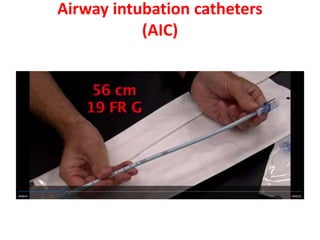
Aintree Intubation Catheter (AIC)
(Cook Medical, USA)
USES
• replacement of an endotracheal tube or
tracheostomy tube, when one is already in
place
• Bronchoscope-assisted exchange of a
supraglottic airway device (SAD) for an
endotracheal tube using the Aintree
Intubation Catheter (AIC
DESCRIPTION
• Long, thin, flexible catheters with straight rounded tips
• length markings enable depth of insertion to be
determined
• re-usable and single use models available
• Sizes: 5, 10, 15 F sizes with varying length (500–700
mm) available for paediatric and adult patients
• Some have a hollow central lumen with distal side
holes and a connector that can attach and enable
oxygen insufflation (e.g. Cook Airway Exchanger has 15
mm and jet connections via the Rapi-FitTM adapter at
the proximal end)
Aintree Intubation Catheter (AIC)
(Cook Medical, USA)
• an adaptation of the Cook Airway Exchange Catheter
with a larger internal diameter
• 56 cm long hollow catheter
• has a larger internal diameter (4.7 mm) and is flexible
enough to allow it to be pre-loaded onto a pediatric
fiberoptic bronchoscope (4.2 mm diameter)
• external diameter (6.5 mm) allows use with
endotracheal tubes with internal diameter of 7 mm or
larger, and is stiff enough to allow rail-roading of the
endotracheal tube
• Comes with 2 Rapi-FitTM adaptors that attach to the
proximal end
METHOD OF INSERTION/ USE
• Endotracheal tube exchange
• Airway exchange catheter (AEC) is lubricated with
water soluble gel
• AEC is passed through the existing tube into the airway
• Oxygen insufflation is performed via the AEC until the
new ETT is placed
• The old tube is removed and the new tube is rail-
roaded over the catheter as a guide
• A laryngoscope can be used to optimise the view of the
larynx, ensure that the AEC is not dislodged and to
displace soft tissues that might resist passage of the
new tube.
Bronchoscope-assisted exchange of a
supraglottic airway device (SAD) for an
endotracheal tube using the Aintree
Intubation Catheter (AIC)
AIC
• Apply lubricating gel to the bronchoscope and the AIC
• Insert the SAD (e.g. Classic LMA, Fastrach iLMA or Proseal)
and attach a bronchoscope swivel connector (with access
port)
• An assistant secures the placement of the SAD until it is
removed (see below)
• Under visual guidance, introduce the bronchoscope (with
the AIC pre-loaded onto it and taped on to secure it) into
the trachea by sequentially visualise SAD aperture bars (if
present), glottis, tracheal rings and finally carina as the
bronchoscope passes caudally (never pass beyond the
carina)
• Note the depth of the AIC
• Remove the securing tape then remove bronchoscope leaving the
AIC in place
• Remove the SAD (with swivel connector) leaving the AIC in place
(apply counter pressure to the AIC to prevent displacement); grasp
the AIC in the mouth as soon as it is visible
• Check the AIC distance at the lip (ensure never greater than 26 cm)
• Load the endotracheal tube (minimum size 7-0) over the AIC (eith
endotracheal tube tip anterior)
• Reintroduce the bronchoscope into the AIC to ensure the AIC
remains positioned in the trachea during endotracheal
tube insertion
• Advance the endotracheal tube into the trachea while holding the
AIC securely in place
• Remove the AIC and confirm endotracheal tube placement
with ETCO2 monitoring
COMPLICATIONS
• Airway trauma
• failure to insert a new tube over the catheter
• accidental dislodgement during removal of the
endotracheal tube
• a bougie can be used for ETT replacement if
an AEC is not available
• Unlike blind introduction of a bougie, the AIC
loaded over a bronchoscope allows visually
directed placement and avoids trauma
• Oxygen insufflation can be performed via
AECs, but ventilation is inadequate

AEC

  • 1.
    Airway exchange catheters (AEC) DRRAJU C.ABRAHAM JEDDAH NATIONAL HOSPITAL
  • 2.
  • 3.
    Airway exchange catheters CookAirway Exchange Catheter and the Aintree Intubation Catheter
  • 4.
    Aintree Intubation Catheter(AIC) (Cook Medical, USA)
  • 5.
    USES • replacement ofan endotracheal tube or tracheostomy tube, when one is already in place • Bronchoscope-assisted exchange of a supraglottic airway device (SAD) for an endotracheal tube using the Aintree Intubation Catheter (AIC
  • 6.
    DESCRIPTION • Long, thin,flexible catheters with straight rounded tips • length markings enable depth of insertion to be determined • re-usable and single use models available • Sizes: 5, 10, 15 F sizes with varying length (500–700 mm) available for paediatric and adult patients • Some have a hollow central lumen with distal side holes and a connector that can attach and enable oxygen insufflation (e.g. Cook Airway Exchanger has 15 mm and jet connections via the Rapi-FitTM adapter at the proximal end)
  • 7.
    Aintree Intubation Catheter(AIC) (Cook Medical, USA) • an adaptation of the Cook Airway Exchange Catheter with a larger internal diameter • 56 cm long hollow catheter • has a larger internal diameter (4.7 mm) and is flexible enough to allow it to be pre-loaded onto a pediatric fiberoptic bronchoscope (4.2 mm diameter) • external diameter (6.5 mm) allows use with endotracheal tubes with internal diameter of 7 mm or larger, and is stiff enough to allow rail-roading of the endotracheal tube • Comes with 2 Rapi-FitTM adaptors that attach to the proximal end
  • 8.
    METHOD OF INSERTION/USE • Endotracheal tube exchange • Airway exchange catheter (AEC) is lubricated with water soluble gel • AEC is passed through the existing tube into the airway • Oxygen insufflation is performed via the AEC until the new ETT is placed • The old tube is removed and the new tube is rail- roaded over the catheter as a guide • A laryngoscope can be used to optimise the view of the larynx, ensure that the AEC is not dislodged and to displace soft tissues that might resist passage of the new tube.
  • 9.
    Bronchoscope-assisted exchange ofa supraglottic airway device (SAD) for an endotracheal tube using the Aintree Intubation Catheter (AIC) AIC
  • 10.
    • Apply lubricatinggel to the bronchoscope and the AIC • Insert the SAD (e.g. Classic LMA, Fastrach iLMA or Proseal) and attach a bronchoscope swivel connector (with access port) • An assistant secures the placement of the SAD until it is removed (see below) • Under visual guidance, introduce the bronchoscope (with the AIC pre-loaded onto it and taped on to secure it) into the trachea by sequentially visualise SAD aperture bars (if present), glottis, tracheal rings and finally carina as the bronchoscope passes caudally (never pass beyond the carina) • Note the depth of the AIC
  • 11.
    • Remove thesecuring tape then remove bronchoscope leaving the AIC in place • Remove the SAD (with swivel connector) leaving the AIC in place (apply counter pressure to the AIC to prevent displacement); grasp the AIC in the mouth as soon as it is visible • Check the AIC distance at the lip (ensure never greater than 26 cm) • Load the endotracheal tube (minimum size 7-0) over the AIC (eith endotracheal tube tip anterior) • Reintroduce the bronchoscope into the AIC to ensure the AIC remains positioned in the trachea during endotracheal tube insertion • Advance the endotracheal tube into the trachea while holding the AIC securely in place • Remove the AIC and confirm endotracheal tube placement with ETCO2 monitoring
  • 12.
    COMPLICATIONS • Airway trauma •failure to insert a new tube over the catheter • accidental dislodgement during removal of the endotracheal tube
  • 13.
    • a bougiecan be used for ETT replacement if an AEC is not available • Unlike blind introduction of a bougie, the AIC loaded over a bronchoscope allows visually directed placement and avoids trauma • Oxygen insufflation can be performed via AECs, but ventilation is inadequate