April 2024 © Haramaya University, CHMS,
Department of Emergency and Critical Care Nursing
Operation Room Technique
By Ame Mehadi (EMCCN, Assistant Professor)
INTRODUCTION TO
OPERATION ROOM TECHNIQUE
By Ame Mehadi (EMCCN, Assistant Professor)
1
December 2024 © Haramaya University, CHMS,
Department of Emergency and Critical Care Nursing
Operation Room Technique
By Ame Mehadi (EMCCN, Assistant Professor)
Learning Objectives
At the end of this Session, the learners will be able to:
►Describe specific areas within the OR
►Identify major OR equipment
►Discuss how the OR environmental layout contributes to the aseptic technique.
►Differentiate the OR personnel
►Identify basic principles of aseptic technique
2
December 2024 © Haramaya University, CHMS,
Department of Emergency and Critical Care Nursing
Operation Room Technique
By Ame Mehadi (EMCCN, Assistant Professor)
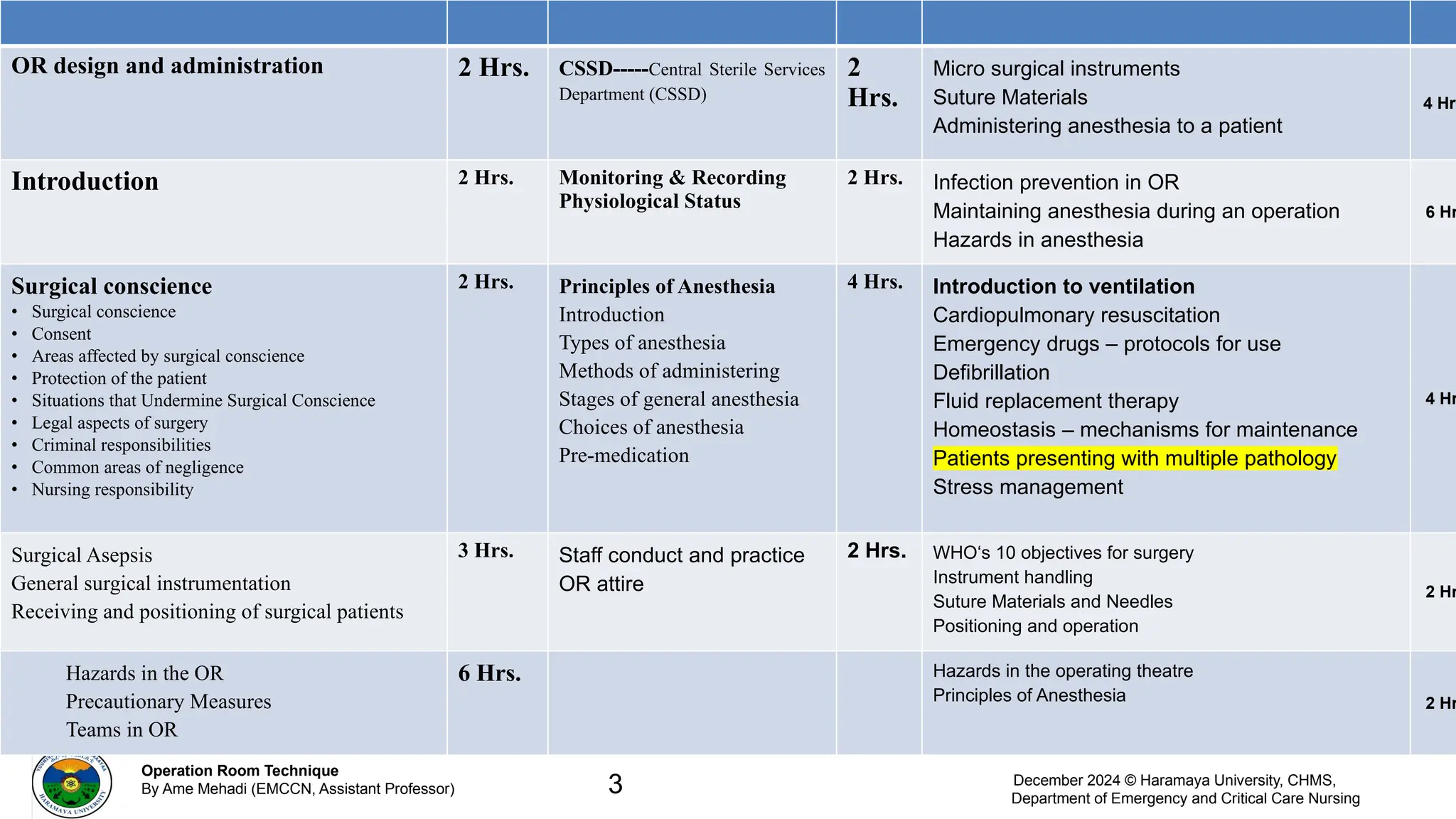
OR design and administration 2 Hrs. CSSD-----Central Sterile Services
Department (CSSD)
2
Hrs.
Micro surgical instruments
Suture Materials
Administering anesthesia to a patient
4 Hrs
Introduction 2 Hrs. Monitoring & Recording
Physiological Status
2 Hrs. Infection prevention in OR
Maintaining anesthesia during an operation
Hazards in anesthesia
6 Hr
Surgical conscience
• Surgical conscience
• Consent
• Areas affected by surgical conscience
• Protection of the patient
• Situations that Undermine Surgical Conscience
• Legal aspects of surgery
• Criminal responsibilities
• Common areas of negligence
• Nursing responsibility
2 Hrs. Principles of Anesthesia
Introduction
Types of anesthesia
Methods of administering
Stages of general anesthesia
Choices of anesthesia
Pre-medication
4 Hrs. Introduction to ventilation
Cardiopulmonary resuscitation
Emergency drugs – protocols for use
Defibrillation
Fluid replacement therapy
Homeostasis – mechanisms for maintenance
Patients presenting with multiple pathology
Stress management
4 Hr
Surgical Asepsis
General surgical instrumentation
Receiving and positioning of surgical patients
3 Hrs. Staff conduct and practice
OR attire
2 Hrs. WHO‘s 10 objectives for surgery
Instrument handling
Suture Materials and Needles
Positioning and operation
2 Hr
Hazards in the OR
Precautionary Measures
Teams in OR
6 Hrs. Hazards in the operating theatre
Principles of Anesthesia 2 Hr
3
December 2024 © Haramaya University, CHMS,
Department of Emergency and Critical Care Nursing
Operation Room Technique
By Ame Mehadi (EMCCN, Assistant Professor)
Operating Room Technique
SN SDL Allocated Hrs.
SDL 1 Gowning and gloving 2 Hrs.
SDL 2 Identification of surgical instruments 1 Hr.
SDL 3 Material processing 2 Hrs.
SDL 4 Surgical attire, surgical scrub 2 Hrs.
SDL 5
Wound care
Suturing
Suture removal
4 hrs.
4
 Fundamentals of Nursing
► Perioperative patient care --4 Hrs.
 Pre-operative
 Intra operative
 Post-operative
 Ongoing postoperative patient care
April 2024 © Haramaya University, CHMS,
Department of Emergency and Critical Care Nursing
Operation Room Technique
By Ame Mehadi (EMCCN, Assistant Professor)
OR DESIGN & ADMINISTRATION (2 Hrs.)
5
December 2024 © Haramaya University, CHMS,
Department of Emergency and Critical Care Nursing
Operation Room Technique
By Ame Mehadi (EMCCN, Assistant Professor)
Definitions of Terminologies
 OPERATING DEPARTMENT:
►A unit consisting of one or more operating suites
together wz ancillary accommodations such as;
 Changing room, Reception
 Transfer room, Restroom
 RR, Circulatory room
 OPERATING SUITE:
►comprises of operating theatre/room together wz
immediate ancillary areas such as;
 Anesthetic rooms
 Sterile layup or preparation room
 Disposal room
 Scrub up & gowning areas
 Exit room.
 OPERATING/OPERATION THEATER:
►is a facility within a hospital where surgical
operations are carried out in a sterile env’t.
►is where surgical operations & certain diagnostic
procedures are performed.
►Real area of operation
►is the entire area in which
 surgeries are performed and materials are
prepared and stored for surgery.
►specifically for use by the anesthetist & surgical
teams
►must not be used for other purposes.
►Includes
 OR/or surgical suite
 recovery room(RR)
6
December 2024 © Haramaya University, CHMS,
Department of Emergency and Critical Care Nursing
Operation Room Technique
By Ame Mehadi (EMCCN, Assistant Professor)
Definitions of ……
OPERATING ROOM
►is where surgery is performed
►is organized & designed differently
from other wards.
►is a special room wz washable walls
& ceilings made of ceramics
►equipped wz special instruments
RECOVERY ROOM(RR)
►is a place where the pt stays until
recovers from anesthesia after surgery.
►Both rooms (OR & RR) require:
 Good lighting & ventilation
 Dedicated equipment
 Monitoring Equipment
 Sutures & extra equipment
 Drugs
7
December 2024 © Haramaya University, CHMS,
Department of Emergency and Critical Care Nursing
Operation Room Technique
By Ame Mehadi (EMCCN, Assistant Professor)
OR Design Principles
 Common basic OR design principles
criteria:
►Simple design & easy to clean
►simple & easy to clean & keep it clean
►suitable to prevent cross-contamination:
►smooth wall & floor surfaces made of nonporous
materials
►separate rooms for clean, sterile & soiled
instruments
►sufficient space to ensure safe transportation of
pts & staff.
►convenient layout for the supervisor to control
traffic
►RR attached to OR
 Major consideration during OR designation
►Designing and planning consideration of the physical
facility of a theatre:
 determination of the numbers of OR.
 future surgical needs of the community.
 future development in surgical technology.
 Surgical support system
• e.g.
– Temperature,
– Humidity,
– Ventilation
– Lighting
– Doors
 Communication and information
 Administration units
December 2024 © Haramaya University, CHMS,
Department of Emergency and Critical Care Nursing
Operation Room Technique
By Ame Mehadi (EMCCN, Assistant Professor) 9
 Doors
► OR doors are designed to ensure the safety of patients and medical staff by
controlling access to sterile areas and providing a secure environment.
► Ideally should be sliding doors.
► microbial count is usually at its peak at the time of the skin incision because this
follows the disturbance of air by:
 gowning, draping,
 personnel movements and
 opening and closing of doors.
► During the surgical procedure, the microbial count rises every time doors swing
open from either direction.
► Also, swinging doors may touch a sterile table or person.
► The risk of catching hands, equipment cords, IV line tubing, or other supplies is
high.
► Some common types of OR doors include:
 Sliding doors
► eliminate the air currents caused by swinging doors.
► disturbs MOs that have previously settled in the room with each swing
of the door.
► heavy, steel doors are often automated & slide horizontally on tracks.
► good choice for areas with limited space & when many people need to enter
quickly.
 Hinged doors
► Opened like regular doors using hinges.
► good choice for providing a strong seal when closed.
 Folding doors
► Opened up & folded together to make a space bigger.
► Can also slide apart like a sliding door.
 Smart glass doors
► can change from transparent to opaque to offer privacy when needed.
 Fire-rated doors
► are made of strong materials like steel or wood to help stop fires from spreading.
 Other features of OR doors include:
► Soundproofing,
► Durability,
► Easy to clean,
► Automatic closing,
► Air pressure regulation.
December 2024 © Haramaya University, CHMS,
Department of Emergency and Critical Care Nursing
Operation Room Technique
By Ame Mehadi (EMCCN, Assistant Professor) 10
December 2024 © Haramaya University, CHMS,
Department of Emergency and Critical Care Nursing
Operation Room Technique
By Ame Mehadi (EMCCN, Assistant Professor)
Lighting in the Theatre
Can be
►Natural light
►Service light
►Artificial light
Lights should be
►overhead
►freely movable,
►shadowless and
►less heat emitting.
11
December 2024 © Haramaya University, CHMS,
Department of Emergency and Critical Care Nursing
Operation Room Technique
By Ame Mehadi (EMCCN, Assistant Professor) 12
December 2024 © Haramaya University, CHMS,
Department of Emergency and Critical Care Nursing
Operation Room Technique
By Ame Mehadi (EMCCN, Assistant Professor)
Ventilation in the Theatre
►purpose:
 Supply heated or cooled, humidified,
contamination-free air to the room.
 Introduce air into the theatre to
remove contaminants liberated
there.
 Prevent entry of air from adjacent
contaminated areas.
 Should be 25 times air exchange/hr.
Humidity
►To prevent ventilating air not to be dry.
►must be b/n 50-60%.
►Controlled by an instrument called a
Hygrometer to measure the level.
Heating
►The room temp of OR must be b/n 18.5–
22o
C may exceed to 240
C.
13
December 2024 © Haramaya University, CHMS,
Department of Emergency and Critical Care Nursing
Operation Room Technique
By Ame Mehadi (EMCCN, Assistant Professor) 14
December 2024 © Haramaya University, CHMS,
Department of Emergency and Critical Care Nursing
Operation Room Technique
By Ame Mehadi (EMCCN, Assistant Professor)
Organizational Areas……
 LOCATION
►centrally located so that easily & quickly reached from all
areas of the hospital, thus
 enabling personnel to transfer pts with the least possible
delay.
►near such support activities as ICU, RR, Lab. Pharmacy, X-Ray &
CMS/CSR
► in a passage with only one outlet, or at least away from those areas of
the hospital through which most of the traffic flows.
►sufficiently isolated
 to prevent annoyance, anxiety, & disturbance to other
pts.
►near easily reached elevators
 for transportation of pts or supplies.
15
OR
X-ray
Laboratory
CMS or
CSR
Pharmacy
Recovery
room.
ICU
December 2024 © Haramaya University, CHMS,
Department of Emergency and Critical Care Nursing
Operation Room Technique
By Ame Mehadi (EMCCN, Assistant Professor)
Organizational Areas ……..
Arrangement of rooms
• Arrangement of rooms
within a surgical suite
• should allow smooth &
efficient workflow.
• E.g., traffic into, & out
of the suite.
• Proper arrangement
• reduces excess
traffic flow,
• saves much
unnecessary
walking,
• conserves time &
effort.
Size of the Suite
• determined by numerous
factors:
• Operative load
• # of cases to be done per day
• types of surgery
• number & frequency of
emergency cases
• average number of OR
needed is indicated by
Size of Individual
OR
• should have
sufficient floor
space
• that avoid breaks in
aseptic technique
due to
overcrowding.
• shouldn’t be larger
than necessary,
thus
• reducing the
amount of
unnecessary times
spent walking.
16
December 2024 © Haramaya University, CHMS,
Department of Emergency and Critical Care Nursing
Operation Room Technique
By Ame Mehadi (EMCCN, Assistant Professor) 17
December 2024 © Haramaya University, CHMS,
Department of Emergency and Critical Care Nursing
Operation Room Technique
By Ame Mehadi (EMCCN, Assistant Professor)
Zoning…
 Zonal division
► are designated by the physical activities performed in each
area.
► Three Vs Four Zone Concept
► Three Zone Division
 more common and includes
• Unrestricted area,
• Semi-restricted area and
• Restricted area.
► Four Zone Division
 Protective zone/limited access area/unrestricted area
 Clean/Semi Restricted zone
 Sterile/restricted Zone
 Disposal Zone
 Four Zone Division Concept
► not necessarily used for all hospitals,
► but whenever feasible the OR is segregated into four
areas for traffic control.
► Purpose
 to assure maximum protection against infections.
► Traffic control design
 needs determination of specific traffic patterns.
 dependent on the entrances and exits for both
personnel & materials.
 is aided by designation of the four-zone concept (as
shown below):
December 2024 © Haramaya University, CHMS,
Department of Emergency and Critical Care Nursing
Operation Room Technique
By Ame Mehadi (EMCCN, Assistant Professor)
December 2024 © Haramaya University, CHMS,
Department of Emergency and Critical Care Nursing
Operation Room Technique
By Ame Mehadi (EMCCN, Assistant Professor)
 A. Protective Zone
► is an unrestricted Area but limited Access Area
► street clothes permitted.
► A corridor on the periphery accommodates traffic from outside,
including patients.
► isolated by doors from main corridor and other areas of the suite.
► Usually separated by RED or green line from the next area.
► serves as an outside-to-inside access area.
► Exit from clean zone & sterile zone
► Transfer or change over section.
► is 1st stage of entry to operation Dep’t
► Includes:
 RR, Plaster room
 Change room
 Offices (e.g. reception, staff, head)
 Seminar & teaching rooms.
 B. Clean/Semi Restricted Zone
► is a transitional zone
► Traffic is limited to properly attired/dressed personnel
► pt transferred to a clean side & stretcher is on entry to this area.
► Approach sterility to the operating theatre.
► Approach to the sterile preparation room
► coverings are required
 Head, face, entire body
► pt’s hair must be covered.
► includes
 peripheral support areas
 access corridors to the OR.
 Scrubbing room.
 Gowning area
 Anesthetic room
 Exit lobby, Clean movements
 Rest area, Sterile store.
20
December 2024 © Haramaya University, CHMS,
Department of Emergency and Critical Care Nursing
Operation Room Technique
By Ame Mehadi (EMCCN, Assistant Professor)
 C. Sterile/Restricted Zone
►is the place where actual surgery and other
sterile procedures are performed.
►is the main OR itself.
►is where complete surgical attire/OR attire
including masks, caps, shoes & trousers are
required
►is where sterile instruments are used
►is sterile team members wear (don) sterile
gowns & gloves.
►The zone includes:
 OR.
 sterile preparation rooms.
 scrubbing rooms, scrubbing sink areas.
 Sub-sterile rooms or clean core area(s) where
unwrapped supplies are sterilized.
 RR or PACU is by.
 D. The Disposal Zone
►least clean area of the whole department
►includes:
 The disposal room
 Interim storage area
 The disposal corridor
21
December 2024 © Haramaya University, CHMS,
Department of Emergency and Critical Care Nursing
Operation Room Technique
By Ame Mehadi (EMCCN, Assistant Professor)
Organizational Areas…
December 2024 © Haramaya University, CHMS,
Department of Emergency and Critical Care Nursing
Operation Room Technique
By Ame Mehadi (EMCCN, Assistant Professor)
Illustration of areas within the OR
Illustration
of
areas
within
the
OR
Supervisor’s Office (A)
• has direct access to the outside of OR.
Dressing rooms (B)
• for OR personnel have a door to the outside
corridors so that personnel may enter there,
change into scrub attire and go directly into OR.
Holding area (C)
• is an area designated for the parking of
stretchers with patients awaiting surgery.
• is the area where the health care givers properly
identify the patient and make sure that all
preoperative cares are carried out and other
important data are in the patient’s chart.
Scrub sink areas (D)/Scrub (room) area:
• is an area of surgical hand washing or scrubbing
before surgical procedures
• located in several places close to operating suite
• Scrub brushes, Caps, Soaps, masks are present
at each scrub station.
Illustration
…….
Workroom (E)
• is located away from the direct traffic of the
operating suites.
Sterile supply room (F)
• serves as a supply depot for wrapped sterile articles.
• Sterilizing room – where instruments sterilized
• Storage areas (G)
• for extra equipment and supplies
• are used to store extra instruments & supplies
for each unit.
• Recovery room (H)
• has an access to the outside of the OR for
transporting patients back to their rooms.
• Operating suites (I)
• where real surgery is performed.
• Anesthesia room(J)
• Anesthesia preparation area
• where patients are prepared for anesthesia
• IV line –cannula insertion
• Pre-op medication given (e.g., Atropine, Morphine
December 2024 © Haramaya University, CHMS,
Department of Emergency and Critical Care Nursing
Operation Room Technique
By Ame Mehadi (EMCCN, Assistant Professor)
By Ame M.
December 2024 © Haramaya University, CHMS,
Department of Emergency and Critical Care Nursing
Operation Room Technique
By Ame Mehadi (EMCCN, Assistant Professor)
OR Major Equipment
OR Major
Equipment
• Pipe line suction
apparatus
• Sterile hand lotion bowl,
unopened packet
• Diathermy machine
(electrosurgical unit)
• Cautery cable with knife
and needle packed
• Mobile supplementary
operating light fitting
• Swabs count board.
• X-ray viewing screen
• Swab or sponge
checking rack.
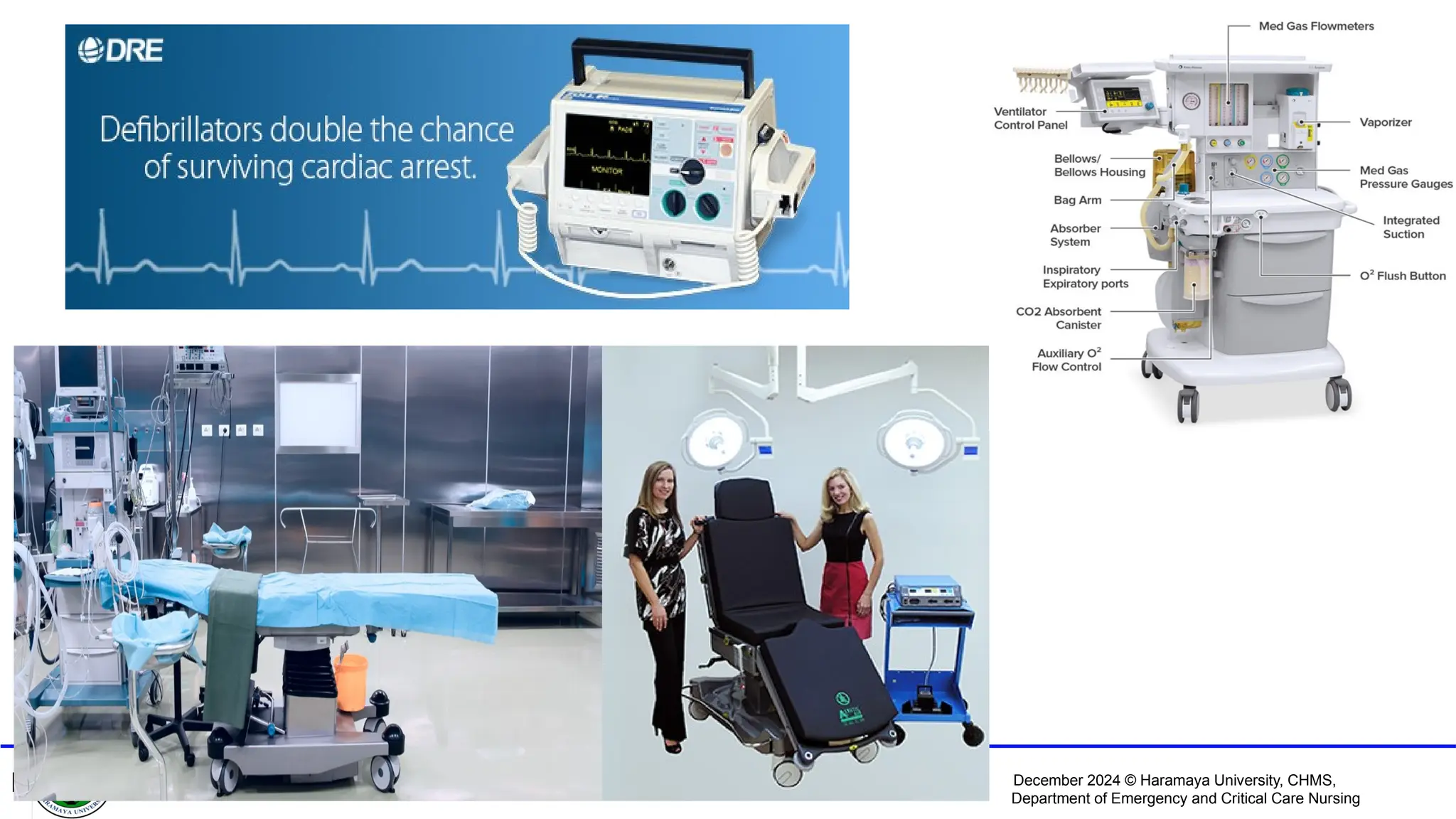
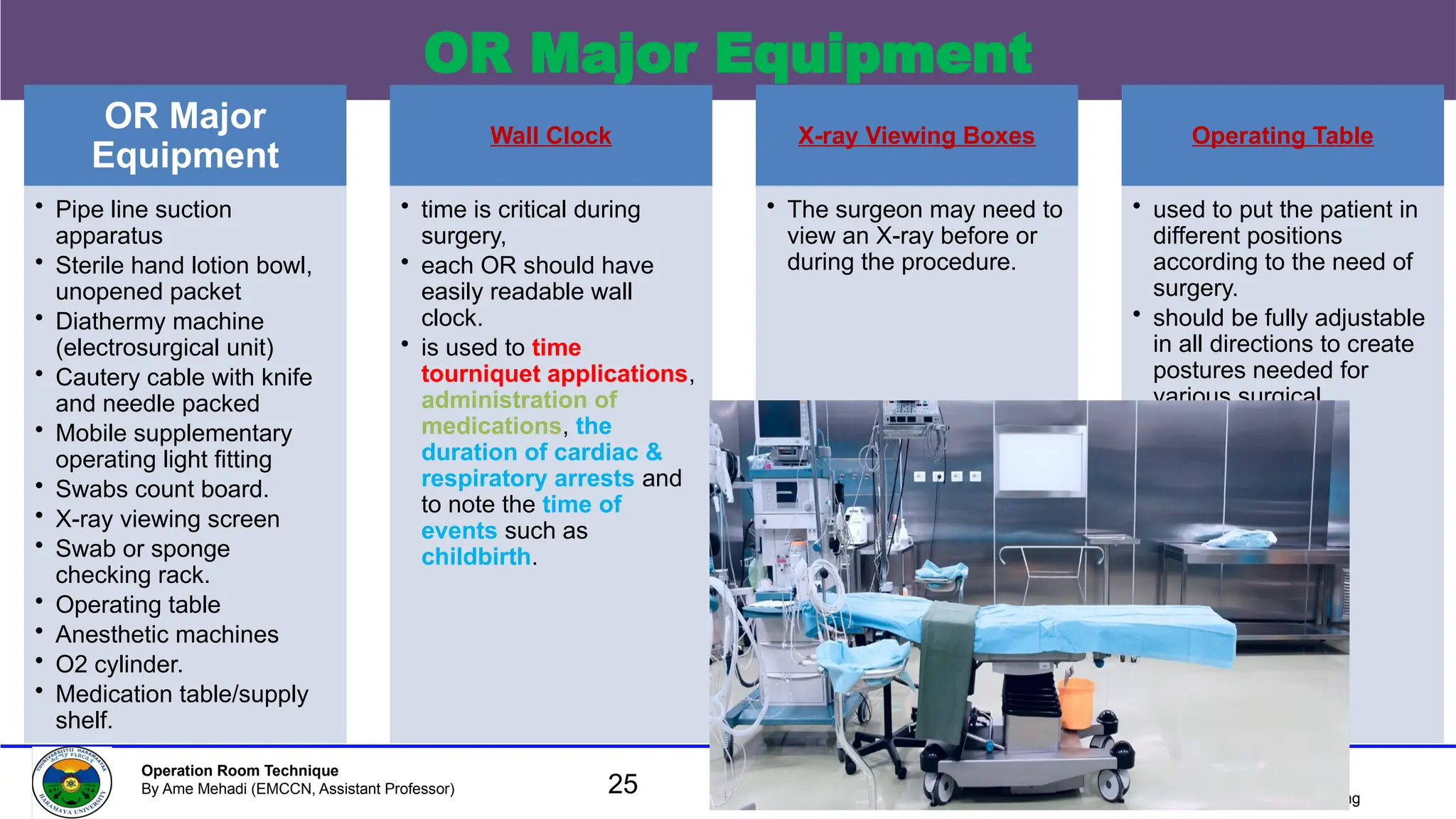
• Operating table
• Anesthetic machines
• O2 cylinder.
• Medication table/supply
shelf.
Wall Clock
• time is critical during
surgery,
• each OR should have
easily readable wall
clock.
• is used to time
tourniquet applications,
administration of
medications, the
duration of cardiac &
respiratory arrests and
to note the time of
events such as
childbirth.
X-ray Viewing Boxes
• The surgeon may need to
view an X-ray before or
during the procedure.
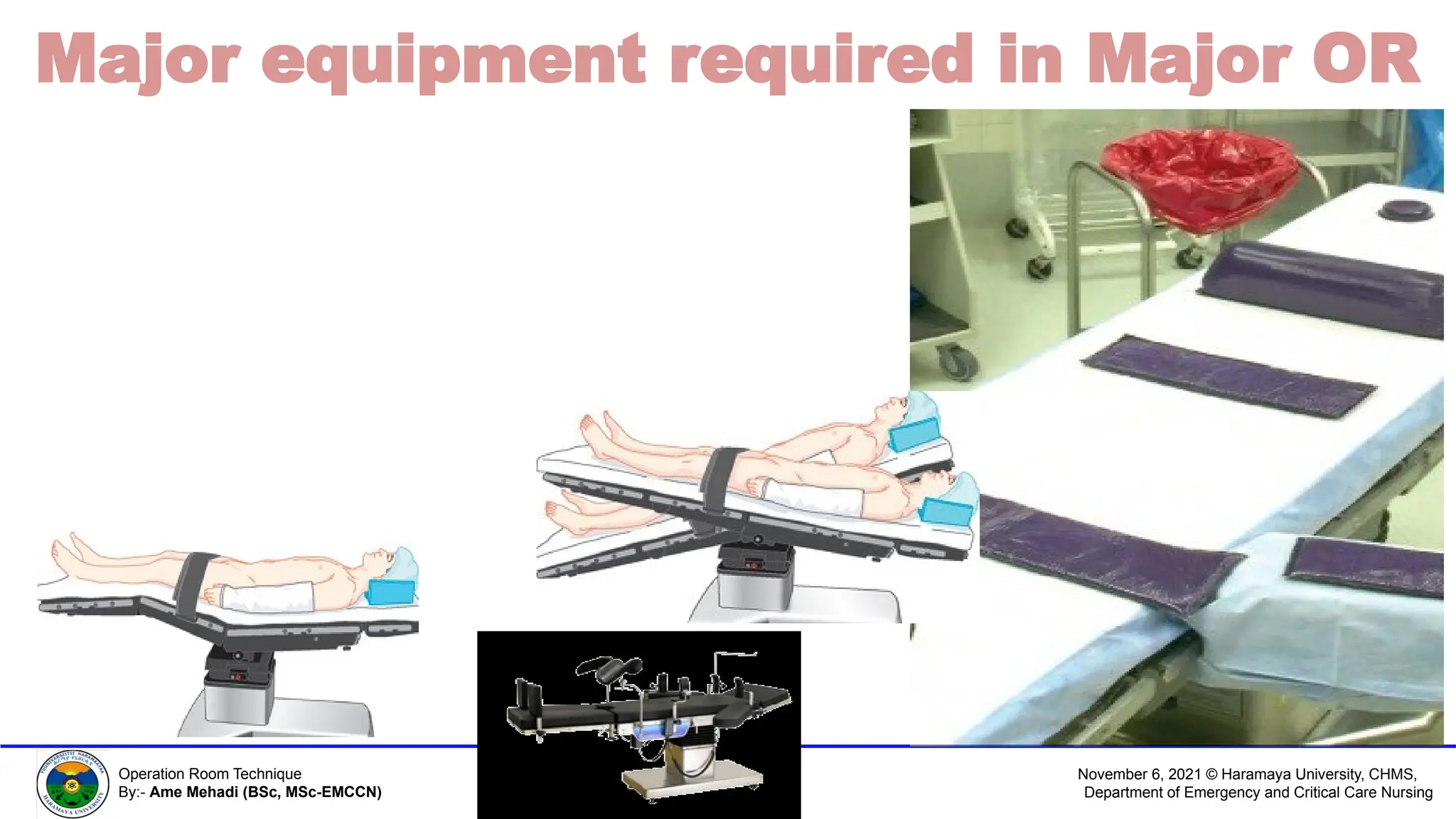
Operating Table
• used to put the patient in
different positions
according to the need of
surgery.
• should be fully adjustable
in all directions to create
postures needed for
various surgical
positions.
25
November 6, 2021 © Haramaya University, CHMS,
Department of Emergency and Critical Care Nursing
Operation Room Technique
By:- Ame Mehadi (BSc, MSc-EMCCN)
Major equipment required in Major OR
December 2024 © Haramaya University, CHMS,
Department of Emergency and Critical Care Nursing
Operation Room Technique
By Ame Mehadi (EMCCN, Assistant Professor)
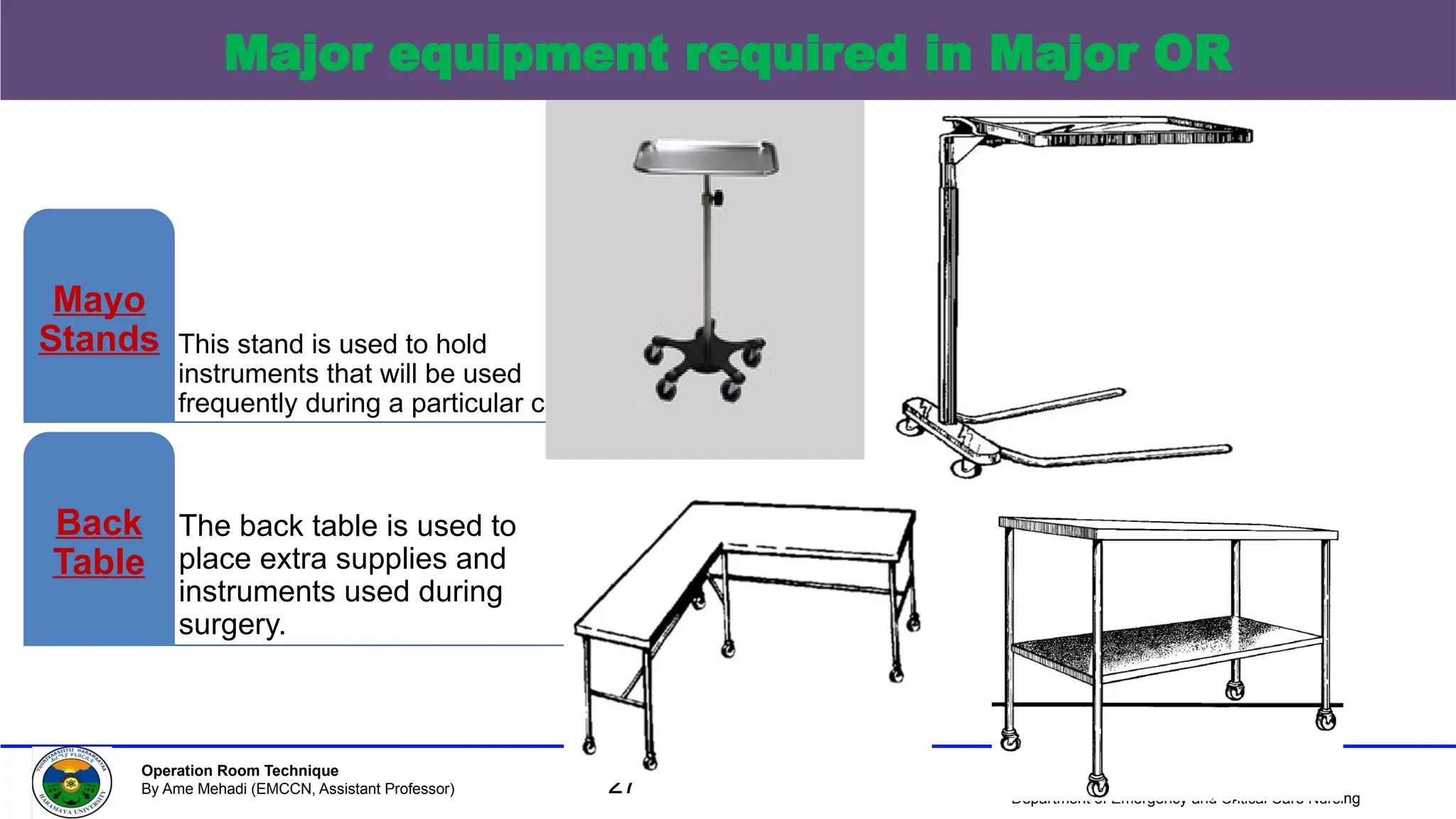
Major equipment required in Major OR
This stand is used to hold
instruments that will be used
frequently during a particular case.
Mayo
Stands
The back table is used to
place extra supplies and
instruments used during
surgery.
Back
Table
27
December 2024 © Haramaya University, CHMS,
Department of Emergency and Critical Care Nursing
Operation Room Technique
By Ame Mehadi (EMCCN, Assistant Professor)
OR Major Equipment
Ring Stand
• The ring stand is used to hold basins
which contains normal saline or
sterile water during surgery.
Kick Bucket
• The kick bucket (a bucket on
wheels) is used to place soiled
sponges during surgery.
28
December 2024 © Haramaya University, CHMS,
Department of Emergency and Critical Care Nursing
Operation Room Technique
By Ame Mehadi (EMCCN, Assistant Professor)
Major equipment required in Major OR
Supply
Cabinets
• These cabinets are used to
store frequently used items
such as drapes, dressings,
solutions, sutures, etc.
• Cabinets with doors are
preferred to those without so
as to reduce exposure of the
content to dust.
STOOLS
• Revolving Stools
• Straight Stool
(Footstool
29
December 2024 © Haramaya University, CHMS,
Department of Emergency and Critical Care Nursing
Operation Room Technique
By Ame Mehadi (EMCCN, Assistant Professor)
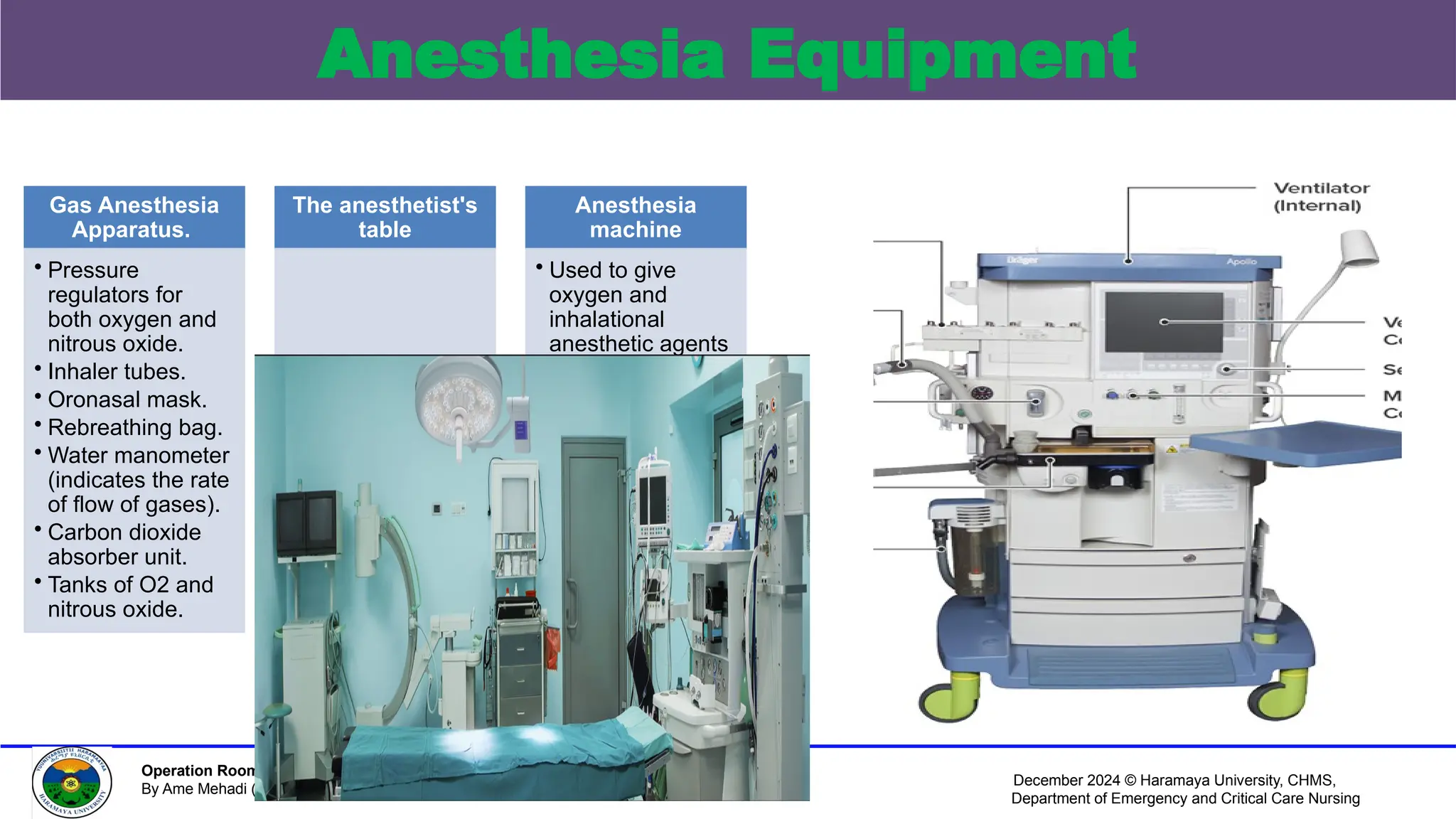
Anesthesia Equipment
Gas Anesthesia
Apparatus.
• Pressure
regulators for
both oxygen and
nitrous oxide.
• Inhaler tubes.
• Oronasal mask.
• Rebreathing bag.
• Water manometer
(indicates the rate
of flow of gases).
• Carbon dioxide
absorber unit.
• Tanks of O2 and
nitrous oxide.
The anesthetist's
table
Anesthesia
machine
• Used to give
oxygen and
inhalational
anesthetic agents
December 2024 © Haramaya University, CHMS,
Department of Emergency and Critical Care Nursing
Operation Room Technique
By Ame Mehadi (EMCCN, Assistant Professor)
Electrocardiograp
hy (ECG) machine
• Used to monitor
the electrical
activity of the
heart.
Respironics Esprit
• Used to monitor
and support
respirations.
31
November 6, 2021 © Haramaya University, CHMS,
Department of Emergency and Critical Care Nursing
Operation Room Technique
By:- Ame Mehadi (BSc, MSc-EMCCN) 32
Electro-cautery (cautery
machine)
►Used for cutting tissues and
stopping of bleeding by sealing
blood vessels.
Suction machine
►Used to suck body fluids
December 2024 © Haramaya University, CHMS,
Department of Emergency and Critical Care Nursing
Operation Room Technique
By Ame Mehadi (EMCCN, Assistant Professor)
OR Essential Equipment Checklist
OR Essential Equipment
Checklist
• Anesthesia Machine
• Anesthesia Cart
• Anesthesia Circuits
• Anesthesia Monitor - CO2 and
Agents
• Laryngeal Mask Airways
• Surgical Table
• Patient Stretcher
• Patient Stirrups
• Positioning Pillows
• Restraint Straps and Patient
Positioners
• Surgical Headlight
• Surgical Lights - ceiling mounted
• Surgical Microscope
• AED/Defibrillator
• Vital Signs Monitor
OR Essential Equipment
Checklist ….
• EKG Machine
• Video Monitors and Cameras
• C-Arms
• Ultrasound Machines
• Endoscopy Tower
• Laryngoscopes
• Electrosurgical Unit
• Smoke Evacuator
• Sequential Compression
Device
• Surgical Tourniquet
• Nerve Stimulator
• Blood Warmer
• Warming Air Units
• Central Gas and Suction
• Desk/Computer
• Medical Cabinetry
OR Essential Equipment
Checklist ….Ring Stand
• Back Instrument Table
• Exchange Cart
• Hand Table
• Mayo Stand(s)
• Prep Table
• Utility Cart
• Stools (Rolling, Step, etc.)
• Linen Hamper
• IV Accessories
• Needle Counters
• Kick Buckets
• Biohazard Waste Cans
• Sponge Counter Units/Bags
December 2024 © Haramaya University, CHMS,
Department of Emergency and Critical Care Nursing
Operation Room Technique
By Ame Mehadi (EMCCN, Assistant Professor)
Recovery room (RR)
Recovery room (RR)
• RR is a place where the pt stays
until he/she recovers from
anesthesia after surgery.
• ICU and RR are not the same.
• ICU is a place where care is
given for critically ill patients
with any medical or surgical
problem.
Materials required in RR
• Oxygen & means of delivery +
ambubag
• Monitoring devices: ECG, BP
apparatus
• Suction machine
• Dressing set
• Tongue depressor-spatula
• Kidney dish
• Emergency drugs
• IV fluids
December 2024 © Haramaya University, CHMS,
Department of Emergency and Critical Care Nursing
Operation Room Technique
By Ame Mehadi (EMCCN, Assistant Professor)
Materials required in RR
Emergency drugs
• Adrenaline
• Analgesics like morphine
• Anti-emetic drugs
• Chlorpromazine
• Promethazine
• Anticholinergic drugs like atropine
• decrease secretion, increase HR
• Sodium bicarbonate –for acidosis
IV fluids
• Crystalloids – are fluids with lower
molecular weight.
• e.g.
• 5% DW [sugar + water]
• 0.9% NS [salt + water]
• 5% DNS [sugar + salt]
• R/L [water + electrolytes-k, Ca, Mg
etc.
• Colloids – are fluids with higher
molecular weight
• Are plasma expanders –used for
hemorrhagic (bleeding) pts.
• e.g. Dextran, plander, plasmin.
35
December 2024 © Haramaya University, CHMS,
Department of Emergency and Critical Care Nursing
Operation Room Technique
By Ame Mehadi (EMCCN, Assistant Professor)
Operation Theatre Cleaning
36
December 2024 © Haramaya University, CHMS,
Department of Emergency and Critical Care Nursing
Operation Room Technique
By Ame Mehadi (EMCCN, Assistant Professor)
Need for fumigation
Surveillance studies of different
zones in operation theatre
showed that the isolates were
►Staphylococcus aureus (16%)
►Coagulase-negative
staphylococcus aureus (26.7%)
►Acinobacter species (2.03%)
►Klebsiella (0.3%)
►E.coli, Pseudomonas species, &
Proteus species were also found in
majority
37
December 2024 © Haramaya University, CHMS,
Department of Emergency and Critical Care Nursing
Operation Room Technique
By Ame Mehadi (EMCCN, Assistant Professor)
 Daily cleaning should be carried out after the operating sessions are over.
 All the surfaces should be cleaned with detergent and water and maybe wiped over with a phenol
if any spills with blood/body fluid are present.
 All the walls must be wiped down to hand height every day.
 Floors should be scrubbed with warm water and detergent and dried. No disinfectant is necessary.
 OR table and other non-clinical equipment must be wiped to remove all visible dirt and left to dry.
 Weakly cleaning of all the areas inside the operating theatre complex should be done thoroughly
with warm water and detergent and dried.
 Storage shelves must be emptied and wiped over, allowed to dry, and restacked.
38
April 2024 © Haramaya University, CHMS,
Department of Emergency and Critical Care Nursing
Operation Room Technique
By Ame Mehadi (EMCCN, Assistant Professor)
SURGICAL TEAM MEMBERS & THEIR
RESPONSIBILITIES
39
December 2024 © Haramaya University, CHMS,
Department of Emergency and Critical Care Nursing
Operation Room Technique
By Ame Mehadi (EMCCN, Assistant Professor)
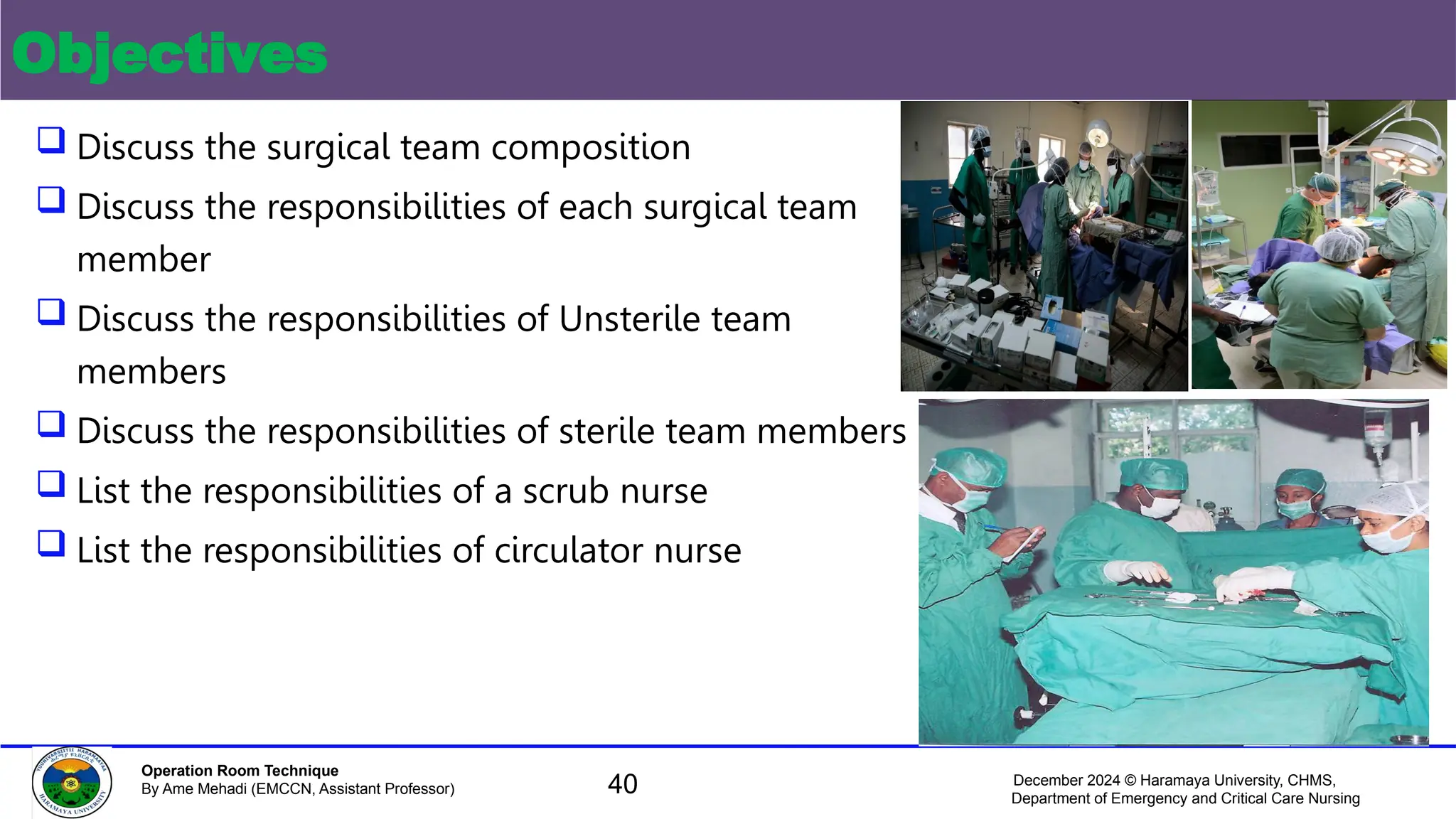
Objectives
 Discuss the surgical team composition
 Discuss the responsibilities of each surgical team
member
 Discuss the responsibilities of Unsterile team
members
 Discuss the responsibilities of sterile team members
 List the responsibilities of a scrub nurse
 List the responsibilities of circulator nurse
40
December 2024 © Haramaya University, CHMS,
Department of Emergency and Critical Care Nursing
Operation Room Technique
By Ame Mehadi (EMCCN, Assistant Professor)
Surgical Team …….
41
 Definition:
► A group of professionals providing the continuum of care
during:-
 pre-operative.
 intra-operative and
 postoperative and recovery
 Includes
► Surgeon,
► Assistant surgeon (One or two),
► Anesthesia provider (Anesthetist/Anesthesiologist),
► Scrub,
► Circulator/runner,
► Janitor/cleaner,
► Others (cardiologist, perfusionist, radiographer, etc. )
► is subdivided according to the functions of its members as
 Sterile Vs Unsterile
► Sterile team:
 Surgeon
 First assistant (RN or PA)
 Scrub Nurse
► Unsterile team:
 Anesthesia provider
 Circulator nurse
 Janitors
► Others
 cardiologist,
 perfusionist,
 radographer, etc.
November 6, 2021 © Haramaya University, CHMS,
Department of Emergency and Critical Care Nursing
Operation Room Technique
By:- Ame Mehadi (BSc, MSc-EMCCN)
Surgical Team …cont’d
Sterile team members
►those working together in the sterile field during operation.
►wash (scrub) their hands and arms,
►put on (don) a sterile gown and gloves, and
►enter the sterile field,
►work within limited area (only sterile field) and
►handle only sterile items.
►the sterile field
 is the area of the OR that immediately surrounds the patient
 is specially prepared for the patient.
 established by all sterilized items needed for the surgical procedure.
 Consists
►Surgeon
►Assistant surgeon
►Scrub nurse
►The patient
OR team members while
performing operation
April, 2024 © Haramaya University, CHMS,
Department of Emergency and Critical Care Nursing
OR Technique
By Ame Mehadi (Assistant Prof. of EMCCN)
• those persons working together out of sterile field in the OR during the
operation.
• do not enter the sterile field;
• work outside and around the sterile field.
• assume responsibility for maintaining sterile technique during the surgical
procedure, but
• handle supplies and equipment that are not considered sterile.
• follow the principles of aseptic technique,
• keep the sterile team supplied,
• provide direct patient care, and
• handle other requirements that may arise during the surgical procedure.
• Consists of:
• Anesthetist/anesthesiologist
• Circulator/Runner
• Cleaner/janitor
• Others, such as students, cleaners & those who may be needed to set
up & operate specialized equipment or monitoring devices.
Non-Sterile/Clean
Team
November 6, 2021 © Haramaya University, CHMS,
Department of Emergency and Critical Care Nursing
Operation Room Technique
By:- Ame Mehadi (BSc, MSc-EMCCN)
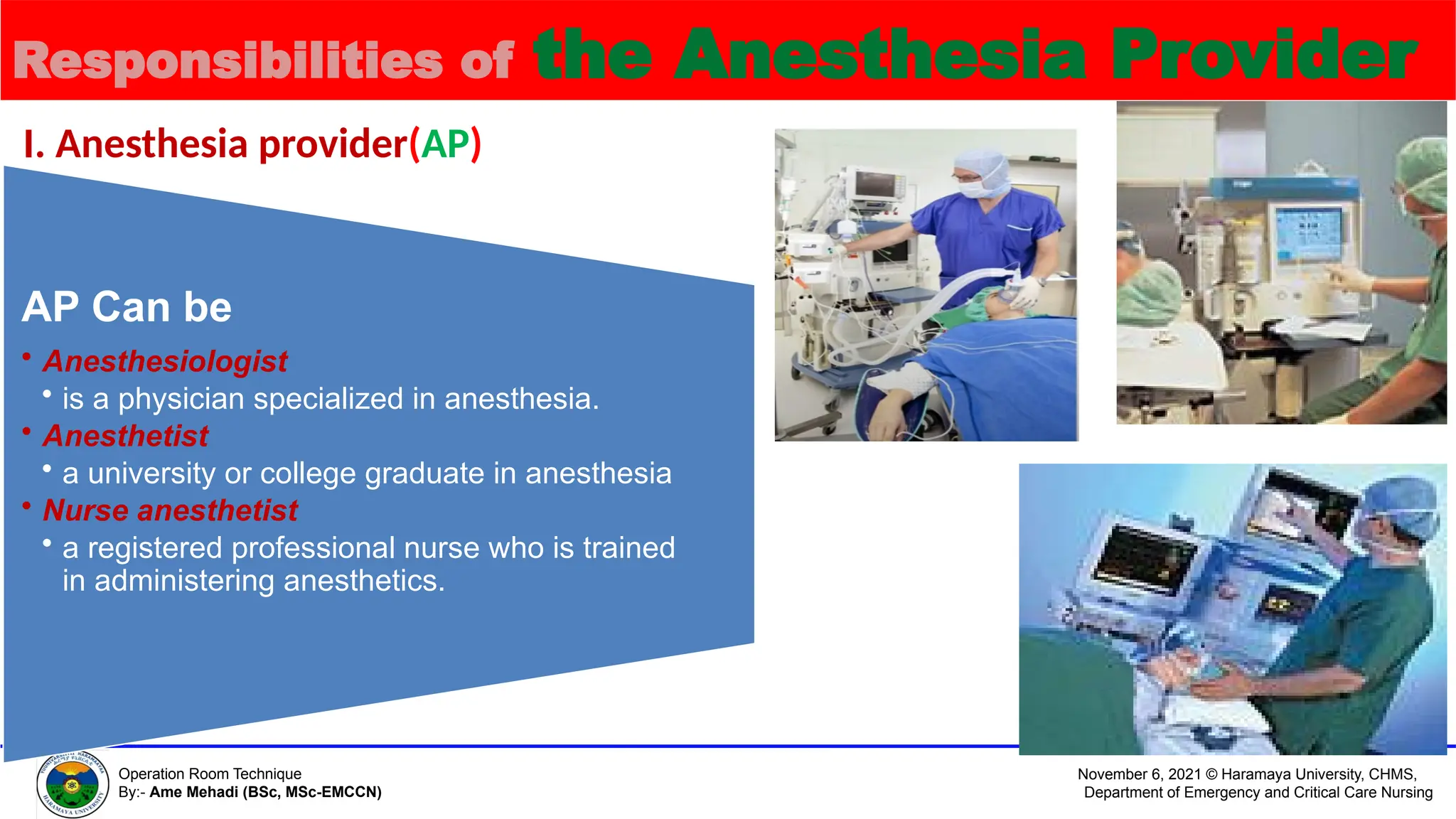
Responsibilities of the Anesthesia Provider
I. Anesthesia provider(AP)
AP Can be
• Anesthesiologist
• is a physician specialized in anesthesia.
• Anesthetist
• a university or college graduate in anesthesia
• Nurse anesthetist
• a registered professional nurse who is trained
in administering anesthetics.
July, 2021 © Haramaya University, CHMS,
Department of Emergency and Critical Care Nursing
Introduction to OR Technique
By:- Ame Mehadi (BSc, MSc)
July, 2021 © Haramaya University, CHMS,
Department of Emergency and Critical Care Nursing
Introduction to OR Technique
By:- Ame Mehadi (BSc, MSc)
Anesth
esia &
surgery
• are two distinct, but inseparable disciplines;
• are two parts of one entity.
Anesthe
sia
provider
 guardian of the patient,
administering fluids & electrolytes,
Selecting & administering anesthesia,
Intubating the patient,
manage anesthesia risks,
Maintaining anesthesia at the required levels- satisfactory degrees of
relaxation
Monitoring vital functions & parameters
Oxygen exchange, circulatory functions, systemic circulation, vital sign
supervise the patient's condition,
advising the surgeon on potential Cxns & independently intervening as
needed
December 2024 © Haramaya University, CHMS,
Department of Emergency and Critical Care Nursing
Operation Room Technique
By Ame Mehadi (EMCCN, Assistant Professor)
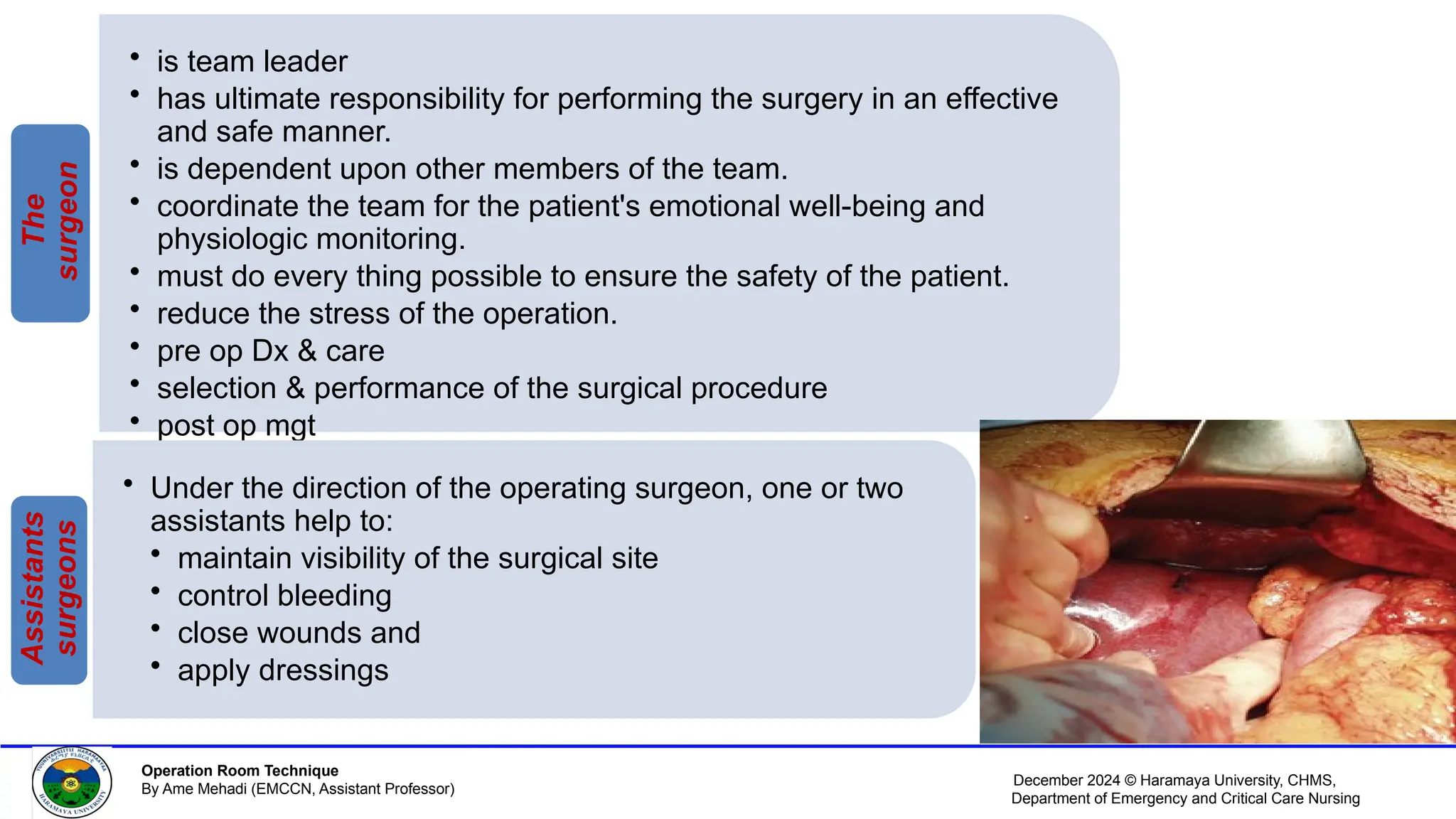
• is team leader
• has ultimate responsibility for performing the surgery in an effective
and safe manner.
• is dependent upon other members of the team.
• coordinate the team for the patient's emotional well-being and
physiologic monitoring.
• must do every thing possible to ensure the safety of the patient.
• reduce the stress of the operation.
• pre op Dx & care
• selection & performance of the surgical procedure
• post op mgt
The
surgeon
• Under the direction of the operating surgeon, one or two
assistants help to:
• maintain visibility of the surgical site
• control bleeding
• close wounds and
• apply dressings
Assistants
surgeons
July, 2021 © Haramaya University, CHMS,
Department of Emergency and Critical Care Nursing
Introduction to OR Technique
By:- Ame Mehadi (BSc, MSc)
July, 2021 © Haramaya University, CHMS,
Department of Emergency and Critical Care Nursing
Introduction to OR Technique
By:- Ame Mehadi (BSc, MSc)
• Scrub is the term used to designate the member of the surgical team who assists the surgeon by
providing sterile instruments, sutures, & supplies within the sterile field.
• Perform Check list before scrubbing
• Check Consent
• Confirm Surgical Procedure
• Check Instruments
• Check Supplies
• dons conductive shoes, greens (pants & shirt), cap, & mask.
• then scrub hands and arms
• gowns & gloves other members of the sterile team.
• Work with the surgeon.
• is guided & directed constantly by the surgical procedure.
• works primarily with instruments and equipment.
• arranges the sterile supplies
• responsible for the sterility of the items for use within the operative field both before & during the surgical
procedure.
• Check internal sterilization indicator controls.
• Assemble instruments
• Arrange instruments and sterile supplies on back table and Mayo tray.
• Selecting instruments, equipment, and other supplies appropriate for the surgery.
• Select, collect special surgical instruments
Responsibilities
of
the
Scrub
Nurse
April, 2024 © Haramaya University, CHMS,
Department of Emergency and Critical Care Nursing
OR Technique
By Ame Mehadi (Assistant Prof. of EMCCN)
Scrub Nurse……
April, 2024 © Haramaya University, CHMS,
Department of Emergency and Critical Care Nursing
OR Technique
By Ame Mehadi (Assistant Prof. of EMCCN)
• Gown and glove the surgeon.
• Prepares the setup
• Preparing the sterile field
• Setting up the sterile table
• Prepare & Drape mayo stand
• Prepare prep set first
• Separate and arrange sterile basins
• Assist surgeon in cleaning & draping patient
• Identify and prepare appropriate suturing materials and ligatures.
• Maintaining the integrity and sterility of the sterile field.
• Assisting the surgeon and surgical assistant.
• anticipating the surgeon’s needs.
• Anticipates and meets the needs of the surgeon by watching the
progress of the surgery and knowing the various steps of the procedure.
• Anticipating the required instruments, sponges, drains and procedures.
• Providing instruments, sponges, sutures, and supplies in an appropriate
and timely manner to surgeon.
• Preparing sterile dressings
• Assist surgeon with dressing.
Scrub
Nurse…...
cont’d
April, 2024 © Haramaya University, CHMS,
Department of Emergency and Critical Care Nursing
OR Technique
By Ame Mehadi (Assistant Prof. of EMCCN)
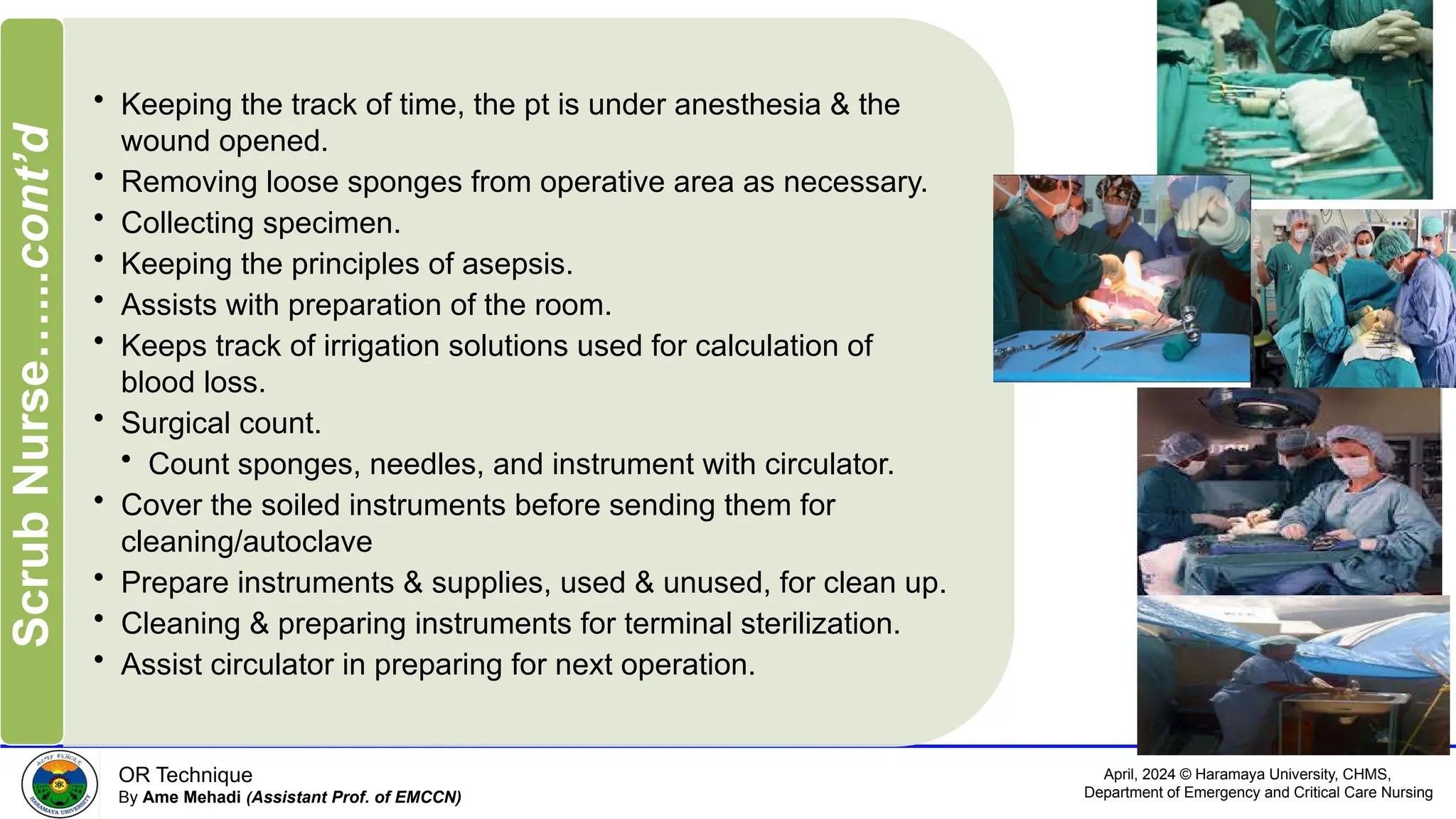
• Keeping the track of time, the pt is under anesthesia & the
wound opened.
• Removing loose sponges from operative area as necessary.
• Collecting specimen.
• Keeping the principles of asepsis.
• Assists with preparation of the room.
• Keeps track of irrigation solutions used for calculation of
blood loss.
• Surgical count.
• Count sponges, needles, and instrument with circulator.
• Cover the soiled instruments before sending them for
cleaning/autoclave
• Prepare instruments & supplies, used & unused, for clean up.
• Cleaning & preparing instruments for terminal sterilization.
• Assist circulator in preparing for next operation.
Scrub
Nurse…...cont’d
July, 2021 © Haramaya University, CHMS,
Department of Emergency and Critical Care Nursing
Introduction to OR Technique
By:- Ame Mehadi (BSc, MSc)
July, 2021 © Haramaya University, CHMS,
Department of Emergency and Critical Care Nursing
Introduction to OR Technique
By:- Ame Mehadi (BSc, MSc)
• Works outside the sterile field,
• providing patient care,
• providing procedures needed supplies,
• assists surgical team members in performing the operation safely and expeditiously.
• maintaining a neat, quiet, well-organized OR,
• anticipating & meet the needs of the other team members such as
• the scrub nurse, the anesthesia provider, the surgeon and above all the patient.
• assembles & brings all packs, supplies, & equipment needed for the case into the room;
• Performs other unsterile duties.
• the circulator must posses the ability to:
• Organize activities and direct personnel with due understanding of interpersonal
relations,
• Anticipate needs,
• Maintain a quiet, neat and well equipped unit,
• Maintain the principles of asepsis,
• Teach actively
Responsibilities
of
C
irculator
Nurse
April, 2024 © Haramaya University, CHMS,
Department of Emergency and Critical Care Nursing
OR Technique
By Ame Mehadi (Assistant Prof. of EMCCN)
• manages the OR & protects the patient’s safety & health by
• monitoring the activities of the surgical team,
• checking the OR conditions,
• continually assessing the patient for signs of injury & implementing appropriate
interventions
• verifying consent,
• coordinating the team, and
• ensuring cleanliness, proper temp, humidity, lighting, safe function of equipment,
and the availability of supplies and materials
• observes aseptic technique at all times to see that it is maintained properly.
• Monitors aseptic practices to avoid breaks in technique
• Perform “surgical or pre-procedure pause” or timeout”
• liaison b/n scrubbed personnel and those outside of the OR.
• Communicating relevant info to other team members & to the patient’s family
• Assists with preparing the room,
• Identifies and assesses the patient.
• plans and coordinates the intra-op cares.
• Providing comfort and the safety of the patient.
• Providing emotional support & psychological comfort to the patient prior to & during
induction of anesthesia.
circulator
Nurse…...
cont’d
April, 2024 © Haramaya University, CHMS,
Department of Emergency and Critical Care Nursing
OR Technique
By Ame Mehadi (Assistant Prof. of EMCCN)
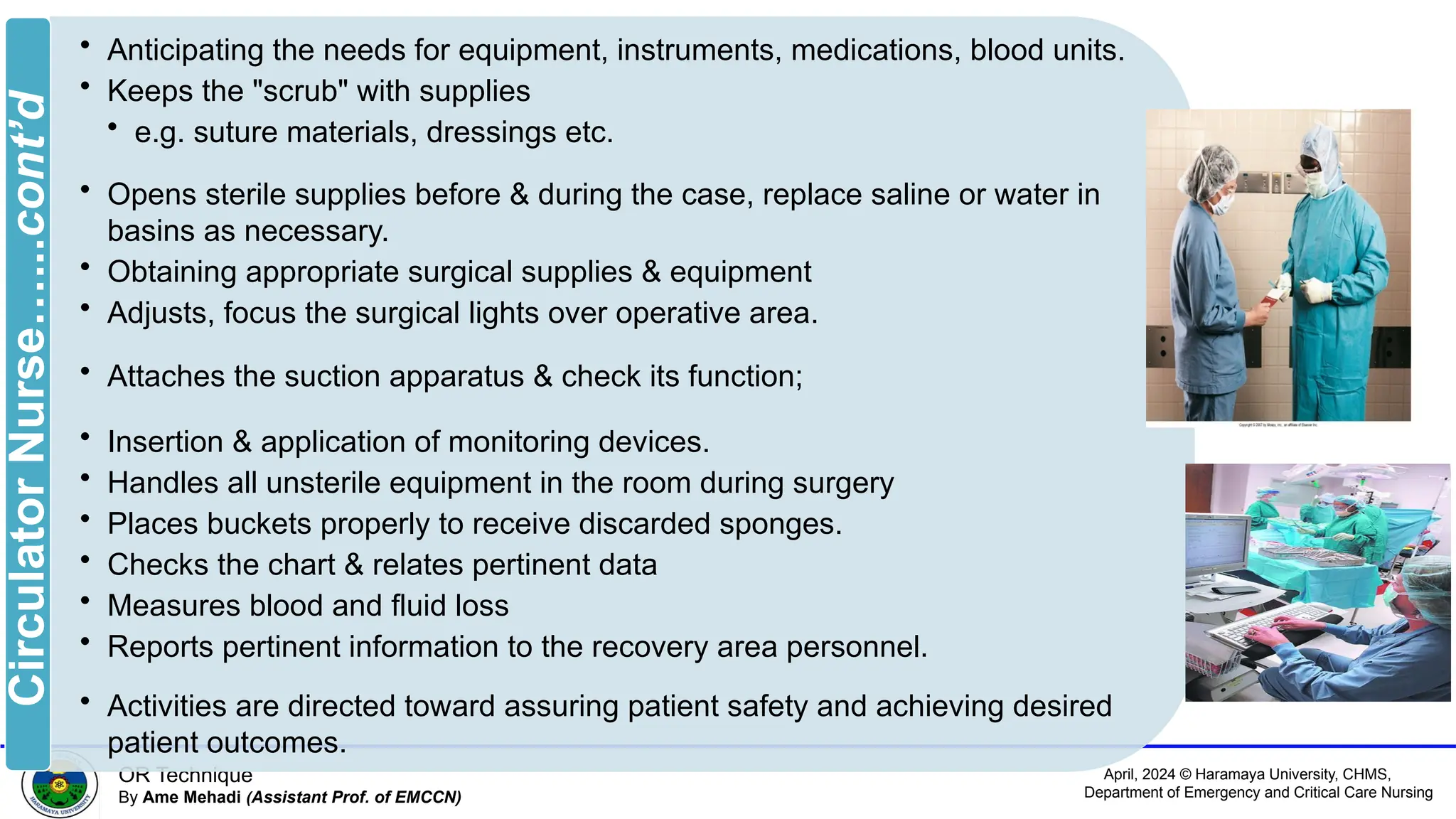
• Anticipating the needs for equipment, instruments, medications, blood units.
• Keeps the "scrub" with supplies
• e.g. suture materials, dressings etc.
• Opens sterile supplies before & during the case, replace saline or water in
basins as necessary.
• Obtaining appropriate surgical supplies & equipment
• Adjusts, focus the surgical lights over operative area.
• Attaches the suction apparatus & check its function;
• Insertion & application of monitoring devices.
• Handles all unsterile equipment in the room during surgery
• Places buckets properly to receive discarded sponges.
• Checks the chart & relates pertinent data
• Measures blood and fluid loss
• Reports pertinent information to the recovery area personnel.
• Activities are directed toward assuring patient safety and achieving desired
patient outcomes.
Circulator
Nurse…...cont’d
April, 2024 © Haramaya University, CHMS,
Department of Emergency and Critical Care Nursing
OR Technique
By Ame Mehadi (Assistant Prof. of EMCCN)
•Teaching patient & family
•Coordinates the care of the patient,
•Making initial assessment of the patient & continued monitoring.
•Serves as the patient’s advocate throughout intra-op experience.
•Performing ongoing patient assessment
•Patient care documentation
•Developing & implementing a plan of care & formulating a Dx
•Evaluating patient outcomes
•Transfer the patient to the RR.
•Administering drugs
•Implementing & enforcing policies & procedures that contribute to pt safety,
such as
•surgical checklists, “time-out” protocols,
•surgical counts
•checking equipment
•Managing and implementing activities outside the sterile field.
•Check mechanical & electrical equipment.
Circulator
Nurse…...cont’d
April, 2024 © Haramaya University, CHMS,
Department of Emergency and Critical Care Nursing
OR Technique
By Ame Mehadi (Assistant Prof. of EMCCN)
• Documents & preserves any specimens received during surgery
• Preparing & disposing of specimens
• Preparing labels for the patient specimens
• Submits to the laboratory for analysis.
• Creating and maintaining a safe environment
• Damp dust all equipment & wet-vacuum floor prior to a surgical procedure.
• Arrange furniture in functional order.
• Assemble, arrange, and open outer and inner wrappers of sterile supplies.
• Check package integrity, expiration date, and appearance of the indicating
tape.
• Deliver supplies to the sterile field,
• Pass additional sterile supplies to scrub as needed.
• Pour sterile solutions: water, N/S, and antibacterial solutions.
• Pass dressing sponges to scrub.
• Saving all discarded sponges during surgery.
Circulator
Nurse…...
cont’d
April, 2024 © Haramaya University, CHMS,
Department of Emergency and Critical Care Nursing
OR Technique
By Ame Mehadi (Assistant Prof. of EMCCN)
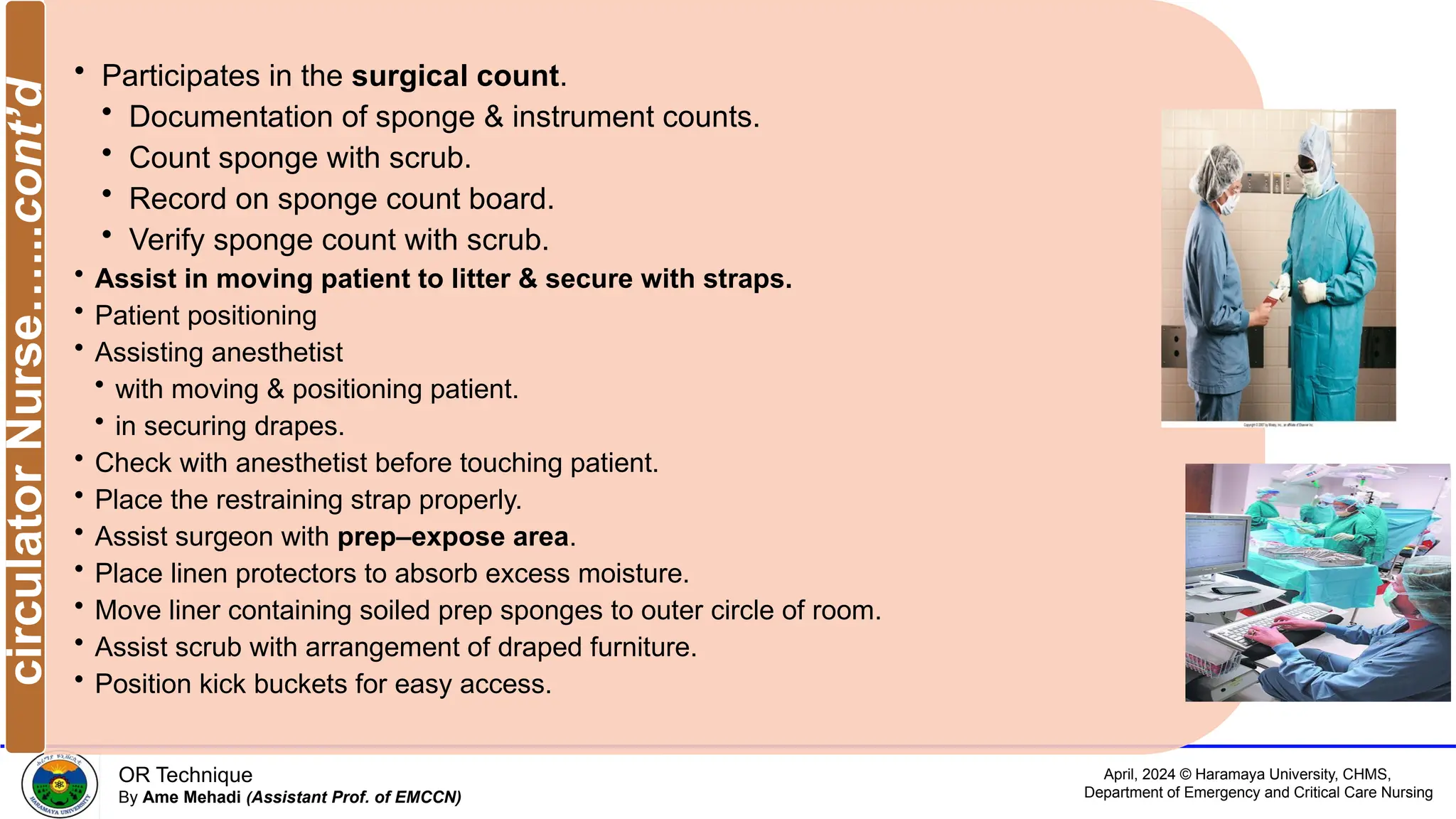
• Participates in the surgical count.
• Documentation of sponge & instrument counts.
• Count sponge with scrub.
• Record on sponge count board.
• Verify sponge count with scrub.
• Assist in moving patient to litter & secure with straps.
• Patient positioning
• Assisting anesthetist
• with moving & positioning patient.
• in securing drapes.
• Check with anesthetist before touching patient.
• Place the restraining strap properly.
• Assist surgeon with prep–expose area.
• Place linen protectors to absorb excess moisture.
• Move liner containing soiled prep sponges to outer circle of room.
• Assist scrub with arrangement of draped furniture.
• Position kick buckets for easy access.
circulator
Nurse…...cont’d
April, 2024 © Haramaya University, CHMS,
Department of Emergency and Critical Care Nursing
OR Technique
By Ame Mehadi (Assistant Prof. of EMCCN)
• Replace kick bucket liner.
• Prepare adhesive strips for dressing.
• Remove and check drapes for instruments and supplies before
discarding into hamper.
• Clean the room and prepare for next case.
• During the positioning procedure, it is the Circulator
responsibility to:
• Restrict access to the OR
• Close all doors
• Limit traffic within the OR
• Minimize exposure
• Provide auditory privacy
• Prohibit prejudicial behavior
circulator
Nurse…...cont’d
December 2024 © Haramaya University, CHMS,
Department of Emergency and Critical Care Nursing
Operation Room Technique
By Ame Mehadi (EMCCN, Assistant Professor)
• The coordinated role is essential
• to move the schedule of surgical procedures efficiently and
• to serve the best interests of the patient.
• complete preparation of the environment.
• Consists
• Sponge, Sharp, and Instrument Count
Coordinated
Roles
of
the
Scrub
and
the
Circulator
• Nurses have exciting and diverse role involving some or all
of the following:
• Monitoring role
• Organizing role
• Managerial role
• Record keeping
• Statistical reports
• Stock mgt
General
Responsibilities
of
Nurses
in
the
OR
December 2024 © Haramaya University, CHMS,
Department of Emergency and Critical Care Nursing
Operation Room Technique
By Ame Mehadi (EMCCN, Assistant Professor)
• Nurses may be assigned to
• the scrub,
• the circulator,
• the recovery room,
• the workroom,
• the instrument room,
• the anesthesia section, or
• any other area within the surgical suite.
• function in various roles, including those of
• manager/director,
• clinical practitioner,
• e.g.,
• scrub,
• circulator,
• clinical nurse specialist,
• registered nurse first assistant [RNFA],
• educator, and
• researcher.
General
Responsibilities
of
Nurses
in
the
OR
December 2024 © Haramaya University, CHMS,
Department of Emergency and Critical Care Nursing
Operation Room Technique
By Ame Mehadi (EMCCN, Assistant Professor)
• monitoring the patient’s vital parameters with anesthesia provider,
• organizing patient transportation from OR to RR,
• carry-out and/or supervise all post-op activities to prepare OR for the next
operation.
• receiving pts from preparation room, taking to OR &
• ensure patients’ readiness for surgery.
• preparation, and maintenance of sterile and unsterile supplies.
• preparation of the material and equipment,
• In addition to understanding and performing tasks related to assignment as the
scrub or the circulator for an operation, OR Nurses are required to:
• understand and participate in tasks concerned with
• preparing the patient for surgery (surgical "prep"),
• assembling packs for use during surgery,
• assembling instrument sets, and
• sterilizing supplies and equipment.
• practice personal hygiene measures to prevent spread of pathogenic organisms;
• demonstrate a high standard of personal ethics, as well as practicing such
medical ethics as upholding the patient's right to privacy.
General
Responsibilities
of
Nurses
in
the
OR
……
cont’d
December 2024 © Haramaya University, CHMS,
Department of Emergency and Critical Care Nursing
Operation Room Technique
By Ame Mehadi (EMCCN, Assistant Professor)
• Ensure safety of patients and staff
• Supervise and train the assistants and cleaners in OR
• Control all equipment and material stock used in the OR
• to ensure efficient and rational use of material resources
• Record keeping
• Contribute to monthly reports according to guidelines (statistical reports, etc.)
• Assistance role
• Assist the surgeon during the operation
• Assist the anesthetist;
• Prevention of Complications
• Prevention of Later Post-op Complications
• Prevention of Respiratory Complications.
• Assisting the Client With Post-op Exercises
• Splinting an Incision
• Turning, Coughing, and Deep Breathing (TCDB)
• Huffing
• Use of the Incentive Spirometer
• Leg Exercises
• Suture and Staple Removal
General
Responsibilities
of
Nurses
in
the
OR
……
cont’d
December 2024 © Haramaya University, CHMS,
Department of Emergency and Critical Care Nursing
Operation Room Technique
By Ame Mehadi (EMCCN, Assistant Professor)
• Patient assessment before, during, and after surgery
• Patient and family teaching
• Patient and family support and reassurance
• Patient advocacy
• Performing as scrub or circulator during surgery
• Control of the environment
• Efficient provision of resources
• Coordination of activities related to patient care
• Communication, collaboration, and consultation with other healthcare team members.
• Maintenance of asepsis
• Ongoing monitoring of the patient’s physiological and psychological status
• Supervision of ancillary personnel
General
Responsibilities
of
Nurses
in
the
OR
……
cont’d
• include, but not limited to, the following:
• Participation in professional organization activities
• Participation in research activities that support the profession of perioperative
Nursing.
• Exploration and validation of current and future practice
• On job training for perioperative Nurse colleagues
• Functioning as a role model for nursing students
• Mentoring, precepting, and instructing other perioperative Nurses
Additional
responsibilities
that
promote
personal
and
professional
growth
and
contribute
to
the
profession
December 2024 © Haramaya University, CHMS,
Department of Emergency and Critical Care Nursing
Operation Room Technique
By Ame Mehadi (EMCCN, Assistant Professor)
Surgical Count
• Sponge, Sharp, and Instrument Count
Consists
• before and after use.
Done
• accountability which is a professional responsibility.
Need
• patient and personnel safety,
• infection control, and
• inventory purposes.
• Prevention of lawsuit
• An item left in the wound after closure is a possible cause for a lawsuit
following a surgical procedure.
Performed for
December 2024 © Haramaya University, CHMS,
Department of Emergency and Critical Care Nursing
Operation Room Technique
By Ame Mehadi (EMCCN, Assistant Professor)
• Inventory control
• is monitored by accounting for the instrument set in its entirety.
• Counting ensures that expensive instruments such as towel clips and
scissors are not accidentally thrown away or discarded with the drapes.
• Injury to laundry and housekeeping/env’tal services personnel by the
contaminated sharp edges of surgical instruments, blades, and needles
is a potential risk.
• Surgical instruments also can cause major damage to equipment in the
laundry service.
• A count must be undertaken for all procedures in which the likelihood
exists that swabs, instruments and/or sharps could be retained.
Sponge,
Sharp,
and
Instrument
Count
December 2024 © Haramaya University, CHMS,
Department of Emergency and Critical Care Nursing
Operation Room Technique
By Ame Mehadi (EMCCN, Assistant Professor)
• is a method of accounting for items put on the sterile table for use during the surgical
procedure.
• Sponges, sharps, and instruments should be counted and/or accounted for on all
surgical procedures.
• This includes any material introduced into the patient during the procedure.
• is made three times in a surgical procedure.
• First Count
• Second Count
• Third Count
Counting
Procedure
• include, but not limited to, the following:
• Participation in professional organization activities
• Participation in research activities that support the profession of perioperative
Nursing.
• Exploration and validation of current and future practice
• On job training for perioperative Nurse colleagues
• Functioning as a role model for nursing students
• Mentoring, precepting, and instructing other perioperative Nurses
Additional
responsibilities
that
promote
personal
and
professional
growth
and
contribute
to
the
profession
December 2024 © Haramaya University, CHMS,
Department of Emergency and Critical Care Nursing
Operation Room Technique
By Ame Mehadi (EMCCN, Assistant Professor)
Counting Procedure
• is performed by the person who assembles and wraps items for sterilization.
• In commercially prepackaged sterile items, the count is performed by the manufacturer.
First
Count
• done by the scrub and the circulator together
• done before the surgical procedure begins and during the surgical procedure as
each additional package is opened and added to the sterile field.
• is initial counts
• provide the baseline for subsequent counts.
• Any item initially placed in the wound is recorded.
• A useful method for counting is as follows:
• counting all items as the scrub touches each item.
• numbering each counted item aloud
• immediately recording the count for each type of item on the count record.
• counting additional packages away from counted items already on the table
• Counting should not be interrupted.
• should be repeated if there is uncertainty because of interruption, fumbling, or any other reason.
Second
Count
December 2024 © Haramaya University, CHMS,
Department of Emergency and Critical Care Nursing
Operation Room Technique
By Ame Mehadi (EMCCN, Assistant Professor)
Counting Procedure…………
•performed before the surgeon starts the
closure of a body cavity or a deep/large
incision:
•takes place in three areas
c. Third Count
• done by the scrub assisted by either the surgeon or the
assistant.
• additional items are accounted at this time.
Field
Count
• the scrub & the circulator together count all items on the Mayo
stand & instrument table.
• surgeon & assistant may be closing the wound, while this count is
in process.
Table
Count
• is counting of items recovered from the floor or passed off the sterile field to the
kick buckets.
• done by circulator
• should be verified by the scrub.
Floor
Count
December 2024 © Haramaya University, CHMS,
Department of Emergency and Critical Care Nursing
Operation Room Technique
By Ame Mehadi (EMCCN, Assistant Professor)
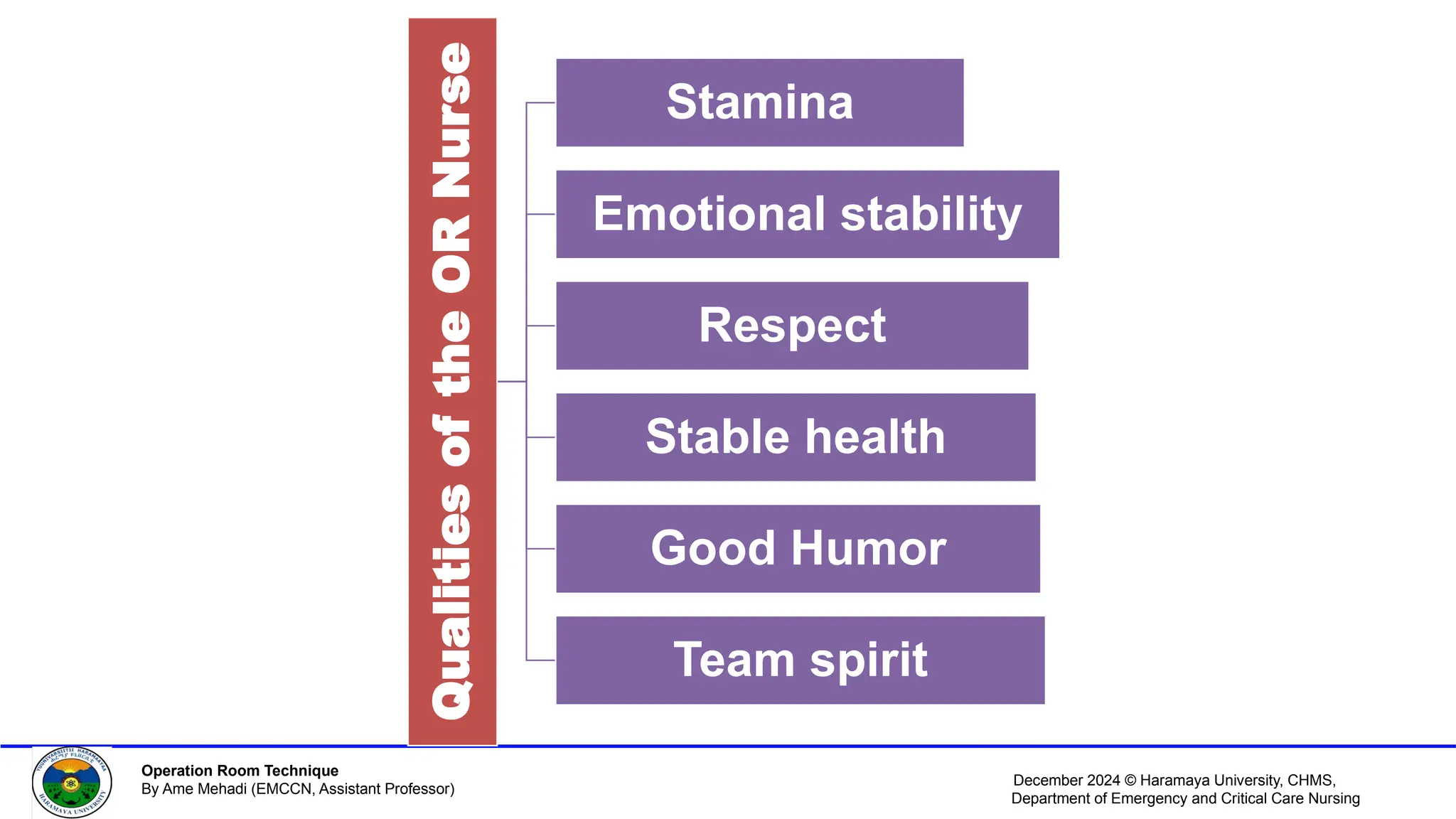
Qualities
of
the
OR
Nurse
Stamina
Emotional stability
Respect
Stable health
Good Humor
Team spirit
December 2024 © Haramaya University, CHMS,
Department of Emergency and Critical Care Nursing
Operation Room Technique
By Ame Mehadi (EMCCN, Assistant Professor)
Qualities ……
• is having good physical condition and the energy to complete daily work in a safe
and efficient manner.
• Since the job requires long hours of standing, lifting heavy instrument trays, positioning
patients, and many other physical tasks, the OR nurse should be in good physical
condition and have the energy to complete her/his daily work in a safe and efficient
manner.
Stamina
• is the ability to cope with own tension and with that of teammates.
• The OR work is stressful.
• The nature of the work can cause team members to be tense or to display aggressive
behavior while working.
• In the OR you must be able to cope with your own tension and with that of your teammates.
• Occasionally, the surgeon may express feelings of stress by being verbally abrupt or harsh.
• While extremely inappropriate behavior should not be tolerated by the OR supervisor, all
team members must appreciate the responsibility that rests on the surgeon and not become
personally offended by occasional outbursts.
Emotional
stability
December 2024 © Haramaya University, CHMS,
Department of Emergency and Critical Care Nursing
Operation Room Technique
By Ame Mehadi (EMCCN, Assistant Professor)
Qualities ……
Respect
►respect for the patient’s rights for privacy, for other team members, and for own
self is very important in the OR.
►The OR relies on chain of command for efficient and safe patient care.
►Those who experience problems in responding to authority should not work.
December 2024 © Haramaya University, CHMS,
Department of Emergency and Critical Care Nursing
Operation Room Technique
By Ame Mehadi (EMCCN, Assistant Professor)
Qualities ……
Stable health
►If one person is ill, the workload of other team members is increased because they must
perform the work of the absentee.
►The surgery department relies upon the daily presence of its employees.
►If one person is ill, the workload of other team members is increased because they must
perform the work of the absentee.
►Cases are generally not cancelled because of absenteeism.
►Since the OR is a stressful situation and because stress can contribute to ill health, you
must be careful to guard against illness and injury.
►Of particular importance are prevention of injury to the back and maintenance of healthy
skin and respiratory tract (common areas of illness).
December 2024 © Haramaya University, CHMS,
Department of Emergency and Critical Care Nursing
Operation Room Technique
By Ame Mehadi (EMCCN, Assistant Professor)
Qualities ……
 Good Humor
► is having a proper perspective on the day’s events and to share in good spirit.
► It is a senseless waste of energy for a team member to allow one distressing episode to influence an entire day’s
work.
► Team members who are consistently sullen can lower the morale of the whole department, while those who are
cheerful can raise everyone’s spirit.
 In a difficult and demanding env’t such as the OR, it is important to have a proper perspective on the day’s events
and to share in good spirit.
 Team spirit
► is very important in surgery. is the ability to work with team members toward a common goal.
► The patient expects and should receive the undivided attention of all who care for him/her.
► To accomplish this, you should recognize the importance of not only your job, but also those of the other team
members.
► You should either put personnel problems aside or bring them to the attention of the supervisor, who might able to
resolve them.
April 2024 © Haramaya University, CHMS,
Department of Emergency and Critical Care Nursing
Operation Room Technique
By Ame Mehadi (EMCCN, Assistant Professor)
CO-OPERATION AND ECONOMICAL
USE OF HOSPITAL SUPPLIES,
EQUIPMENT AND TIME
73
December 2024 © Haramaya University, CHMS,
Department of Emergency and Critical Care Nursing
Operation Room Technique
By Ame Mehadi (EMCCN, Assistant Professor)
Co-operation and Economical Use of Hospital
Supplies, Equipment and Time
 The team approach to care should involve a coordinated effort with the cooperation of
all caregivers.
 Team members should communicate and have a shared division of duties to perform
specified tasks as a unified body.
 The failure of any member to perform her/his role can seriously impact the success of
the entire team.
 Performing as a team requires that each member exert an effort to attain the common
goals competently and safely.
 No individual can accomplish the goal without the cooperation of the rest of the team.
74
December 2024 © Haramaya University, CHMS,
Department of Emergency and Critical Care Nursing
Operation Room Technique
By Ame Mehadi (EMCCN, Assistant Professor)
A. Economical use of supplies & hospital Equipment
 Most of hospital equipment is being imported from abroad and it is costy and, therefore economical
and proper usage is mandatory.
 As the cost of supplies and equipment increases, the OR team members should be conscious of ways
to eliminate wasteful practices.
 e.g.,, throw away disposable items only.
 Avoid throwing away reusable items.
 OR is one of the most expensive departments of a hospital.
 Adequate instruments & supplies are necessary for patient care, & cost is not always the primary
consideration.
 Economy becomes a hazard when exercised beyond the point of safety.
 Nevertheless, supplies do not need to be used lavishly, just b/c they are available.
 Most of the hospital equipment is being imported from abroad and it is costy and, therefore
economical and proper usage is mandatory.
December 2024 © Haramaya University, CHMS,
Department of Emergency and Critical Care Nursing
Operation Room Technique
By Ame Mehadi (EMCCN, Assistant Professor)
A. Economical use ……..
 “Just Enough Is Enough”
►Variety & number of instruments & supplies needed for each surgical procedure can be kept to a
minimum.
►Materials no longer used can be eliminated.
►Items to “have available” are not opened unnecessarily.
►The following procedures should be observed:
 Pour just enough antiseptic solution,
 Follow the procedures for draping,
 Do not open another packet of sutures for the last stitch unless absolutely necessary,
 A few leftover pieces are usually long enough to complete the closure,
 Supplies should be opened only as needed, not routinely “just in case” they may be needed,
 Turn off lights when they are not needed.
December 2024 © Haramaya University, CHMS,
Department of Emergency and Critical Care Nursing
Operation Room Technique
By Ame Mehadi (EMCCN, Assistant Professor)
B. Time Economy
 Time is money; do not waste it.
 Know the policies and procedures, and follow them efficiently.
 Learn to do things right the first time and continue to do them that way; time is wasted in correcting
errors.
 Time is an important element in the OR.
 If time is wasted between surgical procedures, the day’s schedule is slowed down and later procedures
are delayed.
 The patients and families become anxious during these delays.
 By reducing time we can reduce the prolonged administration of anesthetic agents, and other
medication.
 The hazards of surgery will also be decreased with reduced time.
July, 2021 © Haramaya University, CHMS,
Department of Emergency and Critical Care Nursing
Introduction to OR Technique
By:- Ame Mehadi (BSc, MSc)
July, 2021 © Haramaya University, CHMS,
Department of Emergency and Critical Care Nursing
Introduction to OR Technique
By:- Ame Mehadi (BSc, MSc) 78
?

1. Introduction to Operation Theatre Nursing

  • 1.
    April 2024 ©Haramaya University, CHMS, Department of Emergency and Critical Care Nursing Operation Room Technique By Ame Mehadi (EMCCN, Assistant Professor) INTRODUCTION TO OPERATION ROOM TECHNIQUE By Ame Mehadi (EMCCN, Assistant Professor) 1
  • 2.
    December 2024 ©Haramaya University, CHMS, Department of Emergency and Critical Care Nursing Operation Room Technique By Ame Mehadi (EMCCN, Assistant Professor) Learning Objectives At the end of this Session, the learners will be able to: ►Describe specific areas within the OR ►Identify major OR equipment ►Discuss how the OR environmental layout contributes to the aseptic technique. ►Differentiate the OR personnel ►Identify basic principles of aseptic technique 2
  • 3.
    December 2024 ©Haramaya University, CHMS, Department of Emergency and Critical Care Nursing Operation Room Technique By Ame Mehadi (EMCCN, Assistant Professor) OR design and administration 2 Hrs. CSSD-----Central Sterile Services Department (CSSD) 2 Hrs. Micro surgical instruments Suture Materials Administering anesthesia to a patient 4 Hrs Introduction 2 Hrs. Monitoring & Recording Physiological Status 2 Hrs. Infection prevention in OR Maintaining anesthesia during an operation Hazards in anesthesia 6 Hr Surgical conscience • Surgical conscience • Consent • Areas affected by surgical conscience • Protection of the patient • Situations that Undermine Surgical Conscience • Legal aspects of surgery • Criminal responsibilities • Common areas of negligence • Nursing responsibility 2 Hrs. Principles of Anesthesia Introduction Types of anesthesia Methods of administering Stages of general anesthesia Choices of anesthesia Pre-medication 4 Hrs. Introduction to ventilation Cardiopulmonary resuscitation Emergency drugs – protocols for use Defibrillation Fluid replacement therapy Homeostasis – mechanisms for maintenance Patients presenting with multiple pathology Stress management 4 Hr Surgical Asepsis General surgical instrumentation Receiving and positioning of surgical patients 3 Hrs. Staff conduct and practice OR attire 2 Hrs. WHO‘s 10 objectives for surgery Instrument handling Suture Materials and Needles Positioning and operation 2 Hr Hazards in the OR Precautionary Measures Teams in OR 6 Hrs. Hazards in the operating theatre Principles of Anesthesia 2 Hr 3
  • 4.
    December 2024 ©Haramaya University, CHMS, Department of Emergency and Critical Care Nursing Operation Room Technique By Ame Mehadi (EMCCN, Assistant Professor) Operating Room Technique SN SDL Allocated Hrs. SDL 1 Gowning and gloving 2 Hrs. SDL 2 Identification of surgical instruments 1 Hr. SDL 3 Material processing 2 Hrs. SDL 4 Surgical attire, surgical scrub 2 Hrs. SDL 5 Wound care Suturing Suture removal 4 hrs. 4  Fundamentals of Nursing ► Perioperative patient care --4 Hrs.  Pre-operative  Intra operative  Post-operative  Ongoing postoperative patient care
  • 5.
    April 2024 ©Haramaya University, CHMS, Department of Emergency and Critical Care Nursing Operation Room Technique By Ame Mehadi (EMCCN, Assistant Professor) OR DESIGN & ADMINISTRATION (2 Hrs.) 5
  • 6.
    December 2024 ©Haramaya University, CHMS, Department of Emergency and Critical Care Nursing Operation Room Technique By Ame Mehadi (EMCCN, Assistant Professor) Definitions of Terminologies  OPERATING DEPARTMENT: ►A unit consisting of one or more operating suites together wz ancillary accommodations such as;  Changing room, Reception  Transfer room, Restroom  RR, Circulatory room  OPERATING SUITE: ►comprises of operating theatre/room together wz immediate ancillary areas such as;  Anesthetic rooms  Sterile layup or preparation room  Disposal room  Scrub up & gowning areas  Exit room.  OPERATING/OPERATION THEATER: ►is a facility within a hospital where surgical operations are carried out in a sterile env’t. ►is where surgical operations & certain diagnostic procedures are performed. ►Real area of operation ►is the entire area in which  surgeries are performed and materials are prepared and stored for surgery. ►specifically for use by the anesthetist & surgical teams ►must not be used for other purposes. ►Includes  OR/or surgical suite  recovery room(RR) 6
  • 7.
    December 2024 ©Haramaya University, CHMS, Department of Emergency and Critical Care Nursing Operation Room Technique By Ame Mehadi (EMCCN, Assistant Professor) Definitions of …… OPERATING ROOM ►is where surgery is performed ►is organized & designed differently from other wards. ►is a special room wz washable walls & ceilings made of ceramics ►equipped wz special instruments RECOVERY ROOM(RR) ►is a place where the pt stays until recovers from anesthesia after surgery. ►Both rooms (OR & RR) require:  Good lighting & ventilation  Dedicated equipment  Monitoring Equipment  Sutures & extra equipment  Drugs 7
  • 8.
    December 2024 ©Haramaya University, CHMS, Department of Emergency and Critical Care Nursing Operation Room Technique By Ame Mehadi (EMCCN, Assistant Professor) OR Design Principles  Common basic OR design principles criteria: ►Simple design & easy to clean ►simple & easy to clean & keep it clean ►suitable to prevent cross-contamination: ►smooth wall & floor surfaces made of nonporous materials ►separate rooms for clean, sterile & soiled instruments ►sufficient space to ensure safe transportation of pts & staff. ►convenient layout for the supervisor to control traffic ►RR attached to OR  Major consideration during OR designation ►Designing and planning consideration of the physical facility of a theatre:  determination of the numbers of OR.  future surgical needs of the community.  future development in surgical technology.  Surgical support system • e.g. – Temperature, – Humidity, – Ventilation – Lighting – Doors  Communication and information  Administration units
  • 9.
    December 2024 ©Haramaya University, CHMS, Department of Emergency and Critical Care Nursing Operation Room Technique By Ame Mehadi (EMCCN, Assistant Professor) 9  Doors ► OR doors are designed to ensure the safety of patients and medical staff by controlling access to sterile areas and providing a secure environment. ► Ideally should be sliding doors. ► microbial count is usually at its peak at the time of the skin incision because this follows the disturbance of air by:  gowning, draping,  personnel movements and  opening and closing of doors. ► During the surgical procedure, the microbial count rises every time doors swing open from either direction. ► Also, swinging doors may touch a sterile table or person. ► The risk of catching hands, equipment cords, IV line tubing, or other supplies is high. ► Some common types of OR doors include:  Sliding doors ► eliminate the air currents caused by swinging doors. ► disturbs MOs that have previously settled in the room with each swing of the door. ► heavy, steel doors are often automated & slide horizontally on tracks. ► good choice for areas with limited space & when many people need to enter quickly.  Hinged doors ► Opened like regular doors using hinges. ► good choice for providing a strong seal when closed.  Folding doors ► Opened up & folded together to make a space bigger. ► Can also slide apart like a sliding door.  Smart glass doors ► can change from transparent to opaque to offer privacy when needed.  Fire-rated doors ► are made of strong materials like steel or wood to help stop fires from spreading.  Other features of OR doors include: ► Soundproofing, ► Durability, ► Easy to clean, ► Automatic closing, ► Air pressure regulation.
  • 10.
    December 2024 ©Haramaya University, CHMS, Department of Emergency and Critical Care Nursing Operation Room Technique By Ame Mehadi (EMCCN, Assistant Professor) 10
  • 11.
    December 2024 ©Haramaya University, CHMS, Department of Emergency and Critical Care Nursing Operation Room Technique By Ame Mehadi (EMCCN, Assistant Professor) Lighting in the Theatre Can be ►Natural light ►Service light ►Artificial light Lights should be ►overhead ►freely movable, ►shadowless and ►less heat emitting. 11
  • 12.
    December 2024 ©Haramaya University, CHMS, Department of Emergency and Critical Care Nursing Operation Room Technique By Ame Mehadi (EMCCN, Assistant Professor) 12
  • 13.
    December 2024 ©Haramaya University, CHMS, Department of Emergency and Critical Care Nursing Operation Room Technique By Ame Mehadi (EMCCN, Assistant Professor) Ventilation in the Theatre ►purpose:  Supply heated or cooled, humidified, contamination-free air to the room.  Introduce air into the theatre to remove contaminants liberated there.  Prevent entry of air from adjacent contaminated areas.  Should be 25 times air exchange/hr. Humidity ►To prevent ventilating air not to be dry. ►must be b/n 50-60%. ►Controlled by an instrument called a Hygrometer to measure the level. Heating ►The room temp of OR must be b/n 18.5– 22o C may exceed to 240 C. 13
  • 14.
    December 2024 ©Haramaya University, CHMS, Department of Emergency and Critical Care Nursing Operation Room Technique By Ame Mehadi (EMCCN, Assistant Professor) 14
  • 15.
    December 2024 ©Haramaya University, CHMS, Department of Emergency and Critical Care Nursing Operation Room Technique By Ame Mehadi (EMCCN, Assistant Professor) Organizational Areas……  LOCATION ►centrally located so that easily & quickly reached from all areas of the hospital, thus  enabling personnel to transfer pts with the least possible delay. ►near such support activities as ICU, RR, Lab. Pharmacy, X-Ray & CMS/CSR ► in a passage with only one outlet, or at least away from those areas of the hospital through which most of the traffic flows. ►sufficiently isolated  to prevent annoyance, anxiety, & disturbance to other pts. ►near easily reached elevators  for transportation of pts or supplies. 15 OR X-ray Laboratory CMS or CSR Pharmacy Recovery room. ICU
  • 16.
    December 2024 ©Haramaya University, CHMS, Department of Emergency and Critical Care Nursing Operation Room Technique By Ame Mehadi (EMCCN, Assistant Professor) Organizational Areas …….. Arrangement of rooms • Arrangement of rooms within a surgical suite • should allow smooth & efficient workflow. • E.g., traffic into, & out of the suite. • Proper arrangement • reduces excess traffic flow, • saves much unnecessary walking, • conserves time & effort. Size of the Suite • determined by numerous factors: • Operative load • # of cases to be done per day • types of surgery • number & frequency of emergency cases • average number of OR needed is indicated by Size of Individual OR • should have sufficient floor space • that avoid breaks in aseptic technique due to overcrowding. • shouldn’t be larger than necessary, thus • reducing the amount of unnecessary times spent walking. 16
  • 17.
    December 2024 ©Haramaya University, CHMS, Department of Emergency and Critical Care Nursing Operation Room Technique By Ame Mehadi (EMCCN, Assistant Professor) 17
  • 18.
    December 2024 ©Haramaya University, CHMS, Department of Emergency and Critical Care Nursing Operation Room Technique By Ame Mehadi (EMCCN, Assistant Professor) Zoning…  Zonal division ► are designated by the physical activities performed in each area. ► Three Vs Four Zone Concept ► Three Zone Division  more common and includes • Unrestricted area, • Semi-restricted area and • Restricted area. ► Four Zone Division  Protective zone/limited access area/unrestricted area  Clean/Semi Restricted zone  Sterile/restricted Zone  Disposal Zone  Four Zone Division Concept ► not necessarily used for all hospitals, ► but whenever feasible the OR is segregated into four areas for traffic control. ► Purpose  to assure maximum protection against infections. ► Traffic control design  needs determination of specific traffic patterns.  dependent on the entrances and exits for both personnel & materials.  is aided by designation of the four-zone concept (as shown below):
  • 19.
    December 2024 ©Haramaya University, CHMS, Department of Emergency and Critical Care Nursing Operation Room Technique By Ame Mehadi (EMCCN, Assistant Professor)
  • 20.
    December 2024 ©Haramaya University, CHMS, Department of Emergency and Critical Care Nursing Operation Room Technique By Ame Mehadi (EMCCN, Assistant Professor)  A. Protective Zone ► is an unrestricted Area but limited Access Area ► street clothes permitted. ► A corridor on the periphery accommodates traffic from outside, including patients. ► isolated by doors from main corridor and other areas of the suite. ► Usually separated by RED or green line from the next area. ► serves as an outside-to-inside access area. ► Exit from clean zone & sterile zone ► Transfer or change over section. ► is 1st stage of entry to operation Dep’t ► Includes:  RR, Plaster room  Change room  Offices (e.g. reception, staff, head)  Seminar & teaching rooms.  B. Clean/Semi Restricted Zone ► is a transitional zone ► Traffic is limited to properly attired/dressed personnel ► pt transferred to a clean side & stretcher is on entry to this area. ► Approach sterility to the operating theatre. ► Approach to the sterile preparation room ► coverings are required  Head, face, entire body ► pt’s hair must be covered. ► includes  peripheral support areas  access corridors to the OR.  Scrubbing room.  Gowning area  Anesthetic room  Exit lobby, Clean movements  Rest area, Sterile store. 20
  • 21.
    December 2024 ©Haramaya University, CHMS, Department of Emergency and Critical Care Nursing Operation Room Technique By Ame Mehadi (EMCCN, Assistant Professor)  C. Sterile/Restricted Zone ►is the place where actual surgery and other sterile procedures are performed. ►is the main OR itself. ►is where complete surgical attire/OR attire including masks, caps, shoes & trousers are required ►is where sterile instruments are used ►is sterile team members wear (don) sterile gowns & gloves. ►The zone includes:  OR.  sterile preparation rooms.  scrubbing rooms, scrubbing sink areas.  Sub-sterile rooms or clean core area(s) where unwrapped supplies are sterilized.  RR or PACU is by.  D. The Disposal Zone ►least clean area of the whole department ►includes:  The disposal room  Interim storage area  The disposal corridor 21
  • 22.
    December 2024 ©Haramaya University, CHMS, Department of Emergency and Critical Care Nursing Operation Room Technique By Ame Mehadi (EMCCN, Assistant Professor) Organizational Areas…
  • 23.
    December 2024 ©Haramaya University, CHMS, Department of Emergency and Critical Care Nursing Operation Room Technique By Ame Mehadi (EMCCN, Assistant Professor) Illustration of areas within the OR Illustration of areas within the OR Supervisor’s Office (A) • has direct access to the outside of OR. Dressing rooms (B) • for OR personnel have a door to the outside corridors so that personnel may enter there, change into scrub attire and go directly into OR. Holding area (C) • is an area designated for the parking of stretchers with patients awaiting surgery. • is the area where the health care givers properly identify the patient and make sure that all preoperative cares are carried out and other important data are in the patient’s chart. Scrub sink areas (D)/Scrub (room) area: • is an area of surgical hand washing or scrubbing before surgical procedures • located in several places close to operating suite • Scrub brushes, Caps, Soaps, masks are present at each scrub station. Illustration ……. Workroom (E) • is located away from the direct traffic of the operating suites. Sterile supply room (F) • serves as a supply depot for wrapped sterile articles. • Sterilizing room – where instruments sterilized • Storage areas (G) • for extra equipment and supplies • are used to store extra instruments & supplies for each unit. • Recovery room (H) • has an access to the outside of the OR for transporting patients back to their rooms. • Operating suites (I) • where real surgery is performed. • Anesthesia room(J) • Anesthesia preparation area • where patients are prepared for anesthesia • IV line –cannula insertion • Pre-op medication given (e.g., Atropine, Morphine
  • 24.
    December 2024 ©Haramaya University, CHMS, Department of Emergency and Critical Care Nursing Operation Room Technique By Ame Mehadi (EMCCN, Assistant Professor) By Ame M.
  • 25.
    December 2024 ©Haramaya University, CHMS, Department of Emergency and Critical Care Nursing Operation Room Technique By Ame Mehadi (EMCCN, Assistant Professor) OR Major Equipment OR Major Equipment • Pipe line suction apparatus • Sterile hand lotion bowl, unopened packet • Diathermy machine (electrosurgical unit) • Cautery cable with knife and needle packed • Mobile supplementary operating light fitting • Swabs count board. • X-ray viewing screen • Swab or sponge checking rack. • Operating table • Anesthetic machines • O2 cylinder. • Medication table/supply shelf. Wall Clock • time is critical during surgery, • each OR should have easily readable wall clock. • is used to time tourniquet applications, administration of medications, the duration of cardiac & respiratory arrests and to note the time of events such as childbirth. X-ray Viewing Boxes • The surgeon may need to view an X-ray before or during the procedure. Operating Table • used to put the patient in different positions according to the need of surgery. • should be fully adjustable in all directions to create postures needed for various surgical positions. 25
  • 26.
    November 6, 2021© Haramaya University, CHMS, Department of Emergency and Critical Care Nursing Operation Room Technique By:- Ame Mehadi (BSc, MSc-EMCCN) Major equipment required in Major OR
  • 27.
    December 2024 ©Haramaya University, CHMS, Department of Emergency and Critical Care Nursing Operation Room Technique By Ame Mehadi (EMCCN, Assistant Professor) Major equipment required in Major OR This stand is used to hold instruments that will be used frequently during a particular case. Mayo Stands The back table is used to place extra supplies and instruments used during surgery. Back Table 27
  • 28.
    December 2024 ©Haramaya University, CHMS, Department of Emergency and Critical Care Nursing Operation Room Technique By Ame Mehadi (EMCCN, Assistant Professor) OR Major Equipment Ring Stand • The ring stand is used to hold basins which contains normal saline or sterile water during surgery. Kick Bucket • The kick bucket (a bucket on wheels) is used to place soiled sponges during surgery. 28
  • 29.
    December 2024 ©Haramaya University, CHMS, Department of Emergency and Critical Care Nursing Operation Room Technique By Ame Mehadi (EMCCN, Assistant Professor) Major equipment required in Major OR Supply Cabinets • These cabinets are used to store frequently used items such as drapes, dressings, solutions, sutures, etc. • Cabinets with doors are preferred to those without so as to reduce exposure of the content to dust. STOOLS • Revolving Stools • Straight Stool (Footstool 29
  • 30.
    December 2024 ©Haramaya University, CHMS, Department of Emergency and Critical Care Nursing Operation Room Technique By Ame Mehadi (EMCCN, Assistant Professor) Anesthesia Equipment Gas Anesthesia Apparatus. • Pressure regulators for both oxygen and nitrous oxide. • Inhaler tubes. • Oronasal mask. • Rebreathing bag. • Water manometer (indicates the rate of flow of gases). • Carbon dioxide absorber unit. • Tanks of O2 and nitrous oxide. The anesthetist's table Anesthesia machine • Used to give oxygen and inhalational anesthetic agents
  • 31.
    December 2024 ©Haramaya University, CHMS, Department of Emergency and Critical Care Nursing Operation Room Technique By Ame Mehadi (EMCCN, Assistant Professor) Electrocardiograp hy (ECG) machine • Used to monitor the electrical activity of the heart. Respironics Esprit • Used to monitor and support respirations. 31
  • 32.
    November 6, 2021© Haramaya University, CHMS, Department of Emergency and Critical Care Nursing Operation Room Technique By:- Ame Mehadi (BSc, MSc-EMCCN) 32 Electro-cautery (cautery machine) ►Used for cutting tissues and stopping of bleeding by sealing blood vessels. Suction machine ►Used to suck body fluids
  • 33.
    December 2024 ©Haramaya University, CHMS, Department of Emergency and Critical Care Nursing Operation Room Technique By Ame Mehadi (EMCCN, Assistant Professor) OR Essential Equipment Checklist OR Essential Equipment Checklist • Anesthesia Machine • Anesthesia Cart • Anesthesia Circuits • Anesthesia Monitor - CO2 and Agents • Laryngeal Mask Airways • Surgical Table • Patient Stretcher • Patient Stirrups • Positioning Pillows • Restraint Straps and Patient Positioners • Surgical Headlight • Surgical Lights - ceiling mounted • Surgical Microscope • AED/Defibrillator • Vital Signs Monitor OR Essential Equipment Checklist …. • EKG Machine • Video Monitors and Cameras • C-Arms • Ultrasound Machines • Endoscopy Tower • Laryngoscopes • Electrosurgical Unit • Smoke Evacuator • Sequential Compression Device • Surgical Tourniquet • Nerve Stimulator • Blood Warmer • Warming Air Units • Central Gas and Suction • Desk/Computer • Medical Cabinetry OR Essential Equipment Checklist ….Ring Stand • Back Instrument Table • Exchange Cart • Hand Table • Mayo Stand(s) • Prep Table • Utility Cart • Stools (Rolling, Step, etc.) • Linen Hamper • IV Accessories • Needle Counters • Kick Buckets • Biohazard Waste Cans • Sponge Counter Units/Bags
  • 34.
    December 2024 ©Haramaya University, CHMS, Department of Emergency and Critical Care Nursing Operation Room Technique By Ame Mehadi (EMCCN, Assistant Professor) Recovery room (RR) Recovery room (RR) • RR is a place where the pt stays until he/she recovers from anesthesia after surgery. • ICU and RR are not the same. • ICU is a place where care is given for critically ill patients with any medical or surgical problem. Materials required in RR • Oxygen & means of delivery + ambubag • Monitoring devices: ECG, BP apparatus • Suction machine • Dressing set • Tongue depressor-spatula • Kidney dish • Emergency drugs • IV fluids
  • 35.
    December 2024 ©Haramaya University, CHMS, Department of Emergency and Critical Care Nursing Operation Room Technique By Ame Mehadi (EMCCN, Assistant Professor) Materials required in RR Emergency drugs • Adrenaline • Analgesics like morphine • Anti-emetic drugs • Chlorpromazine • Promethazine • Anticholinergic drugs like atropine • decrease secretion, increase HR • Sodium bicarbonate –for acidosis IV fluids • Crystalloids – are fluids with lower molecular weight. • e.g. • 5% DW [sugar + water] • 0.9% NS [salt + water] • 5% DNS [sugar + salt] • R/L [water + electrolytes-k, Ca, Mg etc. • Colloids – are fluids with higher molecular weight • Are plasma expanders –used for hemorrhagic (bleeding) pts. • e.g. Dextran, plander, plasmin. 35
  • 36.
    December 2024 ©Haramaya University, CHMS, Department of Emergency and Critical Care Nursing Operation Room Technique By Ame Mehadi (EMCCN, Assistant Professor) Operation Theatre Cleaning 36
  • 37.
    December 2024 ©Haramaya University, CHMS, Department of Emergency and Critical Care Nursing Operation Room Technique By Ame Mehadi (EMCCN, Assistant Professor) Need for fumigation Surveillance studies of different zones in operation theatre showed that the isolates were ►Staphylococcus aureus (16%) ►Coagulase-negative staphylococcus aureus (26.7%) ►Acinobacter species (2.03%) ►Klebsiella (0.3%) ►E.coli, Pseudomonas species, & Proteus species were also found in majority 37
  • 38.
    December 2024 ©Haramaya University, CHMS, Department of Emergency and Critical Care Nursing Operation Room Technique By Ame Mehadi (EMCCN, Assistant Professor)  Daily cleaning should be carried out after the operating sessions are over.  All the surfaces should be cleaned with detergent and water and maybe wiped over with a phenol if any spills with blood/body fluid are present.  All the walls must be wiped down to hand height every day.  Floors should be scrubbed with warm water and detergent and dried. No disinfectant is necessary.  OR table and other non-clinical equipment must be wiped to remove all visible dirt and left to dry.  Weakly cleaning of all the areas inside the operating theatre complex should be done thoroughly with warm water and detergent and dried.  Storage shelves must be emptied and wiped over, allowed to dry, and restacked. 38
  • 39.
    April 2024 ©Haramaya University, CHMS, Department of Emergency and Critical Care Nursing Operation Room Technique By Ame Mehadi (EMCCN, Assistant Professor) SURGICAL TEAM MEMBERS & THEIR RESPONSIBILITIES 39
  • 40.
    December 2024 ©Haramaya University, CHMS, Department of Emergency and Critical Care Nursing Operation Room Technique By Ame Mehadi (EMCCN, Assistant Professor) Objectives  Discuss the surgical team composition  Discuss the responsibilities of each surgical team member  Discuss the responsibilities of Unsterile team members  Discuss the responsibilities of sterile team members  List the responsibilities of a scrub nurse  List the responsibilities of circulator nurse 40
  • 41.
    December 2024 ©Haramaya University, CHMS, Department of Emergency and Critical Care Nursing Operation Room Technique By Ame Mehadi (EMCCN, Assistant Professor) Surgical Team ……. 41  Definition: ► A group of professionals providing the continuum of care during:-  pre-operative.  intra-operative and  postoperative and recovery  Includes ► Surgeon, ► Assistant surgeon (One or two), ► Anesthesia provider (Anesthetist/Anesthesiologist), ► Scrub, ► Circulator/runner, ► Janitor/cleaner, ► Others (cardiologist, perfusionist, radiographer, etc. ) ► is subdivided according to the functions of its members as  Sterile Vs Unsterile ► Sterile team:  Surgeon  First assistant (RN or PA)  Scrub Nurse ► Unsterile team:  Anesthesia provider  Circulator nurse  Janitors ► Others  cardiologist,  perfusionist,  radographer, etc.
  • 42.
    November 6, 2021© Haramaya University, CHMS, Department of Emergency and Critical Care Nursing Operation Room Technique By:- Ame Mehadi (BSc, MSc-EMCCN) Surgical Team …cont’d Sterile team members ►those working together in the sterile field during operation. ►wash (scrub) their hands and arms, ►put on (don) a sterile gown and gloves, and ►enter the sterile field, ►work within limited area (only sterile field) and ►handle only sterile items. ►the sterile field  is the area of the OR that immediately surrounds the patient  is specially prepared for the patient.  established by all sterilized items needed for the surgical procedure.  Consists ►Surgeon ►Assistant surgeon ►Scrub nurse ►The patient OR team members while performing operation
  • 43.
    April, 2024 ©Haramaya University, CHMS, Department of Emergency and Critical Care Nursing OR Technique By Ame Mehadi (Assistant Prof. of EMCCN) • those persons working together out of sterile field in the OR during the operation. • do not enter the sterile field; • work outside and around the sterile field. • assume responsibility for maintaining sterile technique during the surgical procedure, but • handle supplies and equipment that are not considered sterile. • follow the principles of aseptic technique, • keep the sterile team supplied, • provide direct patient care, and • handle other requirements that may arise during the surgical procedure. • Consists of: • Anesthetist/anesthesiologist • Circulator/Runner • Cleaner/janitor • Others, such as students, cleaners & those who may be needed to set up & operate specialized equipment or monitoring devices. Non-Sterile/Clean Team
  • 44.
    November 6, 2021© Haramaya University, CHMS, Department of Emergency and Critical Care Nursing Operation Room Technique By:- Ame Mehadi (BSc, MSc-EMCCN) Responsibilities of the Anesthesia Provider I. Anesthesia provider(AP) AP Can be • Anesthesiologist • is a physician specialized in anesthesia. • Anesthetist • a university or college graduate in anesthesia • Nurse anesthetist • a registered professional nurse who is trained in administering anesthetics.
  • 45.
    July, 2021 ©Haramaya University, CHMS, Department of Emergency and Critical Care Nursing Introduction to OR Technique By:- Ame Mehadi (BSc, MSc) July, 2021 © Haramaya University, CHMS, Department of Emergency and Critical Care Nursing Introduction to OR Technique By:- Ame Mehadi (BSc, MSc) Anesth esia & surgery • are two distinct, but inseparable disciplines; • are two parts of one entity. Anesthe sia provider  guardian of the patient, administering fluids & electrolytes, Selecting & administering anesthesia, Intubating the patient, manage anesthesia risks, Maintaining anesthesia at the required levels- satisfactory degrees of relaxation Monitoring vital functions & parameters Oxygen exchange, circulatory functions, systemic circulation, vital sign supervise the patient's condition, advising the surgeon on potential Cxns & independently intervening as needed
  • 46.
    December 2024 ©Haramaya University, CHMS, Department of Emergency and Critical Care Nursing Operation Room Technique By Ame Mehadi (EMCCN, Assistant Professor) • is team leader • has ultimate responsibility for performing the surgery in an effective and safe manner. • is dependent upon other members of the team. • coordinate the team for the patient's emotional well-being and physiologic monitoring. • must do every thing possible to ensure the safety of the patient. • reduce the stress of the operation. • pre op Dx & care • selection & performance of the surgical procedure • post op mgt The surgeon • Under the direction of the operating surgeon, one or two assistants help to: • maintain visibility of the surgical site • control bleeding • close wounds and • apply dressings Assistants surgeons
  • 47.
    July, 2021 ©Haramaya University, CHMS, Department of Emergency and Critical Care Nursing Introduction to OR Technique By:- Ame Mehadi (BSc, MSc) July, 2021 © Haramaya University, CHMS, Department of Emergency and Critical Care Nursing Introduction to OR Technique By:- Ame Mehadi (BSc, MSc) • Scrub is the term used to designate the member of the surgical team who assists the surgeon by providing sterile instruments, sutures, & supplies within the sterile field. • Perform Check list before scrubbing • Check Consent • Confirm Surgical Procedure • Check Instruments • Check Supplies • dons conductive shoes, greens (pants & shirt), cap, & mask. • then scrub hands and arms • gowns & gloves other members of the sterile team. • Work with the surgeon. • is guided & directed constantly by the surgical procedure. • works primarily with instruments and equipment. • arranges the sterile supplies • responsible for the sterility of the items for use within the operative field both before & during the surgical procedure. • Check internal sterilization indicator controls. • Assemble instruments • Arrange instruments and sterile supplies on back table and Mayo tray. • Selecting instruments, equipment, and other supplies appropriate for the surgery. • Select, collect special surgical instruments Responsibilities of the Scrub Nurse
  • 48.
    April, 2024 ©Haramaya University, CHMS, Department of Emergency and Critical Care Nursing OR Technique By Ame Mehadi (Assistant Prof. of EMCCN) Scrub Nurse……
  • 49.
    April, 2024 ©Haramaya University, CHMS, Department of Emergency and Critical Care Nursing OR Technique By Ame Mehadi (Assistant Prof. of EMCCN) • Gown and glove the surgeon. • Prepares the setup • Preparing the sterile field • Setting up the sterile table • Prepare & Drape mayo stand • Prepare prep set first • Separate and arrange sterile basins • Assist surgeon in cleaning & draping patient • Identify and prepare appropriate suturing materials and ligatures. • Maintaining the integrity and sterility of the sterile field. • Assisting the surgeon and surgical assistant. • anticipating the surgeon’s needs. • Anticipates and meets the needs of the surgeon by watching the progress of the surgery and knowing the various steps of the procedure. • Anticipating the required instruments, sponges, drains and procedures. • Providing instruments, sponges, sutures, and supplies in an appropriate and timely manner to surgeon. • Preparing sterile dressings • Assist surgeon with dressing. Scrub Nurse…... cont’d
  • 50.
    April, 2024 ©Haramaya University, CHMS, Department of Emergency and Critical Care Nursing OR Technique By Ame Mehadi (Assistant Prof. of EMCCN) • Keeping the track of time, the pt is under anesthesia & the wound opened. • Removing loose sponges from operative area as necessary. • Collecting specimen. • Keeping the principles of asepsis. • Assists with preparation of the room. • Keeps track of irrigation solutions used for calculation of blood loss. • Surgical count. • Count sponges, needles, and instrument with circulator. • Cover the soiled instruments before sending them for cleaning/autoclave • Prepare instruments & supplies, used & unused, for clean up. • Cleaning & preparing instruments for terminal sterilization. • Assist circulator in preparing for next operation. Scrub Nurse…...cont’d
  • 51.
    July, 2021 ©Haramaya University, CHMS, Department of Emergency and Critical Care Nursing Introduction to OR Technique By:- Ame Mehadi (BSc, MSc) July, 2021 © Haramaya University, CHMS, Department of Emergency and Critical Care Nursing Introduction to OR Technique By:- Ame Mehadi (BSc, MSc) • Works outside the sterile field, • providing patient care, • providing procedures needed supplies, • assists surgical team members in performing the operation safely and expeditiously. • maintaining a neat, quiet, well-organized OR, • anticipating & meet the needs of the other team members such as • the scrub nurse, the anesthesia provider, the surgeon and above all the patient. • assembles & brings all packs, supplies, & equipment needed for the case into the room; • Performs other unsterile duties. • the circulator must posses the ability to: • Organize activities and direct personnel with due understanding of interpersonal relations, • Anticipate needs, • Maintain a quiet, neat and well equipped unit, • Maintain the principles of asepsis, • Teach actively Responsibilities of C irculator Nurse
  • 52.
    April, 2024 ©Haramaya University, CHMS, Department of Emergency and Critical Care Nursing OR Technique By Ame Mehadi (Assistant Prof. of EMCCN) • manages the OR & protects the patient’s safety & health by • monitoring the activities of the surgical team, • checking the OR conditions, • continually assessing the patient for signs of injury & implementing appropriate interventions • verifying consent, • coordinating the team, and • ensuring cleanliness, proper temp, humidity, lighting, safe function of equipment, and the availability of supplies and materials • observes aseptic technique at all times to see that it is maintained properly. • Monitors aseptic practices to avoid breaks in technique • Perform “surgical or pre-procedure pause” or timeout” • liaison b/n scrubbed personnel and those outside of the OR. • Communicating relevant info to other team members & to the patient’s family • Assists with preparing the room, • Identifies and assesses the patient. • plans and coordinates the intra-op cares. • Providing comfort and the safety of the patient. • Providing emotional support & psychological comfort to the patient prior to & during induction of anesthesia. circulator Nurse…... cont’d
  • 53.
    April, 2024 ©Haramaya University, CHMS, Department of Emergency and Critical Care Nursing OR Technique By Ame Mehadi (Assistant Prof. of EMCCN) • Anticipating the needs for equipment, instruments, medications, blood units. • Keeps the "scrub" with supplies • e.g. suture materials, dressings etc. • Opens sterile supplies before & during the case, replace saline or water in basins as necessary. • Obtaining appropriate surgical supplies & equipment • Adjusts, focus the surgical lights over operative area. • Attaches the suction apparatus & check its function; • Insertion & application of monitoring devices. • Handles all unsterile equipment in the room during surgery • Places buckets properly to receive discarded sponges. • Checks the chart & relates pertinent data • Measures blood and fluid loss • Reports pertinent information to the recovery area personnel. • Activities are directed toward assuring patient safety and achieving desired patient outcomes. Circulator Nurse…...cont’d
  • 54.
    April, 2024 ©Haramaya University, CHMS, Department of Emergency and Critical Care Nursing OR Technique By Ame Mehadi (Assistant Prof. of EMCCN) •Teaching patient & family •Coordinates the care of the patient, •Making initial assessment of the patient & continued monitoring. •Serves as the patient’s advocate throughout intra-op experience. •Performing ongoing patient assessment •Patient care documentation •Developing & implementing a plan of care & formulating a Dx •Evaluating patient outcomes •Transfer the patient to the RR. •Administering drugs •Implementing & enforcing policies & procedures that contribute to pt safety, such as •surgical checklists, “time-out” protocols, •surgical counts •checking equipment •Managing and implementing activities outside the sterile field. •Check mechanical & electrical equipment. Circulator Nurse…...cont’d
  • 55.
    April, 2024 ©Haramaya University, CHMS, Department of Emergency and Critical Care Nursing OR Technique By Ame Mehadi (Assistant Prof. of EMCCN) • Documents & preserves any specimens received during surgery • Preparing & disposing of specimens • Preparing labels for the patient specimens • Submits to the laboratory for analysis. • Creating and maintaining a safe environment • Damp dust all equipment & wet-vacuum floor prior to a surgical procedure. • Arrange furniture in functional order. • Assemble, arrange, and open outer and inner wrappers of sterile supplies. • Check package integrity, expiration date, and appearance of the indicating tape. • Deliver supplies to the sterile field, • Pass additional sterile supplies to scrub as needed. • Pour sterile solutions: water, N/S, and antibacterial solutions. • Pass dressing sponges to scrub. • Saving all discarded sponges during surgery. Circulator Nurse…... cont’d
  • 56.
    April, 2024 ©Haramaya University, CHMS, Department of Emergency and Critical Care Nursing OR Technique By Ame Mehadi (Assistant Prof. of EMCCN) • Participates in the surgical count. • Documentation of sponge & instrument counts. • Count sponge with scrub. • Record on sponge count board. • Verify sponge count with scrub. • Assist in moving patient to litter & secure with straps. • Patient positioning • Assisting anesthetist • with moving & positioning patient. • in securing drapes. • Check with anesthetist before touching patient. • Place the restraining strap properly. • Assist surgeon with prep–expose area. • Place linen protectors to absorb excess moisture. • Move liner containing soiled prep sponges to outer circle of room. • Assist scrub with arrangement of draped furniture. • Position kick buckets for easy access. circulator Nurse…...cont’d
  • 57.
    April, 2024 ©Haramaya University, CHMS, Department of Emergency and Critical Care Nursing OR Technique By Ame Mehadi (Assistant Prof. of EMCCN) • Replace kick bucket liner. • Prepare adhesive strips for dressing. • Remove and check drapes for instruments and supplies before discarding into hamper. • Clean the room and prepare for next case. • During the positioning procedure, it is the Circulator responsibility to: • Restrict access to the OR • Close all doors • Limit traffic within the OR • Minimize exposure • Provide auditory privacy • Prohibit prejudicial behavior circulator Nurse…...cont’d
  • 58.
    December 2024 ©Haramaya University, CHMS, Department of Emergency and Critical Care Nursing Operation Room Technique By Ame Mehadi (EMCCN, Assistant Professor) • The coordinated role is essential • to move the schedule of surgical procedures efficiently and • to serve the best interests of the patient. • complete preparation of the environment. • Consists • Sponge, Sharp, and Instrument Count Coordinated Roles of the Scrub and the Circulator • Nurses have exciting and diverse role involving some or all of the following: • Monitoring role • Organizing role • Managerial role • Record keeping • Statistical reports • Stock mgt General Responsibilities of Nurses in the OR
  • 59.
    December 2024 ©Haramaya University, CHMS, Department of Emergency and Critical Care Nursing Operation Room Technique By Ame Mehadi (EMCCN, Assistant Professor) • Nurses may be assigned to • the scrub, • the circulator, • the recovery room, • the workroom, • the instrument room, • the anesthesia section, or • any other area within the surgical suite. • function in various roles, including those of • manager/director, • clinical practitioner, • e.g., • scrub, • circulator, • clinical nurse specialist, • registered nurse first assistant [RNFA], • educator, and • researcher. General Responsibilities of Nurses in the OR
  • 60.
    December 2024 ©Haramaya University, CHMS, Department of Emergency and Critical Care Nursing Operation Room Technique By Ame Mehadi (EMCCN, Assistant Professor) • monitoring the patient’s vital parameters with anesthesia provider, • organizing patient transportation from OR to RR, • carry-out and/or supervise all post-op activities to prepare OR for the next operation. • receiving pts from preparation room, taking to OR & • ensure patients’ readiness for surgery. • preparation, and maintenance of sterile and unsterile supplies. • preparation of the material and equipment, • In addition to understanding and performing tasks related to assignment as the scrub or the circulator for an operation, OR Nurses are required to: • understand and participate in tasks concerned with • preparing the patient for surgery (surgical "prep"), • assembling packs for use during surgery, • assembling instrument sets, and • sterilizing supplies and equipment. • practice personal hygiene measures to prevent spread of pathogenic organisms; • demonstrate a high standard of personal ethics, as well as practicing such medical ethics as upholding the patient's right to privacy. General Responsibilities of Nurses in the OR …… cont’d
  • 61.
    December 2024 ©Haramaya University, CHMS, Department of Emergency and Critical Care Nursing Operation Room Technique By Ame Mehadi (EMCCN, Assistant Professor) • Ensure safety of patients and staff • Supervise and train the assistants and cleaners in OR • Control all equipment and material stock used in the OR • to ensure efficient and rational use of material resources • Record keeping • Contribute to monthly reports according to guidelines (statistical reports, etc.) • Assistance role • Assist the surgeon during the operation • Assist the anesthetist; • Prevention of Complications • Prevention of Later Post-op Complications • Prevention of Respiratory Complications. • Assisting the Client With Post-op Exercises • Splinting an Incision • Turning, Coughing, and Deep Breathing (TCDB) • Huffing • Use of the Incentive Spirometer • Leg Exercises • Suture and Staple Removal General Responsibilities of Nurses in the OR …… cont’d
  • 62.
    December 2024 ©Haramaya University, CHMS, Department of Emergency and Critical Care Nursing Operation Room Technique By Ame Mehadi (EMCCN, Assistant Professor) • Patient assessment before, during, and after surgery • Patient and family teaching • Patient and family support and reassurance • Patient advocacy • Performing as scrub or circulator during surgery • Control of the environment • Efficient provision of resources • Coordination of activities related to patient care • Communication, collaboration, and consultation with other healthcare team members. • Maintenance of asepsis • Ongoing monitoring of the patient’s physiological and psychological status • Supervision of ancillary personnel General Responsibilities of Nurses in the OR …… cont’d • include, but not limited to, the following: • Participation in professional organization activities • Participation in research activities that support the profession of perioperative Nursing. • Exploration and validation of current and future practice • On job training for perioperative Nurse colleagues • Functioning as a role model for nursing students • Mentoring, precepting, and instructing other perioperative Nurses Additional responsibilities that promote personal and professional growth and contribute to the profession
  • 63.
    December 2024 ©Haramaya University, CHMS, Department of Emergency and Critical Care Nursing Operation Room Technique By Ame Mehadi (EMCCN, Assistant Professor) Surgical Count • Sponge, Sharp, and Instrument Count Consists • before and after use. Done • accountability which is a professional responsibility. Need • patient and personnel safety, • infection control, and • inventory purposes. • Prevention of lawsuit • An item left in the wound after closure is a possible cause for a lawsuit following a surgical procedure. Performed for
  • 64.
    December 2024 ©Haramaya University, CHMS, Department of Emergency and Critical Care Nursing Operation Room Technique By Ame Mehadi (EMCCN, Assistant Professor) • Inventory control • is monitored by accounting for the instrument set in its entirety. • Counting ensures that expensive instruments such as towel clips and scissors are not accidentally thrown away or discarded with the drapes. • Injury to laundry and housekeeping/env’tal services personnel by the contaminated sharp edges of surgical instruments, blades, and needles is a potential risk. • Surgical instruments also can cause major damage to equipment in the laundry service. • A count must be undertaken for all procedures in which the likelihood exists that swabs, instruments and/or sharps could be retained. Sponge, Sharp, and Instrument Count
  • 65.
    December 2024 ©Haramaya University, CHMS, Department of Emergency and Critical Care Nursing Operation Room Technique By Ame Mehadi (EMCCN, Assistant Professor) • is a method of accounting for items put on the sterile table for use during the surgical procedure. • Sponges, sharps, and instruments should be counted and/or accounted for on all surgical procedures. • This includes any material introduced into the patient during the procedure. • is made three times in a surgical procedure. • First Count • Second Count • Third Count Counting Procedure • include, but not limited to, the following: • Participation in professional organization activities • Participation in research activities that support the profession of perioperative Nursing. • Exploration and validation of current and future practice • On job training for perioperative Nurse colleagues • Functioning as a role model for nursing students • Mentoring, precepting, and instructing other perioperative Nurses Additional responsibilities that promote personal and professional growth and contribute to the profession
  • 66.
    December 2024 ©Haramaya University, CHMS, Department of Emergency and Critical Care Nursing Operation Room Technique By Ame Mehadi (EMCCN, Assistant Professor) Counting Procedure • is performed by the person who assembles and wraps items for sterilization. • In commercially prepackaged sterile items, the count is performed by the manufacturer. First Count • done by the scrub and the circulator together • done before the surgical procedure begins and during the surgical procedure as each additional package is opened and added to the sterile field. • is initial counts • provide the baseline for subsequent counts. • Any item initially placed in the wound is recorded. • A useful method for counting is as follows: • counting all items as the scrub touches each item. • numbering each counted item aloud • immediately recording the count for each type of item on the count record. • counting additional packages away from counted items already on the table • Counting should not be interrupted. • should be repeated if there is uncertainty because of interruption, fumbling, or any other reason. Second Count
  • 67.
    December 2024 ©Haramaya University, CHMS, Department of Emergency and Critical Care Nursing Operation Room Technique By Ame Mehadi (EMCCN, Assistant Professor) Counting Procedure………… •performed before the surgeon starts the closure of a body cavity or a deep/large incision: •takes place in three areas c. Third Count • done by the scrub assisted by either the surgeon or the assistant. • additional items are accounted at this time. Field Count • the scrub & the circulator together count all items on the Mayo stand & instrument table. • surgeon & assistant may be closing the wound, while this count is in process. Table Count • is counting of items recovered from the floor or passed off the sterile field to the kick buckets. • done by circulator • should be verified by the scrub. Floor Count
  • 68.
    December 2024 ©Haramaya University, CHMS, Department of Emergency and Critical Care Nursing Operation Room Technique By Ame Mehadi (EMCCN, Assistant Professor) Qualities of the OR Nurse Stamina Emotional stability Respect Stable health Good Humor Team spirit
  • 69.
    December 2024 ©Haramaya University, CHMS, Department of Emergency and Critical Care Nursing Operation Room Technique By Ame Mehadi (EMCCN, Assistant Professor) Qualities …… • is having good physical condition and the energy to complete daily work in a safe and efficient manner. • Since the job requires long hours of standing, lifting heavy instrument trays, positioning patients, and many other physical tasks, the OR nurse should be in good physical condition and have the energy to complete her/his daily work in a safe and efficient manner. Stamina • is the ability to cope with own tension and with that of teammates. • The OR work is stressful. • The nature of the work can cause team members to be tense or to display aggressive behavior while working. • In the OR you must be able to cope with your own tension and with that of your teammates. • Occasionally, the surgeon may express feelings of stress by being verbally abrupt or harsh. • While extremely inappropriate behavior should not be tolerated by the OR supervisor, all team members must appreciate the responsibility that rests on the surgeon and not become personally offended by occasional outbursts. Emotional stability
  • 70.
    December 2024 ©Haramaya University, CHMS, Department of Emergency and Critical Care Nursing Operation Room Technique By Ame Mehadi (EMCCN, Assistant Professor) Qualities …… Respect ►respect for the patient’s rights for privacy, for other team members, and for own self is very important in the OR. ►The OR relies on chain of command for efficient and safe patient care. ►Those who experience problems in responding to authority should not work.
  • 71.
    December 2024 ©Haramaya University, CHMS, Department of Emergency and Critical Care Nursing Operation Room Technique By Ame Mehadi (EMCCN, Assistant Professor) Qualities …… Stable health ►If one person is ill, the workload of other team members is increased because they must perform the work of the absentee. ►The surgery department relies upon the daily presence of its employees. ►If one person is ill, the workload of other team members is increased because they must perform the work of the absentee. ►Cases are generally not cancelled because of absenteeism. ►Since the OR is a stressful situation and because stress can contribute to ill health, you must be careful to guard against illness and injury. ►Of particular importance are prevention of injury to the back and maintenance of healthy skin and respiratory tract (common areas of illness).
  • 72.
    December 2024 ©Haramaya University, CHMS, Department of Emergency and Critical Care Nursing Operation Room Technique By Ame Mehadi (EMCCN, Assistant Professor) Qualities ……  Good Humor ► is having a proper perspective on the day’s events and to share in good spirit. ► It is a senseless waste of energy for a team member to allow one distressing episode to influence an entire day’s work. ► Team members who are consistently sullen can lower the morale of the whole department, while those who are cheerful can raise everyone’s spirit.  In a difficult and demanding env’t such as the OR, it is important to have a proper perspective on the day’s events and to share in good spirit.  Team spirit ► is very important in surgery. is the ability to work with team members toward a common goal. ► The patient expects and should receive the undivided attention of all who care for him/her. ► To accomplish this, you should recognize the importance of not only your job, but also those of the other team members. ► You should either put personnel problems aside or bring them to the attention of the supervisor, who might able to resolve them.
  • 73.
    April 2024 ©Haramaya University, CHMS, Department of Emergency and Critical Care Nursing Operation Room Technique By Ame Mehadi (EMCCN, Assistant Professor) CO-OPERATION AND ECONOMICAL USE OF HOSPITAL SUPPLIES, EQUIPMENT AND TIME 73
  • 74.
    December 2024 ©Haramaya University, CHMS, Department of Emergency and Critical Care Nursing Operation Room Technique By Ame Mehadi (EMCCN, Assistant Professor) Co-operation and Economical Use of Hospital Supplies, Equipment and Time  The team approach to care should involve a coordinated effort with the cooperation of all caregivers.  Team members should communicate and have a shared division of duties to perform specified tasks as a unified body.  The failure of any member to perform her/his role can seriously impact the success of the entire team.  Performing as a team requires that each member exert an effort to attain the common goals competently and safely.  No individual can accomplish the goal without the cooperation of the rest of the team. 74
  • 75.
    December 2024 ©Haramaya University, CHMS, Department of Emergency and Critical Care Nursing Operation Room Technique By Ame Mehadi (EMCCN, Assistant Professor) A. Economical use of supplies & hospital Equipment  Most of hospital equipment is being imported from abroad and it is costy and, therefore economical and proper usage is mandatory.  As the cost of supplies and equipment increases, the OR team members should be conscious of ways to eliminate wasteful practices.  e.g.,, throw away disposable items only.  Avoid throwing away reusable items.  OR is one of the most expensive departments of a hospital.  Adequate instruments & supplies are necessary for patient care, & cost is not always the primary consideration.  Economy becomes a hazard when exercised beyond the point of safety.  Nevertheless, supplies do not need to be used lavishly, just b/c they are available.  Most of the hospital equipment is being imported from abroad and it is costy and, therefore economical and proper usage is mandatory.
  • 76.
    December 2024 ©Haramaya University, CHMS, Department of Emergency and Critical Care Nursing Operation Room Technique By Ame Mehadi (EMCCN, Assistant Professor) A. Economical use ……..  “Just Enough Is Enough” ►Variety & number of instruments & supplies needed for each surgical procedure can be kept to a minimum. ►Materials no longer used can be eliminated. ►Items to “have available” are not opened unnecessarily. ►The following procedures should be observed:  Pour just enough antiseptic solution,  Follow the procedures for draping,  Do not open another packet of sutures for the last stitch unless absolutely necessary,  A few leftover pieces are usually long enough to complete the closure,  Supplies should be opened only as needed, not routinely “just in case” they may be needed,  Turn off lights when they are not needed.
  • 77.
    December 2024 ©Haramaya University, CHMS, Department of Emergency and Critical Care Nursing Operation Room Technique By Ame Mehadi (EMCCN, Assistant Professor) B. Time Economy  Time is money; do not waste it.  Know the policies and procedures, and follow them efficiently.  Learn to do things right the first time and continue to do them that way; time is wasted in correcting errors.  Time is an important element in the OR.  If time is wasted between surgical procedures, the day’s schedule is slowed down and later procedures are delayed.  The patients and families become anxious during these delays.  By reducing time we can reduce the prolonged administration of anesthetic agents, and other medication.  The hazards of surgery will also be decreased with reduced time.
  • 78.
    July, 2021 ©Haramaya University, CHMS, Department of Emergency and Critical Care Nursing Introduction to OR Technique By:- Ame Mehadi (BSc, MSc) July, 2021 © Haramaya University, CHMS, Department of Emergency and Critical Care Nursing Introduction to OR Technique By:- Ame Mehadi (BSc, MSc) 78 ?

Editor's Notes

  • #16 Some hospitals have more patients requiring medical care than surgical care. In such a hospital, only a small operative section would be necessary. Several operative procedures can be done per day in each OR, one case following another, but all should be completed by the end of the usual day shift or shortly thereafter. (a) The average number of ORs needed is indicated by the number of operative cases to be done daily divided by the number of cases that can be done daily in one OR. (b) Operative load can also be broadly interpreted to include the amount of work to be done per day, outside of actual cases. There is a great deal of preparatory work necessary for each surgical procedure as well as the routine tasks to maintain the suite. If most supplies are prepared and sterilized in CMS, the OR suite needs to maintain only a small preparation and sterilization area; otherwise, it may need a large one. In the first instance, a single OR would be engaged for the whole operative day with just one case; in the second example, eight or ten such procedures could be done in the same length of time. Some procedures are very long and detailed, requiring many hours of operative time; others can be accomplished in just 20 to 30 minutes. The larger the troop area near a hospital, the greater the number of accident and emergency cases that may have to be done. Some hospitals have more patients requiring medical care than surgical care. In such hospital, only a small operative section would be necessary. Several operative procedures can be done per day in each OR, one case following another, but all should be completed by the end of the usual day shift or shortly thereafter.
  • #18 Some hospitals have more patients requiring medical care than surgical care. In such a hospital, only a small operative section would be necessary. Several operative procedures can be done per day in each OR, one case following another, but all should be completed by the end of the usual day shift or shortly thereafter. (a) The average number of ORs needed is indicated by the number of operative cases to be done daily divided by the number of cases that can be done daily in one OR. (b) Operative load can also be broadly interpreted to include the amount of work to be done per day, outside of actual cases. There is a great deal of preparatory work necessary for each surgical procedure as well as the routine tasks to maintain the suite. If most supplies are prepared and sterilized in CMS, the OR suite needs to maintain only a small preparation and sterilization area; otherwise, it may need a large one. In the first instance, a single OR would be engaged for the whole operative day with just one case; in the second example, eight or ten such procedures could be done in the same length of time. Some hospitals have more patients requiring medical care than surgical care. In such a hospital, only a small operative section would be necessary. Several operative procedures can be done per day in each OR, one case following another, but all should be completed by the end of the usual day shift or shortly thereafter. (a) The average number of ORs needed is indicated by the number of operative cases to be done daily divided by the number of cases that can be done daily in one OR. (b) Operative load can also be broadly interpreted to include the amount of work to be done per day, outside of actual cases. There is a great deal of preparatory work necessary for each surgical procedure as well as the routine tasks to maintain the suite. If most supplies are prepared and sterilized in CMS, the OR suite needs to maintain only a small preparation and sterilization area; otherwise, it may need a large one. In the first instance, a single OR would be engaged for the whole operative day with just one case; in the second example, eight or ten such procedures could be done in the same length of time. designations listed in the Four Zone Concept (1) thru (4) are not necessarily used for all hospitals, but whenever feasible the surgical suite is segregated into four areas for traffic control. The purpose of such control is to assure maximum protection against infections. In analyzing the traffic and commerce system of the OR system, specific traffic patterns must be determined. These are dependent on the entrances and exits for both personnel and materials. Renovation planning of existing facilities should consider renovation of central supply and storage areas to bring these as close to the point of utilization as possible. Where entirely new wings, buildings, or entire hospital complexes are being considered, there is opportunity to design traffic, materials-handling, and storage systems around the requirements of the surgical suite. Traffic control design is aided by designation of the four-zone concept (as shown below):
  • #19 designations listed in the Four Zone Concept (1) thru (4) are not necessarily used for all hospitals, but whenever feasible the surgical suite is segregated into four areas for traffic control. The purpose of such control is to assure maximum protection against infections. In analyzing the traffic and commerce system of the OR system, specific traffic patterns must be determined. These are dependent on the entrances and exits for both personnel and materials. Renovation planning of existing facilities should consider renovation of central supply and storage areas to bring these as close to the point of utilization as possible. Where entirely new wings, buildings, or entire hospital complexes are being considered, there is opportunity to design traffic, materials-handling, and storage systems around the requirements of the surgical suite. Traffic control design is aided by designation of the four-zone concept (as shown below):
  • #20 designations listed in the Four Zone Concept (1) thru (4) are not necessarily used for all hospitals, but whenever feasible the surgical suite is segregated into four areas for traffic control. The purpose of such control is to assure maximum protection against infections. In analyzing the traffic and commerce system of the OR system, specific traffic patterns must be determined. These are dependent on the entrances and exits for both personnel and materials. Renovation planning of existing facilities should consider renovation of central supply and storage areas to bring these as close to the point of utilization as possible. Where entirely new wings, buildings, or entire hospital complexes are being considered, there is opportunity to design traffic, materials-handling, and storage systems around the requirements of the surgical suite. Traffic control design is aided by designation of the four-zone concept (as shown below):
  • #23  This is the area where the health care givers properly identify the patient and make sure that all preoperative cares are carried out and other important data are in the patient’s chart. Scrub brushes, Caps, Soaps, masks are located at each scrub station. These rooms are wide enough to allow scrub personnel to move around non sterile equipment without their contamination.
  • #45 adequate communication b/n an AP & surgeon is the patient’s greater safeguard.
  • #46 The surgeon must have the knowledge, skill, and judgment required to successfully perform the intended surgical procedure and any deviations necessitated by unforeseen difficulties.
  • #47 adequate communication b/n an AP & surgeon is the patient’s greater safeguard.
  • #51 adequate communication b/n an AP & surgeon is the patient’s greater safeguard.
  • #58 The coordinated role The circulator and the scrub nurses should plan their duties so that, through coordination of their efforts, the sterile and the unsterile parts of the surgical procedure move along simultaneously. From the time the scrub nurse starts the surgical scrub until the surgical procedure is completed and dressings are applied, an invisible line separates the duties of the scrub nurse and the circulator, which neither person may cross. In the previous sections, the responsibilities of both the scrub and circulating nurses are listed separately, but a spirit of mutual cooperation is essential to move the schedule of surgical procedures efficiently and to serve the best interests of the patient. As a coordinated effort, the scrub nurse and the circulator nurse should complete the preparation of the environment.
  • #59 The coordinated role The circulator and the scrub nurses should plan their duties so that, through coordination of their efforts, the sterile and the unsterile parts of the surgical procedure move along simultaneously. From the time the scrub nurse starts the surgical scrub until the surgical procedure is completed and dressings are applied, an invisible line separates the duties of the scrub nurse and the circulator, which neither person may cross. In the previous sections, the responsibilities of both the scrub and circulating nurses are listed separately, but a spirit of mutual cooperation is essential to move the schedule of surgical procedures efficiently and to serve the best interests of the patient. As a coordinated effort, the scrub nurse and the circulator nurse should complete the preparation of the environment.
  • #63 The operating team members should be accountable for the performance of quality patient care.