Introduction to General
anaesthesia
By:
Dr. Radhwan Alkhashab
Consultant anaesthesia & ICU
2020
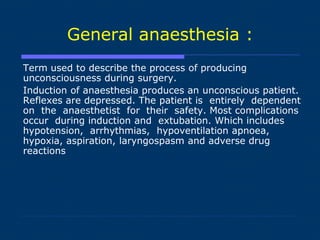
General anaesthesia :
Term used to describe the process of producing
unconsciousness during surgery.
Induction of anaesthesia produces an unconscious patient.
Reflexes are depressed. The patient is entirely dependent
on the anaesthetist for their safety. Most complications
occur during induction and extubation. Which includes
hypotension, arrhythmias, hypoventilation apnoea,
hypoxia, aspiration, laryngospasm and adverse drug
reactions
Pharmacodynamic of general anaesthesia:
Drugs acting on CNS & pass blood stream & then
transport to brain , where they penetrate BBB
& enter specific cell in the central nervous
system, here they exert their effects which are
usually reversible effect .
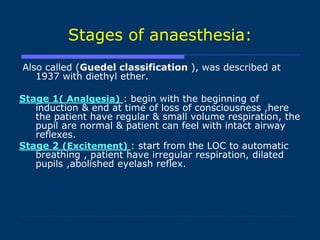
Stages of anaesthesia:
Also called (Guedel classification ), was described at
1937 with diethyl ether.
Stage 1( Analgesia) : begin with the beginning of
induction & end at time of loss of consciousness ,here
the patient have regular & small volume respiration, the
pupil are normal & patient can feel with intact airway
reflexes.
Stage 2 (Excitement) : start from the LOC to automatic
breathing , patient have irregular respiration, dilated
pupils ,abolished eyelash reflex.
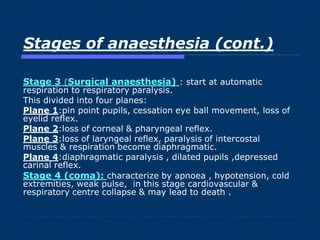
Stages of anaesthesia (cont.)
Stage 3 (Surgical anaesthesia) : start at automatic
respiration to respiratory paralysis.
This divided into four planes:
Plane 1:pin point pupils, cessation eye ball movement, loss of
eyelid reflex.
Plane 2:loss of corneal & pharyngeal reflex.
Plane 3:loss of laryngeal reflex, paralysis of intercostal
muscles & respiration become diaphragmatic.
Plane 4:diaphragmatic paralysis , dilated pupils ,depressed
carinal reflex.
Stage 4 (coma): characterize by apnoea , hypotension, cold
extremities, weak pulse, in this stage cardiovascular &
respiratory centre collapse & may lead to death .
Induction of anaesthesia
Routes :
-I.V.
-Inhalational.
-I.M.
-Rectal.
Intravenous anaesthesia
Uses:
1. Induction of anaesthesia.
2. TIVA.
3. Supplement inhalational or regional anaesthesia.
4. Sedation.
Criteria of I.V. anaesthesia:
Advantages
 Rapid onset
 Dose titratable
 Depression of pharyngeal reflexes allows early
insertion of LMA
 Anti-emetic and anti-convulsive properties
Disadvantages
 Venous access required
 Risk of hypotension
 Apnoea common
 Loss of airway control
 Anaphylaxis
Types of I.V. drugs
Barbiturates :
Thiopentone :
 Hypnotic & anticonvulsant.
 High lipid soluble.
 Rapid onset(30 seconds).
 Short duration (6-8 minutes)& patient awake within 20 minutes.
 Can be use as I.V. induction agent & rectal route induction agent in
children.
 Dose 4-7mg/kg as induction dose , 0.5-1.5mg/kg as sedation dose.
 CVS: decrease BP & increase heart rate.
 Respiratory system: respiratory centre depression, cause apnoea
,upper airway obstruction, bronchospasm in asthmatic patient,
laryngospasm in light anaesthesia.
 CNS : decrease cerebral blood flow, intracranial pressure, oxygen
consumption. this give brain protection against focal ischemia.
 Cause histamine release , & precipitate acute intermittent porphyria.
Ketamine
 Cause dissociative anaesthesia: in which patient
appear awake (eye open,swallowing,moving limbs)
but unable to respond to pain.
 I.V & I.M. routes.
 Cause hallucination .
 Painless & not irritant to vein.
 Onset of anaesthesia is slower than Thiopentone.
 Longer duration (10-15 minutes).
 Muscle rigidity.
 CVS: stimulant leading to tachycardia & hypertension.
 Respiratory system: bronchodilator.
Propofol
1) Rapid onset within 30 seconds.
2) Short duration up to 5 minutes.
3) Irritant at site of infusion.
4) Uses in outpatient clinic.
5) CVS: hypotension .
6) Good laryngeal reflex useful for LMA insertion
Benzodiazepine
 Diazepam.midazolam,lorazepam.
 Use as sedation & as induction agents.
 Can be given oral,I.V., I.M., routes.
 Induction dose 0.25-0.5mg/kg of diazepam intravenous route.
 Slower onset than other I.V. agent.
 Cause more stable cardiovascular effect so can be use for poor
cardiac performance.
 Respiratory arrest & reduce respiratory response to CO2 .
 Decrease cerebral blood flow& intracranial pressure& oxygen
consumption , can be use to control grand mal seizure.
 Can produce ante grade amnesia.
 No analgesic property.
Opioids
 Use for Premedication, induction, maintenance of
anaesthesia & postoperative analgesia.
 Cause respiratory depression.
 Do not seriously impaired cardiovascular function.
 Slowing gastric empty.
 Decrease cerebral blood flow, ICP,& cerebral oxygen
consumption
Inhalational drugs
 Useful as induction agent in paediatric group.
 Can use to maintain anaesthesia.
 Oxygenation can be assured, so can use in patient
suspected upper airway obstruction.
 Slow onset of induction , so it avoided in patient with
full stomach.
Types of inhalational agents
Nitrous oxide N2O
 Use as carrier gas in mixture with O2 & up to 70% conc.
 Weak anaesthetic agent & can supplement with inhalational agents.
 Good analgesic property.
 Teratogen.
 Irreversible oxidizing cobalt atom in vitamin B12 so prolong exposure
to anaesthetic concentration of N2O can result in megaloplatic
anaemia & peripheral neuropathy.
N2O is 35 time more soluble than N2 in the blood, thus it tend to diffuse
into air containing cavities more rapidly than N2 , so cause expanding air
containing cavity or may cause increase pressure inside the cavity, e.g.:
• air embolism.
• pneumothorax.
• Acute intestinal obstruction.
• Intracranial air, e.g. air encephalography.
• Pulmonary air cyst.
• Intraocular air bubbles.
Ether (diethyl ether)
 -1st volatile agent.
 -It is flammable.
 -Irritant.
 Safe but unpleasant agent for inhalational.
 Cumulative effect lead to prolong postoperative
drowsiness.
 Bronchodilator.
Halothane
 Non flammable, non irritant.
 Potent, rapid induction & recovery.
 Respiratory depressant & bronchodilator effect.
 CVS: cardiac depressant, decrease cardiac output by
decrease heart rate & contractility & BP.
 Sensitize myocardium to dysrhythmogenic effect of
epinephrine.
 Increase cerebral blood flow, ICP, this can be
prevented by hyperventilation before halothane
administration.
 Cause relaxation of pregnant uterus in conc. More
than 0.5%.
 It is poor analgesic.
 20% metabolized in liver, it's reductive form can
cause halothane hepatitis in 1:35000.
Isoflurane
 More potent than halothane & more irritant at
inhalation.
 Respiratory depressant.
 Less cardiac depressant & doesn't precipitate
dysrhythmias, but produce hypotension by peripheral
vasodilatation.
 0.2% metabolized & have no significant hepatic or renal
toxicity.
Sevoflurane
 Cardiovascular effect similar to isoflurane
but less tachycardia.
 Does not precipitate dysrhythmias.
 Respiratory depressant similar to
isoflurane.
 Non irritant to upper respiratory tract.
 Faster induction & elimination than
halothane.
 2% metabolized, renal or hepatic toxicity
are reported.
Muscle relaxant
Neuromuscular blocking agents
 Transmission of nerve impulse to the muscle at the
neuromuscular junction (NMJ) of voluntary muscle is
accomplished by acetylcholine (Ach). That large amount of
Ach are released when an impulse is conducted down the
motor nerve fibre to the nerve ending.
 Ach cross myoneural junctionl cleft & become attached to
the paired lipoprotein receptors grouped around ion
channels in the membrane. this makes the membrane of
the motor end plate permeable to an inward flow of sodium
ion & calcium ion & the exit of potassium ion. depolarization
thus occur, an electrical potential is produced & propagated
lead to a muscle contraction.
 The Ach is rapidly hydrolyzed by acetyl cholinesterase,
which is present in the vicinity of motor end plate.
Two types of muscle relaxant:
1.Depolarizing (short acting) (non competitive)
muscle relaxant:-
suxamethonium:
Act similar to Ach by causing depolarization, but instead of
repolarisation occurring immediately, the depolarization
persist& the muscle remain flaccid until suxamethonium are
destroyed by another enzyme serum cholinesterase (pseudo
cholinesterase). The action is not reversed by neostigmin.
Dose 1mg/kg, onset of action within 45 seconds & last up to 3
minutes.
2. Non depolarizing (competitive) muscle relaxant
 These typified by tubocurarine, which accompany end
plate without causing depolarization. These drugs are
reversed by neostigmin by inhibition of Ach-esterase
leading to increase concentration of Ach & compete the
drug at end plat & restore normal muscle activity.
 Types of NDMR depending on duration of action:
 Short-acting compounds with a duration of action of up to
15 min (mivacurium).
 Medium-acting compounds which are effective for
approximately 40 min (atracurium, vecuronium,
rocuronium, cis-atracurium).
 Long-acting compounds which have a clinical effect for 60
min (pancuronium, d-tubocurarine).
Indication of muscle relaxant
1.Facilitate tracheal intubation.
2.Maintain the relaxation state during IPPV.
Suxamethonium
Suxamethonium is the only depolarizing relaxant in clinical
use today and is metabolized by plasma cholinesterase.
Onset of action start within 45-60 seconds & last up to 3
minutes.
 Suxamethonium have many side effects:
 Postoperative muscle pains.
 Raised intra-ocular pressure.
 Hyperkalaemia.
 Bradycardias, particularly in children.
 Malignant hyperthermia.
Tubocurarine (1935)
Intubating dose 0.3 to 0.5 mg/kg, duration of action 30
to 40 minutes, it cause histamine release leading to
hypotension , bronchospasm.
*Atracurium (1980)
Intubating dose 0.3 to 0.6 mg/kg, duration of action 20
to 40 minutes, Atracurium may cause histamine release
and has caused anaphylaxis. At body temperature and pH
it undergoes spontaneous “breakdown” (Hofmann
elimination) to laudanosine. Up to 50% may also be
hydrolyzed by blood esters.
This makes atracurium very predictable and may be the drug of
choice for patients
with renal or liver failure.
Pancuronium (1967)
Intubating dose 0.1 mg/kg, duration of action 30 to
60 minutes, supplementary doses 0.01 to 0.02
mg/kg. The onset of action is about 3 minutes.
Pancuronium may cause an increase in heart rate,
blood pressure and cardiac output. Traditionally
used in shocked patients. It rarely causes
histamine release.
Elimination may be prolonged in renal and liver failure.
*Vecuronium (1983)
Intubating dose 0.08 to 0.1 mg/kg, duration of action 20
to 30 minutes, supplementary doses 0.03 to 0.05
mg/kg. The onset of action is about 2 to 3 minutes.
Vecuronium has minimal effect on blood pressure or pulse rate
and does not cause histamine release.
*Rocuronium (1994)
Intubating dose 0.6 mg/kg, duration of action 30 to 40
minutes, supplementary doses 0.15 mg/kg. The onset of
action is about 1 minute.
Rocuronium is similar to vecuronium but may cause some
tachycardia.
Thank you
Any Q

General anaesthesia principles

  • 1.
    Introduction to General anaesthesia By: Dr.Radhwan Alkhashab Consultant anaesthesia & ICU 2020
  • 2.
    General anaesthesia : Termused to describe the process of producing unconsciousness during surgery. Induction of anaesthesia produces an unconscious patient. Reflexes are depressed. The patient is entirely dependent on the anaesthetist for their safety. Most complications occur during induction and extubation. Which includes hypotension, arrhythmias, hypoventilation apnoea, hypoxia, aspiration, laryngospasm and adverse drug reactions
  • 3.
    Pharmacodynamic of generalanaesthesia: Drugs acting on CNS & pass blood stream & then transport to brain , where they penetrate BBB & enter specific cell in the central nervous system, here they exert their effects which are usually reversible effect .
  • 4.
    Stages of anaesthesia: Alsocalled (Guedel classification ), was described at 1937 with diethyl ether. Stage 1( Analgesia) : begin with the beginning of induction & end at time of loss of consciousness ,here the patient have regular & small volume respiration, the pupil are normal & patient can feel with intact airway reflexes. Stage 2 (Excitement) : start from the LOC to automatic breathing , patient have irregular respiration, dilated pupils ,abolished eyelash reflex.
  • 5.
    Stages of anaesthesia(cont.) Stage 3 (Surgical anaesthesia) : start at automatic respiration to respiratory paralysis. This divided into four planes: Plane 1:pin point pupils, cessation eye ball movement, loss of eyelid reflex. Plane 2:loss of corneal & pharyngeal reflex. Plane 3:loss of laryngeal reflex, paralysis of intercostal muscles & respiration become diaphragmatic. Plane 4:diaphragmatic paralysis , dilated pupils ,depressed carinal reflex. Stage 4 (coma): characterize by apnoea , hypotension, cold extremities, weak pulse, in this stage cardiovascular & respiratory centre collapse & may lead to death .
  • 6.
    Induction of anaesthesia Routes: -I.V. -Inhalational. -I.M. -Rectal.
  • 7.
    Intravenous anaesthesia Uses: 1. Inductionof anaesthesia. 2. TIVA. 3. Supplement inhalational or regional anaesthesia. 4. Sedation.
  • 8.
    Criteria of I.V.anaesthesia: Advantages  Rapid onset  Dose titratable  Depression of pharyngeal reflexes allows early insertion of LMA  Anti-emetic and anti-convulsive properties Disadvantages  Venous access required  Risk of hypotension  Apnoea common  Loss of airway control  Anaphylaxis
  • 9.
    Types of I.V.drugs Barbiturates : Thiopentone :  Hypnotic & anticonvulsant.  High lipid soluble.  Rapid onset(30 seconds).  Short duration (6-8 minutes)& patient awake within 20 minutes.  Can be use as I.V. induction agent & rectal route induction agent in children.  Dose 4-7mg/kg as induction dose , 0.5-1.5mg/kg as sedation dose.  CVS: decrease BP & increase heart rate.  Respiratory system: respiratory centre depression, cause apnoea ,upper airway obstruction, bronchospasm in asthmatic patient, laryngospasm in light anaesthesia.  CNS : decrease cerebral blood flow, intracranial pressure, oxygen consumption. this give brain protection against focal ischemia.  Cause histamine release , & precipitate acute intermittent porphyria.
  • 10.
    Ketamine  Cause dissociativeanaesthesia: in which patient appear awake (eye open,swallowing,moving limbs) but unable to respond to pain.  I.V & I.M. routes.  Cause hallucination .  Painless & not irritant to vein.  Onset of anaesthesia is slower than Thiopentone.  Longer duration (10-15 minutes).  Muscle rigidity.  CVS: stimulant leading to tachycardia & hypertension.  Respiratory system: bronchodilator.
  • 11.
    Propofol 1) Rapid onsetwithin 30 seconds. 2) Short duration up to 5 minutes. 3) Irritant at site of infusion. 4) Uses in outpatient clinic. 5) CVS: hypotension . 6) Good laryngeal reflex useful for LMA insertion
  • 12.
    Benzodiazepine  Diazepam.midazolam,lorazepam.  Useas sedation & as induction agents.  Can be given oral,I.V., I.M., routes.  Induction dose 0.25-0.5mg/kg of diazepam intravenous route.  Slower onset than other I.V. agent.  Cause more stable cardiovascular effect so can be use for poor cardiac performance.  Respiratory arrest & reduce respiratory response to CO2 .  Decrease cerebral blood flow& intracranial pressure& oxygen consumption , can be use to control grand mal seizure.  Can produce ante grade amnesia.  No analgesic property.
  • 13.
    Opioids  Use forPremedication, induction, maintenance of anaesthesia & postoperative analgesia.  Cause respiratory depression.  Do not seriously impaired cardiovascular function.  Slowing gastric empty.  Decrease cerebral blood flow, ICP,& cerebral oxygen consumption
  • 14.
    Inhalational drugs  Usefulas induction agent in paediatric group.  Can use to maintain anaesthesia.  Oxygenation can be assured, so can use in patient suspected upper airway obstruction.  Slow onset of induction , so it avoided in patient with full stomach.
  • 15.
  • 16.
    Nitrous oxide N2O Use as carrier gas in mixture with O2 & up to 70% conc.  Weak anaesthetic agent & can supplement with inhalational agents.  Good analgesic property.  Teratogen.  Irreversible oxidizing cobalt atom in vitamin B12 so prolong exposure to anaesthetic concentration of N2O can result in megaloplatic anaemia & peripheral neuropathy. N2O is 35 time more soluble than N2 in the blood, thus it tend to diffuse into air containing cavities more rapidly than N2 , so cause expanding air containing cavity or may cause increase pressure inside the cavity, e.g.: • air embolism. • pneumothorax. • Acute intestinal obstruction. • Intracranial air, e.g. air encephalography. • Pulmonary air cyst. • Intraocular air bubbles.
  • 17.
    Ether (diethyl ether) -1st volatile agent.  -It is flammable.  -Irritant.  Safe but unpleasant agent for inhalational.  Cumulative effect lead to prolong postoperative drowsiness.  Bronchodilator.
  • 18.
    Halothane  Non flammable,non irritant.  Potent, rapid induction & recovery.  Respiratory depressant & bronchodilator effect.  CVS: cardiac depressant, decrease cardiac output by decrease heart rate & contractility & BP.  Sensitize myocardium to dysrhythmogenic effect of epinephrine.  Increase cerebral blood flow, ICP, this can be prevented by hyperventilation before halothane administration.  Cause relaxation of pregnant uterus in conc. More than 0.5%.  It is poor analgesic.  20% metabolized in liver, it's reductive form can cause halothane hepatitis in 1:35000.
  • 19.
    Isoflurane  More potentthan halothane & more irritant at inhalation.  Respiratory depressant.  Less cardiac depressant & doesn't precipitate dysrhythmias, but produce hypotension by peripheral vasodilatation.  0.2% metabolized & have no significant hepatic or renal toxicity.
  • 20.
    Sevoflurane  Cardiovascular effectsimilar to isoflurane but less tachycardia.  Does not precipitate dysrhythmias.  Respiratory depressant similar to isoflurane.  Non irritant to upper respiratory tract.  Faster induction & elimination than halothane.  2% metabolized, renal or hepatic toxicity are reported.
  • 21.
  • 22.
    Neuromuscular blocking agents Transmission of nerve impulse to the muscle at the neuromuscular junction (NMJ) of voluntary muscle is accomplished by acetylcholine (Ach). That large amount of Ach are released when an impulse is conducted down the motor nerve fibre to the nerve ending.  Ach cross myoneural junctionl cleft & become attached to the paired lipoprotein receptors grouped around ion channels in the membrane. this makes the membrane of the motor end plate permeable to an inward flow of sodium ion & calcium ion & the exit of potassium ion. depolarization thus occur, an electrical potential is produced & propagated lead to a muscle contraction.  The Ach is rapidly hydrolyzed by acetyl cholinesterase, which is present in the vicinity of motor end plate.
  • 23.
    Two types ofmuscle relaxant: 1.Depolarizing (short acting) (non competitive) muscle relaxant:- suxamethonium: Act similar to Ach by causing depolarization, but instead of repolarisation occurring immediately, the depolarization persist& the muscle remain flaccid until suxamethonium are destroyed by another enzyme serum cholinesterase (pseudo cholinesterase). The action is not reversed by neostigmin. Dose 1mg/kg, onset of action within 45 seconds & last up to 3 minutes.
  • 24.
    2. Non depolarizing(competitive) muscle relaxant  These typified by tubocurarine, which accompany end plate without causing depolarization. These drugs are reversed by neostigmin by inhibition of Ach-esterase leading to increase concentration of Ach & compete the drug at end plat & restore normal muscle activity.  Types of NDMR depending on duration of action:  Short-acting compounds with a duration of action of up to 15 min (mivacurium).  Medium-acting compounds which are effective for approximately 40 min (atracurium, vecuronium, rocuronium, cis-atracurium).  Long-acting compounds which have a clinical effect for 60 min (pancuronium, d-tubocurarine).
  • 25.
    Indication of musclerelaxant 1.Facilitate tracheal intubation. 2.Maintain the relaxation state during IPPV.
  • 26.
    Suxamethonium Suxamethonium is theonly depolarizing relaxant in clinical use today and is metabolized by plasma cholinesterase. Onset of action start within 45-60 seconds & last up to 3 minutes.  Suxamethonium have many side effects:  Postoperative muscle pains.  Raised intra-ocular pressure.  Hyperkalaemia.  Bradycardias, particularly in children.  Malignant hyperthermia.
  • 27.
    Tubocurarine (1935) Intubating dose0.3 to 0.5 mg/kg, duration of action 30 to 40 minutes, it cause histamine release leading to hypotension , bronchospasm. *Atracurium (1980) Intubating dose 0.3 to 0.6 mg/kg, duration of action 20 to 40 minutes, Atracurium may cause histamine release and has caused anaphylaxis. At body temperature and pH it undergoes spontaneous “breakdown” (Hofmann elimination) to laudanosine. Up to 50% may also be hydrolyzed by blood esters. This makes atracurium very predictable and may be the drug of choice for patients with renal or liver failure.
  • 28.
    Pancuronium (1967) Intubating dose0.1 mg/kg, duration of action 30 to 60 minutes, supplementary doses 0.01 to 0.02 mg/kg. The onset of action is about 3 minutes. Pancuronium may cause an increase in heart rate, blood pressure and cardiac output. Traditionally used in shocked patients. It rarely causes histamine release. Elimination may be prolonged in renal and liver failure.
  • 29.
    *Vecuronium (1983) Intubating dose0.08 to 0.1 mg/kg, duration of action 20 to 30 minutes, supplementary doses 0.03 to 0.05 mg/kg. The onset of action is about 2 to 3 minutes. Vecuronium has minimal effect on blood pressure or pulse rate and does not cause histamine release. *Rocuronium (1994) Intubating dose 0.6 mg/kg, duration of action 30 to 40 minutes, supplementary doses 0.15 mg/kg. The onset of action is about 1 minute. Rocuronium is similar to vecuronium but may cause some tachycardia.
  • 30.