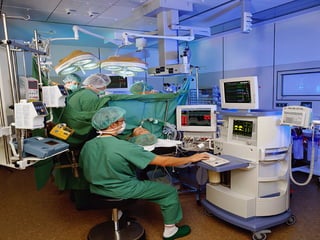
Introduction to Anesthesiology
Narendra P L MD PDCC FCARCSI(pri),MRCS-I
Dept. of Anesthesiology & Intensive Care
BLDE University ,BIJAPUR,Karnataka India
Meaning of Anaesthesia
• Greek  an-, "without"; and , aisthēsis,
"sensation” refers to the inhibition of
sensation .
Oxford dictionary definition
•
insensitivity to pain, especially as
artificially induced by the
administration of gases or the injection
of drugs before surgical operations:
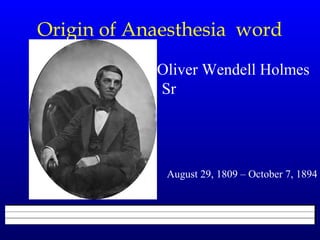
Origin of Anaesthesia word
Oliver Wendell Holmes
Sr

August 29, 1809 – October 7, 1894
The letter of “Anaesthesia”
• Holmes wrote: "Everybody wants to have a
hand in a great discovery. All I will do is to
give a hint or two as to names—or the name
—to be applied to the state produced and the
agent. The state should, I think, be called
'Anaesthesia.' This signifies insensibility—
more particularly ... to objects of touch."
•

Small, MR (1962). Oliver Wendell Holmes New York: Twayne Publishers. p. 55. "In a letter to dentist 
William T. G. Morton
Some Basic Questions
• I am a student /intern-I don’t need to
learn Anaesthesia
• I am not specialising in Anaesthesia
• I am keen to learn –But I think its very
risky
Why should I know it ?
• Airway skills –life saving
• Expertise in IV access-life saving
• CPR-Life giving
• Some knowledge of GA ,LA, Pain Relief
whatever you may practice
Thus

• Anaesthetic skills are life saving and
pain releiving
• learning is a must for every doctor
• 1. Scope of anesthesiology
• 2. Roles of anesthesiologist
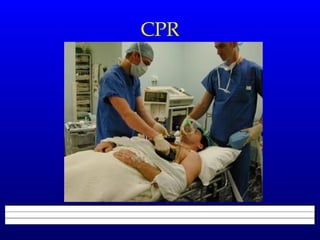
CPR
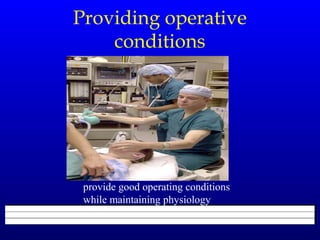
Providing operative
conditions

provide good operating conditions
while maintaining physiology
Areas of the practice of anesthesiology
• 1. clinical anesthesia
-in operating room
-Radiologic department : CT MRI INR RT
-Cardiac laboratory : catheterization EPS insertion of
AICD,PCD
-ECT

• 2. pain management
• 3.intensive care and Respiratory Care
• 4.CPR
Clinical Roles of the anesthesiologist
1. OR ,RR, LR, ER
2. ICU, ward, Respiratory care unit
3. Pain clinic
4. CPR team, EMS ,intravenous team
Expanding Role of
Anesthesiologist
• The anesthesiologist is the perioperative
physician
• From Surgical Anesthesia to Critical
Care Medicine and Pain Medicine
• Administrative ,Co ordinating roles
Evolution of anesthesia
Early Records-

East

•  Sumerians the 
opium poppy (
Papaver somniferum)
3400 BC
•

 Sushruta

Samhita  - wine with
incense of cannabis for anesthesia.[

•

8th century AD, Arab traders had
brought opium to India[ and China.[21
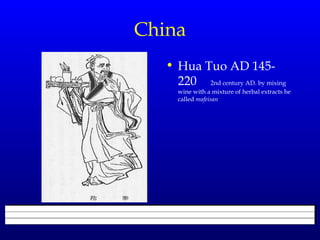
China
• Hua Tuo AD 145220 2nd century AD. by mixing

wine with a mixture of herbal extracts he
called mafeisan 
Primitive Anesthesia
• Ancient civilizations- opium poppy, coca
leaves, mandrake root, alcohol

• Regional anesthesia in ancient timescompression of nerve trunks or the
application of cold (cryoanalgesia)
Middle Ages and Renaissance
• 1200 - 1500 A.D. in England, a potion
called dwale was used as an anesthetic.
contained bile, opium, lettuce, bryony,
and hemlock. 
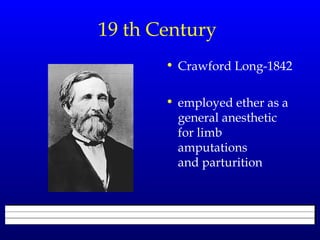
19 th Century
• Crawford Long-1842
• employed ether as a
general anesthetic
for limb
amputations
and parturition
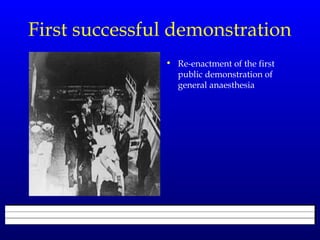
First successful demonstration
• Re-enactment of the first
public demonstration of 
general anaesthesia
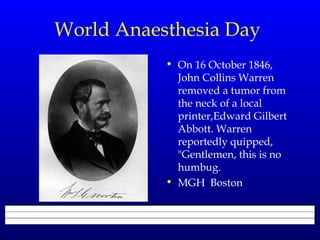
World Anaesthesia Day
• On 16 October 1846,
John Collins Warren
removed a tumor from
the neck of a local
printer,Edward Gilbert
Abbott. Warren
reportedly quipped,
"Gentlemen, this is no
humbug.
• MGH Boston
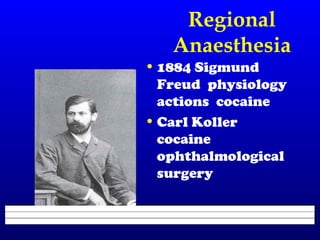
Regional
Anaesthesia
• 1884 Sigmund
Freud physiology
actions cocaine
• Carl Koller
cocaine
ophthalmological
surgery
Journey of anesthesia
• Local anesthesia : chewed coca leaves and
spat saliva
• The evolution of modern anesthesia : first
with inhalation anesthesia=> local and
regional anesthesia=> finally intravenous
anesthesia
Birth of modern Anaesthesia
• 1913,Chevalier Jackson-use of direct
laryngoscopy as a means to intubate the
trachea
• Sodium Pentathal - first used in
humans on 8 March 1934 by Ralph M.
Waters
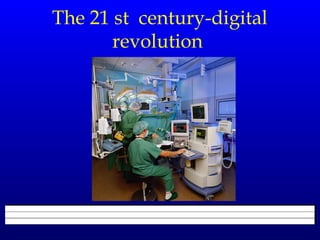
The 21 st century-digital
revolution
What I need to learn as
Student /Intern
• Recognise Breathing problems
• Mask Ventilation
• Airway manuevres
• Intubation skills
• Intravenous Access
Basic Airway Skills
• Video-1
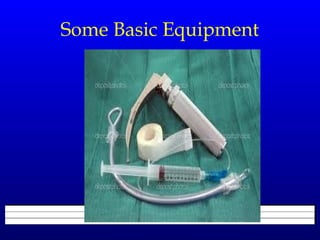
Some Basic Equipment
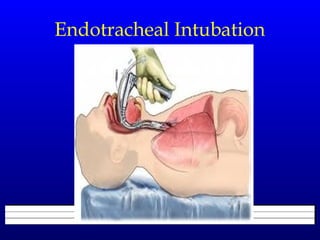
Endotracheal Intubation
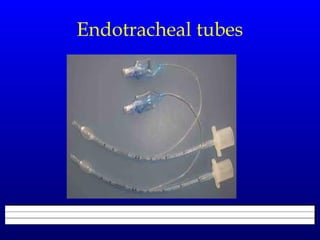
Endotracheal tubes
Basic Intubation Skills –
Casualty Area
• Assess
• Cervical Spine Protection
• Call for help
Indications for Intubation
• Protection of Airway
• Prevention & Treatment Aspiration
• Administritation of General
Anaesthesia
• Mechanical Ventilation
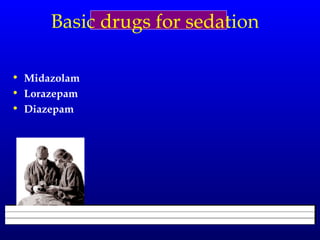
Basic drugs for sedation
• Midazolam
• Lorazepam
• Diazepam
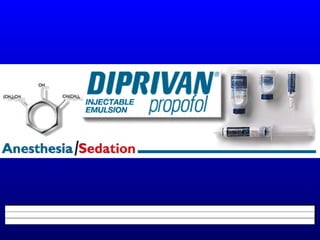
Induction agents
• Thiopental
• Ketamine
• Propofol
Muscle relaxants
• Only trained personnel must use them
• If doubt, don’t use
opioids
• Morphine » meperidine » fentanyl ,
sufentanyl , alfentanil » remifentanyl

• Moniter after administration
Triad of anesthesia
• 1. unconsciosness
• 2. analgesia
• 3. muscle relaxation …..
Endotraheal Intubation
• Video-2
Inhalational Agents
• Chloroform
• Ether
• Halothane
• Isoflurane
• Sevoflurane
• Desflurane
Monitoring-Eternal Vigilance
• Presence of Anaesthetist
• Non Invasive-SpO2,ETCO2,NIBP,Agent
• Invasive-CVP,PA Catheter
Local and Regional anesthesia
• Don’t take Local Lightly
• Be Prepared for full resuscitation
• Know the patient,
• Know the drug
•
Contraindications for
Regional Anaestesia
• Absolute-Coagulopathy,
• Patient Refusal,Local Infection
• Relative-Preexisting Neurological
Disease,Cardiac Disease,
Spinal Anaesthesia
• Video-3
regional anesthesia
• Intradermal infiltrating and nerve blocks »
Bier block ( intravenous regional anesthesia
of the arm) » spinal anesthesia » caudal
epidural anesthesia » lumbar epidural
anesthesia
• Techniques of anesthesia
1. GA
2. RA or LA
Choice of anesthesia : technique, agents
1. LA
2. GA
3. RA
4. MAC
How to choose
1. the operation
2. the patient
3. the anesthetist
4. the surgeon
advantages of anesthesia
1. good operating condition
2. no suffer to pain
3. decrease stress response to surgery
4. maintain physiologic balance
Challenges of anesthesia
• Alter physiology and control
• Adequate but not too much

• Anticipate ,Prevent & Treat
Complications
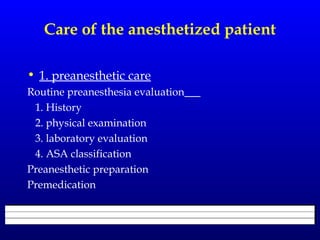
Care of the anesthetized patient
• 1. preanesthetic care
Routine preanesthesia evaluation
1. History
2. physical examination
3. laboratory evaluation
4. ASA classification
Preanesthetic preparation
Premedication
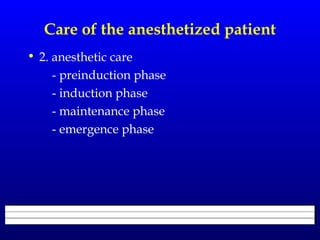
Care of the anesthetized patient
• 2. anesthetic care
- preinduction phase
- induction phase
- maintenance phase
- emergence phase
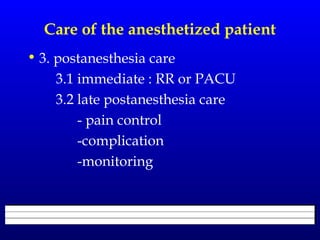
Care of the anesthetized patient
• 3. postanesthesia care
3.1 immediate : RR or PACU
3.2 late postanesthesia care
- pain control
-complication
-monitoring
The primary goal of the anesthetist ☺ to
see the patient safety and comfortably
through procedure
Anaesthesia Today
• Video-4
Anaesthesia Today
• Video -5
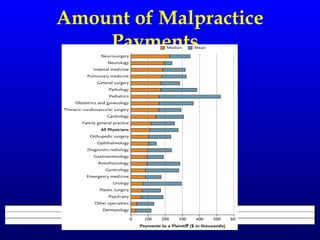
Malpractice Risk according to
Speciality
• Anupam B. Jena, M.D., Ph.D., Seth Seabury, Ph.D., Darius
Lakdawalla, Ph.D., and Amitabh Chandra, Ph.D.

• New England Journal of Medicine
2011;Aug 18; 365(7):629-6
The most common specialties
• Anesthesiology
• Family General Practice
• Internal Medicine
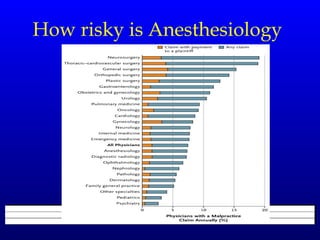
How risky is Anesthesiology
Amount of Malpractice
Payments,
Anaesthesiology as a Career Vis-À-Vis
Professional Satisfaction in Developing
Countries
•

Sanjeev Singh1, Arti Singh Anbarasu Annamalai
and Gaurav Goel

• J Anesthe Clinic Res 4: 304
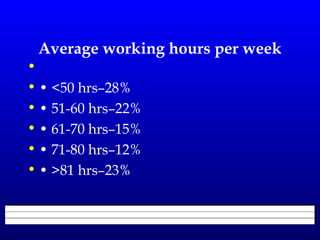
Average working hours per week

•
• • <50 hrs–28%
• • 51-60 hrs–22%
• • 61-70 hrs–15%
• • 71-80 hrs–12%
• • >81 hrs–23%
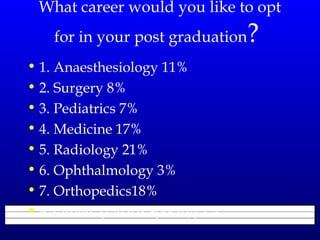
What career would you like to opt
for in your post graduation
• 1. Anaesthesiology 11%
• 2. Surgery 8%
• 3. Pediatrics 7%
• 4. Medicine 17%
• 5. Radiology 21%
• 6. Ophthalmology 3%
• 7. Orthopedics18%
• 8. Others (Please Specify) 1%

?
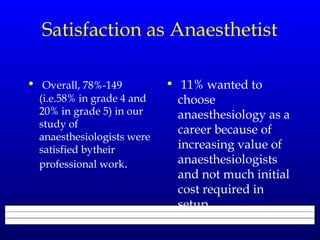
Satisfaction as Anaesthetist
• Overall, 78%-149

(i.e.58% in grade 4 and
20% in grade 5) in our
study of
anaesthesiologists were
satisfied bytheir
professional work.

• 11% wanted to
choose
anaesthesiology as a
career because of
increasing value of
anaesthesiologists
and not much initial
cost required in
setup
• Look Ahead and Explore
• Anesthesiologists are those who do not
run way from challenges of life
•

Thank You