




Recruitment and Selection
Staffing Management • Myrna L. Gusdorf, MBA, SPHR • 2008
)
In the Name of ALLAH, the Beneficent,
the Merciful
2
JOB ANNOUNCEMENT
3
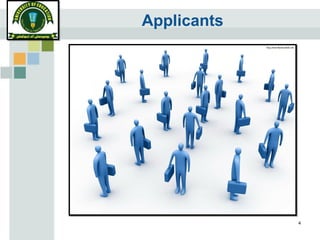
Applicants
4
SHORTLISING
5
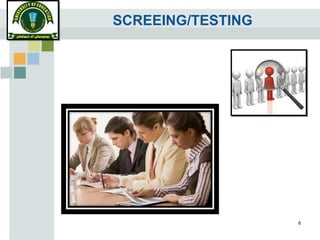
SCREEING/TESTING
6
INTERVIEW SESSION
7
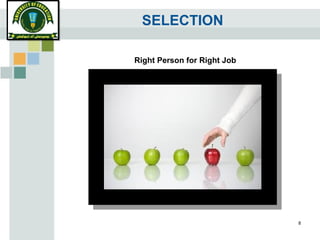
SELECTION
8
Right Person for Right Job
SELECTION for Best Option
9
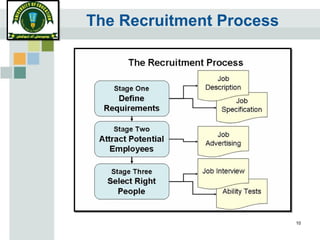
The Recruitment Process
10
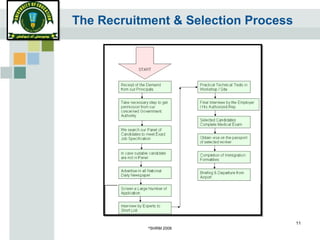
The Recruitment & Selection Process
©
SHRM 2008
11
Let’s Fill it out that Provided Questionnaire
Please, Keep it with you;
at the end you have to
fill it out and do return it
to me.
Best Regards
12
13
Learning Objectives
> What is Recruitment, Selection &
Appointment ?
> What Factors are Affecting
Recruitment & Selection ?
> What is Effective Recruitment &
Selection ?
> What are the Stages in Recruitment
& Selection ?
> What is difficult in the Process of
Recruitment & Selection ?
©
SHRM 2008
14
Recruitment, Selection & Appointment
• RECRUITMENT
> The process by which applicants are
encouraged to apply for employment to
college or School.
• SELECTION
> The process through which the best
person for the particular post is chosen
and offered employment.
• APPOINTTMENT
> It is the final agreement process in which
employer and employee commit
themselves to the contract of
employment.
©
SHRM 2008
15
Factors Affecting Recruitment
• External Authority;
Leaders and Managers at individual context level may be
considerably constrained by the fact that staff are nominated to
their organization.
• Market Situation;
Economic Climate, Areas of employment, Population &
Demographic Situation & Number of Entrants into Profession.
• Legislation;
Management of recruitment and selection has to be carried out
within the framework of the relevant legislation.
• Local Condition;
Institutional level in local reputation; expansion or contraction,
Cost and availability and Accessibility of institution.
16
Factors Affecting Selection Management
• Quality of Applicants;
Selector can only make a choice from those who actually apply
and it is the stage the care taken in job description will pay
dividend.
• Quality of Selectors;
Leaders and Managers could consider the Middle Managers
and could be dependant on their expertise.
• Fallibility of Selectors;
Judgment, Insisting on Personal Stereotype, Comparing
Candidates and Preferring a Candidate.
• Micro Political Factor;
A choice for the actually important one of agreeing that an
accurate choice had been made.
17
Effective Recruitment ???
Purpose of Strategy
Equal Opportunity Commitment
Applicant must be kept informed
Commitment about the use of
data
Statement about approach to
assessment
Commitment to Confidentiality
©
SHRM 2008
18
EFFECTIVE MANAGEMENT OF
SELECTION
• Personnel;
Who will be involved- and the extent and nature of that
involvement ?
• Criteria;
Against which standards will candidates be assessed?
• Weight ;
What should be the relative importance of the criteria?
• Instruments for Assessment;
How will the candidates’ performance be assessed ?
• Matching;
Making a decision on which person is the best suited to
the post.
19
What are the Stages in
Recruitment & Selection ?
• The need to know about the job to be
filled
• The need to know the type of person
and qualities required to perform the
job effectively
• The need to know the likely means of
best attracting a range of suitable
candidates
• Training for those who selected
• Monitoring the Effectiveness
20
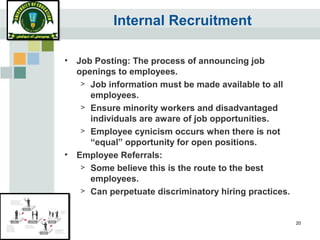
Internal Recruitment
• Job Posting: The process of announcing job
openings to employees.
> Job information must be made available to all
employees.
> Ensure minority workers and disadvantaged
individuals are aware of job opportunities.
> Employee cynicism occurs when there is not
“equal” opportunity for open positions.
• Employee Referrals:
> Some believe this is the route to the best
employees.
> Can perpetuate discriminatory hiring practices.
21
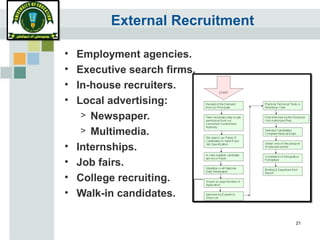
External Recruitment
• Employment agencies.
• Executive search firms.
• In-house recruiters.
• Local advertising:
> Newspaper.
> Multimedia.
• Internships.
• Job fairs.
• College recruiting.
• Walk-in candidates.
22
Internet Recruiting
• Advantages:
> Inexpensive.
> Quick and easy to post announcement.
> Responses arrive faster and in greater quantity.
> Will generate a wider range of applicants.
> Applicants can be screened by computer.
> Some selection tests can be administered by
computer.
> Automated applicant tracking.
• Disadvantages:
> Ease of submission will result in a lot of applicants,
many whom are not qualified.
> May take more HR time to sort through the greater
quantity of applicants.
23
Recruitment for Diversity
• An ethnically diverse workforce enhances
creativity and may facilitate expansion
into global markets.
• Recruiting must generate applicants from
a wide variety of individuals.
• Train recruiters to use objective
standards.
• Include pictures of minority and disabled
employees on recruitment flyers.
• Make sure ads and interviews are bi-
lingual.
24
Evaluating the Recruitment and
Selection Process
• Cost:
> Did you stay within your recruitment
budget?
• Time:
> How long did it take you to fill the
position?
• Quality:
> Were your applicants well qualified for
the job?
• Longevity:
> What about turnover? Do your new hires
stay for the long term?
25
CONGRATULATIONS!
You have a new employee!

Recruitment and selection

  • 1.
    Recruitment and Selection StaffingManagement • Myrna L. Gusdorf, MBA, SPHR • 2008 )
  • 2.
    In the Nameof ALLAH, the Beneficent, the Merciful 2
  • 3.
  • 4.
  • 5.
  • 6.
  • 7.
  • 8.
  • 9.
  • 10.
  • 11.
    The Recruitment &Selection Process © SHRM 2008 11
  • 12.
    Let’s Fill itout that Provided Questionnaire Please, Keep it with you; at the end you have to fill it out and do return it to me. Best Regards 12
  • 13.
    13 Learning Objectives > Whatis Recruitment, Selection & Appointment ? > What Factors are Affecting Recruitment & Selection ? > What is Effective Recruitment & Selection ? > What are the Stages in Recruitment & Selection ? > What is difficult in the Process of Recruitment & Selection ?
  • 14.
    © SHRM 2008 14 Recruitment, Selection& Appointment • RECRUITMENT > The process by which applicants are encouraged to apply for employment to college or School. • SELECTION > The process through which the best person for the particular post is chosen and offered employment. • APPOINTTMENT > It is the final agreement process in which employer and employee commit themselves to the contract of employment.
  • 15.
    © SHRM 2008 15 Factors AffectingRecruitment • External Authority; Leaders and Managers at individual context level may be considerably constrained by the fact that staff are nominated to their organization. • Market Situation; Economic Climate, Areas of employment, Population & Demographic Situation & Number of Entrants into Profession. • Legislation; Management of recruitment and selection has to be carried out within the framework of the relevant legislation. • Local Condition; Institutional level in local reputation; expansion or contraction, Cost and availability and Accessibility of institution.
  • 16.
    16 Factors Affecting SelectionManagement • Quality of Applicants; Selector can only make a choice from those who actually apply and it is the stage the care taken in job description will pay dividend. • Quality of Selectors; Leaders and Managers could consider the Middle Managers and could be dependant on their expertise. • Fallibility of Selectors; Judgment, Insisting on Personal Stereotype, Comparing Candidates and Preferring a Candidate. • Micro Political Factor; A choice for the actually important one of agreeing that an accurate choice had been made.
  • 17.
    17 Effective Recruitment ??? Purposeof Strategy Equal Opportunity Commitment Applicant must be kept informed Commitment about the use of data Statement about approach to assessment Commitment to Confidentiality
  • 18.
    © SHRM 2008 18 EFFECTIVE MANAGEMENTOF SELECTION • Personnel; Who will be involved- and the extent and nature of that involvement ? • Criteria; Against which standards will candidates be assessed? • Weight ; What should be the relative importance of the criteria? • Instruments for Assessment; How will the candidates’ performance be assessed ? • Matching; Making a decision on which person is the best suited to the post.
  • 19.
    19 What are theStages in Recruitment & Selection ? • The need to know about the job to be filled • The need to know the type of person and qualities required to perform the job effectively • The need to know the likely means of best attracting a range of suitable candidates • Training for those who selected • Monitoring the Effectiveness
  • 20.
    20 Internal Recruitment • JobPosting: The process of announcing job openings to employees. > Job information must be made available to all employees. > Ensure minority workers and disadvantaged individuals are aware of job opportunities. > Employee cynicism occurs when there is not “equal” opportunity for open positions. • Employee Referrals: > Some believe this is the route to the best employees. > Can perpetuate discriminatory hiring practices.
  • 21.
    21 External Recruitment • Employmentagencies. • Executive search firms. • In-house recruiters. • Local advertising: > Newspaper. > Multimedia. • Internships. • Job fairs. • College recruiting. • Walk-in candidates.
  • 22.
    22 Internet Recruiting • Advantages: >Inexpensive. > Quick and easy to post announcement. > Responses arrive faster and in greater quantity. > Will generate a wider range of applicants. > Applicants can be screened by computer. > Some selection tests can be administered by computer. > Automated applicant tracking. • Disadvantages: > Ease of submission will result in a lot of applicants, many whom are not qualified. > May take more HR time to sort through the greater quantity of applicants.
  • 23.
    23 Recruitment for Diversity •An ethnically diverse workforce enhances creativity and may facilitate expansion into global markets. • Recruiting must generate applicants from a wide variety of individuals. • Train recruiters to use objective standards. • Include pictures of minority and disabled employees on recruitment flyers. • Make sure ads and interviews are bi- lingual.
  • 24.
    24 Evaluating the Recruitmentand Selection Process • Cost: > Did you stay within your recruitment budget? • Time: > How long did it take you to fill the position? • Quality: > Were your applicants well qualified for the job? • Longevity: > What about turnover? Do your new hires stay for the long term?
  • 25.

Editor's Notes

  • #20 There are a number of laws that will affect your hiring process, particularly in the area of discrimination. The Civil Rights Act of 1964 prohibits discrimination in employment practices when the discrimination is based on a person’s race, color, sex, religion or national origin. The federal law applies to organizations with 15 or more employees. The Age Discrimination in Employment Act of 1967 extends discrimination protection to persons aged 40 years old and older for organizations of 20 or more employees. Passed as an amendment to Title VII of the Civil Rights Act, the Pregnancy Discrimination Act of 1975 makes it illegal to refuse to employ a woman because of pregnancy, childbirth or a related medical condition. The basic principle of the act is that a woman affected by pregnancy or other related medical condition must be treated the same as any other applicant in the recruitment and selection process. The Americans with Disabilities Act of 1990 prohibits discrimination against qualified individuals with disabilities in organizations of 15 or more employees. The ADA also requires that the employer offer reasonable accommodations to disabled individuals so that they have equal opportunity to apply for job openings and if hired, to be successful in their job functions. Many states and local communities have passed legislation that extends discrimination protection beyond the scope of federal laws. If you are not sure of the regulations in your state, contact your state department of labor for information on appropriate laws in your area and remember that it is important for you to remain current on employment law, as regulations are frequently updated. Additional information on legal compliance can be found at the EEOC website at www.eeoc.gov and at the website for the Department of Labor at www.dol.gov.