ASHRAE‐Chicago
Air Distribution Selection Basics
           June 8, 2010
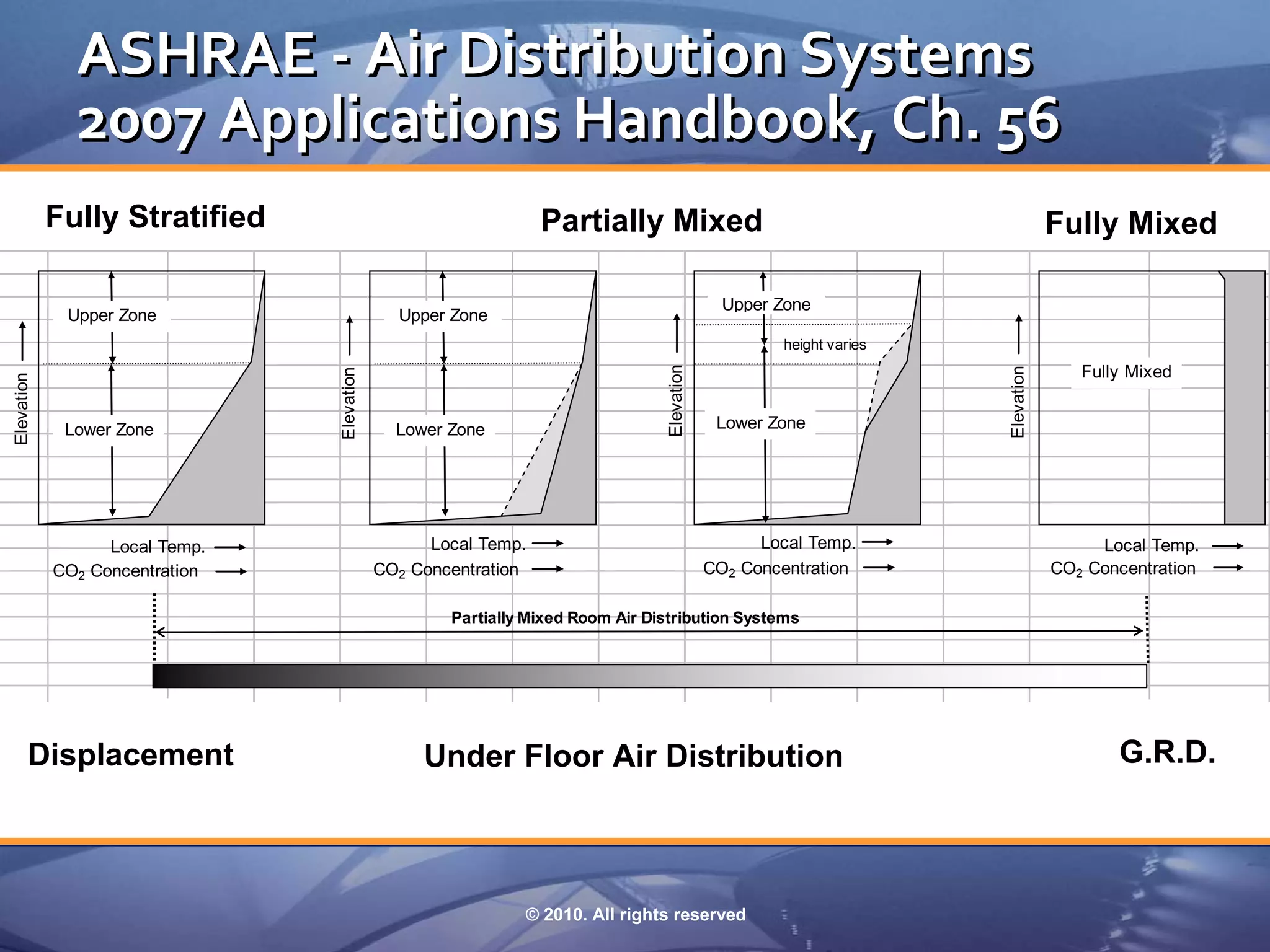
ASHRAE ‐ Air Distribution Systems
              2007 Applications Handbook, Ch. 56
            Fully Stratified                                    Partially Mixed                                                Fully Mixed

                                                                                             Upper Zone
             Upper Zone                       Upper Zone
                                                                                                   height varies
                                                                                                                                  Fully Mixed


                                                                               Elevation


                                                                                                                   Elevation
                                Elevation
Elevation


             Lower Zone                       Lower Zone                                    Lower Zone


                  Local Temp.                     Local Temp.                                    Local Temp.                        Local Temp.
            CO2 Concentration               CO2 Concentration                              CO2 Concentration                   CO2 Concentration

                                                    Partially Mixed Room Air Distribution Systems


       Displacement                              Under Floor Air Distribution                                                         G.R.D.


                                                             © 2010. All rights reserved
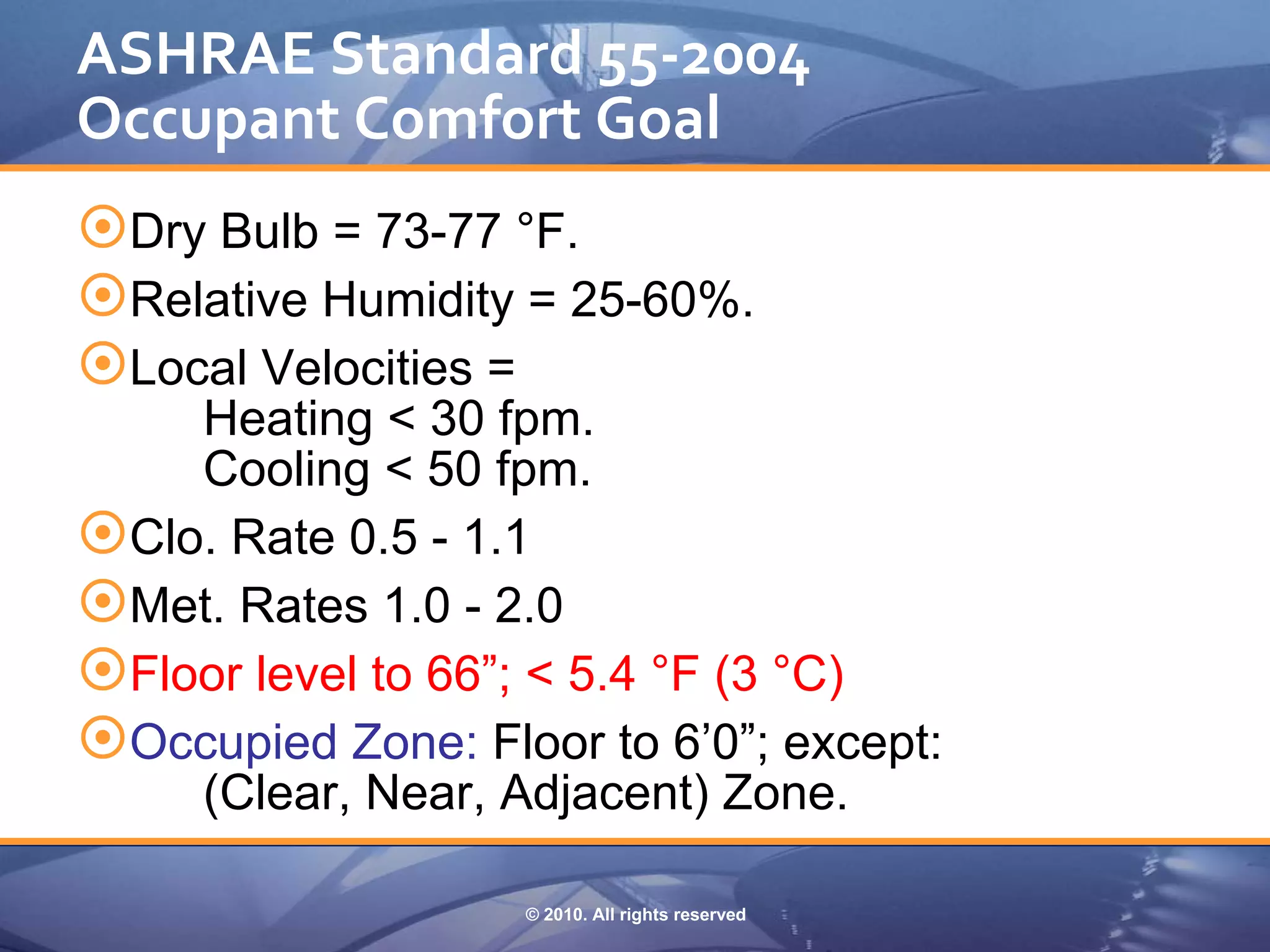
ASHRAE Standard 55‐2004 
Occupant Comfort Goal
Dry Bulb = 73-77 °F.
Relative Humidity = 25-60%.
Local Velocities =
    Heating < 30 fpm.
    Cooling < 50 fpm.
Clo. Rate 0.5 - 1.1
Met. Rates 1.0 - 2.0
Floor level to 66”; < 5.4 °F (3 °C)
Occupied Zone: Floor to 6’0”; except:
    (Clear, Near, Adjacent) Zone.

                   © 2010. All rights reserved
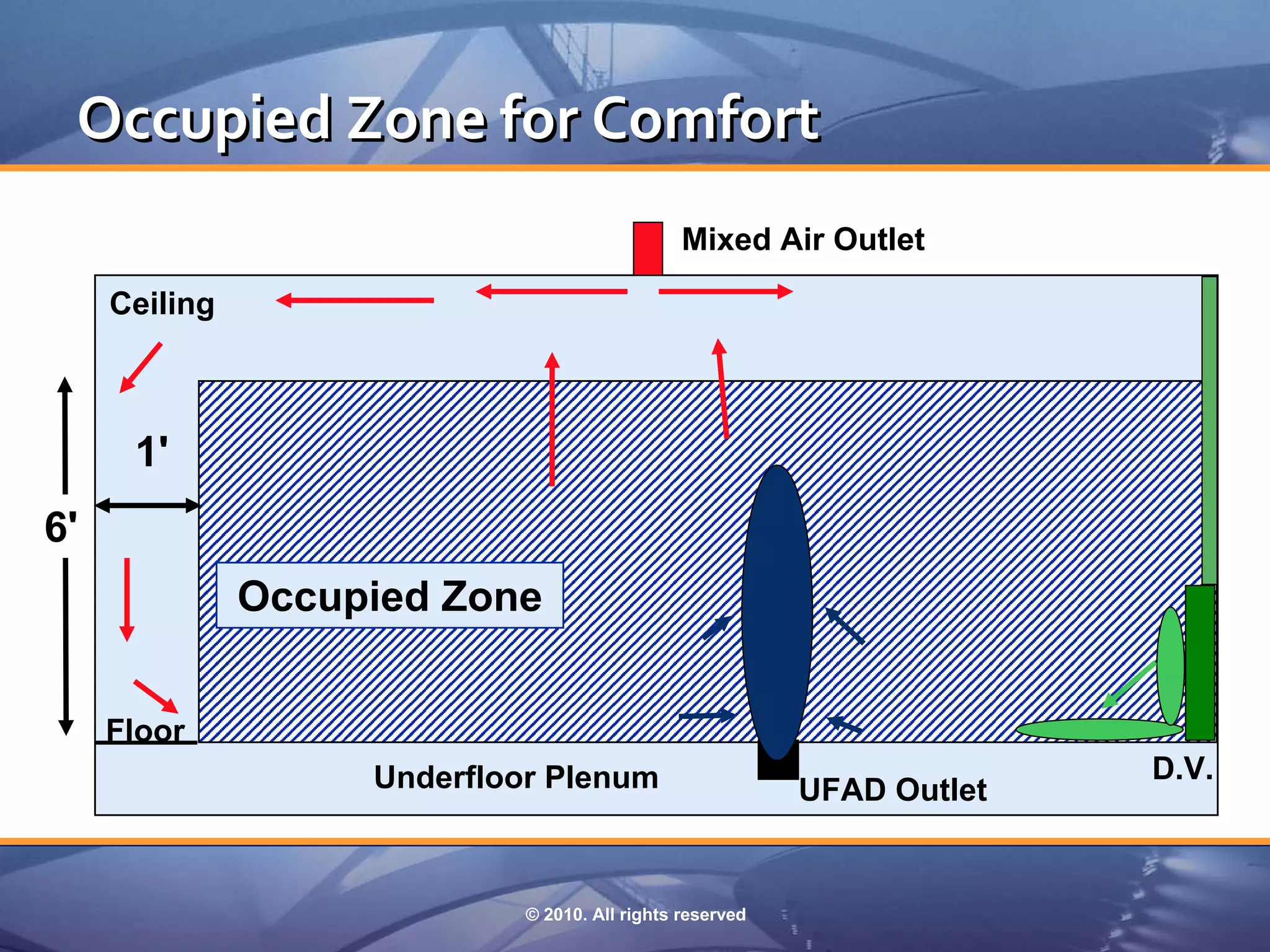
Occupied Zone for Comfort
                                                Mixed Air Outlet

     Ceiling


      1'
6'                                         F
               Occupied Zone


     Floor
                    Underfloor Plenum                                    D.V.
                                                           UFAD Outlet


                             © 2010. All rights reserved
Fully Mixed Air Distribution
Air Patterns
Mapping Room Air Motion
Vertical Projection
ADPI
Perimeter Heating


                   © 2010. All rights reserved
Air Flow Patterns
High Sidewall – No Ceiling
   Horizontal Pattern
     Deflected (less drop)
     Spread (shorter throw)

High Sidewall with Ceiling
   Longer throw with less drop
High Sidewall near Ceiling
   Deflect up for longer throw/less drop

                        © 2010. All rights reserved
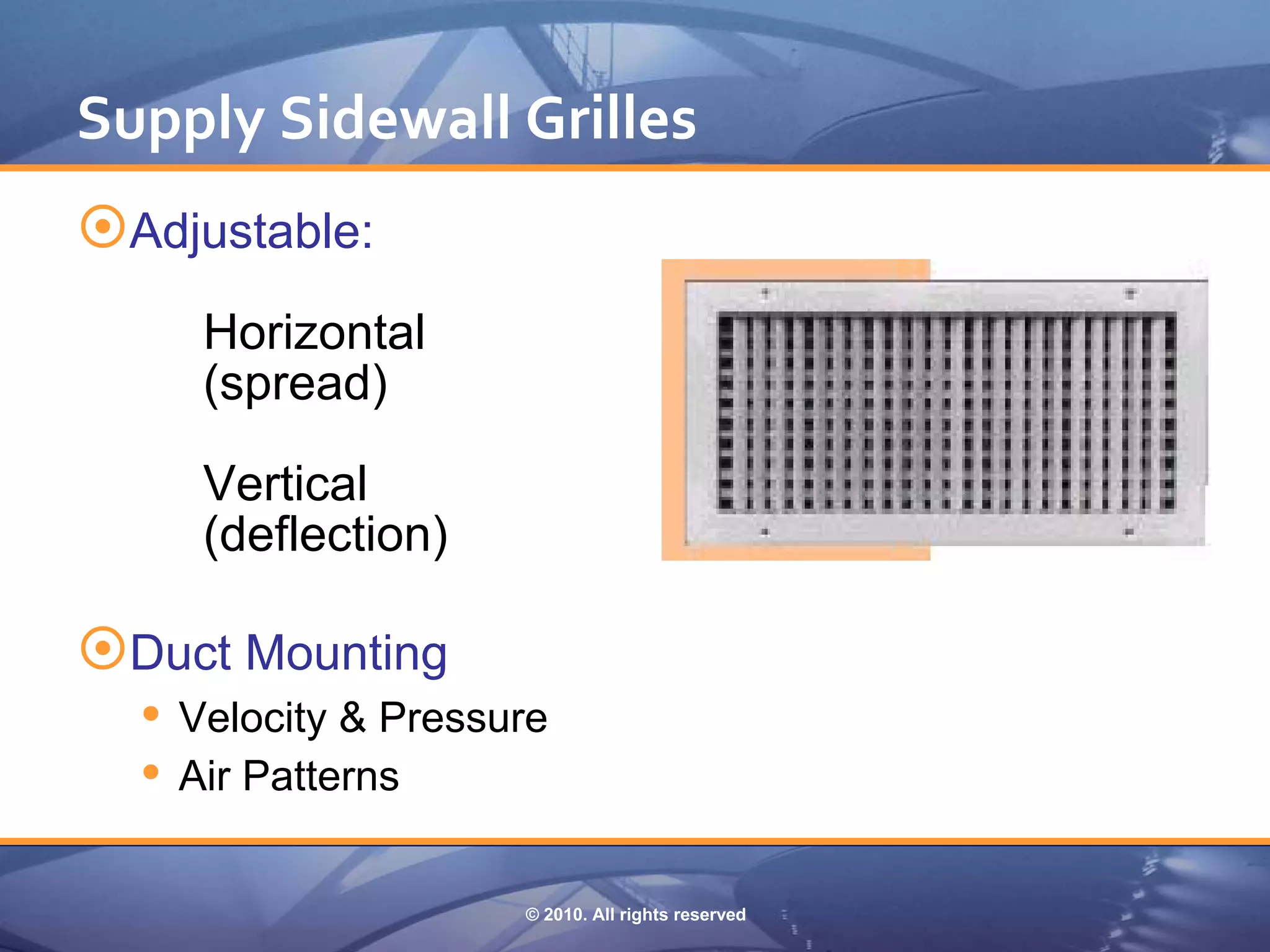
Supply Sidewall Grilles
Adjustable:
     Horizontal
     (spread)

     Vertical
     (deflection)

Duct Mounting
   Velocity & Pressure
   Air Patterns

                     © 2010. All rights reserved
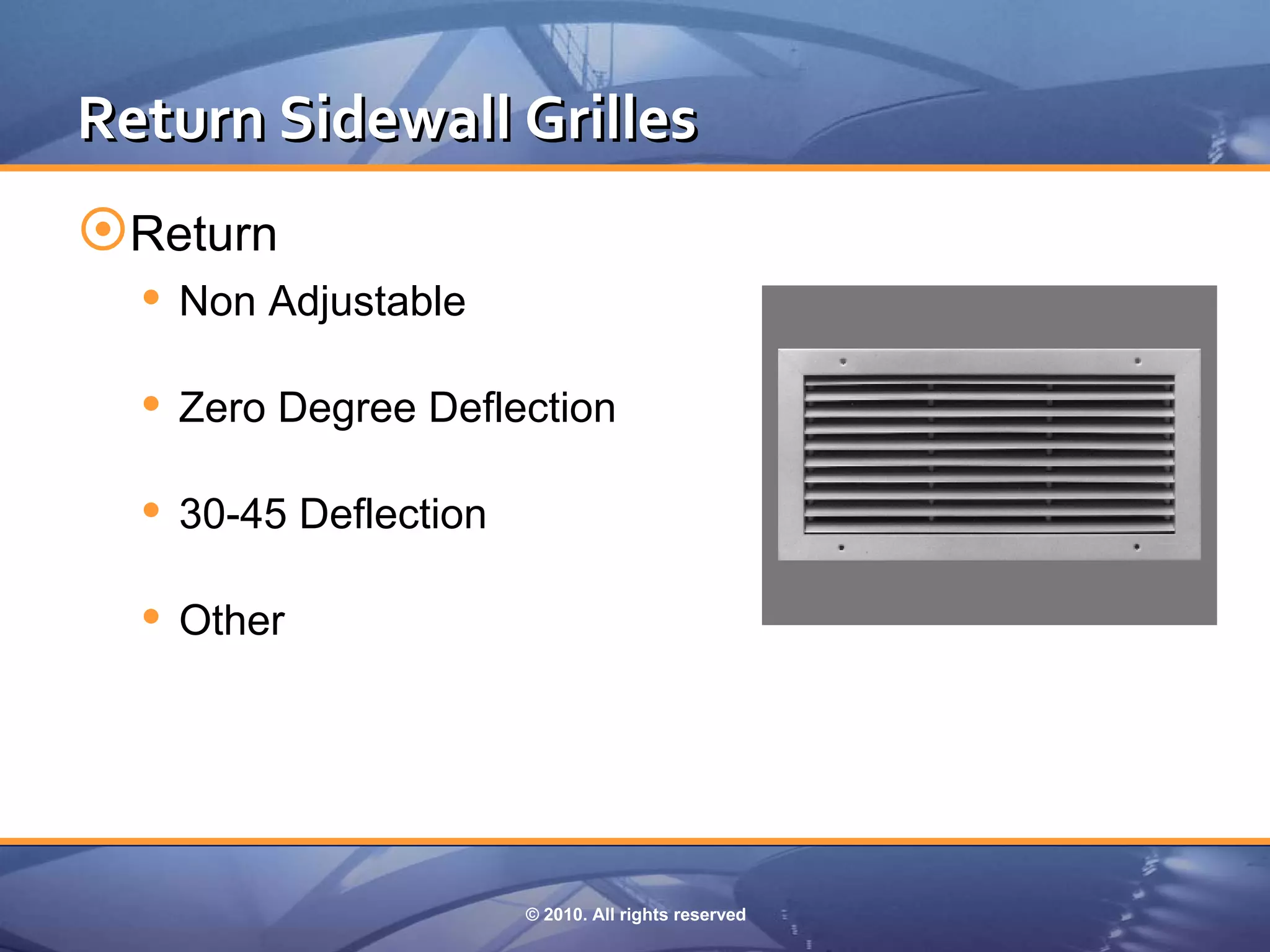
Return Sidewall Grilles
Return
   Non Adjustable

   Zero Degree Deflection

   30-45 Deflection

   Other


                       © 2010. All rights reserved
Air Flow Patterns
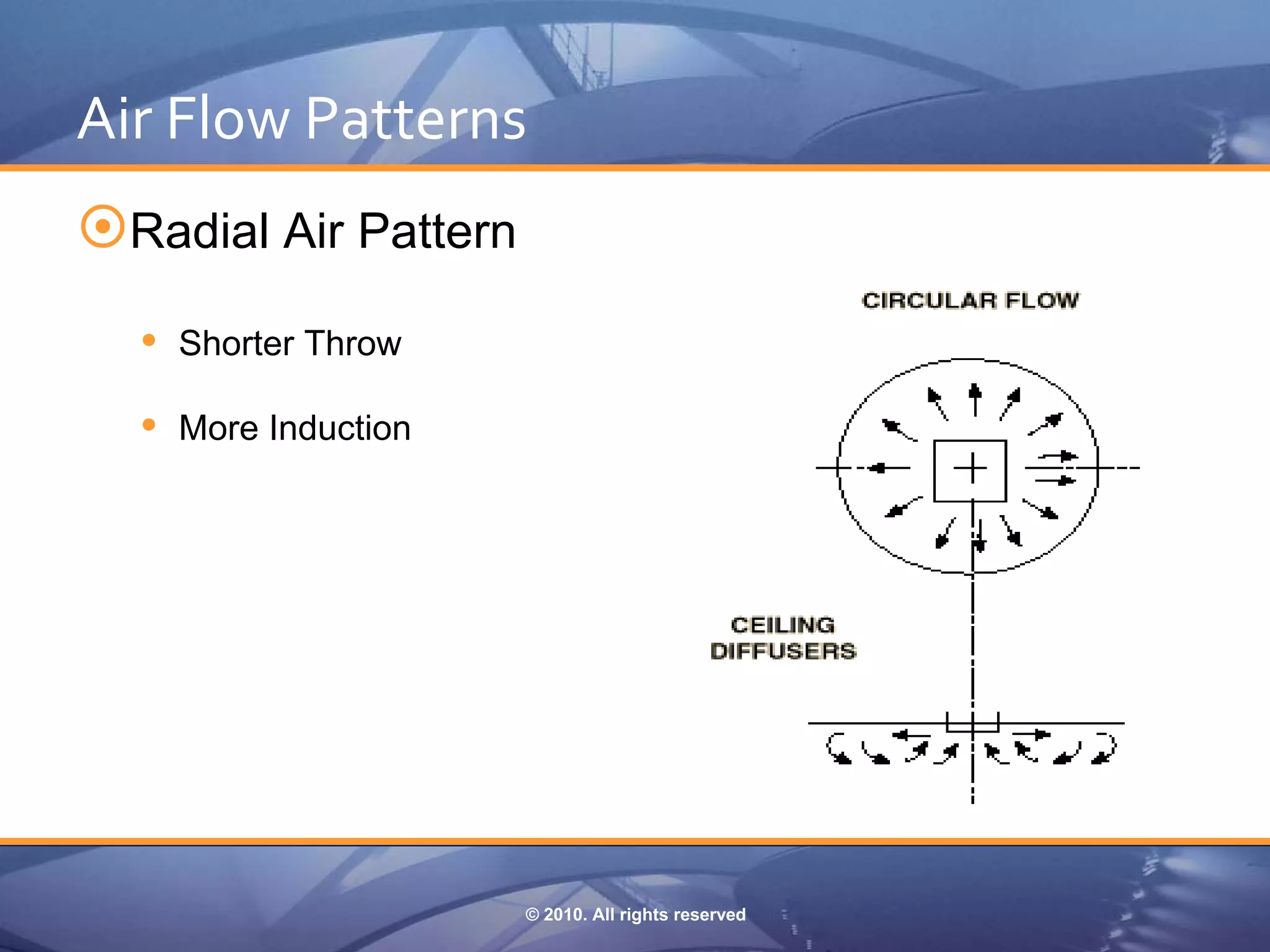
Radial Air Pattern
   Shorter Throw
   More Induction


                      © 2010. All rights reserved
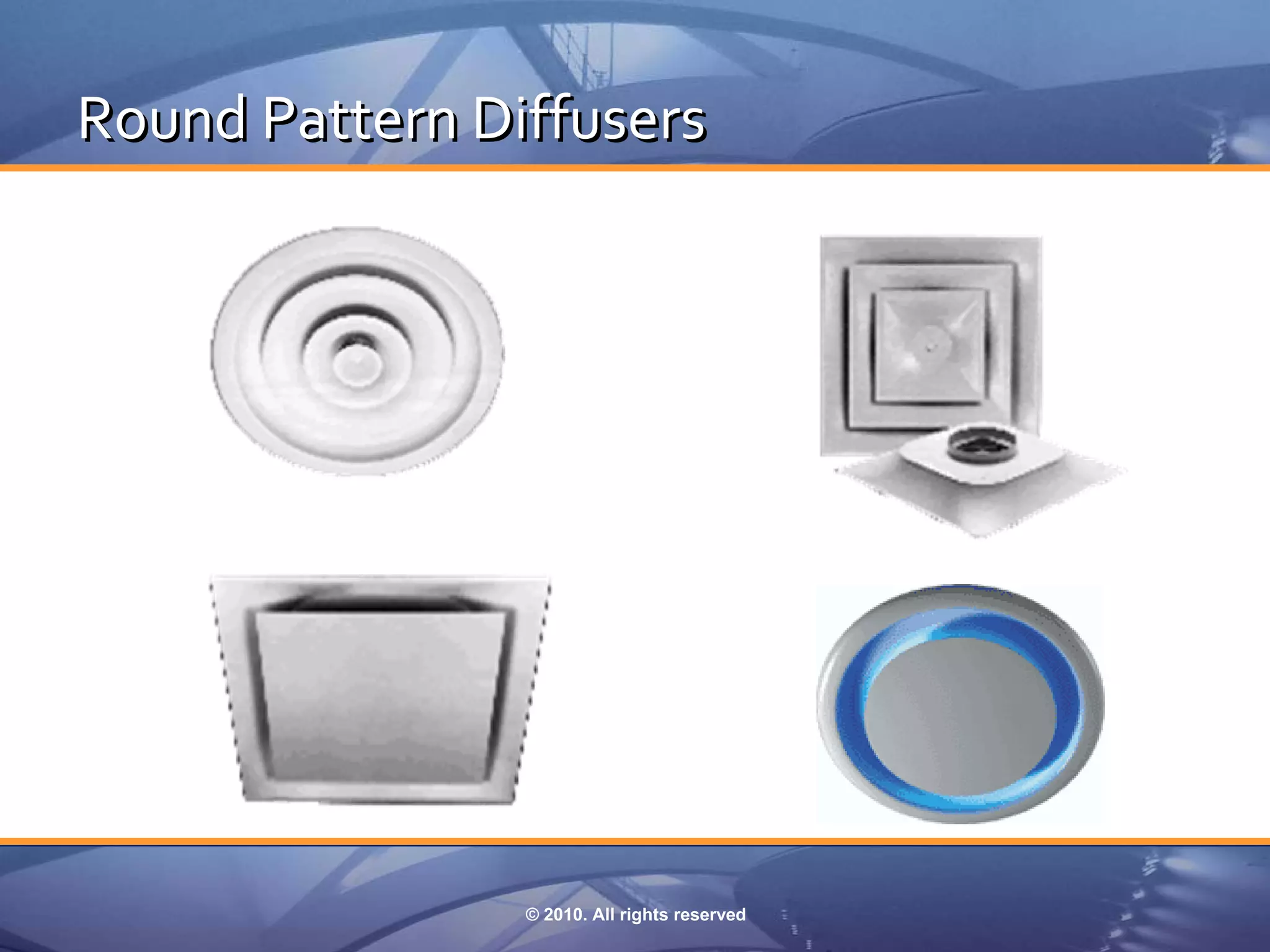
Round Pattern Diffusers


                © 2010. All rights reserved
Air Flow Patterns
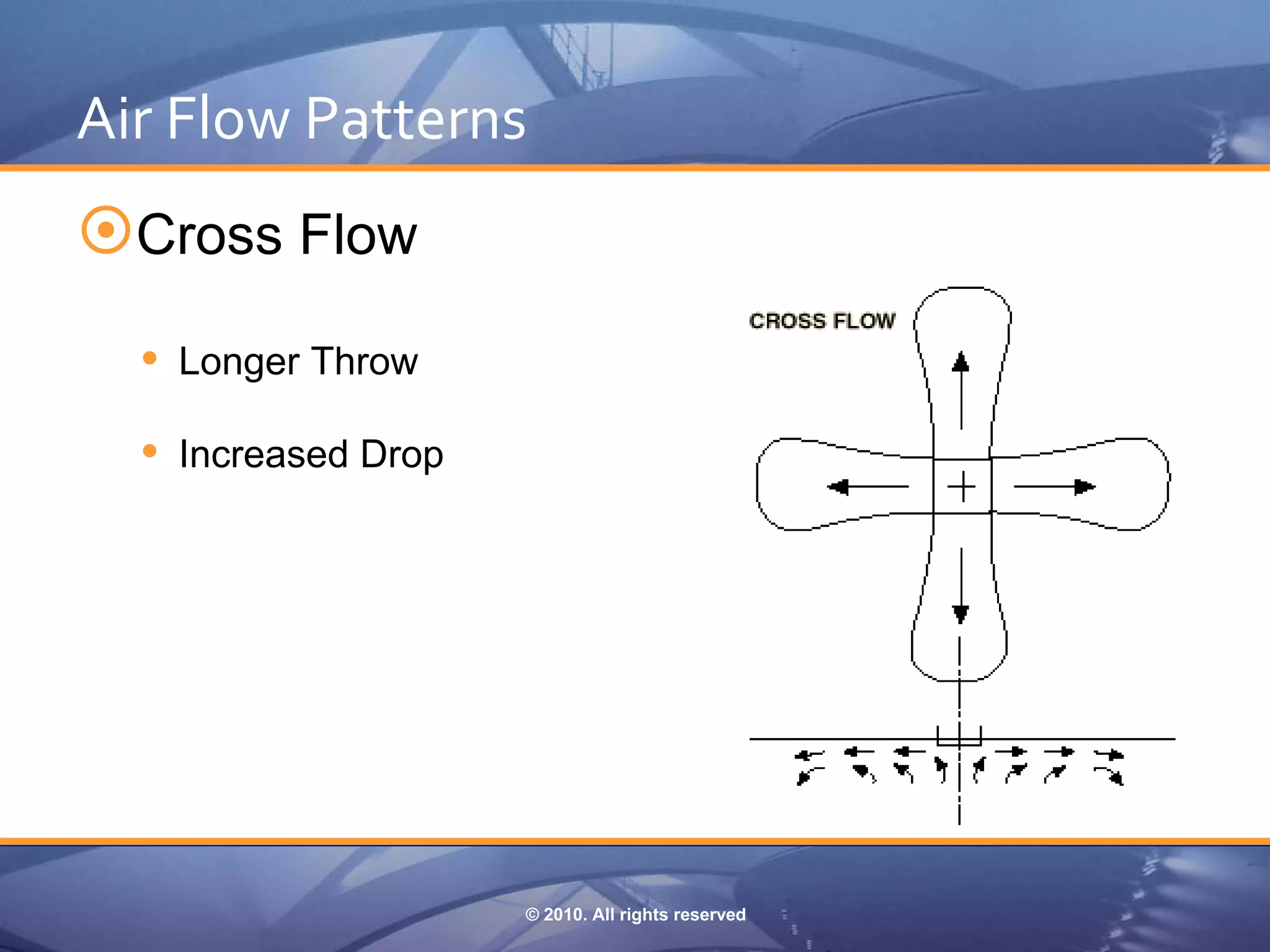
Cross Flow
   Longer Throw

   Increased Drop


                     © 2010. All rights reserved
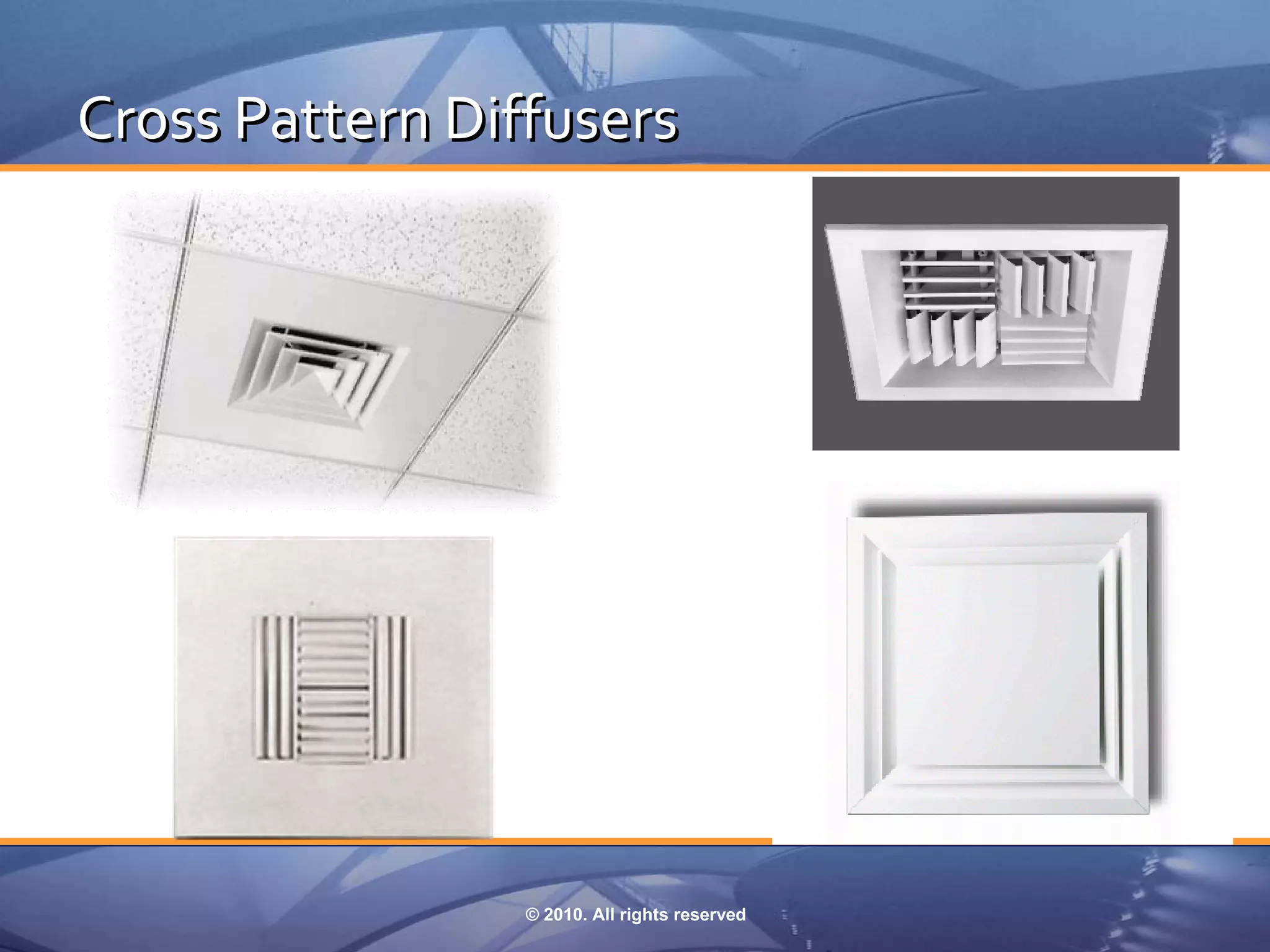
Cross Pattern Diffusers


                 © 2010. All rights reserved
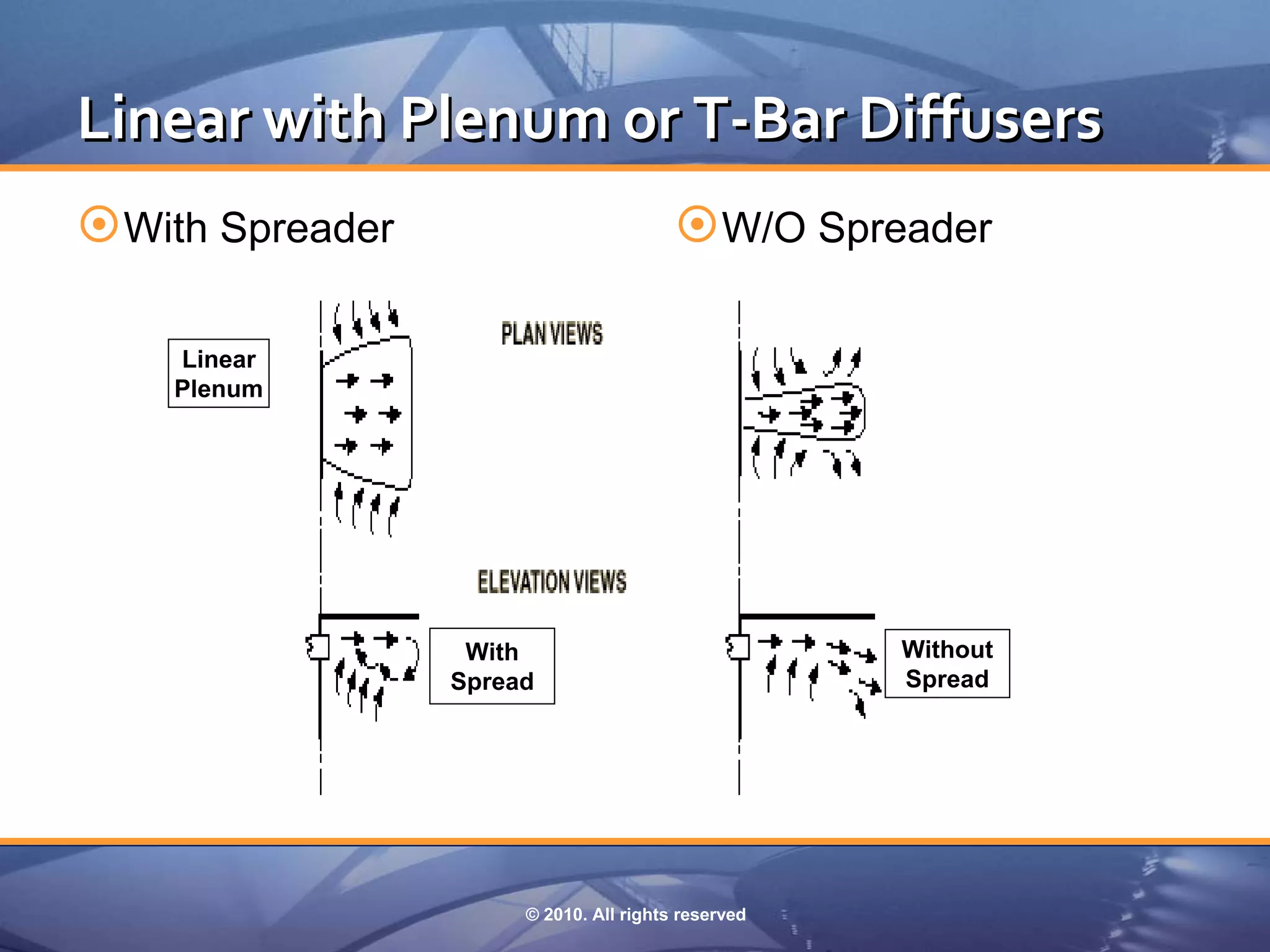
Linear with Plenum or T‐Bar Diffusers
 With Spreader                           W/O Spreader

    Linear
    Plenum


                   With                              Without
                  Spread                             Spread


                       © 2010. All rights reserved
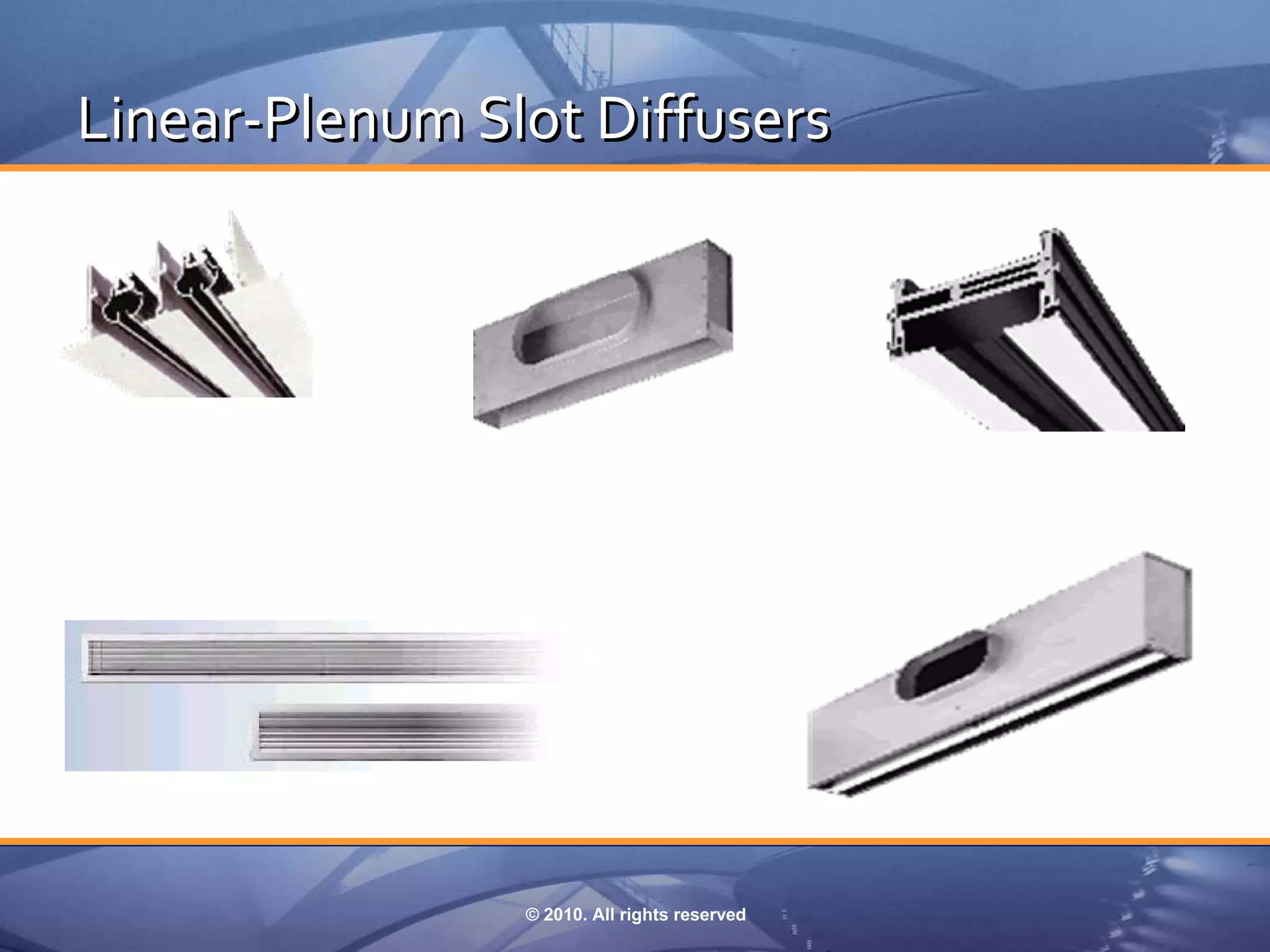
Linear‐Plenum Slot Diffusers


                © 2010. All rights reserved
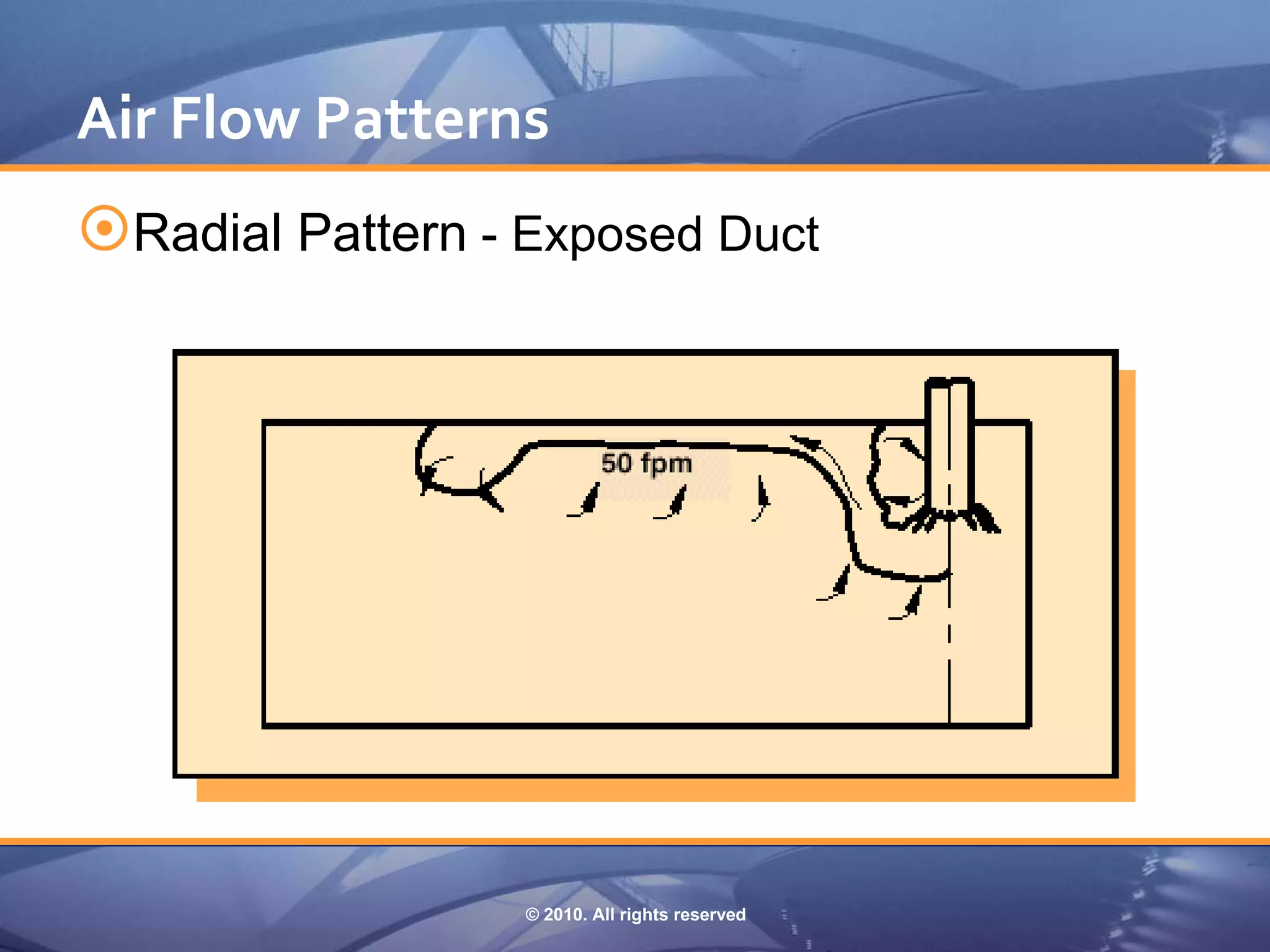
Air Flow Patterns
Radial Pattern - Exposed Duct


                  © 2010. All rights reserved
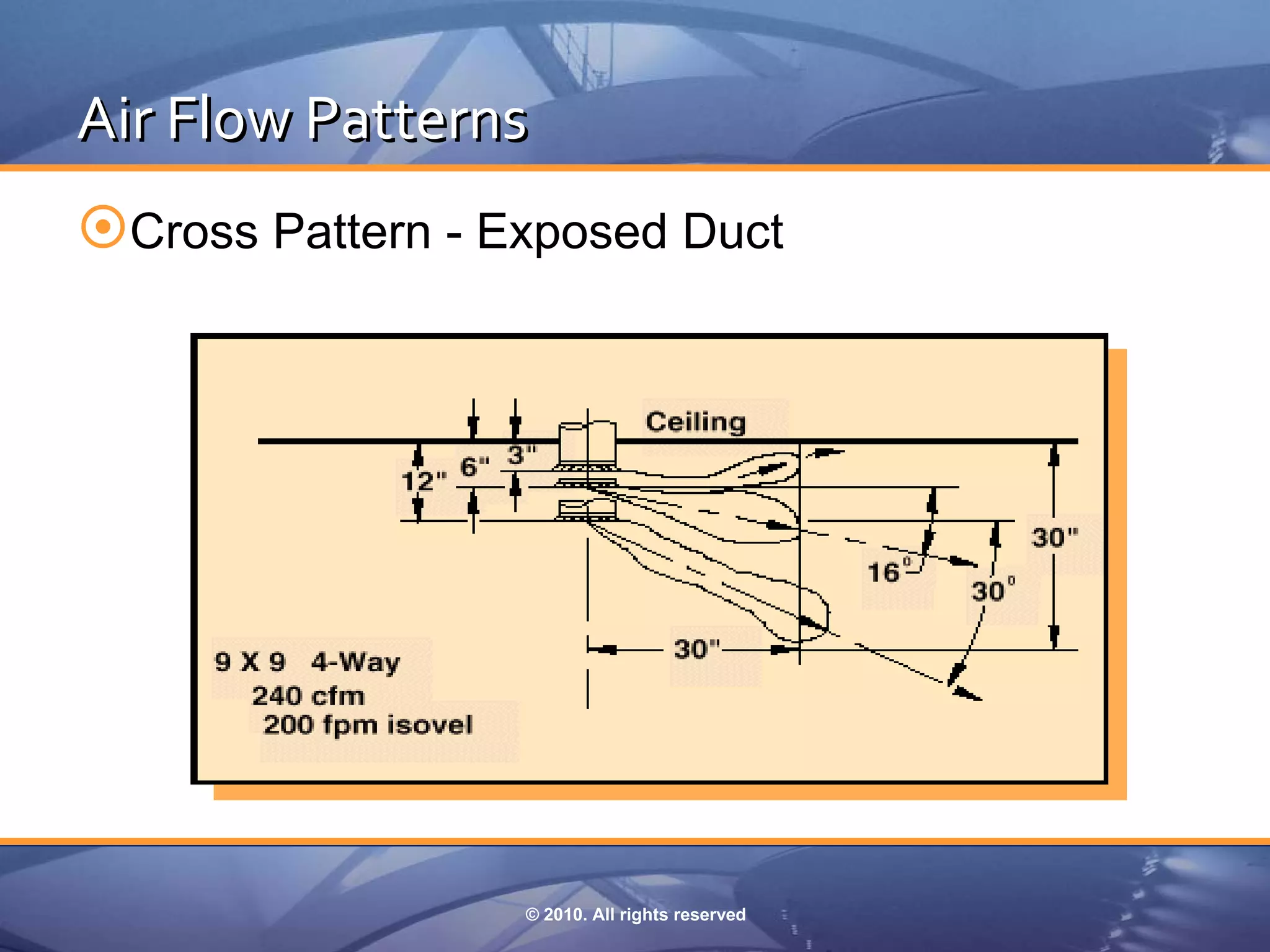
Air Flow Patterns
Cross Pattern - Exposed Duct


                  © 2010. All rights reserved
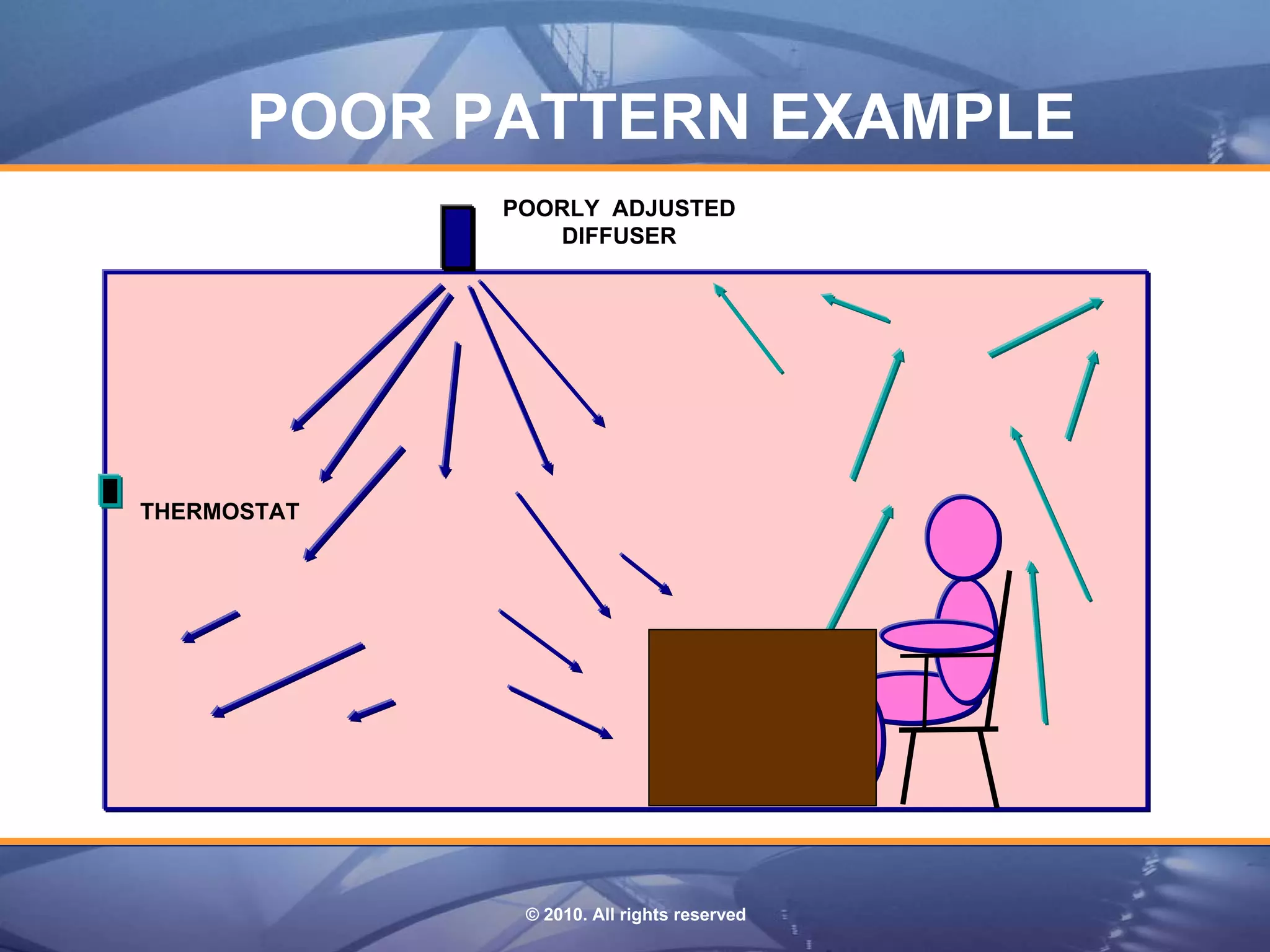
POOR PATTERN EXAMPLE
             POORLY ADJUSTED
                DIFFUSER


THERMOSTAT


              © 2010. All rights reserved
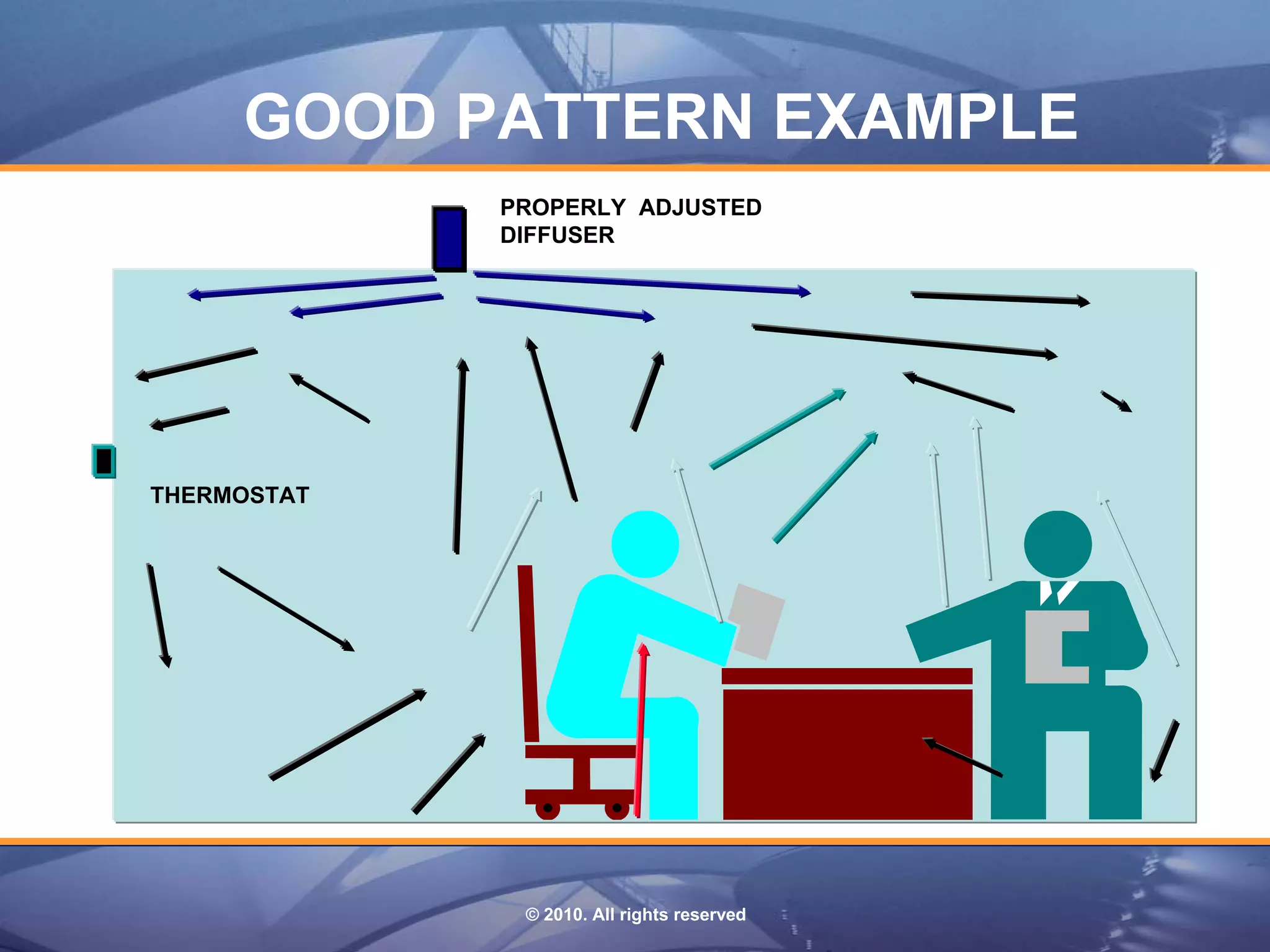
GOOD PATTERN EXAMPLE
             PROPERLY ADJUSTED
             DIFFUSER


THERMOSTAT


              © 2010. All rights reserved
Mapping Room Air Motion
5-step approach
   Primary air
   Total air
   Convection currents
   Room intake
   Room air


                     © 2010. All rights reserved
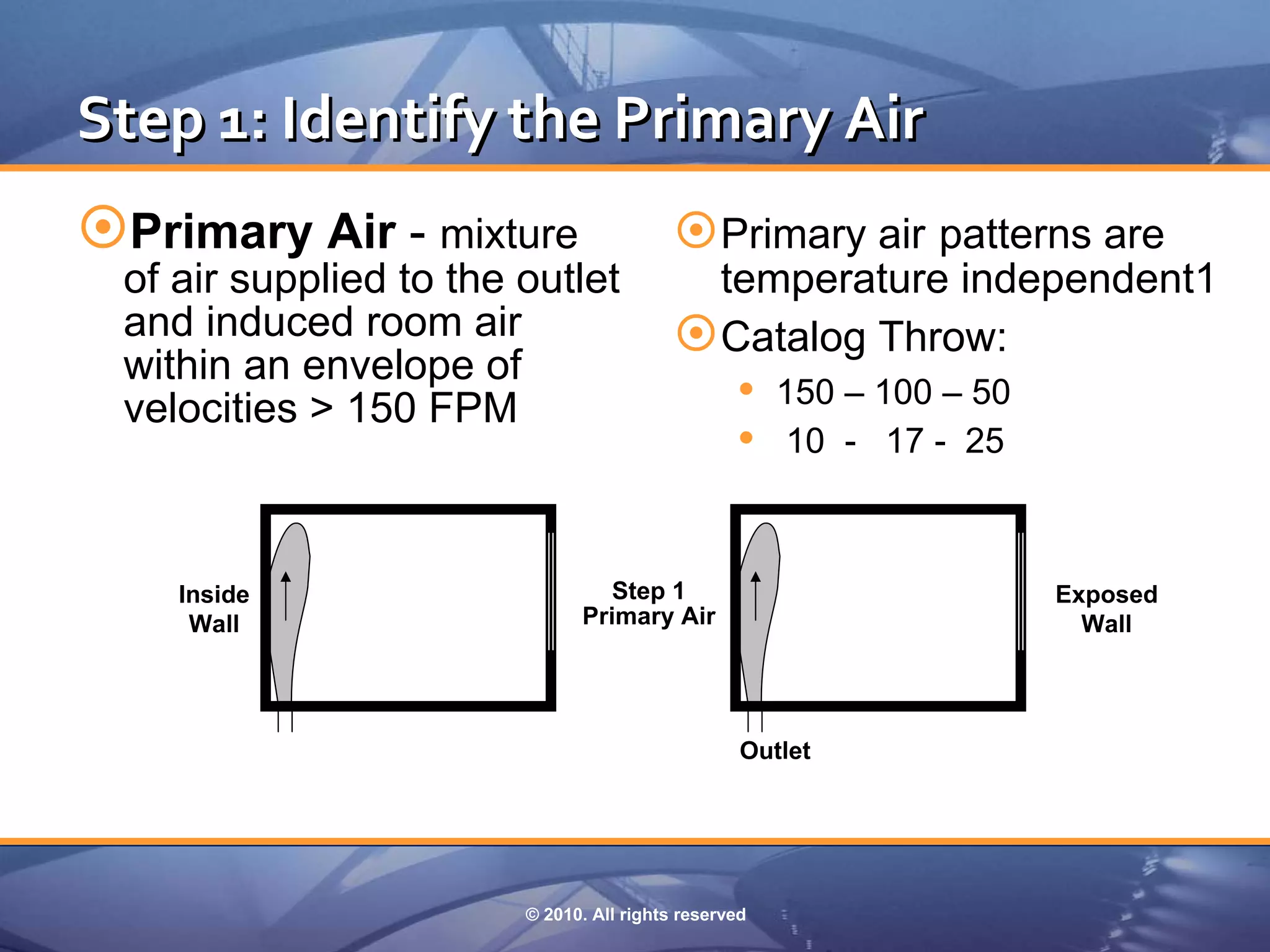
Step 1: Identify the Primary Air
Primary Air - mixture                      Primary air patterns are
  of air supplied to the outlet              temperature independent1
  and induced room air                      Catalog Throw:
  within an envelope of
  velocities > 150 FPM                         150 – 100 – 50
                                               10 - 17 - 25


     Inside                       Step 1                       Exposed
      Wall                     Primary Air                       Wall


                                                   Outlet


                         © 2010. All rights reserved
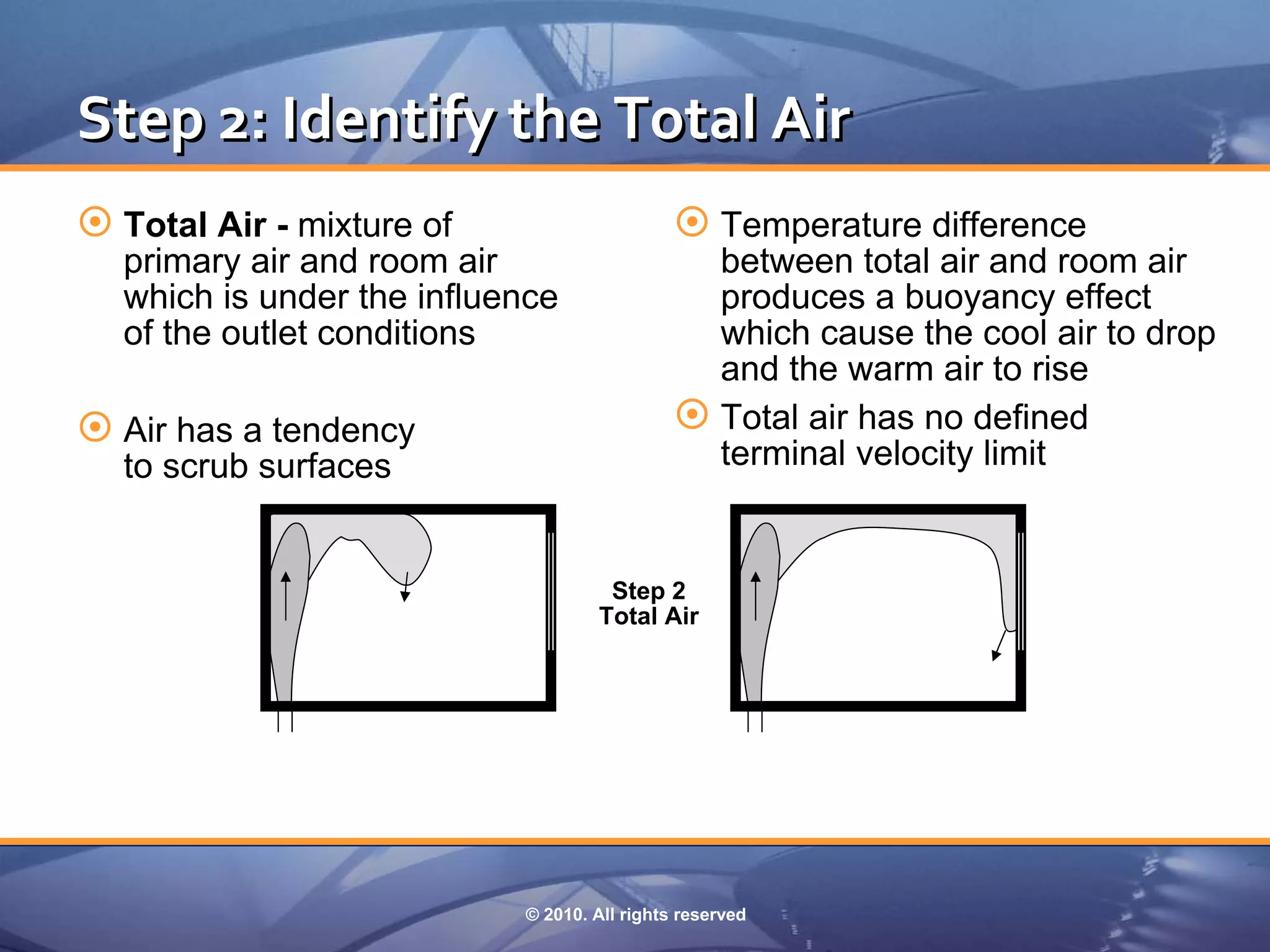
Step 2: Identify the Total Air
 Total Air - mixture of                       Temperature difference
   primary air and room air                     between total air and room air
   which is under the influence                 produces a buoyancy effect
   of the outlet conditions                     which cause the cool air to drop
                                                and the warm air to rise
 Air has a tendency                           Total air has no defined
   to scrub surfaces                            terminal velocity limit


                                     Step 2
                                    Total Air


                            © 2010. All rights reserved
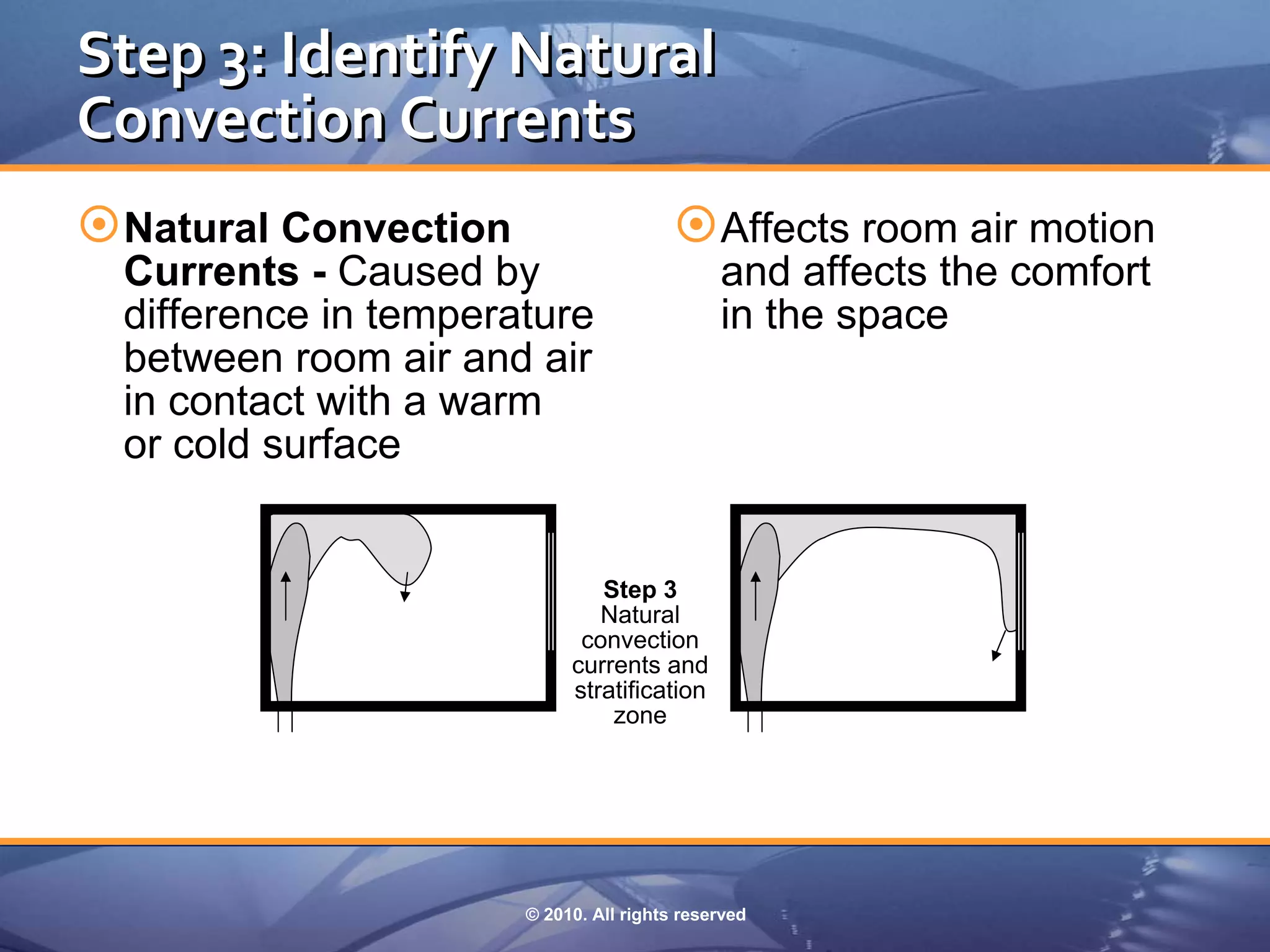
Step 3: Identify Natural 
Convection Currents
 Natural Convection                      Affects room air motion
  Currents - Caused by                        and affects the comfort
  difference in temperature                   in the space
  between room air and air
  in contact with a warm
  or cold surface


                               Step 3
                               Natural
                             convection
                            currents and
                            stratification
                                zone


                       © 2010. All rights reserved
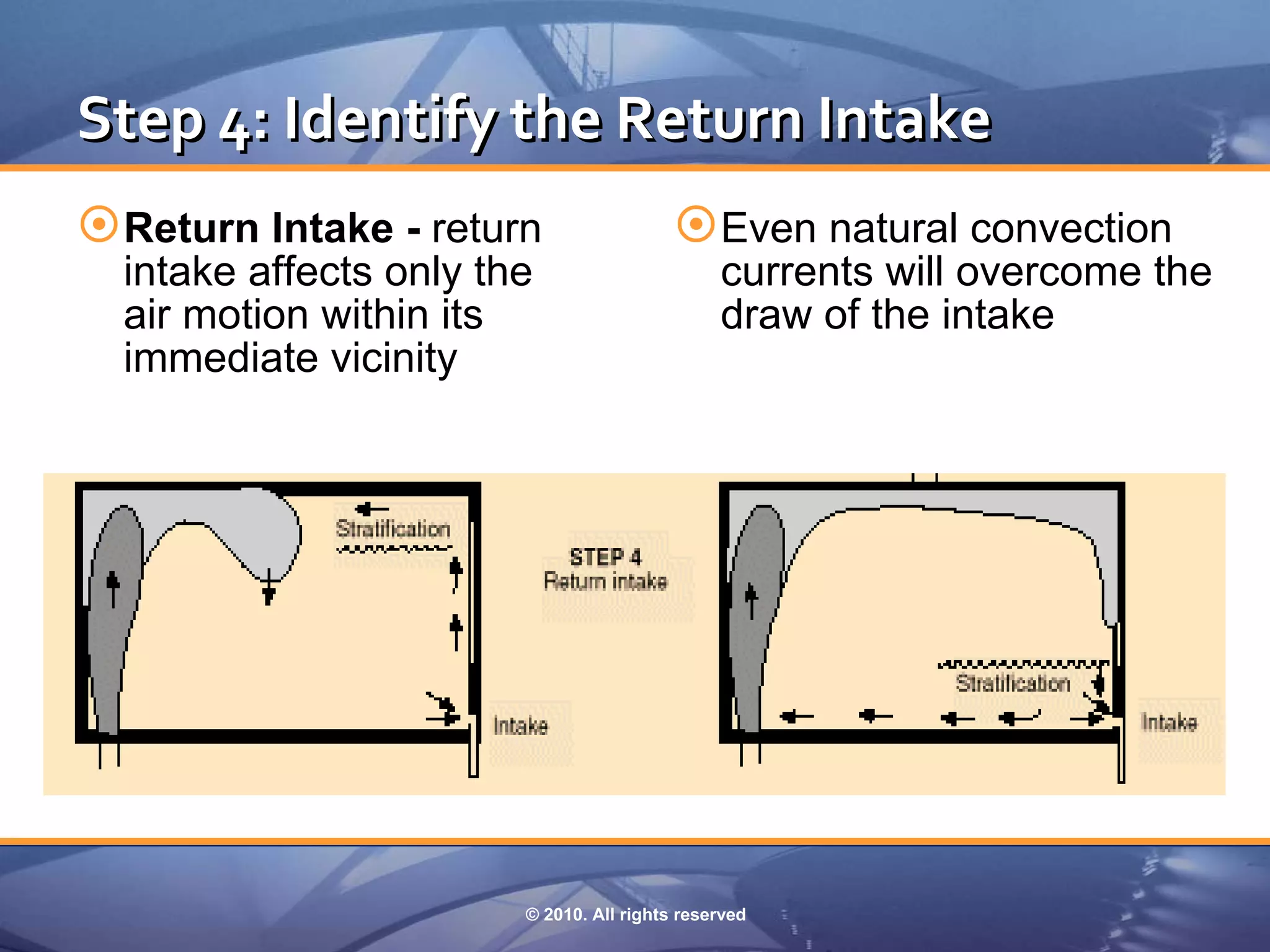
Step 4: Identify the Return Intake
 Return Intake - return                   Even natural convection
  intake affects only the                      currents will overcome the
  air motion within its                        draw of the intake
  immediate vicinity


                        © 2010. All rights reserved
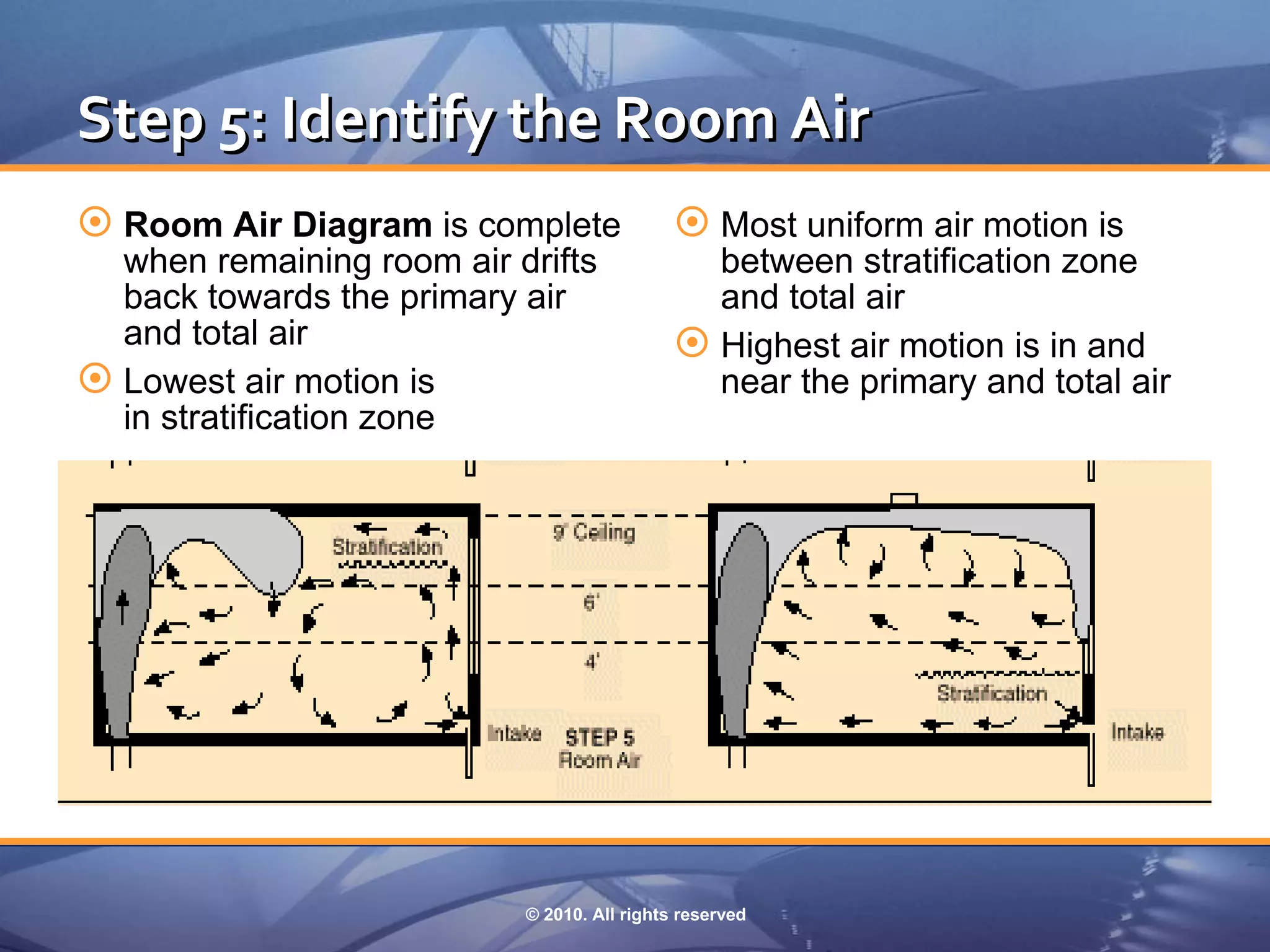
Step 5: Identify the Room Air
 Room Air Diagram is complete                Most uniform air motion is
  when remaining room air drifts               between stratification zone
  back towards the primary air                 and total air
  and total air                               Highest air motion is in and
 Lowest air motion is                         near the primary and total air
  in stratification zone


                           © 2010. All rights reserved
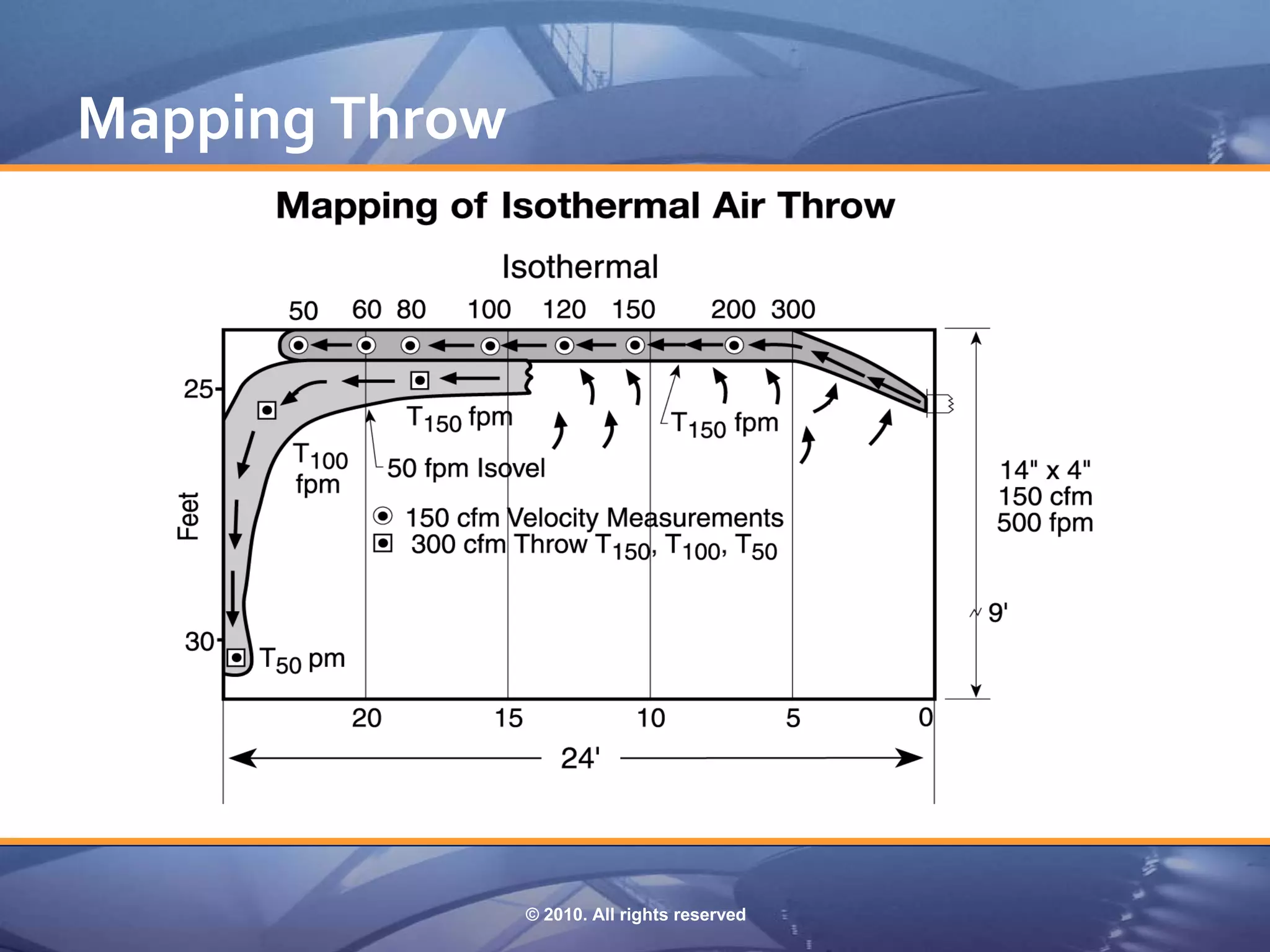
Mapping Throw


                © 2010. All rights reserved
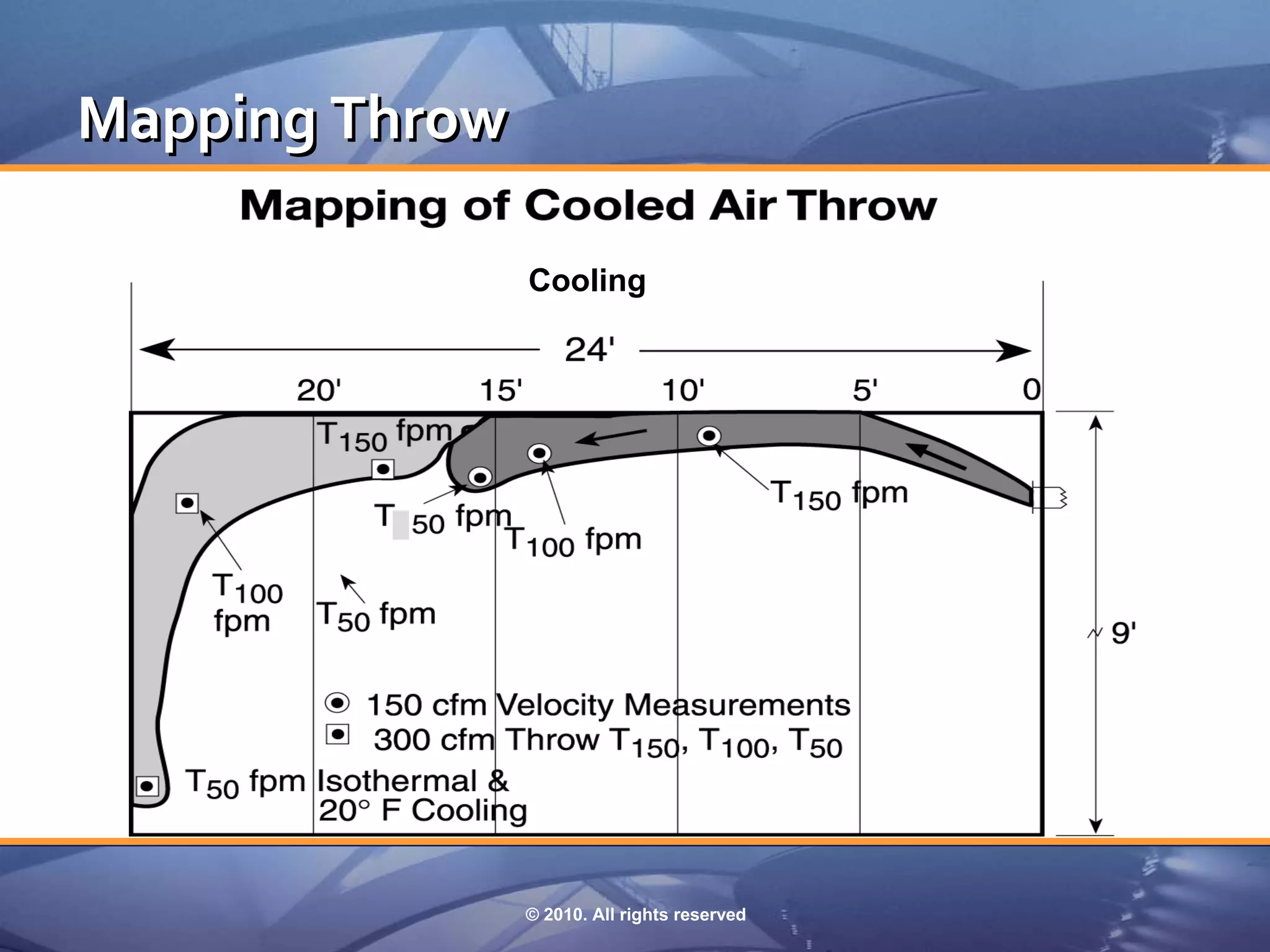
Mapping Throw

                Cooling


                © 2010. All rights reserved
Estimating Downward Projection
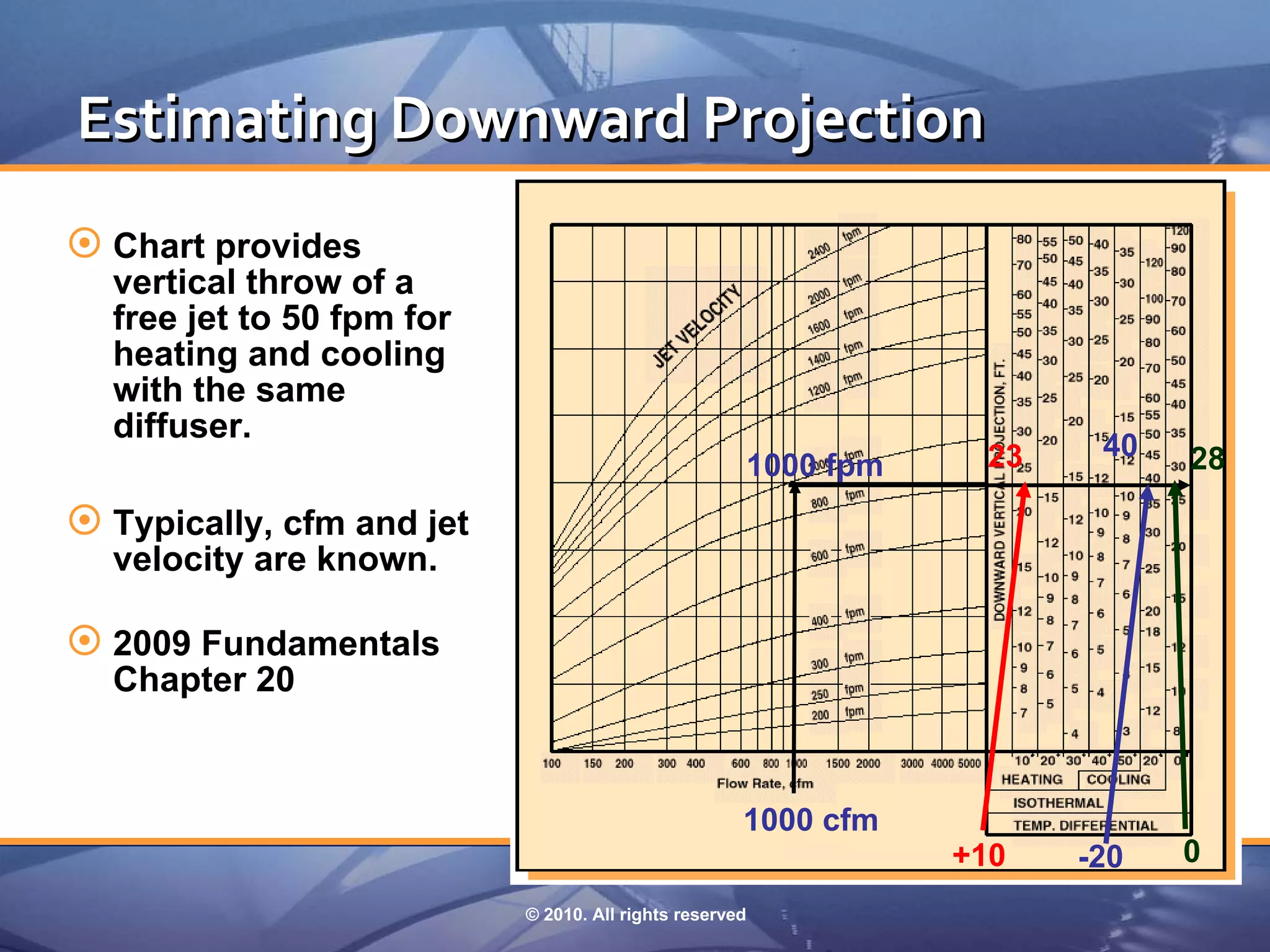
 Chart provides
  vertical throw of a
  free jet to 50 fpm for
  heating and cooling
  with the same
  diffuser.
                                                                 23    40   28
                                                     1000 fpm
 Typically, cfm and jet
  velocity are known.

 2009 Fundamentals
  Chapter 20


                                                     1000 cfm
                                                                +10   -20   0
                           © 2010. All rights reserved
ADPI & Comfort
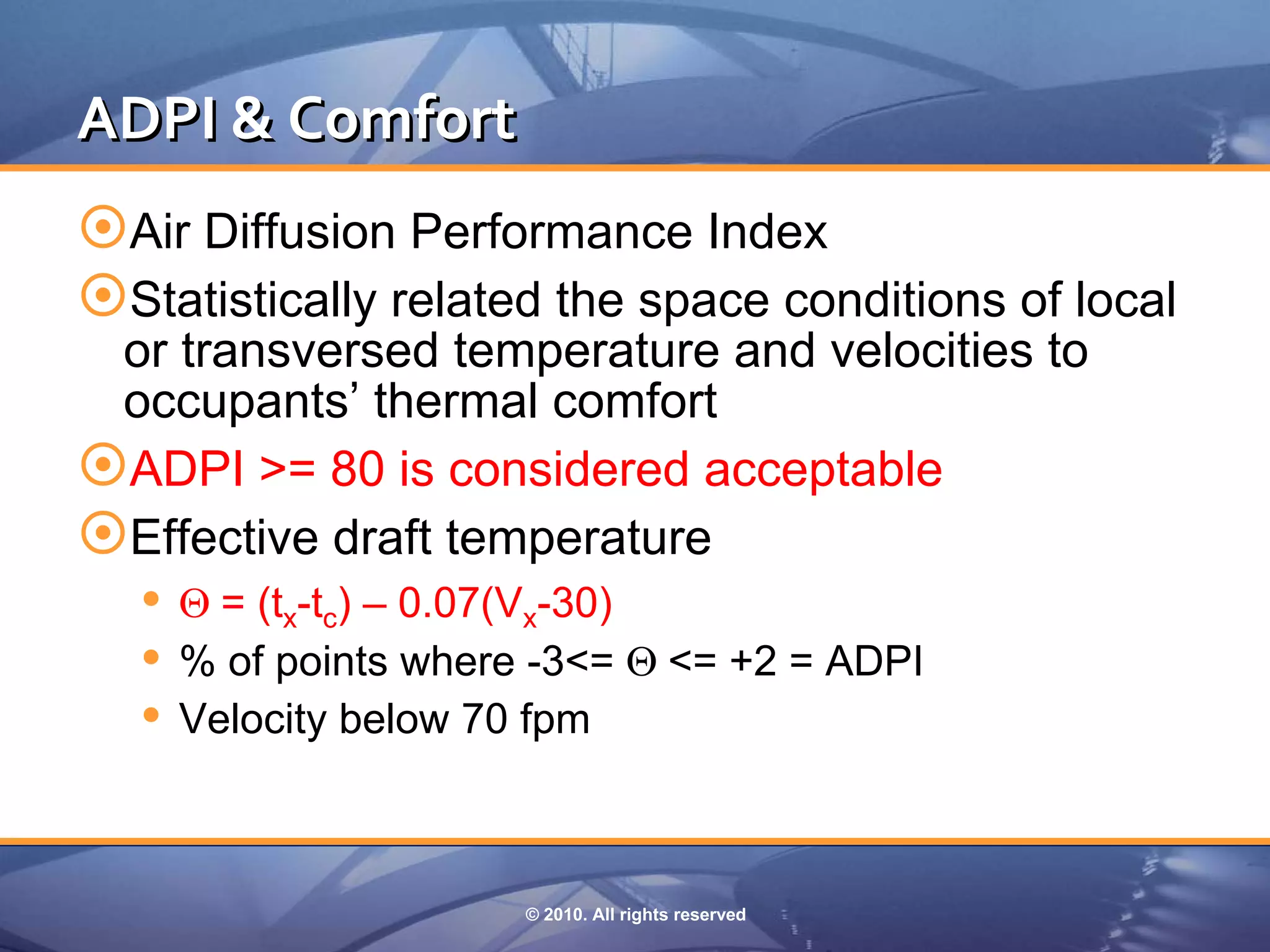
Air Diffusion Performance Index
Statistically related the space conditions of local
 or transversed temperature and velocities to
 occupants’ thermal comfort
ADPI >= 80 is considered acceptable
Effective draft temperature
   = (tx-tc) – 0.07(Vx-30)
   % of points where -3<= <= +2 = ADPI
   Velocity below 70 fpm


                     © 2010. All rights reserved
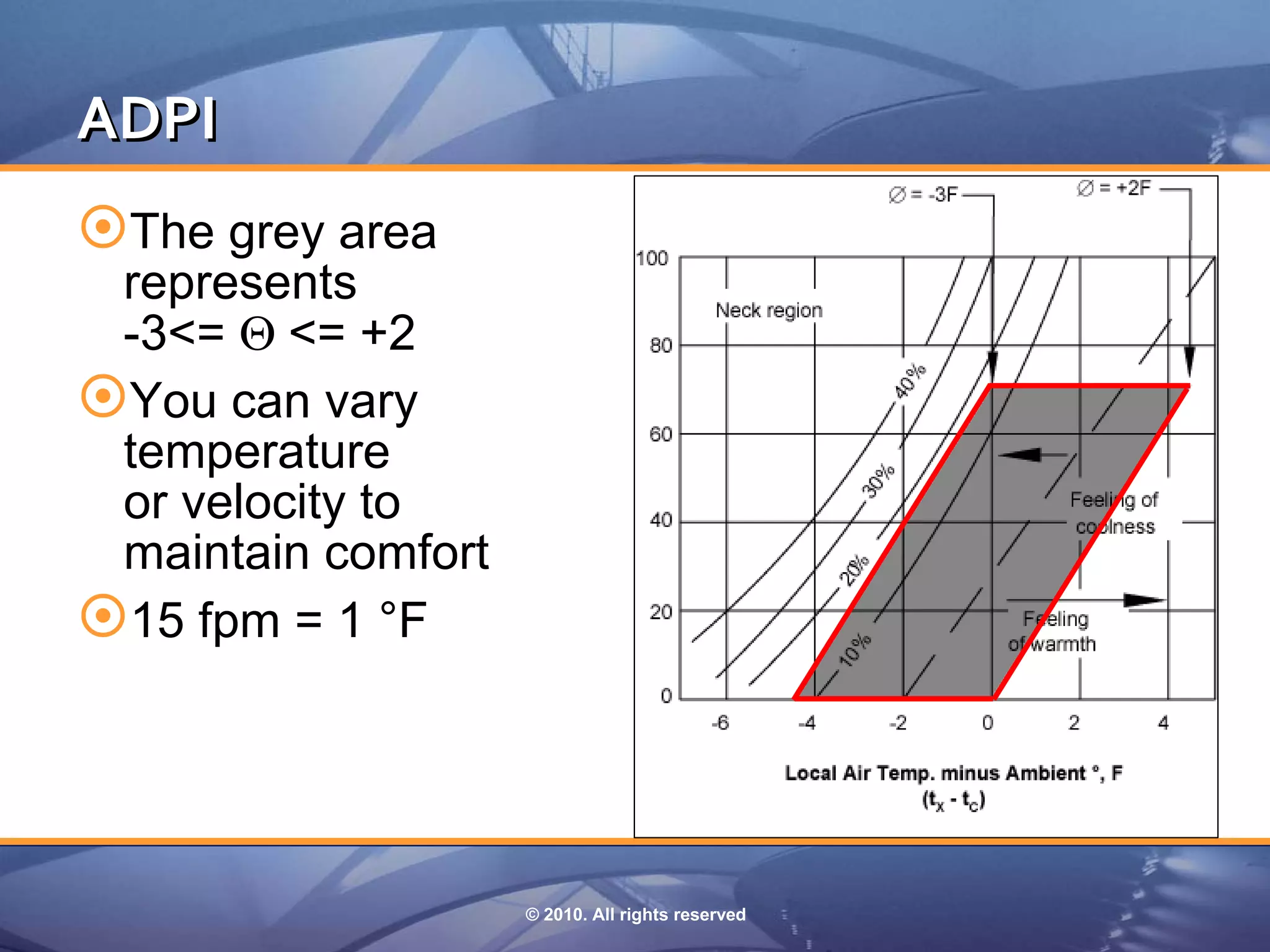
ADPI
The grey area
 represents
 -3<= <= +2
You can vary
 temperature
 or velocity to
 maintain comfort
15 fpm = 1 °F


                    © 2010. All rights reserved
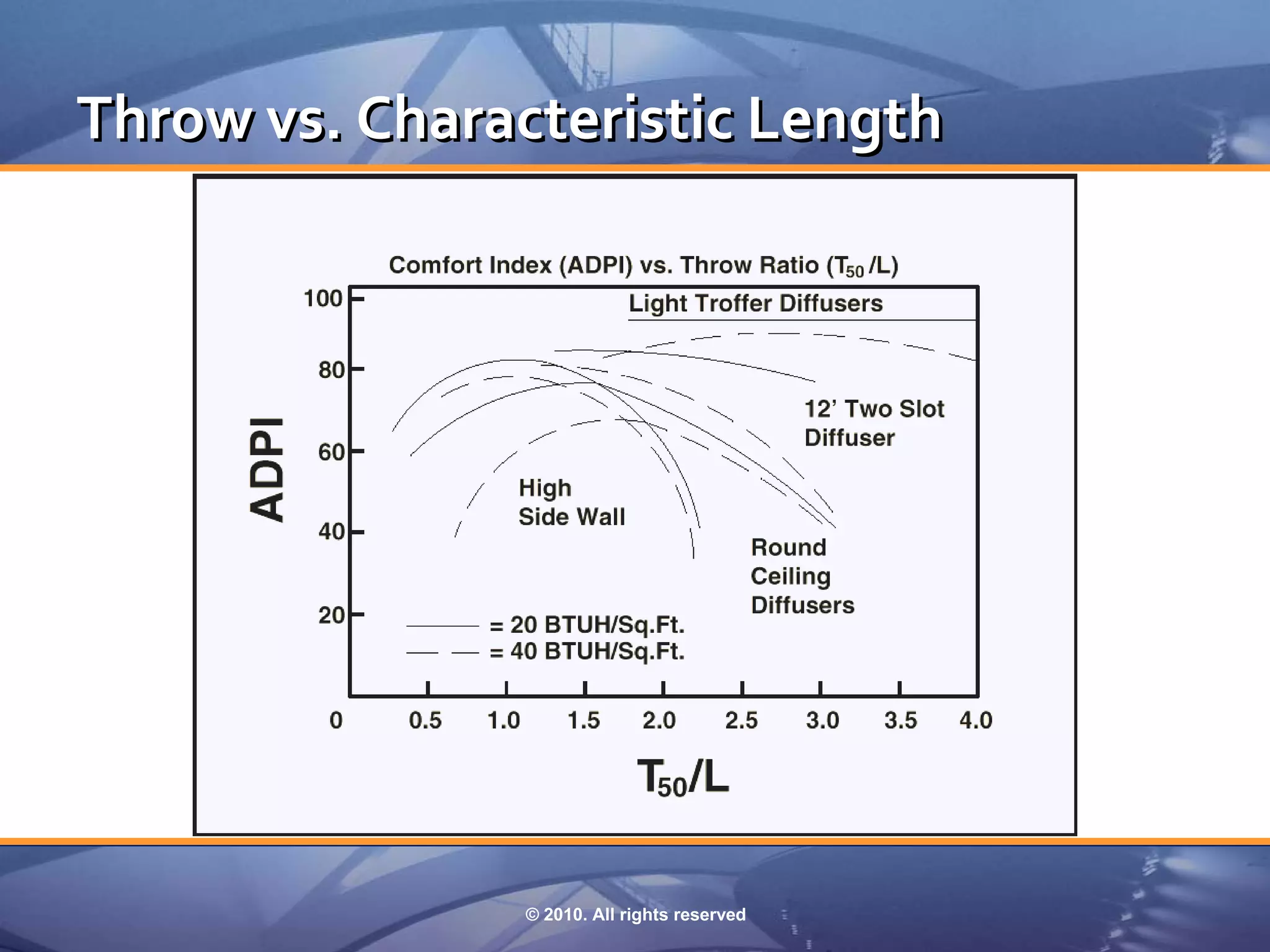
Throw vs. Characteristic Length


                © 2010. All rights reserved
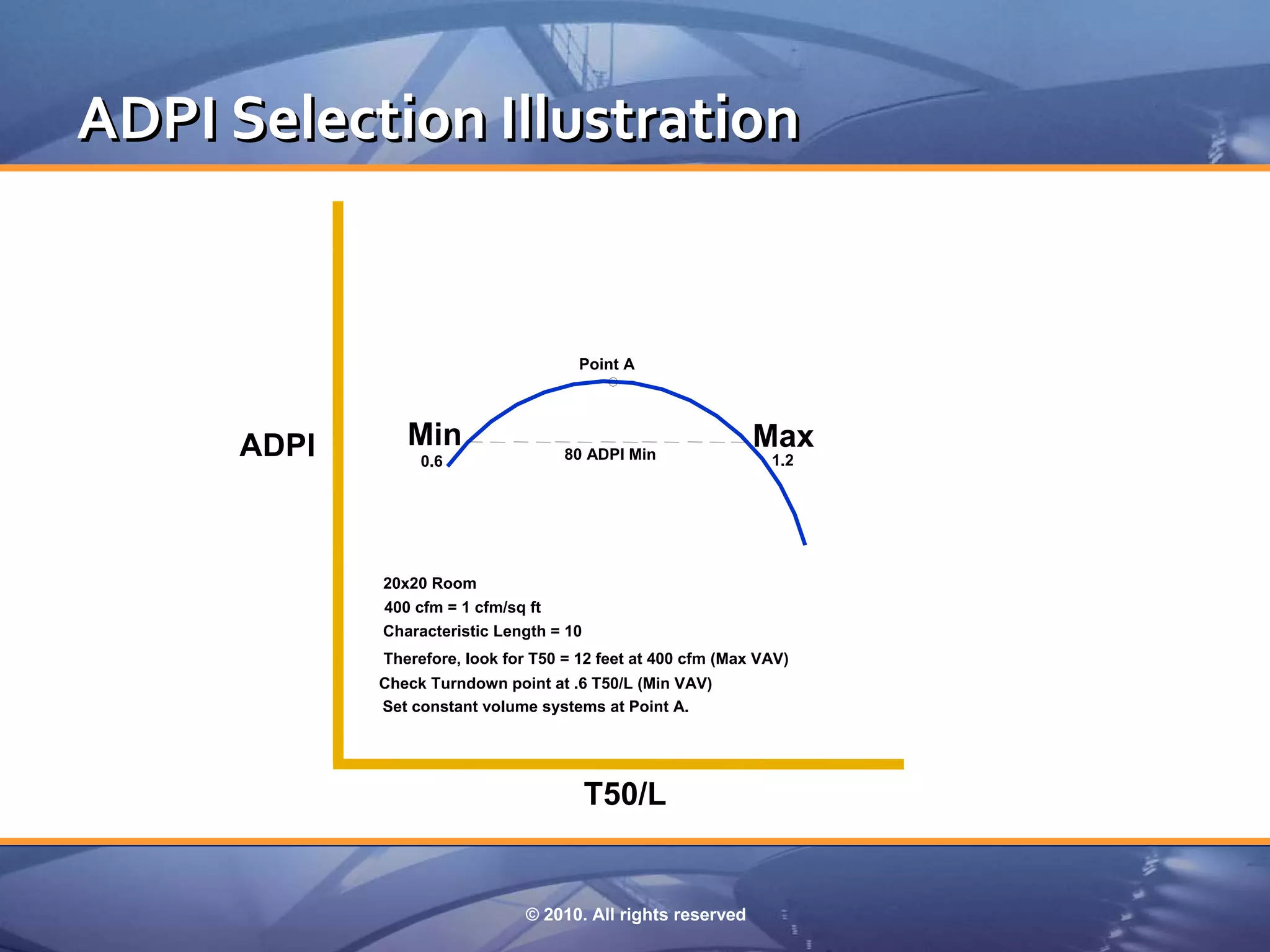
ADPI Selection Illustration


                                       Point A


      ADPI      Min                  80 ADPI Min
                                                              Max
                  0.6                                           1.2


             20x20 Room
             400 cfm = 1 cfm/sq ft
             Characteristic Length = 10
             Therefore, look for T50 = 12 feet at 400 cfm (Max VAV)
             Check Turndown point at .6 T50/L (Min VAV)
             Set constant volume systems at Point A.


                                          T50/L


                               © 2010. All rights reserved
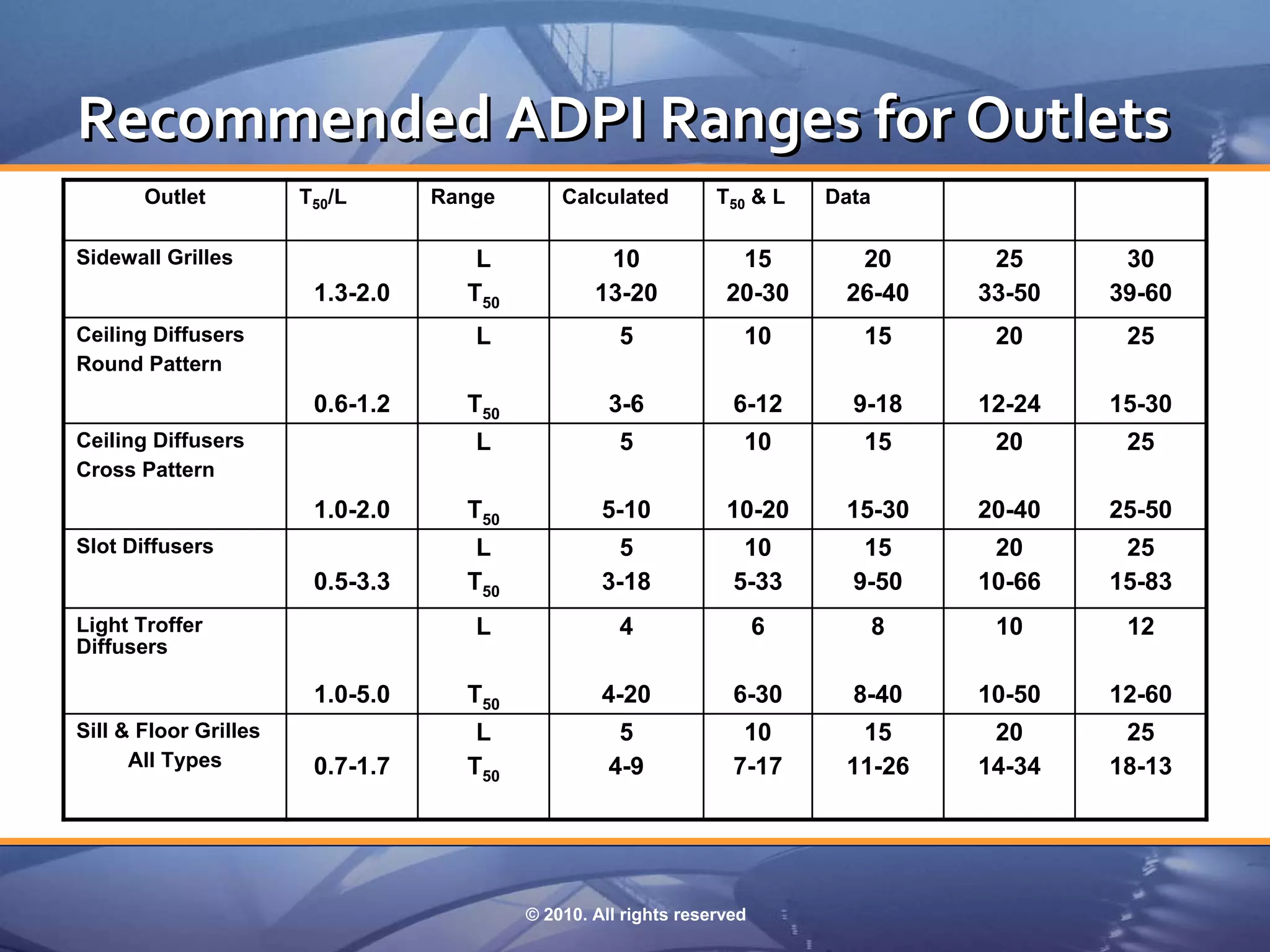
Recommended ADPI Ranges for Outlets
       Outlet          T50/L      Range       Calculated         T50 & L    Data

Sidewall Grilles                     L             10              15         20        25      30
                        1.3-2.0     T50           13-20           20-30      26-40     33-50   39-60
Ceiling Diffusers                    L               5              10         15       20      25
Round Pattern
                        0.6-1.2     T50             3-6            6-12       9-18     12-24   15-30
Ceiling Diffusers                    L               5              10         15       20      25
Cross Pattern
                        1.0-2.0     T50            5-10           10-20      15-30     20-40   25-50
Slot Diffusers                       L               5              10         15       20      25
                        0.5-3.3     T50            3-18            5-33       9-50     10-66   15-83
Light Troffer                        L               4                  6          8    10      12
Diffusers

                        1.0-5.0     T50            4-20            6-30       8-40     10-50   12-60
Sill & Floor Grilles                 L               5              10        15        20      25
      All Types         0.7-1.7     T50             4-9            7-17      11-26     14-34   18-13


                                          © 2010. All rights reserved
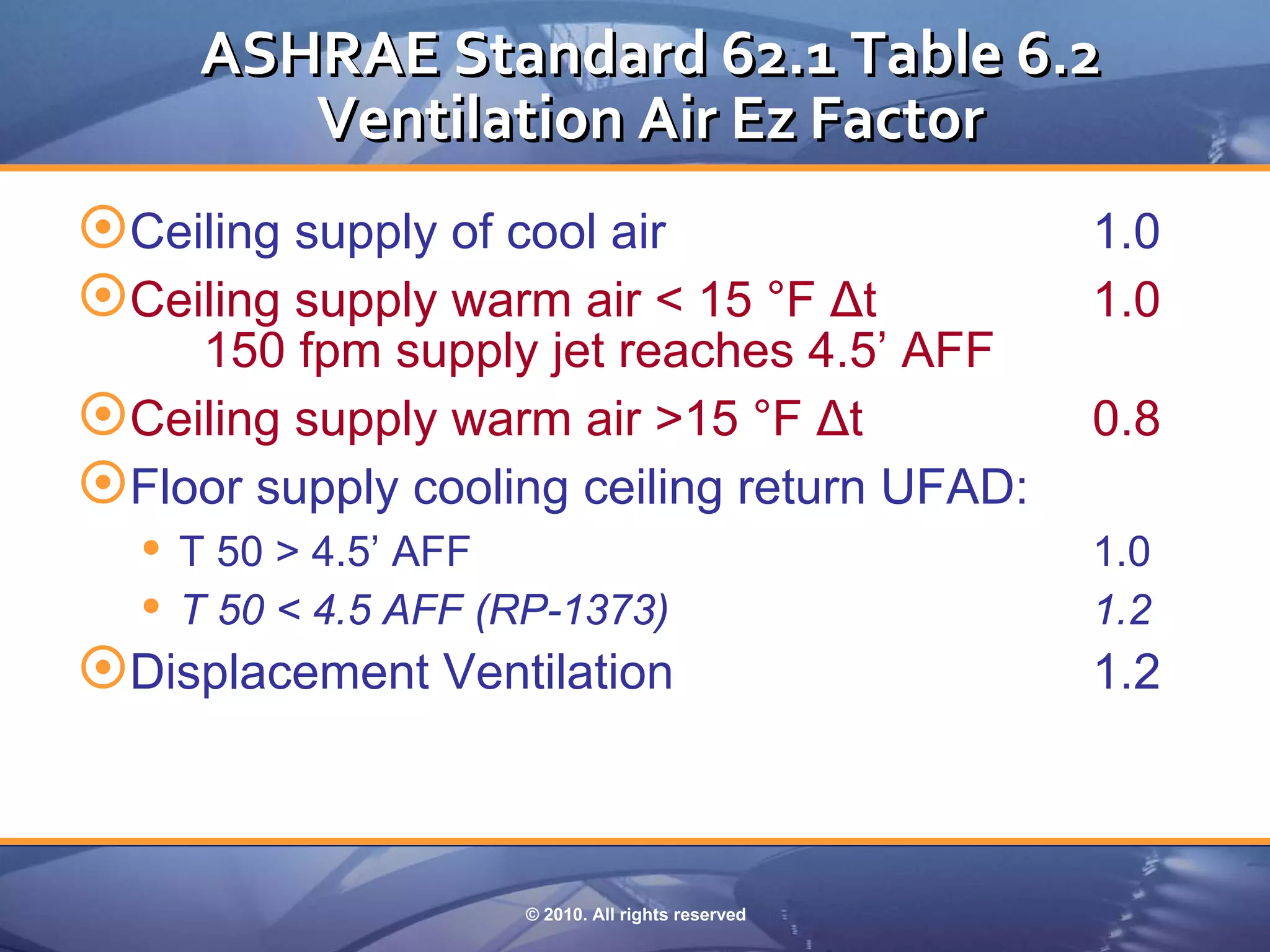
ASHRAE Standard 62.1 Table 6.2
        Ventilation Air Ez Factor
Ceiling supply of cool air                      1.0
Ceiling supply warm air < 15 °F Δt              1.0
    150 fpm supply jet reaches 4.5’ AFF
Ceiling supply warm air >15 °F Δt               0.8
Floor supply cooling ceiling return UFAD:
  T 50 > 4.5’ AFF                               1.0
  T 50 < 4.5 AFF (RP-1373)                      1.2
Displacement Ventilation                        1.2


                   © 2010. All rights reserved
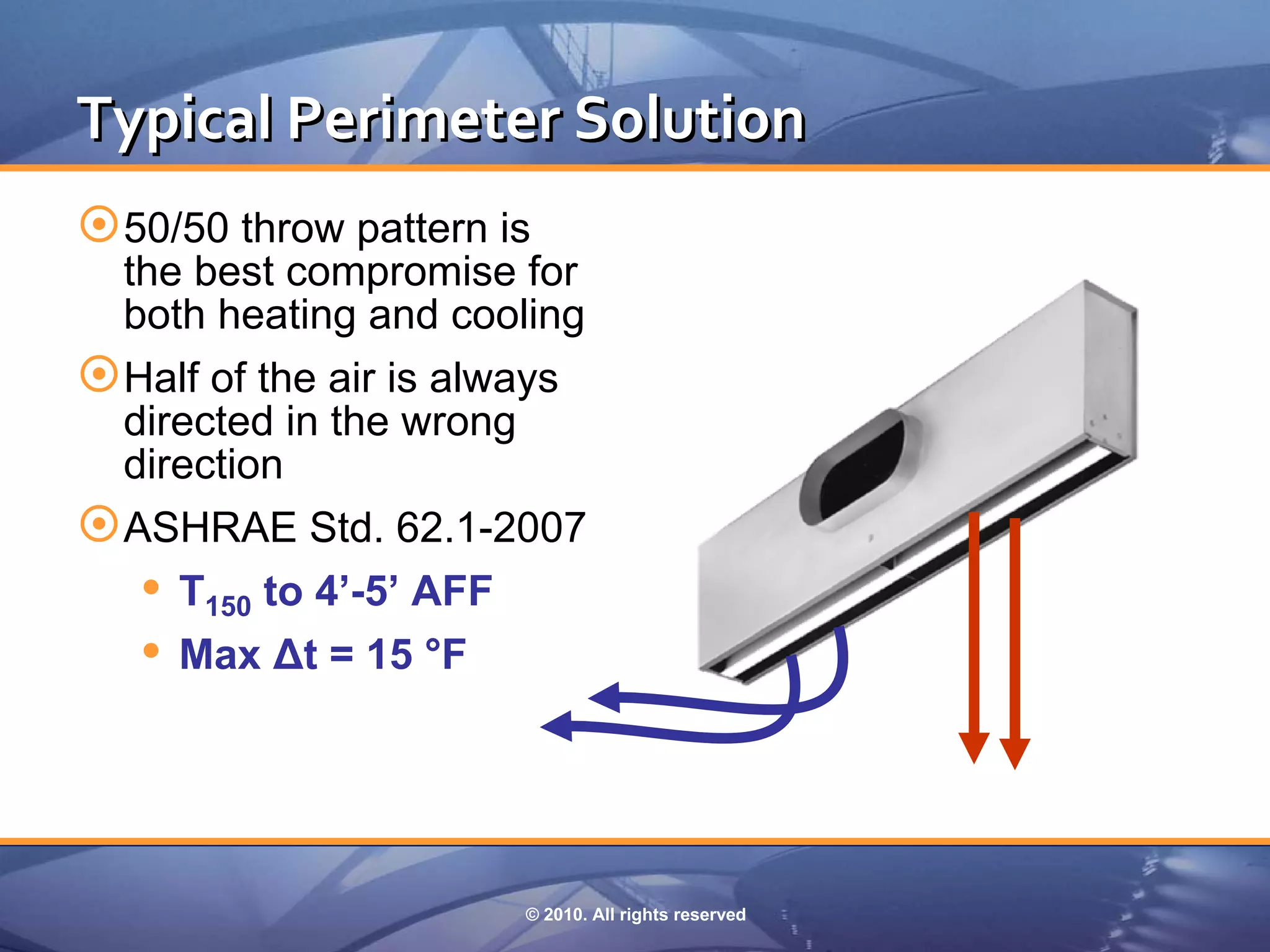
Typical Perimeter Solution
 50/50 throw pattern is
  the best compromise for
  both heating and cooling
 Half of the air is always
  directed in the wrong
  direction
 ASHRAE Std. 62.1-2007
    T150 to 4’-5’ AFF
    Max Δt = 15 °F


                       © 2010. All rights reserved
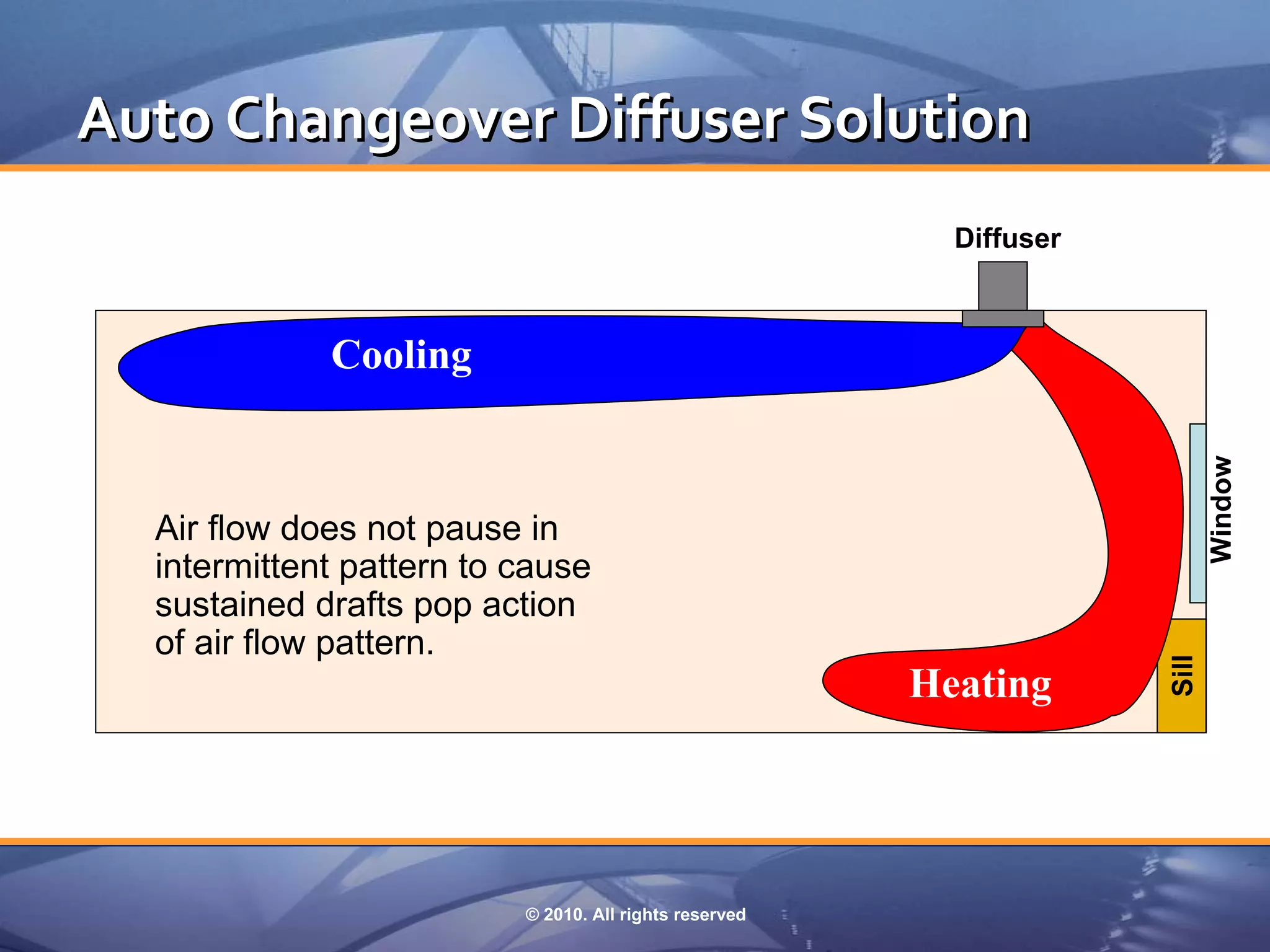
Auto Changeover Diffuser Solution
                                                          Diffuser


             Cooling


                                                                            Window
  Air flow does not pause in
  intermittent pattern to cause
  sustained drafts pop action
  of air flow pattern.


                                                                     Sill
                                                        Heating


                          © 2010. All rights reserved
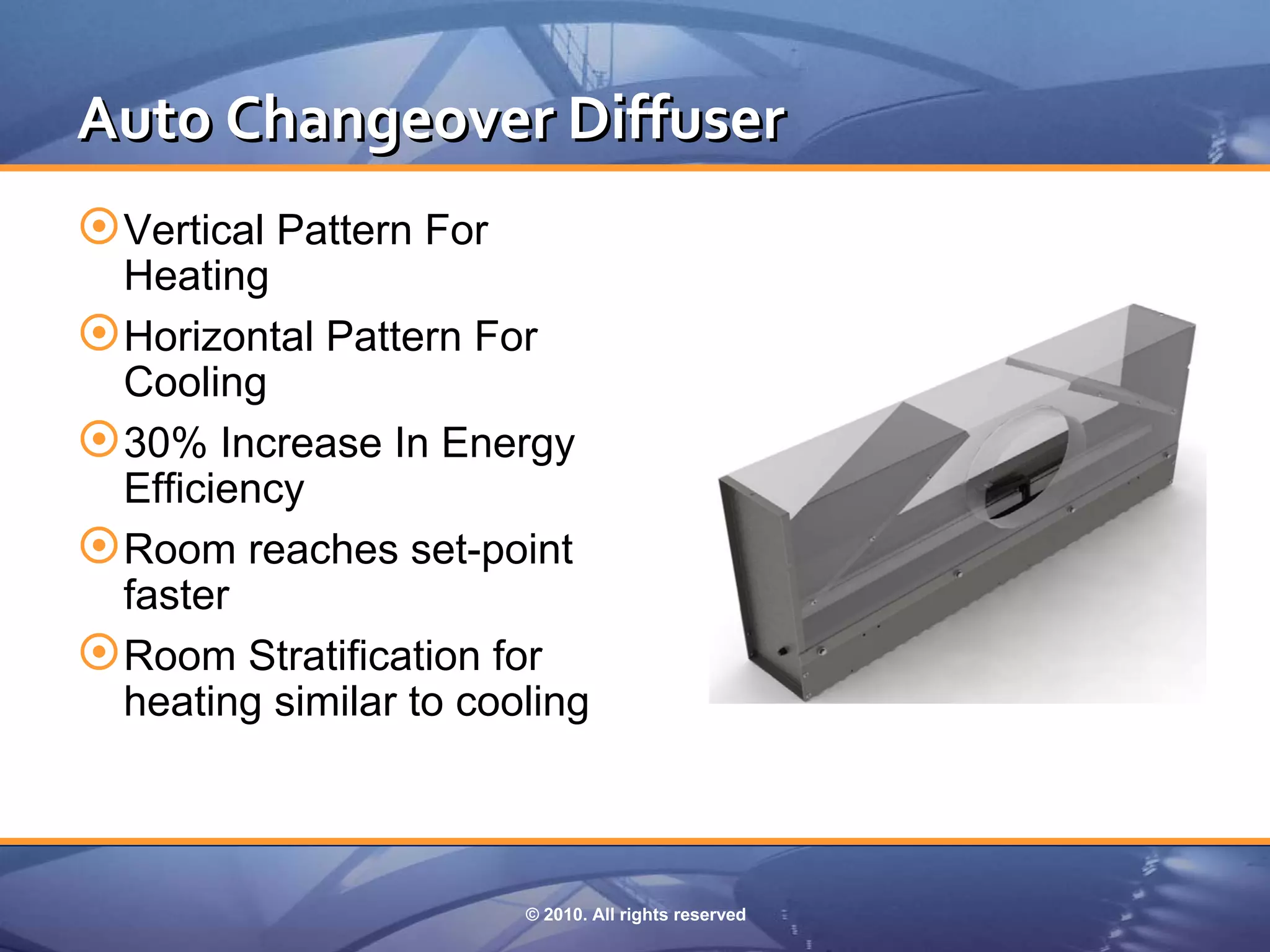
Auto Changeover Diffuser
 Vertical Pattern For
  Heating
 Horizontal Pattern For
  Cooling
 30% Increase In Energy
  Efficiency
 Room reaches set-point
  faster
 Room Stratification for
  heating similar to cooling


                         © 2010. All rights reserved
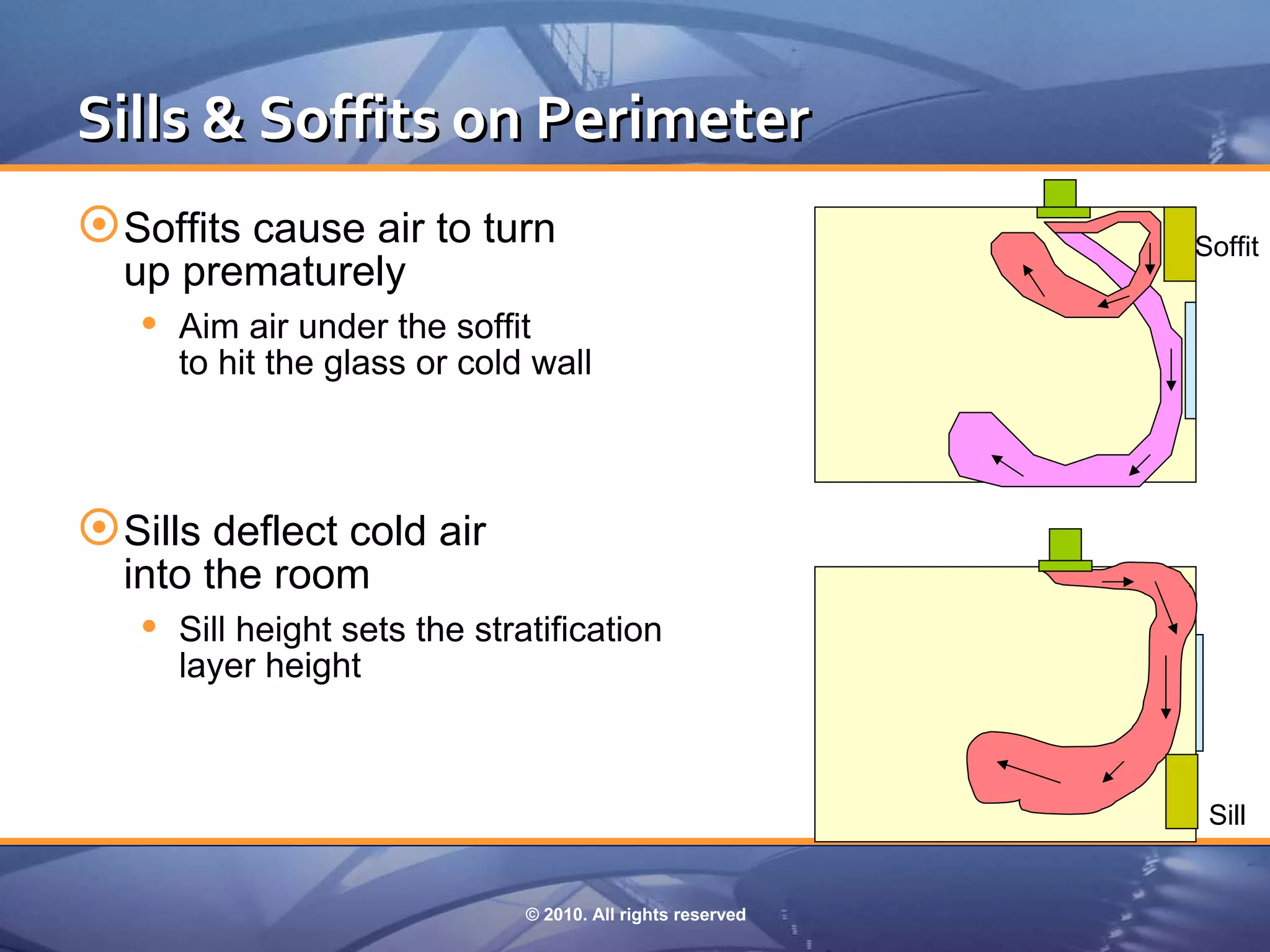
Sills & Soffits on Perimeter
 Soffits cause air to turn                                 Soffit
  up prematurely
    Aim air under the soffit
      to hit the glass or cold wall


 Sills deflect cold air
  into the room
    Sill height sets the stratification
      layer height


                                                             Sill


                              © 2010. All rights reserved
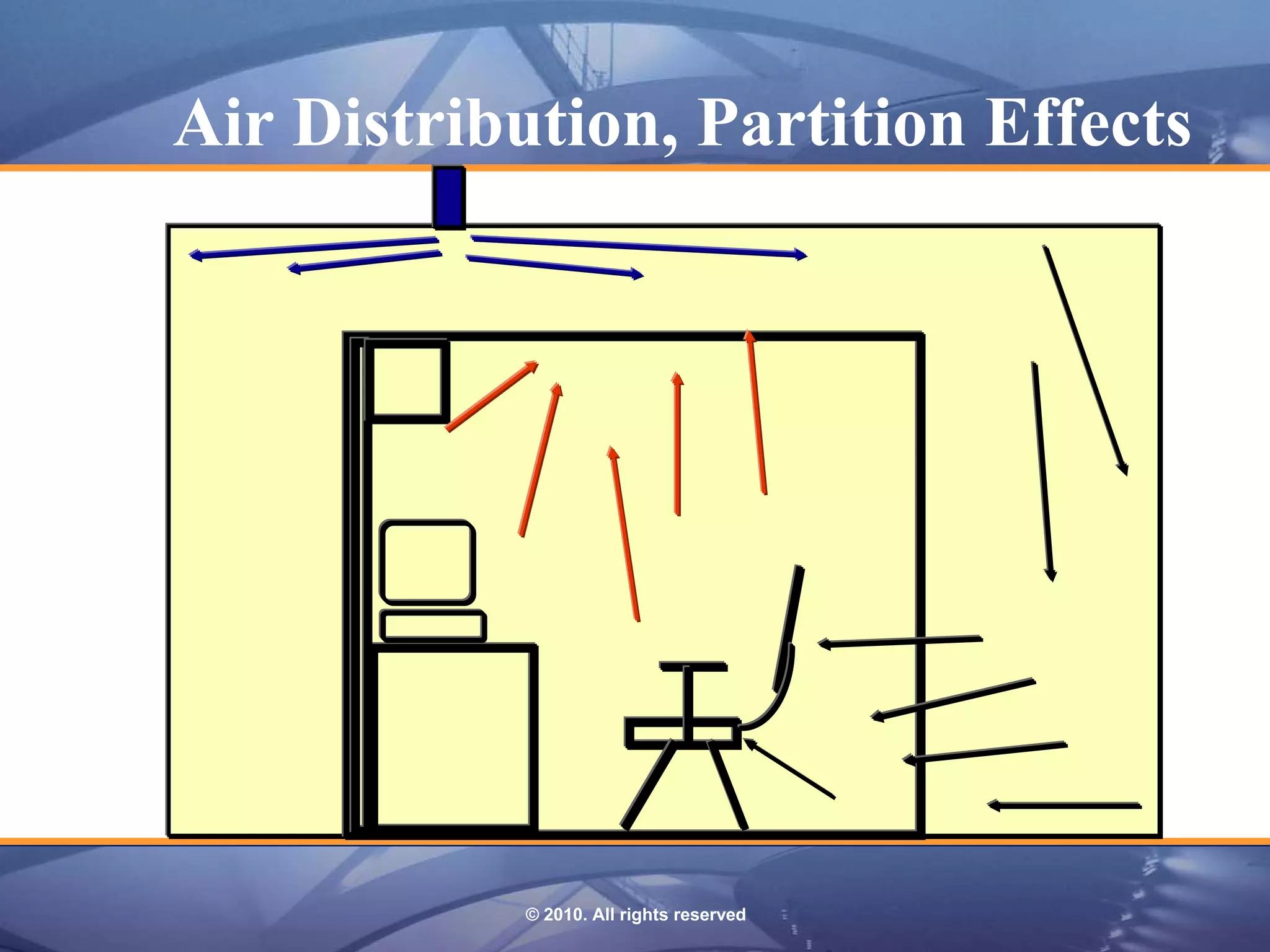
Air Distribution, Partition Effects


            © 2010. All rights reserved
Partially Mixed Air Distribution
UFAD – Interior Zone
Perimeter with Series Fan Terminal
Perimeter with Plenum VAV Cooling
Perimeter with Passive Heating


                  © 2010. All rights reserved
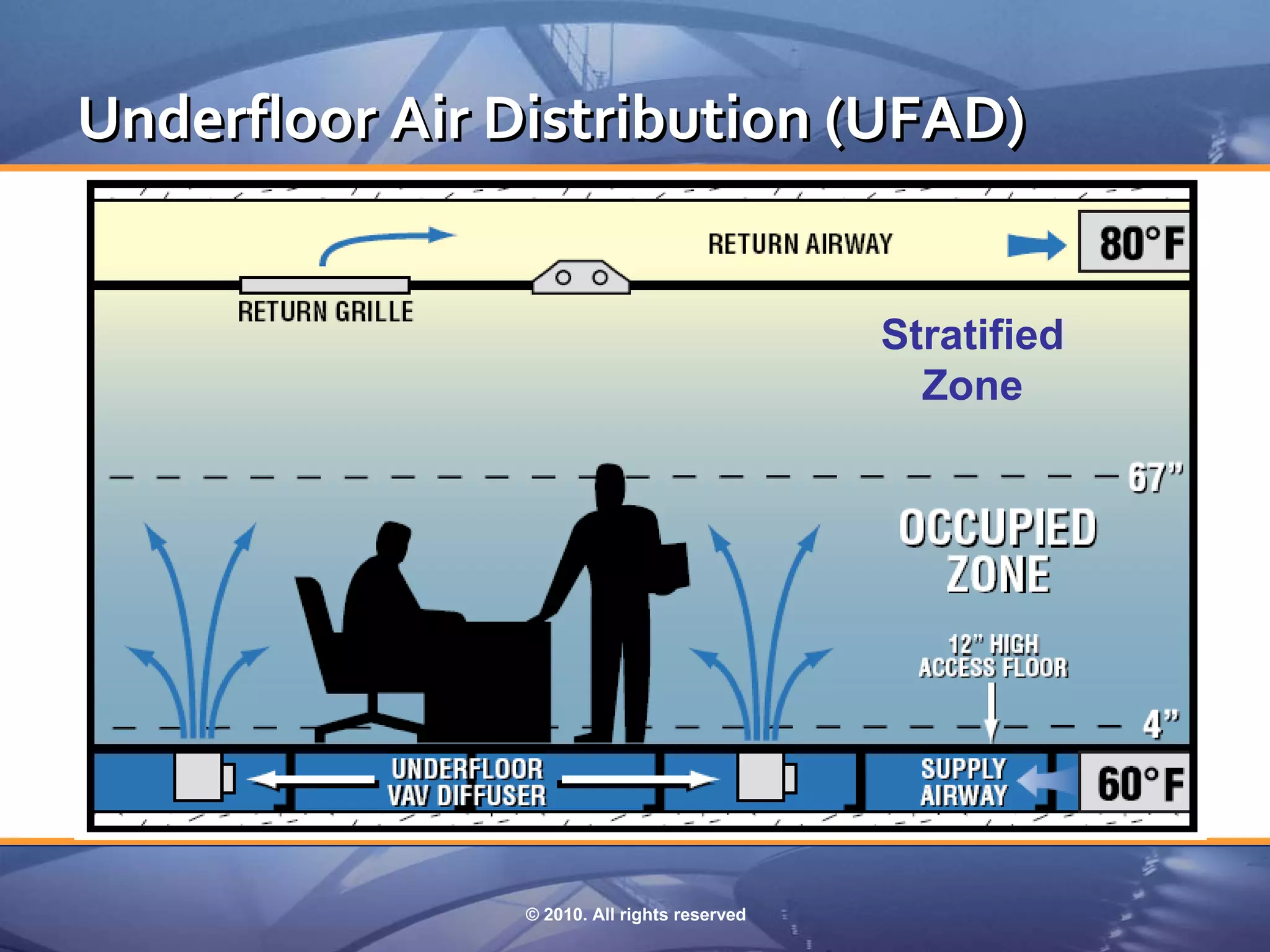
Underfloor Air Distribution (UFAD)


                                              Stratified
                                                Zone


                © 2010. All rights reserved
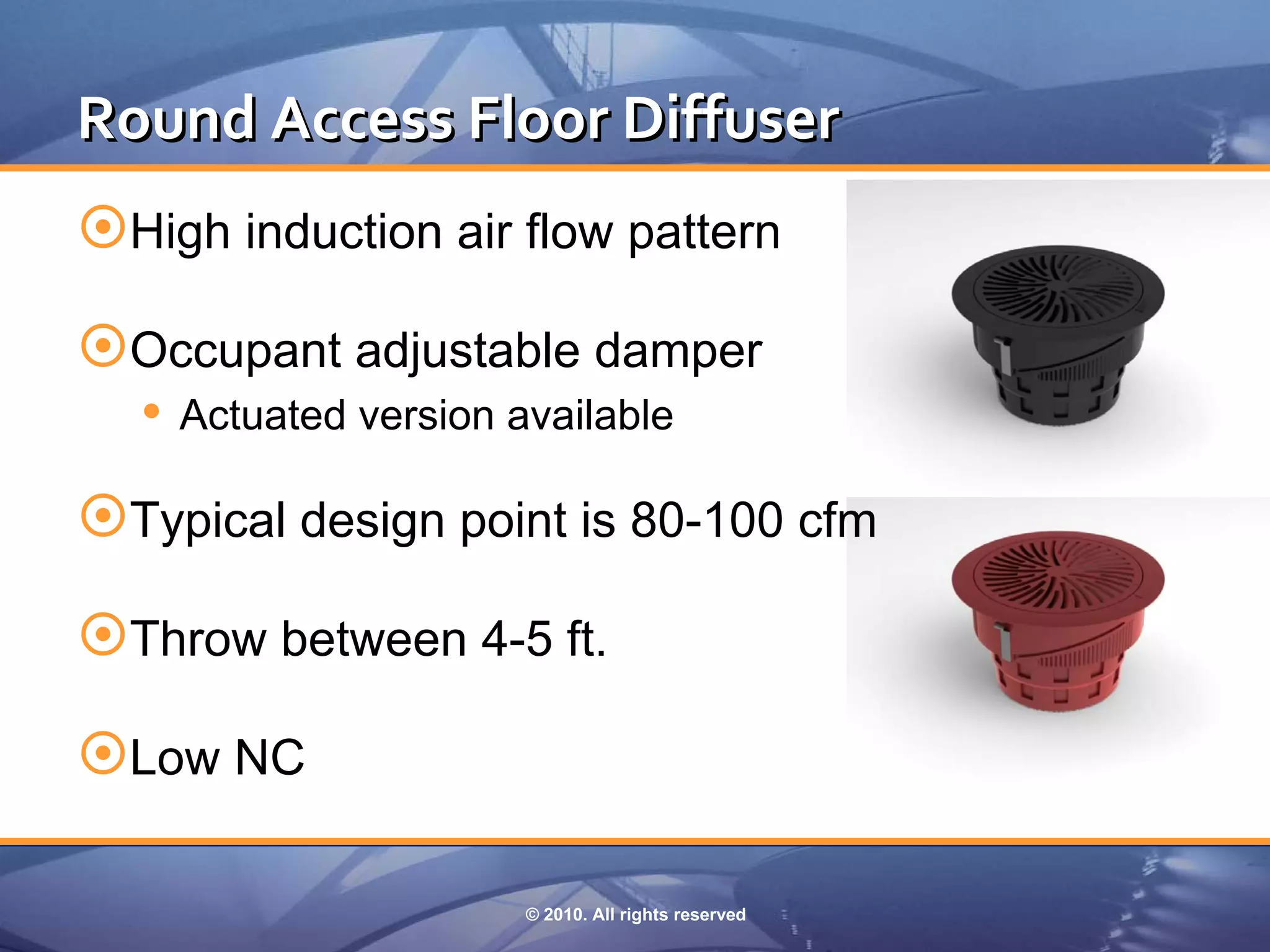
Round Access Floor Diffuser
High induction air flow pattern
Occupant adjustable damper
   Actuated version available

Typical design point is 80-100 cfm
Throw between 4-5 ft.
Low NC

                      © 2010. All rights reserved
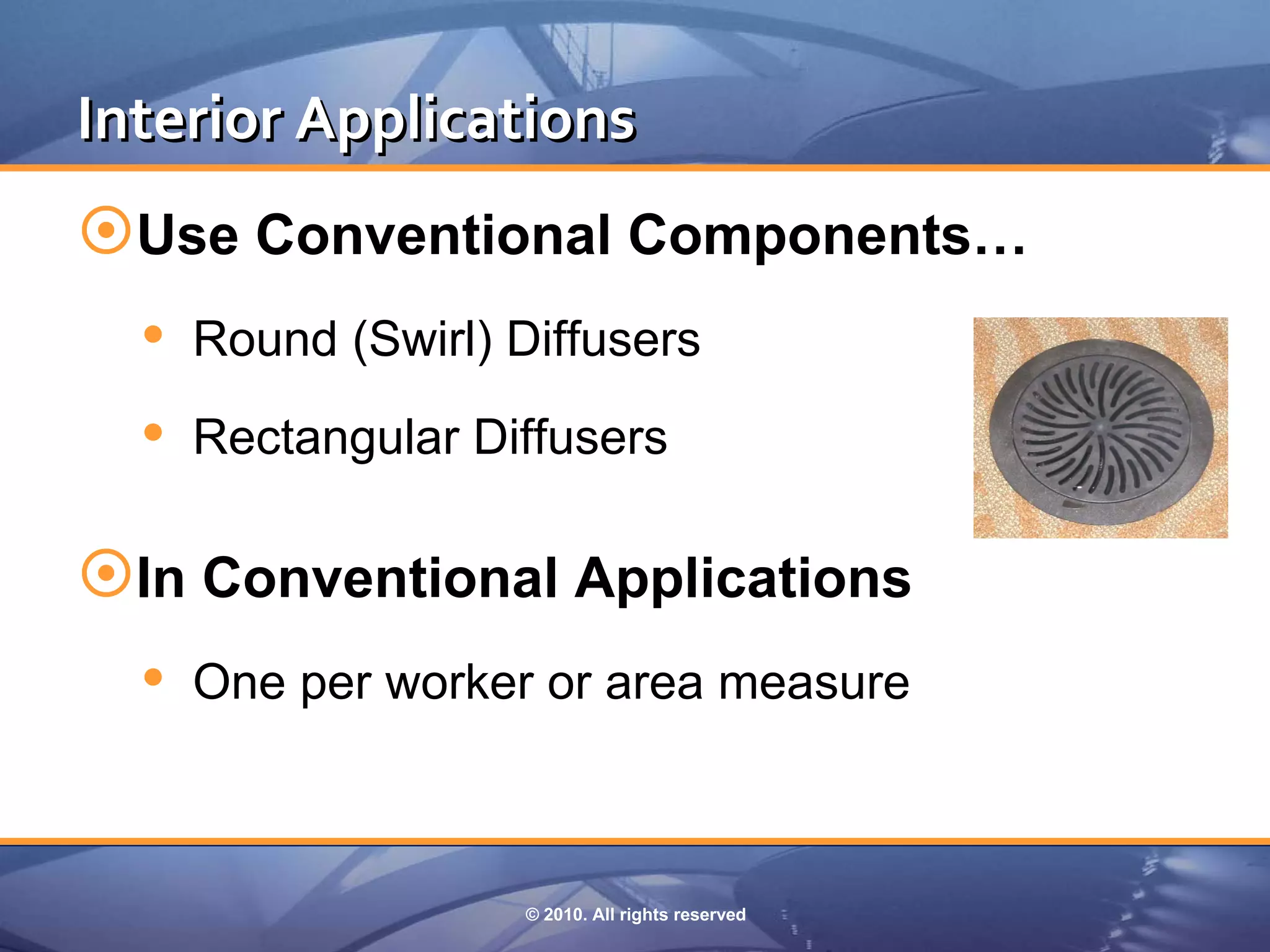
Interior Applications
Use Conventional Components…
   Round (Swirl) Diffusers
   Rectangular Diffusers

In Conventional Applications
   One per worker or area measure


                   © 2010. All rights reserved
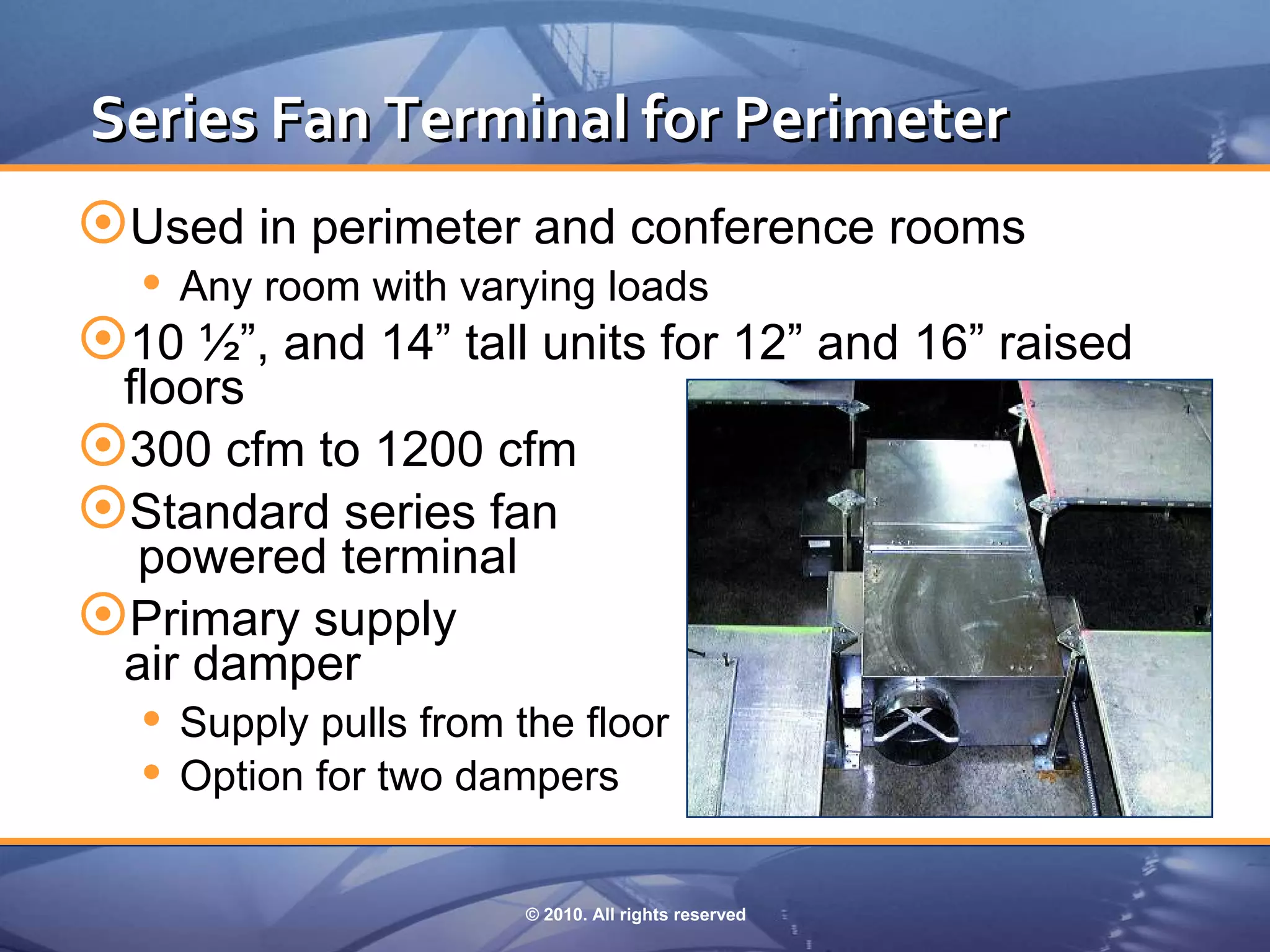
Series Fan Terminal for Perimeter
Used in perimeter and conference rooms
   Any room with varying loads
10 ½”, and 14” tall units for 12” and 16” raised
 floors
300 cfm to 1200 cfm
Standard series fan
  powered terminal
Primary supply
 air damper
   Supply pulls from the floor
   Option for two dampers

                    © 2010. All rights reserved
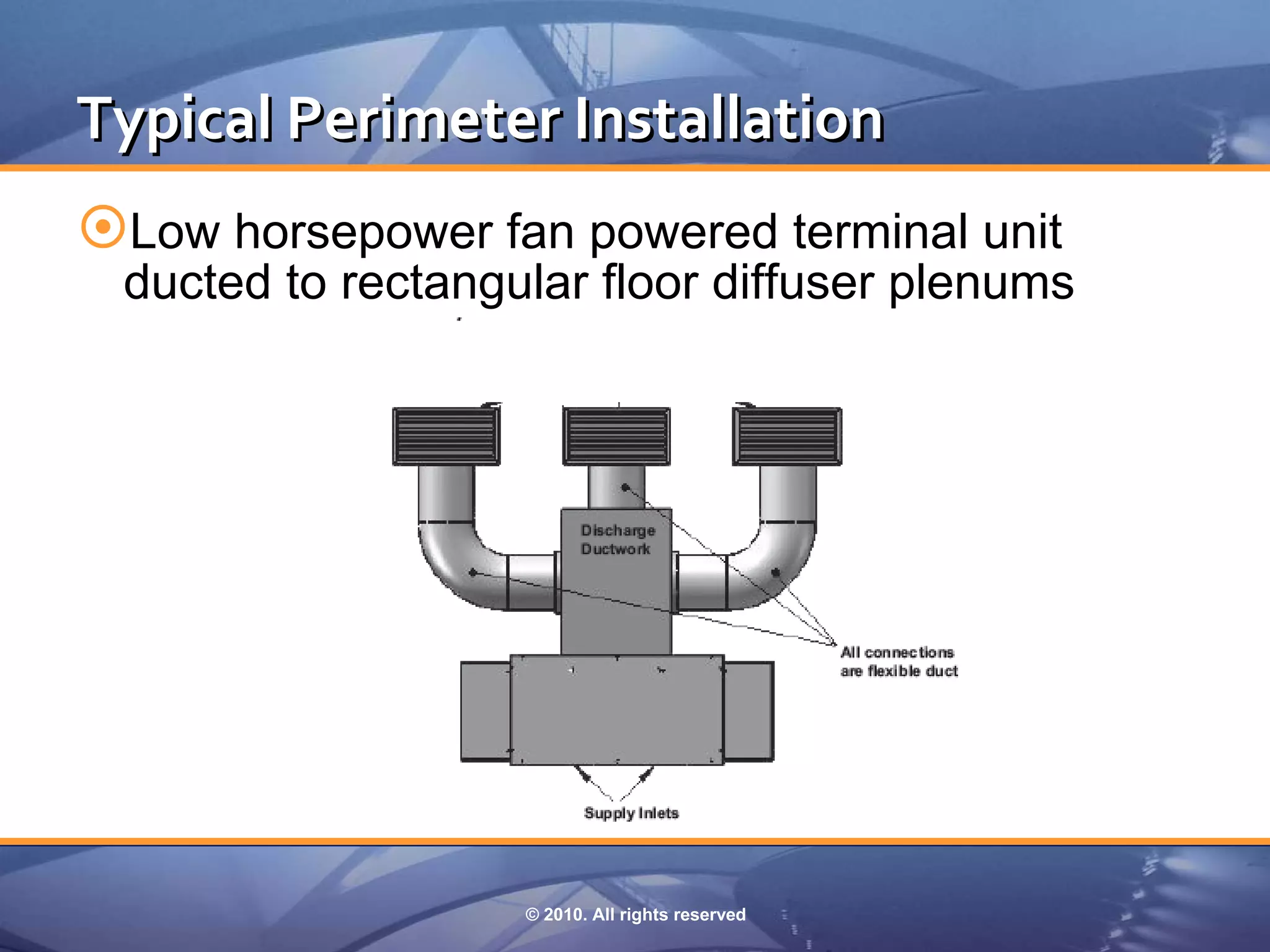
Typical Perimeter Installation
Low horsepower fan powered terminal unit
 ducted to rectangular floor diffuser plenums


                   © 2010. All rights reserved
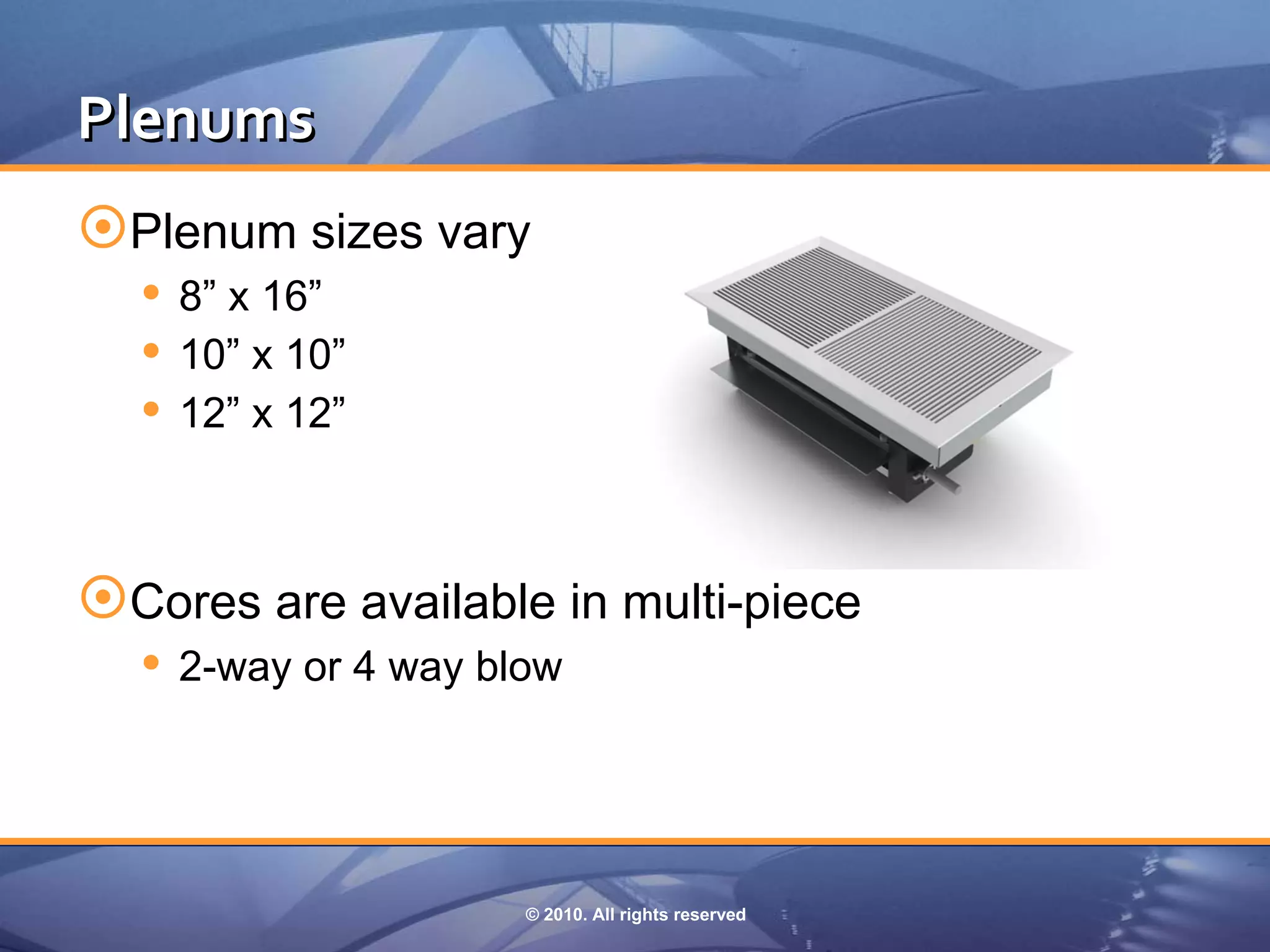
Plenums 
Plenum sizes vary
   8” x 16”
   10” x 10”
   12” x 12”


Cores are available in multi-piece
   2-way or 4 way blow


                     © 2010. All rights reserved
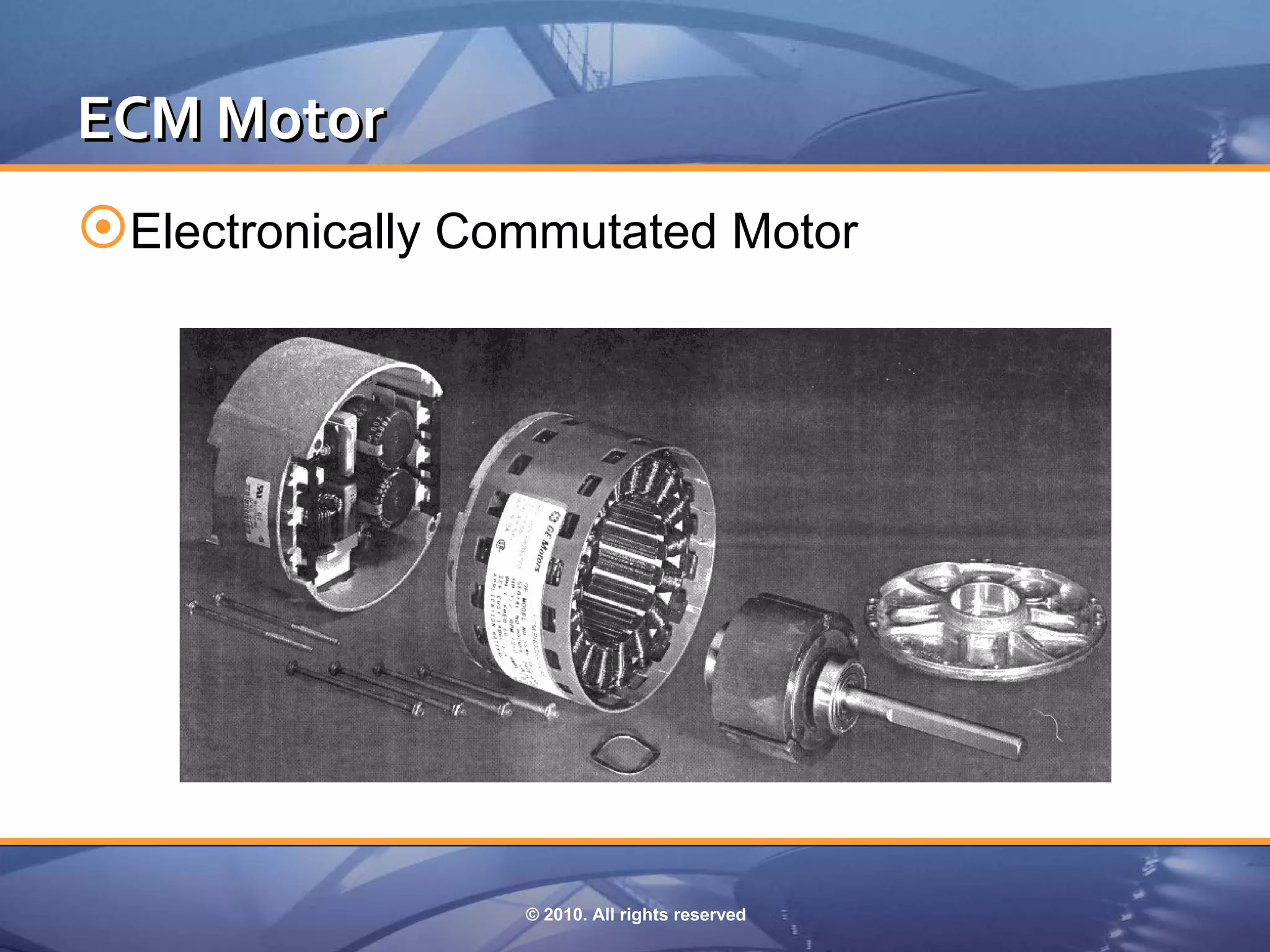
ECM Motor
Electronically Commutated Motor


                  © 2010. All rights reserved
ECM Motor
Brushless, DC motor
Converts AC to DC for motor
Ultra high efficiency motor
   Efficiencies of up to 70% across the entire operating
    range
Energy savings
Control of fan speed through DDC controller


                      © 2010. All rights reserved
Energy Savings
350 watts savings = .350 kW

250 days/year x 12 hours/day
 = 3000 operating hours/year

.350 kW x 3000 hours = 1050 kWh

1050 kWh x $.10 per kWh
 = $105 per unit per year energy savings!
   Does not include demand charges


                   © 2010. All rights reserved
PWM 
The ECM motor is controlled by a PWM (Pulse
 Width Modulated) signal
Voltage pulses over a specific time period
Voltage is proportional to cfm
Low voltage device
Manual PWM is adjusted like a SCR, with a
 screwdriver
Remote PWM is controlled by a 0-10V signal from
 the DDC controller


                  © 2010. All rights reserved
Additional ECM Benefits
Soft start
  Motors are set to start up slowly
No brushes
  No noise associated with brushes
  Titus has found no significant overall sound reduction
     with the ECM motor
    No wearing of brushes
ECM motor life is ~90,000 hours (30 years of
 typical series fan box life)
Cooler operation

                       © 2010. All rights reserved
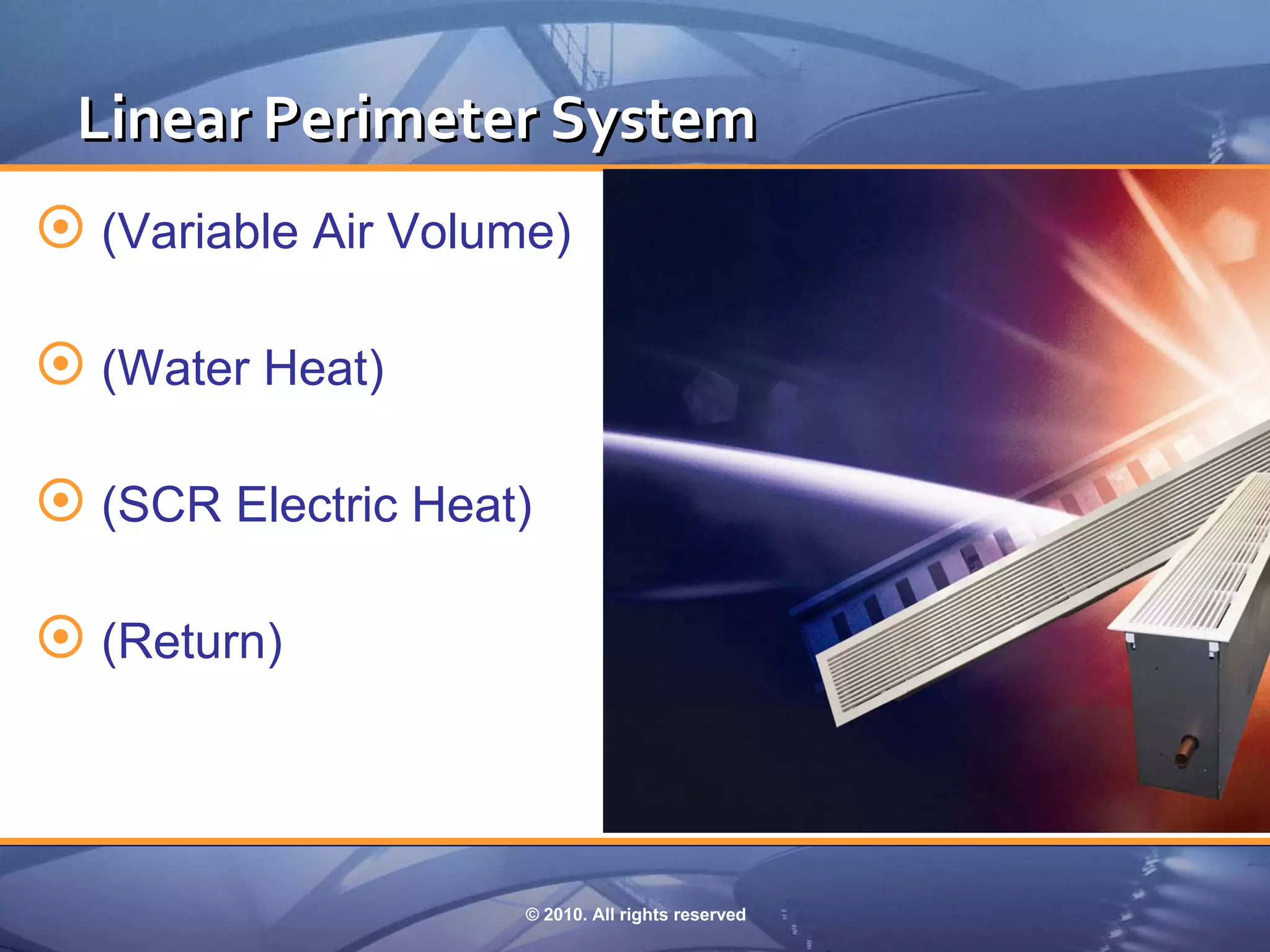
Linear Perimeter System
 (Variable Air Volume)

 (Water Heat)

 (SCR Electric Heat)

 (Return)


                     © 2010. All rights reserved
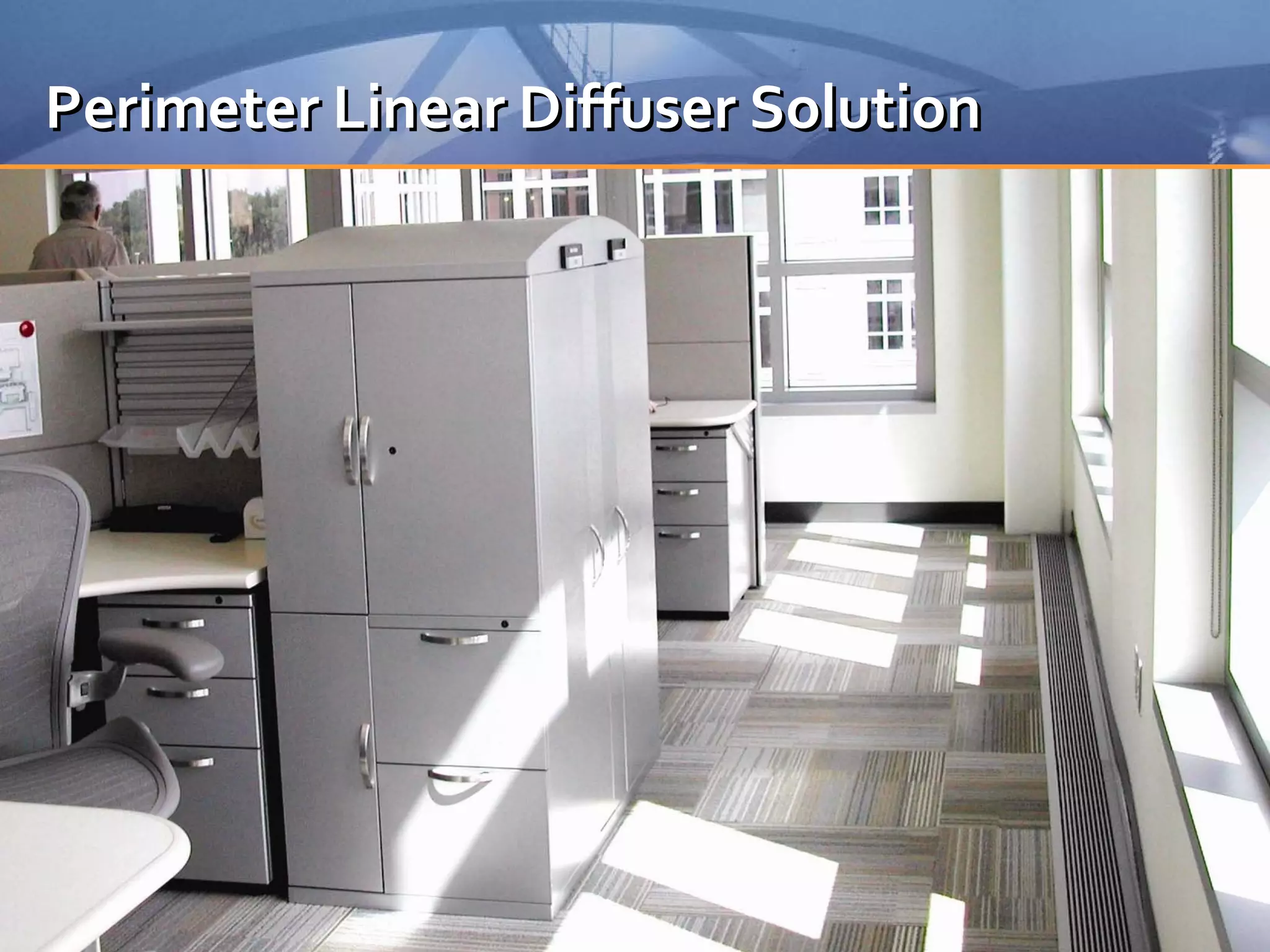
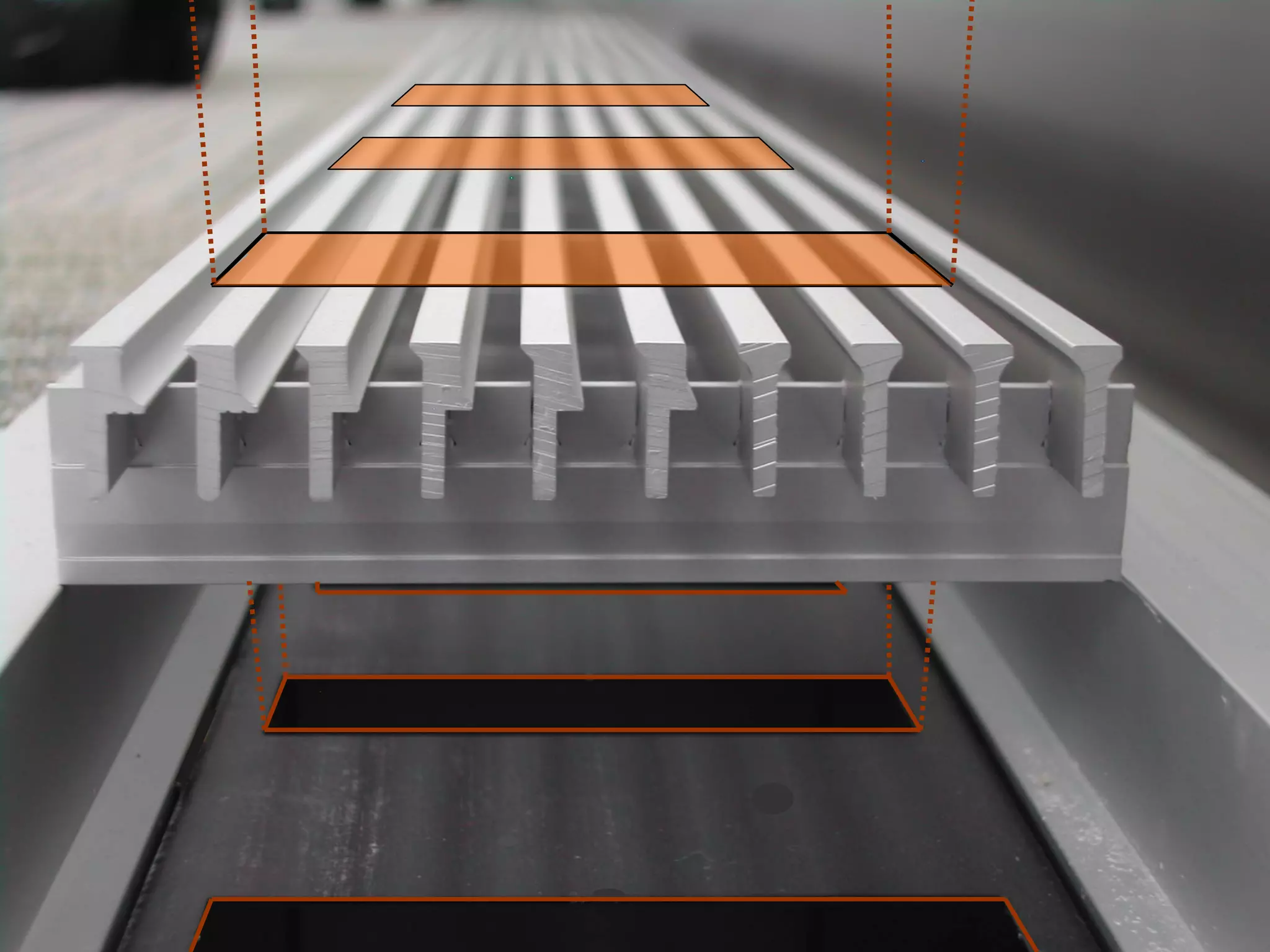
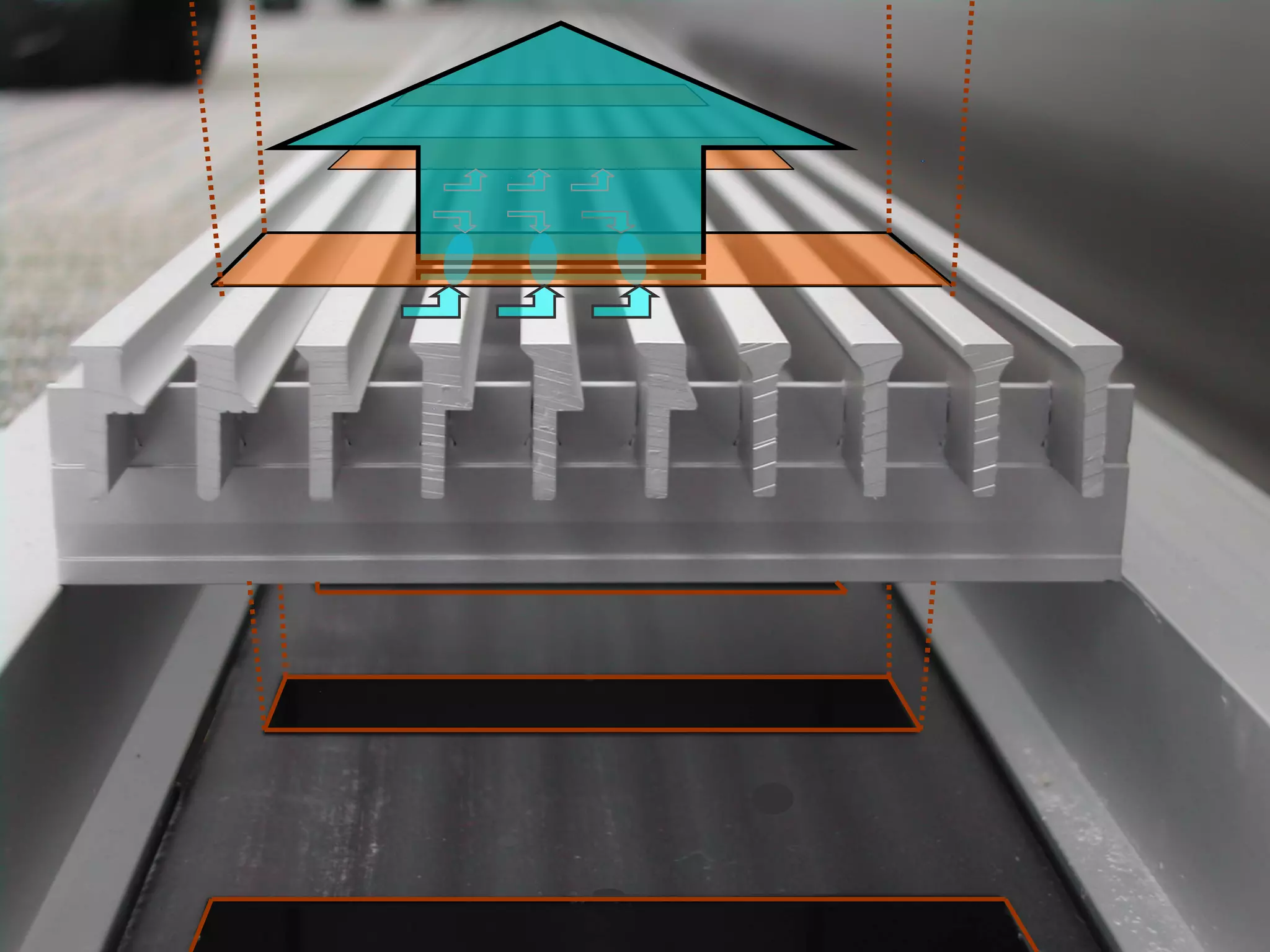
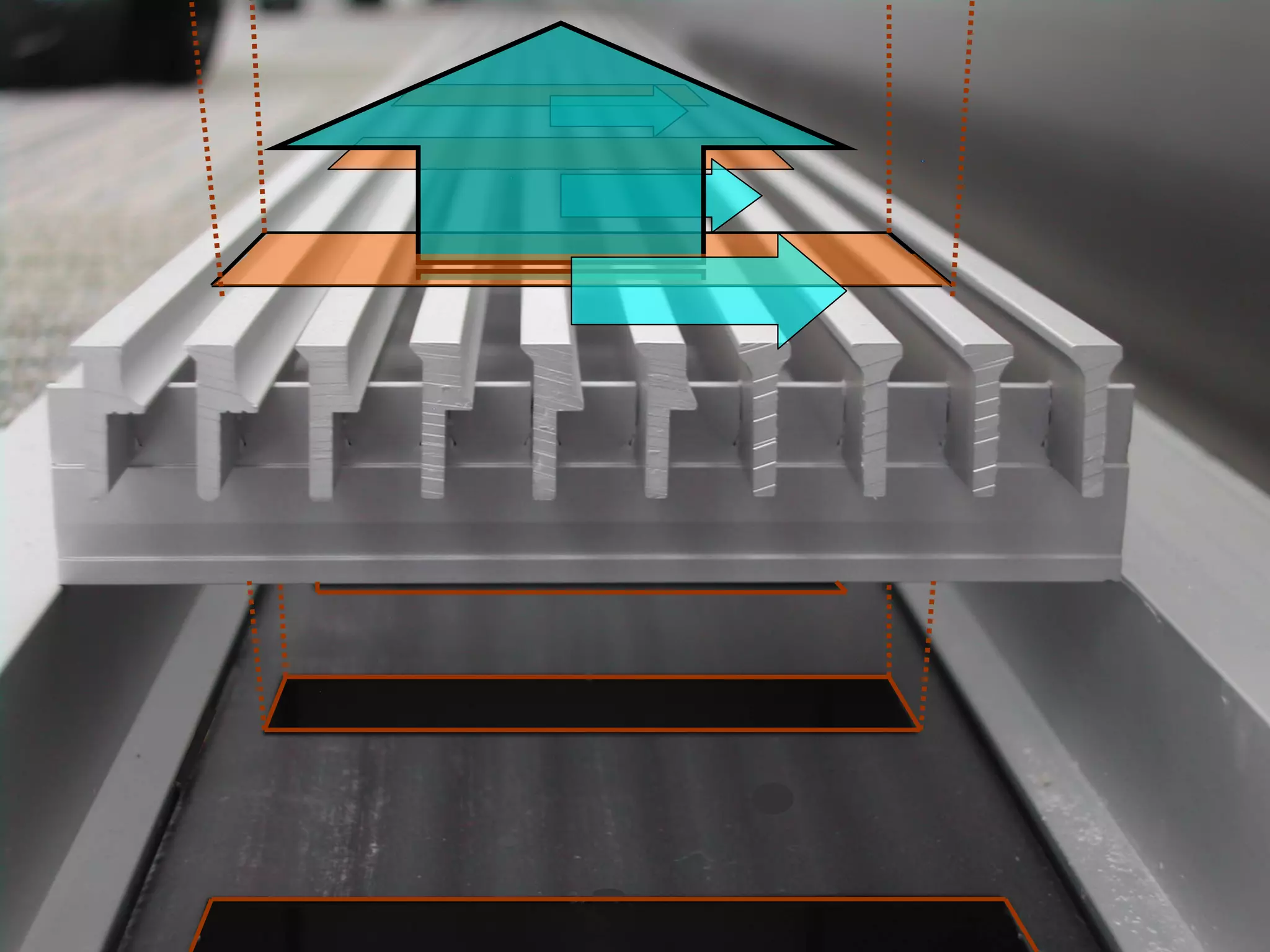
Perimeter Linear Diffuser Solution


                 © 2010. All rights reserved
Transverse Apertures

      © 2010. All rights reserved
Transverse Apertures

      © 2010. All rights reserved
Transverse Apertures

      © 2010. All rights reserved
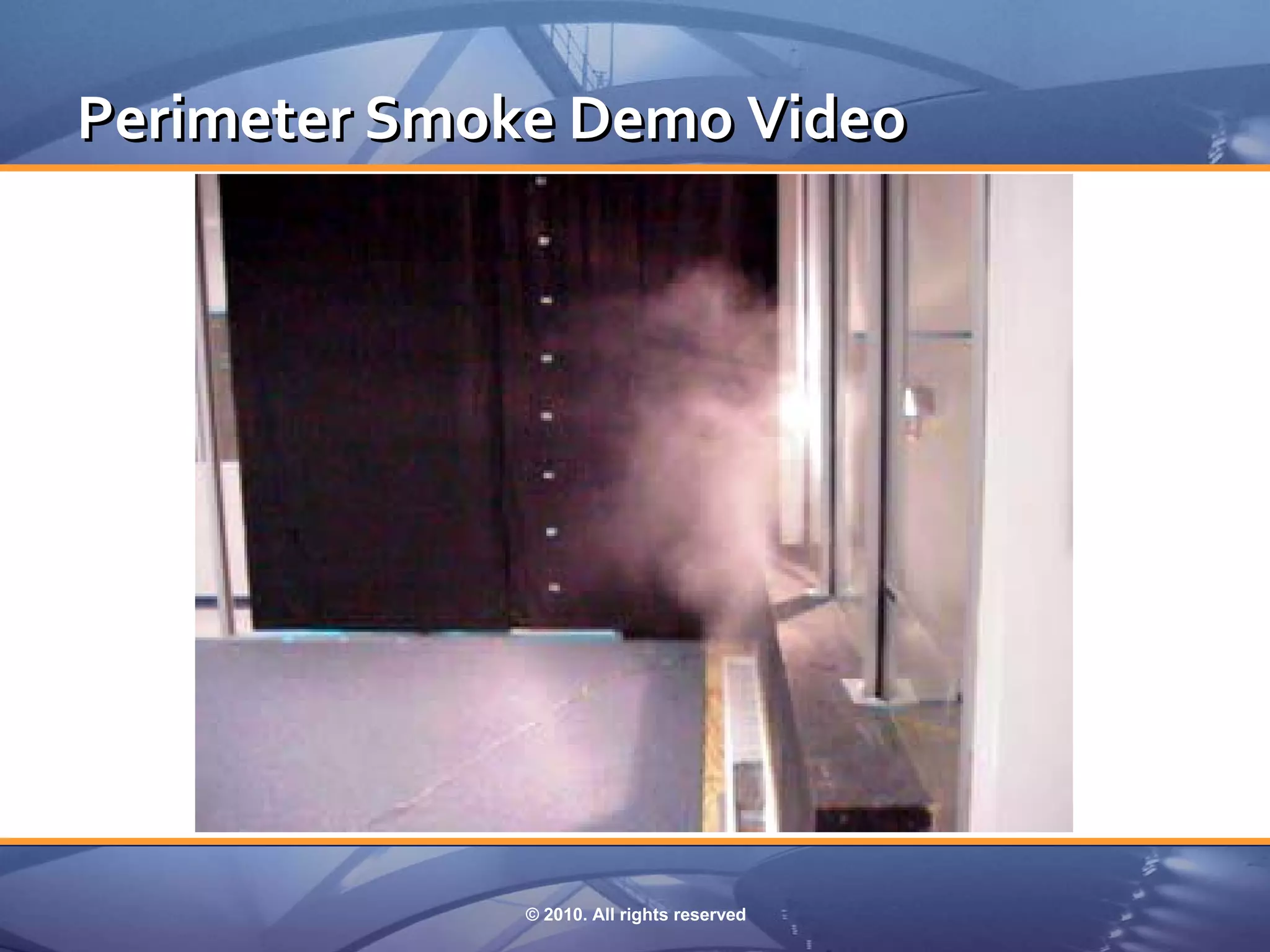
Perimeter Smoke Demo Video


              © 2010. All rights reserved
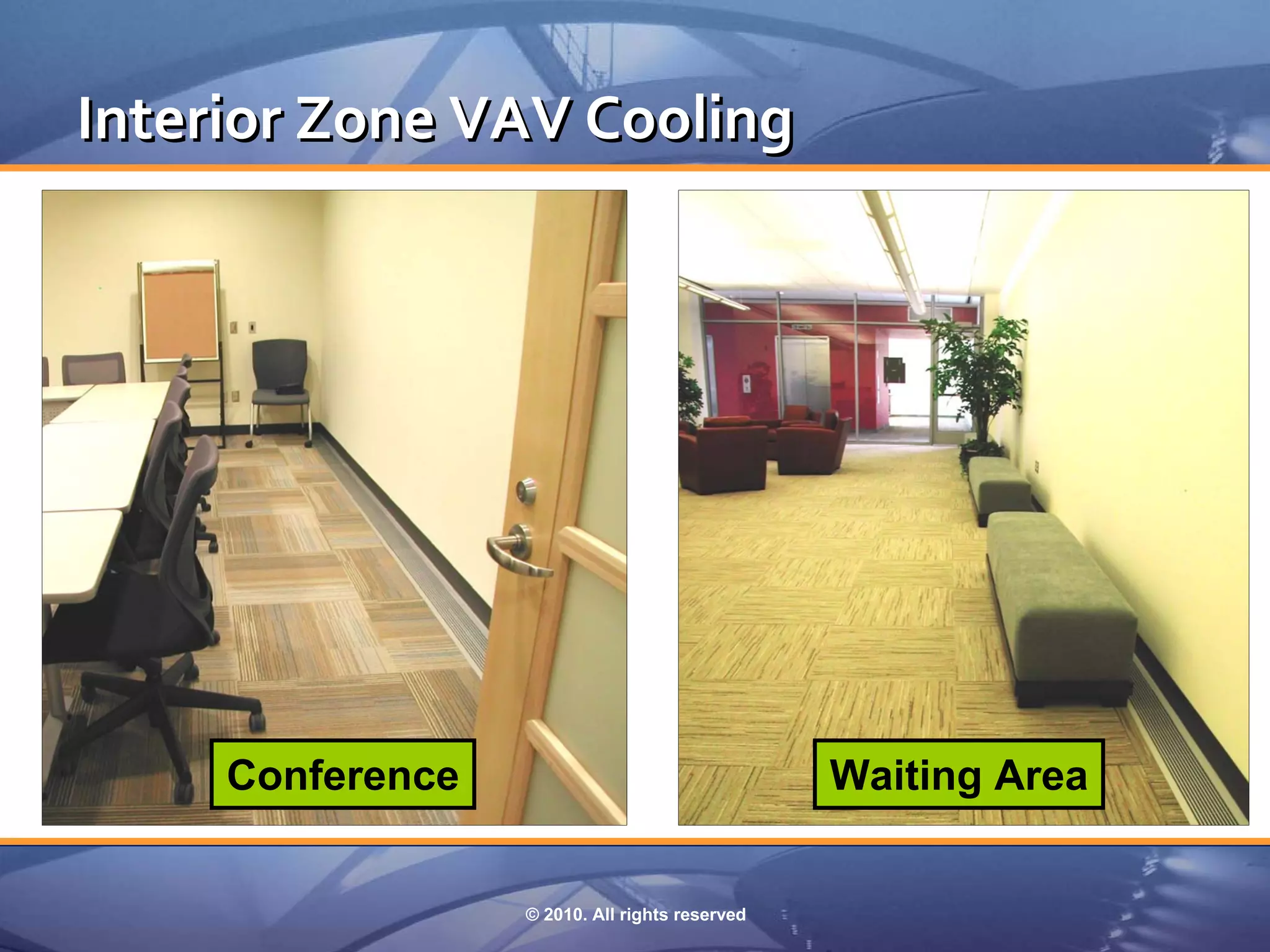
Interior Zone VAV Cooling


     Conference                                 Waiting Area


                  © 2010. All rights reserved
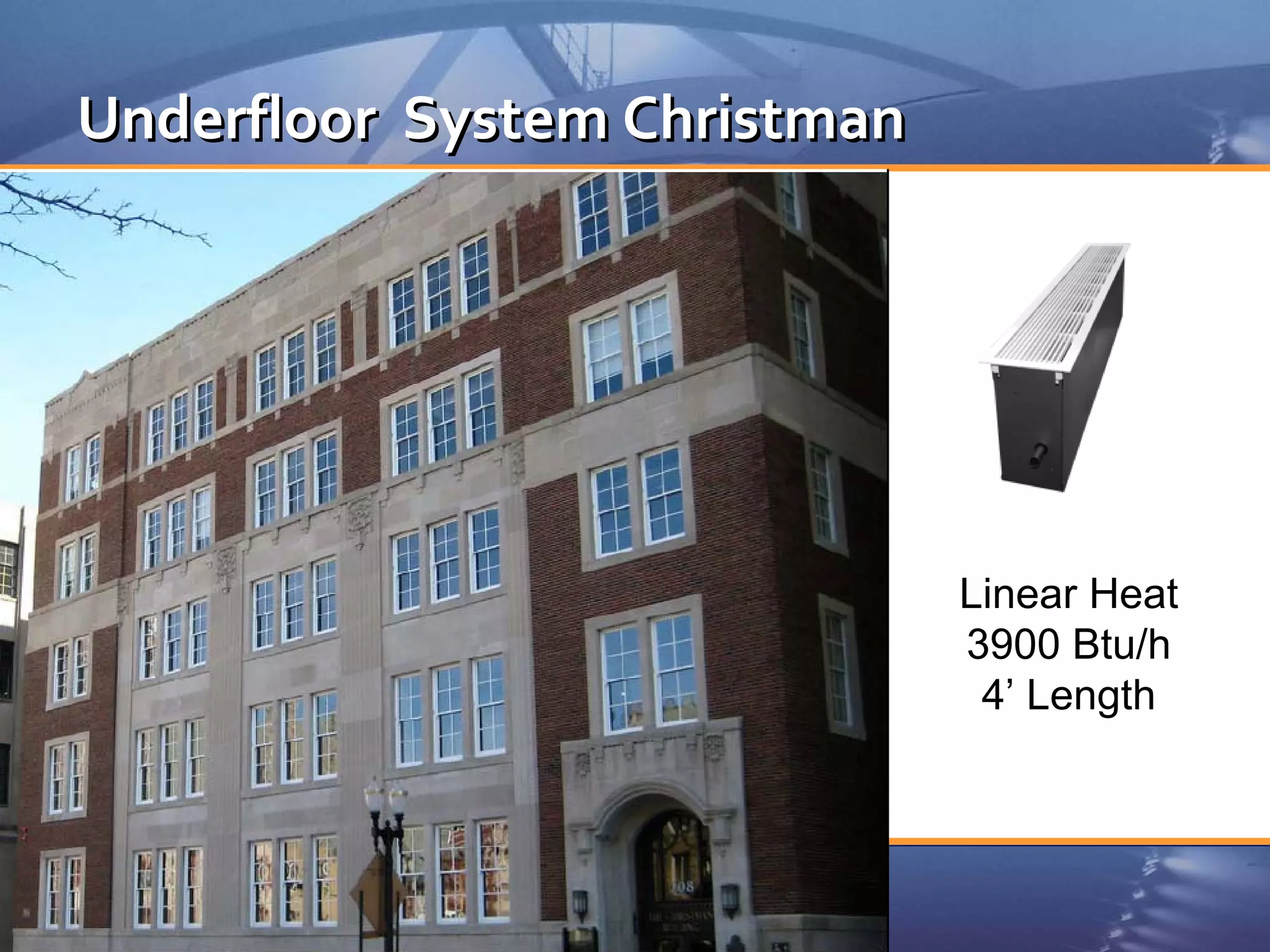
Underfloor  System Christman


                                             Linear Heat
                                             3900 Btu/h
                                              4’ Length


               © 2010. All rights reserved
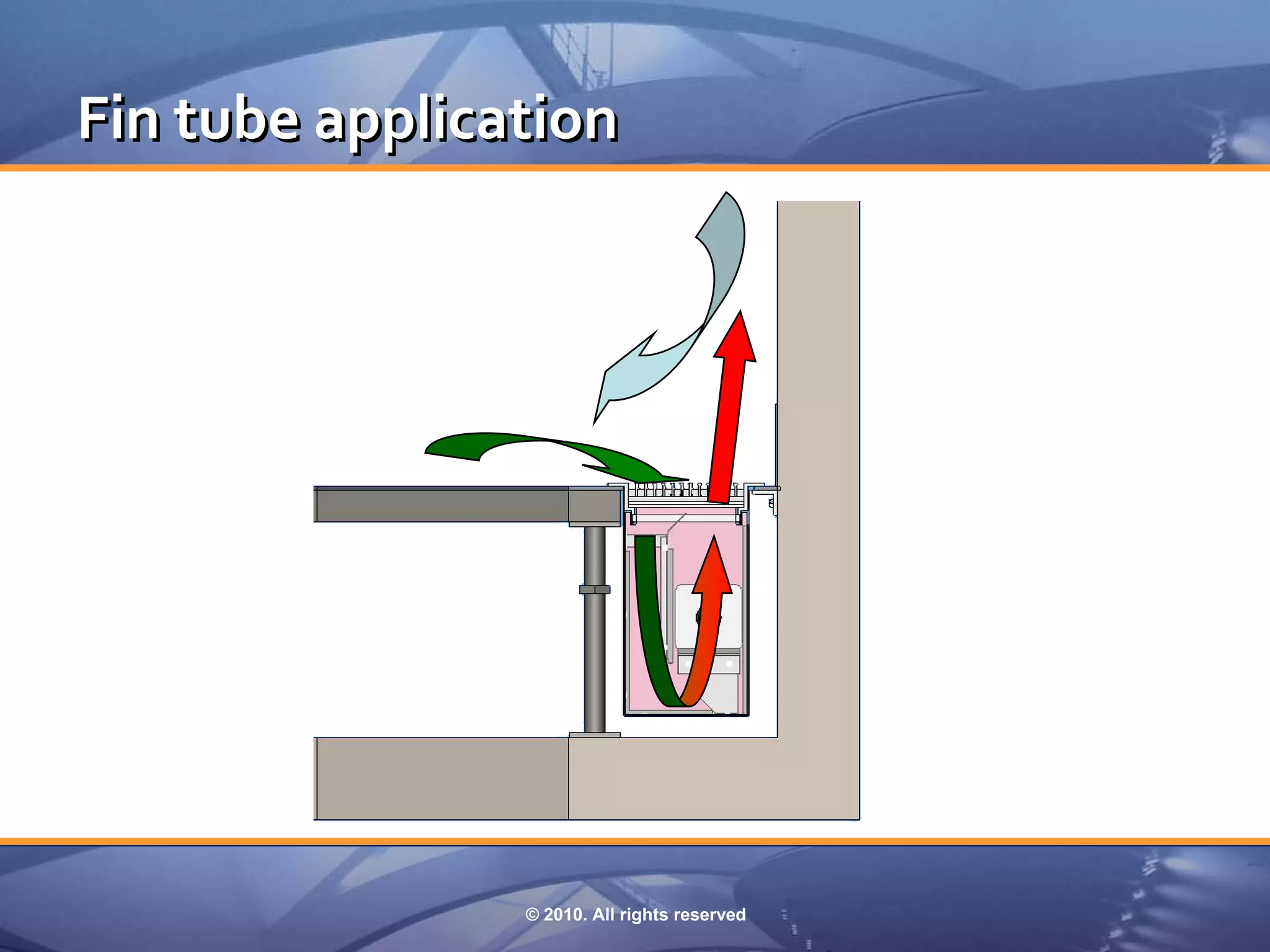
Fin tube application


                © 2010. All rights reserved
Fully Stratified Air Systems
Energy & Comfort Optimization (ECO)
Basic system concepts
Displacement diffusers


                  © 2010. All rights reserved
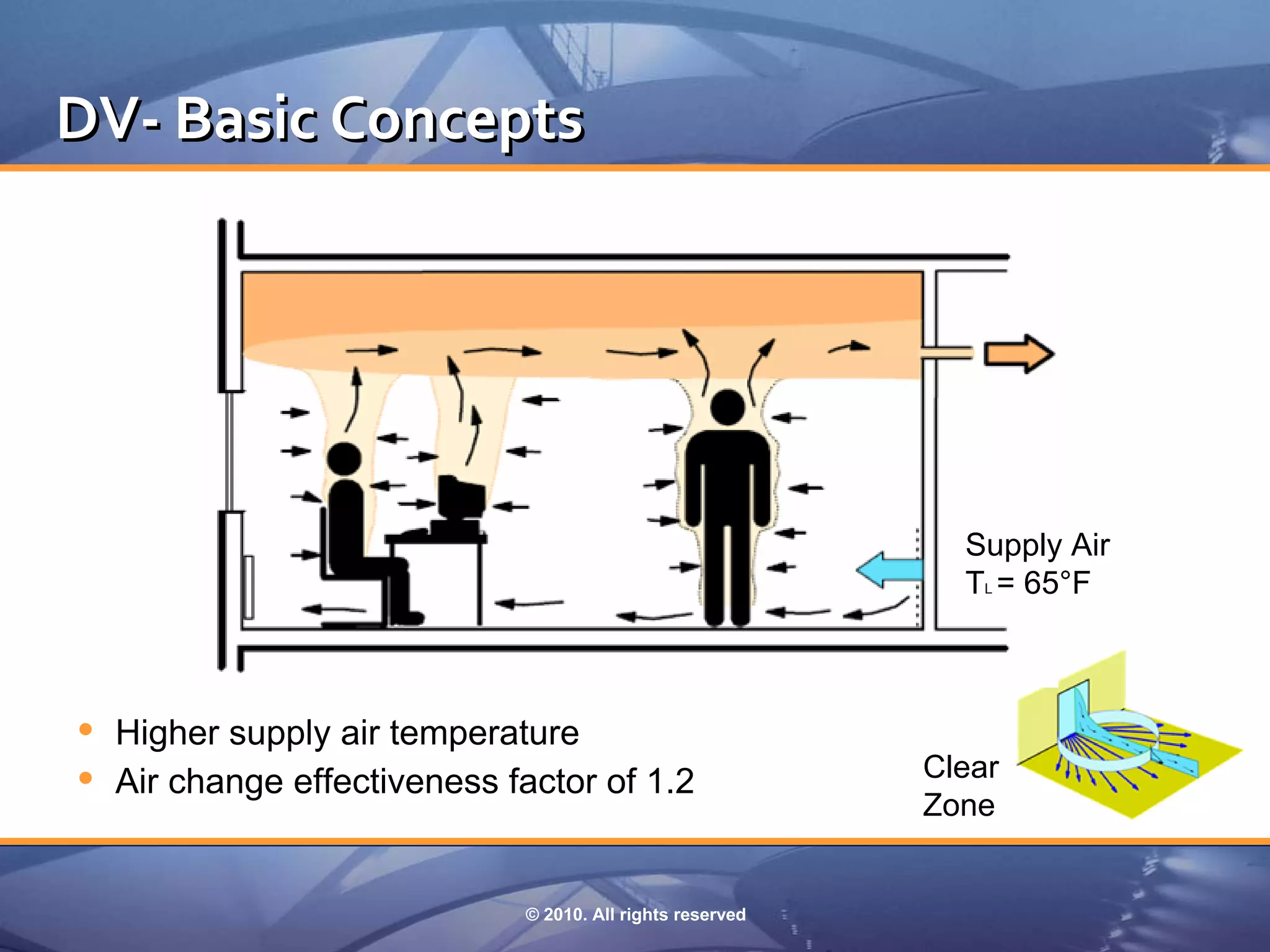
DV‐ Basic Concepts


                                                             Supply Air
                                                             TL = 65°F


 Higher supply air temperature
 Air change effectiveness factor of 1.2                   Clear
                                                           Zone


                             © 2010. All rights reserved
Displacement Ventilation Applications
Good application
   Room height > 9.5 ft
   Open Plan Offices, Classrooms, & Meeting
   Rooms

   Casinos, Restaurants, Theaters, &
   Auditoriums


                  © 2010. All rights reserved
Displacement Ventilation Applications
Poor application
   Room height < 8 ft
   Surplus heat is the main problem – not air
   quality

   In combination with chilled beams


                  © 2010. All rights reserved
System Equipment
Higher equipment efficiency
  Uses warmer supply air
     65°F compared to 55°F
  Energy consumption is often reduced by raising
   discharge temperature


                   © 2010. All rights reserved
System Equipment
Lower horsepower fans
  0.04 in. pressure is required for proper
   diffuser performance

  Results in lower horsepower fans required


                  © 2010. All rights reserved
HVAC System Benefits
Heat sources outside the
 stratification layer are not
 considered in airflow calculations
   Lighting load is designed as “equipment
   load”, but not as “space load”

   Effects cooling load capacity, but not air
   distribution capacity


                   © 2010. All rights reserved
Perimeter Heating
Perimeter heating cannot be
 accomplished with the displacement
 ventilation system

Separate system is required:


               © 2010. All rights reserved
Return Air
Located at ceiling

Allows heat from ceiling light to be
 returned before it is able to mix with
 occupied zone


               © 2010. All rights reserved
Return Air
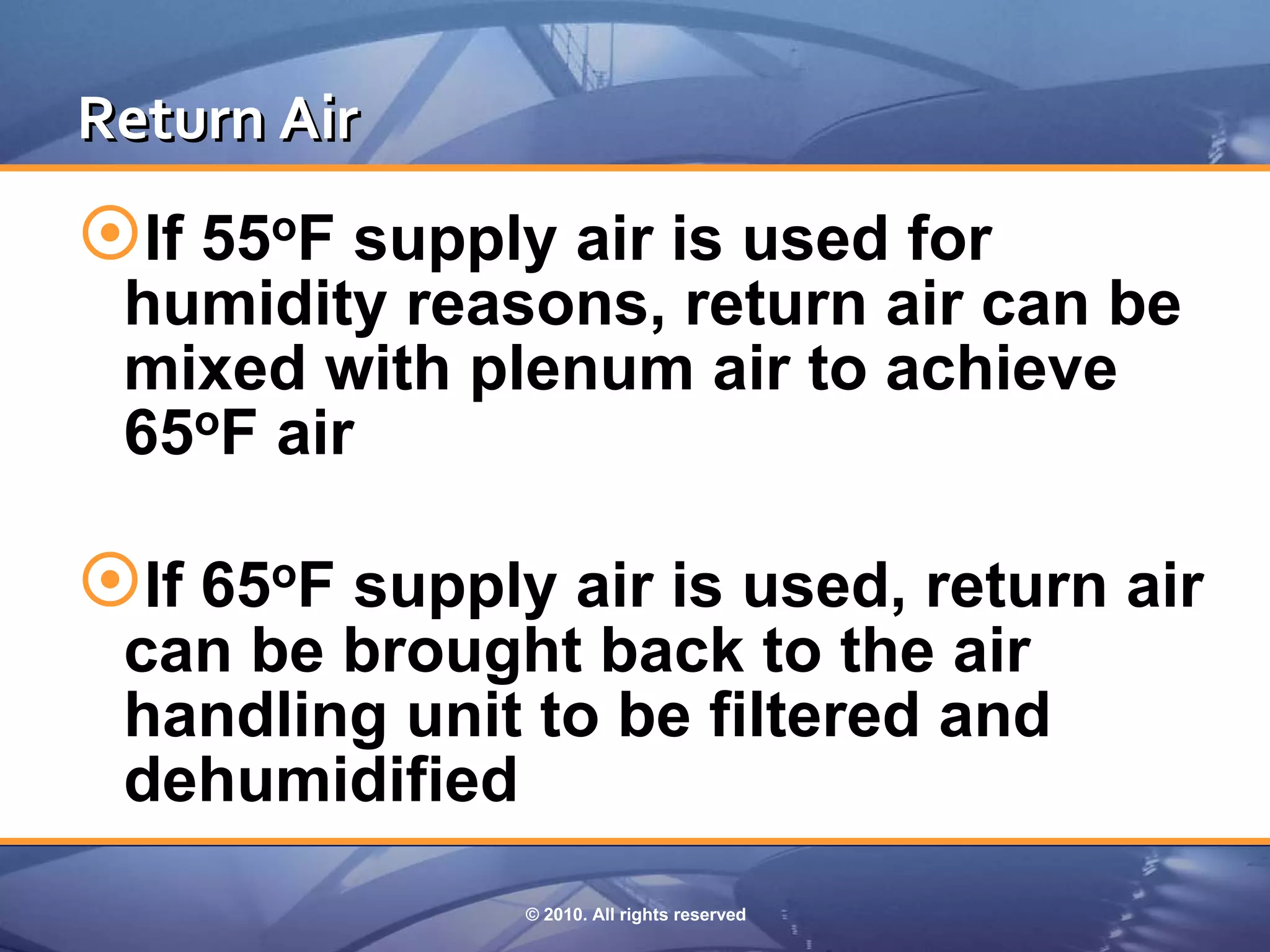
If 55oF supply air is used for
 humidity reasons, return air can be
 mixed with plenum air to achieve
 65oF air

If 65oF supply air is used, return air
 can be brought back to the air
 handling unit to be filtered and
 dehumidified
               © 2010. All rights reserved
Temperature Gradient
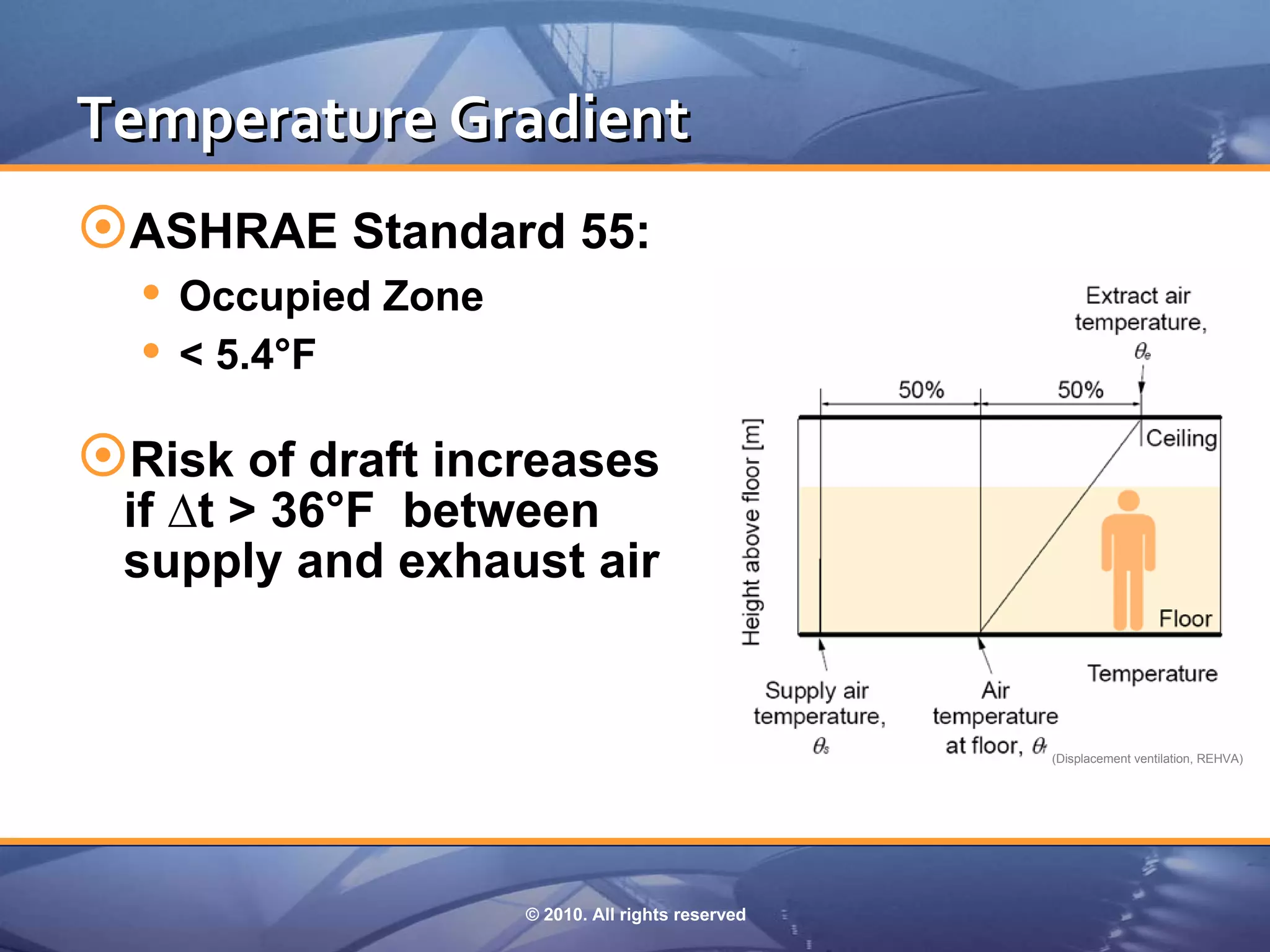
ASHRAE Standard 55:
   Occupied Zone
   < 5.4°F

Risk of draft increases
 if ∆t > 36°F between
 supply and exhaust air


                                                  (Displacement ventilation, REHVA)


                    © 2010. All rights reserved
Temperature Gradient
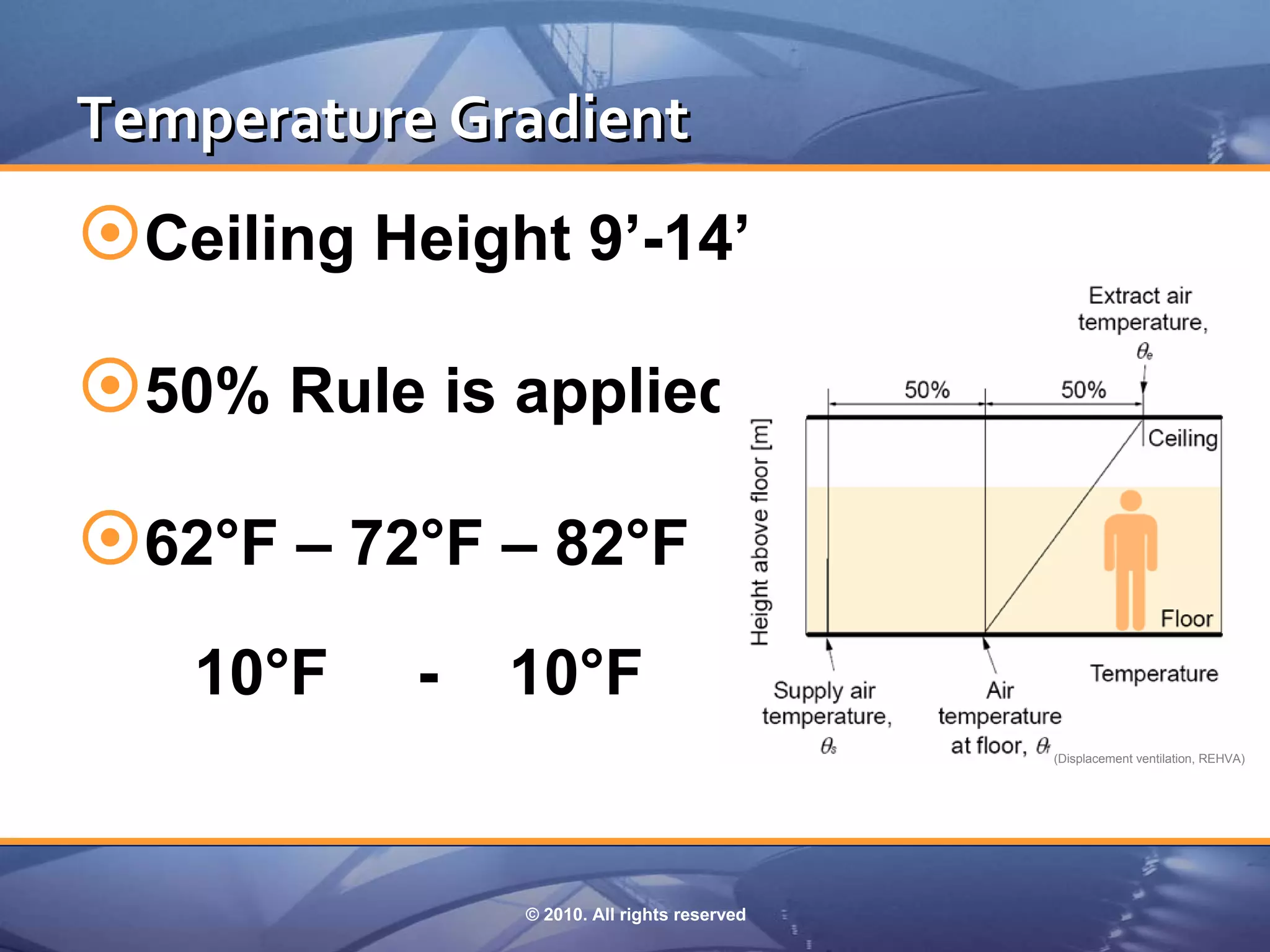
Ceiling Height 9’-14’

50% Rule is applied

62°F – 72°F – 82°F
   10°F    -   10°F
                                             (Displacement ventilation, REHVA)


               © 2010. All rights reserved
Temperature Gradient
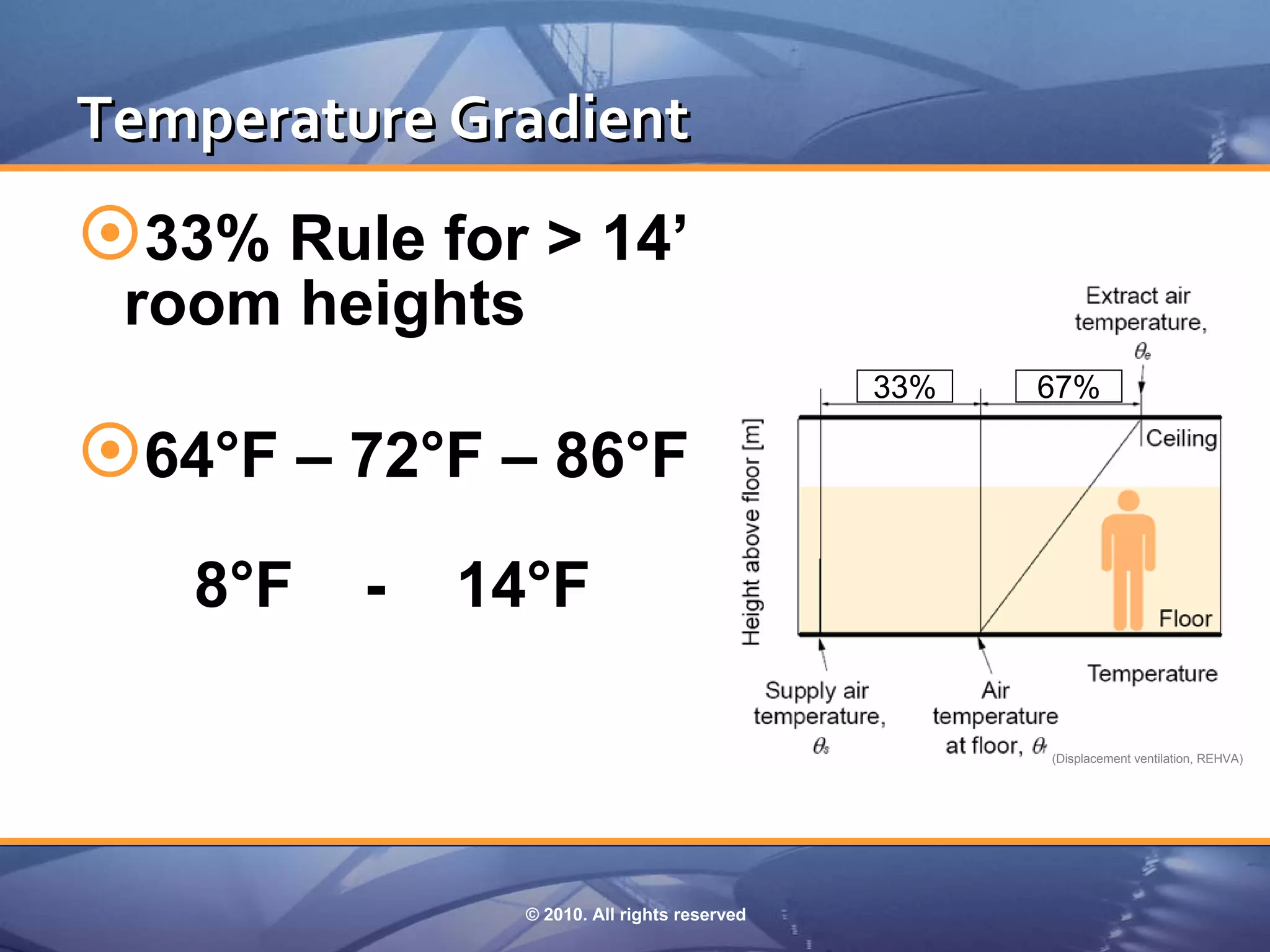
33% Rule for > 14’
 room heights
                                              33%   67%

64°F – 72°F – 86°F
   8°F   -   14°F

                                                    (Displacement ventilation, REHVA)


                © 2010. All rights reserved
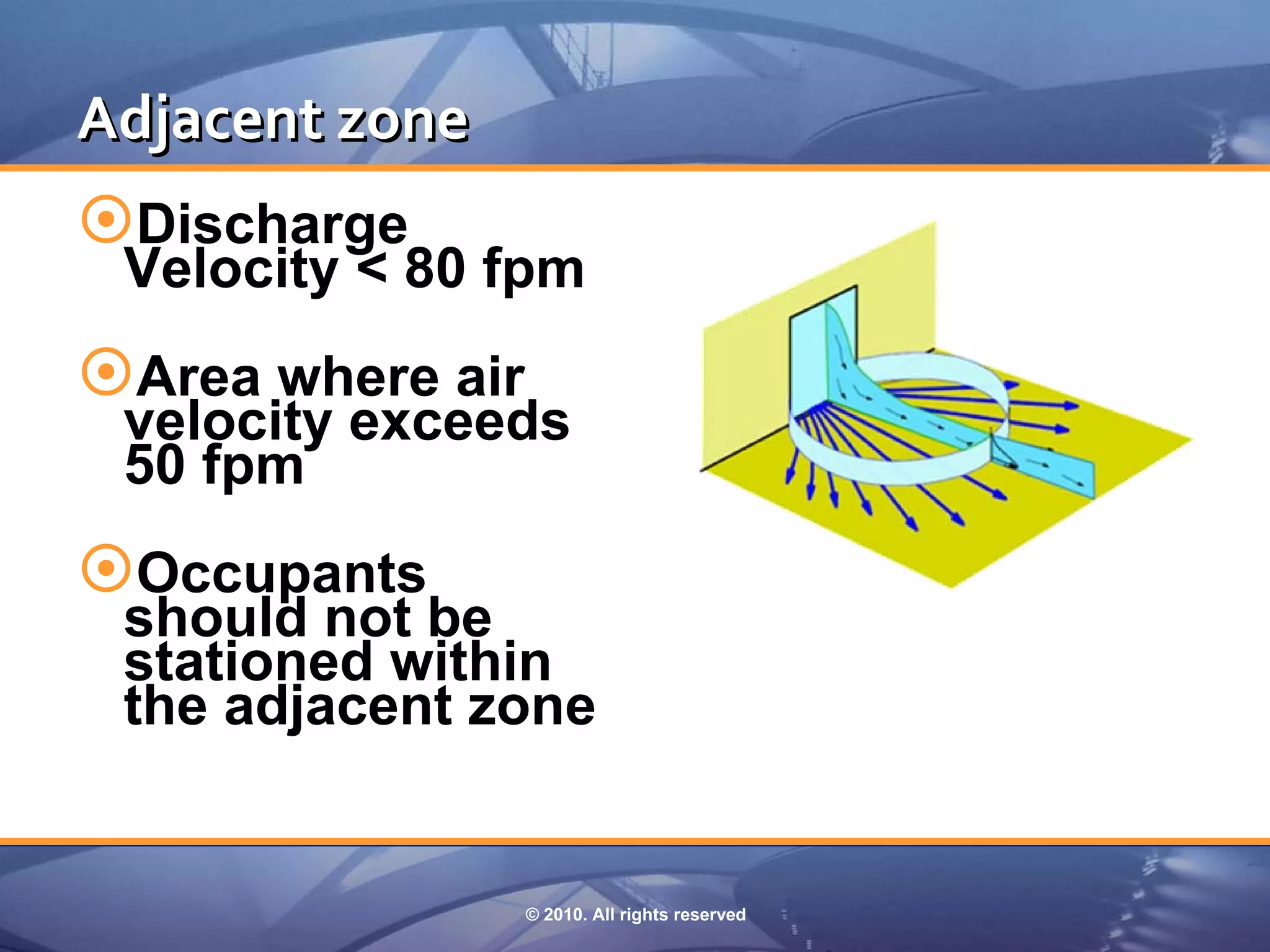
Adjacent zone
Discharge
 Velocity < 80 fpm
Area where air
 velocity exceeds
 50 fpm
Occupants
 should not be
 stationed within
 the adjacent zone


                  © 2010. All rights reserved
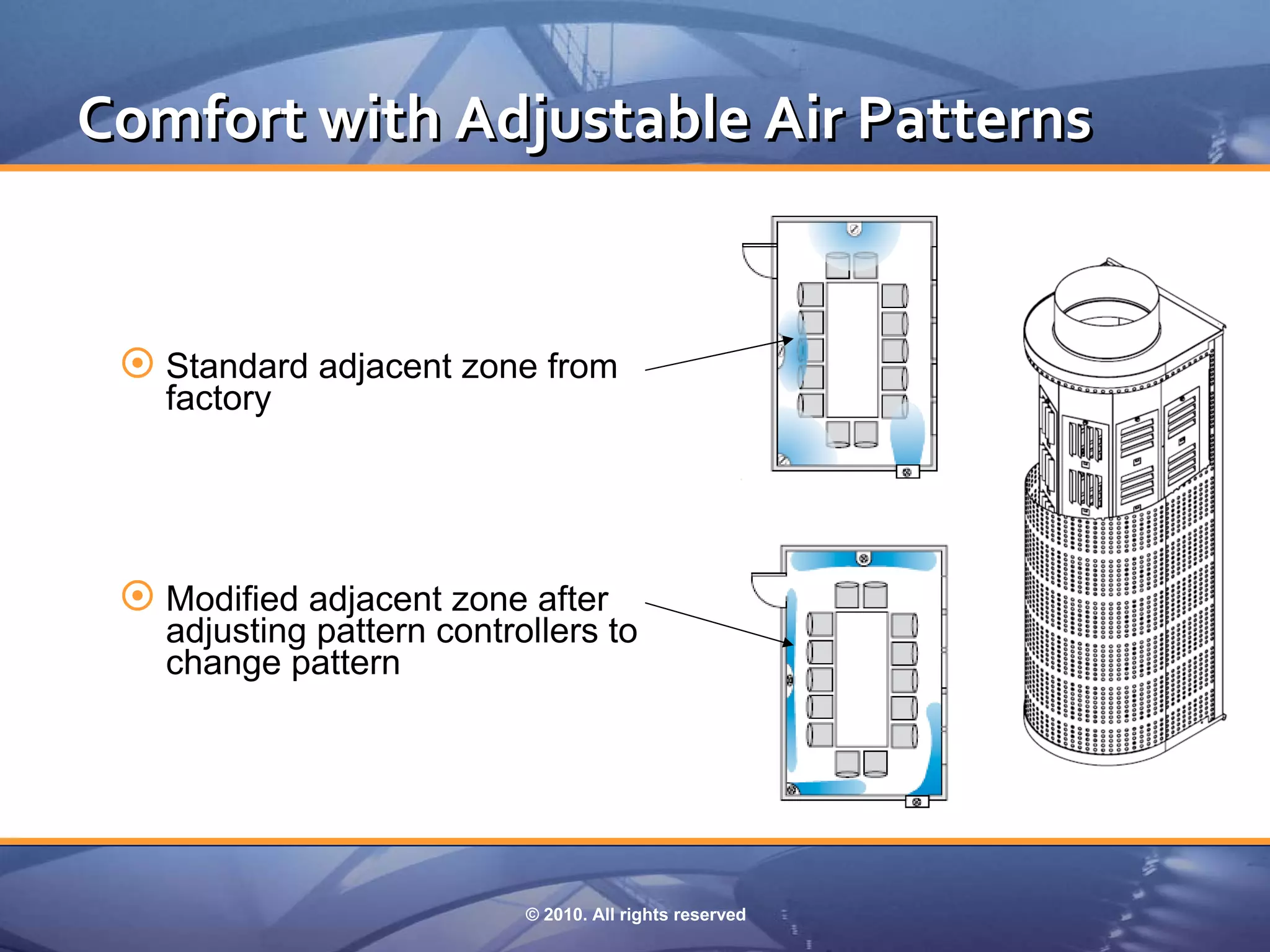
Comfort with Adjustable Air Patterns


  Standard adjacent zone from
   factory


  Modified adjacent zone after
   adjusting pattern controllers to
   change pattern


                           © 2010. All rights reserved
Comfort Air Distribution
The ASHRAE 2009 Fundamentals handbook,
 Chapter 20, 2007 Applications handbook Chapter
 56, and 2008 Systems & Equipment handbook
 provides guidance on diffuser selection.
Select throw at Max. & Min. to meet ADPI
 guidelines.
It cost less for install a good design than to
 replace a bad design.
Employees cost 70 times the cost of Energy.


                  © 2010. All rights reserved
Questions?

10 air distribution basics