Introduction to Engineering mechanics:
Mechanics is a branch of the physical sciences that is concerned with
the state of rest or motion of bodies subjected to the action of forces.
1. Newtonian Mechanics (Newton)
2. Relativistic Mechanics (Einstein)
3. Quantum Mechanics (Schrodinger and De Broglie)
Application of laws of mechanics to actual field problem is termed as
Engineering mechanics.
We use classical or Newtonian mechanics for the analysis of
engineering problems.
Rigid Body:
The body in which deformation is negligible is known as
rigid body.
Distance b/w two points in a rigid body never changes.
If a rigid body is in motion, then the velocity of two points along the line will always be
same.
• In a rigid body, the relative velocity of two points along the line will be zero.
 Particle:
Mass is concentrated at a point , size is negligible.
 Continuum:
Continuous distribution of mass.
‘Continuum mechanics is a branch of mechanics that deals with the mechanical behavior of
materials modeled as a continuous mass rather than as discrete particles.’
 Force:
It is an agency which tends to change or changes the state of the body or shape of
the body.
• Magnitude
• Direction
• Point of application
• Line of action
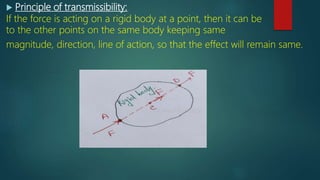
 Principle of transmissibility:
If the force is acting on a rigid body at a point, then it can be
to the other points on the same body keeping same
magnitude, direction, line of action, so that the effect will remain same.
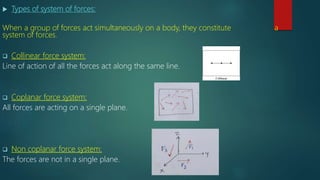
 Types of system of forces:
When a group of forces act simultaneously on a body, they constitute a
system of forces.
 Collinear force system:
Line of action of all the forces act along the same line.
 Coplanar force system:
All forces are acting on a single plane.
 Non coplanar force system:
The forces are not in a single plane.
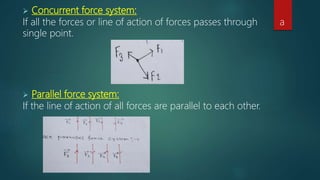
 Concurrent force system:
If all the forces or line of action of forces passes through a
single point.
 Parallel force system:
If the line of action of all forces are parallel to each other.
 Like parallel force system:
Acting in the same direction.
 Unlike parallel force system:
Acting in the opposite direction.
 Parallelogram law:
If two forces are acting at a point and it can be represented by the
adjacent sides of a parallelogram, then the diagonal which is passing
through that point will be the resultant of the two forces in terms of
magnitude and direction.
 Lami’s theorem:
If three forces act at a point and forces are non collinear as well as
force system is in equilibrium ,then the force will be directly
proportional to sine of angle between the other two forces.
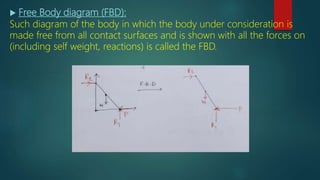
 Free Body diagram (FBD):
Such diagram of the body in which the body under consideration is
made free from all contact surfaces and is shown with all the forces on
(including self weight, reactions) is called the FBD.
 Moment of a force:
The Moment of a force is a measure of its tendency to cause a body to rotate
rotate about a specific point or axis.
• Magnitude:
Product of magnitude of force and perpendicular distance from
of action of force to the point or axis about which we have to
calculate the moment of force.
Moment = (Force)(perpendicular distance)
Couple:
System of two equal and unlike parallel forces.
Moment of couple:
Two equal and unlike parallel forces acting on a body and
separated by a distance apart, then moment of couple is the
product of magnitude of force and perpendicular distance
between the line of action of forces.
Engineering Mechanics.

Engineering Mechanics.

  • 1.
    Introduction to Engineeringmechanics: Mechanics is a branch of the physical sciences that is concerned with the state of rest or motion of bodies subjected to the action of forces. 1. Newtonian Mechanics (Newton) 2. Relativistic Mechanics (Einstein) 3. Quantum Mechanics (Schrodinger and De Broglie) Application of laws of mechanics to actual field problem is termed as Engineering mechanics.
  • 2.
    We use classicalor Newtonian mechanics for the analysis of engineering problems.
  • 7.
    Rigid Body: The bodyin which deformation is negligible is known as rigid body. Distance b/w two points in a rigid body never changes.
  • 8.
    If a rigidbody is in motion, then the velocity of two points along the line will always be same. • In a rigid body, the relative velocity of two points along the line will be zero.
  • 9.
     Particle: Mass isconcentrated at a point , size is negligible.  Continuum: Continuous distribution of mass. ‘Continuum mechanics is a branch of mechanics that deals with the mechanical behavior of materials modeled as a continuous mass rather than as discrete particles.’  Force: It is an agency which tends to change or changes the state of the body or shape of the body. • Magnitude • Direction • Point of application • Line of action
  • 10.
     Principle oftransmissibility: If the force is acting on a rigid body at a point, then it can be to the other points on the same body keeping same magnitude, direction, line of action, so that the effect will remain same.
  • 11.
     Types ofsystem of forces: When a group of forces act simultaneously on a body, they constitute a system of forces.  Collinear force system: Line of action of all the forces act along the same line.  Coplanar force system: All forces are acting on a single plane.  Non coplanar force system: The forces are not in a single plane.
  • 12.
     Concurrent forcesystem: If all the forces or line of action of forces passes through a single point.  Parallel force system: If the line of action of all forces are parallel to each other.
  • 13.
     Like parallelforce system: Acting in the same direction.  Unlike parallel force system: Acting in the opposite direction.
  • 15.
     Parallelogram law: Iftwo forces are acting at a point and it can be represented by the adjacent sides of a parallelogram, then the diagonal which is passing through that point will be the resultant of the two forces in terms of magnitude and direction.
  • 18.
     Lami’s theorem: Ifthree forces act at a point and forces are non collinear as well as force system is in equilibrium ,then the force will be directly proportional to sine of angle between the other two forces.
  • 19.
     Free Bodydiagram (FBD): Such diagram of the body in which the body under consideration is made free from all contact surfaces and is shown with all the forces on (including self weight, reactions) is called the FBD.
  • 20.
     Moment ofa force: The Moment of a force is a measure of its tendency to cause a body to rotate rotate about a specific point or axis. • Magnitude: Product of magnitude of force and perpendicular distance from of action of force to the point or axis about which we have to calculate the moment of force. Moment = (Force)(perpendicular distance)
  • 22.
    Couple: System of twoequal and unlike parallel forces. Moment of couple: Two equal and unlike parallel forces acting on a body and separated by a distance apart, then moment of couple is the product of magnitude of force and perpendicular distance between the line of action of forces.