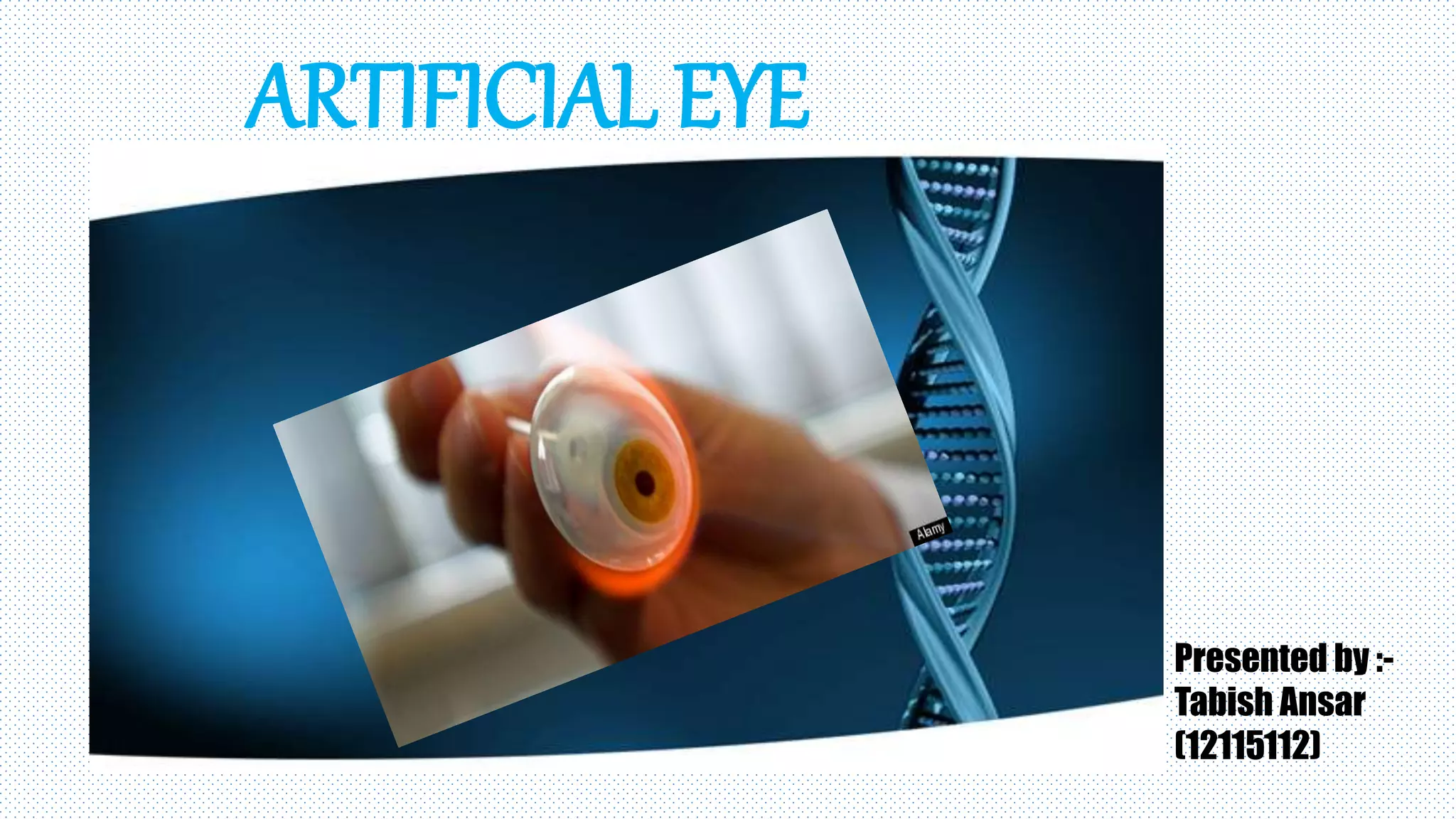
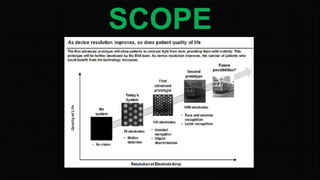
ARTIFICIAL EYE
Presented by :-
Tabish Ansar
(12115112)
INTRODUCTION
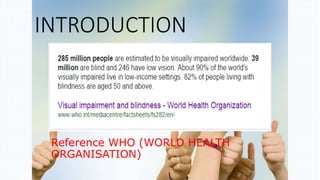
Reference WHO (WORLD HEALTH
ORGANISATION)
• There are 10 million people in the US who are blind or
facing blindness due to diseases of the retina… and

there’s little that can be done for them.
• For the vast majority, their best hope is through
prosthetic devices.
• The U.S. Food and Drug Administration (FDA) has
granted market approval to an artificial retina
technology, the first bionic eye to be approved for
patients in the U.S.
Conti…
Conti…
• Scientists claim to have developed a new revolutionary
bionic eye that enables blind people to read letters and
simple words.
• In the mid-20th century, researchers began to explore the
idea of creating an artificial eye which could actually see.
INTRODUCTION
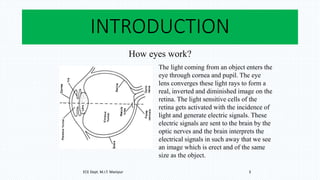
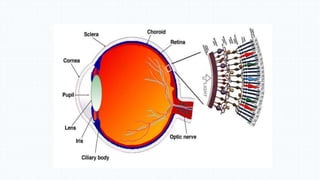
How eyes work?
The light coming from an object enters the
eye through cornea and pupil. The eye
lens converges these light rays to form a
real, inverted and diminished image on the
retina. The light sensitive cells of the
retina gets activated with the incidence of
light and generate electric signals. These
electric signals are sent to the brain by the
optic nerves and the brain interprets the
electrical signals in such away that we see
an image which is erect and of the same
size as the object.
ECE Dept. M.I.T. Manipur 3
HOW BRAIN WORKS AFTER SEEING AN
IMAGE?
• After seeing an image the brain takes information from the outside
world and encodes it in patterns of electrical activity.
• After the creating pattern the brain get an visualization of an image.
That we actually see the image from our eyes.
Need For Artificial Eye….
• In damaged or dysfunctional retina, the
photoreceptors stop working, causing blindness
• The absence of effective therapeutic (medical
treatment) remedies for retinitis pigmentosa (RP) and
age-related macular degeneration (AMD)
DISEASE RELATED TO EYE
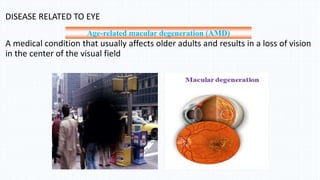
A medical condition that usually affects older adults and results in a loss of vision
in the center of the visual field
Age-related macular degeneration (AMD)
CONTINUED…..
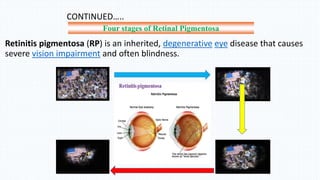
Retinitis pigmentosa (RP) is an inherited, degenerative eye disease that causes
severe vision impairment and often blindness.
Four stages of Retinal Pigmentosa
ARTIFICIAL EYE?
• An artificial eye is a prosthesis which is used to replace a missing or
damaged eye.
• In order to accomplish the goal of creating a visual prosthesis,
scientists had to develop a camera which could interact with the brain
by stimulating the optic nerve.
Artificial Eye (continued)
• Form of neural prosthesis to restore
vision.
• An externally worn camera and a
retinal implanted chip makes it
possible.
• It is often usable for those who
suffers from age-related macular
degeneration (AMD) or retinal
pigmentosa.
What is
artificial
eye?
 WHAT IS BIONIC EYE?
• BIONIC EYE REFERS TO BIOELECTRONIC EYE.
• A BIONIC EYE mimics the function of the retina
to restore sight for those with
severe vision loss.
• THE ELECTRONIC DEVICE WHICH REPLACES
FUNCTIONALITY OF A PART OR WHOLE OF THE
EYE.
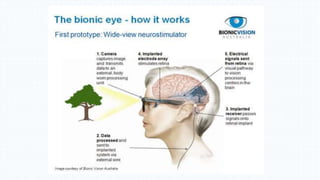
• It uses a retinal implant connected to a video
camera to convert images into electrical
impulses that activate remaining retinal cells
which then carry the signal back to the brain.
Continued……
making of an
artificial eye or bionic
eye
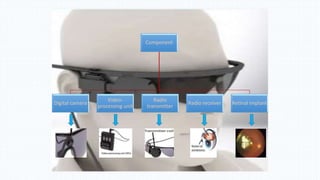
Component
Digital camera
Video-
processing unit
Radio
transmitter
Radio receiver Retinal implant
Digital Camera
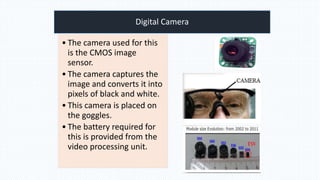
• The camera used for this
is the CMOS image
sensor.
• The camera captures the
image and converts it into
pixels of black and white.
• This camera is placed on
the goggles.
• The battery required for
this is provided from the
video processing unit.
Video Processing Unit
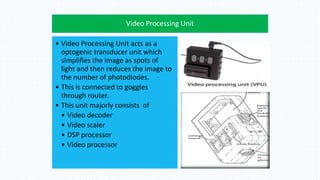
• Video Processing Unit acts as a
optogenic transducer unit which
simplifies the image as spots of
light and then reduces the image to
the number of photodiodes.
• This is connected to goggles
through router.
• This unit majorly consists of
• Video decoder
• Video scaler
• DSP processor
• Video processor
Retinal implant
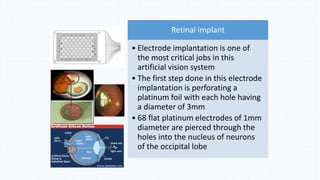
• Electrode implantation is one of
the most critical jobs in this
artificial vision system
• The first step done in this electrode
implantation is perforating a
platinum foil with each hole having
a diameter of 3mm
• 68 flat platinum electrodes of 1mm
diameter are pierced through the
holes into the nucleus of neurons
of the occipital lobe
Continued…….
• Each electrode is connected by separate Teflon insulated
wire to a connector contained in the pedestal
• The group of wires pass the electrical impulses which are
generated by the processor
• When the electrode is stimulated by the processor by
sending an electrical impulse, the electrode produces
closely spaced phosphene (light spots seen by visual
field)
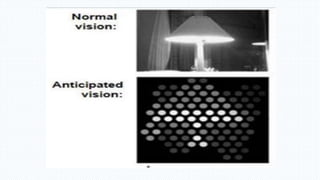
• By sending the electrical impulses in different
combinations and permutations the phosphene can be
created in a regular fashion describing the image
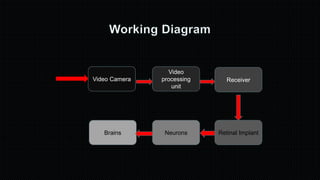
Working
Camera on glasses views image
Signals are sent to video processing
microchip
Processed information is sent back
to receiver
Receiver sends information to
electrodes in retinal implant
Electrodes stimulate retina to send
information to brain
Video Camera
Video
processing
unit
Receiver
Retinal ImplantNeuronsBrains
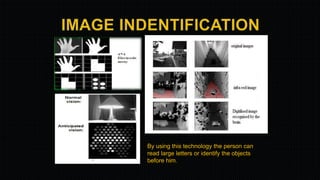
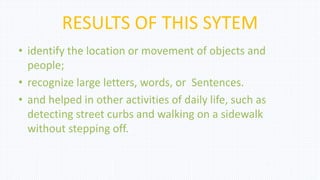
By using this technology the person can
read large letters or identify the objects
before him.
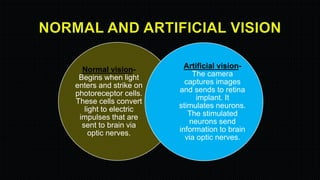
Normal vision-
Begins when light
enters and strike on
photoreceptor cells.
These cells convert
light to electric
impulses that are
sent to brain via
optic nerves.
Artificial vision-
The camera
captures images
and sends to retina
implant. It
stimulates neurons.
The stimulated
neurons send
information to brain
via optic nerves.
Surgery is required to implant the
electrode array.
Repairing is difficult if any of the
devices got damaged.
Those who lost their visions due to
other reasons could not use this
device.
The approximated cost of the
device is $1,500
RESULTS OF THIS SYTEM
• identify the location or movement of objects and
people;
• recognize large letters, words, or Sentences.
• and helped in other activities of daily life, such as
detecting street curbs and walking on a sidewalk
without stepping off.
Support for Argus ii(bionic eye)device…
• Three government organizations provided support for the
development of the Argus II. The Department of Energy,
National Eye Institute at the National Institutes of Health and
the National Science Foundation collaborated to provide grant
funding totaling more than $100 million, support for material
design and other basic research for the project.
Advantages
• ability to perform visual tasks demonstrated in many
patients
• Upgradable external hardware and software to
benefit from future innovations
• the brain has an amazing ability to adapt to new input
and to improve his or her understanding of what is
being “seen” via an artificial vision system.
• Reduction of stress upon retina
• Compact Size – 6x6 mm
Disadvantages
• The cost of device is too high( $1500)
• It is difficult to acquire this technology by common
man.
• If a single part of the chip is damaged the total
technique will be meaningless.
Conclusion
•people suffering from low vision to, people who are
completely blind will benefit from this project.
•Bionic devices are being developed to do more than
replace defective parts.
•Revolutionary piece of technology.
•Good news for AMD and retinal pigmentosa patients
Conti….
• Researchers are also using them to fight illnesses.
•Providing power to run bionic implants and making
connections to the brain's control system pose the
two great challenges for biomedical engineering.
•Scientist are now looking at devices like bionic arms,
tongues, noses etc.
Hope in INDIA also will acquire this
technology soon….
References:-
 www.ai.rug.ni/~lambert/projects/BCI/literature/misc/bio.ppt
 www.met.edu/institute/ICS/NCNHIT/papers/0.5.pdf
 www.bionicsinstitute.org/publications/...../Factsheet_Bionic eye.pdf
 www.hansmalab.physics.ucsb.edu/phys150/Bionic_Eyes.pdf
 www.howstuffworks.com
 Chandu Gude,"Bionic Eye", Scribd, 2009.
 www.wikipedia.org
 www.sciencedaily.com
 www.electrooptic.com
THANKING YOU !!!
Basic overview of an artificial eye

Basic overview of an artificial eye

  • 1.
    ARTIFICIAL EYE Presented by:- Tabish Ansar (12115112)
  • 3.
  • 4.
    • There are10 million people in the US who are blind or facing blindness due to diseases of the retina… and there’s little that can be done for them. • For the vast majority, their best hope is through prosthetic devices. • The U.S. Food and Drug Administration (FDA) has granted market approval to an artificial retina technology, the first bionic eye to be approved for patients in the U.S. Conti…
  • 5.
    Conti… • Scientists claimto have developed a new revolutionary bionic eye that enables blind people to read letters and simple words. • In the mid-20th century, researchers began to explore the idea of creating an artificial eye which could actually see.
  • 6.
    INTRODUCTION How eyes work? Thelight coming from an object enters the eye through cornea and pupil. The eye lens converges these light rays to form a real, inverted and diminished image on the retina. The light sensitive cells of the retina gets activated with the incidence of light and generate electric signals. These electric signals are sent to the brain by the optic nerves and the brain interprets the electrical signals in such away that we see an image which is erect and of the same size as the object. ECE Dept. M.I.T. Manipur 3
  • 8.
    HOW BRAIN WORKSAFTER SEEING AN IMAGE? • After seeing an image the brain takes information from the outside world and encodes it in patterns of electrical activity. • After the creating pattern the brain get an visualization of an image. That we actually see the image from our eyes.
  • 9.
    Need For ArtificialEye…. • In damaged or dysfunctional retina, the photoreceptors stop working, causing blindness • The absence of effective therapeutic (medical treatment) remedies for retinitis pigmentosa (RP) and age-related macular degeneration (AMD)
  • 10.
    DISEASE RELATED TOEYE A medical condition that usually affects older adults and results in a loss of vision in the center of the visual field Age-related macular degeneration (AMD)
  • 11.
    CONTINUED….. Retinitis pigmentosa (RP)is an inherited, degenerative eye disease that causes severe vision impairment and often blindness. Four stages of Retinal Pigmentosa
  • 12.
    ARTIFICIAL EYE? • Anartificial eye is a prosthesis which is used to replace a missing or damaged eye. • In order to accomplish the goal of creating a visual prosthesis, scientists had to develop a camera which could interact with the brain by stimulating the optic nerve.
  • 13.
    Artificial Eye (continued) •Form of neural prosthesis to restore vision. • An externally worn camera and a retinal implanted chip makes it possible. • It is often usable for those who suffers from age-related macular degeneration (AMD) or retinal pigmentosa. What is artificial eye?
  • 14.
     WHAT ISBIONIC EYE? • BIONIC EYE REFERS TO BIOELECTRONIC EYE. • A BIONIC EYE mimics the function of the retina to restore sight for those with severe vision loss.
  • 15.
    • THE ELECTRONICDEVICE WHICH REPLACES FUNCTIONALITY OF A PART OR WHOLE OF THE EYE. • It uses a retinal implant connected to a video camera to convert images into electrical impulses that activate remaining retinal cells which then carry the signal back to the brain. Continued……
  • 17.
    making of an artificialeye or bionic eye
  • 18.
  • 19.
    Digital Camera • Thecamera used for this is the CMOS image sensor. • The camera captures the image and converts it into pixels of black and white. • This camera is placed on the goggles. • The battery required for this is provided from the video processing unit.
  • 20.
    Video Processing Unit •Video Processing Unit acts as a optogenic transducer unit which simplifies the image as spots of light and then reduces the image to the number of photodiodes. • This is connected to goggles through router. • This unit majorly consists of • Video decoder • Video scaler • DSP processor • Video processor
  • 21.
    Retinal implant • Electrodeimplantation is one of the most critical jobs in this artificial vision system • The first step done in this electrode implantation is perforating a platinum foil with each hole having a diameter of 3mm • 68 flat platinum electrodes of 1mm diameter are pierced through the holes into the nucleus of neurons of the occipital lobe
  • 22.
    Continued……. • Each electrodeis connected by separate Teflon insulated wire to a connector contained in the pedestal • The group of wires pass the electrical impulses which are generated by the processor • When the electrode is stimulated by the processor by sending an electrical impulse, the electrode produces closely spaced phosphene (light spots seen by visual field) • By sending the electrical impulses in different combinations and permutations the phosphene can be created in a regular fashion describing the image
  • 23.
    Working Camera on glassesviews image Signals are sent to video processing microchip Processed information is sent back to receiver Receiver sends information to electrodes in retinal implant Electrodes stimulate retina to send information to brain
  • 24.
  • 25.
    By using thistechnology the person can read large letters or identify the objects before him.
  • 26.
    Normal vision- Begins whenlight enters and strike on photoreceptor cells. These cells convert light to electric impulses that are sent to brain via optic nerves. Artificial vision- The camera captures images and sends to retina implant. It stimulates neurons. The stimulated neurons send information to brain via optic nerves.
  • 27.
    Surgery is requiredto implant the electrode array. Repairing is difficult if any of the devices got damaged. Those who lost their visions due to other reasons could not use this device. The approximated cost of the device is $1,500
  • 29.
    RESULTS OF THISSYTEM • identify the location or movement of objects and people; • recognize large letters, words, or Sentences. • and helped in other activities of daily life, such as detecting street curbs and walking on a sidewalk without stepping off.
  • 30.
    Support for Argusii(bionic eye)device… • Three government organizations provided support for the development of the Argus II. The Department of Energy, National Eye Institute at the National Institutes of Health and the National Science Foundation collaborated to provide grant funding totaling more than $100 million, support for material design and other basic research for the project.
  • 31.
    Advantages • ability toperform visual tasks demonstrated in many patients • Upgradable external hardware and software to benefit from future innovations • the brain has an amazing ability to adapt to new input and to improve his or her understanding of what is being “seen” via an artificial vision system. • Reduction of stress upon retina • Compact Size – 6x6 mm
  • 32.
    Disadvantages • The costof device is too high( $1500) • It is difficult to acquire this technology by common man. • If a single part of the chip is damaged the total technique will be meaningless.
  • 33.
    Conclusion •people suffering fromlow vision to, people who are completely blind will benefit from this project. •Bionic devices are being developed to do more than replace defective parts. •Revolutionary piece of technology. •Good news for AMD and retinal pigmentosa patients
  • 34.
    Conti…. • Researchers arealso using them to fight illnesses. •Providing power to run bionic implants and making connections to the brain's control system pose the two great challenges for biomedical engineering. •Scientist are now looking at devices like bionic arms, tongues, noses etc. Hope in INDIA also will acquire this technology soon….
  • 35.
    References:-  www.ai.rug.ni/~lambert/projects/BCI/literature/misc/bio.ppt  www.met.edu/institute/ICS/NCNHIT/papers/0.5.pdf www.bionicsinstitute.org/publications/...../Factsheet_Bionic eye.pdf  www.hansmalab.physics.ucsb.edu/phys150/Bionic_Eyes.pdf  www.howstuffworks.com  Chandu Gude,"Bionic Eye", Scribd, 2009.  www.wikipedia.org  www.sciencedaily.com  www.electrooptic.com
  • 36.

Editor's Notes

  • #11 Macular degeneration, often age-related macular degeneration (AMD or ARMD), is a medical condition that usually affects older adults and results in a loss of vision in the center of the visual field (the macula) because of damage to the retina. It occurs in "dry" and "wet" forms. It is a major cause of blindness and visual impairment in older adults (>50 years). Macular degeneration can make it difficult or impossible to read or recognize faces, although enough peripheral vision remains to allow other activities of daily life
  • #12 Retinitis pigmentosa (RP) is an inherited, degenerative eye disease that causes severe vision impairment and often blindness.[1]The progress of RP is not consistent. Some people will exhibit symptoms from infancy, others may not notice symptoms until later in life.[2] Generally, the later the onset, the more rapid is the deterioration in sight.[citation needed] Those who do not have RP have 90 degree peripheral vision, while some people who have RP have less than 90 degrees.
  • #20 Both types of sensor accomplish the same task of capturing light and converting it into electrical signals.
  • #21 Optogenetics (from Greek optos, meaning "visible") uses light to control neurons which have been genetically sensitised to light. It is a neuromodulation technique employed inneuroscience that uses a combination of techniques from optics and genetics to control and monitor the activities of individual neurons in living tissue—even within freely-moving animals A photodiode is a semiconductor device that converts light into current.