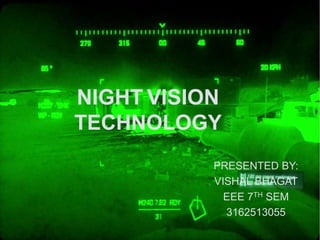
NIGHT VISION
TECHNOLOGY
PRESENTED BY:
VISHAL BHAGAT
EEE 7TH SEM
3162513055
CONTENT
 INTRODUCTION
 LIGHT
 IMAGE ENHANCEMENT
 IMAGE ENHANCEMENT PROCESS
 HOW IMAGE ENHANCEMENT WORK
 THERMAL IMAGING
 WORKING OF THERMAL IMAGING
 EQUIPMENT
 APPLICATION
INTRODUCTION
 Night vision is used to locate an object which is 200
yard away even in moonless, cloudy night.
 Night vision can work into two different ways,
depending on the technology used.
 They are image enhancement and thermal imaging.
 Image enhancement work by collecting lower
portion of infrared light spectrum.
 Thermal imaging operates by capturing the upper
portion of infrared light spectrum.
LIGHT
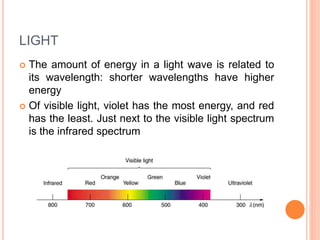
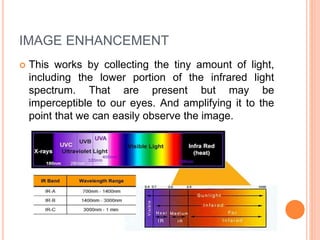
 The amount of energy in a light wave is related to
its wavelength: shorter wavelengths have higher
energy
 Of visible light, violet has the most energy, and red
has the least. Just next to the visible light spectrum
is the infrared spectrum
IMAGE ENHANCEMENT
 This works by collecting the tiny amount of light,
including the lower portion of the infrared light
spectrum. That are present but may be
imperceptible to our eyes. And amplifying it to the
point that we can easily observe the image.
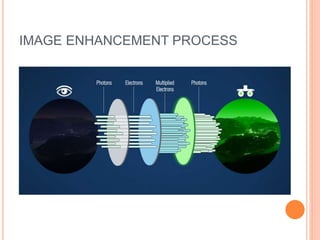
IMAGE ENHANCEMENT PROCESS
HOW IMAGE ENHANCEMENT WORK
 A conventional lens, called the objective lens
captures ambient light and some near-infrared light.
 The gathered light is sent to the image-intensifier
tube. In most NVDs, the power supply for the
image-intensifier tube receives power from two N-
Cell . To the image-tube components.
 The image-intensifier tube has a photo cathode,
which is used to convert the photons of light energy
into electrons.
 As the electrons pass through the tube, similar
electrons are released from atoms in the tube,
multiplying the original number of electrons by a
factor of thousands through the use of a micro
channel plate (MCP) in the tube.
 At the end of the image-intensifier tube, the
electrons hit a screen coated with phosphors.
 The green phosphor image is viewed through
another lens, called the ocular lens, which allows
you to magnify and focus the image. The NVD may
be connected to an electronic display, such as a
monitor, or the image may be viewed directly the
ocular lens.
THERMAL IMAGING
 This technology operates by capturing the upper
portion of the infrared light spectrum. Which is
emitted as heat by objects instead of simply
reflected as light. Hotter objects, such as warm
bodies, emit more of this light than cooler objects
like trees or buildings.
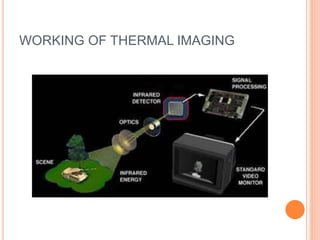
WORKING OF THERMAL IMAGING
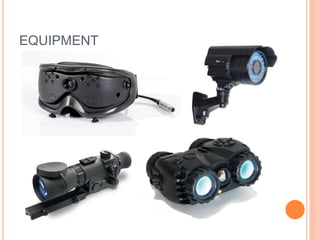
EQUIPMENT
APPLICATION
 Military
 Hunting
 Wildlife observation
 Security
 Navigation
 Hidden object detection
REFERENCE
 ^”Histological study of choroidal melanocytes in
animals with tapetum lucidum cellulosum (abstract)”
 ^Luria, S.M.; Kobus, D.A.(July 1984). “THE
RELATIVE EFFECTIVENESS OF RED AND
WHITE LIGHT FOR SUBSEQUENT DARK-
ADAPTATION”.Submrine base, Groton, CT: Naval
Submarine Medical Research Laboratory
(published 3 july 1984). Retrieved March 24, 2012
THANK YOU

Night vision technology

  • 1.
    NIGHT VISION TECHNOLOGY PRESENTED BY: VISHALBHAGAT EEE 7TH SEM 3162513055
  • 2.
    CONTENT  INTRODUCTION  LIGHT IMAGE ENHANCEMENT  IMAGE ENHANCEMENT PROCESS  HOW IMAGE ENHANCEMENT WORK  THERMAL IMAGING  WORKING OF THERMAL IMAGING  EQUIPMENT  APPLICATION
  • 3.
    INTRODUCTION  Night visionis used to locate an object which is 200 yard away even in moonless, cloudy night.  Night vision can work into two different ways, depending on the technology used.  They are image enhancement and thermal imaging.  Image enhancement work by collecting lower portion of infrared light spectrum.  Thermal imaging operates by capturing the upper portion of infrared light spectrum.
  • 4.
    LIGHT  The amountof energy in a light wave is related to its wavelength: shorter wavelengths have higher energy  Of visible light, violet has the most energy, and red has the least. Just next to the visible light spectrum is the infrared spectrum
  • 5.
    IMAGE ENHANCEMENT  Thisworks by collecting the tiny amount of light, including the lower portion of the infrared light spectrum. That are present but may be imperceptible to our eyes. And amplifying it to the point that we can easily observe the image.
  • 6.
  • 7.
    HOW IMAGE ENHANCEMENTWORK  A conventional lens, called the objective lens captures ambient light and some near-infrared light.  The gathered light is sent to the image-intensifier tube. In most NVDs, the power supply for the image-intensifier tube receives power from two N- Cell . To the image-tube components.  The image-intensifier tube has a photo cathode, which is used to convert the photons of light energy into electrons.
  • 8.
     As theelectrons pass through the tube, similar electrons are released from atoms in the tube, multiplying the original number of electrons by a factor of thousands through the use of a micro channel plate (MCP) in the tube.  At the end of the image-intensifier tube, the electrons hit a screen coated with phosphors.  The green phosphor image is viewed through another lens, called the ocular lens, which allows you to magnify and focus the image. The NVD may be connected to an electronic display, such as a monitor, or the image may be viewed directly the ocular lens.
  • 9.
    THERMAL IMAGING  Thistechnology operates by capturing the upper portion of the infrared light spectrum. Which is emitted as heat by objects instead of simply reflected as light. Hotter objects, such as warm bodies, emit more of this light than cooler objects like trees or buildings.
  • 10.
  • 11.
  • 12.
    APPLICATION  Military  Hunting Wildlife observation  Security  Navigation  Hidden object detection
  • 13.
    REFERENCE  ^”Histological studyof choroidal melanocytes in animals with tapetum lucidum cellulosum (abstract)”  ^Luria, S.M.; Kobus, D.A.(July 1984). “THE RELATIVE EFFECTIVENESS OF RED AND WHITE LIGHT FOR SUBSEQUENT DARK- ADAPTATION”.Submrine base, Groton, CT: Naval Submarine Medical Research Laboratory (published 3 july 1984). Retrieved March 24, 2012
  • 14.