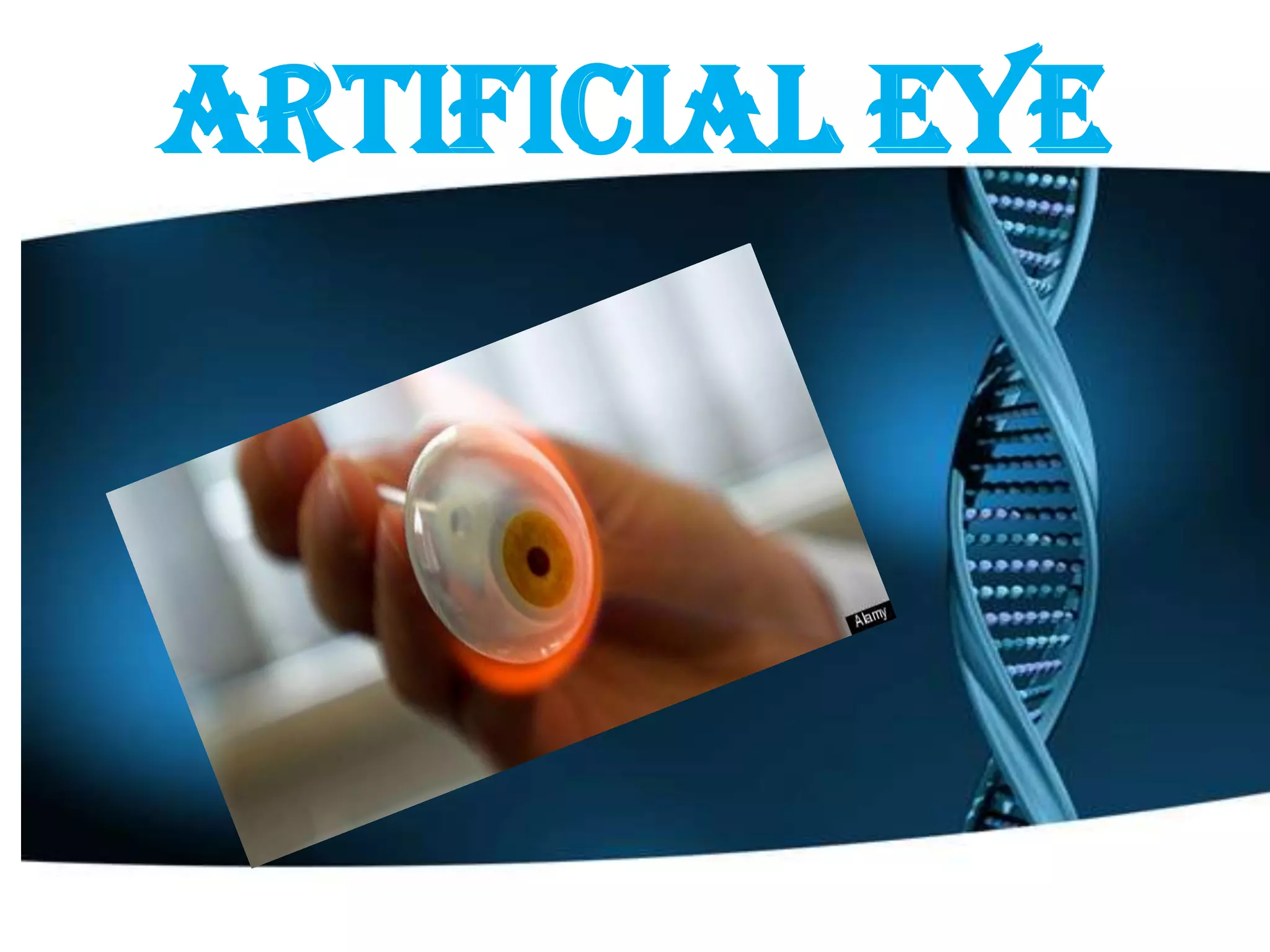
ARTIFICIAL EYE
โ€ข There are 10 billion people in the US who are blind
or facing blindness due to diseases of the retinaโ€ฆ
and thereโ€™s little that can be done for them.
โ€ข For the vast majority, their best hope is through
prosthetic devices.
โ€ข The U.S. Food and Drug Administration (FDA) has
granted market approval to an artificial retina
technology, the first bionic eye to be approved for
patients in the U.S.
INTRODUCTION
Contiโ€ฆ
โ€ข Scientists claim to have developed a new
revolutionary bionic eye that enables blind people to
read letters and simple words.
โ€ข In the mid-20th century, researchers began to
explore the idea of creating an artificial eye which
could actually see.
ARTIFICIAL EYE?
โ€ข An artificial eye is a prosthesis which is used to
replace a missing or damaged eye.
โ€ข In order to accomplish the goal of creating a
visual prosthesis, scientists had to develop a
camera which could interact with the brain by
stimulating the optic nerve.
HOW BRAIN WORKS AFTER SEEING AN
IMAGE?
โ€ข After seeing an image the brain takes
information from the outside world and
encodes it in patterns of electrical activity.
โ€ข After the creating pattern the brain get an
visualization of an image. That can we actually
seeing the image from our eyes.
Contiโ€ฆ.
โ€ข In damaged or dysfunctional retina, the
photoreceptors stop working, causing
blindness
โ€ข The absence of effective therapeutic remedies
for retinitis pigmentosa (RP) and age-related
macular degeneration (AMD)
ARGUS-II DEVICE
๏ถ The Argus II Retinal Prosthesis System
(โ€œArgus IIโ€) is the worldโ€™s first approved device
intended to restore some functional vision for
people suffering from blindness.
๏ถtransmits images from a small, eye-glass-
mounted camera wirelessly to a
microelectrode array implanted on a patientโ€™s
damaged retina.
PARTS OF ARGUS II DEVICE
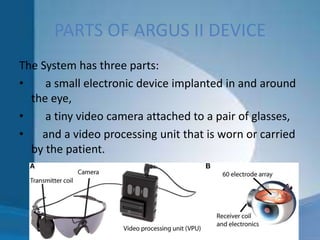
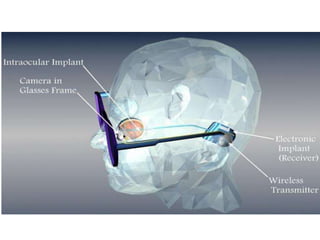
The System has three parts:
โ€ข a small electronic device implanted in and around
the eye,
โ€ข a tiny video camera attached to a pair of glasses,
โ€ข and a video processing unit that is worn or carried
by the patient.
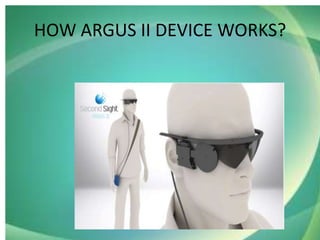
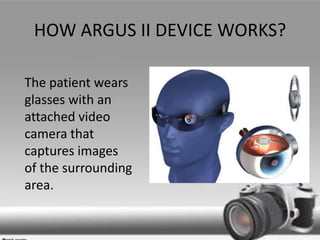
HOW ARGUS II DEVICE WORKS?
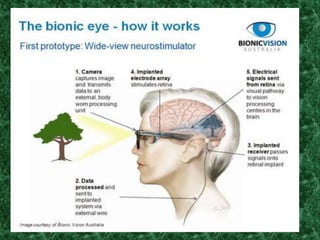
The patient wears
glasses with an
attached video
camera that
captures images
of the surrounding
area.
Contโ€ฆ
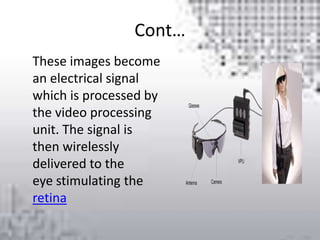
These images become
an electrical signal
which is processed by
the video processing
unit. The signal is
then wirelessly
delivered to the
eye stimulating the
retina
Contโ€ฆ.
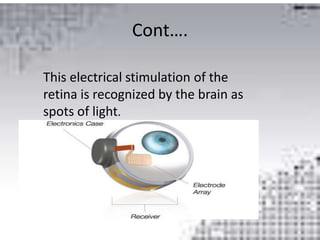
This electrical stimulation of the
retina is recognized by the brain as
spots of light.
When is it used?
โ€ข The Argus II Retinal Prosthesis System is
intended for patients aged 25 years
โ€ข and older with bare or no light perception
vision caused by advanced retinitis
pigmentosa.
RESULTS OF THIS SYTEM
โ€ข identify the location or movement of objects
and people;
โ€ข recognize large letters, words, or Sentences.
โ€ข and helped in other activities of daily life, such
as detecting street curbs and walking on a
sidewalk without stepping off.
Support for argus ii deviceโ€ฆ
โ€ข Three government organizations provided
support for the development of the Argus II.
The Department of Energy, National Eye
Institute at the National Institutes of Health
and the National Science Foundation
collaborated to provide grant funding totaling
more than $100 million, support for material
design and other basic research for the
project.
Advantages
โ€ข ability to perform visual tasks demonstrated in many
patients
โ€ข Upgradable external hardware and software to
benefit from future innovations
โ€ข the brain has an amazing ability to adapt to new
input and to improve his or her understanding of
what is being โ€œseenโ€ via an artificial vision system.
Disadvantages
โ€ข The cost of device is too high( $1500)
โ€ข It is difficult to acquire this technology by
common man.
CONCLUSION
artificial eye

artificial eye

  • 1.
  • 3.
    โ€ข There are10 billion people in the US who are blind or facing blindness due to diseases of the retinaโ€ฆ and thereโ€™s little that can be done for them. โ€ข For the vast majority, their best hope is through prosthetic devices. โ€ข The U.S. Food and Drug Administration (FDA) has granted market approval to an artificial retina technology, the first bionic eye to be approved for patients in the U.S. INTRODUCTION
  • 4.
    Contiโ€ฆ โ€ข Scientists claimto have developed a new revolutionary bionic eye that enables blind people to read letters and simple words. โ€ข In the mid-20th century, researchers began to explore the idea of creating an artificial eye which could actually see.
  • 5.
    ARTIFICIAL EYE? โ€ข Anartificial eye is a prosthesis which is used to replace a missing or damaged eye. โ€ข In order to accomplish the goal of creating a visual prosthesis, scientists had to develop a camera which could interact with the brain by stimulating the optic nerve.
  • 6.
    HOW BRAIN WORKSAFTER SEEING AN IMAGE? โ€ข After seeing an image the brain takes information from the outside world and encodes it in patterns of electrical activity. โ€ข After the creating pattern the brain get an visualization of an image. That can we actually seeing the image from our eyes.
  • 8.
    Contiโ€ฆ. โ€ข In damagedor dysfunctional retina, the photoreceptors stop working, causing blindness โ€ข The absence of effective therapeutic remedies for retinitis pigmentosa (RP) and age-related macular degeneration (AMD)
  • 9.
    ARGUS-II DEVICE ๏ถ TheArgus II Retinal Prosthesis System (โ€œArgus IIโ€) is the worldโ€™s first approved device intended to restore some functional vision for people suffering from blindness. ๏ถtransmits images from a small, eye-glass- mounted camera wirelessly to a microelectrode array implanted on a patientโ€™s damaged retina.
  • 10.
    PARTS OF ARGUSII DEVICE The System has three parts: โ€ข a small electronic device implanted in and around the eye, โ€ข a tiny video camera attached to a pair of glasses, โ€ข and a video processing unit that is worn or carried by the patient.
  • 11.
    HOW ARGUS IIDEVICE WORKS?
  • 12.
    HOW ARGUS IIDEVICE WORKS? The patient wears glasses with an attached video camera that captures images of the surrounding area.
  • 13.
    Contโ€ฆ These images become anelectrical signal which is processed by the video processing unit. The signal is then wirelessly delivered to the eye stimulating the retina
  • 14.
    Contโ€ฆ. This electrical stimulationof the retina is recognized by the brain as spots of light.
  • 17.
    When is itused? โ€ข The Argus II Retinal Prosthesis System is intended for patients aged 25 years โ€ข and older with bare or no light perception vision caused by advanced retinitis pigmentosa.
  • 18.
    RESULTS OF THISSYTEM โ€ข identify the location or movement of objects and people; โ€ข recognize large letters, words, or Sentences. โ€ข and helped in other activities of daily life, such as detecting street curbs and walking on a sidewalk without stepping off.
  • 19.
    Support for argusii deviceโ€ฆ โ€ข Three government organizations provided support for the development of the Argus II. The Department of Energy, National Eye Institute at the National Institutes of Health and the National Science Foundation collaborated to provide grant funding totaling more than $100 million, support for material design and other basic research for the project.
  • 20.
    Advantages โ€ข ability toperform visual tasks demonstrated in many patients โ€ข Upgradable external hardware and software to benefit from future innovations โ€ข the brain has an amazing ability to adapt to new input and to improve his or her understanding of what is being โ€œseenโ€ via an artificial vision system.
  • 21.
    Disadvantages โ€ข The costof device is too high( $1500) โ€ข It is difficult to acquire this technology by common man.
  • 22.