Seminar on
Artificial Eye
{an eye for the eye}
Presented by
JAMVANT SONWANE
Guided by
MR.ABHISEK TRIPATHI
Lecturer
Department of Applied Physics
Shree G S Institute of Technology & Science, Indore
Jan 2012
CONTENT
• How eyes work?
• Rods and cones
• Disease related to eye
• What is Artificial eye?
• Component
• Working diagram
• Normal and artificial vision
• Types of artificial eye
• Limitations
• Conclusion
• references
Dept. of Applied physics SGSITS Indore 2
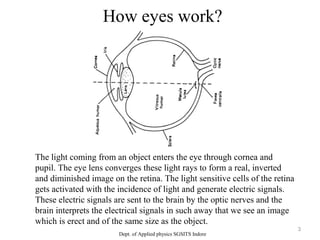
How eyes work?
Dept. of Applied physics SGSITS Indore
3
The light coming from an object enters the eye through cornea and
pupil. The eye lens converges these light rays to form a real, inverted
and diminished image on the retina. The light sensitive cells of the retina
gets activated with the incidence of light and generate electric signals.
These electric signals are sent to the brain by the optic nerves and the
brain interprets the electrical signals in such away that we see an image
which is erect and of the same size as the object.
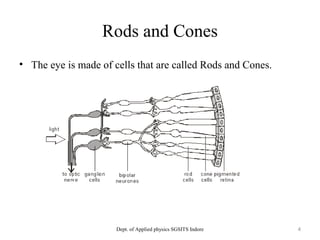
Rods and Cones
• The eye is made of cells that are called Rods and Cones.
Dept. of Applied physics SGSITS Indore 4
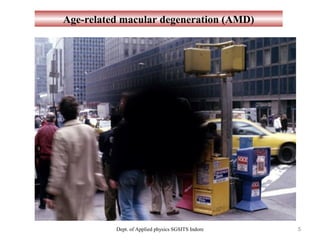
Age-related macular degeneration (AMD)
Dept. of Applied physics SGSITS Indore 5
1
43
2
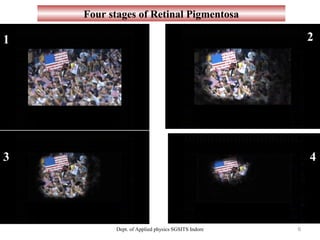
Four stages of Retinal Pigmentosa
Dept. of Applied physics SGSITS Indore 6
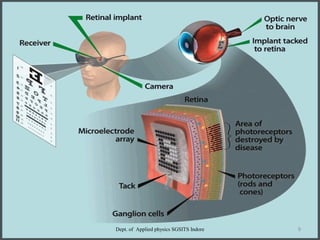
What is artificial eye?What is artificial eye?
• Form of neural prosthesis to restore vision.
• An externally worn camera and a retinal implanted chip
makes it possible.
• It is often usable for those who suffers from age-related
macular degeneration (AMD) or retinal pigmentosa.
Dept. of Applied physics SGSITS Indore 7
ComponentComponent
Dept. of Applied physics SGSITS Indore 8
• Digital camera
• Video-processing microchip
• Radio transmitter
• Radio receiver
• Retinal implant
Dept. of Applied physics SGSITS Indore 9
WORKINGWORKING
Dept. of Applied physics SGSITS Indore 10
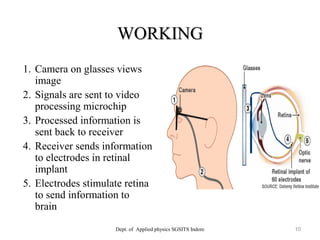
1. Camera on glasses views
image
2. Signals are sent to video
processing microchip
3. Processed information is
sent back to receiver
4. Receiver sends information
to electrodes in retinal
implant
5. Electrodes stimulate retina
to send information to
brain
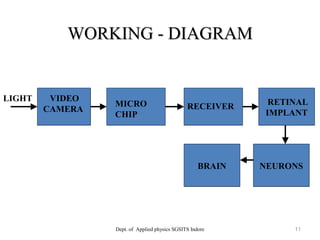
RETINAL
IMPLANT
BRAIN
VIDEO
CAMERA
MICRO
CHIP
RECEIVER
WORKING - DIAGRAMWORKING - DIAGRAM
Dept. of Applied physics SGSITS Indore 11
LIGHT
NEURONS
NORMAL & ARTIFICIAL VISIONSNORMAL & ARTIFICIAL VISIONS
Dept. of Applied physics SGSITS Indore 12
• Normal vision- Begins when light enters and strike on
photoreceptor cells. These cells convert light to electric
impulses that are sent to brain via optic nerves.
• Artificial vision- The camera captures images and sends to
retina implant. It stimulates neurons. The stimulated neurons
send information to brain via optic nerves.
TYPES OF ARTIFICIAL EYESTYPES OF ARTIFICIAL EYES
Dept. of Applied physics SGSITS Indore 13
• First generation – Consists of 16 electrode array and large
sized receiver placed behind ear.
• Second generation – Designed with 60 electrode array and
much smaller receiver placed around the eye.
LIMITATIONSLIMITATIONS
Dept. of Applied physics SGSITS Indore 14
• Surgery is required to implant the electrode array.
• Repairing is difficult if any of the devices got damaged.
• Those who lost their visions due to other reasons could not
use this device.
Conclusion
• Revolutionary piece of technology.
• Good news for AMD and retinal pigmentosa patients.
Dept. of Applied physics SGSITS Indore 15
THANK YOU
Dept. of Applied physics SGSITS Indore 16

Jammy

  • 1.
    Seminar on Artificial Eye {aneye for the eye} Presented by JAMVANT SONWANE Guided by MR.ABHISEK TRIPATHI Lecturer Department of Applied Physics Shree G S Institute of Technology & Science, Indore Jan 2012
  • 2.
    CONTENT • How eyeswork? • Rods and cones • Disease related to eye • What is Artificial eye? • Component • Working diagram • Normal and artificial vision • Types of artificial eye • Limitations • Conclusion • references Dept. of Applied physics SGSITS Indore 2
  • 3.
    How eyes work? Dept.of Applied physics SGSITS Indore 3 The light coming from an object enters the eye through cornea and pupil. The eye lens converges these light rays to form a real, inverted and diminished image on the retina. The light sensitive cells of the retina gets activated with the incidence of light and generate electric signals. These electric signals are sent to the brain by the optic nerves and the brain interprets the electrical signals in such away that we see an image which is erect and of the same size as the object.
  • 4.
    Rods and Cones •The eye is made of cells that are called Rods and Cones. Dept. of Applied physics SGSITS Indore 4
  • 5.
    Age-related macular degeneration(AMD) Dept. of Applied physics SGSITS Indore 5
  • 6.
    1 43 2 Four stages ofRetinal Pigmentosa Dept. of Applied physics SGSITS Indore 6
  • 7.
    What is artificialeye?What is artificial eye? • Form of neural prosthesis to restore vision. • An externally worn camera and a retinal implanted chip makes it possible. • It is often usable for those who suffers from age-related macular degeneration (AMD) or retinal pigmentosa. Dept. of Applied physics SGSITS Indore 7
  • 8.
    ComponentComponent Dept. of Appliedphysics SGSITS Indore 8 • Digital camera • Video-processing microchip • Radio transmitter • Radio receiver • Retinal implant
  • 9.
    Dept. of Appliedphysics SGSITS Indore 9
  • 10.
    WORKINGWORKING Dept. of Appliedphysics SGSITS Indore 10 1. Camera on glasses views image 2. Signals are sent to video processing microchip 3. Processed information is sent back to receiver 4. Receiver sends information to electrodes in retinal implant 5. Electrodes stimulate retina to send information to brain
  • 11.
    RETINAL IMPLANT BRAIN VIDEO CAMERA MICRO CHIP RECEIVER WORKING - DIAGRAMWORKING- DIAGRAM Dept. of Applied physics SGSITS Indore 11 LIGHT NEURONS
  • 12.
    NORMAL & ARTIFICIALVISIONSNORMAL & ARTIFICIAL VISIONS Dept. of Applied physics SGSITS Indore 12 • Normal vision- Begins when light enters and strike on photoreceptor cells. These cells convert light to electric impulses that are sent to brain via optic nerves. • Artificial vision- The camera captures images and sends to retina implant. It stimulates neurons. The stimulated neurons send information to brain via optic nerves.
  • 13.
    TYPES OF ARTIFICIALEYESTYPES OF ARTIFICIAL EYES Dept. of Applied physics SGSITS Indore 13 • First generation – Consists of 16 electrode array and large sized receiver placed behind ear. • Second generation – Designed with 60 electrode array and much smaller receiver placed around the eye.
  • 14.
    LIMITATIONSLIMITATIONS Dept. of Appliedphysics SGSITS Indore 14 • Surgery is required to implant the electrode array. • Repairing is difficult if any of the devices got damaged. • Those who lost their visions due to other reasons could not use this device.
  • 15.
    Conclusion • Revolutionary pieceof technology. • Good news for AMD and retinal pigmentosa patients. Dept. of Applied physics SGSITS Indore 15
  • 16.
    THANK YOU Dept. ofApplied physics SGSITS Indore 16