Artificial
Retina
By
Purushotham Baskarla
13245A0420
Contents
 How human eye works?
 Diseases related to eye
 Implantation
 What is Bionic Eye?
 Components
 Working
 Results & Advantages
 Limitations & Drawbacks
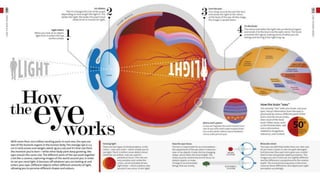
Working of human eye :
 The eye is one of the most important organs of
the body. Before we learn about ASR, it is
important to know the working of natural retina.
 The light coming from an object enters the eye
through cornea and pupil and forms inverted
image on the retina.
 The light sensitive cells of the retina gets
activated with the incidence of light and generate
electric signals. These electric signals are sent to
the brain by the optic nerves and the brain
interprets the electrical signals in such away that
we see an image .
Diseases
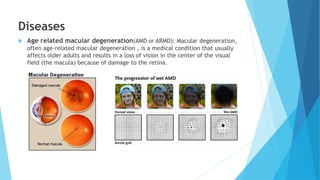
 Age related macular degeneration(AMD or ARMD): Macular degeneration,
often age-related macular degeneration , is a medical condition that usually
affects older adults and results in a loss of vision in the center of the visual
field (the macula) because of damage to the retina.
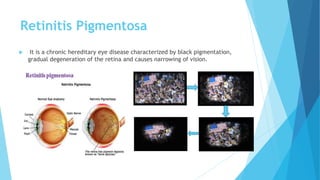
Retinitis Pigmentosa
 It is a chronic hereditary eye disease characterized by black pigmentation,
gradual degeneration of the retina and causes narrowing of vision.
History of BIONIC EYE :
 -Dr.Mark Humayun, Dr. Eugene Dejuan along with few more scientists
demonstrated that a visually impaired person could be made to see light by
stimulating the optic nerves behind the retina with electrical impulses. This
test proved that the nerves behind retina still functioned even when the
retina had degenerated.
 Based on this scientists set out to create a devise that could translate images
to electrical pulses that could restore vision.
Groups of researchers have found that blind people can see spots of light when
electrical currents stimulate cells, following the experimental insertion of an
electrode device near to the retina.
 The main target of the research was:
small enough to be implanted in the eye.
supplied with a continuous source of power.
bio-compatible with eye tissues and its surroundings.
WHAT IS ARTIFICIAL RETINA
TECHNOLOGY???
 Artificial Retinas are referred to as visual prosthesis, it is also known as a
bionic eye
 It is an experimental visual device intended to restore functional vision in
those suffering from partial or total blindness
 In this presentation we will be discussing about the Artificial Retina made
using. Thin-Film Transistors, which can be fabricated on transparent and
exible substrates. Electronic photo devices and circuits are integrated on the
artificial retina, which is implanted on the inside surface of the living retina
at the back part of the human eyeballs.
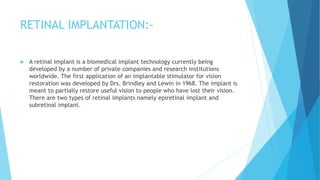
RETINAL IMPLANTATION:-
 A retinal implant is a biomedical implant technology currently being
developed by a number of private companies and research institutions
worldwide. The first application of an implantable stimulator for vision
restoration was developed by Drs. Brindley and Lewin in 1968. The implant is
meant to partially restore useful vision to people who have lost their vision.
There are two types of retinal implants namely epiretinal implant and
subretinal implant.
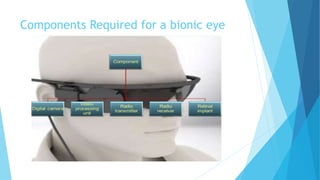
Components Required for a bionic eye
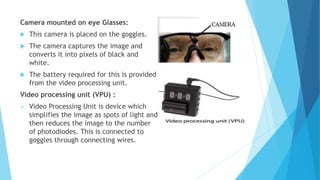
Camera mounted on eye Glasses:
 This camera is placed on the goggles.
 The camera captures the image and
converts it into pixels of black and
white.
 The battery required for this is provided
from the video processing unit.
Video processing unit (VPU) :
 Video Processing Unit is device which
simplifies the image as spots of light and
then reduces the image to the number
of photodiodes. This is connected to
goggles through connecting wires.
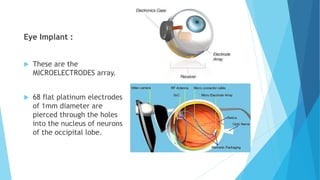
Eye Implant :
 These are the
MICROELECTRODES array.
 68 flat platinum electrodes
of 1mm diameter are
pierced through the holes
into the nucleus of neurons
of the occipital lobe.
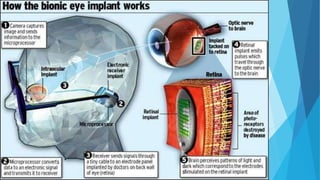
Working of BIONIC EYE :
 The camera mounted on a pair of eyeglasses, captures the scene in
front of the wearer and sends it to VPU on the patient's belt.
 The processor translates the image into a series of signals that the
brain can understand. The group of wires pass the processed image
which are generated by the processor to the transmitter.
 RF transmitter sends the signal to the RF receiver which is near the
eye implant wirelessly.
 Receiver attains the transmitted signal and demodulation is done
which is sent to the microelectrode strip.
 These electrodes converts it into electrical pulses and provide it to
the optic nerve.
Advantages :
 Identify the location or movement of objects and people.
 Recognize large letters, words or sentences.
 Helps in other activities of daily life, such as detecting street curbs and walking on a
sidewalk without stepping off.
 Ability to perform visual tasks demonstrated in many patients.
 Upgradable external hardware and software to benefit from future innovations.
 The brain has an amazing ability to adapt to new input and to improve his or her
understanding of what is being “seen” via an artificial vision system.
Artificial retina

Artificial retina

  • 1.
  • 2.
    Contents  How humaneye works?  Diseases related to eye  Implantation  What is Bionic Eye?  Components  Working  Results & Advantages  Limitations & Drawbacks
  • 4.
    Working of humaneye :  The eye is one of the most important organs of the body. Before we learn about ASR, it is important to know the working of natural retina.  The light coming from an object enters the eye through cornea and pupil and forms inverted image on the retina.  The light sensitive cells of the retina gets activated with the incidence of light and generate electric signals. These electric signals are sent to the brain by the optic nerves and the brain interprets the electrical signals in such away that we see an image .
  • 5.
    Diseases  Age relatedmacular degeneration(AMD or ARMD): Macular degeneration, often age-related macular degeneration , is a medical condition that usually affects older adults and results in a loss of vision in the center of the visual field (the macula) because of damage to the retina.
  • 6.
    Retinitis Pigmentosa  Itis a chronic hereditary eye disease characterized by black pigmentation, gradual degeneration of the retina and causes narrowing of vision.
  • 7.
    History of BIONICEYE :  -Dr.Mark Humayun, Dr. Eugene Dejuan along with few more scientists demonstrated that a visually impaired person could be made to see light by stimulating the optic nerves behind the retina with electrical impulses. This test proved that the nerves behind retina still functioned even when the retina had degenerated.  Based on this scientists set out to create a devise that could translate images to electrical pulses that could restore vision. Groups of researchers have found that blind people can see spots of light when electrical currents stimulate cells, following the experimental insertion of an electrode device near to the retina.  The main target of the research was: small enough to be implanted in the eye. supplied with a continuous source of power. bio-compatible with eye tissues and its surroundings.
  • 8.
    WHAT IS ARTIFICIALRETINA TECHNOLOGY???  Artificial Retinas are referred to as visual prosthesis, it is also known as a bionic eye  It is an experimental visual device intended to restore functional vision in those suffering from partial or total blindness  In this presentation we will be discussing about the Artificial Retina made using. Thin-Film Transistors, which can be fabricated on transparent and exible substrates. Electronic photo devices and circuits are integrated on the artificial retina, which is implanted on the inside surface of the living retina at the back part of the human eyeballs.
  • 9.
    RETINAL IMPLANTATION:-  Aretinal implant is a biomedical implant technology currently being developed by a number of private companies and research institutions worldwide. The first application of an implantable stimulator for vision restoration was developed by Drs. Brindley and Lewin in 1968. The implant is meant to partially restore useful vision to people who have lost their vision. There are two types of retinal implants namely epiretinal implant and subretinal implant.
  • 10.
  • 11.
    Camera mounted oneye Glasses:  This camera is placed on the goggles.  The camera captures the image and converts it into pixels of black and white.  The battery required for this is provided from the video processing unit. Video processing unit (VPU) :  Video Processing Unit is device which simplifies the image as spots of light and then reduces the image to the number of photodiodes. This is connected to goggles through connecting wires.
  • 12.
    Eye Implant : These are the MICROELECTRODES array.  68 flat platinum electrodes of 1mm diameter are pierced through the holes into the nucleus of neurons of the occipital lobe.
  • 14.
    Working of BIONICEYE :  The camera mounted on a pair of eyeglasses, captures the scene in front of the wearer and sends it to VPU on the patient's belt.  The processor translates the image into a series of signals that the brain can understand. The group of wires pass the processed image which are generated by the processor to the transmitter.  RF transmitter sends the signal to the RF receiver which is near the eye implant wirelessly.  Receiver attains the transmitted signal and demodulation is done which is sent to the microelectrode strip.  These electrodes converts it into electrical pulses and provide it to the optic nerve.
  • 15.
    Advantages :  Identifythe location or movement of objects and people.  Recognize large letters, words or sentences.  Helps in other activities of daily life, such as detecting street curbs and walking on a sidewalk without stepping off.  Ability to perform visual tasks demonstrated in many patients.  Upgradable external hardware and software to benefit from future innovations.  The brain has an amazing ability to adapt to new input and to improve his or her understanding of what is being “seen” via an artificial vision system.