Free Powerpoint Templates
“ELECTRONIC
EYE”: A Ray of
Vision For the
Blind…
Presented by:
Biswa Bandini Aastha Khamari
Aiswarya Lakshmi Khilar
Roll No.: 12EEE052
12EEE053
(Current Research and Future Prospects)
CONTENTS:-
 WHAT IS ELECTRONIC EYE ?
 BLINDNESS
 TECHNIQUES FOR ELECTRONIC
EYE
 MARC
 ADVANTAGES & DISADVANTAGES
 CONCLUSION
 WHAT IS ELECTRONIC OR BIONIC
EYE?
 ELECTRONIC OR BIONIC EYE REFERS TO
BIOELECTRONIC EYE.
 THE ELECTRONIC DEVICE WHICH
REPLACES FUNCTIONALITY OF A PART
OR WHOLE OF THE EYE.
BLINDNESS
 BLINDNESS MEANS LOSS OF VISION.
 A COMPLETELY BLIND INDIVISUAL UNABLE TO SEE
ANYTHING EVEN WITH THE USE OF EYE GLASSES ,
CONTACT LENSES , MEDICINE OR SURGERY.
 8O% OF BLINDNESS OCCURS IN PEOPLE OVER 50
YEARS OLD.
 COMMON CAUSES :- MACULAR DEGENERATION ,
TRAUMATIC INJURIES , GLAUCOMA etc.
 LESS COMMON CAUSES :- VIT-A DEFICIENCY ,
RETINITIS PIGMENTOSA , RETINOPATHY OF
PREMATURITY etc.
TECHNOLOGIES APPLIED IN BIONIC EYE :-
 MIT – HARVARD DEVICE
 ASR(ARTIFICIAL SILICON RETINA)
 MARC(MULTI UNIT ARTIFICIAL
RETINA CHIPSET SYSYEM)
 ARGUS II
 HOLOGRAPHIC TECHNOLOGY
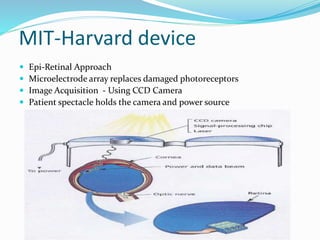
MIT-Harvard device
 Epi-Retinal Approach
 Microelectrode array replaces damaged photoreceptors
 Image Acquisition - Using CCD Camera
 Patient spectacle holds the camera and power source
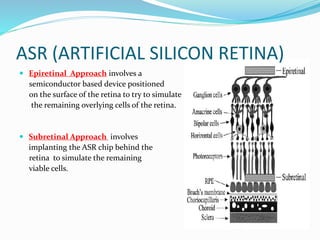
 Epiretinal Approach involves a
semiconductor based device positioned
on the surface of the retina to try to simulate
the remaining overlying cells of the retina.
 Subretinal Approach involves
implanting the ASR chip behind the
retina to simulate the remaining
viable cells.
ASR (ARTIFICIAL SILICON RETINA)
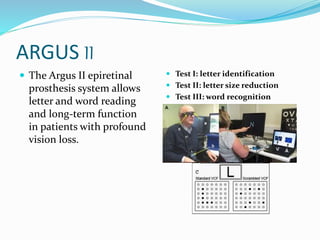
ARGUS II
 The Argus II epiretinal
prosthesis system allows
letter and word reading
and long-term function
in patients with profound
vision loss.
 Test I: letter identification
 Test II: letter size reduction
 Test III: word recognition
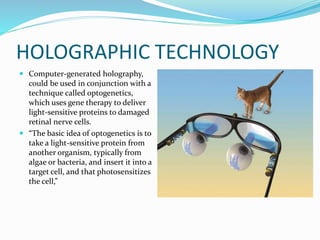
HOLOGRAPHIC TECHNOLOGY
 Computer-generated holography,
could be used in conjunction with a
technique called optogenetics,
which uses gene therapy to deliver
light-sensitive proteins to damaged
retinal nerve cells.
 “The basic idea of optogenetics is to
take a light-sensitive protein from
another organism, typically from
algae or bacteria, and insert it into a
target cell, and that photosensitizes
the cell,”
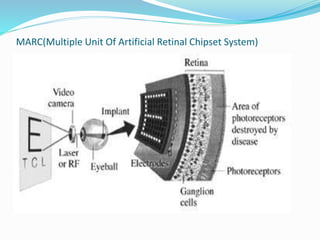
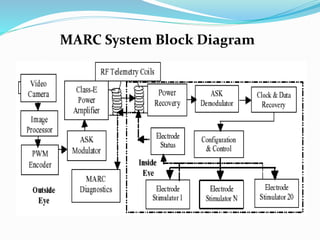
MARC(Multiple Unit Of Artificial Retinal Chipset System)
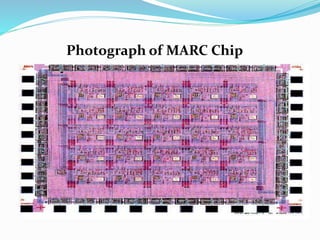
Photograph of MARC Chip
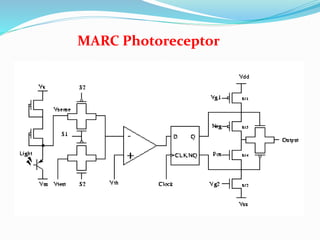
MARC Photoreceptor
MARC System Block Diagram
On-Going Development:
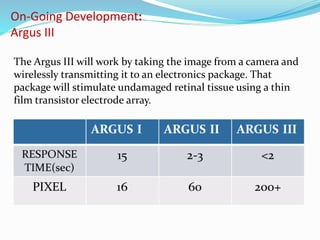
Argus III
The Argus III will work by taking the image from a camera and
wirelessly transmitting it to an electronics package. That
package will stimulate undamaged retinal tissue using a thin
film transistor electrode array.
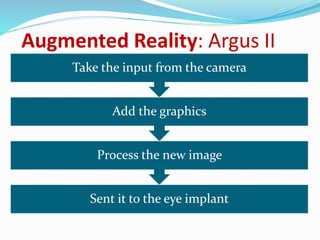
Augmented Reality: Argus II
Sent it to the eye implant
Process the new image
Add the graphics
Take the input from the camera
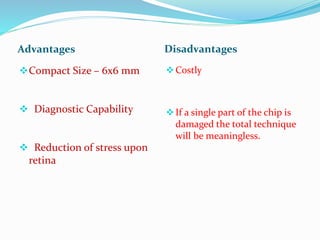
Advantages Disadvantages
Compact Size – 6x6 mm
 Diagnostic Capability
 Reduction of stress upon
retina
Costly
If a single part of the chip is
damaged the total technique
will be meaningless.
Conclusion
 Its been 40 years since Arne Larsson received the first fully implanted
cardiac pacemaker at the Karolinska Institute in Stockholm.
 Researchers throughout the world have looked for ways to improve
people's lives with artificial, bionic devices.
 Bionic devices are being developed to do more than replace defective
parts.
 Researchers are also using them to fight illnesses.
 Providing power to run bionic implants and making connections to the
brain's control system pose the two great challenges for both electrical
& biomedical engineering.
 Scientist are now looking at devices like bionic arms, tongues, noses
etc.
THE ELECTRONIC EYE

THE ELECTRONIC EYE

  • 1.
    Free Powerpoint Templates “ELECTRONIC EYE”:A Ray of Vision For the Blind… Presented by: Biswa Bandini Aastha Khamari Aiswarya Lakshmi Khilar Roll No.: 12EEE052 12EEE053 (Current Research and Future Prospects)
  • 2.
    CONTENTS:-  WHAT ISELECTRONIC EYE ?  BLINDNESS  TECHNIQUES FOR ELECTRONIC EYE  MARC  ADVANTAGES & DISADVANTAGES  CONCLUSION
  • 3.
     WHAT ISELECTRONIC OR BIONIC EYE?  ELECTRONIC OR BIONIC EYE REFERS TO BIOELECTRONIC EYE.  THE ELECTRONIC DEVICE WHICH REPLACES FUNCTIONALITY OF A PART OR WHOLE OF THE EYE.
  • 4.
    BLINDNESS  BLINDNESS MEANSLOSS OF VISION.  A COMPLETELY BLIND INDIVISUAL UNABLE TO SEE ANYTHING EVEN WITH THE USE OF EYE GLASSES , CONTACT LENSES , MEDICINE OR SURGERY.  8O% OF BLINDNESS OCCURS IN PEOPLE OVER 50 YEARS OLD.  COMMON CAUSES :- MACULAR DEGENERATION , TRAUMATIC INJURIES , GLAUCOMA etc.  LESS COMMON CAUSES :- VIT-A DEFICIENCY , RETINITIS PIGMENTOSA , RETINOPATHY OF PREMATURITY etc.
  • 5.
    TECHNOLOGIES APPLIED INBIONIC EYE :-  MIT – HARVARD DEVICE  ASR(ARTIFICIAL SILICON RETINA)  MARC(MULTI UNIT ARTIFICIAL RETINA CHIPSET SYSYEM)  ARGUS II  HOLOGRAPHIC TECHNOLOGY
  • 6.
    MIT-Harvard device  Epi-RetinalApproach  Microelectrode array replaces damaged photoreceptors  Image Acquisition - Using CCD Camera  Patient spectacle holds the camera and power source
  • 7.
     Epiretinal Approachinvolves a semiconductor based device positioned on the surface of the retina to try to simulate the remaining overlying cells of the retina.  Subretinal Approach involves implanting the ASR chip behind the retina to simulate the remaining viable cells. ASR (ARTIFICIAL SILICON RETINA)
  • 8.
    ARGUS II  TheArgus II epiretinal prosthesis system allows letter and word reading and long-term function in patients with profound vision loss.  Test I: letter identification  Test II: letter size reduction  Test III: word recognition
  • 9.
    HOLOGRAPHIC TECHNOLOGY  Computer-generatedholography, could be used in conjunction with a technique called optogenetics, which uses gene therapy to deliver light-sensitive proteins to damaged retinal nerve cells.  “The basic idea of optogenetics is to take a light-sensitive protein from another organism, typically from algae or bacteria, and insert it into a target cell, and that photosensitizes the cell,”
  • 10.
    MARC(Multiple Unit OfArtificial Retinal Chipset System)
  • 11.
  • 12.
  • 13.
  • 14.
    On-Going Development: Argus III TheArgus III will work by taking the image from a camera and wirelessly transmitting it to an electronics package. That package will stimulate undamaged retinal tissue using a thin film transistor electrode array.
  • 15.
    Augmented Reality: ArgusII Sent it to the eye implant Process the new image Add the graphics Take the input from the camera
  • 16.
    Advantages Disadvantages Compact Size– 6x6 mm  Diagnostic Capability  Reduction of stress upon retina Costly If a single part of the chip is damaged the total technique will be meaningless.
  • 17.
    Conclusion  Its been40 years since Arne Larsson received the first fully implanted cardiac pacemaker at the Karolinska Institute in Stockholm.  Researchers throughout the world have looked for ways to improve people's lives with artificial, bionic devices.  Bionic devices are being developed to do more than replace defective parts.  Researchers are also using them to fight illnesses.  Providing power to run bionic implants and making connections to the brain's control system pose the two great challenges for both electrical & biomedical engineering.  Scientist are now looking at devices like bionic arms, tongues, noses etc.