MODERATOR : DR BALWINDER
KAUR REKHI
PRESENTOR: DR LOVEPREET
POST OPERATIVE NAUSEA
AND VOMITING
INCIDENCE
 PONV- two of the most common and unpleasant side
effects following anaesthesia and surgery.
 Incidence of nausea- 22% to 38%
 Incidence of vomiting-12% to 26%
 An episode of vomiting prolongs postanaesthetic
care unit stay by about 25 minutes.
SIGNIFICANCE OF PONV
PONV remains a significant problem in modern anesthetic
practice because of adverse consequences such as
delayed recovery
unexpected hospital admission
delayed return to work of ambulatory patients
pulmonary aspiration
wound dehiscence
Considering increasing demand for ambulatory and day
care surgery, a holistic approach should be attempted
before and during surgery to prevent PONV.
DEFINATION
 NAUSEA
It is an unpleasant sensation referred to a desire to vomit not
associated with expulsive muscular movement.
 VOMITING
It is the forceful expulsion of even a small amount of upper
gastrointestinal contents through mouth.
CLASSIFICATION
 Early PONV- within 6 hrs of emergence from
anesthesia
 Late PONV- 6-24 hrs after procedure
PATHOPHYSIOLOGY
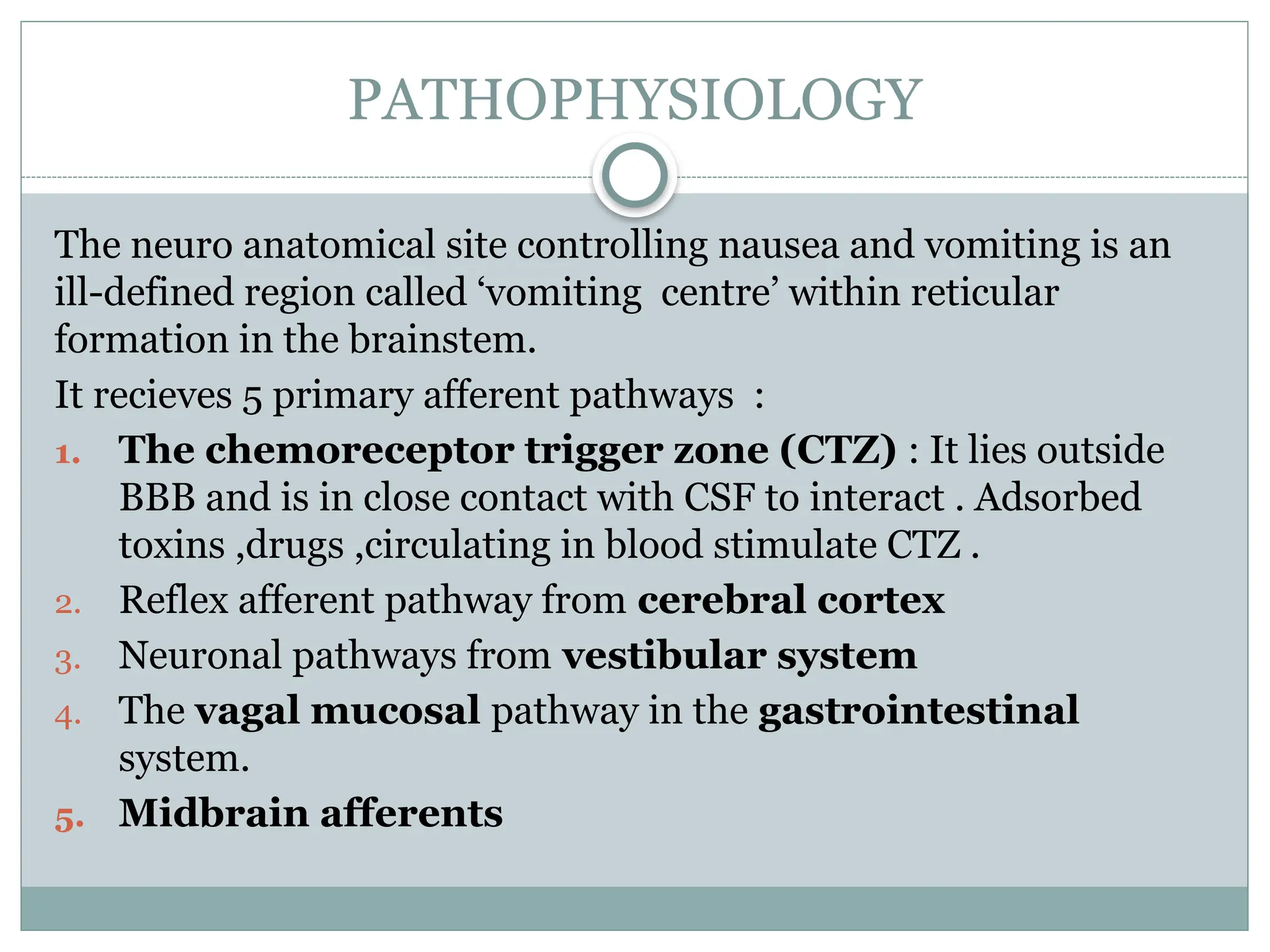
The neuro anatomical site controlling nausea and vomiting is an
ill-defined region called ‘vomiting centre’ within reticular
formation in the brainstem.
It recieves 5 primary afferent pathways :
1. The chemoreceptor trigger zone (CTZ) : It lies outside
BBB and is in close contact with CSF to interact . Adsorbed
toxins ,drugs ,circulating in blood stimulate CTZ .
2. Reflex afferent pathway from cerebral cortex
3. Neuronal pathways from vestibular system
4. The vagal mucosal pathway in the gastrointestinal
system.
5. Midbrain afferents
These afferents stimulate the vomiting centre and initiate the process of
vomiting by sending efferent signals . There occur coordinated contraction
of abdominal muscles against closed glottis. The pyloric sphincter contracts
and esophageal sphincter relaxes and there is active antiperistalsis within
esophagus which forcibly expels the gastric contents.
Stimulation of any of these afferent pathway can activate the sensation of
vomiting via various receptors
 Serotonergic( 5HT3)
 Dopaminergic(D2)
 Histaminergic (H1)
 Cholinergic (muscarinic)(M)
 NK1 receptor
ETIOLOGY
 The etiology of PONV is usually multifactorial and
associated with anesthetic and analgesic agents, the
type of surgical procedure, intrinsic patient factors
such as history of motion sickness
 It is important to recognize that nausea is common
complain reported at the onset of hypotension,
particularly following spinal or epidural anesthesia.
RISK FACTORS FOR PONV
 Patient factors
- young age
- female gender ( particular menstruating on day of
surgery or first trimester of pregnancy)
- nonsmoker ( 1.8 times more)
- history of prior postoperative emesis
- history of motion sickness
 Anesthetic technique
- general anaesthesia > epidural > SAB > PNB
- drugs: opioids, volatile agents, nitrous oxide
 Surgical procedure
- strabismus surgery
- ear surgery
- laparoscopy
- orchiopexy
- ovum retrieval
- tonsillectomy
- breast surgery
 Postoperative factors
- posteroperative pain
- hypotension
RULE OUT
 Hypotension
 Hypovolemia
 Postoperative pain
 Inadequate oxygenation
 Temperature- hypothermia, or patient feels too
warm
 Poor oral hygiene
 Foul or upsetting smell in the vicinity of the patient
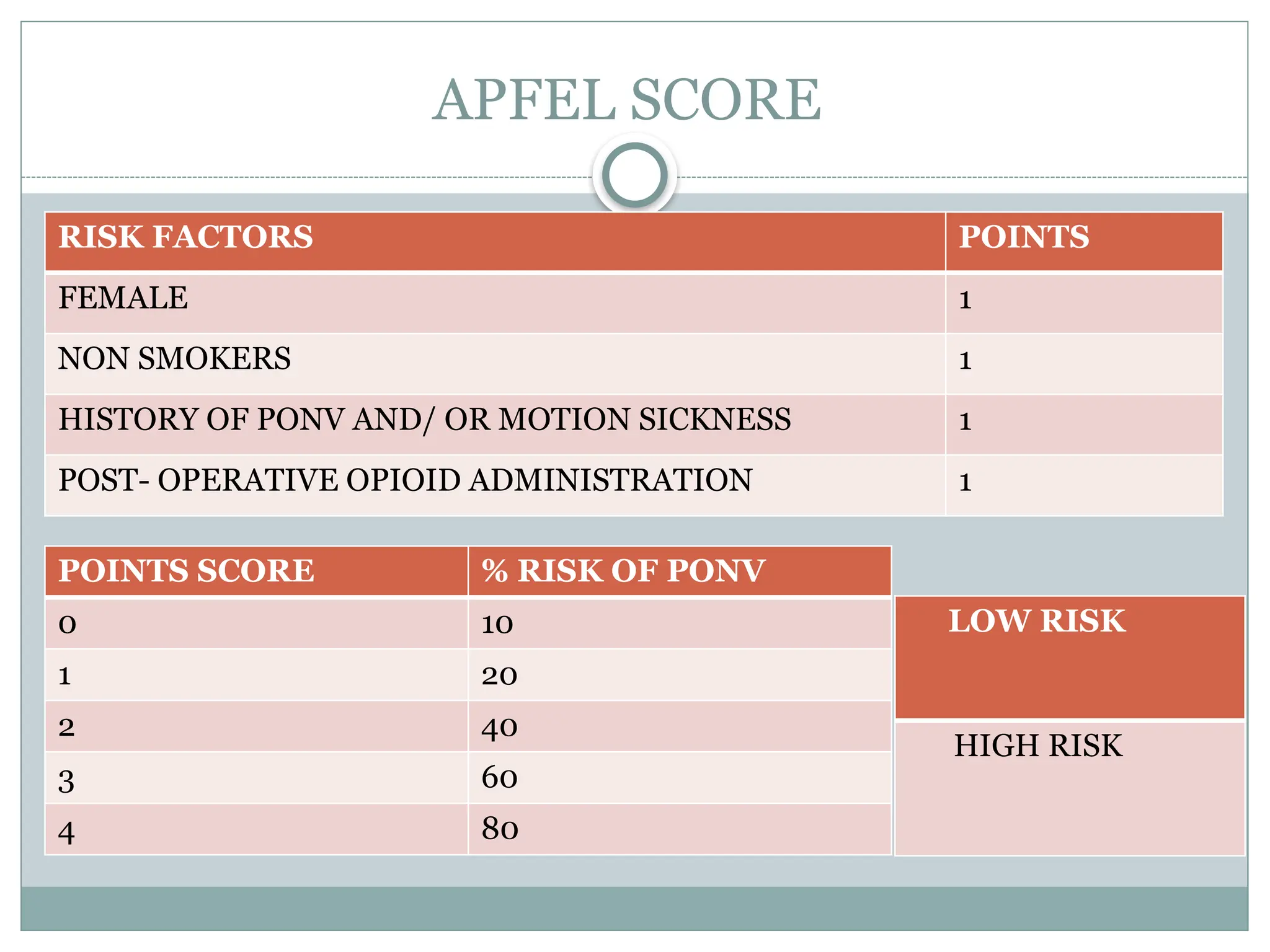
APFEL SCORE
RISK FACTORS POINTS
FEMALE 1
NON SMOKERS 1
HISTORY OF PONV AND/ OR MOTION SICKNESS 1
POST- OPERATIVE OPIOID ADMINISTRATION 1
POINTS SCORE % RISK OF PONV
0 10
1 20
2 40
3 60
4 80
LOW RISK
HIGH RISK
PONV : DRUGS FOR PROPHYLAXIS AND T/T
 5HT3 RECEPTOR ANTAGONIST:
- Ondansetron
-Granisetron
-Dolasetron
-Palonsetron
 CORTICOSTEROIDS
-Dexamethasone
 DOPAMINE ANTAGONIST
-Metoclopramide
-Prochlorperazine
 BUTYROPHENONES
-Droperidol
-Haloperidol
 ANTIHISTAMINES
-Promethazine
-cyclizine
-dimenhydrinate
 ANTICHOLINERGIC
-Transdermal Scopolamine
 NK-1 RECEPTOR ANTAGONIST
-Aprepitant
 PROPOFOL
 GABAPENTINE
 MIDAZOLAM
5HT3 ANTAGONIST
 Selectively block 5-HT3 receptors of GI tract and CTZ in area postrema of
brain.
ONDENSETRON:
FDA dose- 4mg iv
plasma ½ life -3 hours (most effective when given at the end of surgery)
Reduce risk by 26%
S/E: Headache , nausea, slight prolongation of QT interval , allergic reactions
Metabolism-ondensetron undergoes extensive metabolism in liver via
hydrolation and cojugation by cytochrome P-450 enzymes.
Dose should be reduced in liver failure.
 DOLASETRON
FDA Dose : 12-50 mg
iv- 12.5mg
oral- 25-30 mg
Plasma ½ life- 7 hours ( at induction)
Not recommended due to QT prolongation.
 GRANISTRON
FDA Dose: 1mg( 20-40 ug/kg)
Plasma ½ life -9 hours ( at induction)
 PALANOSETRON
Most effective antiemetic in this group with NK-1
antagonism.
FDA Dose-0.075 mg iv
Reduce the risk by 30% with ½ life of 40 hrs ( usually
given at the start of surgery)
Most useful in PDNV
 DEXAMETHASONE
MOA- Inhibition of corticosteroid receptors inNTS
Inhibition of prostaglandins synthesis
FDA Dose – 4-5mg iv
Slower in onset
Administer at the induction
Complication-Perioperative hyperglycemia in DM and
obese patients, post op infection.
BUTYROPHENONES
 DROPERIDOL
MOA: It is relatively selective D2 receotor antagonist .
It is very effective in small doses ( 0.625-1.25mg iv)for prevention and treatment
of PONV.
Plasma ½ life of 3 hours
Risk reduced by 26%
FDA has given Black box warning
Unfortunately its use has declined after its association with rare fatal arrythmias
Contraindicated in suspected QT prolongation.
S/E: Anxiety , restlessness ,akathsia,dystonia, torsedes de pointes.
METOCLOPRAMIDE
FDA Dose – 10mg iv ( 0.2-0.5 mg/kg)
MOA- D2 receptor antagonist both central( CTZ) and
peripheral.
Peripheral prokinetic activity
COMPLICATIONS- EPS, hypotension, tachycardia
CONTRAINDICATED- Parkinson’s disease, restless
leg syndrome.
NK1 ANTAGONIST
APREPITANT
MOA: Blocks NK1 receptors present in GIT
FDA Dose – 40mg orally ( at induction)
Risk reduced by 69%
High cost
ANTIHISTAMINES
PROMETHAZINE
DIPHENHYDRAMINE
CYCLIZINE
MOA: H1 antagonism and anti cholinergic activity.
S/E: Drowsiness , urinary retention ,
dry mouth,blurred vision.
Given at the start –sedative side effects may delay
recovery if given at end of surgery.
 PROPOFOL
The median plasma propofol concentration associated
with an antiemetic response was 343ng/ml , which is
much lower than the concentration ranges associated
with general anaesthesia( 3-6 mcg/ml) or sedation (1-
3mcg/ml)
Propofol in small doses (20mg as needed) can be used
as rescue therapy.
GABAPENTINE
600mg orally given 2 hours before surgery
800mg 1hour before surgery.
MIDAZOLAM
Midazolam 2mg when administered 30 mints before
the end of surgery was as effective against PONV as
ondensetron 4mg.
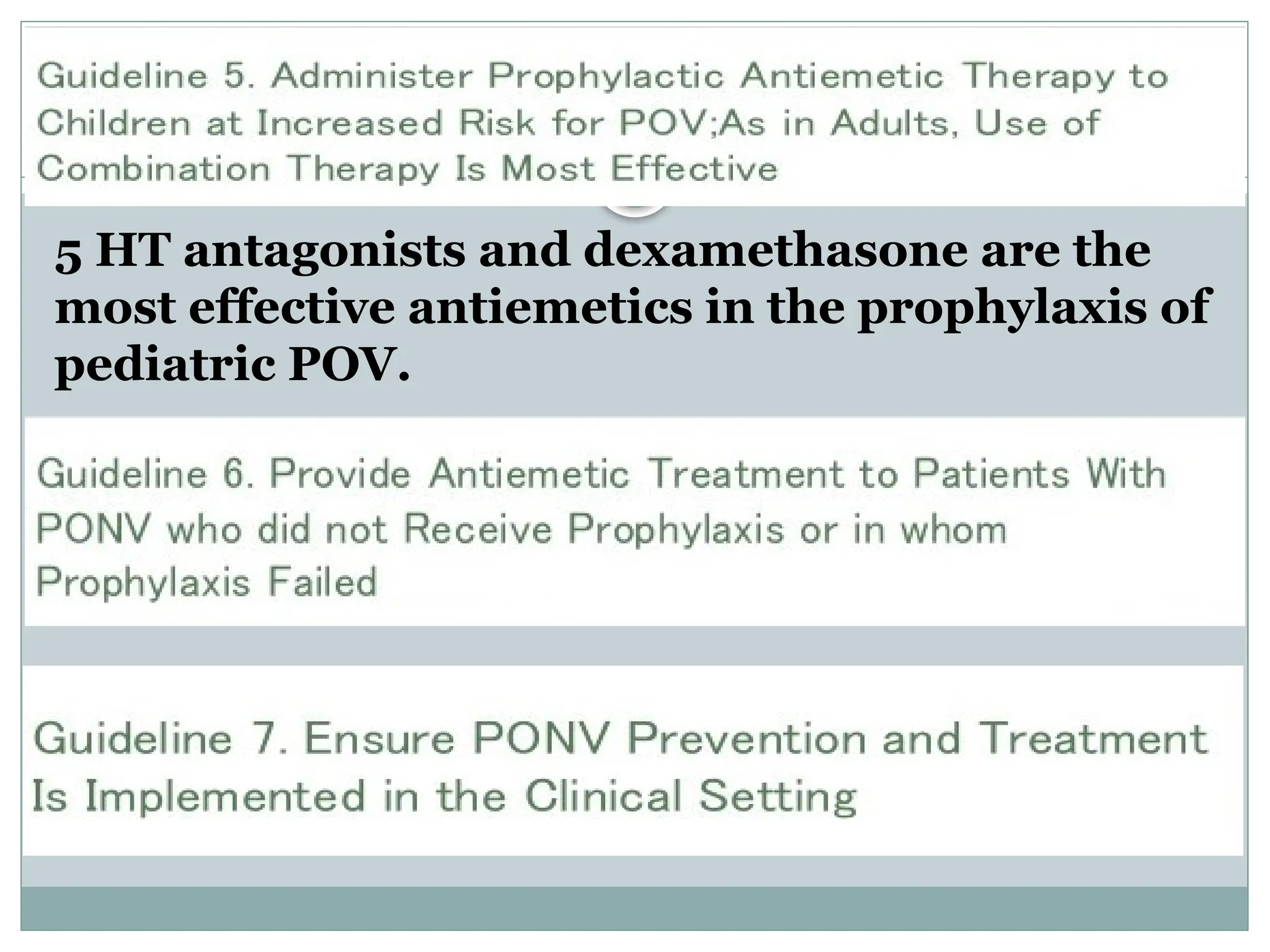
5 HT antagonists and dexamethasone are the
most effective antiemetics in the prophylaxis of
pediatric POV.

POST OPERATIVE NAUSEA AND VOMITING-2.pptx

  • 1.
    MODERATOR : DRBALWINDER KAUR REKHI PRESENTOR: DR LOVEPREET POST OPERATIVE NAUSEA AND VOMITING
  • 2.
    INCIDENCE  PONV- twoof the most common and unpleasant side effects following anaesthesia and surgery.  Incidence of nausea- 22% to 38%  Incidence of vomiting-12% to 26%  An episode of vomiting prolongs postanaesthetic care unit stay by about 25 minutes.
  • 3.
    SIGNIFICANCE OF PONV PONVremains a significant problem in modern anesthetic practice because of adverse consequences such as delayed recovery unexpected hospital admission delayed return to work of ambulatory patients pulmonary aspiration wound dehiscence Considering increasing demand for ambulatory and day care surgery, a holistic approach should be attempted before and during surgery to prevent PONV.
  • 4.
    DEFINATION  NAUSEA It isan unpleasant sensation referred to a desire to vomit not associated with expulsive muscular movement.  VOMITING It is the forceful expulsion of even a small amount of upper gastrointestinal contents through mouth.
  • 5.
    CLASSIFICATION  Early PONV-within 6 hrs of emergence from anesthesia  Late PONV- 6-24 hrs after procedure
  • 6.
    PATHOPHYSIOLOGY The neuro anatomicalsite controlling nausea and vomiting is an ill-defined region called ‘vomiting centre’ within reticular formation in the brainstem. It recieves 5 primary afferent pathways : 1. The chemoreceptor trigger zone (CTZ) : It lies outside BBB and is in close contact with CSF to interact . Adsorbed toxins ,drugs ,circulating in blood stimulate CTZ . 2. Reflex afferent pathway from cerebral cortex 3. Neuronal pathways from vestibular system 4. The vagal mucosal pathway in the gastrointestinal system. 5. Midbrain afferents
  • 7.
    These afferents stimulatethe vomiting centre and initiate the process of vomiting by sending efferent signals . There occur coordinated contraction of abdominal muscles against closed glottis. The pyloric sphincter contracts and esophageal sphincter relaxes and there is active antiperistalsis within esophagus which forcibly expels the gastric contents. Stimulation of any of these afferent pathway can activate the sensation of vomiting via various receptors  Serotonergic( 5HT3)  Dopaminergic(D2)  Histaminergic (H1)  Cholinergic (muscarinic)(M)  NK1 receptor
  • 9.
    ETIOLOGY  The etiologyof PONV is usually multifactorial and associated with anesthetic and analgesic agents, the type of surgical procedure, intrinsic patient factors such as history of motion sickness  It is important to recognize that nausea is common complain reported at the onset of hypotension, particularly following spinal or epidural anesthesia.
  • 11.
    RISK FACTORS FORPONV  Patient factors - young age - female gender ( particular menstruating on day of surgery or first trimester of pregnancy) - nonsmoker ( 1.8 times more) - history of prior postoperative emesis - history of motion sickness  Anesthetic technique - general anaesthesia > epidural > SAB > PNB - drugs: opioids, volatile agents, nitrous oxide
  • 12.
     Surgical procedure -strabismus surgery - ear surgery - laparoscopy - orchiopexy - ovum retrieval - tonsillectomy - breast surgery  Postoperative factors - posteroperative pain - hypotension
  • 13.
    RULE OUT  Hypotension Hypovolemia  Postoperative pain  Inadequate oxygenation  Temperature- hypothermia, or patient feels too warm  Poor oral hygiene  Foul or upsetting smell in the vicinity of the patient
  • 14.
    APFEL SCORE RISK FACTORSPOINTS FEMALE 1 NON SMOKERS 1 HISTORY OF PONV AND/ OR MOTION SICKNESS 1 POST- OPERATIVE OPIOID ADMINISTRATION 1 POINTS SCORE % RISK OF PONV 0 10 1 20 2 40 3 60 4 80 LOW RISK HIGH RISK
  • 15.
    PONV : DRUGSFOR PROPHYLAXIS AND T/T  5HT3 RECEPTOR ANTAGONIST: - Ondansetron -Granisetron -Dolasetron -Palonsetron  CORTICOSTEROIDS -Dexamethasone  DOPAMINE ANTAGONIST -Metoclopramide -Prochlorperazine  BUTYROPHENONES -Droperidol -Haloperidol
  • 16.
     ANTIHISTAMINES -Promethazine -cyclizine -dimenhydrinate  ANTICHOLINERGIC -TransdermalScopolamine  NK-1 RECEPTOR ANTAGONIST -Aprepitant  PROPOFOL  GABAPENTINE  MIDAZOLAM
  • 17.
    5HT3 ANTAGONIST  Selectivelyblock 5-HT3 receptors of GI tract and CTZ in area postrema of brain. ONDENSETRON: FDA dose- 4mg iv plasma ½ life -3 hours (most effective when given at the end of surgery) Reduce risk by 26% S/E: Headache , nausea, slight prolongation of QT interval , allergic reactions Metabolism-ondensetron undergoes extensive metabolism in liver via hydrolation and cojugation by cytochrome P-450 enzymes. Dose should be reduced in liver failure.
  • 18.
     DOLASETRON FDA Dose: 12-50 mg iv- 12.5mg oral- 25-30 mg Plasma ½ life- 7 hours ( at induction) Not recommended due to QT prolongation.  GRANISTRON FDA Dose: 1mg( 20-40 ug/kg) Plasma ½ life -9 hours ( at induction)
  • 19.
     PALANOSETRON Most effectiveantiemetic in this group with NK-1 antagonism. FDA Dose-0.075 mg iv Reduce the risk by 30% with ½ life of 40 hrs ( usually given at the start of surgery) Most useful in PDNV
  • 20.
     DEXAMETHASONE MOA- Inhibitionof corticosteroid receptors inNTS Inhibition of prostaglandins synthesis FDA Dose – 4-5mg iv Slower in onset Administer at the induction Complication-Perioperative hyperglycemia in DM and obese patients, post op infection.
  • 21.
    BUTYROPHENONES  DROPERIDOL MOA: Itis relatively selective D2 receotor antagonist . It is very effective in small doses ( 0.625-1.25mg iv)for prevention and treatment of PONV. Plasma ½ life of 3 hours Risk reduced by 26% FDA has given Black box warning Unfortunately its use has declined after its association with rare fatal arrythmias Contraindicated in suspected QT prolongation. S/E: Anxiety , restlessness ,akathsia,dystonia, torsedes de pointes.
  • 22.
    METOCLOPRAMIDE FDA Dose –10mg iv ( 0.2-0.5 mg/kg) MOA- D2 receptor antagonist both central( CTZ) and peripheral. Peripheral prokinetic activity COMPLICATIONS- EPS, hypotension, tachycardia CONTRAINDICATED- Parkinson’s disease, restless leg syndrome.
  • 23.
    NK1 ANTAGONIST APREPITANT MOA: BlocksNK1 receptors present in GIT FDA Dose – 40mg orally ( at induction) Risk reduced by 69% High cost
  • 24.
    ANTIHISTAMINES PROMETHAZINE DIPHENHYDRAMINE CYCLIZINE MOA: H1 antagonismand anti cholinergic activity. S/E: Drowsiness , urinary retention , dry mouth,blurred vision. Given at the start –sedative side effects may delay recovery if given at end of surgery.
  • 25.
     PROPOFOL The medianplasma propofol concentration associated with an antiemetic response was 343ng/ml , which is much lower than the concentration ranges associated with general anaesthesia( 3-6 mcg/ml) or sedation (1- 3mcg/ml) Propofol in small doses (20mg as needed) can be used as rescue therapy.
  • 26.
    GABAPENTINE 600mg orally given2 hours before surgery 800mg 1hour before surgery. MIDAZOLAM Midazolam 2mg when administered 30 mints before the end of surgery was as effective against PONV as ondensetron 4mg.
  • 33.
    5 HT antagonistsand dexamethasone are the most effective antiemetics in the prophylaxis of pediatric POV.