By
Dr.SANDEEP
• The Dibucaine Number is a measure of the qualitative
  activity of Pseudo cholinesterase and is the percentage
  of inhibition of the enzyme by the local anesthetic
  Dibucaine.


• It is used to differentiate individuals who have substitution
  mutations of the Butryl cholinesterase enzyme
• Dibucaine (cinchocaine), is an amino amide L.A.

• It was commonly used for central neuraxial anesthesia.

• When administered to humans i.v , it is capable of
  inhibiting the plasma Pseudocholinesterase enzyme.

• This tetrameric enzyme is responsible for the
  metabolism of a number of substances including amino
  ester local anaesthetics and Succinylcholine
• Synthesis-liver

• Converts Succinylcholine to Succinylmonocholine
  and choline

• The activity of the enzyme refers to the number of
  substrate molecules (micromoles) hydrolysed per
  unit of time, often expressed in international units
  (IU)

• Dibucaine inhibits its normal activity.
• Depolarizing neuromuscular blocker.

• Composed of two molecules of acetylcholine linked back
  to back through the acetate methyl groups.

• Like Ach, stimulates cholinergic receptors at the NMJ,
  nicotinic and muscarinic autonomic sites.

• Rapid onset of effect and ultra short duration of action

• ED95 is 0.51 to 0.63 mg/kg.
• Administration of 1mg/kg of Sch results in complete
  suppression of neuromuscular stimulation in
  approximately 60 seconds.

• In patients with normal Butrylcholinesterase, recovery of
  90% muscle strength requires 9 to 13 min

• Metabolised to Succinylmonocholine and then to succinic
  acid and choline.

• Elimination t ½ is 47 sec
• Reduced Butyrylcholinesterase activity may occur as a

  result of

              inherited causes

              acquired causes.
• In the inherited type, an individual receives a gene from
  each parent, one of which may be the wild type
  Butyrylcholinesterase, or the mutant.

• Some mutations will slow or completely deactivate the
  enzyme's ability to catalyze the breakdown of Sch

• Inherited reductions occur due to mutations at a single
  autosomal location on the long arm of chromosome 3
• At least one substitution is capable of altering the
  efficiency of enzymatic catalysis.

• A point mutation has been identified that changes Asp-70
  to Gly in the atypical form of serum cholinesterase,
  leading to reduced affinity of atypical cholinesterase for
  choline esters.

• It can be   Homozygous typical

              Heterozygous atypical

              Homozygous atypical
PEOPLE SUCH AS

•   Elderly
•   pregnant
•   Infants
•   Parturition

     and certain other physiologic conditions have low
Pseudocholinesterase enzyme levels.
PATHOLOGIC STATES      DRUGS
• Liver diseases       • Oral contraceptives
• Malnutrition,        • MAOI
• burns,               • Anticholinesterase drugs
• malignancy           • Tetrahydroaminacrine
• Uremia               • Hexafluorenium
• O.P. poisoning       • Metocllopramide
• Chronic infections   • Bambuterol(prodrug of
• Hypothroidism          terbutaline)
• Collagen vascular    • Esmolol
  diseases             • Cytotoxic drugs
                       • Ecothiphate
• The Dibucaine Number is used to differentiate individuals
  who have substitution mutations of the
  butrylcholinesterase enzyme


• The extent of the catalysis can be determined by
  measuring % of Sch that remains unchanged in the blood
  after a standard dose of Dibucaine inhibition challenge
  which has been established as the DIBUCAINE
  NUMBER TEST.
• Typical measurement of Dibucane number yields values
 of

      80 and above for wild type homozygotes (normal),

      40-60 for heterozygotes (atypical),

      20 or less for atypical homozygotes.
TYPE OF      GENOTYPE   INCIDENCE   DIBUCAINE    RESPONSE
BUTRYLCHOLINE                           NUMBER      TO SCH OR
STERASE                                            MIVACURIUM


HOMOZYGOUS       E1uE1u    NORMAL       NORMAL       NORMAL
  TYPICAL


HETEROZYGOUS     E1uE1a      1/480       50-60     LENGTHENED
   ATYPICAL                                        BY 50%-100%


HOMOZYGOUS       E1aE1a     1/3200       20-30     PROLONGED
  ATYPICAL                                          BY 4-8 HRS
• The distinctive quality of Dibucaine is that its enzyme

  inhibition of the wild type Butyrylcholinesterase (Typical)

  is substantially greater than that of the mutant

  Butyrylcholinesterase (Atypical).

• Thus, the atypical enzyme is said to be resistant to

  Dibucaine inhibition.
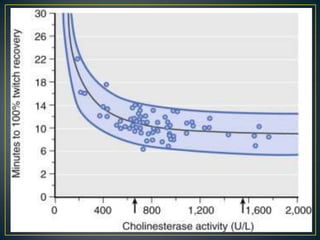
• When enzyme activity is reduced, there is an increase in
  the duration of the neuromuscular blockade - which may
  necessitates the unnecessary post op mechanical
  ventilation due to prolonged neuromuscular blockade

• But, in most of the cases, there is only mild increase in
  the duration of the apnea

 Eg:- Decrease to 20% of normal activity by severe liver
      disease, the duration of apnoea, increases from a
      normal duration of 3 minutes to just 9 minutes
Dibucaine number
Dibucaine number

Dibucaine number

  • 1.
  • 2.
    • The DibucaineNumber is a measure of the qualitative activity of Pseudo cholinesterase and is the percentage of inhibition of the enzyme by the local anesthetic Dibucaine. • It is used to differentiate individuals who have substitution mutations of the Butryl cholinesterase enzyme
  • 3.
    • Dibucaine (cinchocaine),is an amino amide L.A. • It was commonly used for central neuraxial anesthesia. • When administered to humans i.v , it is capable of inhibiting the plasma Pseudocholinesterase enzyme. • This tetrameric enzyme is responsible for the metabolism of a number of substances including amino ester local anaesthetics and Succinylcholine
  • 4.
    • Synthesis-liver • ConvertsSuccinylcholine to Succinylmonocholine and choline • The activity of the enzyme refers to the number of substrate molecules (micromoles) hydrolysed per unit of time, often expressed in international units (IU) • Dibucaine inhibits its normal activity.
  • 5.
    • Depolarizing neuromuscularblocker. • Composed of two molecules of acetylcholine linked back to back through the acetate methyl groups. • Like Ach, stimulates cholinergic receptors at the NMJ, nicotinic and muscarinic autonomic sites. • Rapid onset of effect and ultra short duration of action • ED95 is 0.51 to 0.63 mg/kg.
  • 6.
    • Administration of1mg/kg of Sch results in complete suppression of neuromuscular stimulation in approximately 60 seconds. • In patients with normal Butrylcholinesterase, recovery of 90% muscle strength requires 9 to 13 min • Metabolised to Succinylmonocholine and then to succinic acid and choline. • Elimination t ½ is 47 sec
  • 7.
    • Reduced Butyrylcholinesteraseactivity may occur as a result of inherited causes acquired causes.
  • 8.
    • In theinherited type, an individual receives a gene from each parent, one of which may be the wild type Butyrylcholinesterase, or the mutant. • Some mutations will slow or completely deactivate the enzyme's ability to catalyze the breakdown of Sch • Inherited reductions occur due to mutations at a single autosomal location on the long arm of chromosome 3
  • 9.
    • At leastone substitution is capable of altering the efficiency of enzymatic catalysis. • A point mutation has been identified that changes Asp-70 to Gly in the atypical form of serum cholinesterase, leading to reduced affinity of atypical cholinesterase for choline esters. • It can be Homozygous typical Heterozygous atypical Homozygous atypical
  • 10.
    PEOPLE SUCH AS • Elderly • pregnant • Infants • Parturition and certain other physiologic conditions have low Pseudocholinesterase enzyme levels.
  • 11.
    PATHOLOGIC STATES DRUGS • Liver diseases • Oral contraceptives • Malnutrition, • MAOI • burns, • Anticholinesterase drugs • malignancy • Tetrahydroaminacrine • Uremia • Hexafluorenium • O.P. poisoning • Metocllopramide • Chronic infections • Bambuterol(prodrug of • Hypothroidism terbutaline) • Collagen vascular • Esmolol diseases • Cytotoxic drugs • Ecothiphate
  • 12.
    • The DibucaineNumber is used to differentiate individuals who have substitution mutations of the butrylcholinesterase enzyme • The extent of the catalysis can be determined by measuring % of Sch that remains unchanged in the blood after a standard dose of Dibucaine inhibition challenge which has been established as the DIBUCAINE NUMBER TEST.
  • 13.
    • Typical measurementof Dibucane number yields values of 80 and above for wild type homozygotes (normal), 40-60 for heterozygotes (atypical), 20 or less for atypical homozygotes.
  • 14.
    TYPE OF GENOTYPE INCIDENCE DIBUCAINE RESPONSE BUTRYLCHOLINE NUMBER TO SCH OR STERASE MIVACURIUM HOMOZYGOUS E1uE1u NORMAL NORMAL NORMAL TYPICAL HETEROZYGOUS E1uE1a 1/480 50-60 LENGTHENED ATYPICAL BY 50%-100% HOMOZYGOUS E1aE1a 1/3200 20-30 PROLONGED ATYPICAL BY 4-8 HRS
  • 15.
    • The distinctivequality of Dibucaine is that its enzyme inhibition of the wild type Butyrylcholinesterase (Typical) is substantially greater than that of the mutant Butyrylcholinesterase (Atypical). • Thus, the atypical enzyme is said to be resistant to Dibucaine inhibition.
  • 16.
    • When enzymeactivity is reduced, there is an increase in the duration of the neuromuscular blockade - which may necessitates the unnecessary post op mechanical ventilation due to prolonged neuromuscular blockade • But, in most of the cases, there is only mild increase in the duration of the apnea Eg:- Decrease to 20% of normal activity by severe liver disease, the duration of apnoea, increases from a normal duration of 3 minutes to just 9 minutes