
Recommendations of the European Society of
                                  Anesthesiology
Gogarten, Wiebke; Vandermeulen, Erik; Van Aken, Hugo; Kozek, Sibylle; Llau, Juan V; Samama, Charles M
                             European Journal of Anaesthesiology. 27(12):999-1015, December 2010.


                                                          Miljenko Mratinović
                                                              Tomislav Čutura
Spinal epidural haematoma in patients on
antithrombotic drugs
First national recommendations on neuraxial
  anaesthesia and antithrombotic drugs
  1997. German Society for Anaesthesiology and Intensive
   Care
  1998. ASRA
  2000. Belgian anaesthesiologists


              Regional anaesthesia and antithrombotic agents
Recommendations are based on case report
 and expert opinion ( mainly on knowledge of
 the pharmacokinetics of individual agent)

Mostly the time interval between cessation of
 medication and neuraxial blocade at 2x the
 elimination half-life of the drug.


             Regional anaesthesia and antithrombotic agents
The risk of haemorrhage
  ↓ spinal anaesthesia
  ↑epidural catether anaesthesia


½ of all cases of bleeding occur during the
 removal of an epidural catether


              Regional anaesthesia and antithrombotic agents
Tromboprophylaxis preoperatively vs.
     postoperatively (exeption neurosurgery)

A meta-analysis of preoperative vs. postoperative
 studies shows that LMWH given 12 h
 preoperatively does not reduce the risk of VTE
 compared to postoperative regime
German guidelines on thromboprophylaxis refer
 to preoperative administration only as an option,
 not as a requirement.


             Regional anaesthesia and antithrombotic agents
Tromboprophylaxis preoperatively vs.
      postoperatively (exeption neurosurgery)
Because preoperative vs. postoperative
 thromboprophylaxis is not proven to be
 beneficial, in the presence of acetylsalicylic acid,
 VTE prophylaxis should be started
 postoperatively.
AHA recommends acetylsalicylic acid
 administration on a life-long basis and
 perioperative interruptions should be avoided in
 patients with DES/BMS.
               Regional anaesthesia and antithrombotic agents
Antithrombotic drugs

Heparins - UFH, LMWH
Anti-Xa agents - fondaparinux, idrabiotaparinux,
 rivaroxaban, apixaban, danaparoid
 Direct trombin inhibitors - desirudin, lepirudin,
 hirudin, argatroban
Vitamin K antagonists - warfarin, fluindione,
 acenocoumarol, phenprocoumon


               Regional anaesthesia and antithrombotic agents
Antithrombotic drugs

Platelet aggregation inhibitors - acetylsalicylic acid,
  thienopyridines, clopidogrel, selective serotonin reuptake
  inhibitors, glycoprotein IIb/IIIa inhibitors (abciximab,
  tirofibam, eptifibatide


                Regional anaesthesia and antithrombotic agents
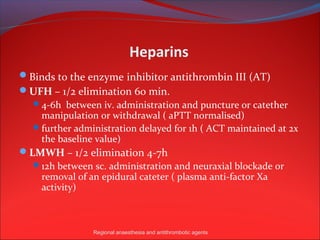
Heparins
Binds to the enzyme inhibitor antithrombin III (AT)
UFH – 1/2 elimination 60 min.
   4-6h between iv. administration and puncture or catether
    manipulation or withdrawal ( aPTT normalised)
   further administration delayed for 1h ( ACT maintained at 2x
    the baseline value)
LMWH – 1/2 elimination 4-7h
   12h between sc. administration and neuraxial blockade or
    removal of an epidural cateter ( plasma anti-factor Xa
    activity)


                 Regional anaesthesia and antithrombotic agents
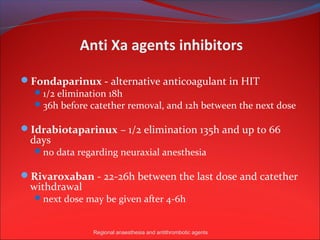
Anti Xa agents inhibitors

Fondaparinux - alternative anticoagulant in HIT
   1/2 elimination 18h
   36h before catether removal, and 12h between the next dose

Idrabiotaparinux – 1/2 elimination 135h and up to 66
  days
    no data regarding neuraxial anesthesia

Rivaroxaban - 22-26h between the last dose and catether
  withdrawal
    next dose may be given after 4-6h


                Regional anaesthesia and antithrombotic agents
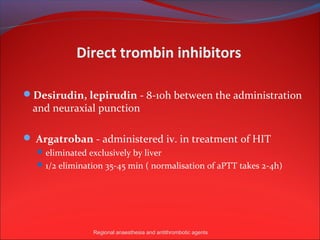
Direct trombin inhibitors

Desirudin, lepirudin - 8-10h between the administration
 and neuraxial punction

 Argatroban - administered iv. in treatment of HIT
   eliminated exclusively by liver
   1/2 elimination 35-45 min ( normalisation of aPTT takes 2-4h)


                Regional anaesthesia and antithrombotic agents
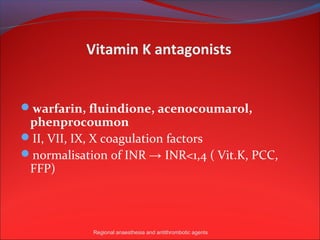
Vitamin K antagonists


warfarin, fluindione, acenocoumarol,
 phenprocoumon
II, VII, IX, X coagulation factors
normalisation of INR → INR<1,4 ( Vit.K, PCC,
 FFP)


            Regional anaesthesia and antithrombotic agents
Platelet aggregation inhibitors
Acetylsalicylic acid
    irreversible inhibition of cyclo-oxygenase
    when given in isolation do not increase the risk of spinal epidural
     haemathoma and are not a contraindication to neuraxial block

Thienopyridines - irreversible antagonosing ADP at the
  platelets purine receptors

Ticlopidine - neuraxial regional anesthesia should not be
  performed until 10 days elapsed between last ingestion and the
  procedure

Clopidrogel - 7 days after the last intake


                   Regional anaesthesia and antithrombotic agents
Glycoprotein IIa/IIIb inhibitors - abciximab, tirofibam,
 eptifibatide
   the most potent form of platelet inhibition
   reduces thrombin generation
   are used only in ACS ( in combination with anticoagulants and
    aspirin )
   cardiac surgery procedures are emergencies with continuing
    antigoagulation → neuraxial blockade is contrainicated!


                 Regional anaesthesia and antithrombotic agents
Platelet aggregation inhibitors

If a catheter has to be removed after administration of
  glycoprotein inhibitors, most guidelines recomend waiting
  at least 48h after abciximab, and 8-10 h after tirofiban or
  eptifibatide ( platelet count should be obtained to exclude
  thrombocytopenia )


                Regional anaesthesia and antithrombotic agents
HVALA!


Regional anaesthesia and antithrombotic agents

ESA- antitrombotic therapy

  • 1.
    Recommendations of theEuropean Society of Anesthesiology Gogarten, Wiebke; Vandermeulen, Erik; Van Aken, Hugo; Kozek, Sibylle; Llau, Juan V; Samama, Charles M European Journal of Anaesthesiology. 27(12):999-1015, December 2010. Miljenko Mratinović Tomislav Čutura
  • 2.
    Spinal epidural haematomain patients on antithrombotic drugs First national recommendations on neuraxial anaesthesia and antithrombotic drugs 1997. German Society for Anaesthesiology and Intensive Care 1998. ASRA 2000. Belgian anaesthesiologists Regional anaesthesia and antithrombotic agents
  • 3.
    Recommendations are basedon case report and expert opinion ( mainly on knowledge of the pharmacokinetics of individual agent) Mostly the time interval between cessation of medication and neuraxial blocade at 2x the elimination half-life of the drug. Regional anaesthesia and antithrombotic agents
  • 4.
    The risk ofhaemorrhage ↓ spinal anaesthesia ↑epidural catether anaesthesia ½ of all cases of bleeding occur during the removal of an epidural catether Regional anaesthesia and antithrombotic agents
  • 5.
    Tromboprophylaxis preoperatively vs. postoperatively (exeption neurosurgery) A meta-analysis of preoperative vs. postoperative studies shows that LMWH given 12 h preoperatively does not reduce the risk of VTE compared to postoperative regime German guidelines on thromboprophylaxis refer to preoperative administration only as an option, not as a requirement. Regional anaesthesia and antithrombotic agents
  • 6.
    Tromboprophylaxis preoperatively vs. postoperatively (exeption neurosurgery) Because preoperative vs. postoperative thromboprophylaxis is not proven to be beneficial, in the presence of acetylsalicylic acid, VTE prophylaxis should be started postoperatively. AHA recommends acetylsalicylic acid administration on a life-long basis and perioperative interruptions should be avoided in patients with DES/BMS. Regional anaesthesia and antithrombotic agents
  • 7.
    Antithrombotic drugs Heparins -UFH, LMWH Anti-Xa agents - fondaparinux, idrabiotaparinux, rivaroxaban, apixaban, danaparoid  Direct trombin inhibitors - desirudin, lepirudin, hirudin, argatroban Vitamin K antagonists - warfarin, fluindione, acenocoumarol, phenprocoumon Regional anaesthesia and antithrombotic agents
  • 8.
    Antithrombotic drugs Platelet aggregationinhibitors - acetylsalicylic acid, thienopyridines, clopidogrel, selective serotonin reuptake inhibitors, glycoprotein IIb/IIIa inhibitors (abciximab, tirofibam, eptifibatide Regional anaesthesia and antithrombotic agents
  • 9.
    Heparins Binds to theenzyme inhibitor antithrombin III (AT) UFH – 1/2 elimination 60 min.  4-6h between iv. administration and puncture or catether manipulation or withdrawal ( aPTT normalised)  further administration delayed for 1h ( ACT maintained at 2x the baseline value) LMWH – 1/2 elimination 4-7h  12h between sc. administration and neuraxial blockade or removal of an epidural cateter ( plasma anti-factor Xa activity) Regional anaesthesia and antithrombotic agents
  • 10.
    Anti Xa agentsinhibitors Fondaparinux - alternative anticoagulant in HIT  1/2 elimination 18h  36h before catether removal, and 12h between the next dose Idrabiotaparinux – 1/2 elimination 135h and up to 66 days  no data regarding neuraxial anesthesia Rivaroxaban - 22-26h between the last dose and catether withdrawal  next dose may be given after 4-6h Regional anaesthesia and antithrombotic agents
  • 11.
    Direct trombin inhibitors Desirudin,lepirudin - 8-10h between the administration and neuraxial punction  Argatroban - administered iv. in treatment of HIT  eliminated exclusively by liver  1/2 elimination 35-45 min ( normalisation of aPTT takes 2-4h) Regional anaesthesia and antithrombotic agents
  • 12.
    Vitamin K antagonists warfarin,fluindione, acenocoumarol, phenprocoumon II, VII, IX, X coagulation factors normalisation of INR → INR<1,4 ( Vit.K, PCC, FFP) Regional anaesthesia and antithrombotic agents
  • 13.
    Platelet aggregation inhibitors Acetylsalicylicacid  irreversible inhibition of cyclo-oxygenase  when given in isolation do not increase the risk of spinal epidural haemathoma and are not a contraindication to neuraxial block Thienopyridines - irreversible antagonosing ADP at the platelets purine receptors Ticlopidine - neuraxial regional anesthesia should not be performed until 10 days elapsed between last ingestion and the procedure Clopidrogel - 7 days after the last intake Regional anaesthesia and antithrombotic agents
  • 14.
    Glycoprotein IIa/IIIb inhibitors- abciximab, tirofibam, eptifibatide  the most potent form of platelet inhibition  reduces thrombin generation  are used only in ACS ( in combination with anticoagulants and aspirin )  cardiac surgery procedures are emergencies with continuing antigoagulation → neuraxial blockade is contrainicated! Regional anaesthesia and antithrombotic agents
  • 15.
    Platelet aggregation inhibitors Ifa catheter has to be removed after administration of glycoprotein inhibitors, most guidelines recomend waiting at least 48h after abciximab, and 8-10 h after tirofiban or eptifibatide ( platelet count should be obtained to exclude thrombocytopenia ) Regional anaesthesia and antithrombotic agents
  • 16.
    HVALA! Regional anaesthesia andantithrombotic agents