Introduction to POSIX Threads Asynchronous Programming in a Unix/Linux Environment Doug Abbott Silver City, NM 575-388-4879 email:  [email_address] web:  www. Intellimetrix.us Class #308
Topics Asynchronous  programming What is it and why do you care Threads Objects and their APIs Threads Mutexes and Condition variables Thread cancellation Threads implementations User Space Kernel Space
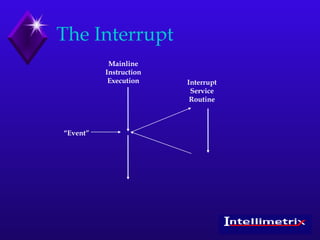
The Interrupt Mainline Instruction Execution “ Event” Interrupt Service Routine
Interrupts Cause Problems Thread 1 Thread 2 Data Structure while (1) { wait for (event1); write (data_structure); } while (1) { wait for (event2); read (data_structure); } Priority 1 Priority 2
The Real-time Programming Problem Thread 2 while (1) { Reading data structure;   INTERRUPT (event 1)! Still reading data structure; (but data has changed!) } Thread 1 executes!
Multitasking is... A paradigm for handling asynchronous events reliably A way to break a large problem into smaller independent parts Multiple program parts running in “parallel”
“ Processes” vs “Threads” DATA CODE DATA CODE DATA CODE UNIX Process Model DATA THREAD 1 THREAD 2 THREAD 3 Multi-threaded Process
Creating a Linux Process--the  fork()  function Creates a complete  copy  of the process Code, Data, File descriptors, etc Uses  copy-on-write  so only page tables and task structure copied initially Both processes continue from the return from  fork() Returns 0 to  child  process Returns PID of child to  parent  process
Thread API int pthread_create (pthread_t *thread, pthread_attr_t *attr, void *(* start_ routine) (void *), void *arg); void pthread_exit (void *retval); int pthread_join (pthread_t thread, void **thread_return); pthread_t pthread_self (void); int sched_yield (void);
/*  Thread Example  */ #include <pthread.h> #include &quot;errors.h&quot; /* * Thread start routine. */ void *thread_routine (void *arg) { printf (&quot;%s\n&quot;), arg); return arg; } main (int argc, char *argv[]) { pthread_t thread_id; void *thread_result; int status; status = pthread_create (&thread_id, NULL, thread_routine, (void *)argv[0]); printf (&quot;New thread created\n&quot;); status = pthread_join (thread_id, thread_result); printf (&quot;Thread returned %p\n&quot;, thread_result); return 0; }
Thread State Diagram Ready Blocked Running Terminated created scheduled preempted wait for resource wait satisfied done or cancelled
Thread Termination Thread function just returns Thread function calls  pthread_exit Thread is  cancelled  by another thread detachstate PTHREAD_CREATE_JOINABLE  -  Can be “joined” by another thread when it terminates PTHREAD_CREATE_DETACHED  -  Can’t be joined.  Resources reclaimed immediately.
Attribute Objects All pthread objects can have additional, separate attribute objects Extended argument list for object creation Attribute is second argument to create call if NULL, use defaults Objects are “opaque” access with specific attribute functions
Thread Attributes int pthread_attr_init (pthread_attr_t *attr); int pthread_attr_destroy (pthread_attr_t *attr); int pthread_attr_getdetachstate (pthread_attr_t *attr, int *detachstate); int pthread_attr_setdetachstate  (pthread_attr_t *attr, int detachstate); #ifdef _POSIX_THREAD_ATTR_STACKSIZE int pthread_attr_getstacksize (pthread_attr_t *attr, size_t *stacksize); int pthread_attr_setstacksize (pthread_attr_t *attr, size_t stacksize); #endif #ifdef _POSIX_THREAD_ATTR_STACKADDR int pthread_attr_getstackaddr (pthread_attr_t *attr, void **stackaddr); int pthread_attr_setstackaddr (pthread_attr_t *attr, void *stackaddr); #endif
/*  Thread Attributes  */ #include <limits.h> #include <pthread.h> void *thread_routine (void *arg) {/ * Thread start routine. Reports it ran, and then exits. */ printf (&quot;The thread is here\n&quot;); return NULL; } int main (int argc, char *argv[]) { pthread_t thread_id; pthread_attr_t thread_attr; size_t stack_size; int status; status = pthread_attr_init (&thread_attr); status = pthread_attr_setdetachstate (&thread_attr, PTHREAD_CREATE_DETACHED); #ifdef _POSIX_THREAD_ATTR_STACKSIZE / *  Set stack size to twice the minimum  */ status = pthread_attr_getstacksize (&thread_attr, &stack_size); printf (&quot;Default stack size is %u; minimum is %u\n&quot;, stack_size, PTHREAD_STACK_MIN); status = pthread_attr_setstacksize (&thread_attr, PTHREAD_STACK_MIN*2); #endif status = pthread_create (&thread_id, &thread_attr, thread_routine, NULL); printf (&quot;Main exiting\n&quot;); return 0; }
Thread Scheduling int pthread_attr_setschedparam (pthread_attr_t *attr, const struct sched_param *param); int pthread_attr_getschedparam (const pthread_attr_t *attr, struct sched_param *param); int pthread_attr_setschedpolicy (pthread_attr_t *attr, int policy); int pthread_attr_getschedpolicy (const pthread_attr_t *attr, int *policy); int pthread_attr_setinheritsched (pthread_attr_t *attr, int inherit); int pthread_attr_getinheritsched (const pthread_attr_t *attr, int *inherit); int pthread_setschedparam (pthread_t pthread, int *policy,    const struct sched_param *param); int pthread_getschedparam (pthread_t pthread, int *policy,  struct sched_param *param); int sched_get_priority_max (int policy); int sched_get_priority_min (int policy); Optional Thread Attributes
Scheduling Policies SCHED_FIFO Preemptive scheduler SCHED_RR Preemptive scheduler with time slicing SCHED_OTHER Default policy Tries to be “fair”
Scheduling: Non-Preemptive vs Preemptive ISR Task Hi Task Lo Blocks Interrupt Ready ISR Task Hi Task Lo NON-PREEMPTIVE PREEMPTIVE Ready
Reentrancy & “Thread-safe” Functions A function that may be called by more than one thread must be either  reentrant   or  thread-safe Library functions must be reentrant or thread-safe A function is reentrant if it does not access any  statically allocated  resources
return addr Reentrancy--What is it void fun1 (int a, int b) { int i, j; i = a; j = b; . . } b a i j stack pointer Stack “frame” for fun1 Stack
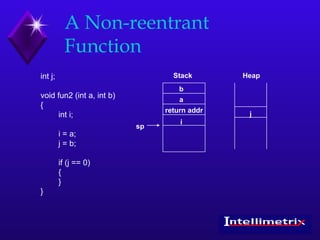
return addr A Non-reentrant Function int j; void fun2 (int a, int b) { int i; i = a; j = b; if (j == 0) { } } b a i Stack sp j Heap
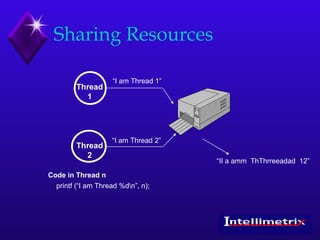
Sharing Resources Thread 1 Thread 2 “ I am Thread 1” “ I am Thread 2” “ II a amm  ThThrreeadad  12” Code in Thread n printf (“I am Thread %d\n”, n);
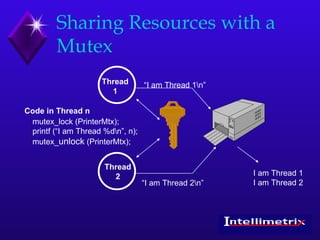
Sharing Resources with a Mutex Thread 1 Thread 2 “ I am Thread 1\n” “ I am Thread 2\n” Code in Thread n mutex_lock (PrinterMtx); printf (“I am Thread %d\n”, n); mutex_ unlock  (PrinterMtx); I am Thread 1 I am Thread 2
Mutex API pthread_mutex_t mutex = PTHREAD_MUTEX_INITIALIZER; int pthread_mutex_init (pthread_mutex_t *mutex, const pthread_mutexattr_t  *mutex_attr); int pthread_mutex_destroy (pthread_mutex_t *mutex); int pthread_mutex_lock (pthread_mutex_t *mutex); int pthread_mutex_unlock (pthread_mutex_t *mutex); int pthread_mutex_trylock (pthread_mutex_t *mutex);
Mutex Attributes int pthread_mutexattr_init (pthread_mutexattr_t *attr); int pthread_mutexattr_destroy (pthread_mutexattr_t *attr); #ifdef _POSIX_THREAD_PROCESS_SHARED int pthread_mutexattr_getpshared (pthread_mutexattr_t *attr, int *pshared); int pthread_mutexattr_setpshared (pthread_mutexattr_t *attr, int pshared); #endif int pthread_mutexattr_getkind_np (pthread_mutexattr_t *attr, int *kind); int pthread_mutexattr_setkind_np (pthread_mutexattr_t *attr, int kind);
Mutex “Kind” Non-portable Linux extension Three “kinds” PTHREAD_MUTEX_FAST_NP PTHREAD_MUTEX_RECURSIVE_NP PTHREAD_MUTEX_ERRORCHECK_NP
Priority Inversion Thread 1 Thread 2 Thread 3 Priority 1 3 2 Lock Lock Resource
Priority Inversion 2 Resource Thread 1 (priority 1) Thread 2 (priority 3) Thread 3 (priority 2) Thread 2 Lock Int Lock Int Block Unlock Thread 1
Priority Inversion Solutions Priority Inheritance Temporarily raise priority of Thread 2 = Thread 1 when Thread 1 tries to lock the mutex Priority Ceiling Raise priority of Thread 2 = priority of highest priority thread that will lock the mutex Raise it when Thread 2 locks the mutex Set the mutex’s  protocol
Priority Inversion Solutions II #if defined (_POSIX_THREAD_PRIO_PROTECT) || defined (_POSIX_THREAD_PRIO_INHERIT) int pthread_mutexattr_getprotocol (const pthread_mutexattr_t *attr, int *protocol); int pthread_mutexattr_setprotocol (pthread_mutexattr_t *attr, int protocol); #endif #ifdef _POSIX_THREAD_PRIO_PROTECT int pthread_mutexattr_getprioceiling (const pthread_mutexattr_t *attr, int *ceiling); int pthread_mutexattr_setprioceiling (pthread_mutexattr_t *attr, int ceiling); int pthread_mutex_getprioceiling (const pthread_mutex_t *mutex, int *ceiling); int pthread_mutex_setprioceiling (pthread_mutex_t * mutex, int ceiling); #endif
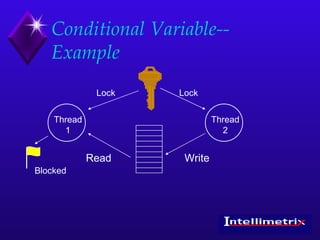
Conditional Variable “ Signals” an event associated with shared data protected by a mutex Threads wait for an event to occur (with mutex locked!) Another thread signals that the event has occurred
Conditional Variable--Example Thread 1 Thread 2 Read Write Lock Lock Blocked
Conditional Variable API pthread_cond_t cond = PTHREAD_COND_INITIALIZER; int pthread_cond_init (pthread_cond_t *cond, const pthread_condattr_t  *cond_attr); int pthread_cond_destroy (pthread_cond_t *cond); int pthread_cond_wait (pthread_cond_t *cond, pthread_mutex_t *mutex); int pthread_cond_timedwait (pthread_cond_t *cond, pthread_mutex_t *mutex,  const struct timespec *abstime); int pthread_cond_signal (pthread_cond_t *cond); int pthread_cond_broadcast (pthread_cond_t *cond);
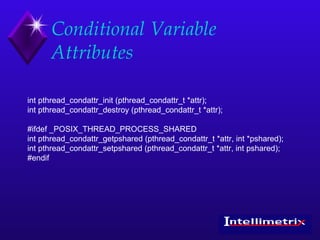
Conditional Variable Attributes int pthread_condattr_init (pthread_condattr_t *attr); int pthread_condattr_destroy (pthread_condattr_t *attr); #ifdef _POSIX_THREAD_PROCESS_SHARED int pthread_condattr_getpshared (pthread_condattr_t *attr, int *pshared); int pthread_condattr_setpshared (pthread_condattr_t *attr, int pshared); #endif
// Declare a queue structure type queue_t void *write_queue_thread (void *arg) { queue_t *q = (queue_t *) arg; int status; while (1) { wait_for_data(); status = pthread_mutex_lock (&q->mutex); write_to_queue (q); status = pthread_cond_signal (&q->cond); status = pthread_mutex_unlock (&q->mutex); } } Continued on next slide
Continued from previous slide void *read_queue_thread (void *arg) { queue_t *q = (queue_t *) arg; int status; while (1) { status = pthread_mutex_lock (&q->mutex); if (queue_is_empty (q))   status = pthread_cond_wait (&q->cond); read_from_queue (q); status = pthread_mutex_unlock (&q->mutex); } }
Contention Scope PTHREAD_SCOPE_PROCESS Thread competes only with other threads in process for resources “ cheap” PTHREAD_SCOPE_SYSTEM Thread competes with all other threads in the system for resources predictable int pthread_attr_getscope (const pthread_attr_t *attr, int *contentionscope); int pthread_attr_setscope (const pthread_attr_t *attr, int contentionscope);
Threads in User Space Thr 1 Thr n Thread scheduler Process 1 Thr 1 Thr n Thread scheduler Process n Linux Kernel Read Blocks  all  threads in Process n Posix doesn’t allow this
“Many-to-one” Thread Mapping Pthread 1 Pthread 2 Pthread 3 Pthread 4 Kernel entity 1 Processor 1 Processor 2
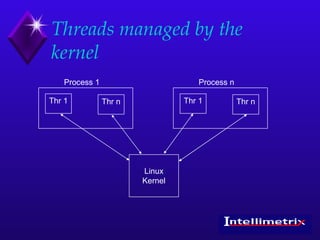
Threads managed by the kernel Thr 1 Thr n Process 1 Thr 1 Thr n Process n Linux Kernel
“One-to-one” Thread Mapping Pthread 1 Pthread 2 Pthread 3 Pthread 4 Kernel entity 1 Processor 1 Processor 2 Kernel entity 2 Kernel entity 3 Kernel entity 4
Thread Cancellation int pthread_cancel (pthread_t thread); int pthread_setcancelstate (int state, int *oldstate); int pthread_setcanceltype (int type, int *oldtype); void pthread_testcancel (void); void pthread_cleanup_push (void (*routine)(void *), void *arg); void pthread_cleanup_pop (int execute);
Cancellation Type PTHREAD_CANCEL_DEFERRED Only happens at a “cancellation point” Most library functions that block have cancellation points pthread_testcancel()  is a cancellation point PTHREAD_CANCEL_ASYNCHRONOUS Be very careful! Can’t allocate any resources Cancellation is  asynchronous
include <pthread.h> include <stdio.h> int counter; void *thread_function (void *arg); { printf (“thread_function starting\n”); for (counter = 0; ; counter++) if ((counter % 1000) == 0) {   printf (“Calling testcancel\n”);   pthread_testcancel(); } } Int main (int argc, char *argv) { pthread_t thread_id; void *result; int status; status = pthread_create (&thread_id, NULL, thread_function, NULL); sleep (2); Continued on next slide
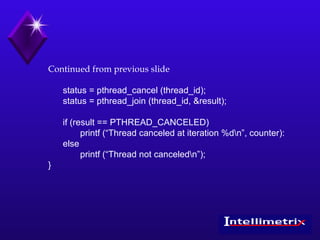
Continued from previous slide status = pthread_cancel (thread_id); status = pthread_join (thread_id, &result); if (result == PTHREAD_CANCELED) printf (“Thread canceled at iteration %d\n”, counter): else printf (“Thread not canceled\n”); }
“Cleanup Handlers” What if … Thread has memory allocated Mutex is locked Disable cancellation Cleanup handlers “ Pushed” on a conceptual stack Executed in reverse order when thread is canceled Can be “popped” when no longer needed
typedef struct { . . pthread_mutext_t mutex; } control_t; void cleanup (void *arg) { control_ *st = (control_t *) arg; int status; pthread_mutex_unlock (&st->mutex) } Continued on next slide
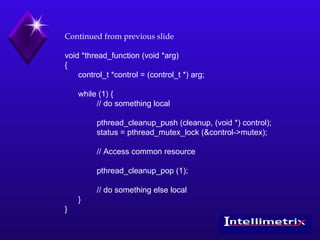
Continued from previous slide void *thread_function (void *arg) { control_t *control = (control_t *) arg; while (1) { // do something local pthread_cleanup_push (cleanup, (void *) control); status = pthread_mutex_lock (&control->mutex); // Access common resource pthread_cleanup_pop (1); // do something else local } }
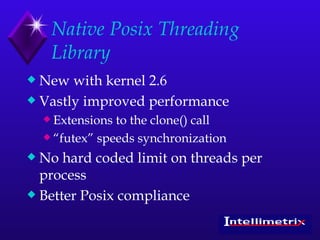
Native Posix Threading Library New with kernel 2.6 Vastly improved performance Extensions to the clone() call “ futex” speeds synchronization No hard coded limit on threads per process Better Posix compliance
Cancellation Mode

Posix Threads

  • 1.
    Introduction to POSIXThreads Asynchronous Programming in a Unix/Linux Environment Doug Abbott Silver City, NM 575-388-4879 email: [email_address] web: www. Intellimetrix.us Class #308
  • 2.
    Topics Asynchronous programming What is it and why do you care Threads Objects and their APIs Threads Mutexes and Condition variables Thread cancellation Threads implementations User Space Kernel Space
  • 3.
    The Interrupt MainlineInstruction Execution “ Event” Interrupt Service Routine
  • 4.
    Interrupts Cause ProblemsThread 1 Thread 2 Data Structure while (1) { wait for (event1); write (data_structure); } while (1) { wait for (event2); read (data_structure); } Priority 1 Priority 2
  • 5.
    The Real-time ProgrammingProblem Thread 2 while (1) { Reading data structure; INTERRUPT (event 1)! Still reading data structure; (but data has changed!) } Thread 1 executes!
  • 6.
    Multitasking is... Aparadigm for handling asynchronous events reliably A way to break a large problem into smaller independent parts Multiple program parts running in “parallel”
  • 7.
    “ Processes” vs“Threads” DATA CODE DATA CODE DATA CODE UNIX Process Model DATA THREAD 1 THREAD 2 THREAD 3 Multi-threaded Process
  • 8.
    Creating a LinuxProcess--the fork() function Creates a complete copy of the process Code, Data, File descriptors, etc Uses copy-on-write so only page tables and task structure copied initially Both processes continue from the return from fork() Returns 0 to child process Returns PID of child to parent process
  • 9.
    Thread API intpthread_create (pthread_t *thread, pthread_attr_t *attr, void *(* start_ routine) (void *), void *arg); void pthread_exit (void *retval); int pthread_join (pthread_t thread, void **thread_return); pthread_t pthread_self (void); int sched_yield (void);
  • 10.
    /* ThreadExample */ #include <pthread.h> #include &quot;errors.h&quot; /* * Thread start routine. */ void *thread_routine (void *arg) { printf (&quot;%s\n&quot;), arg); return arg; } main (int argc, char *argv[]) { pthread_t thread_id; void *thread_result; int status; status = pthread_create (&thread_id, NULL, thread_routine, (void *)argv[0]); printf (&quot;New thread created\n&quot;); status = pthread_join (thread_id, thread_result); printf (&quot;Thread returned %p\n&quot;, thread_result); return 0; }
  • 11.
    Thread State DiagramReady Blocked Running Terminated created scheduled preempted wait for resource wait satisfied done or cancelled
  • 12.
    Thread Termination Threadfunction just returns Thread function calls pthread_exit Thread is cancelled by another thread detachstate PTHREAD_CREATE_JOINABLE - Can be “joined” by another thread when it terminates PTHREAD_CREATE_DETACHED - Can’t be joined. Resources reclaimed immediately.
  • 13.
    Attribute Objects Allpthread objects can have additional, separate attribute objects Extended argument list for object creation Attribute is second argument to create call if NULL, use defaults Objects are “opaque” access with specific attribute functions
  • 14.
    Thread Attributes intpthread_attr_init (pthread_attr_t *attr); int pthread_attr_destroy (pthread_attr_t *attr); int pthread_attr_getdetachstate (pthread_attr_t *attr, int *detachstate); int pthread_attr_setdetachstate (pthread_attr_t *attr, int detachstate); #ifdef _POSIX_THREAD_ATTR_STACKSIZE int pthread_attr_getstacksize (pthread_attr_t *attr, size_t *stacksize); int pthread_attr_setstacksize (pthread_attr_t *attr, size_t stacksize); #endif #ifdef _POSIX_THREAD_ATTR_STACKADDR int pthread_attr_getstackaddr (pthread_attr_t *attr, void **stackaddr); int pthread_attr_setstackaddr (pthread_attr_t *attr, void *stackaddr); #endif
  • 15.
    /* ThreadAttributes */ #include <limits.h> #include <pthread.h> void *thread_routine (void *arg) {/ * Thread start routine. Reports it ran, and then exits. */ printf (&quot;The thread is here\n&quot;); return NULL; } int main (int argc, char *argv[]) { pthread_t thread_id; pthread_attr_t thread_attr; size_t stack_size; int status; status = pthread_attr_init (&thread_attr); status = pthread_attr_setdetachstate (&thread_attr, PTHREAD_CREATE_DETACHED); #ifdef _POSIX_THREAD_ATTR_STACKSIZE / * Set stack size to twice the minimum */ status = pthread_attr_getstacksize (&thread_attr, &stack_size); printf (&quot;Default stack size is %u; minimum is %u\n&quot;, stack_size, PTHREAD_STACK_MIN); status = pthread_attr_setstacksize (&thread_attr, PTHREAD_STACK_MIN*2); #endif status = pthread_create (&thread_id, &thread_attr, thread_routine, NULL); printf (&quot;Main exiting\n&quot;); return 0; }
  • 16.
    Thread Scheduling intpthread_attr_setschedparam (pthread_attr_t *attr, const struct sched_param *param); int pthread_attr_getschedparam (const pthread_attr_t *attr, struct sched_param *param); int pthread_attr_setschedpolicy (pthread_attr_t *attr, int policy); int pthread_attr_getschedpolicy (const pthread_attr_t *attr, int *policy); int pthread_attr_setinheritsched (pthread_attr_t *attr, int inherit); int pthread_attr_getinheritsched (const pthread_attr_t *attr, int *inherit); int pthread_setschedparam (pthread_t pthread, int *policy, const struct sched_param *param); int pthread_getschedparam (pthread_t pthread, int *policy, struct sched_param *param); int sched_get_priority_max (int policy); int sched_get_priority_min (int policy); Optional Thread Attributes
  • 17.
    Scheduling Policies SCHED_FIFOPreemptive scheduler SCHED_RR Preemptive scheduler with time slicing SCHED_OTHER Default policy Tries to be “fair”
  • 18.
    Scheduling: Non-Preemptive vsPreemptive ISR Task Hi Task Lo Blocks Interrupt Ready ISR Task Hi Task Lo NON-PREEMPTIVE PREEMPTIVE Ready
  • 19.
    Reentrancy & “Thread-safe”Functions A function that may be called by more than one thread must be either reentrant or thread-safe Library functions must be reentrant or thread-safe A function is reentrant if it does not access any statically allocated resources
  • 20.
    return addr Reentrancy--Whatis it void fun1 (int a, int b) { int i, j; i = a; j = b; . . } b a i j stack pointer Stack “frame” for fun1 Stack
  • 21.
    return addr ANon-reentrant Function int j; void fun2 (int a, int b) { int i; i = a; j = b; if (j == 0) { } } b a i Stack sp j Heap
  • 22.
    Sharing Resources Thread1 Thread 2 “ I am Thread 1” “ I am Thread 2” “ II a amm ThThrreeadad 12” Code in Thread n printf (“I am Thread %d\n”, n);
  • 23.
    Sharing Resources witha Mutex Thread 1 Thread 2 “ I am Thread 1\n” “ I am Thread 2\n” Code in Thread n mutex_lock (PrinterMtx); printf (“I am Thread %d\n”, n); mutex_ unlock (PrinterMtx); I am Thread 1 I am Thread 2
  • 24.
    Mutex API pthread_mutex_tmutex = PTHREAD_MUTEX_INITIALIZER; int pthread_mutex_init (pthread_mutex_t *mutex, const pthread_mutexattr_t *mutex_attr); int pthread_mutex_destroy (pthread_mutex_t *mutex); int pthread_mutex_lock (pthread_mutex_t *mutex); int pthread_mutex_unlock (pthread_mutex_t *mutex); int pthread_mutex_trylock (pthread_mutex_t *mutex);
  • 25.
    Mutex Attributes intpthread_mutexattr_init (pthread_mutexattr_t *attr); int pthread_mutexattr_destroy (pthread_mutexattr_t *attr); #ifdef _POSIX_THREAD_PROCESS_SHARED int pthread_mutexattr_getpshared (pthread_mutexattr_t *attr, int *pshared); int pthread_mutexattr_setpshared (pthread_mutexattr_t *attr, int pshared); #endif int pthread_mutexattr_getkind_np (pthread_mutexattr_t *attr, int *kind); int pthread_mutexattr_setkind_np (pthread_mutexattr_t *attr, int kind);
  • 26.
    Mutex “Kind” Non-portableLinux extension Three “kinds” PTHREAD_MUTEX_FAST_NP PTHREAD_MUTEX_RECURSIVE_NP PTHREAD_MUTEX_ERRORCHECK_NP
  • 27.
    Priority Inversion Thread1 Thread 2 Thread 3 Priority 1 3 2 Lock Lock Resource
  • 28.
    Priority Inversion 2Resource Thread 1 (priority 1) Thread 2 (priority 3) Thread 3 (priority 2) Thread 2 Lock Int Lock Int Block Unlock Thread 1
  • 29.
    Priority Inversion SolutionsPriority Inheritance Temporarily raise priority of Thread 2 = Thread 1 when Thread 1 tries to lock the mutex Priority Ceiling Raise priority of Thread 2 = priority of highest priority thread that will lock the mutex Raise it when Thread 2 locks the mutex Set the mutex’s protocol
  • 30.
    Priority Inversion SolutionsII #if defined (_POSIX_THREAD_PRIO_PROTECT) || defined (_POSIX_THREAD_PRIO_INHERIT) int pthread_mutexattr_getprotocol (const pthread_mutexattr_t *attr, int *protocol); int pthread_mutexattr_setprotocol (pthread_mutexattr_t *attr, int protocol); #endif #ifdef _POSIX_THREAD_PRIO_PROTECT int pthread_mutexattr_getprioceiling (const pthread_mutexattr_t *attr, int *ceiling); int pthread_mutexattr_setprioceiling (pthread_mutexattr_t *attr, int ceiling); int pthread_mutex_getprioceiling (const pthread_mutex_t *mutex, int *ceiling); int pthread_mutex_setprioceiling (pthread_mutex_t * mutex, int ceiling); #endif
  • 31.
    Conditional Variable “Signals” an event associated with shared data protected by a mutex Threads wait for an event to occur (with mutex locked!) Another thread signals that the event has occurred
  • 32.
    Conditional Variable--Example Thread1 Thread 2 Read Write Lock Lock Blocked
  • 33.
    Conditional Variable APIpthread_cond_t cond = PTHREAD_COND_INITIALIZER; int pthread_cond_init (pthread_cond_t *cond, const pthread_condattr_t *cond_attr); int pthread_cond_destroy (pthread_cond_t *cond); int pthread_cond_wait (pthread_cond_t *cond, pthread_mutex_t *mutex); int pthread_cond_timedwait (pthread_cond_t *cond, pthread_mutex_t *mutex, const struct timespec *abstime); int pthread_cond_signal (pthread_cond_t *cond); int pthread_cond_broadcast (pthread_cond_t *cond);
  • 34.
    Conditional Variable Attributesint pthread_condattr_init (pthread_condattr_t *attr); int pthread_condattr_destroy (pthread_condattr_t *attr); #ifdef _POSIX_THREAD_PROCESS_SHARED int pthread_condattr_getpshared (pthread_condattr_t *attr, int *pshared); int pthread_condattr_setpshared (pthread_condattr_t *attr, int pshared); #endif
  • 35.
    // Declare aqueue structure type queue_t void *write_queue_thread (void *arg) { queue_t *q = (queue_t *) arg; int status; while (1) { wait_for_data(); status = pthread_mutex_lock (&q->mutex); write_to_queue (q); status = pthread_cond_signal (&q->cond); status = pthread_mutex_unlock (&q->mutex); } } Continued on next slide
  • 36.
    Continued from previousslide void *read_queue_thread (void *arg) { queue_t *q = (queue_t *) arg; int status; while (1) { status = pthread_mutex_lock (&q->mutex); if (queue_is_empty (q)) status = pthread_cond_wait (&q->cond); read_from_queue (q); status = pthread_mutex_unlock (&q->mutex); } }
  • 37.
    Contention Scope PTHREAD_SCOPE_PROCESSThread competes only with other threads in process for resources “ cheap” PTHREAD_SCOPE_SYSTEM Thread competes with all other threads in the system for resources predictable int pthread_attr_getscope (const pthread_attr_t *attr, int *contentionscope); int pthread_attr_setscope (const pthread_attr_t *attr, int contentionscope);
  • 38.
    Threads in UserSpace Thr 1 Thr n Thread scheduler Process 1 Thr 1 Thr n Thread scheduler Process n Linux Kernel Read Blocks all threads in Process n Posix doesn’t allow this
  • 39.
    “Many-to-one” Thread MappingPthread 1 Pthread 2 Pthread 3 Pthread 4 Kernel entity 1 Processor 1 Processor 2
  • 40.
    Threads managed bythe kernel Thr 1 Thr n Process 1 Thr 1 Thr n Process n Linux Kernel
  • 41.
    “One-to-one” Thread MappingPthread 1 Pthread 2 Pthread 3 Pthread 4 Kernel entity 1 Processor 1 Processor 2 Kernel entity 2 Kernel entity 3 Kernel entity 4
  • 42.
    Thread Cancellation intpthread_cancel (pthread_t thread); int pthread_setcancelstate (int state, int *oldstate); int pthread_setcanceltype (int type, int *oldtype); void pthread_testcancel (void); void pthread_cleanup_push (void (*routine)(void *), void *arg); void pthread_cleanup_pop (int execute);
  • 43.
    Cancellation Type PTHREAD_CANCEL_DEFERREDOnly happens at a “cancellation point” Most library functions that block have cancellation points pthread_testcancel() is a cancellation point PTHREAD_CANCEL_ASYNCHRONOUS Be very careful! Can’t allocate any resources Cancellation is asynchronous
  • 44.
    include <pthread.h> include<stdio.h> int counter; void *thread_function (void *arg); { printf (“thread_function starting\n”); for (counter = 0; ; counter++) if ((counter % 1000) == 0) { printf (“Calling testcancel\n”); pthread_testcancel(); } } Int main (int argc, char *argv) { pthread_t thread_id; void *result; int status; status = pthread_create (&thread_id, NULL, thread_function, NULL); sleep (2); Continued on next slide
  • 45.
    Continued from previousslide status = pthread_cancel (thread_id); status = pthread_join (thread_id, &result); if (result == PTHREAD_CANCELED) printf (“Thread canceled at iteration %d\n”, counter): else printf (“Thread not canceled\n”); }
  • 46.
    “Cleanup Handlers” Whatif … Thread has memory allocated Mutex is locked Disable cancellation Cleanup handlers “ Pushed” on a conceptual stack Executed in reverse order when thread is canceled Can be “popped” when no longer needed
  • 47.
    typedef struct {. . pthread_mutext_t mutex; } control_t; void cleanup (void *arg) { control_ *st = (control_t *) arg; int status; pthread_mutex_unlock (&st->mutex) } Continued on next slide
  • 48.
    Continued from previousslide void *thread_function (void *arg) { control_t *control = (control_t *) arg; while (1) { // do something local pthread_cleanup_push (cleanup, (void *) control); status = pthread_mutex_lock (&control->mutex); // Access common resource pthread_cleanup_pop (1); // do something else local } }
  • 49.
    Native Posix ThreadingLibrary New with kernel 2.6 Vastly improved performance Extensions to the clone() call “ futex” speeds synchronization No hard coded limit on threads per process Better Posix compliance
  • 50.