Learning Java 3 –Threads, Synchronization Christopher Swenson Center for Information Security University of Tulsa 600 S. College Ave Tulsa, OK 74104
Overview Threads Synchronization of Threads
Threads Everything up to now has been single processing: only one thing was executing at once Threads allow multiple things to execute simultaneously Most of what you need is in the  Thread  class
How to Make a Thread You need to make a  public void run()  function Two options Class that implements  Runnable Class that extends  Thread Anonymous inner class t = new Thread( Runnable  r); t = new MyThread();
Starting/Stopping Say we have a Thread  t t.start()  – starts executing the Thread’s  run() t.interrupt()  – interrupts a Thread t.join()  – waits for Thread to die
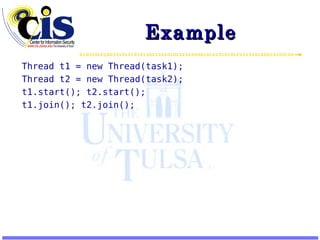
Example Thread t1 = new Thread(task1); Thread t2 = new Thread(task2); t1.start(); t2.start(); t1.join(); t2.join();
Useful Thread Methods Thead.sleep( long  millis[,  int  nanos]); Causes current executing Thread to sleep Thread.yield(); Causes current executing Thread to be put back on the ready list
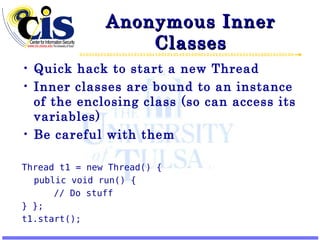
Anonymous Inner Classes Quick hack to start a new Thread Inner classes are bound to an instance of the enclosing class (so can access its variables) Be careful with them Thread t1 = new Thread() { public void run() { // Do stuff } }; t1.start();
Clobbering Time! So now we have multiple Threads going at once, but they can trample each other’s feet Writing to the same variable at the same time Reading and writing at the same time where order matters Some objects are inherently thread-safe (or “synchronized”) Vector, Hashtable, Collections.synchronizedList(List l) Synchronization is the key
Locks Locks are the primitive for doing synchronization in Java Every  Object  is a lock Two methods that have code that is synchronized on the same lock (object) cannot execute that code at the same time
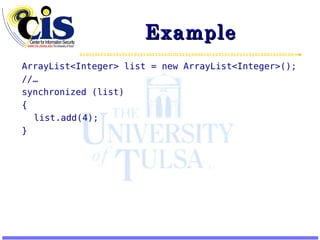
Example ArrayList<Integer> list = new ArrayList<Integer>(); //… synchronized (list) { list.add(4); }
Synchronized methods If an method is synchronized, then the entire code is wrapped in an implicit  synchronized (this) { … } They will all be synchronized to their instance Only one synchronized method of an instance of an object can be running at one time
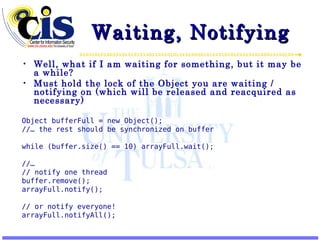
Waiting, Notifying Well, what if I am waiting for something, but it may be a while? Must hold the lock of the Object you are waiting / notifying on (which will be released and reacquired as necessary) Object bufferFull = new Object(); //… the rest should be synchronized on buffer while (buffer.size() == 10) arrayFull.wait(); //… // notify one thread buffer.remove(); arrayFull.notify(); // or notify everyone! arrayFull.notifyAll();
Advanced Synchronization Java 1.5 adds many shiny new synchronization mechanisms (java.util.concurrent.*) Lock provides non-blocking access to code ReentrantLock Condition provides an implementation of condition variables Associated with a  Lock Semaphore AtomicInteger , etc

Learning Java 3 – Threads and Synchronization

  • 1.
    Learning Java 3–Threads, Synchronization Christopher Swenson Center for Information Security University of Tulsa 600 S. College Ave Tulsa, OK 74104
  • 2.
  • 3.
    Threads Everything upto now has been single processing: only one thing was executing at once Threads allow multiple things to execute simultaneously Most of what you need is in the Thread class
  • 4.
    How to Makea Thread You need to make a public void run() function Two options Class that implements Runnable Class that extends Thread Anonymous inner class t = new Thread( Runnable r); t = new MyThread();
  • 5.
    Starting/Stopping Say wehave a Thread t t.start() – starts executing the Thread’s run() t.interrupt() – interrupts a Thread t.join() – waits for Thread to die
  • 6.
    Example Thread t1= new Thread(task1); Thread t2 = new Thread(task2); t1.start(); t2.start(); t1.join(); t2.join();
  • 7.
    Useful Thread MethodsThead.sleep( long millis[, int nanos]); Causes current executing Thread to sleep Thread.yield(); Causes current executing Thread to be put back on the ready list
  • 8.
    Anonymous Inner ClassesQuick hack to start a new Thread Inner classes are bound to an instance of the enclosing class (so can access its variables) Be careful with them Thread t1 = new Thread() { public void run() { // Do stuff } }; t1.start();
  • 9.
    Clobbering Time! Sonow we have multiple Threads going at once, but they can trample each other’s feet Writing to the same variable at the same time Reading and writing at the same time where order matters Some objects are inherently thread-safe (or “synchronized”) Vector, Hashtable, Collections.synchronizedList(List l) Synchronization is the key
  • 10.
    Locks Locks arethe primitive for doing synchronization in Java Every Object is a lock Two methods that have code that is synchronized on the same lock (object) cannot execute that code at the same time
  • 11.
    Example ArrayList<Integer> list= new ArrayList<Integer>(); //… synchronized (list) { list.add(4); }
  • 12.
    Synchronized methods Ifan method is synchronized, then the entire code is wrapped in an implicit synchronized (this) { … } They will all be synchronized to their instance Only one synchronized method of an instance of an object can be running at one time
  • 13.
    Waiting, Notifying Well,what if I am waiting for something, but it may be a while? Must hold the lock of the Object you are waiting / notifying on (which will be released and reacquired as necessary) Object bufferFull = new Object(); //… the rest should be synchronized on buffer while (buffer.size() == 10) arrayFull.wait(); //… // notify one thread buffer.remove(); arrayFull.notify(); // or notify everyone! arrayFull.notifyAll();
  • 14.
    Advanced Synchronization Java1.5 adds many shiny new synchronization mechanisms (java.util.concurrent.*) Lock provides non-blocking access to code ReentrantLock Condition provides an implementation of condition variables Associated with a Lock Semaphore AtomicInteger , etc